EP0023079A2 - Verfahren zur Herstellung einer fotoelektrischen Festkörper-Vorrichtung - Google Patents
Verfahren zur Herstellung einer fotoelektrischen Festkörper-Vorrichtung Download PDFInfo
- Publication number
- EP0023079A2 EP0023079A2 EP80301904A EP80301904A EP0023079A2 EP 0023079 A2 EP0023079 A2 EP 0023079A2 EP 80301904 A EP80301904 A EP 80301904A EP 80301904 A EP80301904 A EP 80301904A EP 0023079 A2 EP0023079 A2 EP 0023079A2
- Authority
- EP
- European Patent Office
- Prior art keywords
- layer
- photoconductive
- photoconductive layer
- photoelectric device
- atomic
- Prior art date
- Legal status (The legal status is an assumption and is not a legal conclusion. Google has not performed a legal analysis and makes no representation as to the accuracy of the status listed.)
- Granted
Links
Images



Classifications
-
- H—ELECTRICITY
- H10—SEMICONDUCTOR DEVICES; ELECTRIC SOLID-STATE DEVICES NOT OTHERWISE PROVIDED FOR
- H10F—INORGANIC SEMICONDUCTOR DEVICES SENSITIVE TO INFRARED RADIATION, LIGHT, ELECTROMAGNETIC RADIATION OF SHORTER WAVELENGTH OR CORPUSCULAR RADIATION
- H10F39/00—Integrated devices, or assemblies of multiple devices, comprising at least one element covered by group H10F30/00, e.g. radiation detectors comprising photodiode arrays
- H10F39/10—Integrated devices
- H10F39/12—Image sensors
- H10F39/191—Photoconductor image sensors
Definitions
- This invention relates to a photoelectric device employing a photoconductive layer, and also to a method of producing the same.
- a solid-state imaging device As a typical example of a photoelectric device employing a photoconductive layer, there is a solid-state imaging device.
- the solid-state imaging device is such that an image pickup screen is formed by arranging a plurality of solid-state elements having the function of photoelectric conversion and the function of signal storage, each of the solid-state elements corresponding to one picture element, and that the image pickup screen is sequentially scanned thereby to convert external image information into electric signals.
- the photoconductive layer which forms the image pickup screen is disposed in a manner to cover a semiconductor body in which switching elements, scanning-circuits etc. are formed. Examples of such solid-state imaging devices are known' from Japanese Published Unexamined Patent Application No. 51-10715 etc.
- the solid-state imaging device has the features of small size, light weight, no necessity for a high voltage, etc., but it has not attained practicable characteristics yet.
- One aspect of the present invention provides a photoelectric device having at least a first electrode which lies in contact with at least a part of an impurity layer formed in a semiconductor body, a photoconductive layer which is formed on the first electrode, and a second electrode which transmits light and which is formed on the photoconductive layer; characterised in that said photoconductive layer is made of an amorphous chalcogenide material whose principal constituent is Se.
- the amorphous chalcogenide material layer principally containing Se is partially doped with Te so as to enhance its sensitivity.
- a second aspect of the present invention is characterised in that, in forming a photoconductive material layer on a semiconductor body, in the course of or after the formation of at least one layer of a photoconductor to overlie the semiconductor body, a heat treatment is carried out at a temperature of or above the softening point of the photoconductor so as to flatten the photoconductor layer.
- This treatment may avoid any discontinuous part of the photoconductor layer attributed to an uneven surface of the semiconductor body. Accordingly, white flaws etc. may be prevented from occurring in a picture reproduced by the use of the photoelectric device.
- Figure 1 illustrates the principle of a solid-state imaging device.
- Picture elements 14 are arranged in the form of a matrix, and are read out one by one by means of an XY-address system.
- the respective picture elements are addressed by a horizontal scan signal generator 10 and a vertical scan signal generator 12.
- Numeral 13 designates a switching portion connected to the picture elements, and numeral 15 an output terminal.
- a scanning circuit and a switching circuit are integrated on a Si substrate 1, and a photoconductive thin film 8 fulfilling the function of photoelectric conversion is deposited on the IC substrate.
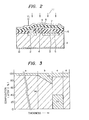
- the operating principle will be described in accordance with Figure 2.
- Incident light 11 arrives at the photoconductive film 8 through a transparent electrode 9.
- the light is absorbed to create electron-hole pairs, and these carriers are stored in an electrode 7 by a bias voltage V T*
- the stored carriers are switched by an insulated-gate field effect transistor (hereinbelow, shortly written "MOSFET”) which consists of a source 2, a drain 3 and a gate 4 formed on the semiconductor substrate 1, and they are taken out through a signal line 5.
- Numeral 6 indicates an insulating film.
- An electrode 12 on the rear surface of the semiconductor substrate 1 is usually grounded.
- amorphous chalcogenide material which principally contains Se is especially favorable as stated before.
- the amorphous chalcogenide material layer can provide a solid-state imaging device having especially favorable characteristics.
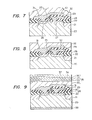
- Figure 3 is a composition distribution diagram showing the construction of this photoconductor layer.
- a part a in Figure 3 is a Se layer which contains at least one element selected from the group consisting of Te and elements adapted to form deep levels in Se, and in which the quantity of Te and that of the element adapted to form the deep level in Se are respectively at most 10 atomic-% on the average.
- the element or elements considered to form the deep level or levels in Se may well be at least one of the group-Vb elements such as As, Sb and Bi and group-IV elements such as Si and Ge or at least one compound containing at least one of these elements. These elements may coexist with Te, or only these elements may be included as well. With such elements adapted to form deep levels, even when the device is operated continuously for a long time, the variation of signal current is very small, and the lag is conspicuously reduced.
- the part a ordinarily has a thickness of 0.5 - 10 f m, and principally has the effects of causing holes generated in a part c to travel, diminishing the capacitance of the photoconductor and avoiding pinholes etc. More desirably, the thickness of the part a is 1 - 4 ⁇ m.
- a part b in the figure is a part in which the dopant to form a deep level (in this case, As) is introduced, and which serves to enhance the effect of intensifying the sensitivity to red as based on Te included in part c in the figure and also to suppress the signal current variation in the case of operating the device for long.
- the Se layer requires that the concentration of the dopant to form the deep level is at least 15 atomiq-% at the position of the peak of a continuous concentration distribution. In practical use, concentrations of or below 40 atomic-% are often employed.
- the shape of the concentration distribution of the dopant to form the deep level in the part b in the figure should desirably be such that the concentration is the highest at the interface contacting with the part c and smoothly lowers over 200 - 3,000 ⁇ as the position comes away from the interface.
- This layer usually has a thickness of 100 R - 5,000 ⁇ .
- the part c in Figure 3 needs to be a Se layer in which the peak concentration of the continuous distribution of Te concentrations is at least 15 atomic-%, particularly desirably within a range of 15 - 30 atomic-%, in order to attain a sufficient sensitivity to the visible light region. It is also desirable that the thickness of 0 this part is 200 - 5,000 A.
- the distribution of the Te concentrations of the part c in Figure 3 is uniform and has a rectangular shape, but the shape of the distribution is not restricted to the illustrated one.
- the Te concentrations may well be in a distribution having a triangular, trapezoidal, semicircular or more complicated shape.
- a part d in Figure 3 is necessary in order that this film may form a rectifying contact in touch with the n-type transparent conductive film to overlie the photoconductor layer.
- the Te concentration of this Se layer part does not exceed 15 atomic-% on the average.
- an element such as As and Ge which is added to increase the thermal stability does not exceed 15 atomic-% on the average.
- the thickness of this part needs to be at least 100 A. In case where the lifetime is not a considerable problem, a mere Se layer may be used as well.
- the concentration distributions of Te, As, Ge etc. may be grasped as continuous distributions considered macroscopically, and the concentrations may be controlled as such.
- the photoconductive film of this invention by employing Se and AS2Se3 or Te and Ge etc. as vaporization sources and using evaporation equipment of the rotary type, the vaporization products are stacked on a substrate for evaporation in the form of thousands of circulative layers each being a thin layer of several to several tens of angstroms, whereby the products are put into macroscopically continuous distributions, and a film exhibiting a desired composition ratio or composition distribution can be obtained.
- the composition ratio of the continuous distribution is defined as the continuous distribution of an average composition ratio within a multiple layer which is constructed of the sum of the individual layers of one or more sorts of vaporization products evaporated circulatively, that is, a multiple layer which is formed by one cycle of the rotary evaporation.
- the chalcogenide amorphous material which principally contains Se can be made into a flat photoconductor layer by performing a heat treatment to be described in detail below. Accordingly, a reproduced picture of good quality as stated before can be obtained.
- the scanning circuit and the switching circuit are first formed on the Si substrate 1, and the amorphous thin film is subsequently formed as the photoconductor layer by, for example, vacuum evaporation.
- the chalcogenide amorphous material whose principal constituent is.Se according to this invention is a material which can compensate for the disadvantage and provide a sufficiently good picture quality. More specifically, in the course of the deposition or after the deposition of the amorphous thin film on the Si substrate provided with the scanning circuit etc.', the heat treatment is carried out at a temperature of or above the softening point of the amorphous thin film, whereby the thin film is flattened to remove the discontinuous parts of the thin film and to avoid the white flaw defects otherwise appearing on a TV monitor. As the temperature of the heat treatment, at least 50 °C is desirable.
- the heat treatment is performed at a temperature which is at least 100 °C and at which the quality of the thin film material does not change.
- a temperature of at most 120°C is preferable in practice.
- An atmosphere during the heating may be nitrogen, a rare gas, air or the like.
- a preferable heating time is within about 15 minutes.
- the layer is flattened in a very short time at temperatures of and above the softening point of the amorphous material, and hence, the heating period of time is suitably about 5 minutes. Heating for a short time only is also important in order to prevent the diffusion of the dopant impurities.
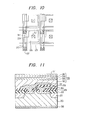
- Figures 4 to 9 are sectional views of a picture element portion showing a method of producing a solid-state imaging device.
- a switching circuit and a scanning circuit etc. to be formed on a semiconductor substrate are fabricated by the use of processes for conventional semiconductor devices.
- a thin Si0 2 film of approximately 800 ⁇ is formed on a p-type silicon substrate 20, and a Si 3 N 4 film of approximately 1,400 ⁇ is formed on a predetermined position of the Si0 2 film.
- the . Si0 2 film was formed by the conventional CVD process, and the Si 3 N 4 film by the CVD process in which Si 3 N 4 , NH 4 and N 2 were caused to flow.
- a p-type diffused region 21 is formed-by ion implantation from above the silicon substrate.
- LOC local oxidation of silicon for isolating elements
- the Si 3 N 4 film and the Si0 2 film-above stated are once removed, and a gate insulating film of a MOS transistor is formed of a SiO 2 film.
- a gate portion 25 made of polycrystalline silicon and diffused regions 26 and 27 are formed, whereupon they are overlaid with a SiO 2 film 28.
- Electrode lead-out windows for the source 26 and the drain 27 are provided in the film by etching ( Figure 5).
- a drain electrode 29 Al is evaporated to 0 8,000 A.
- a SiO 2 film 30 is formed to a thickness of 7,500 A, and Al is continuously evaporated to 1 ⁇ m thickness as a source electrode 31.
- Figure 6 is a sectional view showing this state.
- FIG. 10 shows a plan view of a Si body part.
- Numeral 37 designates a contact hole for an electrode. In the figure, the same numerals as in the foregoing sectional views indicate the same parts.
- a Se-As 'layer 32 which contains 5 atomic-% of arsenic is formed to a thickness of 3 ⁇ m. It is the part a in the composition distribution diagram of Figure 3.
- the front surface of the semiconductor body is uneven after the scanning circuit etc. have been formed on the semiconductor substrate 20.
- the front surface of the Se-As layer reflects the unevenness of the IC substrate and is not flat as illustrated in Figure 7.
- the body is subjected to a heat treatment at 110 °C for 5 minutes in an atmosphere of nitrogen gas.
- S ince the softening point of this Se-As is approximately 70 °C
- the layer is softened and flattened as shown in Figure 8 by the heat treatment.
- the temperature of the heat treatment should be at least 80°C and should be such that the quality of the thin film material does not change.
- a temperature of at most 120°C is preferable in practice.
- the atmosphere during the heating may be nitrogen, a rare gas, air or the like.
- the chalcogenide amorphous material whose principal constituent is Se does not undergo a change in its photoconductive characteristics even when subjected to the heat treatment.
- irradiation via a lamp is a favorable method.
- a second layer 33 made of Se and As is evaporated.
- Se and As 2 Se 3 are respectively put in separate evaporation boats and are simultaneously vaporized.
- current flowing through the evaporation boat for As 2 Se 3 is controlled, whereby the concentration of As is made 5 atomic-% at first, to increase smoothly as evaporation proceeds, and to become 15 atomic-% to 25 atomic-% at the end 0 of a third layer 34 having a thickness of 500 - 1,500 A.
- Se and Te are respectively and simultaneously evaporated from separate evaporation boats to form the third layer 34 (part c).
- the third layer 34 contains Te uniformly, and has its thickness made 500 - 2,000 ⁇ and its Te concentration made 15 atomic-% to 25 atomic-%.
- Se containing 10 atomic-% of As is evaporated on the third layer to a thickness of 100 ⁇ to 500 ⁇ .
- a blocking layer 36 such as CeO 2 film is inserted on the fourth layer 35.
- this layer is not always necessary, it produces the effect of hindering the flow of holes and can suppress the dark current.
- the material of this layer is a substance whose principal constituent is an oxide of at least one element selected from the group consisting of Ce, Zn, Cd,.B, Al, Sc, Y, Si, Ge, Ti, Zr, Hf, Th, La, Sb, Bi, V, Nb, Ta, Fe, U, W and Mo.
- the oxide there are Ce0 2 , CdO, B 2 O 2 , S c 2 0 3 , Zr0 2 , Th0 2 , Fe 2 0 3 , Cr 2 O 3 , CoO, Co 2 O 3 , Pr 2 O 3 , Tc 2 O 3 , ReO 3 , MgO, WO 3 , PbCrO 4 , Nb 2 O 3 , Ta 2 O 3 , Bi 2 O 3 , V 2 O 5 , Y 2 O 3 , HfO 2 , La 2 O 3 , GeO 2 , NiO, Cu20, MnO, U 3 O 8 , BeO, WO 3 , Mo 2 O 5 , Al 2 CoO 4 , etc.
- the blocking layer is usually made a thickness of approximately 0 0 100 A - 400 A.
- the blocking layer is not restricted to this example, but is extensively'applicable to photoconductive layers according to this invention.
- a transparent electrode 37 is subsequently formed to finish up an amorphous film element.
- a very thin film of gold or the like or a transparent conductive film containing indium oxide or tin oxide which can be formed at a low temperature may be employed.
- a refined metal film or the like may be made the light transmissive electrode instead.
- a conductor film 38 in ohmic contact is disposed on the other surface of the semiconductor substrate 20.
- the conductor film 38 is grounded through a terminal.
- Cr-Au is evaporated on a part of the transparent electrode by the use of a mask, and is subjected to wire bonding into a biasing electrode.
- a solid-state imaging device of a high signal-to-noise ratio and a high picture quality free from blooming was obtained.
- the signal current of this device responsive to a unit area illumination was about 71 nA/lx with respect to a white light source having a color temperature of 3,200 °K, and the spectral sensitivity was 0.28 fA/fW (0.78 in terms of the quantum efficiency) for blue (450 nm).
- Table 1 indicates the results of the comparison between the case where the Se-As layer (first layer) was flattened and the case where it was not flattened.
- the scanning circuit is exemplified as being constructed of the MOS type field effect transistors, this invention is not restricted thereto. Needless to say, the scanning circuit may well employ, for example, the transfer regions of a CCD (Charge Coupled Device). It is a matter of course that other circuit systems can be employed even when the MOS type transistors are used.
- CCD Charge Coupled Device
- the switching circuit and the scanning circuit portion etc. are formed in the semiconductor body.
- Figure 6 is the sectional view of the body showing this state.
- a Se-As layer 32 containing 8 atomic-% of arsenic is formed to a thickness of 1 ⁇ m.
- the semiconductor body thus prepared is subjected to a heat treatment at 150 °C for 3 minutes in the air.
- a Se-As-Te layer (As: 2 atomic-%, Te: 21 atomic-%) 33 and a Se-As layer (As: 6 atomic-%) 34 are deposited by the vacuum evaporation, whereupon a transparent electrode 37 is formed.
- a conductor film 38 in ohmic contact with the other surface of the semiconductor substrate 20 is disposed. In general, the conductor film 38 is grounded through a terminal.
- Figure 11 is a sectional view showing this state.
- the photoconductive film is constructed of the three layers of the Se-As layer, the Se-As-Te layer and the Se-As layer.
- this invention is effective when applied to a photoconductive film which is constructed of a single layer or which is constructed of a multiple layer of at least four layers.
- a switching circuit and a scanning circuit etc. are formed in a predetermined semiconductor body.
- a Se-Ge layer (germanium content: 5 atomic-%) is deposited by vacuum evaporation while holding the temperature of the body at 6 0 °C. Within an evaporation equipment, the layer is subjected to a heat treatment at 100 C for 3 minutes. The surface of the photoconductive film is flattened by this step.
- Se and Ge are respectively and simultaneously evaporated from individual evaporation boats in a vacuum of 3 x 10 -6 Torr.
- the Ge concentration is made 5 atomic-% at the initial stage of the evaporation, to increase smoothly with the proceeding of the evaporation, and to become 20 - 25 atomic-% when the thickness of this layer has reached 500 - 1,500 ⁇ .
- the composition is controlled so that the Te concentration may be 20 - 25 atomic-% at the initial stage of the evaporation, thereafter decrease smoothly, and become 0 - 5 atomic-% at a thickness of 1,000 ⁇ .
- a film of Se containing 10 atomic-% of Ge is formed of 300 ⁇ thickness.
- a transparent electrode is formed on the photoconductive film to finish up an amorphous thin film element.
- a switching circuit and a scanning circuit etc. are formed in a predetermined semiconductor body.
- Figure 6 is a sectional view of the body showing this state.
- a Se-As layer (arsenic content: 8 atomic-% or less) 32, a Se-As-Te layer (As: 2 atomic-%, Te: 21 atomic-%) 33 and a Se-As layer (As: 6 atomic-%) 34 are successively formed by vacuum evaporation while holding the temperature of the body at 60 °C.
- a heat treatment at 100 °C for 3 minutes is performed within an evaporation equipment.
- the surface of the photoconductive film is flattened by this step.
- a transparent conductive film is formed.
- a solid-state imaging device is fabricated.
- Figure 12 shows an explanatory plan view of the arrangement of respective elements.
- Numeral 50 designates a horizontal clock terminal, numeral 51 a vertical clock terminal, numeral 52 an output horizontal shift register, numeral 53 a vertical transfer gate, numeral 54 a vertical analog shift register, and numeral 55 a picture element portion which comprises in combination a diffused region and a MOS type switching element employing the diffused region as its source.
- Figure 13 is a sectional view of the CCD transfer regions, while Figure 14 is a sectional view of the picture element portion.
- electrodes 62 and 63 are formed on a Si substrate 61 through an insulating layer and have two-phase clock voltages applied thereto through lines 64 and 65. Thus, a potential well within the Si substrate moves to transfer charges.
- numeral 41 indicates a diffused layer
- numeral 42 an insulating layer
- numeral 43 a metal electrode
- numeral 44 a gate
- numeral 45 a photoconductive film
- numeral 46 a transparent electrode.
- the CCD transfer regions shown in Figure 13 are formed continuously to the light receiving region.
- the transparent electrode 46, the photoconductive film 45 and the metal electrode 43 form the light receiving portion.
- the switching region which moves carriers induced here to the transfer region is the portion having the gate 44, and forms a substantial MOS switch.
- the Si substrate formed with the CCD transfer regions and the MOS switching portions is prepared, and is subjected to an evaporation in a vacuum evaporation equipment.
- the Se-As layer (As: 8 atomic-% or less) 45 of 3 ⁇ m thickness is formed.
- the surface of the Se-As layer 45 reflects the unevenness of the body and is not flat.
- the body is subjected to a heat treatment at 110 °C for 5 minutes in a nitrogen gas atmosphere.
- a Se-As-Te layer (As: 2 atomic-%, Te: 21 atomic-%) 46 of 0.05 ⁇ m thickness and a Se-As layer (As: 6 atomic-%) 47 of 0.02 ⁇ m are successively deposited.
- a transparent electrode 48 is formed as in the previous description. Cr-Au is evaporated on a part of the transparent electrode by the use of a mask, and a wire is'bonded here to form a biasing electrode.
- a conductor film 49 in ohmic contact is disposed on the other surface of the semiconductor substrate 20.
- the conductor film 49 is grounded through a terminal.
- the vertical shift registers are CCDs which are driven through the two-phase vertical clock terminals 51, and the charges are fed to the output horizontal shift register 52 through the vertical transfer gate 53 in everv column.
- the horizontal shift register is a CCD which is driven through the two-phase horizontal clock terminals 50, and the charges corresponding to the signal are fed to an output end and are taken out as a signal output.
- the frequency of the two-phase drive may be selected so as to complete the shift of the horizontal shift register within the pulse period of the applied voltage to the vertical transfer gate.
- a switching circuit and a scanning circuit etc. are formed in a predetermined semiconductor body.
- a Se-As layer (arsenic content: 5 atomic-%) is formed as in the foregoing embodiment.
- the method of formation was such that a Se-As layer of 0.3 ⁇ m was first evaporated without heating, whereupon the same Se-As layer of 3 ⁇ m as in the foregoing was evaporated while heating the substrate at 75 °C.
- the photoconductive film is flattened by this step.
- a Se-As-Te layer (As: 2 atomic-%, Te: 21 atomic-%) and a Se-As layer (As: 6 atomic-%) were evaporated.
- a transparent electrode was formed after the completion of the evaporation, and a good imaging device similar to the foregoing embodiment was obtained.
- another device was also fabricated.
- a Se-As layer of 0.2 ⁇ m was evaporated without heating, a Se-As layer of 2 ⁇ m was evaporated with heating (80 °C), and a Se-As layer of 0.5 fm was evaporated without heating.
Landscapes
- Solid State Image Pick-Up Elements (AREA)
Applications Claiming Priority (4)
| Application Number | Priority Date | Filing Date | Title |
|---|---|---|---|
| JP7127279A JPS55163881A (en) | 1979-06-08 | 1979-06-08 | Manufacture of light receiving surface |
| JP71272/79 | 1979-06-08 | ||
| JP14441579A JPS5668069A (en) | 1979-11-09 | 1979-11-09 | Solid image pickup device |
| JP144415/79 | 1979-11-09 |
Publications (3)
| Publication Number | Publication Date |
|---|---|
| EP0023079A2 true EP0023079A2 (de) | 1981-01-28 |
| EP0023079A3 EP0023079A3 (en) | 1981-04-01 |
| EP0023079B1 EP0023079B1 (de) | 1984-09-26 |
Family
ID=26412398
Family Applications (1)
| Application Number | Title | Priority Date | Filing Date |
|---|---|---|---|
| EP80301904A Expired EP0023079B1 (de) | 1979-06-08 | 1980-06-06 | Verfahren zur Herstellung einer fotoelektrischen Festkörper-Vorrichtung |
Country Status (4)
| Country | Link |
|---|---|
| US (1) | US4394749A (de) |
| EP (1) | EP0023079B1 (de) |
| CA (1) | CA1145835A (de) |
| DE (1) | DE3069268D1 (de) |
Cited By (1)
| Publication number | Priority date | Publication date | Assignee | Title |
|---|---|---|---|---|
| EP0139366A1 (de) * | 1983-08-23 | 1985-05-02 | Kabushiki Kaisha Toshiba | Verfahren zum Herstellen einer Festkörper-Bildaufnahmevorrichtung |
Families Citing this family (7)
| Publication number | Priority date | Publication date | Assignee | Title |
|---|---|---|---|---|
| US4507758A (en) * | 1982-06-03 | 1985-03-26 | VEB Zentrum fur Forschung und Technologie Mikroelektronik im VEB Kombinat Mikroelektronik | Semiconductor memory element with two field effect transistors |
| US4650984A (en) * | 1984-01-12 | 1987-03-17 | Canon Kabushiki Kaisha | Photosensor array for treating image information |
| EP0238759B1 (de) * | 1986-03-25 | 1992-03-11 | Kabushiki Kaisha Toshiba | Verfahren zum Aufzeichnen von optischer Information |
| JPH0748785B2 (ja) * | 1986-07-04 | 1995-05-24 | キヤノン株式会社 | 信号読み出し方法 |
| JP3616514B2 (ja) * | 1998-11-17 | 2005-02-02 | 株式会社東芝 | 半導体集積回路及びその製造方法 |
| JP3792433B2 (ja) * | 1999-04-19 | 2006-07-05 | シャープ株式会社 | 光又は放射線検出素子ならびに二次元画像検出器の製造方法 |
| US7960753B2 (en) * | 2007-09-11 | 2011-06-14 | The Aerospace Corporation | Surface plasmon polariton actuated transistors |
Family Cites Families (3)
| Publication number | Priority date | Publication date | Assignee | Title |
|---|---|---|---|---|
| JPS5757905B2 (de) * | 1975-02-19 | 1982-12-07 | Matsushita Electric Ind Co Ltd | |
| JPS51120611A (en) * | 1975-04-16 | 1976-10-22 | Hitachi Ltd | Photoconducting film |
| JPS5850030B2 (ja) * | 1979-03-08 | 1983-11-08 | 日本放送協会 | 光電変換装置およびそれを用いた固体撮像板 |
-
1980
- 1980-05-30 US US06/154,999 patent/US4394749A/en not_active Expired - Lifetime
- 1980-06-06 CA CA000353538A patent/CA1145835A/en not_active Expired
- 1980-06-06 EP EP80301904A patent/EP0023079B1/de not_active Expired
- 1980-06-06 DE DE8080301904T patent/DE3069268D1/de not_active Expired
Cited By (1)
| Publication number | Priority date | Publication date | Assignee | Title |
|---|---|---|---|---|
| EP0139366A1 (de) * | 1983-08-23 | 1985-05-02 | Kabushiki Kaisha Toshiba | Verfahren zum Herstellen einer Festkörper-Bildaufnahmevorrichtung |
Also Published As
| Publication number | Publication date |
|---|---|
| EP0023079B1 (de) | 1984-09-26 |
| EP0023079A3 (en) | 1981-04-01 |
| DE3069268D1 (en) | 1984-10-31 |
| CA1145835A (en) | 1983-05-03 |
| US4394749A (en) | 1983-07-19 |
Similar Documents
| Publication | Publication Date | Title |
|---|---|---|
| US4862237A (en) | Solid state image sensor | |
| CA1134932A (en) | Solid-state imaging device | |
| US5084747A (en) | Photoelectric conversion device having cells of different spectral sensitivities | |
| CN103050501A (zh) | 固态成像装置及其制造方法、以及摄像机 | |
| US4143389A (en) | Photoelectric element in a solid-state image pick-up device | |
| EP0020175B2 (de) | Festkörper-Bildaufnahmevorrichtung | |
| US4419604A (en) | Light sensitive screen | |
| US4148051A (en) | Solid-state imaging device | |
| US4394749A (en) | Photoelectric device and method of producing the same | |
| JPH0120592B2 (de) | ||
| US4554478A (en) | Photoelectric conversion element | |
| JPS5822899B2 (ja) | 固体撮像装置 | |
| US4405935A (en) | Solid-state imaging device | |
| JPH05167056A (ja) | 積層型固体撮像装置 | |
| US4376888A (en) | Photoelectric conversion type information processing device | |
| EP0055114B1 (de) | Festkörper-Bildaufnahmevorrichtung | |
| KR840001163B1 (ko) | 광전변환 장치 | |
| JPS6244696B2 (de) | ||
| Burt | Development of ccd area image sensors for 625-line television applications | |
| Tsukada et al. | Solid-state color imager using an a-Si: H photoconductive film | |
| JPH08204165A (ja) | 積層型固体撮像装置 | |
| KR840002282B1 (ko) | 고체 촬상장치 | |
| Baji et al. | Solid-State Color Image Sensor Using Hydrogenated Amorphous Silicon | |
| JPH07335936A (ja) | 光電変換装置 | |
| KR840002185B1 (ko) | 광전변환소자 |
Legal Events
| Date | Code | Title | Description |
|---|---|---|---|
| PUAI | Public reference made under article 153(3) epc to a published international application that has entered the european phase |
Free format text: ORIGINAL CODE: 0009012 |
|
| 17P | Request for examination filed |
Effective date: 19800915 |
|
| AK | Designated contracting states |
Designated state(s): DE FR GB NL |
|
| PUAL | Search report despatched |
Free format text: ORIGINAL CODE: 0009013 |
|
| AK | Designated contracting states |
Designated state(s): DE FR GB NL |
|
| GRAA | (expected) grant |
Free format text: ORIGINAL CODE: 0009210 |
|
| AK | Designated contracting states |
Designated state(s): DE FR GB NL |
|
| REF | Corresponds to: |
Ref document number: 3069268 Country of ref document: DE Date of ref document: 19841031 |
|
| ET | Fr: translation filed | ||
| PLBE | No opposition filed within time limit |
Free format text: ORIGINAL CODE: 0009261 |
|
| STAA | Information on the status of an ep patent application or granted ep patent |
Free format text: STATUS: NO OPPOSITION FILED WITHIN TIME LIMIT |
|
| 26N | No opposition filed | ||
| ITCP | It: supplementary protection certificate |
Spc suppl protection certif: CCP 267 |
|
| PGFP | Annual fee paid to national office [announced via postgrant information from national office to epo] |
Ref country code: FR Payment date: 19970616 Year of fee payment: 18 |
|
| PGFP | Annual fee paid to national office [announced via postgrant information from national office to epo] |
Ref country code: NL Payment date: 19970630 Year of fee payment: 18 |
|
| PGFP | Annual fee paid to national office [announced via postgrant information from national office to epo] |
Ref country code: DE Payment date: 19970826 Year of fee payment: 18 |
|
| PGFP | Annual fee paid to national office [announced via postgrant information from national office to epo] |
Ref country code: GB Payment date: 19980414 Year of fee payment: 19 |
|
| PG25 | Lapsed in a contracting state [announced via postgrant information from national office to epo] |
Ref country code: NL Free format text: LAPSE BECAUSE OF NON-PAYMENT OF DUE FEES Effective date: 19990101 |
|
| PG25 | Lapsed in a contracting state [announced via postgrant information from national office to epo] |
Ref country code: FR Free format text: LAPSE BECAUSE OF NON-PAYMENT OF DUE FEES Effective date: 19990226 |
|
| NLV4 | Nl: lapsed or anulled due to non-payment of the annual fee |
Effective date: 19990101 |
|
| PG25 | Lapsed in a contracting state [announced via postgrant information from national office to epo] |
Ref country code: DE Free format text: LAPSE BECAUSE OF NON-PAYMENT OF DUE FEES Effective date: 19990401 |
|
| REG | Reference to a national code |
Ref country code: FR Ref legal event code: ST |
|
| PG25 | Lapsed in a contracting state [announced via postgrant information from national office to epo] |
Ref country code: GB Free format text: LAPSE BECAUSE OF NON-PAYMENT OF DUE FEES Effective date: 19990606 |
|
| GBPC | Gb: european patent ceased through non-payment of renewal fee |
Effective date: 19990606 |