EP0139366A1 - Verfahren zum Herstellen einer Festkörper-Bildaufnahmevorrichtung - Google Patents
Verfahren zum Herstellen einer Festkörper-Bildaufnahmevorrichtung Download PDFInfo
- Publication number
- EP0139366A1 EP0139366A1 EP84305337A EP84305337A EP0139366A1 EP 0139366 A1 EP0139366 A1 EP 0139366A1 EP 84305337 A EP84305337 A EP 84305337A EP 84305337 A EP84305337 A EP 84305337A EP 0139366 A1 EP0139366 A1 EP 0139366A1
- Authority
- EP
- European Patent Office
- Prior art keywords
- film
- insulating film
- state image
- solid state
- image pickup
- Prior art date
- Legal status (The legal status is an assumption and is not a legal conclusion. Google has not performed a legal analysis and makes no representation as to the accuracy of the status listed.)
- Granted
Links
- 238000004519 manufacturing process Methods 0.000 title claims description 14
- 239000007787 solid Substances 0.000 claims abstract description 18
- 239000000758 substrate Substances 0.000 claims abstract description 16
- 238000003860 storage Methods 0.000 claims abstract description 5
- 238000000034 method Methods 0.000 claims description 13
- 229920001721 polyimide Polymers 0.000 claims description 13
- 238000005530 etching Methods 0.000 claims description 7
- 229920002120 photoresistant polymer Polymers 0.000 claims description 7
- 238000000151 deposition Methods 0.000 claims description 4
- 229910021417 amorphous silicon Inorganic materials 0.000 claims description 2
- 239000000463 material Substances 0.000 claims description 2
- 239000004642 Polyimide Substances 0.000 claims 1
- 239000010410 layer Substances 0.000 claims 1
- 239000004065 semiconductor Substances 0.000 claims 1
- 239000002356 single layer Substances 0.000 claims 1
- 239000011248 coating agent Substances 0.000 abstract description 2
- 238000000576 coating method Methods 0.000 abstract description 2
- 238000001020 plasma etching Methods 0.000 description 11
- 238000009825 accumulation Methods 0.000 description 5
- 229910021420 polycrystalline silicon Inorganic materials 0.000 description 5
- 230000000694 effects Effects 0.000 description 4
- 238000000059 patterning Methods 0.000 description 4
- 229920005591 polysilicon Polymers 0.000 description 4
- 238000006243 chemical reaction Methods 0.000 description 3
- 230000006866 deterioration Effects 0.000 description 3
- OAKJQQAXSVQMHS-UHFFFAOYSA-N Hydrazine Chemical compound NN OAKJQQAXSVQMHS-UHFFFAOYSA-N 0.000 description 2
- XUIMIQQOPSSXEZ-UHFFFAOYSA-N Silicon Chemical compound [Si] XUIMIQQOPSSXEZ-UHFFFAOYSA-N 0.000 description 2
- 230000002411 adverse Effects 0.000 description 2
- 239000004411 aluminium Substances 0.000 description 2
- XAGFODPZIPBFFR-UHFFFAOYSA-N aluminium Chemical compound [Al] XAGFODPZIPBFFR-UHFFFAOYSA-N 0.000 description 2
- 229910052782 aluminium Inorganic materials 0.000 description 2
- QVGXLLKOCUKJST-UHFFFAOYSA-N atomic oxygen Chemical compound [O] QVGXLLKOCUKJST-UHFFFAOYSA-N 0.000 description 2
- YXTPWUNVHCYOSP-UHFFFAOYSA-N bis($l^{2}-silanylidene)molybdenum Chemical compound [Si]=[Mo]=[Si] YXTPWUNVHCYOSP-UHFFFAOYSA-N 0.000 description 2
- 238000005229 chemical vapour deposition Methods 0.000 description 2
- 229910021344 molybdenum silicide Inorganic materials 0.000 description 2
- 229910052760 oxygen Inorganic materials 0.000 description 2
- 239000001301 oxygen Substances 0.000 description 2
- 238000000206 photolithography Methods 0.000 description 2
- 230000035945 sensitivity Effects 0.000 description 2
- 229910052710 silicon Inorganic materials 0.000 description 2
- 239000010703 silicon Substances 0.000 description 2
- ZOKXTWBITQBERF-UHFFFAOYSA-N Molybdenum Chemical compound [Mo] ZOKXTWBITQBERF-UHFFFAOYSA-N 0.000 description 1
- OAICVXFJPJFONN-UHFFFAOYSA-N Phosphorus Chemical compound [P] OAICVXFJPJFONN-UHFFFAOYSA-N 0.000 description 1
- VYPSYNLAJGMNEJ-UHFFFAOYSA-N Silicium dioxide Chemical compound O=[Si]=O VYPSYNLAJGMNEJ-UHFFFAOYSA-N 0.000 description 1
- NIXOWILDQLNWCW-UHFFFAOYSA-N acrylic acid group Chemical group C(C=C)(=O)O NIXOWILDQLNWCW-UHFFFAOYSA-N 0.000 description 1
- 238000003486 chemical etching Methods 0.000 description 1
- 238000004140 cleaning Methods 0.000 description 1
- 239000004020 conductor Substances 0.000 description 1
- 238000010276 construction Methods 0.000 description 1
- 230000008020 evaporation Effects 0.000 description 1
- 238000001704 evaporation Methods 0.000 description 1
- 238000010438 heat treatment Methods 0.000 description 1
- 239000011810 insulating material Substances 0.000 description 1
- 230000000873 masking effect Effects 0.000 description 1
- 229910052750 molybdenum Inorganic materials 0.000 description 1
- 239000011733 molybdenum Substances 0.000 description 1
- 230000003647 oxidation Effects 0.000 description 1
- 238000007254 oxidation reaction Methods 0.000 description 1
- 238000005215 recombination Methods 0.000 description 1
- 230000006798 recombination Effects 0.000 description 1
- 239000005368 silicate glass Substances 0.000 description 1
- 229910052814 silicon oxide Inorganic materials 0.000 description 1
- 238000004528 spin coating Methods 0.000 description 1
- 238000000992 sputter etching Methods 0.000 description 1
- WFKWXMTUELFFGS-UHFFFAOYSA-N tungsten Chemical compound [W] WFKWXMTUELFFGS-UHFFFAOYSA-N 0.000 description 1
- 229910052721 tungsten Inorganic materials 0.000 description 1
- 239000010937 tungsten Substances 0.000 description 1
Images




Classifications
-
- H—ELECTRICITY
- H10—SEMICONDUCTOR DEVICES; ELECTRIC SOLID-STATE DEVICES NOT OTHERWISE PROVIDED FOR
- H10F—INORGANIC SEMICONDUCTOR DEVICES SENSITIVE TO INFRARED RADIATION, LIGHT, ELECTROMAGNETIC RADIATION OF SHORTER WAVELENGTH OR CORPUSCULAR RADIATION
- H10F39/00—Integrated devices, or assemblies of multiple devices, comprising at least one element covered by group H10F30/00, e.g. radiation detectors comprising photodiode arrays
- H10F39/10—Integrated devices
- H10F39/12—Image sensors
- H10F39/15—Charge-coupled device [CCD] image sensors
- H10F39/159—Charge-coupled device [CCD] image sensors comprising a photoconductive layer deposited on the CCD structure
-
- H—ELECTRICITY
- H10—SEMICONDUCTOR DEVICES; ELECTRIC SOLID-STATE DEVICES NOT OTHERWISE PROVIDED FOR
- H10F—INORGANIC SEMICONDUCTOR DEVICES SENSITIVE TO INFRARED RADIATION, LIGHT, ELECTROMAGNETIC RADIATION OF SHORTER WAVELENGTH OR CORPUSCULAR RADIATION
- H10F39/00—Integrated devices, or assemblies of multiple devices, comprising at least one element covered by group H10F30/00, e.g. radiation detectors comprising photodiode arrays
- H10F39/80—Constructional details of image sensors
-
- Y—GENERAL TAGGING OF NEW TECHNOLOGICAL DEVELOPMENTS; GENERAL TAGGING OF CROSS-SECTIONAL TECHNOLOGIES SPANNING OVER SEVERAL SECTIONS OF THE IPC; TECHNICAL SUBJECTS COVERED BY FORMER USPC CROSS-REFERENCE ART COLLECTIONS [XRACs] AND DIGESTS
- Y10—TECHNICAL SUBJECTS COVERED BY FORMER USPC
- Y10S—TECHNICAL SUBJECTS COVERED BY FORMER USPC CROSS-REFERENCE ART COLLECTIONS [XRACs] AND DIGESTS
- Y10S148/00—Metal treatment
- Y10S148/075—Imide resists
-
- Y—GENERAL TAGGING OF NEW TECHNOLOGICAL DEVELOPMENTS; GENERAL TAGGING OF CROSS-SECTIONAL TECHNOLOGIES SPANNING OVER SEVERAL SECTIONS OF THE IPC; TECHNICAL SUBJECTS COVERED BY FORMER USPC CROSS-REFERENCE ART COLLECTIONS [XRACs] AND DIGESTS
- Y10—TECHNICAL SUBJECTS COVERED BY FORMER USPC
- Y10S—TECHNICAL SUBJECTS COVERED BY FORMER USPC CROSS-REFERENCE ART COLLECTIONS [XRACs] AND DIGESTS
- Y10S148/00—Metal treatment
- Y10S148/172—Vidicons
Definitions
- This invention relates to a method of manufacturing a solid state image pickup device for use in a photoelectric converter employing a photoconductive film, and more particularly to a method of manufacturing the same having a low dark current and low lag characteristic.
- a "two-level" solid state image pickup device is a device having a signal charge read-out portion constituted by a charge coupled device (CCD) formed on a silicon monocrystalline substrate, and a photoelectric conversion portion constituted by a photoconductive film formed on the signal charge read-out portion.
- CCD charge coupled device
- Figure 1 shows a cross-section of a conventional two level solid state image pickup device.
- Reference numeral 11 is, for example a p-type Si substrate, on the surface of which are provided a first n + layer 12a providing the CCD channel for read-out of signal charge, a second n + layer 12b constituting a signal charge accumulation region, an n ++ layer 14 provided to establish an ohmic connection between this accumulation region 12a and a first metallic electrode 17a formed for example of aluminium (Al), and a channel stopper p + layer 13.
- a gate oxide film is formed on top of the CCD channel 12a, and CCD transfer electrodes 15a, 15b are then formed on top of the gate oxide film, and are made of for example two layers of polycrystalline silicon.
- a first insulating film 16a is deposited on top of these two transfer electrode layers 15a and 15b.
- the first metallic electrode 17a which is connected to the n ++ layer 14 through contact holes formed in this insulating film 16a, is arranged to extend over the CCD channel.
- a second insulating film 16b is then deposited on top of this, and second metallic electrodes 17b formed of aluminium (Al), which comprise pixel electrodes, are provided for each pixel region.
- Al aluminium
- These second metallic electrodes 17b are connected to the first metallic electrodes 17a through contact holes 20 provided in the second insulating film 16b.
- the contact holes 20 are formed by a reactive ion etching of the second insulating film 16b using a patterned photoresist as a mask.
- a photoconductive film 18 consisting of for example amorphous Si and a transparent conductive layer provided by an ITO film 19 are formed.
- n + layer 12b constituting the signal charge accumulation region, n ++ layer 14, first metallic electrode 17a and second metallic electrode 17b are separately provided for each pixel. That is, the second metallic electrodes 17b define image pickup pixel regions and the potential variations obtained by the second metallic electrodes 17b as a result of the image pickup performed by the photoelectric film 18 are transmitted through the first metallic electrode 17a to the n + layer 12b constituting the accumulation region, and are accumulated in this region as signal charges.
- Figure 1 shows the cross-section in which the channel stopper P layer 13 can be seen, but transfer regions which transfer the signal charges of the n + layers 12b to the CCD channel n layer 12a are of course provided for each pixel.
- the substrate surface before the photoconductive film 18 is formed must be as flat as possible. If it is not flat, this results in appreciable dark current and lag of the solid state image pickup device, with adverse effects on the image pickup characteristic.
- the film quality of the photoconductive film is poorer over substrate surface irregularities as compared with what it is where the substrate surface is smooth, and this increases the numbers of generation and recombination centres, which cause dark current and lag. It is therefore necessary to ensure that the surface of the second insulating film 16b is as flat as possible, and that the contact holes 20 formed in the second insulating film 16b provide as few irregularities as possible.
- the process was complicated by the number of stages required, including forming a photoresist film, patterning the film, and then etching the insulating layer by RIE. Furthermore, in the previous method in which RIE was used, the sides of the contact holes were very steep so if the second metallic electrodes 17b were made thin, breaks in the metallic film become a considerable problem. Therefore, the minimum thickness of the metallic electrodes 17b was 0 0 limited to approximately 4000A-5000A, and irregularities of the substrate surface could not be minimised.
- RIE reactive ion etching
- the present invention seeks to provide a method of manufacturing a two level solid state image pickup device in which the aforementioned problems are solved and which has little dark current or lag.
- part of the first metallic electrode is made to project to the highest position above the substrate on which it is formed, a coating of an organic insulating film is then applied to produce a flat surface, and the entire surface of the organic insulating film is then etched to expose the projections of the first metallic electrode.
- Figure 2a shows the condition in which p + layers 22 are formed as channel stopper regions of the p type silicon substrate 21, field oxide films 23 projecting upwards are formed by selective oxidation, the CCD channel n + layer 24a is formed, signal charge accumulation n + layers 24b are formed, and an n ++ layer 25 is formed constituting a contact region for the n + layer 24b and metallic electrodes.
- CCD transfer electrodes 26a and 26b are formed of polysilicon extending over the field oxide film 23, and the entire surface of the device is covered with a silicon oxide film 27, which is a first insulating film, by chemical vapour deposition (CVD).
- CVD chemical vapour deposition
- the contact holes 33 are then formed, and evaporation of Al and patterning thereof are carried out, so that first metallic electrodes 28a are formed which extend over the CCD channel, contacting the n ++ layer 25, as shown in Figure 2c.
- the first metallic electrodes 28a are formed with portions A that project upwards.
- a polyimide film 29 which is a second insulating film constituting an organic insulating film is then applied onto the substrate by for example the spin coating process, as shown in Figure 2d.
- the use of this polyimide film 29 produces a very flat surface.
- the polyimide film 29 is then fixed by heating for about 30 minutes at the temperature of 400°C - 450°C.
- the entire surface of the polyimide film 29 is etched by reactive.ion etching (RIE) using for example oxygen plasma, and the etching is stopped when the aforesaid projections A of the first metallic electrodes 28a are exposed, as shown in Figure 2e.
- RIE reactive.ion etching
- the completion of the etching process can be easily established by determining the etching time or by detecting reflected light from the first metallic electrode 28a. Contact portions for the first metallic electrodes 28a are therefore formed automatically and without requiring a masking step and in a manner giving a flat surface.
- Second metallic electrodes 28b formed of Al are then formed in the same manner as in the conventional device and the photoconductive film 30 and ITO (transparent organic) film 31 are deposited over the entire surface to complete the device as shown in Figure 2f.
- the first metallic electrode 28a and second metallic electrode 28b can be electrically connected with self-alignment without patterning by photolithography, and the shape of the projection A of the first metallic electrode 28a, which constitutes the contact portion, reflects the surface shape of the first insulating film 27.
- the present invention device manufacture is simplified, and thin second metallic electrodes, the thickness of which is less than ° 1000A, can be used without any risk of disconnection, so the dark current of the two level solid state image pickup device is reduced and the lag characteristics are much improved.
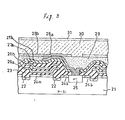
- the portion constituted by the oxide film 27 can be replaced by a combination of an oxide film 27a with a phosphor silicate glass (PSG) 27b on top of it, as shown in Figure 3.
- PSG phosphor silicate glass
- the PSG layer 27b is then heat treated at for example 1000°C - 1100°C to melt the surface thereof.
- the projections A become more smooth convexities, and therefore, a continuous smooth connection can be achieved between the projection A and the surface of the polyimide film 29.
- This enables the second metallic electrode 28b to be made thinner and the overall surface to be made flat, so that the photoconductive film 30 that is formed on this substrate can likewise be deposited in a uniform manner. This results in considerable improvement in respect of the dark current and lag characteristics. Deterioration in sensitivity can also be prevented because the photoconductive film is much more uniform over the surface of the substrate and has few trap levels.
- FIGS 4a and 4b are given in explanation of another embodiment of the present invention.
- a flat surface is achieved by application of a thick polyimide film 29, but, when this method is performed using RIE, the inside wall of the reaction vessel becomes very dirty. This does not directly affect the characteristics of the device, but cleaning of the inner wall of the reaction vessel is very laborious, while if it is left dirty problems arise when RIE is next carried out.
- a two stage process is performed, in which the flatness shown in Figure 2d is achieved by first of all depositing a relatively thin polyimide film 29a sufficient to cover the projections A of the second metallic electrode 28a, then applying a photoresist film 29b onto its surface, as shown in Figure 4a.
- the whole surface is then etched by RIE as in the preceding embodiments, to expose the projections A of the second metallic electrode 28a, as shown in Figure 4b.
- Figure 5 shows yet a further embodiment of the present invention. It differs from Figure 2 in that a buried electrode 32 consisting of a third polysilicon layer is formed in the oxide film 27 between the transfer electrodes 26a and 26b and first metallic electrode 28a on the channel stopper p + layer 22.
- This buried electrode 32 is earthed or has a DC voltage applied to it and provides electrostatic shielding between the transfer electrodes 26a and 26b and the first metallic electrode 28a.
- the projections A project further above than the rest of the surface. This facilitates the process of exposing only these projections.
- This electrostatic shielding also has the effect of preventing deterioration of the lag characteristics or unstable operation.
- the storage diode constituted by the n layer 25 and p type substrate 21, that is connected to the first metallic electrode 28a is in an electrically floating condition during the period for which the signal charge is stored, so application of the clock pulse to the transfer electrodes 26a and 26b causes capacitative variation of the potential of the n ++ layer 25. This results in some of the signal charge that has reached this n ++ layer 25 being returned to the photoconductive film, causing deterioration of the lag characteristics and operational instability such as flickering.
- the electrostatic shielding effect of the buried electrode 32 of this embodiment is effective in preventing such adverse effects on the characteristics.
- Polysilicon was used as the material of the CCD transfer electrodes and buried electrode in the above description but other conductive materials such as molybdenum (Mo), molybdenum silicide (Mo-Si) or tungsten (W) could be used.
- Mo molybdenum
- Mo-Si molybdenum silicide
- W tungsten
- the etching of the polyimide film 29 was performed by reactive ion etching using oxygen plasma, but other methods such as chemical etching using hydrazine solution could be used provided they produce uniform etching of the entire surface.
- Other ogranic insulating materials instead of the polyimide film 29 could be used, such as for example rubbery or acrylic macromolecular films.
- the above description concerns mainly the effective sensitive region of the solid state image pickup device. If the metallic electrodes in the region of the bonding pad that is provided around the edges of the element for external connections are left exposed at the same time as the first metallic electrodes 28a are exposed, it is not necessary to carry out patterning by photolithography on the bonding pad.
Landscapes
- Solid State Image Pick-Up Elements (AREA)
Applications Claiming Priority (2)
| Application Number | Priority Date | Filing Date | Title |
|---|---|---|---|
| JP58153761A JPS6045057A (ja) | 1983-08-23 | 1983-08-23 | 固体撮像装置の製造方法 |
| JP153761/83 | 1983-08-23 |
Publications (2)
| Publication Number | Publication Date |
|---|---|
| EP0139366A1 true EP0139366A1 (de) | 1985-05-02 |
| EP0139366B1 EP0139366B1 (de) | 1988-10-12 |
Family
ID=15569550
Family Applications (1)
| Application Number | Title | Priority Date | Filing Date |
|---|---|---|---|
| EP84305337A Expired EP0139366B1 (de) | 1983-08-23 | 1984-08-06 | Verfahren zum Herstellen einer Festkörper-Bildaufnahmevorrichtung |
Country Status (4)
| Country | Link |
|---|---|
| US (1) | US4608749A (de) |
| EP (1) | EP0139366B1 (de) |
| JP (1) | JPS6045057A (de) |
| DE (1) | DE3474611D1 (de) |
Cited By (4)
| Publication number | Priority date | Publication date | Assignee | Title |
|---|---|---|---|---|
| EP0192269A1 (de) * | 1985-02-22 | 1986-08-27 | Siemens Aktiengesellschaft | Elektrische Isolation und Einebnung von strukturierten Oberflächen |
| EP0263497A3 (en) * | 1986-10-07 | 1989-09-06 | Canon Kabushiki Kaisha | Image reading device |
| EP0354619A1 (de) * | 1988-08-10 | 1990-02-14 | Koninklijke Philips Electronics N.V. | Bildaufnahmevorrichtung vom Halbbildübertragungstyp |
| EP2443656A4 (de) * | 2009-06-17 | 2013-11-20 | Univ Michigan | Photodiode und andere sensorstrukturen in flachtafel-röntgenabbildungsgeräten sowie verfahren zur verbesserung der topologischen gleichförmigkeit der photodiode und der anderen strukturen in dem flachtafel-röntgenabbildungsgerät auf dünnschichtelektronikbasis |
Families Citing this family (16)
| Publication number | Priority date | Publication date | Assignee | Title |
|---|---|---|---|---|
| ATE88014T1 (de) * | 1985-01-07 | 1993-04-15 | Siemens Ag | Monolithisch integrierter wdm-demultiplexmodul und ein verfahren zur herstellung eines solchen moduls. |
| US5309013A (en) * | 1985-04-30 | 1994-05-03 | Canon Kabushiki Kaisha | Photoelectric conversion device |
| US4713142A (en) * | 1985-05-01 | 1987-12-15 | Texas Instruments Incorporated | Method for fabricating EPROM array |
| JPS61292960A (ja) * | 1985-06-21 | 1986-12-23 | Toshiba Corp | 固体撮像装置 |
| DE3650362T2 (de) * | 1986-01-06 | 1996-01-25 | Sel Semiconductor Energy Laboratory Co., Ltd., Atsugi, Kanagawa | Photoelektrische Umwandlungsvorrichtung mit hoher Ansprechgeschwindigkeit und Herstellungsverfahren. |
| US4894701A (en) * | 1988-05-09 | 1990-01-16 | General Electric Company | Semiconductor device detector and method of forming same |
| US5286669A (en) * | 1989-07-06 | 1994-02-15 | Kabushiki Kaisha Toshiba | Solid-state imaging device and method of manufacturing the same |
| US5235198A (en) * | 1989-11-29 | 1993-08-10 | Eastman Kodak Company | Non-interlaced interline transfer CCD image sensing device with simplified electrode structure for each pixel |
| US5182624A (en) * | 1990-08-08 | 1993-01-26 | Minnesota Mining And Manufacturing Company | Solid state electromagnetic radiation detector fet array |
| US5273910A (en) * | 1990-08-08 | 1993-12-28 | Minnesota Mining And Manufacturing Company | Method of making a solid state electromagnetic radiation detector |
| US5254480A (en) * | 1992-02-20 | 1993-10-19 | Minnesota Mining And Manufacturing Company | Process for producing a large area solid state radiation detector |
| JP2910394B2 (ja) * | 1992-03-19 | 1999-06-23 | 日本電気株式会社 | 固体撮像素子およびその製造方法 |
| US5234860A (en) * | 1992-03-19 | 1993-08-10 | Eastman Kodak Company | Thinning of imaging device processed wafers |
| US5416344A (en) * | 1992-07-29 | 1995-05-16 | Nikon Corporation | Solid state imaging device and method for producing the same |
| GB9520791D0 (en) * | 1995-10-13 | 1995-12-13 | Philips Electronics Nv | Image sensor |
| JP4294745B2 (ja) * | 1997-09-26 | 2009-07-15 | 株式会社半導体エネルギー研究所 | 光電変換装置の作製方法 |
Citations (3)
| Publication number | Priority date | Publication date | Assignee | Title |
|---|---|---|---|---|
| EP0012863A2 (de) * | 1978-12-26 | 1980-07-09 | International Business Machines Corporation | Verfahren zur Herstellung von Halbleiteranordnungen mit herabgesetzter parasitärer Kapazität |
| EP0023079A2 (de) * | 1979-06-08 | 1981-01-28 | Hitachi, Ltd. | Verfahren zur Herstellung einer fotoelektrischen Festkörper-Vorrichtung |
| EP0040076A2 (de) * | 1980-05-09 | 1981-11-18 | Hitachi, Ltd. | Photoelektrischer Umwandler |
Family Cites Families (13)
| Publication number | Priority date | Publication date | Assignee | Title |
|---|---|---|---|---|
| JPS57702B2 (de) * | 1971-10-15 | 1982-01-07 | ||
| JPS5622862B2 (de) * | 1972-03-09 | 1981-05-27 | ||
| JPS5140711A (en) * | 1974-10-02 | 1976-04-05 | Nippon Electric Co | 2 jigendenkatensososhi oyobi koreomochiita eizoshingono goseihoho |
| JPS5827712B2 (ja) * | 1975-12-25 | 1983-06-10 | 株式会社東芝 | コタイサツゾウソウチ |
| FR2433871A1 (fr) * | 1978-08-18 | 1980-03-14 | Hitachi Ltd | Dispositif de formation d'image a semi-conducteur |
| JPS5850030B2 (ja) * | 1979-03-08 | 1983-11-08 | 日本放送協会 | 光電変換装置およびそれを用いた固体撮像板 |
| JPS56103578A (en) * | 1980-01-23 | 1981-08-18 | Hitachi Ltd | Solid state pickup element |
| US4517733A (en) * | 1981-01-06 | 1985-05-21 | Fuji Xerox Co., Ltd. | Process for fabricating thin film image pick-up element |
| JPS57162364A (en) * | 1981-03-30 | 1982-10-06 | Matsushita Electric Ind Co Ltd | Solid state image pickup device |
| JPS5833854A (ja) * | 1981-08-21 | 1983-02-28 | Fujitsu Ltd | 半導体装置の製造方法 |
| JPS5846652A (ja) * | 1981-09-14 | 1983-03-18 | Fujitsu Ltd | 多層配線形成方法 |
| JPS5861663A (ja) * | 1981-10-08 | 1983-04-12 | Matsushita Electronics Corp | 固体撮像装置の製造方法 |
| JPS5873285A (ja) * | 1981-10-28 | 1983-05-02 | Nec Corp | 固体撮像素子 |
-
1983
- 1983-08-23 JP JP58153761A patent/JPS6045057A/ja active Pending
-
1984
- 1984-08-06 DE DE8484305337T patent/DE3474611D1/de not_active Expired
- 1984-08-06 EP EP84305337A patent/EP0139366B1/de not_active Expired
- 1984-08-22 US US06/643,232 patent/US4608749A/en not_active Expired - Lifetime
Patent Citations (3)
| Publication number | Priority date | Publication date | Assignee | Title |
|---|---|---|---|---|
| EP0012863A2 (de) * | 1978-12-26 | 1980-07-09 | International Business Machines Corporation | Verfahren zur Herstellung von Halbleiteranordnungen mit herabgesetzter parasitärer Kapazität |
| EP0023079A2 (de) * | 1979-06-08 | 1981-01-28 | Hitachi, Ltd. | Verfahren zur Herstellung einer fotoelektrischen Festkörper-Vorrichtung |
| EP0040076A2 (de) * | 1980-05-09 | 1981-11-18 | Hitachi, Ltd. | Photoelektrischer Umwandler |
Non-Patent Citations (1)
| Title |
|---|
| PATENT ABSTRACTS OF JAPAN vol. 5, no. 121, 5th August 1981, page (E-68) (793); & JP-A-56-58247 (FUJITSU K.K.) 21-05-1981 * |
Cited By (12)
| Publication number | Priority date | Publication date | Assignee | Title |
|---|---|---|---|---|
| EP0192269A1 (de) * | 1985-02-22 | 1986-08-27 | Siemens Aktiengesellschaft | Elektrische Isolation und Einebnung von strukturierten Oberflächen |
| EP0263497A3 (en) * | 1986-10-07 | 1989-09-06 | Canon Kabushiki Kaisha | Image reading device |
| US4924282A (en) * | 1986-10-07 | 1990-05-08 | Canon Kabushiki Kaisha | Image reading device with moisture resistant layer |
| EP0354619A1 (de) * | 1988-08-10 | 1990-02-14 | Koninklijke Philips Electronics N.V. | Bildaufnahmevorrichtung vom Halbbildübertragungstyp |
| FR2636171A1 (fr) * | 1988-08-10 | 1990-03-09 | Philips Nv | Dispositif capteur d'images du type a transfert de trame |
| EP2443656A4 (de) * | 2009-06-17 | 2013-11-20 | Univ Michigan | Photodiode und andere sensorstrukturen in flachtafel-röntgenabbildungsgeräten sowie verfahren zur verbesserung der topologischen gleichförmigkeit der photodiode und der anderen strukturen in dem flachtafel-röntgenabbildungsgerät auf dünnschichtelektronikbasis |
| US8754379B2 (en) | 2009-06-17 | 2014-06-17 | Regents Of The University Of Michigan | Photodiode and other sensor structures in flat-panel x-ray imagers and method for improving topological uniformity of the photodiode and other sensor structures in flat-panel x-ray imagers based on thin-film electronics |
| US9395453B2 (en) | 2009-06-17 | 2016-07-19 | The Regents Of The University Of Michigan, University Of Michigan Office Of Technology Transfer | Photodiode and other sensor structures in flat-panel x-ray imagers and method for improving topological uniformity of the photodiode and other sensor structures in flat-panel x-ray imagers based on thin-film electronics |
| CN107425020A (zh) * | 2009-06-17 | 2017-12-01 | 密执安州立大学董事会 | 辐射传感器 |
| US9880296B2 (en) | 2009-06-17 | 2018-01-30 | Regents Of The University Of Michigan | Photodiode and other sensor structures in flat-panel x-ray imagers and method for improving topological uniformity of the photodiode and other sensor structures in flat-panel x-ray imagers based on thin-film electronics |
| EP3447802A1 (de) * | 2009-06-17 | 2019-02-27 | The Regents Of The University Of Michigan | Photodiode und andere sensorstrukturen in flachtafel-röntgenabbildungsgeräten sowie verfahren zur verbesserung der topologischen gleichförmigkeit der photodiode und der anderen strukturen in dem flachtafel-röntgenabbildungsgerät auf dünnschichtelektronikbasis |
| CN107425020B (zh) * | 2009-06-17 | 2019-10-18 | 密执安州立大学董事会 | 辐射传感器 |
Also Published As
| Publication number | Publication date |
|---|---|
| DE3474611D1 (en) | 1988-11-17 |
| US4608749A (en) | 1986-09-02 |
| JPS6045057A (ja) | 1985-03-11 |
| EP0139366B1 (de) | 1988-10-12 |
Similar Documents
| Publication | Publication Date | Title |
|---|---|---|
| EP0139366B1 (de) | Verfahren zum Herstellen einer Festkörper-Bildaufnahmevorrichtung | |
| US4360821A (en) | Solid-state imaging device | |
| US3941630A (en) | Method of fabricating a charged couple radiation sensing device | |
| JP4600964B2 (ja) | ゲーテッドフォトダイオードを有する固体イメージャ及びその製造方法 | |
| KR100218849B1 (ko) | 고체촬상소자의제조방법 | |
| US5519207A (en) | Solid-state image pickup device having different structures for image sensing region and optical black region | |
| US4783691A (en) | Color solid-state image sensor | |
| CA1161534A (en) | Photoelectric converter | |
| JPH07107928B2 (ja) | 固体撮像装置 | |
| JPH06326293A (ja) | 光検出装置 | |
| US6784434B2 (en) | Imaging array and method for manufacturing same | |
| US5621461A (en) | Solid state image device with gate electrodes having low resistance and a method of producing the same | |
| JPH0680811B2 (ja) | Ccd画像感知器 | |
| US5637894A (en) | Solid state image sensor device with single-layered transfer electrodes | |
| JPH09172156A (ja) | 固体撮像素子及びその製造方法 | |
| JP2982206B2 (ja) | 固体撮像素子 | |
| JPS6292364A (ja) | 半導体デバイスおよびその製造方法 | |
| EP0380654A1 (de) | Linsenanordnungen für photoempfindliche vorrichtungen | |
| JPH04207076A (ja) | 固体撮像装置の製造方法 | |
| JPS6051376A (ja) | 固体撮像装置 | |
| JP2773739B2 (ja) | 固体撮像装置の製造方法 | |
| US5038190A (en) | Photoelectric conversion device with disabled electrode | |
| EP0309542A1 (de) | Ladungsgekoppelte anordnung mit zweischichtigen elektroden | |
| JPS6047574A (ja) | 固体撮像装置 | |
| KR100280400B1 (ko) | 고체촬상소자 제조방법 |
Legal Events
| Date | Code | Title | Description |
|---|---|---|---|
| PUAI | Public reference made under article 153(3) epc to a published international application that has entered the european phase |
Free format text: ORIGINAL CODE: 0009012 |
|
| AK | Designated contracting states |
Designated state(s): DE FR GB NL |
|
| 17P | Request for examination filed |
Effective date: 19851025 |
|
| 17Q | First examination report despatched |
Effective date: 19870309 |
|
| GRAA | (expected) grant |
Free format text: ORIGINAL CODE: 0009210 |
|
| AK | Designated contracting states |
Kind code of ref document: B1 Designated state(s): DE FR GB NL |
|
| REF | Corresponds to: |
Ref document number: 3474611 Country of ref document: DE Date of ref document: 19881117 |
|
| ET | Fr: translation filed | ||
| PLBE | No opposition filed within time limit |
Free format text: ORIGINAL CODE: 0009261 |
|
| STAA | Information on the status of an ep patent application or granted ep patent |
Free format text: STATUS: NO OPPOSITION FILED WITHIN TIME LIMIT |
|
| 26N | No opposition filed | ||
| PGFP | Annual fee paid to national office [announced via postgrant information from national office to epo] |
Ref country code: GB Payment date: 19970728 Year of fee payment: 14 |
|
| PGFP | Annual fee paid to national office [announced via postgrant information from national office to epo] |
Ref country code: FR Payment date: 19970811 Year of fee payment: 14 |
|
| PGFP | Annual fee paid to national office [announced via postgrant information from national office to epo] |
Ref country code: DE Payment date: 19970818 Year of fee payment: 14 |
|
| PG25 | Lapsed in a contracting state [announced via postgrant information from national office to epo] |
Ref country code: GB Free format text: LAPSE BECAUSE OF NON-PAYMENT OF DUE FEES Effective date: 19980806 |
|
| GBPC | Gb: european patent ceased through non-payment of renewal fee |
Effective date: 19980806 |
|
| PG25 | Lapsed in a contracting state [announced via postgrant information from national office to epo] |
Ref country code: FR Free format text: LAPSE BECAUSE OF NON-PAYMENT OF DUE FEES Effective date: 19990430 |
|
| PG25 | Lapsed in a contracting state [announced via postgrant information from national office to epo] |
Ref country code: DE Free format text: LAPSE BECAUSE OF NON-PAYMENT OF DUE FEES Effective date: 19990601 |
|
| REG | Reference to a national code |
Ref country code: FR Ref legal event code: ST |
|
| PGFP | Annual fee paid to national office [announced via postgrant information from national office to epo] |
Ref country code: NL Payment date: 20010830 Year of fee payment: 18 |
|
| PG25 | Lapsed in a contracting state [announced via postgrant information from national office to epo] |
Ref country code: NL Free format text: LAPSE BECAUSE OF NON-PAYMENT OF DUE FEES Effective date: 20030301 |
|
| NLV4 | Nl: lapsed or anulled due to non-payment of the annual fee |
Effective date: 20030301 |