EP0023721A2 - Construction en treillis - Google Patents
Construction en treillis Download PDFInfo
- Publication number
- EP0023721A2 EP0023721A2 EP80104596A EP80104596A EP0023721A2 EP 0023721 A2 EP0023721 A2 EP 0023721A2 EP 80104596 A EP80104596 A EP 80104596A EP 80104596 A EP80104596 A EP 80104596A EP 0023721 A2 EP0023721 A2 EP 0023721A2
- Authority
- EP
- European Patent Office
- Prior art keywords
- belt
- diagonal
- bars
- degrees
- structure according
- Prior art date
- Legal status (The legal status is an assumption and is not a legal conclusion. Google has not performed a legal analysis and makes no representation as to the accuracy of the status listed.)
- Ceased
Links
Images

Classifications
-
- E—FIXED CONSTRUCTIONS
- E04—BUILDING
- E04B—GENERAL BUILDING CONSTRUCTIONS; WALLS, e.g. PARTITIONS; ROOFS; FLOORS; CEILINGS; INSULATION OR OTHER PROTECTION OF BUILDINGS
- E04B1/00—Constructions in general; Structures which are not restricted either to walls, e.g. partitions, or floors or ceilings or roofs
- E04B1/18—Structures comprising elongated load-supporting parts, e.g. columns, girders, skeletons
- E04B1/19—Three-dimensional [3D] framework structures
- E04B1/1903—Connecting nodes specially adapted therefor
-
- E—FIXED CONSTRUCTIONS
- E04—BUILDING
- E04B—GENERAL BUILDING CONSTRUCTIONS; WALLS, e.g. PARTITIONS; ROOFS; FLOORS; CEILINGS; INSULATION OR OTHER PROTECTION OF BUILDINGS
- E04B1/00—Constructions in general; Structures which are not restricted either to walls, e.g. partitions, or floors or ceilings or roofs
- E04B1/38—Connections for building structures in general
- E04B1/58—Connections for building structures in general of bar-shaped building elements
- E04B1/5825—Connections for building structures in general of bar-shaped building elements with a closed cross-section
- E04B1/5837—Connections for building structures in general of bar-shaped building elements with a closed cross-section of substantially circular form
- E04B1/5843—Connections for building structures in general of bar-shaped building elements with a closed cross-section of substantially circular form with ends provided with protuberances
-
- E—FIXED CONSTRUCTIONS
- E04—BUILDING
- E04B—GENERAL BUILDING CONSTRUCTIONS; WALLS, e.g. PARTITIONS; ROOFS; FLOORS; CEILINGS; INSULATION OR OTHER PROTECTION OF BUILDINGS
- E04B1/00—Constructions in general; Structures which are not restricted either to walls, e.g. partitions, or floors or ceilings or roofs
- E04B1/18—Structures comprising elongated load-supporting parts, e.g. columns, girders, skeletons
- E04B1/19—Three-dimensional [3D] framework structures
- E04B1/1903—Connecting nodes specially adapted therefor
- E04B2001/1918—Connecting nodes specially adapted therefor with connecting nodes having flat radial connecting surfaces
-
- E—FIXED CONSTRUCTIONS
- E04—BUILDING
- E04B—GENERAL BUILDING CONSTRUCTIONS; WALLS, e.g. PARTITIONS; ROOFS; FLOORS; CEILINGS; INSULATION OR OTHER PROTECTION OF BUILDINGS
- E04B1/00—Constructions in general; Structures which are not restricted either to walls, e.g. partitions, or floors or ceilings or roofs
- E04B1/18—Structures comprising elongated load-supporting parts, e.g. columns, girders, skeletons
- E04B1/19—Three-dimensional [3D] framework structures
- E04B2001/1924—Struts specially adapted therefor
- E04B2001/1927—Struts specially adapted therefor of essentially circular cross section
- E04B2001/193—Struts specially adapted therefor of essentially circular cross section with flattened connecting parts, e.g. ends
-
- E—FIXED CONSTRUCTIONS
- E04—BUILDING
- E04B—GENERAL BUILDING CONSTRUCTIONS; WALLS, e.g. PARTITIONS; ROOFS; FLOORS; CEILINGS; INSULATION OR OTHER PROTECTION OF BUILDINGS
- E04B1/00—Constructions in general; Structures which are not restricted either to walls, e.g. partitions, or floors or ceilings or roofs
- E04B1/18—Structures comprising elongated load-supporting parts, e.g. columns, girders, skeletons
- E04B1/19—Three-dimensional [3D] framework structures
- E04B2001/1924—Struts specially adapted therefor
- E04B2001/1933—Struts specially adapted therefor of polygonal, e.g. square, cross section
-
- E—FIXED CONSTRUCTIONS
- E04—BUILDING
- E04B—GENERAL BUILDING CONSTRUCTIONS; WALLS, e.g. PARTITIONS; ROOFS; FLOORS; CEILINGS; INSULATION OR OTHER PROTECTION OF BUILDINGS
- E04B1/00—Constructions in general; Structures which are not restricted either to walls, e.g. partitions, or floors or ceilings or roofs
- E04B1/18—Structures comprising elongated load-supporting parts, e.g. columns, girders, skeletons
- E04B1/19—Three-dimensional [3D] framework structures
- E04B2001/1924—Struts specially adapted therefor
- E04B2001/1936—Winged profiles, e.g. with a L-, T-, U- or X-shaped cross section
-
- E—FIXED CONSTRUCTIONS
- E04—BUILDING
- E04B—GENERAL BUILDING CONSTRUCTIONS; WALLS, e.g. PARTITIONS; ROOFS; FLOORS; CEILINGS; INSULATION OR OTHER PROTECTION OF BUILDINGS
- E04B1/00—Constructions in general; Structures which are not restricted either to walls, e.g. partitions, or floors or ceilings or roofs
- E04B1/18—Structures comprising elongated load-supporting parts, e.g. columns, girders, skeletons
- E04B1/19—Three-dimensional [3D] framework structures
- E04B2001/1957—Details of connections between nodes and struts
- E04B2001/1963—Screw connections with axis at an angle, e.g. perpendicular, to the main axis of the strut
-
- E—FIXED CONSTRUCTIONS
- E04—BUILDING
- E04B—GENERAL BUILDING CONSTRUCTIONS; WALLS, e.g. PARTITIONS; ROOFS; FLOORS; CEILINGS; INSULATION OR OTHER PROTECTION OF BUILDINGS
- E04B1/00—Constructions in general; Structures which are not restricted either to walls, e.g. partitions, or floors or ceilings or roofs
- E04B1/18—Structures comprising elongated load-supporting parts, e.g. columns, girders, skeletons
- E04B1/19—Three-dimensional [3D] framework structures
- E04B2001/1975—Frameworks where the struts are directly connected to each other, i.e. without interposed connecting nodes or plates
Definitions
- the invention relates to a framework construction made up of a plurality of horizontally arranged tubular belt bars, and preferably three-dimensional, e.g. pyramid-shaped, tubular diagonal rods, whose superimposed, squeezed parts are connected to each other in a knot.
- the main forces acting on the construction system act as tensile or compressive forces in the axial direction of the bars and must be absorbed by the bar ends.
- the rod ends must be squeezed and / or drilled through for the node connection of the individual rods. This inevitable weakening of the rod ends for the node connection is therefore of particular importance.
- the change in cross-section which is usually achieved by squeezing the tubular rod end, must transmit all the forces acting on the node into the rod axis and from there at the opposite rod end to the other rods connected there.
- a particular criterion is, among other things, the deflection of the forces in the diagonal bars, which previously ran at an angle of at least 45 degrees, onto the horizontally arranged belt bars. This flow of lines of force inevitably leads to a particular buckling stress of this transition area tapered by the pinch from the end of the rod to the tubular, undeformed part of the diagonal rod.
- the problem underlying the present invention therefore lies in the creation of a specially designed tapering section of the rod ends, the buckling strength and buckling strength of which do not result in a weakening in comparison with the undeformed rod section.
- this is done in that - seen in a longitudinal section perpendicular to the crushing surface - the tube wall tapers approximately linearly towards the crushed part, the length of the circumferential line of the axial cross-section being essentially constant in the entire rod area.
- the wedge-shaped surfaces enable a favorable flow of the axial pressure forces to the nodes and thus a high dent resistance; Tests have shown that the dent resistance of the linear crush is 61 times higher than the natural, bulged crush.
- the crimp with beading according to the above-mentioned DE-GM is only 20 times stronger than the natural crimp.
- the buckling strength of the tapered area is optimal when the angle enclosed by the two wedge-shaped tapering, flat lateral surfaces is approximately 15 to approximately 35 degrees, preferably approximately 20 to approximately 28 degrees.
- a further advantageous embodiment of the invention consists in that the crushing planes can be arranged not only horizontally but also vertically and the screws connecting the belt rods with the diagonal rods can be arranged horizontally.
- This position of the knot is only possible due to the particularly high bending stiffness of the tapered area in the plane of the pinched rod end.
- the particular advantage of this knot is that the line of force of the diagonal bars in the knot area can be brought exactly to the belt axis, so that the eccentricities of the line of force, which are inevitable for vertical screw axes and have to be taken into account in the static calculation, are eliminated.
- belts with a polygonal, preferably square, cross section can be used.
- the labor-intensive and time-consuming squeezing of the belts in the knot area is no longer necessary, and the flexural strength of the belt is also not impaired.
- the diagonals always remain squashed.
- An additional advantage can also be seen in the fact that particularly rigid cross-sectional shapes can be used. To fasten the diagonal bars, threaded holes can be cut into the belt bar walls.
- the diagonal bars provided in the spatial framework at an angle of less than 45 degrees, preferably less than about 40 degrees, e.g. to be arranged between about 30 and about 40 degrees to the horizontal plane in order to keep the eccentricities occurring in the nodes as small as possible.
- a - for example box-shaped - node piece can be arranged between the flat-crimped ends of the rods, which is dimensioned such that the axes of the diagonal rods coincide with the axes of the belt rods at the same point meet so that no torques arise.
- the node piece according to the invention also enables a particularly efficient assembly, uz a separate screwing of the diagonal and the belt rods.
- FIG. 1 shows a rod end in longitudinal section
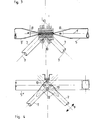
- FIGS. 2 and 5 show a section of a spatial framework construction
- 3 shows a longitudinal section through a belt including knots.
- 4 shows the view of a knot
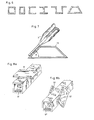
- 6 shows a selection of preferred cross sections for belt profiles
- 7 shows a special embodiment of a belt profile in cross section
- FIG. 8 shows the view of a belt profile specially prepared for connection to the diagonal bars
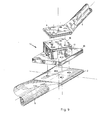
- 9 shows the view of a node connection with a node piece
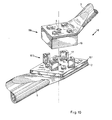
- FIG. 10 shows the view of a node connection with a two-piece node piece, both in an exploded view.
- the flat-squeezed end 2 of a belt or diagonal bar with a circular cross-section in FIG. 1 is connected to other bar ends in the node according to FIG. 3 with the aid of screws 10 leading through the bores 6 and thus firmly clamped in the entire system.
- continuous belt rods can be squeezed undivided in the corresponding places for the connection with the diagonal rods in an analogous manner.
- up to four belt rod ends and up to four diagonal rod ends can meet in a spatial node (two rod ends can be inserted into one another, as shown here for the two belt rods 5 and 5 '), so that the knot thickness corresponds to up to 16 times the wall thickness of the bars. This results in a rigid and heavy-duty connection point. So far, the only weak point of the bars has been in the tapered area, where the axial lines of force are deflected.
- the tapering area 8 can be achieved by squeezing the tubular rod end between two trapezoidal pressing jaws; the width of the surfaces 8a, 8b increases with increasing reduction in their distance, so that the bending stiffness of the tapering region 8 in the projected plane 1 leading through the flat-crimped rod end 2 is increased considerably.
- the belt rods 5 and (shown in section in FIG. 2 in section) 4 connected to one another in the nodes are arranged in a horizontal position. Adjacent belts are connected by diagonal bars 7, the flat-crimped ends of which are angled such that they come to lie parallel to the corresponding belt bar ends.
- the belt profile 5 ′′ shown in FIG. 4 has a rectangular cross section and has the advantage that no crushing and thus no weakening of the bending stiffness is necessary in the node area.
- a rotation of the end of the diagonal rod 7, not shown, in the direction of the arrow 9 is countered by the increased bending stiffness of the tapered section, which increases resistance.
- FIG. 6 shows some possible cross-sectional shapes of belt profiles that have proven to be particularly advantageous in the implementation of the present invention. These are profiles with a square, rectangular or trapezoidal cross-section, as well as so-called C, double-T or omega profiles.
- FIG. 7 shows a belt profile 13 with a trapezoidal cross section, in which the crimped ends of the diagonal bars 7 need not be angled for mounting on the inclined surfaces, and the inclined surfaces form an angle / 3 of approximately 45 degrees with the horizontal.
- the diagonal bars 7 are arranged obliquely in space, that is to say not in a plane perpendicular to the belt profile axis, the angle which they form with the horizontal plane will be less than 45 degrees, possibly between 30 and 40 degrees.
- plates 12 or 12 ' are welded onto a belt profile 5 "with a rectangular cross-section, or onto such a 5""with a square cross-section, which are used to connect the squeezed ends of the diagonal bars serve.
- This is particularly useful if a belt profile is used, the edge length of which is smaller than the diagonal of the squeezed diagonal bar end. It also has the advantage that the belt profile need not be weakened or only to a lesser extent by the arrangement of bores.
- the diagonal part 18 a consists of a peripheral frame 19, the opening of which is closed with a cover plate, not shown, which is screwed to the flat-crimped end of the diagonal rod 7;
- the belt part 18 b consists of a belt plate 15 'on which spacers, e.g. Angle pieces 17 are welded on.
- the frame 19 slides over the angle pieces 17; the knot connection is then screwed through the holes 6.
- the connection can also be reversed: the spacers would then be connected to the diagonal bar and the frame 19 to the belt bar.
Landscapes
- Engineering & Computer Science (AREA)
- Architecture (AREA)
- Physics & Mathematics (AREA)
- Electromagnetism (AREA)
- Civil Engineering (AREA)
- Structural Engineering (AREA)
- Joining Of Building Structures In Genera (AREA)
- Reinforcement Elements For Buildings (AREA)
- Prostheses (AREA)
Applications Claiming Priority (2)
| Application Number | Priority Date | Filing Date | Title |
|---|---|---|---|
| AT538679A AT362112B (de) | 1979-08-06 | 1979-08-06 | Fachwerkskonstruktion |
| AT5386/79 | 1979-08-06 |
Publications (2)
| Publication Number | Publication Date |
|---|---|
| EP0023721A2 true EP0023721A2 (fr) | 1981-02-11 |
| EP0023721A3 EP0023721A3 (fr) | 1981-04-08 |
Family
ID=3575224
Family Applications (1)
| Application Number | Title | Priority Date | Filing Date |
|---|---|---|---|
| EP80104596A Ceased EP0023721A3 (fr) | 1979-08-06 | 1980-08-04 | Construction en treillis |
Country Status (3)
| Country | Link |
|---|---|
| EP (1) | EP0023721A3 (fr) |
| AT (1) | AT362112B (fr) |
| CA (1) | CA1131872A (fr) |
Cited By (5)
| Publication number | Priority date | Publication date | Assignee | Title |
|---|---|---|---|---|
| US4347690A (en) * | 1979-12-19 | 1982-09-07 | Wallace Jr Brenton G | Skeletal framework structure and junction for use therein |
| AU647789B2 (en) * | 1990-05-21 | 1994-03-31 | Novaplas Pty Ltd | Nodal connection for space frame |
| WO2001024955A1 (fr) * | 1999-10-05 | 2001-04-12 | Weeks Peacock Quality Homes Pty Ltd | Procede d'ecrasement d'un tube |
| GB2433268A (en) * | 2005-12-13 | 2007-06-20 | Francis & Lewis Internat Ltd | Bracing member for building |
| CN101979790A (zh) * | 2010-09-14 | 2011-02-23 | 上海珊迪建筑科技有限公司 | 钢管连接头 |
Families Citing this family (3)
| Publication number | Priority date | Publication date | Assignee | Title |
|---|---|---|---|---|
| AU603239B2 (en) * | 1987-06-19 | 1990-11-08 | Supertruss Pty. Ltd. | Metal frame structure |
| US5003748A (en) * | 1987-06-19 | 1991-04-02 | Supertruss Pty. Ltd. | Metal frame structure |
| US10465373B2 (en) | 2016-07-28 | 2019-11-05 | Cole David Kazuyuki TURNER | Integrated structural member |
Family Cites Families (4)
| Publication number | Priority date | Publication date | Assignee | Title |
|---|---|---|---|---|
| GB832307A (en) * | 1958-03-12 | 1960-04-06 | Fentiman & Sons Ltd F | Improvements relating to walls |
| BE813544A (fr) * | 1974-04-10 | 1974-07-31 | Element de construction pour la realisation de charpentes metalliques spatiales et charpente obtenue. | |
| FR2350543A1 (fr) * | 1976-05-07 | 1977-12-02 | Dziewolski Richard | Noeud d'assemblage en forme de " boite " en acier moule des structures tubulaires spatiales |
| FR2376998A1 (fr) * | 1977-01-10 | 1978-08-04 | Cotecno | Procede et elements modulaires pour la construction de structures tridimensionnelles |
-
1979
- 1979-08-06 AT AT538679A patent/AT362112B/de not_active IP Right Cessation
-
1980
- 1980-08-01 CA CA357,550A patent/CA1131872A/fr not_active Expired
- 1980-08-04 EP EP80104596A patent/EP0023721A3/fr not_active Ceased
Cited By (5)
| Publication number | Priority date | Publication date | Assignee | Title |
|---|---|---|---|---|
| US4347690A (en) * | 1979-12-19 | 1982-09-07 | Wallace Jr Brenton G | Skeletal framework structure and junction for use therein |
| AU647789B2 (en) * | 1990-05-21 | 1994-03-31 | Novaplas Pty Ltd | Nodal connection for space frame |
| WO2001024955A1 (fr) * | 1999-10-05 | 2001-04-12 | Weeks Peacock Quality Homes Pty Ltd | Procede d'ecrasement d'un tube |
| GB2433268A (en) * | 2005-12-13 | 2007-06-20 | Francis & Lewis Internat Ltd | Bracing member for building |
| CN101979790A (zh) * | 2010-09-14 | 2011-02-23 | 上海珊迪建筑科技有限公司 | 钢管连接头 |
Also Published As
| Publication number | Publication date |
|---|---|
| CA1131872A (fr) | 1982-09-21 |
| EP0023721A3 (fr) | 1981-04-08 |
| ATA538679A (de) | 1980-09-15 |
| AT362112B (de) | 1981-04-27 |
Similar Documents
| Publication | Publication Date | Title |
|---|---|---|
| AT394896B (de) | Rohrkupplung | |
| DE4224663C2 (de) | Knotenstück für zweifach gekrümmte Gittertragkonstruktionen, insbesondere in einlagiger Ausführung | |
| CH652651A5 (de) | Rahmen zum siebspannen und siebdrucken. | |
| DE1286338B (de) | Kegelgewindeverbindung | |
| EP3119658B1 (fr) | Châssis de bogie | |
| DE2757189A1 (de) | Keilverbindung, insbesondere fuer metallrohrgerueste | |
| EP0023721A2 (fr) | Construction en treillis | |
| DE2258721C3 (de) | Verbindungseinrichtung zum Verbinden von vorgefertigten Spannbetonteilen | |
| WO2005070580A1 (fr) | Appareil à plier doté de rouleaux compensateurs | |
| DE102017006653A1 (de) | Palettencontainer | |
| DE9116436U1 (de) | Konstruktion aus Profilstäben und Binderprofilen | |
| EP1749948A2 (fr) | Système de profilés avec des profilés creuses rectangulaires en tôle pliée | |
| DE1627837C3 (de) | Presse, insbesondere Strangpresse | |
| WO2019154500A1 (fr) | Ensemble de profilés à éléments de liaison spéciaux | |
| DE1782188C3 (de) | Gestell für Schichtenfilter | |
| DE3738524A1 (de) | Verbundtraeger mit stahlsteg | |
| EP1372877A1 (fr) | Procede et dispositif d'extrusion notamment destines a la fabrication de produits extrudes courbes | |
| DE102020131455B4 (de) | Verbindungssystem | |
| DE202005013048U1 (de) | Bauelement zur Schubbewehrung | |
| EP0710343A1 (fr) | Feuillard | |
| EP1516097A1 (fr) | Element de raccordement et de deviation pour cordons de traction utilise dans un element pneumatique | |
| AT33171B (de) | Bauträger. | |
| DE19708286A1 (de) | Blechteil | |
| DE2134273C3 (de) | Verbinder für die Kappe mit Streckenstempeln beim Türstockausbau in Abbaustrecken | |
| DE202022105156U1 (de) | Verbindungsanordnung zur kraftübertragenden Anbindung eines ersten kraftaufnehmenden Bauwerkteils an ein zweites kraftaufnehmendes Bauwerkteil und Bauwerk |
Legal Events
| Date | Code | Title | Description |
|---|---|---|---|
| PUAI | Public reference made under article 153(3) epc to a published international application that has entered the european phase |
Free format text: ORIGINAL CODE: 0009012 |
|
| PUAL | Search report despatched |
Free format text: ORIGINAL CODE: 0009013 |
|
| AK | Designated contracting states |
Designated state(s): AT BE CH DE FR GB IT NL |
|
| AK | Designated contracting states |
Designated state(s): AT BE CH DE FR GB IT NL |
|
| 17P | Request for examination filed |
Effective date: 19810727 |
|
| STAA | Information on the status of an ep patent application or granted ep patent |
Free format text: STATUS: THE APPLICATION HAS BEEN REFUSED |
|
| 18R | Application refused |
Effective date: 19831015 |
|
| RIN1 | Information on inventor provided before grant (corrected) |
Inventor name: DER ERFINDER HAT AUF SEINE NENNUNG VERZICHTET. |