EP0024005B1 - Verfahren zum Trockenpressen von Formteilen - Google Patents
Verfahren zum Trockenpressen von Formteilen Download PDFInfo
- Publication number
- EP0024005B1 EP0024005B1 EP80104444A EP80104444A EP0024005B1 EP 0024005 B1 EP0024005 B1 EP 0024005B1 EP 80104444 A EP80104444 A EP 80104444A EP 80104444 A EP80104444 A EP 80104444A EP 0024005 B1 EP0024005 B1 EP 0024005B1
- Authority
- EP
- European Patent Office
- Prior art keywords
- filling
- powder
- mold
- pressing
- mould
- Prior art date
- Legal status (The legal status is an assumption and is not a legal conclusion. Google has not performed a legal analysis and makes no representation as to the accuracy of the status listed.)
- Expired
Links
- 238000003825 pressing Methods 0.000 title claims abstract description 16
- 238000000034 method Methods 0.000 title claims abstract description 13
- 239000000843 powder Substances 0.000 claims abstract description 28
- 239000012254 powdered material Substances 0.000 claims abstract 3
- 238000005429 filling process Methods 0.000 claims description 3
- 238000000465 moulding Methods 0.000 abstract description 2
- 238000005469 granulation Methods 0.000 description 5
- 230000003179 granulation Effects 0.000 description 5
- 238000004519 manufacturing process Methods 0.000 description 5
- 230000009969 flowable effect Effects 0.000 description 2
- 239000000463 material Substances 0.000 description 2
- 239000000126 substance Substances 0.000 description 2
- 239000000654 additive Substances 0.000 description 1
- 239000000919 ceramic Substances 0.000 description 1
- 238000007906 compression Methods 0.000 description 1
- 230000006835 compression Effects 0.000 description 1
- 230000000694 effects Effects 0.000 description 1
- 238000005516 engineering process Methods 0.000 description 1
- 230000002349 favourable effect Effects 0.000 description 1
- 239000002184 metal Substances 0.000 description 1
- 229910044991 metal oxide Inorganic materials 0.000 description 1
- 150000004706 metal oxides Chemical class 0.000 description 1
- 239000011812 mixed powder Substances 0.000 description 1
- 238000001694 spray drying Methods 0.000 description 1
Images
Classifications
-
- B—PERFORMING OPERATIONS; TRANSPORTING
- B30—PRESSES
- B30B—PRESSES IN GENERAL
- B30B11/00—Presses specially adapted for forming shaped articles from material in particulate or plastic state, e.g. briquetting presses, tabletting presses
- B30B11/02—Presses specially adapted for forming shaped articles from material in particulate or plastic state, e.g. briquetting presses, tabletting presses using a ram exerting pressure on the material in a moulding space
- B30B11/08—Presses specially adapted for forming shaped articles from material in particulate or plastic state, e.g. briquetting presses, tabletting presses using a ram exerting pressure on the material in a moulding space co-operating with moulds carried by a turntable
- B30B11/10—Presses specially adapted for forming shaped articles from material in particulate or plastic state, e.g. briquetting presses, tabletting presses using a ram exerting pressure on the material in a moulding space co-operating with moulds carried by a turntable intermittently rotated
-
- B—PERFORMING OPERATIONS; TRANSPORTING
- B30—PRESSES
- B30B—PRESSES IN GENERAL
- B30B15/00—Details of, or accessories for, presses; Auxiliary measures in connection with pressing
- B30B15/30—Feeding material to presses
- B30B15/302—Feeding material in particulate or plastic state to moulding presses
Definitions
- the invention relates to a method for dry pressing molded parts on automatic presses made of powdery substances with a flow behavior of more than 60 seconds per 100 g of powder, in which the powder by means of a filling device in its own working position in the die (filling space) of a pressing tool with a bottom - and upper stamps are filled in, pressed in another own working position and the finished molded parts are ejected in another own working position and in which the work processes are gradually interchanged cyclically.
- the flow properties are characterized by the flow time when the powder flows from a 60 ° standard funnel with a nozzle opening of 4 mm and a nozzle length of 4 mm. The flow time is usually given in seconds per 100 g of powder. Free-flowing powders have a flow duration of 20 seconds per 100 g powder. Starting powders with poorer flow properties are also often to be processed on automatic presses.
- the flow properties can be determined by the known granulation processes such as e.g. mechanical granulation, thermal granulation and by granulation additives or spray drying into a more flowable form. Even after the different granulation processes, different powders are poorly flowable with flow properties of more than 60 seconds per 100 g of powder.
- the production of compacts from powdery materials on automatic presses is e.g. known from DE-PS 24 20 726.
- the invention is therefore based on the object to improve the known methods so that it is possible to use powdery substances such as e.g. To process metal powder, ceramic powder, metal oxide powder or mixed powder of various components with a flow behavior of more than 60 seconds per 100 g powder on molding machines into molded parts with small weight or mass tolerances.
- powdery substances such as e.g. To process metal powder, ceramic powder, metal oxide powder or mixed powder of various components with a flow behavior of more than 60 seconds per 100 g powder on molding machines into molded parts with small weight or mass tolerances.
- An influencing variable when filling a mold is in addition to the size, e.g. of the diameter, also the ratio of height to diameter of the mold.
- the method according to the invention is intended to press molded parts with a geometry that results from the predetermined ratio of fill height to diameter greater than 2.
- the ratio of fill height to wall thickness should be used for hollow parts.
- the fill height / diameter or fill height / wall thickness ratio can be more than 10.
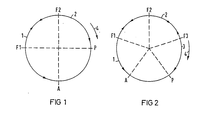
- FIG. 1 shows the arrangement of the pressing tools and the working positions for a division of four with the filling periods F1, F2, presses P and ejection A, on a multi-position press machine.
- the circular parts 1 and 2 show the area for the chronological sequence of the filling periods 1 and 2 respectively.
- the direction arrow 4 shows the direction of rotation of the press table.
- FIG. 2 shows a schematic representation of the arrangement of the pressing tools and the working positions for a division of five Press table on with three filling periods F1, F2 and F3, presses P and ejection A.
- the circular parts 1, 2 and 3 show the area of the filling periods F1, F2 and F3.
- the direction arrow 4 shows the direction of rotation of the press table.
- the die volume is filled using filling devices.
- a filling device e.g. a filling pot moved over the die opening can be used.
- sloping sheets are usually arranged in the filling pot.
- grid-shaped sheets are arranged on the bottom of the filling pot so that wedge effects are reduced when the filling pot is moved over the die opening or when the die is moved under the filling pot.
Landscapes
- Engineering & Computer Science (AREA)
- Mechanical Engineering (AREA)
- Powder Metallurgy (AREA)
- Casting Or Compression Moulding Of Plastics Or The Like (AREA)
- Battery Electrode And Active Subsutance (AREA)
- Press-Shaping Or Shaping Using Conveyers (AREA)
- Sampling And Sample Adjustment (AREA)
- Diaphragms For Electromechanical Transducers (AREA)
- Polishing Bodies And Polishing Tools (AREA)
- Press Drives And Press Lines (AREA)
- Arc Welding In General (AREA)
- Drying Of Solid Materials (AREA)
Description
- Die Erfindung bezieht sich auf ein Verfahren zum Trockenpressen von Formteilen auf Preßautomaten aus pulverförmigen Stoffen mit einem Fließverhalten von mehr als 60 Sekunden pro 100 g Pulver, bei welchem die Pulver mittels einer Fülleinrichtung in einer eigenen Arbeitsposition in die Matrize (Füllraum) eines Preßwerkzeugs mit Unter- und Oberstempel eingefüllt werden, in einer weiteren eigenen Arbeitsposition gepreßt werden und in einer anderen eigenen Arbeitsposition die fertigen Formteile ausgestoßen werden und bei dem die Arbeitsvorgänge schrittweise zyklisch vertauscht werden.
- Ein wesentliches Ziel bei der Massenproduktion von Pulverpreßteilen auf Preßautomaten ist eine kleine Massentoleranz. Die Toleranzen bei gleich großen Teilen ist umso kleiner je besser die Fließeigenschaften eines Pulvers sind. Die Fließeigenschaften sind gekennzeichnet durch die Fließdauer beim Fließen des Pulvers aus einem 60° Normtrichter mit einer Düsenöffnung von 4 mm und einer Düsenlänge von 4 mm. Üblicherweise wird die Fließdauer in Sekunden pro 100 g Pulver angegeben. Gutflie- ßende Pulver liegen in den Fließeigenschaften bei einer Fließdaucer von 20 Sekunden pro 100 g Pulver. Häufig sollen auch Ausgangspulver mit schlechteren Fließeigenschaften auf Preßautomaten bearbeitet werden. Die Fließeigenschaften können durch die bekannten Granulierverfahren wie z.B. mechanische Granulation, thermische Granulation und durch Granulierzusätze oder durch Sprühtrocknung in eine besser fließfähige Form gebracht werden. Verschiedene Pulver sind auch nach den verschiedenen Granulierverfahren nur schlecht fließfähig mit Fließeigenschaften von mehr als 60 Sekunden pro 100 g Pulver. Das Herstellen von Preßkörpern aus pulverförmigen Stoffen auf Preßautomaten ist z.B. bekannt durch die DE-PS 24 20 726.
- Durch die DE-C-563083 ist eine Füllvorrichtung für Rundlaufpreßmaschinen zur Herstellung von Tabletten bekannt, mit der die Gesamtfüllhöhe in einer ersten Füllposition vorgefüllt und dann in einer zweiten Füllposition nachgefüllt wird, nachdem sich das Pulver gesetzt hat. Auf diese Weise können jedoch keine Formteile gepreßt werden, die eine möglichst geringe Porosität aufweisen, wie sie für die Verwendung als Kontaktstücke in Schaltern der elektrischen Energietechnik erforderlich sind.
- Der Erfindung liegt daher die Aufgabe zugrunde, die bekannten Verfahren so zu verbessern, daß es möglich ist, pulverförmige Stoffe wie z.B. Metallpulver, keramische Pulver, Metalloxidpulver oder Mischpulver verschiedener Komponenten mit einem Fließverhalten von mehr als 60 Sekunden pro 100 g Pulver auf Preßautomaten zu Formteilen mit kleinen Gewichts- oder Massentoleranzen zu verarbeiten.
- Gemäß der Erfindung wird die Aufgabe dadurch gelöst, daß
- a) der vor dem Pressen erfolgende Gesamtfüllvorgang für die Matrize in mindestens zwei direkt aufeinanderfolgende Füllperioden (F1, F2) unterteilt ist und
- b) jeder Füllperiode (F1 bzw. F2) eine definierte Teilfüllhöhe zugeordnet ist.
- Eine Einflußgröße beim Füllen einer Preßform ist neben der Größe, z.B. des Durchmessers, auch das Verhältnis von Höhe zu Durchmesser der Preßform. Insbesondere sollen mit dem Verfahren gemäß der Erfindung Formteile gepreßt werden mit einer Geometrie, die sich aus dem vorgegebenen Verhältnis von Füllhöhe zu Durchmesser größer als 2 ergibt. Bei Hohlteilen ist das Verhältnis Füllhöhe zu Wanddicke einzusetzen. Bei preßtechnisch ungünstigen Geometrien kann das Füllhöhen/ Durchmesseroder Füllhöhen/Wanddicken-Verhältnis mehr als 10 betragen.
- Bei schlecht fließenden Pulvern, Fließverhalten mehr als 60 Sekunden pro 100 g Pulver, entsteht bei Verwendung nur einer Fülleinrichtung ein Hohlraum innerhalb des im Fülltopf befindlichen Pulvers. Selbst auch bei Rüttelbewegungen des Fülltopfes dauert es eine gewisse Zeit, um die Pulverschicht im Fülltopf wieder aufzufüllen. Durch das Unterteilen der Gesamtfüllhöhe gemäß der Erfindung wird für den Einzelfüllvorgang, z.B. der halben Füllhöhe, in einer Füllperiode nur soviel Pulver benötigt, daß der Nachfließvorgang des Pulvers nicht mehr störend in Erscheinung tritt. Darüber hinaus wird die Zeit für den Füllvorgang der halben Füllhöhe auf etwa den halben Wert reduziert. Für die beschriebenen Hohlteile liegt er dann in einer vergleichbaren Zeit, die auch für den Preßvorgang notwendig ist. Durch Aufteilen der Zeit, die für das Füllen eines hohen Füllraumes erforderlich ist, in zwei oder mehrere Füllhöhen gelangt man beim Pressen auf Mehrpositions-Preßautomaten in einen günstigen Bereich für die Zykluszeit und damit in den Bereich besonders wirtschaftlicher Fertigung.
- Anhand der Zeichnung und eines Ausführungsbeispiels wird die Erfindung näher beschrieben. Es zeigen:
- FIG. 1 in schematischer Darstellung die Anordnung der Preßwerkzeuge und der Arbeitspositionen für eine Viererteilung,
- FIG. 2 in schematischer Darstellung die Anordnung der Preßwerkzeuge und der Arbeitspositionen für eine Fünferteilung.
- FIG. 1 zeigt die Anordnung der Preßwerkzeuge und der Arbeitspositionen für eine Viererteilung mit den Füllperioden F1, F2, Pressen P und Ausstoßen A, auf einem Mehrpositions-Preßautomaten. Die Kreisteile 1 bzw. 2 zeigen den Bereich für den zeitlichen Ablauf der Füllperioden 1 bzw. 2 an. Der Richtungspfeil 4 gibt die Drehrichtung des Pressentisches wieder.
- FIG. 2 zeigt in schematischer Darstellung die Anordnung der Preßwerkzeuge und der Arbeitspositionen für eine Fünferteilung des Pressentisches an mit drei Füllperioden F1, F2 und F3, Pressen P und Ausstoßen A. Die Kreisteile 1, 2 und 3 zeigen den Bereich der Füllperioden F1, F2 und F3 an. Der Richtungspfeil 4 zeigt die Drehrichtung des Pressentisches.
- Beim automatischen Herstellen von Formteilen aus pulverförmigen Stoffen durch Pressen erfolgt das Füllen des Matrizenvolumens über Fülleinrichtungen. Als Fülleinrichtung kann z.B. ein über die Matrizenöffnung bewegter Fülltopf verwendet werden. Zur Konstanthaltung der im Fülltopf befindlichen Pulversäule werden meist im Fülltopf schrägstehende Bleche angeordnet. Des weiteren werden am Boden des Fülltopfes rasterförmige Bleche angeordnet, damit Füllkeile beim Bewegen des Fülltopfes über die Matrizenöffnung oder beim Bewegen der Matrize unter den Fülltopf Keilwirkungen vermindert werden.
Claims (3)
Priority Applications (1)
| Application Number | Priority Date | Filing Date | Title |
|---|---|---|---|
| AT80104444T ATE7870T1 (de) | 1979-08-09 | 1980-07-28 | Verfahren zum trockenpressen von formteilen. |
Applications Claiming Priority (2)
| Application Number | Priority Date | Filing Date | Title |
|---|---|---|---|
| DE19792932420 DE2932420A1 (de) | 1979-08-09 | 1979-08-09 | Verfahren zum trockenpressen von formteilen |
| DE2932420 | 1979-08-09 |
Publications (3)
| Publication Number | Publication Date |
|---|---|
| EP0024005A2 EP0024005A2 (de) | 1981-02-18 |
| EP0024005A3 EP0024005A3 (en) | 1981-07-15 |
| EP0024005B1 true EP0024005B1 (de) | 1984-06-13 |
Family
ID=6078101
Family Applications (1)
| Application Number | Title | Priority Date | Filing Date |
|---|---|---|---|
| EP80104444A Expired EP0024005B1 (de) | 1979-08-09 | 1980-07-28 | Verfahren zum Trockenpressen von Formteilen |
Country Status (8)
| Country | Link |
|---|---|
| US (1) | US4543223A (de) |
| EP (1) | EP0024005B1 (de) |
| JP (1) | JPS5630098A (de) |
| AT (1) | ATE7870T1 (de) |
| DE (2) | DE2932420A1 (de) |
| ES (1) | ES494114A0 (de) |
| GR (1) | GR69844B (de) |
| PT (1) | PT71668B (de) |
Family Cites Families (4)
| Publication number | Priority date | Publication date | Assignee | Title |
|---|---|---|---|---|
| DE563083C (de) * | 1930-04-06 | 1932-11-01 | Fritz Kilian Fa | Geruettelte Fuellvorrichtung fuer Rundlaufpressmaschinen zur Herstellung von Tabletten und aehnlichen Presslingen, insbesondere fuer pharmazeutische Zwecke |
| US2970554A (en) * | 1959-01-09 | 1961-02-07 | Bristol Myers Co | Tablet press |
| US3677674A (en) * | 1971-03-09 | 1972-07-18 | Nat Forge Co | High production isostatic molding device |
| US4080128A (en) * | 1974-04-29 | 1978-03-21 | Siemens Aktiengesellschaft | Apparatus for the production of compacts of layerwise different composition, for heavy duty electric contacts |
-
1979
- 1979-08-09 DE DE19792932420 patent/DE2932420A1/de not_active Withdrawn
-
1980
- 1980-07-28 AT AT80104444T patent/ATE7870T1/de not_active IP Right Cessation
- 1980-07-28 EP EP80104444A patent/EP0024005B1/de not_active Expired
- 1980-07-28 DE DE8080104444T patent/DE3068196D1/de not_active Expired
- 1980-08-07 PT PT71668A patent/PT71668B/de unknown
- 1980-08-07 GR GR62630A patent/GR69844B/el unknown
- 1980-08-08 JP JP10908580A patent/JPS5630098A/ja active Pending
- 1980-08-08 ES ES494114A patent/ES494114A0/es active Granted
-
1983
- 1983-12-14 US US06/561,080 patent/US4543223A/en not_active Expired - Fee Related
Also Published As
| Publication number | Publication date |
|---|---|
| ES8103831A1 (es) | 1981-03-16 |
| JPS5630098A (en) | 1981-03-26 |
| EP0024005A2 (de) | 1981-02-18 |
| US4543223A (en) | 1985-09-24 |
| PT71668B (de) | 1981-07-01 |
| DE3068196D1 (en) | 1984-07-19 |
| GR69844B (de) | 1982-07-19 |
| ES494114A0 (es) | 1981-03-16 |
| PT71668A (de) | 1980-09-01 |
| ATE7870T1 (de) | 1984-06-15 |
| EP0024005A3 (en) | 1981-07-15 |
| DE2932420A1 (de) | 1981-02-26 |
Similar Documents
| Publication | Publication Date | Title |
|---|---|---|
| DE3820411C2 (de) | ||
| DE2456271A1 (de) | Verfahren und vorrichtung zur herstellung von pulver-formpresslingen | |
| CH683243A5 (de) | Verfahren zur Steuerung und/oder Regelung des Pressvorganges einer Steinpresse. | |
| DE69119932T2 (de) | Schieber zur Zweistufenbefüllung von Keramikformen, insbesondere zur Herstellung druckglasierter Keramikplatten | |
| DE2456911C2 (de) | Vorrichtung zur Herstellung von Kohleformkörpern | |
| DE2229537A1 (de) | Vorrichtung zur automatischen herstellung von scheibenbremsbelaegen | |
| EP0246394A2 (de) | Vorrichtung zum Mischen von Sand für Giessereiformen oder Kerne | |
| CH595198A5 (en) | Moulding plant for gas concrete bricks | |
| DE2602547C3 (de) | Formmaschine zur Herstellung von kastenlosen stapelbaren SandgieBformen | |
| EP0024005A2 (de) | Verfahren zum Trockenpressen von Formteilen | |
| DE3304576A1 (de) | Verfahren und vorrichtung zum herstellen von tiefen kegeligen oder zylindrischen keramischen hohlkoerpern aus pulverfoermiger oder granulatartiger pressmasse durch isostatisches pressen | |
| DE3731769C2 (de) | ||
| DE2918081C2 (de) | Anlage zur Herstellung von Gießkernen | |
| DE19824716A1 (de) | Preßanlage zur Herstellung von schalenförmigen keramischen Preßkörpern | |
| DE265394C (de) | ||
| DE2554984C3 (de) | Verfahren und Vorrichtung zur Herstellung von Betonformlingen | |
| DE19537077A1 (de) | Mehrkammerform und Verfahren zur maschinellen Herstellung von Betonformteilen | |
| DE2651144B2 (de) | Verfahren zur Herstellung von Formschalen aus thermohärtbaren flüssigen Massen und Vorrichtung zur Durchführung des Verfahrens | |
| DE4114880A1 (de) | Presse zum verpressen pulverfoermiger massen | |
| DD130774B1 (de) | Verfahren zur herstellung von zweiseitig profilierten formlingen | |
| DE3033252A1 (de) | Verfahren und vorrichtung zum pressen von pulver von formkoerpern von dotierungsstoffen fuer lampen | |
| DE1155883B (de) | Verfahren zur Herstellung von Kernen und Formen fuer Giessereizwecke | |
| DE679628C (de) | Presse zum Herstellen von Presskoerpern mit Teilen aus verschiedenartigen Pressstoffen | |
| DD144657A1 (de) | Verfahren und vorrichtung zum fuellen von matrizen bei drehtischpressen | |
| DE2932397A1 (de) | Verfahren zum herstellen von einschicht-presskoerpern |
Legal Events
| Date | Code | Title | Description |
|---|---|---|---|
| PUAI | Public reference made under article 153(3) epc to a published international application that has entered the european phase |
Free format text: ORIGINAL CODE: 0009012 |
|
| AK | Designated contracting states |
Designated state(s): AT CH DE GB IT SE |
|
| PUAL | Search report despatched |
Free format text: ORIGINAL CODE: 0009013 |
|
| AK | Designated contracting states |
Designated state(s): AT CH DE GB IT SE |
|
| 17P | Request for examination filed |
Effective date: 19811015 |
|
| ITF | It: translation for a ep patent filed | ||
| GRAA | (expected) grant |
Free format text: ORIGINAL CODE: 0009210 |
|
| AK | Designated contracting states |
Designated state(s): AT CH DE GB IT LI SE |
|
| REF | Corresponds to: |
Ref document number: 7870 Country of ref document: AT Date of ref document: 19840615 Kind code of ref document: T |
|
| PGFP | Annual fee paid to national office [announced via postgrant information from national office to epo] |
Ref country code: SE Payment date: 19840630 Year of fee payment: 5 |
|
| REF | Corresponds to: |
Ref document number: 3068196 Country of ref document: DE Date of ref document: 19840719 |
|
| PGFP | Annual fee paid to national office [announced via postgrant information from national office to epo] |
Ref country code: DE Payment date: 19840925 Year of fee payment: 5 |
|
| PGFP | Annual fee paid to national office [announced via postgrant information from national office to epo] |
Ref country code: CH Payment date: 19841023 Year of fee payment: 5 |
|
| PLBE | No opposition filed within time limit |
Free format text: ORIGINAL CODE: 0009261 |
|
| STAA | Information on the status of an ep patent application or granted ep patent |
Free format text: STATUS: NO OPPOSITION FILED WITHIN TIME LIMIT |
|
| 26N | No opposition filed | ||
| PGFP | Annual fee paid to national office [announced via postgrant information from national office to epo] |
Ref country code: AT Payment date: 19860625 Year of fee payment: 7 |
|
| PG25 | Lapsed in a contracting state [announced via postgrant information from national office to epo] |
Ref country code: GB Effective date: 19880728 Ref country code: AT Effective date: 19880728 |
|
| PG25 | Lapsed in a contracting state [announced via postgrant information from national office to epo] |
Ref country code: SE Effective date: 19880729 |
|
| PG25 | Lapsed in a contracting state [announced via postgrant information from national office to epo] |
Ref country code: LI Effective date: 19880731 Ref country code: CH Effective date: 19880731 |
|
| GBPC | Gb: european patent ceased through non-payment of renewal fee | ||
| REG | Reference to a national code |
Ref country code: CH Ref legal event code: PL |
|
| PG25 | Lapsed in a contracting state [announced via postgrant information from national office to epo] |
Ref country code: DE Effective date: 19890401 |
|
| EUG | Se: european patent has lapsed |
Ref document number: 80104444.7 Effective date: 19890510 |