EP0025009A2 - Stabilizer mixture consisting of a metal mercaptide and an ester of boric acid and its use as stabilizer for halogenated polymers - Google Patents
Stabilizer mixture consisting of a metal mercaptide and an ester of boric acid and its use as stabilizer for halogenated polymers Download PDFInfo
- Publication number
- EP0025009A2 EP0025009A2 EP80810212A EP80810212A EP0025009A2 EP 0025009 A2 EP0025009 A2 EP 0025009A2 EP 80810212 A EP80810212 A EP 80810212A EP 80810212 A EP80810212 A EP 80810212A EP 0025009 A2 EP0025009 A2 EP 0025009A2
- Authority
- EP
- European Patent Office
- Prior art keywords
- alkyl
- group
- formula
- coor
- stabilizer
- Prior art date
- Legal status (The legal status is an assumption and is not a legal conclusion. Google has not performed a legal analysis and makes no representation as to the accuracy of the status listed.)
- Withdrawn
Links
Classifications
-
- C—CHEMISTRY; METALLURGY
- C08—ORGANIC MACROMOLECULAR COMPOUNDS; THEIR PREPARATION OR CHEMICAL WORKING-UP; COMPOSITIONS BASED THEREON
- C08K—Use of inorganic or non-macromolecular organic substances as compounding ingredients
- C08K5/00—Use of organic ingredients
- C08K5/56—Organo-metallic compounds, i.e. organic compounds containing a metal-to-carbon bond
- C08K5/57—Organo-tin compounds
- C08K5/58—Organo-tin compounds containing sulfur
-
- C—CHEMISTRY; METALLURGY
- C08—ORGANIC MACROMOLECULAR COMPOUNDS; THEIR PREPARATION OR CHEMICAL WORKING-UP; COMPOSITIONS BASED THEREON
- C08K—Use of inorganic or non-macromolecular organic substances as compounding ingredients
- C08K5/00—Use of organic ingredients
- C08K5/55—Boron-containing compounds
-
- C—CHEMISTRY; METALLURGY
- C08—ORGANIC MACROMOLECULAR COMPOUNDS; THEIR PREPARATION OR CHEMICAL WORKING-UP; COMPOSITIONS BASED THEREON
- C08K—Use of inorganic or non-macromolecular organic substances as compounding ingredients
- C08K5/00—Use of organic ingredients
- C08K5/59—Arsenic- or antimony-containing compounds
Definitions
- the present invention relates to new stabilizer mixtures consisting of metal mercaptides and cyclic boric acid esters for stabilizing chlorine-containing thermoplastics.
- PVC stabilizer mixtures of tin mercaptides and acyclic boric acids are known from Japanese published patent application 53 / 111.346. However, it has been shown that these mixtures are not always entirely satisfactory in practice, in particular with regard to light and storage stability.
- DE-OS 26 29 202 describes mixtures of antimony mercaptides as stabilizers for vinyl halides.
- Orthoboric acid esters alone are also known from various publications, such as, for example, US Pat. No. 2,912,400 and GB Pat. No. 833,853. In all of these cases, however, the results regarding the stabilizing effect are not quite sufficient in practice.
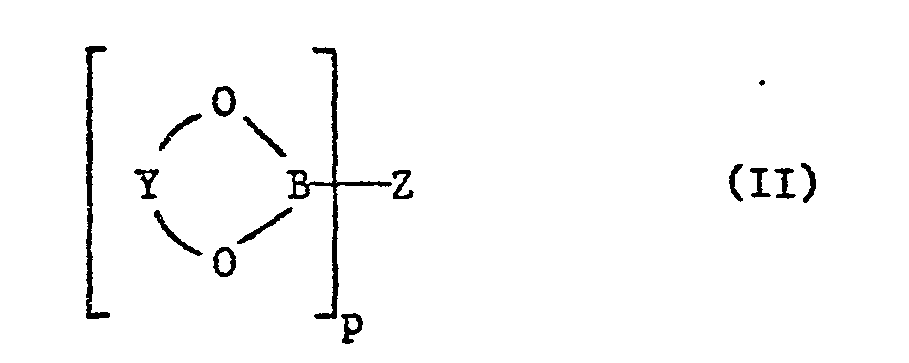
- the present invention relates to stabilizer mixtures consisting of a) a metal mercaptide of the formula I.
- X optionally substituted by one or more groups -OH, -OR 2 , -COOR 2 or -OOCR 2 C 1 -C 18 alkyl, C 3 -C 12 cycloalkyl, C 2 -C 18 alkenyl, cyclohexenyl or one of the groups of the formulas in which n is the numbers 2 to 8 and m is the numbers 1 to 200, R 1 is C 1 -C 18 alkyl, phenyl or benzyl optionally substituted by one or more groups -COOR 2 or -OR 2 and R 2 C 1 - C 18 are alkyl or C 2 -C 18 alkenyl, and a cyclic boric acid ester of the formula II wherein p is the numbers 1 to 4, Y is optionally one or more times by C 1 -C 18 alkyl, halogen or by a group -OR 3 or -COOR 3 substituted o-phenylene or o-naphthylene, where R
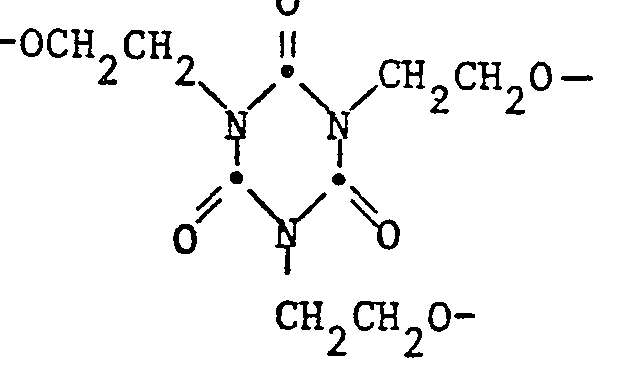
- R 4 is phenyl or npahthyl which is optionally substituted one or more times by C 1 -C 18 alkyl, halogen or by a group -OR 5 , -COOR 5 or -A-COOR 5 , in which AC 1 -C 6 Is alkylene and R 5 has the same meaning as R 2 independently of R, and, if n is 2, Z represents a group -OY 1 -O-, wherein Y 1 has the same meaning as Y independently of Y and furthermore Y 1 C 1 -C 6 alkylene or a group where q is the numbers 2 to 8 and r is the numbers 1 to 200, and furthermore, if n is 3, Z is one of the groups of the formulas -OCH (CH 2 O-) 2 , CH 3 CH 2 -C ( CH 2 O-) 3 or and, when n is 4, Z is a group of the formula C (CH 2 0-) 4 .
- any substituents are halogen, it is preferably bromine or, in particular, chlorine.
- any substituents are C 1 -C 18 alkyl, they are, for example, methyl, ethyl, n-propyl, isopropyl, n-butyl, sec-butyl, tert-butyl, n-pentyl, n-hexyl, 2-methyl -pentyl, 2,4-dimethylpentyl, n-octyl, 6-methylheptyl, 2-ethylhexyl, n-nonyl, branched or unbranched decyl, dodecyl, tridecyl, tetradecyl, hexadecyl or octadecyl.
- any substituents are C 3 -C 12 cycloalkyl, they mean in particular cyclopentyl, cycloheptyl and preferably cyclohexyl.
- Any C 2 -C 18 alkenyl substituents are, for example, vinyl, allyl, methallyl, or branched or unbranched 2-butenyl, 2-hexenyl, 3-hexenyl, 2-octenyl, 2-dodecenyl, 3-dodecenyl, 2-tetradecenyl, 2-hexadecenyl or 2-octadecenyl. Allyl is preferred.
- a denotes or Y 1 is C 1 -C 6 alkylene, it is branched or in particular straight-chain alkylene such as methylene, ethylene, tri-, tetra-, penta- or hexamethylene. Methylene, ethylene and trimethylene are preferred.
- R 7 as C1-C8 alkyl is, for example, methyl, ethyl, n-propyl, isopropyl, n-butyl, tert-butyl, n-pentyl, n-hexyl, 2-methyl-pentyl, 2,4-dimethylpentyl, n- Octyl and especially 2-ethylhexyl.
- Stabilizer mixtures which contain an antimony mercaptide of the formula Sb (SX) 3 as component a), in which X has the meaning given above.
- the mixing ratio of a) and b) varies, for example, between 50:50 and 99: 1, preferably between 80:20 and 98: 2 parts by weight.
- Solvents can also be present in the stabilizer mixture.
- the metal mercaptides of the formula I are generally known and can be prepared by known methods.
- the cyclic boric acid esters of the formula II are known per se. If some of them are still new, they can be prepared in analogy to known reactions, for example by reacting boron trioxide (B 2 0 3 ) with an aromatic o-dihydroxy compound or with a mixture of an aromatic o-dihydroxy compound and a single , di-, tri- or tetravalent alcohol or phenol in the corresponding molar ratio, in the presence of a solvent suitable as a tug. After removing the water of reaction, the solvent is removed by distillation. Another Purification of the reaction product is often not necessary, but can optionally be carried out by recrystallization or by rectification.
- the synergistic stabilizer mixture according to the invention is outstandingly suitable for protection against degradation by the action of heat from chlorine-containing thermoplastics.
- the individual constituents of the stabilizer mixture are mixed individually or already, and the thermoplastics to be stabilized are incorporated in the above-mentioned mixing ratio before processing in conventional facilities, in each case in amounts of 0.05 to 4.0, preferably 0.1 to 0.5,% by weight. -%, based on the total composition.
- thermoplastics polyvinylidene chloride and preferably polymers made of or based on vinyl chloride. Suspension and bulk polymers and washed-out, ie low-emulsifier, emulsion polymers are preferred. Polyvinyl chloride can be plasticized or rigid PVC.
- thermoplastics based on vinyl chloride vinilidene chloride, transdichloroethene, ethylene, propylene, butylene, maleic acid, acrylic acid, fumaric acid or itaconic acid.
- Preferred costabilizers are Ca salts of carboxylic acids and / or phenols, which can be present in an amount of 0.05 to 4.0% by weight, based on the overall composition.
- a preferred formulation for a chlorine-containing thermoplastic stabilized with the stabilizer mixture according to the invention is the following:
- the stabilization mixture according to the invention ensures an excellent thermostabilizing effect, which far exceeds that of the individual components.
- Parts are parts by weight and percentages, percentages by weight.
- Example 1 55.1 g of pyrocatechol (0.5 mol), 17.4 g of boron trioxide (0.25 mol), 37.5 g of triethylene glycol (0.25 mol) and 250 g of toluene are mixed together. The mixture is kept at the boil for 1 hour and the water formed is removed using a water separator. After the solvent has been distilled off, an oily, light brown liquid remains, which contains a compound of the following formula as the main constituent: Yield: 99% of theory.
- Example 2 44.0 g of pyrocatechol (0.4 mol), 13.9 g of boron trioxide (0.2 mol), 29.7 g of n-butanol (0 , 4 mol) and 250 g of toluene are reacted in the same manner as in Example 1. After removing the solvent, a brown liquid remains which, by distillation, gives the orthoboric acid ester of the following formula: The compound is a water-clear liquid with a boiling point of 97 to 98 ° C / l mm. .
- Example 2 In Example 2, the butanol is replaced with the equivalent amount of isotridecanol (iC 13 H 27 OH: mixture of short-chain branched alcohols, such as 2,5,7-trimethyl-decanol and others; supplier Ruhrchemie), so you get a compound of the formula The compound is a light yellow liquid with a boiling point of 145-150 ° C / 0.1 mm. Analysis: 3.2% B (calculated 3.4%).
- isotridecanol iC 13 H 27 OH: mixture of short-chain branched alcohols, such as 2,5,7-trimethyl-decanol and others; supplier Ruhrchemie
- Example 4 If the butanol in Example 2 is replaced with the equivalent amount of triethylene glycol n-butyl ether, a compound of the formula is obtained The compound is an oily light brown liquid. Analysis: 3.2% B (calculated 3.3%).
- a dry mixture consisting of 100 parts of S-PVC (K value), 1.0 part of chalk, 1.0 part of rutile, 0.8 parts of paraffin wax, 0.8 parts of Ca stearate and the parts indicated in Table 1 below
- the amount of the two stabilizers a) and b) is rolled on a laboratory rolling mill at 200 ° C.
- a 0.3 mm thick piece of film is removed every 3 minutes to assess the discoloration.
- the yellowing that has occurred (yellowness index YI) is determined as a measure of the thermal stability in accordance with ASTM D 1925-70.
- the antimony mercaptide of the formula Sb [SCH 2 COO-CH 2 -CH (C 2 H 5 ) -C 4 H 9 ] (stabilizer I) has been used as component a)
- Test No. 1 which contains no boron compound
- Tests 2 to 9 in which different boron compounds are used in varying amounts, demonstrates the synergistic effect of the benzodioxaborols, which by themselves have no effect in PVC.
Landscapes
- Chemical & Material Sciences (AREA)
- Health & Medical Sciences (AREA)
- Chemical Kinetics & Catalysis (AREA)
- Medicinal Chemistry (AREA)
- Polymers & Plastics (AREA)
- Organic Chemistry (AREA)
- Compositions Of Macromolecular Compounds (AREA)
Abstract
Description
Die vorliegende Erfindung betrifft neue Stabilisatorgemische bestehend aus Metallmercaptiden und cyclischen Borsäureestern zur Stabilisierung von chlorhaltigen Thermoplasten.The present invention relates to new stabilizer mixtures consisting of metal mercaptides and cyclic boric acid esters for stabilizing chlorine-containing thermoplastics.
Aus der Japanischen Offenlegungsschrift 53/111.346 sind PVC-Stabilisatorgemische aus Zinnmercaptiden und acyclischen Borsäuren bekannt. Es hat sich aber gezeigt, dass diese Gemische in der Praxis insbesondere bezüglich Licht- und Lagerstabilität nicht immer ganz befriedigend sind. Als Stabilisierungsmittel für Vinylhalogenide sind in der DE-OS 26 29 202 Gemische aus Antimonmercaptiden beschrieben. Auch Orthoborsäureester allein sind aus verschiedenen Publikationen, wie beispielsweise die US-PS 2 912 400 und die GB-PS 833 853 bekannt. In allen diesen Fällen sind jedoch die Resultate bezüglich stabilisierender Wirkung für die Praxis nicht ganz ausreichend.PVC stabilizer mixtures of tin mercaptides and acyclic boric acids are known from Japanese published patent application 53 / 111.346. However, it has been shown that these mixtures are not always entirely satisfactory in practice, in particular with regard to light and storage stability. DE-OS 26 29 202 describes mixtures of antimony mercaptides as stabilizers for vinyl halides. Orthoboric acid esters alone are also known from various publications, such as, for example, US Pat. No. 2,912,400 and GB Pat. No. 833,853. In all of these cases, however, the results regarding the stabilizing effect are not quite sufficient in practice.
Es ist nun gefunden worden, dass Gemische aus Antimon- oder Zinnmercaptiden mit cyclischen Borsäureestern eine überraschend gute, für die Praxis befriedigende Stabilisierung von chlorhaltigen Thermoplasten und, insbesondere bei Verwendung von Antimonmercaptiden auch unerwartet hohe Licht- und Lagerstabilität gewährleisten.It has now been found that mixtures of antimony or tin mercaptides with cyclic boric acid esters ensure a surprisingly good, in practice satisfactory stabilization of chlorine-containing thermoplastics and, especially when using antimony mercaptides, also unexpectedly high light and storage stability.
Demnach betrifft die vorliegende Erfindung Stabilisatorgemische bestehend aus a) einem Metallmercaptid der Formel I


Stellen etwaige Substituenten Halogen dar so handelt es sich vorzugsweise um Brom oder insbesondere um Chlor.If any substituents are halogen, it is preferably bromine or, in particular, chlorine.
Bedeuten etwaige Substituenten CI-C18 Alkyl so handelt es sich beispielsweise um Methyl, Aethyl, n-Propyl, Isopropyl, n-Butyl, sec.-Butyl, tert.-Butyl, n-Pentyl, n-Hexyl, 2-Methyl-pentyl, 2,4-Dimethylpentyl, n-Octyl, 6-Methylheptyl, 2-Aethylhexyl, n-Nonyl, verzweigtes oder unverzweigtes Decyl, Dodecyl, Tridecyl, Tetradecyl, Hexadecyl oder Octadecyl.If any substituents are C 1 -C 18 alkyl, they are, for example, methyl, ethyl, n-propyl, isopropyl, n-butyl, sec-butyl, tert-butyl, n-pentyl, n-hexyl, 2-methyl -pentyl, 2,4-dimethylpentyl, n-octyl, 6-methylheptyl, 2-ethylhexyl, n-nonyl, branched or unbranched decyl, dodecyl, tridecyl, tetradecyl, hexadecyl or octadecyl.
Stellen etwaige Substituenten C3-C12 Cycloalkyl dar, so bedeuten sie insbesondere Cyclopentyl, Cycloheptyl und bevorzugt Cyclohexyl.If any substituents are C 3 -C 12 cycloalkyl, they mean in particular cyclopentyl, cycloheptyl and preferably cyclohexyl.
Bedeuten etwaige Substituenten C2-C18 Alkenyl, so handelt es sich beispielsweise um Vinyl, Allyl, Methallyl, oder verzweigtes oder unverzweigtes 2-Butenyl, 2-Hexenyl, 3-Hexenyl, 2-Octenyl, 2-Dodecenyl, 3-Dodecenyl, 2-Tetradecenyl, 2-Hexadecenyl oder 2-Octadecenyl. Bevorzugt ist Allyl.Any C 2 -C 18 alkenyl substituents are, for example, vinyl, allyl, methallyl, or branched or unbranched 2-butenyl, 2-hexenyl, 3-hexenyl, 2-octenyl, 2-dodecenyl, 3-dodecenyl, 2-tetradecenyl, 2-hexadecenyl or 2-octadecenyl. Allyl is preferred.
Bedeuten A oder Y1 C1-C6 Alkylen, so handelt es sich um verzweigtes oder insbesondere geradkettiges Alkylen, wie beispielsweise Methylen, Aethylen , Tri-, Tetra-, Penta- oder Hexamethylen. Bevorzugt sind Methylen, Aethylen und Trimethylen.A denotes or Y 1 is C 1 -C 6 alkylene, it is branched or in particular straight-chain alkylene such as methylene, ethylene, tri-, tetra-, penta- or hexamethylene. Methylene, ethylene and trimethylene are preferred.
Besonders interessant sind Stabilisatorgemische bestehend aus
- a) einem Metallmercaptid der Formel I, worin

- b) einem cyclischen Borsäureester der Formel II, worin p die Zahlen 1 oder 2 bedeutet, Y o-Phenylen ist und, wenn n 1 ist, Z -OX1 bedeutet, worin X1 C1-C18 Alkyl oder eine Gruppe (̵CH2CH2O)̵mR6 ist, wobei m die Zahlen 1 bis 3 sein kann und R6 C1-C4 Alkyl bedeutet, und, wenn n 2 ist, Z eine Gruppe -O-Y1-O- ist, worin Y1 C1-C3 Alkylen, o-Phenylen oder die Gruppe (̵-CH2CH2O)̵r-CH2CH2- bedeutet, worin r die Zahlen 1 oder 2 sein können. R6 ist als C1-C4 Alkyl beispielsweise Methyl, Aethyl, n-Propyl, Isopropyl, sec.-Butyl, tert.-Butyl, insbesondere jedoch n-Butyl.
- Von ganz besonderem Interesse sind Stabilisatorgemische bestehend aus
- a) einem Metallmercaptid der Formel I, worin Q die in der letzten Bevorzugung angegebene Bedeutung hat und X eine Gruppe -CH2-COOR7 oder -CH2CH2-COOR7 bedeutet, worin R7 C1-C8 Alkyl ist, und
- b) einem cyclischen Borsäureester der Formel II worin p, Y und Z die in der letzten Bevorzugung angegebene Bedeutung haben.
- a) a metal mercaptide of formula I, wherein
- b) a cyclic boric acid ester of the formula II, in which p is 1 or 2, Y is o-phenylene and, if n is 1, Z is -OX 1 , in which X 1 is C 1 -C 18 alkyl or a group (̵CH 2 CH 2 O) ̵ m R 6 , where m can be the numbers 1 to 3 and R 6 is C 1 -C 4 alkyl, and, if n is 2, Z is a group -OY 1 -O-, wherein Y 1 is C 1 -C 3 alkylene, o-phenylene or the group (̵-CH 2 CH 2 O) ̵ r -CH 2 CH 2 -, in which r can be the numbers 1 or 2. R 6 as C 1 -C 4 alkyl is, for example, methyl, ethyl, n-propyl, isopropyl, sec-butyl, tert-butyl, but especially n-butyl.
- Stabilizer mixtures consisting of are of particular interest
- a) a metal mercaptide of the formula I in which Q has the meaning given in the last preference and X denotes a group -CH 2 -COOR 7 or -CH 2 CH 2 -COOR 7 , in which R 7 is C 1 -C 8 alkyl, and
- b) a cyclic boric acid ester of the formula II where p, Y and Z have the meaning given in the last preference.
R7 ist als C1-C8 Alkyl beispielsweise Methyl, Aethyl, n-Propyl, Isopropyl, n-Butyl, tert.-Butyl, n-Pentyl, n-Hexyl, 2-Methyl-pentyl, 2,4-Dimethylpentyl, n-Octyl und insbesondere 2-Aethylhexyl.R 7 as C1-C8 alkyl is, for example, methyl, ethyl, n-propyl, isopropyl, n-butyl, tert-butyl, n-pentyl, n-hexyl, 2-methyl-pentyl, 2,4-dimethylpentyl, n- Octyl and especially 2-ethylhexyl.
Bevorzugt sind Stabilisatorgemische, die als Komponente a) ein Antimonmercaptid der Formel Sb(SX)3 enthalten, worin X die oben angegebene Bedeutung hat.Stabilizer mixtures are preferred which contain an antimony mercaptide of the formula Sb (SX) 3 as component a), in which X has the meaning given above.
Das Mischungsverhältnis von a) und b) variiert beispielsweise zwischen 50:50 und 99:1, bevorzugt zwischen 80:20 und 98:2 Gewichtsteilen.The mixing ratio of a) and b) varies, for example, between 50:50 and 99: 1, preferably between 80:20 and 98: 2 parts by weight.
Im Stabilisatorgemisch können auch Lösungsmittel enthalten sein.Solvents can also be present in the stabilizer mixture.
Die Metallmercaptide der Formel I sind allgemein bekannt und können nach bekannten Methoden hergestellt werden.The metal mercaptides of the formula I are generally known and can be prepared by known methods.
Die cyclischen Borsäureester der Formel II sind an sich bekannt. Sollten einzelne von ihnen noch neu sein, so können sie in Analogie zu bekannten Reaktionen hergestellt werden, z.B. durch Umsetzung von Bortrioxid (B203) mit einer aromatischen o-Dihydroxyverbindung oder mit einem Gemisch aus einer aromatischen o-Dihydroxyverbindung und einem ein-, zwei-, drei- oder vierwertigen Alkohol bzw. Phenol im entsprechenden Molverhältnis, in Gegenwart eines als Schlepper geeigneten Lösungsmittels. Nach Entfernung des Reaktionswassers wird das Lösungsmittel destillativ entfernt. Eine weitere Reinigung des Reaktionsproduktes ist oft nicht erforderlich, kann aber gegebenenfalls durch Umkristallisieren oder durch Rektifizierung erfolgen.The cyclic boric acid esters of the formula II are known per se. If some of them are still new, they can be prepared in analogy to known reactions, for example by reacting boron trioxide (B 2 0 3 ) with an aromatic o-dihydroxy compound or with a mixture of an aromatic o-dihydroxy compound and a single , di-, tri- or tetravalent alcohol or phenol in the corresponding molar ratio, in the presence of a solvent suitable as a tug. After removing the water of reaction, the solvent is removed by distillation. Another Purification of the reaction product is often not necessary, but can optionally be carried out by recrystallization or by rectification.
Das erfindungsgemässe synergistische Stabilisatorgemisch eignet sich hervorragend zum Schutz gegen den Abbau durch Wärmeeinwirkung von chlorhaltigen Thermoplasten.The synergistic stabilizer mixture according to the invention is outstandingly suitable for protection against degradation by the action of heat from chlorine-containing thermoplastics.
Die Einzelbestandteile des Stabilisatorgemisches werden einzeln oder bereits vermischt, im oben erwähnten Mischungsverhältnis den zu stabilisierenden Thermoplasten vor der Verarbeitung in üblichen Einrichtungen einverleibt, und zwar in jeweiligen Mengen von 0,05 bis 4,0, bevorzugt 0,1 bis 0,5 Gew.-%, bezogen auf die gesamte Zusammensetzung.The individual constituents of the stabilizer mixture are mixed individually or already, and the thermoplastics to be stabilized are incorporated in the above-mentioned mixing ratio before processing in conventional facilities, in each case in amounts of 0.05 to 4.0, preferably 0.1 to 0.5,% by weight. -%, based on the total composition.
Als chlorhaltige Thermoplaste seien genannt: Polyvinylidenchlorid und bevorzugt Polymere aus oder auf der Grundlage von Vinylchlorid. Bevorzugt sind Suspensions- und Massepolymere und ausgewaschene, also emulgatorarme Emulsionspolymere. Beim Polyvinylchlorid kann es sich um weichmacherhaltiges oder um Hart-PVC handeln.The following may be mentioned as chlorine-containing thermoplastics: polyvinylidene chloride and preferably polymers made of or based on vinyl chloride. Suspension and bulk polymers and washed-out, ie low-emulsifier, emulsion polymers are preferred. Polyvinyl chloride can be plasticized or rigid PVC.
Als Comonomere für Thermoplaste auf der Grundlage von Vinylchlorid seien genannt: Vinilidenchlorid, Transdichloräthen, Aethylen, Propylen, Butylen, Maleinsäure, Acrylsäure, Fumarsäure oder Itaconsäure.The following may be mentioned as comonomers for thermoplastics based on vinyl chloride: vinilidene chloride, transdichloroethene, ethylene, propylene, butylene, maleic acid, acrylic acid, fumaric acid or itaconic acid.
Vor, während oder nach der Zugabe des erfindungsgemässen Stabilisätorgemisches können je nach Verwendungszweck der Formmasse weitere Zusätze einverleibt werden.Depending on the intended use of the molding composition, further additives can be incorporated before, during or after the addition of the stabilizer mixture according to the invention.
Als weitere Additive, mit denen zusammen die erfindungsgemäss verwendbaren Stabilisatoren eingesetzt werden können, sind beispielsweise zu nennen:
- Antioxydantien, wie 2,6-Dialkylphenole, Derivate von alkylierten Hydrochinonen, hydroxylierte Thiodiphenyläther, Alkyliden-bisphenole, 0-, N- und S-Benzylverbindungen, hydroxybenzylierte Malonester, Hydroxybenzyl-Aromaten, 2-Triazinverbindungen, Amide der 'ß-(3,5-Di-tert.-butyl-4-hydroxyphenyl)-propionsäure, Ester der β-(3,5-Di-tert.-butyl-4-hydroxyphenyl)-propionsäure, Ester der β-(5-tert.-Butyl-4-hydroxy-3-methylphenyl)-propionsäure, Ester der 3,5-Di-tert.-butyl-4-hydroxyphenylessigsäure, Acylaminophenole, Benzylphosphonate, Aminoarylderivate, UV-Absorber und Lichtschutzmittel, wie 2-(2'-Hydroxyphenyl)-benztriazole, 2,4-Bis-(2'-hydroxyphenyl)-6-alkyl-s-triazine, 2-Hydroxybenzophenone, 1,3-Bis-(2'-hydroxybenzoyl)-benzole, Ester von gegebenenfalls substituierten Benzoesäuren, Acrylate, des weiteren Nickelverbindungen, sterisch gehinderte Amine, Oxalsäurediamide, Metalldesaktivatoren, Phosphite, peroxidzerstörende Verbindungen, Polyamidstabilisatoren, basische Costabilisatoren, Nukleierungsmittel oder sonstige Zusätze, wie z.B. Weichmacheer, Gleitmittel, Emulgatoren, Füllstoffe, Russ, Asbest, Kaolin, Talk, Glasfasern, Pigmente, optische Aufheller, Flammschutzmittel, Antistatica.
- Antioxidants such as 2,6-dialkylphenols, derivatives of alkylated hydroquinones, hydroxylated thiodiphenyl ethers, alkylidene bisphenols, 0-, N- and S-benzyl compounds, hydroxybenzylated malonic esters, hydroxybenzyl aromatics, 2-triazine compounds, amides of the 'ß- (3, 5-di-tert-butyl-4-hydroxyphenyl) propionic acid, esters of β- (3,5-di-tert-butyl-4-hydroxyphenyl) propionic acid, esters of β- (5-tert-butyl -4-hydroxy-3-methylphenyl) propionic acid, esters of 3,5-di-tert-butyl-4-hydroxyphenylacetic acid, acylaminophenols, benzylphosphonates, aminoaryl derivatives, UV absorbers and light stabilizers, such as 2- (2'-hydroxyphenyl) -benztriazoles, 2,4-bis- (2'-hydroxyphenyl) -6-alkyl-s-triazines, 2-hydroxybenzophenones, 1,3-bis- (2'-hydroxybenzoyl) benzenes, esters of optionally substituted benzoic acids, acrylates , furthermore nickel compounds, sterically hindered amines, oxalic acid diamides, metal deactivators, phosphites, peroxide-destroying compounds, polyamide stabilizers, basic costabilizers, nucleating agents agents or other additives, such as softeners, lubricants, emulsifiers, fillers, carbon black, asbestos, kaolin, talc, glass fibers, pigments, optical brighteners, flame retardants, antistatic agents.
Beispiele für weitere Additive, mit denen zusammen die erfindungsgemäss verwendbaren Stabilisatoren eingesetzt werden können, finden sich in der DE-OS 2 427 853 auf Seiten 18 bis 24.Examples of further additives with which the stabilizers which can be used according to the invention can be used can be found in DE-OS 2 427 853 on pages 18 to 24.
Bevorzugte Costabilisatoren sind Ca-Salze von Carbonsäuren und/oder Phenolen, die in einer Menge von 0,05 bis 4,0 Gew.-% bezogen auf die gesamte Zusammensetzung enthalten sein können.Preferred costabilizers are Ca salts of carboxylic acids and / or phenols, which can be present in an amount of 0.05 to 4.0% by weight, based on the overall composition.
Eine bevorzugte Formulierung für einen mit der erfindungsgemässen Stabilisatormischung stabilisierten chlorhaltigen Thermoplasten ist die folgende:

Das erfindungsgemässe Stabilisationsgemisch gewährleistet eine ausgezeichnete thermostabilisierende Wirkung, welche diejenige der Einzelkomponenten weit übersteigt.The stabilization mixture according to the invention ensures an excellent thermostabilizing effect, which far exceeds that of the individual components.
Die nachfolgenden Beispiele dienen der näheren Erläuterung der Erfindung. Teile sind dabei Gewichtsteile und Prozente, Gewichtsprozente.The following examples serve to explain the invention in more detail. Parts are parts by weight and percentages, percentages by weight.
Beispiel 1 : 55,1 g Brenzcatechin (0,5 Mol), 17,4 g Bortrioxid (0,25 Mol), 37,5 g Triäthylenglykol (0,25 Mol) und 250 g Toluol werden miteinander vermischt. Die Mischung wird 1 Stunde lang am Sieden gehalten, das entstehende Wasser mit Hilfe eines Wasserabscheiders entfernt. Nach dem Abdestillieren des Lösungsmittels verbleibt eine ölige, hellbraune Flüssigkeit, die als Hauptbestandteil eine Verbindung der folgenden Formel enthält:



Beispiel 4: Ersetzt man in Beispiel 2 das Butanol mit der äquivalenten Menge Triäthylenglykol-n-butyläther, so erhält man eine Verbindung der Formel

Eine Trockenmischung bestehend aus 100 Teilen S-PVC (K-Wert), 1,0 Teil Kreide, 1,0 Teil Rutil, 0,8 Teilen Paraffinwachs, 0,8 Teilen Ca-Stearat sowie der in der nachstehenden Tabelle 1 in Teilen angegebenen Menge der beiden Kostabilisatoren a) und b) wird auf einem Laborwalzwerk bei 200° C gewalzt. Alle 3 Minuten wird ein 0,3 mm dickes Folienstück zur Beurteilung der Verfärbung entnommen. Als Mass für die Thermostabilität wird die eingetretene Vergilbung (Yellowness-Index YI) nach ASTM D 1925-70 bestimmt.A dry mixture consisting of 100 parts of S-PVC (K value), 1.0 part of chalk, 1.0 part of rutile, 0.8 parts of paraffin wax, 0.8 parts of Ca stearate and the parts indicated in Table 1 below The amount of the two stabilizers a) and b) is rolled on a laboratory rolling mill at 200 ° C. A 0.3 mm thick piece of film is removed every 3 minutes to assess the discoloration. The yellowing that has occurred (yellowness index YI) is determined as a measure of the thermal stability in accordance with ASTM D 1925-70.
Als Komponente a) ist das Antimonmercaptid der Formel Sb[SCH2COO-CH2-CH(C2H5)-C4H9] (Stabilisator I) verwendet worden

Ein Vergleich des Tests Nr. 1, der keine Borverbindung enthält, mit den Tests 2 bis 9, bei denen verschiedene Borverbindungen in wechselnden Mengen verwendet werden, demonstriert die synergistische Wirkung der Benzodioxaborole, die für sich allein in PVC keine Wirkung haben.A comparison of Test No. 1, which contains no boron compound, with Tests 2 to 9, in which different boron compounds are used in varying amounts, demonstrates the synergistic effect of the benzodioxaborols, which by themselves have no effect in PVC.
Claims (9)




Applications Claiming Priority (2)
| Application Number | Priority Date | Filing Date | Title |
|---|---|---|---|
| CH6196/79 | 1979-07-03 | ||
| CH619679 | 1979-07-03 |
Publications (2)
| Publication Number | Publication Date |
|---|---|
| EP0025009A2 true EP0025009A2 (en) | 1981-03-11 |
| EP0025009A3 EP0025009A3 (en) | 1981-03-18 |
Family
ID=4305775
Family Applications (1)
| Application Number | Title | Priority Date | Filing Date |
|---|---|---|---|
| EP80810212A Withdrawn EP0025009A3 (en) | 1979-07-03 | 1980-06-27 | Stabilizer mixture consisting of a metal mercaptide and an ester of boric acid and its use as stabilizer for halogenated polymers |
Country Status (2)
| Country | Link |
|---|---|
| EP (1) | EP0025009A3 (en) |
| JP (1) | JPS5611938A (en) |
Family Cites Families (5)
| Publication number | Priority date | Publication date | Assignee | Title |
|---|---|---|---|---|
| US3244662A (en) * | 1963-09-10 | 1966-04-05 | Nat Polychemicals Inc | Polymers stabilized by a combination of organic phosphites and organic borates |
| US3644217A (en) * | 1968-12-02 | 1972-02-22 | Universal Oil Prod Co | Synergistic mixture and use thereof |
| US3928285A (en) * | 1975-01-16 | 1975-12-23 | Cincinnati Milacron Inc | Synergistic organotin borate stabilizer composition and resins containing same |
| US4021407A (en) * | 1976-06-28 | 1977-05-03 | Cincinnati Milacron, Inc. | Synergistic organotin borate stabilizer compositions and resins containing same |
| US4231895A (en) * | 1979-01-02 | 1980-11-04 | M & T Chemicals Inc. | Synergistic heat stabilizer compositions containing an antimony or a bismuth compound |
-
1980
- 1980-06-27 EP EP80810212A patent/EP0025009A3/en not_active Withdrawn
- 1980-07-03 JP JP9120880A patent/JPS5611938A/en active Pending
Also Published As
| Publication number | Publication date |
|---|---|
| EP0025009A3 (en) | 1981-03-18 |
| JPS5611938A (en) | 1981-02-05 |
Similar Documents
| Publication | Publication Date | Title |
|---|---|---|
| EP0041479B1 (en) | Chlorine-containing thermoplastic polymers stabilized with amino-thiouracils | |
| EP0022749B1 (en) | Alcanolamid-beta-ketocarboxylic acid esters and their use as stabilizers for chlorine-containing thermoplastics | |
| EP0002007B1 (en) | Pyridine dicarboxylic acid derivatives, their mixtures with metallic stabilisers and their use in stabilising chlorine-containing thermoplasts | |
| EP0065934B1 (en) | Chlorine-containing thermoplastic polymers stabilised with amino uracils | |
| DE2540655A1 (en) | ANTISTATIC THERMOPLASTIC MOLDING COMPOSITIONS AND MOLDED BODIES | |
| DE2929993A1 (en) | NEW STABILIZERS | |
| EP0224438B1 (en) | Alpha-beta-unsaturated carbonyl compounds | |
| EP0244362A2 (en) | Compositions stabilized by aminoxysilanes | |
| EP0822221A2 (en) | Novel light stabilisers based on sterically hindered amines | |
| EP0015241B2 (en) | Mixtures consisting of an organo-tin alcoholate and an organo-tin mercaptide; their use as stabilizers for chlorinated polymers | |
| EP0017614A1 (en) | Process for the preparation of esters of mercaptoalcanols with hydroxyphenylcarboxylic acids | |
| DE2703904A1 (en) | STABILIZER COMPOSITION AND PLASTIC COMPOSITION IT CONTAINS | |
| EP0032106B1 (en) | Mixture of n-octyl tin compounds, process of their preparation and their use as stabilizers for halogen containing thermoplastics | |
| EP0001421B1 (en) | Use of mercaptans for the heat-stabilisation of thermoplastic polymers containing halogen | |
| EP0025009A2 (en) | Stabilizer mixture consisting of a metal mercaptide and an ester of boric acid and its use as stabilizer for halogenated polymers | |
| EP0031295B1 (en) | Organic antimony-sulphur compounds, their use as stabilisers in chloric thermoplastics, and thermoplastics so stabilised | |
| EP0553059B1 (en) | Novel cycloalkylidine-bis phenol phosphites | |
| EP0249577B1 (en) | Long chain-(4-hydroxyphenyl)propionate derivatives as stabilizers | |
| DE2608699A1 (en) | PHOSPHONATES, PROCESS FOR THEIR PRODUCTION AND ORGANIC MATERIALS STABILIZED THEREOF | |
| EP0019576A1 (en) | Mixtures of beta-cetocarboxylic acid esters of diols or polyols with a thioether structure and metal-containing stabilisers for the stabilisation of chlorinated thermoplastic polymers | |
| EP0038773A2 (en) | Stabilizing composition based on metal mercaptides and carboxylic acid esters of ortho-dihydric phenols or tetrahalogen ortho-dihydric phenol compounds and thermoplastic polymers containing chloride stabilized therewith | |
| DE2226011A1 (en) | Tns (hydroxyalkylphenyl) derivatives of thiopropionylhexahydrotnazine and their use | |
| EP0321405A2 (en) | Organo-tin-alkoxycarbonyl phenyl mercaptides and their use | |
| DE3416257A1 (en) | NEW PVC STABILIZERS | |
| DE2021088A1 (en) | Hydroxyalkyl alkanoates and hydroxyalkyl benzoates |
Legal Events
| Date | Code | Title | Description |
|---|---|---|---|
| PUAI | Public reference made under article 153(3) epc to a published international application that has entered the european phase |
Free format text: ORIGINAL CODE: 0009012 |
|
| PUAL | Search report despatched |
Free format text: ORIGINAL CODE: 0009013 |
|
| 17P | Request for examination filed |
Effective date: 19800630 |
|
| AK | Designated contracting states |
Designated state(s): DE FR GB NL |
|
| AK | Designated contracting states |
Designated state(s): DE FR GB NL |
|
| STAA | Information on the status of an ep patent application or granted ep patent |
Free format text: STATUS: THE APPLICATION HAS BEEN WITHDRAWN |
|
| 18W | Application withdrawn |
Withdrawal date: 19810411 |
|
| RIN1 | Information on inventor provided before grant (corrected) |
Inventor name: MUELLER, HORST, DR. Inventor name: ABELER, GERD, DR. |