EP0025109A2 - 1-Benzoxepin-5(2H)-on-Derivate und ihre Salze sowie Verfahren zu deren Herstellung - Google Patents
1-Benzoxepin-5(2H)-on-Derivate und ihre Salze sowie Verfahren zu deren Herstellung Download PDFInfo
- Publication number
- EP0025109A2 EP0025109A2 EP80104466A EP80104466A EP0025109A2 EP 0025109 A2 EP0025109 A2 EP 0025109A2 EP 80104466 A EP80104466 A EP 80104466A EP 80104466 A EP80104466 A EP 80104466A EP 0025109 A2 EP0025109 A2 EP 0025109A2
- Authority
- EP
- European Patent Office
- Prior art keywords
- benzoxepin
- group
- alkyl
- hydrogen atom
- formula
- Prior art date
- Legal status (The legal status is an assumption and is not a legal conclusion. Google has not performed a legal analysis and makes no representation as to the accuracy of the status listed.)
- Granted
Links
- 0 CC(C1)C(C)CC(OC)=C1C(*)=O Chemical compound CC(C1)C(C)CC(OC)=C1C(*)=O 0.000 description 1
Classifications
-
- C—CHEMISTRY; METALLURGY
- C07—ORGANIC CHEMISTRY
- C07D—HETEROCYCLIC COMPOUNDS
- C07D313/00—Heterocyclic compounds containing rings of more than six members having one oxygen atom as the only ring hetero atom
- C07D313/02—Seven-membered rings
- C07D313/06—Seven-membered rings condensed with carbocyclic rings or ring systems
- C07D313/08—Seven-membered rings condensed with carbocyclic rings or ring systems condensed with one six-membered ring
-
- A—HUMAN NECESSITIES
- A61—MEDICAL OR VETERINARY SCIENCE; HYGIENE
- A61P—SPECIFIC THERAPEUTIC ACTIVITY OF CHEMICAL COMPOUNDS OR MEDICINAL PREPARATIONS
- A61P1/00—Drugs for disorders of the alimentary tract or the digestive system
-
- A—HUMAN NECESSITIES
- A61—MEDICAL OR VETERINARY SCIENCE; HYGIENE
- A61P—SPECIFIC THERAPEUTIC ACTIVITY OF CHEMICAL COMPOUNDS OR MEDICINAL PREPARATIONS
- A61P1/00—Drugs for disorders of the alimentary tract or the digestive system
- A61P1/14—Prodigestives, e.g. acids, enzymes, appetite stimulants, antidyspeptics, tonics, antiflatulents
Definitions
- New 1-benzoxepin-5 (2H) -one derivatives and their salts Processes and intermediates for their preparation and medicaments containing these compounds.
- the invention relates to new 1-benzoxepin-5 (2H) -one derivatives and their salts, processes and intermediates for their preparation and pharmaceutical compositions containing these substances.
- the object of the present invention is to produce new compounds with valuable pharmacological and therapeutic properties.
- the invention therefore relates to new 3-amino-1-benzoxepin-5 (2H) -one derivatives of the formula I.
- R 1 and R 2 independently of one another each represent a hydrogen atom, a C 1 -C 5 alkyl group which optionally has an unsubstituted phenyl radical or one with one or two halogen atoms, methyl or methoxy groups or a 3,4-methylenedioxy or 3,4 -Ahylenedioxy distr can carry substituted phenyl radical, mean a C 2 -C 5 alkyl group or a C 3 -C 4 alkenyl group optionally substituted with a hydroxy or methoxy group, or one of the two radicals
- R 1 and R 2 is a hydrogen atom or one C 1 -C 5 alkyl group and the other a C 2 -C 5 alkyl group, terminally substituted with an NR 5 R 6 group - in which R 5 and R 6 independently of one another each represent a hydrogen atom
- R 1 and R 2 are straight or branched groups with up to 5 carbon atoms, for example the methyl, ethyl, propyl, isopropyl, butyl, isobutyl, tert-butyl -, Pentyl, isopentyl, neopentyl, allyl, 2-butenyl or 3-butenyl radicals.
- Compounds are preferred in which only one of the radicals R 1 and R 2 denotes a substituted alkyl radical and the other is a hydrogen atom or alkyl radical.
- alkyl groups on the nitrogen atoms are connected to one another either directly or via a heteroatom, e.g. in question pyrrolidine, piperidine, azacycloheptane, morpholine, thiomorpholine, piperazine and homopiperazine, the latter optionally being substituted on the nitrogen atom with methyl, benzyl or phenyl.
- a heteroatom e.g. in question pyrrolidine, piperidine, azacycloheptane, morpholine, thiomorpholine, piperazine and homopiperazine, the latter optionally being substituted on the nitrogen atom with methyl, benzyl or phenyl.
- the 5- or 6-ring compounds are preferred.
- Halogen substituents for the substituents R 3 and R 4 on the phenyl ring are fluorine, chlorine, bromine or iodine atoms, in particular fluorine, chlorine or bromine atoms.
- the C i -C 4 -alkyl in the alkyl, alkoxy or alkylthio groups may be straight or branched, especially in the case of multiple substitution on the phenyl radical, the methyl radical, methyl, methoxy or methylthio, predominates. Mono substitution is preferred for the nitro or trifluoromethyl group.
- the free bases isolated from the reaction mixture can, if desired, be converted into their physiologically tolerated acid addition salts by reaction with inorganic or organic acids in a manner known per se.
- Suitable acids have for example been found to be hydrochloric acid, hydrobromic acid, sulfuric acid, nitric acid, orthophosphoric acid, maleic acid, cyclohexylaminosulfonic acid, amidosulfonic acid or p-toluenesulfonic acid.
- the invention further relates to a process for the preparation of the 3-amino-1-benzoxepin-5 (2H) -one derivatives of the formula I. wherein R 1 , R 2 , R 3 and R 4 have the above meaning, and their acid addition salts, characterized in that ma n is a compound of formula II wherein R 3 and R 4 have the above meaning, or a compound of formula IV wherein R 3 and R 4 have the above meaning and X is chlorine or bromine, with an amine of formula III wherein R 1 and R 2 have the meaning given above, reacting them in an inert solvent, isolating the free base and optionally converting it to an acid addition salt or isolating the free base from the acid addition salt thereof.
- the reaction of a compound II or IV with an amine of the formula III can be carried out in a manner known per se.
- the reaction of the 2,3,4,5-tetrahydro-1-benzox-epine-3,5-dione derivatives of the formula II with the amines of the formula III can be carried out by adding catalytic amounts of inorganic and organic acids, such as hydrochloric acid, for example. Sulfuric acid, p-toluenesulfonic acid or formic acid are favored. Examples of inert solvents which can be used are chloroform, dichloromethane and benzene or toluene.
- the reaction can be carried out in the temperature range from 0 to 150 ° C.
- the reaction can be improved by removing the water which forms in a conventional manner during the reaction.
- the reaction with the amine of formula III can be carried out in an inert solvent, such as chloroform, dichloromethane, dimethylformamide, dioxane or tetrahydrofuran, at temperatures between -70 and + 50 ° C., the reaction preferably is carried out in the presence of an organic base, such as triethylamine, or an excess amount of the amine used.
- an inert solvent such as chloroform, dichloromethane, dimethylformamide, dioxane or tetrahydrofuran
- the new compounds of the formula IV can be prepared in a manner known per se by reacting the 2,3,4,5-tetrahydro-1-benzoxepine-3,5-dione derivatives of the formula II with a corresponding acid halide.
- Suitable acid halides are phosphorus oxyhalides, phosphorus trihalides, thionyl chloride or, in particular, oxalyl chloride.
- an inert solvent for example dichloromethane or dimethylformamide
- the reaction product freed from the excess acid halide and from the solvent can be used for the reaction with the amine of the formula III.
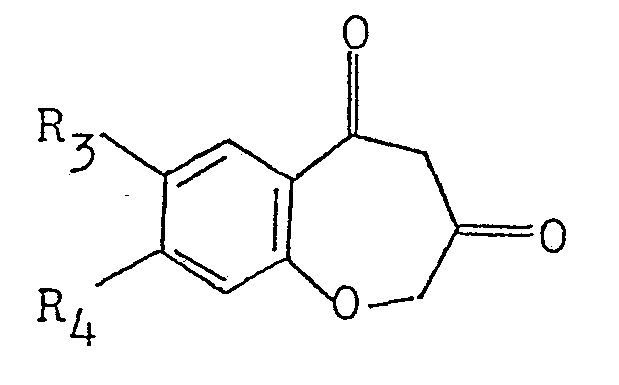
- the 2,3,4,5-tetra-hydro-1-benzoxepine-3,5-dione derivatives of the formula II used as starting compounds in which R 3 and R 4 have the above meaning can be prepared by using compounds of the formula V in which R 3 and R 4 have the above meaning and R 8 is a straight or branched low molecular weight alkyl group, preferably a methyl group, with a strong base from the series lithium hydride, sodium hydride, lithium tert-butoxide or potassium tert- butylate in the presence of an inert solvent at temperatures between -70 ° C and the boiling point of the solvent.
- suitable solvents are dimethylformamide or tetrahydrofuran.
- the reaction mixture can be mixed with ice water and the precipitated compound of the formula II can be separated off. But you can also by failures the alkali salts, in particular the lithium salt, with a non-polar solvent, for example toluene or petroleum ether, to separate the compounds of the formula II from the by-products.
- the free compound can be released from the salt by means of an inorganic or organic acid, for example an aqueous solution of hydrochloric acid, sulfuric acid or acetic acid.
- the new compounds and their acid addition salts have valuable therapeutic properties, and above all they have an inhibitory and regulating effect in spasms of the smooth muscles in the gastrointestinal tract.
- Painful abdominal diseases are often caused by spasms of the gastrointestinal muscles. They are the therapeutic target of a large number of antispasmodic drugs. Parasympathicolytics in particular have been used for some time. The poor selectivity of their effects, however, places narrow limits on their use. Above all dry mouth, visual disturbances and urine retention prohibit the application of sufficiently high doses.
- the substances according to the invention specifically show the desired inhibitory and regulating action without chemical or pharmacological indications of the above-mentioned side effects.
- test substances are dissolved in physiological sodium chloride solution or suspended in Tylose MH50 in a dose of 20 mg / kg intraperitoneally and the amplitude and frequency changes of the pressure waves are determined.
- the evaluation shows that shortly after application of the substances according to the invention there is a reduction in the peristaltic movements of the stomach, which is manifested in a significant reduction in the amplitudes.
- the frequency is only changed to a lesser extent, as can be seen in the table below.
- the low toxicity of the substances ensures that they are well tolerated. Another advantage is the rapid onset of action observed.
- the pharmaceutical preparations contain the substances of the formula I or their pharmacologically acceptable salts as active ingredients in combination with customary pharmacologically acceptable carriers and / or diluents.
- the drugs can be administered orally or parenterally and are in the form of tablets, capsules, syrups, dry powder, injectable and infusible Solutions or suspensions from you can also be made up as suppositories. Orally administrable preparations are generally preferred.
- the dosage of the medicinal products according to the invention depends on various factors, such as the type and severity of the disease or the compound used. In general, a single dose of 1 to 50, in particular 2 to 20 mg is sufficient for oral administration in order to obtain satisfactory results.
- the active ingredient is mixed with lactose and corn starch.
- the resulting mixture is moistened with a 15% aqueous solution of the soluble starch and granulated.
- the moist mass is passed through a 1.6 mm sieve, dried on trays at 40 ° C. and then passed through a 1.0 mm sieve.
- the resulting mixture is encapsulated in amounts of 120 mg, so that each capsule contains 10 mg of active ingredient.
- Dimethylamine is introduced into a boiling solution of 52.8 g (0.3 mol) of 2,3,4,5-tetrahydro-1-benzoxepine-3,5-dione and a spatula tip of p-toluenesulfonic acid in 225 ml of toluene with stirring.
- the resulting water is separated on the water separator.
- the solution is concentrated, the remaining residue suction filtered and recrystallized from chloroform / ether.
- Methylamine is introduced into a boiling solution of 160 g (0.9 mol) of 2,3,4,5-tetrahydro-1-benzoxepine-3,5-dione and 1 ml of formic acid in 500 ml of dichloromethane with stirring. The resulting water is separated on the water separator. When the reaction is complete, the solution is cooled with ice, the 3-methylamino-1-benzoxepin-5 (2H) -one is suctioned off and recrystallized from methanol. There are obtained 140 g (81% of theory) of the compound of mp. 176-178 0 C.
- This salt is added to a mixture of 150 ml of water and 11 ml of hydrochloric acid (32%).
- the precipitated product is filtered off, dissolved in dichloromethane, the solution washed with saturated sodium chloride solution, dried over sodium sulfate, evaporated and the residue recrystallized from cyclohexane.
- 11.7 g (46% of theory) of 2,3,4,5-tetrahydro-7-bromo-1-benzoxepine-3,5-dione with mp 110-112 ° C. were obtained.
Landscapes
- Chemical & Material Sciences (AREA)
- Organic Chemistry (AREA)
- Health & Medical Sciences (AREA)
- Pharmacology & Pharmacy (AREA)
- Animal Behavior & Ethology (AREA)
- Chemical Kinetics & Catalysis (AREA)
- General Chemical & Material Sciences (AREA)
- Medicinal Chemistry (AREA)
- Nuclear Medicine, Radiotherapy & Molecular Imaging (AREA)
- Engineering & Computer Science (AREA)
- Veterinary Medicine (AREA)
- Life Sciences & Earth Sciences (AREA)
- Bioinformatics & Cheminformatics (AREA)
- General Health & Medical Sciences (AREA)
- Public Health (AREA)
- Nutrition Science (AREA)
- Pharmaceuticals Containing Other Organic And Inorganic Compounds (AREA)
- Pyrane Compounds (AREA)
- Heterocyclic Carbon Compounds Containing A Hetero Ring Having Oxygen Or Sulfur (AREA)
- Epoxy Compounds (AREA)
Abstract
Description
- Neue 1-Benzoxepin-5(2H)-on-Derivate und ihre Salze; Verfahren und Zwischenprodukte zu deren Herstellung und diese Verbindungen enthaltende Arzneimittel.
- Die Erfindung betrifft neue 1-Benzoxepin-5(2H)-on-Derivate und ihre Salze, Verfahren und Zwischenprodukte zu deren Herstellung sowie diese Substanzen enthaltende pharmazeutische Zusammensetzungen.
- Der vorliegenden Erfindung liegt die Aufgabe zugrunde, neue Verbindungen mit wertvollen pharmakologischen und therapeutischen Eigenschaften herzustellen.
- Überraschenderweise wurde gefunden, daß die neuen 3-Amino-1-benzoxepin-5(2H)-on-Derivate eine gute Wirkung auf die Motilität des Magens haben.
- Gegenstand der Erfindung sind daher neue 3-Amino-1-benz- oxepin-5(2H)-on-Derivate der Formel I

- Als gegebenenfalls substituierte Alkylreste bzw. Alkenylreste R1 und R2 kommen gerade oder verzweigte Gruppen mit bis zu 5 Kohlenstoffatomen in Frage, so beispielsweise die Methyl-, Äthyl-, Propyl-, Isopropyl-, Butyl-, Isobutyl-, tert.-Butyl-, Pentyl-, Isopentyl-, Neopentyl-, Allyl-, 2-Butenyl- oder 3-Butenylreste. Bevorzugt sind Verbindungen, in welchen nur einer der Reste R1 und R2 einen substituierten Alkylrest bedeutet und der andere ein Wasserstoffatom oder Alkylrest ist.
- Für R5 und R6 kommen die obengenannten Alkylgruppen mit 1 bis 5 Kohlenstoffatomen in Frage.
- Wenn die Alkylgruppen an den Stickstoffatomen entweder direkt oder über ein Heteroatom miteinander verbunden sind, kommen z.B. in Frage Pyrrolidin, Piperidin, Azacycloheptan, Morpholin, Thiomorpholin, Piperazin und Homopiperazin, wobei letztere gegebenenfalls am Stickstoffatom mit Methyl, Benzyl oder Phenyl substituiert sein können. Bevorzugt werden die Verbindungen mit 5- bzw. 6-Ring.
- Für die Substituenten R3 und R4 am Phenylring kommen als Halogenatome Fluor-, Chlor-, Brom- oder Jodatome, insbesondere Fluor-, Chlor- oder Bromatome in Frage. Die Ci-bis C4-Alkylreste in den Alkyl-, Alkoxy- oder Alkylthiogruppen können gerade oder verzweigt sein, wobei insbesondere bei Mehrfachsubstitution am Phenylrest der Methylrest, so Methyl, Methoxy oder Methylthio, vorherrscht. Für die Nitro- oder Trifluormethylgruppe ist die Monosubstitution bevorzugt.
- Bei Substitution mit gegebenenfalls substituiertem Piperazin oder Homopiperazin bzw. Alkyl-NR5R6 der oben angegebenen Bedeutung, können die aus dem Reaktionsgemisch isolierten freien Basen gewünschtenfalls durch Umsetzung mit anorganischen oder organischen Säuren nach an sich bekannter Weise in ihre physiologisch verträglichen Säureadditionssalzeüberführt werden. Als geeignete Säuren haben sich beispielsweise Chlorwasserstoffsäure, Bromwasserstoffsäure, Schwefelsäure, Salpetersäure, Orthophosphorsäure, Maleinsäure, Cyclohexylaminosulfonsäure, Amidosulfonsäure oder p-Toluolsulfonsäure erwiesen.
- Gegenstand der Erfindung ist ferner ein Verfahren zur Herstellung der 3-Amino-1-benzoxepin-5(2H)-on-Derivate der Formel I


- Die Umsetzung einer Verbindung II oder IV mit einem Amin der Formel III kann in an sich bekannter Weise erfolgen. Die Umsetzung der 2,3,4,5-Tetrahydro-1-benzox- epin-3,5-dion-Derivate der Formel II mit den Aminen der Formel III kann durch Zugabe katalytischer Mengen an anorganischen und organischen Säuren, wie beispielsweise Salzsäure, Schwefelsäure, p-Toluolsulfonsäure oder Ameisensäure begünstigt werden. Als inerte Lösungsmittel können beispielsweise Chloroform, Dichlormethan, Benzol oder Toluol dienen. Die Reaktion kann im Temperaturbereich von 0 bis 150°C durchgeführt werden. Die Umsetzung kann dadurch verbessert werden, daß man das sich bildende Wasser während der Reaktion auf übliche Weise entfernt. Bei Verwendung der Verbindungen der Formel IV kann man die Umsetzung mit dem Amin der Formel III in einem inerten Lösungsmittel, wie Chloroform, Dichlormethan, Dimethylformamid, Dioxan oder Tetrahydrofuran, bei Temperaturen zwischen -70 und +50°C, durchführen, wobei die Reaktion vorzugsweise in Gegenwart einer organischen Base, wie Triäthylamin, oder einer überschüssigen Menge des eingesetzten Amins vorgenommen wird.
- Die neuen Verbindungen der Formel IV lassen sich in an sich bekannter Weise dadurch herstellen, daß man die 2,3,4,5-Tetrahydro-1-benzoxepin-3,5-dion-Derivate der Formel II mit einem entsprechenden Säurehalogenid umsetzt. Als Säurehalogenide kommen Phosphoroxidhalogenide, Phosphortrihalogenide, Thionylchlorid oder insbesondere Oxalylchlorid in Frage. In Gegenwart eines inerten Lösungsmittels, beispielsweise Dichlormethan oder Dimethylformamid, kann die Umsetzung im Temperaturbereich von -20 bis 80°C durchgeführt werden. Für die Umsetzung mit dem Amin der Formel III kann das vom überschüssigen Säurehalogenid und vom Lösungsmittel befreite Reaktionsprodukt eingesetzt werden.
- Die als Ausgangsverbindungen eingesetzten 2,3,4,5-Tetra- hydro-1-benzoxepin-3,5-dion-Derivate der Formel II


- Zur Aufarbeitung kann das Reaktionsgemisch mit Eiswasser, versetzt und die ausfallende Verbindung der Formel II abgetrennt werden. Man kann aber auch durch Ausfällen der Alkalisalze, insbesondere des Lithiumsalzes, mit einem unpolaren Lösungsmittel, beispielsweise Toluol oder Petroläther, die Verbindungen der Formel II von den Nebenprodukten abtrennen. Aus dem Salz kann die freie Verbindung mittels einer anorganischen oder organischen Säure, beispielsweise einer wäßrigen Lösung von Salzsäure, Schwefelsäure oder Essigsäure, freigesetzt werden.
- Es ist überraschend, daß unter Verwendung der oben genannten Basen, vorzugsweise Natriumhydrid und Lithium- tert.-butylat die Verbindungen der Formel II unter Ringschluß der Verbindungen der Formel V erhalten werden können; bei den Cyclisierungsversuchen von 2'-Acetylphenoxyacetaten mit dem üblicherweise eingesetzten Natrium- äthylat konnten nur Benzofuranderivate erhalten werden (s. J.Org.Chem. Vol.42 (1977) S.4265 sowie Tetrahedron Letters (196G) No.41, S.4995, Abs.1). Bekannt ist nur das 7-Brom-8-methyl-substituierte sowie das unsubstituierte 2,3,4,5-Tetrahydro-1-benzoxepin-3,5-dion, welches u.a. bei der Hydrolyse von 2,3-Dihydro-5-hydroxy-3-oxo-1-benzoxepin-4-carbox- aldehyd isoliert wurde (s. Synthesis (1977) S.61-63). Die substituierten 2,3,4,5-Tetrahydro-1-benzoxepin-3,5-dione der Formel II sind daher wertvolle neue Zwischenprodukte und stellen einen Teil der vorliegenden Erfindung dar. Die für die Herstellung von 2,3,4,5-Tetrahydro-1-benzoxepin-3,5-dion-Derivaten der Formel II erforderlichen 2'-Acetylphenoxyacetate können bekanntlich aus den 2-Hydroxyacetophenonen in guter Ausbeute erhalten werden, so daß ein einfacher Weg zur Herstellung der pharmakologisch interessanten 3-Amino-1-benzoxepin-5(2H)-on-Derivate der Formel I gegeben ist.
- Die neuen Verbindungen und ihre Säureadditionssalze weisen wertvolle therapeutische Eigenschaften auf, vor allem zeigen sie eine hemmende und regulierende Wirkung bei Spasmen der glatten Muskulatur im Magen-Darm-Kanal.
- Schmerzhafte abdominale Erkrankungen werden häufig durch Spasmen der gastrointestinalen Muskulatur hervorgerufen. Sie sind das therapeutische Ziel einer Vielzahl spasmolytisch wirkender Medikamente. Vor allem die Parasympathicolytica werden schon seit geraumer Zeit angewandt. Die mangelhafte Selektivität ihrer Wirkung setzt jedoch ihrem Einsatz enge Grenzen. Vor allem Mundtrockenheit, Sehstörungen und Harnretention verbieten die Applikation ausreichend hoher Dosen.
- Überraschenderweise wurde gefunden, daß die erfindungsgemäßen Substanzen spezifisch die gewünschte hemmende und regulierende Wirkung zeigen, ohne daß chemische oder pharmakologische Hinweise auf die oben genannten Nebenwirkungen gegeben sind.
-
- 1. Akute Toxizität Die akute 7-Tage-Toxizität wird nach einmaliger Applikation intraperitoneal an der weißen nüchternen NMRI-Maus bestimmt. Die Berechnung der LD50-Werte erfolgt über EDV durch eine Probitanalyse (L.Cavalli-Sforza, Gustav Fischer-Verlag, Stuttgart (1964), Grundbegriffe der Biometrie, S. 153 ff.).
- 2. Prüfung der Magenperistaltik Zur Bestimmung der Magenperistaltik werden etwa 200 g schwerer, mit Ketamino-Hydrochlorid/Xylazin narkotisierten Ratten in die Vena jugularis ein Gefäß-Katheter und in die Trachea ein Trachealkatheter eingeführt. In den Magen wird eine Magensonde eingebunden, die über einen Dreiwegehahn mit einem Statham-Druckgeber (P 23 DB) verbunden wird. Der Magen wird am Pylorus und an der Cardia durch eine Ligatur verschlossen. Anschließend wird der Magen mit 3 ml 0,9%- iger NaCl gefüllt. Die vom Magen erzeugten Drucke werden kontinuierlich von einem Watanabe-Multicorder (MC 641) registriert.
- Zur Durchführung der Versuche wird eine Stimulation der peristaltischen Bewegungen des Magens durch Dauerinfusion von 50 mg/kg/h Bariumchlorid i.v. vorgenommen und die auftretenden Amplituden und Frequenzen der vom Magen erzeugten Druckwellen gemessen (Kontrollwerte), Anschließend werden die Testsubstanzen in physiologischer Natriumchloridlösung gelöst oder in Tylose MH50 suspendiert in einer Dosis von 20 mg/kg intraperitoneal appliziert und die Amplituden- und Frequenzänderung der Druckwellen ermittelt.
- Die Auswertung ergibt, daß kurz nach Applikation der erfindungsgemäßen Substanzen eine Herabsetzung der peristaltischen Bewegungen des Magens erfolgt, die sich in einer deutlichen Senkung der Amplituden bemerkbar macht. Die Frequenz wird nur im geringeren Maße verändert, wie der nachfolgenden Tabelle zu entnehmen ist. Die geringe Toxizität der Substanzen gewährleistet eine gute Verträglichkeit derselben. Ein weiterer Vorteil ist der beobachtete rasche Wirkungseintritt.
- Nach den beschriebenen Methoden wurden beispielsweise folgende Substanzen untersucht:
- A) 3-Methylamino-1-benzoxepin-5(2H)-on
- B) 3-Methylamino-8-chlor-1-benzoxepin-5(2H)-on
- C) 3-Isopropylamino-1-benzoxepin-5(2H)-on
- D) 3-Amino-1-benzoxepin-5(2H)-on
- E) 3-(n-Butylamino)-1-benzoxepin-5(2H)-on
- F) 3-Phenäthylamino-1-benzoxepin-5(2H)-on
- G) 3-(N-Benzylpiperazino)-1-benzoxepin-5(2H)-on
- H) 3-Morpholino-1-benzoxepin-5(2H)-on
- I) 3-(ß-Methoxyäthylamino)-1-benzoxepin-5(2H)-on
- K) 3-Methylamino-8-methyl-1-benzoxepin-5(2H)-on
- L) 3-Methylamino-7-methyl-1-benzoxepin-5(2H)-on
- M) 3-Methylamino-8-tert.-butyl-1-benzoxepin-5(2H)-on
- N) 3-Methylamino-7-chlor-1-benzoxepin-5(2H)-on
- 0) 3-Methylamino-7-fluor-1-benzoxepin-5(2H)-on

- Die pharmakologisch beobachteten Wirkungen lassen eine günstige Beeinflussung bei verschiedenen spastischen Zuständen sowohl im Magen-Darm-Kanal als auch im Gallenwegsystem am Menschen erwarten.
- Die Arzneimittelzubereitungen enthalten die Substanzen der Formel I oder deren pharmakologisch verträgliche Salze als Wirkstoff in Kombination mit üblichen pharmakologisch verträglichen Trägerstoffen und/oder Verdünnungsmitteln. Die Arzneimittel können oral oder parenteral verabreicht werden und liegen als Tabletten, Kapseln, Sirups, Trockenpulver, injizierbare und infundierbare Lösungen oder Suspensionen von Sie können aber auch als Suppositorien konfektioniert werden. Im allgemeinen werden oral verabreichbare Präparate bevorzugt.
- Die Dosierung der erfindungsgemäßen Arzneipräparate hängt von verschiedenen Faktoren ab, wie von der Art und der Schwere der Krankheit oder von der verwendeten Verbindung. Im allgemeinen genügt bei oraler Gabe eine Einzeldosis von 1 bis 50, insbesondere 2 bis 20 mg, um zufriedenstellende Ergebnisse zu erhalten.
- Kapseln mit 10 mg 3-Methylamino-1-benzoxepin-5(2H)-on als Wirkstoff
-

- Der Wirkstoff wird mit Lactose und Maisstärke vermischt. Die entstandene Mischung wird mit einer 15%-igen wäßrigen Lösung der löslichen Stärke durchfeuchtet und granuliert. Die feuchte Masse wird durch ein 1,6mm-Sieb passiert, bei 40°C auf Horden getrocknet und anschließend durch ein 1,Omm-Sieb passiert. Nach dem Vermischen des Granulats mit Magnesiumstearat wird die entstandene Mischung in Mengen von 120 mg verkapselt, so daß jede Kapsel 10 mg Wirkstoff enthält.
- Die nachstehenden Beispiele dienen zur Erläuterung der Erfindung.
- Eine Lösung von 88 g (0,5 Mol) 2,3,4,5-Tetrahydro-1-benz- oxepin-3,5-dion und einer Spatelspitze p-Toluolsulfonsäure in 750 ml Toluol wird unter Rühren mit 44 g (0,5 Mol) N,N-Dimethyläthylendiamin versetzt und anschließend bis zur Beendigung der Reaktion bei Raumtemperatur gerührt. Der nach Einengen der Lösung gewonnene Rückstand wird abgesaugt und aus Benzol/Ligroin umkristallisiert. Es werden 108 g (88 % d.Th.) 3-(ß-Dimethylamino-äthylamino)-1-benzoxepin-5(2H)-on mit Fp. 100-101°C erhalten.
- Eine Lösung von 17,6 g (0,1 Mol) 2,3,4,5-Tetrahydro-1-benzoxepin-3,5-dion und einer Spatelspitze p-Toluolsulfonsäure in 200 ml Dichlormethan wird unter Rühren mit 6 g (0,1 Mol) Isopropylamin versetzt und anschließend bis zur Beendigung der Reaktion bei Raumtemperatur gerührt. Der nach Einengen der Lösung gewonnene Rückstand wird abgesaugt und aus Butylacetat umkristallisiert. Es werden 13,5 g (62 % d.Th.) 3-Isopropylamino-1-benzoxepin-5(2H)-on mit Fp. 150-152°C erhalten.
- In eine siedende Lösung von 52,8 g (0,3 Mol) 2,3,4,5-Tetrahydro-1-benzoxepin-3,5-dion und einer Spatelspitze p-Toluolsulfonsäure in 225 ml Toluol wird unter Rühren Dimethylamin eingeleitet. Das entstehende Wasser wird am Wasserabscheider abgetrennt. Nach beendeter Reaktion wird die Lösung eingeengt, der verbleibende Rückstand abgesaugt und aus Chloroform/Äther umkristallisiert. Es werden 42 g (69 % d.Th.) 3-Dimethylamino-1-benzox- epin-5(2H)-on mit Fp. 136-1380C erhalten.
- In eine siedende Lösung von 160 g (0,9 Mol) 2,3,4,5-Te- trahydro-1-benzoxepin-3,5-dion und 1 ml Ameisensäure in 500 ml Dichlormethan wird unter Rühren Methylamin eingeleitet. Das entstehende Wasser wird am Wasserabscheider abgetrennt. Nach beendeter Reaktion wird die Lösung mit Eis gekühlt, das 3-Methylamino-1-benzoxepin-5(2H)-on abgesaugt und aus Methanol umkristallisiert. Es werden 140 g (81 % d.Th.) der Verbindung mit Fp. 176-1780C erhalten.
- In eine siedende Lösung von 70,4 g (0,4 Mol) 2,3,4,5-Te- trahydro-1-benzoxepin-3,5-dion in 400 ml Chloroform wird unter Rühren Ammoniak eingeleitet. Das entstehende Wasser wird am Wasserabscheider abgetrennt. Nach beendeter Reaktion wird die Lösung abgekühlt, das 3-Amino-1-benz- oxepin-5(2H)-on abgesaugt und umkristallisiert. Ausbeute 60,5 g (86 / d.Th.), Fp. 196-200°C aus Chloroform.
- Zu einer Lösung von 35,2 g (0,2 Mol) 2,3,4,5-Tetrahydro-1-benzoxepin-3,5-dion in 200 ml Dichlormethan werden 38,1 g (0,3 Mol) Oxalylchlorid gegeben. Nach 14 h bei Raumtemperatur wird das Lösungsmittel abgezogen und das zurückbleibende Öl destilliert. Die bei 150-170°C/ 3 mbar übergehende Fraktion, die in der Hauptsache aus 3-Chlor-1-benzoxepin-5(2H)-on besteht, wird in 100 ml Chloroform aufgenommen. Die erhaltene Lösung wird mit Eis gekühlt und tropfenweise unter Kühlung mit einem Überschuß von Piperidin, gelöst in Dichlormethan, versetzt. Bis zur Beendigung der Reaktion wird bei 0°C gerührt, die Reaktionslösung anschließend auf Eis gegossen und die organische Phase abgetrennt; letztere wird mit Wasser gewaschen, getrocknet und eingedampft. Das 3-Piperidino-1-benzoxepin-5(2H)-on wird aus Äther umkristallisiert. Es werden 19,3 g (40 % d.Th., bezogen auf 2,3,4,5-Tetrahydro-1-benzoxepin-3,5-dion)mit Fp. 101-103°C erhalten.
- Auf die in den Beispielen 1 bis 6 beschriebene Weise erhält man mit ähnlichen Ausbeuten aus
- 2,3,4,5-Tetrahydro-1-benzoxepin-3,5-dion und β,β-Dimethyl-y-dimethylamino-propylamin, n-Butylamin, Benzylamin, Morpholin, y-Dimethylamino-propylamin, Phenäthylamin, Diäthylamin, Pyrrolidin, ß-Methoxyäthylamin, N-Benzylpiperazin oder tert.-Butylamin

- Auf die in den Beispielen 1 bis 6 beschriebene Weise erhält man mit ähnlichen Ausbeuten aus
- 2,3,4,5-Tetrahydro-7-fluor-1-benzoxepin-3,5-dion,
- 2,3,4,5-Tetrahydro-7-nitro-1-benzoxepin-3,5-dion,
- 2,3,4,5-Tetrahydro-7,8-dichlor-1-benzoxepin-3,5-dion,
- 2,3,4,5-Tetrahydro-7,8-dimethyl-1-benzoxepin-3,5-dion,
- 2,3,h,5-Tetrahydro-7-brom-1-benzoxepin-3,5-dion,
- 2,3,4,5-Tetrahydro-7-methoxy-1-benzoxepin-3,5-dion,
- 2,3,4,5-Tetrahydro-8-methoxy-1-benzoxepin-3,5-dion,
- 2,3,4,5-Tetrahydro-7-chlor-1-benzoxepin-3,5-dion,
- 2,3,4,5-Tetrahydro-8-chlor-1-benzoxepin-3,5-dion,
- 2,3,4,5-Tetrahydro-7-methyl-1-benzoxepin-3,5-dion,
- 2,3,4,5-Tetrahydro-7-äthyl-1-benzoxepin-3,5-dion,
- 2,3,4,5-Tetrahydro-8-methyl-1-benzoxepin-3,5-dion,
- 2,3,4,5-Tetrahydro-7-chlor-8-methyl-1-benzoxepin-3,5-dion,
- 2,3,4,5-Tetrahydro-8-tert.-butyl-1-benzoxepin-3,5-dion
- Zu einer auf -200C gekühlten Lösung von 24.2 g (1 Mol) (2'-Acetyl-4'-chlor)-phenoxyessigsäure-methylester in 300 ml Dimethylformamid werden 30,1 g (1 Mol) Natriumhydrid (80 % in Öl) unter Kühlung so in kleinen Portionen zugefügt, daß die Temperatur nicht über -10°C ansteigt. Anschließend wird noch 45 min bei -15°C gerührt, dann die Lösung vorsichtig in Eiswasser gegossen und einmal mit Toluol extrahiert. Nach Ansäuern der wäßrigen Phase wird das ausgefallene Produkt abgesaugt und aus Cyclohexan/Toluol umkristallisiert. Es werden 126 g 2,3,4,-5-Tetrahydro-7-chlor-1-benzoxepin-3,5-dion mit Fp. 131-134°C erhalten (60% d.Th.).
- Zu einer Lösung von 28,7 g (0,1 Mol) (2'-Acetyl-4'-brom)-phenoxyessigsäure-methylester in 150 ml trockenem Tetrahydrofuran werden 8,8 g (0,11 Mol) Lithium-tert.-butylat in 50 ml trockenem Tetrahydrofuran unter Kühlung so zugetropft, daß die Temperatur zwischen 25-35°C gehalten wird. Anschließend wird die Suspension in 400 ml Petroläther gegossen und das ausgefallene Lithiumsalz des 2,3,4,5-Tetrahydro-7-brom-1-benzoxepin-3,5-dion abgesaugt. Dieses Salz wird in ein Gemisch aus 150 ml Wasser und 11 ml Salzsäure (32 %) eingetragen. Das ausgefallene Produkt wird abgesaugt, in Dichlormethan gelöst, die Lösung mit gesättigter Kochsalzlösung gewaschen, über Natriumsulfat getrocknet, eingedampft und der Rückstand aus Cyclohexan umkristallisiert. Es wurden 11,7 g (46% d.Th.) 2,3,4,5-Tetrahydro-7-brom-1-benzoxepin-3,5-dion mit Fp. 110-112°C erhalten.
- Auf die in den Beispielen 9 und 10 beschriebene Weise erhält man unter Verwendung von Natriumhydrid bzw. Lithium-tert.-butylat in ähnlichen Ausbeuten aus
- (2'-Acetyl-4'-methyl)-phenoxyessigsäure-methylester,
- (2'-Acetyl-5'-methyl)-phenoxyessigsäure-methylester,
- (2'-Acetyl-5'-chlor)-phenoxyessigsäure-methylester,
- (2'-Acetyl-4'-fluor)-phenoxyessigsäure-methylester,
- (2'-Acetyl-4'-methoxy)-phenoxyessigsäuremethylester,
- (2'-Acetyl-5'-methoxy)-phenoxyessigsäuremethylester,
- (2'-Acetyl-4',5'-dichlor)-phenoxyessigsäuremethylester,
- (2'-Acetyl-4'-chlor-5'-methyl)-phenoxyessigsäureme- thylester,
- (2'-Acetyl-4',5'-dimethyl)-phenoxyessigsäuremethylester,
- (2'-Acetyl-5'-tert.-butyl)-phenoxyessigsäuremethylester
- (2'-Acetyl-4'-äthyl)-phenoxyessigsäuremethylester


und Methylamin, Dimethylamin oder y-Dimethylaminopropylamin die Verbindungen


Claims (12)


Priority Applications (3)
| Application Number | Priority Date | Filing Date | Title |
|---|---|---|---|
| AT80104466T ATE13296T1 (de) | 1979-08-02 | 1980-07-29 | 1-benzoxepin-5(2h)-on-derivate und ihre salze sowie verfahren zu deren herstellung. |
| AT82108303T ATE12639T1 (de) | 1979-08-02 | 1980-07-29 | 2,3,4,5-tetrahydro-1-benzoxepin-3,5-dion-deriva e und verfahren zu deren herstellung. |
| DE8282108303T DE3070495D1 (en) | 1979-08-02 | 1980-07-29 | 2,3,4,5-tetrahydro-1-benzoxepine-3,5-dione derivatives and process for their preparation |
Applications Claiming Priority (2)
| Application Number | Priority Date | Filing Date | Title |
|---|---|---|---|
| DE2931398 | 1979-08-02 | ||
| DE19792931398 DE2931398A1 (de) | 1979-08-02 | 1979-08-02 | Neue 1-benzoxepin-5(2h)-on-derivate und ihre salze, verfahren und zwischenprodukte zu deren herstellung und diese verbindungen enthaltende arzneimittel |
Related Child Applications (1)
| Application Number | Title | Priority Date | Filing Date |
|---|---|---|---|
| EP82108303.7 Division-Into | 1980-07-29 |
Publications (3)
| Publication Number | Publication Date |
|---|---|
| EP0025109A2 true EP0025109A2 (de) | 1981-03-18 |
| EP0025109A3 EP0025109A3 (en) | 1981-07-15 |
| EP0025109B1 EP0025109B1 (de) | 1985-05-15 |
Family
ID=6077477
Family Applications (2)
| Application Number | Title | Priority Date | Filing Date |
|---|---|---|---|
| EP82108303A Expired EP0074121B1 (de) | 1979-08-02 | 1980-07-29 | 2,3,4,5-Tetrahydro-1-benzoxepin-3,5-dion-Derivate und Verfahren zu deren Herstellung |
| EP80104466A Expired EP0025109B1 (de) | 1979-08-02 | 1980-07-29 | 1-Benzoxepin-5(2H)-on-Derivate und ihre Salze sowie Verfahren zu deren Herstellung |
Family Applications Before (1)
| Application Number | Title | Priority Date | Filing Date |
|---|---|---|---|
| EP82108303A Expired EP0074121B1 (de) | 1979-08-02 | 1980-07-29 | 2,3,4,5-Tetrahydro-1-benzoxepin-3,5-dion-Derivate und Verfahren zu deren Herstellung |
Country Status (20)
| Country | Link |
|---|---|
| US (2) | US4279905A (de) |
| EP (2) | EP0074121B1 (de) |
| JP (2) | JPS5653675A (de) |
| AU (1) | AU537110B2 (de) |
| CA (1) | CA1162553A (de) |
| DD (2) | DD154487A5 (de) |
| DE (3) | DE2931398A1 (de) |
| DK (2) | DK151629C (de) |
| ES (2) | ES493927A0 (de) |
| FI (1) | FI77029C (de) |
| GR (1) | GR69360B (de) |
| HU (2) | HU181580B (de) |
| IE (1) | IE50059B1 (de) |
| IL (1) | IL60557A (de) |
| NO (1) | NO155054C (de) |
| NZ (1) | NZ194331A (de) |
| PH (2) | PH16306A (de) |
| PT (1) | PT71599A (de) |
| SU (2) | SU955860A3 (de) |
| ZA (1) | ZA804546B (de) |
Families Citing this family (7)
| Publication number | Priority date | Publication date | Assignee | Title |
|---|---|---|---|---|
| DE3440296A1 (de) * | 1984-11-05 | 1986-05-15 | Kali-Chemie Pharma Gmbh, 3000 Hannover | 3-amino-2,3-dihydro-1-benzoxepin-verbindungen sowie verfahren zu ihrer herstellung und diese verbindungen enthaltende arzneimittel |
| DE3440295A1 (de) * | 1984-11-05 | 1986-05-15 | Kali-Chemie Pharma Gmbh, 3000 Hannover | Verfahren zur diastereoselektiven reduktion von 3-amino-1-benzoxepin-5(2h)-onen |
| GB0412139D0 (en) | 2004-06-01 | 2004-06-30 | Exxonmobil Chem Patents Inc | Olefin oligomerization process |
| JP4916481B2 (ja) * | 2008-05-27 | 2012-04-11 | ティーオーエー株式会社 | 機器筐体 |
| US8722896B2 (en) | 2008-12-17 | 2014-05-13 | The Regents Of The University Of California | Prokineticin receptor antagonists and uses thereof |
| US8718544B2 (en) | 2009-08-31 | 2014-05-06 | Sony Corporation | Signal transmission device, electronic device, and signal transmission method |
| EP3724156B1 (de) | 2017-12-14 | 2023-05-10 | ExxonMobil Chemical Patents Inc. | Verfahren zur isomerisierung von alpha-olefinen |
Family Cites Families (3)
| Publication number | Priority date | Publication date | Assignee | Title |
|---|---|---|---|---|
| DE1593760A1 (de) * | 1967-02-01 | 1972-06-08 | Boehringer Sohn Ingelheim | Verfahren zur Herstellung neuer Benz-epinderivate |
| US3991082A (en) * | 1975-03-03 | 1976-11-09 | Warner-Lambert Company | 4-Substituted-2,3-dihydro-1-benzoxepin-3,5-diones and tautomers |
| US4153612A (en) * | 1977-10-31 | 1979-05-08 | The Upjohn Company | 2-Benzoxepins |
-
1979
- 1979-08-02 DE DE19792931398 patent/DE2931398A1/de not_active Withdrawn
-
1980
- 1980-07-03 IE IE1387/80A patent/IE50059B1/en unknown
- 1980-07-11 IL IL60557A patent/IL60557A/xx unknown
- 1980-07-11 NZ NZ194331A patent/NZ194331A/xx unknown
- 1980-07-14 AU AU60389/80A patent/AU537110B2/en not_active Ceased
- 1980-07-16 PH PH24299A patent/PH16306A/en unknown
- 1980-07-24 PT PT71599A patent/PT71599A/pt unknown
- 1980-07-25 SU SU802950853A patent/SU955860A3/ru active
- 1980-07-28 ZA ZA00804546A patent/ZA804546B/xx unknown
- 1980-07-28 US US06/173,076 patent/US4279905A/en not_active Expired - Lifetime
- 1980-07-29 DE DE8080104466T patent/DE3070642D1/de not_active Expired
- 1980-07-29 HU HU801890A patent/HU181580B/hu unknown
- 1980-07-29 EP EP82108303A patent/EP0074121B1/de not_active Expired
- 1980-07-29 HU HU821782A patent/HU182436B/hu unknown
- 1980-07-29 DE DE8282108303T patent/DE3070495D1/de not_active Expired
- 1980-07-29 EP EP80104466A patent/EP0025109B1/de not_active Expired
- 1980-07-30 DD DD80222971A patent/DD154487A5/de unknown
- 1980-07-30 DD DD80237321A patent/DD201792A5/de unknown
- 1980-07-30 FI FI802385A patent/FI77029C/fi not_active IP Right Cessation
- 1980-07-31 GR GR62578A patent/GR69360B/el unknown
- 1980-08-01 NO NO802324A patent/NO155054C/no unknown
- 1980-08-01 CA CA000357544A patent/CA1162553A/en not_active Expired
- 1980-08-01 DK DK333280A patent/DK151629C/da not_active IP Right Cessation
- 1980-08-01 ES ES493927A patent/ES493927A0/es active Granted
- 1980-08-01 JP JP10515980A patent/JPS5653675A/ja active Granted
-
1981
- 1981-03-16 US US06/243,745 patent/US4320061A/en not_active Expired - Lifetime
- 1981-04-09 ES ES501213A patent/ES501213A0/es active Granted
- 1981-06-11 SU SU813294901A patent/SU963468A3/ru active
- 1981-11-27 PH PH26551A patent/PH17306A/en unknown
-
1988
- 1988-02-19 DK DK086188A patent/DK154081C/da active
-
1989
- 1989-03-16 JP JP1062356A patent/JPH0256478A/ja active Granted
Also Published As
Similar Documents
| Publication | Publication Date | Title |
|---|---|---|
| DE69018876T2 (de) | Pyridazinon-Derivate. | |
| EP0174464B1 (de) | Substituierte Benzylphthalazinon-Derivate | |
| EP0093084B1 (de) | 1-Carboxyalkanoylindolin-2-carbonsäure-ester, Verfahren zu ihrer Herstellung, pharmazeutische Präparate enthaltend diese Verbindungen, sowie ihre therapeutische Verwendung | |
| EP0025109B1 (de) | 1-Benzoxepin-5(2H)-on-Derivate und ihre Salze sowie Verfahren zu deren Herstellung | |
| CH617689A5 (de) | ||
| DE3630903A1 (de) | Neue tetrahydronaphthalin- und indanderivate, verfahren zu deren herstellung sowie diese enthaltende arzneimittel | |
| EP0665228B1 (de) | Neue 3-Phenylsulfonyl-3,7-diazabicyclo(3,3,1)nonan-Verbindungen enthaltende Arzneimittel | |
| DE3687035T2 (de) | 3-aminopropyloxyphenylabkoemmlinge, herstellung und arzneitmittel die sie enthalten. | |
| EP0043054B1 (de) | Neue Pyrimidinderivate, ihre Herstellung und Arzneimittel enthaltend diese Derivate | |
| EP0024560B1 (de) | Neue 3-Amino-1-benzoxepin-Derivate und ihre Salze; Verfahren zu deren Herstellung und diese Verbindungen enthaltende Arzneimittel | |
| DE3807813A1 (de) | Neue benzocycloheptenderivate, diese verbindungen enthaltende arzneimittel und verfahren zu deren herstellung | |
| EP0045911B1 (de) | Neue Aminopropanol-Derivate, Verfahren zu ihrer Herstellung und diese Verbindungen enthaltende Arzneimittel | |
| EP0088323B1 (de) | Imidazothiadiazolalkencarbonsäureamide, neue Zwischenprodukte zu ihrer Herstellung, ihre Herstellung und ihre Verwendung in Arzneimitteln | |
| EP0110219B1 (de) | Heterocyclisch substituierte Nitrile, ihre Herstellung und Verwendung als Arzneimittel | |
| DD148633A5 (de) | Verfahren zur herstellung von hexahydro-1,4-oxazepinen | |
| DE60013607T2 (de) | Bemzimidazolverbindungen und medikamente die diese enthalten | |
| EP0061709B1 (de) | 5,6-Dihydro-11-alkylen-morphantridin-6-one, ihre Herstellung und diese enthaltende Arzneimittel | |
| DE2923817B1 (de) | (3-Alkylamino-2-hydroxypropoxy)-furan-2-carbonsaeureanilide und deren physiologisch vertraegliche Saeureadditionssalze und Verfahren zu deren Herstellung sowie Arzneimittel mit einem Gehalt dieser Verbindungen | |
| DE68924416T2 (de) | Carboximidamid-Derivate. | |
| EP0011092A1 (de) | Alpha-Aminophenylessigsäurederivate zur Verwendung bei der Behandlung von Entzündungen sowie neue alpha-Aminophenylessigsäurederivate | |
| WO2000005207A1 (de) | Substituierte phenylamidine mit antithrombotischer wirkung | |
| EP0035714B1 (de) | 10-substituierte 5-Cyanmethylen-10,11-dihydro-dibenzo-(a,d)-cycloheptene, Verfahren zu ihrer Herstellung und diese enthaltende therapeutische Mittel | |
| EP0158170B1 (de) | Erythromycin-A-salz mit mucosecretolytischer und fluidisierender Aktivität, Verfahren zu seiner Herstellung und dieses enthaltende pharmazeutische Zusammensetzungen | |
| DD267491A5 (de) | Verfahren zur herstellung neuer isoxazolderivate | |
| EP0127000B1 (de) | 1,3-bis(Dimethylamino)-2-propyl-4-chlorphenoxyacetat, seine Säureadditionssalze, Verfahren zu seiner Herstellung und diese Verbindungen enthaltende Arzneimittelpräparate |
Legal Events
| Date | Code | Title | Description |
|---|---|---|---|
| PUAI | Public reference made under article 153(3) epc to a published international application that has entered the european phase |
Free format text: ORIGINAL CODE: 0009012 |
|
| AK | Designated contracting states |
Designated state(s): AT BE CH DE FR GB IT LU NL SE |
|
| PUAL | Search report despatched |
Free format text: ORIGINAL CODE: 0009013 |
|
| AK | Designated contracting states |
Designated state(s): AT BE CH DE FR GB IT LU NL SE |
|
| 17P | Request for examination filed |
Effective date: 19810907 |
|
| ITF | It: translation for a ep patent filed | ||
| GRAA | (expected) grant |
Free format text: ORIGINAL CODE: 0009210 |
|
| AK | Designated contracting states |
Designated state(s): AT BE CH DE FR GB IT LI LU NL SE |
|
| REF | Corresponds to: |
Ref document number: 13296 Country of ref document: AT Date of ref document: 19850615 Kind code of ref document: T |
|
| RIN1 | Information on inventor provided before grant (corrected) |
Inventor name: HEINEMANN, HENNING DIPL.-CHEM. DR.RER.NAT. Inventor name: KAUPMANN, WILHELM DIPL.-CHEM. DR.ING. Inventor name: WOLF, KLAUS-ULLRICH, DR. Inventor name: OHLENDORF, HEINRICH-WILHELM DIPL.-CHEM. DR. |
|
| REF | Corresponds to: |
Ref document number: 3070642 Country of ref document: DE Date of ref document: 19850620 |
|
| ET | Fr: translation filed | ||
| PG25 | Lapsed in a contracting state [announced via postgrant information from national office to epo] |
Ref country code: LU Free format text: LAPSE BECAUSE OF NON-PAYMENT OF DUE FEES Effective date: 19850731 |
|
| PLBE | No opposition filed within time limit |
Free format text: ORIGINAL CODE: 0009261 |
|
| STAA | Information on the status of an ep patent application or granted ep patent |
Free format text: STATUS: NO OPPOSITION FILED WITHIN TIME LIMIT |
|
| 26N | No opposition filed | ||
| PGFP | Annual fee paid to national office [announced via postgrant information from national office to epo] |
Ref country code: AT Payment date: 19860701 Year of fee payment: 7 |
|
| PG25 | Lapsed in a contracting state [announced via postgrant information from national office to epo] |
Ref country code: AT Effective date: 19890729 |
|
| PG25 | Lapsed in a contracting state [announced via postgrant information from national office to epo] |
Ref country code: SE Effective date: 19890730 |
|
| ITTA | It: last paid annual fee | ||
| EUG | Se: european patent has lapsed |
Ref document number: 80104466.0 Effective date: 19900418 |
|
| PGFP | Annual fee paid to national office [announced via postgrant information from national office to epo] |
Ref country code: FR Payment date: 19960619 Year of fee payment: 17 |
|
| PGFP | Annual fee paid to national office [announced via postgrant information from national office to epo] |
Ref country code: CH Payment date: 19960625 Year of fee payment: 17 |
|
| PGFP | Annual fee paid to national office [announced via postgrant information from national office to epo] |
Ref country code: GB Payment date: 19960722 Year of fee payment: 17 |
|
| PGFP | Annual fee paid to national office [announced via postgrant information from national office to epo] |
Ref country code: DE Payment date: 19960723 Year of fee payment: 17 |
|
| PGFP | Annual fee paid to national office [announced via postgrant information from national office to epo] |
Ref country code: BE Payment date: 19960725 Year of fee payment: 17 |
|
| PGFP | Annual fee paid to national office [announced via postgrant information from national office to epo] |
Ref country code: NL Payment date: 19960731 Year of fee payment: 17 |
|
| REG | Reference to a national code |
Ref country code: CH Ref legal event code: PFA Free format text: KALI-CHEMIE PHARMA GMBH TRANSFER- SOLVAY PHARMACEUTICALS GMBH |
|
| PG25 | Lapsed in a contracting state [announced via postgrant information from national office to epo] |
Ref country code: GB Free format text: LAPSE BECAUSE OF NON-PAYMENT OF DUE FEES Effective date: 19970729 |
|
| PG25 | Lapsed in a contracting state [announced via postgrant information from national office to epo] |
Ref country code: LI Free format text: LAPSE BECAUSE OF NON-PAYMENT OF DUE FEES Effective date: 19970731 Ref country code: CH Free format text: LAPSE BECAUSE OF NON-PAYMENT OF DUE FEES Effective date: 19970731 Ref country code: BE Free format text: LAPSE BECAUSE OF NON-PAYMENT OF DUE FEES Effective date: 19970731 |
|
| NLT1 | Nl: modifications of names registered in virtue of documents presented to the patent office pursuant to art. 16 a, paragraph 1 |
Owner name: SOLVAY PHARMACEUTICALS GMBH |
|
| REG | Reference to a national code |
Ref country code: FR Ref legal event code: CD |
|
| BERE | Be: lapsed |
Owner name: SOLVAY PHARMACEUTICALS G.M.B.H. Effective date: 19970731 |
|
| PG25 | Lapsed in a contracting state [announced via postgrant information from national office to epo] |
Ref country code: NL Free format text: LAPSE BECAUSE OF NON-PAYMENT OF DUE FEES Effective date: 19980201 |
|
| REG | Reference to a national code |
Ref country code: CH Ref legal event code: PL |
|
| GBPC | Gb: european patent ceased through non-payment of renewal fee |
Effective date: 19970729 |
|
| PG25 | Lapsed in a contracting state [announced via postgrant information from national office to epo] |
Ref country code: FR Free format text: LAPSE BECAUSE OF NON-PAYMENT OF DUE FEES Effective date: 19980331 |
|
| NLV4 | Nl: lapsed or anulled due to non-payment of the annual fee |
Effective date: 19980201 |
|
| PG25 | Lapsed in a contracting state [announced via postgrant information from national office to epo] |
Ref country code: DE Free format text: LAPSE BECAUSE OF NON-PAYMENT OF DUE FEES Effective date: 19980401 |
|
| REG | Reference to a national code |
Ref country code: FR Ref legal event code: ST |