EP0025530A2 - Verfahren zur Herstellung von Polyisobutylenen - Google Patents
Verfahren zur Herstellung von Polyisobutylenen Download PDFInfo
- Publication number
- EP0025530A2 EP0025530A2 EP80105115A EP80105115A EP0025530A2 EP 0025530 A2 EP0025530 A2 EP 0025530A2 EP 80105115 A EP80105115 A EP 80105115A EP 80105115 A EP80105115 A EP 80105115A EP 0025530 A2 EP0025530 A2 EP 0025530A2
- Authority
- EP
- European Patent Office
- Prior art keywords
- polymerization
- isobutylene
- weight
- solvent
- zone
- Prior art date
- Legal status (The legal status is an assumption and is not a legal conclusion. Google has not performed a legal analysis and makes no representation as to the accuracy of the status listed.)
- Granted
Links
Images
Classifications
-
- C—CHEMISTRY; METALLURGY
- C08—ORGANIC MACROMOLECULAR COMPOUNDS; THEIR PREPARATION OR CHEMICAL WORKING-UP; COMPOSITIONS BASED THEREON
- C08F—MACROMOLECULAR COMPOUNDS OBTAINED BY REACTIONS ONLY INVOLVING CARBON-TO-CARBON UNSATURATED BONDS
- C08F110/00—Homopolymers of unsaturated aliphatic hydrocarbons having only one carbon-to-carbon double bond
- C08F110/04—Monomers containing three or four carbon atoms
- C08F110/08—Butenes
- C08F110/10—Isobutene
Definitions
- the invention relates to a process for the preparation of polyisobutylenes by polymerizing isobutylene in a polymerization zone in which there is a temperature between 0 and -160 ° C., using a Friedel-Crafts catalyst and - if appropriate - molecular weight regulators in conventional amounts in the presence of 10 to 5000 ppm by weight, based on the isobutylene used, of a polymerization accelerator and in the presence of 30 to 90 percent by weight, based on the isobutylene used, of a low-boiling solvent which is inert under the reaction conditions.
- the evaporated solvent is compressed in a compressor and returned to the polymerization process.
- the solvent can be washed (cf. DE-AS 11 08 438) or passed over a cleaning compound, usually alumina gel (cf. DE-PS 10 71 340).
- a cleaning compound usually alumina gel (cf. DE-PS 10 71 340).
- a complicated distillation at low temperature or under pressure is usually also necessary (see. DE-AS 11 08 438).
- the known economical processes for cleaning the solvent have the disadvantage that the acidic substances formed by side reactions are not eliminated or only to a limited extent.
- Alumina gel can only be absorbed to a limited extent with regard to acidic substances, especially if traces of isobutylene from the polymerization zone enter the circuit of the evaporating solvent and polymerize on the alumina gel to form isobutylene oligomers and cover its surface.
- Highly active alumina gels also disintegrate under the simultaneous effect of water or butanol formed in side reactions, and the fine powder produced leads to annoying blockages in fittings. Water proves to be extremely disruptive, because when the evaporated solvent is frozen in microcrystalline form it passes through the filters and is deposited indefinitely and even disrupts the polymerization of the isobutylene.
- the invention has for its object to find a method in which the circulating solvent is freed of disturbing impurities without the above-mentioned disadvantages.
- This object is achieved in that the solvent evaporated during the polymerization is continuously drawn off, liquefied and passed in the liquid state through an anhydrous adsorption zone and is fed again to the polymerization zone.
- the adsorption zone should consist of 70 to 95 percent by weight of an aluminum oxide activated at temperatures of 250 to 550 ° C. and 30 to 5 percent by weight of an alkali and / or alkaline earth hydroxide or it should consist of a highly active zinc oxide layer.
- the aluminum oxide is said to have been activated by heating to temperatures of 300 to 500 ° C.
- the isobutylene is polymerized by known processes at reaction temperatures between 0 and -160 ° C, preferably at temperatures between -50 ° C and -110 ° C. The process works without pressure.
- boron trifluoride is used as Friedel-Crafts catalyst in customary amounts of 0.01 to 1.0 percent by weight, based on the isobutylene used.
- the Friedel-Crafts catalysts known for the polymerization of isobutylene such as A1C13, AlBr 3 , SnCl 4 , TiCl 4 , VC1 3 etc. and mixtures of these are suitable.
- the so-called molecular weight regulator is used in customary amounts of from 1 to 5000 ppm by weight, based on the isobutylene used.
- Such molecular weight regulators are, for example, the compounds n-butene, diisobutylene, mercaptans, sulfides or polysulfides.
- the molecular weight regulators bring about a considerable increase in the reaction time and often also require an increase in the catalyst requirement.
- the polymerization of the isobutylene is carried out in the presence of 10 to 5000 ppm by weight, based on the isobutylene used, of a polymerization accelerator. These substances accelerate the reaction ab-J run and a reduction in the amount of catalyst required. As a result of these additives, high-molecular polyisobutylenes are also formed, since chain-breaking influences become less effective.
- These are preferably primary or secondary alcohols having 1 to 10 carbon atoms, for example methanol, ethanol, n-propanol, isopropanol, n-butanol, isobutanol, amyl alcohols, cyclohexanol and benzyl alcohol. Phenols, carboxylic acids or mineral acids are also suitable.
- the polymerization of the isobutylene is carried out in the presence of 30 to 90 percent by weight, based on the isobutylene used, of a low-boiling solvent which is inert under the reaction conditions.
- Suitable solvents because of the favorable location of their boiling points are preferably methane, ethane, propane and especially ethylene, since the heat of polymerization of isobutylene can be removed in a simple manner by evaporating them under reaction conditions.
- the isobutylene is polymerized at the boiling point of the inert solvent. In the case of ethylene, the polymerization temperature is -104 ° C.
- the solvent evaporated during the polymerization is continuously drawn off, liquefied and passed in the liquid state through an anhydrous, alkaline adsorption zone and fed again to the polymerization zone.
- the absorption zone consists of 70 to 95 percent by weight of an aluminum oxide activated at temperatures of 250 to 550 ° C., preferably 300 to 500 ° C., and 30 to 5 percent by weight of an alkali and / or alkaline earth hydroxide.
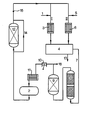
- the monomeric isobutylene 1 is introduced with the liquid solvent 2 as stream I via the cooler 3 into the polymerization reactor 4, where it is combined with the catalyst 5 dissolved in stream II.
- Stream II consists of a solution of the polymerization initiator 5 (for example BF 3 ) and the solvent 2.
- Stream II is brought to the polymerization temperature in the cooler 6.
- the polymerization is preferably carried out at a temperature of from -90 ° C. to -110 ° C. in order to achieve a high molecular weight.
- the product is discharged through a lock 13.
- the solvent which evaporates during the heat is passed into the circuit 7 and thus initially into the column 8, in which it can be washed, for example, with water to remove oligomers and unused initiator.
- the solvent is dried in the column 9 charged with a desiccant, compressed in the compressor 10 to 15-25 bar, in the condenser 11 at a temperature of -25 to -35 0 C liquefied and passed over the tower 12 charged with active A1 2 0 3 , where it is completely free of the residual moisture and contamination, such as residues of the monomer, the initiator, by-products of the polymerization and, if appropriate, traces of the lubrication of the compressor 10 related oil is exempted.
- the solvent is collected in the storage vessel 2. After passing through the tower 12, it is distributed to the current I and current II for the cycle which starts anew. In cooler 3 and 6, the solvent is brought to the desired polymerization temperature.
- the core of the solvent cleaning 12 is that of the 5 to 30 wt .-% alkali or J Alkaline earth hydroxide impregnated aluminum oxide existing adsorption layer.
- the activated, impregnated aluminum oxide is produced, for example, by using 70 to 95 parts by weight of Al 2 O 3 with a grain size of 2 to 8 mm, preferably 3 to 5 mm, with a diameter of 30 to 5 parts of one of the hydroxides in question, in particular NaOH, KOH and Ca (OH) 2 , preferably KOH, impregnated and the contact thus obtained at 250 to 550 ° C, preferably at 350 to 500 ° C, activated in an inert gas stream, for example an air or nitrogen stream. But you can also wet the A1 2 0 3 with a solution of the hydroxide and then evaporate the solvent, preferably water. Exhausted contact masses can be regenerated by reactivating them in a stream of air or nitrogen. You will then be fully effective again.
- the adsorption layer has a thickness of 0.2 to 10 cm, preferably 2 to 5 cm.
- a cylindrical design is recommended for cleaning. It is preferably designed as a trickle tower.
- Adsorption processes to be adapted to the problem are, for example, in “Drying of Gases and Liquids” by Klaus Sztaticsny Chemie-Technik 5th, Year 1976, No. 12 and in “Chemical Process Engineering” by Kassatkin Volume II VEB-Verlag, Leipzig, 1962 on page 222 and 223.
- the highly activated zinc oxide which is used for the process according to the application is a commercially available product which is produced by the processes described in DE-PS 12 66 549, US-PS 4 128 619 and US-PS 4 071 609.
- Reaction screw machines endless belts, continuously working kneaders, mixers, extruders and spray systems come into consideration as the polymerization reactor 4.
- the scrubber 8 can be, for example, a tray column, a packed column or a trickle tower.
- the pre-dryer 9 is a with a desiccant, e.g. Sodium sulfate, calcium chloride and in particular silica gel-filled vessel with the shape adapted to the problem.
- a desiccant e.g. Sodium sulfate, calcium chloride and in particular silica gel-filled vessel with the shape adapted to the problem.
- the pre-dryer 9 is designed as a tower through which the gaseous solvent flows in ascending order.
- Customary additives such as stabilizers, regulators, dyes and the like can be incorporated into the isobutylene before or during the polymerization. However, these can also be mixed into the polyisobutylenes after the polymerization.
- the stabilizers are generally used in amounts of from 0.01 to 2.0, preferably from 0.05 to 0.25,% by weight, based on the weight of the polyisobutylene.
- phenolic antioxidants such as 2,6-di - tert-butyl-p-cresol, tertiary amylphenol sulfide and tertiary amylphenol disulfide are suitable.
- Substances containing amine, sulfide or aromatic hydroxyl groups e.g. Di- (2-oxy-5-butyl-phenyl) sulfide or disulfide, phenyl- ⁇ -naphthylamine, polyvinyl ethyl sulfide or polyvinyl butyl sulfide are suitable.
- the process allows polyisobutylene to be produced continuously, either batchwise or without interference, over long periods of time.
- the polyisobutylenes obtained by the process according to the invention have a Grenzvis-L J kostician [ ⁇ ] from 0.9 to 12 dl / g (determined according to ASTM D 1601 and DIN 51562), have a narrow molecular weight distribution with little standard deviation and are characterized by minimal discoloration.
- the intrinsic viscosity [ ⁇ ] in dl / g is determined from the solution viscosity of a polyisobutene isooctane solution at 20 ° C.
- An Ubbelohde viscometer, capillary No. 1 serves as the measuring device.
- the intrinsic viscosity can be calculated on the basis of the Schulze-Blaschke relationship:
- the "mg NaOH / kg cycle gas" parameter is selected. About 500 ml of simply distilled water, which is placed in commercially available frit washing bottles, is passed through approx. 1 - 2 Nm 3 of cycle gas. An aliquot of the washing liquid is added n NaOH titrated against phenolphthalein. The consumption at n NaOH is the measure of the content of acidic components.
- ethylene 14,500 room parts per hour of ethylene are removed from storage vessel 2 by handling. According to sampling 15, the ethylene contains acidic components with the equivalent value of 2 mg NaOH / kg C 2 H 4 . This current is divided in a ratio of 1: 1 in stream I and stream II.
- Stream I is mixed with 270 room parts / hour of isobutylene from template 1, which contains 175 ppm by weight of isobutanol, 75 ppm by weight of methanol, 1600 ppm by weight of diisobutylene and is cooled in the cooler 3 to the polymerization temperature of -104 ° C.
- Stream II is cooled in the cooler 6 to the polymerization temperature of -104 ° C., and 0.4 room parts / hour of boron trifluoride are added via the catalyst metering station 5.
- Streams I and II are combined in the polymerization reactor 4 of 5000 parts by volume, the polymerization of the isobutene taking place as an exothermic reaction.
- the temperature rises above the boiling point of ethylene.
- the ethylene is then dried in the drying tower 9 (volume approx. 500 room parts) over granular, walnut-sized calcium chloride and compressed to about 19 bar in the two-stage compressor 10. It is cooled in condenser 11 to -30 o C and liquefied and stored in storage vessel 2 and redistributed to currents I and II. Losses are added via fresh gas ethylene addition 16.
- the ethylene from catalyst residues is slightly yellow in color, the measuring lines are covered with oligomers and make the flow more difficult.
- the catalyst consumption must be increased to 0.6 room parts / hour.
- the polymer initially had a standard deviation S of + 0.03 in the intrinsic viscosity, after 24 hours the standard deviation increases to ⁇ 0.3. After about 100 hours, the circulation ethylene is so contaminated that trouble-free and type-appropriate polymerization is no longer possible. The cycle must be dampened.
- Example 1 The procedure described in Example 1 is followed, however. Difference in that the ethylene flow of 500 room parts per hour from storage vessel 2 in the circulating gas cleaning system 12 (see FIG.) Formed as a trickle tower over 100 room parts contact mass with a layer thickness of 3 cm made of Al 2 0 3 impregnated with 20% by weight KOH (grain size approx 3 mm) is cleaned.
- the polymerization is still trouble-free after 14 days, the cycle gas ethylene and the polymer obtained are colorless, the standard deviation of the intrinsic viscosity of the polyisobutylene produced is constant + 0.03.
- the contact consumption is unchanged at 0.15% BF 3 based on the amount of polymer formed in the meantime.
- Example 2 The procedure is as described in Example 2. The difference is that the contact used in cleaning 12 has been regenerated after about 400 hours of operation as a cycle gas cleaning agent in an air stream at about 430 ° C. The polymerization runs trouble-free, the cycle gas ethylene remains colorless, the contact consumption remains constant, the intrinsic viscosity of the polymer formed in the meantime shows a constant standard deviation of + 0.03.
- Example 1 The procedure is as described in Example 1, but with the difference that the ethylene flow of 500 room parts per hour from storage vessel 2 in the cycle gas cleaning system 12 (see FIG. 1) designed as a trickle tower over 100 room parts of highly active zinc oxide (grain size about 4 mm) with a layer thickness of 4 cm is cleaned.
- the polymerization continues to run smoothly even after 20 days, the cycle gas ethylene and the polymer obtained are colorless, the contact consumption remains constant and the intrinsic viscosity of the polymer formed in the meantime shows a standard deviation of ⁇ 0.03 which remains constant.
Landscapes
- Chemical & Material Sciences (AREA)
- Health & Medical Sciences (AREA)
- Chemical Kinetics & Catalysis (AREA)
- Medicinal Chemistry (AREA)
- Polymers & Plastics (AREA)
- Organic Chemistry (AREA)
- Addition Polymer Or Copolymer, Post-Treatments, Or Chemical Modifications (AREA)
- Organic Low-Molecular-Weight Compounds And Preparation Thereof (AREA)
Abstract
Description
- Die Erfindung betrifft ein Verfahren zur Herstellung von Polyisobutylenen durch Polymerisation von Isobutylen in einer Polymerisationszone, in der eine Temperatur zwischen 0 und -160°C herrscht, mit einem Friedel-Crafts-Katalysator und - gegebenenfalls - Molekulargewichtsregler in üblichen Mengen in Anwesenheit von 10 bis 5000 Gew.-ppm, bezogen auf das eingesetzte Isobutylen, eines Polymerisationsbeschleunigers und in Gegenwart von 30 bis 90 Gewichtsprozent, bezogen auf das eingesetzte Isobutylen, eines unter Reaktionsbedingungen inerten, niedrigsiedenden Lösungsmittels.
- Bei derartigen Polymerisationsverfahren ist es erforderlich, in Gegenwart von Katalysatoren und gegebenenfalls Molekulargewichtsreglern sowie in Gegenwart von Beschleunigern zu arbeiten, wobei letztere außer einer Erhöhung des Molekulargewichts des entstehenden Polymerisats eine Beschleunigung des Reaktionsablaufs und eine Verringerung der Katalysatormenge bewirken sollen. Es ist ferner von technischem Interesse, die Polymerisation des Isobutylens bei festgelegten niedrigen Temperaturen durchzuführen, wo Vernetzungs-und Nebenreaktionen nicht vorhanden sind und gleichzeitig die Polymerisationswärme des Isobutylens abzuführen.
- Es ist bekannt, zur Erfüllung dieser Erfordernisse die Polymerisation des Isobutylens, die zwischen 0 und -160oC verläuft, mit Friedel-Crafts-Verbindungen gegebenenfalls in Gegenwart von Molekulargewichtsreglern zu katalysieren und zur Beschleunigung der Reaktion und Erhöhung des Molekulargewichts in Anwesenheit von 10 bis 5000 Gew.-ppm, bezogen auf das Isobutylen, eines Polymerisationsbeschleunigers zu arbeiten und zur Abführung der Reaktionswärme in Gegenwart eines niedrigsiedenden inerten Lösungsmittels, das unter Reaktionsbedingungen verdampft, zu polymerisieren (vgl. i
- 'DE-AS 11 08 438, DE-PS 10 71 340 und DE-PS 10 99 171). Bei den bekannten Verfahren wird das verdampfte Lösungsmittel in einem Kompressor verdichtet und in den Polymerisationsprozeß zurückgeführt.
- Es hat sich gezeigt, daß das im Kreis geführte Lösungsmittel nach kurzer Zeit eine so hohe Konzentration an Fremdstoffen, welche die Reglerwirkung stören und eine Erhöhung der Polymerisationszeit und des Katalysatorverbrauchs verursachen können, mit sich führt, daß eine aufarbeitende Reinigung unumgänglich war.
- Hierzu kann man das Lösungsmittel waschen (vgl. DE-AS 11 08 438), oder über eine Reinigungsmasse, üblicherweise Tonerdegel leiten (vgl. DE-PS 10 71 340). Eine aufwendige Destillation bei tiefer Temperatur oder aber unter Druck ist meist außerdem noch erforderlich (vgl. DE-AS 11 08 438).
- Die bekannten wirtschaftlichen Verfahren zur Reinigung des Lösungsmittels haben aber den Nachteil, daß die durch Nebenreaktionen entstandenen sauren Stoffe nicht oder nur im beschränkten Ausmaß beseitigt werden. So ist z.B. Tonerdegel in bezug auf saure Stoffe nur beschränkt aufnahmefähig, besonders dann, wenn Spuren von Isobutylen aus der Polymerisationszone in den Kreislauf des verdampfenden Lösungsmittels gelangen und auf dem Tonerdegel unter Bildung von Oligomeren des Isobutylens polymerisieren und dessen Oberfläche bedekken. Hochaktive Tonerdegele zerfallen außerdem unter gleichzeitiger Wirkung von in Nebenreaktionen entstandenem Wasser oder Butanol und das entstehende feine Pulver führt zu lästigen Verstopfungen von Armaturen. Als äußerst störend erweist sich Wasser, das beim Tiefkühlen des verdampften Lösungsmittels in mikrokristalliner Form die Filter passiert und sich undefiniert ablagert und gar die Polymerisation des Isobutylens stört.
- Der Erfindung liegt die Aufgabe zugrunde, ein Verfahren aufzufinden, bei dem das im Kreis geführte Lösungsmittel von störenden Verunreinigungen befreit wird, ohne daß die obenerwähnten Nachteile auftreten.
- Diese Aufgabe wird erfindungsgemäß dadurch gelöst, daß das bei der Polymerisation verdampfte Lösungsmittel kontinuierlich abgezogen, verflüssigt und im flüssigen Zustand durch eine wasserfreie Adsorptionszone geleitet und erneut der Polymerisationszone zugeführt wird.
- Nach bevorzugter Verfahrensweise soll die Adsorptionszone zu 70 bis 95 Gewichtsprozent aus einem bei Temperaturen von 250 bis 550°C aktiviertem Aluminiumoxid und zu 30 bis 5 Gewichtsprozent aus einem Alkali- und/oder Erdalkalhydroxid oder sie soll aus einer hochaktiven Zinkoxidschicht bestehen.
- Nach besonders bevorzugter Verfahrensweise soll das Aluminiumoxid durch Erhitzen auf Temperaturen von 300 bis 5000C aktiviert worden sein.
- Verfahren zur Herstellung von Polyisobutylen durch Polymerisation von Isobutylen in einer Polymerisationszone sind seit geraumer Zeit bekannt und werden in der Monographie von H. Güterbock "Chemische Technologie der Kunststoffe in Einzeldarstellungen, Polyisobutylen", 1959, Seiten 77 bis 105, Springer-Verlag, Berlin/Göttingen/Heidelberg ausführlich beschrieben. Die erhaltenen Polyisobutylene sind bei Raumtemperatur, je nach Molekulargewicht, viskos-ölig bis gummielastisch, haben eine Dichte von 0,83 bis 0,93 g/cm3 und weisen die Formel:

- Die Polymerisation des Isobutylens erfolgt nach bekanntem Verfahren bei Reaktionstemperaturen zwischen 0 und -160°C, vorzugsweise arbeitet man bei Temperaturen zwischen -50°C und -110°C. Das Verfahren arbeitet drucklos.
- Für das erfindungsgemäße Verfahren verwendet man in erster Linie Bortrifluorid als Friedel-Crafts-Katalysator in üblichen Mengen von 0,01 bis 1,0 Gewichtsprozent, bezogen auf das eingesetzte Isobutylen. Außer Bortrifluorid eignen sich die für die Polymerisation von Isobutylen bekannten Friedel--Crafts-Katalysatoren wie A1C13, AlBr3, SnCl4, TiCl4, VC13 etc. und Mischungen aus diesen. Um bei einer gegebenen Temperatur das Molekulargewicht des Polyisobutylens gezielt einstellen zu können, bedient man sich gegebenenfalls der sogenannten Molekulargewichtsregler in üblichen Mengen von 1 bis 5000 Gew.-ppm, bezogen auf das eingesetzte Isobutylen. Derartige Molekulargewichtsregler sind beispielsweise die Verbindungen n-Buten, Diisobutylen, Mercaptane, Sulfide oder Polysulfide. Neben einer Erniedrigung des Molekulargewichts der entstehenden Isobutylenpolymerisate bewirken die Molekulargewichtsregler eine beträchtliche Erhöhung der Reaktionszeit und erfordern häufig auch eine Erhöhung des Katalysatorbedarfs.
- Die Polymerisation des Isobutylens wird in Gegenwart von 10 bis 5000 Gew.-ppm, bezogen auf das eingesetzte Isobutylen, eines Polymerisationsbeschleunigers durchgeführt. Diese Substanzen bewirken eine Beschleunigung des Reaktionsab-J laufs und eine Verringerung der erforderlichen Katalysatormenge. Als Folge dieser Zusätze entstehen außerdem hochmolekulare Polyisobutylene, da kettenabbrechende Einflüsse weniger wirksam werden. Es handelt sich hierbei vorzugsweise um primäre oder sekundäre Alkohole mit 1 bis 10 Kohlenstoffatomen, beispielsweise um Methanol, Äthanol, n-Propanol, iso-Propanol, n-Butanol, iso-Butanol, Amylalkohole, Cyclohexanol und Benzylalkohol. In Betracht kommen außerdem Phenole, Carbonsäuren oder Mineralsäuren.
- Die Polymerisation des Isobutylens wird in Gegenwart von 30 bis 90 Gewichtsprozent, bezogen auf das eingesetzte Isobutylen, eines unter Reaktionsbedingungen inerten, niedrigsiedenden Lösungsmittels vorgenommen. Wegen der günstigen Lage ihrer Siedepunkte geeignete Lösungsmittel sind bevorzugt Methan, Äthan, Propan und besonders Äthylen, da durch Verdampfen derselben unter Reaktionsbedingungen die Polymerisationswärme des Isobutylens auf einfache Weise abgeführt werden kann. Bei Verwendung der obengenannten Lösungsmittel, die gleichzeitig Kühlmittel sind, z.B. beim Einsatz von Äthylen, wird das Isobutylen bei Siedetemperatur des inerten Lösungsmittels polymerisiert. Im Falle des Äthylens beträgt die Polymerisationstemperatur -104°C.
- Nach erfindungsgemäßem Verfahren wird das bei der Polymerisation verdampfte Lösungsmittel kontinuierlich abgezogen, verflüssigt und in flüssigem Zustand durch eine wasserfreie, alkalisch eingestellte Adsorptionszone geleitet und erneut der Polymerisationszone zugeführt. Nach bevorzugter Verfahrensweise besteht die Absorptionszone zu 70 bis 95 Gewichtsprozent aus einem bei Temperaturen von 250 bis 550°C, bevorzugt von 300 bis 500°C, aktiviertem Aluminiumoxid und zu 30 bis 5 Gewichtsprozent aus einem Alkali- und/oder Erdalkalihydroxid.
- Bei der Durchführung des erfindungsgemäßen Verfahrens geht man zweckmäßig in der Reihenfolge vor wie in der Figur schematisch dargestellt ist.
- Das monomere Isobutylen 1 wird mit dem flüssigen Lösungsmittel 2 als Strom I über den Kühler 3 in den Polymerisationsreaktor 4 eingebracht und dort mit dem im Strom II gelösten Katalysator 5 vereinigt. Strom II besteht aus einer Lösung des Polymerisationsinitiators 5 (z.B. BF3) und dem Lösungsmittel 2. Strom II wird im Kühler 6 auf Polymerisationstemperatur gebracht. Die Polymerisation wird, um ein hohes Molekulargewicht zu erzielen, vorzugsweise bei einer Temperatur von -90°C bis -110°C durchgeführt. Das Produkt wird über eine Schleuse 13 ausgetragen. Das durch die Wärmeabgabe bei der Reaktion verdampfende Lösungsmittel gelangt in den Kreislauf 7 und damit zunächst in die Kolonne 8, in der es z.B. mit Wasser zur Entfernung von Oligomeren und nicht verbrauchtem Initiator gewaschen werden kann. Gegebenenfalls verwendet man für diese Aufgabe Wasserdampf gemäß DE-AS 23 03 744. Im weiteren Durchströmen des Kreislaufs wird das Lösungsmittel in der mit einem Trockenmittel beschickten Kolonne 9 getrocknet, im Kompressor 10 auf 15 - 25 bar komprimiert, im Kondensator 11 bei einer Temperatur von -25 bis -350C verflüssigt und über den mit aktivem A1203 beschickten Turm 12 geleitet, wo es vollständig von der Restfeuchtigkeit und Verunreinigung, wie Resten des Monomeren, des Initiators, Nebenprodukten der Polymerisation sowie gegebenenfalls Spuren des zur Schmierung des Kompressores 10 verwandten Öls befreit wird. Das Lösungsmittel wird im Vorratsgefäß 2 gesammelt. Nach dem Durchlaufen des Turmes 12 wird es auf den Strom I und Strom II für den von neuem einsetzenden Kreislauf verteilt. In Kühler 3 und 6 wird das Lösungsmittel auf die gewünschte Polymerisationstemperatur gebracht. Kernstück der Lösungsmittelreinigung 12 ist die aus dem mit 5 bis 30 Gew.-% Alkali- oder J Erdalkalihydroxid imprägnierten Aluminiumoxid bestehende Adsorptionsschicht.
- Das aktivierte, imprägnierte Aluminiumoxid wird beispielsweise hergestellt, indem man 70 bis 95 Gewichtsteile A1203 einer Korngröße von 2 bis 8 mm, vorzugsweise von 3 bis 5 mm, Durchmesser mit 30 bis 5 Teilen eines der in Betracht kommenden Hydroxide, insbesondere NaOH, KOH und Ca(OH)2, vorzugsweise KOH, imprägniert und den so erhaltenen Kontakt bei 250 bis 550°C, vorzugsweise bei 350 bis 500°C, in einem Inertgasstrom, z.B. einem Luft- oder Stickstoffstrom, aktiviert. Man kann aber auch das A1203 mit einer Lösung des Hydroxids benetzen und sodann das Lösungsmittel, vorzugsweise Wasser, verdampfen. Erschöpfte Kontaktmassen können durch erneutes Aktivieren in einem Luft- oder Stickstoffstrom regeneriert werden. Sie sind dann wieder voll wirksam.
- Die Adsorptionsschicht weist eine Dicke von 0,2 bis 10 cm, vorzugsweise von 2 bis 5 cm, auf. Für die Reinigung empfielt sich eine zylinderförmige Ausgestaltung. Vorzugsweise ist sie als Rieselturm ausgebildet.
- Dem Problem anzupassende Adsorptionsprozesse sind zum Beispiel in "Trocknung von Gasen und Flüssigkeiten" von Klaus Sztaticsny Chemie-Technik 5., Jahrgang 1976, Nr. 12 und in "Chemische Verfahrenstechnik" von Kassatkin Band II VEB-Verlag, Leipzig, 1962 auf Seiten 222 und 223 beschrieben.
- Das hochaktivierte Zinkoxid, das für das anmeldungsgemäße Verfahren verwendet wird, ist ein im Handel erhältliches Produkt, das nach den in der DE-PS 12 66 549, US-PS 4 128 619 und US-PS 4 071 609 beschriebenen Verfahren hergestellt wird.
- Als Polymerisationsreaktor 4 kommen Reaktionsschneckenmaschinen, endlose Bänder, kontinuierlich arbeitende Kneter, Mischer, Extruder und Sprühanlagen in Betracht.
- Der Wäscher 8 kann beispielsweise eine Bodenkolonne, eine Füllkörperkolonne oder ein Rieselturm sein.
- Der Vortrockner 9 ist ein mit einem Trockenmittel, z.B. Natriumsulfat, Calciumchlorid und insbesondere Kieselgel beschicktes Gefäß mit dem Problem angepaßten Gestalt. Mit Vorteil wird der Vortrockner 9 als Turm ausgebildet, den das gasförmige Lösungsmittel aufsteigend durchströmt.
- Dem Isobutylen können vor oder während der Polymerisation übliche Additive, wie Stabilisatoren, Regler, Farbstoffe und dergleichen einverleibt werden. Diese können aber auch den Polyisobutylenen nach der Polymerisation zugemischt werden. Die Stabilisatoren werden im allgemeinen in Mengen von 0,01 bis 2,0, vorzugsweise von 0,05 bis 0,25 Gew.-%, bezogen auf das Gewicht des Polyisobutylens, verwendet.
- Als Stabilisatoren kommen alle für die Stabilisierung von Polyisobutylen üblichen Verbindungen in Betracht. Geeignet sind beispielsweise phenolische Antioxydantien, wie 2,6-Di--tert.-butyl-p-kresol, Tertiäramylphenolsulfid und Tertiäramylphenoldisulfid. Weiterhin sind Stoffe, die Amin-, Sulfid- oder aromatische Hydroxylgruppen enthalten, z.B. Di-(2-oxy-5-butyl-phenyl)-sulfid oder -disulfid, Phenyl-ß--naphthylamin, Polyvinyläthylsulfid oder Polyvinylbutylsulfid geeignet.
- Das Verfahren erlaubt es, Polyisobutylen sowohl diskontinuierlich als auch ohne Störungen über lange Zeiträume kontinuierlich herzustellen. Die nach dem erfindungsgemäßen Verfahren erhaltenen Polyisobutylene haben eine Grenzvis-L J kosität [η]von 0,9 bis 12 dl/g (bestimmt nach ASTM D 1601 und DIN 51562), weisen eine enge Molekulargewichtsverteilung mit geringer Standardabweichung auf und zeichnen sich durch eine minimale Verfärbung aus. Es ist ein Vorteil des erfindungsgemäßen Verfahrens, daß Polymerisationsstörungen, wie erhöhte Wasser- und Alkoholbildung durch Nebenreaktionen, Umsetzungen mit gegebenenfalls eingesetzten Trockenmitteln, wie Calciumchlorid unter Freisetzung von Salzsäure, erhöhte Oligomerenbildung, Verstopfungen von Meßleitungen durch Katalysatorreste und niedermolekulare Polyisobuylene und- Helegungen von Apparaten und Wärmeaustauschern vermieden werden.
- Das neue Verfahren wird in den nachstehenden Beispielen näher erläutert. Dabei bedeuten Teile, soweit nicht anders angegeben, Gewichtsteile. Die Grenzviskosität wird zur Charakterisierung des Molekulargewichts von Polyisobutylen verwandt.
- Die Grenzviskosität [η]in dl/g wird aus der Lösungsviskosität einer Polyisobuten-Isooktanlösung bei 20°C bestimmt. Als Meßgerät dient ein Ubbelohde-Viskosimeter, Kapillare Nr. 1. Aufgrund der Schulze-Blaschke-Beziehung kann die Grenzviskosität errechnet werden:

- Es bedeuten: [η]= Grenzviskosität (intrinsic Viscosity)
- = t - 1 = spezifische Viskosität sp to
- t = Durchlaufzeit der Lösung korrigiert nach Hagenbach-Couette
- to = Durchlaufzeit des Lösungsmittels Isooktan, korrigiert nach Hagenbach-Couette
- c = Konzentration der Lösung in g Polyisobutylen/100 ml Lösung.
- Zur Charakterisierung des Vergiftungsgrades durch Katalysatorrest im Kreisgas wird die Maßzahl "mg NaOH/kg Kreisgas" gewählt. Dabei werden über 500 ml einfach destilliertes Wasser, welches in handelsüblichen Frittenwaschflaschen vorgelegt wird, ca. 1 - 2 Nm3 Kreisgas geleitet. Ein aliquoter Teil der Waschflüssigkeit wird mit


- 1 ml 0,1 n NaOH = 4 mg NaOH entspricht 1,08 mg Bor oder 6,781 mg BF 3 oder 3,65 mg HC1 oder 4,9 mg H2SO4
- Man entnimmt dem Vorratsgefäß 2 über Umgang 14 500 Raumteile pro Stunde Äthylen. Das Äthylen enthält gemäß Probennahme 15 an sauren Bestandteilen den äquivalenten Wert von 2 mg NaOH/kg C2H4. Diesen Strom teilt man im Verhältnis 1:1 in Strom I und Strom II. Strom I mischt man mit 270 Raumteilen/Stunde Isobutylen aus Vorlage 1, das 175 Gew.-ppm Iso-butanol, 75 Gew.-ppm Methanol, 1600 Gew.-ppm Diisobutylen enthält und kühlt im Kühler 3 auf die Polymerisationstemperatur von -104°C.
- Strom II wird im Kühler 6 auf die Polymerisationstemperatur von -104°C abgekühlt und über die Katalysatordosierstation 5 mit 0,4 Raumteilen/Stunde Bortrifluorid versetzt.
- Die Ströme I und II werden in den Polymerisationsreaktor 4 von 5000 Raumteilen Inhalt vereinigt, wobei die Polymerisation des Isobutens als exotherme Reaktion abläuft. Die Temperatur steigt dabei über den Siedepunkt des Äthylens an. Das Polymerisat mit einer Grenzviskosität [η] = 1,26 g/dl wird über 14 ausgetragen, während das verdampfende Äthylen den Reaktor über die Kreislaufleitung 7 verläßt und einer 500 Raumteile fassenden, mit Raschigringen beschickten Füllkörperkolonne 8 zum Waschen mit Wasser zugeleitet wird. Anschließend wird das Äthylen im Trockenturm 9 (Volumen ca. 500 Raumteile) über gekörntes, walnußgroßes Calciumchlorid getrocknet und im zweistufigen Kompressor 10 auf etwa 19 bar komprimiert. Es wird im Kondensator 11 auf -30oC abgekühlt und verflüssigt und im Vorratsgefäß 2 gespeichert und wieder auf Strom I und II verteilt. Verluste werden über Frischgas- äthylenzugabe 16 ergänzt.
- Die Probennahme an Stelle 15 wird alle 12 Stunden durchgeführt.

- Nach 24 Stunden ist das Äthylen von Katalysatorresten leicht gelblich verfärbt, die Meßleitungen belegen sich mit Oligomeren und erschweren den Durchfluß. Der Katalysatorverbrauch muß auf 0,6 Raumteilen/Stunde erhöht werden. Das Polymerisat hatte anfänglich in der Grenzviskosität eine Standardabweichung S von + 0,03, nach 24 Stunden vergrößert sich die Standardabweichung auf ± 0,3. Nach ca. 100 Stunden ist das Kreislaufäthylen so verunreinigt, daß eine störungsfreie und typengerechte Polymerisation nicht mehr möglich ist. Der Kreislauf muß ausgedämpft werden.
- Man verfährt wie in Beispiel 1 beschrieben jedoch mit dem . Unterschied, daß der Äthylenstrom von 500 Raumteilen pro Stunde aus Vorratsgefäß 2 in der als Rieselturm ausgebildeten Kreisgasreinigung 12 (vgl. Figur) über 100 Raumteile Kontaktmasse einer Schichtdicke von 3 cm aus mit 20 Gew.-% KOH imprägnierten Al203 (Körnung etwa 3 mm) gereinigt wird.
- Die Kreisgasprobennahme an Stelle 15 wird wie im Beispiel 1 beschrieben durchgeführt.

- Die Polymerisation läuft auch nach.14 Tagen noch störungsfrei, das Kreisgasäthylen und das erhaltene Polymerisat sind farblos, die Standardabweichung der Grenzviskosität des erzeugten Polyisobutylens beträgt konstant + 0,03. Der Kontaktverbrauch beträgt unverändert 0,15 % BF3 bezogen auf die Menge des in der Zwischenzeit gebildeten Polymerisats.
- Man verfährt wie in Beispiel 2 beschrieben. Der Unterschied besteht darin, daß der in der Reinigung 12 eingesetzte Kontakt nach ca. 400 Betriebsstunden als Kreisgasreinigungsmittel in einem Luftstrom bei etwa 430°C regeneriert worden ist.

- Man verfährt wie in Beispiel 1 beschrieben, jedoch mit dem Unterschied, daß der Äthylenstrom von 500 Raumteilen pro Stunde aus Vorratsgefäß 2 in der als Rieselturm ausgebildeten Kreisgasreinigung 12 (vgl. Figur) über 100 Raumteile hochaktives Zinkoxid (Körnung etwa 4 mm) einer Schichtdicke von 4 cm gereinigt wird.
- Die Kreisgasprobennahme an Stelle 15 wird wie im Beispiel 1 beschrieben durchgeführt.

- Die Polymerisation läuft auch nach 20 Tagen noch störungsfrei, das Kreisgasäthylen und das erhaltene Polymerisat sind farblos, der Kontaktverbrauch bleibt konstant und die Grenzviskosität des in der Zwischenzeit gebildeten Polymerisates zeigt eine konstant bleibende Standardabweichung von ± 0,03.
- Zeichn.
Claims (4)
Priority Applications (1)
| Application Number | Priority Date | Filing Date | Title |
|---|---|---|---|
| AT80105115T ATE8055T1 (de) | 1979-09-08 | 1980-08-28 | Verfahren zur herstellung von polyisobutylenen. |
Applications Claiming Priority (2)
| Application Number | Priority Date | Filing Date | Title |
|---|---|---|---|
| DE2936361 | 1979-09-08 | ||
| DE19792936361 DE2936361A1 (de) | 1979-09-08 | 1979-09-08 | Verfahren zur herstellung von polyisobutylenen |
Publications (3)
| Publication Number | Publication Date |
|---|---|
| EP0025530A2 true EP0025530A2 (de) | 1981-03-25 |
| EP0025530A3 EP0025530A3 (en) | 1981-06-17 |
| EP0025530B1 EP0025530B1 (de) | 1984-06-20 |
Family
ID=6080388
Family Applications (1)
| Application Number | Title | Priority Date | Filing Date |
|---|---|---|---|
| EP80105115A Expired EP0025530B1 (de) | 1979-09-08 | 1980-08-28 | Verfahren zur Herstellung von Polyisobutylenen |
Country Status (3)
| Country | Link |
|---|---|
| EP (1) | EP0025530B1 (de) |
| AT (1) | ATE8055T1 (de) |
| DE (2) | DE2936361A1 (de) |
Cited By (10)
| Publication number | Priority date | Publication date | Assignee | Title |
|---|---|---|---|---|
| EP0115635A1 (de) * | 1983-01-05 | 1984-08-15 | BASF Aktiengesellschaft | Verfahren zur kontinuierlichen Herstellung von Isobutylenpolymerisaten |
| EP0154164A3 (en) * | 1984-02-10 | 1989-06-07 | Basf Aktiengesellschaft | Process for the polymerisation of isobutylene |
| EP0213401A3 (en) * | 1985-08-01 | 1989-06-14 | Basf Aktiengesellschaft | Process for the polymerization of isobutylene |
| WO1995033779A1 (en) * | 1994-06-09 | 1995-12-14 | Exxon Chemical Patents Inc. | DILUTE PROCESS FOR THE POLYMERIZATION OF NON-ETHYLENE α-OLEFIN HOMOPOLYMERS AND COPOLYMERS USING METALLOCENE CATALYST SYSTEMS |
| EP0696601A1 (de) * | 1994-08-08 | 1996-02-14 | Bayer Ag | Verfahren zur Herstellung von Polyisoolefinen |
| US5859159A (en) * | 1992-12-17 | 1999-01-12 | Exxon Chemical Patents Inc. | Dilute process for the polymerization of non-ethylene α-olefin homopolymers and copolymers using metallocene catalyst systems |
| WO2007042516A1 (de) * | 2005-10-11 | 2007-04-19 | Basf Se | Verfahren zur herstellung von polyisobuten |
| KR101157906B1 (ko) * | 2011-10-20 | 2012-06-22 | (주)유엠브이기술 | 대용량 파일 시스템 모니터링을 위한 캐쉬 파일 관리 시스템 및 방법 |
| WO2015010943A1 (de) * | 2013-07-25 | 2015-01-29 | Basf Se | Verfahren zur herstellung von höhermolekularen isobutenhomopolymeren |
| WO2019011814A1 (en) | 2017-07-13 | 2019-01-17 | Arlanxeo Deutschland Gmbh | PROCESS FOR THE PRODUCTION OF ISOBUTENE POLYMERS WITH ENHANCED TEMPERATURE CONTROL |
Families Citing this family (1)
| Publication number | Priority date | Publication date | Assignee | Title |
|---|---|---|---|---|
| DE3629233A1 (de) * | 1986-08-28 | 1988-03-10 | Erdoelchemie Gmbh | Verfahren zur katalytischen umsetzung von isoolefinen |
Family Cites Families (3)
| Publication number | Priority date | Publication date | Assignee | Title |
|---|---|---|---|---|
| DE1071340B (de) * | 1956-03-08 | 1959-12-17 | Esso Research and Engineering Company Elizabeth N J (V St A) | Verfahren zur Herstellung von Polyisoolefmcn |
| US3129205A (en) * | 1958-11-03 | 1964-04-14 | Exxon Research Engineering Co | Reactor flushing system |
| NL271440A (de) * | 1960-11-16 |
-
1979
- 1979-09-08 DE DE19792936361 patent/DE2936361A1/de not_active Withdrawn
-
1980
- 1980-08-28 AT AT80105115T patent/ATE8055T1/de not_active IP Right Cessation
- 1980-08-28 DE DE8080105115T patent/DE3068308D1/de not_active Expired
- 1980-08-28 EP EP80105115A patent/EP0025530B1/de not_active Expired
Cited By (12)
| Publication number | Priority date | Publication date | Assignee | Title |
|---|---|---|---|---|
| EP0115635A1 (de) * | 1983-01-05 | 1984-08-15 | BASF Aktiengesellschaft | Verfahren zur kontinuierlichen Herstellung von Isobutylenpolymerisaten |
| EP0154164A3 (en) * | 1984-02-10 | 1989-06-07 | Basf Aktiengesellschaft | Process for the polymerisation of isobutylene |
| EP0213401A3 (en) * | 1985-08-01 | 1989-06-14 | Basf Aktiengesellschaft | Process for the polymerization of isobutylene |
| US5859159A (en) * | 1992-12-17 | 1999-01-12 | Exxon Chemical Patents Inc. | Dilute process for the polymerization of non-ethylene α-olefin homopolymers and copolymers using metallocene catalyst systems |
| WO1995033779A1 (en) * | 1994-06-09 | 1995-12-14 | Exxon Chemical Patents Inc. | DILUTE PROCESS FOR THE POLYMERIZATION OF NON-ETHYLENE α-OLEFIN HOMOPOLYMERS AND COPOLYMERS USING METALLOCENE CATALYST SYSTEMS |
| EP0696601A1 (de) * | 1994-08-08 | 1996-02-14 | Bayer Ag | Verfahren zur Herstellung von Polyisoolefinen |
| US5543479A (en) * | 1994-08-08 | 1996-08-06 | Bayer Ag | Process for the production of polyisoolefins |
| WO2007042516A1 (de) * | 2005-10-11 | 2007-04-19 | Basf Se | Verfahren zur herstellung von polyisobuten |
| US7662900B2 (en) | 2005-10-11 | 2010-02-16 | Basf Aktiengesellschaft | Method for producing polyisobutene |
| KR101157906B1 (ko) * | 2011-10-20 | 2012-06-22 | (주)유엠브이기술 | 대용량 파일 시스템 모니터링을 위한 캐쉬 파일 관리 시스템 및 방법 |
| WO2015010943A1 (de) * | 2013-07-25 | 2015-01-29 | Basf Se | Verfahren zur herstellung von höhermolekularen isobutenhomopolymeren |
| WO2019011814A1 (en) | 2017-07-13 | 2019-01-17 | Arlanxeo Deutschland Gmbh | PROCESS FOR THE PRODUCTION OF ISOBUTENE POLYMERS WITH ENHANCED TEMPERATURE CONTROL |
Also Published As
| Publication number | Publication date |
|---|---|
| EP0025530A3 (en) | 1981-06-17 |
| EP0025530B1 (de) | 1984-06-20 |
| ATE8055T1 (de) | 1984-07-15 |
| DE3068308D1 (en) | 1984-07-26 |
| DE2936361A1 (de) | 1981-04-02 |
Similar Documents
| Publication | Publication Date | Title |
|---|---|---|
| EP0807641B1 (de) | Verfahren zur Herstellung von mittelmolekularem, hochreaktivem Polyisobuten | |
| EP0036974B1 (de) | Verfahren zur Polymerisation von Isobutylen | |
| EP0628575B1 (de) | Verfahren zur Herstellung hochreaktiver Polyisobutene | |
| EP0025530B1 (de) | Verfahren zur Herstellung von Polyisobutylenen | |
| DE60019960T2 (de) | Herstellung von isobutencopolymere | |
| WO2001030869A1 (de) | Verfahren zur herstellung von hochreaktiven polyisobutenen | |
| EP0213401B1 (de) | Verfahren zur Polymerisation von Isobutylen | |
| DE69419101T2 (de) | Hochreine thiol-en-zusammensetzung | |
| EP0115635B2 (de) | Verfahren zur kontinuierlichen Herstellung von Isobutylenpolymerisaten | |
| DE2708303A1 (de) | Verfahren zur bildung eines fluessigen polybutenpolymerisates | |
| DE1520656A1 (de) | Verfahren zur Polymerisation von alpha-Olefinen | |
| EP0154164B1 (de) | Verfahren zur Polymerisation von Isobutylen | |
| DE863262C (de) | Verfahren zur Herstellung von Polymerisationsprodukten | |
| DE3025397C2 (de) | Verfahren zur Herstellung von elastomeren Terpolymeren aus Äthylen, Propylen und einem nicht-konjugierten Dien | |
| EP0555747B1 (de) | Phillips-Katalysator und seine Verwendung zur Herstellung von Ethylenhomopolymerisaten und -copolymerisaten | |
| DE2706552A1 (de) | Hydrierungsverfahren fuer olefinpolymere | |
| DE2062213C3 (de) | Verfahren zum Herstellen von PoIyvinylalkyläthern | |
| DE2061289B2 (de) | Verfahren zur Polymerisation von Isobutylen | |
| WO2005066222A1 (de) | Herstellung hochreaktiver polyisobutene mit niedrigem fluorgehalt unter verwendung eines moderators | |
| DE912021C (de) | Verfahren zum fortlaufenden Mischpolymerisieren eines niedrigen aliphatischen Monoolefins mit einem polymerisierbaren, einen aromatischen Kern enthaltenden Monoolefin | |
| DE69314549T2 (de) | Kompressor-Verstoffungsschutz in Vinylacetat-Produktionseinheiten | |
| DE936719C (de) | Verfahren zur stetigen Mischpolymerisation | |
| DE1101764B (de) | Verfahren zur Herstellung isoolefinhaltiger Polymerisate | |
| AT203208B (de) | Verfahren zur Herstellung von linearen, ungesättigten Polymeren mit hohem Molekulargewicht | |
| DE3137499C2 (de) |
Legal Events
| Date | Code | Title | Description |
|---|---|---|---|
| PUAI | Public reference made under article 153(3) epc to a published international application that has entered the european phase |
Free format text: ORIGINAL CODE: 0009012 |
|
| AK | Designated contracting states |
Designated state(s): AT BE DE FR GB NL |
|
| PUAL | Search report despatched |
Free format text: ORIGINAL CODE: 0009013 |
|
| AK | Designated contracting states |
Designated state(s): AT BE DE FR GB NL |
|
| RBV | Designated contracting states (corrected) |
Designated state(s): AT BE DE FR GB NL |
|
| 17P | Request for examination filed |
Effective date: 19811022 |
|
| GRAA | (expected) grant |
Free format text: ORIGINAL CODE: 0009210 |
|
| AK | Designated contracting states |
Designated state(s): AT BE DE FR GB NL |
|
| REF | Corresponds to: |
Ref document number: 8055 Country of ref document: AT Date of ref document: 19840715 Kind code of ref document: T |
|
| REF | Corresponds to: |
Ref document number: 3068308 Country of ref document: DE Date of ref document: 19840726 |
|
| ET | Fr: translation filed | ||
| PLBE | No opposition filed within time limit |
Free format text: ORIGINAL CODE: 0009261 |
|
| STAA | Information on the status of an ep patent application or granted ep patent |
Free format text: STATUS: NO OPPOSITION FILED WITHIN TIME LIMIT |
|
| 26N | No opposition filed | ||
| PGFP | Annual fee paid to national office [announced via postgrant information from national office to epo] |
Ref country code: FR Payment date: 19990715 Year of fee payment: 20 |
|
| PGFP | Annual fee paid to national office [announced via postgrant information from national office to epo] |
Ref country code: NL Payment date: 19990721 Year of fee payment: 20 |
|
| PGFP | Annual fee paid to national office [announced via postgrant information from national office to epo] |
Ref country code: AT Payment date: 19990722 Year of fee payment: 20 |
|
| PGFP | Annual fee paid to national office [announced via postgrant information from national office to epo] |
Ref country code: DE Payment date: 19990804 Year of fee payment: 20 |
|
| PGFP | Annual fee paid to national office [announced via postgrant information from national office to epo] |
Ref country code: BE Payment date: 19990813 Year of fee payment: 20 |
|
| PGFP | Annual fee paid to national office [announced via postgrant information from national office to epo] |
Ref country code: GB Payment date: 19990816 Year of fee payment: 20 |
|
| BE20 | Be: patent expired |
Free format text: 20000828 *BASF A.G. |
|
| PG25 | Lapsed in a contracting state [announced via postgrant information from national office to epo] |
Ref country code: GB Free format text: LAPSE BECAUSE OF EXPIRATION OF PROTECTION Effective date: 20000827 |
|
| PG25 | Lapsed in a contracting state [announced via postgrant information from national office to epo] |
Ref country code: NL Free format text: LAPSE BECAUSE OF EXPIRATION OF PROTECTION Effective date: 20000828 Ref country code: AT Free format text: LAPSE BECAUSE OF EXPIRATION OF PROTECTION Effective date: 20000828 |
|
| REG | Reference to a national code |
Ref country code: GB Ref legal event code: PE20 Effective date: 20000827 |
|
| NLV7 | Nl: ceased due to reaching the maximum lifetime of a patent |
Effective date: 20000828 |