EP0025530A2 - Procédé de fabrication de polyisobutènes - Google Patents
Procédé de fabrication de polyisobutènes Download PDFInfo
- Publication number
- EP0025530A2 EP0025530A2 EP80105115A EP80105115A EP0025530A2 EP 0025530 A2 EP0025530 A2 EP 0025530A2 EP 80105115 A EP80105115 A EP 80105115A EP 80105115 A EP80105115 A EP 80105115A EP 0025530 A2 EP0025530 A2 EP 0025530A2
- Authority
- EP
- European Patent Office
- Prior art keywords
- polymerization
- isobutylene
- weight
- solvent
- zone
- Prior art date
- Legal status (The legal status is an assumption and is not a legal conclusion. Google has not performed a legal analysis and makes no representation as to the accuracy of the status listed.)
- Granted
Links
Images
Classifications
-
- C—CHEMISTRY; METALLURGY
- C08—ORGANIC MACROMOLECULAR COMPOUNDS; THEIR PREPARATION OR CHEMICAL WORKING-UP; COMPOSITIONS BASED THEREON
- C08F—MACROMOLECULAR COMPOUNDS OBTAINED BY REACTIONS ONLY INVOLVING CARBON-TO-CARBON UNSATURATED BONDS
- C08F110/00—Homopolymers of unsaturated aliphatic hydrocarbons having only one carbon-to-carbon double bond
- C08F110/04—Monomers containing three or four carbon atoms
- C08F110/08—Butenes
- C08F110/10—Isobutene
Definitions
- the invention relates to a process for the preparation of polyisobutylenes by polymerizing isobutylene in a polymerization zone in which there is a temperature between 0 and -160 ° C., using a Friedel-Crafts catalyst and - if appropriate - molecular weight regulators in conventional amounts in the presence of 10 to 5000 ppm by weight, based on the isobutylene used, of a polymerization accelerator and in the presence of 30 to 90 percent by weight, based on the isobutylene used, of a low-boiling solvent which is inert under the reaction conditions.
- the evaporated solvent is compressed in a compressor and returned to the polymerization process.
- the solvent can be washed (cf. DE-AS 11 08 438) or passed over a cleaning compound, usually alumina gel (cf. DE-PS 10 71 340).
- a cleaning compound usually alumina gel (cf. DE-PS 10 71 340).
- a complicated distillation at low temperature or under pressure is usually also necessary (see. DE-AS 11 08 438).
- the known economical processes for cleaning the solvent have the disadvantage that the acidic substances formed by side reactions are not eliminated or only to a limited extent.
- Alumina gel can only be absorbed to a limited extent with regard to acidic substances, especially if traces of isobutylene from the polymerization zone enter the circuit of the evaporating solvent and polymerize on the alumina gel to form isobutylene oligomers and cover its surface.
- Highly active alumina gels also disintegrate under the simultaneous effect of water or butanol formed in side reactions, and the fine powder produced leads to annoying blockages in fittings. Water proves to be extremely disruptive, because when the evaporated solvent is frozen in microcrystalline form it passes through the filters and is deposited indefinitely and even disrupts the polymerization of the isobutylene.
- the invention has for its object to find a method in which the circulating solvent is freed of disturbing impurities without the above-mentioned disadvantages.
- This object is achieved in that the solvent evaporated during the polymerization is continuously drawn off, liquefied and passed in the liquid state through an anhydrous adsorption zone and is fed again to the polymerization zone.
- the adsorption zone should consist of 70 to 95 percent by weight of an aluminum oxide activated at temperatures of 250 to 550 ° C. and 30 to 5 percent by weight of an alkali and / or alkaline earth hydroxide or it should consist of a highly active zinc oxide layer.
- the aluminum oxide is said to have been activated by heating to temperatures of 300 to 500 ° C.
- the isobutylene is polymerized by known processes at reaction temperatures between 0 and -160 ° C, preferably at temperatures between -50 ° C and -110 ° C. The process works without pressure.
- boron trifluoride is used as Friedel-Crafts catalyst in customary amounts of 0.01 to 1.0 percent by weight, based on the isobutylene used.
- the Friedel-Crafts catalysts known for the polymerization of isobutylene such as A1C13, AlBr 3 , SnCl 4 , TiCl 4 , VC1 3 etc. and mixtures of these are suitable.
- the so-called molecular weight regulator is used in customary amounts of from 1 to 5000 ppm by weight, based on the isobutylene used.
- Such molecular weight regulators are, for example, the compounds n-butene, diisobutylene, mercaptans, sulfides or polysulfides.
- the molecular weight regulators bring about a considerable increase in the reaction time and often also require an increase in the catalyst requirement.
- the polymerization of the isobutylene is carried out in the presence of 10 to 5000 ppm by weight, based on the isobutylene used, of a polymerization accelerator. These substances accelerate the reaction ab-J run and a reduction in the amount of catalyst required. As a result of these additives, high-molecular polyisobutylenes are also formed, since chain-breaking influences become less effective.
- These are preferably primary or secondary alcohols having 1 to 10 carbon atoms, for example methanol, ethanol, n-propanol, isopropanol, n-butanol, isobutanol, amyl alcohols, cyclohexanol and benzyl alcohol. Phenols, carboxylic acids or mineral acids are also suitable.
- the polymerization of the isobutylene is carried out in the presence of 30 to 90 percent by weight, based on the isobutylene used, of a low-boiling solvent which is inert under the reaction conditions.
- Suitable solvents because of the favorable location of their boiling points are preferably methane, ethane, propane and especially ethylene, since the heat of polymerization of isobutylene can be removed in a simple manner by evaporating them under reaction conditions.
- the isobutylene is polymerized at the boiling point of the inert solvent. In the case of ethylene, the polymerization temperature is -104 ° C.
- the solvent evaporated during the polymerization is continuously drawn off, liquefied and passed in the liquid state through an anhydrous, alkaline adsorption zone and fed again to the polymerization zone.
- the absorption zone consists of 70 to 95 percent by weight of an aluminum oxide activated at temperatures of 250 to 550 ° C., preferably 300 to 500 ° C., and 30 to 5 percent by weight of an alkali and / or alkaline earth hydroxide.
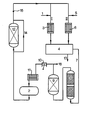
- the monomeric isobutylene 1 is introduced with the liquid solvent 2 as stream I via the cooler 3 into the polymerization reactor 4, where it is combined with the catalyst 5 dissolved in stream II.
- Stream II consists of a solution of the polymerization initiator 5 (for example BF 3 ) and the solvent 2.
- Stream II is brought to the polymerization temperature in the cooler 6.
- the polymerization is preferably carried out at a temperature of from -90 ° C. to -110 ° C. in order to achieve a high molecular weight.
- the product is discharged through a lock 13.
- the solvent which evaporates during the heat is passed into the circuit 7 and thus initially into the column 8, in which it can be washed, for example, with water to remove oligomers and unused initiator.
- the solvent is dried in the column 9 charged with a desiccant, compressed in the compressor 10 to 15-25 bar, in the condenser 11 at a temperature of -25 to -35 0 C liquefied and passed over the tower 12 charged with active A1 2 0 3 , where it is completely free of the residual moisture and contamination, such as residues of the monomer, the initiator, by-products of the polymerization and, if appropriate, traces of the lubrication of the compressor 10 related oil is exempted.
- the solvent is collected in the storage vessel 2. After passing through the tower 12, it is distributed to the current I and current II for the cycle which starts anew. In cooler 3 and 6, the solvent is brought to the desired polymerization temperature.
- the core of the solvent cleaning 12 is that of the 5 to 30 wt .-% alkali or J Alkaline earth hydroxide impregnated aluminum oxide existing adsorption layer.
- the activated, impregnated aluminum oxide is produced, for example, by using 70 to 95 parts by weight of Al 2 O 3 with a grain size of 2 to 8 mm, preferably 3 to 5 mm, with a diameter of 30 to 5 parts of one of the hydroxides in question, in particular NaOH, KOH and Ca (OH) 2 , preferably KOH, impregnated and the contact thus obtained at 250 to 550 ° C, preferably at 350 to 500 ° C, activated in an inert gas stream, for example an air or nitrogen stream. But you can also wet the A1 2 0 3 with a solution of the hydroxide and then evaporate the solvent, preferably water. Exhausted contact masses can be regenerated by reactivating them in a stream of air or nitrogen. You will then be fully effective again.
- the adsorption layer has a thickness of 0.2 to 10 cm, preferably 2 to 5 cm.
- a cylindrical design is recommended for cleaning. It is preferably designed as a trickle tower.
- Adsorption processes to be adapted to the problem are, for example, in “Drying of Gases and Liquids” by Klaus Sztaticsny Chemie-Technik 5th, Year 1976, No. 12 and in “Chemical Process Engineering” by Kassatkin Volume II VEB-Verlag, Leipzig, 1962 on page 222 and 223.
- the highly activated zinc oxide which is used for the process according to the application is a commercially available product which is produced by the processes described in DE-PS 12 66 549, US-PS 4 128 619 and US-PS 4 071 609.
- Reaction screw machines endless belts, continuously working kneaders, mixers, extruders and spray systems come into consideration as the polymerization reactor 4.
- the scrubber 8 can be, for example, a tray column, a packed column or a trickle tower.
- the pre-dryer 9 is a with a desiccant, e.g. Sodium sulfate, calcium chloride and in particular silica gel-filled vessel with the shape adapted to the problem.
- a desiccant e.g. Sodium sulfate, calcium chloride and in particular silica gel-filled vessel with the shape adapted to the problem.
- the pre-dryer 9 is designed as a tower through which the gaseous solvent flows in ascending order.
- Customary additives such as stabilizers, regulators, dyes and the like can be incorporated into the isobutylene before or during the polymerization. However, these can also be mixed into the polyisobutylenes after the polymerization.
- the stabilizers are generally used in amounts of from 0.01 to 2.0, preferably from 0.05 to 0.25,% by weight, based on the weight of the polyisobutylene.
- phenolic antioxidants such as 2,6-di - tert-butyl-p-cresol, tertiary amylphenol sulfide and tertiary amylphenol disulfide are suitable.
- Substances containing amine, sulfide or aromatic hydroxyl groups e.g. Di- (2-oxy-5-butyl-phenyl) sulfide or disulfide, phenyl- ⁇ -naphthylamine, polyvinyl ethyl sulfide or polyvinyl butyl sulfide are suitable.
- the process allows polyisobutylene to be produced continuously, either batchwise or without interference, over long periods of time.
- the polyisobutylenes obtained by the process according to the invention have a Grenzvis-L J kostician [ ⁇ ] from 0.9 to 12 dl / g (determined according to ASTM D 1601 and DIN 51562), have a narrow molecular weight distribution with little standard deviation and are characterized by minimal discoloration.
- the intrinsic viscosity [ ⁇ ] in dl / g is determined from the solution viscosity of a polyisobutene isooctane solution at 20 ° C.
- An Ubbelohde viscometer, capillary No. 1 serves as the measuring device.
- the intrinsic viscosity can be calculated on the basis of the Schulze-Blaschke relationship:
- the "mg NaOH / kg cycle gas" parameter is selected. About 500 ml of simply distilled water, which is placed in commercially available frit washing bottles, is passed through approx. 1 - 2 Nm 3 of cycle gas. An aliquot of the washing liquid is added n NaOH titrated against phenolphthalein. The consumption at n NaOH is the measure of the content of acidic components.
- ethylene 14,500 room parts per hour of ethylene are removed from storage vessel 2 by handling. According to sampling 15, the ethylene contains acidic components with the equivalent value of 2 mg NaOH / kg C 2 H 4 . This current is divided in a ratio of 1: 1 in stream I and stream II.
- Stream I is mixed with 270 room parts / hour of isobutylene from template 1, which contains 175 ppm by weight of isobutanol, 75 ppm by weight of methanol, 1600 ppm by weight of diisobutylene and is cooled in the cooler 3 to the polymerization temperature of -104 ° C.
- Stream II is cooled in the cooler 6 to the polymerization temperature of -104 ° C., and 0.4 room parts / hour of boron trifluoride are added via the catalyst metering station 5.
- Streams I and II are combined in the polymerization reactor 4 of 5000 parts by volume, the polymerization of the isobutene taking place as an exothermic reaction.
- the temperature rises above the boiling point of ethylene.
- the ethylene is then dried in the drying tower 9 (volume approx. 500 room parts) over granular, walnut-sized calcium chloride and compressed to about 19 bar in the two-stage compressor 10. It is cooled in condenser 11 to -30 o C and liquefied and stored in storage vessel 2 and redistributed to currents I and II. Losses are added via fresh gas ethylene addition 16.
- the ethylene from catalyst residues is slightly yellow in color, the measuring lines are covered with oligomers and make the flow more difficult.
- the catalyst consumption must be increased to 0.6 room parts / hour.
- the polymer initially had a standard deviation S of + 0.03 in the intrinsic viscosity, after 24 hours the standard deviation increases to ⁇ 0.3. After about 100 hours, the circulation ethylene is so contaminated that trouble-free and type-appropriate polymerization is no longer possible. The cycle must be dampened.
- Example 1 The procedure described in Example 1 is followed, however. Difference in that the ethylene flow of 500 room parts per hour from storage vessel 2 in the circulating gas cleaning system 12 (see FIG.) Formed as a trickle tower over 100 room parts contact mass with a layer thickness of 3 cm made of Al 2 0 3 impregnated with 20% by weight KOH (grain size approx 3 mm) is cleaned.
- the polymerization is still trouble-free after 14 days, the cycle gas ethylene and the polymer obtained are colorless, the standard deviation of the intrinsic viscosity of the polyisobutylene produced is constant + 0.03.
- the contact consumption is unchanged at 0.15% BF 3 based on the amount of polymer formed in the meantime.
- Example 2 The procedure is as described in Example 2. The difference is that the contact used in cleaning 12 has been regenerated after about 400 hours of operation as a cycle gas cleaning agent in an air stream at about 430 ° C. The polymerization runs trouble-free, the cycle gas ethylene remains colorless, the contact consumption remains constant, the intrinsic viscosity of the polymer formed in the meantime shows a constant standard deviation of + 0.03.
- Example 1 The procedure is as described in Example 1, but with the difference that the ethylene flow of 500 room parts per hour from storage vessel 2 in the cycle gas cleaning system 12 (see FIG. 1) designed as a trickle tower over 100 room parts of highly active zinc oxide (grain size about 4 mm) with a layer thickness of 4 cm is cleaned.
- the polymerization continues to run smoothly even after 20 days, the cycle gas ethylene and the polymer obtained are colorless, the contact consumption remains constant and the intrinsic viscosity of the polymer formed in the meantime shows a standard deviation of ⁇ 0.03 which remains constant.
Landscapes
- Chemical & Material Sciences (AREA)
- Health & Medical Sciences (AREA)
- Chemical Kinetics & Catalysis (AREA)
- Medicinal Chemistry (AREA)
- Polymers & Plastics (AREA)
- Organic Chemistry (AREA)
- Addition Polymer Or Copolymer, Post-Treatments, Or Chemical Modifications (AREA)
- Organic Low-Molecular-Weight Compounds And Preparation Thereof (AREA)
Priority Applications (1)
| Application Number | Priority Date | Filing Date | Title |
|---|---|---|---|
| AT80105115T ATE8055T1 (de) | 1979-09-08 | 1980-08-28 | Verfahren zur herstellung von polyisobutylenen. |
Applications Claiming Priority (2)
| Application Number | Priority Date | Filing Date | Title |
|---|---|---|---|
| DE2936361 | 1979-09-08 | ||
| DE19792936361 DE2936361A1 (de) | 1979-09-08 | 1979-09-08 | Verfahren zur herstellung von polyisobutylenen |
Publications (3)
| Publication Number | Publication Date |
|---|---|
| EP0025530A2 true EP0025530A2 (fr) | 1981-03-25 |
| EP0025530A3 EP0025530A3 (en) | 1981-06-17 |
| EP0025530B1 EP0025530B1 (fr) | 1984-06-20 |
Family
ID=6080388
Family Applications (1)
| Application Number | Title | Priority Date | Filing Date |
|---|---|---|---|
| EP80105115A Expired EP0025530B1 (fr) | 1979-09-08 | 1980-08-28 | Procédé de fabrication de polyisobutènes |
Country Status (3)
| Country | Link |
|---|---|
| EP (1) | EP0025530B1 (fr) |
| AT (1) | ATE8055T1 (fr) |
| DE (2) | DE2936361A1 (fr) |
Cited By (10)
| Publication number | Priority date | Publication date | Assignee | Title |
|---|---|---|---|---|
| EP0115635A1 (fr) * | 1983-01-05 | 1984-08-15 | BASF Aktiengesellschaft | Procédé continu de préparation de polymères d'isobutylène |
| EP0154164A3 (en) * | 1984-02-10 | 1989-06-07 | Basf Aktiengesellschaft | Process for the polymerisation of isobutylene |
| EP0213401A3 (en) * | 1985-08-01 | 1989-06-14 | Basf Aktiengesellschaft | Process for the polymerization of isobutylene |
| WO1995033779A1 (fr) * | 1994-06-09 | 1995-12-14 | Exxon Chemical Patents Inc. | PROCEDE DE DILUTION UTILE POUR POLYMERISER DES HOMOPOLYMERES ET DES COPOLYMERES OLEFINES-α NON ETHYLENIQUES AU MOYEN DE SYSTEMES CATALYSEURS EN ALLIAGES ORGANOMETALLIQUES |
| EP0696601A1 (fr) * | 1994-08-08 | 1996-02-14 | Bayer Ag | Procédé pour la préparation de polyoléfines |
| US5859159A (en) * | 1992-12-17 | 1999-01-12 | Exxon Chemical Patents Inc. | Dilute process for the polymerization of non-ethylene α-olefin homopolymers and copolymers using metallocene catalyst systems |
| WO2007042516A1 (fr) * | 2005-10-11 | 2007-04-19 | Basf Se | Procede de production de polyisobutene |
| KR101157906B1 (ko) * | 2011-10-20 | 2012-06-22 | (주)유엠브이기술 | 대용량 파일 시스템 모니터링을 위한 캐쉬 파일 관리 시스템 및 방법 |
| WO2015010943A1 (fr) * | 2013-07-25 | 2015-01-29 | Basf Se | Procédé de production d'homopolymères d'isobutène de poids moléculaires élevés |
| WO2019011814A1 (fr) | 2017-07-13 | 2019-01-17 | Arlanxeo Deutschland Gmbh | Procédé de production de polymères d'isobutène à régulation de température améliorée |
Families Citing this family (1)
| Publication number | Priority date | Publication date | Assignee | Title |
|---|---|---|---|---|
| DE3629233A1 (de) * | 1986-08-28 | 1988-03-10 | Erdoelchemie Gmbh | Verfahren zur katalytischen umsetzung von isoolefinen |
Family Cites Families (3)
| Publication number | Priority date | Publication date | Assignee | Title |
|---|---|---|---|---|
| DE1071340B (de) * | 1956-03-08 | 1959-12-17 | Esso Research and Engineering Company Elizabeth N J (V St A) | Verfahren zur Herstellung von Polyisoolefmcn |
| US3129205A (en) * | 1958-11-03 | 1964-04-14 | Exxon Research Engineering Co | Reactor flushing system |
| NL271440A (fr) * | 1960-11-16 |
-
1979
- 1979-09-08 DE DE19792936361 patent/DE2936361A1/de not_active Withdrawn
-
1980
- 1980-08-28 AT AT80105115T patent/ATE8055T1/de not_active IP Right Cessation
- 1980-08-28 DE DE8080105115T patent/DE3068308D1/de not_active Expired
- 1980-08-28 EP EP80105115A patent/EP0025530B1/fr not_active Expired
Cited By (12)
| Publication number | Priority date | Publication date | Assignee | Title |
|---|---|---|---|---|
| EP0115635A1 (fr) * | 1983-01-05 | 1984-08-15 | BASF Aktiengesellschaft | Procédé continu de préparation de polymères d'isobutylène |
| EP0154164A3 (en) * | 1984-02-10 | 1989-06-07 | Basf Aktiengesellschaft | Process for the polymerisation of isobutylene |
| EP0213401A3 (en) * | 1985-08-01 | 1989-06-14 | Basf Aktiengesellschaft | Process for the polymerization of isobutylene |
| US5859159A (en) * | 1992-12-17 | 1999-01-12 | Exxon Chemical Patents Inc. | Dilute process for the polymerization of non-ethylene α-olefin homopolymers and copolymers using metallocene catalyst systems |
| WO1995033779A1 (fr) * | 1994-06-09 | 1995-12-14 | Exxon Chemical Patents Inc. | PROCEDE DE DILUTION UTILE POUR POLYMERISER DES HOMOPOLYMERES ET DES COPOLYMERES OLEFINES-α NON ETHYLENIQUES AU MOYEN DE SYSTEMES CATALYSEURS EN ALLIAGES ORGANOMETALLIQUES |
| EP0696601A1 (fr) * | 1994-08-08 | 1996-02-14 | Bayer Ag | Procédé pour la préparation de polyoléfines |
| US5543479A (en) * | 1994-08-08 | 1996-08-06 | Bayer Ag | Process for the production of polyisoolefins |
| WO2007042516A1 (fr) * | 2005-10-11 | 2007-04-19 | Basf Se | Procede de production de polyisobutene |
| US7662900B2 (en) | 2005-10-11 | 2010-02-16 | Basf Aktiengesellschaft | Method for producing polyisobutene |
| KR101157906B1 (ko) * | 2011-10-20 | 2012-06-22 | (주)유엠브이기술 | 대용량 파일 시스템 모니터링을 위한 캐쉬 파일 관리 시스템 및 방법 |
| WO2015010943A1 (fr) * | 2013-07-25 | 2015-01-29 | Basf Se | Procédé de production d'homopolymères d'isobutène de poids moléculaires élevés |
| WO2019011814A1 (fr) | 2017-07-13 | 2019-01-17 | Arlanxeo Deutschland Gmbh | Procédé de production de polymères d'isobutène à régulation de température améliorée |
Also Published As
| Publication number | Publication date |
|---|---|
| EP0025530A3 (en) | 1981-06-17 |
| EP0025530B1 (fr) | 1984-06-20 |
| ATE8055T1 (de) | 1984-07-15 |
| DE3068308D1 (en) | 1984-07-26 |
| DE2936361A1 (de) | 1981-04-02 |
Similar Documents
| Publication | Publication Date | Title |
|---|---|---|
| EP0807641B1 (fr) | Procédé pour la préparation de polyisobutène de poids moléculaire moyen, hautement réactif | |
| EP0036974B1 (fr) | Procédé de polymérisation d'isobutène | |
| EP0628575B1 (fr) | Procédé de préparation de polyisobutènes hautement réactifs | |
| EP0025530B1 (fr) | Procédé de fabrication de polyisobutènes | |
| DE60019960T2 (de) | Herstellung von isobutencopolymere | |
| WO2001030869A1 (fr) | Procede pour produire des polyisobutenes a reactivite elevee | |
| EP0213401B1 (fr) | Procédé de polymérisation de l'isobutène | |
| DE69419101T2 (de) | Hochreine thiol-en-zusammensetzung | |
| EP0115635B2 (fr) | Procédé continu de préparation de polymères d'isobutylène | |
| DE2708303A1 (de) | Verfahren zur bildung eines fluessigen polybutenpolymerisates | |
| DE1520656A1 (de) | Verfahren zur Polymerisation von alpha-Olefinen | |
| EP0154164B1 (fr) | Procédé de polymérisation d'isobutylène | |
| DE863262C (de) | Verfahren zur Herstellung von Polymerisationsprodukten | |
| DE3025397C2 (de) | Verfahren zur Herstellung von elastomeren Terpolymeren aus Äthylen, Propylen und einem nicht-konjugierten Dien | |
| EP0555747B1 (fr) | Catalyseur de type Phillips et son utilisation pour produire des homo- et copolymères d'éthylène | |
| DE2706552A1 (de) | Hydrierungsverfahren fuer olefinpolymere | |
| DE2062213C3 (de) | Verfahren zum Herstellen von PoIyvinylalkyläthern | |
| DE2061289B2 (de) | Verfahren zur Polymerisation von Isobutylen | |
| WO2005066222A1 (fr) | Production de polyisobutenes fortement reactifs a faible teneur en fluore au moyen d'un moderateur | |
| DE912021C (de) | Verfahren zum fortlaufenden Mischpolymerisieren eines niedrigen aliphatischen Monoolefins mit einem polymerisierbaren, einen aromatischen Kern enthaltenden Monoolefin | |
| DE69314549T2 (de) | Kompressor-Verstoffungsschutz in Vinylacetat-Produktionseinheiten | |
| DE936719C (de) | Verfahren zur stetigen Mischpolymerisation | |
| DE1101764B (de) | Verfahren zur Herstellung isoolefinhaltiger Polymerisate | |
| AT203208B (de) | Verfahren zur Herstellung von linearen, ungesättigten Polymeren mit hohem Molekulargewicht | |
| DE3137499C2 (fr) |
Legal Events
| Date | Code | Title | Description |
|---|---|---|---|
| PUAI | Public reference made under article 153(3) epc to a published international application that has entered the european phase |
Free format text: ORIGINAL CODE: 0009012 |
|
| AK | Designated contracting states |
Designated state(s): AT BE DE FR GB NL |
|
| PUAL | Search report despatched |
Free format text: ORIGINAL CODE: 0009013 |
|
| AK | Designated contracting states |
Designated state(s): AT BE DE FR GB NL |
|
| RBV | Designated contracting states (corrected) |
Designated state(s): AT BE DE FR GB NL |
|
| 17P | Request for examination filed |
Effective date: 19811022 |
|
| GRAA | (expected) grant |
Free format text: ORIGINAL CODE: 0009210 |
|
| AK | Designated contracting states |
Designated state(s): AT BE DE FR GB NL |
|
| REF | Corresponds to: |
Ref document number: 8055 Country of ref document: AT Date of ref document: 19840715 Kind code of ref document: T |
|
| REF | Corresponds to: |
Ref document number: 3068308 Country of ref document: DE Date of ref document: 19840726 |
|
| ET | Fr: translation filed | ||
| PLBE | No opposition filed within time limit |
Free format text: ORIGINAL CODE: 0009261 |
|
| STAA | Information on the status of an ep patent application or granted ep patent |
Free format text: STATUS: NO OPPOSITION FILED WITHIN TIME LIMIT |
|
| 26N | No opposition filed | ||
| PGFP | Annual fee paid to national office [announced via postgrant information from national office to epo] |
Ref country code: FR Payment date: 19990715 Year of fee payment: 20 |
|
| PGFP | Annual fee paid to national office [announced via postgrant information from national office to epo] |
Ref country code: NL Payment date: 19990721 Year of fee payment: 20 |
|
| PGFP | Annual fee paid to national office [announced via postgrant information from national office to epo] |
Ref country code: AT Payment date: 19990722 Year of fee payment: 20 |
|
| PGFP | Annual fee paid to national office [announced via postgrant information from national office to epo] |
Ref country code: DE Payment date: 19990804 Year of fee payment: 20 |
|
| PGFP | Annual fee paid to national office [announced via postgrant information from national office to epo] |
Ref country code: BE Payment date: 19990813 Year of fee payment: 20 |
|
| PGFP | Annual fee paid to national office [announced via postgrant information from national office to epo] |
Ref country code: GB Payment date: 19990816 Year of fee payment: 20 |
|
| BE20 | Be: patent expired |
Free format text: 20000828 *BASF A.G. |
|
| PG25 | Lapsed in a contracting state [announced via postgrant information from national office to epo] |
Ref country code: GB Free format text: LAPSE BECAUSE OF EXPIRATION OF PROTECTION Effective date: 20000827 |
|
| PG25 | Lapsed in a contracting state [announced via postgrant information from national office to epo] |
Ref country code: NL Free format text: LAPSE BECAUSE OF EXPIRATION OF PROTECTION Effective date: 20000828 Ref country code: AT Free format text: LAPSE BECAUSE OF EXPIRATION OF PROTECTION Effective date: 20000828 |
|
| REG | Reference to a national code |
Ref country code: GB Ref legal event code: PE20 Effective date: 20000827 |
|
| NLV7 | Nl: ceased due to reaching the maximum lifetime of a patent |
Effective date: 20000828 |