EP0025538A2 - Verfahren zur Herstellung isolierter Wickeldrähte durch Extrusion von Thermoplasten - Google Patents
Verfahren zur Herstellung isolierter Wickeldrähte durch Extrusion von Thermoplasten Download PDFInfo
- Publication number
- EP0025538A2 EP0025538A2 EP80105156A EP80105156A EP0025538A2 EP 0025538 A2 EP0025538 A2 EP 0025538A2 EP 80105156 A EP80105156 A EP 80105156A EP 80105156 A EP80105156 A EP 80105156A EP 0025538 A2 EP0025538 A2 EP 0025538A2
- Authority
- EP
- European Patent Office
- Prior art keywords
- wires
- extrusion
- aromatic
- winding wires
- radicals
- Prior art date
- Legal status (The legal status is an assumption and is not a legal conclusion. Google has not performed a legal analysis and makes no representation as to the accuracy of the status listed.)
- Granted
Links
Classifications
-
- H—ELECTRICITY
- H01—ELECTRIC ELEMENTS
- H01B—CABLES; CONDUCTORS; INSULATORS; SELECTION OF MATERIALS FOR THEIR CONDUCTIVE, INSULATING OR DIELECTRIC PROPERTIES
- H01B3/00—Insulators or insulating bodies characterised by the insulating materials; Selection of materials for their insulating or dielectric properties
- H01B3/18—Insulators or insulating bodies characterised by the insulating materials; Selection of materials for their insulating or dielectric properties mainly consisting of organic substances
- H01B3/30—Insulators or insulating bodies characterised by the insulating materials; Selection of materials for their insulating or dielectric properties mainly consisting of organic substances plastics; resins; waxes
- H01B3/42—Insulators or insulating bodies characterised by the insulating materials; Selection of materials for their insulating or dielectric properties mainly consisting of organic substances plastics; resins; waxes polyesters; polyethers; polyacetals
- H01B3/427—Polyethers
-
- H—ELECTRICITY
- H01—ELECTRIC ELEMENTS
- H01B—CABLES; CONDUCTORS; INSULATORS; SELECTION OF MATERIALS FOR THEIR CONDUCTIVE, INSULATING OR DIELECTRIC PROPERTIES
- H01B13/00—Apparatus or processes specially adapted for manufacturing conductors or cables
- H01B13/06—Insulating conductors or cables
- H01B13/14—Insulating conductors or cables by extrusion
- H01B13/148—Selection of the insulating material therefor
-
- H—ELECTRICITY
- H01—ELECTRIC ELEMENTS
- H01B—CABLES; CONDUCTORS; INSULATORS; SELECTION OF MATERIALS FOR THEIR CONDUCTIVE, INSULATING OR DIELECTRIC PROPERTIES
- H01B3/00—Insulators or insulating bodies characterised by the insulating materials; Selection of materials for their insulating or dielectric properties
- H01B3/18—Insulators or insulating bodies characterised by the insulating materials; Selection of materials for their insulating or dielectric properties mainly consisting of organic substances
- H01B3/30—Insulators or insulating bodies characterised by the insulating materials; Selection of materials for their insulating or dielectric properties mainly consisting of organic substances plastics; resins; waxes
- H01B3/308—Wires with resins
Definitions
- the present invention relates to an improved method for producing insulated winding wires by extrusion of thermoplastics.
- Enamel-insulated winding wires so-called “enamelled wires” are precisely characterized in the German standard DIN 46435 from April 1977. They are used on a large scale in electrical engineering, transformer construction and electronics.
- the conductor metal preferably copper or aluminum, is insulated with a thin, but mechanically and thermally extremely resistant synthetic resin lacquer layer.
- Such enamelled wires are produced on wire enamelling machines by repeatedly applying an enamelled wire enamel to the metal wire.
- wire enamel dispersions and aqueous solutions of wire enamel resins as well as resin melts are already used for wire enamelling.
- thermoplastics for thick-walled sheathing of electrical conductor bundles and for the production of conductor wires has long been known from the cable industry.
- thermoplastic polycondensates with crystallite melting points above 170 ° C., preferably above 250 ° C., are used as thermoplastics for the extrusion coating of winding wires.
- polymers with chain sulfur atoms e.g. Called polyphenylene sulfide.
- the examples describe the extrusion conditions for polyethylene terephthalate, 6,6-polyamide and polyphenylene sulfide and the properties of the winding wires obtained therewith.
- the invention thus relates to a process for the production of so-called enamel-insulated winding wires by extrusion of partially crystalline thermoplastic polycondensates with crystallite melting points above 170 ° C, preferably above 250 ° C, characterized in that aromatic polyether ketones with recurring units of the formula where Ar is aromatic radicals, which may be the same or different, in particular benzene, naphthalene or diphenyl radicals, and where n is an integer from 50 to 200, are used.
- Winding wires have a softening temperature of well over 300 ° C and a surface hardness of 2 - 3 H, which is normally only achieved with winding wires with thermoset coatings.
- thermoplastics In comparison to the values for the other thermoplastics, the thermal shock value of the winding wires insulated with polyether ketone coatings has surprisingly been greatly improved.
- Coating material Semi-crystalline aromatic polyetherketone of the summary formula
Landscapes
- Physics & Mathematics (AREA)
- Spectroscopy & Molecular Physics (AREA)
- Engineering & Computer Science (AREA)
- Manufacturing & Machinery (AREA)
- Organic Insulating Materials (AREA)
- Extrusion Moulding Of Plastics Or The Like (AREA)
- Manufacture Of Motors, Generators (AREA)
- Processes Specially Adapted For Manufacturing Cables (AREA)
- Manufacture Of Macromolecular Shaped Articles (AREA)
- Insulated Conductors (AREA)
- Adornments (AREA)
Abstract
Description
- Die vorliegende Erfindung betrifft ein verbessertes Verfahren zur Herstellung von isolierten Wickeldrähten durch Extrusion von Thermoplasten.
- Lackisolierte Wickeldrähte, sogenannte "Lackdrähte" sind in der Deutschen Norm DIN 46435 von April 1977 genau charakterisiert. Sie kommen in großem Umfang im Elektromaschinenbau, Transformatorenbau und in der Elektronik zum Einsatz.
- Das Leitermetall, vorzugsweise Kupfer oder Aluminium, ist mit einer dünnen, jedoch mechanisch und thermisch äußerst widerstandsfähigen Kunstharzlackschicht isoliert.
- Die Herstellung derartiger Lackdrähte erfolgt auf Drahtlackiermaschinen durch mehrfaches kontinuierliches Auftragen eines Drahtlackes auf den Metalldraht. Im Hinblick auf die Schädlichkeit der in dem Drahtlack enthaltenen Lösungsmittel und auf die sich daraus ergebenden Umweltprobleme werden zur Drahtlackierung auch schon Drahtlack-Dispersionen und wässrige Lösungen von Drahtlackharzen sowie auch Harzschmelzen eingesetzt.
- Alle diese bekannten Verfahren sind durch die damit erreichbaren verhältnismäßig niedrigen Abzugsgeschwindigkeiten jedoch recht arbeits- und zeitaufwendig.
- Aus der Kabelindustrie ist seit langem die Extrusion von Thermoplasten zur dickwandigen Ummantelung elektrischer Leiterbündel sowie zur Herstellung von Leitungsdrähten bekannt.
- In einer älteren Anmeldung (vergl. z.B. DE-OS 26 38 763) wird bereits ein Verfahren zur Herstellung von lackisolierten Wickeldrähten durch Extrusion von Thermoplasten beschrieben.
- Diese unter Mitwirkung der Anmelderin getätigte ältere Anmeldung leistet damit einen entscheidenden Beitrag zur Überwindung des Vorurteils, die Erzielung derart dünner Isolierschichten, wie sie laut DIN 46435 gefordert werden, sei im Extrusionsverfahren nicht möglich. Nach DE-OS 26 38 763 werden als Thermoplaste für die Extrusionsbeschichtung von Wickeldrähten teilkristalline thermoplastische Polykondensate mit Kristallitschmelzpunkten oberhalb 170°C, vorzugsweise oberhalb 250°C, eingesetzt.
- Außer den verschiedenen linearen Polyestern und Polyamiden werden im Text Polymere mit kettenständigen Schwefelatomen, wie z.B. Polyphenylensulfid, genannt. In den Beispielen werden die Extrusionsbedingungen für Polyäthylenterephthalat, 6,6-Polyamid sowie Polyphenylensulfid und die Eigenschaften der damit erhaltenen Wickeldrähte beschrieben.
- Alle diese mit den genannten Thermoplasten beschichteten Wickeldrähte haben den Nachteil, daß ihre Erweichungstemperaturen (nach DIN 46453) weit unter 300°C liegen, also den gestiegenen Anforderungen nicht entsprechen und auch, daß die Wärmeschockwerte teilweise unbefriedigend sind; außerdem weisen die Lackdrähte eine für die Ansprüche der modernen Motorenwickeltechnik zu niedrige Oberflächenhärte auf.
- Es wurde nun überraschenderweise gefunden, daß spezielle teilkristalline thermoplastische Polykondensate mit Kristallitschmelzpunkten oberhalb 250°C hier entscheidende Verbesserungen bringen.
- Gegenstand der Erfindung ist also ein Verfahren zur Herstellung von sogenannten lackisolierten Wickeldrähten durch Extrusion von teilkristallinen thermoplastischen Polykondensaten mit Kristallitschmelzpunkten oberhalb 170°C, vorzugsweise oberhalb 250°C, dadurch gekennzeichnet, daß aromatische Polyätherketone mit wiederkehrenden Einheiten der Formel

- Es war in keiner Weise vorauszusehen und ist daher völlig überraschend,daß mit aromatischen Poly- ätherketonen, d.i. mit Thermoplasten, beschichtete Wickeldrähte eine Erweichungstemperatur von weit über 300°C sowie eine Oberflächenhärte von 2 - 3 H besitzen, wie sie sonst nur Wickeldrähte mit Duroplastbeschichtungen erreichen.
- Im Vergleich zu den Werten bei den übrigen Thermoplasten ist außerdem der Wärmeschockwert der mit Polyätherketonüberzügen isolierten Wickeldrähte überraschenderweise stark verbessert.
- Beschichtungsmaterial: Teilkristallines aromatisches Polyätherketon der summarischen Formel

- Kristallitschmelzpunkt 335°C.
- Extrudertemperaturen vom Einlauf bis zur Düse:
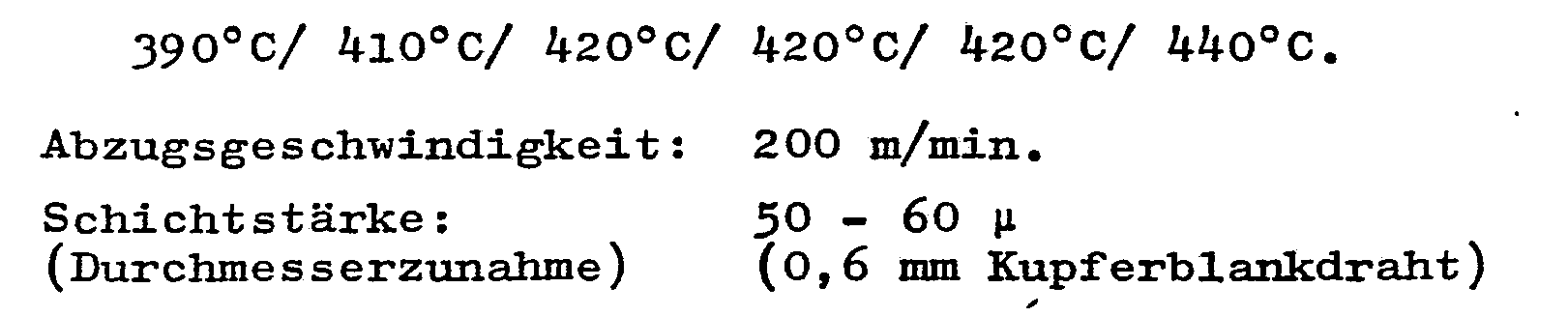
- Eigenschaften der Wickeldrähte:


Claims (1)
- Verfahren zur Herstellung von sogenannten lackisolierten Wickeldrähten durch Extrusion von teilkristallinen thermoplastischen Polykondensaten mit Kristallitschmelzpunkten oberhalb 170°C, vorzugsweise oberhalb 250°C, dadurch gekennzeichnet, daß aromatische Polyätherketone mit wiederkehrenden Einheiten der Formel

Priority Applications (1)
| Application Number | Priority Date | Filing Date | Title |
|---|---|---|---|
| AT80105156T ATE7975T1 (de) | 1979-09-12 | 1980-08-29 | Verfahren zur herstellung isolierter wickeldraehte durch extrusion von thermoplasten. |
Applications Claiming Priority (2)
| Application Number | Priority Date | Filing Date | Title |
|---|---|---|---|
| DE2936795A DE2936795C2 (de) | 1979-09-12 | 1979-09-12 | Verfahren zur Herstellung isolierter Wickeldrähte durch Extrusion von Thermoplasten |
| DE2936795 | 1979-09-12 |
Publications (3)
| Publication Number | Publication Date |
|---|---|
| EP0025538A2 true EP0025538A2 (de) | 1981-03-25 |
| EP0025538A3 EP0025538A3 (en) | 1981-10-07 |
| EP0025538B1 EP0025538B1 (de) | 1984-06-13 |
Family
ID=6080629
Family Applications (1)
| Application Number | Title | Priority Date | Filing Date |
|---|---|---|---|
| EP80105156A Expired EP0025538B1 (de) | 1979-09-12 | 1980-08-29 | Verfahren zur Herstellung isolierter Wickeldrähte durch Extrusion von Thermoplasten |
Country Status (10)
| Country | Link |
|---|---|
| EP (1) | EP0025538B1 (de) |
| JP (1) | JPS5673818A (de) |
| AT (1) | ATE7975T1 (de) |
| AU (1) | AU6144180A (de) |
| CA (1) | CA1136817A (de) |
| DE (2) | DE2936795C2 (de) |
| DK (1) | DK386380A (de) |
| ES (1) | ES494986A0 (de) |
| FI (1) | FI802708A7 (de) |
| IN (1) | IN154846B (de) |
Cited By (2)
| Publication number | Priority date | Publication date | Assignee | Title |
|---|---|---|---|---|
| WO1983001864A1 (fr) * | 1981-11-19 | 1983-05-26 | Lehmann, Helmut | Procede pour impregner par extrusion de matiere plastique des fils ou conducteurs guipes |
| DE19748529A1 (de) * | 1997-11-03 | 1999-03-04 | Siemens Ag | Elektrische Maschine mit Wickeldrähten |
Families Citing this family (3)
| Publication number | Priority date | Publication date | Assignee | Title |
|---|---|---|---|---|
| JPS5837618U (ja) * | 1981-09-08 | 1983-03-11 | 三菱電線工業株式会社 | 絶縁電線 |
| JPS59207233A (ja) * | 1983-05-11 | 1984-11-24 | 住友化学工業株式会社 | 被覆方法 |
| JPS62148234A (ja) * | 1985-12-23 | 1987-07-02 | Sumitomo Bakelite Co Ltd | 熱可塑性芳香族ポリエ−テルケトン絶縁電線の製造方法 |
Family Cites Families (3)
| Publication number | Priority date | Publication date | Assignee | Title |
|---|---|---|---|---|
| US3503818A (en) * | 1966-12-01 | 1970-03-31 | Union Carbide Corp | Polyarylene polyether insulated conductors and process for making same |
| US4239884A (en) * | 1975-08-11 | 1980-12-16 | Raychem Corporation | Process for isolation of solid polymers |
| CH616264A5 (de) * | 1976-07-01 | 1980-03-14 | Maillefer Sa |
-
1979
- 1979-09-12 DE DE2936795A patent/DE2936795C2/de not_active Expired
-
1980
- 1980-08-14 AU AU61441/80A patent/AU6144180A/en not_active Abandoned
- 1980-08-27 FI FI802708A patent/FI802708A7/fi not_active Application Discontinuation
- 1980-08-27 JP JP11713880A patent/JPS5673818A/ja active Pending
- 1980-08-29 DE DE8080105156T patent/DE3068209D1/de not_active Expired
- 1980-08-29 AT AT80105156T patent/ATE7975T1/de not_active IP Right Cessation
- 1980-08-29 EP EP80105156A patent/EP0025538B1/de not_active Expired
- 1980-09-03 IN IN640/DEL/80A patent/IN154846B/en unknown
- 1980-09-11 CA CA000360090A patent/CA1136817A/en not_active Expired
- 1980-09-11 DK DK386380A patent/DK386380A/da not_active Application Discontinuation
- 1980-09-12 ES ES494986A patent/ES494986A0/es active Granted
Cited By (3)
| Publication number | Priority date | Publication date | Assignee | Title |
|---|---|---|---|---|
| WO1983001864A1 (fr) * | 1981-11-19 | 1983-05-26 | Lehmann, Helmut | Procede pour impregner par extrusion de matiere plastique des fils ou conducteurs guipes |
| EP0080138A1 (de) * | 1981-11-19 | 1983-06-01 | Dr. Beck & Co. AG | Verfahren zur Imprägnierung umsponnener Drähte und Litzen durch Extrusion von Thermoplasten |
| DE19748529A1 (de) * | 1997-11-03 | 1999-03-04 | Siemens Ag | Elektrische Maschine mit Wickeldrähten |
Also Published As
| Publication number | Publication date |
|---|---|
| AU6144180A (en) | 1981-03-19 |
| DK386380A (da) | 1981-03-13 |
| EP0025538A3 (en) | 1981-10-07 |
| JPS5673818A (en) | 1981-06-18 |
| CA1136817A (en) | 1982-12-07 |
| ATE7975T1 (de) | 1984-06-15 |
| ES8106630A1 (es) | 1981-08-01 |
| DE3068209D1 (en) | 1984-07-19 |
| IN154846B (de) | 1984-12-15 |
| ES494986A0 (es) | 1981-08-01 |
| DE2936795A1 (de) | 1981-04-02 |
| EP0025538B1 (de) | 1984-06-13 |
| FI802708A7 (fi) | 1981-01-01 |
| DE2936795C2 (de) | 1982-12-09 |
Similar Documents
| Publication | Publication Date | Title |
|---|---|---|
| DE3786429T2 (de) | Isolierte Leitung mit hochtemperaturbeständiger Multischichtisolierung. | |
| DE2526626C3 (de) | Verfahren zur Herstellung eines elektrischen Litzenleiters | |
| DE69607104T2 (de) | Wärmebeständiger, leitfähiger Draht mit einer Benzimidazolpolymer enthaltenden Beschichtung | |
| DE2811028A1 (de) | Energiekabel, insbesondere isolierueberzug fuer ein energiekabel | |
| DE19524526A1 (de) | Koaxialkabel | |
| WO2006061360A1 (de) | Verfahren zum herstellen eines wickelleiters für elektrische geräte und nach diesem verfahren hergestellter wickelleiter | |
| DE1033291B (de) | Isolierte elektrische Leitung | |
| EP0025538B1 (de) | Verfahren zur Herstellung isolierter Wickeldrähte durch Extrusion von Thermoplasten | |
| EP0002224A1 (de) | Verfahren zur Herstellung von isolierten Wickeldrähten durch Extrusion von Thermoplasten und Thermoplaste zur Ausführung desselben | |
| EP0030717B1 (de) | Verfahren zur Herstellung von Wickeldrähten durch Extrusion von Thermoplasten | |
| DE3403556A1 (de) | Isolierter elektrischer leiter und ein verfahren fuer seine vorbereitung | |
| EP0024674B1 (de) | Verfahren zur Herstellung isolierter Wickeldrähte durch Aufextrudieren von Polyethylenterephtalat | |
| DE3243925A1 (de) | Verfahren zur herstellung von laminaten mit niedriger dielektrizitaetskonstante | |
| DE2032075B2 (de) | Mehrschichtisolierstoffe | |
| EP0080138B1 (de) | Verfahren zur Imprägnierung umsponnener Drähte und Litzen durch Extrusion von Thermoplasten | |
| DE3808738A1 (de) | Ueberzuege mit polyarylensulfiden | |
| DE102005058040A1 (de) | Verfahren zum Herstellen eines Wickelleiters für elektrische Geräte und nach diesem Verfahren hergestellter Wickelleiter | |
| DE2409655B2 (de) | Verfahren zum umkleiden von elektrischen leitern aus aluminium | |
| DE1947030C (de) | Isoliertes elektrisches Bauteil | |
| DE895180C (de) | Verfahren zur Herstellung von oelfreien elektrischen Lackdraehten | |
| DE1765680C (de) | Mit zwei Lackschichten isolierter, elektrischer Leiter | |
| DE1866342U (de) | Draht mit zwei isolationsschichten. | |
| DE959528C (de) | Lackueberzuege auf Metallen | |
| DE829321C (de) | Verfahren zum wasserdichten UEberziehen, Impraegnieren oder Voneinandertrennen von Gegenstaenden oder Teilen derselben mit Hilfe einer Kunststoffmasse | |
| DE949527C (de) | Verfahren zur Herstellung von Dimethylpolysiloxanen |
Legal Events
| Date | Code | Title | Description |
|---|---|---|---|
| PUAI | Public reference made under article 153(3) epc to a published international application that has entered the european phase |
Free format text: ORIGINAL CODE: 0009012 |
|
| AK | Designated contracting states |
Designated state(s): AT BE CH DE FR GB IT NL SE |
|
| PUAL | Search report despatched |
Free format text: ORIGINAL CODE: 0009013 |
|
| AK | Designated contracting states |
Designated state(s): AT BE CH DE FR GB IT NL SE |
|
| 17P | Request for examination filed |
Effective date: 19811023 |
|
| ITF | It: translation for a ep patent filed | ||
| GRAA | (expected) grant |
Free format text: ORIGINAL CODE: 0009210 |
|
| AK | Designated contracting states |
Designated state(s): AT BE CH DE FR GB IT LI NL SE |
|
| PG25 | Lapsed in a contracting state [announced via postgrant information from national office to epo] |
Ref country code: SE Effective date: 19840613 Ref country code: NL Effective date: 19840613 Ref country code: BE Effective date: 19840613 |
|
| REF | Corresponds to: |
Ref document number: 7975 Country of ref document: AT Date of ref document: 19840615 Kind code of ref document: T |
|
| REF | Corresponds to: |
Ref document number: 3068209 Country of ref document: DE Date of ref document: 19840719 |
|
| PG25 | Lapsed in a contracting state [announced via postgrant information from national office to epo] |
Ref country code: GB Effective date: 19840829 Ref country code: AT Effective date: 19840829 |
|
| NLV1 | Nl: lapsed or annulled due to failure to fulfill the requirements of art. 29p and 29m of the patents act | ||
| PLBI | Opposition filed |
Free format text: ORIGINAL CODE: 0009260 |
|
| PLBI | Opposition filed |
Free format text: ORIGINAL CODE: 0009260 |
|
| REG | Reference to a national code |
Ref country code: CH Ref legal event code: PL |
|
| PG25 | Lapsed in a contracting state [announced via postgrant information from national office to epo] |
Ref country code: DE Effective date: 19850501 |
|
| 26 | Opposition filed |
Opponent name: IMPERIAL CHEMICAL INDUSTRIES PLC Effective date: 19850306 |
|
| GBPC | Gb: european patent ceased through non-payment of renewal fee | ||
| 26 | Opposition filed |
Opponent name: AEG-TELEFUNKEN KABELWERKE AG RHEYDT Effective date: 19850312 |
|
| EN | Fr: translation not filed | ||
| PLAB | Opposition data, opponent's data or that of the opponent's representative modified |
Free format text: ORIGINAL CODE: 0009299OPPO |
|
| R26 | Opposition filed (corrected) |
Opponent name: IMPERIAL CHEMICAL INDUSTRIES PLC * 850312 AEG KABE Effective date: 19850306 |
|
| RDAG | Patent revoked |
Free format text: ORIGINAL CODE: 0009271 |
|
| STAA | Information on the status of an ep patent application or granted ep patent |
Free format text: STATUS: PATENT REVOKED |
|
| 27W | Patent revoked |
Effective date: 19851214 |
|
| GBPR | Gb: patent revoked under art. 102 of the ep convention designating the uk as contracting state |