EP0025729B1 - Schalter mit mehreren Lagen von Kreuzungspunkten - Google Patents
Schalter mit mehreren Lagen von Kreuzungspunkten Download PDFInfo
- Publication number
- EP0025729B1 EP0025729B1 EP19800401188 EP80401188A EP0025729B1 EP 0025729 B1 EP0025729 B1 EP 0025729B1 EP 19800401188 EP19800401188 EP 19800401188 EP 80401188 A EP80401188 A EP 80401188A EP 0025729 B1 EP0025729 B1 EP 0025729B1
- Authority
- EP
- European Patent Office
- Prior art keywords
- plug
- bars
- switch according
- selection
- grid
- Prior art date
- Legal status (The legal status is an assumption and is not a legal conclusion. Google has not performed a legal analysis and makes no representation as to the accuracy of the status listed.)
- Expired
Links
- 239000004020 conductor Substances 0.000 claims description 11
- 238000009434 installation Methods 0.000 claims description 6
- 238000013519 translation Methods 0.000 claims description 5
- 238000006073 displacement reaction Methods 0.000 claims description 2
- 230000008961 swelling Effects 0.000 claims 2
- 239000011810 insulating material Substances 0.000 claims 1
- 239000011159 matrix material Substances 0.000 description 20
- 238000005192 partition Methods 0.000 description 4
- 238000012360 testing method Methods 0.000 description 3
- 230000005540 biological transmission Effects 0.000 description 2
- 238000010276 construction Methods 0.000 description 2
- 238000003780 insertion Methods 0.000 description 2
- 230000037431 insertion Effects 0.000 description 2
- 239000000463 material Substances 0.000 description 2
- 239000002184 metal Substances 0.000 description 2
- 230000000284 resting effect Effects 0.000 description 2
- 239000000956 alloy Substances 0.000 description 1
- 229910045601 alloy Inorganic materials 0.000 description 1
- 210000003323 beak Anatomy 0.000 description 1
- 230000000903 blocking effect Effects 0.000 description 1
- 239000003795 chemical substances by application Substances 0.000 description 1
- 230000001419 dependent effect Effects 0.000 description 1
- 238000013461 design Methods 0.000 description 1
- 230000000694 effects Effects 0.000 description 1
- 210000000056 organ Anatomy 0.000 description 1
- 230000003071 parasitic effect Effects 0.000 description 1
- 230000000717 retained effect Effects 0.000 description 1
- 239000007787 solid Substances 0.000 description 1
- 230000014616 translation Effects 0.000 description 1
Images




Classifications
-
- H—ELECTRICITY
- H04—ELECTRIC COMMUNICATION TECHNIQUE
- H04Q—SELECTING
- H04Q1/00—Details of selecting apparatus or arrangements
- H04Q1/02—Constructional details
- H04Q1/14—Distribution frames
- H04Q1/145—Distribution frames with switches arranged in a matrix configuration
-
- H—ELECTRICITY
- H01—ELECTRIC ELEMENTS
- H01H—ELECTRIC SWITCHES; RELAYS; SELECTORS; EMERGENCY PROTECTIVE DEVICES
- H01H67/00—Electrically-operated selector switches
- H01H67/22—Switches without multi-position wipers
- H01H67/26—Co-ordinate-type selector switches not having relays at cross-points but involving mechanical movement, e.g. cross-bar switch, code-bar switch
-
- H—ELECTRICITY
- H02—GENERATION; CONVERSION OR DISTRIBUTION OF ELECTRIC POWER
- H02B—BOARDS, SUBSTATIONS OR SWITCHING ARRANGEMENTS FOR THE SUPPLY OR DISTRIBUTION OF ELECTRIC POWER
- H02B1/00—Frameworks, boards, panels, desks, casings; Details of substations or switching arrangements
- H02B1/20—Bus-bar or other wiring layouts, e.g. in cubicles, in switchyards
- H02B1/207—Cross-bar layouts
Definitions
- the present invention relates to a matrix switch with several layers of crossing points according to the preamble of claim 1. These switches can be used in particular in telephone or other distributors, or in similar devices. More particularly, the invention relates to such a switch with selection by coordinates.
- Cross bar telephone switches have been known for a long time. Recently, multi-layer switches have been developed such as those described in patents FR-A-1,584,604 and FR-A-2,106,738. These switches consist of several first layers of parallel wires oriented in a first direction and several second layers of parallel threads interposed between the first layers and oriented in a direction perpendicular to the first layers. We thus define, in a direction normal to the plies of wires, multiple crossing points which are open or closed by sorts of multi-contact plugs displaced perpendicular to the plies. In patent FR-A-2 038 444, multi-contact plugs are also used which are rotated to close or break the contacts. These switches have been designed to constitute fast-functioning switches involved in establishing communications between subscribers.
- US-A-3,312,792 there is described a switching matrix with a layer of crossing points comprising a first layer of pairs of parallel wires, oriented in a first direction, and a second layer of pairs of parallel threads, oriented in a direction perpendicular to the first. The first and second layers are superimposed.
- plugs which can turn a quarter of a turn, in one direction or the other, to establish or break the electrical path between a pair of wires of the first ply and a pair of wires of the second tablecloth.
- the means used to rotate the plugs include a pinion threaded on the axis of each of the plugs and racks. The pinions and racks can be selectively meshed by individual clutch means.
- An object of the invention is to provide a switch making it possible to produce matrix distributors with several layers of crossing points comprising means capable of selectively rotating the switching plugs, which avoid the drawbacks mentioned above and which are more simple and less expensive than those provided in patent US-A-3,312,792.
- Another object of the present invention is to provide a control member for the rotary plug heads which requires access only on one face of the switch, while retaining the advantages of the above switches.
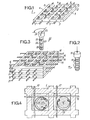
- the switch element of FIG. 1 is constituted by a square grid 1 of insulating plastic material having square openings 2 forming alignments parallel to the external sides 3 to 6 of the grid. In the alignments, the openings 2 are regularly spaced.
- Metal bands or beams, which will be designated more generally hereinafter by wires 7, pass right through the grid 1 perpendicular to the sides 3 and 5.
- Each wire 7 passes through an alignment of openings 2 parallel to the sides 4 and 6, with in each opening crossed an apparent segment 8.
- the height of each wire 7 is less than the thickness of the grid 1 with its longitudinal axis in the median plane of the grid. As also shown in the plan view of FIG.
- Fig. 1 indicates that all the threads of a grid are offset in the same direction relative to the centers of the openings they pass through.
- the ends 9 of the wires 7, which are located outside the grid, are used to connect the beams to connecting cables.
- the wires 7 are electrically conductive and made of a material whose elasticity is compatible with a reasonable contact pressure.
- Sheet 49 of FIG. 2 is a plug of a known type. It comprises a cylindrical body around which are provided circular contact rings 50 of the same height as 25 and separated from one another as 25, 26 and 27.
- the head 51 of 49 does not have a slot.
- the plug 49 is designed to be inserted manually into the stack 35 to create contacts by plugging in, which can be advantageous in rudimentary switches. In this case, to saturate a matrix, it suffices a number of plugs 49 equal to the numbers of wires on the shortest side of the matrix.
- FIG. 3 shows a stack of grids 10 to 15, all identical to grid 1.
- the layers 16, 18 and 20 of the grids 10, 12 and 14 are oriented in a direction perpendicular to the plies 17, 19 and 21 of the grids, 11, 13 and 15.
- FIG. 3 also shows a plug 22 comprising a cylindrical body 23 provided with a head 24, the assembly of 23 and 24 being made of insulating plastic.
- the body 23 carries contact strips 25, 26 and 27, all identical, made of metal or a good conductive alloy.
- the contact strips 25 to 27 are regularly spaced along the body. They do not completely surround the body 23 and have a height of the order of the thickness of a grid plus the height of a wire 7.
- Fig. 4 the cross section of the plug 22 has been shown in the plane passing through the strip 25. It appears that the diameter of the body 23 is less than a + h so that the body 23 alone can be introduced into a grid opening without simultaneously carrying on the edges of the grid and the wire segment 8.
- the section of the strip 25 is substantially in an arc of 270 °, the diameter of the circle of 25 being greater than that of 23.
- the extreme edges 28 and 29 of 25 are rolled up on themselves and are housed in longitudinal grooves 30 and 31 hollowed out in the body 23. Given the difference in diameter between 25 and 23, the strip 25 progressively moves away from the surface of 23 from from its edges 28 and 29.
- the diameter of 25 is such that the whole of the body 23 and of the strip 25 comes into contact with the sides of the square defined by the wire 16, the wire 17 and the faces of the corresponding openings. Under these conditions, the strip 25 deforms and balances each contact, allowing easier rotations.
- the height of the strip 25 is greater than the thickness of a grid, but less than twice this thickness. Therefore, the strip 25 can come into contact with both the wires 16 and 17.
- FIG. 4 shows the plug 22 in the working position, 25 being in contact with 16 and 17. It also shows a second plug 32, identical to 22, but turned a quarter of a turn, in an anticlockwise direction , so that 25 is only in contact with 17. The plug 32 is in the rest position.
- the head 24 of the plug 22 is provided with a slot 33 making it possible to turn the plug a quarter of a turn anticlockwise or in the direct direction to put it at rest or again at job. It will be noted that if the plug 22 is turned a quarter of a turn clockwise, it remains in the working position. In practice, as will be seen below in describing the control device, the plug 22 can only take two positions, without ambiguity.
- each grid includes 4x4 openings 2 allows the insertion of four plugs, such as 22, to make four separate connections.
- the stack of FIG. 3 has only been shown as an example to illustrate the basic structure of the switch according to the invention.
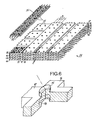
- a stack 34 formed from elongated grids, such as the grid 35 shown before it is placed on the stack.
- the grid 35 has a rectangular shape comprising four lines of openings 2, each line having 19 openings.
- the grid 35 is crossed by a sheet of four conducting wires 36, each of which passes respectively through a line of openings, parallel to the length of the grid 35.
- the respective positions of the bare segments of the wires are identical to those of the grid 1.
- the grid 35 differs from the grid 1 only in that in one direction it has a greater number of openings.
- the stack 34 is formed of hit levels 37 to 44, each level being formed by four grids 35 arranged parallel next to each other, their long sides being adjacent. In each level, the adjacent grids 35 are separated from each other by an interval t equal to the pitch of the openings in the grid 35.
- the grids of the odd levels 37, 39, 41 and 43 are oriented in the same direction while that the grids of even levels 38, 40, 42 and 44 are oriented in the perpendicular direction.
- the levels being superimposed, the openings create vertical alignments as in the stack in Fig. 2.
- a grid of the type of that of 35 consists of n lines of holes, which corresponds to a sheet of n conductive wires parallel to the pitch p. Each line can include q holes.
- Length and width are then obtained by multiplying n and q by the step p.
- a basic grid may include a sheet of 10 conductors with a pitch of 5 mm. Each conductor has a section of 1 x 0.2 mm and the grid with a thickness of 2.5 mm is overmolded on the sheet.
- the length of a grid can reach 120 steps or more. To obtain the grids, a very long strip is made overmolded on a sheet of wire, then the strip is cut to the desired length.
- Fig. 6 shows a cylindrical tenon 45 provided at a crossing point of two bars 46 and 47 of the grid 35 on one face of this grid.
- a cylindrical blind hole 48 On the other face of the grid, opposite the tenon 45, there is provided a cylindrical blind hole 48.
- the grid 35 thus comprises a certain number of torque composed of a tenon 45 and a blind hole 48, and it the same is true of the other grids of the stack 34.
- These couples are provided to ensure the correct positioning of the superimposed grids, a lug 45 of a lower grid being received in a corresponding hole of the immediately upper grid.
- the distribution of the pairs takes account of the fact that from one level to another the direction of the grids changes and that empty intervals are provided between parallel grids of a level.
- the tenons and the holes are produced during the overmolding of the wires 36 to obtain the grid.
- the battery 35 thus obtained is rigid and solid, and, moreover, practically dustproof.
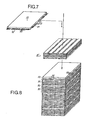
- a stack 35 comprising eight levels.
- fourteen levels are required, which leads to a thickness of 10 mm.
- a battery 35 which is capped with a control module 52.
- the control module supports the heads of the switching plugs which are inserted in the holes of the battery 35 when the module 52 is installed
- the module 52 includes selection bars 53 which pass right through it and the first ends of which are visible on the side 54 of the module. It also includes control bars 55 which pass right through it and whose first ends are visible on the side 56 of the module. We will see in the following how by pushing or pulling these bars 53 and 55 in an adequate way, we can turn the plugs a quarter of a turn to the right or to the left, to obtain the closing or opening of crossing in the matrix formed by the stack 35.
- the sections of the bars 55 are in the form of an inverted T, the soles of the T serving to retain the heads of the plugs.
- the module 52 is, moreover, provided on its upper face with studs, not shown, of the type 45 and has holes 48 on its lower face. Thus, by its holes 48, the module 52 fits well on the first level of 3.5.
- Fig. 8 shows that it is possible to constitute columns of stacks 35, respectively surmounted by their modules 52, stacked one on the other.
- the lugs 45 of the modules 52 allow the positioning of the stack immediately above. Obviously, such a column is only possible because the bars 53 and 55 of the control modules are accessible from the sides.
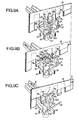
- Figs. 9a to 9b illustrate the structure of a control module 52, as well as its operation.
- a conducting wire 57 carried by a bar 58 of a grid 35
- a conducting wire 59 carried by a bar 60 of another grid 35 placed under the first and oriented perpendicularly
- a plug 61 constituted by a body 62, similar to 23, and a head 63.
- the body 62 carries a contact strip 64, similar to 25.
- the head 63 has a cylindrical bottom part 65, which rests on the edges of the soles of the work bars 55 adjacent to a T-shaped profile and a crescent-shaped upper part 66 having a cylindrical bulge at its center.
- Fig. 9a there has been shown a conducting wire 57 carried by a bar 58 of a grid 35
- a conducting wire 59 carried by a bar 60 of another grid 35 placed under the first and oriented perpendicularly
- a plug 61 constituted by a body 62, similar to
- FIG. 10 which is a plan view, schematically shows a certain number of heads 64 showing, for each one a crescent 66 comprising a cylindrical external part of the same diameter as 65, two horns 67a and 67b, as well as the bulged cylindrical part 68 of which the axis coincides with that of 65.
- Each horn 67a or 67b is connected to the cylinder 68 by a concave surface 69a and 69b.
- the ends of the horns 67a and 67b intervene directly in the state switching of the plug, while the central part 68 is only retained to make the crescent less fragile.
- a selection bar 53 and two working bars 55a and 55b have also been shown.
- the selection bar 53 is parallel to the wire 57 while the bars 55a and 55b are parallel to the wire 59. More specifically, the bar 53 is in the vertical plane of the bar, not shown, parallel to 60 on the other side of plug 61, the bar 55a is in the vertical plane of the bar 58, and the bar 55b is in the vertical plane of the bar, not shown, parallel to 58 on the other side of the plug 61.
- the selection bar 53 has the shape of a comb, the teeth 70a, 70b, 70c, etc., are flexible and are arranged in a pitch equal to the pitch of the grids.
- the back of comb 53 is located substantially above the top of the heads 64 of the plugs 61 and the teeth are long enough so that their lower parts are at the level of the horns 67a and 67b, but above the base 65.
- Each work bar 55a or 55b carries rigid teeth, such as 71 a and 71b, which are distributed along the bar according to the pitch of the grids.
- the bottom of the bar 55a or 55b is below the base 65 and the top of the teeth 71 a or 71 b is at a level higher than the bottom of the teeth 70a, 70b, ...
- the selection bar 53 is placed so that each tooth 70a, 70b, 70c, etc., is respectively opposite the axis of a plug 61.
- the working bars 55a and 55b are placed so that the teeth are respectively opposite the axes of the plugs.
- the width of a tooth 70a, 70b, etc. is such that, in the position indicated, the working bars 55a and 55b can be moved without the teeth 71a or 71b touching the teeth 70a or 70b, but pass freely between them.
- the bar 53 can be moved with its teeth passing between the teeth of the working bars.
- the plug 61 is in a position such that the horn 67a is further from the tooth 70b than the horn 67b.
- the contact strip 64 is then in contact only with the wire 57 and the current cannot pass from 57 to 59.
- FIG. 9b illustrates the operation of the switching which switches the plug 61 from the rest state to the working state.
- the bar 53 is first of all pushed in the direction of the arrow F1, by means not shown, so that the part of the tooth 70b which was in front of the horn 67a comes in front of the horn 67b.
- the other part of tooth 70b is then in front of tooth 71b of the work bar 55b.
- the bar 55b is pushed, in the direction of the arrow F2, so that the tooth 71 pushes the flexible bottom of the tooth 70b, which comes into contact with the horn 67b of the head of the plug, then pushes this horn which causes the rotation of the plug 61.
- the stroke of the working bar 55b is such that the plug 61 rotates a quarter of a turn, so that the contact strip 64 comes into contact, at the same time, with the wires 57 and 59.
- the current can go from 57 to 59.
- the bar 55b is released so that it returns to its initial position in FIG. 9a, for example under the action of a return spring not shown.
- the selection bar 53 is released and returns to its initial position, for example also under the action of a return spring.
- the plug 61 keeps the position it has reached during the switching so that the contact is maintained without external energy supply and without causing mechanical stress, as in some switches where an element remains stuck in extension.
- FIG. 9c illustrates the operation of the switching which switches the plug 61 from the working state to the resting state.
- the bar 53 is firstly pulled in the direction of the arrow F3, by means not shown, so that the part of the tooth 70b which was, at rest, in front of the horn 67b comes in front of the horn 67a.
- the other part of tooth 70b is then in front of tooth 71a of the work bar 55a.
- the bar 55a is pushed, in the direction of the arrow F2, so that the tooth 71 has pushes the flexible bottom of the tooth 70b, which comes into contact with the horn 67a of the head of the plug, then pushes this horn which causes the rotation of the plug 61.
- the stroke of the working bar 55a is such that the plug 61 turns backwards by a quarter of a turn, so that it returns to the rest position indicated in the Fig. 9a. Then, the selection bars 53 and working bars 55a are released, as described in relation to FIG. 9b.
- Fig. 10 which partially shows a matrix of file heads 61 associated with a selection busbar 53.1, 53.2, 53.3, ..., and a working busbar 55.1, 55.2, 55.3, ..., makes it possible to illustrate the operation of a module 52.
- the selection bars 53.1 to 53.5 are each represented by a small horizontal rectangle, to the right of the matrix, with, in its horizontal extension, double horizontal lines symbolizing the flexible teeth 70 of the bars.
- the working bars 55.1 to 55.6 are each represented by a small vertical rectangle, under the matrix, with, in its vertical extension, a series of small vertical rectangles symbolizing the rigid teeth 71 of the bars.
- the vertical line 88 indicates the position of the ends of the selection bars and the horizontal line 89 that of the ends of the working bars at rest.
- the bar 53.2 has been pushed towards the die, in the position indicated in FIG. 9b, then the work bar 55.5 has been pushed as in FIG. 9b, so that the head of the card for the second row and the fourth column has been turned in the direction of the arrow, ie put to work.
- the bar 53.4 has, on the contrary, been pulled towards the outside of the matrix and the bar 55.2 has been pushed, as in FIG. 9c, so that the head of the card of the fourth row and of the second column is turned in the direction of the arrow, that is to say put to rest.
- each level can be manufactured in a modular fashion, the basic modular element 35 consisting of a sheet of conductors parallel to the pitch p.
- the connections of the inputs and outputs can be made respectively on the faces of the parallelepiped of FIG. 8, which correspond respectively to the sides 56 and 54 of the modules 52, the other two faces being able to be used for testing the circuitry as well as for controlling the bars 53 and 55.
- Fig. 11 1 highlights the advantages of this type of battery. If we share the stack along an axis passing through a diagonal which leaves on the same side 54 and 56, we delimit two zones 74 and 75, i.e. zone 74 devolved to the line and installation teams, and the zone 75 reserved for the operating department. In zone 74, the side 56 receives the incoming cable conductors 76 and the side 54 receives the outgoing cable conductors 77 to the central office. Certain inter-matrix connections are possible in the factory. The other two sides 72 and 73 are assigned to the command and to the tests (link interruption, realization of bypass, etc.).
- Fig. 12 there is shown a series of batteries of FIG. 8 mounted vertically between two cable trays 78 and 79 respectively for the incoming cables 76 and the outgoing cables 77.
- the stacks are oriented so that their diagonals are aligned, all leaving the installation area 74 on one side and on the other side, the operating area 75.
- a series of batteries of FIG. 8 mounted horizontally on means not shown, between two cable trays 80 and 81 similar to 78 and 79.
- the diagonal planes of the stacks are aligned to separate zones 74 and 75.
- Fig. 14 shows two distributor bays formed from stacks of FIG. 8, in which the dies are mounted on a vertical axis 82 which makes it possible to extract them from the stack by rotating them, as indicated by the arrows, to have access to the entire surface of each matrix when it is desired to establish or break a connection by acting on the plug heads.
- the cables are passed through a chute 83 and therefore undergo twists with each operation of the matrix.
- each bay comprises two stacks of dies with, at the rear, in the central part, the cable trays 84.
- the management principle remains the same, the dies being articulated on the same vertical axis 90 and being arranged symmetrically with respect to to this one.
- This arrangement of FIG. 15 should take up less space than that of FIG. 14.
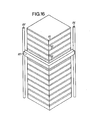
- FIG. 16 a fully automated distributor bay, the visible side of the stack overlooking the operating area.
- the matrices are fixed.
- the member 87 has the shape of a right angle whose plane is perpendicular to that of the rails 85 and 86, and is therefore parallel to those of the levels of the dies or also in the plane of the control devices 52.
- the rails 85 and 86 can carry racks on which roll gear wheels mounted at the end of the sides of the member 87, in order to be able to position the member 87 in front any one of the devices 52.
- the member 87 which contains means, such as core coils, not shown, in a number equal to that of the work and selection bars. Each nucleus hangs the bar which corresponds to it.
- a selection system selects the coils to be excited, in one direction or in the other, to push or pull the corresponding bar and thus cause the switching of a card in a matrix, as we have seen in relation to the Figs. 9b, 9c and 10.
- the high number of plugs with rotation control is compensated by the possibility of controlling them from a single side face of the stack and, even, automatically.
- a battery 34 has been symbolically represented, which is capped with a control module 91.
- the control module covers the heads of the switching plugs which are inserted into the holes in the battery 34 when the module 91 is installed. .
- control module 91 has the form of a cover formed by juxtaposed grooves 92 which serve as guide elements for a switching member. We will see below how by introducing a switching member in these grooves 92, it is possible to selectively rotate the heads 24 of the plugs.
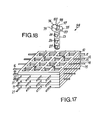
- Figs. 17 and 18 there is shown, on the one hand, the stack of grids 10 to 15 in FIG. 3 and, on the other hand, a variant 94 of the sheet 22.
- the head 93 of the plug 94 has a cylindrical base part 95 and a high part in the form of a circular sector 96 having a cylindrical bulge 97 at its center.
- the center of the cylindrical bulge 97 is surmounted by a conical pin 98.
- the body of the plug, the cylinder of 95, that of 97 and the cone 98 are of revolution about the same axis.
- the sectoral part 96 is limited by the planes 99 and 100 which make between them an angle at the center slightly less than 180 °.
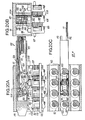
- FIG. 20a is a sectional view along the line XXA-XXA of FIG. 20b;
- Fig. 20c is a sectional view along the line XXB-XXB of FIG. 20a, the member 101 being drawn, but supposed to be transparent;
- Fig. 20b is a view in vertical section along the line XXC-XXC of FIG. 20a.
- the cylindrical parts 95 of the plugs 102 to 105 rest on the edges of the meshes of the grid 106 which supports the layer of wires 107.
- the grid 106 rests on a grid 108 which supports the layer of wires 109.
- the partitions 110 delimiting the grooves 92 of the cover 91 rest on the edges of the meshes of the grid 106 which are parallel to the wires 107.
- the width of a wall 110 is less than that of the bars of the grids, a vertical face of each partition falling practically vertically from the vertical face of the bar which is adjacent to the wire 107 and the other face of the partition falling substantially in the middle of the bar.
- the cylindrical parts 95 can rotate freely.
- the offset of each partition is explained by the fact that, in each mesh, the plug is also eccentric, as shown in FIG. 4.
- the height of the member 101 is practically equal to the distance between the plane delimited by the top of the cones 98 and the upper bottom of each groove 92.
- the width of the member 101 is equal to the internal width of the grooves 92.
- the member 101 consists of a central beam of cross-section at 1 111 and two flat control rods 112 and 113, arranged on each side of the core of the beam at 1 111.
- the sum of the thicknesses of the rods 112, 113 and the core of 1 1 is equal to that of the soles of 1.
- the upper sole of 1 bears against the bottom of the groove 92.
- the end 114 of the part 111 which is introduced into a groove 92 is bevelled so to facilitate its introduction.
- the two sides of the lower sole 115 are cut over a certain length. Furthermore, above these cutouts, the core of 1 1 is drilled right through, and the opening or opening 116 thus obtained serves as a cam groove for two studs 117 and 118 respectively fixed in the heads 119 and 120 of the ends of the rods 112 and 113.
- the heads 119 and 120 respectively carry hooks 121 and 122 directed downwards and oriented so as to be able to exert a traction towards the entry of the groove 92.
- the heads 119 and 120 and the rod bodies are joined by parts 123 and 124 of reduced height compared to that of the rod bodies, which makes them flexible, so that the hooks 121 and 122 can be lowered on either side of the 'soul of 111, where the sole 115 is cut.
- the light 116 has a V shape, very open towards the top, with the top 125 of the V slightly extended towards the end 114 and the bottom 126 of the V towards the entrance of the groove, the bottom part 126 of the V also comprising a horizontal rectilinear stroke 127.
- Figs. 21 a to 21 c planes 99 and 100 make an angle such that the rotation of the plug is at each switching of + or -90 °.
- the distance between the rods 112 and 113 is just greater than the diameter of the cylindrical bulge 97. Since the radius of 97 is practically half that of 95, the angle of the planes 99 and 100 is very little less than 180 °.
- the conical terminations 98 limit the surface in contact with the member 101 during translations of the latter in the groove and therefore limit the parasitic torques which would tend to rotate heads of unselected plugs.
- the rods 112 and 113 are held laterally, against the web of the beam 111, by two cheeks 128 and 129.
- the sum of the thicknesses of the cheeks 128 and 129 and the width of the sole of 1 1 is equal to the width of a groove, up to the required clearance.
- FIG. 21 a shows the plug head 104 at rest, as well as the rods 112 and 113 whose hooks 121 and 122 have been shown by hatched squares.
- Fig. 21 b the rod 112 has been pulled and the hook 121 has driven the plane 100, so that the head has rotated by + 90 °.
- the width of the core of 111 is practically equal to the diameter of the central part 97 of the plug head. Therefore, when the rod 112 is pushed back to return to rest, the hook 121 can touch the lateral surface of 97, but does not cause the head to rotate.
- Fig. 21c the rod 113 has been pulled and, in a similar manner, rotates the head by -90 0 .
- the longitudinal position of the switching member in the groove must be such that the front part of the horizontal stroke 127 of 116 is slightly in front of the plane 98 while the rear part of 127 of found behind 99, or vice versa, depending on the orientation of the head. It is assumed that the member 101 is driven by a stepping motor whose pitch is equal to that of the plugs. Note that the cutouts in the soles of 115 have a length which can be less than twice the pitch of the cards and that they are practically centered on the card to be switched.
- Fig. 22 schematically shows a member 101 in front of the grooves 92 of a switching module 91.
- the arrow F2 suggests the first lateral movement to bring the member 101 in front of the selected groove and the arrow F3 suggests the longitudinal movement of the member in the groove to bring the cutouts of 115 above the head to switch.
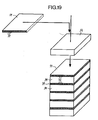
- FIG. 23 there is shown a stack 34, surmounted by a cover 91, in which the sheets are all oriented with the head up, as indicated on the left part of the drawing. The pitch of the grooves is then equal to the pitch p of the sheets in their grids.
- FIG. 24 there is shown a stack 34 ', surmounted by an upper cover 91' and resting on a lower cover 91 ", in which the plugs are alternately oriented head up and head down, as indicated on the left part of the drawing
- the pitch of the grooves of the modules 91 ′ and 91 " is then equal to twice the pitch p of the plugs, ie equal to 2 p.
- the arrangement of FIG. 24 allows the use of heads 93 ′ of larger diameter, which has the advantage of doubling the active torque when the rods 112 and 113 of the switching members are actuated.
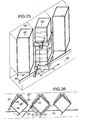
- Fig. 25 there is shown schematically in perspective a series of stacks of FIG. 9, mounted vertically.
- the batteries 130 are oriented so that their diagonals are aligned, leaving all on one side the installation area 131 and on the other side the operating area 132.
- a machine 133 which can be moved on a rail 134 parallel to the bays 130, as indicated by the arrows F4.
- the bays 130 are provided with vertical rails or racks 135 making it possible to ensure the vertical displacement of the automaton 133 which carries a switching member 101, which can be moved laterally and longitudinally. It is also assumed that the automaton 133 includes means for pulling and pushing the rods 112 and 113 of the member 101.
- the automaton 133 makes it possible to select the bay, to select the switching module 91 in the bay, the groove 92 in the module 91, to introduce the member 101 in the groove, to order the appropriate rod to make a connection or a disconnection, then to remove the member 101 from the groove. After an operation, the machine can return to the base of the bay. For all these operations, stepper motors can be provided in the PLC. It is clear that the positioning of a switching member can be fully automatic, as well as the operation of the rods 112 and 113. As a result, the switching operations inside the distributor can be fully automated, which has an important advantage. .
- Fig. 26 highlights the advantages of this type of battery.
- Two zones 131 and 132 are delimited, zone 131 being assigned to the line and installation teams and zone 132 being reserved for the operating service.
- the side 136 receives the conductors of the incoming cables 137 and the side 138 receives the conductors of outgoing cables 139 to the central office.
- Certain inter-battery connections can be made at the factory.
- the 140 side is assigned to the command and to the tests (link interruption, realization of bypass, etc.).
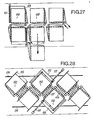
- Fig. 27 shows an example of a span made up of two rows of attachable bays 130. This very compact arrangement requires moving (see arrow F5) modules' stackable during connection.
- Fig. 28 shows another example of a double row bay bay 130. This staggered arrangement allows direct access to the incoming 137 and outgoing 139 cables.
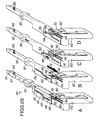
- Figs. 29a to 29d schematically represent a manual intervention tool 141 which makes it possible to actuate the plug heads like a member 101.
- the tool 141 comprises a member 101 mounted, in the manner of a pistol barrel, on a stock 142.
- the external ends of the rods 112 and 113 are subjected to the action of compressed springs 143 and 144 which tend to repel them. towards the end 114.
- the stick 142 is provided with a trigger 145 which makes it possible to push a lever 150 towards the rear of the tool, as indicated by arrow F6.
- a slider 146 is mounted astride the rear part of 101.
- the slider 146 has a slot 147 open upwards in the shape of a V, with an extension horizontal at the top, like slot 116.
- the center of slot 147 is perpendicular to the median plane of rods 112 and 113.
- the ends of slot 147 are straight and parallel to the axis of 101, one 148 above 112 and the other 149 above 113.
- the lever 150 integral with the trigger 145 has its upper end which passes through the slot 147.
- the trigger 145 is pressed, the lever 150 abuts the curved part (towards 113) of the rod 112 so that the rod 112 is pulled and can actuate a plug head as described in relation to Figs. 20a to 20c.
- the end of the lever 150 is offset towards the rod 113.
- the trigger 145 is pressed, the lever 150 abuts on the curved part (towards 112) of the rod 113 so that the rod 113 is pulled and can actuate a plug head.
- FIG. 29a shows the pistol 97 in the rest state, the slide 107 being positioned correctly so that the heads 75 and 76, symbolically represented by a square 108, can be, once the member is pressed, above the head to switch.
- Fig. 29b shows the position of the slide 146 for carrying out a connection operation, the trigger 145 being able to pull the rod 112.
- Fig. 29c shows the position of the slide 146, pulled back, to prepare a disconnection operation.
- Fig. 29d shows the action of the trigger 145 on the lever 150 which drives the rod 113 for a disconnection operation.
Landscapes
- Engineering & Computer Science (AREA)
- Power Engineering (AREA)
- Computer Networks & Wireless Communication (AREA)
- Structure Of Telephone Exchanges (AREA)
- Push-Button Switches (AREA)
Claims (12)
Applications Claiming Priority (4)
| Application Number | Priority Date | Filing Date | Title |
|---|---|---|---|
| FR7921202A FR2468990A1 (fr) | 1979-08-16 | 1979-08-16 | Commutateur a plusieurs couches de points de croisement |
| FR7921202 | 1979-08-16 | ||
| FR8008934A FR2480494A2 (fr) | 1980-04-15 | 1980-04-15 | Commutateur a plusieurs couches de points de croisement |
| FR8008934 | 1980-04-15 |
Publications (2)
| Publication Number | Publication Date |
|---|---|
| EP0025729A1 EP0025729A1 (de) | 1981-03-25 |
| EP0025729B1 true EP0025729B1 (de) | 1984-12-27 |
Family
ID=26221327
Family Applications (1)
| Application Number | Title | Priority Date | Filing Date |
|---|---|---|---|
| EP19800401188 Expired EP0025729B1 (de) | 1979-08-16 | 1980-08-13 | Schalter mit mehreren Lagen von Kreuzungspunkten |
Country Status (3)
| Country | Link |
|---|---|
| EP (1) | EP0025729B1 (de) |
| CA (1) | CA1159977A (de) |
| DE (1) | DE3069866D1 (de) |
Families Citing this family (2)
| Publication number | Priority date | Publication date | Assignee | Title |
|---|---|---|---|---|
| CA1179434A (en) * | 1980-04-15 | 1984-12-11 | Etat Francais, Represente Par Le Secretaire D'etat Aux Postes Et Telecommunications Et A La Telediffusion (Centre National D'etudes Des Telecommunications) (L') | Switch with several layers of cross points |
| CN115896899A (zh) * | 2022-11-04 | 2023-04-04 | 宁波韵升股份有限公司 | 一种钕铁硼磁钢磷化自动挂镀工艺 |
Family Cites Families (6)
| Publication number | Priority date | Publication date | Assignee | Title |
|---|---|---|---|---|
| FR1457726A (fr) * | 1964-10-02 | 1966-01-24 | Matrice d'interconnexion | |
| US3312792A (en) * | 1966-01-28 | 1967-04-04 | Gen Dynamics Corp | Matrix switch with improved contact actuator means |
| GB1196111A (en) * | 1966-05-12 | 1970-06-24 | Gen Electric & English Elect | Improvements in or relating to Cross-bar Selector Switches |
| FR1584604A (de) * | 1968-07-26 | 1969-12-26 | ||
| FR2038444A6 (de) * | 1969-03-07 | 1971-01-08 | Lucas Pierre | |
| US4125309A (en) * | 1977-06-22 | 1978-11-14 | Amp Incorporated | Miniature pin board assembly |
-
1980
- 1980-08-12 CA CA000358076A patent/CA1159977A/en not_active Expired
- 1980-08-13 DE DE8080401188T patent/DE3069866D1/de not_active Expired
- 1980-08-13 EP EP19800401188 patent/EP0025729B1/de not_active Expired
Also Published As
| Publication number | Publication date |
|---|---|
| DE3069866D1 (en) | 1985-02-07 |
| EP0025729A1 (de) | 1981-03-25 |
| CA1159977A (en) | 1984-01-03 |
Similar Documents
| Publication | Publication Date | Title |
|---|---|---|
| EP0403350B1 (de) | Verfahren und Vorrichtung für die Herstellung von Kabelbäumen | |
| FR2464616A1 (fr) | Dispositif et procede de montage de composants electriques sur des platines | |
| FR2530082A1 (fr) | Procede et appareil d'assemblage des composants d'une batterie d'accumulateurs | |
| EP0348278A1 (de) | Verteil- und Verbindungsvorrichtung für optische Fasern | |
| EP0550327A1 (de) | Stütz- und Führungsgerüst für elektrische und optische Übertragungskabeln | |
| WO1996011579A1 (fr) | Machine pour la fabrication automatique de brochettes de viandes et/ou de legumes | |
| BE897637A (fr) | Dispositif et procede de positionnement de lames et d'ailettes pour des grilles de support de barres de combustible nucleaire | |
| EP0161961B1 (de) | Steckverbinder, Verfahren zum Einstecken eines Steckers in eine Steckdose und Vorrichtung zur Ausführung des Verfahrens | |
| EP0025729B1 (de) | Schalter mit mehreren Lagen von Kreuzungspunkten | |
| FR2552940A1 (fr) | Bloc de montage pour interconnecter des connecteurs a une plaque a circuits imprimes | |
| EP0218494B1 (de) | Verfahren und Vorrichtung zur Kompaktierung eines Brennstabbündels | |
| EP0230172B1 (de) | Stabbündelgreifvorrichtung für ein Kernbrennstabbündel | |
| FR2846481A1 (fr) | Procede et dispositif d'insertion d'un enroulement dans un stator, avec stratification du chignon | |
| FR2480494A2 (fr) | Commutateur a plusieurs couches de points de croisement | |
| EP0159927A1 (de) | Maschine zur Herstellung von Strukturelementen durch Flechten und auf dieser Maschine hergestellte Strukturelemente | |
| US4421965A (en) | Commutator with several layers of cross-points | |
| BE1005699A3 (fr) | Equipement d'assemblage de jeu de combustible nucleaire. | |
| EP0038256B1 (de) | Schalter mit mehreren Lagen von Kreuzungspunkten | |
| FR2634982A1 (fr) | Machine a confectionner des brochettes | |
| BE1007101A3 (fr) | Equipement destine a attacher un element de clavette a une grille d'assemblage de combustible nucleaire et a l'en detacher. | |
| BE347769A (de) | ||
| FR2480495A2 (fr) | Commutateur a plusieurs couches de points de croisement | |
| BE436303A (de) | ||
| FR3102077A1 (fr) | Dispositif d'alimentation en plaques d'une machine de decoupe a partir d'un magasin. | |
| FR2668311A1 (fr) | Procedes et dispositifs pour connecter automatiquement des extremites de troncons de fils conducteurs ou de fibres optiques a des receptacles adaptes de composants. |
Legal Events
| Date | Code | Title | Description |
|---|---|---|---|
| PUAI | Public reference made under article 153(3) epc to a published international application that has entered the european phase |
Free format text: ORIGINAL CODE: 0009012 |
|
| AK | Designated contracting states |
Designated state(s): BE CH DE GB IT NL SE |
|
| 17P | Request for examination filed |
Effective date: 19810923 |
|
| ITF | It: translation for a ep patent filed | ||
| GRAA | (expected) grant |
Free format text: ORIGINAL CODE: 0009210 |
|
| AK | Designated contracting states |
Designated state(s): BE CH DE GB IT LI NL SE |
|
| REF | Corresponds to: |
Ref document number: 3069866 Country of ref document: DE Date of ref document: 19850207 |
|
| PGFP | Annual fee paid to national office [announced via postgrant information from national office to epo] |
Ref country code: NL Payment date: 19850831 Year of fee payment: 6 |
|
| PLBE | No opposition filed within time limit |
Free format text: ORIGINAL CODE: 0009261 |
|
| STAA | Information on the status of an ep patent application or granted ep patent |
Free format text: STATUS: NO OPPOSITION FILED WITHIN TIME LIMIT |
|
| 26N | No opposition filed | ||
| PG25 | Lapsed in a contracting state [announced via postgrant information from national office to epo] |
Ref country code: SE Effective date: 19860814 |
|
| PG25 | Lapsed in a contracting state [announced via postgrant information from national office to epo] |
Ref country code: LI Effective date: 19860831 Ref country code: CH Effective date: 19860831 |
|
| BERE | Be: lapsed |
Owner name: L' ETAT FRANCAIS REPRESENTE PAR LE SECRETAIRE D'ET Effective date: 19860831 |
|
| PG25 | Lapsed in a contracting state [announced via postgrant information from national office to epo] |
Ref country code: NL Effective date: 19870301 |
|
| NLV4 | Nl: lapsed or anulled due to non-payment of the annual fee | ||
| GBPC | Gb: european patent ceased through non-payment of renewal fee | ||
| REG | Reference to a national code |
Ref country code: CH Ref legal event code: PL |
|
| PG25 | Lapsed in a contracting state [announced via postgrant information from national office to epo] |
Ref country code: DE Effective date: 19870501 |
|
| PG25 | Lapsed in a contracting state [announced via postgrant information from national office to epo] |
Ref country code: GB Effective date: 19881118 |
|
| PG25 | Lapsed in a contracting state [announced via postgrant information from national office to epo] |
Ref country code: BE Effective date: 19890831 |
|
| EUG | Se: european patent has lapsed |
Ref document number: 80401188.0 Effective date: 19870812 |