EP0025760A1 - Verfahren zur Identifikation sich auf einer Oberfläche befindender Objekte und zur Bestimmung der Parameter dieser Objekte - Google Patents
Verfahren zur Identifikation sich auf einer Oberfläche befindender Objekte und zur Bestimmung der Parameter dieser Objekte Download PDFInfo
- Publication number
- EP0025760A1 EP0025760A1 EP80401303A EP80401303A EP0025760A1 EP 0025760 A1 EP0025760 A1 EP 0025760A1 EP 80401303 A EP80401303 A EP 80401303A EP 80401303 A EP80401303 A EP 80401303A EP 0025760 A1 EP0025760 A1 EP 0025760A1
- Authority
- EP
- European Patent Office
- Prior art keywords
- elementary
- line
- origin
- memory
- objects
- Prior art date
- Legal status (The legal status is an assumption and is not a legal conclusion. Google has not performed a legal analysis and makes no representation as to the accuracy of the status listed.)
- Granted
Links
Images
Classifications
-
- G—PHYSICS
- G06—COMPUTING OR CALCULATING; COUNTING
- G06V—IMAGE OR VIDEO RECOGNITION OR UNDERSTANDING
- G06V10/00—Arrangements for image or video recognition or understanding
- G06V10/40—Extraction of image or video features
- G06V10/44—Local feature extraction by analysis of parts of the pattern, e.g. by detecting edges, contours, loops, corners, strokes or intersections; Connectivity analysis, e.g. of connected components
- G06V10/457—Local feature extraction by analysis of parts of the pattern, e.g. by detecting edges, contours, loops, corners, strokes or intersections; Connectivity analysis, e.g. of connected components by analysing connectivity, e.g. edge linking, connected component analysis or slices
Definitions
- the present invention relates to a method for identifying and determining parameters of objects located on a flat surface.
- the invention relates to a method which allows the identification of planar objects arranged on a planar surface and the determination of certain parameters related to each of these objects such as their perimeter, their surface, etc. , these objects possibly having any shape and any arrangement on said surface, two objects being separated by an area of said surface having an optical density different from that of said objects.
- the method of the invention is of the type in which the surface on which said objects are arranged is illuminated, and is analyzed line by line for example using a video camera, or using photodetectors or similar components , the spatial variations in the intensity of the light beam having passed through said surface, that is to say that the variations in optical density of said surface are detected due to the presence of said objects. More precisely, in particular using one or more lines of photodiode photodetectors, for example, a line covering the entire width of the surface is moved globally and in steps parallel to the length of the surface.
- the signal delivered by each photodetector is successively collected, a “map” of the optical density of the surface is obtained, the map being constituted by the juxtaposition of elementary surfaces affected by a average optical density corresponding to the light energy received by a photodetector.
- the coordinates of each measurement are defined by the rank of each photodetector and the position of the photodetector line relative to the surface. The invention relates to the processing of these different measurements to identify each object and to determine certain parameters such as their perimeter, their surface, etc.
- Chromosome analyzes currently constitute an essential examination in a large number of human sciences and disciplines, biological (clinical genetics, carcinology, radio-pathology, pediatrics, etc ). Chromosome analyzes in humans are based on a technique which uses a culture of blood lymphocytes, maintained for 48 hours in the presence of the pHA antigen (phytohaemagglutinin) and stopped at the end of this period by the introduction of colchicine. Hypotonic shock then makes the cells in the process of division swell (at the metaphase stage of mitosis), thus separating their chromosomes from each other at best.
- pHA antigen phytohaemagglutinin
- the few drops of culture are spread on the slide, and the cells they contain spread their chromosomes on the surface of the slide.
- the percentage of metaphases having their chromosomes well dispersed is extremely low, compared to all the non-interesting images, constituted in particular by the nuclei of undivided cells and unfinished mitosis.
- a first task of the biologist therefore consists in an examination of the different samples to select those which present a methaphase having its chromosomes well dispersed. This selection of suitable images is done under the microscope in two stages: a first rough selection, followed by a finer selection. This research is extremely long and tedious.
- a first object of the invention is to carry out a method of the type described above which comprises only a minimum of memory functions for processing the information collected in order to calculate the value of the various parameters.
- a second object of the invention is to carry out a method of the type described above in which the determination of the value of the different parameters associated with the different objects to be identified is obtained using a single scan of the surface to be explored by the using a photodetector matrix-column for example.
- a third object of the invention is to carry out a method of the type described above in which a so-called connectivity algorithm is implemented.
- it is a device which makes it possible to identify without risk of error the various objects placed on said surface whatever their shape and their orientation on this surface.
- a fourth object of the invention is to carry out a method of the type described above in which the value of said parameters associated with said objects can be calculated in real time.
- a fifth object of the invention is to carry out a method of the type described above by which it is possible to detect not only the objects, but also "inclusions" in these objects, that is to say portions of the surface of those objects where the optical density is different from that of the object in which it is located. It is understood that such a characteristic is particularly interesting in the case of chromosomal analysis.
- a sixth object of the invention is to carry out a method of the type described above in which the set of optical opacity thresholds can be adjusted to adapt the device to the particular problem to be solved.
- a device for identifying objects or images which implements a so-called connectivity algorithm, that is to say an algorithm which makes it possible to know whether or not a rectangle of the line N belongs to a object that we have already started to identify when scanning the previous lines. From this information, it is possible to determine for each object certain parameters thereof.
- one of these can be the line number of the last elementary surface belonging to a given object. It then constitutes an element for locating the object on the surface. This is particularly true when these objects are of very reduced dimensions, the knowledge of the position of a point of the object then making it possible to locate the object.
- connection can carry on affected elementary surfaces of binary 1 and on the affected surface elements of the binary value 0.
- Such an implementation mode is interesting when it comes to take into account internal inclusions for example to calculate the surface of an object taking into account inclusions.
- the determination of the connectivity can relate to elementary surfaces of more than two types, corresponding to more than two gray levels; in particular, the transition from two to three gray levels takes place with a minimum of modifications to the device.
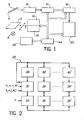
- FIG. 1 there is a simplified view of the set of identification and determination of parameters.
- Reference 2 designates the surface on which the objects are placed or more often than not an image of this surface.
- Means shown diagrammatically by the reference 10 make it possible to scan the entire surface 2 using photodiodes.
- These means can be constituted by a table movable in two orthogonal directions, the photodiodes being fixed; it is this solution which is adopted in the following description.
- the displacement means 10 is associated with a position coding means 12 which gives the number N of the lines (in the direction Y).
- the position in the direction X is given by the rank n of the photodiode.
- the electrical signal delivered by each photodiode has an amplitude which is representative of the optical density of the elementary surface corresponding to the photodiode for the given position of the strip 6.
- These signals are for example put in digital form and corrected in the processing circuit 14 after passing through the electronics 16 associated with the photodiodes 8.
- These signals are then introduced into a double threshold circuit 18 which, for each input signal, delivers a binary signal 0 or 1 depending on the level of the input signal compared to a set of reference optical densities.
- a binary value corresponding to its optical density and information n and N constituting the coordinates of the elementary surface considered are therefore successively obtained for each elementary surface.
- a set 20 which will be explained later, ensures the implementation of the connectivity algorithm as well as the calculation of the different parameters associated with different objects, that is to say with different sets of related elementary surfaces. As of now, it can be indicated that this treatment can be applied to the elementary surfaces having the binary value 1 and to the elementary surfaces having the binary value 0.
- a mini-computer 22 is connected to the rest of the device by a coupler 24. This mini-computer is used for dialogue with the user to fix the different thresholds and the parameters of the analysis, at the start of analysis; it is also used, during analysis, to memorize the final information relating to the selected objects. He can also perform additional processing of the results.
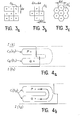
- a processing device 20 is associated with the mini-computer 22.
- the circuit 20 comprises a logic of connectivity 30 which receives the binary value associated with the elementary surfaces at the intersection of the lines N-1, N and the columns n-1, n and the operation of which will be described later.
- This connectivity logic 30 includes a microcomputer.
- the memory 32 receives information corresponding to the coordinates of the elementary surface being analyzed. For example, we analyze the surface n, N. This memory 32 contains the binary value of the elementary surfaces of the previous line N-1 with the addresses (associated with each object) already assigned to each elementary surface of the line N-1.
- the connectivity logic 30 is also connected to a memory 34 which contains the instructions for the implementation of the connectivity algorithm.
- the device which is the subject of the invention calls in its concrete embodiment for a microcomputer.
- the separation into blocks can therefore be considered a little arbitrary.
- Those skilled in the art will easily be able to concretize them. For example, we can consider that the binary values associated with the elementary surfaces of line N-1 and the elementary surface n-1 of line N are taken directly from memory 32, only the binary information corresponding to the elementary surface n, N and coming from the threshold circuit 18 being applied to the actual input of the connectivity logic 30.
- the device includes different sets for the calculation of each parameter.
- the set of calculation of the parameter K comprises a memory 36 for storing the values of the parameter K for each object, that is to say for each set of related elementary surfaces being analyzed.
- each individual memory must have a sufficient number of positions to store the numerical value of the parameter as well as the reference of the object.
- Each set of parameter calculation also includes an arithmetic and logic unit 38 for performing the calculations and an instruction memory 40 corresponding to the determination of the parameter K.
- the blocks 38 and 40 form part of the microcomputer.
- this address and the appropriate information 'linked to this elementary surface are sent to the memories 36, 36' ... corresponding to the parameters. This new information makes it possible to continue calculating the value of the parameters for the object having the reference considered.
- the type of information transmitted naturally depends on the parameter to be calculated. For example, in the case of the calculation of the surface, it is a question of incrementing the value recorded in the memory and of joining two objects hitherto unrelated.
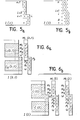
- This algorithm can be implemented either with elementary surfaces S i square (FIG. 3a or 3b), or with elementary surfaces S ′ i hexagonal (FIG. 3c).
- I (t) will represent, in fact, the set of points of the image acquired at time t.
- the border F (t) comprises n + 1 elementary surfaces or points.
- the border F (t) has n points. In all cases, each line includes n elementary surfaces silent, that is to say that one photodiodes.
- C F (t) C (t) OF (t), the set of points of the connected C (t) belonging to the border F (t).
- C F (t) C (t) OF (t)
- Each connected connection in progress C (t) will be represented by one of its points, noted w, chosen in F (t) therefore in C F (t). We will call this point the origin of C (t).
- w the point at any point P of F (t)
- we associate an address in ML corresponding to its position in the border. With this address P, we associate in ML, the address w of the origin of P, therefore the connected C (t) to which it belongs.
- this address w in MP are written the values of the parameters of C (t).
- C 1 (t-1) and C 2 (t-1) are two different related ones; we therefore have two origins w and ⁇ '.
- P has a neighbor in the last line and 1 to 3 in the penultimate (depending on the shape of the elementary surface).
- the neighbor of the last line is the last point treated before P; its origin has just been calculated [ ⁇ (P-1)]. Only the origin of the point Q, of the penultimate line which has just entered the vicinity of P is not directly accessible (the others were calculated in the two previous steps). You have to look for it in ML, with as many readings k as there are indirections:
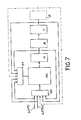
- the origin of a point Q can be determined using circuits which are associated with the reference memory ML (memory 32 in FIG. 2). These circuits represented on figure 7 make it possible to determine the origin of a point Q by a processing of the connectivity of the three points . for which only the origin of point Q is unknown. In this figure, two alternative embodiments of these circuits are shown.
- these circuits include a data multiplexer 50 and an address multiplexer 51 which control the writing of data to determined addresses in the memory ML. These two multiplexers make it possible to write into the memory ML, at addresses wp and ⁇ p-1 , the respective coordinates of the origins w of the points P and P-1. This data is supplied to the multiplexers by the connectivity logic 30 of FIG. 2, not shown in this figure.
- These circuits also include, in this first alternative embodiment, three registers A, B, C, connected in cascade, at the output of the memory ML. The outputs of registers A and C are further connected to the inputs of the multiplexers 50, 51.
- the circuits associated with the reference memory ML include, in addition to the multiplexers 50, 51 and the three registers A, B, C, a fourth register D, connected in cascade with the first three.
- the output of this register is connected to the inputs of the multiplexers.
- the attached table provides a better understanding of the operation of these circuits according to this second variant.
- the notations used in this table have the same meanings as in the previous table and [D] represents the content of the register D.
- the circuits associated with the reference memory can be used to determine the connectivity, after having determined the origin of the point Q, by carrying out the following operations, according to the configuration of the points Q, P and Pl assigned with binary values O or 1:
- This type of treatment makes it possible to treat both black and white objects.
- the parameters stored in aux are grouped together. addresses wj, in the reference memory, with those contained at address w. In all cases, the parameters are incremented at the address w, as a function of P and of its neighborhood, according to the calculated parameter.
- an object is identified (address) by its origin. If we consider the coordinates of this origin (for example the line number), this data can be considered as a new parameter of the object which makes it possible to identify it.
- This method has the advantage of allowing image processing as it is acquired.
Landscapes
- Engineering & Computer Science (AREA)
- Computer Vision & Pattern Recognition (AREA)
- Physics & Mathematics (AREA)
- General Physics & Mathematics (AREA)
- Multimedia (AREA)
- Theoretical Computer Science (AREA)
- Image Analysis (AREA)
- Image Processing (AREA)
Applications Claiming Priority (2)
| Application Number | Priority Date | Filing Date | Title |
|---|---|---|---|
| FR7922761A FR2465220A1 (fr) | 1979-09-12 | 1979-09-12 | Dispositif d'identification d'objets situes sur une surface et de determination de parametres desdits objets |
| FR7922761 | 1979-09-12 |
Publications (2)
| Publication Number | Publication Date |
|---|---|
| EP0025760A1 true EP0025760A1 (de) | 1981-03-25 |
| EP0025760B1 EP0025760B1 (de) | 1984-08-29 |
Family
ID=9229582
Family Applications (1)
| Application Number | Title | Priority Date | Filing Date |
|---|---|---|---|
| EP80401303A Expired EP0025760B1 (de) | 1979-09-12 | 1980-09-11 | Verfahren zur Identifikation sich auf einer Oberfläche befindender Objekte und zur Bestimmung der Parameter dieser Objekte |
Country Status (3)
| Country | Link |
|---|---|
| EP (1) | EP0025760B1 (de) |
| DE (1) | DE3069067D1 (de) |
| FR (1) | FR2465220A1 (de) |
Cited By (6)
| Publication number | Priority date | Publication date | Assignee | Title |
|---|---|---|---|---|
| FR2534434A1 (fr) * | 1982-10-08 | 1984-04-13 | Thomson Csf | Procede de codage et de decodage d'une image et dispositifs pour la mise en oeuvre de ce procede |
| FR2538653A1 (fr) * | 1982-05-28 | 1984-06-29 | Thomson Csf | Procede d'estimation des translations subies par des objets representes dans une sequence d'images et dispositif mettant en oeuvre ce procede |
| EP0087442A4 (de) * | 1981-09-10 | 1986-08-21 | Commw Of Australia | Bildanalysesystem. |
| FR2599205A1 (fr) * | 1981-11-27 | 1987-11-27 | Thomson Csf | Procede recursif de caracterisation de zones isotropes dans une image video; dispositif detecteur de mouvement et detecteur de bruit dans une sequence d'images |
| EP0156344A3 (en) * | 1984-03-26 | 1988-10-05 | Hitachi, Ltd. | Image processing segmentation apparatus |
| US5972691A (en) * | 1995-06-07 | 1999-10-26 | Hercules Incorporated | Dehalogenation of polyamine, neutral curing wet strength resins |
Citations (6)
| Publication number | Priority date | Publication date | Assignee | Title |
|---|---|---|---|---|
| US3349372A (en) * | 1964-07-20 | 1967-10-24 | Rca Corp | First stroke locator for a character reader |
| US3408485A (en) * | 1965-02-24 | 1968-10-29 | Perkin Elmer Corp | Apparatus for counting irregularly shaped objects |
| FR2179421A5 (de) * | 1972-04-01 | 1973-11-16 | Leitz Ernst Gmbh | |
| FR2198634A5 (de) * | 1972-09-05 | 1974-03-29 | Green James E | |
| US3999047A (en) * | 1972-09-05 | 1976-12-21 | Green James E | Method and apparatus utilizing color algebra for analyzing scene regions |
| US4183013A (en) * | 1976-11-29 | 1980-01-08 | Coulter Electronics, Inc. | System for extracting shape features from an image |
-
1979
- 1979-09-12 FR FR7922761A patent/FR2465220A1/fr active Granted
-
1980
- 1980-09-11 DE DE8080401303T patent/DE3069067D1/de not_active Expired
- 1980-09-11 EP EP80401303A patent/EP0025760B1/de not_active Expired
Patent Citations (6)
| Publication number | Priority date | Publication date | Assignee | Title |
|---|---|---|---|---|
| US3349372A (en) * | 1964-07-20 | 1967-10-24 | Rca Corp | First stroke locator for a character reader |
| US3408485A (en) * | 1965-02-24 | 1968-10-29 | Perkin Elmer Corp | Apparatus for counting irregularly shaped objects |
| FR2179421A5 (de) * | 1972-04-01 | 1973-11-16 | Leitz Ernst Gmbh | |
| FR2198634A5 (de) * | 1972-09-05 | 1974-03-29 | Green James E | |
| US3999047A (en) * | 1972-09-05 | 1976-12-21 | Green James E | Method and apparatus utilizing color algebra for analyzing scene regions |
| US4183013A (en) * | 1976-11-29 | 1980-01-08 | Coulter Electronics, Inc. | System for extracting shape features from an image |
Non-Patent Citations (1)
| Title |
|---|
| PROCEEDINGS OF THE FOURTH INTERNATIONAL JOINT CONFERENCE ON PATTERN RECOGNITION, 7-10 Novembre 1978 Kyoto, JP F. VEILLON: "One pass computation of morphological and geometrical properties of objects in digital pictures", pages 672-674. * |
Cited By (7)
| Publication number | Priority date | Publication date | Assignee | Title |
|---|---|---|---|---|
| EP0087442A4 (de) * | 1981-09-10 | 1986-08-21 | Commw Of Australia | Bildanalysesystem. |
| FR2599205A1 (fr) * | 1981-11-27 | 1987-11-27 | Thomson Csf | Procede recursif de caracterisation de zones isotropes dans une image video; dispositif detecteur de mouvement et detecteur de bruit dans une sequence d'images |
| FR2538653A1 (fr) * | 1982-05-28 | 1984-06-29 | Thomson Csf | Procede d'estimation des translations subies par des objets representes dans une sequence d'images et dispositif mettant en oeuvre ce procede |
| FR2534434A1 (fr) * | 1982-10-08 | 1984-04-13 | Thomson Csf | Procede de codage et de decodage d'une image et dispositifs pour la mise en oeuvre de ce procede |
| EP0108659A1 (de) * | 1982-10-08 | 1984-05-16 | Thomson-Csf | Verfahren zum Kodieren und Dekodieren eines Bildes und Gerät zur Durchführung dieses Verfahrens |
| EP0156344A3 (en) * | 1984-03-26 | 1988-10-05 | Hitachi, Ltd. | Image processing segmentation apparatus |
| US5972691A (en) * | 1995-06-07 | 1999-10-26 | Hercules Incorporated | Dehalogenation of polyamine, neutral curing wet strength resins |
Also Published As
| Publication number | Publication date |
|---|---|
| FR2465220B1 (de) | 1983-10-14 |
| EP0025760B1 (de) | 1984-08-29 |
| FR2465220A1 (fr) | 1981-03-20 |
| DE3069067D1 (en) | 1984-10-04 |
Similar Documents
| Publication | Publication Date | Title |
|---|---|---|
| US6529612B1 (en) | Method for acquiring, storing and analyzing crystal images | |
| EP0054598B1 (de) | Verfahren zum Untersuchen und automatischen Sortieren von Objekten bestimmter Gestalt mit festen dimensionalen Toleranzen und Einrichtung zur Durchführung des Verfahrens | |
| EP0054596B1 (de) | Verfahren für die Inspektion und die automatische Sortierung von Objekten, die Konfigurationen mit dimensionellen Toleranzen aufweisen und platzabhängige Kriterien für die Verwerfung, Anlage und Schaltung dafür | |
| EP0115462B1 (de) | Verfahren zum automatischen Erkennen eines Bildes auf der Basis eines korrespondierenden Referenzbildes | |
| EP0840252B1 (de) | Numerisches Bildverarbeitungsverfahren zur automatischen Extraktion bandförmiger Objekte | |
| CA2502993A1 (fr) | Cible codee et procede de photogrammetrie utilisant de telles cibles | |
| CA3095089A1 (fr) | Methode de detection de cellules presentant au moins une anomalie dans un echantilllon cytologique | |
| EP0945830A1 (de) | Bildverarbeitungsverfahren mit multidimensionalen Bildsegmentationsstufen und medizinische Vorrichtung die diese verwendet | |
| EP0025760B1 (de) | Verfahren zur Identifikation sich auf einer Oberfläche befindender Objekte und zur Bestimmung der Parameter dieser Objekte | |
| Guan et al. | Defect classification for specular surfaces based on deflectometry and multi-modal fusion network | |
| Landstrom et al. | Sub-millimeter crack detection in casted steel using color photometric stereo | |
| FR2611270A1 (fr) | Procede et dispositif de determination d'un champ de deformation par photoelasticimetrie | |
| FR2831697A1 (fr) | Dispositif et procede d'etiquetage en trois dimensions. | |
| EP0681270A1 (de) | Verfahren zur Bahnverfolgung von Objekten und Vorrichtung zur Durchführung des Verfahrens | |
| FR2533044A1 (fr) | Procede d'introduction de donnees de modeles graphiques | |
| EP1035493A1 (de) | Verfahren zur Mustererkennung | |
| Feng et al. | Addressing the “open world”: detecting and segmenting pollen on palynological slides with deep learning | |
| FR2570206A1 (fr) | Appareil pour detecter et classer les caracteristiques de formes de surface de peau | |
| EP0993650B1 (de) | Verfahren zur segmentierung und erkennung eines beleges, insbesondere einer technischen zeichnung | |
| EP0692714A1 (de) | Verfahren und Vorrichtung zur Erkennung von geometrischen Eigenheiten von quaderförmigen Teilen mit polygonalem Querschnitt | |
| EP0206853A1 (de) | Verfahren und Vorrichtung zur Identifizierung verschlossener Umrisse von auf einer Oberfläche hingestellten Gegenständen | |
| Zhang | In situ image segmentation using the convexity of illumination distribution of the light sources | |
| FR2697930A1 (fr) | Procédé de réalisation d'une image de référence synthétisée pour l'inspection d'objets. | |
| JP2022135652A (ja) | 被検物質の分析方法、分析装置、訓練方法、分析システム、及び分析プログラム | |
| FR3115386A1 (fr) | Procédé de classification d’une image d’entrée représentant une particule dans un échantillon |
Legal Events
| Date | Code | Title | Description |
|---|---|---|---|
| PUAI | Public reference made under article 153(3) epc to a published international application that has entered the european phase |
Free format text: ORIGINAL CODE: 0009012 |
|
| AK | Designated contracting states |
Designated state(s): CH DE GB NL |
|
| 17P | Request for examination filed |
Effective date: 19810820 |
|
| GRAA | (expected) grant |
Free format text: ORIGINAL CODE: 0009210 |
|
| AK | Designated contracting states |
Designated state(s): CH DE GB LI NL |
|
| PGFP | Annual fee paid to national office [announced via postgrant information from national office to epo] |
Ref country code: DE Payment date: 19840915 Year of fee payment: 5 |
|
| REF | Corresponds to: |
Ref document number: 3069067 Country of ref document: DE Date of ref document: 19841004 |
|
| PGFP | Annual fee paid to national office [announced via postgrant information from national office to epo] |
Ref country code: CH Payment date: 19841120 Year of fee payment: 5 |
|
| PLBE | No opposition filed within time limit |
Free format text: ORIGINAL CODE: 0009261 |
|
| STAA | Information on the status of an ep patent application or granted ep patent |
Free format text: STATUS: NO OPPOSITION FILED WITHIN TIME LIMIT |
|
| 26N | No opposition filed | ||
| PGFP | Annual fee paid to national office [announced via postgrant information from national office to epo] |
Ref country code: NL Payment date: 19870930 Year of fee payment: 8 |
|
| PG25 | Lapsed in a contracting state [announced via postgrant information from national office to epo] |
Ref country code: GB Effective date: 19880911 |
|
| PG25 | Lapsed in a contracting state [announced via postgrant information from national office to epo] |
Ref country code: LI Effective date: 19880930 Ref country code: CH Effective date: 19880930 |
|
| PG25 | Lapsed in a contracting state [announced via postgrant information from national office to epo] |
Ref country code: NL Effective date: 19890401 |
|
| NLV4 | Nl: lapsed or anulled due to non-payment of the annual fee | ||
| REG | Reference to a national code |
Ref country code: CH Ref legal event code: PL |
|
| GBPC | Gb: european patent ceased through non-payment of renewal fee | ||
| PG25 | Lapsed in a contracting state [announced via postgrant information from national office to epo] |
Ref country code: DE Effective date: 19890601 |