EP0026351A2 - Procédé et dispositif manuel d'enfilage - Google Patents
Procédé et dispositif manuel d'enfilage Download PDFInfo
- Publication number
- EP0026351A2 EP0026351A2 EP80105281A EP80105281A EP0026351A2 EP 0026351 A2 EP0026351 A2 EP 0026351A2 EP 80105281 A EP80105281 A EP 80105281A EP 80105281 A EP80105281 A EP 80105281A EP 0026351 A2 EP0026351 A2 EP 0026351A2
- Authority
- EP
- European Patent Office
- Prior art keywords
- air
- channel
- hand
- chamber
- threading
- Prior art date
- Legal status (The legal status is an assumption and is not a legal conclusion. Google has not performed a legal analysis and makes no representation as to the accuracy of the status listed.)
- Withdrawn
Links
Images

Classifications
-
- B—PERFORMING OPERATIONS; TRANSPORTING
- B65—CONVEYING; PACKING; STORING; HANDLING THIN OR FILAMENTARY MATERIAL
- B65H—HANDLING THIN OR FILAMENTARY MATERIAL, e.g. SHEETS, WEBS, CABLES
- B65H51/00—Forwarding filamentary material
- B65H51/16—Devices for entraining material by flow of liquids or gases, e.g. air-blast devices
-
- B—PERFORMING OPERATIONS; TRANSPORTING
- B65—CONVEYING; PACKING; STORING; HANDLING THIN OR FILAMENTARY MATERIAL
- B65H—HANDLING THIN OR FILAMENTARY MATERIAL, e.g. SHEETS, WEBS, CABLES
- B65H2701/00—Handled material; Storage means
- B65H2701/30—Handled filamentary material
- B65H2701/31—Textiles threads or artificial strands of filaments
Definitions
- the present invention relates to a method for threading a textile material in the form of a yarn, thread or the like into a closed channel of a textile machine, in which the beginning of the textile material is brought to one of the ends of the channel and air is moved through the channel, which the textile material takes with it.
- the invention also relates to a hand-held device for carrying out the method with a chamber, the volume of which can be changed by manual actuation, and which has an air inlet and outlet point controlled by a valve.
- the invention relates to the use of the method or the hand-held device.
- DE-PS 902 946 is made of a flexible steel wire existing handheld device has become known, in which the steel wire has a ball at its front end, the thread to be pulled through being attached to this end.
- DE-PS 1 217 828 also shows a pull-in wire. This type of threading is time consuming and is not useful in all cases.
- a blast nozzle is provided which is actuated for the purpose of threading and which generates an air stream through which the - brought thread on an entry point of the channel, sucked thereof in a first part and in a subsequent portion is blown through.
- This embodiment requires a compressed air reservoir and a complicated structure for the blow nozzle arrangement, its control and its adjustment. It therefore turns out to be bad.
- DE-AS 1 289 470 the statements just made also apply essentially.
- the thread to be threaded is drawn in exclusively by a suction process.
- Motors, these actuating electrical switches and other structural parts are used, so that a very complex arrangement is also present in this case.
- the present invention is characterized in that when moving from a hand-held device operating as a pump, which has an air inlet and an air outlet point, one of these air passage points is coupled to one end of the duct, the hand-held device is actuated by hand and the air is thereby moved through the duct.
- the handheld device itself is characterized in that it is connected to the channel Air passage point to be coupled is connected to one end of a connection element, the other end of which is provided with a sealing member.
- the use of the method or of the hand-held device is characterized in that it takes place on a wing of a prespinning machine that has a closed channel.
- the invention is characterized above all by its astonishing simplicity.
- the handheld device can easily be carried by the operating personnel. It can also be operated with one hand. It is therefore easy to transport and very handy.
- the complex arrangements specifically provided in the known devices are not necessary. This results in a large saving in costs. Threading takes very little time. To carry it out, it is sufficient to bring the beginning of the textile material to be threaded into the selected opening of the channel or to insert a small part into the opening, e.g. the hand-held device by coupling it to the duct and generating air impulses with a few pumping movements. This moves the fuse or yarn through the channel.
- the invention therefore allows a thread or a sliver to be pulled through a closed channel in a very simple manner and with minimal effort, or to be threaded into it.
- the hand-held device can be designed in such a way that both a suction process and a blowing process can be carried out with it.
- the provision of two valves also ensures that the air only flows in one direction when the hand-held device is actuated. An annoying retraction of the partially threaded thread due to air flowing unintentionally in the reverse direction during the threading process thus does not occur. That's why it is it is possible to thread or sliver through relatively long channels. With regard to threading into a channel of normal length, additional actuating movements on the hand-held device are only necessary in accordance with the greater length.
- the flyer wing shown in Fig. 1 has a hollow shaft 11 which is rotatable in a bearing, not shown.
- Two arms 12, 13 of the flyer wing extend from the hollow shaft 11 and are held at their ends by a ring 14.
- a tubular, closed channel 15 leads from the shaft 11, on which the one opening 16 of the channel 15 is located, to the other opening 17 thereof.
- a fiber sliver or roving is supplied by a drafting system, not shown, and enters the channel 15 through the opening 16.
- the roving formed in this way emerges from the other opening 17 again from the channel 15, runs through the thread guide 18 and is wound on a spindle, not shown.
- the sliver must or yarn-like textile material can be re-threaded into the channel 15.
- this is carried out using a hand-held device.
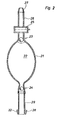
- the example of such a device shown in FIG. 2 has a chamber 22 delimited by a bellows 21.
- the bellows 21 consists at least partially of an elastic material, such as rubber.
- air inlet point 23 formed by a valve that allows passage on one side, for example a ball valve, air can only enter the chamber 22.
- a second ball valve which also only passes in one direction, has the effect that the air can only escape from the chamber 22 at the air outlet point 24.
- An air filter 25 is positioned upstream of the air inlet valve with respect to the direction of the air flow.
- a connection element 26 is attached, which is provided at its free end with a sealing member 27.
- a second connection element 29 provided with a sealing element 28 is provided at the air outlet point 24.
- the beginning of the material to be threaded is brought up to the opening 16 or a small piece is inserted into this opening 16.
- the sealing member 27 is inserted into the channel opening 17 or placed against it and in this way coupled to it.
- the bellows 21 is then actuated by repeated compression by hand. When compressed, the air escapes through the air outlet point 24 designed as a valve and when the bellows 21 resiliently returns to its original shape, air enters through the air inlet point 23 designed as a valve.
- the air flows only in one direction during the pumping process, and impulsive air movements occur, through which the textile material passes through after being placed on or introduced into the opening 16 the channel 15 is drawn - and finally emerges from the opening 17.
- the air filter 25 is provided. This means that the material cannot get inside the handheld device.
- the filter 25 additionally retains any contaminants that may be present, which also extends the duration of the valves working properly.
- the connecting element 26 is made of transparent material at least in the immediate vicinity of the filter 25, so that one can visually determine whether the roving is completely threaded into the channel 15.
- the blowing effect of the handheld device can also be used.
- the obliquely arranged opening 31 is provided on the flyer wing, to which the beginning of the textile material is brought by hand, or into which a small piece is inserted.
- the sealing member 28 is coupled to the opening 31.
- a notch 32 can be provided in the sealing member 28. To thread a thread, it is inserted into the notch 32 and the sealing member 28 is placed on the channel entrance. The thread is created by the air generated when the bellows 21 is actuated impulses carried away and threaded.
- Fig. 3 shows a hand-held device in which the suction impulses are formed by pressing the device and can thus be relatively amplified when operated forcefully.
- a piston 42 is movable back and forth in a cylinder 41.
- the latter and an actuating lever 43 are coupled to one another by a piston rod 44, the latter being articulated on both parts 42 and 43.
- the lever 43 is carried by an arm 45 and can be pivoted about an axis 46 between two end positions. One end position is drawn with solid lines and the other end position is drawn in broken lines.
- the two end positions of the piston 42 are shown in the same way.
- a compression spring 47 strives to move the lever 43 into the position shown in broken lines.
- a preferably transparent connecting element 49 provided with a sealing member 48 and an air filter 51 are provided.
- the air passage points 52, 53 designed as valves have the effect that the air can only enter at the air entry point 52 and can only exit at the air exit point 53.
- One end of the cylinder 41 is delimited by the end
- the piston 42 By pressing the operating lever 43, the piston 42 is moved upward. As a result, the volume of the chamber delimited by the cylinder 41, the piston 42 and the end wall 54 is increased. This requires air to be sucked in, so that air flows into the chamber through the air entry point 52. By means of air pulses formed in this way, the textile material present as yarn, fuse or the like is carried along in a closed channel and threaded into it.
Landscapes
- Spinning Or Twisting Of Yarns (AREA)
- Forwarding And Storing Of Filamentary Material (AREA)
- Yarns And Mechanical Finishing Of Yarns Or Ropes (AREA)
- Treatment Of Fiber Materials (AREA)
- Cookers (AREA)
Applications Claiming Priority (2)
| Application Number | Priority Date | Filing Date | Title |
|---|---|---|---|
| CH876779 | 1979-09-28 | ||
| CH8767/79 | 1979-09-28 |
Publications (2)
| Publication Number | Publication Date |
|---|---|
| EP0026351A2 true EP0026351A2 (fr) | 1981-04-08 |
| EP0026351A3 EP0026351A3 (fr) | 1981-08-26 |
Family
ID=4344501
Family Applications (1)
| Application Number | Title | Priority Date | Filing Date |
|---|---|---|---|
| EP80105281A Withdrawn EP0026351A3 (fr) | 1979-09-28 | 1980-09-04 | Procédé et dispositif manuel d'enfilage |
Country Status (6)
| Country | Link |
|---|---|
| US (1) | US4353202A (fr) |
| EP (1) | EP0026351A3 (fr) |
| JP (1) | JPS5656461A (fr) |
| AU (1) | AU6274280A (fr) |
| BR (1) | BR8006218A (fr) |
| ES (1) | ES495764A0 (fr) |
Cited By (1)
| Publication number | Priority date | Publication date | Assignee | Title |
|---|---|---|---|---|
| EP0143187A1 (fr) * | 1983-10-29 | 1985-06-05 | Hacoba Textilmaschinen GmbH & Co KG | Dispositif de nouage |
Families Citing this family (1)
| Publication number | Priority date | Publication date | Assignee | Title |
|---|---|---|---|---|
| US7743597B2 (en) * | 2008-08-26 | 2010-06-29 | General Pneumatics Corp. | Marine safety device attachment with automatic release capability |
Family Cites Families (14)
| Publication number | Priority date | Publication date | Assignee | Title |
|---|---|---|---|---|
| DE123998C (fr) * | ||||
| DE494272C (de) * | 1930-03-20 | Westfaelische Eisen Und Blechw | Entleerungsvorrichtung an Jauchepumpen | |
| FR949819A (fr) | 1949-06-09 | 1949-09-09 | Fuseau notamment pour double torsion | |
| GB907402A (en) | 1960-04-22 | 1962-10-03 | Scragg & Sons | Two-for-one spindle threader |
| DE1217828B (de) | 1963-02-22 | 1966-05-26 | Josef Trost | Doppeldrahtzwirnspindel mit zwei ueber Kopf abzuziehenden Ablaufspulen |
| DE1289470B (de) | 1963-03-25 | 1969-02-13 | Nimtz Klaus | Pressluft-Einfaedler fuer Doppeldrahtzwirnspindeln |
| US3691744A (en) * | 1970-11-20 | 1972-09-19 | North American Rockwell | Yarn piecing device |
| IT992918B (it) * | 1973-08-10 | 1975-09-30 | Marzoli E C Spa Flli | Dispositivo di ripresa del filo in macchine tessili |
| US4026095A (en) * | 1974-10-16 | 1977-05-31 | Asahi Kasei Kogyo Kabushiki Kaisha | Variable passage type yarn guide arrangement |
| DE2541690C2 (de) * | 1975-09-18 | 1977-11-03 | Hamel GmbH, Zwirnmaschinen, 4400 Münster | Druckluftbetätigte Einfädelvorrichtung für Doppeldrahtzwirnspindeln |
| DE2559423C2 (de) * | 1975-09-18 | 1977-11-03 | Ausscheidung aus: 25 41 690 Hamel GmbH, Zwirnmaschinen, 4400 Münster | Druckluftbetätigte Einfädelvorrichtung für Doppeldrahtzwirnspindeln |
| DE7631698U1 (de) * | 1976-10-09 | 1977-02-03 | Gebrueder Funke, 5768 Sundern | Vorrichtung zur entnahme von fluessigkeiten aus flaschen |
| DE2646921C2 (de) * | 1976-10-18 | 1980-01-03 | Palitex Project-Company Gmbh, 4150 Krefeld | Doppeldrahtzwirnmaschine |
| GB2033967B (en) * | 1978-10-03 | 1982-12-22 | Secr Defence | Pumping devices |
-
1980
- 1980-09-04 EP EP80105281A patent/EP0026351A3/fr not_active Withdrawn
- 1980-09-08 US US06/185,014 patent/US4353202A/en not_active Expired - Lifetime
- 1980-09-26 AU AU62742/80A patent/AU6274280A/en not_active Abandoned
- 1980-09-26 ES ES495764A patent/ES495764A0/es active Granted
- 1980-09-26 BR BR8006218A patent/BR8006218A/pt unknown
- 1980-09-29 JP JP13449980A patent/JPS5656461A/ja active Pending
Cited By (1)
| Publication number | Priority date | Publication date | Assignee | Title |
|---|---|---|---|---|
| EP0143187A1 (fr) * | 1983-10-29 | 1985-06-05 | Hacoba Textilmaschinen GmbH & Co KG | Dispositif de nouage |
Also Published As
| Publication number | Publication date |
|---|---|
| BR8006218A (pt) | 1981-04-07 |
| US4353202A (en) | 1982-10-12 |
| ES8203115A1 (es) | 1982-03-01 |
| ES495764A0 (es) | 1982-03-01 |
| JPS5656461A (en) | 1981-05-18 |
| EP0026351A3 (fr) | 1981-08-26 |
| AU6274280A (en) | 1981-04-09 |
Similar Documents
| Publication | Publication Date | Title |
|---|---|---|
| DE1535828B1 (de) | Vorrichtung zum Verbinden der Enden von Fadengarnen durch Verwirbeln der Faeden ueberlappter Garnenden | |
| EP2329066B1 (fr) | Groupe de filature a buse d'air comprenant un composant en forme de broche | |
| DE19838762A1 (de) | Spinnmaschine mit einer Vielzahl von Spinnstellen | |
| DE69308062T2 (de) | Elektropneumatische Vorrichtung zum automatischen Einfädeln eines Gerätes, das Schussfaden einer Textilmaschine zuführt und Schussfadenzufuhrgerät, das diese Vorrichtung enthält | |
| DE2910864A1 (de) | Verfahren und geraet zum verbinden von faeden | |
| CH633327A5 (de) | Verfahren und vorrichtung zum anspinnen eines umwindegarnes. | |
| EP0370232A2 (fr) | Disposition d'un entonnoir à la sortie d'une machine de cardage | |
| DE102004044345A1 (de) | Luftdüsenspinnvorrichtung | |
| DE19544617B4 (de) | Adapter für Offenend-Spinnvorrichtungen | |
| DE102005035049A1 (de) | Spinnvorrichtung zur Herstellung eines gesponnenen Fadens mittels eines umlaufenden Luftstroms | |
| EP0023929A1 (fr) | Buses pour métier à tisser à jet de fluide | |
| DE2653220C3 (de) | Reinigungsvorrichtung für die steuerbare Fadenklemme einer Düsenwebmaschine | |
| DE1435639C3 (de) | Fadenfuhrungsvorrichtung | |
| DE10349651A1 (de) | Luftdüsen-Spinnvorrichtung | |
| DE3813720C2 (fr) | ||
| EP0026351A2 (fr) | Procédé et dispositif manuel d'enfilage | |
| DE1574405B2 (de) | Vorrichtung zum fuehren eines fadens in einer textilmaschine | |
| DE3541220C1 (de) | Verfahren und Vorrichtung zum Wiederanspinnen einer Spinnvorrichtung | |
| DE2437857C2 (de) | Glocken- oder Flügelspinnmaschine | |
| DE4206030C2 (de) | Zentrifugenspinnvorrichtung mit Mitteln zum Anspinnen | |
| DE2540261A1 (de) | Anordnung eines fadenwaechters an spinnstellen einer offenend-spinnmaschine | |
| EP0463441B1 (fr) | Dispositif pour le filage d'un fil | |
| DE102006018242A1 (de) | Luftdüsenspinnvorrichtung | |
| DE69326615T2 (de) | Verfahren zum Zentrifugalspinnen | |
| AT227631B (de) | Verfahren und Vorrichtung zur Überwachung der Schußfäden bei Webstühlen |
Legal Events
| Date | Code | Title | Description |
|---|---|---|---|
| PUAI | Public reference made under article 153(3) epc to a published international application that has entered the european phase |
Free format text: ORIGINAL CODE: 0009012 |
|
| AK | Designated contracting states |
Designated state(s): CH DE FR GB IT |
|
| PUAL | Search report despatched |
Free format text: ORIGINAL CODE: 0009013 |
|
| AK | Designated contracting states |
Designated state(s): CH DE FR GB IT |
|
| 17P | Request for examination filed |
Effective date: 19810831 |
|
| STAA | Information on the status of an ep patent application or granted ep patent |
Free format text: STATUS: THE APPLICATION IS DEEMED TO BE WITHDRAWN |
|
| 18D | Application deemed to be withdrawn |
Effective date: 19830119 |
|
| RIN1 | Information on inventor provided before grant (corrected) |
Inventor name: GASSER, HERMANN Inventor name: NOVAK, PETER |