EP0026720A1 - Masses fondues anisotropes conformables à base de polyesters aromatiques, leurs procédés de préparation et articles formés à partir d'elles - Google Patents
Masses fondues anisotropes conformables à base de polyesters aromatiques, leurs procédés de préparation et articles formés à partir d'elles Download PDFInfo
- Publication number
- EP0026720A1 EP0026720A1 EP80420105A EP80420105A EP0026720A1 EP 0026720 A1 EP0026720 A1 EP 0026720A1 EP 80420105 A EP80420105 A EP 80420105A EP 80420105 A EP80420105 A EP 80420105A EP 0026720 A1 EP0026720 A1 EP 0026720A1
- Authority
- EP
- European Patent Office
- Prior art keywords
- anisotropic
- homopolyesters
- methyl group
- chlorine atom
- melts
- Prior art date
- Legal status (The legal status is an assumption and is not a legal conclusion. Google has not performed a legal analysis and makes no representation as to the accuracy of the status listed.)
- Granted
Links
- 229920000728 polyester Polymers 0.000 title claims abstract description 17
- 125000003118 aryl group Chemical group 0.000 title claims abstract description 10
- 238000000034 method Methods 0.000 title description 6
- 239000000155 melt Substances 0.000 claims abstract description 26
- 229910052801 chlorine Inorganic materials 0.000 claims abstract description 11
- 230000009466 transformation Effects 0.000 claims description 10
- 125000001309 chloro group Chemical group Cl* 0.000 claims description 9
- 125000002496 methyl group Chemical group [H]C([H])([H])* 0.000 claims description 9
- 239000002253 acid Substances 0.000 claims description 6
- XKZQKPRCPNGNFR-UHFFFAOYSA-N 2-(3-hydroxyphenyl)phenol Chemical compound OC1=CC=CC(C=2C(=CC=CC=2)O)=C1 XKZQKPRCPNGNFR-UHFFFAOYSA-N 0.000 claims description 5
- 125000004429 atom Chemical group 0.000 claims description 5
- 238000009987 spinning Methods 0.000 claims description 5
- -1 diaryl diester Chemical class 0.000 claims description 4
- 230000004927 fusion Effects 0.000 claims description 4
- 125000004435 hydrogen atom Chemical group [H]* 0.000 claims description 4
- OFOBLEOULBTSOW-UHFFFAOYSA-N Malonic acid Chemical compound OC(=O)CC(O)=O OFOBLEOULBTSOW-UHFFFAOYSA-N 0.000 claims description 3
- 229910052799 carbon Inorganic materials 0.000 claims description 3
- 150000005690 diesters Chemical class 0.000 claims description 2
- 238000004519 manufacturing process Methods 0.000 claims 3
- OKTJSMMVPCPJKN-UHFFFAOYSA-N Carbon Chemical compound [C] OKTJSMMVPCPJKN-UHFFFAOYSA-N 0.000 claims 1
- 229920000642 polymer Polymers 0.000 abstract description 13
- RTZKZFJDLAIYFH-UHFFFAOYSA-N Diethyl ether Chemical compound CCOCC RTZKZFJDLAIYFH-UHFFFAOYSA-N 0.000 abstract description 4
- 229910052739 hydrogen Inorganic materials 0.000 abstract description 2
- QTBSBXVTEAMEQO-UHFFFAOYSA-N Acetic acid Chemical compound CC(O)=O QTBSBXVTEAMEQO-UHFFFAOYSA-N 0.000 description 15
- 238000006243 chemical reaction Methods 0.000 description 13
- WXNZTHHGJRFXKQ-UHFFFAOYSA-N 4-chlorophenol Chemical compound OC1=CC=C(Cl)C=C1 WXNZTHHGJRFXKQ-UHFFFAOYSA-N 0.000 description 6
- IJGRMHOSHXDMSA-UHFFFAOYSA-N Atomic nitrogen Chemical compound N#N IJGRMHOSHXDMSA-UHFFFAOYSA-N 0.000 description 6
- 239000000203 mixture Substances 0.000 description 6
- 238000002347 injection Methods 0.000 description 5
- 239000007924 injection Substances 0.000 description 5
- 238000006068 polycondensation reaction Methods 0.000 description 5
- QPFMBZIOSGYJDE-UHFFFAOYSA-N 1,1,2,2-tetrachloroethane Chemical compound ClC(Cl)C(Cl)Cl QPFMBZIOSGYJDE-UHFFFAOYSA-N 0.000 description 4
- WSLDOOZREJYCGB-UHFFFAOYSA-N 1,2-Dichloroethane Chemical compound ClCCCl WSLDOOZREJYCGB-UHFFFAOYSA-N 0.000 description 4
- DTQVDTLACAAQTR-UHFFFAOYSA-N Trifluoroacetic acid Chemical compound OC(=O)C(F)(F)F DTQVDTLACAAQTR-UHFFFAOYSA-N 0.000 description 4
- 125000001931 aliphatic group Chemical group 0.000 description 4
- 239000002904 solvent Substances 0.000 description 4
- 0 COC(C=C1)=C(*)CC1O* Chemical compound COC(C=C1)=C(*)CC1O* 0.000 description 3
- 238000005452 bending Methods 0.000 description 3
- 230000015556 catabolic process Effects 0.000 description 3
- 239000003054 catalyst Substances 0.000 description 3
- 238000006731 degradation reaction Methods 0.000 description 3
- 150000001991 dicarboxylic acids Chemical class 0.000 description 3
- 238000000227 grinding Methods 0.000 description 3
- 229910052751 metal Inorganic materials 0.000 description 3
- 239000002184 metal Substances 0.000 description 3
- VLKZOEOYAKHREP-UHFFFAOYSA-N n-Hexane Chemical compound CCCCCC VLKZOEOYAKHREP-UHFFFAOYSA-N 0.000 description 3
- 229910052757 nitrogen Inorganic materials 0.000 description 3
- KZBUYRJDOAKODT-UHFFFAOYSA-N Chlorine Chemical compound ClCl KZBUYRJDOAKODT-UHFFFAOYSA-N 0.000 description 2
- QIGBRXMKCJKVMJ-UHFFFAOYSA-N Hydroquinone Chemical compound OC1=CC=C(O)C=C1 QIGBRXMKCJKVMJ-UHFFFAOYSA-N 0.000 description 2
- 230000005540 biological transmission Effects 0.000 description 2
- 150000001735 carboxylic acids Chemical class 0.000 description 2
- 150000001875 compounds Chemical class 0.000 description 2
- JXTHNDFMNIQAHM-UHFFFAOYSA-N dichloroacetic acid Chemical compound OC(=O)C(Cl)Cl JXTHNDFMNIQAHM-UHFFFAOYSA-N 0.000 description 2
- 238000001035 drying Methods 0.000 description 2
- 239000000835 fiber Substances 0.000 description 2
- 238000010438 heat treatment Methods 0.000 description 2
- 238000000465 moulding Methods 0.000 description 2
- QWVGKYWNOKOFNN-UHFFFAOYSA-N o-cresol Chemical compound CC1=CC=CC=C1O QWVGKYWNOKOFNN-UHFFFAOYSA-N 0.000 description 2
- 238000010926 purge Methods 0.000 description 2
- CNHDIAIOKMXOLK-UHFFFAOYSA-N toluquinol Chemical compound CC1=CC(O)=CC=C1O CNHDIAIOKMXOLK-UHFFFAOYSA-N 0.000 description 2
- XLYOFNOQVPJJNP-UHFFFAOYSA-N water Substances O XLYOFNOQVPJJNP-UHFFFAOYSA-N 0.000 description 2
- ISPYQTSUDJAMAB-UHFFFAOYSA-N 2-chlorophenol Chemical compound OC1=CC=CC=C1Cl ISPYQTSUDJAMAB-UHFFFAOYSA-N 0.000 description 1
- OTMSDBZUPAUEDD-UHFFFAOYSA-N Ethane Chemical compound CC OTMSDBZUPAUEDD-UHFFFAOYSA-N 0.000 description 1
- DGAQECJNVWCQMB-PUAWFVPOSA-M Ilexoside XXIX Chemical compound C[C@@H]1CC[C@@]2(CC[C@@]3(C(=CC[C@H]4[C@]3(CC[C@@H]5[C@@]4(CC[C@@H](C5(C)C)OS(=O)(=O)[O-])C)C)[C@@H]2[C@]1(C)O)C)C(=O)O[C@H]6[C@@H]([C@H]([C@@H]([C@H](O6)CO)O)O)O.[Na+] DGAQECJNVWCQMB-PUAWFVPOSA-M 0.000 description 1
- FYYHWMGAXLPEAU-UHFFFAOYSA-N Magnesium Chemical compound [Mg] FYYHWMGAXLPEAU-UHFFFAOYSA-N 0.000 description 1
- ZLMJMSJWJFRBEC-UHFFFAOYSA-N Potassium Chemical compound [K] ZLMJMSJWJFRBEC-UHFFFAOYSA-N 0.000 description 1
- 239000004305 biphenyl Substances 0.000 description 1
- 235000010290 biphenyl Nutrition 0.000 description 1
- 239000001273 butane Substances 0.000 description 1
- 159000000007 calcium salts Chemical class 0.000 description 1
- 125000004432 carbon atom Chemical group C* 0.000 description 1
- 239000000460 chlorine Substances 0.000 description 1
- AJPXTSMULZANCB-UHFFFAOYSA-N chlorohydroquinone Chemical compound OC1=CC=C(O)C(Cl)=C1 AJPXTSMULZANCB-UHFFFAOYSA-N 0.000 description 1
- 238000000354 decomposition reaction Methods 0.000 description 1
- 150000001990 dicarboxylic acid derivatives Chemical class 0.000 description 1
- 229960005215 dichloroacetic acid Drugs 0.000 description 1
- 238000004821 distillation Methods 0.000 description 1
- 230000032050 esterification Effects 0.000 description 1
- 238000005886 esterification reaction Methods 0.000 description 1
- 230000007717 exclusion Effects 0.000 description 1
- 239000003365 glass fiber Substances 0.000 description 1
- NWVVVBRKAWDGAB-UHFFFAOYSA-N hydroquinone methyl ether Natural products COC1=CC=C(O)C=C1 NWVVVBRKAWDGAB-UHFFFAOYSA-N 0.000 description 1
- RLSSMJSEOOYNOY-UHFFFAOYSA-N m-cresol Chemical compound CC1=CC=CC(O)=C1 RLSSMJSEOOYNOY-UHFFFAOYSA-N 0.000 description 1
- 239000011777 magnesium Substances 0.000 description 1
- 229910052749 magnesium Inorganic materials 0.000 description 1
- 239000000463 material Substances 0.000 description 1
- 238000005259 measurement Methods 0.000 description 1
- 238000010128 melt processing Methods 0.000 description 1
- 238000002844 melting Methods 0.000 description 1
- 230000008018 melting Effects 0.000 description 1
- 229940100630 metacresol Drugs 0.000 description 1
- IJDNQMDRQITEOD-UHFFFAOYSA-N n-butane Chemical compound CCCC IJDNQMDRQITEOD-UHFFFAOYSA-N 0.000 description 1
- OFBQJSOFQDEBGM-UHFFFAOYSA-N n-pentane Natural products CCCCC OFBQJSOFQDEBGM-UHFFFAOYSA-N 0.000 description 1
- 239000012299 nitrogen atmosphere Substances 0.000 description 1
- 230000003287 optical effect Effects 0.000 description 1
- 230000008520 organization Effects 0.000 description 1
- 229940090668 parachlorophenol Drugs 0.000 description 1
- ZUOUZKKEUPVFJK-UHFFFAOYSA-N phenylbenzene Natural products C1=CC=CC=C1C1=CC=CC=C1 ZUOUZKKEUPVFJK-UHFFFAOYSA-N 0.000 description 1
- 229920003023 plastic Polymers 0.000 description 1
- 239000004033 plastic Substances 0.000 description 1
- 239000011591 potassium Substances 0.000 description 1
- 229910052700 potassium Inorganic materials 0.000 description 1
- 238000011160 research Methods 0.000 description 1
- 238000007493 shaping process Methods 0.000 description 1
- 239000011734 sodium Substances 0.000 description 1
- 229910052708 sodium Inorganic materials 0.000 description 1
- 239000000126 substance Substances 0.000 description 1
- 238000012360 testing method Methods 0.000 description 1
- 238000000844 transformation Methods 0.000 description 1
- 230000000007 visual effect Effects 0.000 description 1
Classifications
-
- C—CHEMISTRY; METALLURGY
- C08—ORGANIC MACROMOLECULAR COMPOUNDS; THEIR PREPARATION OR CHEMICAL WORKING-UP; COMPOSITIONS BASED THEREON
- C08G—MACROMOLECULAR COMPOUNDS OBTAINED OTHERWISE THAN BY REACTIONS ONLY INVOLVING UNSATURATED CARBON-TO-CARBON BONDS
- C08G63/00—Macromolecular compounds obtained by reactions forming a carboxylic ester link in the main chain of the macromolecule
- C08G63/68—Polyesters containing atoms other than carbon, hydrogen and oxygen
- C08G63/682—Polyesters containing atoms other than carbon, hydrogen and oxygen containing halogens
- C08G63/6824—Polyesters containing atoms other than carbon, hydrogen and oxygen containing halogens derived from polycarboxylic acids and polyhydroxy compounds
- C08G63/6826—Dicarboxylic acids and dihydroxy compounds
-
- C—CHEMISTRY; METALLURGY
- C08—ORGANIC MACROMOLECULAR COMPOUNDS; THEIR PREPARATION OR CHEMICAL WORKING-UP; COMPOSITIONS BASED THEREON
- C08G—MACROMOLECULAR COMPOUNDS OBTAINED OTHERWISE THAN BY REACTIONS ONLY INVOLVING UNSATURATED CARBON-TO-CARBON BONDS
- C08G63/00—Macromolecular compounds obtained by reactions forming a carboxylic ester link in the main chain of the macromolecule
- C08G63/02—Polyesters derived from hydroxycarboxylic acids or from polycarboxylic acids and polyhydroxy compounds
- C08G63/12—Polyesters derived from hydroxycarboxylic acids or from polycarboxylic acids and polyhydroxy compounds derived from polycarboxylic acids and polyhydroxy compounds
- C08G63/16—Dicarboxylic acids and dihydroxy compounds
- C08G63/18—Dicarboxylic acids and dihydroxy compounds the acids or hydroxy compounds containing carbocyclic rings
- C08G63/19—Hydroxy compounds containing aromatic rings
-
- C—CHEMISTRY; METALLURGY
- C08—ORGANIC MACROMOLECULAR COMPOUNDS; THEIR PREPARATION OR CHEMICAL WORKING-UP; COMPOSITIONS BASED THEREON
- C08G—MACROMOLECULAR COMPOUNDS OBTAINED OTHERWISE THAN BY REACTIONS ONLY INVOLVING UNSATURATED CARBON-TO-CARBON BONDS
- C08G63/00—Macromolecular compounds obtained by reactions forming a carboxylic ester link in the main chain of the macromolecule
- C08G63/66—Polyesters containing oxygen in the form of ether groups
- C08G63/668—Polyesters containing oxygen in the form of ether groups derived from polycarboxylic acids and polyhydroxy compounds
- C08G63/672—Dicarboxylic acids and dihydroxy compounds
Definitions
- the present invention relates to conformable anisotropic melts based on aromatic polyesters containing sequences of the arylaliphatic ether type.
- polyesters comprising residues of one or more diphenols and one or more aromatic and / or cycloalipatic dicarboxylic acids capable of forming by melting anisotropic melts from which oriented filaments can be formed by spinning in the molten state.
- Homopolyesters prepared from a dicarboxylic acid containing two aromatic rings linked by an aliphatic chain containing four or more atoms are excluded from the field covered by this document.
- English Patent No. 989,552 describes homopolyesters derived from diphenols and dicarboxy-p, p 'diphenoxy-1,2 ethane. These homopolyesters are prepared from a diacid containing two aromatic rings linked by an aliphatic chain comprising four atoms. The anisotropy in the molten state of these particular homopolyesters does not seem established and it is noted that such compounds have flow temperatures above 350 ° C., that is to say very close to the degradation temperatures of these polyesters. This information supports the idea that homopolyesters derived from a dicarboxylic acid containing two aromatic rings linked by an aliphatic chain containing four or more atoms cannot be suitable for carrying out transformations in the molten state leading to shaped articles.
- the Applicant has now surprisingly found that it is possible to prepare melts derived from homopolyesters derived from diphenols and dicarboxylic acids containing two aromatic rings linked by an aliphatic chain comprising more than four atoms which are anisotropic and which have a range of transformation temperatures sufficiently lower than the degradation temperature of the polyesters to allow an easy shaping.
- the present invention also relates to shaped articles obtained from anisotropic melts.
- the anisotropy of the melts according to the present invention can be highlighted when the polyesters are observed in the molten state in optical systems equipped with crossed polarizers: there is a transmission of polarized light and creation of a strong birefringence whereas the light transmission and the birefringence are zero for the isotropic products observed in polarized light.
- the molten masses have their own orientation and a relatively high degree of organization which are found on shaped articles such as for example wires, films, molded objects, already giving them in the raw state good mechanical properties that are not usually observed on crude isotropic products.
- the homopolyesters from which the anisotropic melts according to the present invention are derived by fusion, have flow temperatures of between 200 ° C. and 340 ° C. More generally, these flow temperatures are between 250 ° C and 300 ° C.
- flow temperature is understood to mean the temperature at which the edges of a sample in the form of a polymer chip or cut fiber begin to round off. This temperature is determined by visual observation of the sample on a coverslip placed between crossed polarizers (90 ° C) for an appropriate temperature rise rate, generally of the order of 10 to 20 ° C / minute over a microscope equipped with a heating stage known in the trade under the brand THERMOPAN and manufactured by REICHERT.
- the polymers constituting the melts according to the present invention are insoluble in the usual solvents for polyesters, in particular the solants used for the measurements of inherent viscosity of such products. Therefore, the inherent viscosity could not be determined here.
- p-chlorophenol the mixture parachlorophenol / 1,2-dichloroethane; trifluoroacetic acid, alone or as a mixture with chlorinated solvents; dichloroacetic acid; orthocresol; orthochlorophenol, metacresol and tetrachloroethane.
- melts in the anisotropic state according to the present invention have ranges of transformation temperatures spread over at least 30 ° C.
- transformation temperature range is understood to mean the temperature zone, which starts from the polyester flow temperature and which is situated above said temperature, inside which the melt is anisotropic and easily conformable. without any risk of decomposition of the polyester.
- thermotropic homopolyesters from which the anisotropic melts are derived by fusion can be advantageously obtained by acidolysis reaction, that is to say by reaction in substantially stoichiometric proportions between a diphenol diester of formula: such as alkanoic acid diesters containing from 2 to 6 carbon atoms (preferably di-acetate) and a carboxylic acid of formula: in which X and n have the meanings indicated above, optionally in the presence of catalysts, chosen in particular from the sodium, potassium, magnesium or calcium salts derived from carboxylic acids.
- a diphenol diester of formula: such as alkanoic acid diesters containing from 2 to 6 carbon atoms (preferably di-acetate)
- carboxylic acid of formula: in which X and n have the meanings indicated above optionally in the presence of catalysts, chosen in particular from the sodium, potassium, magnesium or calcium salts derived from carboxylic acids.
- the diphenol used may be hydroquinone, methylhydroquinone or chlorohydroquinone.
- the reaction begins above 200 ° C, then the acid formed distills while the temperature of the reaction mass is raised above 280 ° C. When the distillation of the acid is almost finished, the pressure is gradually reduced and the polycondensation is carried out under a high vacuum for at least 30 minutes.
- Homopolyesters can also be obtained by reaction free diphenol and a dicarboxylic acid derivative (in particular a dihalide such as a dichloride or a diaryl diester such as the diphenyl diester) in substantially stoichiometric proportions, generally in the presence of catalysts such as those cited in Canadian patent N ° 735 543.
- a dicarboxylic acid derivative in particular a dihalide such as a dichloride or a diaryl diester such as the diphenyl diester
- catalysts such as those cited in Canadian patent N ° 735 543.
- the anisotropic melts according to the present invention can be shaped by any known method, such as spinning, filming, molding and by operating in the anisotropy phase to give shaped articles having a good level of properties.
- these shaped articles derived from homopolyesters (therefore from compounds of simple chemical structure), have mechanical characteristics in materials for example of flexural strength, tensile strength and torsional modulus which are from one level to the next. less equal to that of plastics reinforced with glass fibers. These articles also maintain a good level of properties depending on the temperature.
- flexural modulus greater than 400 daN / mm2 and a torsional modulus of at least 50 daN / mm2.
- filaments which already have, immediately after spinning, a modulus of elasticity of at least 500 cN / tex and more generally of at least 700 at 800 cN / tex.
- the apparatus is purged with nitrogen and the reactor is heated by a metal bath; from 231 ° C, acetic acid distills; when about 60% of the theoretical amount of acid has distilled, the temperature of the reaction mass is raised from 235 ° C to 320 ° C.
- the pressure in the device is reduced from 760 mmHg to 2 mmHg in 20 minutes and the temperature is maintained for 10 minutes at this pressure.
- the polymer obtained, of fibrillar appearance, is insoluble in the solvents tested (trifluoroacetic acid, tetrachloroethane, p-chlorophenol, p-chlorophenol / dichloro-1,2-ethane mixture). It has a flow temperature of 325 ° C.
- the transformation temperature range of the anisotropic melt from this polymer is from 325 ° C to more than 355 ° C.
- the polymer is then dried for 48 hours at 80 ° C. under vacuum before being spun through a die of 7 orifices with a diameter of 0.23 mm, each of these orifices being at a temperature of 325 ° C.
- the filaments obtained have an initial elastic modulus of 1,123 cN / tex, a tenacity of 15.5 cN / tex, an elongation of 1.8%.
- the reactor is heated with a metal bath adjusted to 250 ° C.
- the acidolysis reaction starts and in one hour the temperature is gradually raised to 295 ° C while the weight of distilled acetic acid is 88.61% of the theoretical amount.
- the pressure is then gradually reduced from 760 to 0.7 mmHg in 30 minutes; the reaction mass is maintained for 1 hour at .295 ° C. under a pressure of 0.4 mmHg.
- a total of 98.15% of the theoretical amount of acetic acid has distilled.
- the polyester obtained is poured into a water / ice mixture: it is fibrillar and insoluble. It has a flow temperature of 260 ° C.
- the temperature range of transformation of the anisotropic melt from this polyester is from 260 ° C to about 345 ° C, temperature at which it begins to degrade. After grinding, the polyester is dried for 6 hours at 150 ° C under a pressure of 1 mmHg and then for 15 hours at 90 ° C under vacuum.
- the reactor After purging with nitrogen, the reactor is heated with a metal bath adjusted to 250 ° C.
- the acidolysis reaction starts at 235 ° C and in 1.25 hours the mass is brought to 288 ° C. The proportion of distilled acetic acid is then 90.74% of the theoretical amount. In 30 minutes, the pressure is lowered to 0.7 mmHg and the temperature of the mass is maintained at 295 ° C for 35 minutes.
- the flow temperature of the polymer is 300 ° C.
- the temperature range of transformation of the melt from this polymer is from 300 ° C to more than 355 ° C.
- test specimens are molded by injection on a "KAP" press under the following conditions:
- the acidolysis reaction begins at 258 ° C and in 1 hour 25 minutes the reaction mass is gradually brought to 300 ° C.
- the proportion of distilled acetic acid is 91.85% of the theoretical amount.
- the pressure is then reduced to 3 mmHg in 30 minutes; the temperature of the reaction mass is raised to 310 ° C. and maintained for 25 minutes at this value.
- the polymer obtained poured into a water / ice bath, is insoluble in the p-chlorophenol / 1,2-dichloroethane mixture. It has a flow temperature of 320 ° C.
- the melt processing temperature range from this polyester is from 320 ° C to over 355 ° C.
- Example 2 After grinding and drying under the conditions indicated in Example 2, it is injection molded on a "KAP" press under the following conditions:
- a polymer identical to that prepared according to Example 1 is used which is dried for 6 hours at 150 ° C under 1 mmHg, then for 15 hours at 90 ° C under vacuum.
Landscapes
- Chemical & Material Sciences (AREA)
- Health & Medical Sciences (AREA)
- Chemical Kinetics & Catalysis (AREA)
- Medicinal Chemistry (AREA)
- Polymers & Plastics (AREA)
- Organic Chemistry (AREA)
- Polyesters Or Polycarbonates (AREA)
- Artificial Filaments (AREA)
- Noodles (AREA)
- Organic Low-Molecular-Weight Compounds And Preparation Thereof (AREA)
- Treatment Of Fiber Materials (AREA)
Abstract
Description
- La présente invention concerne des masses fondues anisotropes conformables à base de polyesters aromatiques contenant des enchaînements du type éther arylaliphatique.
- Elle concerne également des procédés pour l'obtention des dites masses fondues anisotropes.
- Elle concerne encore les articles issus de ces masses fondues, tels que notamment des fils, fibres, films ou objets moulés, mis en forme à partir de la mésophase des dites masses fondues.
- Il est connu d'après la demande française N° 2 270 282, publiée le 5 Décembre 1975, de préparer des polyesters comprenant des résidus d'un ou plusieurs diphénols et d'un ou plusieurs diacides carboxyliques aromatiques et/ou cycloalipatiques capables de former par fusion des masses fondues anisotropes à partir desquelles des filaments orientés peuvent être formés par filage à l'état fondu. On exclut du domaine visé par ce document les homopolyesters préparés à partir d'un diacide carboxylique contenant deux noyaux aromatiques liés par une chaîne aliphatique comportant quatre atomes ou plus. Il y a lieu de penser que la raison de cette exclusion réside dans le fait que les homopolyesters précités doivent présenter à l'état fondu une température de transformation trop proche de la température de dégradation de sorte que le filage à l'état fondu est rendu difficile ou même impossible. L'expression "température de transformation" est expliquée plus en détail dans la suite du présent mémoire.
- Dans le brevet anglais N° 989 552, on décrit des homopolyesters dérivés de diphénols et de dicarboxy-p,p' diphénoxy-1,2 éthane. Ces homopolyesters sont préparés à partir d'un diacide contenant deux noyaux aromatiques liés par une chaîne aliphatique comportant quatre atomes. L'anisotropie à l'état fondu de ces homopolyesters particuliers ne semble pas établie et on note que de tels composés possèdent des températures d'écoulement supérieures à 350°C, c'est-à-dire très proches de la températures de dégradation de ces polyesters. Cette information vient conforter l'idée selon laquelle les homopolyesters dérivés d'un diacide carboxylique contenant deux noyaux aromatiques liés par une chaîne aliphatique comportant quatre atomes ou plus ne peuvent pas convenir pour faire des transformations à l'état fondu conduisant à des articles conformés.
- Poursuivant des recherches dans ce domaine de la technique la demanderesse a maintenant trouvé de manière surprenante qu'il est possible de préparer des masses fondues issues d'homopolyesters dérivés de diphénols et de diacides carboxyliques contenant deux noyaux aromatiques liés par une chaîne aliphatique comportant plus de quatre atomes qui soient anisotropes et qui possèdent une plage de températures de transformation suffisamment inférieures à la température de dégradation des polyesters pour permettre une mise en forme aisée.
- Plus précisément, la présente invention concerne des masses fondues anisotropes conformables à base de polyesters aromatiques, . caractérisées en ce qu'elles sont préparées par fusion des homopolyesters présentant les particularités suivantes :
- . ils sont constitués par des motifs de récurrence de formules :


- - n = 4 et X représente un groupe méthyle ou un atome de chlore,
- - n = 6 et X représente un atome d'hydrogène, un groupe méthyle ou un atome de chlore ;
- . ils présentent des températures d'écoulement comprises entre 200°C et 340°C.
- La présente invention concerne également les articles en forme obtenus à partir des masses fondues anisotropes.
- L'anisotropie des masses fondues selon la présente invention peut être mise en évidence lorsque l'on observe les polyesters à l'état fondu dans des systèmes optiques équipés de polariseurs croisés : il se produit une transmission de la lumière polarisée et création d'une forte biréfringence alors que la transmission de la lumière et la biréfringence sont nulles pour les produits isotropes observés en lumière polarisée.
- La mise en évidence de l'anisotropie des masses fondues selon la présente invention a été effectuée par la méthode thermooptique TOT décrite dans la demande française 2 270 282.
- De ce fait, les masses fondues possèdent une orientation propre et un degré relativement élevé d'organisation qui se retrouvent sur les articles conformés tels que par exemple des fils, des films, des objets moulés, leur conférant déjà à l'état brut de bonnes propriétés mécaniques que l'on n'observe pas habituellement sur les produits bruts isotropes.
- Les masses fondues anisotropes selon la présente invention sont constituées d'homopolyesters ayant des motifs de formule :


- Les homopolyesters, dont dérivent par fusion les masses fondues anisotropes selon la présente invention, présentent des températures d'écoulement comprises entre 200°C et 340°C. Plus généralement ces températures d'écoulement sont comprises entre 250°C et 300°C.
- On entend par "température d'écoulement" la température à laquelle les bords d'un échantillon sous forme de copeau de polymère ou de fibre coupée commencent à s'arrondir. Cette température est déterminée par observation visuelle de l'échantillon sur une lamelle couvre-objet placée entre des polariseurs croisés (90°C) pour une vitesse de montée en température appropriée, généralement de l'ordre de 10 à 20°C/minute sur un microscope équipé d'une platine chauffante connu dans le commerce sous la marque THERMOPAN et fabriqué par REICHERT.
- Les polymères constituant les masses fondues selon la présente invention sont insolubles dans les solvants habituels des polyesters, notamment les solants utilisés pour les mesures de viscosité inhérente de pareils produits. C'est pourquoi la viscosité inhérente n'a pas pu être déterminée ici.
- Parmi les solvants essayés, on peut citer : le p-chlorophénol ;, le mélange parachlorophénol/dichloro-1,2 éthane ; l'acide trifluoroacétique, seul ou en mélange avec des solvants chlorés ; l'acide dichloroacétique ; l'orthocrésol ; l'orthochlorophénol, le métacrésol et le tétrachloroéthane.
- Il convient de noter que les masses fondues à l'état anisotropes selon la présente invention possèdent des plages de températures de transformation étalées sur 30°C au moins.
- On entend par "plage de températures de transformation" la zone de températures, qui part de la température d'écoulement du polyester et qui se situe au-dessus de ladite température, à l'intérieur de laquelle la masse fondue est anisotrope et facilement conformable sans aucun risque de décomposition du polyester.
- Les homopolyesters thermotropes dont dérivent par fusion les masses fondues anisotropes peuvent être obtenus avantageusement par réaction d'acidolyse, c'est-à-dire par réaction dans les proportions sensiblement stoechiométriques entre un diester de diphénol de formule :


- Le diphénol auquel on fait appel peut être l'hydroquinone, la méthylhydroquinone ou la chlorohydroquinone. Lorsque n = 4 , le diacide mis en oeuvre est le dicarboxy-p,p' diphénoxy-1,4 butane . Lorsque n = 6, le diacide est le dicarboxy-p,p' diphénoxy-1,6 hexane.
- La réaction débute au-dessus de 200°C, puis l'acide formé distille alors que la température de la masse réactionnelle est élevée au-delà de 280°C. Lorsque la distillation de l'acide est à peu près terminée, la pression est diminuée progressivement et la polycondensation est effectuée sous un vide important pendant au moins 30 minutes.
- Les homopolyesters peuvent également être obtenus par réaction du diphénol libre et d'un dérivé de l'acide dicarboxylique (notamment un dihalogénure comme un dichlorure ou un diester de diaryle comme le diester de diphényle) en proportions sensiblement stoechiométriques, généralement en présence de catalyseurs tels que ceux cités dans le brevet canadien N° 735 543.
- Enfin, il est également possible d'opérer par estérification directe entre le diphénol et le diacide, en présence de catalyseurs connus.
- Les masses fondues anisotropes selon la pésente invention peuvent être mises en forme au moyen de tout procédé connu, tel que filage, filmage, moulage et en opérant dans la phase d'anisotropie pour donner des articles en forme ayant un bon niveau de propriétés.
- Plus précisément ces articles en forme, issus d'homopolyesters (donc de composés de structure chimique simple), posssèdent des caractéristiques mécaniques en matières par exemple de résistance en flexion, de résistance en traction et de module de torsion qui sont d'un niveau au moins égal à celui des matières plastiques renforcées par des fibres de verre. Ces articles conservent en outre un bon niveau de propriétés en fonction de la température.
- C'est le cas par exemple des objets moulés par injection qui présentent les propriétés suivantes :
- - un module de flexion supérieur à 200 daN/mm2 (mesuré selon la norme NF T 51 001), et
- - un module ce torsion à 140°C d'au moins 20 daN/mm2 (mesuré selon la norme ISO, R 537, méthode B).
- Généralement, ils possèdent un module de flexion supérieur à 400 daN/mm2 et un module de torsion d'au moins 50 daN/mm2.
- D'autres articles particulièrement intéressants obtenus à partir des masses fondues anisotropes selon l'invention sont les filaments qui possèdent déjà, immédiatement après le filage, un module d'élasticité d'au moins 500 cN/tex et plus généralement d'au moins 700 à 800 cN/tex.
- De plus, il est possible d'augmenter encore les propriétés mécaniques de ces filaments par un traitement thermique à température élevée, inférieure à la température d'écoulement du polyester.
- Les exemples qui suivent dans lesquels, sauf indication contraire, les parties et pourcentages s'entendent en poids, sont donnés à titre indicatif mais non limitatif pour illustrer l'invention.
- Dans un réacteur de polycondensation, on introduit :

- On purge l'appareil à l'azote et on chauffe le réacteur par bain métallique ; à partir de 231°C, l'acide acétique distille ; lorsque 60 % environ de la quantité théorique d'acide ont distillé, on élève la température de la masse réactionnelle de 235°C à 320°C. La pression dans l'appareil est diminuée de 760 mmHg à 2 mmHg en 20 minutes et l'on maintient la température pendant 10 minutes à cette pression.
- Le polymère obtenu, d'aspect fibrillaire, est insoluble dans les solvants essayés (acide trifluoroacétique, tétrachloroéthane, p-chlorophénol, mélange p-chlorophénol/dichloro-1,2-éthane). Il possède une température d'écoulement de 325°C.
- La plage de températures de transformation de la masse fondue anisotrope issue de ce polymère va de 325°C à plus de 355°C.
- Le polymère est séché ensuite pendant 48 heures à 80°C sous vide avant d'être filé à travers une filière de 7 orifices de diamètre 0,23 mm, chacun de ces orifices étant à une température de 325°C.
- Les filaments obtenus, de titre global 106 dtex, possèdent un module d'élasticité initial de 1 123 cN/tex, une ténacité de 15,5 cN/tex, un allongement de 1,8 %.
- Ils sont ensuite traités thermiquement de la manière suivante

- A la suite de ce traitement, ils sont ensuite chauffés pendant 0,3 heure à 286°C :


- Dans un réacteur de polycondensation, on introduit simultanément :

- Après une purge à l'azote, le réacteur est chauffé avec un bain métallique réglé à 250°C. Lorsque la masse réactionnelle atteint 239°C, la réaction d'acidolyse démarre et en une heure la température est élevée peu à peu à 295°C alors que le poids d'acide acétique distillé est de 88,61 % de la quantité théorique. La pression est ensuite progressivement diminuée de 760 à 0,7 mmHg en 30 minutes ; la masse réactionnelle est maintenue pendant 1 heure à .295°C sous une pression de 0,4 mmHg. Au total 98,15 % de la quantité théorique d'acide acétique ont distillé. Le polyester obtenu est coulé dans un mélange eau/glace : il est fibrillaire et insoluble. Il possède une température d'écoulement de 260°C.
- La plage de températures de tranformation de la masse fondue anisotrope issue de ce polyester va de 260°C jusqu'à 345°C environ, température à laquelle il commence à se dégrader. Après broyage, le polyester est séché pendant 6 heures à 150°C sous une pression de 1 mmHg puis pendant 15 heures à 90°C sous vide.
- il est moulé par injection sur presse "KAP" sous atmosphère d'azote dans les conditions suivantes :

- Les résultats obtenus sont les suivants :
- .Propriétés en flexion :

- . Propriétés en traction :

- . Résistance au choc Charpy :

- . Module élastique de torsion à 140°C :
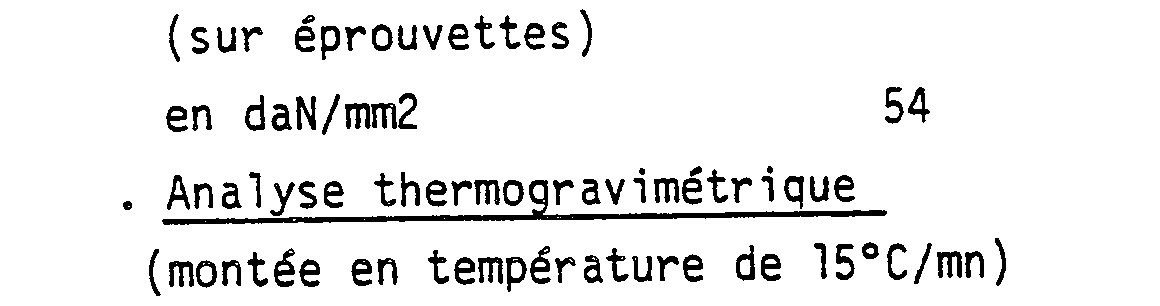
- faite sur polymère avant moulage :

- Dans un réacteur de polycondensation, on charge :

- Après purge à l'azote, le réacteur est chauffé avec un bain métallique réglé à 250°C.
- La réaction d'acidolyse démarre à 235°C et en 1,25 heure la masse est amenée à 288°C. La proportion d'acide acétique distillé est alors de 90,74 % de la quantité théorique. En 30 minutes, la pression est abaissée à 0,7 mmHg et la température de la masse est maintenue à 295°C pendant 35 minutes.
- On obtient 184 parties (93,15 %) de polymère qui est insoluble dans le mélange p-chlorophénol/dichloro-1,2 éthane.
- La température d'écoulement du polymère est de 300°C.
- La plage de températures de transformation de la masse fondue issue de ce polymère va de 300°C jusqu'à plus de 355°C.
- Après broyage et séchage du polymère de la manière indiquée dans l'exemple 2, on moule des éprouvettes par injection sur presse "KAP" dans les conditions suivantes :

- Les résultats obtenus sont les suivants :
- .Propriétés en flexion :

- . Propriétés en traction :

- Dans un réacteur de polycondensation, on introduit :

- La réaction d'acidolyse débute à 258°C et en 1 heure 25 minutes la masse réactionnelle est amenée progressivement à 300°C. La proportion d'acide acétique distillé est de 91,85 % de la quantité théorique. La pression est ensuite diminuée à 3 mmHg en 30 minutes ; la température de la masse réactionnelle est élevée à 310°C et maintenue pendant 25 minutes à cette valeur.
- Le polymère obtenu, coulé dans un bain eau/glace, est insoluble dans le mélange p-chlorophénol/dichloro-1,2 éthane. Il a une température d'écoulement de 320°C.
- La plage de températures de transformation de la masse fondue issue de ce polyester va de 320°C jusqu'à plus de 355°C.
- Après broyage et séchage dans les conditions indiquées dans l'exemple 2, il est moulé par injection sur presse "KAP" dans les conditions suivantes :

- On utilise un polymère identique à celui préparé'selon l'exemple 1 qui est séché pendant 6 heures à 150°C sous 1 mmHg, puis pendant 15 heures à 90°C sous vide.
- Il est moulé par injection sur presse "KAP" dans les conditions suivantes :

- .Propriétés en flexion :


- . Propriétés en traction :

- . Résistance au choc Charpy :

- . Module élastique de torsion à 140°C :

Claims (9)


Priority Applications (1)
| Application Number | Priority Date | Filing Date | Title |
|---|---|---|---|
| AT80420105T ATE4906T1 (de) | 1979-09-21 | 1980-09-18 | Anisotrope konformierbare formmassen auf der basis aromatischer polyester, verfahren zu ihrer herstellung und daraus geformte artikel. |
Applications Claiming Priority (2)
| Application Number | Priority Date | Filing Date | Title |
|---|---|---|---|
| FR7924135 | 1979-09-21 | ||
| FR7924135A FR2465758A1 (fr) | 1979-09-21 | 1979-09-21 | Masses fondues anisotropes conformables a base de polyesters aromatiques et articles formes a partir d'elles |
Publications (2)
| Publication Number | Publication Date |
|---|---|
| EP0026720A1 true EP0026720A1 (fr) | 1981-04-08 |
| EP0026720B1 EP0026720B1 (fr) | 1983-10-05 |
Family
ID=9230088
Family Applications (1)
| Application Number | Title | Priority Date | Filing Date |
|---|---|---|---|
| EP80420105A Expired EP0026720B1 (fr) | 1979-09-21 | 1980-09-18 | Masses fondues anisotropes conformables à base de polyesters aromatiques, leurs procédés de préparation et articles formés à partir d'elles |
Country Status (8)
| Country | Link |
|---|---|
| US (1) | US4346208A (fr) |
| EP (1) | EP0026720B1 (fr) |
| JP (1) | JPS5679123A (fr) |
| AT (1) | ATE4906T1 (fr) |
| BR (1) | BR8006029A (fr) |
| CA (1) | CA1147895A (fr) |
| DE (1) | DE3065177D1 (fr) |
| FR (1) | FR2465758A1 (fr) |
Families Citing this family (7)
| Publication number | Priority date | Publication date | Assignee | Title |
|---|---|---|---|---|
| US4412058A (en) * | 1982-06-02 | 1983-10-25 | E. I. Du Pont De Nemours And Company | Aromatic polyesters and high strength filaments thereof |
| US4511706A (en) * | 1982-07-26 | 1985-04-16 | Ethicon, Inc. | Copolymers of a 4,4'-(ethylenedioxy)bis benzoate, an alkylene diol and a (2-alkenyl or alkyl) succinic anhydride |
| US4608428A (en) * | 1982-07-26 | 1986-08-26 | Ethicon, Inc. | Copolymers of a 4,4'-(ethylenedioxy)bis benzoate, an alkylene diol and a (2-alkenyl or alkyl) succinic anhydride; and surgical devices formed therefrom |
| JPS5941331A (ja) * | 1982-09-01 | 1984-03-07 | Agency Of Ind Science & Technol | 含ハロゲン芳香族ポリエステル |
| US4605727A (en) * | 1984-03-09 | 1986-08-12 | Director General Of The Agency Of Industrial Science And Technology | High modulus polyester |
| US4612154A (en) * | 1984-06-15 | 1986-09-16 | E. I. Du Pont De Nemours And Company | Spinning of certain high molecular weight anisotropic melt forming polyesters |
| EP0305070B1 (fr) * | 1987-08-11 | 1993-03-03 | Mitsubishi Gas Chemical Company, Inc. | Copolyester façonnable à l'état fondu |
Citations (3)
| Publication number | Priority date | Publication date | Assignee | Title |
|---|---|---|---|---|
| DE1795502A1 (de) * | 1963-12-02 | 1972-02-10 | Unitika Ltd | Neue kristallisierbare Copolymere und Verfahren zu ihrer Herstellung |
| US3991013A (en) * | 1974-05-10 | 1976-11-09 | E. I. Du Pont De Nemours And Company | Copolyesters of derivatives of hydroquinone |
| US3991014A (en) * | 1974-05-10 | 1976-11-09 | E. I. Du Pont De Nemours And Company | Polyesters of derivatives of hydroquinone and bis(carboxyphenyl)ether |
Family Cites Families (5)
| Publication number | Priority date | Publication date | Assignee | Title |
|---|---|---|---|---|
| DE1795502U (de) | 1959-06-25 | 1959-09-10 | Goetzewerke | Spannfeder. |
| GB989552A (en) | 1962-02-19 | 1965-04-22 | Ici Ltd | Crystalline polyesters |
| US3873504A (en) * | 1973-10-03 | 1975-03-25 | Fmc Corp | Flame-retardant copolyester resin containing dialkyl tetrabromo diphenoxyalkane dicarboxylates |
| US4065432A (en) * | 1976-12-16 | 1977-12-27 | E. I. Du Pont De Nemours And Company | Thermally stable, rigid polyesters from aromatic dibasic acids and thermally stable, rigid bisphenols |
| US4156070A (en) * | 1977-08-08 | 1979-05-22 | Eastman Kodak Company | Liquid crystal copolyesters prepared from an aromatic dicarboxylic acid, a substituted hydroquinone and resorcinol |
-
1979
- 1979-09-21 FR FR7924135A patent/FR2465758A1/fr active Granted
-
1980
- 1980-09-11 US US06/186,289 patent/US4346208A/en not_active Expired - Lifetime
- 1980-09-18 DE DE8080420105T patent/DE3065177D1/de not_active Expired
- 1980-09-18 AT AT80420105T patent/ATE4906T1/de not_active IP Right Cessation
- 1980-09-18 EP EP80420105A patent/EP0026720B1/fr not_active Expired
- 1980-09-19 BR BR8006029A patent/BR8006029A/pt unknown
- 1980-09-19 CA CA000360588A patent/CA1147895A/fr not_active Expired
- 1980-09-22 JP JP13088080A patent/JPS5679123A/ja active Granted
Patent Citations (3)
| Publication number | Priority date | Publication date | Assignee | Title |
|---|---|---|---|---|
| DE1795502A1 (de) * | 1963-12-02 | 1972-02-10 | Unitika Ltd | Neue kristallisierbare Copolymere und Verfahren zu ihrer Herstellung |
| US3991013A (en) * | 1974-05-10 | 1976-11-09 | E. I. Du Pont De Nemours And Company | Copolyesters of derivatives of hydroquinone |
| US3991014A (en) * | 1974-05-10 | 1976-11-09 | E. I. Du Pont De Nemours And Company | Polyesters of derivatives of hydroquinone and bis(carboxyphenyl)ether |
Also Published As
| Publication number | Publication date |
|---|---|
| EP0026720B1 (fr) | 1983-10-05 |
| DE3065177D1 (en) | 1983-11-10 |
| JPS5679123A (en) | 1981-06-29 |
| FR2465758A1 (fr) | 1981-03-27 |
| JPS6245891B2 (fr) | 1987-09-29 |
| ATE4906T1 (de) | 1983-10-15 |
| CA1147895A (fr) | 1983-06-07 |
| BR8006029A (pt) | 1981-03-31 |
| FR2465758B1 (fr) | 1984-10-12 |
| US4346208A (en) | 1982-08-24 |
Similar Documents
| Publication | Publication Date | Title |
|---|---|---|
| FR2477557A1 (fr) | Polyester totalement aromatique pouvant etre traite a la fusion et fibre, pellicule, article moule et compose de moulage obtenus | |
| EP0010051B1 (fr) | Copolyesters thermotropes issus d'au moins une hydroquinone substituée, d'un diacide aromatique et/ou cycloaliphatique et d'un diacide aliphatique | |
| EP0015856B1 (fr) | Copolyesters aromatiques thermotropes et leurs procédés de préparation | |
| EP0026720B1 (fr) | Masses fondues anisotropes conformables à base de polyesters aromatiques, leurs procédés de préparation et articles formés à partir d'elles | |
| EP0191705B1 (fr) | Copolyesters aromatiques thermotropes | |
| EP0408449A1 (fr) | Copolyesteramides semialiphatiques thermotropes et leur procédé de préparation | |
| FR2473048A1 (fr) | Polyester de l'acide para-hydroxy benzoique, de 1,4-bis(para-carboxyphenoxy)benzene, d'un diol aromatique et d'un diacide aromatique pouvant etre traite a la fusion, et fibre, pellicule, article moule et compose de moulage obtenus | |
| CA1096996A (fr) | Copolyestres ignifuges a groupes phosphoniques | |
| EP0301976B1 (fr) | Copolyesters et copolyesteramides aromatiques thermotropes | |
| CH362233A (fr) | Procédé pour la préparation de polyanhydrides linéaires aromatiques à poids moléculaire élevé | |
| JPH0360331B2 (fr) | ||
| FR2718139A1 (fr) | Polyesters à chaîne rigide, leur procédé de préparation et leur utilisation pour produire des fibres. | |
| CA1133186A (fr) | Procede d'obtention de copolyesters alcoylaromatiques | |
| EP0298883A1 (fr) | Copolyesteramides aromatiques thermotropes | |
| EP0272992B1 (fr) | Procédé pour l'obtention de copolyesters amides aromatiques thermotropes | |
| JPH0472814B2 (fr) | ||
| JP2591056B2 (ja) | 芳香族ポリエステルおよびその製造方法 | |
| CH616693A5 (fr) | ||
| JPS63317524A (ja) | 液晶性共重合ポリエステルの製造法 | |
| JP2544731B2 (ja) | 全芳香族ポリエステル | |
| CA1100683A (fr) | Copolyesters avec compose diphosphonique | |
| US5017678A (en) | Thermotropic liquid crystalline polymers | |
| BE828935A (fr) | Perfectionnements aux polyesters synthetiques | |
| EP0298884A1 (fr) | Copolyesteramides aromatiques thermotropes | |
| JP3128539B2 (ja) | サーモトロピック液晶性ポリエステルの製造方法 |
Legal Events
| Date | Code | Title | Description |
|---|---|---|---|
| PUAI | Public reference made under article 153(3) epc to a published international application that has entered the european phase |
Free format text: ORIGINAL CODE: 0009012 |
|
| AK | Designated contracting states |
Designated state(s): AT BE CH DE FR GB IT LU NL SE |
|
| 17P | Request for examination filed |
Effective date: 19810825 |
|
| RAP1 | Party data changed (applicant data changed or rights of an application transferred) |
Owner name: RHONE-POULENC RECHERCHES |
|
| RAP1 | Party data changed (applicant data changed or rights of an application transferred) |
Owner name: RHONE-POULENC SPECIALITES CHIMIQUES |
|
| RAP1 | Party data changed (applicant data changed or rights of an application transferred) |
Owner name: RHONE-POULENC SPECIALITES CHIMIQUES |
|
| ITF | It: translation for a ep patent filed | ||
| GRAA | (expected) grant |
Free format text: ORIGINAL CODE: 0009210 |
|
| AK | Designated contracting states |
Designated state(s): AT BE CH DE FR GB IT LI LU NL SE |
|
| REF | Corresponds to: |
Ref document number: 4906 Country of ref document: AT Date of ref document: 19831015 Kind code of ref document: T |
|
| REF | Corresponds to: |
Ref document number: 3065177 Country of ref document: DE Date of ref document: 19831110 |
|
| PLBE | No opposition filed within time limit |
Free format text: ORIGINAL CODE: 0009261 |
|
| STAA | Information on the status of an ep patent application or granted ep patent |
Free format text: STATUS: NO OPPOSITION FILED WITHIN TIME LIMIT |
|
| PG25 | Lapsed in a contracting state [announced via postgrant information from national office to epo] |
Ref country code: LU Free format text: LAPSE BECAUSE OF NON-PAYMENT OF DUE FEES Effective date: 19840930 |
|
| 26N | No opposition filed | ||
| PGFP | Annual fee paid to national office [announced via postgrant information from national office to epo] |
Ref country code: FR Payment date: 19900730 Year of fee payment: 11 |
|
| PGFP | Annual fee paid to national office [announced via postgrant information from national office to epo] |
Ref country code: GB Payment date: 19900831 Year of fee payment: 11 |
|
| PGFP | Annual fee paid to national office [announced via postgrant information from national office to epo] |
Ref country code: SE Payment date: 19900913 Year of fee payment: 11 |
|
| PGFP | Annual fee paid to national office [announced via postgrant information from national office to epo] |
Ref country code: AT Payment date: 19900924 Year of fee payment: 11 |
|
| ITTA | It: last paid annual fee | ||
| PGFP | Annual fee paid to national office [announced via postgrant information from national office to epo] |
Ref country code: NL Payment date: 19900930 Year of fee payment: 11 |
|
| PGFP | Annual fee paid to national office [announced via postgrant information from national office to epo] |
Ref country code: LU Payment date: 19901002 Year of fee payment: 11 |
|
| PGFP | Annual fee paid to national office [announced via postgrant information from national office to epo] |
Ref country code: CH Payment date: 19901009 Year of fee payment: 11 |
|
| PGFP | Annual fee paid to national office [announced via postgrant information from national office to epo] |
Ref country code: DE Payment date: 19901031 Year of fee payment: 11 |
|
| PGFP | Annual fee paid to national office [announced via postgrant information from national office to epo] |
Ref country code: BE Payment date: 19901114 Year of fee payment: 11 |
|
| PG25 | Lapsed in a contracting state [announced via postgrant information from national office to epo] |
Ref country code: GB Effective date: 19910918 Ref country code: AT Effective date: 19910918 |
|
| PG25 | Lapsed in a contracting state [announced via postgrant information from national office to epo] |
Ref country code: SE Effective date: 19910919 |
|
| PG25 | Lapsed in a contracting state [announced via postgrant information from national office to epo] |
Ref country code: LI Effective date: 19910930 Ref country code: CH Effective date: 19910930 Ref country code: BE Effective date: 19910930 |
|
| BERE | Be: lapsed |
Owner name: RHONE-POULENC SPECIALITES CHIMIQUES Effective date: 19910930 |
|
| PG25 | Lapsed in a contracting state [announced via postgrant information from national office to epo] |
Ref country code: NL Effective date: 19920401 |
|
| GBPC | Gb: european patent ceased through non-payment of renewal fee | ||
| NLV4 | Nl: lapsed or anulled due to non-payment of the annual fee | ||
| PG25 | Lapsed in a contracting state [announced via postgrant information from national office to epo] |
Ref country code: FR Effective date: 19920529 |
|
| REG | Reference to a national code |
Ref country code: CH Ref legal event code: PL |
|
| PG25 | Lapsed in a contracting state [announced via postgrant information from national office to epo] |
Ref country code: DE Effective date: 19920602 |
|
| REG | Reference to a national code |
Ref country code: FR Ref legal event code: ST |
|
| EUG | Se: european patent has lapsed |
Ref document number: 80420105.1 Effective date: 19920408 |