EP0029106A2 - Reaktivfarbstoffe, die eine Halogenalkanoylamido- oder Halogenacryloylamido-Gruppe enthalten, deren Herstellung und Verwendung, sowie die Halogenalkanoylamido- bzw. Halogenacryloylamido-Zwischenverbindung - Google Patents
Reaktivfarbstoffe, die eine Halogenalkanoylamido- oder Halogenacryloylamido-Gruppe enthalten, deren Herstellung und Verwendung, sowie die Halogenalkanoylamido- bzw. Halogenacryloylamido-Zwischenverbindung Download PDFInfo
- Publication number
- EP0029106A2 EP0029106A2 EP80105948A EP80105948A EP0029106A2 EP 0029106 A2 EP0029106 A2 EP 0029106A2 EP 80105948 A EP80105948 A EP 80105948A EP 80105948 A EP80105948 A EP 80105948A EP 0029106 A2 EP0029106 A2 EP 0029106A2
- Authority
- EP
- European Patent Office
- Prior art keywords
- formula
- radical
- acid
- halogen
- dye
- Prior art date
- Legal status (The legal status is an assumption and is not a legal conclusion. Google has not performed a legal analysis and makes no representation as to the accuracy of the status listed.)
- Granted
Links
- 0 C*1(C)*(C)=*(*)*=*1 Chemical compound C*1(C)*(C)=*(*)*=*1 0.000 description 1
Classifications
-
- C—CHEMISTRY; METALLURGY
- C09—DYES; PAINTS; POLISHES; NATURAL RESINS; ADHESIVES; COMPOSITIONS NOT OTHERWISE PROVIDED FOR; APPLICATIONS OF MATERIALS NOT OTHERWISE PROVIDED FOR
- C09B—ORGANIC DYES OR CLOSELY-RELATED COMPOUNDS FOR PRODUCING DYES, e.g. PIGMENTS; MORDANTS; LAKES
- C09B62/00—Reactive dyes, i.e. dyes which form covalent bonds with the substrates or which polymerise with themselves
- C09B62/44—Reactive dyes, i.e. dyes which form covalent bonds with the substrates or which polymerise with themselves with the reactive group not directly attached to a heterocyclic ring
- C09B62/465—Reactive dyes, i.e. dyes which form covalent bonds with the substrates or which polymerise with themselves with the reactive group not directly attached to a heterocyclic ring the reactive group being an acryloyl group, a quaternised or non-quaternised aminoalkyl carbonyl group or a (—N)n—CO—A—O—X or (—N)n—CO—A—Hal group, wherein A is an alkylene or alkylidene group, X is hydrogen or an acyl radical of an organic or inorganic acid, Hal is a halogen atom, and n is 0 or 1
Definitions
- the remains of the formula are each bound to an aromatic carbon atom of D, in particular to a benzene nucleus.
- an organic dye D in formula (1) may contain further substituents.
- substituents include: alkyl groups with 1 to 4 carbon atoms, such as methyl, ethyl, propyl, isopropyl and butyl, alkoxy groups with 1 to 4 carbon atoms, such as methoxy, aechoxy, propoxy, Iaopropoxy and butoxy, aryloxy groups such as phenoxy or with chlorine, bromine , Nitro, methyl or methoxy substituted phenoxy, acylamino groups with 1 to 6 carbon atoms, such as acetylamino, propionylamino and benzoylamino, halogen, such as fluorine, chlorine or bromine, nitro, cyano, trifluoromethyl, optionally N-mono- or -N, N-di-alkyl and / or aryl substituted sulfamoyl or carbamoyl, ureido, hydroxy, carboxy and sulf
- D is to have a unsubstituted or substituted by C l- C 4 alkyl or C 1 -C 4 alkoxy phenyl, because the novel reactive group can introduce particularly well in such a.
- the radical D preferably contains sulfo groups as water-solubilizing groups.
- D is a dye of the anthraquinone, azo, dioxazine or phthalocyanine series, which contains 1 to 3, preferably 1 or 2 sulfo groups.
- anthraquinone and azo dyes which contain one or 2 groups of the formula (1) and in which the radical R has one of the following meanings: -CH 2 Cl, -CH 2 Br, -CCl-CH 2 , -CHCl -CH 2 Cl or especially -CHBr-CH 2 Br and -CBr-CH 2 .
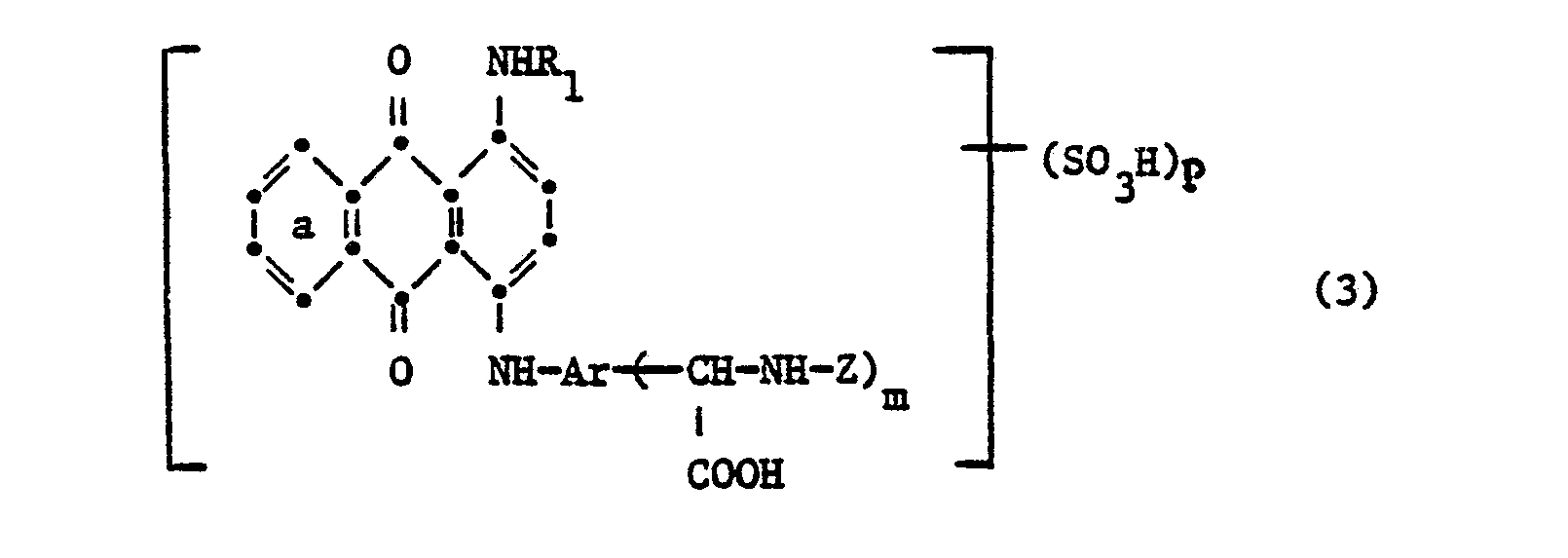
- anthraquinone dyes are those of the formula of interest, wherein R 1 is hydrogen, low molecular weight alkyl, aralkyl or aryl, Ar is an arylene radical, Z is an a, ⁇ -dichloro- or -dibromopropionyl, an a-chloro or a-bromoacryloyl or a chloroacetyl radical, m 1 or 2 and p is 1 or 2 and wherein the ring a is optionally substituted with hydroxyl or halogen.
- R 1 here preferably denotes hydrogen or a secondary alkyl radical or a cycloalkyl radical having up to 9 carbon atoms, such as, for example, 2-methylbutyl-3, pentyl-2, pentyl-3, cyclopentyl, cyclohexyl, cyclohexyl substituted with 1 to 3 methyl groups and in particular Isopropyl and butyl-2.
- Ar is preferably a radical of the benzene series which is optionally substituted, for example with C 1 -C 4 alkyl, C 1 -C 4 alkoxy, C 1 -C 4 alkylsulfonyl, carboxy, sulfo, sulfamoyl, N-alkyl or N-arylsulfamoyl or halogen. Above all, however, Ar is a phenylene radical substituted with up to 3 methyl groups.
- Ring a can be a sulfo group or other substituents, e.g. Halogen, especially chlorine, or hydroxyl.
- anthraquinone dyes are those of the formula in which A 1 and A 2 each have an optionally branched alkylene radical having up to 5 carbon atoms and Z is an a, ⁇ -dichloro- or -dibromopropionyl, an ⁇ -chloro or a-bromoacryloyl or a chloroacetyl radical and in which the ring a 'optionally with Hydroxyl or halogen is substituted.
- ring a is substituted with hydroxyl groups, these are preferably in positions 5 and 8. Bromine and in particular chlorine are suitable as halogen atoms. These are mainly in positions 6 and / or 7 of the anthraquinone structure.
- radicals A 1 and A 2 can be the same or different.
- a 1 and A 2 are each preferred 1-methylpropylene chains.
- azo dyes are also of interest, in particular those of the formula wherein D represents the remainder of a diazo component of the benzene or naphthalene series and K represents the remainder of a coupling component, preferably the remainder of a naphtholsulphonic acid, an acetoacetanilide, a pyrazol-5-one or a naphtho (1,2-d) imidazole.
- D is preferably a radical of the benzene series which is substituted by C 1 -C 4 alkyl, especially methyl.
- the new dyes are made by using the appropriate dye compounds wherein D and n are the same as in formula (1) and H is a replaceable hydrogen atom bonded to an aromatic carbon atom of D with a haloalkanoyl or haloacryloylamidoglycolic acid.
- This reaction takes place under the same conditions as the reaction with N-methylol compounds of aliphatic halocarboxamides or functional derivatives thereof (A. Einhorn, Liebigs Annalen der Chemie, 343, 207 (1905) and 361.113 (1908).
- the chloroacetamidoglycolic acid is known from DE-OS 2,640,615.
- the dihalopropionamidoglycolic acids and the a-haloacrylolylamidoglycolic acids are new and also form one Subject of the invention.
- the dihalogen compounds are obtained by halogenation of acryloylamidoglycolic acid and the a-haloacryloyl compounds are obtainable by splitting off hydrogen halide from the dihalogen compounds by the action of alkali, for example sodium hydroxide solution.
- alkali for example sodium hydroxide solution.
- Of particular interest are the dibromopropionamidoglycolic acid and the ⁇ -bromoacryloylamidoglycolic acid obtainable therefrom by splitting off HBr.
- the dye obtained can be sulfonated and / or, if it has been reacted with dibromopropionamidoglycolic acid, hydrogen bromide can subsequently be eliminated by treatment with alkali.
- the compounds of formula (4) are conveniently prepared by using a compound of formula wherein A 1 and A 2 each represent an optionally branched alkylene radical having up to 5 carbon atoms and the ring a 'is optionally substituted by hydroxyl or halogen, with 2 equivalents of ⁇ , ⁇ -dichloro- or a, .ß-dibromopropionamidoglycolic acid, a-chloro or ⁇ -bromoacryloylamidoglycolic acid or chloroacetamidoglycolic acid and then sulfonated.
- a 1 and A 2 each represent an optionally branched alkylene radical having up to 5 carbon atoms and the ring a 'is optionally substituted by hydroxyl or halogen, with 2 equivalents of ⁇ , ⁇ -dichloro- or a, .ß-dibromopropionamidoglycolic acid, a-chloro or ⁇ -bromoacryloylamidoglycoli
- the dyes are condensed with the acylamidoglycolic acids in the presence of acidic condensing agents or water-releasing agents which react as such.
- acidic condensing agents or water-releasing agents which react as such.
- Concentrated hydrochloric acid, zinc chloride, phosphorus pentoxide, acetic hydride, phosphoric acid and oleum can be used.
- the preferred condensing agent is concentrated to anhydrous sulfuric acid, since it can usually serve as a solvent for the reactants at the same time.
- the reaction temperature can vary within wide limits and depends primarily on the condensing agent used. In concentrated sulfuric acid, the reaction usually proceeds quickly and completely even at room temperature. In some cases, working at elevated temperatures is necessary, for example at 40 to 80 ° C.
- the finished reaction products are separated by pouring the sulfuric acid solutions or suspensions into ice water and isolated in the usual way.
- a, ⁇ -dibromopropionamidoglycolic acid is primarily used as the haloalkanoylamidoglycolic acid.
- the new dyes are suitable for dyeing and printing a wide variety of materials, e.g. such animal origin as leather, silk and especially wool, as well as various synthetic fibers, e.g. made of super polyamides and super polyurethanes. They are particularly suitable for dyeing from neutral to acidic medium.
- the new dyes are also suitable for dyeing and printing cellulosic materials, such as cotton and regenerated cellulose fibers, in order to fix a heat treatment in the presence of alkali, e.g. in the presence of sodium (hydrogen) carbonate, sodium hydroxide or trisodium phosphate.
- They are particularly suitable for dyeing wool from weakly acidic, for example, acetic acid bath in the presence of wetting and leveling agents, in particular in the presence of polyglycol ether derivatives which contain on average 5 to 10 -CH 2 -CH 2 -O groups, and are of primary origin Derive monamines containing an aliphatic hydrocarbon radical with 15 to 20 carbon atoms.
- the dyeings obtained with the new dyes are characterized by good light fastness and fastness to rubbing and excellent wet fastness, such as fastness to washing, water, sweat, damp heat and fulling. They have good water solubility and a high degree of fixation and give strong, level colorations.
- Example 1 78 parts of acrybylamidoglycolic acid monohydrate are brominated with 77 parts of bromine in 500 parts of carbon tetrachloride at room temperature. After 20 hours the reaction is complete and the viscous suspension is suctioned off and washed with carbon tetrachloride until the washing liquid remains colorless. The filter cake is dried in vacuo at 60 ° C. 143 parts of dibromopropionamidoglycolic acid of the formula are obtained:
- a mixture of 16 parts of the dibromopropionamidoglycolic acid thus obtained and 24 parts of the sodium salt of 1-amino-4-mesidinoanthraquinone-2-sulfonic acid of the formula is dissolved at 10 to 15 ° in 125 parts of 96% sulfuric acid.
- the reaction mixture is stirred for a further 15 hours at this temperature, then poured into an ice-water mixture and the dye which has separated out is filtered off with suction.
- a water-soluble blue dye of the formula is obtained: dyes the wool preferably in the presence of leveling agents (for example a condensation product of higher aliphatic amines with ethylene oxide) from acetic acid bath in wet-fast, brilliant, blue shades of good lightfastness.
- leveling agents for example a condensation product of higher aliphatic amines with ethylene oxide
- Example 2 If 32 parts of the same compound are used instead of the 16 parts of dibromopropionamidoglycolic acid and the procedure of Example 1 is followed, a bis-reactive dye of the formula: with very good coloring properties and excellent wet fastness properties.
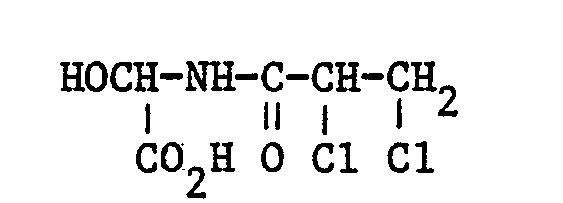
- Example 3 78 parts of acryloylamidoglycolic acid monohydrate are slurried in 500 parts of carbon tetrachloride and 34 parts of chlorine are introduced within 4 hours at room temperature. The suspension is suctioned off and washed with carbon tetrachloride. The filter cake is dried at 60 ° in a vacuum, 102 parts of dichloropropionamidoglycolic acid of the formula are obtained:
- a mixture of 12 parts of the dichloropropionamidoglycolic acid thus obtained and 24 parts of the sodium salt of 1-amino-4-mesidino-anthraquinone-2-sulfonic acid are condensed according to Example 1.
- the reactive dye of the formula is obtained: the wool dyes in pure, wet-fast blue tones.
- Example 4 76.5 parts of the dye obtainable according to Example 1 are dissolved in 500 parts of water, the solution is cooled to 10 ° with the addition of ice and 12 parts by volume of 10N sodium hydroxide solution are added. After stirring at 10-15 ° for 30 minutes, the solution is neutralized by adding about 10 parts by volume of hydrochloric acid, and the dye is separated off by adding sodium chloride, filtered and a vacuum is dried at 60-70 °.
- a readily water-soluble bromoacrylic derivative of the formula is obtained: that dyes wool in its blue tones with good fastness properties.
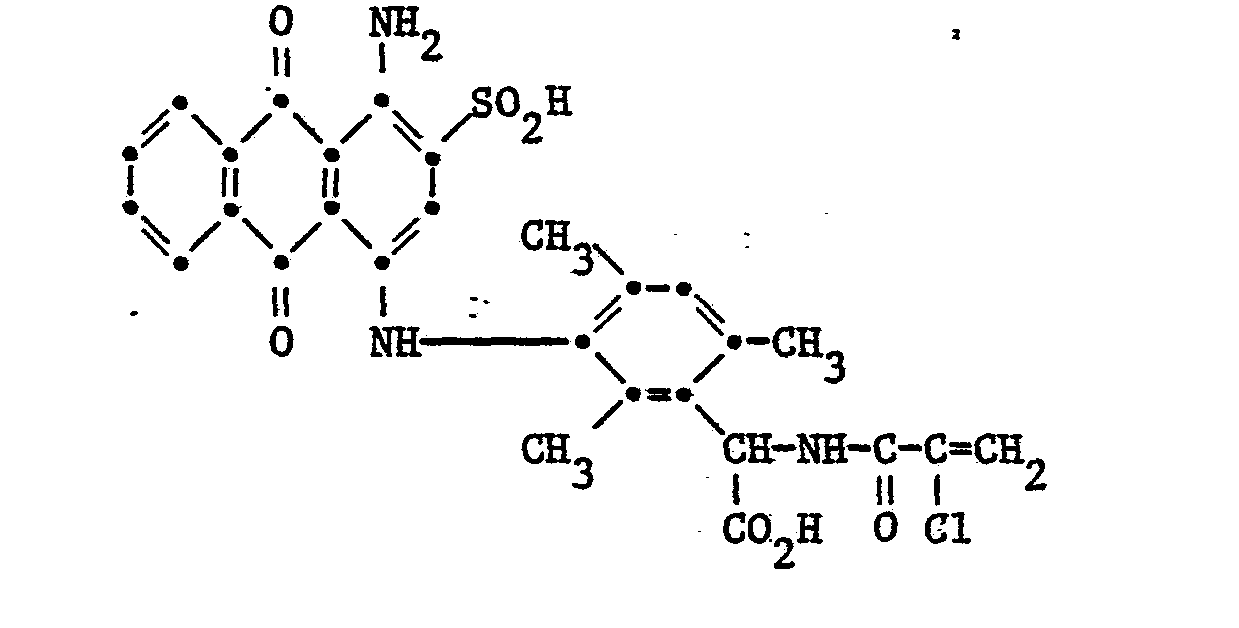
- Example 5 In the example above, if the 76.5 parts of the dye obtainable according to Example 1 are replaced by 67.5 parts of the dichloro derivative corresponding to Example 3, the dye of the formula with very similar properties.
- Example 6 A mixture of 9 parts of chloroacetamidoglycolic acid and 24 parts of the sodium salt of 1-amino-4-mesidinoanthraquinone-2-sulfonic acid is dissolved at 10-15 ° in 125 parts of 96% sulfuric acid. The reaction mixture is stirred for a further 15 hours at this temperature, then poured into an ice-water mixture and the dye which has separated out is filtered off with suction.
- Example 41 At a temperature of 5-10 °, a homogeneous mixture of 25 parts of the compound of the formula is worn and 32 parts of dibromopropionamidoglycolic acid (obtained according to Example 1) in 180 parts of 90% sulfuric acid and then stirring the solution obtained for 15 hours at the same temperature. For the sulfonation, 180 parts of 65% oleum are run in at 10-15 ° and the sulfonation mixture is poured into an ice-water mixture. The excreted bis-reactive dye of the formula: is suctioned off and isolated in the usual way as sodium salt.
Landscapes
- Chemical & Material Sciences (AREA)
- Organic Chemistry (AREA)
- Coloring (AREA)
- Organic Low-Molecular-Weight Compounds And Preparation Thereof (AREA)
Abstract
Description
- Die Erfindung betrifft faserreaktive Farbstoffe der Formel

- D ein organischer Farbstoffrest ist, der mindestens eine wasserlöslichmachende Gruppe enthält,
- R einen Halogenalkylrest mit 1 bis 2 C-Atomen oder einen Halogenacrylrest und
- n eine ganze Zahl von 1 bis 4 bedeutet.
- Die Reste der Formel

- Der Rest eines organischen Farbstoffes D in Formel (1) kann weitere Substituenten enthalten. Als Beispiele seien genannt: Alkylgruppen mit 1 bis 4 Kohlenstoffatomen, wie Methyl, Aethyl, Propyl, Isopropyl und Butyl, Alkoxygruppen mit 1 bis 4 Kohlenstoffatomen, wie Methoxy, Aechoxy, Propoxy, Iaopropoxy und Butoxy, Aryloxygruppen, wie Phenoxy oder mit Chlor, Brom, Nitro, Methyl oder Methoxy substituiertes Phenoxy, Acylaminogruppen mit 1 bis 6 Kohlenstoffatomen, wie Acetylamino, Propionylamino und Benzoylamino, Halogen, wie Fluor, Chlor oder Brom, Nitro, Cyan, Trifluormethyl, gegebenenfalls N-mono-oder -N,N-di-alkyl und/oder-aryl substituiertes Sulfamoyl oder Carbamoyl, Ureido, Hydroxy, Carboxy und Sulfomethyl.
- Vorzugsweise soll D einen gegebenenfalls durch Cl-C4-Alkyl oder C1-C4-Alkoxy substituierten Phenylrest aufweisen, da sich die neue Reaktivgruppe in einen solchen besonders gut einführen lässt.
- Als wasserlöslichmachende Gruppen enthält der Rest D vorzugsweise Sulfogruppen.
- Insbesondere handelt es sich bei D um einen Farbstoff der Anthrachinon-, Azo-, Dioxazin- oder Phthalocyaninreihe, der 1 bis 3, vorzugsweise 1 oder 2 Sulfogruppen enthält.
- Von besonderem Interesse sind die Anthrachinon- und Azofarbstoffe, die eine oder 2 Gruppen der Formel (1) enthalten und worin der Rest R eine der folgenden Bedeutungen hat: -CH2Cl, -CH2Br, -CCl-CH2, -CHCl-CH2Cl oder vor allem -CHBr-CH2Br und -CBr-CH2.
- Unter den Anthrachinonfarbstoffen sind speziell diejenigen der Formel

- R1 bedeutet hierin vorzugsweise Wasserstoff oder einen sekundären Alkylrest oder einen Cycloalkylrest mit bis zu 9 C-Atomen, wie z.B. 2-Methylbutyl-3, Pentyl-2, Pentyl-3, Cyclopentyl, Cyclohexyl, mit 1 bis 3 Methylgruppen substituiertes Cyclohexyl und insbesondere Isopropyl und Butyl-2.
- Ar ist vorzugsweise ein Rest der Benzolreihe, der gegebenenfalls substituiert ist, z.B. mit C1-C4-Alkyl, C1-C4-Alkoxy, C1-C4-Alkylsulfonyl, Carboxy, Sulfo, Sulfamoyl, N-Alkyl- oder N-Arylsulfamoyloder Halogen. Vor allem ist Ar jedoch ein mit bis zu 3 Methylgruppen substituierten Phenylenrest.
- Der Ring a kann eine Sulfogruppe oder auch andere Substituenten, wie z.B. Halogen, insbesondere Chlor, oder Hydroxyl tragen.
- Eine weitere Gruppe von speziell interessanten Anthrachinonfarbstoffen sind diejenigen der Formel
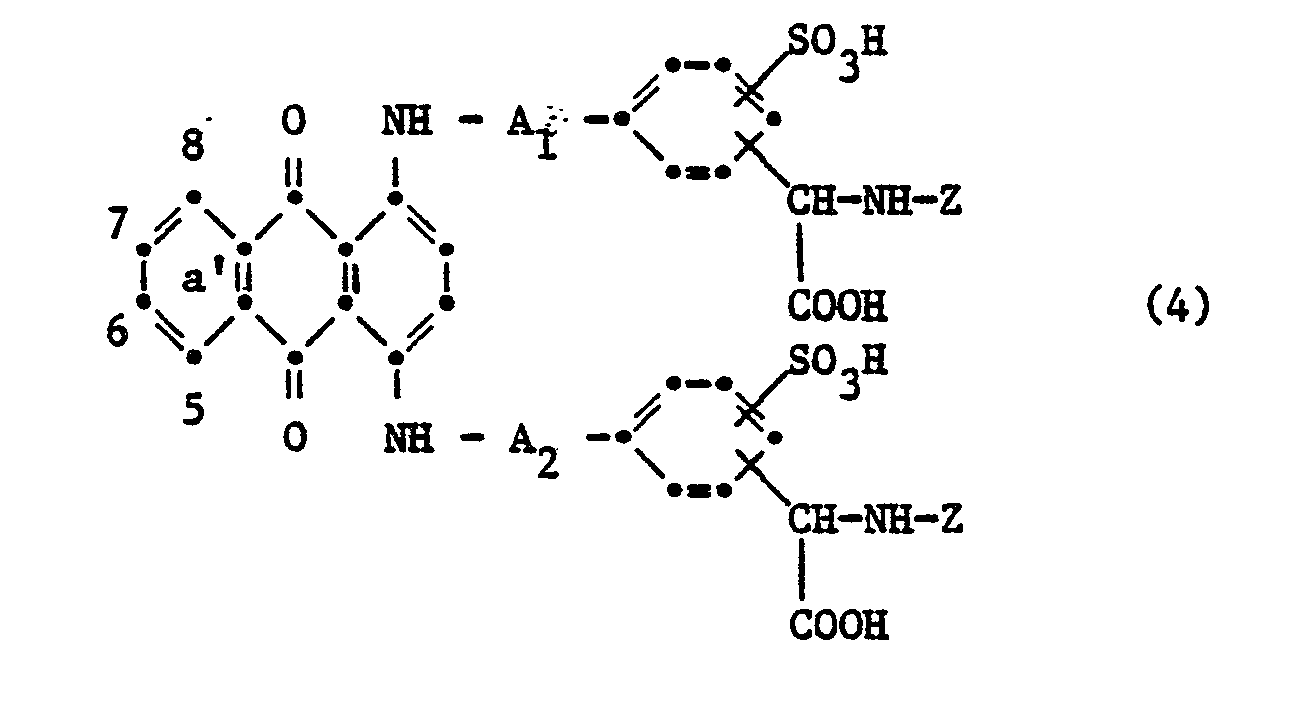
- Wenn der Ring a' mit Hydroxylgruppen substituiert ist, so stehen diese vorzugsweise in den Stellungen 5 und 8. Als Halogenatome kommen Brom und insbesondere Chlor in Betracht. Diese stehen vor allem in den Positionen 6 und /oder 7 des Anthrachinongerüstes.
- Die Reste A1 und A2 können gleich oder verschieden sein. Bevorzugt sind A1 und A2 je 1-Methylpropylenketten.
- Von Interesse sind nebst den genannten Anthrachinonfarbstoffen auch Azofarbstoffe, insbesondere solche der Formel

- Vorzugsweise ist D ein Rest der Benzolreihe, der mit C1-C4-Alkyl, vor allem Methyl substituiert ist.
- Die Reste K leiten sich insbesondere von folgenden Gruppen von Kupplungskomponenten ab:
- - Naphtholsulfonsäuren, wie z.B. 2-Naphthol-3-, -4-, -5-, -6-, -7-oder -8-sulfosäure oder 1-Naghthol-3-, -4- oder -5-sulfosäure.
- - Acetessigsäurearylide, insbesondere -anilide, die im Anilidkern gegebenenfalls mit Chlor, Brom, Sulfo, C1-C4-Alkyl sowie C1-C4-Alkoxy substituiert sind, wie z.B. Acetoacetanilid, Acetoacetanilid-3- oder -4-sulfosäure, Acetoacet-o-chloranilid, Acetoacet-o-toluidid, Acetoacet-o-anisidid oder Acetoacet-m-xylidid.
- - 5-Pyrazolone oder 5-Aminopyrazole, die in 1-Stellung einen gegebenenfalls mit Chlor, Nitro, Sulfo, C1-C4-Alkyl oder Cl-C4-Alkoxy substituierten Phenylrest tragen, wie z.B. 1-(2'-, 3'- oder 4'-Sulfophenyl)-3-methyl-pyrazol-5-on, 1-(2'-Chlor-5'-sulfophenyl)-3-methyl-pyrazol-5-on, 1-(2',5'-Dichlor-4'-sulfophenyl)-3-methyl-pyrazol-5-on, 1-(2'- oder 4'-Methylphenyl)-3-methyl-pyrazol-5-on, oder 1-(2'-, 3'- oder 4'-Methylphenyl)-3-methyl-pyraznl-5-on.
- - Naphtho-(1,2-d)-imidazole, wie sie in der DT-OS 2'247'838 beschrieben worden sind, z.B. l-(2'-Chlorphenylamino)-9-hydroxy-2-' methyl-H-naphtho-(1,2-d)-imidazol-7-sulfonsäure, 1-(2',5'-Disulfophenylaminn)-9-hydroxy-2-methyl-1H-naphtho-(1,2-d)-imidazal-7-sulfonsäure oder 1-(2'-Chlor-5'-sulfophenylamino)-9-hydroxy-2-methyl-1H-naphtho-(1,2-d)-imidazol-7-sulfonsäure. 2
- Die neuen Farbstoffe werden hergestellt, indem man die entsprechenden Farbstoffverbindungen

- Die Chloracetamidoglykolsäure ist aus der DE-OS 2'640'615 bekannt. Die Dihalogenpropionamidoglykolsäuren und die a-Halogenacrylolylamidoglykolsäuren sind neu und bilden ebenfalls einen Gegenstand der Erfindung. Die Dihalogenverbindungen werden erhalten durch Halogenierung von Acryloylamidoglykolsäure und die a-Halogenacryloylverbindungen sind erhältlich durch Abspalten von Halogenwasserstoff aus den Dihalogenverbindungen durch Einwirkung von Alkali, z.B. Natronlauge. Von besonderem Interesse sind die Dibrompropionamidoglykolsäure und die daraus durch Abspalten von HBr erhältliche α-Bromacryloylamidoglykolsäure.
- Gegebenenfalls können im Anschluss an diese Kondensation noch weitere Reaktionen durchgeführt werden, z.B. kann der erhaltene Farbstoff sulfiert werden und/oder, wenn mit Dibrompropionamidoglykolsäure umgesetzt wurde, kann anschliessend durch Behandeln mit Alkali Bromwasserstoff abgespalten werden.
- So werden z.B. die Verbindungen der Formel (4) zweckmässig hergestellt, indem man eine Verbindung der Formel

- Die Kondensation der Farbstoffe mit denAcylamidoglykolsäuren erfolgt in Gegenwart saurer Kondensationsmittel oder wie solche reagierender wasserabspaltender Mittel. Als solche sind vor allem konzentrierte Salzsäure, Chlorzink, Phosphorpentoxyd, Essigsäurenhydrid, Phosphorsäure und Oleum verwendbar. Das bevorzugte Kondensationsmittel ist jedoch konzentrierte bis wasserfreie Schwefelsäure, da sie meist gleichzeitig als Lösungsmittel für die Reaktionspartner dienen kann. Die Reaktionstemperatur kann innerhalb weiter Grenzen schwanken und hängt vor allem von dem verwendeten Kondensationsmittel ab. In konzentrierter Schwefelsäure verläuft die Reaktion meist schon bei Zimmertemperatur rasch und vollständig. In einigen Fällen ist das Arbeiten bei erhöhter Temperatur, beispielsweise bei 40 bis 80°C, nötig. Die fertigen Reaktionsprodukte werden durch Eingiessen der schwefelsauren Lösungen oder Suspensionen in Eiswasser abgeschieden und auf übliche Art isoliert.
- Mit Rücksicht auf die gute Zugänglichkeit wie auch im Hinblick auf die guten färberischen Eigenschaften der daraus erhältichen Endprodukte, verwendet man als Halogenalkanoylamidoglykolsäure vor allem die a,ß-Dibrompropionamidoglykolsäure.
- Die neuen Farbstoffe eignen sich zum Färben und Bedrucken der verschiedensten Materialien, z.B. solcher tierischer Herkunft, wie Leder, Seide und vor allem Wolle, sowie verschiedener Kunstfasern, z.B. aus Superpolyamiden und Superpolyurethanen. Sie sind besonders zum Färben aus neutralem bis saurem Medium geeignet.
- Die neuen Farbstoffe eignen sich ebenfalls zum Färben und Bedrucken von cellulosehaltigen Materialien, wie Baumwolle und regenerierten Cellulosefasern, wobei sie zwecks Fixierung einer Wärmebehandlung in Gegenwart von Alkali, z.B. in Gegenwart von Natrium(hydrogen)carbonat, Natriumhydroxyd oder Trinatriumphosphat unterworfen werden.
- Sie eignen sich insbesondere zum Färben von Wolle aus schwach saurem, z.B. essigsaurem Bade in Gegenwart von Netz- und Egalisiermitteln, insbesondere in Gegenwart von Polyglycolätherderivaten, die durchschnittlich 5 bis 10 -CH2-CH2-O-Gruppen enthalten, und sich von primären Monaminen ableiten, die einen aliphatischen Kohlenwasserstoffrest mit 15 bis 20 Kohlenstoffatomen enthalten.
- Die mit den neuen Farbstoffen erhaltenen Färbungen zeichnen sich durch gute Lichtechtheit und Reibechtheit und ausgezeichnete Nassechtheit, wie z.Bo Wasch-, Wasser-, Schweiss-, Feuchthitze- und Walkechtheit, aus. Sie haben eine gute Wasserlöslichkeit und einen hohen Fixiergrad und geben kräftige, egale Färbungen.
- In den nachfolgenden Beispielen bedeuten die Teile, sofern nichts anderes angegeben wird, Gewichtsteile, die Prozente Gewichtsprozente, und die Temperaturen sind in Celsiusgraden angegeben.
- Beispiel 1: 78 Teile Acrybylamidoglykolsäure Monohydrat werden mit 77 Teilen Brom in 500 Teilen Tetrachlorkohlenstoff bei Raumtemperatur bromiert. Nach 20 Stunden ist die Reaktion beendet und die dickflüssige Suspension wird abgesaugt und mit Tetrachlorkohlenstoff gewaschen, bis die Waschflüssigkeit farblos bleibt. Das Nutschgut wird bei 60°C im Vakuum getrocknet, man erhält 143 Teile Dibrompropionamidoglykolsäure der Formel:
-

- Eine Mischung aus 16 Teilen der so erhaltenen Dibrompropionamidoglykolsäure und 24 Teilen des Natriumsalzes der 1-Amino-4- mesidinoanthrachinon-2-sulfonsäure der Formel

- Der so erhaltene Rückstand wird in Wasser angeschlämmt und nach üblicher Art als Natriumsalz isoliert. Man erhält einen wasserlöslichen blauen Farbstoff der Formel:

- Beispiel 2: Verwendet man anstelle der 16 Teile Dibrompropionamidoglykolsäure 32 Teile der gleichen Verbindung und verfährt gemäss den Angaben des Beispiels 1, so erhält man einen bis-Reaktivfarbstoff der Formel:

- Beispiel 3: 78 Teile Acryloylamidoglykolsäure Monohydrat werden in 500 Teilen Tetrachlorkohlenstoff angeschlämmt und 34 Teile Chlor werden innerhalb von 4 Stunden bei Raumtemperatur eingeleitet. Die Suspension wird abgesaugt und mit Tetrachlorkohlenstoff gewaschen. Das Nutschgut wird bei 60° im Vakuum getrocknet, man erhält 102 Teile Dichlorpropionamidoglykolsäure der Formel:
- Eine Mischung aus 12 Teilen der so erhaltenen Dichlorpropionamidoglykolsäure und 24 Teilen des Natriumsalzes der 1-Amino-4-mesidino- anthrachinon-2-sulfonsäure werden gemäss Beispiel 1 kondensiert. Man erhält den Reaktivfarbstoff der Formel:

- Beispiel 4: 76,5 Teile des nach Beispiel 1 erhältlichen Farbstoffes werden in 500 Teilen Wasser gelöst, die'Lösung unter Zugabe von Eis auf 10° abgekühlt und mit 12 Vol.-Teilen 10n-Natriumhydroxydlösung versetzt. Nach 30-minütigem Nachrühren bei 10-15° wird die Lösung durch Zugabe von ca. 10 Vol.-Teilen In-Salzsäure neutralisiert und der Farbstoff durch Zugabe von Natriumchlorid abgeschieden, filtriert und ein Vakuum bei 60-70° getrocknet. Man erhält ein gut wasserlösliches Bromacrylderivat der Formel:

- Beispiel 5: Ersetzt man im obigen Beispiel die 76,5 Teile des nach Beispiel 1 erhältlichen Farbstoffes durch 67,5 Teile des gemäss Beispiel 3 entsprechenden Dichlorderivates, so erhält man bei im übrigen gleicher Arbeitsweise den Farbstoff der Formel:
- Beispiel 6: Ein Gemisch aus 9 Teilen Chloracetamidoglykolsäure und 24 Teilen des Natriumsalzes der 1-Amino-4-mesidinoanthrachinon-2-sulfonsäure wird bei 10-15° in 125 Teilen 96%iger Schwefelsäure gelöst. Man rührt das Reaktionsgemisch noch 15 Stunden bei dieser Temperatur, giesst es dann in ein Eis-Wasser-Gemisch und saugt den ausgeschiedenen Farbstoff ab.
- Der so erhaltene Rückstand wird in Wasser angeschlämmt und nach üblicher Art als Natriumsalz isoliert. Man erhält einen Reaktivfarbstoff der Formel:

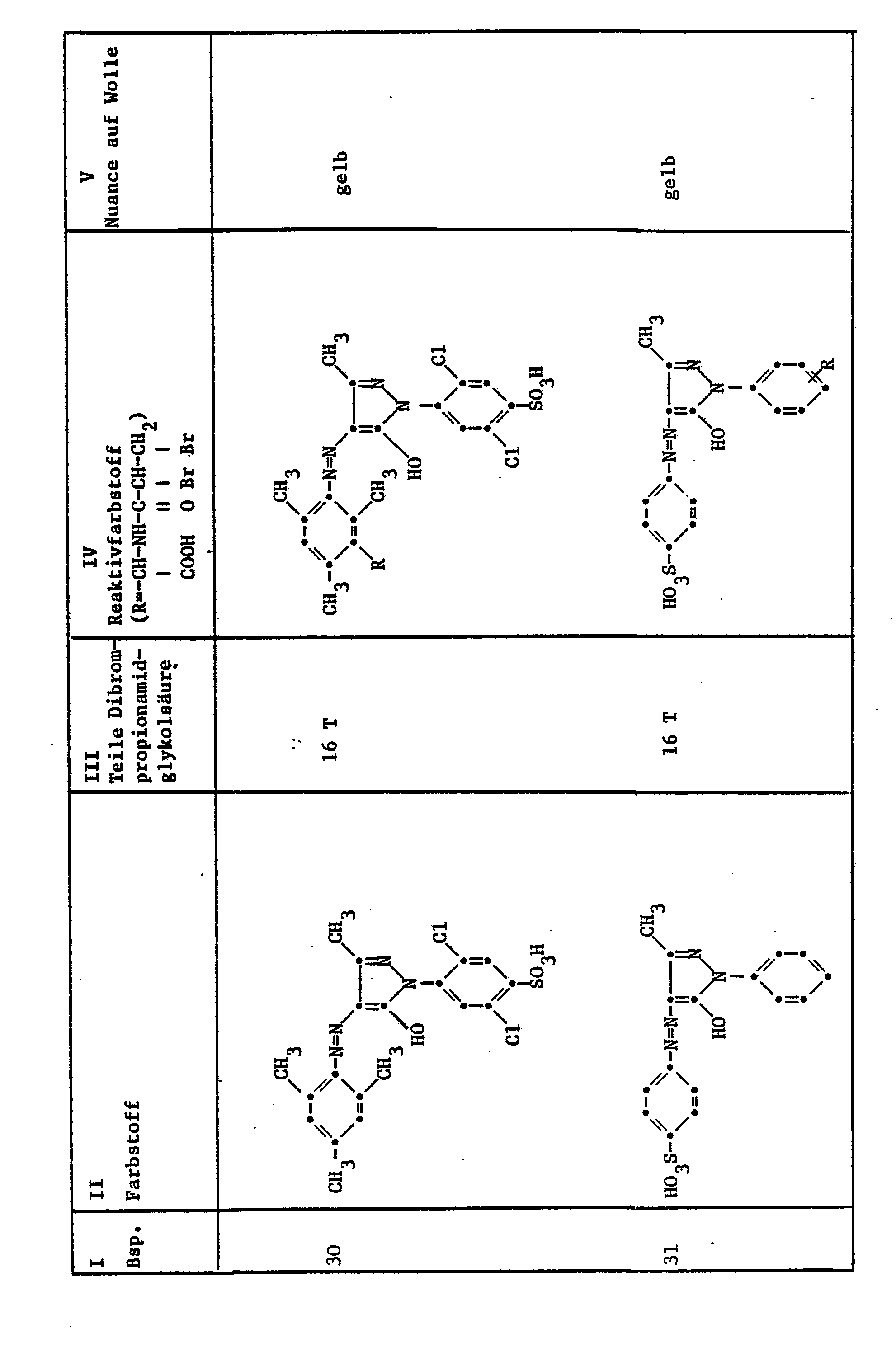
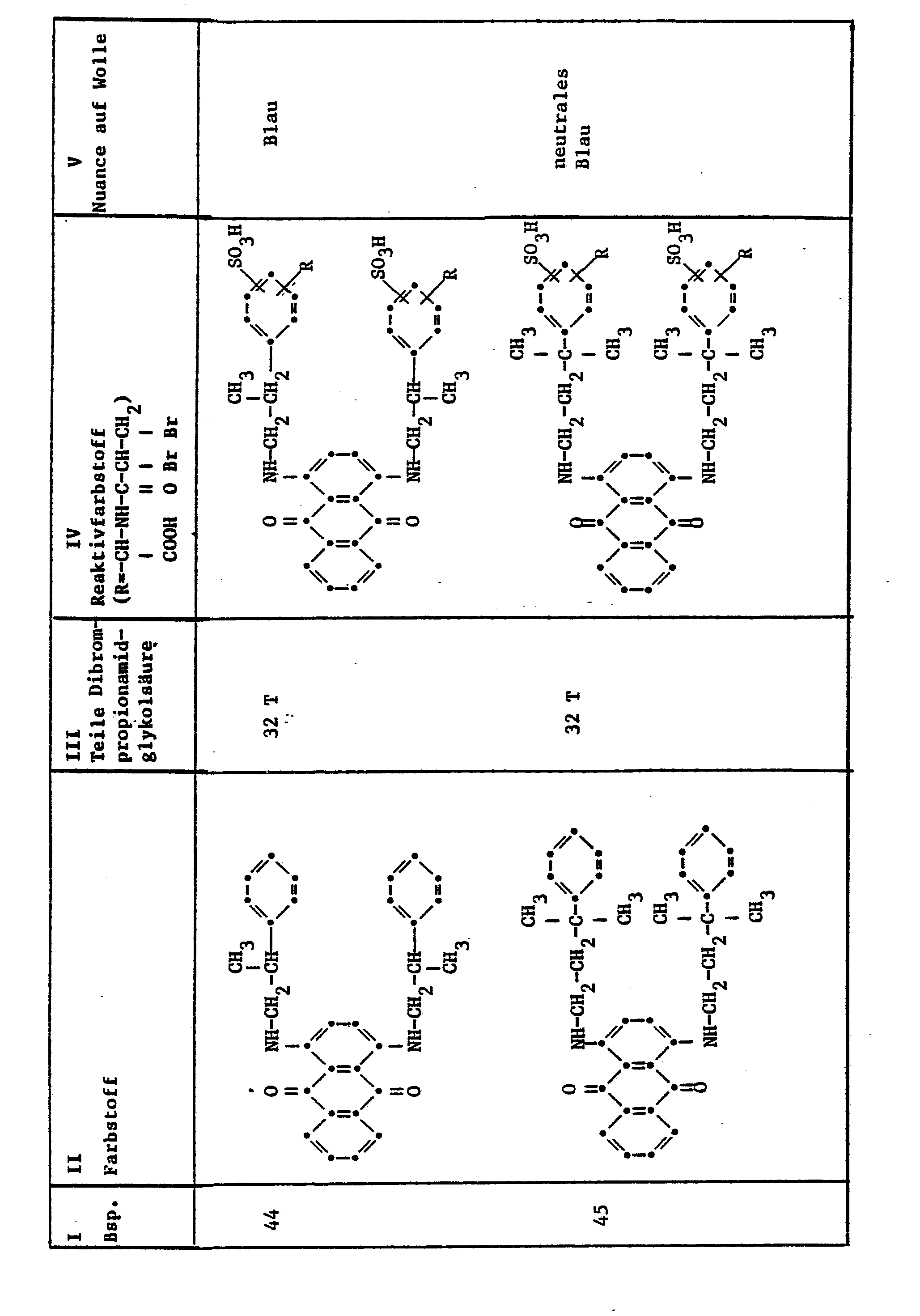
- Verwendet man anstelle der 24 Teile des Natriumsalzes der 1-Amino-4-mesidinoanthrachinon-2-sulfonsäure äquivalente Teile der in der folgenden Tabelle in Kolonne II aufgeführten Farbstoffe und setzt diese mit den in Kolonne III angegebenen Teilen der Dibrompropionamidoglykolsäure um, so erhält man bei gleicher Arbeitsweise wie in Beispiel 1 Reaktivfarbstoffe gemäss der Kolonne IV, deren Farbnuancen auf Wolle in Kolonne V der Tabelle angegeben sind.




- Beispiel 41: Bei einer Temperatur von 5-10° trägt man eine homogene Mischung aus 25 Teilen der Verbindung der Formel


- Auf Wolle appliziert, erhält man sehr brillante blaue Färbungen, welche sich durch eine gute Lichtechtheit und sehr gute Nassechtheiten auszeichnen.
- Verwendet man, bei gleichem Vorgehen, anstelle der eingangs erwähnten Anthrachinonverbindung äquivalente Teile der in der folgenden Tabelle in Kolonne II aufgeführten Farbstoffe und setzt diese mit den in Kolonne III angegebenen Teilen der Dibrompropionamidoglykolsäure um, und sulfiert sie, so erhält man Reaktivfarbstoffe gemäss der Kolonne IV, deren Farbnuancen auf Wolle in Kolonne V der Tabelle angegeben sind.



- In ein Färbebad, das in 3000 Teilen Wasser 10 Teile kristallisiertes Natriumsulfat, 6 Teile 40%ige Essigsäure, 0,5 Teile eines Kondensationsproduktes aus höheren aliphatischen Aminen mit Aethylenoxyd und 2 Teilen des im Beispiel 1 beschriebenen Farbstoffes enthält, geht man bei 50 bis 80° mit 100 Teilen Wollstückgarn ein. Im Verlaufe einer halben Stunde wird das Bad auf Siedetemperatur erhitzt und dann 1 Stunde lang kochend gefärbt. Hierauf wird die Wolle gespult und getrocknet. Man erhält eine gleichmässige blaue Färbung.
Claims (25)




Applications Claiming Priority (2)
| Application Number | Priority Date | Filing Date | Title |
|---|---|---|---|
| CH901779 | 1979-10-05 | ||
| CH9017/79 | 1979-10-05 |
Publications (3)
| Publication Number | Publication Date |
|---|---|
| EP0029106A2 true EP0029106A2 (de) | 1981-05-27 |
| EP0029106A3 EP0029106A3 (en) | 1981-07-22 |
| EP0029106B1 EP0029106B1 (de) | 1985-01-30 |
Family
ID=4347418
Family Applications (1)
| Application Number | Title | Priority Date | Filing Date |
|---|---|---|---|
| EP80105948A Expired EP0029106B1 (de) | 1979-10-05 | 1980-10-01 | Reaktivfarbstoffe, die eine Halogenalkanoylamido- oder Halogenacryloylamido-Gruppe enthalten, deren Herstellung und Verwendung, sowie die Halogenalkanoylamido- bzw. Halogenacryloylamido-Zwischenverbindung |
Country Status (8)
| Country | Link |
|---|---|
| US (2) | US4426328A (de) |
| EP (1) | EP0029106B1 (de) |
| JP (2) | JPS5923737B2 (de) |
| BR (1) | BR8008857A (de) |
| CA (1) | CA1168653A (de) |
| DE (1) | DE3070068D1 (de) |
| ES (1) | ES8201193A1 (de) |
| WO (1) | WO1981001009A1 (de) |
Families Citing this family (4)
| Publication number | Priority date | Publication date | Assignee | Title |
|---|---|---|---|---|
| US4855084A (en) * | 1987-07-01 | 1989-08-08 | Ciba-Geigy Corporation | Anthraquinoylcarboxylic acid hydrazides, curable compositions and use thereof |
| EP0601970A1 (de) * | 1992-12-03 | 1994-06-15 | Ciba-Geigy Ag | Anthrachinonfarbstoffe, Verfahren zu deren Herstellung und deren Verwendung |
| AT399519B (de) * | 1993-09-14 | 1995-05-26 | Chemiefaser Lenzing Ag | Form- bzw. spinnmasse enthaltend cellulose und verfahren zur herstellung cellulosischer formkörper |
| US8697792B2 (en) | 2009-09-24 | 2014-04-15 | Basf Se | Migration-free coloured copolycondensates for colouring polymers |
Family Cites Families (15)
| Publication number | Priority date | Publication date | Assignee | Title |
|---|---|---|---|---|
| US2722534A (en) | 1950-12-20 | 1955-11-01 | Gen Aniline & Film Corp | Anthraquinone dyes for wool |
| US3007762A (en) | 1956-08-14 | 1961-11-07 | Ciba Ltd | Process for dyeing polyhydroxylated materials |
| CH373117A (de) * | 1957-09-27 | 1963-11-15 | Ciba Geigy | Verfahren zur Herstellung neuer Azofarbstoffe |
| US3431299A (en) * | 1961-02-17 | 1969-03-04 | Frosst & Co Charles E | Sodium salt of n-dichloroacetyl-dl-serine |
| CH413178A (de) | 1961-11-29 | 1966-05-15 | Ciba Geigy | Verfahren zur Herstellung neuer Farbstoffe der Anthrachinonreihe |
| FR1384361A (fr) * | 1963-02-22 | 1965-01-04 | Sandoz Sa | Colorants réactifs, leur fabrication et leurs applications |
| FR1411715A (fr) * | 1964-06-09 | 1965-09-24 | Nobel Bozel | Amides alpha, beta-éthyléniques nu-alcoylolées et leur procédé de fabrication |
| CH476084A (de) | 1965-11-16 | 1969-07-31 | Ciba Geigy | Verfahren zur Herstellung neuer Azofarbstoffe |
| US3843695A (en) | 1966-08-16 | 1974-10-22 | Ciba Geigy Ag | Anthraquinone dyestuffs |
| GB1278262A (en) * | 1968-04-17 | 1972-06-21 | Ici Ltd | Chemical process |
| US3923778A (en) | 1969-11-12 | 1975-12-02 | Ciba Geigy Ag | Disazo dyestuffs containing the {60 :{62 -dichloro- or {60 :{62 -dibromopropionylamino group |
| BE794893A (fr) | 1972-02-04 | 1973-08-02 | Ciba Geigy | Composes anthraquinoniques reagissant sur la fibre, leur procede de preparation et leur emploi |
| BE795019A (fr) | 1972-02-07 | 1973-08-06 | Ciba Geigy | Composes anthraquinoniques, leur procede de preparation et leur utilisation |
| CH616446A5 (de) | 1975-07-02 | 1980-03-31 | Sandoz Ag | |
| NL7609939A (nl) * | 1975-09-12 | 1977-03-15 | Nobel Hoechst Chimie Societe A | Werkwijze voor de bereiding van n-acylhydroxyaryl- glycinen. |
-
1980
- 1980-09-29 US US06/191,551 patent/US4426328A/en not_active Expired - Lifetime
- 1980-09-29 JP JP55502177A patent/JPS5923737B2/ja not_active Expired
- 1980-09-29 WO PCT/CH1980/000114 patent/WO1981001009A1/de not_active Ceased
- 1980-09-29 BR BR8008857A patent/BR8008857A/pt unknown
- 1980-10-01 EP EP80105948A patent/EP0029106B1/de not_active Expired
- 1980-10-01 DE DE8080105948T patent/DE3070068D1/de not_active Expired
- 1980-10-04 ES ES495646A patent/ES8201193A1/es not_active Expired
- 1980-10-06 CA CA000361614A patent/CA1168653A/en not_active Expired
-
1982
- 1982-09-28 US US06/425,594 patent/US4667057A/en not_active Expired - Fee Related
-
1984
- 1984-01-12 JP JP59002768A patent/JPS6029700B2/ja not_active Expired
Also Published As
| Publication number | Publication date |
|---|---|
| JPS6029700B2 (ja) | 1985-07-12 |
| WO1981001009A1 (fr) | 1981-04-16 |
| EP0029106B1 (de) | 1985-01-30 |
| ES495646A0 (es) | 1981-12-01 |
| JPS59144742A (ja) | 1984-08-18 |
| US4426328A (en) | 1984-01-17 |
| BR8008857A (pt) | 1981-08-25 |
| JPS56501162A (de) | 1981-08-20 |
| JPS5923737B2 (ja) | 1984-06-04 |
| CA1168653A (en) | 1984-06-05 |
| DE3070068D1 (en) | 1985-03-14 |
| EP0029106A3 (en) | 1981-07-22 |
| ES8201193A1 (es) | 1981-12-01 |
| US4667057A (en) | 1987-05-19 |
Similar Documents
| Publication | Publication Date | Title |
|---|---|---|
| EP0036582B1 (de) | Wasserlösliche Azoverbindungen, Verfahren zu ihrer Herstellung und ihre Verwendung als Farbstoffe | |
| EP0028787B1 (de) | Kupfer-Formazanverbindungen, Verfahren zu ihrer Herstellung und ihre Verwendung als Farbstoffe | |
| DE3102287A1 (de) | Wasserloesliche monoazoverbindungen, verfahren zu ihrer herstellung und ihre verwendung als farbstoffe | |
| EP0014432B1 (de) | Wasserlösliche, faserreaktive Disazofarbstoffe, Verfahren zu deren Herstellung und ihre Verwendung zum Färben und Bedrucken von hydroxygruppen- und carbonamidgruppenhaltigen Fasermaterialien | |
| EP0029106B1 (de) | Reaktivfarbstoffe, die eine Halogenalkanoylamido- oder Halogenacryloylamido-Gruppe enthalten, deren Herstellung und Verwendung, sowie die Halogenalkanoylamido- bzw. Halogenacryloylamido-Zwischenverbindung | |
| EP0271893B1 (de) | Cyangruppenhaltige Azoverbindungen, Verfahren zu deren Herstellung und ihre Verwendung als Farbstoffe | |
| EP0658605B1 (de) | Verfahren zum Trichromie-Färben oder -Bedrucken | |
| DE3705789A1 (de) | Kupferkomplex-formazan-verbindungen, verfahren zu ihrer herstellung und ihre verwendung als farbstoffe | |
| DE3879476T2 (de) | Faserreaktiv-azofarbstoffe, verfahren zu ihrer herstellung und ihre verwendung zum faerben von hydroxy und/oder carboxamidgruppen enthaltendem fasermaterial. | |
| EP0629666A1 (de) | Wasserlösliche Azoverbindungen, Verfahren zu ihrer Herstellung und ihre Verwendung als Farbstoffe | |
| EP0603116A1 (de) | Azoreaktivfarbstoffe | |
| EP0094019A1 (de) | Wasserlösliche Disazoverbindungen, Verfahren zu deren Herstellung und ihre Verwendung als Farbstoffe | |
| EP0279277A2 (de) | Wasserlösliche Monoazo-pyrazolon-Verbindungen, Verfahren zu ihrer Herstellung und ihre Verwendung als Farbstoffe | |
| DE1233517B (de) | Verfahren zur Herstellung von Farbstoffen | |
| EP0457729B1 (de) | Azofarbstoffe, Verfahren zu deren Herstellung und deren Verwendung | |
| DE2840119A1 (de) | Anthrachinon-azoverbindungen, ihre herstellung und verwendung als farbstoffe | |
| DE4437265A1 (de) | Reaktivfarbstoffe, Verfahren zu deren Herstellung und deren Verwendung | |
| DE1644088A1 (de) | Verfahren zur Herstellung neuer Azofarbstoffe | |
| DE2015157C3 (de) | Anthrachinonfarbstoffe, deren Herstellung und deren Verwendung | |
| EP0198350B1 (de) | Disazoreaktivfarbstoffe | |
| EP0026913B1 (de) | Kupferkomplex-Naphthylazonaphthyl-Verbindungen, Verfahren zu ihrer Herstellung und ihre Verwendung zum Färben und Bedrucken von Fasermaterialien und Leder | |
| DE2757681A1 (de) | Phenylazopyridon-verbindung, verfahren zu deren herstellung, ihre verwendung als farbstoff und mit ihr gefaerbte fasermaterialien | |
| AT232621B (de) | Verfahren zur Herstellung von neuen Reaktivfarbstoffen der Azo-, Anthrachinon- oder Tetrazaporphinreihe | |
| DE2347124A1 (de) | Azoverbindungen | |
| EP0014318A1 (de) | Reaktivfarbstoffe sowie deren Herstellung und Verwendung zum Färben von Hydroxyl- oder Amidgruppen enthaltenden Materialien |
Legal Events
| Date | Code | Title | Description |
|---|---|---|---|
| PUAI | Public reference made under article 153(3) epc to a published international application that has entered the european phase |
Free format text: ORIGINAL CODE: 0009012 |
|
| PUAL | Search report despatched |
Free format text: ORIGINAL CODE: 0009013 |
|
| 17P | Request for examination filed |
Effective date: 19801001 |
|
| AK | Designated contracting states |
Designated state(s): BE CH DE FR GB IT |
|
| AK | Designated contracting states |
Designated state(s): BE CH DE FR GB IT |
|
| ITF | It: translation for a ep patent filed | ||
| GRAA | (expected) grant |
Free format text: ORIGINAL CODE: 0009210 |
|
| AK | Designated contracting states |
Designated state(s): BE CH DE FR GB IT LI |
|
| REF | Corresponds to: |
Ref document number: 3070068 Country of ref document: DE Date of ref document: 19850314 |
|
| ET | Fr: translation filed | ||
| PLBE | No opposition filed within time limit |
Free format text: ORIGINAL CODE: 0009261 |
|
| STAA | Information on the status of an ep patent application or granted ep patent |
Free format text: STATUS: NO OPPOSITION FILED WITHIN TIME LIMIT |
|
| 26N | No opposition filed | ||
| PG25 | Lapsed in a contracting state [announced via postgrant information from national office to epo] |
Ref country code: BE Effective date: 19881031 |
|
| BERE | Be: lapsed |
Owner name: CIBA-GEIGY A.G. Effective date: 19881031 |
|
| PGFP | Annual fee paid to national office [announced via postgrant information from national office to epo] |
Ref country code: GB Payment date: 19910802 Year of fee payment: 12 |
|
| PGFP | Annual fee paid to national office [announced via postgrant information from national office to epo] |
Ref country code: FR Payment date: 19910823 Year of fee payment: 12 |
|
| PGFP | Annual fee paid to national office [announced via postgrant information from national office to epo] |
Ref country code: DE Payment date: 19910909 Year of fee payment: 12 |
|
| PGFP | Annual fee paid to national office [announced via postgrant information from national office to epo] |
Ref country code: CH Payment date: 19911126 Year of fee payment: 12 |
|
| PG25 | Lapsed in a contracting state [announced via postgrant information from national office to epo] |
Ref country code: GB Effective date: 19921001 |
|
| PG25 | Lapsed in a contracting state [announced via postgrant information from national office to epo] |
Ref country code: LI Effective date: 19921031 Ref country code: CH Effective date: 19921031 |
|
| GBPC | Gb: european patent ceased through non-payment of renewal fee |
Effective date: 19921001 |
|
| PG25 | Lapsed in a contracting state [announced via postgrant information from national office to epo] |
Ref country code: FR Effective date: 19930630 |
|
| REG | Reference to a national code |
Ref country code: CH Ref legal event code: PL |
|
| PG25 | Lapsed in a contracting state [announced via postgrant information from national office to epo] |
Ref country code: DE Effective date: 19930701 |
|
| REG | Reference to a national code |
Ref country code: FR Ref legal event code: ST |