EP0030916A1 - Azatetracyclische Carbonitrile - Google Patents
Azatetracyclische Carbonitrile Download PDFInfo
- Publication number
- EP0030916A1 EP0030916A1 EP80810377A EP80810377A EP0030916A1 EP 0030916 A1 EP0030916 A1 EP 0030916A1 EP 80810377 A EP80810377 A EP 80810377A EP 80810377 A EP80810377 A EP 80810377A EP 0030916 A1 EP0030916 A1 EP 0030916A1
- Authority
- EP
- European Patent Office
- Prior art keywords
- lower alkyl
- formula
- compound
- acid addition
- acid
- Prior art date
- Legal status (The legal status is an assumption and is not a legal conclusion. Google has not performed a legal analysis and makes no representation as to the accuracy of the status listed.)
- Granted
Links
Classifications
-
- C—CHEMISTRY; METALLURGY
- C07—ORGANIC CHEMISTRY
- C07D—HETEROCYCLIC COMPOUNDS
- C07D491/00—Heterocyclic compounds containing in the condensed ring system both one or more rings having oxygen atoms as the only ring hetero atoms and one or more rings having nitrogen atoms as the only ring hetero atoms, not provided for by groups C07D451/00 - C07D459/00, C07D463/00, C07D477/00 or C07D489/00
- C07D491/02—Heterocyclic compounds containing in the condensed ring system both one or more rings having oxygen atoms as the only ring hetero atoms and one or more rings having nitrogen atoms as the only ring hetero atoms, not provided for by groups C07D451/00 - C07D459/00, C07D463/00, C07D477/00 or C07D489/00 in which the condensed system contains two hetero rings
- C07D491/04—Ortho-condensed systems
- C07D491/044—Ortho-condensed systems with only one oxygen atom as ring hetero atom in the oxygen-containing ring
-
- C—CHEMISTRY; METALLURGY
- C07—ORGANIC CHEMISTRY
- C07D—HETEROCYCLIC COMPOUNDS
- C07D491/00—Heterocyclic compounds containing in the condensed ring system both one or more rings having oxygen atoms as the only ring hetero atoms and one or more rings having nitrogen atoms as the only ring hetero atoms, not provided for by groups C07D451/00 - C07D459/00, C07D463/00, C07D477/00 or C07D489/00
- C07D491/02—Heterocyclic compounds containing in the condensed ring system both one or more rings having oxygen atoms as the only ring hetero atoms and one or more rings having nitrogen atoms as the only ring hetero atoms, not provided for by groups C07D451/00 - C07D459/00, C07D463/00, C07D477/00 or C07D489/00 in which the condensed system contains two hetero rings
- C07D491/04—Ortho-condensed systems
-
- A—HUMAN NECESSITIES
- A61—MEDICAL OR VETERINARY SCIENCE; HYGIENE
- A61P—SPECIFIC THERAPEUTIC ACTIVITY OF CHEMICAL COMPOUNDS OR MEDICINAL PREPARATIONS
- A61P25/00—Drugs for disorders of the nervous system
-
- A—HUMAN NECESSITIES
- A61—MEDICAL OR VETERINARY SCIENCE; HYGIENE
- A61P—SPECIFIC THERAPEUTIC ACTIVITY OF CHEMICAL COMPOUNDS OR MEDICINAL PREPARATIONS
- A61P25/00—Drugs for disorders of the nervous system
- A61P25/20—Hypnotics; Sedatives
-
- C—CHEMISTRY; METALLURGY
- C07—ORGANIC CHEMISTRY
- C07C—ACYCLIC OR CARBOCYCLIC COMPOUNDS
- C07C255/00—Carboxylic acid nitriles
-
- C—CHEMISTRY; METALLURGY
- C07—ORGANIC CHEMISTRY
- C07C—ACYCLIC OR CARBOCYCLIC COMPOUNDS
- C07C59/00—Compounds having carboxyl groups bound to acyclic carbon atoms and containing any of the groups OH, O—metal, —CHO, keto, ether, groups, groups, or groups
- C07C59/40—Unsaturated compounds
- C07C59/58—Unsaturated compounds containing ether groups, groups, groups, or groups
- C07C59/64—Unsaturated compounds containing ether groups, groups, groups, or groups containing six-membered aromatic rings
- C07C59/66—Unsaturated compounds containing ether groups, groups, groups, or groups containing six-membered aromatic rings the non-carboxylic part of the ether containing six-membered aromatic rings
- C07C59/68—Unsaturated compounds containing ether groups, groups, groups, or groups containing six-membered aromatic rings the non-carboxylic part of the ether containing six-membered aromatic rings the oxygen atom of the ether group being bound to a non-condensed six-membered aromatic ring
-
- C—CHEMISTRY; METALLURGY
- C07—ORGANIC CHEMISTRY
- C07D—HETEROCYCLIC COMPOUNDS
- C07D313/00—Heterocyclic compounds containing rings of more than six members having one oxygen atom as the only ring hetero atom
- C07D313/02—Seven-membered rings
- C07D313/06—Seven-membered rings condensed with carbocyclic rings or ring systems
- C07D313/10—Seven-membered rings condensed with carbocyclic rings or ring systems condensed with two six-membered rings
- C07D313/14—[b,f]-condensed
Definitions
- the present invention relates to new azatetracyclic carbonitriles and their acid addition salts with valuable pharmacological properties, processes for their preparation, and pharmaceutical compositions which contain the new substances as active substances, and their use.
- the invention also relates to the acid addition salts of the compounds of the formula I, in particular the pharmaceutically acceptable acid addition salts.
- lower radicals are understood to mean those having at most 8 and preferably at most 4 carbon atoms.
- R preferably contains 1 to 6 carbon atoms as lower alkyl. atoms.
- These lower alkyl groups which may be straight chain or branched, are e.g. Methyl, ethyl, propyl, isopropyl, butyl, isobutyl or tertiary butyl.
- the radical R preferably contains 4 to 8 carbon atoms as cycloalkyl-lower alkyl.
- Cycloalkyl-lower alkyl is e.g. Cyclopropylmethyl, cyclobutylmethyl and especially cyclopentylmethyl, cyclohexylmethyl, further e.g. Cyclopropylethyl, cyclobutylethyl, cyclopentylethyl, cyclohexylethyl.
- the radical R preferably contains 3 to 4 carbon atoms and in particular 3 carbon atoms as lower alkenyl.
- Niederalkenyl is e.g. as allyl or 2-methylallyl.
- radical R is in particular propargyl.
- the hydroxyl group is separated from the ring nitrogen atom by at least 2 carbon atoms.
- This radical contains 2 to 8 and preferably 2 to 4 carbon atoms.
- the hydroxy lower alkyl which can be straight-chain or branched, is e.g. B. the 1-methyl-2-hydroxyethyl, 2-hydroxypropyl, 1- or 2-methyl-2-hydroxypropyl, and in particular the 2-hydroxyethyl and the 3-hydroxypropyl.
- the oxygen atom is separated from the ring nitrogen atom by at least 2 carbon atoms.
- This rest contains e.g. 3 to 10 and preferably 3 to 6 carbon atoms.
- This lower alkoxy lower alkyl is e.g. 2-methoxy-propyl, 2- or 3-ethoxypropyl, 2- or 3-propoxypropyl, 3-isopropoxypropyl and in particular 2-methoxy or 2-ethoxy-ethyl and especially 3-methoxy-propyl.
- the ester oxygen atom is separated from the ring nitrogen atom by at least 2 carbon atoms.
- This rest contains e.g. 3 to 21 and preferably 4 to 11 carbon atoms.
- This rest is e.g. 2-formyloxy-ethyl, 2-acetyloxy-ethyl, 2-propionyloxy-ethyl, 2-acetyloxy-propyl, 2-methyl-3-acetyloxy-propyl or 2- or 3-propionyloxy-propyl and in particular 3-acetyloxy-propyl and 3-octanoyloxypropyl.
- Salts of compounds of formula I are primarily acid addition salts, especially pharmaceutically acceptable acid addition salts, e.g. with inorganic acids, such as hydrochloric acid, hydrobromic acid, sulfuric acid or phosphoric acid, or with organic acids, such as organic carboxylic and sulfonic acids, such as methanesulfonic acid, ethanesulfonic acid, 2-hydroxyethanesulfonic acid, acetic acid, malic acid, tartaric acid, citric acid, lactic acid.
- the new azatetracyclic carbonitriles of the general formula I and their acid addition salts have valuable pharmacological properties, for example those which act on the central nervous system. They are primarily characterized by central depressant, anti-agitation (amphetamine-antagonistic) effects, which can be demonstrated by pharmacological tests. In the amphetamine antagonism test (Niemegeers and Janssen, Arzneistoffforsch., Vol. 24, p. 45 (1974)), they show an antitoxic effect in the dose range of 0.01 to 1 mg / kg ip or per os . The cataleptic effect is relatively low compared to the amphetamine-antagonistic effect.
- the new azatetracyclic carbonitriles of the general formula I and their pharmaceutically acceptable acid addition salts can therefore be used as tranquilizing, antipsychotic and anti-irritant Compounds can be used to treat arousal states of various origins.
- the invention particularly relates to compounds of formula I wherein R is hydrogen, lower alkyl, e.g. Methyl or ethyl, cycloalkyl-lower alkyl with 4-8 carbon atoms, e.g. Cyclopentylmethyl and cyclohexylmethyl, lower alkenyl, e.g. Allyl, lower alkynyl, e.g. Propargyl, hydroxy lower alkyl, e.g. 2-hydroxyethyl and 3-hydroxypropyl, lower alkoxy lower alkyl, e.g. 3-methoxy-propyl, or alkanoyloxy-lower alkyl, e.g. Acetoxypropyl and octanoyloxypropyl mean and salts, especially acid addition salts, primarily pharmaceutically acceptable acid addition salts thereof.
- R is hydrogen, lower alkyl, e.g. Methyl or ethyl, cycloalkyl-low
- the invention relates especially to compounds of formula I, wherein R is lower alkyl, e.g. Methyl or ethyl, or cyclopentylmethyl, such as 7-cyano-3-methyl-2,3,4,5-tetrahydro-lH-dibenzo [2,3: 6,7] oxepino [4,5-d] azepine, or the 3- (cyclopentylmethyl-7-cyano-2,3,4,5-tetrahydro-1H-dibenzo [2,3: 6,7] oxepino [4,5-d] azepine, and salts thereof, in particular acid addition salts, primarily pharmaceutically acceptable acid addition salts thereof.
- R is lower alkyl, e.g. Methyl or ethyl, or cyclopentylmethyl, such as 7-cyano-3-methyl-2,3,4,5-tetrahydro-lH-dibenzo [2,3: 6,7] oxepino [4,5-d]
- the compounds of formula I are prepared in a manner known per se. They can be obtained, for example, by using a reactive diester of the diethanol of the formula with a compound of the formula implements.
- esters of strong inorganic acids e.g. Bishlorohydro, bis-iodohydrate or especially bis-hydrobromate or hydrobromic-hydrochloric acid esters are used.
- Corresponding diesters of strong organic acids e.g. of sulfonic acids such as methanesulfonic acid, benzenesulfonic acid, p-chloro- or p-bromobenzenesulfonic acid or p-toluenesulfonic acid can be used.
- sulfonic acids such as methanesulfonic acid, benzenesulfonic acid, p-chloro- or p-bromobenzenesulfonic acid or p-toluenesulfonic acid can be used.
- These diesters of the compounds of formula II are preferably reacted in a suitable inert solvent at a reaction temperature of 20 to 130 ° C.
- suitable inert solvents are hydrocarbons such as benzene or toluene, halogenated hydrocarbons such as chloroform, lower alcohols such as ethanol and especially methanol, ethereal liquids such as ether or dioxane, and lower alkanones, e.g. Acetone, methyl ethyl ketone or diethyl ketone or mixtures of such solvents, e.g. Benzene-methanol.
- hydrocarbons such as benzene or toluene
- halogenated hydrocarbons such as chloroform
- lower alcohols such as ethanol and especially methanol
- ethereal liquids such as ether or dioxane
- lower alkanones e.g. Acetone, methyl ethyl ketone or diethyl ketone or mixtures of such solvents, e.g. Benzene-methanol.
- two molar equivalents of acid are split off, which are preferably bound to an acid-binding agent.
- Suitable acid-binding agents are e.g. Alkali carbonates such as potassium carbonate or e.g. Alkali hydroxides, such as sodium hydroxide or potassium hydroxide, or excess base of the formula III, furthermore tertiary organic bases, such as pyridine and especially triethylamine or N-ethyl-di-isopropylamine.
- the immediate starting materials can be prepared from the corresponding diethanols by esterification or replacement of the hydroxyl groups by halogen by customary methods.
- the diethanols in turn can be prepared from the corresponding methyl diacetates by reduction with lithium aluminum hydride.
- the methyl diacetates can be prepared from the corresponding diacetonitriles with methanol and 2 molar equivalents of water with the introduction of hydrogen chloride.
- the diacetonitriles in turn can be obtained from the corresponding bis (bromomethyl) compounds with sodium cyanide.
- the compounds of the formula I are obtained by using a compound of the formula in which Hal represents a halogen atom, is reacted with a cyanide compound.
- the radicals Hal in compounds of the formula IV are chlorine or iodine, but preferably bromine.
- Cyanide compounds are primarily alkali metal or heavy metal cyanides. Sodium cyanide is preferred as the alkali metal cyanide. But copper-I-cyanide is particularly suitable as a representative of the heavy metal cyanides.
- the reaction can be carried out in the presence or absence of solvents, and this in a temperature range from 80 ° to 250 °.
- Particularly suitable solvents are pyridine, quinoline, dimethylformamide, 1-methyl-2-pyrrolidinone and hexamethylphosphoric triamide. The two the latter are particularly suitable for copper (1) cyanide as cyanating agents.
- the starting materials of the formula IV are known or can be prepared by methods known per se, such as e.g. analogous to the first-mentioned method.
- i.a. refer to DOS 2 723 105.
- a compound of formula I the radical R of which is hydrogen
- a process product the radical R of which has one of the other meanings.
- an N substitution can take place, either with a reactive ester of a corresponding alcohol of the formula R 1 -OH, in which R 1 has the same meaning as R in formula I, with the exception of hydrogen, or by reaction with corresponding aldehydes or ketones under reducing conditions.
- reaction of compounds of the formula I in which R is hydrogen with a reactive ester of a hydroxy compound of the formula R 1 -OH is preferably carried out in a solvent at a reaction temperature of 20 to 130 ° C., in particular at the boiling point of the solvent.
- Reactive esters that can be used include, for example, halides, such as chlorides or bromides, furthermore aromatic or aliphatic sulfonic acid esters, such as methyl or ethyl p-toluenesulfonic acid, or methyl methanesulfonic acid, ethyl ester, or cyclopentyl methyl ester or sulfuric acid ester, such as dimethyl or diethyl sulfate can be used.
- halides such as chlorides or bromides
- aromatic or aliphatic sulfonic acid esters such as methyl or ethyl p-toluenesulfonic acid, or methyl methanesulfonic acid, ethyl ester, or cyclopentyl methyl ester or sulfuric acid ester, such as dimethyl or diethyl sulfate can be used.
- Suitable acid-binding agents are alkali metal carbonates, such as, for example, potassium carbonate, or alkali hydroxides, such as, for example, sodium hydroxide, or tertiary organic bases, such as, for example, pyridine or the N-ethyldiisopropylamine.
- Suitable solvents are those solvents which are inert under the reaction conditions, for example hydrocarbons, such as benzene or toluene, furthermore alkanols, such as, for example, methanol or ethanol, or alkanones, such as acetone or methyl ethyl ketone.
- Aldehydes and ketones which correspond to the alcohols of the formula R 1 - OH are, for example, lower aliphatic aldehydes or ketones, lower free, esterified or etherified hydroxyoxoalkanes or esterified oxoalkane carboxylic acids.
- the reaction product obtained in the reaction of these aldehydes or ketones with the compounds of the formula I mentioned can be reduced in the same operation or subsequently.
- the aldehydes e.g. Formaldehyde or acetaldehyde, or the ketones, e.g. Acetone, for example, are heated to about 30 ° to 100 ° C. in an inert solvent with the compounds of the formula I mentioned, and at the same time or subsequently the reaction mixture is hydrogenated with hydrogen in the presence of a catalyst.
- Suitable solvents are e.g. Alkanols, such as methanol or ethanol, and suitable catalysts.
- Precious metal catalysts such as palladium on carbon.
- the compounds of the formula I mentioned are heated with formic acid and the types of aldehydes or ketones, in particular formaldehyde, preferably without solvent.
- a compound of formula I the radical R of which is a hydroxy-lower alkyl group, can optionally be acylated to a compound whose radical R is an esterified hydroxy-lower alkyl group.
- Acylation can e.g. with a carboxylic acid anhydride or with an appropriate carboxylic acid halide at a reaction temperature between about 20 and 100 ° C. Since the condensation takes place with the elimination of acid, it is expedient to add an acid-binding agent, e.g. add a tertiary organic base such as pyridine. Excess tertiary organic base can also be used as a solvent. Furthermore, hydrocarbons, e.g. Benzene or toluene, or halogenated hydrocarbons, e.g. Chloroform.
- a compound of the formula I in which R is different from hydrogen can optionally be converted into a process product, the rest of which R is hydrogen.
- R preferably an easily removable group such as the methyl or allyl group
- a residue which can be removed by reduction, including hydrogenolysis, in particular by reaction with a 2-arylalkyl ester or 2-haloalkyl ester is replaced by a 2-arylalkoxycarbonyl radical, for example the benzyloxycarbonyl radical, or a 2-haloalkoxycarbonyl radical, for example the 2,2,2-trichloroethoxycarbonyl radical, and this radical is replaced by hydrogen in the customary manner by means of hydrogenolysis or reduction.
- 2-arylalkoxycarbonyl radicals can be hydrogenated away, for example by means of hydrogen in the presence of a hydrogenation catalyst, for example platinum, palladium or Raney nickel, and optionally hydrogen chloride, at room temperature and normal pressure or at moderately elevated temperatures and pressures in suitable organic solvents, such as, for example, methanol, ethanol or dioxane will.
- a hydrogenation catalyst for example platinum, palladium or Raney nickel
- suitable organic solvents such as, for example, methanol, ethanol or dioxane will.
- suitable organic solvents such as, for example, methanol, ethanol or dioxane will.
- 2-Halogen-alkoxycarbonyl residues such as the 2,2,2-trichloroethoxycarbonyl residue, for example also the 2-iodoethoxy or 2,2,2-tribromoethoxycarbonyl residue, can be removed in particular by metallic reduction (so-called nascent hydrogen).
- Nascent hydrogen can be obtained by the action of metal or metal alloys, such as amalgams, on hydrogen-supplying agents, such as carboxylic acids, alcohols or water, zinc or zinc alloys in particular together with acetic acid.
- metal or metal alloys such as amalgams
- hydrogen-supplying agents such as carboxylic acids, alcohols or water, zinc or zinc alloys in particular together with acetic acid.
- the reductive cleavage of 2-halogeno-alkoxy-carbonyl radicals can also be carried out using chromium (II) compounds, such as chromium (II) chloride or chromium (II) acetate.
- the end products are optionally obtained in free form or in the form of their salts, which can be converted into one another or into other salts in the customary manner.
- free compounds of formula I are formed from acid addition salts obtained, e.g. by treatment with bases or basic ion exchangers, while free bases of formula 1 e.g. converted into acid addition salts by reaction with organic or inorganic acids, in particular those which are suitable for the formation of pharmaceutically usable salts, such as the abovementioned.
- Salts of the new compounds can also be used for cleaning purposes, e.g. by converting the free compounds into their salts, isolating them and, if necessary, cleaning them, and converting them back into the free compounds.
- the free compounds are also to be understood as meaningful and expedient, if appropriate, the corresponding salts.
- Racemates obtained can be broken down into the antipodes by methods known per se, e.g. by recrystallization from an optically active solvent, by treatment with suitable microorganisms or by reaction with an optically active substance, in particular acid, which forms salts with the racemic compound, and separation of the salt mixture obtained in this way, e.g. due to different solubilities, into the diastereomeric salts, from which the free antipodes can be released by the action of suitable agents.
- optically active acids are e.g.
- the D and L forms of tartaric acid, di-0,0'-p-toluoyl tartaric acid, malic acid, mandelic acid, camphorsulfonic acid, glutamic acid, aspartic acid or quinic acid.
- the more effective of the two antipodes is advantageously isolated.
- the invention also relates to those embodiments of the process according to which one starts from a compound obtainable as an intermediate at any stage of the process and carries out the missing process steps, or terminates the process at any stage, or in which a starting material is formed under the reaction conditions, or in which a reaction component is optionally in the form of its salts.
- the new compounds can be used, for example, in the form of pharmaceutical preparations which contain an effective amount of the active substance, optionally together with inorganic or organic, solid or liquid, pharmaceutically usable excipients which are suitable for enteral, for example oral or parenteral administration.
- tablets or gelatin capsules which dilute the active ingredient agents, for example lactose, dextrose, sucrose, mannitol, sorbitol, cellulose and / or glycine, and lubricants, for example silica, talc, stearic acid or salts thereof, such as magnesium or calcium stearate and / or polyethylene glycol; Tablets also contain binders, e.g.
- magnesium aluminum silicate starches such as corn, wheat, rice or arrowroot starch, gelatin, tragacanth, methyl cellulose, sodium carboxymethyl cellulose and / or polyvinylpyrrolidone, and, if desired, disintegrants, e.g. starches, agar, alginic acid or a salt thereof, such as sodium alginate, and / or effervescent mixtures, or adsorbents, colors, flavors and sweeteners.
- disintegrants e.g. starches, agar, alginic acid or a salt thereof, such as sodium alginate, and / or effervescent mixtures, or adsorbents, colors, flavors and sweeteners.
- the new pharmacologically active compounds can be used in the form of injectable, for example intravenous, administrable preparations or infusion solutions.
- Such solutions are preferably isotonic aqueous solutions or suspensions, and these can be prepared before use, for example as lyophilized preparations which contain the active substance alone or together with a carrier material, for example mannitol.
- the pharmaceutical preparations can be sterilized and / or contain auxiliaries, for example preservatives, stabilizers, wetting agents and / or emulsifiers, solubilizers, salts for regulating the osmotic pressure and / or buffers.
- the present pharmaceutical preparations which, if desired, can contain further pharmacologically valuable substances, are produced in a manner known per se, for example by means of conventional mixing, granulating, coating, dissolving or lyophilizing processes, and contain about 0.1% up to 100%, in particular from about 1% to about 50%, lyophilisates up to 100% of the active substance.
- the dosage depends on the mode of application, the species, the age and the individual condition.
- Daily doses of the free bases or pharmaceutically acceptable salts thereof range from about 0.01 mg / kg to 0.5 mg / kg for warm-blooded animals in general and from about 0.001 g to about 0.01 g for warm-blooded animals weighing about 70 kg.
- Example 1 A mixture of 18.5 g (0.05 mol) of 7-bromo-3-methyl-2,3,4,5-tetrahydro-lH-dibenz [2,3: 6,7] oxepino [4, 5-d] azepine and 5.35 g (0.06 mol) of copper (I) cyanide in 20 ml of dimethylformamide are heated to 180 ° in a nitrogen atmosphere with stirring for 24 hours. The mixture is then cooled to 30 °, diluted with 100 ml of methylene chloride and mixed with 50 ml of a 50% aqueous ethylenediamine solution. The organic phase is then separated off, washed with water and evaporated after drying over sodium sulfate.
- the aqueous phase of the filtrate is separated off and washed with 100 ml of diethyl ether; the combined organic phases are dried over magnesium sulfate and evaporated to dryness under 11 mm Hg; the 2- (4-bromophenyloxy) benzyl alcohol remains as a colorless oil.
- reaction mixture is distilled further until the boiling point has again reached 108-110 °.
- the reaction mixture is then cooled to room temperature, with 300 ml of abs. Dilute toluene and added dropwise 170 g (1.2 mol) of methyl iodide within one hour.
- the mixture is stirred for 1 hour at room temperature and 5 hours at 80 °.
- 1 liter of water is run in, the organic phase is separated off, washed with water and, after drying over sodium sulfate, completely evaporated in vacuo.
- the crude ethyl 2- (4-bromophenyloxy) phenyl-a-methyl-cyanoacetic acid remains as residue.
- reaction mixture is stirred for a further 17 hours at room temperature, then cooled to 0-5 ° and the excess aluminum hydride is carefully decomposed by dropwise addition of 100 ml of water.
- the organic phase is then separated off, washed twice with 300 ml of water each time, dried over sodium sulfate and evaporated.
- the crude 2-bromo-dibenz [b, f] oxepin-10,11-diethanol remains as a residue as a yellow oil.
- the filter cake 7-bromo-3-methyl-2,3,4,5-tetra-hydro-lH-dibenz [2,3: 6,7] oxepino [4,5-d] azepine, melts after drying at 80 ° in a vacuum cabinet at 189-192 °.
- Example 2 Analogously to Example 1, 20.6 g (0.05 mol) of 7-bromo-3- (cyclopentylmethyl) -2,3,4,5-tetrahydro-1H-dibenz [2.3: 6.7] oxepino [4,5-d] azepine and 5.35 g (0.06 mol) copper (I) cyanide in 20 ml dimethylformamide the 7-cyano-3- (cyclopentylmethyl) -2,3,4,5-tetrahydro -1H-dibenz [2,3: 6,7] oxepino [4,5-d] azepine, obtained with mp 99-102 ° (from acetonitrile). The methanesulfonate melts at 266-269 ° (from ethanol).
- Example 3 To a stirred solution of 6.0 g (0.02 mol) of 7-cyano-3-methyl-2,3,4,5-tetrahydro-lH-dibenz [2,3: 6,7] oxepino [ 4,5-d] azepine in 100 ml of absolute benzene are added 0.2 g of anhydrous potassium carbonate and then a solution of 5.1 g (0.024 mol) of chloroformic acid trichloroethyl ester in 20 ml of absolute benzene is added dropwise at a temperature of 20 to 25 °. The reaction mixture is left to stir at room temperature for 16 hours and 20 ml of 5% ammonia are then added.
- Example 4 Tablets containing 0.002 g of 7-cyano-3-methyl-2,3,4,5-tetrahydro-1H-dibenz [2,3: 6,7] oxepino [4,5-d] azepine methanesulfonate , manufactured as follows:
- Example 5 Dragees containing 0.005 g of the methanesulfonic acid salt of 7-cyano-3- (cyclopentylmethyl) -2,3,4,5-tetrahydro-lH-dibenz [2.3: 6.7] oxepino [4.5-d ] azepine are manufactured as follows:
- composition for 10,000 coated tablets:
- Composition for 1,000 capsules:
- the 7-cyano-3-methyl-2,3,4,5-tetrahydro-lH-dibenz [2,3: 6,7] oxepino [4,5-d] azepine methanesulfonate is mixed with the lactose, the is moistened Mix evenly with an aqueous solution of the gelatin and granulate it through a suitable sieve (eg a sieve with a mesh size of 1.2-1.5 mm. The granulate is mixed with the dried corn starch and the talc and filled evenly into the hard gelatin capsules (Size 1).
- a suitable sieve eg a sieve with a mesh size of 1.2-1.5 mm.
- the granulate is mixed with the dried corn starch and the talc and filled evenly into the hard gelatin capsules (Size 1).
- Example 7 An aqueous solution for injection containing 0.001 g / ml 7-cyano-3-methyl-2,3,4,5-tetrahydro-lH-dibenz [2,3: 6,7] oxepino [4,5-d ] azepine methanesulfonate is produced as follows:
- composition for 1000 ampoules
Landscapes
- Chemical & Material Sciences (AREA)
- Organic Chemistry (AREA)
- Health & Medical Sciences (AREA)
- General Health & Medical Sciences (AREA)
- Medicinal Chemistry (AREA)
- Neurology (AREA)
- Neurosurgery (AREA)
- Bioinformatics & Cheminformatics (AREA)
- Chemical Kinetics & Catalysis (AREA)
- General Chemical & Material Sciences (AREA)
- Veterinary Medicine (AREA)
- Nuclear Medicine, Radiotherapy & Molecular Imaging (AREA)
- Engineering & Computer Science (AREA)
- Pharmacology & Pharmacy (AREA)
- Life Sciences & Earth Sciences (AREA)
- Animal Behavior & Ethology (AREA)
- Public Health (AREA)
- Biomedical Technology (AREA)
- Anesthesiology (AREA)
- Pharmaceuticals Containing Other Organic And Inorganic Compounds (AREA)
- Solid-Sorbent Or Filter-Aiding Compositions (AREA)
- Organic Low-Molecular-Weight Compounds And Preparation Thereof (AREA)
- Nitrogen Condensed Heterocyclic Rings (AREA)
- Other In-Based Heterocyclic Compounds (AREA)
- Water Treatment By Sorption (AREA)
- Carbon And Carbon Compounds (AREA)
- Hydrogenated Pyridines (AREA)
- Low-Molecular Organic Synthesis Reactions Using Catalysts (AREA)
- Indole Compounds (AREA)
- Polyesters Or Polycarbonates (AREA)
- Separation Using Semi-Permeable Membranes (AREA)
- Paper (AREA)
- Plural Heterocyclic Compounds (AREA)
Abstract
Description
- Die vorliegende Erfindung betrifft neue azatetracyclische Carbonitrile und ihre Säureadditionssalze mit wertvollen pharmakologischen Eigenschaften, Verfahren zu ihrer Herstellung, sowie pharmazeutische Zusammensetzungen, welche die neuen Stoffe als Wirksubstanzen enthalten, und deren Anwendung.
- Die erfindungsgemässen azatetracyclischen Carbonitrile entsprechen der Formel

- R Wasserstoff, Niederalkyl, Cycloalkylniederalkyl mit bis zu 10 Kohlenstoffatomen, Niederalkenyl, Niederalkinyl oder freies,veräthertes oder verestertes Hydroxyniederalkyl bedeutet.
- Ebenfalls Gegenstand der Erfindung sind die Säureadditionssalze der Verbindungen der Formel I, insbesondere die pharmazeutisch annehmbaren Säureadditionssalze.
- In der obigen Definition der Formel I wie auch nachstehend werden unter niederen Resten solche mit höchstens 8 und vorzugsweise höchstens 4 Kohlenstoffatomen verstanden.
- R enthält als Niederalkyl vorzugsweise 1 bis 6 Kohlenstoff-. atome. Diese Niederalkylgruppen, die geradkettig oder verzweigt sein können, sind z.B. Methyl, Aethyl, Propyl, Isopropyl, Butyl, Isobutyl oder Tertiärbutyl.
- Als Cycloalkylniederalkyl enthält der Rest R vorzugsweise 4 bis 8 Kohlenstoffatome. Cycloalkylniederalkyl ist also z.B. Cyclopropylmethyl, Cyclobutylmethyl und insbesondere Cyclopentylmethyl, Cyclohexylmethyl, weiter z.B. Cyclopropyläthyl, Cyclobutyläthyl, Cyclopentyläthyl, Cyclohexyläthyl.
- Als Niederalkenyl enthält der Rest R vorzugsweise 3 bis 4 Kohlenstoffatome und insbesondere 3 Kohlenstoffatome. Niederalkenyl liegt z.B. als Allyl oder 2-Methylallyl vor.
- Als Niederalkinyl ist der Rest R insbesondere Propargyl.
- Im Hydroxyniederalkyl als Rest R ist die Hydroxylgruppe durch mindestens 2 Kohlenstoffatome vom Ringstickstoffatom getrennt. Dieser Rest enthält 2 bis 8 und bevorzugt 2 bis 4 Kohlenstoffatome. Das Hydroxyniederalkyl, das geradkettig oder verzweigt sein kann, ist z.B. das 1-Methyl-2-hydroxyäthyl,2-Hydroxypropyl, 1- oder 2-Methyl-2-hydroxypropyl, und insbesondere das 2-Hydroxy-äthyl und das 3-Hydroxypropyl.
- Im Niederalkoxyniederalkyl als Rest R ist das Sauerstoffatom durch mindestens 2 Kohlenstoffatome vom Ringstickstoffatom getrennt. Dieser Rest enthält z.B. 3 bis 10 und bevorzugt 3 bis 6 Kohlenstoffatome. Dieses Niederalkoxyniederalkyl ist z.B. das 2-Methoxy-propyl, 2- oder 3-Aethoxypropyl, 2- oder 3-Propoxy-propyl, 3-Isopropoxypropyl und insbesondere das 2-Methoxy oder 2-Aethoxy- äthyl und vor allem das 3-Methoxy-propyl.
- Im Alkanoyloxyniederalkyl als Rest R ist das Ester-Sauerstoffatom durch mindestens 2 Kohlenstoffatome vom Ringstickstoffatom getrennt. Dieser Rest enthält z.B. 3 bis 21 und bevorzugt 4 bis 11 Kohlenstoffatome. Dieser Rest ist z.B. 2-Formyloxy-äthyl,2-Acetyloxy-äthyl,2-Propionyloxy-äthyl, 2-Acetyloxy-propyl, 2-Methyl-3-acetyloxy-propyl oder 2- oder 3-Propionyloxy-propyl und insbesondere 3-Acetyloxy-propyl und 3-Oktanoyloxy-propyl.
- Salze von Verbindungen der Formel I sind in erster Linie Säureadditionssalze, insbesondere pharmazeutisch annehmbare Säureadditionssalze, z.B. mit anorganischen Säuren, wie Chlorwasserstoffsäure, Bromwasserstoffsäure, Schwefelsäure oder Phosphorsäure, oder mit organischen Säuren, wie organischen Carbon- und Sulfonsäuren, wie Methansulfonsäure, Aethansulfonsäure, 2-Hydroxyäthansulfonsäure, Essigsäure, Aepfelsäure, Weinsäure, Zitronensäure, Milchsäure. Oxalsäure, Bernsteinsäure, Fumarsäure, Maleinsäure, Benzoesäure, Salicylsäure, Phenylessigsäure, Mandelsäure oder Embonsäure.
- Die neuen azatetracyclischen Carbonitrile der allgemeinen Formel I und ihre Säureadditionssalze weisen wertvolle pharmakologische, z.B. auf das Zentralnervensystem wirkende, Eigenschaften auf. Sie zeichnen sich in erster Linie durch zentraldämpfende, erregungshemmende (Amphetamin-antagonistische) Wirkungen aus, was anhand von pharmakologischen Versuchen nachgewiesen werden kann. So zeigen sie an der Ratte im Amphetamin-Antagonismus-Test (Niemegeers und Janssen, Arzneimittelforsch., Bd. 24, S. 45 (1974)) in einem Dosisbereich von 0,01 bis 1 mg/kg i.p. oder per os eine erregungshemmende Wirkung. Die kataleptische Wirkung ist gegenüber der Amphetamin-antagonistischen Wirkung verhältnismässig gering. Die neuen azatetracyclischen Carbonitrile der allgemeinen Formel I und ihre pharmazeutisch annehmbaren Säureadditionssalze können deshalb als tranquillisierende, antipsychotische und erregungshemmende Verbindungen zur Behandlung von Erregungszuständen verschiedener Genese verwendet werden.
- Die Erfindung betrifft insbesondere Verbindungen der Formel I, worin R Wasserstoff, Niederalkyl, z.B. Methyl oder Aethyl, Cycloalkylniederalkyl mit 4-8 Kohlenstoffatomen, z.B. Cyclopentylmethyl und Cyclohexylmethyl, Niederalkenyl, z.B. Allyl, Niederalkinyl, z.B. Propargyl, Hydroxyniederalkyl, z.B. 2-Hydroxy-äthyl und 3-Hydroxypropyl, Niederalkoxyniederalkyl, z.B. 3-Methoxy-propyl, oder Alkanoyloxy-niederalkyl, z.B. Acetoxy-propyl und Oktanoyloxypropyl bedeuten und Salze, insbesondere Säureadditionssalze, in erster Linie pharmazeutisch annehmbare Säureadditionssalze davon.
- Die Erfindung betrifft vor allem Verbindungen der Formel I, worin R Niederalkyl, z.B. Methyl oder Aethyl, oder Cyclopentylmethyl bedeutet , wie das 7-Cyano-3-methyl-2,3,4,5-tetrahydro- lH-dibenzo[2,3:6,7]oxepino[4,5-d]azepin, oder das 3-(Cyclopentylmethyl-7-cyano-2,3,4,5-tetrahydro-1H-dibenzo[2,3:6,7]oxepino[4,5-d] azepin, und Salze davon, insbesondere Säureadditionssalze, in erster Linie pharmazeutisch annehmbare Säureadditionssalze davon.
- Die Verbindungen der Formel I werden in an sich bekannter Weise hergestellt. So erhält man sie z.B., indem man einen reaktionsfähigen Diester des Diäthanols der Formel
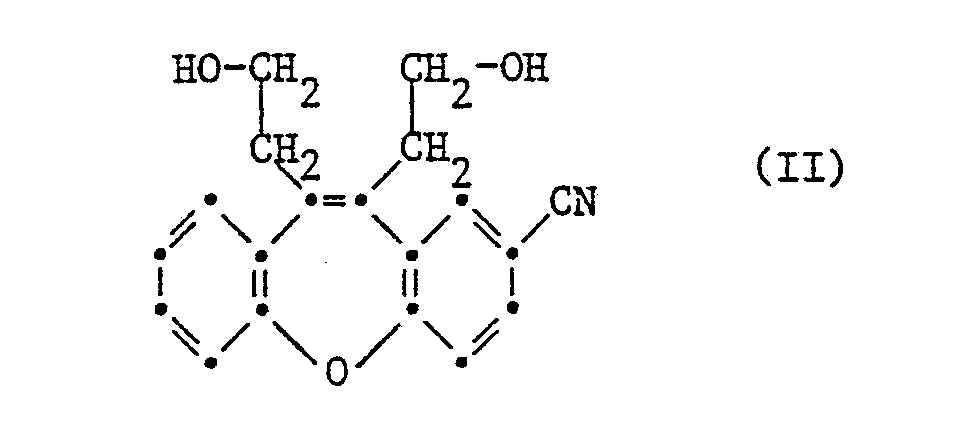

- Als reaktionsfähige Diester eines Diäthanols der Formel II können Ester von starken anorganischen Säuren, wie z.B. Bischlorwasserstoff-, Bis-jodwasserstoffsäureester oder insbesondere Bis-bromwasserstoffsäureester oder Bromwasserstoff-chlorwasserstoffsäureester eingesetzt werden. Ferner können auch entsprechende Diester von starken organischen Säuren, z.B. von Sulfonsäuren, wie Methansulfonsäure, Benzolsulfonsäure, p-Chlor- oder p-Brombenzolsulfonsäure oder p-Toluolsulfonsäure, verwendet werden. Diese Diester der Verbindungen der Formel II werden vorzugsweise in einem geeigneten inerten Lösungsmittel bei einer Reaktionstemperatur von 20 bis 130°C umgesetzt. Als inerte Lösungsmittel eignen sich beispielsweise Kohlenwasserstoffe, wie Benzol oder Toluol, Halogenkohlenwasserstoffe, wie Chloroform, niedere Alkohole, wie Aethanol und insbesondere Methanol, ätherartige Flüssigkeiten, wie Aether oder Dioxan, sowie niedere Alkanone, z.B. Aceton, Methyläthylketon oder Diäthylketon oder Gemische von solchen Lösungsmitteln, z.B. Benzol-Methanol.
- Bei der erfindungsgemässen Umsetzung von einem Moläquivalent Diester eines Diäthanols der Formel II mit einem Moläquivalent freier Base der Formel III werden zwei Moläquivalente Säure abgespalten, die vorzugsweise an ein säurebindendes Mittel gebunden werden. Als säurebindende Mittel eignen sich z.B. Alkalicarbonate, wie Kaliumcarbonat, oder z.B. Alkalihydroxide, wie Natriumhydroxid oder Kaliumhydroxid, oder überschüssige Base der Formel III, ferner tertiäre organische Basen, wie Pyridin und insbesondere Triäthylamin oder N-Aethyl-di-isopropylamin.
- Die unmittelbaren Ausgangsstoffe, also die reaktionsfähigen Diester der Formel II können aus den entsprechenden Diäthanolen durch Veresterung bzw. Ersatz der Hydroxygruppen durch Halogen nach üblichen Methoden hergestellt werden. Die Diäthanole wiederum lassen sich aus den entsprechenden Diessigsäuremethylestern durch Reduktion mit Lithiumaluminiumhydrid herstellen. Die Diessigsäuremethylester können aus den entsprechenden Diacetonitrilen mit Methanol und 2 Moläquivalenten Wasser unter Einleiten von Chlorwasserstoff hergestellt werden. Die Diacetonitrile wiederum lassen sich aus den entsprechenden Bis-(brommethyl)-verbindungen mit Natriumcyanid gewinnen.
- Nach einem weiteren Verfahren erhält man die Verbindungen der Formel I, indem man eine Verbindung der Formel

- Als Reste Hal in Verbindungen der Formel IV wählt man Chlor oder Jod, aber vorzugsweise Brom. Cyanidverbindungen sind in erster Linie Alkalimetall- oder Schwermetallcyanide. Als Alkalicyanid wird Natriumcyanid bevorzugt. Aber ganz besonuers eignet sich Kupfer-I-cyanid, als Vertreter der Schwermetallcyanide. Die Reaktion kann in An- oder Abwesenheit von Lösungsmitteln durchgeführt werden, und dies in einem Temperaturbereich von 80° bis 250°. Als Lösungsmittel eignen sich besonders Pyridin, Chinolin, Dimethylformamid, 1-Methyl-2-pyrrolidinon und Hexamethylphosphorsäuretriamid. Die beiden letztgenannten eignen sich besonders für Kupfer(1)-cyanid als Cyanierungsmittel.
- Die Ausgangsstoffe der Formel IV sind bekannt oder können nach an sich bekannt Methoden, wie z.B. analog dem erstgenannten Verfahren, hergestellt werden. In diesem Zusammenhang wird u.a. auf DOS 2 723 105 verwiesen.
- Anschliessend an die erfindungsgemässen Umsetzungen kann gegebenenfalls eine Reihe von Umwandlungen vorgenommen werden, die Verbindungen der Formel I in andere Verbindungen der Formel I überführen.
- Gegebenenfalls kann eine Verbindung der Formel I, deren Rest R Wasserstoff darstellt, in eine Verfahrensprodukt übergeführt, werden, dessen Rest R eine der anderen Bedeutungen hat.
- So kann z.B. eine N-Substitution erfolgen, entweder mit einem reaktionsfähigen Ester eines entsprechenden Alkohols der Formel Rl -OH, worin R1 die gleiche Bedeutung wie R in Formel I hat mit Ausnahme von Wasserstoff, oder durch eine Umsetzung mit entsprechenden Aldehyden oder Ketonen unter reduzierenden Bedingungen.
- Die Umsetzung von Verbindungen der Formel I, in der R Wasserstoff bedeutet, mit einem reaktionsfähigen Ester einer Hydroxyverbindung der Formel R1 -OH wird vorzugsweise in einem Lösungsmittel bei einer Reaktionstemperatur von 20 bis 130°C, insbesondere bei der Siedetemperatur des Lösungsmittels, vorgenommen.
- Als reaktionsfähige Ester können z.B. Halogenide, wie Chloride oder Bromide, ferner aromatische oder aliphatische Sulfonsäureester, wie der p-Toluolsulfonsäure-methylester oder -äthylester, bzw. der Methansulfonsäure-methylester, -äthylester oder Cyclopentylmethylester oder Schwefelsäureester, wie z.B. das Dimethyl- oder Diäthylsulfat, verwendet werden. Als säurebindende Mittel eignen sich Alkalimetallcarbonate, wie z.B. Kaliumcarbonat, oder Alkalihydroxide, wie z.B. Natriumhydroxid, oder tertiäre organische Basen, wie z.B. Pyridin oder das N-Aethyl- diisopropylamin.Geeignete Lösungsmittel sind solche Lösungsmittel, die unter den Reaktionsbedingungen inert sind, beispielsweise Kohlenwasserstoffe, wie Benzol oder Toluol, ferner Alkanole, wie z.B. Methanol oder Aethanol, oder Alkanone, wie Aceton oder Methyläthylketon.
- Aldehyde und Ketone, die den Alkoholen der Formel Rl-OH entsprechen, sind z.B. niedere aliphatische Aldehyde oder Ketone, niedere freie, veresterte oder verätherte Hydroxyoxoalkane oder veresterte Oxoalkancarbonsäuren. Das erhaltene Reaktionsprodukt bei der Umsetzung dieser Aldehyde oder Ketone mit den genannten Verbindungen der Formel I kann im gleichen Arbeitsgang oder anschliessend reduziert werden.
- Die Aldehyde, z.B. Formaldehyd oder Acetaldehyd, oder die Ketone, z.B. Aceton, werden beispielsweise mit den genannten Verbindungen der Formel I in einem inerten Lösungsmittel auf ca. 30° bis 100°C erwärmt, und gleichzeitig oder anschliessend wird das Reaktionsgemisch mit Wasserstoff in Gegenwart eines Katalysators hydriert. Geeignete Lösungsmittel sind z.B. Alkanole, wie Methanol oder Aethanol, und geeignete Katalysatoren Edelmetallkatalysatoren, wie Palladium auf Kohle.
- Anstelle von Wasserstoff in Gegenwart eines Katalysators können aber auch andere Reduktionsmittel, z.B. Ameisensäure, für die reduktive Alkylierung verwendet werden. Nach dieser Variante des Verfahrens werden die genannten Verbindungen der Formel I mit Ameisensäure und den genannten Typen von Aldehyden oder Ketonen, insbesondere-Formaldehyd, vorzugsweise ohne Lösungsmittel, erwärmt.
- Ferner kann gegebenenfalls eine Verbindung der Formel I, dessen Rest R eine Hydroxyniederalkylgruppe darstellt, zu einer Verbindung acyliert werden, deren Rest R eine veresterte Hydroxyniederalkylgruppe bedeutet.
- Die Acylierung kann z.B. mit einem Carbonsäureanhydrid oder mit einem entsprechenden Carbonsäurehalogenid bei einer Reaktionstemperatur zwischen ca. 20 und 100°C vorgenommen werden. Da die Kondensation unter Abspaltung von Säure vor sich geht, ist es zweckmässig, dem Reaktionsgemisch ein säurebindendes Mittel, z.B. eine tertiäre organische Base, wie Pyridin, beizufügen. Ueberschüssige tertiäre organische Base kann auch als Lösungsmittel verwendet werden. Ferner kann man als Lösungsmittel Kohlenwasserstoffe, z.B. Benzol oder Toluol, oder Halogenkohlenwasserstoffe, z.B. Chloroform, einsetzen.
- Ferner kann gegebenenfalls eine Verbindung der Formel I, in der R von Wasserstoff verschieden ist in ein Verfahrensprodukt übergeführt werden, dessen Rest R Wasserstoff bedeutet. Dies erreicht man vorteilhafterweise dadurch, dass man diese Gruppe R, vorzugsweise eine leicht abspaltbare Gruppe wie die Methyl- oder Allylgruppe, durch einen durch Reduktion einschliesslich Hydrogenolyse abspaltbaren Rest, insbesondere mittels Umsetzung mit einem Halogenameisensäure-2-arylalkyl- ester oder-2-halogenalkylester, durch einen 2-Arylalkoxycarbonylrest, z.B. den Benzyloxycarbonylrest, oder einen 2-Halogen-alkoxycarbonylrest, z.B. den 2,2,2-Trichloräthoxycarbonylrest ersetzt und diesen Rest mittels Hydrogenolyse oder Reduktion in üblicher Weise durch Wasserstoff ersetzt. 2-Arylalkoxycarbonylreste können z.B. mittels Wasserstoff in Gegenwart eines Hydrierungskatalysators, beispielsweise Platin, Palladium oder Raney-Nickel, und gegebenenfalls von Chlorwasserstoff, bei Raumtemperatur und Normaldruck oder bei mässig erhöhten Temperaturen und Drücken in geeigneten organischen Lösungsmittel, wie z.B. Methanol, Aethanol oder Dioxan weghydriert werden. 2-Halogen-alkoxycarbonylreste, wie neben dem 2,2,2-Trichloräthoxycarbonylrest, z.B. auch der 2-Jödäthoxy- oder 2,2,2-Tribromäthoxycarbonylrest, können insbesondere durch metallische Reduktion (sog. naszierenden Wasserstoff) entfernt werden. Naszierender Wasserstoff kann dabei durch Einwirkung von Metall oder Metall-Legierungen, wie Amalgamen, auf Wasserstoff liefernde Mittel, wie Carbonsäuren, Alkohole oder Wasser erhalten werden, wobei insbesondere Zink oder Zinklegierungen zusammen mit Essigsäure in Betracht kommen. Die reduktive Abspaltung von 2-Halogen-alkoxy-carbonylresten kann ferner durch Chrom(II)-verbindungen, wie Chrom(II)-chlorid oder Chrom(II)-acetat erfolgen.
- Je nach den Verfahrensbedingungen und Ausgangsstoffen erhält man die Endstoffe gegebenenfalls in freier Form oder in Form ihrer Salze, die sich in üblicher Weis ineinander oder in andere Salze umwandeln lassen. So bildet man freie Verbindungen der Formel I aus erhaltenen Säureadditionssalzen, z.B. durch Behandeln mit Basen oder basischen Ionenaustauschern, während man freie Basen der Formel 1 z.B. durch Umsetzen mit organischen oder anorganischen Säuren, insbesondere solchen, die zur Bildung pharmazeutisch verwendbarer Salze geeignet sind, wie den obgenannten, in Säureadditionssalze überführt.
- Salze der neuen Verbindungen können auch zu Reinigungszwecken verwendet werden, z.B. indem man die freien Verbindungen in ihre Salze überführt, diese isoliert und gegebenenfalls reinigt, und wieder in die freien Verbindungen überführt. Infolge der engen Beziehungen zwischen den neuen Verbindungen in freier Form und in Form ihrer Salze sind im Vorausgegangenen und nachfolgend unter den freien Verbindungen sinn- und zweckmässig gegebenenfalls auch die entsprechenden Salze zu verstehen.
- Erhaltene Racemate lassen sich nach an sich bekannten Methoden in die Antipoden zerlegen, z.B. durch Umkristallisieren aus einem optisch aktiven Lösungsmittel, durch Behandeln mit geeigneten Mikroorganismen oder durch Umsetzen mit einer, mit der racemischen Verbindung Salze bildenden optisch aktiven Substanz, insbesondere Säure, und Trennen des auf diese Weise erhaltenen Salzgemisches, z.B. auf Grund von verschiedenen Löslichkeiten, in die diastereomeren Salze, aus denen die freien Antipoden durch Einwirkung geeigneter Mittel freisetzt werden können. Besonders gebräuchliche, optisch aktive Säuren sind z.B. die D-und L-Formen von Weinsäure, Di-0,0'-p-toluoyl-weinsäure, Apfelsäure, Mandelsäure, Camphersulfonsäure, Glutaminsäure, Asparaginsäure oder Chinasäure. Vorteilhaft isoliert man den wirksameren der beiden Antipoden.
- Die Erfindung betrifft auch diejenigen Ausführungsformen des Verfahrens, nach denen man von einer auf irgend einer Stufe des Verfahrens als Zwischenprodukt erhältlichen Verbindung ausgeht und die fehlenden Verfahrensschritte durchführt, oder das Verfahren auf irgendeiner Stufe abbricht, oder bei denen man einen Ausgangsstoff unter den Reaktionsbedingungen bildet, oder bei denen eine Reaktionskomponente gegebenenfalls in Form ihrer Salze vorliegt.
- Zweckmässig verwendet man für die Durchführung des erfindungsgemässen Verfahrens solche Ausgangsstoffe, die zu den eingangs besonders erwähnten Gruppen von Endstoffen und besonders zu den speziell beschriebenen oder hervorgehobenen Endstoffen führen.
- Die neuen Verbindungen können z.B. in Form pharmazeutischer Präparate Verwendung finden, welche eine wirksame Menge der Aktivsubstanz, gegebenenfalls zusammen mit anorganischen oder organischen, festen oder flüssigen, pharmazeutisch verwendbaren Trägerstoffen enthalten, die sich zur enteralen, z.B. oralen, oder parenteralen Verabreichung eignen. So verwendet man Tabletten oder Gelatinekapseln, welche den Wirkstoff zusammen mit Verdünnungsmitteln, z.B. Laktose, Dextrose, Sukrose, Mannitol, Sorbitol, Cellulose und/oder Glycin, und Schmiermitteln, z.B. Kieselerde, Talk, Stearinsäure oder Salze davon, wie Magnesium- oder Calciumstearat, und/oder Polyäthylenglykol, aufweisen; Tabletten enthalten ebenfalls Bindemittel, z.B. Magnesiumaluminiumsilikat, Stärken, wie Mais-, Weizen-, Reis- oder Pfeilwurzstärke, Gelatine, Traganth, Methylcellulose, Natriumcarboxymethylcellulose und/oder Polyvinylpyrrolidon, und, wenn erwünscht, Sprengmittel, z.B. Stärken, Agar, Alginsäure oder ein Salz davon, wie Natriumalginat, und/oder Brausemischungen, oder Adsorptionsmittel, Farbstoffe, Geschmackstoffe und Süssmittel. Ferner kann man die neuen pharmakologisch wirksamen Verbindungen in Form von injizierbaren, z.B. intravenös, verabreichbaren Präparaten oder von Infusionslösungen verwenden. Solche Lösungen sind vorzugsweise isotonische wässrige Lösungen oder Suspensionen, wobei diese z.B. als lyophilisierten Präparate , welche die Wirksubstanz allein oder zusammen mit einem Trägermaterial, z.B. Mannit, enthalten, vor Gebrauch hergestellt werden können. Die pharmazeutischen Präparate können sterilisiert sein und/oder Hilfsstoffe, z.B. Konservier-, Stabilisier-, Netz- und/oder Emulgiermittel, Löslichkeitsvermittler, Salze zur Regulierung des osmotischen Druckes und/oder Puffer enthalten. Die vorliegenden pharmazeutischen Präparate, die, wenn erwünscht, weitere pharmakologisch wertvolle Stoffe enthalten können, werden in an sich bekannter Weise, z.B. mittels konventioneller Misch-, Granulier-, Dragier-, Lösungs- oder Lyophilisierungsverfahren, hergestellt und enthalten von etwa 0,1% bis 100%, insbesondere von etwa 1% bis etwa 50%, Lyophilisate bis zu 100% des Aktivstoffes. Die Dosierung hängt von der Applikationsweise, der Spezies, dem Alter und von dem individuellen Zustand ab. Die täglichen Dosen der freien Basen oder von pharmazeutisch annehmbaren Salzen derselben bewegen sich zwischen etwa 0,01 mg/kg und 0,5 mg/kg für Warmblüter im allgemeinen und etwa 0,001 g bis etwa 0,01 g für Warmblüter mit einem Gewicht von etwa 70 kg.
- Die folgenden Beispiele dienen zur Illustration der Erfindung; Temperaturen werden in Celsiusgraden angegeben.
- Beispiel 1: Ein Gemisch von 18,5 g (0,05 Mol) 7-Brom-3-methyl-2,3,4,5-tetrahydro-lH-dibenz[2,3:6,7]oxepino[4,5-d]azepin und 5,35 g (0,06 Mol) Kupfer(I)-cyanid in 20 ml Dimethylformamid wird in einer Stickstoffatmosphäre 24 Stunden unter Rühren auf 180° erwärmt. Hierauf wird das Gemisch auf 30° abgekühlt, mit 100 ml Methylenchlorid verdünnt und mit 50 ml einer 50%-igen wässerigen Aethylendiaminlösung versetzt . Die organische Phase wird anschliessend abgetrennt, mit Wasser gewaschen und nach dem Trocknen über Natriumsulfat eingedampft. Der kristalline Rückstand, das 7-Cyano-3-methyl-2,3,4,5-tetrahydro-lH-dibenz[2,3:6,7]oxepino [4,5-d]azepin schmilzt nach dem Umkristallisieren aus Aceton bei 181-183°.
- Zur Ueberführung ins Methansulfonat löst man 12,1 g (0,04 Mol) davon in 250 ml Aceton und versetzt diese Lösung unter Rühren mit 3,84 g Methansulfonsäure, worauf das 7-Cyano-3-methyl-2,3,4,5-tetra- hydro-lH-dibenz [2,3:6,7]oxepino[4,5-d]azepin-methansulfonat vom Smp. 265-268° auskristallisiert.
- Das Ausgangsmaterial kann auf folgende Weise hergestellt werden:
- Ein Gemisch von 560,0 g 2-(4-Brom-phenyloxy)-benzoesäure in 1940 ml absolutem Benzol, 218 ml absolutem Aethanol und 32,6 ml konzentrierter Schwefelsäure wird 32 Stunden unter Rückfluss gekocht, wobei man das sich bildende Wasser in einem Wasserabscheider entfernt. Man kühlt das Reaktionsgemisch auf 10° ab und wäscht unter Zusatz von Eis mit 1000 ml Wasser, 500 ml einer 2-n. wässerigen Natriumcarbonatlösung und anschliessend nochmals mit 1000 ml Wasser. Die organische Phase wird abgetrennt, über Magnesiumsulfat getrocknet und unter einem Druck von 11 mm Hg bei 40° eingedampft. Der Rückstand wird im Hochvakuum destilliert und ergibt den 2-(4-Bromphenyloxy)-benzoesäure-äthylester, Kp. 140-150°/0,05 mm Hg.
- Eine Lösung von 477,0 g des 2-(4-Brom-phenyloxy)-benzoesäure- äthylesters in 900 ml absolutem Diäthyläther wird innerhalb 1 Stunde und unter Durchleiten eines Stickstoffstroms zu 42,3 g Lithiumaluminiumhydrid in 500 ml Diäthyläther eingetropft. Das Reaktionsgemisch wird 6 Stunden unter Rückfluss gekocht, auf 0-5° abgekühlt und unter Durchleiten von Stickstoff mit 450 ml Essigsäureäthylester und anschliessend vorsichtig mit 350 ml Wasser versetzt. Man filtriert vom Niederschlag ab und wäscht diesen mit Diäthyläther nach. Die wässerige Phase des Filtrats wird abgetrennt und mit 100 ml Diäthyläther gewaschen; die vereinigten organischen Phasen werden über Magnesiumsulfat getrocknet und unter 11 mm Hg zur Trockne eingedampft; der 2-(4-Brom-phenyloxy)-benzylalkohol bleibt als farbloses Oel zurück.
- Ein Gemisch von 413,0 g des 2-(4-Brom-phenyloxy)-benzyl-. alkohols und 1290 ml 48%-iger Bromwasserstoffsäure wird 4 Stunden unter Rückfluss gekocht, dann abgekühlt und auf 2000 ml Eis und Wasser ausgegossen. Das ausgeschiedene grünliche Oel wird in 2000 ml Diäthyläther gelöst. Die organische Phase wird zweimal mit 400 ml Wasser und mit 400 ml einer 1-n. wässerigen Natriumhydrogencarbonatlösung gewaschen, über Magnesiumsulfat getrocknet und unter 11 mm Hg bei 40° eingedampft. Das als öliger Rückstand erhaltene 2-(4-Bromphenyloxy)-benzylbromid wird ohne Reinigung weiterverwendet.
- Man fügt 457,8 g des rohen 2-(4-Brom-phenyloxy)-benzyl- bromids innerhalb einer Stunde zu einem unter Rückfluss siedenden Gemisch von 171,0 g Natriumcyanid in 160 ml Wasser und 44 ml Aethanol; gleichzeitig werden 362 ml Aethanol zugetropft. Anschliessend kocht man 3 weitere Stunden unter Rückfluss und verdünnt dann mit 1500 ml Wasser. Man wäscht die wässerig-äthanolische Phase mit 1000 ml Diäthyläther, trennt die Aetherphase ab, wäscht sie zweimal mit 200 ml Wasser, trocknet sie über Magnesiumsulfat und engt sie unter 11 mm Hg zur Trockne ein. Den Rückstand kristallisiert man aus einem Gemisch von Diäthyläther und Petroläther und erhält so das 2-(4-Bromphenyloxy)-phenylacetonitril, F. 56-58°.
- 25,3 g Natrium werden unter Rühren in 400 ml abs. Aethanol gelöst, und anschliessend destilliert man wieder ca. 200 ml abs. Aethanol aus dem Reaktionsgemisch ab. Hierauf gibt man 1500 ml abs. Toluol zu und destilliert unter einer Vigreuxkolonne weiter, bis der Siedepunkt 108° erreicht hat, wobei das Natriumäthylat auskristallisiert. Bei 100-110° wird nun innerhalb einer Stunde ein Gemisch von 288 g (1 Mol) 2-(4-Bromphenyloxy)-phenylacetonitril und 354 g (3 Mol) Diäthylcarbonat unter gleichzeitigem Abdestillieren des entstehenden Aethanols zugetropft. Nach Beendigung des Zutropfens wird das Reaktionsgemisch weiter destilliert bis der Siedepunkt wieder 108-110° erreicht hat. Anschliessend wird das Reaktionsgemisch auf Raumtemperatur abgekühlt, mit 300 ml abs. Toluol verdünnt und innerhalb einer Stunde 170 g (1,2 Mol) Methyljodid zugetropft. Zur vollständigen Umsetzung wird das Gemisch 1 Stunde bei Raumtemperatur und 5 Stunden bei 80° weitergerührt. Nach dem Abkühlen auf Raumtemperatur lässt man 1 Liter Wasser zulaufen, trennt die organische Phase ab, wäscht sie mit Wasser und dampft sie nach dem Trocknen über Natriumsulfat im Vakuum vollständig ein. Als Rückstand bleibt der rohe 2-(4-Bromphenyloxy)-phenyl-a-methyl-cyanessigsäure-äthylester zurück.
- Unter gutem Rühren werden 374 g (1 Mol) roher 2-(4-Bromphenyl- oxy)-phenyl-a-methyl-cyanessigsäure-äthylester, 830 ml Aethanol 962-ig und 460 ml 50%-ige wässerige Kalilauge 24 Stunden unter Rückfluss gekocht. Dann wird das Reaktionsgemisch unter 11 mm Hg bei 50° eingedampft und der Rückstand in 3500 ml Wasser gelöst. Nach dem Klarfiltrieren wird die alkalische Lösung mit konzentrierter Salzsäure angesäuert, wobei die 2-(4-Bromphenyloxy)-phenyl-a-methylessigsäure auskristallisiert. Nach dem Abfiltrieren wird die erhaltene Säure im Vakuum bei 50° getrocknet und anschliessend aus Acetonitril umkristallisiert, Smp. 99 - 101°.
- 321 g (1 Mol) 2-(4-Bromphenyloxy)-phenyl-a-methylessigsäure und 3210 g Polyphosphorsäure werden unter gutem Rühren eine Stunde auf 100-105° erwärmt. Anschliessend giesst man das Reaktionsgemisch unter Rühren in 3 Liter Wasser, wobei durch Eiszugabe die Temperatur unter 10° gehalten wird. Das ausgeschiedene Oel wird mit Diäthyläther extrahiert, die organische Phase wird mit Wasser gewaschen, über Kaliumcarbonat getrocknet und eingeengt, wobei nach dem Abkühlen das 8-Brom-ll-methyl-dibenz[b,f]oxepin-10(llH)-on vom Smp. 85-87° auskristallisiert.
- Zu einer Grignardlösung, die aus 49 g (2 Mol) Magnesium, 450 ml abs. Aether und 284 g Methyljodid bereitet wird, lässt man innerhalb 5 Stunden unter gutem Rühren eine Lösung von 303 g (1 Mol) 8-Brom-11-methyl-dibenz[b,f]oxepin-10(11H)-on in 1500 ml abs. Toluol eintropfen, wobei man eine Reaktionstemperatur von -5 bis 0° einhält. Anschliessend erwärmt man das Reaktionsgemisch auf 55° und rührt es 15 Stunden bei dieser Temperatur weiter. Hierauf kühlt man das Reaktionsgemisch auf 0° ab und giesst es unter Rühren auf eine Lösung von 680 g Ammoniumchlorid in 2000 ml Eiswasser. Die organische Phase wird abgetrennt und die wässerige Phase mit Toluol extrahiert. Die vereinigten organischen Lösungen wäscht man mit Wasser, trocknet sie über Natriumsulfat und dampft sie im Vakuum ein. Als Rückstand bleibt das 8-Brom-10,11-dimethyl-dihydrodibenz[b,f]oxepin-10-ol als Oel zurück.
- 319 g (1 Mol) 8-Brom-10,11-dimethyl-dihydro-dibenz[b,f] oxepin-10-ol (Rohprodukt) und 1,5 g p-Toluolsulfonsäure werden in einer Destillationsapparatur unter 11 mm Hg 1 Stunde auf 180° und 5 Stunden auf 200° Aussentemperatur erhitzt, wobei sich Wasser abspaltet. Anschliessend wird die Destillationsvorlage ausgewechselt und das entstandene 2-Brom-10,11-dimethyl-dibenz[b,f]oxepin im Hochvakuum destilliert, Kp 142-148°/0,01 Torr. Das hellgelbe Destillat löst man in 300 ml Acetonitril und kühlt die Lösung auf 0° ab, wobei das Produkt auskristallisiert, Smp. 117-119°.
- 30,1 g (0,1 Mol) 2-Brom-10,11-dimethyl-dibenz[b,f]oxepin, werden in 525 ml Tetrachlorkohlenstoff gelöst und diese Lösung wird mit 35,6 g (0,2 Mol) N-Bromsuccinimid versetzt. Unter Rühren in einer Stickstoffatmosphäre wird unter Belichten mit einer UV-Lampe das Gemisch zum Sieden erhitzt. Man hält das Gemisch solange am Sieden, bis alles N-Bromsuccinimid, welches auf dem Boden des Gefässes liegt, sich in auf der Lösung schwimmendes Succinimid umgewandelt hat; Dauer etwa 10 Minuten. Hierauf kühlt man_das Reaktionsgemisch auf 20° ab und trennt das Succinimid durch Filtration ab. Das Filtrat wird mit Wasser gewaschen, über Natriumsulfat getrocknet und im Vakuum eingeengt. Beim Abkühlen kristallisiert das 2-Brom-10,11-bis-brommethyl-dibenz[b,f]oxepin von Smp. 124-126° aus.
- 45,9 g (0,1 Mol) 2-Brom-10,11-bis-(brommethyl)-dibenz[b,f] oxepin werden unter Rühren in einer Stickstoffatmosphäre in 500 ml Acetonitril suspendiert. Zu dieser Suspension wird innerhalb von 10 Minuten eine Lösung von 11,8 g (0,24 Mol) Natriumcyanid in 36 ml destilliertem Wasser getropft. Anschliessend rührt man 1 1/2 Stunden weiter wobei die Innentemperatur durch schwaches Kühlen bei 20° gehalten wird. Nach dieser Zeit ist alles Ausgangsmaterial umgesetzt, und eine braune Lösung ist entstanden. Diese Reaktionslösung wird mit Wasser gewaschen und im Vakuum eingeengt, wobei das 2-Brom-dibenz[b,f]oxepin-10,11-diacetonitril vom Smp. 241-243° auskristallisiert.
- 35,1 g (0,1 Mol) 2-Brom-dibenz[b,f]oxepin-10,11-diaceto- nitril werden unter Rühren in 400 ml Methanol und 3,6 ml Wasser suspendiert und in einem Eisbad auf 0-5° abgekühlt. Hierauf wird bis zur Sättigung trockener Chlorwasserstoff eingeleitet. Das Reaktionsgemisch wird 12 Stunden bei 20° weitergerührt und anschliessend 24 Stunden am Rückfluss gekocht. Anschliessend dampft man die Reaktionslösung im Vakuum ein und extrahiert den Rückstand mit Aether. Die organische Phase wird abgetrennt, mit Wasser und 2N-Sodalösung gewaschen, über Natriumsulfat getrocknet und eingedampft. Der rohe 2-Brom-dibenz[b,f]oxepin-lO,ll-diessigsäuremethylester bleibt als gelbes Oel zurück.
- In eine eisgekühlte Lösung von 40 g (0,3 Mol) wasserfreiem Aluminiumchlorid in 1 Liter absolutem Diäthyläther lässt man unter Rühren und Feuchtigkeitsausschluss in einer Stickstoffatmosphäre langsam eine Suspension von 11,4 g (0,3 Mol) Lithiumaluminiumhydrid in 750 ml absolutem Diäthyläther derart zulaufen, dass die Reaktionstemperatur nicht über 5° steigt. Anschliessend lässt man bei -2° bis +3° innerhalb 30 Minuten eine Lösung von 41,7 g (0,1 Mol) rohem 2-Brom-dibenz[b,f]oxepin-lO,11-diessigsäuremethylester in 300 ml absolutem Diäthyläther zutropfen. Nach Beendigung des Zutropfens wird das Reaktionsgemisch noch 17 Stunden bei Raumtemperatur weitergerührt, dann auf 0-5° abgekühlt und das überschüssige Aluminiumhydrid vorsichtig durch tropfenweise Zugabe von 100 ml Wasser zersetzt. Hierauf wird die organische Phase abgetrennt, zweimal mit je 300 ml Wasser gewaschen, über Natriumsulfat getrocknet und eingedampft. Als Rückstand bleibt das rohe 2-Brom-dibenz[b,f]oxepin-10,11-diäthanol als gelbes Oel zurück.
- 36,1 g (0,1 Mol) rohes 2-Brom-dibenz[b,f]oxepin-lO,11- diäthanol werden bei Raumtemperatur in 120 ml Pyridin gelöst und unter Rühren in einem Eis-Natriumchloridbad bei einer Reaktionstemperatur von -5° tropfenweise mit 25,2 g (0,22 Mol) Methansulfochlorid versetzt. Anschliessend rührt man das Reaktionsgemisch 30 Minuten bei 0° und zwei Stunden bei 15-25°. Danach wird es zusammen mit Methylenchlorid in einem Scheidetrichter hintereinander mit je 800 ml 2-n. Salzsäure und Wasser gewaschen, über Natriumsulfat getrocknet und im Vakuum eingedampft. Als Rückstand verbleibt das rohe 2-Brom-10,11-bis-j2-(methylsulfonyloxy)äthyl]-dibenz[b,f] oxepin als hellbraunes Oel zurück.
- 51,7 g (0,1 Mol) rohes 2-Brom-10,11-bis-[2-(methylsulfonyloxy)-äthyl]-dibenz[b,f]oxepin werden mit einer Lösung von 60 g (1,36 Mol) Methylamin in 350 ml Aethanol 3 Stunden bei einer Innentemperatur von 60° gerührt, wobei sich nach 30 Minuten langsam Kristalle abscheiden. Anschliessend wird das Reaktionsgemisch in einem Eisbad abgekühlt, die ausgefallenen Kristalle abgenutscht und mit Aethanol gewaschen. Das Nutschgut, das 7-Brom-3-methyl-2,3,4,5-tetra- hydro-lH-dibenz[2,3:6,7]oxepino[4,5-d]azepin, schmilzt nach dem Trocknen bei 80° im Vakuumschrank bei 189-192°.
- Beispiel 2: Analog Beispiel 1 wird aus 20,6 g (0,05 Mol) 7-Brom-3-(cyclopentylmethyl)-2,3,4,5-tetrahydro-1H-dibenz[2,3:6,7]oxepino [4,5-d]azepin und 5,35 g (0,06 Mol) Kupfer(I)-cyanid in 20 ml Dimethylformamid das 7-Cyano-3-(cyclopentylmethyl)-2,3,4,5-tetrahydro-1H-dibenz[2,3:6,7]oxepino[4,5-d]azepin, vom Smp. 99-102° (aus Acetonitril) erhalten. Das Methansulfonat schmilzt bei 266-269° (aus Aethanol).
- Der Ausgangsstoff, das 7-Brom-3-(cyclopentylmethyl)-2,3,4,5-tetrahydro-lH-dibenz[2,3:6,7]oxepino[4,5-d]azepin, wird analog zum letzten Abschnitt von Beispiel 1 aus 51,7 g (0,1 Mol) rohem 2-Brom-10,11-bi-[2-(methylsülfonyloxy)-äthyl]dibenz[b,f]oxepin und 29,7 g (0,3 Mol) :(Aminomethyl)-cyclopentan in 100 ml Aethanol hergestellt, Smp. 125-218° (aus Acetonitril).
- Beispiel 3: Zu einer gerührten Lösung von 6,0 g (0,02 Mol) 7-Cyano-3-methyl-2,3,4,5-tetrahydro-lH-dibenz[2,3:6,7]oxepino[4,5-d]azepin in 100 ml absolutem Benzol gibt man 0,2 g wasserfreies Kaliumcarbonat und tropft anschliessend eine Lösung von 5,1 g (0,024 Mol) Chlorameisensäuretrichloräthylester in 20 ml absolutem Benzol bei einer Temperatur von 20 bis 25° zu. Das Reaktionsgemisch lässt man während 16 Stunden bei Raumtemperatur nachrühren und versetzt es hierauf mit 20 ml 5%igem Ammoniak. Die organische Phase wird abgetrennt, mit 5%iger wässriger Methansulfonsäure gewaschen und nach dem Trocknen über Natriumsulfat auf ein kleines Volumen eingeengt, worauf der 7-Cyano-2,3,4,5-tetrahydro-1H-dibenz[2,3:6,7]oxepino[4,5-d]azepin-3-carbonsäure-trichloräthylester vom Smp. 178-180° auskristallisiert. 4,6 g (0,01 Mol) 7-Cyano-2,3,4,5-tetrahydro-lH-dibenz[2,3:6,7]oxepino[4,5-d] azepin-3-carbonsäure-trichloräthylester werden in 700 ml 90%iger Essigsäure gelöst und bei 35° auf einmal 6,8 g Zinkstaub zugegeben.
- Dieses Gemisch lässt man 6 Stunden bei Raumtemperatur rühren und dampft es anschliessend am'Rotationsverdampfer vollständig ein. Den Rückstand versetzt man unter Eiskühlung mit 100 ml konz. Ammoniak und extrahiert die ausgefallene Base mit Methylenchlorid. Die organische Phase wird abgetrennt, mit Wasser gewaschen, über Natriumsulfat getrocknet und eingedampft. Den öligen Rückstand löst man in 10 ml Aethanol und neutralisiert diese Lösung mit Methansulfonsäure, worauf das 7-Cyano-2,3,4,5-tetrahydro-lH-dibenz[2,3:6,7]oxepino[4,5-d]azepin-methansulfonat auskristallisiert, welches nach dem Umkristallisieren aus Methanol bei 219-222° schmilzt.
- Beispiel 4: Tabletten, enthaltend 0,002 g 7-Cyano-3-methyl-2,3,4,5-tetrahydro-1H-dibenz[2,3:6,7]oxepino[4,5-d]azepin-methansulfonat werden, wie folgt hergestellt:

- Ein Gemisch des 7-Cyano-3-methyl-2,3,4,5-tetrahydro-lH- dibenz[2,3:6,7]oxepino[4,5-d]azepin-methansulfonat, der Lactose und 194,70 g Kartoffelstärke wird mit einer äthanolischen Lösung der Stearinsäure befeuchtet und durch ein Sieb granuliert. Nach dem Trocknen mischt man die restliche Kartoffelstärke, den Talk, das Magnesiumstearat und das kolloidale Siliciumdioxid zu und presst die Mischung zu Tabletten von je 0,1 g Gewicht, die gewünschtenfalls mit Teilkerben zur feineren Anpassung der Dosierung versehen sein können.
- Beispiel 5: Dragees, enthaltend 0,005 g des Methansulfonsäuresalzes des 7-Cyano-3-(cyclopentylmethyl)-2,3,4,5-tetrahydro-lH-dibenz [2,3:6,7]oxepino[4,5-d]azepin werden wie folgt hergestellt:
- Zusammensetzung (für 10 000 Dragees):

- Aus dem 7-Cyano-3-(cyclopentylmethyl)-2,3,4,5-tetrahydro-lH-dibenz [2,3:6,7]oxepino[4,5-d]azepin-methansulfonat, der Lactose und einer äthanolischen Lösung der Stearinsäure stellt man ein Granulat her, das man nach dem Trocknen mit dem kolloidalen Siliciumdioxid, dem Talk, der Kartoffelstärke und dem Magnesiumstearat vermischt und zu Dragee-Kernen presst. Diese werden anschliessend mit einem konzentrierten Sirup aus der Saccharose, dem Schellack, dem arabischen Gummi, dem Farbstoff und dem Titandioxid überzogen und getrocknet. Man erhält so Dragees mit einem Gewicht von je 0,100 g enthaltend je 0,005 g Wirkstoff.
- Beispiel 6: Kapseln, enthaltend 0,002 g des 7-Cyano-3-methyl-2,3,4,5-tetrahydro-1H-dibenz[2,3:6,7]oxepino[4,5-d]azepin-methansulfonat werden wie folgt hergestellt:
- Zusammensetzung (für 1 000 Kapseln):

- Man mischt das 7-Cyano-3-methyl-2,3,4,5-tetrahydro-lH-dibenz[2,3:6,7] oxepino[4,5-d]azepin-methansulfonat mit der Lactose, befeuchtet die Mischung gleichmässig mit einer wässrigen Lösung der Gelatine und granuliert sie durch ein geeignetes Sieb (z.B. ein Sieb mit lichter Maschenweite von 1,2-1,5 mm. Das Granulat mischt man mit der getrockneten Maisstärke und dem Talk und füllt es gleichmässig in die Hartgelatinekapseln (Grösse 1) ab.
- Beispiel 7: Eine wässerige Injektionslösung, enthaltend0,001 g/ml 7-Cyano-3-methyl-2,3,4,5-tetrahydro-lH-dibenz[2,3:6,7]oxepino[4,5-d] azepin-methansulfonat wird wie folgt hergestellt:
- Zusammensetzung (für 1000 Ampullen)

- Eine Lösung des 7-Cyano-3-methyl-2,3,4,5-tetrahydro-1H-dibenz[2,3:6,7] oxepino[4,5-d]azepin-methansulfonat in 1000 ml Wasser wird in Ampullen abgefüllt und sterilisiert. Eine Ampulle enthält eine 0,1%-ige Lösung des Wirkstoffes.
Claims (17)


Priority Applications (1)
| Application Number | Priority Date | Filing Date | Title |
|---|---|---|---|
| AT80810377T ATE9159T1 (de) | 1979-12-10 | 1980-12-04 | Azatetracyclische carbonitrile. |
Applications Claiming Priority (2)
| Application Number | Priority Date | Filing Date | Title |
|---|---|---|---|
| CH10928/79 | 1979-12-10 | ||
| CH1092879 | 1979-12-10 |
Publications (2)
| Publication Number | Publication Date |
|---|---|
| EP0030916A1 true EP0030916A1 (de) | 1981-06-24 |
| EP0030916B1 EP0030916B1 (de) | 1984-08-29 |
Family
ID=4368292
Family Applications (1)
| Application Number | Title | Priority Date | Filing Date |
|---|---|---|---|
| EP80810377A Expired EP0030916B1 (de) | 1979-12-10 | 1980-12-04 | Azatetracyclische Carbonitrile |
Country Status (25)
| Country | Link |
|---|---|
| US (1) | US4492691A (de) |
| EP (1) | EP0030916B1 (de) |
| JP (1) | JPS5692890A (de) |
| KR (2) | KR850000610B1 (de) |
| AT (1) | ATE9159T1 (de) |
| AU (1) | AU546197B2 (de) |
| CA (1) | CA1152987A (de) |
| CY (1) | CY1354A (de) |
| DD (1) | DD155617A5 (de) |
| DE (1) | DE3069086D1 (de) |
| DK (1) | DK157869C (de) |
| ES (1) | ES497550A0 (de) |
| FI (1) | FI76575C (de) |
| GB (1) | GB2065120B (de) |
| GR (1) | GR72505B (de) |
| HK (1) | HK12887A (de) |
| HU (1) | HU187283B (de) |
| IE (1) | IE50583B1 (de) |
| IL (1) | IL61662A (de) |
| KE (1) | KE3683A (de) |
| MY (1) | MY8700558A (de) |
| NO (1) | NO154796C (de) |
| NZ (1) | NZ195795A (de) |
| PT (1) | PT72178B (de) |
| ZA (1) | ZA807692B (de) |
Citations (2)
| Publication number | Priority date | Publication date | Assignee | Title |
|---|---|---|---|---|
| CH592095A5 (de) * | 1974-02-22 | 1977-10-14 | Ciba Geigy Ag | |
| DE2723209A1 (de) * | 1976-05-24 | 1977-12-15 | Akzo Nv | Tetracyclische pyridin- oder pyrrolderivate |
Family Cites Families (17)
| Publication number | Priority date | Publication date | Assignee | Title |
|---|---|---|---|---|
| US3116283A (en) * | 1963-12-31 | Preparation of nitrogen heterocyclic | ||
| US3418339A (en) * | 1966-04-04 | 1968-12-24 | American Home Prod | 10,11-epoxy-10,11-dihydro-5h-dibenzo[a,d] cycloheptene-5-carboxamides |
| CH501007A (de) * | 1968-11-27 | 1970-12-31 | Ciba Geigy Ag | Verfahren zur Herstellung von neuen Thiepin- und Oxepinderivaten |
| CH501650A (de) * | 1968-12-19 | 1971-01-15 | Ciba Geigy Ag | Verfahren zur Herstellung von neuen Azepinderivaten |
| US3749790A (en) * | 1969-11-12 | 1973-07-31 | Ciba Geigy Corp | Derivatives of dibenzo(b,f)pyrrolo-(3,4-d)azepine in compositions and a method for producing a c.n.s. depressant effect |
| DK134555B (da) * | 1969-11-20 | 1976-11-29 | Ciba Geigy Ag | Analogifremgangsmåde til fremstilling af azepinderivater eller additionssalte deraf med uorganiske eller organiske syrer. |
| US3682959A (en) * | 1969-12-23 | 1972-08-08 | Hans Blattner | BENZOTHIEPINO{8 4,5-c{9 {0 PYRROLES |
| US3798237A (en) * | 1969-12-23 | 1974-03-19 | Ciba Geigy Corp | Thiepin derivatives |
| US3777032A (en) * | 1969-12-23 | 1973-12-04 | Ciba Geigy Corp | 2,3-dihydro-1h-thienobenozothiepino(4,5-c)pyrroles as cns-depressants |
| CH532038A (de) * | 1970-05-25 | 1972-12-31 | Ciba Geigy Ag | Verfahren zur Herstellung von neuen Cycloheptenderivaten |
| US3859439A (en) * | 1970-05-26 | 1975-01-07 | Ciba Geigy Corp | 2,3-dihydro-5 -trifluoromethyl-1h-dibenzo(2,3:6,7) thiepino (4,5-c) pyrroles as cns-depressants |
| CH531535A (de) * | 1970-05-26 | 1972-12-15 | Ciba Geigy Ag | Verfahren zur Herstellung von neuen Thiepinderivaten |
| NL178593C (nl) * | 1974-01-31 | 1986-04-16 | Akzo Nv | Werkwijze ter bereiding van een farmaceutisch preparaat op basis van een tetracyclische verbinding en werkwijze voor de bereiding van de daarbij te gebruiken tetracyclische verbindingen. |
| US4112110A (en) * | 1974-02-22 | 1978-09-05 | Ciba-Geigy Corporation | Oxygenated azatetracyclic compounds |
| SE405475B (sv) * | 1974-03-06 | 1978-12-11 | Du Pont | Forfarande att framstella nya polycykliska derivat av pyrrolidin med lugnande och bedovande verkan |
| SE7501669L (sv) * | 1974-04-05 | 1975-10-06 | Ciba Geigy Ag | Pyrrol-derivat och sett att framstella desamma. |
| CH624105A5 (en) * | 1976-05-26 | 1981-07-15 | Ciba Geigy Ag | Process for the preparation of novel azatetracyclic compounds |
-
1980
- 1980-12-04 DE DE8080810377T patent/DE3069086D1/de not_active Expired
- 1980-12-04 EP EP80810377A patent/EP0030916B1/de not_active Expired
- 1980-12-04 AT AT80810377T patent/ATE9159T1/de not_active IP Right Cessation
- 1980-12-05 CY CY135480A patent/CY1354A/en unknown
- 1980-12-05 GB GB8039112A patent/GB2065120B/en not_active Expired
- 1980-12-08 DD DD80225838A patent/DD155617A5/de not_active IP Right Cessation
- 1980-12-08 GR GR63593A patent/GR72505B/el unknown
- 1980-12-08 HU HU802937A patent/HU187283B/hu not_active IP Right Cessation
- 1980-12-08 FI FI803806A patent/FI76575C/fi not_active IP Right Cessation
- 1980-12-08 IL IL61662A patent/IL61662A/xx unknown
- 1980-12-08 CA CA000366305A patent/CA1152987A/en not_active Expired
- 1980-12-09 IE IE2575/80A patent/IE50583B1/en not_active IP Right Cessation
- 1980-12-09 NO NO803712A patent/NO154796C/no unknown
- 1980-12-09 ES ES497550A patent/ES497550A0/es active Granted
- 1980-12-09 PT PT72178A patent/PT72178B/de not_active IP Right Cessation
- 1980-12-09 NZ NZ195795A patent/NZ195795A/en unknown
- 1980-12-09 ZA ZA00807692A patent/ZA807692B/xx unknown
- 1980-12-09 AU AU65196/80A patent/AU546197B2/en not_active Ceased
- 1980-12-09 DK DK525180A patent/DK157869C/da not_active IP Right Cessation
- 1980-12-10 JP JP17336580A patent/JPS5692890A/ja active Granted
- 1980-12-10 KR KR1019800004693A patent/KR850000610B1/ko not_active Expired
- 1980-12-10 KR KR1019800004093A patent/KR830004305A/ko active Pending
-
1982
- 1982-07-01 US US06/394,368 patent/US4492691A/en not_active Expired - Lifetime
-
1986
- 1986-12-04 KE KE3683A patent/KE3683A/xx unknown
-
1987
- 1987-02-12 HK HK128/87A patent/HK12887A/xx unknown
- 1987-12-30 MY MY558/87A patent/MY8700558A/xx unknown
Patent Citations (2)
| Publication number | Priority date | Publication date | Assignee | Title |
|---|---|---|---|---|
| CH592095A5 (de) * | 1974-02-22 | 1977-10-14 | Ciba Geigy Ag | |
| DE2723209A1 (de) * | 1976-05-24 | 1977-12-15 | Akzo Nv | Tetracyclische pyridin- oder pyrrolderivate |
Also Published As
Similar Documents
| Publication | Publication Date | Title |
|---|---|---|
| DE2411382A1 (de) | Neue 2-tetrahydrofurfuryl-6,7-benzomorphane, deren saeureadditionssalze, ihre verwendung als arzneimittel und verfahren zu deren herstellung | |
| DE3002367A1 (de) | 2-substituierte trans-5-aryl-2,3,4,4a,5, 9b-hexahydro-1h-pyrido eckige klammer auf 4,3-b eckige klammer zu indole | |
| WO1985000171A1 (fr) | Spiroxuccinimides, leur fabrication et leur utilisation | |
| DD300105A5 (de) | Neue R(-)3-Quinuliclidinol - Derivate | |
| DE69810560T2 (de) | Indanol-Derivate, Verfahren zu deren Herstellung und diese enthaltende pharmazeutische Zusammensetzungen | |
| EP0082461B1 (de) | Substituierte Phenoxyalkanolamine und Phenoxyalkanol-cycloalkylamine, Verfahren zu ihrer Herstellung, diese Verbindungen enthaltende pharmazeutische Zubereitungen und Zwischenprodukte | |
| EP0665228A1 (de) | Neue 3-Phenylsulfonyl-3,7-diazabicyclo(3,3,1)nonan-Verbindungen enthaltende Arzneimittel | |
| EP0233483B1 (de) | Pyrrolo[1,2-a][4,1]benzoxazepine, Verfahren zur ihrer Herstellung, pharmazeutische Präparate enthaltend diese Verbindungen, sowie therapeutische Verwendung | |
| EP0389425B1 (de) | Neue Benzothiopyranylamine | |
| DE3807813A1 (de) | Neue benzocycloheptenderivate, diese verbindungen enthaltende arzneimittel und verfahren zu deren herstellung | |
| EP0068240B1 (de) | 2-Acylaminomethyl-1,4-benzodiazepin-Verbindungen sowie Verfahren und Zwischenprodukte zu ihrer Herstellung und diese Verbindungen enthaltende Arzneimittel | |
| EP0030916B1 (de) | Azatetracyclische Carbonitrile | |
| WO1988008843A2 (en) | New imidazols | |
| CH630902A5 (en) | Process for preparing novel derivatives of 1,2,3,4,4a,10b-hexahydrobenzo(f)isoquinoline. | |
| EP0017727A1 (de) | Polysubstituierte Diazatricyclen, Verfahren zu ihrer Herstellung und sie enthaltende pharmazeutische Zusammensetzungen | |
| EP0024560A1 (de) | Neue 3-Amino-1-benzoxepin-Derivate und ihre Salze; Verfahren zu deren Herstellung und diese Verbindungen enthaltende Arzneimittel | |
| DE3520104A1 (de) | Naphthoxazine, ihre herstellung und verwendung | |
| EP0086980B1 (de) | Substituierte Dibenzodiazepinone, Verfahren zu ihrer Herstellung und diese Verbindungen enthaltende Arzneimittel | |
| EP0007450A1 (de) | Azatetracyclische Carbonitrile, ihre Herstellung, pharmazeutische Präparate, die diese enthalten und deren Verwendung | |
| DE3700825A1 (de) | 8(alpha)-acylaminoergoline, ihre herstellung und verwendung | |
| WO1983002775A1 (en) | Ergot alkaloids, manufacturing process thereof and pharmaceutical preparations containing them | |
| CH656384A5 (de) | Neue eburnan-oxim-aether-derivate und verfahren zur herstellung dieser verbindungen. | |
| DE3020895A1 (de) | Ergopeptinderivate, verfahren zu deren herstellung sowie diese ergopeptinderivate enthaltende pharmazeutischen zusammensetzungen | |
| DD299303A5 (de) | Indolobenzoquinolinderivate, deren herstellung und verwendung als antiarrhythmische medikamente | |
| AT356119B (de) | Verfahren zur herstellung von neuen azepin- derivaten und deren saeureadditionssalzen und isomeren |
Legal Events
| Date | Code | Title | Description |
|---|---|---|---|
| PUAI | Public reference made under article 153(3) epc to a published international application that has entered the european phase |
Free format text: ORIGINAL CODE: 0009012 |
|
| 17P | Request for examination filed |
Effective date: 19801206 |
|
| AK | Designated contracting states |
Designated state(s): AT BE CH DE FR IT LU NL SE |
|
| ITF | It: translation for a ep patent filed | ||
| GRAA | (expected) grant |
Free format text: ORIGINAL CODE: 0009210 |
|
| AK | Designated contracting states |
Designated state(s): AT BE CH DE FR IT LI LU NL SE |
|
| REF | Corresponds to: |
Ref document number: 9159 Country of ref document: AT Date of ref document: 19840915 Kind code of ref document: T |
|
| REF | Corresponds to: |
Ref document number: 3069086 Country of ref document: DE Date of ref document: 19841004 |
|
| ET | Fr: translation filed | ||
| PLBE | No opposition filed within time limit |
Free format text: ORIGINAL CODE: 0009261 |
|
| STAA | Information on the status of an ep patent application or granted ep patent |
Free format text: STATUS: NO OPPOSITION FILED WITHIN TIME LIMIT |
|
| 26N | No opposition filed | ||
| PGFP | Annual fee paid to national office [announced via postgrant information from national office to epo] |
Ref country code: AT Payment date: 19921020 Year of fee payment: 13 |
|
| PGFP | Annual fee paid to national office [announced via postgrant information from national office to epo] |
Ref country code: FR Payment date: 19921023 Year of fee payment: 13 |
|
| PGFP | Annual fee paid to national office [announced via postgrant information from national office to epo] |
Ref country code: DE Payment date: 19921113 Year of fee payment: 13 |
|
| PGFP | Annual fee paid to national office [announced via postgrant information from national office to epo] |
Ref country code: LU Payment date: 19921216 Year of fee payment: 13 |
|
| PGFP | Annual fee paid to national office [announced via postgrant information from national office to epo] |
Ref country code: SE Payment date: 19921218 Year of fee payment: 13 |
|
| PGFP | Annual fee paid to national office [announced via postgrant information from national office to epo] |
Ref country code: CH Payment date: 19921222 Year of fee payment: 13 |
|
| PGFP | Annual fee paid to national office [announced via postgrant information from national office to epo] |
Ref country code: BE Payment date: 19921223 Year of fee payment: 13 |
|
| ITTA | It: last paid annual fee | ||
| PGFP | Annual fee paid to national office [announced via postgrant information from national office to epo] |
Ref country code: NL Payment date: 19921231 Year of fee payment: 13 |
|
| EPTA | Lu: last paid annual fee | ||
| PG25 | Lapsed in a contracting state [announced via postgrant information from national office to epo] |
Ref country code: LU Free format text: LAPSE BECAUSE OF NON-PAYMENT OF DUE FEES Effective date: 19931204 Ref country code: AT Effective date: 19931204 |
|
| PG25 | Lapsed in a contracting state [announced via postgrant information from national office to epo] |
Ref country code: SE Effective date: 19931205 |
|
| PG25 | Lapsed in a contracting state [announced via postgrant information from national office to epo] |
Ref country code: LI Effective date: 19931231 Ref country code: CH Effective date: 19931231 Ref country code: BE Effective date: 19931231 |
|
| BERE | Be: lapsed |
Owner name: CIBA-GEIGY A.G. Effective date: 19931231 |
|
| PG25 | Lapsed in a contracting state [announced via postgrant information from national office to epo] |
Ref country code: NL Effective date: 19940701 |
|
| NLV4 | Nl: lapsed or anulled due to non-payment of the annual fee | ||
| PG25 | Lapsed in a contracting state [announced via postgrant information from national office to epo] |
Ref country code: FR Effective date: 19940831 |
|
| REG | Reference to a national code |
Ref country code: CH Ref legal event code: PL |
|
| PG25 | Lapsed in a contracting state [announced via postgrant information from national office to epo] |
Ref country code: DE Effective date: 19940901 |
|
| REG | Reference to a national code |
Ref country code: FR Ref legal event code: ST |
|
| EUG | Se: european patent has lapsed |
Ref document number: 80810377.4 Effective date: 19940710 |