EP0032886A1 - Verfahren zur Regenerierung von Beizlösungen - Google Patents
Verfahren zur Regenerierung von Beizlösungen Download PDFInfo
- Publication number
- EP0032886A1 EP0032886A1 EP81850009A EP81850009A EP0032886A1 EP 0032886 A1 EP0032886 A1 EP 0032886A1 EP 81850009 A EP81850009 A EP 81850009A EP 81850009 A EP81850009 A EP 81850009A EP 0032886 A1 EP0032886 A1 EP 0032886A1
- Authority
- EP
- European Patent Office
- Prior art keywords
- solution
- pickling
- acid
- iron
- bath
- Prior art date
- Legal status (The legal status is an assumption and is not a legal conclusion. Google has not performed a legal analysis and makes no representation as to the accuracy of the status listed.)
- Granted
Links
- 238000005554 pickling Methods 0.000 title claims abstract description 110
- 238000000034 method Methods 0.000 title claims abstract description 77
- 230000001172 regenerating effect Effects 0.000 title claims abstract description 20
- XEEYBQQBJWHFJM-UHFFFAOYSA-N Iron Chemical compound [Fe] XEEYBQQBJWHFJM-UHFFFAOYSA-N 0.000 claims abstract description 65
- 239000002253 acid Substances 0.000 claims abstract description 55
- NBIIXXVUZAFLBC-UHFFFAOYSA-N Phosphoric acid Chemical compound OP(O)(O)=O NBIIXXVUZAFLBC-UHFFFAOYSA-N 0.000 claims abstract description 42
- VEXZGXHMUGYJMC-UHFFFAOYSA-N Hydrochloric acid Chemical compound Cl VEXZGXHMUGYJMC-UHFFFAOYSA-N 0.000 claims abstract description 35
- 229910052742 iron Inorganic materials 0.000 claims abstract description 33
- QAOWNCQODCNURD-UHFFFAOYSA-N Sulfuric acid Chemical compound OS(O)(=O)=O QAOWNCQODCNURD-UHFFFAOYSA-N 0.000 claims abstract description 32
- 239000001117 sulphuric acid Substances 0.000 claims abstract description 29
- 235000011149 sulphuric acid Nutrition 0.000 claims abstract description 29
- 238000001816 cooling Methods 0.000 claims abstract description 24
- 229910000147 aluminium phosphate Inorganic materials 0.000 claims abstract description 21
- 238000002425 crystallisation Methods 0.000 claims abstract description 18
- 230000008025 crystallization Effects 0.000 claims abstract description 16
- 229910000831 Steel Inorganic materials 0.000 claims abstract description 15
- 239000010959 steel Substances 0.000 claims abstract description 15
- 150000002505 iron Chemical class 0.000 claims abstract description 11
- 229910000640 Fe alloy Inorganic materials 0.000 claims abstract description 5
- 230000007423 decrease Effects 0.000 claims description 8
- 230000003247 decreasing effect Effects 0.000 claims description 3
- 159000000014 iron salts Chemical class 0.000 abstract description 10
- 239000002244 precipitate Substances 0.000 abstract description 5
- 239000000243 solution Substances 0.000 description 94
- BAUYGSIQEAFULO-UHFFFAOYSA-L iron(2+) sulfate (anhydrous) Chemical class [Fe+2].[O-]S([O-])(=O)=O BAUYGSIQEAFULO-UHFFFAOYSA-L 0.000 description 15
- 235000011167 hydrochloric acid Nutrition 0.000 description 14
- 229960000443 hydrochloric acid Drugs 0.000 description 14
- 239000005569 Iron sulphate Substances 0.000 description 12
- 229910001868 water Inorganic materials 0.000 description 12
- 239000002184 metal Substances 0.000 description 10
- 229910052751 metal Inorganic materials 0.000 description 10
- UQSXHKLRYXJYBZ-UHFFFAOYSA-N Iron oxide Chemical compound [Fe]=O UQSXHKLRYXJYBZ-UHFFFAOYSA-N 0.000 description 9
- 239000000203 mixture Substances 0.000 description 9
- XLYOFNOQVPJJNP-UHFFFAOYSA-N water Chemical group O XLYOFNOQVPJJNP-UHFFFAOYSA-N 0.000 description 9
- 229910000359 iron(II) sulfate Inorganic materials 0.000 description 7
- 238000011069 regeneration method Methods 0.000 description 6
- JEIPFZHSYJVQDO-UHFFFAOYSA-N iron(III) oxide Inorganic materials O=[Fe]O[Fe]=O JEIPFZHSYJVQDO-UHFFFAOYSA-N 0.000 description 5
- 238000001556 precipitation Methods 0.000 description 5
- 238000007792 addition Methods 0.000 description 4
- 238000010586 diagram Methods 0.000 description 4
- NMCUIPGRVMDVDB-UHFFFAOYSA-L iron dichloride Chemical class Cl[Fe]Cl NMCUIPGRVMDVDB-UHFFFAOYSA-L 0.000 description 4
- 239000000463 material Substances 0.000 description 4
- 150000002739 metals Chemical class 0.000 description 4
- 230000008929 regeneration Effects 0.000 description 4
- HEMHJVSKTPXQMS-UHFFFAOYSA-M Sodium hydroxide Chemical compound [OH-].[Na+] HEMHJVSKTPXQMS-UHFFFAOYSA-M 0.000 description 3
- 150000007513 acids Chemical class 0.000 description 3
- 239000000356 contaminant Substances 0.000 description 3
- 230000006378 damage Effects 0.000 description 3
- 238000001704 evaporation Methods 0.000 description 3
- 230000002349 favourable effect Effects 0.000 description 3
- 239000001257 hydrogen Substances 0.000 description 3
- 150000002431 hydrogen Chemical class 0.000 description 3
- 229910052739 hydrogen Inorganic materials 0.000 description 3
- 238000010587 phase diagram Methods 0.000 description 3
- ZAMOUSCENKQFHK-UHFFFAOYSA-N Chlorine atom Chemical compound [Cl] ZAMOUSCENKQFHK-UHFFFAOYSA-N 0.000 description 2
- 235000008733 Citrus aurantifolia Nutrition 0.000 description 2
- 229910021577 Iron(II) chloride Inorganic materials 0.000 description 2
- QAOWNCQODCNURD-UHFFFAOYSA-L Sulfate Chemical compound [O-]S([O-])(=O)=O QAOWNCQODCNURD-UHFFFAOYSA-L 0.000 description 2
- 235000011941 Tilia x europaea Nutrition 0.000 description 2
- 238000005275 alloying Methods 0.000 description 2
- 239000007864 aqueous solution Substances 0.000 description 2
- 230000008901 benefit Effects 0.000 description 2
- 238000005119 centrifugation Methods 0.000 description 2
- 239000003795 chemical substances by application Substances 0.000 description 2
- 239000000460 chlorine Substances 0.000 description 2
- 229910001902 chlorine oxide Inorganic materials 0.000 description 2
- 238000000576 coating method Methods 0.000 description 2
- 238000007796 conventional method Methods 0.000 description 2
- 230000001419 dependent effect Effects 0.000 description 2
- 238000004090 dissolution Methods 0.000 description 2
- 230000000694 effects Effects 0.000 description 2
- 230000008020 evaporation Effects 0.000 description 2
- 239000007789 gas Substances 0.000 description 2
- 229910000041 hydrogen chloride Inorganic materials 0.000 description 2
- IXCSERBJSXMMFS-UHFFFAOYSA-N hydrogen chloride Substances Cl.Cl IXCSERBJSXMMFS-UHFFFAOYSA-N 0.000 description 2
- XLYOFNOQVPJJNP-UHFFFAOYSA-M hydroxide Chemical compound [OH-] XLYOFNOQVPJJNP-UHFFFAOYSA-M 0.000 description 2
- 238000009434 installation Methods 0.000 description 2
- 239000004571 lime Substances 0.000 description 2
- 238000004519 manufacturing process Methods 0.000 description 2
- 239000002994 raw material Substances 0.000 description 2
- 238000005096 rolling process Methods 0.000 description 2
- 238000000926 separation method Methods 0.000 description 2
- 239000007787 solid Substances 0.000 description 2
- 229910021653 sulphate ion Inorganic materials 0.000 description 2
- 238000009834 vaporization Methods 0.000 description 2
- 230000008016 vaporization Effects 0.000 description 2
- KZBUYRJDOAKODT-UHFFFAOYSA-N Chlorine Chemical compound ClCl KZBUYRJDOAKODT-UHFFFAOYSA-N 0.000 description 1
- UFHFLCQGNIYNRP-UHFFFAOYSA-N Hydrogen Chemical compound [H][H] UFHFLCQGNIYNRP-UHFFFAOYSA-N 0.000 description 1
- 229910021578 Iron(III) chloride Inorganic materials 0.000 description 1
- 239000003513 alkali Substances 0.000 description 1
- 238000000137 annealing Methods 0.000 description 1
- QVGXLLKOCUKJST-UHFFFAOYSA-N atomic oxygen Chemical compound [O] QVGXLLKOCUKJST-UHFFFAOYSA-N 0.000 description 1
- 238000005219 brazing Methods 0.000 description 1
- 238000006243 chemical reaction Methods 0.000 description 1
- 238000011437 continuous method Methods 0.000 description 1
- 239000000498 cooling water Substances 0.000 description 1
- 230000007797 corrosion Effects 0.000 description 1
- 238000005260 corrosion Methods 0.000 description 1
- 239000013078 crystal Substances 0.000 description 1
- 230000018109 developmental process Effects 0.000 description 1
- 238000010790 dilution Methods 0.000 description 1
- 239000012895 dilution Substances 0.000 description 1
- 238000006073 displacement reaction Methods 0.000 description 1
- 229960002089 ferrous chloride Drugs 0.000 description 1
- 238000001914 filtration Methods 0.000 description 1
- 239000003517 fume Substances 0.000 description 1
- 238000010438 heat treatment Methods 0.000 description 1
- 239000003112 inhibitor Substances 0.000 description 1
- 230000002401 inhibitory effect Effects 0.000 description 1
- 229910052500 inorganic mineral Inorganic materials 0.000 description 1
- 239000013067 intermediate product Substances 0.000 description 1
- 229910000398 iron phosphate Inorganic materials 0.000 description 1
- RBTARNINKXHZNM-UHFFFAOYSA-K iron trichloride Chemical compound Cl[Fe](Cl)Cl RBTARNINKXHZNM-UHFFFAOYSA-K 0.000 description 1
- SURQXAFEQWPFPV-UHFFFAOYSA-L iron(2+) sulfate heptahydrate Chemical compound O.O.O.O.O.O.O.[Fe+2].[O-]S([O-])(=O)=O SURQXAFEQWPFPV-UHFFFAOYSA-L 0.000 description 1
- WBJZTOZJJYAKHQ-UHFFFAOYSA-K iron(3+) phosphate Chemical compound [Fe+3].[O-]P([O-])([O-])=O WBJZTOZJJYAKHQ-UHFFFAOYSA-K 0.000 description 1
- 239000007788 liquid Substances 0.000 description 1
- 229910001510 metal chloride Inorganic materials 0.000 description 1
- 239000007769 metal material Substances 0.000 description 1
- 229910044991 metal oxide Inorganic materials 0.000 description 1
- 150000004706 metal oxides Chemical class 0.000 description 1
- 239000011707 mineral Substances 0.000 description 1
- 239000012452 mother liquor Substances 0.000 description 1
- 230000003647 oxidation Effects 0.000 description 1
- 238000007254 oxidation reaction Methods 0.000 description 1
- 239000001301 oxygen Substances 0.000 description 1
- 229910052760 oxygen Inorganic materials 0.000 description 1
- 235000021110 pickles Nutrition 0.000 description 1
- 239000011148 porous material Substances 0.000 description 1
- 239000000047 product Substances 0.000 description 1
- 239000012629 purifying agent Substances 0.000 description 1
- 239000000837 restrainer Substances 0.000 description 1
- 150000003839 salts Chemical class 0.000 description 1
- 238000004062 sedimentation Methods 0.000 description 1
- 238000005476 soldering Methods 0.000 description 1
- 238000001179 sorption measurement Methods 0.000 description 1
- 238000003860 storage Methods 0.000 description 1
- 238000004381 surface treatment Methods 0.000 description 1
- 238000007669 thermal treatment Methods 0.000 description 1
- 238000004148 unit process Methods 0.000 description 1
- 238000003466 welding Methods 0.000 description 1
Images



Classifications
-
- C—CHEMISTRY; METALLURGY
- C23—COATING METALLIC MATERIAL; COATING MATERIAL WITH METALLIC MATERIAL; CHEMICAL SURFACE TREATMENT; DIFFUSION TREATMENT OF METALLIC MATERIAL; COATING BY VACUUM EVAPORATION, BY SPUTTERING, BY ION IMPLANTATION OR BY CHEMICAL VAPOUR DEPOSITION, IN GENERAL; INHIBITING CORROSION OF METALLIC MATERIAL OR INCRUSTATION IN GENERAL
- C23G—CLEANING OR DE-GREASING OF METALLIC MATERIAL BY CHEMICAL METHODS OTHER THAN ELECTROLYSIS
- C23G1/00—Cleaning or pickling metallic material with solutions or molten salts
- C23G1/36—Regeneration of waste pickling liquors
Definitions
- the present invention relates to a method of regenerating by crystallization on cooling pickling bath solutions based on sulphuric acid and/or hydrochloric acid and used for pickling iron, steel and other iron alloys.
- Acid pickling processes are applied within the iron and steel industries and the workshop industry for surface treating articles made of iron, steel and other iron alloys.
- acid pickling processes are primarily applied in order to dissolve the scale and other oxide and hydroxide layers formed on the metal surfaces of-workpieces during the various processes of their manufacture. These layers are mainly the result of the thermal treatment processes to which the workpieces are subjected, e.g. to annealing processes and subsequent rolling operations.
- rust is formed during the transportation, storage and handling of the workshop raw materials, these raw materials comprising, for example, finished goods from the steel industry or intermediate products from other metal-processing industries, e.g. products obtained from different subcontractors.
- the contaminants originate from the same sources, and may comprise welding, soldering or brazing residues and handprints. They may also originate from oil coatings and other coatings resulting from processing operations and from surface treatment processes carried out in order to afford the steel surfaces of the workpieces some protection against corrosion.
- sulphuric acid and hydrochloric acid pickling solutions are primarily used to pickle non-alloyed steel or low-alloyed steel (commercial steel).
- Those pickling baths used in the workshop industry are mainly sulphuric-acid solutions.
- the pickling time for the complete removal of scale in a rolling mill is about 1 minute.
- the time required when pickling to remove rust is normally between 5 and 20 minutes.
- Described in European Patent Application No. 80850166.2 is a method for acid-pickling metallic material having > 80 % Fe while simultaneously inhibiting the exposed metal surfaces against dissolution by acid attack.
- the material are brought into contact with an aqueous solution containing phosphoric acid and one or both of the mineral acids hydrochloric acid and sulphuric acid.
- the phosphoric acid concentration is adjusted to at least about 0.01 M (i.e. mol/1) and at most about 1 M, while the total acid concentration is adjusted to the range between about 0.5 and 4 mole per litre.
- the concentration of acid will decrease as the process proceeds, while the concentration of dissolved iron (and possibly other alloying metals) will increase at the same time. Ultimately the pickling effect will be non-existent or will have decreased to such an extent as to render it no longer possible to utilize the solution for pickling purposes.
- the different regenerating methods which have been developed thus pertain to the re-use of either residual acid or dissolved metals or, optionally, a combination thereof.
- the iron content of sulphuric - acid pickling bath solutions can be recovered therefrom in the form of iron sulphates by crystallization. This method, which is the one most used today for working-up pickling bath solutions, requires the crystallization process to be effected either by strong cooling of the solution or by evaporating the solution under a vacuum. Equipment for such methods is commercially available.
- the crystallization process is carried out in a vacuum crystallizer at a temperature of about lO o C.
- crystallization method The Otto-method
- iron sulphate -heptahydrate is separated from the water phase by centrifugation.
- the mother liquor is returned to the pickling bath, to which concentrated sulphuric acid is added so as to again obtain suitable pickling conditions.
- the iron content of hydrochloric-acid pickling bath solutions can be recovered therefrom in the form of iron chlorides or iron oxide.
- the object of the present invention is to eliminate the aforementioned disadvantages encountered when regenerating pickling bath solutions based on sulphuric acid and hydrochloric acid, and to provide a technically simple, energy-saving solution to the problems encountered when working-up the pickling bath solution for re-use by the normal user, for example within the workshop industry.
- a further object of the present invention is to utilize the solubility of the iron salts at differing acid concentrations and temperatures and in the presence of phosphoric acid in a manner such as to eliminate such energy-consuming operations as high-temperature splitting, or cooling to low temperatures, when regenerating spent pickling bath solutions.
- Another object of the invention is to eliminate or reduce the necessity of destroying spent or consumed pickling bath solutions, by using regenerating agents of suitable composition, which, in comparison with previously known methods, provides a method which has a less negative effect on the environment and which requires less energy.
- Still another object of the invention is to eliminate the need of complicated and expensive apparatus and to reduce the operational costs of regenerating pickling bath solutions.
- the method is characterized in that sulphuric acid or hydrochloric acid is added to the solution in a concentration higher than that of said solution in a quantity sufficient to substantially decrease the solubility of the iron salt corresponding to said acid at the temperature in question, in that a content of about 0.01 - 1 mole per litre of phosphoric acid is maintained in the solution,in that the solution is then cooled to a given temperature to crystallize out the iron salt, said temperature being so selected that the solubility of said iron salt at said temperature is sufficiently low for the solution to again be used for pickling purposes and in that the crystallized iron salt is removed from the solution.
- phosphoric acid containing pickling bath solutions are thus treated in three stages, whereby excess of dissolved iron is removed from the solution and the contents of acid and iron are re-set to values which are suitable for re-use as a pickling solution.
- a concentrated acid or an acid mixture containing one or both of these acids whereat the composition of the solution is displaced towards the saturation value of corresponding iron salts at the temperature prevailing in the bath, which temperature, of course, can be slightly increased by the heat of solution as the acid is added.
- the spent pickling bath solution does not contain any phosphoric acid also such acid is supplied to the solution in this stage, suitably in the form of a mixture with sulphuric acid or hydrochloric acid. If phosphoric acid already is present in the spent pickling bath solution a minor amount phosphoric acid may be added to compensate for losses during the pickling.
- the saturation value is exceeded after only a relatively small amount of acid is added, whereat precipitation of an anhydrous or hydrous iron salt commences.
- the saturation value is not normally exceeded in this process stage.
- the amount of acid added in this stage is suitably adapted so as to at least substantially obtain the desired acid concentration in the pickling bath, and the desired maximum iron content can be adjusted with the cooling capacity available.
- the pickling bath solution with the acid added thereto is cooled to a given temperature above or in the proximity of the ambient temperature, using some conventional method herefore. These methods, for example, may comprise conventional air cooling, water cooling or self-cooling processes.
- the iron salts begin to precipitate when the saturation value is exceeded in said cooling stage.
- the iron content of the pickling bath decreases continuously with decreasing temperature. Since iron is precipitated as hydrous salts, the acid content of the solution increases indirectly during the cooling and iron-salt precipitation processes. Cooling in the second stage is continued to a temperature at which acid and iron contents of the pickling bath solution are suitable for re-use in pickling processes.
- the crystallized iron salt is separated from the bath solution.
- This separation can be effected by conventional methods, e.g. filtration, sedimentation and centrifugation.
- the residual solution freed of crystals is returned to the pickling operation.
- the acid in the solution is again con sumed and iron is dissolved in said solution until said solution loses its pickling ability, whereupon it is again considered a consumed or spent solution and the aforedescribed regeneration stages are .e;eatet.
- the regeneration method can be carried out batchwise, whereat a major portion of a consumed pickling bath is removed and subjected to the aforedescribed stepwise treatment process.
- the regneration process can also be carried out semi-continuously or continuously, whereat minor portions of the bath or a continuous flow of bath solution are withdrawn and processed in accordance with the above. In this way variations in concentration during the pickling process are limited or completely eliminated.
- the described treatment cycle can be repeated without changing the quantity of bath solution.
- the amount of solution removed by crystallization. can be compensated by the quantity of acid added.
- liquid is also lost by adhesion, vaporization and spillage. This loss must also be replaced by suitable additions to the bath.
- the crystallization process is carried out while increasing the concentration in the bath, and displacing the equilibria by the presence of the phosphoric acid the temperature difference required for the desired degree of crystallization is lower than that required in known methods based on crystallization, and therefore the bath need not be cooled to temperatures beneath ambient temperature or exposed to a vacuum.
- the crystallization process can thus be carried out in a comparatively simpler apparatus with less cooling requirements than for prior art crystallization processes.
- the cooling therefore can readily be effected with air or available cooling water.
- the method is energy saving, and incurs lower investment costs and operational costs than hitherto known techniques.
- the acid content can be set at a value preferably within the range of 0.5-4 mol/1, whereat in the case of sulphuric-acid based solutions there is suitably selected a content of 0.5-2.5 mol/l.
- the iron content, which in the consumed solution can be permitted to reach to 100 g/1 or thereabove, can thus be lowered to a value which normally lies beneath 50 g/l.
- even lower contents can be obtained if desired, by a suitable combination of acid addition and cooling.
- the concentrations of iron and acid may be selected so as to be practically constant at suitably selected operational conditions.
- components other than iron are also taken up in the pickling solution, e.g. alloying metals and oil.
- these components will be accumulated in the bath solution and may gradually build up to such concentrations as to disturb the pickling operation.
- the pickling bath solution must be replaced or subjected to special purifying operations for removing these components.
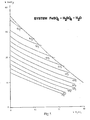
- phase diagrams of actual systems such as FeSO 4 - H 2 SO 4 - H 2 O or FeCl 2 - HC1 - H 2 0.
- Figure 1 shows a corresponding phase diagram for the system FeCl 2 -HCl - H 2 0.
- Figure 3 illustrates on a phase diagram over the system FeSO 4 -H 2 SO 4 - H 2 0 a regenerating procedure both with and without presence of phosphoric acid for a sulphuric acid based pickling solution.
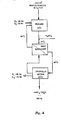
- Figure 4 illustrates in connection with a flow sheet showing the process of the present invention a mass and energy balance according to Example 3.
- the regenerating process is commenced by an addition of a 95 % sulphuric acid, whereby the H 2 S0 4 content of the pickling solution increases, whereas the iron sulphate content decreases due to dilution.
- the acid supply is interrupted at point C when the H 2 S0 4 content has increased to a magnitude which is determined by the desired composition of the pickling solution being regenerated.
- the solution contains then about 13 % H 2 S0 4 and 20 % FeSO 4 .
- Pickling with sulphuric acid is generally carried out at elevated temperatures, such as about 70°C.
- elevated temperatures such as about 70°C.
- sulphuric acid is added to the spent pickling solution a further temperature increase will occur.
- the solution in the example has a temperature of about 77°C.
- iron sulphate precipitation will commence when the temperature reaches a value corresponding to the solubility of the sulphate. In the present case sulphate will begin to precipitate in solid form at about 37°C.
- the content of FeS0 4 in the solution will decrease whereas the content of H 2 SO 4 will decrease due to the fact that FeSO 4 XH 2 O is removed from the solution.
- the point C has been suitable chosen the crystallization will be completed at the point.
- a 1 at which point the solution again has the composition which is suitable for pickling. In this example the solution must be cooled to about 21°C to reach the desired composition.
- the pickling procedure is performed following the same conditions as in Example 1, but the pickling solution is supplied with phosphoric acid so as to reach a content of 0.5 mol/l prior to the regenerating operation.
- the solubility of iron sulphate is hereby lowered, so that the 21°C equilibrium curve (corresponding to the final temperature in Example 1) lies about 5°C lower than in the system free from phosphoric acid. See Figure 3. Precipitation of iron phosphate will not occur at prevailing conditions.
- the pickling operation starts with a solution containing 17 % H 2 S0 4 and 11.5 % FeS0 4 corresponding to point All.
- the acid content decreases to about 10 %, while the iron sulphate content will increase to about 21 %, point B 11 .
- sulphuric acid is supplied until point C11 is reached. At C 11 the acid content is about 13.5 % and the iron sulphate content about 20 %.
- the benefit of utilizing a phosphoric acid containing pickling solution for the regenerating operation is set forth of the energy balances composing the Examples 1 and 2, respectively. In both cases 1000 m 2 steel sheet is pickled and the Fe0 scale removed corresponds to 4 0 g /m 2 .
Landscapes
- Chemical & Material Sciences (AREA)
- Chemical Kinetics & Catalysis (AREA)
- General Chemical & Material Sciences (AREA)
- Engineering & Computer Science (AREA)
- Materials Engineering (AREA)
- Mechanical Engineering (AREA)
- Metallurgy (AREA)
- Organic Chemistry (AREA)
- Cleaning And De-Greasing Of Metallic Materials By Chemical Methods (AREA)
- Separation Using Semi-Permeable Membranes (AREA)
- Ultra Sonic Daignosis Equipment (AREA)
- Television Signal Processing For Recording (AREA)
Priority Applications (1)
| Application Number | Priority Date | Filing Date | Title |
|---|---|---|---|
| AT81850009T ATE7050T1 (de) | 1980-01-18 | 1981-01-16 | Verfahren zur regenerierung von beizloesungen. |
Applications Claiming Priority (2)
| Application Number | Priority Date | Filing Date | Title |
|---|---|---|---|
| SE8000444 | 1980-01-18 | ||
| SE8000444 | 1980-01-18 |
Publications (2)
| Publication Number | Publication Date |
|---|---|
| EP0032886A1 true EP0032886A1 (de) | 1981-07-29 |
| EP0032886B1 EP0032886B1 (de) | 1984-04-11 |
Family
ID=20340024
Family Applications (1)
| Application Number | Title | Priority Date | Filing Date |
|---|---|---|---|
| EP81850009A Expired EP0032886B1 (de) | 1980-01-18 | 1981-01-16 | Verfahren zur Regenerierung von Beizlösungen |
Country Status (6)
| Country | Link |
|---|---|
| EP (1) | EP0032886B1 (de) |
| JP (1) | JPS56501886A (de) |
| AT (1) | ATE7050T1 (de) |
| DE (1) | DE3163015D1 (de) |
| FI (1) | FI68668C (de) |
| WO (1) | WO1981002026A1 (de) |
Cited By (4)
| Publication number | Priority date | Publication date | Assignee | Title |
|---|---|---|---|---|
| WO1986005523A1 (en) * | 1985-03-19 | 1986-09-25 | Korrosionsforskning Ab | Method for pickling iron or steel objects |
| CN1058665C (zh) * | 1994-11-02 | 2000-11-22 | 美国3M公司 | 光学安全制品及其制备方法 |
| WO2001049901A1 (en) * | 2000-01-05 | 2001-07-12 | United States Filter Corporation | Regenerating spent pickling liquor |
| RU2353585C2 (ru) * | 2003-10-06 | 2009-04-27 | Тронокс Пигментс Гмбх | Способ обработки насыщенной железом отработанной серной кислоты |
Families Citing this family (3)
| Publication number | Priority date | Publication date | Assignee | Title |
|---|---|---|---|---|
| DE3422284A1 (de) * | 1983-08-17 | 1985-03-07 | Georg Fischer AG, Schaffhausen, CH, Niederlassung: Georg Fischer AG, 7700 Singen | Verbindungsglied, insbesondere pleuel oder schaekel |
| NL9302035A (nl) * | 1993-11-24 | 1995-06-16 | Piet De Vries | Beitswerkwijze en een inrichting daarvoor. |
| CN103014737A (zh) * | 2011-09-22 | 2013-04-03 | 河南红日锂能源科技有限公司 | 一种冷轧钢酸洗废酸处理方法 |
Citations (5)
| Publication number | Priority date | Publication date | Assignee | Title |
|---|---|---|---|---|
| DE1124781B (de) * | 1958-03-31 | 1962-03-01 | Peter Niedner Dipl Ing | Verfahren zum Aufarbeiten von schwefelsauren Eisenbeizlaugen |
| AT247104B (de) * | 1963-09-02 | 1966-05-25 | Othmar Ing Ruthner | Verfahren zum Regenerieren salzsaurer Eisenbeizen |
| DE1621580A1 (de) * | 1966-07-14 | 1971-05-13 | Gewerk Keramchemie | Verfahren und Vorrichtung zur kontinuierlichen Ausscheidung des Eisens aus schwefelsauren Beizbaedern |
| GB1271891A (en) * | 1969-08-20 | 1972-04-26 | Daido Chem Eng Corp | Regeneration of hydrochloric acid pickling waste |
| DE2209954A1 (de) * | 1972-03-02 | 1973-09-06 | Helmut Babbel | Verfahren und vorrichtung zur aufbereitung einer abfallbeize |
Family Cites Families (11)
| Publication number | Priority date | Publication date | Assignee | Title |
|---|---|---|---|---|
| SU152603A3 (de) * | 1900-01-01 | |||
| US1279331A (en) * | 1918-05-11 | 1918-09-17 | James H Gravell | Pickling iron and steel. |
| US1589610A (en) * | 1925-07-08 | 1926-06-22 | American Copperas Company | Method of reclaiming spent pickling solutions |
| DE561514C (de) * | 1929-10-22 | 1932-10-14 | Ferdinand Fraensemeier | Verfahren zur Behandlung schwefelsaurer Eisenbeizablaugen mit Gewinnung von wasserarmem Eisensulfat |
| FR723484A (fr) * | 1931-08-03 | 1932-04-09 | Zahn & Co G M B H | Procédé d'utilisation, en cycle continu, des lessives de décapage à acide sulfurique avec récupération de l'acide sulfurique libre des solutions de décapage finales |
| US2118802A (en) * | 1936-01-30 | 1938-05-31 | Zahn & Co G M B H | Method of conserving pickling liquor |
| US2155854A (en) * | 1937-05-26 | 1939-04-25 | American Rolling Mill Co | Pickling process |
| US2559445A (en) * | 1946-12-12 | 1951-07-03 | Union Switch & Signal Co | Method for removing scale from steel |
| BE483353A (de) * | 1947-06-25 | |||
| LU32047A1 (de) * | 1952-03-13 | |||
| GB1102463A (en) * | 1963-12-13 | 1968-02-07 | Molbros Ltd | Improvements in or relating to a process for the treatment of spent acid liquors |
-
1981
- 1981-01-16 AT AT81850009T patent/ATE7050T1/de not_active IP Right Cessation
- 1981-01-16 WO PCT/SE1981/000007 patent/WO1981002026A1/en not_active Ceased
- 1981-01-16 EP EP81850009A patent/EP0032886B1/de not_active Expired
- 1981-01-16 JP JP50046081A patent/JPS56501886A/ja active Pending
- 1981-01-16 DE DE8181850009T patent/DE3163015D1/de not_active Expired
- 1981-09-10 FI FI812817A patent/FI68668C/fi not_active IP Right Cessation
Patent Citations (5)
| Publication number | Priority date | Publication date | Assignee | Title |
|---|---|---|---|---|
| DE1124781B (de) * | 1958-03-31 | 1962-03-01 | Peter Niedner Dipl Ing | Verfahren zum Aufarbeiten von schwefelsauren Eisenbeizlaugen |
| AT247104B (de) * | 1963-09-02 | 1966-05-25 | Othmar Ing Ruthner | Verfahren zum Regenerieren salzsaurer Eisenbeizen |
| DE1621580A1 (de) * | 1966-07-14 | 1971-05-13 | Gewerk Keramchemie | Verfahren und Vorrichtung zur kontinuierlichen Ausscheidung des Eisens aus schwefelsauren Beizbaedern |
| GB1271891A (en) * | 1969-08-20 | 1972-04-26 | Daido Chem Eng Corp | Regeneration of hydrochloric acid pickling waste |
| DE2209954A1 (de) * | 1972-03-02 | 1973-09-06 | Helmut Babbel | Verfahren und vorrichtung zur aufbereitung einer abfallbeize |
Cited By (4)
| Publication number | Priority date | Publication date | Assignee | Title |
|---|---|---|---|---|
| WO1986005523A1 (en) * | 1985-03-19 | 1986-09-25 | Korrosionsforskning Ab | Method for pickling iron or steel objects |
| CN1058665C (zh) * | 1994-11-02 | 2000-11-22 | 美国3M公司 | 光学安全制品及其制备方法 |
| WO2001049901A1 (en) * | 2000-01-05 | 2001-07-12 | United States Filter Corporation | Regenerating spent pickling liquor |
| RU2353585C2 (ru) * | 2003-10-06 | 2009-04-27 | Тронокс Пигментс Гмбх | Способ обработки насыщенной железом отработанной серной кислоты |
Also Published As
| Publication number | Publication date |
|---|---|
| JPS56501886A (de) | 1981-12-24 |
| ATE7050T1 (de) | 1984-04-15 |
| FI812817L (fi) | 1981-09-10 |
| FI68668C (fi) | 1985-10-10 |
| FI68668B (fi) | 1985-06-28 |
| EP0032886B1 (de) | 1984-04-11 |
| WO1981002026A1 (en) | 1981-07-23 |
| DE3163015D1 (en) | 1984-05-17 |
Similar Documents
| Publication | Publication Date | Title |
|---|---|---|
| RU2495827C2 (ru) | Способ регенерации оксида железа и хлористоводородной кислоты | |
| US4013430A (en) | Process for regenerating absorbing solution used for exhaust gas purification | |
| JP6468841B2 (ja) | 塩化鉄(iii)含有塩酸溶液中の金属塩化物を濃縮し、かつこれを該溶液から分離する方法 | |
| Anderez et al. | Acid pickling of carbon steel | |
| EP0032886B1 (de) | Verfahren zur Regenerierung von Beizlösungen | |
| KR20130091649A (ko) | 스테인레스강 산세 시스템의 용액으로부터 질산 및 불화수소산을 수득 또는 회수하는 방법 | |
| US4591489A (en) | Process for the treatment of hydrochloric acid pickles containing iron and zinc | |
| WO2001049901A1 (en) | Regenerating spent pickling liquor | |
| JPS6133887B2 (de) | ||
| GB2134095A (en) | Method for regenerating pickling acids | |
| US20090145856A1 (en) | Acid recycle process with iron removal | |
| US2785999A (en) | Process for pickling iron, steel and alloys thereof | |
| EP0968961A2 (de) | Elementare chlorinfreie Umsetzung verbrauchter HCL Beizlösungen durch Oxidation und Konzentration zur Gewinnung wässriger Eisen(III)Clorid-Lösung | |
| Kladnig | A review of steel pickling and acid regeneration an environmental contribution | |
| US7351391B1 (en) | System and method for converting the spent remnants of a first pickling acid solution into a usable second pickling acid solution | |
| Hudson | Pickling and descaling | |
| JP4040136B2 (ja) | 塩浴中で鋼部品を熱処理する際に生じる、硝酸塩・亜硝酸塩・水酸化物含有廃塩から塩成分を選択的に回収する方法 | |
| US2739040A (en) | Treatment of waste sulfate liquor | |
| CN1348020A (zh) | 氯化铁刻蚀或酸洗废液中镍与重金属离子的去除方法 | |
| WO2025057051A1 (en) | Acid regeneration process for pickling process | |
| US2785957A (en) | Regeneration of pickling liquor | |
| JPS5988325A (ja) | 硫酸廃液の処理方法 | |
| WO2025187126A8 (ja) | 鋼帯の酸洗方法及び酸洗設備 | |
| JPS61108696A (ja) | コ−クスの脱リン処理方法 | |
| Brucken et al. | Purification of Metal Salt and Acid Containing Waste Pickling Solutions |
Legal Events
| Date | Code | Title | Description |
|---|---|---|---|
| PUAI | Public reference made under article 153(3) epc to a published international application that has entered the european phase |
Free format text: ORIGINAL CODE: 0009012 |
|
| AK | Designated contracting states |
Designated state(s): AT BE CH DE FR GB IT LI LU NL SE |
|
| 17P | Request for examination filed |
Effective date: 19820126 |
|
| ITF | It: translation for a ep patent filed | ||
| GRAA | (expected) grant |
Free format text: ORIGINAL CODE: 0009210 |
|
| AK | Designated contracting states |
Designated state(s): AT BE CH DE FR GB IT LI LU NL SE |
|
| REF | Corresponds to: |
Ref document number: 7050 Country of ref document: AT Date of ref document: 19840415 Kind code of ref document: T |
|
| REF | Corresponds to: |
Ref document number: 3163015 Country of ref document: DE Date of ref document: 19840517 |
|
| ET | Fr: translation filed | ||
| PGFP | Annual fee paid to national office [announced via postgrant information from national office to epo] |
Ref country code: AT Payment date: 19841227 Year of fee payment: 5 |
|
| PGFP | Annual fee paid to national office [announced via postgrant information from national office to epo] |
Ref country code: SE Payment date: 19841231 Year of fee payment: 5 |
|
| PG25 | Lapsed in a contracting state [announced via postgrant information from national office to epo] |
Ref country code: LU Free format text: LAPSE BECAUSE OF NON-PAYMENT OF DUE FEES Effective date: 19850131 |
|
| PGFP | Annual fee paid to national office [announced via postgrant information from national office to epo] |
Ref country code: NL Payment date: 19850131 Year of fee payment: 5 |
|
| PGFP | Annual fee paid to national office [announced via postgrant information from national office to epo] |
Ref country code: DE Payment date: 19850205 Year of fee payment: 5 |
|
| PLBE | No opposition filed within time limit |
Free format text: ORIGINAL CODE: 0009261 |
|
| STAA | Information on the status of an ep patent application or granted ep patent |
Free format text: STATUS: NO OPPOSITION FILED WITHIN TIME LIMIT |
|
| 26N | No opposition filed | ||
| PG25 | Lapsed in a contracting state [announced via postgrant information from national office to epo] |
Ref country code: AT Effective date: 19860116 |
|
| PG25 | Lapsed in a contracting state [announced via postgrant information from national office to epo] |
Ref country code: SE Effective date: 19860117 |
|
| PG25 | Lapsed in a contracting state [announced via postgrant information from national office to epo] |
Ref country code: LI Effective date: 19860131 Ref country code: CH Effective date: 19860131 Ref country code: BE Effective date: 19860131 |
|
| BERE | Be: lapsed |
Owner name: BOLIDEN A.B. Effective date: 19860131 |
|
| PG25 | Lapsed in a contracting state [announced via postgrant information from national office to epo] |
Ref country code: NL Effective date: 19860801 |
|
| GBPC | Gb: european patent ceased through non-payment of renewal fee | ||
| NLV4 | Nl: lapsed or anulled due to non-payment of the annual fee | ||
| PG25 | Lapsed in a contracting state [announced via postgrant information from national office to epo] |
Ref country code: FR Free format text: LAPSE BECAUSE OF NON-PAYMENT OF DUE FEES Effective date: 19860930 |
|
| REG | Reference to a national code |
Ref country code: CH Ref legal event code: PL |
|
| PG25 | Lapsed in a contracting state [announced via postgrant information from national office to epo] |
Ref country code: DE Effective date: 19861001 |
|
| REG | Reference to a national code |
Ref country code: FR Ref legal event code: ST |
|
| PG25 | Lapsed in a contracting state [announced via postgrant information from national office to epo] |
Ref country code: GB Effective date: 19881118 |
|
| EUG | Se: european patent has lapsed |
Ref document number: 81850009.2 Effective date: 19861029 |