EP0033109B1 - Procédé pour la production hydrothermale de solutions de silicate de sodium dans un récipient de réaction statique - Google Patents
Procédé pour la production hydrothermale de solutions de silicate de sodium dans un récipient de réaction statique Download PDFInfo
- Publication number
- EP0033109B1 EP0033109B1 EP81100352A EP81100352A EP0033109B1 EP 0033109 B1 EP0033109 B1 EP 0033109B1 EP 81100352 A EP81100352 A EP 81100352A EP 81100352 A EP81100352 A EP 81100352A EP 0033109 B1 EP0033109 B1 EP 0033109B1
- Authority
- EP
- European Patent Office
- Prior art keywords
- sand
- reaction
- sodium silicate
- bed
- temperatures
- Prior art date
- Legal status (The legal status is an assumption and is not a legal conclusion. Google has not performed a legal analysis and makes no representation as to the accuracy of the status listed.)
- Expired
Links
- 238000006243 chemical reaction Methods 0.000 title claims abstract description 60
- NTHWMYGWWRZVTN-UHFFFAOYSA-N sodium silicate Chemical compound [Na+].[Na+].[O-][Si]([O-])=O NTHWMYGWWRZVTN-UHFFFAOYSA-N 0.000 title claims abstract description 42
- 239000004115 Sodium Silicate Substances 0.000 title claims abstract description 31
- 229910052911 sodium silicate Inorganic materials 0.000 title claims abstract description 31
- 238000000034 method Methods 0.000 title claims abstract description 28
- 238000004519 manufacturing process Methods 0.000 title claims abstract description 11
- 230000003068 static effect Effects 0.000 title claims abstract description 9
- VYPSYNLAJGMNEJ-UHFFFAOYSA-N Silicium dioxide Chemical compound O=[Si]=O VYPSYNLAJGMNEJ-UHFFFAOYSA-N 0.000 claims abstract description 64
- 239000004576 sand Substances 0.000 claims abstract description 59
- HEMHJVSKTPXQMS-UHFFFAOYSA-M Sodium hydroxide Chemical compound [OH-].[Na+] HEMHJVSKTPXQMS-UHFFFAOYSA-M 0.000 claims abstract description 54
- 238000001914 filtration Methods 0.000 claims abstract description 10
- 239000007791 liquid phase Substances 0.000 claims abstract description 10
- 239000011541 reaction mixture Substances 0.000 claims abstract description 10
- 230000015572 biosynthetic process Effects 0.000 claims abstract description 5
- 229920006395 saturated elastomer Polymers 0.000 claims abstract description 4
- 229910052681 coesite Inorganic materials 0.000 claims abstract 5
- 229910052906 cristobalite Inorganic materials 0.000 claims abstract 5
- 229910052682 stishovite Inorganic materials 0.000 claims abstract 5
- 229910052905 tridymite Inorganic materials 0.000 claims abstract 5
- 239000000203 mixture Substances 0.000 claims description 2
- 239000000377 silicon dioxide Substances 0.000 abstract description 3
- 235000012239 silicon dioxide Nutrition 0.000 abstract 2
- 229910004742 Na2 O Inorganic materials 0.000 abstract 1
- 235000011121 sodium hydroxide Nutrition 0.000 description 15
- 230000035484 reaction time Effects 0.000 description 13
- XLYOFNOQVPJJNP-UHFFFAOYSA-N water Substances O XLYOFNOQVPJJNP-UHFFFAOYSA-N 0.000 description 12
- 239000011734 sodium Substances 0.000 description 10
- 238000001027 hydrothermal synthesis Methods 0.000 description 9
- 229910004298 SiO 2 Inorganic materials 0.000 description 8
- 235000019353 potassium silicate Nutrition 0.000 description 8
- 230000000052 comparative effect Effects 0.000 description 6
- CDBYLPFSWZWCQE-UHFFFAOYSA-L Sodium Carbonate Chemical compound [Na+].[Na+].[O-]C([O-])=O CDBYLPFSWZWCQE-UHFFFAOYSA-L 0.000 description 5
- 238000010438 heat treatment Methods 0.000 description 4
- PEDCQBHIVMGVHV-UHFFFAOYSA-N Glycerine Chemical compound OCC(O)CO PEDCQBHIVMGVHV-UHFFFAOYSA-N 0.000 description 2
- XEEYBQQBJWHFJM-UHFFFAOYSA-N Iron Chemical compound [Fe] XEEYBQQBJWHFJM-UHFFFAOYSA-N 0.000 description 2
- PXHVJJICTQNCMI-UHFFFAOYSA-N Nickel Chemical compound [Ni] PXHVJJICTQNCMI-UHFFFAOYSA-N 0.000 description 2
- 230000000694 effects Effects 0.000 description 2
- 239000007788 liquid Substances 0.000 description 2
- 239000000463 material Substances 0.000 description 2
- 238000002156 mixing Methods 0.000 description 2
- 238000005086 pumping Methods 0.000 description 2
- DGAQECJNVWCQMB-PUAWFVPOSA-M Ilexoside XXIX Chemical compound C[C@@H]1CC[C@@]2(CC[C@@]3(C(=CC[C@H]4[C@]3(CC[C@@H]5[C@@]4(CC[C@@H](C5(C)C)OS(=O)(=O)[O-])C)C)[C@@H]2[C@]1(C)O)C)C(=O)O[C@H]6[C@@H]([C@H]([C@@H]([C@H](O6)CO)O)O)O.[Na+] DGAQECJNVWCQMB-PUAWFVPOSA-M 0.000 description 1
- 239000005909 Kieselgur Substances 0.000 description 1
- 239000006004 Quartz sand Substances 0.000 description 1
- 239000003513 alkali Substances 0.000 description 1
- 229910052910 alkali metal silicate Inorganic materials 0.000 description 1
- 238000001816 cooling Methods 0.000 description 1
- 238000010586 diagram Methods 0.000 description 1
- 230000029087 digestion Effects 0.000 description 1
- 230000008030 elimination Effects 0.000 description 1
- 238000003379 elimination reaction Methods 0.000 description 1
- 239000011521 glass Substances 0.000 description 1
- 235000011187 glycerol Nutrition 0.000 description 1
- 238000007654 immersion Methods 0.000 description 1
- 229910052742 iron Inorganic materials 0.000 description 1
- 239000000155 melt Substances 0.000 description 1
- 238000002844 melting Methods 0.000 description 1
- 230000008018 melting Effects 0.000 description 1
- 229910052759 nickel Inorganic materials 0.000 description 1
- 229910001562 pearlite Inorganic materials 0.000 description 1
- 238000000746 purification Methods 0.000 description 1
- 239000002994 raw material Substances 0.000 description 1
- 239000011435 rock Substances 0.000 description 1
- 238000000926 separation method Methods 0.000 description 1
- NGHMEZWZOZEZOH-UHFFFAOYSA-N silicic acid;hydrate Chemical class O.O[Si](O)(O)O NGHMEZWZOZEZOH-UHFFFAOYSA-N 0.000 description 1
- 239000010802 sludge Substances 0.000 description 1
- 229910052708 sodium Inorganic materials 0.000 description 1
- 239000007787 solid Substances 0.000 description 1
- 239000000725 suspension Substances 0.000 description 1
- 239000002699 waste material Substances 0.000 description 1
Images
Classifications
-
- C—CHEMISTRY; METALLURGY
- C01—INORGANIC CHEMISTRY
- C01B—NON-METALLIC ELEMENTS; COMPOUNDS THEREOF; METALLOIDS OR COMPOUNDS THEREOF NOT COVERED BY SUBCLASS C01C
- C01B33/00—Silicon; Compounds thereof
- C01B33/20—Silicates
- C01B33/32—Alkali metal silicates
Definitions
- the invention relates to an improved process for the hydrothermal production of sodium silicate solutions under pressure and at elevated temperatures in a static reaction vessel and subsequent filtration.
- sodium silicate solutions - commonly referred to as sodium water glass - are most frequently used for technical purposes.
- Sodium water glasses of this type usually have a solids content of about 35 percent by weight and a weight ratio of SiO 2 : Na 2 O of 3.3 to 3.4: 1.
- Such soda water glasses are generally produced on an industrial scale by melting together quartz sand and soda in suitable ovens at temperatures in the range from 1400 to 1500 ° C. the silica drives off the C0 2 .
- the melt which solidifies on cooling - the so-called piece glass - is then dissolved in water in a further process step using pressure and elevated temperatures, and the resulting solution is filtered, depending on the quality requirements.
- sodium silicate solutions with a lower Si0 2 / Na 2 0 weight ratio can be obtained. This method is very expensive both in terms of equipment and in terms of the required amounts of energy and therefore requires relatively high energy and plant costs.
- soda water glasses Another possibility for the production of soda water glasses is hydrothermal digestion of sand with the aid of aqueous sodium hydroxide solution, likewise using pressure and elevated temperatures.
- sodium silicate solutions with a weight ratio Si0 2 : Na 2 0 of up to 2.8: 1 can be obtained by this process.
- Common reaction vessels for such a hydrothermal synthesis are cylindrical iron autoclaves provided with a nickel lining, which, with a view to sufficient mixing of the sand / sodium hydroxide suspension, are either rotatably mounted about their horizontal axis or are provided with appropriate stirrers.
- a disadvantage of this process is that very long reaction times have to be accepted until the sand used has been completely converted - at technically sensible, ie not too high, temperatures.
- the object of the present invention is therefore to develop a hydrothermal process for the production of sodium silicate in which the disadvantages indicated above are avoided.
- this task relates to achieving the highest possible space / time yield when using comparatively low temperatures and thus the lowest possible energy expenditure.
- the invention thus relates to a process for the hydrothermal production of sodium silicate solutions with a SiO 2 : Na 2 O weight ratio of 1 to 2.8: 1 by reacting sand with aqueous sodium hydroxide solution under pressure and at elevated temperatures and subsequent filtration, which is characterized in that that the liquid phase of the reaction mixture at temperatures in the range of 150 to 250 ° C and the pressures of saturated water vapor corresponding to these temperatures as long as in the circuit through a sand bed introduced in a static reaction vessel to form a fluidized bed and through a bypass line arranged outside the vessel pumps until the Si0 2 concentration in the liquid phase has reached a value which corresponds to the range mentioned above.
- the process according to the invention makes it possible, in particular, to produce sodium water glass solutions with an SiO 2 / Na 2 O weight ratio in the range from 1 to 2: 1, which are becoming increasingly important for the production of metasilicates or dihydrogen orthosilicate hydrates, in good yields.
- the disadvantages of the conventional procedure outlined above are invented overcome by applying the specific process features.
- the formation of this fluidized bed thus - with otherwise the same reaction conditions and based on the same amount of sand used - requires both a considerable reduction in the reaction time and a high SiO 2 concentration of the sodium silicate solution formed.
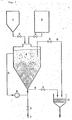
- sand and aqueous sodium hydroxide solution that is to say sodium hydroxide solution
- sodium hydroxide solution are generally introduced in batches from the storage containers 1 and 2 via suitable metering valves 3 into the static pressure vessel 4 serving as a reactor, the sand primarily settling in the lower one - expediently conically trained - settles part of the reaction vessel in the form of a sand bed.
- this sand bed is now brought into motion and kept in motion by continuously pumping around the liquid phase of the reaction mixture in the manner of a fluidized bed process.
- the liquid phase is withdrawn in the upper part from the reaction container and reintroduced into the container through a bypass line 5 arranged outside the container and an appropriate pump 6 at the lower end of the container, so that this liquid flow is always under pressure from below into the sand bed. or into the already formed fluidized bed.
- the “liquid phase of the reaction mixture” essentially means both the aqueous sodium hydroxide solution used and the sodium silicate solution formed in the course of the reaction, but which may also contain portions of the whirled-up sand.
- aqueous sodium hydroxide solution having a concentration of 10 to 50 percent by weight, preferably 20 to 30 percent by weight, is pumped through a sand bed which has an excess of sand of up to 500%, preferably 100 to 200%, based on the molar ratios of Si0 2 and Na 2 0 in the approach.
- the reaction mixture is expediently heated to the required reaction temperature by direct introduction of saturated water vapor into the reaction vessel, with the water vapor advantageously also being introduced into the vessel at the lower end thereof, in order to thereby whirl up the sand bed in the sense of a To support the formation of the fluidized bed essential to the invention.
- the reaction mixture can additionally be heated indirectly by means of suitable heating elements in the reaction vessel or by jacket heating thereof.
- the bypass line 5 can also be equipped with a corresponding heating jacket.
- saturated water vapor is preferably fed to the reaction mixture until the desired reaction temperature is reached, the pressure of the saturated water vapor in the reaction vessel corresponding to this temperature then being established.
- the table below shows an example of some comparative values between the temperature and pressure of saturated water vapor:
- the reaction is carried out at temperatures in the range from 170 to 200 ° C. and the pressures of saturated water vapor corresponding to these temperatures.
- the choice of a relatively low reaction temperature in this preferred temperature range enables - in conjunction with the short reaction times achievable according to the invention - the hydrothermal synthesis to be carried out with the least possible energy expenditure.
- reaction mixture After reaching the desired reaction temperature, the reaction mixture is left in the static pressure vessel under constant pumping around the liquid phase under the set temperature / pressure conditions until a sample of the sodium water glass solution formed reaches the desired Si0 2 / Na z O Weight ratio or the desired Si0 2 concentration indicates.
- the reaction times required for this can generally be determined empirically in the course of a few reaction processes.
- the sodium silicate solution that is formed — still under pressure or expanded to normal pressure — is then transferred through lines 8 or 9 to a sand bed filter 10 in the context of conventional filter units.
- the filter medium for this sand bed filter is preferably the excess sand of the sand bed from the completed hydrothermal synthesis which has already been used for the reaction - optionally in a mixture with excess sand from one of the preceding batch-wise reactions or fresh sand.
- the excess sand which settles in the lower part of the reaction vessel is first transferred to the filter bed, expediently through line 8. Any sand remaining in the reaction vessel can be left in the subsequent reaction or used to prepare the sand bed filter for one of the subsequent batches.
- the sand bed is advantageously prepared by a small amount of liquid flowing in from the bottom, which is circulated, for example water or, if appropriate, sodium silicate solution, in such a way that the fine fractions of the sand used are washed onto the surface of the filter bed and thus form a sufficiently effective filter layer.
- the filter bed used for the filtration it is further preferred to subsequently return the sand of the filter bed used for the filtration to the process and thus to reuse it for the subsequent reaction, including the sodium silicate solution adhering to this sand.
- the elimination of the filter material which is inevitable according to the customary processes, can be dispensed with and, on the other hand, considerable amounts of energy can be saved in the course of the entire process.
- the hydrothermal reaction is carried out continuously, the sodium silicate solution formed being carried out continuously from the reaction vessel and the reaction components likewise being continuously metered into the reaction vessel.
- the introduction of sand and caustic soda into the static reaction vessel is expediently carried out using appropriate pressure pumps; the sand is preferably introduced directly into the lower part of the same through an immersion tube arranged in the container. Adherence to the desired reaction temperature and the pressure is ensured by a correspondingly controlled — optionally continuous — supply of saturated water vapor.
- the sodium water glass solution obtained is withdrawn continuously - preferably via line 9 - from the reaction container and transferred to the sand bed filter.
- the comparative examples below were carried out in the conventional manner of hydrothermally disintegrating sand with aqueous sodium hydroxide solution, and the sodium silicate solution formed was then treated by the customary filtration process.
- a horizontally arranged cylindrical pressure vessel with an empty volume of 340 cm 3 was used as the reaction vessel, which was rotatably mounted about its horizontal axis. It was heated indirectly with the help of a glycerine bath.
- This example according to the invention was carried out - as explained in more detail above - in a cylindrical, vertically arranged static pressure vessel with an empty volume of 3.6 m 3 , which was conical in its lower part and equipped with a bypass line corresponding to the above description.
- the heating was carried out by direct introduction of saturated water vapor at the lower end of the pressure vessel.
- the sodium silicate solution formed after the stated reaction time was filtered through a sand bed filter using the unconverted excess of sand.
- the sodium silicate solution formed after the stated reaction time was likewise filtered through a sand bed filter using the unreacted excess of sand.
- the result was a sodium silicate solution with a weight ratio of SiO 2 / Na 2 O of 1.52: 1 and an SiOg concentration of 20.1 weight percent.
- the process according to the invention can advantageously be used for the hydrothermal production of soda water glass, sodium silicate solutions being formed using relatively low reaction temperatures in comparatively short reaction times, which on the one hand have a high SiO 2 concentration due to the degree of conversion of the raw materials used and which, on the other hand, can be easily cleaned with the aid of the sand bed filter used according to the invention.
Landscapes
- Chemical & Material Sciences (AREA)
- Organic Chemistry (AREA)
- Inorganic Chemistry (AREA)
- Silicates, Zeolites, And Molecular Sieves (AREA)
Claims (5)
Priority Applications (1)
| Application Number | Priority Date | Filing Date | Title |
|---|---|---|---|
| AT81100352T ATE3108T1 (de) | 1980-01-26 | 1981-01-19 | Verfahren zur hydrothermalen herstellung von natriumsilikatloesungen in einem statischen reaktionsbehaelter. |
Applications Claiming Priority (2)
| Application Number | Priority Date | Filing Date | Title |
|---|---|---|---|
| DE19803002834 DE3002834A1 (de) | 1980-01-26 | 1980-01-26 | Verfahren zur hydrothermalen herstellung von natriumsilikatloesungen in einem statischen reaktionsbehaelter |
| DE3002834 | 1980-01-26 |
Publications (2)
| Publication Number | Publication Date |
|---|---|
| EP0033109A1 EP0033109A1 (fr) | 1981-08-05 |
| EP0033109B1 true EP0033109B1 (fr) | 1983-04-20 |
Family
ID=6093034
Family Applications (1)
| Application Number | Title | Priority Date | Filing Date |
|---|---|---|---|
| EP81100352A Expired EP0033109B1 (fr) | 1980-01-26 | 1981-01-19 | Procédé pour la production hydrothermale de solutions de silicate de sodium dans un récipient de réaction statique |
Country Status (3)
| Country | Link |
|---|---|
| EP (1) | EP0033109B1 (fr) |
| AT (1) | ATE3108T1 (fr) |
| DE (2) | DE3002834A1 (fr) |
Families Citing this family (8)
| Publication number | Priority date | Publication date | Assignee | Title |
|---|---|---|---|---|
| DE3121669A1 (de) * | 1981-05-30 | 1982-12-16 | Henkel KGaA, 4000 Düsseldorf | Kontinuierliches verfahren zur reaktion von in fluessiger phase vorliegenden komponenten mit in koerniger form vorliegenden komponenten |
| FR2525204A1 (fr) * | 1982-04-16 | 1983-10-21 | Ugine Kuhlmann | Procede de fabrication de solutions de silicate alcalin dans un reacteur statique |
| FR2541667B2 (fr) * | 1982-04-16 | 1986-07-04 | Ugine Kuhlmann | Procede de fabrication de solutions de silicate alcalin dans un reacteur statique |
| DE3303515A1 (de) * | 1983-02-03 | 1984-08-09 | Henkel KGaA, 4000 Düsseldorf | Hydrothermaler aufschluss von aluminiumsilikat |
| DE3423945A1 (de) * | 1984-06-29 | 1986-01-09 | Henkel KGaA, 4000 Düsseldorf | Verfahren und vorrichtung zur kontinuierlichen hydrothermalen herstellung von natriumsilikatloesungen |
| DE3902754A1 (de) * | 1989-01-31 | 1990-08-02 | Henkel Kgaa | Verfahren zur hydrothermalen herstellung von natriumsilikatloesungen |
| CN102060304B (zh) * | 2010-11-25 | 2012-08-29 | 欧阳天生 | 用于水玻璃生产中放料与过滤的设备及加工方法 |
| TW202543923A (zh) | 2023-12-22 | 2025-11-16 | 法商羅地亞經營管理公司 | 用於由廢鑄造砂製備矽酸鹽和沈澱二氧化矽之水熱方法 |
Citations (3)
| Publication number | Priority date | Publication date | Assignee | Title |
|---|---|---|---|---|
| US2251515A (en) * | 1939-01-23 | 1941-08-05 | Philadelphia Quartz Co | Manufacture of alkali metal silicate solutions |
| DE2118661A1 (en) * | 1971-04-17 | 1972-11-02 | Spalink, Fritz, Dr., 4044 Kaarst | Water glass from quartz and caustic alkali - in aq soln at moderate temp and press |
| US3884645A (en) * | 1970-04-13 | 1975-05-20 | Stauffer Chemical Co | Production of anhydrous sodium metasilicate in a fluidized bed |
Family Cites Families (1)
| Publication number | Priority date | Publication date | Assignee | Title |
|---|---|---|---|---|
| DE2826432C2 (de) * | 1978-06-16 | 1980-10-16 | Henkel Kgaa, 4000 Duesseldorf | Verfahren zur Herstellung von Wasserglas |
-
1980
- 1980-01-26 DE DE19803002834 patent/DE3002834A1/de not_active Withdrawn
-
1981
- 1981-01-19 EP EP81100352A patent/EP0033109B1/fr not_active Expired
- 1981-01-19 AT AT81100352T patent/ATE3108T1/de not_active IP Right Cessation
- 1981-01-19 DE DE8181100352T patent/DE3160189D1/de not_active Expired
Patent Citations (3)
| Publication number | Priority date | Publication date | Assignee | Title |
|---|---|---|---|---|
| US2251515A (en) * | 1939-01-23 | 1941-08-05 | Philadelphia Quartz Co | Manufacture of alkali metal silicate solutions |
| US3884645A (en) * | 1970-04-13 | 1975-05-20 | Stauffer Chemical Co | Production of anhydrous sodium metasilicate in a fluidized bed |
| DE2118661A1 (en) * | 1971-04-17 | 1972-11-02 | Spalink, Fritz, Dr., 4044 Kaarst | Water glass from quartz and caustic alkali - in aq soln at moderate temp and press |
Also Published As
| Publication number | Publication date |
|---|---|
| EP0033109A1 (fr) | 1981-08-05 |
| DE3160189D1 (en) | 1983-05-26 |
| ATE3108T1 (de) | 1983-05-15 |
| DE3002834A1 (de) | 1981-07-30 |
Similar Documents
| Publication | Publication Date | Title |
|---|---|---|
| AT397077B (de) | Verfahren zur herstellung von natriumsilikaten | |
| EP0164073B1 (fr) | Méthode pour la fabrication hydrothermique de solutions limpides de silicates de sodium | |
| CH494733A (de) | Verfahren zur Herstellung von p-Aminophenol | |
| EP0033108B1 (fr) | Procédé pour la production hydrothermale de solutions de silicate de sodium | |
| EP0456654A1 (fr) | PROCEDE DE PRODUCTION HYDROTHERMIQUE DE SOLUTIONS DE SILICATE DE POTASSIUM A RAPPORT MOLAIRE ELEVE ENTRE SiO 2? ET K 2?O | |
| EP0006202B1 (fr) | Procédé de préparation de verre soluble | |
| EP0033109A1 (fr) | Procédé pour la production hydrothermale de solutions de silicate de sodium dans un récipient de réaction statique | |
| EP0118588B1 (fr) | Décomposition hydrothermale de silicates d'aluminium | |
| EP0017799A1 (fr) | Procédé pour la fabrication d'éthers de cellulose solubles dans l'eau froide pour des compositions de lavage et de nettoyage | |
| DE3121919A1 (de) | Hydrothermale direktsynthese von alkalisilikaten | |
| DE3902754A1 (de) | Verfahren zur hydrothermalen herstellung von natriumsilikatloesungen | |
| DE3825874C2 (fr) | ||
| WO1990008735A1 (fr) | PROCEDE DE PRODUCTION HYDROTHERMIQUE DE SOLUTIONS DE SILICATE DE SODIUM AYANT UN RAPPORT MOLAIRE ELEVE ENTRE SiO2 ET Na2O | |
| EP0097892B1 (fr) | Procédé de décomposition hydrothermique de déchets chimiques et résidus à grande teneur en oxydes d'aluminium calcinés | |
| DE2014783C3 (de) | Verfahren zur Abtrennung von Schwefelsäure aus einem Reaktionsgemisch | |
| AT353708B (de) | Verwendung von pulverfoermigen zeolithischen molekularsieben | |
| DE1768781C3 (de) | Verfahren zur Herstellung von Orthokieselsäuretetraäthylester | |
| DE557661C (de) | Herstellung von Alkalihydroxyd durch Umsetzung von Alkalifluorid mit AEtzkalk oder dessen AEquivalenten | |
| DE880282C (de) | Trennung des Tantals und Niobs von den Anionen bildenden Metallen der 3., 4., 5. und 6. Gruppe des Periodischen Systems und von Kieselsaeure | |
| DE1228360B (de) | Verfahren zur Desodorierung von Kohlenwasserstoffgemischen | |
| DE2026484C3 (de) | Verfahren zur Gewinnung von Natriumfluorid und Kieselsäuregel | |
| DE2034014C3 (de) | Verfahren zur Herstellung von geradkettigen aliphatischen Carbonsäuren | |
| DE2065477B2 (de) | Verfahren zur Abtrennung von Schwefelsäure aus einem Reaktionsgemisch. Ausscheidung aus: 2014783 | |
| DE1211142B (de) | Verfahren zur Herstellung von Dialdehydstaerke | |
| DD142034A5 (de) | Verfahren zur herstellung von reinem natriummetaborat |
Legal Events
| Date | Code | Title | Description |
|---|---|---|---|
| PUAI | Public reference made under article 153(3) epc to a published international application that has entered the european phase |
Free format text: ORIGINAL CODE: 0009012 |
|
| AK | Designated contracting states |
Designated state(s): AT BE CH DE FR GB IT NL SE |
|
| 17P | Request for examination filed |
Effective date: 19811028 |
|
| ITF | It: translation for a ep patent filed | ||
| GRAA | (expected) grant |
Free format text: ORIGINAL CODE: 0009210 |
|
| AK | Designated contracting states |
Designated state(s): AT BE CH DE FR GB IT LI NL SE |
|
| REF | Corresponds to: |
Ref document number: 3108 Country of ref document: AT Date of ref document: 19830515 Kind code of ref document: T |
|
| REF | Corresponds to: |
Ref document number: 3160189 Country of ref document: DE Date of ref document: 19830526 |
|
| ET | Fr: translation filed | ||
| ITTA | It: last paid annual fee | ||
| PGFP | Annual fee paid to national office [announced via postgrant information from national office to epo] |
Ref country code: CH Payment date: 19931223 Year of fee payment: 14 |
|
| PGFP | Annual fee paid to national office [announced via postgrant information from national office to epo] |
Ref country code: DE Payment date: 19931229 Year of fee payment: 14 |
|
| PGFP | Annual fee paid to national office [announced via postgrant information from national office to epo] |
Ref country code: GB Payment date: 19940111 Year of fee payment: 14 Ref country code: FR Payment date: 19940111 Year of fee payment: 14 Ref country code: AT Payment date: 19940111 Year of fee payment: 14 |
|
| PGFP | Annual fee paid to national office [announced via postgrant information from national office to epo] |
Ref country code: SE Payment date: 19940117 Year of fee payment: 14 |
|
| PGFP | Annual fee paid to national office [announced via postgrant information from national office to epo] |
Ref country code: NL Payment date: 19940131 Year of fee payment: 14 |
|
| PGFP | Annual fee paid to national office [announced via postgrant information from national office to epo] |
Ref country code: BE Payment date: 19940309 Year of fee payment: 14 |
|
| PG25 | Lapsed in a contracting state [announced via postgrant information from national office to epo] |
Ref country code: GB Effective date: 19950119 Ref country code: AT Effective date: 19950119 |
|
| PG25 | Lapsed in a contracting state [announced via postgrant information from national office to epo] |
Ref country code: SE Effective date: 19950120 |
|
| EAL | Se: european patent in force in sweden |
Ref document number: 81100352.4 |
|
| PG25 | Lapsed in a contracting state [announced via postgrant information from national office to epo] |
Ref country code: LI Effective date: 19950131 Ref country code: CH Effective date: 19950131 Ref country code: BE Effective date: 19950131 |
|
| BERE | Be: lapsed |
Owner name: HENKEL K.G.A.A. Effective date: 19950131 |
|
| PG25 | Lapsed in a contracting state [announced via postgrant information from national office to epo] |
Ref country code: NL Effective date: 19950801 |
|
| GBPC | Gb: european patent ceased through non-payment of renewal fee |
Effective date: 19950119 |
|
| PG25 | Lapsed in a contracting state [announced via postgrant information from national office to epo] |
Ref country code: FR Effective date: 19950929 |
|
| REG | Reference to a national code |
Ref country code: CH Ref legal event code: PL |
|
| NLV4 | Nl: lapsed or anulled due to non-payment of the annual fee |
Effective date: 19950801 |
|
| PG25 | Lapsed in a contracting state [announced via postgrant information from national office to epo] |
Ref country code: DE Effective date: 19951003 |
|
| EUG | Se: european patent has lapsed |
Ref document number: 81100352.4 |
|
| REG | Reference to a national code |
Ref country code: FR Ref legal event code: ST |
|
| PLBE | No opposition filed within time limit |
Free format text: ORIGINAL CODE: 0009261 |
|
| STAA | Information on the status of an ep patent application or granted ep patent |
Free format text: STATUS: NO OPPOSITION FILED WITHIN TIME LIMIT |