EP0034444A2 - Augmentation de l'activité catalytique d'une zéolite - Google Patents
Augmentation de l'activité catalytique d'une zéolite Download PDFInfo
- Publication number
- EP0034444A2 EP0034444A2 EP81300484A EP81300484A EP0034444A2 EP 0034444 A2 EP0034444 A2 EP 0034444A2 EP 81300484 A EP81300484 A EP 81300484A EP 81300484 A EP81300484 A EP 81300484A EP 0034444 A2 EP0034444 A2 EP 0034444A2
- Authority
- EP
- European Patent Office
- Prior art keywords
- conversion
- temperature
- activity
- water
- pressure
- Prior art date
- Legal status (The legal status is an assumption and is not a legal conclusion. Google has not performed a legal analysis and makes no representation as to the accuracy of the status listed.)
- Granted
Links
Images
Classifications
-
- B—PERFORMING OPERATIONS; TRANSPORTING
- B01—PHYSICAL OR CHEMICAL PROCESSES OR APPARATUS IN GENERAL
- B01J—CHEMICAL OR PHYSICAL PROCESSES, e.g. CATALYSIS OR COLLOID CHEMISTRY; THEIR RELEVANT APPARATUS
- B01J29/00—Catalysts comprising molecular sieves
- B01J29/04—Catalysts comprising molecular sieves having base-exchange properties, e.g. crystalline zeolites
- B01J29/06—Crystalline aluminosilicate zeolites; Isomorphous compounds thereof
-
- B—PERFORMING OPERATIONS; TRANSPORTING
- B01—PHYSICAL OR CHEMICAL PROCESSES OR APPARATUS IN GENERAL
- B01J—CHEMICAL OR PHYSICAL PROCESSES, e.g. CATALYSIS OR COLLOID CHEMISTRY; THEIR RELEVANT APPARATUS
- B01J29/00—Catalysts comprising molecular sieves
- B01J29/04—Catalysts comprising molecular sieves having base-exchange properties, e.g. crystalline zeolites
- B01J29/06—Crystalline aluminosilicate zeolites; Isomorphous compounds thereof
- B01J29/40—Crystalline aluminosilicate zeolites; Isomorphous compounds thereof of the pentasil type, e.g. types ZSM-5, ZSM-8 or ZSM-11, as exemplified by patent documents US3702886, GB1334243 and US3709979, respectively
-
- B—PERFORMING OPERATIONS; TRANSPORTING
- B01—PHYSICAL OR CHEMICAL PROCESSES OR APPARATUS IN GENERAL
- B01J—CHEMICAL OR PHYSICAL PROCESSES, e.g. CATALYSIS OR COLLOID CHEMISTRY; THEIR RELEVANT APPARATUS
- B01J29/00—Catalysts comprising molecular sieves
- B01J29/04—Catalysts comprising molecular sieves having base-exchange properties, e.g. crystalline zeolites
- B01J29/06—Crystalline aluminosilicate zeolites; Isomorphous compounds thereof
- B01J29/70—Crystalline aluminosilicate zeolites; Isomorphous compounds thereof of types characterised by their specific structure not provided for in groups B01J29/08 - B01J29/65
- B01J29/7034—MTW-type, e.g. ZSM-12, NU-13, TPZ-12 or Theta-3
-
- B—PERFORMING OPERATIONS; TRANSPORTING
- B01—PHYSICAL OR CHEMICAL PROCESSES OR APPARATUS IN GENERAL
- B01J—CHEMICAL OR PHYSICAL PROCESSES, e.g. CATALYSIS OR COLLOID CHEMISTRY; THEIR RELEVANT APPARATUS
- B01J37/00—Processes, in general, for preparing catalysts; Processes, in general, for activation of catalysts
- B01J37/08—Heat treatment
- B01J37/10—Heat treatment in the presence of water, e.g. steam
-
- C—CHEMISTRY; METALLURGY
- C07—ORGANIC CHEMISTRY
- C07C—ACYCLIC OR CARBOCYCLIC COMPOUNDS
- C07C2/00—Preparation of hydrocarbons from hydrocarbons containing a smaller number of carbon atoms
- C07C2/02—Preparation of hydrocarbons from hydrocarbons containing a smaller number of carbon atoms by addition between unsaturated hydrocarbons
- C07C2/04—Preparation of hydrocarbons from hydrocarbons containing a smaller number of carbon atoms by addition between unsaturated hydrocarbons by oligomerisation of well-defined unsaturated hydrocarbons without ring formation
- C07C2/06—Preparation of hydrocarbons from hydrocarbons containing a smaller number of carbon atoms by addition between unsaturated hydrocarbons by oligomerisation of well-defined unsaturated hydrocarbons without ring formation of alkenes, i.e. acyclic hydrocarbons having only one carbon-to-carbon double bond
- C07C2/08—Catalytic processes
- C07C2/12—Catalytic processes with crystalline alumino-silicates or with catalysts comprising molecular sieves
-
- C—CHEMISTRY; METALLURGY
- C07—ORGANIC CHEMISTRY
- C07C—ACYCLIC OR CARBOCYCLIC COMPOUNDS
- C07C2/00—Preparation of hydrocarbons from hydrocarbons containing a smaller number of carbon atoms
- C07C2/54—Preparation of hydrocarbons from hydrocarbons containing a smaller number of carbon atoms by addition of unsaturated hydrocarbons to saturated hydrocarbons or to hydrocarbons containing a six-membered aromatic ring with no unsaturation outside the aromatic ring
-
- C—CHEMISTRY; METALLURGY
- C07—ORGANIC CHEMISTRY
- C07C—ACYCLIC OR CARBOCYCLIC COMPOUNDS
- C07C4/00—Preparation of hydrocarbons from hydrocarbons containing a larger number of carbon atoms
- C07C4/02—Preparation of hydrocarbons from hydrocarbons containing a larger number of carbon atoms by cracking a single hydrocarbon or a mixture of individually defined hydrocarbons or a normally gaseous hydrocarbon fraction
- C07C4/06—Catalytic processes
-
- C—CHEMISTRY; METALLURGY
- C07—ORGANIC CHEMISTRY
- C07C—ACYCLIC OR CARBOCYCLIC COMPOUNDS
- C07C5/00—Preparation of hydrocarbons from hydrocarbons containing the same number of carbon atoms
- C07C5/22—Preparation of hydrocarbons from hydrocarbons containing the same number of carbon atoms by isomerisation
- C07C5/2206—Catalytic processes not covered by C07C5/23 - C07C5/31
- C07C5/222—Catalytic processes not covered by C07C5/23 - C07C5/31 with crystalline alumino-silicates, e.g. molecular sieves
-
- C—CHEMISTRY; METALLURGY
- C07—ORGANIC CHEMISTRY
- C07C—ACYCLIC OR CARBOCYCLIC COMPOUNDS
- C07C5/00—Preparation of hydrocarbons from hydrocarbons containing the same number of carbon atoms
- C07C5/32—Preparation of hydrocarbons from hydrocarbons containing the same number of carbon atoms by dehydrogenation with formation of free hydrogen
- C07C5/373—Preparation of hydrocarbons from hydrocarbons containing the same number of carbon atoms by dehydrogenation with formation of free hydrogen with simultaneous isomerisation
- C07C5/393—Preparation of hydrocarbons from hydrocarbons containing the same number of carbon atoms by dehydrogenation with formation of free hydrogen with simultaneous isomerisation with cyclisation to an aromatic six-membered ring, e.g. dehydrogenation of n-hexane to benzene
- C07C5/41—Catalytic processes
-
- C—CHEMISTRY; METALLURGY
- C07—ORGANIC CHEMISTRY
- C07C—ACYCLIC OR CARBOCYCLIC COMPOUNDS
- C07C6/00—Preparation of hydrocarbons from hydrocarbons containing a different number of carbon atoms by redistribution reactions
-
- C—CHEMISTRY; METALLURGY
- C07—ORGANIC CHEMISTRY
- C07C—ACYCLIC OR CARBOCYCLIC COMPOUNDS
- C07C6/00—Preparation of hydrocarbons from hydrocarbons containing a different number of carbon atoms by redistribution reactions
- C07C6/08—Preparation of hydrocarbons from hydrocarbons containing a different number of carbon atoms by redistribution reactions by conversion at a saturated carbon-to-carbon bond
- C07C6/12—Preparation of hydrocarbons from hydrocarbons containing a different number of carbon atoms by redistribution reactions by conversion at a saturated carbon-to-carbon bond of exclusively hydrocarbons containing a six-membered aromatic ring
- C07C6/123—Preparation of hydrocarbons from hydrocarbons containing a different number of carbon atoms by redistribution reactions by conversion at a saturated carbon-to-carbon bond of exclusively hydrocarbons containing a six-membered aromatic ring of only one hydrocarbon
-
- C—CHEMISTRY; METALLURGY
- C10—PETROLEUM, GAS OR COKE INDUSTRIES; TECHNICAL GASES CONTAINING CARBON MONOXIDE; FUELS; LUBRICANTS; PEAT
- C10G—CRACKING HYDROCARBON OILS; PRODUCTION OF LIQUID HYDROCARBON MIXTURES, e.g. BY DESTRUCTIVE HYDROGENATION, OLIGOMERISATION, POLYMERISATION; RECOVERY OF HYDROCARBON OILS FROM OIL-SHALE, OIL-SAND, OR GASES; REFINING MIXTURES MAINLY CONSISTING OF HYDROCARBONS; REFORMING OF NAPHTHA; MINERAL WAXES
- C10G11/00—Catalytic cracking, in the absence of hydrogen, of hydrocarbon oils
- C10G11/02—Catalytic cracking, in the absence of hydrogen, of hydrocarbon oils characterised by the catalyst used
- C10G11/04—Oxides
- C10G11/05—Crystalline alumino-silicates, e.g. molecular sieves
-
- C—CHEMISTRY; METALLURGY
- C10—PETROLEUM, GAS OR COKE INDUSTRIES; TECHNICAL GASES CONTAINING CARBON MONOXIDE; FUELS; LUBRICANTS; PEAT
- C10G—CRACKING HYDROCARBON OILS; PRODUCTION OF LIQUID HYDROCARBON MIXTURES, e.g. BY DESTRUCTIVE HYDROGENATION, OLIGOMERISATION, POLYMERISATION; RECOVERY OF HYDROCARBON OILS FROM OIL-SHALE, OIL-SAND, OR GASES; REFINING MIXTURES MAINLY CONSISTING OF HYDROCARBONS; REFORMING OF NAPHTHA; MINERAL WAXES
- C10G49/00—Treatment of hydrocarbon oils, in the presence of hydrogen or hydrogen-generating compounds, not provided for in a single one of groups C10G45/02, C10G45/32, C10G45/44, C10G45/58 or C10G47/00
- C10G49/02—Treatment of hydrocarbon oils, in the presence of hydrogen or hydrogen-generating compounds, not provided for in a single one of groups C10G45/02, C10G45/32, C10G45/44, C10G45/58 or C10G47/00 characterised by the catalyst used
- C10G49/08—Treatment of hydrocarbon oils, in the presence of hydrogen or hydrogen-generating compounds, not provided for in a single one of groups C10G45/02, C10G45/32, C10G45/44, C10G45/58 or C10G47/00 characterised by the catalyst used containing crystalline alumino-silicates, e.g. molecular sieves
-
- B—PERFORMING OPERATIONS; TRANSPORTING
- B01—PHYSICAL OR CHEMICAL PROCESSES OR APPARATUS IN GENERAL
- B01J—CHEMICAL OR PHYSICAL PROCESSES, e.g. CATALYSIS OR COLLOID CHEMISTRY; THEIR RELEVANT APPARATUS
- B01J2229/00—Aspects of molecular sieve catalysts not covered by B01J29/00
- B01J2229/10—After treatment, characterised by the effect to be obtained
- B01J2229/26—After treatment, characterised by the effect to be obtained to stabilize the total catalyst structure
-
- B—PERFORMING OPERATIONS; TRANSPORTING
- B01—PHYSICAL OR CHEMICAL PROCESSES OR APPARATUS IN GENERAL
- B01J—CHEMICAL OR PHYSICAL PROCESSES, e.g. CATALYSIS OR COLLOID CHEMISTRY; THEIR RELEVANT APPARATUS
- B01J2229/00—Aspects of molecular sieve catalysts not covered by B01J29/00
- B01J2229/30—After treatment, characterised by the means used
- B01J2229/36—Steaming
-
- B—PERFORMING OPERATIONS; TRANSPORTING
- B01—PHYSICAL OR CHEMICAL PROCESSES OR APPARATUS IN GENERAL
- B01J—CHEMICAL OR PHYSICAL PROCESSES, e.g. CATALYSIS OR COLLOID CHEMISTRY; THEIR RELEVANT APPARATUS
- B01J2229/00—Aspects of molecular sieve catalysts not covered by B01J29/00
- B01J2229/30—After treatment, characterised by the means used
- B01J2229/42—Addition of matrix or binder particles
-
- B—PERFORMING OPERATIONS; TRANSPORTING
- B01—PHYSICAL OR CHEMICAL PROCESSES OR APPARATUS IN GENERAL
- B01J—CHEMICAL OR PHYSICAL PROCESSES, e.g. CATALYSIS OR COLLOID CHEMISTRY; THEIR RELEVANT APPARATUS
- B01J29/00—Catalysts comprising molecular sieves
- B01J29/04—Catalysts comprising molecular sieves having base-exchange properties, e.g. crystalline zeolites
- B01J29/06—Crystalline aluminosilicate zeolites; Isomorphous compounds thereof
- B01J29/65—Crystalline aluminosilicate zeolites; Isomorphous compounds thereof of the ferrierite type, e.g. types ZSM-21, ZSM-35 or ZSM-38, as exemplified by patent documents US4046859, US4016245 and US4046859, respectively
-
- B—PERFORMING OPERATIONS; TRANSPORTING
- B01—PHYSICAL OR CHEMICAL PROCESSES OR APPARATUS IN GENERAL
- B01J—CHEMICAL OR PHYSICAL PROCESSES, e.g. CATALYSIS OR COLLOID CHEMISTRY; THEIR RELEVANT APPARATUS
- B01J29/00—Catalysts comprising molecular sieves
- B01J29/04—Catalysts comprising molecular sieves having base-exchange properties, e.g. crystalline zeolites
- B01J29/06—Crystalline aluminosilicate zeolites; Isomorphous compounds thereof
- B01J29/70—Crystalline aluminosilicate zeolites; Isomorphous compounds thereof of types characterised by their specific structure not provided for in groups B01J29/08 - B01J29/65
- B01J29/7046—MTT-type, e.g. ZSM-23, KZ-1, ISI-4 or EU-13
-
- C—CHEMISTRY; METALLURGY
- C07—ORGANIC CHEMISTRY
- C07C—ACYCLIC OR CARBOCYCLIC COMPOUNDS
- C07C2529/00—Catalysts comprising molecular sieves
- C07C2529/04—Catalysts comprising molecular sieves having base-exchange properties, e.g. crystalline zeolites, pillared clays
- C07C2529/06—Crystalline aluminosilicate zeolites; Isomorphous compounds thereof
- C07C2529/40—Crystalline aluminosilicate zeolites; Isomorphous compounds thereof of the pentasil type, e.g. types ZSM-5, ZSM-8 or ZSM-11
-
- C—CHEMISTRY; METALLURGY
- C07—ORGANIC CHEMISTRY
- C07C—ACYCLIC OR CARBOCYCLIC COMPOUNDS
- C07C2529/00—Catalysts comprising molecular sieves
- C07C2529/04—Catalysts comprising molecular sieves having base-exchange properties, e.g. crystalline zeolites, pillared clays
- C07C2529/06—Crystalline aluminosilicate zeolites; Isomorphous compounds thereof
- C07C2529/65—Crystalline aluminosilicate zeolites; Isomorphous compounds thereof of the ferrierite type, e.g. types ZSM-21, ZSM-35 or ZSM-38
-
- C—CHEMISTRY; METALLURGY
- C07—ORGANIC CHEMISTRY
- C07C—ACYCLIC OR CARBOCYCLIC COMPOUNDS
- C07C2529/00—Catalysts comprising molecular sieves
- C07C2529/04—Catalysts comprising molecular sieves having base-exchange properties, e.g. crystalline zeolites, pillared clays
- C07C2529/06—Crystalline aluminosilicate zeolites; Isomorphous compounds thereof
- C07C2529/70—Crystalline aluminosilicate zeolites; Isomorphous compounds thereof of types characterised by their specific structure not provided for in groups C07C2529/08 - C07C2529/65
Definitions
- This invention relates to a method for substantially increasing the acid catalytic activity of members of a unique class of crystalline zeolites by treatment with water under controlled conditions.
- Hydrogen zeolites of the 1 to 12 constraint index type are generally prepared from their alkyl ammonium and ammonium form precursors by calcining in an inert atmosphere, usually in nitrogen at about 1000 0 F.
- the more costly nitrogen atmosphere is chosen over the cheaper heating in air to avoid temperature runaway and steam formation that is known to damage the catalyst and results in lower activity.
- Small samples in the laboratory can be calcined in air without significant steam damage if the temperature is controlled by a slow heat up and by allowing any steam formed to diffuse away. With this careful first calcination, hydrogen zeolites result that are free of residual nitrogen compounds and have the maximum number of acidic hydroxyl group, which is equal to the number of framework aluminums. Samples thusly prepared are designated “fresh samples”. The corresponding catalytic activity of these fresh samples is called “initial activity” and when measured by the alpha ( ⁇ ) test as described hereinafter, assigned the designation of " ⁇ o .”
- U.S. Patent 3,493,519 teaches a method of using steam for the stabilization of Y-faujasite zeolite. There, a chelating agent was used after steaming to take out the excess aluminum from the zeolite.
- the resultant catalyst of this process is a hydrothermally stable zeolite catalyst having high hydrocarbon conversion activity.
- a rare earth exchanged zeolite hydrocracking catalyst such as zeolites X or Y can be improved with respect to its cracking activity and selectivity by using water in controlled amounts to activate catalyst cracking sites.
- This disclosure states that the amount of water be maintained during the process such that the water vapor partial pressure is kept at a level of about 10 to about 130 mm. water vapor.
- the members of the unique class of zeolites of the present invention are characterized by a silica to alumina mole ratio of at least 12 and a constraint index within the approximate range of 1 to 12. Unlike other catalyst activation methods, water (steam) addition during the catalytic reaction is not a requirement, rather the catalyst is treated prior to use.
- the enhanced zeolite activity attainable by the use of the method of this invention is achieved only under carefully controlled conditions. These conditions depend on the interplay of several variables such as temperature, water partial pressure, treating time, nature of zeolite and nature of treating gas. There exists a "zone of enhanced activity" where zeolite activity is increased over initial activity. Under conditions that are too mild, catalyst activation is not obtained. Alternatively, under too severe conditions, the catalyst will undergo deactivation. Under conditions of constant temperature, the following expression approximately describes the relationships of two variables, treating time and water partial pressure:
- ammonia is used to suppress catalyst activity
- ammonia addition yields even higher activities than with water treating alone.
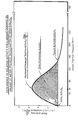
- the drawing is a plot of relative activity for n-hexane cracking versus water partial pressure in the calcination of HZSM-5/Al 2 O 3 .
- the catalyst used in the method described herein comprises a crystalline zeolite which is a member of a class of zeolites exhibiting some unusual properties. These zeolites induce profound transformation of aliphatic hydrocarbons to aromatic hydrocarbons in commercially desirable yields and are generally highly effective in conversion reactions involving aromatic hydrocarbons. Although they have unusually low alumina contents, i.e., high silica to alumina mole ratios, they are very active even when the silica to-alumina mole ratio exceeds 30. The activity is surprising since catalytic activity is generally attributed to framework aluminum atoms and cations associated with these aluminum atoms. These zeolites retain their crystallinity for long periods in spite of the presence of steam at high temperature which induces irreversible collapse of the framework of other zeolites, e.g., of the X and A type.
- the crystal structure of this class of zeolites provides constrained access to, and egress from the intracrystalline free space by virtue of having a pore dimension greater than about 5 Angstroms and pore windows of about a size such as would be provided by 10-membered rings of silicon atoms interconnected by oxygen. It is to be understood, of course, that these rings are those formed by the regular disposition of the tetrahedra making up the anionic framework of the crystalline zeolite, the oxygen atoms themselves being bonded to the silicon or aluminum atoms at the centers of the tetrahedra.
- the preferred type zeolites useful in this invention possess, in combination: a silica to alumina mole ratio of at least about 12; and a structure providing constrained access to the intercrystalline free space.
- the silica to alumina mole ratio referred to may be determined by conventional analysis. This ratio is meant to represent, as closely as possible, the ratio in the rigid anionic framework of the zeolite crystal and to exclude aluminum in the binder or in cationic or other form within the channels.
- zeolites with a silica to alumina mole ratio of at least 12 are useful, it is preferred to use zeolites having higher ratios of at least about 30.
- Such zeolites after activation, acquire an intracrystalline sorption capacity for normal hexane which is greater than that for water, i.e., they exhibit "hydrophobic" properties. It is believed that this hydrophobic character is advantageous in the present invention.
- the type zeolites useful in this invention freely sorb normal hexane and have a pore dimension greater than about 5 Angstroms.
- the structure must provide constrained access to larger molecules. It is sometimes possible to judge from a known crystal structure whether such constrained access exists. For example, if the only pore windows in a crystal are formed by 8-membered rings of silicon and aluminum atoms, then access by molecules of larger cross-section than normal hexane is excluded and the zeolite is not of the desired type. Windows of 10-membered rings are preferred, although, in some instances, excessive puckering or pore blockage may render these zeolites ineffective.
- a simple determination of the "constraint index" may be made by passing continuously a mixture of an equal weight of normal hexane and 3-methylpentane over a sample of zeolite at atmospheric pressure according to the following procedure.
- a sample of the zeolite, in the form of pellets or extrudate, is crushed to a particle size about that of coarse sand and mounted in a glass tube.
- the zeolite Prior to testing, the zeolite is treated with a stream of air at 1000 0 F for at least 15 minutes. The zeolite is then flushed with helium and the temperature adjusted between 550°F and 950°F to give an overall conversion between 10o and 60%.
- the mixture of hydrocarbons is passed at a 1 liquid hourly space velocity (i.e., 1 volume of liquid hydrocarbon per volume of zeolite per hour) over the zeolite with a helium dilution to give a helium to total hydrocarbon mole ratio of 4:1.
- a sample of the effluent is taken and analyzed, most conveniently by gas chromatography, to determine the fraction remaining unchanged for each of the two hydrocarbons.
- the "constraint index” is calculated as follows:
- the constraint index approximates the ratio of the cracking rate constants for the two hydrocarbons.
- Zeolites suitable for the present invention are those having a constraint index in the approximate range of 1 to 12.
- Constraint Index (CI) values for some typical zeolites are:
- the above constraint index values typically characterize the specified zeolites but that such are the cumulative result of several variables used in determination and calculation thereof.
- the constraint index may vary within the indicated approximate range of 1 to 12.
- other variables such as the crystal size of the zeolite, the presence of possible occluded contaminants and binders intimately combined with the zeolite may affect the constraint index.
- the class of zeolites defined herein is exemplified by ZSM-5, ZSM-11, ZSM-12, ZSM-23, ZSM-35 and ZSM-38 and other similar materials.
- U.S. Patent 3,702,886 describing and claiming ZSM-5 is incorporated herein by reference.
- ZSM-11 is more particularly described in U.S. Patent 3,709,979, the entire contents of which is incorporated herein by reference.
- ZSM-12 is more particularly described in U.S. Patent 3,832,449, the entire contents of which is incorporated herein by reference.
- ZSM-23 is more particularly described in U.S. Patent 4,076,842, the entire contents of which is incorporated herein by reference.
- ZSM-35 is more particularly described in U.S. Patent 4,016.,245, the entire contents of which is incorporated herein by reference.
- ZSM-38 is more particularly described in U.S. Patent 4,046,859, the entire contents of which is incorporated herein by reference.
- the specific zeolites described, when prepared in the presence of organic cations, are catalytically inactive, possibly because the intracrystalline free space is occupied by organic cations from the forming solution. They may be activated by heating in an inert atmosphere at 1000°F for one hour, for example, followed by base exchange with ammonium salts followed by calcination at 1000°F in air.
- the presence of organic cation in the forming solution may not be absolutely essential to the formation of this type zeolite; however, the presence of these cations does appear to favor the formation of this special type catalyst by base exchange with ammonium salts followed by calcination in air at about 1000°F for from about 15 minutes to about 24 hours.
- Natural zeolites may sometimes be converted to this type zeolite catalyst by various activation procedures and other treatments such as base exchange, steaming, alumina extraction and calcination, in combinations. Natural minerals which may be so treated include ferrierite, brewsterite, stilbite, dachiardite, epistilbite, heulandite, and clinoptilolite.
- the preferred crystalline zeolites are ZSM-5, ZSM-11, ZSM-12, ZSM-23, ZSM-35 and ZSM-38, with ZSM-5 particularly preferred.
- the zeolites hereof are selected as those having a crystal framework density, in the dry hydrogen form, of not substantially below about 1.6 grams per cubic centimeter. It has been found that zeolites which satisfy all three of these criteria are most desired. Therefore, the preferred zeolites of this invention are those having a constraint index, as defined above of about 1 to about 12, a silica to alumina mole ratio of at least about 12 and a dried crystal density of not less than about 1.6 grams per cubic centimeter.
- the dry density for known structures may be calculated from the number of silicon plus aluminum atoms per 100 cubic Angstroms, as given, e.g., on Page 19 of the article on Zeolite Structure by W. M. Meier.
- the crystal framework density may be determined by classical pykonmeter techniques. For example, it may be determined by immersing the dry hydrogen form of the zeolite in an organic solvent which is not sorbed by the crystal. It is possible that the unusual sustained activity and stability of this class of zeolites is associated with its high crystal anionic framework density of not less than about 1.6 grams per cubic centimeter. This high density, of course, must be associated with a relative small amount of free space within the crystal, which might be expected to result in more stable structures. This free apace, however, is important as the locus of catalytic activity.
- Crystal framework densities of some typical zeolites are:
- the zeolite When synthesized in the alkali metal form, the zeolite is conveniently converted to the hydrogen form, generally by intermediate formation of the ammonium form as a result of ammonium ion exchange and calcination of ammonium form to yield the hydrogen form.
- the hydrogen form In addition to the hydrogen form, other forms of the zeolite wherein the original alkali metal has been reduced to less than about 1.5 percent by weight may be used.
- the original alkali metal of the zeolite or introduced hydrogen cations may be replaced by ion exchange with other suitable ions of Groups IB to VIII of the Periodic Table, including, by way of example, nickel, cadmium, copper, zinc, palladium, calcium or rare earth metals.
- crystalline aluminosilicate zeolite in another material resistant to the temperature and other conditions employed in the process.
- matrix materials include synthetic or naturally occurring substances as well as inorganic materials such as clay, silica and/or metal oxides. The latter may be either naturally occurring or in the form of gelatinous precipitates or gels including mixtures of silica and metal oxides.
- Naturally occurring clays which can be composited with the zeolite include those of the montmorillonite and kaolin families, which families include the sub-bentonites and the kaolins commonly known as Dixie, McNamee-Georgia and Florida clays or others in which the main mineral constituent is halloysite, kaolinite, dickite, nacrite or anauxite.
- Such clays can be used in a raw state as originally mined or initially subjected to calcination, acid treatment or chemical modification.
- the zeolites employed herein may be composited with a porous matrix material, such as alumina, silica-alumina, silica-magnesia, silica-zirconia, silica-thoria, silica-berylia, silica-titania as well as ternary compositions, such as silica-alumina-thoria, silica-alumina-zirconia, silica-alumina-magnesia and silica-magnesia-zirconia.
- the matrix may be in the form of a cogel.
- the relative proportions of zeolite component and inorganic oxide gel matrix may vary widely with the zeolite content ranging from between about 1 to about 99 percent by weight and more usually in the range of about 5 to about 80 percent by weight of the composite.
- the degree of zeolite catalyst activity for all acid catalyzed reactions can be measured and compared by means of "alpha value" ( ⁇ ).
- the alpha value reflects the relative activity of the catalyst with respect to a high activity silica-alumina cracking catalyst.
- n-hexane conversion is determined at a suitable temperature between about 550°F-1000°F, preferably at 1000°F. Conversion is varied by variation in space velocity such that a conversion level of up to about 60 percent of n-hexane is obtained and converted to a rate constant per unit volume of zeolite and compared with that of silica-alumina catalyst which is normalized to a reference activity of 1000 o F.
- Catalytic activity of the catalysts are expressed as multiple of this standard, i.e. the silica-alumina standard.
- the silica-alumina reference catalyst contains about 10 weight percent A1 2 0 3 and the remainder Si0 2 . This method of determining alpha, modified as described above; is more fully described in the Journal of Catalysis; Vol. VI; pages 278-287; 1966.
- Relative activity is the ratio of the activity of the catalyst after treatment over the initial activity.
- relative activity can be expressed as follows:
- the relative activity of a catalyst at the point of initial activity is therefore 1 since .
- the relative activity of a catalyst at the point of maximum enhanced activity can be expressed as follows:
- said zeolites are treated with water, e.g. steam, or water, e.g. steam, produced in-situ.
- water produced in-situ include alcohol dehydration to produce olefins and steam; and hydrocarbon or coke combustion in the presence of oxygen to form carbon oxides and steam.
- the zeolite should be at least partially in the acidic form, e.g. hydrogen form.
- Suitable zeolitic forms also include those that are at least partially convertible to the hydrogen form under treatment conditions, e.g. the ammonium form, or alkyl ammonium form.
- Catalyst activation occurs in a limited region of conditions which can be defined as a "zone of enhanced activity".
- This zone encompasses those conditions which yield activities greater than the initial activity ( ⁇ o ).
- the zone is that area bounded by the activity of an untreated catalyst-initial activity and the activity of the catalyst when it returns to the initial activity.
- the zone of enhanced activity is that area bounded by the initial relative activity ( ) and the return to initial relative activity ( ).
- the zone of enhanced activity embraces all conditions and combinations thereof yielding activities greater than the initial catalyst activity.
- One such activity in this zone is the maximum activity.
- zeolite nature two particular factors can be evaluated.
- One factor is the specific zeolite employed, such as ZSM-5, ZSM-11, ZSM-12, ZSM-23, ZSM-35, ZSM-38, etc.
- Another factor is the crystal size of the particular zeolite employed.
- small crystal size zeolites are those generally of 0.02 to 0.05 microns and large crystal size zeolites are those of generally 0.1 microns and greater.
- the extent of the zone of enhanced activity can also be modified by adjustments in the controlled conditions of treating time, temperature and water partial pressure.
- controlled conditions are such that, for example, an increase in water partial pressure, at constant temperature, will lessen the required treating time to attain a certain activity enhancement.
- increasing the temperature, at constant water partial pressure also lessens the required treating time to attain a specific activity enhancement.
- the nature of the treating gas is another influential factor in catalyst activity enhancement.
- the treating gas in all cases contains either steam or steam producing compounds and mixtures.
- ammonia is a constituent of the treating gas, even greater zeolite maximum activities than those attainable by steam alone can be achieved. Also the zone of enhanced activity is extended.
- the preferred range for ammonia addition is from about 0.01 to about 10 mole ratio ammonia/steam and more preferably from about 0.1 to about 1.0 mole ratio ammonia/steam.
- Zeolites activated in accordance with the present invention are generally useful as catalysts in acid catalyzed hydrocarbon conversion processes over a range of conversion conditions.
- Such conditions include a reaction temperature of from about 95 0 to about 1200 0 F, preferably from about 390 0 to about 1000°F, a reaction pressure of from atmospheric to about 10,000 psig, preferably from about atmospheric to about 3,500 psig, and a hydrogen/hydrocarbon . compound mole ratio of from 0 to about 20, preferably from 0 to about 10.
- the weight hourly space velocity (WHSV) should be maintained at between about 0.1 hr- 1 and about 1000 hr- 1 , preferably between about 0.5 hr- 1 and about 10 hr- 1 .
- the contact time should be maintained at between about 0.01 hour and about 48 hours, preferably between about 0.1 hour and about 24 hours.
- the subject catalysts have extremely high cracking activity and may be used to convert materials such as gas oils, fuel petroleum crudes, paraffins, olefins and the like from high to low molecular weight substances.
- the activated catalysts produced by the instant invention may also be used in hydrocracking, alkylation, dealkylation, transalkylation, isomerization, dimerization, oligomerization, polymerization, addition, disproportionation, aromatization, hydration and many other acid catalyzed reactions.
- a typical alkylation reaction involves the use of aromatics and olefins to synthesize such materials as ethylbenzene, ethyltoluene, or cumene.
- Another alkylation reaction involves the use of aromatics and paraffins.
- a typical transalkylation reaction involves reacting benzene and methylnaphthalene to form toluene and naphthalene.
- Another transalkylation reaction is the conversion of toluene and trimethylbenzene to xylenes.
- Typical disproportionation reactions include the conversion of toluene to benzene and xylenes or the conversion of methylnaphthalene to naphthalene and dimethylnaphthalenes.
- Isomerization reactions may be carried out with diverse feedstocks such as paraffins, olefins or alkyl aromatics, e.g. xylenes.
- catalytic conversion conditions should be maintained within certain ranges, including a temperature of from about 95° to about 935 0 F, preferably from about 390°F to about 810°F, a pressure of from about atmospheric to about 10,000 psig, preferably from about atmospheric to about 2,000 psig, a WHSV (when a flow operation) of from about 0.1 hr- 1 to about 1000 hr- 1 , preferably from about 0.5 hr- 1 to about 100 hr- 1 , and a contact time (when a batch operation) of from about 0.1 hour to about 48 hours, preferably from about 0.5 hour to about 24 hours and a hydrogen/hydrocarbon (i.e. olefin) mole ratio of from about 0 to about 20, preferably from about 0 to about 10.
- a temperature of from about 95° to about 935 0 F preferably from about 390°F to about 810°F
- a pressure of from about atmospheric to about 10,000 psig, preferably from about atmospheric to about 2,000
- catalytic conversion conditions should be maintained within certain ranges, including a temperature of from about 550°F to about 1200°F, preferably from about 650°F to about 1100°F, a pressure of from about atmospheric to about 10,000 psig, preferably from about atmospheric to about 2000 psig, a WHSV (when a flow operation) of from about 0.1 hr -1 to about 10 hr- 1 , preferably from about 1 hr- 1 to about 5 hr- 1 , a contact time (when a batch operation) of from about 0.1 hour to about 48 hours, preferably from about 1 hour to about 24 hours and a hydrogen/hydrocarbon, i.e. olefin or paraffin, mole ratio of from about 0 to about 20, preferably from about 0 to about 10.
- catalytic conversion conditions should be maintained within certain ranges, including a temperature of from about 700° to about 1200°F, preferably from about 800° to about 1100°F, a pressure of from about atmospheric to about 200 psig, a WHSV (when a flow operation) of from about 0.5 hr -1 to about 50 hr- 1 , preferably from about 1 hr- 1 to about 10 hr- 1 , and a contact time (when a batch operation) of from about 0.01 hour to about 24 hours, preferably from about 0.1 hour to about 10 hours.
- catalytic conversion conditions should be maintained within somewhat different ranges, including a temperature of from about 400° to about 1000°F, preferably from about 500° to about 850°F, a pressure of from about 500 psig to about 3500 psig, a WHSV (when a flow operation) of from about 0.1 hr- 1 to about 10 hr- 1 , preferably from about 0.2 hr- 1 to about 5 hr- 1 , a contact time (when a batch operation) of from about 0.1 hour to about 10 hours, preferably from about 0.2 hour to about 5 hours and a hydrogen/hydrocarbon mole ratio of from about 1 to about 20, preferably from about 3 to about 10.
- a temperature of from about 400° to about 1000°F, preferably from about 500° to about 850°F, a pressure of from about 500 psig to about 3500 psig, a WHSV (when a flow operation) of from about 0.1 hr- 1 to about 10 hr- 1 , preferably from
- conversion conditions include a temperature of between about 450 o F and about 1000 0 F, a pressure of between about 0 and about 500 psig, a WHSV of between about 0.1 and 200 hr- 1 , and a hydrogen to hydrocarbon mole ratio of between about 0.1 and about 10.
- conversion conditions include a temperature of between about 100°F and about 950°F for alkylation and a temperature of between about 650°F and about 1100°F for transalkylation, a pressure of between about 0 and about 1000 psig for both alkylation and transalkylation, and a WHSV of between about 1 and about 500 for alkylation and of between about 1 and 20 for transalkylation.
- conversion conditions include a temperature of between about 650°F and about 1100°F, a pressure of between about 0 and about 1000 psig, a WHSV of between about 1 and about 20 and a hydrogen to hydrocarbon mole ratio of between about 0 and about 4.
- the carrying out of the activity enhancement method of this invention can be accomplished concomitant with zeolite manufacture.
- a conventionally treated catalyst can be utilized in a particular process with enhancement being brought about later, such as in subsequent cycles, or between cycles.
- a "small crystal size” ZSM-5 with a crystal size of about 0.02 to 0.05 microns was prepared as follows:
- An acid solution was prepared by adding 1 part aluminum sulfate (17.2 wt % A1 2 0 3 ) to 17.1 parts water, followed by 2.4 parts sulfuric acid (93 wt % H 2 S0 4 ) and 2.7 parts NaCl.
- the silicate solution and the acid solution were . mixed in an agitated vessel while 2.0 parts of NaCl and 0.8 parts water were added to form a gel.
- An organic solution was prepared by adding 1.9 parts tri-n-propylamine, 1.7 parts n-propyl bromide and 3.2 parts methyl-ethyl ketone.
- the organic solution was added to the gel and the mixture was reacted at about 220°F without agitation and held there for 14-15 hours to prereact the organics.
- the agitation was commenced to start the initial crystallization period.
- the temperature was raised to 320° and held there for about three hours to complete crystallization.
- the excess or unreacted organics were flashed off and the remaining contents were cooled and discharged.
- the zeolite was then washed and dried.
- the product was identified as ZSM-5 with a sodium level of about 0.01 wt % and having a silica to alumina mole ratio of about 70.
- the zeolite was mixed with alpha alumina monohydrate and water to an extrudable consistency and formed into 1/16" extrudates.
- the extrudates were dried, calcined in flowing N 2 for 3 hours at 1000°F then ion exchanged twice with 1N NH 4 N0 3 solution (5 parts NH 4 N0 3 solution/1 part zeolite) for 1 hour at ambient temperature and dried.
- a 50 cc sample of ammonium ZSM-5 prepared according to the procedure of Example 1 and containing A1 2 0 3 as a binder material was calcined in an air flow of 1500 cc/min of air to yield a hydrogen form of the zeolite. Aliquot portions of this calcined material were then calcined for 2-1/2 hours at 1000°F in flowing nitrogen containing various water partial pressures and relative hexane cracking activities were determined at 750°F for purposes of comparison. The results for this example are shown in Table 1 and graphically shown in the drawing.
- a "large crystal size" ZSM-5 with a crystal size of about 1-5 microns was prepared as follows:
- An acid salution was prepared by adding 1 part aluminum sulfate (17.2 wt % A1 2 0 3 ) to 16.4 parts water, followed by 2.4 parts sulfuric acid (93 wt % H 2 SO 4 ) and 1.2 parts NaCl.
- An organic solution was prepared by adding 1.6 parts n-propyl bromide and 3.1 parts methyl-ethyl ketone to 1.9 parts tri-n-propylamine and added to the gel.
- the mixture was reacted at 150-160°F with severe agitation for 29 hours.
- the zeolite slurry product was diluted with 4-5 parts water per part slurry and 0.0002 parts of flocculent (Rohm & Haas Primafloc C-7) per part slurry, allowed to settle and supernatant liquid was drawn off.
- the settled solids were reslurried to the original volume of the preceding step with water and 0.00005 parts of flocculent per part slurry. After settling, the aqueous phase was decanted. This procedure was repeated until the decant supernatant liquid was Cl- free.
- the washed zeolite was then filtered, dried and identified as ZSM-5 having a silica/alumina mole ratio of at least 12; i.e., about 70, and a constraint index of between 1 and 12; i.e., about 8.3.
- the dried zeolite product was calcined in flowing N 2 for 3 hours at 538 0 C then ion exchanged twice with 1N NH 4 N0 3 solution (5 parts NH 4 N0 3 sol'n/1 part zeolite) for 1 hour at ambient temp. and dried at about 120°C.
- Example 5 Large crystal size ZSM-5 prepared according to Example 4 and used in its hydrogen form was treated at three different temperatures, all in one atmosphere steam for various amounts of time.
- Example 5 was conducted at 750°F;
- Example 6 was conducted at 800°F and
- Example 7 was conducted at 1000°F.
- Relative activities measured at 1000°F in terms of alpha values were evaluated for all the time intervals in all three examples. The results for these examples are given in Table 2.
- the effect of temperature can be evaluated.
- the time required to reach the maximum relative activity is decreased.
- the maximum relative activity is achieved after 23 hours, while at 800°F, the maximum relative activity is attained after 8 hours.
- the duration of catalyst activation is decreased.
- the duration of catalyst activation is between 70 hours and 170 hours, while at 1000°F, the duration of catalyst activation is only 3.2 hours.
- the "duration of catalyst activation” is defined as the amount of treating time required for the catalyst activity to return to its initial value (to a value of relative of activity - 1).
- ZSM-5 with a crystal size of about 0.1 - 0.5 microns was prepared as follows:
- An acid solution was prepared by adding 1 part aluminum sulfate (17.2 wt % Al 2 0 3 ) to 16.4 parts water, followed by 2.4 parts sulfuric acid (93 wt % H 2 S0 4 ) and 1.2 parts NaCl.
- An organic solution was prepared by adding 1.6 parts n-propyl bromide and 3.1 parts methyl-ethyl ketone to 1.9 parts tri-n-propylamine.
- the zeolite slurry product was diluted with 4-5 parts water per part slurry, allowed to settle and supernatant liquid was drawn off. The settled solids were reslurried to the original volume of the preceding step with water. After settling, the aqueous phase was decanted. This procedure was repeated until the sodium level of the zeolite was less than 1.0 wt%.
- the washed zeolite was then filtered, dried and identified as ZSM-5 having a silica/alumina mole ratio of at least 12; i.e., about 70, and a constraint index of between 1 and 12; i.e., about 8.3.
- Example 9 The intermediate size zeolite ZSM-5 prepared according to the procedure of Example 8 and used in its hydrogen form was heated at a rate of 20°C per minute in a stream of dry helium. This zeolite had an initial activity in terms of alpha value of 211.
- Example 9 the HZSM-5 has heated to 1400°F and held for 2 hours at that temperature.
- Example 10 the HZSM-5 was heated to 1800°F and then rapidly cooled. After treatments according to Example 9 and Example 10, the activities of the zeolite in terms of alpha value were determined. The results for these examples is shown in Table 3.
- HZSM-11 was prepared according to the procedure given in Example 6, Table II of U.S. Patent 4,108,881 and was converted to NH 4 ZSM-11 by the following method:
- the NH 4 ZSM-11 prepared according to the general procedure of Example 11 was heated for 10 hours at 1000°F in a closed container, thus providing an atmosphere containing both steam and ammonia. This treatment resulted in a 3.1 fold increase in catalytic activity relative to a sample that was treated in an inert atmosphere.
- An acid solution was prepared by mixing 1 part aluminum sulfate (17.2 wt % A1 2 0 3 ), 1.4 parts sulfuric acid, 0.8 parts sodium chloride and 6.3 parts water.
- the silicate solution and acid solution were combined in a mixing nozzle and the.resulting gel discharged into an agitated vessel to which 0.4 parts of water had been added.
- the gel was thoroughly mixed at ambient temperature and 0.6 parts of sodium chloride was added to the mixture.
- a solution containing 1.4 parts of tetrabutylammonium bromide and 2.1 parts water was added to the mixture.
- the temperature of the gel mixture was raised to 220°F with severe agitation and held for 256 hours until crystallization was complete.
- the crystallized product was cooled, filtered, washed free of soluble salts and dried. The dried product was analyzed by X-ray diffraction and identified as ZSM-11.
- the NH 4 ZSM-11 prepared according to the general procedure of Example 13 was heated for 10 hours at 1000°F in a closed container.
- the treatment resulted in a 4.2 fold increase in catalytic activity relative to a sample treated in an inert atmosphere.
- Zeolite ZSM-12 was prepared according to the following procedure:
- the washed and dried zeolite was calcined in flowing N 2 for 3 hours at 1000°F then ion exchanged three times with 1N NH 4 N0 3 solution (5 parts NH 4 N0 3 sol'n/1 part zeolite) for 1 hour at ambient temperature and dried at about 250°F.
- Example 5 A sample of HZSM-5 prepared according to the general procedure of Example 4 was steam activated for 10 hours at 1000°F in a closed container. Toluene at a rate of 10 WHSV and 1 atmosphere pressure was passed over both the treated and untreated HZSM-5 catalyst at 900°F in a vertical flow reactor. Toluene was disproportionated to benzene, xylenes and small amounts of trimethyl benzenes. The results of Example 17 are exhibited in Table 5.
- Example 20 The experimental procedure and catalyst used in this example were the same as described in Example 2, except that in this example an inert gas stream containing about 3-14 vol. % ammonia was utilized along with the specified partial pressure amounts of steam. After each treatment, the sample was heated in a dry nitrogen stream to 1000°F to remove adsorbed water and ammonia and the relative activity for cracking hexane was determined at 750 0 F. The results for Example 20 are given in Table 7.
- Example 2 the synergistic action of both steam and ammonia produce catalysts with even greater activity than by steam treatment alone.
- the maximum relative activity is 3.8
- ammonia is added to the steam
- the maximum relative activity is 8.8.
- the range of treating conditions that give enhanced activities, rather than deactivation is increased.
- the range of beneficial steam pressures is increased from 5 to 149 torr for steam to a range of 5 to about 700 torr steam by the addition of small concentrations of ammonia.
Landscapes
- Chemical & Material Sciences (AREA)
- Organic Chemistry (AREA)
- Chemical Kinetics & Catalysis (AREA)
- Crystallography & Structural Chemistry (AREA)
- Engineering & Computer Science (AREA)
- Oil, Petroleum & Natural Gas (AREA)
- Materials Engineering (AREA)
- General Chemical & Material Sciences (AREA)
- Thermal Sciences (AREA)
- Physics & Mathematics (AREA)
- Catalysts (AREA)
- Organic Low-Molecular-Weight Compounds And Preparation Thereof (AREA)
- Production Of Liquid Hydrocarbon Mixture For Refining Petroleum (AREA)
- Silicates, Zeolites, And Molecular Sieves (AREA)
- Low-Molecular Organic Synthesis Reactions Using Catalysts (AREA)
Applications Claiming Priority (2)
| Application Number | Priority Date | Filing Date | Title |
|---|---|---|---|
| US06/121,339 US4326994A (en) | 1980-02-14 | 1980-02-14 | Enhancement of zeolite catalytic activity |
| US121339 | 1993-09-14 |
Publications (4)
| Publication Number | Publication Date |
|---|---|
| EP0034444A2 true EP0034444A2 (fr) | 1981-08-26 |
| EP0034444A3 EP0034444A3 (en) | 1981-11-25 |
| EP0034444B1 EP0034444B1 (fr) | 1984-10-03 |
| EP0034444B2 EP0034444B2 (fr) | 1992-09-30 |
Family
ID=22396037
Family Applications (1)
| Application Number | Title | Priority Date | Filing Date |
|---|---|---|---|
| EP81300484A Expired - Lifetime EP0034444B2 (fr) | 1980-02-14 | 1981-02-05 | Augmentation de l'activité catalytique d'une zéolite |
Country Status (5)
| Country | Link |
|---|---|
| US (1) | US4326994A (fr) |
| EP (1) | EP0034444B2 (fr) |
| JP (1) | JPS56130233A (fr) |
| CA (1) | CA1170281A (fr) |
| DE (1) | DE3166388D1 (fr) |
Cited By (14)
| Publication number | Priority date | Publication date | Assignee | Title |
|---|---|---|---|---|
| EP0134333A1 (fr) * | 1983-08-15 | 1985-03-20 | Mobil Oil Corporation | Traitement de zéolites |
| EP0134330A1 (fr) * | 1983-08-15 | 1985-03-20 | Mobil Oil Corporation | Traitement de zéolites |
| EP0148540A1 (fr) * | 1982-02-08 | 1985-07-17 | Mobil Oil Corporation | Catalyseur actif de stabilité améliorée |
| EP0169027A3 (en) * | 1984-07-16 | 1986-05-21 | Mobil Oil Corporation | Method for reclaiming a heat-damaged zeolite catalyst |
| EP0299671A3 (fr) * | 1987-07-13 | 1989-05-24 | Mobil Oil Corporation | Production d'huiles de graissage à haut indice de viscosité à partir de faibles oléfines et de faibles quantités d'eau |
| WO1991018851A3 (fr) * | 1990-06-07 | 1992-01-09 | Exxon Chemical Patents Inc | Procede de conversion catalytique d'olefines |
| WO1994012452A1 (fr) * | 1992-12-02 | 1994-06-09 | The British Petroleum Company Plc | Procede de production d'olefines ramifiees |
| EP0704416A1 (fr) * | 1994-09-27 | 1996-04-03 | Chevron U.S.A. Inc. | Préparation de benzène à haute purété et des p-xylènes par combinaison d'une aromatisation et de la disproportion de toluène impur |
| US6008426A (en) * | 1990-06-07 | 1999-12-28 | Exxon Chemical Patents Inc. | Process for catalytic conversion of olefins |
| US6410813B1 (en) * | 1999-06-17 | 2002-06-25 | Fina Research, S.A. | Production of olefins |
| FR3017621A1 (fr) * | 2014-02-19 | 2015-08-21 | IFP Energies Nouvelles | Procede d'oligomerisation d'olefines utilisant un catalyseur comprenant une zeolithe et un liant alumine ayant subi une etape de traitement thermique specifique |
| FR3017622A1 (fr) * | 2014-02-19 | 2015-08-21 | IFP Energies Nouvelles | Procede d'oligomerisation d'olefines utilisant un catalyseur comprenant une zeolithe et un liant silicique ayant subi une etape de traitement thermique specifique |
| WO2018046515A1 (fr) | 2016-09-09 | 2018-03-15 | Total Research & Technology Feluy | Procédé de déshydratation de mono-alcool (s) à l'aide d'un aluminosilicate cristallin modifié |
| WO2022106230A1 (fr) * | 2020-11-23 | 2022-05-27 | IFP Energies Nouvelles | Procede de preparation d'un catalyseur a base de zeolithe de code structural mfi presentant une densite et une tenue mecanique ameliorees |
Families Citing this family (67)
| Publication number | Priority date | Publication date | Assignee | Title |
|---|---|---|---|---|
| US4324940A (en) * | 1980-04-09 | 1982-04-13 | Mobil Oil Corporation | Shape selective acid catalyzed reactions of olefins over crystalline zeolites |
| US4477584A (en) * | 1981-06-26 | 1984-10-16 | Mobil Oil Corporation | Para-selective zeolite catalysts treated with nitrogen compounds |
| US4370508A (en) * | 1981-06-26 | 1983-01-25 | Mobil Oil Corporation | Para-selective zeolite catalysts treated with nitrogen compounds |
| US4550092A (en) * | 1981-11-21 | 1985-10-29 | Mobil Oil Corporation | Activity enhancement of high silica zeolites |
| US4522929A (en) * | 1982-02-08 | 1985-06-11 | Mobil Oil Corporation | Active zeolite catalysts of improved stability |
| US4663492A (en) * | 1982-02-08 | 1987-05-05 | Mobil Oil Corporation | Active zeolite catalysts of improved stability for producing gasoline from methanol |
| US4523046A (en) * | 1982-02-25 | 1985-06-11 | Mobil Oil Corporation | Method for gasoline yield enhancement in the fixed bed methanol-to-gasoline process |
| US4559314A (en) * | 1982-03-22 | 1985-12-17 | Mobil Oil Corporation | Zeolite activation |
| US4443554A (en) * | 1982-05-28 | 1984-04-17 | Mobil Oil Corporation | Activation of alkali metal zeolite catalysts by steaming |
| GB8308684D0 (en) * | 1983-03-29 | 1983-05-05 | British Petroleum Co Plc | Production of gallium loaded hydrocarbon conversion catalyst |
| NZ207523A (en) * | 1983-04-22 | 1986-03-14 | Mobil Oil Corp | Catalytic production of olefin mixtures from alcohols and/or ethers |
| US4788377A (en) * | 1983-04-22 | 1988-11-29 | Mobil Oil Corporation | Process for manufacturing olefins |
| JPS59227841A (ja) * | 1983-06-08 | 1984-12-21 | Nitto Chem Ind Co Ltd | ジメチルアミンの選択的製造法 |
| US4599475A (en) * | 1983-09-28 | 1986-07-08 | Mobil Oil Corporation | Process for xylene isomerization using ZSM-23 zeolite |
| US4594146A (en) * | 1983-10-06 | 1986-06-10 | Mobil Oil Corporation | Conversion with zeolite catalysts prepared by steam treatment |
| JPH0811739B2 (ja) * | 1983-10-25 | 1996-02-07 | 三菱化学株式会社 | メチルナフタレン類の不均化方法 |
| US4626609A (en) * | 1984-01-23 | 1986-12-02 | Mobil Oil Corporation | Aromatic compound conversion |
| US4642404A (en) * | 1984-01-23 | 1987-02-10 | Mobil Oil Corporation | Conversion of olefins and paraffins to higher hydrocarbons |
| US4621161A (en) * | 1984-01-23 | 1986-11-04 | Mobil Oil Corporation | Oxygenate conversion over activated zeolite catalyst |
| EP0156490B1 (fr) * | 1984-03-12 | 1992-03-25 | Mobil Oil Corporation | Procédé de craquage catalytique avec ZSM-5 en employant des cristaux ZSM-5 de grande dimension |
| US4828679A (en) * | 1984-03-12 | 1989-05-09 | Mobil Oil Corporation | Octane improvement with large size ZSM-5 catalytic cracking |
| US4678763A (en) * | 1984-07-16 | 1987-07-07 | Mobil Oil Corporation | Method for reclaiming heat-damaged catalysts |
| US4900529A (en) * | 1984-09-04 | 1990-02-13 | W. R. Grace & Co.-Conn. | Process for making crystalline siliceous materials |
| US4665258A (en) * | 1986-02-06 | 1987-05-12 | Cosden Technology, Inc. | Toluene disproportionation process |
| US4814503A (en) * | 1986-06-27 | 1989-03-21 | E. I. Du Pont De Nemours And Company | Zeolite rho and ZK-5 catalysts for conversion of methanol and ammonia to dimethylamine |
| US4663025A (en) * | 1986-08-14 | 1987-05-05 | Phillips Petroleum Company | Catalytic cracking processes |
| US4912275A (en) * | 1987-08-05 | 1990-03-27 | Mobil Oil Corporation | Ammonium activation of zeolites in the presence of gaseous ammonia |
| US4837398A (en) * | 1987-08-05 | 1989-06-06 | Mobil Oil Corporation | Ammonium activation of zeolites in the presence of gaseous ammonia |
| JPH0798946B2 (ja) * | 1988-08-13 | 1995-10-25 | 日本石油化学株式会社 | 副生油の処理方法 |
| US5157185A (en) * | 1989-09-01 | 1992-10-20 | Mobil Oil Corporation | Alkylation of aromatics |
| KR100229405B1 (ko) * | 1992-06-25 | 1999-11-01 | 고오사이 아끼오 | 제올라이트성형체의 강도향상방법 |
| US5349114A (en) * | 1993-04-05 | 1994-09-20 | Mobil Oil Corp. | Shape selective hydrocarbon conversions over modified catalyst |
| US5365004A (en) * | 1993-05-28 | 1994-11-15 | Mobil Oil Corp. | Selective toluene disproportionation process (STDP) with ex situ selectivated zeolite catalysts |
| US5406015A (en) * | 1993-05-28 | 1995-04-11 | Mobil Oil Corp. | Selective ethylbenzene disproportionation processes (SEBDP) with ex situ selectivated zeolite catalyst |
| US5403800A (en) * | 1993-05-28 | 1995-04-04 | Mobil Oil Corp. | Multiple impregnation technique for the preparation of ex situ selectivated zeolite catalysts |
| US5659098A (en) * | 1993-05-28 | 1997-08-19 | Beck; Jeffrey S. | High conversion touluene disproportionation with ex situ selectivated zeolite catalysts |
| US5698756A (en) * | 1993-05-28 | 1997-12-16 | Mobil Oil Corporation | Toluene alkylation with ethylene to produce para-ethyloluene |
| US5382737A (en) * | 1993-05-28 | 1995-01-17 | Mobil Oil Corp. | Selective ethylbenzene disproportionation process (SEBDP) with ex situ selectivated zeolite catalysts |
| US5367099A (en) * | 1993-05-28 | 1994-11-22 | Mobil Oil Corp. | Selective toluene disproportionation process (STDP) with ex situ selectivated zeolite catalyst |
| US5530170A (en) * | 1993-05-28 | 1996-06-25 | Mobil Oil Corporation | Ethylbenzene alkylation with ethylene to produce para-diethylbenzene |
| US6576582B1 (en) | 1993-05-28 | 2003-06-10 | Exxonmobil Oil Corporation | Binderless ex situ selectivated zeolite catalyst |
| US5476823A (en) * | 1993-05-28 | 1995-12-19 | Mobil Oil Corp. | Method of preparation of ex situ selectivated zeolite catalysts for enhanced shape selective applications and method to increase the activity thereof |
| JP2734944B2 (ja) * | 1993-08-27 | 1998-04-02 | 三菱化学株式会社 | シクロヘキサノールの製造方法 |
| CN1081086C (zh) * | 1993-09-30 | 2002-03-20 | 山阳石油化学株式会社 | 沸石系催化剂的部分脱铝方法 |
| US5726114A (en) * | 1993-10-27 | 1998-03-10 | Mobil Oil Corporation | Method of preparation of ex situ selectivated zeolite catalysts for enhanced shape selective applications and methods to increase the activity thereof |
| US5625104A (en) * | 1995-06-06 | 1997-04-29 | Mobil Oil Corporation | Alkali metal ion exchanged selectivated zeolite catalyst |
| US5849968A (en) * | 1995-06-06 | 1998-12-15 | Mobil Oil Corporation | Hydrocarbon conversion process with alkaline earth metal ion exchanged selectivated zeolite catalyst |
| US5773679A (en) * | 1995-12-26 | 1998-06-30 | Mobil Oil Corporation | Performance enhancement of zeolite catalysts with water cofeed |
| NO305308B1 (no) * | 1997-07-31 | 1999-05-10 | Sanyo Petrochemical Co Ltd | Zeolitt-basert katalysator med h°yt silisiumoksyd-innhold, samt anvendelse derav ved fremstilling eller omsetning av aromatiske hydrokarboner |
| US6573413B2 (en) | 2000-04-19 | 2003-06-03 | Solutia Inc. | Process for activating catalyst for the hydroxylation of aromatics |
| US7166756B2 (en) * | 2003-02-14 | 2007-01-23 | Exxonmobil Research And Engineering Company | Method for hydrocarbon isomerization |
| WO2004092309A1 (fr) * | 2003-04-11 | 2004-10-28 | Exxonmobil Research And Engineering Company | Procede ameliore pour l'isomerisation d'hydrocarbures |
| KR101057635B1 (ko) | 2004-01-13 | 2011-08-19 | 에스케이이노베이션 주식회사 | 다이메틸나프탈렌 제조용 촉매 및 이를 이용한다이메틸나프탈렌의 제조방법 |
| US7304194B2 (en) * | 2005-05-05 | 2007-12-04 | Saudi Basic Industries Corporation | Hydrothermal treatment of phosphorus-modified zeolite catalysts |
| US8383080B2 (en) * | 2006-06-09 | 2013-02-26 | Exxonmobil Chemical Patents Inc. | Treatment of CHA-type molecular sieves and their use in the conversion of oxygenates to olefins |
| TWI406707B (zh) * | 2006-08-30 | 2013-09-01 | Jgc Corp | 含鹼土類金屬化合物之沸石催化劑及其調製方法與再生方法、以及低級烴之製造方法 |
| US7851664B2 (en) * | 2007-12-19 | 2010-12-14 | Chevron Phillips Chemical Company Lp | Methods of isomerizing xylenes with a catalyst reduced in the presence of hydrogen and a base |
| RU2548362C2 (ru) * | 2009-06-25 | 2015-04-20 | Чайна Петролеум & Кемикал Корпорейшн | Катализатор каталитического крекинга и способ повышения селективности катализатора(варианты) |
| SG184411A1 (en) * | 2010-04-21 | 2012-11-29 | Exxonmobil Chem Patents Inc | Xylenes isomerization process and catalyst therefor |
| FR2999955B1 (fr) * | 2012-12-20 | 2015-11-13 | IFP Energies Nouvelles | Catalyseur modifie de type structural mtw, sa methode de preparation et son utilisation dans un procede d'isomerisation d'une coupe c8 aromatique |
| WO2015094696A1 (fr) | 2013-12-20 | 2015-06-25 | Exxonmobil Chemical Patents Inc. | Procédé pour convertir des composés oxygénés en hydrocarbures aromatiques |
| CA2925992C (fr) | 2013-12-20 | 2020-08-11 | Exxonmobil Research And Engineering Company | Catalyseur de conversion selective d'oxygenats en aromatiques |
| JP6650391B2 (ja) * | 2014-04-04 | 2020-02-19 | Jxtgエネルギー株式会社 | アルミノシリケート触媒の製造方法、アルミノシリケート触媒、及び単環芳香族炭化水素の製造方法 |
| WO2016054506A1 (fr) * | 2014-10-02 | 2016-04-07 | Monsanto Technology Llc | Procédés de préparation de 2,5-dichlorophénol |
| CA2962823A1 (fr) | 2014-11-03 | 2016-05-12 | Exxonmobil Research And Engineering Company | Production d'huile de base a l'aide d'un catalyseur a activite elevee |
| WO2016073182A1 (fr) | 2014-11-03 | 2016-05-12 | Exxonmobil Research And Engineering Company | Synthese de zeolithes avec matrices principale et secondaire |
| WO2020046579A1 (fr) | 2018-08-27 | 2020-03-05 | Exxonmobil Research And Engineering Company | Déparaffinage à l'aide d'un catalyseur à tamis moléculaire |
Family Cites Families (14)
| Publication number | Priority date | Publication date | Assignee | Title |
|---|---|---|---|---|
| CA882681A (en) | 1971-10-05 | Mobil Oil Corporation | Removal of organic cations from crystalline aluminosilicates | |
| US3308069A (en) * | 1964-05-01 | 1967-03-07 | Mobil Oil Corp | Catalytic composition of a crystalline zeolite |
| US3493490A (en) * | 1966-03-30 | 1970-02-03 | Mobil Oil Corp | Regeneration of aluminosilicate catalysts |
| US3541027A (en) * | 1968-08-08 | 1970-11-17 | Air Prod & Chem | Using added ammonia during deammoniation to cracking catalyst containing hydrogen faujasite |
| US3700585A (en) * | 1969-10-10 | 1972-10-24 | Mobil Oil Corp | Dewaxing of oils by shape selective cracking and hydrocracking over zeolites zsm-5 and zsm-8 |
| US3766056A (en) * | 1970-03-09 | 1973-10-16 | Union Oil Co | Hydrocarbon conversion method |
| NL167934C (nl) | 1970-04-09 | 1982-02-16 | Mobil Oil Corp | Werkwijze voor het verwijderen van organische kationen uit een kristallijn aluminosilicaat zeoliet en werkwijze voor het omzetten van koolwaterstoffen. |
| US3758403A (en) * | 1970-10-06 | 1973-09-11 | Mobil Oil | Olites catalytic cracking of hydrocarbons with mixture of zsm-5 and other ze |
| GB1394979A (en) | 1973-08-20 | 1975-05-21 | Mobil Oil Corp | Preparation of aromatics |
| JPS5643782B2 (fr) * | 1973-11-24 | 1981-10-15 | ||
| US4021447A (en) * | 1975-04-30 | 1977-05-03 | Mobil Oil Corporation | Synthesis of zeolite ZSM-4 |
| US4016218A (en) * | 1975-05-29 | 1977-04-05 | Mobil Oil Corporation | Alkylation in presence of thermally modified crystalline aluminosilicate catalyst |
| FR2348153A1 (fr) | 1976-04-13 | 1977-11-10 | Mobil Oil | Nouvelles formes de zeolites zsm-4 |
| US4083889A (en) * | 1977-05-26 | 1978-04-11 | Mobil Oil Corporation | Process for manufacturing ethylene |
-
1980
- 1980-02-14 US US06/121,339 patent/US4326994A/en not_active Expired - Lifetime
-
1981
- 1981-02-05 DE DE8181300484T patent/DE3166388D1/de not_active Expired
- 1981-02-05 EP EP81300484A patent/EP0034444B2/fr not_active Expired - Lifetime
- 1981-02-05 CA CA000370214A patent/CA1170281A/fr not_active Expired
- 1981-02-13 JP JP1915581A patent/JPS56130233A/ja active Granted
Cited By (23)
| Publication number | Priority date | Publication date | Assignee | Title |
|---|---|---|---|---|
| EP0148540A1 (fr) * | 1982-02-08 | 1985-07-17 | Mobil Oil Corporation | Catalyseur actif de stabilité améliorée |
| EP0134333A1 (fr) * | 1983-08-15 | 1985-03-20 | Mobil Oil Corporation | Traitement de zéolites |
| EP0134330A1 (fr) * | 1983-08-15 | 1985-03-20 | Mobil Oil Corporation | Traitement de zéolites |
| EP0169027A3 (en) * | 1984-07-16 | 1986-05-21 | Mobil Oil Corporation | Method for reclaiming a heat-damaged zeolite catalyst |
| EP0299671A3 (fr) * | 1987-07-13 | 1989-05-24 | Mobil Oil Corporation | Production d'huiles de graissage à haut indice de viscosité à partir de faibles oléfines et de faibles quantités d'eau |
| WO1991018851A3 (fr) * | 1990-06-07 | 1992-01-09 | Exxon Chemical Patents Inc | Procede de conversion catalytique d'olefines |
| US6008426A (en) * | 1990-06-07 | 1999-12-28 | Exxon Chemical Patents Inc. | Process for catalytic conversion of olefins |
| WO1994012452A1 (fr) * | 1992-12-02 | 1994-06-09 | The British Petroleum Company Plc | Procede de production d'olefines ramifiees |
| EP0704416A1 (fr) * | 1994-09-27 | 1996-04-03 | Chevron U.S.A. Inc. | Préparation de benzène à haute purété et des p-xylènes par combinaison d'une aromatisation et de la disproportion de toluène impur |
| US6858133B2 (en) * | 1999-06-17 | 2005-02-22 | Atofina Research S.A. | Production of olefins |
| US6410813B1 (en) * | 1999-06-17 | 2002-06-25 | Fina Research, S.A. | Production of olefins |
| CN106255741B (zh) * | 2014-02-19 | 2018-05-15 | Ifp 新能源公司 | 使用已经经历特定热处理步骤的包含沸石和氧化铝粘合剂的催化剂的烯烃低聚方法 |
| FR3017621A1 (fr) * | 2014-02-19 | 2015-08-21 | IFP Energies Nouvelles | Procede d'oligomerisation d'olefines utilisant un catalyseur comprenant une zeolithe et un liant alumine ayant subi une etape de traitement thermique specifique |
| FR3017622A1 (fr) * | 2014-02-19 | 2015-08-21 | IFP Energies Nouvelles | Procede d'oligomerisation d'olefines utilisant un catalyseur comprenant une zeolithe et un liant silicique ayant subi une etape de traitement thermique specifique |
| WO2015124491A1 (fr) * | 2014-02-19 | 2015-08-27 | IFP Energies Nouvelles | Procédé d'oligomerisation d'olefines utilisant un catalyseur comprenant une zeolithe et un liant silicique ayant subi une etape de traitement thermique specifique |
| WO2015124490A1 (fr) * | 2014-02-19 | 2015-08-27 | IFP Energies Nouvelles | Procede d'oligomerisation d'olefines utilisant un catalyseur comprenant une zeolithe et un liant alumine ayant subi une etape de traitement thermique specifique |
| CN106255741A (zh) * | 2014-02-19 | 2016-12-21 | Ifp 新能源公司 | 使用已经经历特定热处理步骤的包含沸石和氧化铝粘合剂的催化剂的烯烃低聚方法 |
| WO2018046515A1 (fr) | 2016-09-09 | 2018-03-15 | Total Research & Technology Feluy | Procédé de déshydratation de mono-alcool (s) à l'aide d'un aluminosilicate cristallin modifié |
| WO2018046516A1 (fr) | 2016-09-09 | 2018-03-15 | Total Research & Technology Feluy | Composition de catalyseur comprenant de l'aluminosilicate cristallin modifié permettant la déshydratation d'alcools |
| US10851028B2 (en) | 2016-09-09 | 2020-12-01 | Total Research & Technology Feluy | Process for dehydration of mono-alcohol(s) using a modified crystalline aluminosilicate |
| US10899682B2 (en) | 2016-09-09 | 2021-01-26 | Total Refining & Technology Feluy | Catalyst composition comprising modified crystalline aluminosilicate for dehydration |
| WO2022106230A1 (fr) * | 2020-11-23 | 2022-05-27 | IFP Energies Nouvelles | Procede de preparation d'un catalyseur a base de zeolithe de code structural mfi presentant une densite et une tenue mecanique ameliorees |
| FR3116447A1 (fr) * | 2020-11-23 | 2022-05-27 | IFP Energies Nouvelles | Procede de preparation d’un catalyseur a base de zeolithe de code structural mfi presentant une densite et une tenue mecanique ameliorees |
Also Published As
| Publication number | Publication date |
|---|---|
| JPS56130233A (en) | 1981-10-13 |
| EP0034444B2 (fr) | 1992-09-30 |
| EP0034444A3 (en) | 1981-11-25 |
| CA1170281A (fr) | 1984-07-03 |
| US4326994A (en) | 1982-04-27 |
| JPH0147224B2 (fr) | 1989-10-12 |
| EP0034444B1 (fr) | 1984-10-03 |
| DE3166388D1 (en) | 1984-11-08 |
Similar Documents
| Publication | Publication Date | Title |
|---|---|---|
| EP0034444B1 (fr) | Augmentation de l'activité catalytique d'une zéolite | |
| US4418235A (en) | Hydrocarbon conversion with zeolite having enhanced catalytic activity | |
| US4720602A (en) | Process for converting C2 to C12 aliphatics to aromatics over a zinc-activated zeolite | |
| US4465886A (en) | Silica-modified catalyst and use for selective production of para-dialkyl substituted benzenes | |
| US4477583A (en) | Silica-modified catalyst and use for selective production of para-dialkyl substituted benzenes | |
| US4150062A (en) | Light olefin processing | |
| US4324940A (en) | Shape selective acid catalyzed reactions of olefins over crystalline zeolites | |
| US4642404A (en) | Conversion of olefins and paraffins to higher hydrocarbons | |
| US4100215A (en) | Selective production of para-xylene | |
| US4127616A (en) | Process for selective production of para dialkyl substituted benzenes | |
| US4067920A (en) | Selective production of para-xylene | |
| US4522929A (en) | Active zeolite catalysts of improved stability | |
| US4350835A (en) | Process for converting ethane to aromatics over gallium-activated zeolite | |
| US4094921A (en) | Selective ethylation of mono alkyl benzenes | |
| US4113788A (en) | Selective production of para-xylene | |
| US4849573A (en) | Process for manufacturing light olefins | |
| US4429176A (en) | Active zeolite catalysts of improved stability | |
| US4359421A (en) | Process for making epsilon-caprolactam | |
| US4392989A (en) | Zinc-gallium zeolite | |
| US4182923A (en) | Disproportionation of toluene | |
| US4463209A (en) | Aromatics processing | |
| US4104319A (en) | Ethylation of mono alkyl benzene | |
| US4868146A (en) | Zeolite catalyst composition and synthesis method | |
| US4804801A (en) | Process for converting C2 to C8 aliphatics to aromatics over a metal-activated zeolite | |
| US4391998A (en) | Production of para-isopropylphenol |
Legal Events
| Date | Code | Title | Description |
|---|---|---|---|
| PUAI | Public reference made under article 153(3) epc to a published international application that has entered the european phase |
Free format text: ORIGINAL CODE: 0009012 |
|
| AK | Designated contracting states |
Designated state(s): BE DE FR GB IT NL |
|
| PUAL | Search report despatched |
Free format text: ORIGINAL CODE: 0009013 |
|
| AK | Designated contracting states |
Designated state(s): BE DE FR GB IT NL |
|
| 17P | Request for examination filed |
Effective date: 19811204 |
|
| ITF | It: translation for a ep patent filed | ||
| GRAA | (expected) grant |
Free format text: ORIGINAL CODE: 0009210 |
|
| AK | Designated contracting states |
Designated state(s): BE DE FR GB IT NL |
|
| REF | Corresponds to: |
Ref document number: 3166388 Country of ref document: DE Date of ref document: 19841108 |
|
| ET | Fr: translation filed | ||
| PLBI | Opposition filed |
Free format text: ORIGINAL CODE: 0009260 |
|
| 26 | Opposition filed |
Opponent name: IMPERIAL CHEMICAL INDUSTRIES PLC Effective date: 19850629 |
|
| NLR1 | Nl: opposition has been filed with the epo |
Opponent name: IMPERIAL CHEMICAL INDUSTRIES PLC |
|
| ITTA | It: last paid annual fee | ||
| PUAH | Patent maintained in amended form |
Free format text: ORIGINAL CODE: 0009272 |
|
| STAA | Information on the status of an ep patent application or granted ep patent |
Free format text: STATUS: PATENT MAINTAINED AS AMENDED |
|
| 27A | Patent maintained in amended form |
Effective date: 19920930 |
|
| AK | Designated contracting states |
Kind code of ref document: B2 Designated state(s): BE DE FR GB IT NL |
|
| NLR2 | Nl: decision of opposition | ||
| ET3 | Fr: translation filed ** decision concerning opposition | ||
| ITF | It: translation for a ep patent filed | ||
| NLR3 | Nl: receipt of modified translations in the netherlands language after an opposition procedure | ||
| PGFP | Annual fee paid to national office [announced via postgrant information from national office to epo] |
Ref country code: FR Payment date: 20000119 Year of fee payment: 20 |
|
| PGFP | Annual fee paid to national office [announced via postgrant information from national office to epo] |
Ref country code: DE Payment date: 20000120 Year of fee payment: 20 Ref country code: GB Payment date: 20000120 Year of fee payment: 20 |
|
| PGFP | Annual fee paid to national office [announced via postgrant information from national office to epo] |
Ref country code: NL Payment date: 20000125 Year of fee payment: 20 |
|
| PGFP | Annual fee paid to national office [announced via postgrant information from national office to epo] |
Ref country code: BE Payment date: 20000214 Year of fee payment: 20 |
|
| BE20 | Be: patent expired |
Free format text: 20010205 *MOBIL OIL CORP. |
|
| PG25 | Lapsed in a contracting state [announced via postgrant information from national office to epo] |
Ref country code: GB Free format text: LAPSE BECAUSE OF EXPIRATION OF PROTECTION Effective date: 20010204 |
|
| PG25 | Lapsed in a contracting state [announced via postgrant information from national office to epo] |
Ref country code: NL Free format text: LAPSE BECAUSE OF EXPIRATION OF PROTECTION Effective date: 20010205 |
|
| REG | Reference to a national code |
Ref country code: GB Ref legal event code: PE20 Effective date: 20010204 |
|
| NLV7 | Nl: ceased due to reaching the maximum lifetime of a patent |
Effective date: 20010205 |
|
| APAH | Appeal reference modified |
Free format text: ORIGINAL CODE: EPIDOSCREFNO |