EP0034726A2 - Verfahren zur Herstellung von Umsetzungsprodukten aus Fettsäuren und Alkanolaminen sowie die Verwendung der Umsetzungsprodukte als technische Emulgatoren - Google Patents
Verfahren zur Herstellung von Umsetzungsprodukten aus Fettsäuren und Alkanolaminen sowie die Verwendung der Umsetzungsprodukte als technische Emulgatoren Download PDFInfo
- Publication number
- EP0034726A2 EP0034726A2 EP81100673A EP81100673A EP0034726A2 EP 0034726 A2 EP0034726 A2 EP 0034726A2 EP 81100673 A EP81100673 A EP 81100673A EP 81100673 A EP81100673 A EP 81100673A EP 0034726 A2 EP0034726 A2 EP 0034726A2
- Authority
- EP
- European Patent Office
- Prior art keywords
- reaction products
- emulsifiers
- fatty acid
- technical
- fatty acids
- Prior art date
- Legal status (The legal status is an assumption and is not a legal conclusion. Google has not performed a legal analysis and makes no representation as to the accuracy of the status listed.)
- Granted
Links
Classifications
-
- C—CHEMISTRY; METALLURGY
- C09—DYES; PAINTS; POLISHES; NATURAL RESINS; ADHESIVES; COMPOSITIONS NOT OTHERWISE PROVIDED FOR; APPLICATIONS OF MATERIALS NOT OTHERWISE PROVIDED FOR
- C09K—MATERIALS FOR MISCELLANEOUS APPLICATIONS, NOT PROVIDED FOR ELSEWHERE
- C09K23/00—Use of substances as emulsifying, wetting, dispersing, or foam-producing agents
- C09K23/22—Amides or hydrazides
-
- C—CHEMISTRY; METALLURGY
- C23—COATING METALLIC MATERIAL; COATING MATERIAL WITH METALLIC MATERIAL; CHEMICAL SURFACE TREATMENT; DIFFUSION TREATMENT OF METALLIC MATERIAL; COATING BY VACUUM EVAPORATION, BY SPUTTERING, BY ION IMPLANTATION OR BY CHEMICAL VAPOUR DEPOSITION, IN GENERAL; INHIBITING CORROSION OF METALLIC MATERIAL OR INCRUSTATION IN GENERAL
- C23F—NON-MECHANICAL REMOVAL OF METALLIC MATERIAL FROM SURFACE; INHIBITING CORROSION OF METALLIC MATERIAL OR INCRUSTATION IN GENERAL; MULTI-STEP PROCESSES FOR SURFACE TREATMENT OF METALLIC MATERIAL INVOLVING AT LEAST ONE PROCESS PROVIDED FOR IN CLASS C23 AND AT LEAST ONE PROCESS COVERED BY SUBCLASS C21D OR C22F OR CLASS C25
- C23F11/00—Inhibiting corrosion of metallic material by applying inhibitors to the surface in danger of corrosion or adding them to the corrosive agent
- C23F11/08—Inhibiting corrosion of metallic material by applying inhibitors to the surface in danger of corrosion or adding them to the corrosive agent in other liquids
- C23F11/10—Inhibiting corrosion of metallic material by applying inhibitors to the surface in danger of corrosion or adding them to the corrosive agent in other liquids using organic inhibitors
- C23F11/14—Nitrogen-containing compounds
- C23F11/141—Amines; Quaternary ammonium compounds
- C23F11/142—Hydroxy amines
-
- C—CHEMISTRY; METALLURGY
- C09—DYES; PAINTS; POLISHES; NATURAL RESINS; ADHESIVES; COMPOSITIONS NOT OTHERWISE PROVIDED FOR; APPLICATIONS OF MATERIALS NOT OTHERWISE PROVIDED FOR
- C09K—MATERIALS FOR MISCELLANEOUS APPLICATIONS, NOT PROVIDED FOR ELSEWHERE
- C09K23/00—Use of substances as emulsifying, wetting, dispersing, or foam-producing agents
-
- C—CHEMISTRY; METALLURGY
- C10—PETROLEUM, GAS OR COKE INDUSTRIES; TECHNICAL GASES CONTAINING CARBON MONOXIDE; FUELS; LUBRICANTS; PEAT
- C10M—LUBRICATING COMPOSITIONS; USE OF CHEMICAL SUBSTANCES EITHER ALONE OR AS LUBRICATING INGREDIENTS IN A LUBRICATING COMPOSITION
- C10M113/00—Lubricating compositions characterised by the thickening agent being an inorganic material
- C10M113/04—Sulfur
-
- C—CHEMISTRY; METALLURGY
- C10—PETROLEUM, GAS OR COKE INDUSTRIES; TECHNICAL GASES CONTAINING CARBON MONOXIDE; FUELS; LUBRICANTS; PEAT
- C10M—LUBRICATING COMPOSITIONS; USE OF CHEMICAL SUBSTANCES EITHER ALONE OR AS LUBRICATING INGREDIENTS IN A LUBRICATING COMPOSITION
- C10M173/00—Lubricating compositions containing more than 10% water
-
- C—CHEMISTRY; METALLURGY
- C10—PETROLEUM, GAS OR COKE INDUSTRIES; TECHNICAL GASES CONTAINING CARBON MONOXIDE; FUELS; LUBRICANTS; PEAT
- C10M—LUBRICATING COMPOSITIONS; USE OF CHEMICAL SUBSTANCES EITHER ALONE OR AS LUBRICATING INGREDIENTS IN A LUBRICATING COMPOSITION
- C10M2201/00—Inorganic compounds or elements as ingredients in lubricant compositions
- C10M2201/02—Water
-
- C—CHEMISTRY; METALLURGY
- C10—PETROLEUM, GAS OR COKE INDUSTRIES; TECHNICAL GASES CONTAINING CARBON MONOXIDE; FUELS; LUBRICANTS; PEAT
- C10M—LUBRICATING COMPOSITIONS; USE OF CHEMICAL SUBSTANCES EITHER ALONE OR AS LUBRICATING INGREDIENTS IN A LUBRICATING COMPOSITION
- C10M2215/00—Organic non-macromolecular compounds containing nitrogen as ingredients in lubricant Compositions
- C10M2215/02—Amines, e.g. polyalkylene polyamines; Quaternary amines
- C10M2215/04—Amines, e.g. polyalkylene polyamines; Quaternary amines having amino groups bound to acyclic or cycloaliphatic carbon atoms
- C10M2215/042—Amines, e.g. polyalkylene polyamines; Quaternary amines having amino groups bound to acyclic or cycloaliphatic carbon atoms containing hydroxy groups; Alkoxylated derivatives thereof
-
- C—CHEMISTRY; METALLURGY
- C10—PETROLEUM, GAS OR COKE INDUSTRIES; TECHNICAL GASES CONTAINING CARBON MONOXIDE; FUELS; LUBRICANTS; PEAT
- C10M—LUBRICATING COMPOSITIONS; USE OF CHEMICAL SUBSTANCES EITHER ALONE OR AS LUBRICATING INGREDIENTS IN A LUBRICATING COMPOSITION
- C10M2215/00—Organic non-macromolecular compounds containing nitrogen as ingredients in lubricant Compositions
- C10M2215/08—Amides [having hydrocarbon substituents containing less than thirty carbon atoms]
- C10M2215/082—Amides [having hydrocarbon substituents containing less than thirty carbon atoms] containing hydroxyl groups; Alkoxylated derivatives
-
- C—CHEMISTRY; METALLURGY
- C10—PETROLEUM, GAS OR COKE INDUSTRIES; TECHNICAL GASES CONTAINING CARBON MONOXIDE; FUELS; LUBRICANTS; PEAT
- C10M—LUBRICATING COMPOSITIONS; USE OF CHEMICAL SUBSTANCES EITHER ALONE OR AS LUBRICATING INGREDIENTS IN A LUBRICATING COMPOSITION
- C10M2215/00—Organic non-macromolecular compounds containing nitrogen as ingredients in lubricant Compositions
- C10M2215/24—Organic non-macromolecular compounds containing nitrogen as ingredients in lubricant Compositions having hydrocarbon substituents containing thirty or more carbon atoms, e.g. nitrogen derivatives of substituted succinic acid
- C10M2215/28—Amides; Imides
-
- C—CHEMISTRY; METALLURGY
- C10—PETROLEUM, GAS OR COKE INDUSTRIES; TECHNICAL GASES CONTAINING CARBON MONOXIDE; FUELS; LUBRICANTS; PEAT
- C10N—INDEXING SCHEME ASSOCIATED WITH SUBCLASS C10M RELATING TO LUBRICATING COMPOSITIONS
- C10N2030/00—Specified physical or chemical properties which is improved by the additive characterising the lubricating composition, e.g. multifunctional additives
- C10N2030/12—Inhibition of corrosion, e.g. anti-rust agents or anti-corrosives
-
- C—CHEMISTRY; METALLURGY
- C10—PETROLEUM, GAS OR COKE INDUSTRIES; TECHNICAL GASES CONTAINING CARBON MONOXIDE; FUELS; LUBRICANTS; PEAT
- C10N—INDEXING SCHEME ASSOCIATED WITH SUBCLASS C10M RELATING TO LUBRICATING COMPOSITIONS
- C10N2050/00—Form in which the lubricant is applied to the material being lubricated
- C10N2050/01—Emulsions, colloids, or micelles
Definitions
- the invention relates to the production of special reaction products from alkanolamines and fatty acids at elevated temperature, which are useful as industrial emulsifiers, especially in metalworking processes, and which are also low-foaming and have a protective effect against corrosion.
- Metalworking agents for metal cutting and non-metal cutting must lubricate and cool at the same time. This is best achieved with oil-in-water emulsions, with the oil being the lubricating component and the water the cooling component. In order for a stable emulsion to be present, an emulsifier that is as non-foaming as possible is required. In order to avoid the corrosive attacks on the metal to be treated due to the water content, an anti-corrosion agent must also be present. Such emulsions can also be used for cooling liquids.
- Dialkanolamine salts of longer-chain saturated or unsaturated fatty acids which are both emulsifying and anticorrosive, and which are finely dispersed both in the oil and in the water phase, are used for this purpose.
- the emulsifying and corrosion protection effect had to be compromised when the mixture was added to the emulsion in smaller amounts - additional emulsifying and corrosion protection agents often had to be used.
- the aim of the invention was to develop an agent which, when added to the emulsion in conventional amounts, has the least possible low foam and also has an emulsifying action and anticorrosive properties, i.e. it is also said to act as a corrosion inhibitor.
- Starting compounds for carrying out the process according to the invention are unsaturated acyclic fatty acids or fatty acid mixtures and mixtures of acyclic saturated fatty acids with the unsaturated fatty acids with 12 to 30. preferably 12 to 24 carbon atoms.
- These include above all dodecylene, palmitolein, oil, elaidin, ricinol, eläostearin, arachidone, eruca, nervonic acid or mixtures thereof.
- fatty acid mixtures with unsaturated components such as coconut, peanut oil, palm kernel, tall oil, tallow, olive oil fatty acid.
- Mixtures with proportions of certain resin acids, such as abietic or maleopimaric acid, can also be used.
- dialkanolamines are to be used according to the invention which have 2 to 3 carbon atoms per hydroxyalkyl group.
- dialkanolamines are to be used according to the invention which have 2 to 3 carbon atoms per hydroxyalkyl group.
- diethanol and diisopropanol amines are particularly useful.
- the reaction takes place in the absence of solvents at normal pressure or autogenous excess pressure at 110 to 140, preferably 120 to 130 ° C. in a molar ratio of 1: 0.1 to 1.6, preferably 1.1 to 1.2 (acid component: alkanolamine) .
- the reaction is stopped when the reaction mixture has reached an acid number of 45 to 75. This can be determined by simple titration of samples taken.
- the products obtained which are liquid at room temperature, can be finely dispersed both in water and in organic solvents and can be used directly according to the invention.
- the products obtained are used in an amount of 0.01 to 5% by weight, based on the metalworking agent.
- the corrosion protection effect is demonstrated in a 2% aqueous emulsion of active substance and at a water hardness of 10 ° dH using the Herberts test system introduced in the metalworking sector.
- This consists of a standardized gray cast iron plate and also standardized steel chips of 5 mm length, which are supplied by Alfred Herbert, Coventry / England.
- the square plate with the dimensions 100 x 100 x 5 mm is carefully sanded before testing using a belt grinder with 120 corundum emery belt, washed with white spirit and ethanol, and dried with a clean cloth.
- the steel chips supplied with the test system which are obtained under standardized conditions from 0.40% carbon steel, are placed on the prepared cast steel plate in four piles using a suitable metal or plastic spoon with the capacity of a normal teaspoon so that they separate from each other and have the same distance from the edges of the plate.
- the chips should lie in a single layer in the narrowest possible position.
- the emulsions to be tested for their corrosion behavior are applied to the piles of chips by means of a measuring pipette in such an amount that the liquid reaching the cast steel plate is held together by the chips. After standing for 24 hours in an atmosphere of 70% relative humidity, the chips are shaken off the plate by tilting. The clearly visible outline of the dried aqueous medium remains. Depending on the corrosiveness of the liquid, rust marks of smaller or larger dimensions have formed at the contact points of the chips, which can also have grown together to form a closed rust layer. The assessment can be made by visual estimation in percent by area of rust.
- a further corrosion test consists in the gray cast iron filter sample.
- a petri dish with an inner diameter of approx. 10 cm is used with a suitable lid dish.
- a black band round filter is placed in the Petri dish.
- a suitable spoon is used to distribute 5 to 10 g of coarse cast iron GG-20 shavings onto the filter in such a way that a uniform heap is formed in the middle, which is around 1.5 cm away from the edge.
- the chips have a length of approx. 5 to 8 mm and must be obtained from clean gray cast iron GG-20 material without the use of drilling oil or other cooling lubricants. All fine components must be screened off.
- the impact method was used in accordance with DIN 53902.
- the simple test procedure was sufficient, in which the punch with the perforated plate was manually inserted and removed 30 times in 30 s and then carefully pulled out (IG impact method).
- the foam volume is read on the graduated foam cylinder after 1, 5 and 10 min in ml. Information about temperature, concentration and water hardness are also important.
Landscapes
- Chemical & Material Sciences (AREA)
- Organic Chemistry (AREA)
- Engineering & Computer Science (AREA)
- Materials Engineering (AREA)
- Chemical Kinetics & Catalysis (AREA)
- General Chemical & Material Sciences (AREA)
- Oil, Petroleum & Natural Gas (AREA)
- Mechanical Engineering (AREA)
- Metallurgy (AREA)
- Inorganic Chemistry (AREA)
- Lubricants (AREA)
Abstract
Description
- Die Erfindung betrifft die Herstellung spezieller Reaktionsprodukte aus Alkanolaminen und Fettsäuren bei erhöhter Temperatur, die als technische Emulgatoren vor allem bei Metallbearbeitungsprozessen brauchbar sind, und die zudem schaumarm sind und korrosionsschützend wirken.
- Metallarbeitungsmittel für die spanabhebende und nicht spanabhebende Bearbeitung von Metallen müssen gleichzeitig schmieren und kühlen. Dies erreicht man am besten mit Öl-in-Wasser-Emulsionen, wobei das Öl die schmierende und das Wasser die kühlende Komponente darstellt. Damit eine stabile Emulsion vorliegt, benötigt man einen möglichst nicht schäumenden Emulgator. Zur Vermeidung der durch den Wasseranteil auftretenden korrosiven Angriffe auf das zu behandelnde Metall muß außerdem ein Korrosionsschutzmittel anwesend sein. Solche Emulsionen können auch für Kühlflüssigkeiten verwendet werden-.
- Bisher konnte man z.B. Dialkanolaminsalze von längerkettigen gesättigten oder ungesättigten Fettsäuren, die sowohl emulgierend als auch antikorrosiv wirken, und die sich sowohl in der Öl- als auch in der Wasserphase feindispers verteilen, zu diesem Zwecke einsetzen.
- Da diese Seifen aber noch zu stark schäumen, war man gezwungen, noch schaumdämpfende Stoffe zuzusetzen. Dies erreichte man z.B. dadurch, daß man Dialkanolamide von Fettsäuren verwendete, die durch vollständige Umsetzung bei niedrigen Temperaturen erhalten wurden, welche aber 'bezüglich ihrer Emulgier- und Korrosionsschutzwirkung bedeutend schwächer, jedoch schaumarm sind. (Vgl. "Seifen, Öle, Fette, Wachse 103 (1977), 167(6) und Z. Werkstofftechn. 8, 323 (1977).
- Es mußten bei der Mischung, um eine befriedigende Schaumarmut zu erreichen, an der Emulgier- und Korrosionsschutzwirkung Abstriche gemacht werden, wenn die Mischung in geringeren Mengen der Emulsion zugesetzt wurde - es mußten häufig noch weitere Emulgier- und Korrosionsschutzmittel eingesetzt werden.
- Das Ziel der Erfindung bestand darin, ein Mittel zu entwickeln, das in üblichen Mengen der Emulsion zugesetzt sowohl eine möglichst optimale Schaumarmut als auch Emulgierwirkung und antikorrosive Eigenschaften besitzt, d.h. es soll auch als Korrosionsinhibitor wirken.
- Dieses Ziel wird erfindungsgemäß mit dem im Patentanspruch 1 definierten Verfahren erreicht.
- Bekanntlich führt die Umsetzung von Fettsäuren mit Dialkanolaminen bei Temperaturen unter 100°C unter Normaldruck zu den Salzen (Seifen), und bei Temperaturen von über 140°C zu Amiden und komplizierter aufgebauten Kondensationsprodukten. (Vgl. "Seifen - Öle - Fette - Wachse" 85, 853 (1962); US-Pat. 20 89 212; Bueren-Großmann: "Grenzflächenaktive Substanzen", Verlag Chemie, Weinheim/Bergstr., S. 96 ff.) . Die Säure und das Alkanolamin wurden dabei zumeist im Verhältnis 1:1 bis 1:2 umgesetzt.
- Erfindungsgemäß hat sich nun gezeigt, daß die Kriterien
- 1. Umsetzungstemperaturen von 100 bis 1400C
- 2. Molverhältnis Säure zu Amin wie 1:1 bis 1:1,6
- 3. das Arbeiten in Abwesenheit von Lösungsmittel und
- 4. eine Reaktionsführung bis zur Erreichung einer Säurezahl von 45 bis 75
- zu Produkten führen, die allen genannten Erfordernissen optimal entsprechen und zwar in den selben Mengen, wie sie auch im Falle des Einsatzes von beispielsweise reinem Alkanolaminsalzen oder Amiden erforderlich waren. Dieser Befund ist zweifellos überraschend, wenn man bedenkt, daß man ohne weiteres annehmen konnte, daß in diesem mittleren Temperaturbereich die obenerwähnte Mischung auf chemischem Wege entsteht, die aber bisher nur dann einigermaßen befriedigte, wenn sie in der mindestens doppelten Menge zum Einsatz kam. Diese Ausnahme war aber, wie von uns festgestellt wurde, irrig (vgl. Vergleich 6).
- Ausgangsverbindungen zur Durchführung des erfindungsgemmäßen Verfahrens sind ungesättigte acyclische Fettsäuren oder Fettsäuregemische sowie Gemische von acyclischen gesättigten Fettsäuren mit den ungesättigten Fettsäuren mit 12 bis 30,. vorzugsweise 12 bis 24 C-Atomen. Hierzu gehören vor allem Dodecylen-, Palmitolein-, Öl-, Elaidin-, Ricinol-, Eläostearin-, Arachidon-, Eruca-, Nervonsäure oder deren Gemische.
- Geeignet sind auch in der Natur vorkommende Fettsäuregemische mit ungesättigten Anteilen wie Kokos-, Erdnußöl-, Palmkern-, Tallöl-, Talg-, Olivenölfettsäure. Auch Gemische mit Anteilen an gewissen Harzsäuren, wie Abietin-oder Maleopimarsäure sind brauchbar.
- Von den einzusetzenden Dialkanolaminen sind erfindungsgemäß Dialkanolamine zu verwenden, die pro Hydroxyalkylgruppe 2 bis 3 C-Atome besitzen. Technisch von besonderem Interesse sind Diethanol- und Diisopropanolamin.
- Die Umsetzung findet in Abwesenheit von Lösungsmitteln bei Normaldruck oder autogenem Überdruck bei 110 bis 140, vorzugsweise 120 bis 130°C im Molverhältnis von 1:0,1 bis 1,6, vorzugsweise 1,1 bis 1,2 (Säurekomponente : Alkanolamin) statt. Die Reaktion, deren Dauer sich nach der gewählten Reaktionstemperatur richtet, wird abgebrochen, wenn die Reaktionsmischung eine Säurezahl von 45 bis 75 erreicht hat. Dies kann durch einfache Titration von entnommenen Proben.bestimmt werden.
- Die Einhaltung dieser Parameter ist sehr wichtig, da bereits geringfügige Abweichungen zu bedeutenden Minderungen der Wirkung führen. ,
- Die erhaltenen Produkte, die bei Raumtemperatur flüssig sind, können sowohl in Wasser als auch in organischen Lösungsmitteln feindispers verteilt werden und lassen sich direkt erfindungsgemäß einsetzen.
- Die erhaltenen Produkte werden, bezogen auf das Metallbearbeitungsmittel, zu 0,01 bis 5 Gew.% eingesetzt.
- Die nun folgenden Beispiele erläutern die Erfindung.
- 825 g Talgfettsäure (SZ:204) und 378 g Diethanolamin techn. werden in einem 2 1 Dreihals-Rührkolben, ausgerüstet mit Rührer, Thermometer und Destillationsbrücke, 5 Stunden bei 1250 C kondensiert.
man erhält 1184 g eines trüben, etwas pastösen Produktes.
Analytische Daten: - SZ: 56,5
- Jod-FZ: 170
-

Analytische Daten: - SZ: 54,9
- Jod-FZ: 110
-

Analytische Daten: - SZ: 59,9
- Jod-FZ: 30
- 840 g Erdnußölfettsäure (S): 200) und
378 g Diethanolamin techn. werden analog Beispiel 1 5 Stunden bei 125°C kondensiert. - Man erhält 1206 g eines etwas trüben, dickflüssigen Produktes.
Analytische Daten: - SZ: 59,4
- Jod-FZ: 15
- 1988 g Tallölfettsäure (SZ: 197,6) und 735 g Diethanolamin techn. und 14 g DHÄA-Katalysator .(Dimethyl(-dihydroxyäthyl- ammoniumhydroxid)
werden in einem 4 1 Dreihalskolben 4 1/2 Stunden bei 130°C kondensiert. - Man erhält ein klarflüssiges Produkt
- Analytische Daten:
- SZ: 61,6
- Jod-FZ: 150
-

- Analytische Daten: '
- SZ: 56,0
- Jod-FZ: 80
-
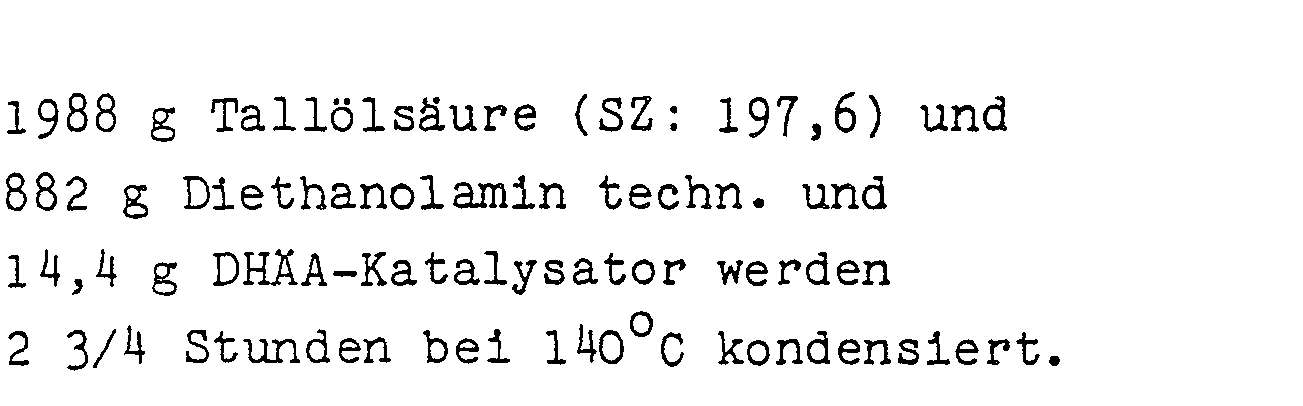
- Analytische Daten:
- SZ: 52,2
- Jod-FZ: 70
-

- Analytische Daten:
- SZ: 62,7
- Jod-FZ: 100
-

- Man erhält ein klares, flüssiges Produkt.
Analytische Daten: - SZ: 44,8:
- Jod-FZ: 100
-

- Man erhält ein klares, flüssiges Produkt.
- Analytische Daten:
- SZ: 73,9
- Jod-FZ: 70
- In die anwendungstechnischen Prüfungen wurden außerdem folgende Vergleichssubstanzen einbezogen:
- Vergleich 1:
- C16/C18-Fettsäuregemisch-Diethanolamid mit der Säurezahl ca. 20
- Vergleich 2:
- C16-C18-Fettsäuregemisch-Diethanolamid mit der Säurezahl ca. 40
- Vergleich 3:
- C16/C18-Fettsäuregemisch-Diethanolamid mit der Restsäurezahl ca. 10
- Vergleich 4:
- Mischung des Fettsäuregemisches entsprechend Beispiel 3 mit Diethanolamin im Mol-Verhältnis 1 . 1,2 bei Raumtemperatur (Diethanolammoniunsalz)
- Vergleich 5:
- Fettsäuregemisch gemäß Beispiel 3, jedoch Kondensation bei 150° - 165°C bis zur Restsäurezahl 5
- Vergleich 6:
- Mischung von Vergleich 4 mit Vergleich 5 in dem Verhältnis, daß sich eine Säurezahl von ca. 60 ergibt
- Vergleich 7:
- Fettsäuregemisch gemäß Beispiel 3, Bedingungen gemäß Beispiel 1, jedoch Kondensation bei 160°C
- Vergleich 8:
- Fettsäuregemisch gemäß Beispiel 3, Bedingungen gemäß Beispiel 1, jedoch Molverhältnis 1 : 0,9
- Vergleich 9:
- Fettsäuregemisch gemäß Beispiel 3, Bedingungen gemäß Beispiel 1, jedoch Molverhältnis 1 : 0,8
- Vergleich 10:
- Fettsäuregemisch (Hauptanteil Stearinsäure) weitgehend ohne ungesättigte Anteile, Bedingungen gemäß Beispiel 1
- Geprüft wurde die unter A) genannten Produkte, wie folgt:
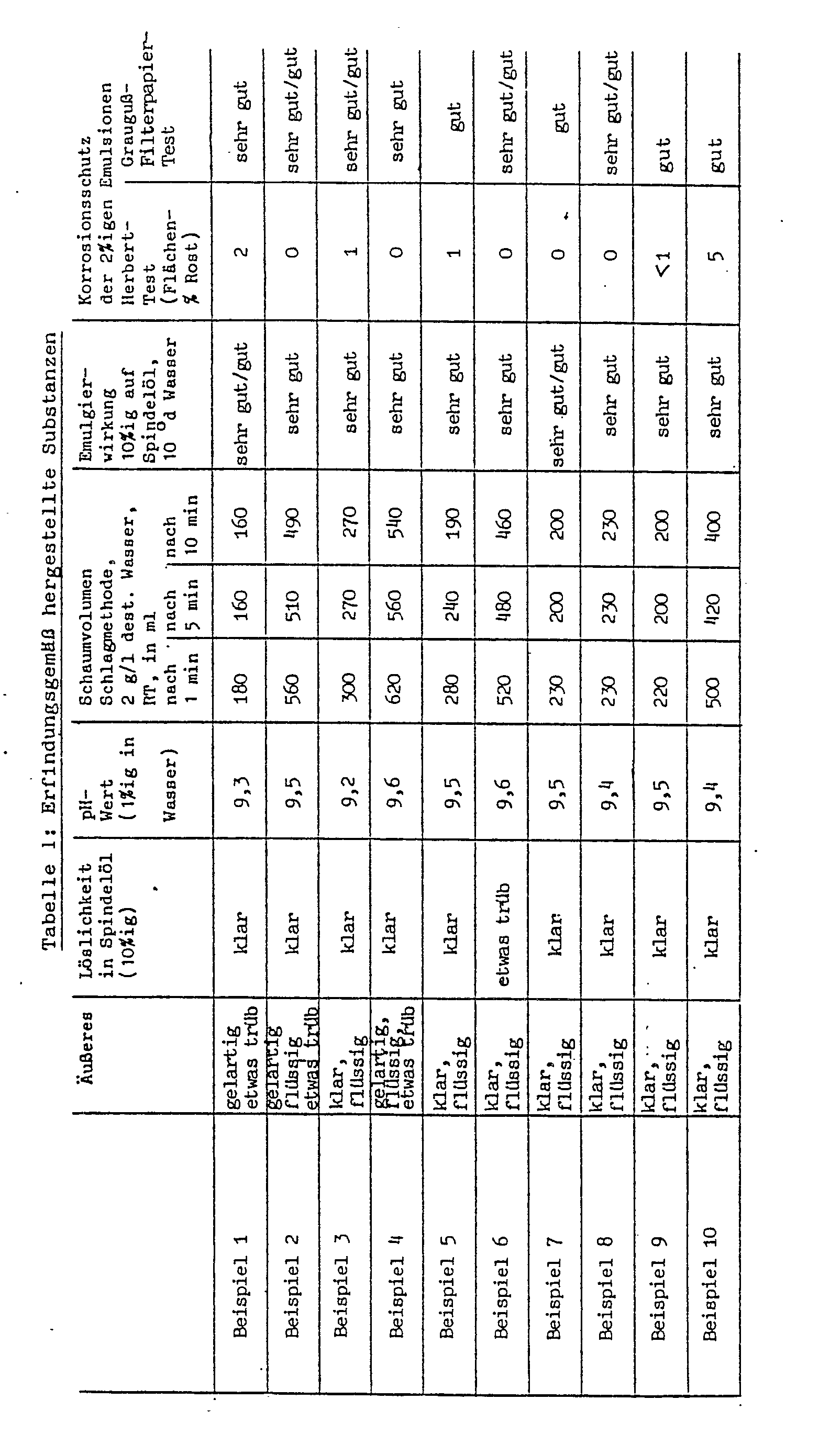
- Die korrosionsschützende Wirkung wurde durch den sogenannten "Herbert"-Korrosionstest und den "Grauguß"-Filtertest bestimmt. Die Schäumneigung wurde durch die "IG-Schlagmethode" in Anlehnung an DIN 53902 ermittelt.
- Die Korrosionstests wurden wie folgt durchgeführt:
- Die Korrosionsschutzwirkung wird in an Wirksubstanz 2 %iger wäßriger Emulsion und bei einer Wasserhärte von 10° dH an dem auf dem Metallverarbeitungssektor eingeführten Herberts-Test-System veranschaulicht. Dieses besteht aus einer standardisierten Grauguß-Platte und ebenfalls standardisierten Stahlspänen von 5 mm Länge, die von der Firma Alfred Herbert, Coventry/England geliefert werden. Die quadratische Platte mit den Abmessungen 100 x 100 x 5 mm wird vor der Prüfung mittels einer Bandschleifmaschine mit Korund-Schmirgelband der Körnung 120 sorgfältig abgeschliffen, mit Testbenzin und Äthanol gewaschen, sowie mit einem reinen Tuch getrocknet. Dann werden die mit dem Prüfsystem gelieferten Stahlspäne, die unter standardisierten Bedingungen aus 0,40%igem Kohlenstoffstahl gewonnen werden, mittels eines geeigneten Metall- oder Plastiklöffels mit dem Fassungsvermögen eines normalen Teelöffels in vier Häufchen so auf die vorbereitete Gußstahlplatte gesetzt, daß sie voneinander und von den Rändern der Platte gleichen Abstand haben. Die Späne sollen in einfacher Schicht bei engstmöglicher Lage liegen.
- Die auf ihr Korrosionsverhalten zu prüfenden Emulsionen werden mittels einer Meßpipette in solcher Menge auf die Späne-Häufchen gegeben, daß die die Gußstahlplatte erreichende Flüssigkeit gerade von den Spänen zusammengehalten wird. Nach einer Standzeit von 24 Stunden in einer Atmosphäre von 70% relativer Luftfeuchtigkeit werden die Späne von der Platte durch Kippen heruntergeschüttelt. Es hinterbleibt der deutlich sichtbare Umriß des angetrockneten wäßrigen Mediums. An den Kontaktstellen der Späne mit der Platte haben sich je nach Korrosivität der Flüssigkeit Rostmarken kleinerer oder größerer Ausdehnung ausgebildet, die auch zu einer geschlossenen Rostschicht zusammengewachsen sein können. Die Beurteilung kann durch visuelles Abschätzen in Flächenprozent Rostanteil geschehen.
- Eine weitere Korrosionsprüfung besteht in der Grauguß-Filterprobe. Verwendet wird eine Petrischale von ca. 10 cm Innendurchmesser mit passender Deckelschale. In die Petrischale legt man ein Schwarzband-Rundfilter. Auf das Filter werden mit einem passenden Löffel 5 bis 10 g grobe Grauguß GG-20-Späne so verteilt, daß ein gleichmäßiger Haufen in der Mitte entsteht, der ringsum ca. 1,5 cm vom Rand Abstand hat. Die Späne haben ca. 5 bis 8 mm Länge und müssen aus sauberem Grauguß-GG-20-Material ohne Verwendung von Bohröl oder sonstigen Kühlschmiermitteln gewonnen sein. Alle feinen Bestandteile müssen abgesiebt werden.
- Von der auf Korrosivität zu prüfenden Emulsion werden jeweils 5 ml gleichmäßig mit einer Meppipette auf die Späne gegeben. Der pH-Wert der Prüfflüssigkeit wird registriert, da er für die Beurteilung von wesentlicher Bedeutung ist. Er kann auf einen bestimmten Standardwert, z.B. 8,5 gestellt sein. Nach der Befeuchtung wird die Deckelschale aufgesetzt und 2 Stunden unter normalen Laborbedingungen bei 23 bis 25°C und ca. 70% relativer Luftfeuchtigkeit stehen gelassen. Danach wird der Deckel abgenommen und das Filter kurz umgekehrt und auf die Oberfläche von Leitungswasser gelegt, wodurch es von den Spänen befreit wird. Gleich darauf wird das so befreite Filterpapier mit einer Indikatorlösung folgender Zusammensetzung besprüht und dadurch durchtränkt:

- Dann läßt man den Indikator 17 Sekunden lang an der Luft einwirken. Schließlich wird sorgfältig in fließendem Trinkwasser gespült und an mäßig warmem Ort an der Luft getrocknet. Auf dem Filterpapier ergeben sich nach dieser Prozedur, je nach Korrosivität des Mediums, braungelbe, gelbe und/oder blaugrüne Flecken verschiedener Intensität"wobei die braungelbe oder gelbe Farbe ungünstiger zu bewerten ist. Ein einwandfreies Verhalten zeigt sich durch Fehlen jeglicher Braun- oder Gelbfärbung und allenfalls spurenweisem Vorhandensein von blaugrünen, blassen Flecken an. Die Filter sind völlig farbstabil und können deshalb zur Dokumentation dienen. Eine Bewertungsskala kann folgendermaßen lauten:
- sehr schlecht:
- intensive große überwiegend gelbbraune Flecken;
- schlecht:
- intensive große Flecken mit etwa gleichem gelbbraunen und blaugrünen Anteil;
- mittelmäßig:
- abgeblaßte mittelgrobe Flecken mit etwa gleichem gelben und blaugrünen Anteil;
- gut:
- stark abgeblaßte, kleine (Stecknadelkopfgroße) Flecken mit überwiegendem Anteil an blaugrün;
- sehr gut:
- keinerlei Flecken oder höchstens sehr wenige, sehr kleine blaßblaugrüne Flecken.
- Es wurde in Anlehnung an die DIN 53902 die Schlagmethode verwendet. Zur Prüfung genügte das einfache Prüfungsverfahren, bei dem der Stempel mit der Lochplatte per Hand 30 mal in 30 s gleichmäßig auf- und abgeführt und dann vorsichtig herausgezogen wird, (IG-Schlagmethode). Das Schaumvolumen wird an dem graduierten Schaumzylinder nach 1, 5 und 10 min in ml abgelesen. Von Wichtigkeit sind daneben Angaben über Temperatur, Konzentration und Wasserhärte.
- Das Emulgiervermögen wurde durch Auflösen von 10 Gew.% - bezogen auf die Lösung - der jeweiligen zu testenden Substanz in Spindelöl und Emulgieren der erhaltenen Lösung in Wasser (10 d) visuell bestimmt (Lösung : Wasser = 1 : 1).
- Ebenso werden die Verdünnungen dieser Emulsionen mit Wasser beurteilt, die einen Lösungsanteil von 20, 10, 5 und 2 Mol.% enthalten.
- Hierbei gilt folgende Bewertungsskala für die Emulsionen nach 38 Stunden:
- sehr gut: Emulsionen sind sehr stabil
- gut: Emulsionen sind weitgehend stabil (geringe Aufrahmung)
- mittelmäßig: Emulsionen zeigen Aufrahmungen oder geringe Abscheidungen
- schlecht: Emulsionen zeigen Abscheidungen
- Die Ergebnisse sind aus den folgenden Tabellen 1 und 2 ersichtlich.

sehr schlecht:Emulsionen sind nicht herstellbar.
Claims (2)
- l. Verfahren zur Herstellung von Umsetzungsprodukten von Alkanolaminen mit ungesättigten C12- bis C30-Fettsäuren oder C12- bis C30-Fettsäuregemischen mit ungesättigten Anteilen durch Umsetzung der Komponenten bei erhöhter Temperatur, dadurch gekennzeichnet, daß man die Fettsäurekomponente und mindestens ein Dialkanolamin mit 2 bis 3 C-Atomen pro Hydroxyalkylrest im Molverhältnis 1: (1,0 bis 1,6) bei Temperaturen von 110 bis 140°C unter Ausschluß von Lösungsmitteln solange aufeinander einwirken läßt, bis die Reaktionsmischung eine Säurezahl von 45 bis 75 aufweist.
- 2. Verwendung der nach dem Verfahren gemäß Anspruch 1 erhaltenen Produkte als technische Emulgatoren und Korrosionschutzmittel.
Applications Claiming Priority (2)
| Application Number | Priority Date | Filing Date | Title |
|---|---|---|---|
| DE19803006115 DE3006115A1 (de) | 1980-02-19 | 1980-02-19 | Verfahen zur herstellung von umsetzungsprodukten aus fettsaeuren und alkanolaminen sowie die verwendung der umsetzungsprodukte als technische emulgatoren |
| DE3006115 | 1980-02-19 |
Publications (3)
| Publication Number | Publication Date |
|---|---|
| EP0034726A2 true EP0034726A2 (de) | 1981-09-02 |
| EP0034726A3 EP0034726A3 (en) | 1981-09-09 |
| EP0034726B1 EP0034726B1 (de) | 1983-10-12 |
Family
ID=6094960
Family Applications (1)
| Application Number | Title | Priority Date | Filing Date |
|---|---|---|---|
| EP81100673A Expired EP0034726B1 (de) | 1980-02-19 | 1981-01-30 | Verfahren zur Herstellung von Umsetzungsprodukten aus Fettsäuren und Alkanolaminen sowie die Verwendung der Umsetzungsprodukte als technische Emulgatoren |
Country Status (2)
| Country | Link |
|---|---|
| EP (1) | EP0034726B1 (de) |
| DE (2) | DE3006115A1 (de) |
Cited By (5)
| Publication number | Priority date | Publication date | Assignee | Title |
|---|---|---|---|---|
| FR2625527A1 (fr) * | 1987-12-30 | 1989-07-07 | Inst Francais Du Petrole | Procede de transport d'un fluide formant des hydrates |
| FR2625548A1 (fr) * | 1987-12-30 | 1989-07-07 | Inst Francais Du Petrole | Procede pour retarder la formation et/ou reduire la tendance a l'agglomeration des hydrates |
| WO1992019693A1 (de) * | 1991-05-07 | 1992-11-12 | Henkel Kommanditgesellschaft Auf Aktien | Verwendung ausgewählter oleophiler verbindungen mit quartärem stickstoff zur verbesserung der ölbenetzbarkeit feinteiliger tone und deren anwendung als viskositätsbildner |
| CN111229117A (zh) * | 2018-11-29 | 2020-06-05 | 中国石油化工股份有限公司 | 含脂肪酸型表面活性剂的混合体系及其制备方法 |
| CN111229120A (zh) * | 2018-11-29 | 2020-06-05 | 中国石油化工股份有限公司 | 含脂肪酸型表面活性剂的混合体系及其制备方法 |
Families Citing this family (1)
| Publication number | Priority date | Publication date | Assignee | Title |
|---|---|---|---|---|
| DE4007985A1 (de) * | 1989-03-17 | 1990-10-04 | Mitsubishi Electric Corp | Verfahren zum bearbeiten von werkstuecken und arbeitsmedium fuer dasselbe |
Family Cites Families (4)
| Publication number | Priority date | Publication date | Assignee | Title |
|---|---|---|---|---|
| US2484146A (en) * | 1945-04-07 | 1949-10-11 | Houghton & Co E F | Lubricating composition |
| US2540678A (en) * | 1946-12-06 | 1951-02-06 | Nopco Chem Co | Fatty acid alkylolamine condensation and products |
| US3244638A (en) * | 1960-06-21 | 1966-04-05 | Swift & Co | Water-in-oil emulsion |
| DE2623085C2 (de) * | 1976-05-22 | 1987-01-08 | Basf Ag, 6700 Ludwigshafen | Verwendung von Umsetzungsprodukten von Glycidylethern als Wasser-in-Öl-Emulgatoren |
-
1980
- 1980-02-19 DE DE19803006115 patent/DE3006115A1/de not_active Withdrawn
-
1981
- 1981-01-30 EP EP81100673A patent/EP0034726B1/de not_active Expired
- 1981-01-30 DE DE8181100673T patent/DE3161143D1/de not_active Expired
Cited By (8)
| Publication number | Priority date | Publication date | Assignee | Title |
|---|---|---|---|---|
| FR2625527A1 (fr) * | 1987-12-30 | 1989-07-07 | Inst Francais Du Petrole | Procede de transport d'un fluide formant des hydrates |
| FR2625548A1 (fr) * | 1987-12-30 | 1989-07-07 | Inst Francais Du Petrole | Procede pour retarder la formation et/ou reduire la tendance a l'agglomeration des hydrates |
| EP0323775A1 (de) * | 1987-12-30 | 1989-07-12 | Institut Français du Pétrole | Verfahren zur Verzögerung der Bildung und/oder zur Reduktion der Agglomerationsneigung von Hydraten |
| WO1992019693A1 (de) * | 1991-05-07 | 1992-11-12 | Henkel Kommanditgesellschaft Auf Aktien | Verwendung ausgewählter oleophiler verbindungen mit quartärem stickstoff zur verbesserung der ölbenetzbarkeit feinteiliger tone und deren anwendung als viskositätsbildner |
| CN111229117A (zh) * | 2018-11-29 | 2020-06-05 | 中国石油化工股份有限公司 | 含脂肪酸型表面活性剂的混合体系及其制备方法 |
| CN111229120A (zh) * | 2018-11-29 | 2020-06-05 | 中国石油化工股份有限公司 | 含脂肪酸型表面活性剂的混合体系及其制备方法 |
| CN111229117B (zh) * | 2018-11-29 | 2022-01-04 | 中国石油化工股份有限公司 | 含脂肪酸型表面活性剂的混合体系及其制备方法 |
| CN111229120B (zh) * | 2018-11-29 | 2022-01-07 | 中国石油化工股份有限公司 | 含脂肪酸型表面活性剂的混合体系及其制备方法 |
Also Published As
| Publication number | Publication date |
|---|---|
| DE3161143D1 (en) | 1983-11-17 |
| EP0034726B1 (de) | 1983-10-12 |
| DE3006115A1 (de) | 1981-08-20 |
| EP0034726A3 (en) | 1981-09-09 |
Similar Documents
| Publication | Publication Date | Title |
|---|---|---|
| DE2357951C3 (de) | Verwendung von en-Addukten des Maleinsäureanhydrids als Korrosionsschutzmittel | |
| DE60206703T2 (de) | Polyamine mit Alkylglycidyletherendgruppen als Schaumregulierungsmittel | |
| DE2426114A1 (de) | Antirostadditiv-zubereitungen | |
| DE1521762A1 (de) | Metallschutz- und Metalldeaktivierungsmittel | |
| EP0002780B1 (de) | Verwendung von Korrosionsinhibitoren in wässrigen Systemen | |
| DE2721493A1 (de) | Verbessertes verfahren zur einschraenkung der korrosion in chemischen aufarbeitungsanlagen unter verwendung von methoxypropylamin (mopa) | |
| DE2246658A1 (de) | Verbessertes hydrobehandlungsverfahren fuer petroleumkohlenwasserstoffoele und katalysator, der dabei verwendet wird | |
| DD151185A5 (de) | Nicht auf erdoel basierende metallkorrosionsschutzzusammensetzung | |
| EP0034726B1 (de) | Verfahren zur Herstellung von Umsetzungsprodukten aus Fettsäuren und Alkanolaminen sowie die Verwendung der Umsetzungsprodukte als technische Emulgatoren | |
| DE2943963C2 (de) | ||
| DE10217208B4 (de) | Verwendung von Ethercarbonsäuren mit niedrigem Stockpunkt | |
| CH638240A5 (de) | Verdraengungszusammensetzung fuer fluessiges wasser. | |
| EP0029529A1 (de) | Umsetzungsprodukte aus Sulfon- oder Carbonamidocarbonsäuren mit Alkanolaminen und ihre Verwendung als schaumarme Korrosionsinhibitoren | |
| DE2026035A1 (de) | Schmiermittel | |
| CH623747A5 (de) | ||
| EP0015442B1 (de) | Schaumarme Korrosionsinhibitoren mit antimikrobiellen Eigenschaften, die als wirksames Prinzip Borsäure-Alkanolamin-Umsetzungsprodukte enthalten | |
| EP0031924B1 (de) | Verwendung von Alkanolaminsalzen cyclischer Amidsäuren als Korrosionsschutzmittel in wässrigen Systemen | |
| EP0060455B1 (de) | Inhibitoren gegen die Korrosion von CO2 und H2S in Wasser-in-Öl-Emulsionen | |
| DE3222996C2 (de) | ||
| DE10043040A1 (de) | Verwendung von N-Alkyl-beta-alanin-Derivaten zur Herstellung von reinigenden Korrosionsschutzmitteln | |
| DE3600401A1 (de) | Verwendung von alkylbenzoylacrylsaeuren als korrosionsinhibitoren | |
| DE2557898A1 (de) | Mittel zur schaumbekaempfung | |
| EP0726335B1 (de) | Lactobionsäureamid enthaltende Korrosionsschutzmittel | |
| AT167126B (de) | Verfahren zum Schützen von unedlen Metallen und deren unedlen Legierungen gegen Korrosion | |
| DE3304164A1 (de) | Reaktionsprodukte aus borsaeure, diethanolamin und monoethanolaminen und deren verwendung als korrosionsschutzmittel |
Legal Events
| Date | Code | Title | Description |
|---|---|---|---|
| PUAI | Public reference made under article 153(3) epc to a published international application that has entered the european phase |
Free format text: ORIGINAL CODE: 0009012 |
|
| PUAL | Search report despatched |
Free format text: ORIGINAL CODE: 0009013 |
|
| AK | Designated contracting states |
Designated state(s): DE FR GB IT |
|
| AK | Designated contracting states |
Designated state(s): DE FR GB IT |
|
| 17P | Request for examination filed |
Effective date: 19810819 |
|
| ITF | It: translation for a ep patent filed | ||
| GRAA | (expected) grant |
Free format text: ORIGINAL CODE: 0009210 |
|
| AK | Designated contracting states |
Designated state(s): DE FR GB IT |
|
| REF | Corresponds to: |
Ref document number: 3161143 Country of ref document: DE Date of ref document: 19831117 |
|
| ET | Fr: translation filed | ||
| PLBE | No opposition filed within time limit |
Free format text: ORIGINAL CODE: 0009261 |
|
| STAA | Information on the status of an ep patent application or granted ep patent |
Free format text: STATUS: NO OPPOSITION FILED WITHIN TIME LIMIT |
|
| 26N | No opposition filed | ||
| ITTA | It: last paid annual fee | ||
| PGFP | Annual fee paid to national office [announced via postgrant information from national office to epo] |
Ref country code: FR Payment date: 19911218 Year of fee payment: 12 |
|
| PGFP | Annual fee paid to national office [announced via postgrant information from national office to epo] |
Ref country code: GB Payment date: 19920116 Year of fee payment: 12 Ref country code: DE Payment date: 19920116 Year of fee payment: 12 |
|
| PG25 | Lapsed in a contracting state [announced via postgrant information from national office to epo] |
Ref country code: DE Effective date: 19930128 |
|
| PG25 | Lapsed in a contracting state [announced via postgrant information from national office to epo] |
Ref country code: GB Effective date: 19930130 |
|
| GBPC | Gb: european patent ceased through non-payment of renewal fee |
Effective date: 19930130 |
|
| PG25 | Lapsed in a contracting state [announced via postgrant information from national office to epo] |
Ref country code: FR Effective date: 19930930 |
|
| REG | Reference to a national code |
Ref country code: FR Ref legal event code: ST |