EP0035355B1 - Modifizierte Aluminium-Hydride, ihre Herstellung und ihre Verwendung zum Reduzieren von Acetylnaphthalen-Derivaten - Google Patents
Modifizierte Aluminium-Hydride, ihre Herstellung und ihre Verwendung zum Reduzieren von Acetylnaphthalen-Derivaten Download PDFInfo
- Publication number
- EP0035355B1 EP0035355B1 EP81300754A EP81300754A EP0035355B1 EP 0035355 B1 EP0035355 B1 EP 0035355B1 EP 81300754 A EP81300754 A EP 81300754A EP 81300754 A EP81300754 A EP 81300754A EP 0035355 B1 EP0035355 B1 EP 0035355B1
- Authority
- EP
- European Patent Office
- Prior art keywords
- compound
- formula
- reducing agent
- reaction
- dimethoxy
- Prior art date
- Legal status (The legal status is an assumption and is not a legal conclusion. Google has not performed a legal analysis and makes no representation as to the accuracy of the status listed.)
- Expired
Links
- WYKATIKHEGTVHM-UHFFFAOYSA-N CC(C(CC1)(Cc2c1c(OC)ccc2OC)O)O Chemical compound CC(C(CC1)(Cc2c1c(OC)ccc2OC)O)O WYKATIKHEGTVHM-UHFFFAOYSA-N 0.000 description 1
- 0 CC(C(CCc1c(cc2)OC)=*c1c2OC)O Chemical compound CC(C(CCc1c(cc2)OC)=*c1c2OC)O 0.000 description 1
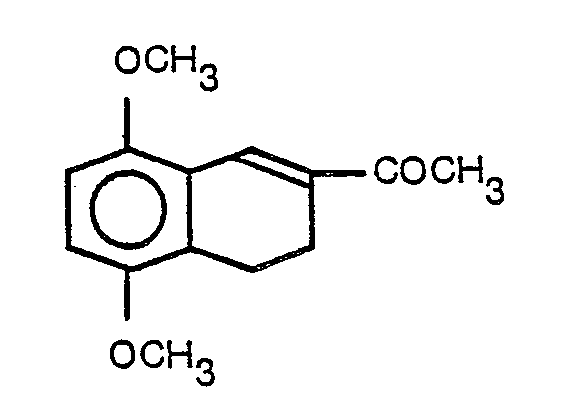
- YNXGVXBSQAEVTO-UHFFFAOYSA-N CC(C(CCc1c(cc2)OC)=Cc1c2OC)=O Chemical compound CC(C(CCc1c(cc2)OC)=Cc1c2OC)=O YNXGVXBSQAEVTO-UHFFFAOYSA-N 0.000 description 1
Classifications
-
- C—CHEMISTRY; METALLURGY
- C07—ORGANIC CHEMISTRY
- C07C—ACYCLIC OR CARBOCYCLIC COMPOUNDS
- C07C43/00—Ethers; Compounds having groups, groups or groups
- C07C43/02—Ethers
- C07C43/20—Ethers having an ether-oxygen atom bound to a carbon atom of a six-membered aromatic ring
- C07C43/23—Ethers having an ether-oxygen atom bound to a carbon atom of a six-membered aromatic ring containing hydroxy or O-metal groups
-
- C—CHEMISTRY; METALLURGY
- C07—ORGANIC CHEMISTRY
- C07F—ACYCLIC, CARBOCYCLIC OR HETEROCYCLIC COMPOUNDS CONTAINING ELEMENTS OTHER THAN CARBON, HYDROGEN, HALOGEN, OXYGEN, NITROGEN, SULFUR, SELENIUM OR TELLURIUM
- C07F5/00—Compounds containing elements of Groups 3 or 13 of the Periodic Table
- C07F5/06—Aluminium compounds
- C07F5/069—Aluminium compounds without C-aluminium linkages
Definitions
- the invention relates to a novel reducing agent which can be used for reducing the organic compounds having a carbonyl group (ketone group or aldehyde group) in their structure into the corresponding alcohols and which is particularly useful as a reducing agent for asymmetrically reducing the unsymmetrical ketones to selectively give an alcohol in which the aymmetric carbon atom bonded to the hydroxy group is in R-configuration or an alcohol in which said asymmetric carbon atom is in S-configuration. That is, the invention relates to a novel lithium aluminum hydride type reducing agent partially decomposed by using one equivalent of an optically active N-substituted ephedrine and two equivalents of an N-substituted aniline.
- this invention relates to a novel modified lithium aluminum hydride type reducing agent obtained by reacting one equivalent of lithium aluminum hydride with one equivalent of an optically active N-substituted ephedrine of the formula (1), (wherein R, is a C l -C 4 alkyl group or benzyl group, and pH is phenyl group) and two equivalents of an N-substituted aniline of the formula (II), (wherein R 2 is a C l -c 4 straight chain alkyl group or phenyl group, and Ph is phenyl group).
- the optically active N-substituted ephedrine represented by the above-shown formula (I) is either a (-)-isomer or a (+)-isomer.
- the C,-C 4 alkyl group represented by R, in the above-shown formula (I) may be properly selected from the straight chain or branched chain alkyl groups such as methyl, ethyl, propyl, isopropyl, butyl, tert-butyl, iso-butyl, sec-butyl, etc., but the methyl group is preferred.
- C 1 ⁇ C 4 alkyl group represented by R 2 in the above-shown formula (II) there may be recited the straight chain alkyl groups such as methyl, ethyl, propyl, butyl, etc., but a methyl or ethyl group is preferred, the latter being more preferred.
- reagents capable of reducing the carbonyl group of an organic compound having a ketone structure or an aldehyde structure into a hydroxy group.
- reagents there may be recited, for example, sodium borohydride, potassium borohydride, lithium borohydride, zinc borohydride, sodium cyanoborohydride, lithium aluminum hydride, lithium tri-tert-butoxyaluminum hydride, lithium tri-methoxyaluminum hydride, sodium bis(2-methoxyethoxy)aluminum hydride, sodium aluminum hydride, etc.
- Vigneron et al have worked out a modified lithium aluminum hydride partially decomposed by using N-methyl-ephedrine and 3,5-dimethylphenol (I. Jacquet and J. P. Vigneron: Tetrahedron Letters, 1974, 2065; J. P. Vigneron and I. Jacquet: Tetrahedron, 32, 939 (1976); J. P. Vigneron and V. Bloy: Tetrahedron Letters, 1979, 2683; Idem., Ibid., 1980, 1735), but this preparation involves the following problems.
- the 3,5-dimethylphenol used as additive is bound to mix in the reduction product alcohol and difficult to be separated. Also, its reducing power is weak, and reduction of an a:,/3-unsaturated ketone, aldehyde or the like results in a poor chemical yield.
- the present inventors have devoted themselves to the study aimed at overcoming the above-shown problems and working out an excellent modified lithium aluminum hydride type reducing agent which can meet all of the following three requirements:
- the present inventors have found an excellent modified lithium aluminum hydride type reducing agent which is free of the defects of the conventional modified lithium aluminum hydride type reducing agents and which meets all of the above-said three requirements and is commercially practiceabie, and completed the present invention.
- the reducing agent according to this invention can be obtained by reacting one equivalent of lithium aluminum hydride with one equivalent of an optically active N-substituted ephedrine of the afore-shown general formula (I) and two equivalents of an N-substituted aniline represented by the afore-shown general formula (II).
- the reaction is carried out under an anhydrous condition in an atmosphere of an inert gas such as nitrogen or argon gas.
- an inert gas such as nitrogen or argon gas.
- reaction solvent used in the process of this invention is not subject to any specific restrictions provided that it does not take any part in the reaction, and there may be used, for example, a solvent such as dimethyl ether, diethyl ether, tetrahydrofuran, digiyme, methylal, toluene or the like, but among them, diethyl ether is preferred.
- the reaction can be safely conducted at a temperature of from 0 to 100°C, but it is recommendable to use a temperature of from room temperature to 40°C.
- the reaction time is not specifically limited, and a one-to three-hour reaction will suffice.
- N-methylephedrine represented by the general formula (I) wherein R, is a methyl group can be easily synthesized by a one-step treatment only comprising reductive methylation of a corresponding readily much accessible unexpensive (+)- or (-)-ephedrine with formaline-formic acid (K. Nakajima: Journal of the Chemical Society of Japan, 81, 1476 (1960)).
- the lithium aluminum hydride employed for the preparation of such modified lithium aluminum hydride type reducing agents is usually used in the form of a solution, but according to the present invention, it is not necessarily used as a solution; it can as well be used as a suspension in a reactant solvent, which widens the industrial versatility of the process of this invention.
- modified lithium aluminum hydride type reducing agents according to this invention are supposed to have a chemical structure expressed by the following formula (III), (wherein R" R 2 and Ph are as defined above).
- the reducing agent of this invention prepared in the manner described above is usually not isolated from the reaction solution but is immediately used for the ensuing reduction reaction.
- the reducing agent of this invention is usable as a reducing agent for converting the carbonyl group in an organic compound having a ketone or aldehyde structure into a hydroxy group. It is specifically noteworthy that the product of this invention can be used as an asymmetric reduction agent for the unsymmetrical ketones, namely, the compounds having a ketone structure which produces the asymmetric center as a result of reduction.
- the preferable organic compounds are the unsymmetrical ketone compounds having a ketone structure which produces the asymmetric center as a result of the reduction.
- the reduction employing the reducing agent of this invention is carried out by using said reducing agent and an organic compound having a ketone or aldehyde structure under an anhydrous condition in an atmosphere of an inert gas such as nitrogen or argon gas.
- the amount of the reducing agent of this invention used in the reaction may be of any ratio greater than one equivalent to one equivalent of the organic compound, but a ratio of 1-5 equivalents to one equivalent of the organic compound is preferred.
- reaction solvent used in this invention is not subject to any specific restrictions provided that it does not participate in the reaction.
- the reaction temperature is within the range of -100° to 100°C, and a temperature of from 78° to -100°C is preferred for an asymmetric reduction reaction.
- the reaction time although not limited specifically, may be 1 to 6 hours.
- reaction solution is treated with an aqueous solution of a mineral acid such as hydrochloric acid or sulfuric acid and the organic solvent layer is separated, followed by drying and distilling-off of the organic solvent, whereby the desired alcohol compound alone can be readily obtained in a high yield.
- a mineral acid such as hydrochloric acid or sulfuric acid
- the optically active N-substituted ephedrine (I) and N-substituted aniline (II) used in the reaction can be recovered as a mixture in an almost quantitative yield by merely adding an alkaline aqueous solution such as an aqueous sodium hydroxide solution or an aqueous potassium hydroxide solution to the above-said aqueous layer, extracting the mixed solution with an organic solvent such as ethyl acetate, etc. which can dissolve the optically active N-substituted ephedrine (I) and N-substituted aniline (II), then drying the extract and distilling off the organic solvent. Also, they can be recovered separately by means of distillation under reduced pressure.
- N-substituted ephedrine (I) can be recovered in an optical purity without accompanying racemization and can be reused as it is.
- the reducing agent of this invention is used in a reaction for obtaining 2-(1'-hydroxy)ethyl-5,8-dimethoxy-3,4-dihydronaphthalene of the formula (V), by reducing the carbonyl portion of 2-acetyl-5,8-dimethoxy-3,4-dihydronaphthalene of the formula (IV),
- the reducing agent of this invention using a (-)-isomer (( ⁇ ) ⁇ 1 (R),2(S) ⁇ N(C 1 ⁇ C 4 ) alkyl- or benzyl-substituted ephedrine) as the N-substituted ephedrine of the formula (I)
- such reducing agent may be used for performing an asymmetric reduction of the compound of the formula (IV) to give (-) - 2 - (1'(S) - hydroxy) - ethyl - 5,8 - dimethoxy - 3,4 -
- Examples of (-)-N-(C,-C 4 ) alkyl- or benzyl-substituted ephedrines usable for the preparation of said reducing agent of this invention are (-)-N-methylephedrine, (-)-N-ethylephedrine (O. Cervinka, et a/: Coll. Czech. Chem; Comm., 32, 3897 (1967)), (-)-N-propylephedrine, (-)-N-isobutylephedrine, (+)-N-benzylephedrine (S. Yamada et a/: Yakugaku Zasshi, 100, 319 (1980)).
- (-)-N-methyl- ephedrine is the most preferred asymmetry source.
- N-mono-(C 1 ⁇ C 4 ) alkyl- or benzyl-substituted anilines one may recite, beside N-ethylaniline, the following: N-methylaniline, N-propyl- aniline, N-isopropylaniline, N-butylaniline, N-isobutylaniline, N-ethyl-3,5-dimethylaniline, N-ethyl-2,6-dimethylaniline, diphenylamine, carbazole, etc., but the asymmetry yield of the compound (V') was best when N-ethylaniline was used.
- the compound of the formula (V) (particularly (V)) is an intermediate product in the course of the preparation of 2 - acetyl - 5,8 - dimethoxy - 1,2,3,4 - tetrahydro - 2 - naphthol of the formula (1), particularly, (-)-2(Rl-acetyl-5,8-dimethoxy-1,2,3,4-tetrahydro-2(R)-naphthol of the formula (1'),
- the compound of the formula (1) or (1') is one which is extraordinarily useful as a material for the synthesis of the anthracycline type antibiotics adriamycin (2), daunorubicin (3), etc., which are attracting keen interest lately in their prominent carcinostatic activities (F.
- Arcamone Lloydia, 40, 45 (1977); T. R. Kelly: “Synthetic Approaches to Antracycline Antibiotics” in “Annual Reports in Medicinal Chemistry", Am. Chem. Soc., 1979).
- adriamycinone (4) and daunomycinone (5) which are the aglycones of (2) and (3), respectively.
- a route for the synthesis of (2) and (3) from the aglycones (4) and (5) respectively (C. M. Wong, et a/: Can. J. Chem., 49, 2712 (1971); C. M.
- the compound of the formula (1) is a very important compound as a starting material for the preparation of natural and non-natural type anthracyclines.
- the reducing agent of this invention can serve as a useful reagent in the first step of a process for producing a compound of the formula (1) or (1') effectively by using the compound of the formula (IV) as a starting material.
- the double bond between 1-position and 2-position of the compound of the formula (V) or (V) is epoxidated to form 2 - (11 - hydroxy)ethyl - 5,8 - dimethoxy - 1,2 - epoxy - 1,2,3,4 - tetrahydronaphthalene or 2(S) - (1'(S) - hydroxy)ethyl - 5,8 - dimethoxy - 1 (S), 2(S) - epoxy - 1,2,3,4 - tetrahydronaphthalene of the formula (VI) or (VI'), Then, the 1,2-epoxy portion of this compound is reduced to obtain 2 - (1' - hydroxy)ethyl - 5,8 - dimethoxy - 1,2,3,4 - tetrahydro - 2 - naphthol or (-) - 2(R) - (1'(S) - hydroxy)ethyl - 5,8 - dimethoxy -
- the ordinary double bond epoxidation reaction formula is used for the 1-position and 2-position double bond epoxidation reaction in the first stage of the above-said process.
- the oxidizing agent there may be ordinarily used a reagent prepared from t-butylhydroperoxide, cumenehydroperoxide, etc., in the presence of a catalyst such as molybdenum dioxyacetylacetonate (Mo0 2 (acac) 2 ), vanadium oxyacetylacetonate (VO(acac) 2 ), etc.
- a catalyst such as molybdenum dioxyacetylacetonate (Mo0 2 (acac) 2 ), vanadium oxyacetylacetonate (VO(acac) 2 ), etc.
- the reaction is carried out in an aromatic hydrocarbon solvent such as benzene, toluene, etc. or a halogenated hydrocarbon solvent such as chloroform, methylene chloride, etc., at a temperature of -20° to +20°C for a period of 30 minutes to 4 hours.
- aromatic hydrocarbon solvent such as benzene, toluene, etc. or a halogenated hydrocarbon solvent such as chloroform, methylene chloride, etc.
- the reduction reaction of the 1,2-epoxy portion of the compound (VI) in the second stage can be accomplished by a usual reduction reaction of an epoxy into an alcohol This reaction is performed in an ether type solvent such as tetrahydrofuran, etc. or an aromatic hydrocarbon type solvent such as benzene, toluene, etc., by using usually lithium aluminum hydride, sodium bis(2-methoxyethoxy) aluminum hydride or the like as reducing agent at a temperature of-20° to +25°C for a period of 1-4 hours.
- an ether type solvent such as tetrahydrofuran, etc. or an aromatic hydrocarbon type solvent such as benzene, toluene, etc.
- optically active compound (VI') When the optically active compound (VI') is subjected to this reduction reaction, there is obtained an optically active compound of the formula (VII').
- the above-said reduction reaction is carried out by using the compound (VI') mixed with small quantities of 1 (R), 2(R) isomers, there is normally obtained a compound (VII') mixed with a 2(S)-epimer, but this crude product can be refined by means of column chromatography, recrystallization, etc.
- Said compound, in the form of a mixture with a 2(S)-epimer may be immediately subjected to the succeeding oxidation reaction.
- the oxidation of the 1 '-hydroxy portion of the compound (VII) in the third step is usually accomplished by using the method of oxidizing a secondary alcohol into a corresponding ketone
- the oxidizing agent there is usually used chromic acid-sulfuric acid, pyridinium chlorochromate (E. J. Corey, et a/: Tetrahedron Letters, 1975, 2647), dimethylsulfoxide-dicyclohexylcarbodiimide-trifluoroacetic acid-pyridine (K. E. Pfitzner, et al: J. Am. Chem.
- Oxidation of the optically active compound (VII') by use of the Fetizon reagent provides optically active compound (1') of this invention.
- the compound (VII') mixed with 2(S)-epimer as said above is used, there is obtained the compound (1') mixed with 2(S)-epimer.
- the compound of the formula (IV) can be readily prepared from 5,8-dimethoxy-3,4-dihydro-2-naphthoic acid (S. Terashima, et al: Chem. Pharm. Bull., (Tokyo), 27, 2351 (1979)).
- the compound (1) includes 2(R)-body, 2(S)-body or mixtures thereof
- compound (V) includes 1'(S)-body, 1'(R)-body or mixtures thereof
- compound (VI) includes 1'(S),1(S),2(S)-body, 1'(S),1(R),2(R)-body, 1'(R),1(R),2(R)-body, 1'(R),1(S),2(S)-body or mixtures of optional combinations of these four types of isomers
- compound (VII) includes 1'(S),2(R)-body, 1'(S),2(S)-body, 1'(R),2(S)-body, 1'(R),2(R)-body and mixtures of optional combinations of these four types of isomers.
- Dry ether (10 ml) was added into lithium aluminum hydride (206 mg, 5.4 mmol) in an argon atmosphere and the mixture was refluxed under heating, mixed with a dry ether (10 ml) solution of (-)-N-methylephedrine (1 g, 5.56 mmol) and reacted under stirring at the same temperature for one hour.
- a dry ether (10 ml) solution of N-ethylaniline (1.35 g, 11.12 mmol) was further added to perform reaction under stirring at the same temperature for one hour, whereupon total 363 ml of hydrogen gas was generated and an ether solution of a modified lithium aluminum hydride type reducing agent having the following physical properties was obtained.
- Example 1 The reaction solution of Example 1 was cooled to -78°C, mixed with a dry ether (10 ml) solution of acetophenone (360 mg, 3 mmol) and reacted under stirring at the same temperature for 3 hours.
- the aqueous layer and the 10% hydrochloric acid washings were joined and the joined solution was treated with a 10% sodium hydroxide solution (30 ml) to adjust the pH to about 11 and extracted with ethyl acetate (50 ml x 3).
- the extract was washed with a saturated saline solution (50 ml x 3), dried and then ethyl acetate was distilled off to obtain a mixture of N-methylephedrine and N-ethylaniline. Yield: 2.4 g (100%). Said two substances can be recovered by distilling the mixture under reduced pressure.
- N-ethylaniline b.p.: 87 ⁇ 90°C/15 mmHg, yield: 1.3 g.
- Dry ether (10 ml) was added to lithium aluminum hydride (376 g, 9.9 mmol) in an argon atmosphere, and the mixture was refluxed under heating, mixed with a dry ether (20 ml) solution of (-)-N-methylephedrine (1.83 g, 10.2 mol) and reacted under stirring at the same temperature for one hour.
- This reaction solution was mixed with a dry ether (10 ml) solution of N-ethylaniline (2.47 g, 20.4 mmol) and further reacted under stirring at the same temperature for one hour.
- Lithium aluminum hydride (1.44 g, 38 mmol) was suspended in ether (70 ml) under argon stream, and to this suspension was added an ether solution (100 ml) of (-)-N-methylephedrine (6.81 g, 38 mmol), followed by refluxing under heating and stirring for one hour, further addition of an ether solution (60 ml) of N-ethylaniline (9.21 g, 76 mmol) and refluxing under heating and stirring for additional one hour to thereby prepare a reducing reagent.
- the 1 N hydrochloric acid layer remaining after extraction with ethyl acetate was made alkaline (pH > 12) with a 10% sodium hydroxide aqueous solution and extracted with ethyl acetate (150 ml x 2).
- the ethyl acetate extracts were joined, washed with a saturated saline solution (150 ml) and dried with anhydrous potassium carbonate, followed by filtration and distillation to obtain a 1:2 mixture of (-)-N-methylephedrine and N-ethylaniline as a light yellow oily product (16.3 g, quantitative recovery).
- the ratio of the compound (VII') to its 2(S)-epimer that is, the ratio of the compound (VI') to its 1 (R),2(R)-epimer was calculated to be 95:5.
Landscapes
- Chemical & Material Sciences (AREA)
- Organic Chemistry (AREA)
- Organic Low-Molecular-Weight Compounds And Preparation Thereof (AREA)
Claims (11)

und 2 Aequivalenten eines N-substituierten Anilins der Formel:




Applications Claiming Priority (4)
| Application Number | Priority Date | Filing Date | Title |
|---|---|---|---|
| JP2767380A JPS56123931A (en) | 1980-03-04 | 1980-03-04 | Novel preparation of 2-acetyl-5,8-demethoxy-1,2,3,4- tetrahydro-2-naphthol |
| JP27673/80 | 1980-03-04 | ||
| JP9895680A JPS5723855A (en) | 1980-07-18 | 1980-07-18 | Newly modified hydrogenated aluminium-lithium reducing agent |
| JP98956/80 | 1980-07-18 |
Publications (3)
| Publication Number | Publication Date |
|---|---|
| EP0035355A2 EP0035355A2 (de) | 1981-09-09 |
| EP0035355A3 EP0035355A3 (en) | 1982-01-20 |
| EP0035355B1 true EP0035355B1 (de) | 1984-05-09 |
Family
ID=26365631
Family Applications (1)
| Application Number | Title | Priority Date | Filing Date |
|---|---|---|---|
| EP81300754A Expired EP0035355B1 (de) | 1980-03-04 | 1981-02-24 | Modifizierte Aluminium-Hydride, ihre Herstellung und ihre Verwendung zum Reduzieren von Acetylnaphthalen-Derivaten |
Country Status (4)
| Country | Link |
|---|---|
| US (2) | US4338255A (de) |
| EP (1) | EP0035355B1 (de) |
| CA (1) | CA1142950A (de) |
| DE (1) | DE3163452D1 (de) |
Families Citing this family (3)
| Publication number | Priority date | Publication date | Assignee | Title |
|---|---|---|---|---|
| US5041651A (en) * | 1983-04-04 | 1991-08-20 | Sumitomo Chemical Company, Limited | Asymmetrically modified boron hydride type compound and a method for producing an optically active alcohol derivative by the use thereof |
| HU200755B (en) * | 1983-04-04 | 1990-08-28 | Sumitomo Chemical Co. Ltd.,Jp | Process for producing optically active alcohol derivatives by using asymmetrically modified compounds of boron hydride type |
| JP2008526850A (ja) * | 2005-01-06 | 2008-07-24 | マリンクロッド・インコーポレイテッド | ベンジル化アミン類の製造方法 |
Family Cites Families (5)
| Publication number | Priority date | Publication date | Assignee | Title |
|---|---|---|---|---|
| US3048612A (en) * | 1958-05-22 | 1962-08-07 | Goodrich Gulf Chem Inc | Transalkylation of aluminum alkyls |
| SE353330B (de) * | 1966-01-31 | 1973-01-29 | Ceskoslovenska Akademie Ved | |
| US3933879A (en) * | 1969-03-18 | 1976-01-20 | Exxon Research And Engineering Company | Chelated lithium aluminum compounds |
| GB2033896B (en) * | 1978-10-12 | 1982-11-24 | Ono Pharmaceutical Co | Lithiumaluminium hydride compounds |
| US4316985A (en) * | 1979-01-16 | 1982-02-23 | Hoffmann-La Roche Inc. | Cyclic compounds |
-
1981
- 1981-02-24 EP EP81300754A patent/EP0035355B1/de not_active Expired
- 1981-02-24 DE DE8181300754T patent/DE3163452D1/de not_active Expired
- 1981-02-25 US US06/238,136 patent/US4338255A/en not_active Expired - Fee Related
- 1981-03-03 CA CA000372229A patent/CA1142950A/en not_active Expired
-
1982
- 1982-03-29 US US06/363,048 patent/US4418218A/en not_active Expired - Fee Related
Also Published As
| Publication number | Publication date |
|---|---|
| DE3163452D1 (en) | 1984-06-14 |
| CA1142950A (en) | 1983-03-15 |
| EP0035355A2 (de) | 1981-09-09 |
| US4418218A (en) | 1983-11-29 |
| US4338255A (en) | 1982-07-06 |
| EP0035355A3 (en) | 1982-01-20 |
Similar Documents
| Publication | Publication Date | Title |
|---|---|---|
| Firouzabadi et al. | Chromium (VI) based oxidants-1: chromium peroxide complexes as versatile, mild, and efficient oxidants in organic synthesis | |
| Kuwajima et al. | Oxidation of alcohols with tert-butyl hydroperoxide and diaryl diselenide | |
| DE60013471T2 (de) | Neue hydronaphthalene, hergestellt durch eine rhodium-katalysierte ringöffnungsreaktion in anwesenheit eines phosphinliganden | |
| Turner et al. | Iron (II)-induced decomposition of unsaturated cyclic peroxides derived from butadienes. A simple procedure for synthesis of 3-alkylfurans | |
| Swenton et al. | Model studies for anthracyclinone synthesis. The chemistry of 1-lithio-3, 3, 6, 6-tetramethoxycyclohexa-1, 4-diene, an umpolung for quinone | |
| EP0153692B1 (de) | Methode zum Isomerisieren eines Glycidats | |
| Brown et al. | Organoboranes for synthesis. 4: Oxidation of organoboranes with pyridinium chlorochromate. A direct synthesis of aldehydes from terminal alkenes via hydroboration | |
| US5120880A (en) | Preparation of muscone, intermediates for this preparation and preparation of said intermediates | |
| US4338255A (en) | Modified lithium aluminum hydrides | |
| FI66835B (fi) | Foerfarande foer framstaellning av nya terapeutiskt anvaendbara polyenfoereningar samt salter daerav | |
| Thomas et al. | The ‘aldol condensation’of citral and related reactions | |
| CA1217779A (fr) | Procede de c-alcoylation selective des phenols | |
| Shimizu et al. | Highly efficient method for oxidation of alcohol with tert-butyl hydroperoxide catalyzed by diaryl diselenide | |
| KAMETANI et al. | Studies on the Syntheses of Tetracycline Derivatives. II. Thermolytic Cycloaddition of o-Quinodimethanes with Tetrahydronaphthoquinone and Naphthoquinone | |
| EP0183042A2 (de) | Verfahren zur Herstellung von Hydrochinonderivaten | |
| Takuwa et al. | The addition of alcohol to 1, 2-naphthoquinone promoted by metal ions. A facile synthesis of 4-alkoxy-1, 2-naphthoquinones. | |
| Küntzel et al. | Photochemical Reactions. Part 63 [1]. The photodecarbonylation of α‐aryl aldehydes | |
| CH657868A5 (de) | Cyclohexanolderivate enthaltende duftstoffmischungen. | |
| Terashima et al. | A novel synthesis of (±)-2-acetyl-5, 8-dimethoxy-1, 2, 3, 4-tetrahydro-2-naphthol, a key intermediate for the synthesis of anthracyclinones | |
| EP0129252A2 (de) | Verfahren zur Herstellung von optisch aktiven Hydrochinonderivaten sowie von d-alpha-Tocopherol | |
| Gonzalez Sierra et al. | Stereospecific transformation of grindelic acid into the antifeedant 6. alpha.-hydroxygrindelic acid, its 6. beta.-epimer, and other related natural diterpene acids | |
| EP0052775A2 (de) | Verfahren zur Herstellung von Aldehyden und Zwischenprodukte | |
| Brettle et al. | Anodic oxidation. Part XIV. Products from the electrochemical functionalisation of olefins in methanol | |
| Misumi et al. | The Preparation of Stereoisomeric α, ω-Diphenylpolyenes and Related Compounds by Means of the Wittig Reaction | |
| US4181683A (en) | 1,7-Octadien-3-one and process for preparing the same |
Legal Events
| Date | Code | Title | Description |
|---|---|---|---|
| PUAI | Public reference made under article 153(3) epc to a published international application that has entered the european phase |
Free format text: ORIGINAL CODE: 0009012 |
|
| AK | Designated contracting states |
Designated state(s): CH DE FR GB IT |
|
| PUAL | Search report despatched |
Free format text: ORIGINAL CODE: 0009013 |
|
| AK | Designated contracting states |
Designated state(s): CH DE FR GB IT |
|
| 17P | Request for examination filed |
Effective date: 19820521 |
|
| ITF | It: translation for a ep patent filed | ||
| GRAA | (expected) grant |
Free format text: ORIGINAL CODE: 0009210 |
|
| AK | Designated contracting states |
Designated state(s): CH DE FR GB IT LI |
|
| REF | Corresponds to: |
Ref document number: 3163452 Country of ref document: DE Date of ref document: 19840614 |
|
| ET | Fr: translation filed | ||
| PLBE | No opposition filed within time limit |
Free format text: ORIGINAL CODE: 0009261 |
|
| STAA | Information on the status of an ep patent application or granted ep patent |
Free format text: STATUS: NO OPPOSITION FILED WITHIN TIME LIMIT |
|
| 26N | No opposition filed | ||
| PGFP | Annual fee paid to national office [announced via postgrant information from national office to epo] |
Ref country code: FR Payment date: 19890111 Year of fee payment: 9 |
|
| PGFP | Annual fee paid to national office [announced via postgrant information from national office to epo] |
Ref country code: CH Payment date: 19890119 Year of fee payment: 9 |
|
| PGFP | Annual fee paid to national office [announced via postgrant information from national office to epo] |
Ref country code: GB Payment date: 19890131 Year of fee payment: 9 Ref country code: DE Payment date: 19890131 Year of fee payment: 9 |
|
| ITTA | It: last paid annual fee | ||
| PG25 | Lapsed in a contracting state [announced via postgrant information from national office to epo] |
Ref country code: GB Effective date: 19900224 |
|
| PG25 | Lapsed in a contracting state [announced via postgrant information from national office to epo] |
Ref country code: LI Effective date: 19900228 Ref country code: CH Effective date: 19900228 |
|
| GBPC | Gb: european patent ceased through non-payment of renewal fee | ||
| PG25 | Lapsed in a contracting state [announced via postgrant information from national office to epo] |
Ref country code: FR Effective date: 19901031 |
|
| REG | Reference to a national code |
Ref country code: CH Ref legal event code: PL |
|
| PG25 | Lapsed in a contracting state [announced via postgrant information from national office to epo] |
Ref country code: DE Effective date: 19901101 |
|
| REG | Reference to a national code |
Ref country code: FR Ref legal event code: ST |