EP0035724A2 - Verfahren zur Herstellung von 1,1-Dihalogen-alkenen - Google Patents
Verfahren zur Herstellung von 1,1-Dihalogen-alkenen Download PDFInfo
- Publication number
- EP0035724A2 EP0035724A2 EP81101466A EP81101466A EP0035724A2 EP 0035724 A2 EP0035724 A2 EP 0035724A2 EP 81101466 A EP81101466 A EP 81101466A EP 81101466 A EP81101466 A EP 81101466A EP 0035724 A2 EP0035724 A2 EP 0035724A2
- Authority
- EP
- European Patent Office
- Prior art keywords
- formula
- optionally
- für
- halogen
- oder
- Prior art date
- Legal status (The legal status is an assumption and is not a legal conclusion. Google has not performed a legal analysis and makes no representation as to the accuracy of the status listed.)
- Granted
Links
Classifications
-
- C—CHEMISTRY; METALLURGY
- C07—ORGANIC CHEMISTRY
- C07C—ACYCLIC OR CARBOCYCLIC COMPOUNDS
- C07C17/00—Preparation of halogenated hydrocarbons
- C07C17/26—Preparation of halogenated hydrocarbons by reactions involving an increase in the number of carbon atoms in the skeleton
- C07C17/263—Preparation of halogenated hydrocarbons by reactions involving an increase in the number of carbon atoms in the skeleton by condensation reactions
Definitions
- the invention relates to a new process for the preparation of known 1,1-dihaloalkenes.
- 1,1-dihaloalkenes e.g. ß, ß-difluoro- or ß-chloro-ß-fluorostyrene
- carbonyl compounds such as e.g. Benzaldehyde
- alkali metal trihaloacetates e.g. Sodium chlorodifluoroacetate or sodium fluorodichloroacetate
- triphenylphosphine cf. Tetrahedron Lett. 1964, 1461; ibid. 1968, 71; J.Org.Chem. 30 (1965), 1027.
- triphenylphosphine to be used in this process is a relatively expensive product.
- the recovery of the triphenylphosphine from the triphenylphosphine oxide formed during the reaction is associated with an unacceptably high outlay. It was therefore necessary to find ways of making this process more cost-effective.
- 1,1-dihaloalkenes of the formula (I) are obtained in good yields by the process according to the invention, since it was to be expected that the reaction of carbonyl compounds with trihaloacetates in the presence of trialkyl phosphites or of phosphorous triamides would be less selective than would occur when using triphenylphosphine.
- trialkyl phosphites and phosphorous triamides are cheaper than triphenyl phosphine.
- the new method is therefore less expensive than the closest synthesis method known from the prior art.
- the ⁇ -hydroxy-phosphonic acid esters of the formula (IV) are obtained by reducing the oxo compounds of the formula (V) with sodium tetrahydridoborate, optionally using a diluent, such as e.g. Water or aqueous methanol, at temperatures between -2o and + 5o ° C and keeping the pH between 5 and 8 by adding a buffering agent, e.g. Sodium hydrogen phosphate (see Chem.Ber.lo3 (197o), 2984-2986).
- a water-immiscible solvent e.g. Methylene chloride
- the corresponding aldehydes of the formula (IIa) can be prepared from the ⁇ -hydroxyphosphonic acid esters of the formula (IV) by treatment with sodium hydroxide solution at temperatures between 0 and 100 ° C, preferably between 10 and 50 ° C (cf. Chem. Ber . lo3 (197o), 2984-2986).
- aldehydes of the formula (II a) are also obtained by reacting acid chlorides of the formula (VI) with lithium trit-butoxy-hydrido-aluminate, which is optionally obtained in situ from lithium tetrahydridoaluminate and tert-butanol has prepared, optionally in the presence of a diluent such as tetrahydrofuran, at temperatures between -loo and + loo ° C, preferably between -8 0 and + 50 ° C.
- a diluent such as tetrahydrofuran
- the mixture is poured into a mixture of hydrochloric acid and ice water and extracted with a water-immiscible solvent, such as, for example, diethyl ether.
- a water-immiscible solvent such as, for example, diethyl ether.
- the extracts are dried, filtered and concentrated. If necessary, distillation is carried out to purify the crude product.
- Examples include sodium trichloroacetate, sodium chlorodifluoroacetate and sodium fluoro-dichloroacetate.
- the compounds of formula (III) are known.
- Trimethylphosphite, triethylphosphite, tripropylphosphite and tris-dimethylamide of phosphoric acid may be mentioned as examples of the trialkyl phosphates or phosphoryamides to be used in the process according to the invention.
- the process according to the invention is preferably carried out using diluents.
- diluents Practically all inert organic solvents, in particular aprotic polar solvents, are suitable as such.
- ethers such as Glycol dimethyl ether, diglycol dimethyl ether, tetrahydrofuran and dioxane
- carboxamides e.g. Dimethylformamide, dimethylacetamide and N-methyl-pyrrolidone
- sulfoxides such as e.g. Dimethyl sulfoxide
- phosphoric acid amides such as e.g. Hexamethylphosphoric triamide
- nitriles e.g. Acetonitrile and propionitrile.
- the reaction temperature is maintained between 0 and 2oo o C, preferably between lo and 18o ° C, with the use of trialkyl phosphites, in particular between 14o and 16 0 ° C, when using Phosphorigklan particular between lo and 5o ° C.
- the process is generally carried out at normal pressure or a pressure corresponding to the vapor pressure of the particular diluent at the reaction temperature.
- reaction components are mixed in a diluent at room temperature (approx. 20 ° C.) in a diluent when using phosphorous acid trialkyl esters and the reaction mixture is heated to 14 ° to 16 ° C. for several hours with stirring.
- the starting materials of the formulas (II) and (III) are preferably placed in a diluent and the phosphoric acid amide is slowly metered in at 10 to 50 ° C., after which the reaction mixture is stirred for a few hours at room temperature.
- Working up can be carried out by customary methods, for example by diluting the reaction mixture with water, with an organic solvent which is practically immiscible with water, such as, for example, Methylene chloride, extracted, the organic phase dries, filtered and evaporated.
- organic solvent which is practically immiscible with water, such as, for example, Methylene chloride
- the products remaining in the residue can be processed in the usual way, e.g. by vacuum distillation.
- 1,1-dihaloalkenes to be prepared by the process according to the invention can be used as intermediates for the preparation of pyrethroids which have an insecticidal and acaricidal action (cf. DE-OS 2 326 o77).
Landscapes
- Chemical & Material Sciences (AREA)
- Organic Chemistry (AREA)
- Chemical Kinetics & Catalysis (AREA)
- Organic Low-Molecular-Weight Compounds And Preparation Thereof (AREA)
- Low-Molecular Organic Synthesis Reactions Using Catalysts (AREA)
- Polymers With Sulfur, Phosphorus Or Metals In The Main Chain (AREA)
- Saccharide Compounds (AREA)
Abstract
Description
- Die Erfindung betrifft ein neues Verfahren zur Herstellung von bekannten 1,1-Dihalogen-alkenen.
- Es ist bekannt, daß man bestimmte 1,1-Dihalogen-alkene, wie z.B. ß,ß-Difluor- oder ß-Chlor-ß-fluor-styrol, erhält, wenn man Carbonylverbindungen, wie z.B. Benzaldehyd, mit Alkalitrihalogenacetaten, wie z.B. Natrium-chlordifluoracetat bzw. Natrium-fluordichloracetat, in Gegenwart von Triphenylphosphin umsetzt (vgl. Tetrahedron Lett.1964, 1461; ibid. 1968, 71; J.Org.Chem. 30 (1965), 1027).
- Das bei diesem Verfahren zu verwendende Triphenylphosphin ist jedoch ein relativ teures Produkt. Die Wiedergewinnung des Triphenylphosphins aus dem bei der Umsetzung entstehenden Triphenylphosphinoxid ist mit unvertretbar hohem Aufwand verbunden. Es war daher erforderlich Wege zu suchen, wie dieses Verfahren kostengünstiger gestaltet werden kann.
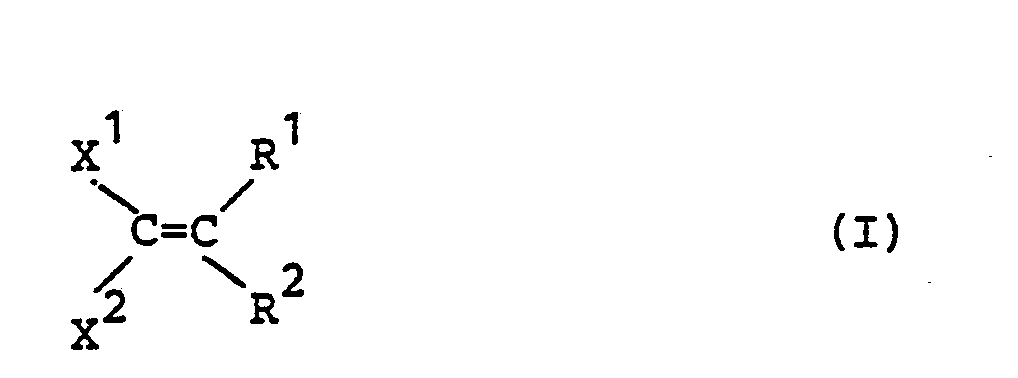
- Es wurde nun ein Verfahren zur Herstellung von 1,1-Dihalogen-alkenen der Formel I

- R für Wasserstoff oder für einen gegebenenfalls substituierten Alkyl-, Alkenyl-, Alkinyl-, Cycloalkyl-, Aralkyl-, Aralkenyl- oder Aryl-Rest steht,
- R2 für einen gegebenenfalls substituierten Alkyl-, Alkenyl-, Alkinyl-, Cycloalkyl-, Aralkyl-, Aralkenyl-oder Aryl-Rest steht, oder in welcher die beiden Reste R1 und R2 zusammen für eine gegebenenfalls verzweigte und/oder gegebenenfalls benzannellierte Kohlenwasserstoffkette stehen, und
- X1 und X2 gleich oder verschieden sind und für Halogen stehen,
- R und R2 die oben angegebenen Bedeutungen haben, mit Trihalogenacetaten der Formel III

- X 1, X2 und X3 gleich oder verschieden sind und für Halogen stehen und
- M⊕ für ein Alkalimetallion oder ein Erdalkalimetallionenäquivalent steht,
- Es ist als überraschend anzusehen, daß man nach dem erfindungsgemäßen Verfahren 1,1-Dihalogenalkene der Formel (I) in guten Ausbeuten erhält, da damit zu rechnen war, daß die Umsetzung von Carbonylverbindungen mit Trihalogenacetaten in Gegenwart von Trialkylphosphiten oder von Phosphorigsäuretriamiden weniger selektiv als bei Verwendung von Triphenylphosphin ablaufen würde.
- Als Vorteile des erfindungsgemäßen Verfahrens sind zu erwähnen, daß Trialkylphosphite und Phosphorigsäuretriamide preiswerter sind als Triphenylphosphin. Das neue Verfahren ist somit kostengünstiger als die nächstliegende aus dem Stand der Technik bekannte Synthesemethode.
- Verwendet man als Ausgangsstoffe beispielsweise 3-Formyl-2,2-dimethyl-cyclopropan-1-carbonsäuremethylester, Natrium-trichloracetat und Trimethylphosphit, so kann die Reaktion dieser Verbindungen durch folgendes Formelschema skizziert werden:

- Die als Ausgangsstoffe zu verwendenden Carbonylverbindungen sind durch Formel (II) definiert. Vorzugsweise stehen darin
- R für Wasserstoff für gegebenenfalls halogen-substituiertes C1-C5-Alkyl, für gegebenenfalls halogen-substituiertes Benzyl oder Phenylethyl, oder für gegebenenfalls durch Halogen, C1-C4-Alkyl,C1-C4-Alkoxy, Methylendioxy, Cyano und/oder Nitro substituiertes Phenyl, und
- R 2 für gegebenenfalls halogen-substituiertes C1-C5-Alkyl, für C2-C5-Alkenyl, für C2-C5-Alkinyl, für gegebenenfalls halogen-substituiertes Benzyl oder Phenylethyl, für gegebenenfalls durch Halogen, C1-C4-Alkyl, C1-C4-Alkoxy, Methylendioxy, Cyano und/oder Nitro substituiertes Phenyl, für gegebenenfalls halogen-substituiertes Styryl oder für den Rest

- Als Ausgangsstoffe besonders bevorzugt sind diejenigen Verbindungen der Formel (II), in welcher
- R1 für Wasserstoff steht und
- R2 für C2-C5-Alkenyl oder den Rest

- Z für Cyano, Acetyl, Carboxy, C1-C4-Alkoxycarbonyl oder für COOM steht, wobei M für Natrium oder Kalium steht.
- Als Beispiele für die Ausgangsverbindungen der Formel (II) seien genannt:
- β,β-Dimethyl-acrolein, 3-Formyl-2,2-dimethyl-l-cyano- cyclopropan, 3-Formyl-2,2-dimethyl-l-acetyl-cyclopropan, 3-Formyl-2,2-dimethyl-cyclopropan-1-carbonsäure und deren Natriumsalz sowie 3-Formyl-2,2-dimethyl-cyclopropan-l-carbonsäure-methylester, -ethylester, -n-propylester, -iso- propylester, -n-butylester, -iso-butylester, -sek.-butylester und -tert.-butylester.
- Die Verbindungen der Formel (II) sind teilweise bekannt (vergleiche Synthesis 1975, 535-536; Tetrahedron Lett. 1976, 1979-1982). Die besonders bevorzugten Cyclopropanderivate der Formel (II) sind teilweise noch nicht in der Literatur beschrieben. Man erhält diese Verbindungen nach an sich bekannten Verfahren. Ein Syntheseweg ist in nachstehendem Formelschema skizziert:
- (R steht für C1-C4-Alkyl)

- Durch Hydrolyse von bekannten Cyclopropancarbonsäureestern der Formel (VIII) (vgl. J.Org.Chem. 32, (1967), 3351-3355; Bull.Soc.Chim.Belg. 87 (1978), 721-732; Tetrahedron Lett. 1978, 1847-185o), beispielsweise durch Umsetzung mit wässrig-alkoholischer Kalilauge bei Temperaturen zwischen 2o und loo°C und anschließendes Ansäuern erhält man die Carbonsäuren der Formel (VII). Diese können durch Umsetzung mit Halogenierungsmitteln, wie z.B. Thionylchlorid, bei Temperaturen zwischen 2o und 8o°C in die Säurechloride der Formel (VI) umgewandelt werden.
- Durch Umsetzung der Säurechloride (VI) mit Trialkylphosphiten bei Temperaturen zwischen -2o und +15o°C, vorzugsweise zwischen 0 und 12o°C, erhält man die Cyclopropanoylphosphonsäureester der Formel (V) (vgl. J.Am. Chem.Soc. 86 (1964), 3862-3866; Methoden der organischen Chemie (Houben-Weyl-Müller), 4.Auflage, Band 12/1, S.453, Georg-Thieme-Verlag, Stuttgart 1963). Zur Isolierung und Reinigung der Produkte wird, gegebenenfalls unter vermindertem Druck destilliert.
- Die α-Hydroxy-phosphonsäureester der Formel (IV) erhält man durch Reduktion der Oxoverbindungen der Formel (V) mit Natriumtetrahydridoborat, gegebenenfalls unter Verwendung eines Verdünnungsmittels, wie z.B. Wasser oder wässriges Methanol, bei Temperaturen zwischen -2o und +5o°C und Halten des pH-Wertes zwischen 5 und 8 durch Zugabe eines Puffermittels, wie z.B. Natriumhydrogenphosphat (vgl. Chem.Ber.lo3 (197o), 2984-2986). Zur Aufarbeitung extrahiert man mit einem mit Wasser nicht mischbaren Lösungsmittel, wie z.B. Methylenchlorid, trocknet die Extrakte, filtriert und destilliert das Lösungsmittel unter vermindertem Druck ab.
- Aus den α-Hydroxy-phosphonsäureestern der Formel (IV) können die entsprechenden Aldehyde der Formel (II a) durch Behandeln mit Natronlauge bei Temperaturen zwischen 0 und 1oo°C, vorzugsweise zwischen lo und 5o°C hergestellt werden (vgl. Chem.Ber. lo3 (197o), 2984-2986).
- Alternativ zum oben skizzierten Herstellungsverfahren erhält man Aldehyde der Formel (II a) auch durch Umsetzung von Säurechloriden der Formel (VI) mit Lithiumtri- tert.-butoxy-hydrido-aluminat, welches man gegebenenfalls in situ aus Lithium-tetrahydridoaluminat und tert.-Butanol hergestellt hat, gegebenenfalls in Gegenwart eines Verdünnungsmittels, wie z.B. Tetrahydrofuran, bei Temperaturen zwischen -loo und +loo°C, vorzugsweise zwischen -80 und +5o°C. Zur Aufarbeitung wird in eine Mischung aus Salzsäure und Eiswasser gegossen und mit einem mit Wasser nicht mischbaren Lösungsmittel, wie z.B. Diethylether, extrahiert. Die Extrakte werden getrocknet, filtriert und eingeengt. Zur Reinigung des Rohproduktes wird gegebenenfalls destilliert.
- Die weiter als Ausgangsstoffe einzusetzenden Trihalogenacetate sind durch Formel (III) definiert. Vorzugsweise stehen darin
- X1, X 2 und X3 unabhängig von einander für Fluor, Chlor oder Brom, insbesondere für Chlor, und
- M⊕ steht für ein Natrium- oder Kalium-ion.
- Als Beispiele seien Natrium-trichloracetat, Natrium-chlordifluoracetat und Natrium-fluor-dichloracetat genannt. Die Verbindungen der Formel (III) sind bekannt.
- Als Beispiele für die beim erfindungsgemäßen Verfahren zu verwendenden Phosphorigsäuretrialkylester bzw. Phosphorigsäureamide seien Trimethylphosphit, Triethylphosphit, Tripropylphosphit und Phosphorigsäure-tris-dimethylamid genannt.
- Das erfindungsgemäße Verfahren wird vorzugsweise unter Verwendung von Verdünnungsmitteln durchgeführt. Als solche kommen praktisch alle inerten organischen Lösungsmittel insbesondere aprotisch polare Solventien in Frage. Hierzu gehören Ether, wie z.B. Glycoldimethylether, Diglycoldimethylether, Tetrahydrofuran und Dioxan, Carbonsäureamide, wie z.B. Dimethylformamid, Dimethylacetamid und N-Methyl-pyrrolidon, Sulfoxide, wie z.B. Dimethylsulfoxid, Phosphorsäureamide, wie z.B. Hexamethylphosphorsäuretriamid, sowie Nitrile, wie z.B. Acetonitril und Propionitril.
- Die Reaktionstemperatur wird zwischen 0 und 2oooC, vorzugsweise zwischen lo und 18o°C,bei Verwendung von Trialkylphosphiten insbesondere zwischen 14o und 160°C, bei Verwendung von Phosphorigsäureamiden insbesondere zwischen lo und 5o°C gehalten. Das Verfahren wird im allgemeinen bei Normaldruck oder einem dem Dampfdruck des jeweiligen Verdünnungsmittels bei der Reaktionstemperatur entsprechender Druck durchgeführt.
- Je Mol Carbonylverbindung der Formel (II) werden o,9 bis 1,2 Mol, vorzugsweise o,95 bis 1,1 Mol Trihalogenacetat der Formel (II) und o,9 bis 1,2 Mol, vorzugsweise o,95 bis 1,1 Mol Phosphorigsäureester bzw. -amid eingesetzt.
- Zur Durchführung des erfindungsgemäßen Verfahrens werden bei Verwendung von Phosphorigsäuretrialkylestern vorzugsweise alle Reaktionskomponenten bei Raumtemperatur (ca. 2o°C) in einem Verdünnungsmittel vermischt und das Reaktionsgemisch wird unter Rühren mehrere Stunden lang auf 14o bis 16o°C erhitzt.
- Bei Verwendung von Phosphorigsäuretriamiden werden vorzugsweise die Ausgangsstoffe der Formeln (II) und (III) in einem Verdünnungsmittel vorgelegt und bei lo bis 5o°C das Phosphorigsäureamid langsam zudosiert, wonach das Reaktionsgemisch noch einige Stunden bei Raumtemperatur gerührt wird.
- Die Aufarbeitung kann nach üblichen Methoden durchgeführt werden, beispielsweise, indem man das Reaktionsgemisch mit Wasser verdünnt, mit einem mit Wasser praktisch nicht mischbaren organischen Lösungsmittel, wie z.B. Methylenchlorid, extrahiert, die organische Phase trocknet, filtriert und eindampft. Die im Rückstand verbleibenden Produkte können auf übliche Weise, z.B. durch Vakuumdestillation, gereinigt werden.
- Die nach dem erfindungsgemäßen Verfahren herzustellenden 1,1-Dihalogen-alkene können zum Teil als Zwischenprodukte zur Herstellung von insektizid und akarizid wirksamen Pyrethroiden verwendet werden (vgl. DE - OS 2 326 o77).
-

-


Claims (1)


Priority Applications (1)
| Application Number | Priority Date | Filing Date | Title |
|---|---|---|---|
| AT81101466T ATE3404T1 (de) | 1980-03-12 | 1981-02-28 | Verfahren zur herstellung von 1,1-dihalogenalkenen. |
Applications Claiming Priority (2)
| Application Number | Priority Date | Filing Date | Title |
|---|---|---|---|
| DE3009487 | 1980-03-12 | ||
| DE19803009487 DE3009487A1 (de) | 1980-03-12 | 1980-03-12 | Verfahren zur herstellung von 1,1-dihalogen-alkenen |
Publications (3)
| Publication Number | Publication Date |
|---|---|
| EP0035724A2 true EP0035724A2 (de) | 1981-09-16 |
| EP0035724A3 EP0035724A3 (en) | 1981-11-18 |
| EP0035724B1 EP0035724B1 (de) | 1983-05-18 |
Family
ID=6096992
Family Applications (1)
| Application Number | Title | Priority Date | Filing Date |
|---|---|---|---|
| EP81101466A Expired EP0035724B1 (de) | 1980-03-12 | 1981-02-28 | Verfahren zur Herstellung von 1,1-Dihalogen-alkenen |
Country Status (9)
| Country | Link |
|---|---|
| US (1) | US4424166A (de) |
| EP (1) | EP0035724B1 (de) |
| JP (1) | JPS56140936A (de) |
| AT (1) | ATE3404T1 (de) |
| BR (1) | BR8101431A (de) |
| DE (2) | DE3009487A1 (de) |
| DK (1) | DK111381A (de) |
| HU (1) | HU187821B (de) |
| IL (1) | IL62324A (de) |
Cited By (1)
| Publication number | Priority date | Publication date | Assignee | Title |
|---|---|---|---|---|
| CN103917551A (zh) * | 2011-11-10 | 2014-07-09 | 巴斯夫欧洲公司 | 通过二氧化碳与氢气反应制备甲酸的方法 |
Families Citing this family (1)
| Publication number | Priority date | Publication date | Assignee | Title |
|---|---|---|---|---|
| CN105461564B (zh) * | 2014-09-04 | 2018-08-03 | 江苏扬农化工股份有限公司 | 一种二氯菊酸甲酯合成新方法 |
Family Cites Families (1)
| Publication number | Priority date | Publication date | Assignee | Title |
|---|---|---|---|---|
| CA1127659A (en) * | 1977-12-16 | 1982-07-13 | Pieter A. Verbrugge | Process for the preparation of di-(halo)-vinyl compounds |
-
1980
- 1980-03-12 DE DE19803009487 patent/DE3009487A1/de not_active Withdrawn
-
1981
- 1981-02-23 US US06/237,005 patent/US4424166A/en not_active Expired - Fee Related
- 1981-02-28 EP EP81101466A patent/EP0035724B1/de not_active Expired
- 1981-02-28 DE DE8181101466T patent/DE3160297D1/de not_active Expired
- 1981-02-28 AT AT81101466T patent/ATE3404T1/de not_active IP Right Cessation
- 1981-03-09 IL IL62324A patent/IL62324A/xx unknown
- 1981-03-09 JP JP3264881A patent/JPS56140936A/ja active Pending
- 1981-03-11 BR BR8101431A patent/BR8101431A/pt unknown
- 1981-03-11 DK DK111381A patent/DK111381A/da not_active Application Discontinuation
- 1981-03-12 HU HU81629A patent/HU187821B/hu unknown
Cited By (1)
| Publication number | Priority date | Publication date | Assignee | Title |
|---|---|---|---|---|
| CN103917551A (zh) * | 2011-11-10 | 2014-07-09 | 巴斯夫欧洲公司 | 通过二氧化碳与氢气反应制备甲酸的方法 |
Also Published As
| Publication number | Publication date |
|---|---|
| JPS56140936A (en) | 1981-11-04 |
| IL62324A (en) | 1984-04-30 |
| ATE3404T1 (de) | 1983-06-15 |
| IL62324A0 (en) | 1981-05-20 |
| EP0035724A3 (en) | 1981-11-18 |
| HU187821B (en) | 1986-02-28 |
| US4424166A (en) | 1984-01-03 |
| EP0035724B1 (de) | 1983-05-18 |
| DE3009487A1 (de) | 1981-09-17 |
| BR8101431A (pt) | 1981-09-22 |
| DK111381A (da) | 1981-09-13 |
| DE3160297D1 (en) | 1983-07-07 |
Similar Documents
| Publication | Publication Date | Title |
|---|---|---|
| EP0006205B1 (de) | Verfahren zur Herstellung von Chloro-styryl-cyclopropan-carbonsäure-derivaten | |
| EP0035724B1 (de) | Verfahren zur Herstellung von 1,1-Dihalogen-alkenen | |
| EP0024611B1 (de) | Verfahren zur Herstellung von substituierten Benzaldehyden | |
| EP0023598B1 (de) | Verfahren zur Herstellung von 1,1-Dichloralkenen | |
| EP0035753B1 (de) | Verfahren zur Herstellung von 1,1-Dichlor-alkenen | |
| EP0035754B1 (de) | Verfahren zur Herstellung von 1,1-Dichlor-alkenen | |
| EP0048370B1 (de) | Verfahren zur Herstellung von trans-3-(Z-2-Chlor-2-aryl-vinyl)-2,2-dimethyl-cyclopropan-1-carbon-säure-derivaten, neue Zwischenprodukte hierfür, Verfahren zu deren Herstellung und Verwendung von Zwischenprodukten in Schädlingsbekämpfungsmitteln | |
| EP0024018B1 (de) | Verfahren zur Herstellung von alpha-Oxo-alpha-(3-alkoxycarbonyl-2,2-dimethyl-cycloprop-1-yl)-methan-phosphonsäureestern, neue Zwischenprodukte hierfür und Verfahren zu deren Herstellung | |
| DE2917620A1 (de) | Verfahren zur herstellung von alkenen | |
| EP0019719A1 (de) | Verfahren zur Herstellung von Alkenen, neue Zwischenprodukte zu ihrer Herstellung und Verfahren zu deren Herstellung | |
| EP0022971A1 (de) | Verfahren zur Herstellung von 3-(2,2-Dichlor-vinyl)-2,2-dimethyl-cyclopropan-1-carbonsäure-derivaten | |
| EP0022984B1 (de) | Verfahren zur Herstellung von 3-(2,2-Dichlor-vinyl)-2,2-dimethyl-cyclopropan-1-carbonsäurederivaten | |
| EP0031915A1 (de) | Verfahren zur Herstellung von Halogenalkenen | |
| EP0089485A2 (de) | Verfahren zur Herstellung von 5-Chlor-1H-tetrazol-1-carbonsäureestern sowie Verfahren zur Herstellung der erforderlichen Dichlorisonitril-carbonsäureester | |
| EP0071126B1 (de) | Verfahren zur Herstellung von Aldehyden | |
| EP0020988A2 (de) | Verfahren zur Herstellung von Alpha-Cyano-benzylestern und Zwischenprodukte dafür sowie deren Herstellung | |
| DE3009242A1 (de) | Verfahren zur herstellung von 3-(2,2-dichlor-vinyl)-2,2-dimethyl-cyclopropan-1-carbonsaeure-derivaten4 | |
| EP0673945A1 (de) | Herstellung eines Wittigestersalzes | |
| DE2929725A1 (de) | Verfahren zur herstellung von 3-(2,2-dichlor-vinyl)-2,2-dimethylcyclopropan-1-carbonsaeureestern | |
| DE2929636A1 (de) | Verfahren zur herstellung von alkenen, neue alkene, deren verwendung und zwischenprodukte zu ihrer herstellung | |
| DE3211036A1 (de) | Verfahren zur herstelung von alkenen |
Legal Events
| Date | Code | Title | Description |
|---|---|---|---|
| PUAI | Public reference made under article 153(3) epc to a published international application that has entered the european phase |
Free format text: ORIGINAL CODE: 0009012 |
|
| PUAL | Search report despatched |
Free format text: ORIGINAL CODE: 0009013 |
|
| 17P | Request for examination filed |
Effective date: 19810306 |
|
| AK | Designated contracting states |
Designated state(s): AT BE CH DE FR GB IT NL |
|
| AK | Designated contracting states |
Designated state(s): AT BE CH DE FR GB IT NL |
|
| ITF | It: translation for a ep patent filed | ||
| GRAA | (expected) grant |
Free format text: ORIGINAL CODE: 0009210 |
|
| AK | Designated contracting states |
Designated state(s): AT BE CH DE FR GB IT LI NL |
|
| REF | Corresponds to: |
Ref document number: 3404 Country of ref document: AT Date of ref document: 19830615 Kind code of ref document: T |
|
| ET | Fr: translation filed | ||
| REF | Corresponds to: |
Ref document number: 3160297 Country of ref document: DE Date of ref document: 19830707 |
|
| PGFP | Annual fee paid to national office [announced via postgrant information from national office to epo] |
Ref country code: FR Payment date: 19840201 Year of fee payment: 4 |
|
| PG25 | Lapsed in a contracting state [announced via postgrant information from national office to epo] |
Ref country code: AT Effective date: 19840228 |
|
| PLBE | No opposition filed within time limit |
Free format text: ORIGINAL CODE: 0009261 |
|
| STAA | Information on the status of an ep patent application or granted ep patent |
Free format text: STATUS: NO OPPOSITION FILED WITHIN TIME LIMIT |
|
| PGFP | Annual fee paid to national office [announced via postgrant information from national office to epo] |
Ref country code: BE Payment date: 19840331 Year of fee payment: 4 |
|
| PGFP | Annual fee paid to national office [announced via postgrant information from national office to epo] |
Ref country code: CH Payment date: 19840405 Year of fee payment: 4 |
|
| 26N | No opposition filed | ||
| PGFP | Annual fee paid to national office [announced via postgrant information from national office to epo] |
Ref country code: DE Payment date: 19850124 Year of fee payment: 5 |
|
| PGFP | Annual fee paid to national office [announced via postgrant information from national office to epo] |
Ref country code: NL Payment date: 19870228 Year of fee payment: 7 |
|
| PG25 | Lapsed in a contracting state [announced via postgrant information from national office to epo] |
Ref country code: LI Effective date: 19890228 Ref country code: GB Effective date: 19890228 Ref country code: CH Effective date: 19890228 Ref country code: BE Effective date: 19890228 |
|
| BERE | Be: lapsed |
Owner name: BAYER A.G. Effective date: 19890228 |
|
| PG25 | Lapsed in a contracting state [announced via postgrant information from national office to epo] |
Ref country code: NL Effective date: 19890901 |
|
| NLV4 | Nl: lapsed or anulled due to non-payment of the annual fee | ||
| GBPC | Gb: european patent ceased through non-payment of renewal fee | ||
| PG25 | Lapsed in a contracting state [announced via postgrant information from national office to epo] |
Ref country code: FR Free format text: LAPSE BECAUSE OF NON-PAYMENT OF DUE FEES Effective date: 19891027 |
|
| REG | Reference to a national code |
Ref country code: CH Ref legal event code: PL |
|
| PG25 | Lapsed in a contracting state [announced via postgrant information from national office to epo] |
Ref country code: DE Effective date: 19891101 |
|
| REG | Reference to a national code |
Ref country code: FR Ref legal event code: ST |