EP0036537A2 - Verfahren zum Färben von Polyester/Cellulosefasermischungen - Google Patents
Verfahren zum Färben von Polyester/Cellulosefasermischungen Download PDFInfo
- Publication number
- EP0036537A2 EP0036537A2 EP81101670A EP81101670A EP0036537A2 EP 0036537 A2 EP0036537 A2 EP 0036537A2 EP 81101670 A EP81101670 A EP 81101670A EP 81101670 A EP81101670 A EP 81101670A EP 0036537 A2 EP0036537 A2 EP 0036537A2
- Authority
- EP
- European Patent Office
- Prior art keywords
- acid
- dye
- dyeing
- polyester
- bath
- Prior art date
- Legal status (The legal status is an assumption and is not a legal conclusion. Google has not performed a legal analysis and makes no representation as to the accuracy of the status listed.)
- Granted
Links
Classifications
-
- D—TEXTILES; PAPER
- D06—TREATMENT OF TEXTILES OR THE LIKE; LAUNDERING; FLEXIBLE MATERIALS NOT OTHERWISE PROVIDED FOR
- D06P—DYEING OR PRINTING TEXTILES; DYEING LEATHER, FURS OR SOLID MACROMOLECULAR SUBSTANCES IN ANY FORM
- D06P3/00—Special processes of dyeing or printing textiles, or dyeing leather, furs, or solid macromolecular substances in any form, classified according to the material treated
- D06P3/58—Material containing hydroxyl groups
- D06P3/60—Natural or regenerated cellulose
- D06P3/66—Natural or regenerated cellulose using reactive dyes
-
- D—TEXTILES; PAPER
- D06—TREATMENT OF TEXTILES OR THE LIKE; LAUNDERING; FLEXIBLE MATERIALS NOT OTHERWISE PROVIDED FOR
- D06P—DYEING OR PRINTING TEXTILES; DYEING LEATHER, FURS OR SOLID MACROMOLECULAR SUBSTANCES IN ANY FORM
- D06P3/00—Special processes of dyeing or printing textiles, or dyeing leather, furs, or solid macromolecular substances in any form, classified according to the material treated
- D06P3/82—Textiles which contain different kinds of fibres
- D06P3/8204—Textiles which contain different kinds of fibres fibres of different chemical nature
- D06P3/8223—Textiles which contain different kinds of fibres fibres of different chemical nature mixtures of fibres containing hydroxyl and ester groups
- D06P3/8238—Textiles which contain different kinds of fibres fibres of different chemical nature mixtures of fibres containing hydroxyl and ester groups using different kinds of dye
- D06P3/8252—Textiles which contain different kinds of fibres fibres of different chemical nature mixtures of fibres containing hydroxyl and ester groups using different kinds of dye using dispersed and reactive dyes
Definitions
- the invention relates to a process for single-bath, single-stage dyeing of fiber mixtures of cellulose and polyester fibers with reactive and disperse dyes by the pull-out process from electrolyte-containing dye baths, characterized in that a dye bath is used which contains a reactive dye with fluorotriazinyl and / or Fluoropyrimidinyl group and 0.1 - 5 g / 1 of an acid donor effective at dyeing temperature.
- Suitable reactive dyes are, in particular, organic dyes from the anthraquinone, azo and phthalocanine series which have a monofluoro-s-triazinyl radical, in particular those which contain an ether or thioether group or in particular an optionally substituted amino group as further substituents on the triazine ring, or else fluoropyrimidine dyes especially those with Difluorchlorpyrimidinylrest.
- Such dyes are described in large numbers, for example. in British Patents 1,169,254; 1,188,606; 1 526 840.
- Water-soluble derivatives of organic or inorganic acids are used as acid donors, which release acidic groups specifically in the temperature range from 60 to 100 ° C and thus the pH value of the dye bath, which is initially neutral to weakly alkaline during the dyeing process, preferably up to pH in the acidic range Move 4-5.
- Suitable acid donors are: alkali metal salts of halocarboxylic acids and their amides, such as sodium monochloroacetic acid, sodium dichloroacetic acid, sodium 3-chloropropionate, monochloroacetamide; Lactones such as butyrolactone; Halbester of sulfuric acid such as lauryl sulfate, hexadecyl sulfate and octadecyl sulfate or preferably 2-ethylhexyl sulfate, butyl sulfate, as well as the oxyethylated and oxypropylated Schwefelklasteder of alcohols, for example butylglycol sulfate, Butyldiglykolsulfat, further C 1 -C 4 alkyl esters of phosphoric acid or phosphorous acid, C 1 -C 4 alkyl esters of phosphonic and phosphinic acid, such as trimethyl phosphate, trie
- polyester fiber components Commercially available carriers may be used for the dyeing of the polyester fiber components. Examples include trichlorobenzene, o-dichlorobenzene, methyl cresotate, butyl benzoate, o-phenylphenol, p-phenylphenol,
- the carriers are used in the usual amounts for dyeing polyester fibers and are added to the dye bath after the dye and salt have been added.
- the process is suitable for dyeing yarn and pieces on packers and packages, jet dyeing machines, reel runners and jiggers.
- the process is generally carried out as follows:
- the textile material is introduced into a dyebath which has a pH of about 7-10, preferably 7-9 and 0.01-10 g / 1 of a fluorotriazinyl and / or fluoropyrimidinyl reactive dye , 01-10 g / l of a conventional disperse dye, 10-200 g / l of a conventional electrolyte such as sodium sulfate or sodium chloride, 0.1-10 g / l of an acid donor and preferably 0.1-10 g / l of a buffer, in particular one Contains phosphate buffers for a pH range of 7-9, as well as other common auxiliaries, for example 1-8 g / l of a carrier.
- the dye bath is inside heated from 30 - 40 ° C to 95 - 130 ° C for 1 - 2 hours and dyed at this temperature for 1/2 - 1 hour.
- Suitable buffer systems are, for example, trisodium phosphate monosodium dihydrogen phosphate or disodium hydrogen phosphate.
- the reactive dye is dyed in the alkaline range, preferably at pH 7.5-9 below 100 ° C.
- 100 g of a knitted fabric consisting of 50 g polyester and 50 g cotton are treated on a HT jet dyeing machine with a 30 ° C. liquor, which consists of consists.
- the liquor is brought to 130 ° C. in 100 minutes and kept at this temperature for 1 hour.
- the liquor is brought to 130 ° C. in 100 minutes and kept at this temperature for 1 hour.
- the liquor is brought to 130 ° C. in 55 minutes and kept at this temperature for 1 hour.
Landscapes
- Engineering & Computer Science (AREA)
- Textile Engineering (AREA)
- Chemical & Material Sciences (AREA)
- Dispersion Chemistry (AREA)
- Coloring (AREA)
Abstract
Description
- Gegenstand der Erfindung ist ein Verfahren zum einbadigen, einstufigen Färben von Fasermischungen aus Cellulose-und Polyesterfasern mit Reaktiv- und Dispersionsfarbstoffen nach dem Auszieh-Verfahren aus elektrolythaltigen Färbebädern, dadurch gekennzeichnet, daß man ein Färbebad verwendet, welches einen Reaktivfarbstoff mit Fluortriazinyl- und/oder Fluor-pyrimidinylgruppe sowie 0,1 - 5 g /1 eines bei Färbetemperatur wirksamen Säurespenders enthält.
- Als Reaktivfarbstoffe kommen insbesondere organische Farbstoffe aus der Anthrachinon-, Azo- und Phthalocaninreihe in Betracht, welche einen Monofluor-s-triazinylreste aufweisen, insbesondere solche die als weiteren Substituenten am Triazinring eine Äther- oder Thioäthergruppe oder insbesondere eine gegebenenfalls substituierte Aminogruppe enthalten oder aber Fluorpyrimidinfarbstoffe insbesondere solche mit Difluorchlorpyrimidinylrest. Derartige Farbstoffe sind in großer Zahl beschrieben, bsp. in den britischen Patentschriften 1 169 254; 1 188 606; 1 526 840.
- Als Säurespender werden wasserlösliche Derivate organischer oder anorganischer Säuren eingesetzt, die spezifisch im Temperturbereich von 60 bis 100°C saure Gruppen freisetzen und damit den pH-Wert des zu Beginn neutral bis schwach alkalisch reagierenden Färbebades während des Färbeprozesses in den sauren Bereich vorzugsweise bis auf pH 4-5 verschieben.
- Als geeignete Säurespender seien genannt: Alkalisalze von Halogencarbonsäuren und deren Amide wie mono-chloressigsaures Natrium, Dichloressigsaures Natrium, 3-chlorpropionsaures Natrium, Monochloracetamid; Lactone wie Butyrolacton; Halbester der Schwefelsäure wie Laurylsulfat, Hexadecylsulfat oder Octadecylsulfat sowie vorzugsweise 2-Ethylhexylsulfat, Butylsulfat, sowie die Schwefelsäureester von oxyethylierten und oxypropylierten Alkoholen wie z.B. Butylglykolsulfat, Butyldiglykolsulfat, ferner C1-C4-Alkylester der Phosphorsäure oder phosphorigen Säure, C1-C4-Alkylester von Phosphon- und Phosphinsäure, wie z.B. Trimethylphosphat, Triethylphosphat, Tris-(hydroxyethyl)-phosphat, Dimethylphosphit, Diethylphosphit, Dipropylphosphit, Di-isopropylphosphit, Dibutylphosphit, Methanphosphonsäuredimethylester, Äthanphosphonsäurediethylester, Phosphonopropionsäuretrimethylester, Cyanethanphosphonsäuredimethylester, Cyanmethanphosphonsäurediemthylester, Hydroxyethan- und Hydroxymethanphosphonsäuredimethylester, 2-Chlore.thanphosphonsäuredi- methylester, 2-Chlorethanphosphonsäurediethylester, Acetylphosphonsäuredimethylester und Acetylphosphonsäurediethylester und Phosphonobernsteinsäure-tetramethylester.
- Sie werden in solchen Mengen eingesetzt, daß nach Beendigung des Färbeprozesses ein pH-Wert unterhalb von 7, insbesondere etwa 4 - 5 vorliegt.
- Als für das Färben der Polyesterfaseranteile gegebenenfalls mitzuverwendende Carrier kommen handelsübliche Carrier in Betracht. Beispielsweise genannt seien Trichlorbenzol, o-Dichlorbenzol, Kresotinsäuremethylester, Benzoesäurebutylester, o-Phenylphenol, p-Phenylphenol,
- Die Carrier kommen in den beim Färben von Polyesterfasern üblichen Mengen zur Anwendung und werden dem Färbebad nach Eintragung des Farbstoffs und des Salzes zugesetzt.
- Das Verfahren eignet sich zum Färben von Garn und Stück auf Pack- und Kreuzspulapparaten, Jetfärbemaschinen, Haspelkufen und Jiggern.
- Das Verfahren wird im allgemeinen folgendermaßen durchgeführt: Das Textilmaterial wird in ein Färbebad eingebracht, welches einen pH von etwa 7 - 10, vorzugsweise 7 - 9 aufweist und 0,01 - 10 g/1 eines Fluortriazinyl-und/oder Fluorpyrimidinyl-Reaktivfarbstoffs, 0,01 - 10 g/l eines üblichen Dispersionsfarbstoffs, 10 - 200 g/l eines üblichen Elektrolyten wie Natriumsulfat oder Natriumchlorid, 0,1 - 10 g/l eines Säurespenders sowie vorzugsweise 0,1 - 10 g/l eines Puffers, insbesondere eines Phosphatpuffers für einen pH-Bereich von 7 - 9 sowie weitere übliche Hilfsmittel beispielsweise 1 - 8 g/l eines Carriers enthält. Das Färbebad wird innerhalb von 1 - 2 Stunden von 30 - 40°C auf 95 - 130°C erwärmt und 1/2 - 1 Stunde bei dieser Temperatur gefärbt.
- Geeignete Puffersysteme sind beispielsweise Trinatriumphosphat-Mononatriumdihydrogenphosphat oder Dinatriumhydrogenphosphat.
- Bei dem vorliegenden Verfahren wird der Reaktivfarbstoff im alkalischen Bereich gefärbt, vorzugsweise bei pH 7,5 - 9 unterhalb von 100°C. Die Menge an Säurespender wird dabei so bemessen, daß nach erfolgter Färbung der pH=Wert unterhalb von 7, vorzugsweise im Bereich von 4 - 5 liegt.
- 100 g einer Wirkware bestehend aus 50 g Polyester und 50 g Baumwolle werden auf einer HT-Jetfärbeanlage mit einer 30°C Flotte behandelt, die aus
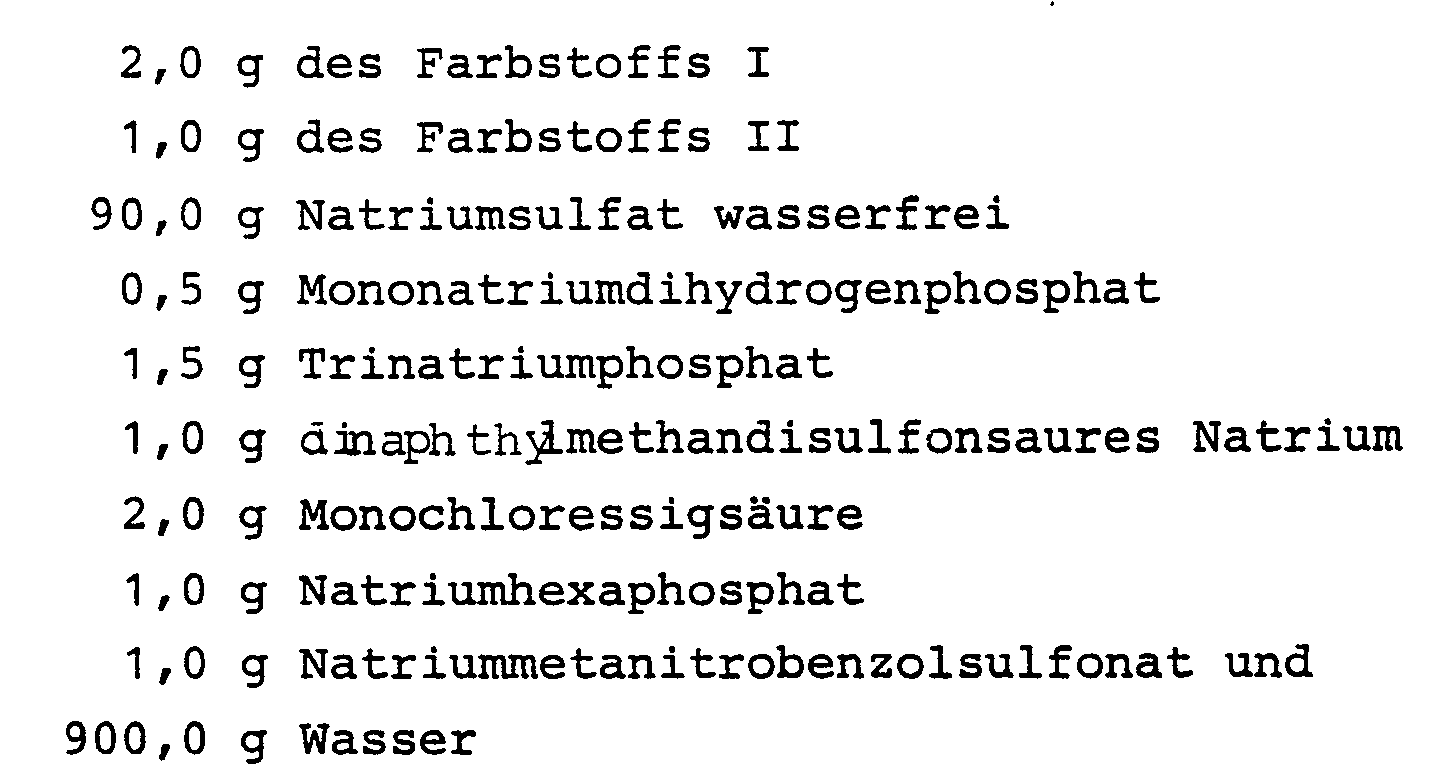
- Die Flotte wird in 100 Minuten auf 130°C gebracht und 1 Stunde bei dieser Temperatur gehalten.
- Nach dem üblichen Spülen und kochendem Seifen erhält man eine klare Blaufärbung mit guten Echtheitseigenschaften.
- 100 g eines Mischgarns bestehend aus 67 g Polyester und 33 g Zellwolle werden mit einer 30°C warmen Färbeflotte behandelt, welche aus
-

- Nach dem üblichen Spülen und einem 10-minütigen Seifen bei 110°C unter Verwendung eines praxisüblichen anionaktiven Waschmittels erhält man eine klare Rotfärbung mit guten Echtheitseigenschaften.
- 100 g einer Wirkware bestehend aus 50 g Polyester und 50 g mercerisierter Baumwolle werden bei 75°C 45 Minuten auf einem HT-Baumfärbeapparat mit einer Flotte behandelt, die aus


- Die Flotte wird in 55 Minuten auf 130°C gebracht und 1 Stunde bei dieser Temperatur gehalten.
- Nach dem üblichen Spülen und Seifen unter Verwendung eines praxisüblichen, anionaktiven Waschmittels erhält man eine klare Gelbfärbung mit guten Echtheitseigenschaften.


Claims (4)
Applications Claiming Priority (2)
| Application Number | Priority Date | Filing Date | Title |
|---|---|---|---|
| DE19803010979 DE3010979A1 (de) | 1980-03-21 | 1980-03-21 | Faerbeverfahren |
| DE3010979 | 1980-03-21 |
Publications (3)
| Publication Number | Publication Date |
|---|---|
| EP0036537A2 true EP0036537A2 (de) | 1981-09-30 |
| EP0036537A3 EP0036537A3 (en) | 1981-12-16 |
| EP0036537B1 EP0036537B1 (de) | 1983-09-28 |
Family
ID=6097954
Family Applications (1)
| Application Number | Title | Priority Date | Filing Date |
|---|---|---|---|
| EP81101670A Expired EP0036537B1 (de) | 1980-03-21 | 1981-03-07 | Verfahren zum Färben von Polyester/Cellulosefasermischungen |
Country Status (3)
| Country | Link |
|---|---|
| EP (1) | EP0036537B1 (de) |
| JP (1) | JPS5846594B2 (de) |
| DE (2) | DE3010979A1 (de) |
Cited By (3)
| Publication number | Priority date | Publication date | Assignee | Title |
|---|---|---|---|---|
| EP0062865A1 (de) * | 1981-04-14 | 1982-10-20 | Bayer Ag | Färbeverfahren |
| EP0597330A1 (de) * | 1992-11-10 | 1994-05-18 | Bayer Ag | Reaktivfarbstoffmischung für Polyester/Cellulosefasermischungen |
| CN102561071A (zh) * | 2010-12-23 | 2012-07-11 | 福建凤竹纺织科技股份有限公司 | 一种涤棉织物的分散、活性一浴染色工艺 |
Families Citing this family (7)
| Publication number | Priority date | Publication date | Assignee | Title |
|---|---|---|---|---|
| JPS5930971A (ja) * | 1982-07-06 | 1984-02-18 | 日本化薬株式会社 | セルロ−ス及びセルロ−ス含有繊維材料の捺染又はパジング染色法 |
| JPS59106583A (ja) * | 1982-12-13 | 1984-06-20 | 日本化学工業株式会社 | ポリエステル/セルロ−ス混紡繊維品の染色方法 |
| JPS6253376A (ja) * | 1985-09-03 | 1987-03-09 | Nippon Chem Ind Co Ltd:The | 染料組成物 |
| JPH0684593B2 (ja) * | 1985-09-15 | 1994-10-26 | 一方社油脂工業株式会社 | ポリエステル/セルロ−ス混紡・交織品の染色方法 |
| JPS62230858A (ja) * | 1985-12-27 | 1987-10-09 | Nippon Chem Ind Co Ltd:The | 染料組成物 |
| TW330957B (en) * | 1995-06-22 | 1998-05-01 | Daistar Japan Kk | Method of dyeing a blended fiber containing cellulose fibers and polyester fibers |
| CN104074069A (zh) * | 2014-07-02 | 2014-10-01 | 浙江航民股份有限公司 | 染色用分散染料与活性染料的同浴剂 |
Family Cites Families (8)
| Publication number | Priority date | Publication date | Assignee | Title |
|---|---|---|---|---|
| DE1469750B2 (de) * | 1965-12-31 | 1973-12-06 | Farbwerke Hoechst Ag, Vormals Meister Lucius & Bruening, 6000 Frankfurt | Verfahren zum Farben von Fasermateriahen aus nativer oder regene nerter Cellulose mit Reaktivfarb stoffen oder von Gemischen aus diesen Cellulosefasern und Fasermateriahen aus hochmolekularen linearen Poly estern mit Reaktivfarbstoffen und Dis persionsfarbstoffen |
| DE1619464A1 (de) * | 1966-02-23 | 1970-10-29 | Hoechst Ag | Verfahren zum Faerben von Cellulosefasern mit Reaktivfarbstoffen oder von Mischungen aus Cellulose- und Polyesterfasern mit Reaktiv- und Dispersionsfarbstoffen |
| US3910758A (en) * | 1971-06-17 | 1975-10-07 | Bayer Ag | Dyeing wool with fluorine substituted pyrimidine containing azo reactive dyestuff |
| US3980428A (en) * | 1972-11-06 | 1976-09-14 | Sandoz Ltd. | Dyeing process |
| DE2834997C2 (de) * | 1978-08-10 | 1980-08-28 | Hoechst Ag, 6000 Frankfurt | Verfahren zum Färben von synthetischen Polyamidfasern mit Reaktivfarbstoffen nach der Ausziehmethode |
| DE2835035B2 (de) * | 1978-08-10 | 1980-10-09 | Hoechst Ag, 6000 Frankfurt | Verfahren zum Färben von Cellulosefasern mit Reaktivfarbstoffen nach der Ausziehmethode |
| DE2913718B2 (de) * | 1979-04-05 | 1981-02-05 | Bayer Ag, 5090 Leverkusen | Verfahren zum Färben von Cellulosefasern und Cellulosefasern enthaltenden Fasermischungen mit Reaktivfarbstoffen |
| DE2933343A1 (de) * | 1979-08-17 | 1981-03-26 | Bayer Ag, 51373 Leverkusen | Faerben von wolle/cellulosefasermischungen |
-
1980
- 1980-03-21 DE DE19803010979 patent/DE3010979A1/de not_active Withdrawn
-
1981
- 1981-03-07 DE DE8181101670T patent/DE3160995D1/de not_active Expired
- 1981-03-07 EP EP81101670A patent/EP0036537B1/de not_active Expired
- 1981-03-18 JP JP56038027A patent/JPS5846594B2/ja not_active Expired
Cited By (3)
| Publication number | Priority date | Publication date | Assignee | Title |
|---|---|---|---|---|
| EP0062865A1 (de) * | 1981-04-14 | 1982-10-20 | Bayer Ag | Färbeverfahren |
| EP0597330A1 (de) * | 1992-11-10 | 1994-05-18 | Bayer Ag | Reaktivfarbstoffmischung für Polyester/Cellulosefasermischungen |
| CN102561071A (zh) * | 2010-12-23 | 2012-07-11 | 福建凤竹纺织科技股份有限公司 | 一种涤棉织物的分散、活性一浴染色工艺 |
Also Published As
| Publication number | Publication date |
|---|---|
| EP0036537A3 (en) | 1981-12-16 |
| JPS5846594B2 (ja) | 1983-10-17 |
| EP0036537B1 (de) | 1983-09-28 |
| JPS56144277A (en) | 1981-11-10 |
| DE3010979A1 (de) | 1981-10-01 |
| DE3160995D1 (en) | 1983-11-03 |
Similar Documents
| Publication | Publication Date | Title |
|---|---|---|
| EP0110007B1 (de) | Verwendung von Milchprotein als Textilhilfsmittel | |
| EP0036537B1 (de) | Verfahren zum Färben von Polyester/Cellulosefasermischungen | |
| DE2834997C2 (de) | Verfahren zum Färben von synthetischen Polyamidfasern mit Reaktivfarbstoffen nach der Ausziehmethode | |
| DE2914111C2 (de) | Verfahren zum Färben von Cellulosematerialien mit Reaktivfarbstoffen nach dem Ausziehverfahren | |
| EP0023341B1 (de) | Klotzhilfsmittel, Verfahren zu seiner Herstellung und Verfahren zum Färben von Cellulosefasern bzw. Gemischen von Cellulosefasern zusammen mit Synthesefasern mit Schwefel-, Schwefelküpen-, Küpen- und Reaktivfarbstoffen | |
| DE3852637T2 (de) | Verfahren zum Färben von Wolle und sonstigen keratinhaltigen Fasern. | |
| EP0805229A2 (de) | Verfahren zum kontinuierlichen Färben von Polyester-Garnen | |
| EP0062865B1 (de) | Färbeverfahren | |
| EP0024332B1 (de) | Färben von Wolle/Cellulosefasermischungen | |
| EP0226155A2 (de) | Verfahren zum Färben und Bedrucken von Polyesterfasermaterialien | |
| EP0043984A1 (de) | Kontinueverfahren zum Färben oder Bedrucken von Fasermischungen aus Cellulose- und Polyesterfasern | |
| DE2821494C2 (de) | Verfahren und Hilfsmittel zum Färben von Polyesterfasern oder diese enthaltenden Fasergemischen | |
| DE3027077A1 (de) | Faerbe- und druckverfahren mit reaktivfarbstoffen | |
| EP0021044B1 (de) | Verfahren zum Färben von Cellulosefasern und Cellulosefasern enthaltenden Fasermischungen mit Reaktivfarbstoffen | |
| EP0273300A2 (de) | Verfahren zum einbadig/einstufigen Färben von Mischungen aus carrierfrei färbbaren Polyesterfasern und Cellulosefasern | |
| DE963862C (de) | Verfahren zum Faerben von Textilien | |
| DE1021826B (de) | Verfahren zum Faerben von Polyesterfasern | |
| EP0474594A1 (de) | Verfahren zum Färben von Wolle und deren Mischungen mit anderen Fasern mit Reaktivfarbstoffen | |
| DE3206093A1 (de) | Nachbehandlungsverfahren fuer reaktivfaerbungen | |
| EP0305839B1 (de) | Verfahren für das Färben von Cellulosefasern | |
| DE1619513C (de) | Verfahren zum Färben von Mischungen aus Cellulose- und Polyesterfasern | |
| DE2238399A1 (de) | Verfahren zum faerben von synthetischen fasermaterialien aus organischen loesemitteln | |
| DE1805157A1 (de) | Verfahren zum kontinuierlichen Faerben oder Bedrucken von Fasermaterialien aus natuerlichen oder synthetischen Polyamiden | |
| CH447107A (de) | Verfahren zum Färben, Klotzen oder Bedrucken von Textilfasern aus Polyamiden | |
| DE3141829A1 (de) | Verfahren zum faerben von cellulosefasern, vor allem zum einbadigen faerben von mischungen aus cellulose/polyester mit dispersions- und reaktivfarbstoffen |
Legal Events
| Date | Code | Title | Description |
|---|---|---|---|
| PUAI | Public reference made under article 153(3) epc to a published international application that has entered the european phase |
Free format text: ORIGINAL CODE: 0009012 |
|
| 17P | Request for examination filed |
Effective date: 19810307 |
|
| AK | Designated contracting states |
Designated state(s): CH DE FR GB IT |
|
| PUAL | Search report despatched |
Free format text: ORIGINAL CODE: 0009013 |
|
| AK | Designated contracting states |
Designated state(s): CH DE FR GB IT |
|
| ITF | It: translation for a ep patent filed | ||
| GRAA | (expected) grant |
Free format text: ORIGINAL CODE: 0009210 |
|
| AK | Designated contracting states |
Designated state(s): CH DE FR GB IT LI |
|
| REF | Corresponds to: |
Ref document number: 3160995 Country of ref document: DE Date of ref document: 19831103 |
|
| ET | Fr: translation filed | ||
| PLBE | No opposition filed within time limit |
Free format text: ORIGINAL CODE: 0009261 |
|
| STAA | Information on the status of an ep patent application or granted ep patent |
Free format text: STATUS: NO OPPOSITION FILED WITHIN TIME LIMIT |
|
| 26N | No opposition filed | ||
| ITTA | It: last paid annual fee | ||
| PGFP | Annual fee paid to national office [announced via postgrant information from national office to epo] |
Ref country code: DE Payment date: 19960214 Year of fee payment: 16 |
|
| PGFP | Annual fee paid to national office [announced via postgrant information from national office to epo] |
Ref country code: GB Payment date: 19960227 Year of fee payment: 16 |
|
| PGFP | Annual fee paid to national office [announced via postgrant information from national office to epo] |
Ref country code: FR Payment date: 19960228 Year of fee payment: 16 |
|
| PGFP | Annual fee paid to national office [announced via postgrant information from national office to epo] |
Ref country code: CH Payment date: 19960419 Year of fee payment: 16 |
|
| PG25 | Lapsed in a contracting state [announced via postgrant information from national office to epo] |
Ref country code: GB Effective date: 19970307 |
|
| PG25 | Lapsed in a contracting state [announced via postgrant information from national office to epo] |
Ref country code: LI Effective date: 19970331 Ref country code: CH Effective date: 19970331 |
|
| GBPC | Gb: european patent ceased through non-payment of renewal fee |
Effective date: 19970307 |
|
| REG | Reference to a national code |
Ref country code: CH Ref legal event code: PL |
|
| PG25 | Lapsed in a contracting state [announced via postgrant information from national office to epo] |
Ref country code: FR Free format text: LAPSE BECAUSE OF NON-PAYMENT OF DUE FEES Effective date: 19971128 |
|
| PG25 | Lapsed in a contracting state [announced via postgrant information from national office to epo] |
Ref country code: DE Effective date: 19971202 |
|
| REG | Reference to a national code |
Ref country code: FR Ref legal event code: ST |