EP0037868A1 - Procédé pour la préparation de matériaux céramiques ayant une faible expansion thermique - Google Patents
Procédé pour la préparation de matériaux céramiques ayant une faible expansion thermique Download PDFInfo
- Publication number
- EP0037868A1 EP0037868A1 EP80302079A EP80302079A EP0037868A1 EP 0037868 A1 EP0037868 A1 EP 0037868A1 EP 80302079 A EP80302079 A EP 80302079A EP 80302079 A EP80302079 A EP 80302079A EP 0037868 A1 EP0037868 A1 EP 0037868A1
- Authority
- EP
- European Patent Office
- Prior art keywords
- weight
- calculated
- oxide
- silica
- titanium
- Prior art date
- Legal status (The legal status is an assumption and is not a legal conclusion. Google has not performed a legal analysis and makes no representation as to the accuracy of the status listed.)
- Granted
Links
- 229910010293 ceramic material Inorganic materials 0.000 title claims abstract description 28
- 238000000034 method Methods 0.000 title claims description 9
- VYPSYNLAJGMNEJ-UHFFFAOYSA-N Silicium dioxide Chemical compound O=[Si]=O VYPSYNLAJGMNEJ-UHFFFAOYSA-N 0.000 claims abstract description 68
- GWEVSGVZZGPLCZ-UHFFFAOYSA-N Titan oxide Chemical compound O=[Ti]=O GWEVSGVZZGPLCZ-UHFFFAOYSA-N 0.000 claims abstract description 66
- CPLXHLVBOLITMK-UHFFFAOYSA-N Magnesium oxide Chemical compound [Mg]=O CPLXHLVBOLITMK-UHFFFAOYSA-N 0.000 claims abstract description 45
- UQSXHKLRYXJYBZ-UHFFFAOYSA-N iron oxide Inorganic materials [Fe]=O UQSXHKLRYXJYBZ-UHFFFAOYSA-N 0.000 claims abstract description 32
- 239000000377 silicon dioxide Substances 0.000 claims abstract description 30
- PNEYBMLMFCGWSK-UHFFFAOYSA-N aluminium oxide Inorganic materials [O-2].[O-2].[O-2].[Al+3].[Al+3] PNEYBMLMFCGWSK-UHFFFAOYSA-N 0.000 claims abstract description 29
- XEEYBQQBJWHFJM-UHFFFAOYSA-N Iron Chemical compound [Fe] XEEYBQQBJWHFJM-UHFFFAOYSA-N 0.000 claims abstract description 26
- 238000002844 melting Methods 0.000 claims abstract description 25
- 230000008018 melting Effects 0.000 claims abstract description 25
- 239000000395 magnesium oxide Substances 0.000 claims abstract description 24
- 239000000203 mixture Substances 0.000 claims abstract description 22
- 238000010304 firing Methods 0.000 claims abstract description 17
- 239000002243 precursor Substances 0.000 claims abstract description 17
- 239000000463 material Substances 0.000 claims abstract description 16
- NDLPOXTZKUMGOV-UHFFFAOYSA-N oxo(oxoferriooxy)iron hydrate Chemical compound O.O=[Fe]O[Fe]=O NDLPOXTZKUMGOV-UHFFFAOYSA-N 0.000 claims abstract description 16
- 239000004408 titanium dioxide Substances 0.000 claims abstract description 14
- 229910052742 iron Inorganic materials 0.000 claims abstract description 13
- 239000010936 titanium Substances 0.000 claims abstract description 12
- 229910052719 titanium Inorganic materials 0.000 claims abstract description 12
- RTAQQCXQSZGOHL-UHFFFAOYSA-N Titanium Chemical compound [Ti] RTAQQCXQSZGOHL-UHFFFAOYSA-N 0.000 claims abstract description 11
- 239000000126 substance Substances 0.000 claims abstract description 7
- OGIDPMRJRNCKJF-UHFFFAOYSA-N titanium oxide Inorganic materials [Ti]=O OGIDPMRJRNCKJF-UHFFFAOYSA-N 0.000 claims abstract description 5
- AXZKOIWUVFPNLO-UHFFFAOYSA-N magnesium;oxygen(2-) Chemical compound [O-2].[Mg+2] AXZKOIWUVFPNLO-UHFFFAOYSA-N 0.000 claims abstract description 4
- 229910052814 silicon oxide Inorganic materials 0.000 claims abstract description 4
- 239000006104 solid solution Substances 0.000 claims abstract description 4
- TWNQGVIAIRXVLR-UHFFFAOYSA-N oxo(oxoalumanyloxy)alumane Chemical compound O=[Al]O[Al]=O TWNQGVIAIRXVLR-UHFFFAOYSA-N 0.000 claims abstract 2
- 239000000919 ceramic Substances 0.000 claims description 42
- JSKIRARMQDRGJZ-UHFFFAOYSA-N dimagnesium dioxido-bis[(1-oxido-3-oxo-2,4,6,8,9-pentaoxa-1,3-disila-5,7-dialuminabicyclo[3.3.1]nonan-7-yl)oxy]silane Chemical compound [Mg++].[Mg++].[O-][Si]([O-])(O[Al]1O[Al]2O[Si](=O)O[Si]([O-])(O1)O2)O[Al]1O[Al]2O[Si](=O)O[Si]([O-])(O1)O2 JSKIRARMQDRGJZ-UHFFFAOYSA-N 0.000 claims description 7
- 229910052878 cordierite Inorganic materials 0.000 claims description 6
- 229910052593 corundum Inorganic materials 0.000 claims description 6
- KZHJGOXRZJKJNY-UHFFFAOYSA-N dioxosilane;oxo(oxoalumanyloxy)alumane Chemical compound O=[Si]=O.O=[Si]=O.O=[Al]O[Al]=O.O=[Al]O[Al]=O.O=[Al]O[Al]=O KZHJGOXRZJKJNY-UHFFFAOYSA-N 0.000 claims description 5
- 229910052863 mullite Inorganic materials 0.000 claims description 5
- FYYHWMGAXLPEAU-UHFFFAOYSA-N Magnesium Chemical compound [Mg] FYYHWMGAXLPEAU-UHFFFAOYSA-N 0.000 claims description 3
- 239000004411 aluminium Substances 0.000 claims description 3
- 229910052782 aluminium Inorganic materials 0.000 claims description 3
- XAGFODPZIPBFFR-UHFFFAOYSA-N aluminium Chemical compound [Al] XAGFODPZIPBFFR-UHFFFAOYSA-N 0.000 claims description 3
- 229910052749 magnesium Inorganic materials 0.000 claims description 3
- 239000011777 magnesium Substances 0.000 claims description 3
- 229910052596 spinel Inorganic materials 0.000 claims description 3
- 239000011029 spinel Substances 0.000 claims description 3
- 239000010431 corundum Substances 0.000 claims description 2
- XUIMIQQOPSSXEZ-UHFFFAOYSA-N Silicon Chemical compound [Si] XUIMIQQOPSSXEZ-UHFFFAOYSA-N 0.000 claims 2
- 229910052710 silicon Inorganic materials 0.000 claims 2
- 239000010703 silicon Substances 0.000 claims 2
- 238000007493 shaping process Methods 0.000 abstract 1
- 230000035939 shock Effects 0.000 description 12
- 239000003054 catalyst Substances 0.000 description 9
- 238000010438 heat treatment Methods 0.000 description 8
- 241000264877 Hippospongia communis Species 0.000 description 7
- 230000000694 effects Effects 0.000 description 7
- 238000012360 testing method Methods 0.000 description 7
- 230000000052 comparative effect Effects 0.000 description 5
- 239000000758 substrate Substances 0.000 description 5
- 239000011230 binding agent Substances 0.000 description 4
- 229910052681 coesite Inorganic materials 0.000 description 4
- 229910052906 cristobalite Inorganic materials 0.000 description 4
- 239000013078 crystal Substances 0.000 description 4
- 229910052682 stishovite Inorganic materials 0.000 description 4
- 229910052905 tridymite Inorganic materials 0.000 description 4
- 229910001845 yogo sapphire Inorganic materials 0.000 description 4
- 229910000502 Li-aluminosilicate Inorganic materials 0.000 description 3
- 230000003197 catalytic effect Effects 0.000 description 3
- 238000001816 cooling Methods 0.000 description 3
- 239000012467 final product Substances 0.000 description 3
- 239000004615 ingredient Substances 0.000 description 3
- JEIPFZHSYJVQDO-UHFFFAOYSA-N iron(III) oxide Inorganic materials O=[Fe]O[Fe]=O JEIPFZHSYJVQDO-UHFFFAOYSA-N 0.000 description 3
- 238000002360 preparation method Methods 0.000 description 3
- 239000007858 starting material Substances 0.000 description 3
- OUFSPJHSJZZGCE-UHFFFAOYSA-N aluminum lithium silicate Chemical compound [Li+].[Al+3].[O-][Si]([O-])([O-])[O-] OUFSPJHSJZZGCE-UHFFFAOYSA-N 0.000 description 2
- 239000004927 clay Substances 0.000 description 2
- 238000002485 combustion reaction Methods 0.000 description 2
- 238000011161 development Methods 0.000 description 2
- 238000001125 extrusion Methods 0.000 description 2
- 239000007789 gas Substances 0.000 description 2
- 238000012986 modification Methods 0.000 description 2
- 230000004048 modification Effects 0.000 description 2
- 238000003825 pressing Methods 0.000 description 2
- 230000008646 thermal stress Effects 0.000 description 2
- XTXRWKRVRITETP-UHFFFAOYSA-N Vinyl acetate Chemical compound CC(=O)OC=C XTXRWKRVRITETP-UHFFFAOYSA-N 0.000 description 1
- 230000002411 adverse Effects 0.000 description 1
- 230000004075 alteration Effects 0.000 description 1
- 229910000323 aluminium silicate Inorganic materials 0.000 description 1
- 235000012211 aluminium silicate Nutrition 0.000 description 1
- VXAUWWUXCIMFIM-UHFFFAOYSA-M aluminum;oxygen(2-);hydroxide Chemical compound [OH-].[O-2].[Al+3] VXAUWWUXCIMFIM-UHFFFAOYSA-M 0.000 description 1
- INJRKJPEYSAMPD-UHFFFAOYSA-N aluminum;silicic acid;hydrate Chemical compound O.[Al].[Al].O[Si](O)(O)O INJRKJPEYSAMPD-UHFFFAOYSA-N 0.000 description 1
- 239000000969 carrier Substances 0.000 description 1
- 238000007084 catalytic combustion reaction Methods 0.000 description 1
- 150000001875 compounds Chemical class 0.000 description 1
- 239000000470 constituent Substances 0.000 description 1
- 230000007797 corrosion Effects 0.000 description 1
- 238000005260 corrosion Methods 0.000 description 1
- 238000005520 cutting process Methods 0.000 description 1
- 238000013461 design Methods 0.000 description 1
- 238000001035 drying Methods 0.000 description 1
- 238000005516 engineering process Methods 0.000 description 1
- 239000000446 fuel Substances 0.000 description 1
- 238000000227 grinding Methods 0.000 description 1
- 238000001746 injection moulding Methods 0.000 description 1
- YDZQQRWRVYGNER-UHFFFAOYSA-N iron;titanium;trihydrate Chemical compound O.O.O.[Ti].[Fe] YDZQQRWRVYGNER-UHFFFAOYSA-N 0.000 description 1
- 238000004898 kneading Methods 0.000 description 1
- 229910052850 kyanite Inorganic materials 0.000 description 1
- 239000010443 kyanite Substances 0.000 description 1
- 238000011068 loading method Methods 0.000 description 1
- 229910000836 magnesium aluminium oxide Inorganic materials 0.000 description 1
- 239000001095 magnesium carbonate Substances 0.000 description 1
- ZLNQQNXFFQJAID-UHFFFAOYSA-L magnesium carbonate Chemical compound [Mg+2].[O-]C([O-])=O ZLNQQNXFFQJAID-UHFFFAOYSA-L 0.000 description 1
- 229910000021 magnesium carbonate Inorganic materials 0.000 description 1
- VTHJTEIRLNZDEV-UHFFFAOYSA-L magnesium dihydroxide Chemical compound [OH-].[OH-].[Mg+2] VTHJTEIRLNZDEV-UHFFFAOYSA-L 0.000 description 1
- 239000000347 magnesium hydroxide Substances 0.000 description 1
- 229910001862 magnesium hydroxide Inorganic materials 0.000 description 1
- 238000004519 manufacturing process Methods 0.000 description 1
- 239000011159 matrix material Substances 0.000 description 1
- 229920000609 methyl cellulose Polymers 0.000 description 1
- 239000001923 methylcellulose Substances 0.000 description 1
- 235000010981 methylcellulose Nutrition 0.000 description 1
- 229920003023 plastic Polymers 0.000 description 1
- 239000004014 plasticizer Substances 0.000 description 1
- 229910052851 sillimanite Inorganic materials 0.000 description 1
- 238000007569 slipcasting Methods 0.000 description 1
- 239000000454 talc Substances 0.000 description 1
- 229910052623 talc Inorganic materials 0.000 description 1
- XLYOFNOQVPJJNP-UHFFFAOYSA-N water Substances O XLYOFNOQVPJJNP-UHFFFAOYSA-N 0.000 description 1
Images

Classifications
-
- C—CHEMISTRY; METALLURGY
- C04—CEMENTS; CONCRETE; ARTIFICIAL STONE; CERAMICS; REFRACTORIES
- C04B—LIME, MAGNESIA; SLAG; CEMENTS; COMPOSITIONS THEREOF, e.g. MORTARS, CONCRETE OR LIKE BUILDING MATERIALS; ARTIFICIAL STONE; CERAMICS; REFRACTORIES; TREATMENT OF NATURAL STONE
- C04B35/00—Shaped ceramic products characterised by their composition; Ceramics compositions; Processing powders of inorganic compounds preparatory to the manufacturing of ceramic products
- C04B35/01—Shaped ceramic products characterised by their composition; Ceramics compositions; Processing powders of inorganic compounds preparatory to the manufacturing of ceramic products based on oxide ceramics
- C04B35/16—Shaped ceramic products characterised by their composition; Ceramics compositions; Processing powders of inorganic compounds preparatory to the manufacturing of ceramic products based on oxide ceramics based on silicates other than clay
- C04B35/18—Shaped ceramic products characterised by their composition; Ceramics compositions; Processing powders of inorganic compounds preparatory to the manufacturing of ceramic products based on oxide ceramics based on silicates other than clay rich in aluminium oxide
- C04B35/195—Alkaline earth aluminosilicates, e.g. cordierite or anorthite
-
- C—CHEMISTRY; METALLURGY
- C04—CEMENTS; CONCRETE; ARTIFICIAL STONE; CERAMICS; REFRACTORIES
- C04B—LIME, MAGNESIA; SLAG; CEMENTS; COMPOSITIONS THEREOF, e.g. MORTARS, CONCRETE OR LIKE BUILDING MATERIALS; ARTIFICIAL STONE; CERAMICS; REFRACTORIES; TREATMENT OF NATURAL STONE
- C04B35/00—Shaped ceramic products characterised by their composition; Ceramics compositions; Processing powders of inorganic compounds preparatory to the manufacturing of ceramic products
- C04B35/01—Shaped ceramic products characterised by their composition; Ceramics compositions; Processing powders of inorganic compounds preparatory to the manufacturing of ceramic products based on oxide ceramics
- C04B35/46—Shaped ceramic products characterised by their composition; Ceramics compositions; Processing powders of inorganic compounds preparatory to the manufacturing of ceramic products based on oxide ceramics based on titanium oxides or titanates
- C04B35/462—Shaped ceramic products characterised by their composition; Ceramics compositions; Processing powders of inorganic compounds preparatory to the manufacturing of ceramic products based on oxide ceramics based on titanium oxides or titanates based on titanates
- C04B35/478—Shaped ceramic products characterised by their composition; Ceramics compositions; Processing powders of inorganic compounds preparatory to the manufacturing of ceramic products based on oxide ceramics based on titanium oxides or titanates based on titanates based on aluminium titanates
Definitions
- This invention relates to low-expansion ceramic materials having a low coefficient of thermal expansion, a high melting point, and a high mechanical strength.
- the invention also relates to a method of producing such low-exapansion ceramic materials.
- thermal shock resistance of ceramic materials depends on various characteristics of the materials, such as their coefficient of thermal expansion, their heat conductivity, their mechanical strength, their Young's modulus, and their Poisson's ratio.
- the thermal shock resistance is also affected by the size,and shape of the goods concerned and the conditions of heating and cooling or the rate of heat propagation.
- the contribution of the coeeficient of thermal expansion is especially large, and when the rate of heat propagation is high, the thermal shock resistance is determined almost solely by the coefficient of thermal expansion, as is well known to those skilled in the art. Accordingly, there is a strong demand for the development of low-expansion materials having good resistance to thermal shock.
- Known ceramics having a comparatively low thermal expansion i.e. a.coefficient of thermal expansion of the order of 5 to 20x10 -7 (1/°C) in the temperature range 25°C to 800°C
- cordierite MAS
- lithium- aluminium-silicate LAS
- such known ceramics have a.comparatively low melting point, for example the melting point of cordierite is 1,450°C and that of lithium- aluminium-silicate is 1,423°C.
- Ceramics having low-expansion characteristics generally have different values of the coefficient of thermal expansion along different crystal axes of the crystals forming the ceramics, and such different values tend to cause thermal stresses in the ceramics; if the thermal stresses exceed the critical strengths of the constituent crystals or grain boundaries, micro cracks are formed in the grains or in the grain boundaries thereby to reduce the mechanical strength of the ceramics.
- breakages may be caused in the ceramics when the ceramic honeycomb is pushed into a catalytic converter, or cracks and breakages are easily caused in the ceramics when the automobile is running due to vibration and other mechanical shocks.
- the low-expansion ceramic materials of the invention have a chemical composition consisting of from 1.2 to 20% by weight of magnesia (MgO), from 6.5 to 68% by weight of alumina (Al 2 O 3 ), from 19 to 80% by weight of titanium (calculated as titanium dioxide)from 1 to 20% by weight of silica (SiO 2 ), and from 0.5 to 20% by weight of iron (calculated as ferric oxide Fe 2 0 3 ).
- they consist of from 2 to 17% by weight of magnesia , from 11 to 62% by weight of alumina, from 25 to 75% by weight of titanium(calculated as titanium dioxide, TiO 2 ), from 2 to 15% by weight of silica (Si0 2 ), and from 2 to 10% by weight of iron-(calculated as ferric oxide).
- the major component of the crystalline phase of the low-expansion ceramic material of the invention consists of a magnesium oxide/aluminium oxide/titanium dioxide/silicon oxide solid solution and the materials have a coeffient of thermal expansion of not more than 20x10 -7 (1/°C), in the temperature range 25°C to 800°C, a four-point flexural strength of not less than 50 kg/em 2 at room temperature, and a melting point of 1,500°C or higher.
- titanium is assumed to be quadrivalent, even though it is able to form non- stiochiometric composition with oxide.
- the invention also provides a method of preparing a low-expansion ceramic material which comprises firing a dried shaped body of a mixture of from 1.2 to 20% by weight (calculated as magnesia) of magnesia or a precursor therefor capable of being converted thereto on firing, from 6.5 to 68% by weight (calculated as alumina) of alumina or a precursor therefor capable of being converted thereto on firing, from 19 to 8% by weight (calculated as titanim dioxide)of titanium oxide or a precursor therefor capable of being converted thereto on firing, from 1 to 20% by weight (calculated as silica) of silica or a precursor therefor capable of being converted thereto on firing,and from 0.5 to 20% by weight (calculated as ferric oxide) of iron oxide or a precursor therefor capable of being converted, thereto on firing; and firing the shaped body at 1,300°C to 1,700°C, thereby to produce a ceramic material having a coefficient of thermal expansion of not more than 20x10 -7 (1/°
- the ceramic material of the invention contains:
- Binary ceramics of the magnesia-alumina system produce spinel crystals and give melting points of 2,000°C or higher, so that magnesia and alumina are very useful ingredients for improving the heat-resistance of ceramic materials.
- the coefficient of thermal expansion of the binary ceramics varies somewhat depending on the composition, it is generally about 60 to 80x10 -7 (1/°C) and this is very large.
- the present invention is concerned with low-expansion ceramics having a coefficient of thermal expansion of not more than 20x10 -7 (1/°C). As can be seen from Fig.
- the ternary system thus produced has a coefficient of thermal expansion of not more than 20x10 -7 (1/°C), while maintaining a melting point above 1,500°C. If the amount of added titania exceeds 80% by weight, the melting point increases with the amount of titania, but the coefficient of thermal expansion-rapidly increases into the range of 20 to 80x10 -7 (1/°C), so that the amount of added titania should not exceed 80% by weight.
- the amount of added titania is less than 19% by weight, although the melting point increases to 1,700 C to 2,000°C, the coefficient of thermal expansion rapidly increases to the high range of 20 to 80x10 -7 (1/°C), so that at least 19% by weight of titanium (as titanium oxide) should be added, while considering the amounts of the other ingredients, ferric oxide and silica.
- the iron content of the ceramics of the invention is from 0.5 to 20% by weight (as ferric oxide) since the addition of iron within this range prevents variation of the coefficient of thermal expansion when the material is exposed to various heat t rea t men t s ,especially to heat treatment at constant temperature for many hours such as at about 1,000°C to 1,200°C for 2,000 hours or is repeatedly heated up and cooled down.
- the addition of iron in the above amounts also gives low-expansion materials having a low coeffiecient of thermal expansion of less than 20x10 -7 (1/°C), in the temperature range 25°C to 800°C, and a high melting point of 1,500°C or higher.
- the amount of iron in the ceramics is less than 0.5% by weight (as ferric oxide)
- the variation of the coefficient of thermal expansion becomes too large when the ceramic is exposed to heat treatment, especially heat treatment at a constant temperature for many hours, e.g at from about 1,000°C to 1,200°C for more than 2,000 hours, or is repeatedly heated up and cooled down.
- the amount of iron in the ceramic is more than 20% by weight (as ferric oxide) the melting point of the ceramics is reduced below 1,500 C, resulting in an inferior heat resistance and the coefficient.of thermal expansion in the temperature range 25°C to 800°C, exceeds 20x10 -7 (1°/C), so that the thermal shock resistance is reduced.
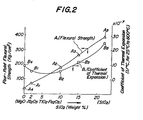
- the silica content of the ceramic of the invention is from 1 to 20% by weight since, as is shown in Fig. 2 of the drawing, if the silica content is less than 1% by weight, the four-point flexural strength is reduced to below 50 kg/cm 2 . If the silica content is greater than 20% by weight, a high mechanical strength can be achieved but production of other different crystalline phases is so much increased that the coefficient of thermal expansion becomes greater than 20x10 -7 (1°/C), resulting in an inferior thermal shock resistance.
- the major component of the crystalline phase of the low expansion ceramics material of the invention is a magnesium oxide aluminium oxide/titanium dioxide/silicon oxide/iron oxide solid solution
- the present invention allows for the presence of not more than 20% by weight, preferably not more than 10% by weight, of a secondary crystalline phase consisting of one or more crystalline phases selected from rutile, spinel, mullite, corundum, and cordierite crystalline phases.
- the presence of secondary crystalline phases in this amount has the effect of improving the heat resistance and strength by increasing the softening temperature and the melting temperature and reducing the gradient of the softening-shrinkage curve from the softening temperature to the melting temperature without adversely affecting the low-expansion characteristics.
- magnesia or precursor therefor
- alumina or precursor therefor
- silica or precursor therefor
- titania or precursor therefor
- ferric oxide or precursor therefor containing from 1.2 to 20% by weight of magnesium (calculated as magnesia), from 6.5 to 68% by weight of aluminium (calculated as alumina), from 19 to 80% by weight of titanium (calculated as titanium dioxide), from 1 to 20% by weight of silica (calculated as silica) and from 0.5 to 20% by weight or iron (calculated,as ferric oxide).
- a plasticizer and/or binder is added to the thus formed mixture to obtain a batch which is formable in a plastic manner, and the batch is formed by a ceramic forming process such as extrusion, pressing, slip casting or injection molding. The thus formed body is then dried.
- the dried body is then heated by raising its temperature at a rate of 5°C/hr to 300°C/hr and fired at 1,300°C to 1,700°C, preferably for 0.5 to 48 hours, whereby to produce a low-expansion ceramic material of the invention.
- the starting materials used in the preparation of the ceramic materials of the invention may be the pure compounds or may be precursors therefor capable of being connected thereto on firing. Further, there may be employed starting materials capable of yielding more than one of the required ingredients, for example aluminium silicates.
- Specific examples of materials which may be employed in the preparation of the ceramics of the invention include magnesia, magnesium carbonate, magnesium hydroxide, talc, alumina, aluminium dioxide, rutile type titanium dioxide, metallic iron, alpha-type ferric oxide, gamma-type ferric oxide, hydrated iron oxide, ilmenite, clay, calcined clay, chamolte, agalmatolite, mullite, sillimanite and kyanite.
- the starting materials for the low-expansion ceramics of the invention are thus not restricted to the pure substances, but various natural materials which essentially consist of the aforesaid chemical composition can be also used for producing the low-expansion ceramics.
- the low-expansion ceramic materials of the present invention can be formed by any conventional forming process available for forming ceramics.
- the shape of the final product may be as desired.
- the final product may be a . honeycomb body having a thin walled matrix with a plurality of cells extending from one end to the other and and the cells of the honeycomb body can be of any geometrical cross-section such as triangular, rectangular hexagonal, and polygonal, circular, or a combination thereof.
- the final product may be a complex three-dimensiona- body, a thick body, a block of various shapes or a body of almost any shape or structure.
- honeycomb-shaped bodies having a square cell cross-section were prepared, by adding 4 parts by weight of methyl cellulose and 30 to 40 parts by weight of water to 100 parts by weight of each mixture, thoroughly kneading the thus formed mixture in a kneader, extruding the kneaded mixture into a honeycomb shape by means of an extrusion machine, and drying the extruded goods.
- the rod-shaped test pieces and the honeycomb-shaped bodies were then fired under the firing conditions given in Table 2 which also indicates the composition of the ceramics in terms of MgO, Al 2 O 3 , TiO 2 , Si0 2 and Fe 2 O 3 .
- a specimen of 4 mm wide by 3 mm thick by 45 mm long was prepared from each of the rod-shaped test pieces by cutting and grinding.
- Thermal shock tests were applied to the honeycomb-shaped bodies, 100 mm in diameter by 75 mm long, by means of an electric furnace, and the temperature differences for rapid heating and cooling which could be withstood without cracks or breakage were determined.
- Ceramics according to the invention (Examples 1 - 5) had coefficients of thermal expansion of not more than 20x10 -7 (1/° C ), in the temperature range 25°C to 800°C, so that they showed higher withstanding temperature differences for rapid heating and cooling than did the ceramics of comparative examples 1 and 2 as demonstrated by the thermal shock tests in the electric furnace. Thus, the ceramics according to the invention had good thermal shock-resistance.
- the ceramics of examples 1 - 5 had four-point flexural strengths of more than 50 kg/cm 2 , i.e. sufficient strength for practical applications, and high melting points, not lower than 1,500°C.
- Fig. 1 is a graph showing the effect of the titania content in magnesia/alumina/titania ceramics on the melting point and the coefficient of thermal expansion of the ceramics.
- curve A shows the relationship between the titania content and the melting point of the ceramics
- curve B shows the relationship between the titania content and the coefficient of thermal expansion of the ceramics in the temperature range 25 0 C to 800°C.
- the addition of titania has the effect of markedly reducing the coefficient of thermal expansion.
- Fig. 2 is a graph(derived from Examples 1 - 3 and comparative example 1)showing the effect of the silica content on the flexural strength and the coefficient of thermal expansion in MgO/Al 2 O 3 /TiO 2 /Fe 2 O 3 /SiO 2 ceramics.
- the curve A shows the relationship between the silica content and the four-point flexural strength of the ceramics
- curve B shows the relationship between silica content and the coefficient of thermal.expansion of the ceramics in the range of 25°C to 800°C.
- Points A 1 and B 1 for a silica content of 2% are derived from Example 1; points A 2 and B 2 for a silica content of 10% from Example 2; points A3 and B 3 for a silica content 15% from Example 3; points A4 and B 4 for a silica content of O% from comparative Example 1; and points A 5 and B 5 for a silica content of 22% from comparative example Reference 2.
- the addition of silica has the effect of markedly improving the flexural strength of the ceramics.
- the low-expansion ceramic material of the invention have a low coefficient of thermal expansion, a high strength, a high melting point, and a high thermal stability even after being exposed to heat treatment for a number of hours at temperatures up to 1,400°C.
- the ceramic material of the invention can be widely used as ceramic materials in fileds where high degrees of heat resistance, thermal shock-resistance, wear resistance, and corrosion resistance are required; for instance as substrates for catalysts for purifying automobile exhaust gases as catalyst carriers for catalytic combustion apparatus as filters for diesel exhaust particulate; as industrial or automobile ceramic heat exchangers; as engine parts such as pistons, cylinder liners, combustion chambers, auxiliary combustion chambers, turbo-charger rotors or the like; as turbine parts such as nozzles, rotors, shrouds, scrolls, plenum, combustors, tail cylinders, or the like; as heat- resistant ceramic materials for solar energy receivers, as various refractory. materials- and chinawares and as porcelains for chemical industry.
Landscapes
- Engineering & Computer Science (AREA)
- Chemical & Material Sciences (AREA)
- Ceramic Engineering (AREA)
- Manufacturing & Machinery (AREA)
- Materials Engineering (AREA)
- Structural Engineering (AREA)
- Organic Chemistry (AREA)
- Compositions Of Oxide Ceramics (AREA)
Applications Claiming Priority (2)
| Application Number | Priority Date | Filing Date | Title |
|---|---|---|---|
| JP41984/80 | 1980-04-02 | ||
| JP55041984A JPS5919069B2 (ja) | 1980-04-02 | 1980-04-02 | 低膨脹セラミックス |
Publications (3)
| Publication Number | Publication Date |
|---|---|
| EP0037868A1 true EP0037868A1 (fr) | 1981-10-21 |
| EP0037868B1 EP0037868B1 (fr) | 1983-07-20 |
| EP0037868B2 EP0037868B2 (fr) | 1989-12-27 |
Family
ID=12623457
Family Applications (1)
| Application Number | Title | Priority Date | Filing Date |
|---|---|---|---|
| EP80302079A Expired EP0037868B2 (fr) | 1980-04-02 | 1980-06-19 | Procédé pour la préparation de matériaux céramiques ayant une faible expansion thermique |
Country Status (5)
| Country | Link |
|---|---|
| US (1) | US4316965A (fr) |
| EP (1) | EP0037868B2 (fr) |
| JP (1) | JPS5919069B2 (fr) |
| CA (1) | CA1135727A (fr) |
| DE (1) | DE3064244D1 (fr) |
Cited By (9)
| Publication number | Priority date | Publication date | Assignee | Title |
|---|---|---|---|---|
| EP0133021A1 (fr) * | 1983-07-27 | 1985-02-13 | Corning Glass Works | Produit céramique en titanate d'aluminium et de mullite et sa fabrication |
| EP0136741A1 (fr) * | 1983-08-24 | 1985-04-10 | KOLBENSCHMIDT Aktiengesellschaft | Piston pour moteurs à combustion interne |
| DE3706209C1 (de) * | 1987-02-26 | 1987-10-29 | Feldmuehle Ag | Sinterformkoerper auf Basis von Aluminiumtitanat und Verfahren zu seiner Herstellung,sowie dessen Verwendung |
| EP0202107A3 (en) * | 1985-05-14 | 1987-12-02 | Ngk Insulators, Ltd. | Low expansion ceramics and method of producing the same |
| EP0210813A3 (en) * | 1985-07-22 | 1988-05-11 | Ngk Insulators, Ltd. | Aluminum titanate.-mullite base ceramics |
| EP0231006A3 (en) * | 1986-01-28 | 1988-08-03 | Matsushita Electric Industrial Co., Ltd. | Method for producing ceramics with thermal shock resistance |
| EP0339379A1 (fr) * | 1988-04-26 | 1989-11-02 | Bayer Ag | Articles réfractaires en titanate d'aluminium leur préparation et leur utilisation |
| GB2233322A (en) * | 1989-06-23 | 1991-01-09 | Secr Defence | Strengthening refractory oxide ceramics |
| US5288672A (en) * | 1988-04-26 | 1994-02-22 | Bayer Aktiensesellschaft | Ceramics based on aluminum titanate, process for their production and their use |
Families Citing this family (28)
| Publication number | Priority date | Publication date | Assignee | Title |
|---|---|---|---|---|
| US4455180A (en) * | 1981-08-24 | 1984-06-19 | Corning Glass Works | Method of fabricating a sintered and selectively plugged honeycomb structure |
| US4403017A (en) * | 1981-11-30 | 1983-09-06 | The Perkin-Elmer Corporation | Low thermal expansion modified cordierites |
| JPS6030292U (ja) * | 1983-08-08 | 1985-03-01 | 株式会社 一晃 | 自動車玩具 |
| JPS60141668A (ja) * | 1983-12-28 | 1985-07-26 | 日本碍子株式会社 | セラミックハニカム構造体を接合若しくはコーティングまたは封着するためのセラミック材料組成物 |
| FR2568722B1 (fr) * | 1984-08-03 | 1987-10-23 | Thomson Csf | Substrat en ceramique dielectrique et procede d'obtention |
| US4851376A (en) * | 1986-03-08 | 1989-07-25 | Ngk Insulators, Ltd. | Cordierite ceramic body having low thermal expansion coefficient, process for producing the same, and method of evaluating cordierite composition |
| DE3879301D1 (de) * | 1987-07-06 | 1993-04-22 | Tokuyama Soda Kk | Verfahren zur erzeugung eines koerpers aus gesinterten anorthit. |
| US4814303A (en) * | 1987-09-25 | 1989-03-21 | E. I. Du Pont De Nemours And Company | Anorthite-cordierite based ceramics from zeolites |
| US5488018A (en) * | 1989-04-21 | 1996-01-30 | Limaye; Santosh Y. | Ultra low thermal expansion, highly thermal shock resistant ceramic |
| DE4029166C3 (de) * | 1990-06-22 | 1998-12-24 | Bayer Ag | Sinterformkörper auf Basis von Aluminiumtitanat, Verfahren zu ihrer Herstellung sowie deren Verwendung |
| US5137789A (en) * | 1990-12-03 | 1992-08-11 | Caterpillar Inc. | Composite ceramic and metal article |
| WO2000030995A1 (fr) | 1998-11-20 | 2000-06-02 | Corning Incorporated | Procede de fabrication de structures en cordierite a haute resistance et a faible dilatation thermique |
| EP1144334B1 (fr) | 1998-12-07 | 2005-08-31 | Corning Incorporated | Fabrication de structures en cordierite a coefficient de dilatation thermique extremement faible |
| EP1261564B1 (fr) | 1999-09-01 | 2008-05-07 | Corning Incorporated | Fabrication des structures de cordierite a paroi ultra-mince |
| US6908879B1 (en) * | 1999-09-06 | 2005-06-21 | Nippon Shokubai Co., Ltd. | Ceramic article, carrier for catalyst, methods for production thereof, catalyst for producing ethylene oxide using the carrier, and method for producing ethylene oxide |
| JP3572250B2 (ja) | 2000-10-24 | 2004-09-29 | 三菱重工業株式会社 | 冷凍機用凝縮器 |
| US10501375B2 (en) * | 2006-06-30 | 2019-12-10 | Corning Incorporated | Cordierite aluminum magnesium titanate compositions and ceramic articles comprising same |
| US8956436B2 (en) | 2006-06-30 | 2015-02-17 | Corning Incorporated | Cordierite aluminum magnesium titanate compositions and ceramic articles comprising same |
| US20080138504A1 (en) * | 2006-12-08 | 2008-06-12 | Coorstek, Inc. | Coatings for components of semiconductor wafer fabrication equipment |
| KR20090092301A (ko) * | 2006-12-27 | 2009-08-31 | 데이진 가부시키가이샤 | 세라믹 섬유 및 세라믹 섬유의 제조 방법 |
| WO2009076985A1 (fr) * | 2007-12-17 | 2009-06-25 | Imerys Services | Structures alvéolaires en céramique |
| AU2012279874A1 (en) | 2011-07-07 | 2014-01-23 | Saint-Gobain Centre De Recherches Et D'etudes Europeen | Regenerator |
| FR2988168B1 (fr) * | 2012-03-15 | 2014-03-14 | Saint Gobain Ct Recherches | Regenerateur |
| JP5863320B2 (ja) | 2011-08-05 | 2016-02-16 | 三菱重工コンプレッサ株式会社 | 遠心圧縮機 |
| US10526249B2 (en) * | 2012-11-30 | 2020-01-07 | Corning Incorporated | Cordierite aluminum magnesium titanate compositions and ceramic articles comprising same |
| DE102013000766A1 (de) | 2013-01-18 | 2014-07-24 | Man Diesel & Turbo Se | Kühler |
| CN113336534B (zh) * | 2021-06-28 | 2023-06-02 | 武汉理工大学 | 一种不含锂矿物的低热膨胀日用陶瓷及其制备方法 |
| CN116099986B (zh) * | 2022-12-22 | 2026-02-03 | 沈阳工业大学 | 一种定向凝固用低热应力模壳型芯系统制备方法 |
Citations (4)
| Publication number | Priority date | Publication date | Assignee | Title |
|---|---|---|---|---|
| DE971258C (de) * | 1953-03-27 | 1958-12-31 | Staatliche Porzellan Manufaktu | Dichtbrennende keramische Koerper hoher Oberflaechenhaerte und -glaette fuer die Herstellung von Fadenfuehrern |
| DD96224A1 (fr) * | 1972-04-03 | 1973-03-12 | ||
| US3784388A (en) * | 1971-08-02 | 1974-01-08 | Norton Co | Wear resistant aluminous ceramic articles |
| DE2645555A1 (de) * | 1976-10-08 | 1978-04-13 | Stettner & Co | Keramischer sinterkoerper und verfahren zum herstellen |
Family Cites Families (5)
| Publication number | Priority date | Publication date | Assignee | Title |
|---|---|---|---|---|
| US2776896A (en) * | 1952-10-22 | 1957-01-08 | Cambridge Tile Mfg Company | Ceramic composition having thermal shock resistance |
| US3625717A (en) * | 1968-04-29 | 1971-12-07 | Avco Corp | Spray coating compositions |
| US3578471A (en) * | 1969-11-10 | 1971-05-11 | Corning Glass Works | Thermal shock resistant ceramic material |
| US4017347A (en) * | 1974-03-27 | 1977-04-12 | Gte Sylvania Incorporated | Method for producing ceramic cellular structure having high cell density |
| DE2750290C3 (de) * | 1977-11-10 | 1987-07-09 | Hoechst CeramTec AG, 8672 Selb | Verwendung eines gebrannten keramischen Formkörpers zur Herstellung von Metall-Keramik-Verbundkörpern |
-
1980
- 1980-04-02 JP JP55041984A patent/JPS5919069B2/ja not_active Expired
- 1980-05-22 US US06/152,314 patent/US4316965A/en not_active Expired - Lifetime
- 1980-06-19 DE DE8080302079T patent/DE3064244D1/de not_active Expired
- 1980-06-19 CA CA000354340A patent/CA1135727A/fr not_active Expired
- 1980-06-19 EP EP80302079A patent/EP0037868B2/fr not_active Expired
Patent Citations (4)
| Publication number | Priority date | Publication date | Assignee | Title |
|---|---|---|---|---|
| DE971258C (de) * | 1953-03-27 | 1958-12-31 | Staatliche Porzellan Manufaktu | Dichtbrennende keramische Koerper hoher Oberflaechenhaerte und -glaette fuer die Herstellung von Fadenfuehrern |
| US3784388A (en) * | 1971-08-02 | 1974-01-08 | Norton Co | Wear resistant aluminous ceramic articles |
| DD96224A1 (fr) * | 1972-04-03 | 1973-03-12 | ||
| DE2645555A1 (de) * | 1976-10-08 | 1978-04-13 | Stettner & Co | Keramischer sinterkoerper und verfahren zum herstellen |
Cited By (10)
| Publication number | Priority date | Publication date | Assignee | Title |
|---|---|---|---|---|
| EP0133021A1 (fr) * | 1983-07-27 | 1985-02-13 | Corning Glass Works | Produit céramique en titanate d'aluminium et de mullite et sa fabrication |
| EP0136741A1 (fr) * | 1983-08-24 | 1985-04-10 | KOLBENSCHMIDT Aktiengesellschaft | Piston pour moteurs à combustion interne |
| EP0202107A3 (en) * | 1985-05-14 | 1987-12-02 | Ngk Insulators, Ltd. | Low expansion ceramics and method of producing the same |
| EP0210813A3 (en) * | 1985-07-22 | 1988-05-11 | Ngk Insulators, Ltd. | Aluminum titanate.-mullite base ceramics |
| EP0231006A3 (en) * | 1986-01-28 | 1988-08-03 | Matsushita Electric Industrial Co., Ltd. | Method for producing ceramics with thermal shock resistance |
| DE3706209C1 (de) * | 1987-02-26 | 1987-10-29 | Feldmuehle Ag | Sinterformkoerper auf Basis von Aluminiumtitanat und Verfahren zu seiner Herstellung,sowie dessen Verwendung |
| AT394039B (de) * | 1987-02-26 | 1992-01-27 | Feldmuehle Ag | Sinterformkoerper |
| EP0339379A1 (fr) * | 1988-04-26 | 1989-11-02 | Bayer Ag | Articles réfractaires en titanate d'aluminium leur préparation et leur utilisation |
| US5288672A (en) * | 1988-04-26 | 1994-02-22 | Bayer Aktiensesellschaft | Ceramics based on aluminum titanate, process for their production and their use |
| GB2233322A (en) * | 1989-06-23 | 1991-01-09 | Secr Defence | Strengthening refractory oxide ceramics |
Also Published As
| Publication number | Publication date |
|---|---|
| DE3064244D1 (en) | 1983-08-25 |
| JPS5919069B2 (ja) | 1984-05-02 |
| US4316965A (en) | 1982-02-23 |
| EP0037868B1 (fr) | 1983-07-20 |
| EP0037868B2 (fr) | 1989-12-27 |
| CA1135727A (fr) | 1982-11-16 |
| JPS56140073A (en) | 1981-11-02 |
Similar Documents
| Publication | Publication Date | Title |
|---|---|---|
| EP0037868B1 (fr) | Procédé pour la préparation de matériaux céramiques ayant une faible expansion thermique | |
| EP0036052B1 (fr) | Structure en nid d'abeille utilisée comme support pour catalyseur des gaz d'échappement d'automobile | |
| CA1059160A (fr) | Methode pour la preparation des pieces de cordierite sans fissures, faite d'un seul bloc polycristallin | |
| EP0036462B1 (fr) | Structure en nid d'abeille utilisée comme support pour des catalysateurs de gaz d'échappement automobiles | |
| US4295892A (en) | Cordierite ceramic honeycomb and a method for producing the same | |
| EP0133021B1 (fr) | Produit céramique en titanate d'aluminium et de mullite et sa fabrication | |
| US6048490A (en) | Method of producing cordierite bodies utilizing substantially reduced firing times | |
| US4327188A (en) | Multicellular monolithic ceramic body and preparation thereof | |
| US7001861B2 (en) | Aluminum titanate-based ceramic article | |
| EP1027304B1 (fr) | Procede permettant de cuire des corps ceramiques en nids d'abeilles | |
| JPH10174885A (ja) | コーディエライトハニカム構造体およびその製造方法 | |
| EP0260893B1 (fr) | Corps composites résistants à la chaleur et à dilatation basse en phosphate de zirconyle-silicate de zirconium et leur procédé de fabrication | |
| JPH013067A (ja) | コージェライトハニカム構造体の製造方法 | |
| JPH0470053B2 (fr) | ||
| JPH0149664B2 (fr) | ||
| JPS61168563A (ja) | コ−ジエライト系セラミツクハニカムの製法 | |
| JPS6049420B2 (ja) | セラミツクスハニカムの製造方法 | |
| JPH0149665B2 (fr) | ||
| JPS63297268A (ja) | 耐熱低膨脹リン酸ジルコニル・ジルコン複合焼結体およびその製造方法 | |
| JPH0520385B2 (fr) |
Legal Events
| Date | Code | Title | Description |
|---|---|---|---|
| PUAI | Public reference made under article 153(3) epc to a published international application that has entered the european phase |
Free format text: ORIGINAL CODE: 0009012 |
|
| AK | Designated contracting states |
Designated state(s): BE DE FR GB IT NL SE |
|
| 17P | Request for examination filed |
Effective date: 19811123 |
|
| ITF | It: translation for a ep patent filed | ||
| GRAA | (expected) grant |
Free format text: ORIGINAL CODE: 0009210 |
|
| AK | Designated contracting states |
Designated state(s): BE DE FR GB IT NL SE |
|
| REF | Corresponds to: |
Ref document number: 3064244 Country of ref document: DE Date of ref document: 19830825 |
|
| ET | Fr: translation filed | ||
| PLBI | Opposition filed |
Free format text: ORIGINAL CODE: 0009260 |
|
| PLBI | Opposition filed |
Free format text: ORIGINAL CODE: 0009260 |
|
| 26 | Opposition filed |
Opponent name: ROSENTHAL TECHNIK AG Effective date: 19840410 |
|
| 26 | Opposition filed |
Opponent name: HUTSCHENREUTHER AG Effective date: 19840418 |
|
| PLAB | Opposition data, opponent's data or that of the opponent's representative modified |
Free format text: ORIGINAL CODE: 0009299OPPO |
|
| R26 | Opposition filed (corrected) |
Opponent name: HOECHST CERAMTEC AG * 840418 HUTSCHENREUTHER AG Effective date: 19840410 |
|
| NLXE | Nl: other communications concerning ep-patents (part 3 heading xe) |
Free format text: IN PAT.BUL.14/84,THE NAME OF THE CORR.:HOECHST CERAMTEC AG |
|
| PLAB | Opposition data, opponent's data or that of the opponent's representative modified |
Free format text: ORIGINAL CODE: 0009299OPPO |
|
| R26 | Opposition filed (corrected) |
Opponent name: HOECHST CERAMTEC AG * 840418 HUTSCHENREUTHER AG Effective date: 19840410 |
|
| PUAH | Patent maintained in amended form |
Free format text: ORIGINAL CODE: 0009272 |
|
| STAA | Information on the status of an ep patent application or granted ep patent |
Free format text: STATUS: PATENT MAINTAINED AS AMENDED |
|
| 27A | Patent maintained in amended form |
Effective date: 19891227 |
|
| AK | Designated contracting states |
Kind code of ref document: B2 Designated state(s): BE DE FR GB IT NL SE |
|
| ITF | It: translation for a ep patent filed | ||
| ET3 | Fr: translation filed ** decision concerning opposition | ||
| NLR2 | Nl: decision of opposition | ||
| NLR3 | Nl: receipt of modified translations in the netherlands language after an opposition procedure | ||
| ITTA | It: last paid annual fee | ||
| PGFP | Annual fee paid to national office [announced via postgrant information from national office to epo] |
Ref country code: FR Payment date: 19940617 Year of fee payment: 15 |
|
| PGFP | Annual fee paid to national office [announced via postgrant information from national office to epo] |
Ref country code: SE Payment date: 19940620 Year of fee payment: 15 |
|
| PGFP | Annual fee paid to national office [announced via postgrant information from national office to epo] |
Ref country code: NL Payment date: 19940630 Year of fee payment: 15 |
|
| EAL | Se: european patent in force in sweden |
Ref document number: 80302079.1 |
|
| PG25 | Lapsed in a contracting state [announced via postgrant information from national office to epo] |
Ref country code: SE Effective date: 19950620 |
|
| PG25 | Lapsed in a contracting state [announced via postgrant information from national office to epo] |
Ref country code: NL Effective date: 19960101 |
|
| PG25 | Lapsed in a contracting state [announced via postgrant information from national office to epo] |
Ref country code: FR Effective date: 19960229 |
|
| NLV4 | Nl: lapsed or anulled due to non-payment of the annual fee |
Effective date: 19960101 |
|
| EUG | Se: european patent has lapsed |
Ref document number: 80302079.1 |
|
| REG | Reference to a national code |
Ref country code: FR Ref legal event code: ST |
|
| APAC | Appeal dossier modified |
Free format text: ORIGINAL CODE: EPIDOS NOAPO |
|
| APAC | Appeal dossier modified |
Free format text: ORIGINAL CODE: EPIDOS NOAPO |
|
| PGFP | Annual fee paid to national office [announced via postgrant information from national office to epo] |
Ref country code: GB Payment date: 19980609 Year of fee payment: 19 |
|
| PGFP | Annual fee paid to national office [announced via postgrant information from national office to epo] |
Ref country code: DE Payment date: 19980620 Year of fee payment: 19 |
|
| PGFP | Annual fee paid to national office [announced via postgrant information from national office to epo] |
Ref country code: BE Payment date: 19980624 Year of fee payment: 19 |
|
| PG25 | Lapsed in a contracting state [announced via postgrant information from national office to epo] |
Ref country code: GB Free format text: LAPSE BECAUSE OF NON-PAYMENT OF DUE FEES Effective date: 19990619 |
|
| PG25 | Lapsed in a contracting state [announced via postgrant information from national office to epo] |
Ref country code: DE Free format text: LAPSE BECAUSE OF NON-PAYMENT OF DUE FEES Effective date: 19990630 Ref country code: BE Free format text: LAPSE BECAUSE OF NON-PAYMENT OF DUE FEES Effective date: 19990630 |
|
| BERE | Be: lapsed |
Owner name: NGK INSULATORS LTD Effective date: 19990630 |
|
| GBPC | Gb: european patent ceased through non-payment of renewal fee |
Effective date: 19990619 |
|
| APAH | Appeal reference modified |
Free format text: ORIGINAL CODE: EPIDOSCREFNO |