EP0037968A2 - Etoffe tissée ou tricotée en multifilaments de polyester - Google Patents
Etoffe tissée ou tricotée en multifilaments de polyester Download PDFInfo
- Publication number
- EP0037968A2 EP0037968A2 EP81102474A EP81102474A EP0037968A2 EP 0037968 A2 EP0037968 A2 EP 0037968A2 EP 81102474 A EP81102474 A EP 81102474A EP 81102474 A EP81102474 A EP 81102474A EP 0037968 A2 EP0037968 A2 EP 0037968A2
- Authority
- EP
- European Patent Office
- Prior art keywords
- fabric
- polyester
- filaments
- length
- polyester multifilament
- Prior art date
- Legal status (The legal status is an assumption and is not a legal conclusion. Google has not performed a legal analysis and makes no representation as to the accuracy of the status listed.)
- Granted
Links
Images


Classifications
-
- D—TEXTILES; PAPER
- D01—NATURAL OR MAN-MADE THREADS OR FIBRES; SPINNING
- D01D—MECHANICAL METHODS OR APPARATUS IN THE MANUFACTURE OF ARTIFICIAL FILAMENTS, THREADS, FIBRES, BRISTLES OR RIBBONS
- D01D5/00—Formation of filaments, threads, or the like
- D01D5/253—Formation of filaments, threads, or the like with a non-circular cross section; Spinnerette packs therefor
-
- D—TEXTILES; PAPER
- D01—NATURAL OR MAN-MADE THREADS OR FIBRES; SPINNING
- D01F—CHEMICAL FEATURES IN THE MANUFACTURE OF ARTIFICIAL FILAMENTS, THREADS, FIBRES, BRISTLES OR RIBBONS; APPARATUS SPECIALLY ADAPTED FOR THE MANUFACTURE OF CARBON FILAMENTS
- D01F1/00—General methods for the manufacture of artificial filaments or the like
- D01F1/02—Addition of substances to the spinning solution or to the melt
- D01F1/08—Addition of substances to the spinning solution or to the melt for forming hollow filaments
-
- D—TEXTILES; PAPER
- D01—NATURAL OR MAN-MADE THREADS OR FIBRES; SPINNING
- D01F—CHEMICAL FEATURES IN THE MANUFACTURE OF ARTIFICIAL FILAMENTS, THREADS, FIBRES, BRISTLES OR RIBBONS; APPARATUS SPECIALLY ADAPTED FOR THE MANUFACTURE OF CARBON FILAMENTS
- D01F6/00—Monocomponent artificial filaments or the like of synthetic polymers; Manufacture thereof
- D01F6/58—Monocomponent artificial filaments or the like of synthetic polymers; Manufacture thereof from homopolycondensation products
- D01F6/62—Monocomponent artificial filaments or the like of synthetic polymers; Manufacture thereof from homopolycondensation products from polyesters
-
- Y—GENERAL TAGGING OF NEW TECHNOLOGICAL DEVELOPMENTS; GENERAL TAGGING OF CROSS-SECTIONAL TECHNOLOGIES SPANNING OVER SEVERAL SECTIONS OF THE IPC; TECHNICAL SUBJECTS COVERED BY FORMER USPC CROSS-REFERENCE ART COLLECTIONS [XRACs] AND DIGESTS
- Y10—TECHNICAL SUBJECTS COVERED BY FORMER USPC
- Y10T—TECHNICAL SUBJECTS COVERED BY FORMER US CLASSIFICATION
- Y10T428/00—Stock material or miscellaneous articles
- Y10T428/29—Coated or structually defined flake, particle, cell, strand, strand portion, rod, filament, macroscopic fiber or mass thereof
- Y10T428/2913—Rod, strand, filament or fiber
- Y10T428/2915—Rod, strand, filament or fiber including textile, cloth or fabric
-
- Y—GENERAL TAGGING OF NEW TECHNOLOGICAL DEVELOPMENTS; GENERAL TAGGING OF CROSS-SECTIONAL TECHNOLOGIES SPANNING OVER SEVERAL SECTIONS OF THE IPC; TECHNICAL SUBJECTS COVERED BY FORMER USPC CROSS-REFERENCE ART COLLECTIONS [XRACs] AND DIGESTS
- Y10—TECHNICAL SUBJECTS COVERED BY FORMER USPC
- Y10T—TECHNICAL SUBJECTS COVERED BY FORMER US CLASSIFICATION
- Y10T428/00—Stock material or miscellaneous articles
- Y10T428/29—Coated or structually defined flake, particle, cell, strand, strand portion, rod, filament, macroscopic fiber or mass thereof
- Y10T428/2913—Rod, strand, filament or fiber
- Y10T428/2973—Particular cross section
-
- Y—GENERAL TAGGING OF NEW TECHNOLOGICAL DEVELOPMENTS; GENERAL TAGGING OF CROSS-SECTIONAL TECHNOLOGIES SPANNING OVER SEVERAL SECTIONS OF THE IPC; TECHNICAL SUBJECTS COVERED BY FORMER USPC CROSS-REFERENCE ART COLLECTIONS [XRACs] AND DIGESTS
- Y10—TECHNICAL SUBJECTS COVERED BY FORMER USPC
- Y10T—TECHNICAL SUBJECTS COVERED BY FORMER US CLASSIFICATION
- Y10T428/00—Stock material or miscellaneous articles
- Y10T428/29—Coated or structually defined flake, particle, cell, strand, strand portion, rod, filament, macroscopic fiber or mass thereof
- Y10T428/2913—Rod, strand, filament or fiber
- Y10T428/2973—Particular cross section
- Y10T428/2975—Tubular or cellular
-
- Y—GENERAL TAGGING OF NEW TECHNOLOGICAL DEVELOPMENTS; GENERAL TAGGING OF CROSS-SECTIONAL TECHNOLOGIES SPANNING OVER SEVERAL SECTIONS OF THE IPC; TECHNICAL SUBJECTS COVERED BY FORMER USPC CROSS-REFERENCE ART COLLECTIONS [XRACs] AND DIGESTS
- Y10—TECHNICAL SUBJECTS COVERED BY FORMER USPC
- Y10T—TECHNICAL SUBJECTS COVERED BY FORMER US CLASSIFICATION
- Y10T428/00—Stock material or miscellaneous articles
- Y10T428/29—Coated or structually defined flake, particle, cell, strand, strand portion, rod, filament, macroscopic fiber or mass thereof
- Y10T428/2913—Rod, strand, filament or fiber
- Y10T428/2973—Particular cross section
- Y10T428/2978—Surface characteristic
-
- Y—GENERAL TAGGING OF NEW TECHNOLOGICAL DEVELOPMENTS; GENERAL TAGGING OF CROSS-SECTIONAL TECHNOLOGIES SPANNING OVER SEVERAL SECTIONS OF THE IPC; TECHNICAL SUBJECTS COVERED BY FORMER USPC CROSS-REFERENCE ART COLLECTIONS [XRACs] AND DIGESTS
- Y10—TECHNICAL SUBJECTS COVERED BY FORMER USPC
- Y10T—TECHNICAL SUBJECTS COVERED BY FORMER US CLASSIFICATION
- Y10T428/00—Stock material or miscellaneous articles
- Y10T428/31504—Composite [nonstructural laminate]
- Y10T428/31786—Of polyester [e.g., alkyd, etc.]
-
- Y—GENERAL TAGGING OF NEW TECHNOLOGICAL DEVELOPMENTS; GENERAL TAGGING OF CROSS-SECTIONAL TECHNOLOGIES SPANNING OVER SEVERAL SECTIONS OF THE IPC; TECHNICAL SUBJECTS COVERED BY FORMER USPC CROSS-REFERENCE ART COLLECTIONS [XRACs] AND DIGESTS
- Y10—TECHNICAL SUBJECTS COVERED BY FORMER USPC
- Y10T—TECHNICAL SUBJECTS COVERED BY FORMER US CLASSIFICATION
- Y10T442/00—Fabric [woven, knitted, or nonwoven textile or cloth, etc.]
- Y10T442/30—Woven fabric [i.e., woven strand or strip material]
- Y10T442/3065—Including strand which is of specific structural definition
- Y10T442/3089—Cross-sectional configuration of strand material is specified
- Y10T442/3114—Cross-sectional configuration of the strand material is other than circular
-
- Y—GENERAL TAGGING OF NEW TECHNOLOGICAL DEVELOPMENTS; GENERAL TAGGING OF CROSS-SECTIONAL TECHNOLOGIES SPANNING OVER SEVERAL SECTIONS OF THE IPC; TECHNICAL SUBJECTS COVERED BY FORMER USPC CROSS-REFERENCE ART COLLECTIONS [XRACs] AND DIGESTS
- Y10—TECHNICAL SUBJECTS COVERED BY FORMER USPC
- Y10T—TECHNICAL SUBJECTS COVERED BY FORMER US CLASSIFICATION
- Y10T442/00—Fabric [woven, knitted, or nonwoven textile or cloth, etc.]
- Y10T442/30—Woven fabric [i.e., woven strand or strip material]
- Y10T442/3065—Including strand which is of specific structural definition
- Y10T442/3089—Cross-sectional configuration of strand material is specified
- Y10T442/3114—Cross-sectional configuration of the strand material is other than circular
- Y10T442/3122—Cross-sectional configuration is multi-lobal
-
- Y—GENERAL TAGGING OF NEW TECHNOLOGICAL DEVELOPMENTS; GENERAL TAGGING OF CROSS-SECTIONAL TECHNOLOGIES SPANNING OVER SEVERAL SECTIONS OF THE IPC; TECHNICAL SUBJECTS COVERED BY FORMER USPC CROSS-REFERENCE ART COLLECTIONS [XRACs] AND DIGESTS
- Y10—TECHNICAL SUBJECTS COVERED BY FORMER USPC
- Y10T—TECHNICAL SUBJECTS COVERED BY FORMER US CLASSIFICATION
- Y10T442/00—Fabric [woven, knitted, or nonwoven textile or cloth, etc.]
- Y10T442/40—Knit fabric [i.e., knit strand or strip material]
- Y10T442/425—Including strand which is of specific structural definition
- Y10T442/431—Cross-sectional configuration of strand material is specified
Definitions
- the present invention relates to a woven or knitted polyester multifilament fabric. More particularly, the present invention relates to a woven or knitted polyester multifilament fabric having a silklike configuration and touch.
- polyesters such as polyalkylene terephthalates, for example, polyethylene terephthalate and polybutylene terephthalate, and alkylene terepthalate copolymers, exhibit excellent physical and chemical properties, and, therefore, are useful as various textile materials. That is, the polyester filament yarns are widely used for producing various woven or knitted fabrics.
- polyester filament fabrics exhibit poor dry touch and opaqueness. This nature of the polyester filament fabrics are quite different from that of natural silk fabrics.
- polyester filaments having an irregular cross-sectional profile especially, trilobate or star-shaped cross-sectional profile
- those types of the polyester irregular filaments caused the resultant fabrics to exhibit a different luster and touch than those of the conventional polyester filament fabrics in which individual filaments had a circular cross-sectional profile.
- the polyester irregular filaments having the trilobate cross-sectional profile also exhibited a different luster and touch than those of the silk fabrics. That is, the luster of the polyester irregular filaments was undesirably metallic and the opaqueness, bulkiness and softeness of the polyester irregular filament fabric were unsatisfactory.
- the luster was closer to that of the silk fabric than that of the polyester filaments having the trilobate corss-sectional profile.
- this type of filaments failed to exhibit a satisfactory opaqueness and touch.
- the filaments exhibited an unsatisfactory bulkiness because a plurality of the lobes in the star-shaped cross-sectional profiles of the individual filaments cause the movement of the filaments from each other to be restricted.
- polyester filaments having the trilobate or star-shaped cross-sectional profile In order to eliminate the above-mentioned disadvantages of the polyester filaments having the trilobate or star-shaped cross-sectional profile, another type of polyester filaments having a C-shaped, L-shaped or V-shaped cross-sectional profile were provided.
- This type of the polyester filaments could cause the resultant fabric to exhibit significantly reduced metallic luster.
- the opaqueness and touch of this type of the polyester filaments were unsatisfactory.
- its bulkiness was unsatisfactory because the leg portions of the C-, L- or V-shaped cross-sectional profiles in the filaments were linked with each other.
- An object of the present invention is to provide a woven or knitted polyester multifilament fabric having a silk-like appearance and touch and a process for producing the same.
- Another object of the present invention is to provide a woven or knitted polyester multifilament fabric having a satisfactory opaqueness and bulkiness, and a process for producing the same.
- the woven or knitted polyester multifilament fabric of the present invention which comprises polyester multifilament yarns each containing at least one type of porous polyester 'filaments each having an irregular cross-sectional profile thereof and numerous linear fine concave parts formed on the peripheral surface thereof and extending along the longitudinal axis of each individual filament, a group of said concave parts corresponding to at least 50% of the entire number of said concaves, each having a length of 5 microns or more and a ratio of the length to the width of the concave of 5 or more.
- the above-mentioned type of woven or knitted polyester multifilament fabric can be produced by the process of the present invention, which comprises the steps of:
- the individual polyester filaments are porous and have an irregular cross-sectional profile and the peripheral surface of each individual filament has numerous fine linear concave parts formed thereon and extending along the longitudinal axis of the individual filament. Also, it is important that among the concave parts, a group of the concaves corresponding to a half of the entire number of the concave parts, have a length of 5 microns or more and a ratio of the length to the width of the each concave, of 5 or more.
- the above-mentioned features are effective for imparting a silk-like dry touch, appearance, bulkiness and opaqueness to the resultant fabric.
- the term "Dry touch” used herein refers to a hand touch which is like that inherent in the silk-made textile materials. Usually, the conventional polyester filament fabric exhibits a wet or waxy touch.
- Op represents an opaqueness of a fabric
- R 1 represents a reflectivity of the fabric when the fabric is laid on a standard black board having a reflectivity of 6%
- R 2 represents another reflectivity of the fabric when the fabric is laid on a standard white board having a reflectivity of 91%.
- R 1 0, the opaqueness of the fabric is zero, that is, the fabric is completely transparent.
- the polyester multifilament yarns each contain at least one type of porous polyester filaments preferably in an amount of at least 50 % based on the weight of each polyester multifilament yarn.
- the porous polyester filaments are made from a fiber-forming polyester having at least 90% by molar amount of recurring units of the formula (I): wherein i represents an integer of 2 to 6. That is, the recurring units of the formula (I) consists of a terephthalic acid moiety and an alkylene glycol moiety containing 2 to 6 carbon atoms.
- the alkylene glycol may be selected from ethylene glycol, trimethylene glycol, tetramethylene glycol, pentamethylene glycol and hexamethylene glycol.
- the preferable alkylene glycol is either ehtylene glycol or tetramethylene glycol. That is, it is preferable that the polyester be either polyethylene terephthalate or polybutylene terephthalate.
- the polyester usable for the present invention may contain at least one di-functional carboxylic acid moiety as an additional moiety to the terephthalic acid moiety.
- the di-functional carboxylic acid may be derived from the compound selected from aromatic carboxylic acids, such as isophthalic acid, napthalene di-carboxylic acid, diphenyldicarboxylic acid, diphenoxyethane dicarboxylic acid, ⁇ -hydroxyethoxy benzoic acid and p-hydroxybenzoic acid; aliphatic carboxylic acids such as sebacic acid, adipic acid and oxalic acid; and cycloaliphatic dicarboxylic acids, such as 1,4-cyclohexane dicarboxylic acid.
- the polyester usable for the present invention may contain at least one diol moiety as additional moiety to the alkylene glycol moiety.
- the diol moiety may be derived from aliphatic, cycloaliphatic and aromatic diol compounds such as cyclohexane-1,-4-dimenthanol, neopentyl glycol, bisphenol A and bisphenol S.
- the polyester may contain a further additional tri-functional moiety as long as the resultant condensation product has a substantial fiber-forming property.
- the tri-functional compound can be selected from trimellitic acid, glycerol and pentaerythritol.
- the polyester may contain a further additional mono-functional moiety as long as the resultant condensation product has a satisfactorily high degree of polymerization.
- the mono-functional compound may be, for example, benzoic acid.
- the polyester usable for the present invention can be prepared by any conventional processes.
- the individual porous filaments each have an irregular cross-sectional profile, for example, trilobate, star-shaped, C-shaped, L-shaped or V-shaped cross-sectional profile.
- the irregular cross-sectional profile is effective for enhancing the difused reflection of light on the resultant fabric and imparting a silk-like luster to the fabric.
- Figs. 1A through 1F Various types of irregular cross-sectional profiles are indicated in Figs. 1A through 1F.
- Fig. 1A shows a trapezoidal cross-sectional profile.
- Fig. 1B shows a C-shaped cross-sectional profile.
- Fig. 1C shows an L-shaped or V-shaped cross-sectional profile.
- Fig. lD shows a triangle cross-sectional profile.
- Fig. 1E shows a trilobate cross-sectional profile.
- Fig. 1F shows a tetralobate cross-sectional profile.
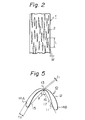
- the filament has numerous linear concave parts formed on the peripheral surface of the filament. Referring to Fig. 2, a peripheral surface of a filament 1 has numerous linear concave parts 2.
- each concave part has a length (L) of 5 microns and a ratio L/W of 5 or more, where W represents a width of the concave parts.
- the resultant fabric When the length (L) is less than 5 microns and/or the ratio L/W is less than 5, the resultant fabric exhibits an unsatisfactory luster, opaqueness and touch and an undesirable poor resistance to fibrilization, abrasion and color change.
- the number of the grooves or concave parts is from 2 to 10 per micron of the length of the circumference of the cross-sectional profile of the silk filament. Therefore, in the porous polyester individual filaments usable for the present invention, it is preferable that the number of the concave parts on the peripheral surface thereof is at least two per micron of the length of the circumference of the cross-sectional profile of each porous individual filament.
- the porous polyester filaments have a V-shaped, L-shaped or C-shaped irregular cross-sectional profile which is defined by substantially V-shaped, L-shaped or C-shaped inside and outside curve lines extending side by side, and which is composed of a center portion thereof and a pair of leg portions thereof extending from the center portion in different directions from the other and having a thickness larger than that of the center portion.
- V-, L- or C-shaped cross-sectional profile satisfied the relationships (1) and (2); and wherein 8 represents an opening angle in degree between a tangent line drawn from a center point of the inside curve line of the center portion to the inside curve line of one of the leg portions and another tangent line drawn from the center point of the inside curve line of the other leg, and R8 represents a difference between the largest opening angle in degree and the smallest opening angle in degree in the porous filaments.
- Fig. 5 shows a substantially C-shaped cross-sectional profile.
- the profile 10 is defined by an inside curve line 11 and an outside curve line 12 which curve lines extend in a side by side relation to each other.
- the profile 10 is composed of a center portion 13 and a pair of leg portions 14A and 14B extending from the center portion 13 and having a larger thickness t 2 than the thickness t of the center portion 13.
- an opening angle 6 is defined by a tangent line 15 drawn from a center point 16 of the inside curve line in the center portion 13 to the inside curve line of the leg portion 14A and another tangent line 17 drawn from the center point 16 to the inside curve line of the leg portion 14B. It is preferable that the opening angle ⁇ satisfies the relationship (1):
- the difference R6 between the largest opening angle and the smallest opening angle of the porous polyester filaments contained in the fabric of the present invention satisfies the relationship (2): That is, it is preferble that the porous polyester filaments contain a group of filaments having an opening angle ⁇ of less than 160 degrees, but not less than 80 degrees. The filaments having an opening angle of less than 80 degrees tend to be linked with each other. This linkage causes the resultant fabric to exhibit a poor bulkiness.
- the smallest thickness t of the center portion 13 is smaller than that of the largest thickness t 2 of the leg portions 14A and 14B.
- the thin center portion of the filament can be more easily deformed than the thick leg portions. This feature allows the leg portions to move so as to become close to each other or far apart from each other while the filaments are being processed, for example, woven or knitted. This deformation of the filament is effective for preventing the linkage of the leg portions with another filament's leg portions and for maintaining the resultant fabric bulky.
- the thickness t and t 2 of the center portion and the leg portions satisfy the relationship (3): When 0.95 t 2 > t l , the center portion can exhibit a satisfactory deforming property. Also, when t 1 ⁇ 0.4 t 2 the center portion can exhibit a satisfactory mechanical strength.
- the center portion may have a groove extending along the longitudinal axis of the filament and formed in the outside surface of the center portion of the filament.
- a center portion 13 in the cross-sectional profile 10 has a depression 18 formed in the outside curve line 12 of the center portion 13. This depression 18 is effective for enhancing the deforming property of the center portion 13.
- polyester multifilament fabric of the present invention can be prepared by the process comprising the steps of:
- the pore-forming material may consist of at least one member selected from organic sulfonic acid metal salts of the formula (II): .
- R represents a member selected from the group consisting of an alkyl group having 3 through 30 carbon atoms and aryl and alkylaryl groups having 7 through 40 carbon atoms
- M represents a member selected from the group consisting of alkali metal atoms and alkaline earth metal atoms.
- R represents an alykyl or alkylaryl group
- the group may be a straight linear group or a branched group. It is preferable that R represents an alkyl group and M represents a Na or K atom, because the above-mentioned group and metal atoms are effective for enhancing the compatibility of the sulfonic acid compound with the polyester matrix polymer.
- the pore-forming material may consist of only one type of a sulfonic acid compound or a mixture of two or more different types of sulfonic acid compounds.
- the sulfonic acid compound may be selected from sodium stearylsulfonate, sodium octylsulfonate, sodium dodecylsulfonate, and mixtures of two or more of sodium alkylsulfonates having an average number of carbon atoms of about 14.
- the pore-forming material is mixed in an amount of from 0.5 to 3% based on the weight of the polyester matrix polymer.
- the pore-forming material can be mixed with the matrix polymer in any stage before the starting polyester filaments are melt spun.
- the pore-forming material is mixed with a polymerization mixture for producing the matrix polymer.
- the pore-forming material is mixed with the polymerization mixture before the first reaction or before the second reaction.
- the pore-forming material may be mixed with the matrix polymer by using a blender, kneader or melt extruder.
- the precursory woven or knitted fabric is treated with an alkali aqueous solution in order to convert the starting filaments to porous filaments having numerous linear concaves formed on the peripheral surface of each filament.
- the alkali may be selected from the group consisting of potassium hydroxide, sodium hydroxide and sodium carbonate.
- the alkali aqueous solution may contain as a promotor, at least one tertiary ammonium salt, for example, lauryl- dimethylhenzyl ammonium chloride or cetyldimethylhenzyl ammonium chloride.
- the concentration of the alkali in the alkali aqueous solution is preferably in the range of from 20 to 40 g/t.
- the alkali-treatment is carried out preferably at a temperature of 60 to 150°C for 30 to 90 minutes. Also, it is preferable that the alkali treatment causes a reduction in the weight of the precursory fabric to be in the range of from 10 to 30%, more preferably, from 15 to 25%, based on the original weight of the precursory fabric.
- the polyester multifilament fabric is prepared from starting polyester multifilament yarns,
- the starting polyester multifilament yarns are converted to a precursory woven or knitted fabric and, the precursory fabric is bulked at an elevated temperature under substantially no tension and the bulked fabric is treated with an alkali aqueous solution so as to convert the starting filaments to porous filaments.
- the starting yarn has a total denier of from 15 to 250, more preferably, from 30 to 75, and consists of a plurality of individual filaments each having a denier of 1.7 or less, more preferably, 1.5 or less. Also, it is preferable that the starting yarn exhibits a shrinkage of 13 % or less when immersed in boiling water under a relaxed condition, that is, under substantially no tension for a time period long enough for completing the shrinking, for example, 30 minutes. If the shrinkage is more than 13%, the resultant bulked, alkali-treated fabric, sometimes, may exhibit an unsatisfactory softness.
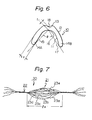
- a bulking procedure causes a starting multifilament yarn 20 to have bulked portions 21 and twisted portions 22, each twisted portion 22 being located between two bulked portions 21.
- Each bulked portion 21 is composed of a plurality of segments 23a, 23b, 23c Vietnamese of the starting individual filaments having different lengthes (i) from each other and being spaced -from each other.
- the length (l m ) of the longest segment of the filaments is 15 mm or less.
- the length of the bulked portion 21 is measured along the longitudinal axis of the yarn 20 under substantially no tension and represented by l B .
- the ratio of the difference (l m - l B ) to l B is 15% or less.
- the ratio (l m - l B )/l B is more than 15%, the resultant fabric, sometimes, does not exhibit the silk-like appearance and touch.
- the promotion in the number of a group of filament segments having a ratio (l - l B )/l B , wherein i represents a length of each segment and B is as defined above, of from 3 to 12%, to all the filament segments is 15% or more.
- the group of the filament segments having a ratio (l-l B )/l B of 3 to 12% have a relatively poor bulking property and are effective for enhancing the silk-like appearance and touch of the resultant fabric.
- the starting polyester multifilament yarns exhibit a bulkiness of 14.0 cm 3 /g or more, more preferably, from 14.0 to 20 cm 3 /g when heat-treated at a temperature of 195°C for 5 minutes under substantially no tension.
- the resultant bulked fabric exhibits a proper bulkiness like that of the silk fabric.
- the above-mentioned type of starting polyester multifilament yarn can be produced by using an interlace nozzle, as disclosed in Japanese Patent Application Publication Nos. 36-12230 (1961) and 37-1175 (1962). That is, the starting multifilament yarn is introduced into the interlace nozzle under a compressed air pressure of from 1 to 5 kg/cm 2 G , at an overfeed of from 1 to 15%, preferably, 1.5 to 6%, at a speed of 200 m/min or more, preferably, 500 m/min or more.
- the bulking and alkali-treatment procedures for the precursory fabric can be carried out in the same manner as mentioned hereinbefore.
- the polyester multifilament yarns may be composed of at least two types of porous polyester filaments, as specified hereinbefore, which are different in the denier of the individual filaments from each other.
- one type of the porous polyester filaments having the largest denier are mainly located in the core portion of each individual yarn.
- the shrinkage in boiling water of a group of the porous polyester filaments having the smallest denier is 3 to 15% below that of a group of other filaments having the largest denier.
- the polyester multifilament yarns may be composed of at least one type of the porous polyester filament as specified in the present invention and at least one type of another filament.
- the porous polyester filaments are mainly located in the peripheral surface layer of each multifilament yarn.
- polyester pellets In order to prepare polyester pellets, a polycondensation reactor provided with a rectification column was charged with 197 parts by weight of dimethylterephthalate, 124 parts by weight of ethylene glycol and.0.118 parts by weight of calcium acetate, and the resultant mixture was subjected to an ester interchange reactions. After removing the theoretical amount of methyl alcohol produced in the ester interchange reaction, the reaction product was placed in another polycondensation reactor provided with a rectification column and mixed with a stabilizer consisting of 0.112 parts by weight of trimethyl phosphate and a polycondensation catalyst consisting of 0.079 parts by weight of antimony oxide.
- the resultant reaction mixture was heated at a temperature of 280°C under ambient pressure for 30 minutes, and, then, under a reduced pressure of 30 mmHg for 15 minutes. Thereafter, the pressure of the reaction mixture was changed to the ambient pressure.
- the reaction mixture was further mixed with 2 parts by weight of mixed sodium alkylsulfonates having 8 to 20 carbon atoms, the average number of the carbon atoms being 14.
- the pressure of the reactor was gradually reduced and the reaction mixture was subjected to a final reaction for 80 minutes. When the reaction was completed, the reactor exhibited a final temperature of 280°C and a final pressure of 0.32 mmHg.
- the resulting polymer exhibited an intrinsic viscosity of 0.655.
- the polymer was pelletized and dried.
- the polymer pellets were melt-spun through a spinneret having 24 spinning orifices and the resultant undrawn filaments were taken-up at a speed of 1500 m/min.
- the spinning orifices were adequate for producing filaments each having an L- or V-shaped cross-sectional profile which has an average opening angle 0 as indicated in Table 1.
- the undrawn multifilament yarn was drawn at a draw ratio of 3.0 and the drawn multifilament yarn was wound at a speed of 800 m/min.
- the resultant multifilament yarn had a yarn count of 50 denier/24 filaments.
- the multifilament yarn was converted to a precursory plain weave fabric having a warp density of 43 yarns/cm and a weft density of 40 yarns/cm.
- the precursory fabric was scoured and pre-heat-set at a temperature of 180°C.
- the pre-heat-set fabric was immersed in an aqueous solution of 35 g/l of sodium hydroxide at a temperature of 100°C for 30 minutes.
- Example 5 through 8 and Comparative Examples 5 through 8 the same procedures as those mentioned in Example 1 were carried out, except that the drawn multifilament yarn had a yarn count of 75 denier/ 24 filaments, the opening angle 8 and the R ⁇ of the filaments in the alkali-treated fabric were as indicated in Table 2, and the precursory fabric had a warp density of 35 yarns/cm and a weft density of 33 yarns/cm.
- Table 2 The ratio t 2 /t l of the drawn filaments and the properties of the alkali-treated fabric are indicated in Table 2.
- Table 2 also indicates percentages of the formation of fibrils in the filaments in the melt-spinning and drawing procedures.
- Example 2 The same procedures for producing the undrawen filament yarn as those described in Example 1 were carried out, except that the undrawn filament yarn had a yarn count of 143 denier/36 filaments and the individual filaments each had a trilobate cross-sectional profile.
- the undrawn filament yarn was drawn at a draw ratio of 2.95 at a temperature of 180°C by feeding the undrawn yarn to a feed roller of a drawing apparatus at a feed speed of 271 m/min and by delivering the drawn yarn from a delivery roller of the drawing apparatus at a delivery speed of 800 m/min.
- the drawn filament yarn exhibited a shrinkage of 15% in boiling water.
- the drawn filament yarn was introduced into an interlacing apparatus at a feed speed of 784 m/min at an overfeed of 2%.
- the filament yarn passed through a turbulent flow of compressed air under a pressure of 2 kg/cm 2 G , and was heated by a heating plate having a length of 30 cm at a temperature of 180°C under a tension of 0.07 g/de.
- the resultant interlaced filament yarn was wound on a bobbin at a speed of 10000 rpm under a tension of 0.4 g/de.
- the interlaced filament yarns had numerous bulked portions in a density of 8 per cm of the length of the yarn and twisted portions in a density of 60 per m of the length of the yarn under substantially no tension.
- the average thickness and length of the bulked portions were 0.9 mm and 11 mm, respectively.
- the interlaced filament yarn After the winding operation, the interlaced filament yarn exhibited a non-bulked yarn-like appearance and a shrinkage of 11% in boiling water, and had numerous twisted portions in a density of 58 per m of the length of the yarn.
- the length (i ) of the longest segment of the individual filament in the bulked portion was 13 mm
- the ratio (i m - l B )/l B was 13.5%
- the proportion of the number of the segments of the filaments having a ratio (t - l B )/l B of from 3 to 12% to the entire number of the filaments was 30%.
- the bulked yarn exhibited a buliness of 17.5 cm 3 /g.
- the bulkiness of the yarn was measured as follows. The yarn was wound 320 times around a frame having a circumference of 1.125 m. The wound yarn was removed from the frame to provide a hank. The hank was suspended under a load of 6 g in a dry heating atmosphere at a temperature of 195°C for 5 minutes. Thereafter, the hank was cooled. The weight (W) in grams of the hank and the volume (V) in cm 3 of the hank under a load of 6.4 g were measured. The bulkiness (Bu) of the yarn was calculated from the relationship:
- the interlaced filament yarn had a twist number of S 300 turns/m, and woven in a warp density of 42 yarns/cm and in a weft density of 43 yarns/cm.
- the woven fabric was relaxed by using a continuous scouring machine at a temperature of 95°C for 10 minutes, dried, and pre-set at a temperature of 180°C for 45 seconds.
- the pre-set fabric was immersed in an aqueous solution of 35 g/t of sodium hydroxide at a temperature of 100°C for 30 minutes. The reduction in weight'of the fabric was 20.7%.
- the alkali-treated fabric was dyed at a temperature of 130°C for 45 minutes and, finally, heat-set at a temperature of 160°C for 45 seconds.
- the resultant fabric had a warp density of 48 yarns/cm and a weft density of 46 yarns/cm.
- the percent of breakage of the yarn in the interlacing procedure was 0.3%
- the primary yield point of the interlaced, wound yarn was 2.6 g/de.
- the interlaced, wound yarn exhibited a satisfactory wearing property.
- the resultant alkali-treated fabric exhibited a satisfactory silk-like dry touch, luster, and draping property.
- the mixed sodium alkylsulfonates were used in the amount as indicated in Table 3.
- the undrawn multifilament yarn had a yarn count of 200 denier/24 filaments and was drawn at a draw ratio of 4.0.
- the yarn count of the drawn multifilament yarn was 50 denier/24 filaments.
- the precursory plain weave fabric had a warp density of 40 yarns/cm and a weft density of 37 yarns/cm.
- the alkali treatment for the precursory fabric was carried out for 10 to 60 minutes, so as to result in a decrease of 15% in the weight of the precursory fabric.
- the resistance of the alkali-treated fabrics to fibrilization was tested in the following manner.
- a test specimen was rubbed 200 times with a rubbing cloth under a load of 500 g by using a rubbing tester.
- the rubbing cloth was made from a polyester multifilament arenturine Georgette cloth which was made from polyester multifilament yarn having a yarn count of 75 denier/ 36 filaments and a twist number of 2500 turns/m, and which had a warp density of 37 yarns/cm and a weft density of 37 yarns/cm.
- the rubbed surface of the specimen was observed by using a microscope, so as to determine how the filaments located in the rubbed surface portions of the specimen were fibrilized.
- Example 15 the same procedures for producing the drawn multifilament yarn as those described in Example 11 were carried out, except that the mixed sodium alkylsulfonates were used in an amount of 1.0% by weight and the resultant filaments had the type of -irregular cross-sectional profile as indicated in Table 4.
- the drawn multifilament yarn had a yarn count of 50 denier/36 filaments and a shrinkage of 8% in boiling water.
- the individual filaments had a denier of about 1.4.
- a drawn multifilament yarn having a yarn count of 30 denier/12 filaments and a shrinkage of 14% in boiling water was prepared from the same polyester mixture as that used above.
- the individual filaments of the drawn multifilament yarn had a regular, that is, circular, cross-sectional profile and a denier of 2.5.
- the 50 denier multifilament yarns were mixed with the 30 denier multifilament yarns in a mixing ratio in weight of 6/4.
- Example 19 no mixing of the 30 denier multifilament yarns was applied to the 50 denier multifilament yarns.
- the mixed multifilament yarns in each of Examples 15 through 18 were relaxed in boiling water. It was observed that the 1.4 denier filaments were located mainly in the peripheral portion of the relaxed yarn, whereas the 2.5 denier filaments were located mainly in the core portion of the relaxed yarns.
- the fabric was scoured, pre-heat set and treated with an aqueous solution of 35 9 /i of sodium hydroxide at a temperature of 98°C for 60 minutes.
- Example 11 In comparative Example 11, the same procedures as those described in Example 15 were carried out, except that the 1.4 denier filaments in the 50 denier multifilament yarn had a regular, that is, circular, cross-sectional profile.
- Comparative Example 16 the same procedures as those described in Comparative 11 were carried out, except that both the 1.4 denier filaments and the 2.5 denier filaments contained no pore-forming material.
- Example 16 The same procedures as those described in Example 16 were carried out, except that the shrinkage of the 30 denier/12 filaments yarn in boiling water was changed to 10, 11, 13, 16, 18, 23, 25, 29 and 31%. That is, the difference in the shrinkage between the 30 denier/ 12 filament yarn and the 50 denier/36 filament yarn was changed to 2, 3, 5, 8, 10, 15, 17, 21 and 23%.
Landscapes
- Engineering & Computer Science (AREA)
- Textile Engineering (AREA)
- Chemical & Material Sciences (AREA)
- Chemical Kinetics & Catalysis (AREA)
- General Chemical & Material Sciences (AREA)
- Mechanical Engineering (AREA)
- Manufacturing & Machinery (AREA)
- Chemical Or Physical Treatment Of Fibers (AREA)
- Artificial Filaments (AREA)
- Woven Fabrics (AREA)
- Spinning Methods And Devices For Manufacturing Artificial Fibers (AREA)
- Knitting Of Fabric (AREA)
Applications Claiming Priority (2)
| Application Number | Priority Date | Filing Date | Title |
|---|---|---|---|
| JP4470880A JPS56144237A (en) | 1980-04-07 | 1980-04-07 | Polyester type fiber woven and knitted fabric |
| JP44708/80 | 1980-04-07 |
Publications (3)
| Publication Number | Publication Date |
|---|---|
| EP0037968A2 true EP0037968A2 (fr) | 1981-10-21 |
| EP0037968A3 EP0037968A3 (en) | 1982-04-28 |
| EP0037968B1 EP0037968B1 (fr) | 1985-08-14 |
Family
ID=12698910
Family Applications (1)
| Application Number | Title | Priority Date | Filing Date |
|---|---|---|---|
| EP81102474A Expired EP0037968B1 (fr) | 1980-04-07 | 1981-04-02 | Etoffe tissée ou tricotée en multifilaments de polyester |
Country Status (4)
| Country | Link |
|---|---|
| US (1) | US4416934A (fr) |
| EP (1) | EP0037968B1 (fr) |
| JP (1) | JPS56144237A (fr) |
| DE (1) | DE3171776D1 (fr) |
Cited By (4)
| Publication number | Priority date | Publication date | Assignee | Title |
|---|---|---|---|---|
| EP0035796B1 (fr) * | 1980-03-12 | 1986-06-04 | Teijin Limited | Filaments synthétiques thermoplastiques et procédé pour leur fabrication |
| EP0073437B1 (fr) * | 1981-08-25 | 1987-05-20 | Teijin Limited | Structure composite teinte comportant des fibres de polyester |
| EP1967631A1 (fr) * | 2007-02-12 | 2008-09-10 | Carl Freudenberg KG | Procédé de fabrication d'une étoffe nappée touffetée, étoffe nappée touffetée et son utilisation |
| CN112323230A (zh) * | 2020-10-30 | 2021-02-05 | 江南大学 | 一种单向导湿面料的制备方法 |
Families Citing this family (18)
| Publication number | Priority date | Publication date | Assignee | Title |
|---|---|---|---|---|
| JPS60104517A (ja) * | 1983-11-10 | 1985-06-08 | Toray Ind Inc | 発色性に優れたポリエステルフイラメント糸およびその製造方法 |
| DE3584960D1 (de) * | 1984-12-24 | 1992-01-30 | Teijin Ltd | Garn aus polyester und daraus hergestelltes gewebe. |
| US4656073A (en) * | 1986-04-04 | 1987-04-07 | Ametek, Inc. | Fabrics made of hollow monofilaments |
| US4833036A (en) * | 1988-03-21 | 1989-05-23 | Arco Chemical Technology, Inc. | Polyalkylene carbonate hot melt adhesive |
| US5972505A (en) * | 1989-04-04 | 1999-10-26 | Eastman Chemical Company | Fibers capable of spontaneously transporting fluids |
| IL107195A (en) * | 1992-10-13 | 1997-07-13 | Allied Signal Inc | Fabric having reduced air permeability comprising multifilament yarn |
| US5447771A (en) * | 1993-06-30 | 1995-09-05 | E. I. Du Pont De Nemours And Company | Fiber bilobal cross-sections and carpets prepared therefrom having a silk-like luster and soft hand |
| US5858054A (en) * | 1997-01-31 | 1999-01-12 | Rosen; Arthur | Knitted protective fabric and garments made therefrom |
| WO2004098236A1 (fr) * | 1999-01-27 | 2004-11-11 | Toshihide Inoue | Membrane de haut-parleur |
| US7472961B2 (en) | 2003-11-18 | 2009-01-06 | Casual Living Worldwide, Inc. | Woven articles from synthetic yarns |
| US7472536B2 (en) * | 2003-11-18 | 2009-01-06 | Casual Living Worldwide, Inc. | Coreless synthetic yarns and woven articles therefrom |
| US7472535B2 (en) * | 2003-11-18 | 2009-01-06 | Casual Living Worldwide, Inc. | Coreless synthetic yarns and woven articles therefrom |
| US20050142630A1 (en) * | 2003-12-08 | 2005-06-30 | Agy Therapeutics, Inc. | Interaction of NMDA receptor with the protein tyrosine phosphatase step in psychotic disorders |
| US20060116041A1 (en) * | 2004-11-30 | 2006-06-01 | Sun Isle Casual Furniture, Llc | Yarn having lateral projections |
| US20060166578A1 (en) * | 2005-01-21 | 2006-07-27 | Myers Kasey R | Process for creating fabrics with branched fibrils and such fibrillated fabrics |
| NL1028224C2 (nl) | 2005-02-08 | 2006-08-09 | Ten Cate Thiolon Bv | Kunststofvezel van het monofilament-type voor toepassing in een kunstgrassportveld alsmede een kunstgrasmat geschikt voor sportvelden voorzien van dergelijke kunststofvezels. |
| NL1036418C2 (nl) * | 2009-01-14 | 2010-07-15 | Ten Cate Thiolon Bv | Kunststofvezel alsmede een kunstgrasveld voorzien van een dergelijke vezel. |
| US10793973B2 (en) * | 2011-07-01 | 2020-10-06 | Ten Cate Thiolon B.V. | Synthetic fibre and an artificial lawn comprising such a fibre |
Family Cites Families (15)
| Publication number | Priority date | Publication date | Assignee | Title |
|---|---|---|---|---|
| GB991224A (en) * | 1962-05-29 | 1965-05-05 | Snia Viscosa | Improvements in or relating to spinnerets |
| DE1669544B2 (de) * | 1966-03-15 | 1974-06-20 | Teijin Ltd., Osaka (Japan) | Textilfasern mit Hohlräumen und Verfahren zu deren Herstellung |
| NL6714466A (fr) * | 1966-10-27 | 1968-04-29 | ||
| US3914488A (en) * | 1973-09-24 | 1975-10-21 | Du Pont | Polyester filaments for fur-like fabrics |
| GB1524473A (en) * | 1975-05-08 | 1978-09-13 | Teijin Ltd | Process for producing textured polyester multilament yarn |
| FR2330793A1 (fr) * | 1975-11-07 | 1977-06-03 | Akzo Nv | Nappe en fils de polymere synthetique et son procede de fabrication |
| DE2550080B2 (de) * | 1975-11-07 | 1978-03-09 | Akzo Gmbh, 5600 Wuppertal | Verfahren zur Herstellung von Filamenten mit nicht durchgehenden Hohlräumen |
| GB1566581A (en) * | 1975-12-29 | 1980-05-08 | Nippon Zeon Co | Hollow fibres and methods of manufacturing such fibres |
| JPS5335028A (en) * | 1976-09-13 | 1978-04-01 | Asahi Chem Ind Co Ltd | Special filament |
| JPS6039776B2 (ja) * | 1977-03-17 | 1985-09-07 | 帝人株式会社 | スエ−ド調起毛織物及びその製造方法 |
| JPS53139817A (en) * | 1977-05-12 | 1978-12-06 | Asahi Chem Ind Co Ltd | Specific multifilament yarns |
| JPS54101917A (en) * | 1978-01-27 | 1979-08-10 | Teijin Ltd | Hollow fibers and their manufacture |
| JPS54120728A (en) * | 1978-03-08 | 1979-09-19 | Kuraray Co Ltd | Fine synthetic fiber having complicatedly roughened surface and its production |
| JPS54151617A (en) * | 1978-05-15 | 1979-11-29 | Teijin Ltd | Synthetic fibers |
| EP0023664B1 (fr) * | 1979-07-26 | 1985-12-04 | Teijin Limited | Procédé pour la préparation des filaments de polyesters creux et hydrophiles |
-
1980
- 1980-04-07 JP JP4470880A patent/JPS56144237A/ja active Granted
-
1981
- 1981-03-31 US US06/249,427 patent/US4416934A/en not_active Expired - Lifetime
- 1981-04-02 EP EP81102474A patent/EP0037968B1/fr not_active Expired
- 1981-04-02 DE DE8181102474T patent/DE3171776D1/de not_active Expired
Cited By (4)
| Publication number | Priority date | Publication date | Assignee | Title |
|---|---|---|---|---|
| EP0035796B1 (fr) * | 1980-03-12 | 1986-06-04 | Teijin Limited | Filaments synthétiques thermoplastiques et procédé pour leur fabrication |
| EP0073437B1 (fr) * | 1981-08-25 | 1987-05-20 | Teijin Limited | Structure composite teinte comportant des fibres de polyester |
| EP1967631A1 (fr) * | 2007-02-12 | 2008-09-10 | Carl Freudenberg KG | Procédé de fabrication d'une étoffe nappée touffetée, étoffe nappée touffetée et son utilisation |
| CN112323230A (zh) * | 2020-10-30 | 2021-02-05 | 江南大学 | 一种单向导湿面料的制备方法 |
Also Published As
| Publication number | Publication date |
|---|---|
| JPS638222B2 (fr) | 1988-02-22 |
| US4416934A (en) | 1983-11-22 |
| DE3171776D1 (en) | 1985-09-19 |
| EP0037968A3 (en) | 1982-04-28 |
| JPS56144237A (en) | 1981-11-10 |
| EP0037968B1 (fr) | 1985-08-14 |
Similar Documents
| Publication | Publication Date | Title |
|---|---|---|
| US4416934A (en) | Woven or knitted polyester multifilament fabric | |
| US4361617A (en) | Hollow water-absorbing polyester filaments and a process for producing the same | |
| US4233355A (en) | Separable composite fiber and process for producing same | |
| KR900004916B1 (ko) | 고밀도 조면화 폴리에스테르 섬유 | |
| US4357390A (en) | Antistatic polyester fibers | |
| JP3104891B2 (ja) | 中空複合繊維およびその製造方法 | |
| JP2771248B2 (ja) | 鮮明性を呈する超ソフト特殊混繊糸の製造方法 | |
| EP0431499A2 (fr) | Procédé pour produire des matériaux textiles tissés ou tricotés ayant un haut degré d'élasticité | |
| JPH08260343A (ja) | 中空ポリエステル繊維及びその製造方法 | |
| JPH03241024A (ja) | カチオン可染極細仮撚加工糸の製造方法 | |
| JP2002038341A (ja) | 極細仮撚加工糸及びその製造方法 | |
| JPS641584B2 (fr) | ||
| JP3333831B2 (ja) | ポリエステル太細糸 | |
| JPS63159537A (ja) | 杢調スパンライク様仮撚2層構造糸 | |
| JPS6010126B2 (ja) | 染色ポリエステル繊維の製造法 | |
| JPH08291463A (ja) | ポリエステル中空太細繊維及びその製造方法 | |
| JPH10110328A (ja) | 透け防止性に優れたポリエステル繊維及びその製造方法 | |
| JPH062235A (ja) | ポリエステル複合仮撚糸 | |
| JP2809706B2 (ja) | 制電性ポリエステル繊維及びその製造方法 | |
| JPH0151589B2 (fr) | ||
| JP2555136B2 (ja) | 微細孔ポリエステル繊維の製造法 | |
| JPH08291462A (ja) | ポリエステル中空太細繊維及びその製造法 | |
| JPS61152816A (ja) | ポリエステル繊維 | |
| JPS62199833A (ja) | ポリエステル複合糸条 | |
| JPH08209528A (ja) | 吸水性ポリエステル繊維の製造法 |
Legal Events
| Date | Code | Title | Description |
|---|---|---|---|
| PUAI | Public reference made under article 153(3) epc to a published international application that has entered the european phase |
Free format text: ORIGINAL CODE: 0009012 |
|
| AK | Designated contracting states |
Designated state(s): DE FR GB |
|
| PUAL | Search report despatched |
Free format text: ORIGINAL CODE: 0009013 |
|
| AK | Designated contracting states |
Designated state(s): DE FR GB |
|
| 17P | Request for examination filed |
Effective date: 19820915 |
|
| GRAA | (expected) grant |
Free format text: ORIGINAL CODE: 0009210 |
|
| AK | Designated contracting states |
Designated state(s): DE FR GB |
|
| REF | Corresponds to: |
Ref document number: 3171776 Country of ref document: DE Date of ref document: 19850919 |
|
| ET | Fr: translation filed | ||
| PLBE | No opposition filed within time limit |
Free format text: ORIGINAL CODE: 0009261 |
|
| STAA | Information on the status of an ep patent application or granted ep patent |
Free format text: STATUS: NO OPPOSITION FILED WITHIN TIME LIMIT |
|
| 26N | No opposition filed | ||
| PGFP | Annual fee paid to national office [announced via postgrant information from national office to epo] |
Ref country code: FR Payment date: 20000322 Year of fee payment: 20 |
|
| PGFP | Annual fee paid to national office [announced via postgrant information from national office to epo] |
Ref country code: GB Payment date: 20000327 Year of fee payment: 20 |
|
| PGFP | Annual fee paid to national office [announced via postgrant information from national office to epo] |
Ref country code: DE Payment date: 20000630 Year of fee payment: 20 |
|
| PG25 | Lapsed in a contracting state [announced via postgrant information from national office to epo] |
Ref country code: GB Free format text: LAPSE BECAUSE OF EXPIRATION OF PROTECTION Effective date: 20010401 |
|
| REG | Reference to a national code |
Ref country code: GB Ref legal event code: PE20 Effective date: 20010401 |