EP0041446B2 - Verfahren zur Haarformung - Google Patents
Verfahren zur Haarformung Download PDFInfo
- Publication number
- EP0041446B2 EP0041446B2 EP81400846A EP81400846A EP0041446B2 EP 0041446 B2 EP0041446 B2 EP 0041446B2 EP 81400846 A EP81400846 A EP 81400846A EP 81400846 A EP81400846 A EP 81400846A EP 0041446 B2 EP0041446 B2 EP 0041446B2
- Authority
- EP
- European Patent Office
- Prior art keywords
- hair
- process according
- drying
- conditioning stage
- relative humidity
- Prior art date
- Legal status (The legal status is an assumption and is not a legal conclusion. Google has not performed a legal analysis and makes no representation as to the accuracy of the status listed.)
- Expired
Links
Images

Classifications
-
- A—HUMAN NECESSITIES
- A45—HAND OR TRAVELLING ARTICLES
- A45D—HAIRDRESSING OR SHAVING EQUIPMENT; EQUIPMENT FOR COSMETICS OR COSMETIC TREATMENTS, e.g. FOR MANICURING OR PEDICURING
- A45D20/00—Hair drying devices; Accessories therefor
-
- A—HUMAN NECESSITIES
- A45—HAND OR TRAVELLING ARTICLES
- A45D—HAIRDRESSING OR SHAVING EQUIPMENT; EQUIPMENT FOR COSMETICS OR COSMETIC TREATMENTS, e.g. FOR MANICURING OR PEDICURING
- A45D7/00—Processes of waving, straightening or curling hair
- A45D7/02—Processes of waving, straightening or curling hair thermal
Definitions
- the present invention relates to a new method for shaping the hair.
- the method according to the invention finds its application either in the making of styling, or for the straightening of a hair, or a wig of natural hair, which is considered to be naturally too curly.
- the method according to the invention consists in giving the hair a non-definitive shape, that is to say a temporary shape, which disappears when the hair is again wet, in particular when it is subjected to a shampoo; the difference, which exists between the temporary deformation conferred by the process according to the invention and a permanent deformation, which implies a chemical treatment, therefore lies in the fact that the hair having undergone the deformation process according to the invention finds, when they are wet, the shape they had before the application of the process whereas after a permanent deformation, the shape of the hair is not altered by wetting or by washing.
- the most commonly used method of styling hair consists of wet hair which is rolled up on supports called> curlers ⁇ or> styling rollers ", then drying the hair under a helmet at a temperature included between 30 and 60 ° C for a time which can vary from 20 to 60 minutes depending on the mass of the hair to be dried, then unroll the curlers and give the hairstyle a comb.
- the initial wet treatment is carried out using a styling lotion which can be constituted, for example, by a solution of reinforcing agents such as resins which, after drying, sheath the hair and keep them in their position.
- the hair subjected to such a styling process has a behavior which changes as a function of time after the end of drying.
- the wet treatment to which a hair is subjected during a wetting with water or a shampoo, causes an increase in the weight of the hair.
- the relative change in weight is around 35%.
- the drying of the hair in a circulation of hot air causes a loss of water, which is greater than the weight gain of the hair during the wet treatment and, at the end of drying, the relative variation of the weight of the hair compared to the weight before wet treatment is generally close to -9%: this weight loss is, of course, essentially a function of the drying and, in particular, of its duration and of the temperature of the forced air used.
- wet treatment of the hair allows water to penetrate the hair and increases the dielectric constant of the medium existing between the charged sites of the constituent molecules of the hair, so that the hydrogen bonds no longer exist for wet hair.
- the water molecules are extracted from the hair in an amount such that there is a loss in weight relative to the initial weight; the charged sites of the constituent molecules of the hair which had been discarded due to the presence of the water molecules, remain relatively spaced apart and do not allow instantaneously at room temperature, the reformation of the hydrogen bonds, this reformation only taking place gradually with relatively low speed.
- the water molecules, which return to the hair at room temperature to ensure the recovery of water after the end of drying, are in the form of agglomerates the larger the lower the temperature and the rearrangement of these molecules. of water in the hair takes place slowly.
- the performance of a styling according to the invention was a function of the relative humidity during the conditioning phase, said function having a maximum for the relative humidity which corresponds to the relative humidity of the external atmosphere in contact with which the hair is found after the end of the conditioning phase.
- the performance of the styling increases when the temperature during the conditioning phase increases.
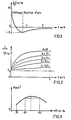
- the two phenomena are translated by the curves of Figures 3 and 4; in FIG. 3, the yield is plotted on the ordinate, the relative humidity expressed in% is plotted on the abscissa, the drying and conditioning times and temperatures constitute parameters of given value; in FIG.
- the yield expressed in% is plotted on the ordinate
- the conditioning temperature expressed in ° C is plotted on the abscissa
- the drying time and temperature as well as the conditioning time and the relative humidity during the conditioning constitute parameters of given value.
- the hatched part of the plane corresponds to the area which it is not possible to reach since the users of the process could not withstand temperatures of this order.
- the yield is expressed as a percentage improvement compared to the lengths of the control locks, which have undergone conventional styling, with drying at 60 ° C. for a total equal time. at the complete treatment time of the process according to the invention, immediately followed by an unwinding of the locks in a standard atmosphere (for example at 26 ° C. and 56% relative humidity).
- the method according to the invention is quite different from the hair treatment methods which hitherto envisaged treating the hair with steam.
- a styling technique of known type consists in subjecting dry hair to a mixture of air and water vapor at a level which is bearable for the scalp, this mixture being propelled towards the hair using a blower helmet or a hand dryer.
- the suction of the drying and conditioning phases which it has been found according to the invention, is not found to be necessary in order to show a good styling yield and good resistance over time.
- the present invention therefore relates to a method for carrying out shaping of hair, in which the hair is subjected to a wet treatment, the hair is wound on bodies of suitable shapes serving as curlers, the hair thus coiled is dried until it exhibits a loss of water relative to their initial state before the wet treatment and the hair is unwound after drying, characterized in that before unwinding the hair, but after having dried it, said hair is subjected to a conditioning phase known per se, the duration of which is between 5 min and 66 min approximately, said conditioning phase being carried out in an atmosphere having a relative humidity between 35 and 80% approximately, at a temperature between 35 ° C and 75 ° C approximately.
- the hair is soft, shiny, easy to comb and not electric; the hair has more volume.
- the relative humidity of the conditioning phase is fixed at a value close to the relative humidity of the ambient atmosphere with which the hair will be in contact, when they will take place; the temperature is maintained during the conditioning phase at a value between 45 and 60 ° C and, preferably, close to 50 ° C; maintaining the temperature of the atmosphere, where the hair is located during the conditioning phase, at a value close to the temperature during the hair drying phase; during the conditioning phase, moisture is taken up in the hair which, as a percentage relative to the weight of the hair before the wet treatment, does not differ from the weight loss on drying, expressed as a percentage relative to the weight of the hair before the wet treatment, only less than 2%; the conditioning phase is maintained for a time of between 10 and 20 minutes approximately; the conditioning phase is carried out by injecting water vapor into the atmosphere, where the hair is located; during the conditioning phase, a treatment product is injected into the atmosphere, where the hair is located.
- treatment product ⁇ is meant a product ordinarily used in cosmetics, such as anti-seborrheic, anti-dandruff, anti-hair loss agents, film-forming resins, deodorants, disinfectants, perfumes, brilliantine and analoque.
- the hair is dried until it reaches a relative humidity of around 15% in the atmosphere which surrounds the hair; the hair is dried until a weight loss is obtained, relative to the weight of the hair before the wet treatment, of between 1 and 15% and preferably between 5% and 15%; the hair is dried at a temperature between 40 and 75 ° C for a time between 10 and 60 minutes; hair is dried by ventilation of air taken outside and heated, in open circuit.
- an aqueous or hydroalcoholic solution for example a solution of reinforcing agents such as only resins
- the bodies used for winding the hair are curlers or styling rollers; in the case where the method is intended to obtain a hair straightening, the bodies used for winding the hair are rollers of large diameter.
- the hair treated by the method according to the invention can be natural hair, bleached, colored or permed.
- FIG. 1 shows that a hair undergoes an increase in weight of 35% at the time of its wetting and then returns by drying in 45 min at 60 ° C to a lower weight. 9% of its initial weight. The hair left in an atmosphere at 26 ° C and 56% relative humidity roughly returns to its initial weight about 2 hours after the end of drying.
- FIG. 2 gives the variation of the length L of a lock of hair, expressed in millimeters, as a function of the time t expressed in hours when the lock, having undergone a process conventional styling, is unrolled from his curler at a time A counted in hours from the end of drying.
- Tables 1 and II give the experimental results for a process, which comprises drying for 45 minutes at 60 ° C. using a ventilated helmet-dryer followed by a conditioning phase, the characteristics of which are given in the first column. Tables 1 and II; the relative humidity during the conditioning phase is designated by HR and by ⁇ c the temperature of the atmosphere that surrounds the hair during the conditioning phase. The duration of conditioning expressed in minutes is indicated in the second column of these two tables. In the third column of these tables, the lengths of the locks subjected to the shaping process of the invention have been shown after a period of 5 hours counted from the time when they are unrolled from their curler-support.
- a control wick which has undergone the drying operation under the conditions indicated above but which has not undergone any conditioning phase, the wicks being unwound just after drying.
- the ratio of the length of a lock treated with the method according to the invention to the length of the control lock gives in% the improvement that the method according to the invention; this improvement is indicated in the fourth column of Tables 1 and II.
- the fifth column of the two tables gives the water uptake of the treated locks, five hours after the end of the treatment.
- the usual treatment involves drying for 45 minutes and it is therefore desirable to be able to bring the time for implementing the method according to the invention to around this value of 45 minutes.
- FIG. 3 schematically translates on a curve the experimental results recorded in Tables 1, II and III.
- This curve shows the variation in the yield of the process according to the invention (plotted on the ordinate) as a function of the relative humidity during the conditioning phase, the yield being identified by the improvement in% as it is calculated in the penultimate column in Tables I, II and III;
- this graph shows, without any precision, the shape of the curve and assumes constant the other parameters, namely, the drying temperature (60 ° C), the drying time (30 minutes), the conditioning temperature (50 ° C ) and the conditioning time (15 minutes).
- FIG. 4 schematically shows the shape of the curve for variation of the yield of the process according to the invention as a function of the conditioning temperature which is adopted; the yield indicated on the ordinate is calculated in the same way as for the ordinate of FIG. 3; the conditioning temperature is indicated on the abscissa and expressed in ° C.
- the other parameters are kept constant, namely the drying time (30 minutes), the drying temperature (60 ° C), the conditioning time (15 minutes) and the relative humidity of the packaging (56%).
- the first embodiment is shown diagrammatically in FIG. 5.
- the user whose hair has been wetted either with water, or by shampooing and rinsing, optionally with the application of a polymerizable reinforcing agent, and wound on hair curlers as places his hair inside a flexible cap 4, made for example of plastic material, said cap being connected by a pipe 5 to a heating and / or humidifier member 6.
- the member 6 sends hot air into the cap 4 and the air is evacuated through the pipe 5 which serves both to bring it in and to evacuate said air; the drying air is exhausted to the outside.
- the air circulation provided by the member 6 is no longer in an open circuit, but in a closed circuit and the member 6 adds to the circulation air a sufficient amount of water to maintain inside the cap 4 a constant relative humidity.
- water it is possible to introduce into the air during the conditioning phase an aqueous or hydroalcoholic liquid for treating the hair or the scalp.
- a dryer hood 7 of conventional type modified is used to allow this implementation.
- the dryer hood 7 is equipped with a fan 8 which draws in the outside air in the direction of arrow F and pulses it after heating in the direction of the hair, the forced air emerging from the helmet around the head of the user according to the arrows F1.
- the helmet 7 is equipped with a device 9 allowing the injection into the pulsed hot air flow of a quantity of steam intended to maintain a constant relative humidity.
- the hair is put under the helmet 7 and the drying phase of the process is started.
- water vapor a treatment liquid in the vapor state
- the quantity of steam being regulated so as to maintain a constant relative humidity around the hair.
Landscapes
- Physics & Mathematics (AREA)
- Thermal Sciences (AREA)
- Cosmetics (AREA)
- Hair Curling (AREA)
- Cleaning And Drying Hair (AREA)
Claims (16)
Priority Applications (1)
| Application Number | Priority Date | Filing Date | Title |
|---|---|---|---|
| AT81400846T ATE8839T1 (de) | 1980-05-30 | 1981-05-26 | Verfahren zur haarformung. |
Applications Claiming Priority (2)
| Application Number | Priority Date | Filing Date | Title |
|---|---|---|---|
| FR8012110 | 1980-05-30 | ||
| FR8012110A FR2483200A1 (fr) | 1980-05-30 | 1980-05-30 | Procede de mise en forme de cheveux et dispositif pour la mise en oeuvre dudit procede |
Publications (3)
| Publication Number | Publication Date |
|---|---|
| EP0041446A1 EP0041446A1 (de) | 1981-12-09 |
| EP0041446B1 EP0041446B1 (de) | 1984-08-08 |
| EP0041446B2 true EP0041446B2 (de) | 1987-10-14 |
Family
ID=9242561
Family Applications (1)
| Application Number | Title | Priority Date | Filing Date |
|---|---|---|---|
| EP81400846A Expired EP0041446B2 (de) | 1980-05-30 | 1981-05-26 | Verfahren zur Haarformung |
Country Status (6)
| Country | Link |
|---|---|
| US (1) | US4481961A (de) |
| EP (1) | EP0041446B2 (de) |
| AT (1) | ATE8839T1 (de) |
| CA (1) | CA1155033A (de) |
| DE (2) | DE41446T1 (de) |
| FR (1) | FR2483200A1 (de) |
Families Citing this family (10)
| Publication number | Priority date | Publication date | Assignee | Title |
|---|---|---|---|---|
| FR2531617A1 (fr) * | 1982-08-16 | 1984-02-17 | Oreal | Procede de traitement des cheveux, et notamment de leurs pointes, et dispositif pour la mise en oeuvre dudit procede |
| CH681848A5 (de) * | 1991-01-28 | 1993-06-15 | Juergen E Sahm | |
| US5584308A (en) * | 1995-04-21 | 1996-12-17 | Maekawa; Seiji | Permanent wave method and apparatus |
| US8800163B2 (en) | 2007-08-21 | 2014-08-12 | Heidi Schmid | Hair care appliance and method of using same |
| US8136263B2 (en) * | 2007-08-21 | 2012-03-20 | Heidi Schmid | Hair care appliance and method of using same |
| FR2921805B1 (fr) * | 2007-10-03 | 2011-04-01 | Oreal | Procede de traitement des cheveux a l'aide de vapeur d'eau |
| JP2010159254A (ja) * | 2008-12-16 | 2010-07-22 | L'oreal Sa | 加熱機械的緊張化装置を使用した永久再成形法 |
| FR2943895B1 (fr) * | 2009-04-03 | 2011-05-06 | Oreal | Procede de traitement des cheveux a l'aide de vapeur d'eau. |
| US10874202B2 (en) | 2014-06-26 | 2020-12-29 | Noxell Corporation | Processes for manufacturing personal-care applicator |
| CN106535706A (zh) * | 2014-06-26 | 2017-03-22 | 宝洁公司 | 个人护理涂敷器和用于制造其的工艺 |
Family Cites Families (11)
| Publication number | Priority date | Publication date | Assignee | Title |
|---|---|---|---|---|
| US1504567A (en) * | 1923-10-05 | 1924-08-12 | Macdonald William | Waving of hair |
| US1678983A (en) * | 1927-07-13 | 1928-07-31 | Hall Edward Nelson | Method of and apparatus for forming permanent waves |
| US1933021A (en) * | 1930-08-07 | 1933-10-31 | Maeder | Preparation for use in curling hair |
| US1932519A (en) * | 1933-07-21 | 1933-10-31 | Clara F Harris | Method of waving human hair |
| FR1178273A (fr) * | 1957-07-08 | 1959-05-05 | Appareil à fonctions multiples pour salons de coiffure | |
| US3934596A (en) * | 1973-11-23 | 1976-01-27 | Robert B. Patterson | Shampooing apparatus |
| JPS51111154A (en) * | 1975-03-26 | 1976-10-01 | Matsushita Electric Works Ltd | Hair curling and setting device |
| US4005720A (en) * | 1975-08-04 | 1977-02-01 | Charles Machata | Spray nozzle |
| JPS5827921B2 (ja) * | 1976-12-27 | 1983-06-13 | シャープ株式会社 | 加温式パ−マネント装置 |
| JPS5438855A (en) * | 1977-08-30 | 1979-03-24 | Sharp Corp | Heating type perming device |
| JPS6031602Y2 (ja) * | 1978-04-14 | 1985-09-21 | シャープ株式会社 | 加温式パ−マネント装置 |
-
1980
- 1980-05-30 FR FR8012110A patent/FR2483200A1/fr active Granted
-
1981
- 1981-05-26 EP EP81400846A patent/EP0041446B2/de not_active Expired
- 1981-05-26 DE DE198181400846T patent/DE41446T1/de active Pending
- 1981-05-26 DE DE8181400846T patent/DE3165377D1/de not_active Expired
- 1981-05-26 AT AT81400846T patent/ATE8839T1/de not_active IP Right Cessation
- 1981-05-27 US US06/267,548 patent/US4481961A/en not_active Expired - Lifetime
- 1981-05-29 CA CA000378618A patent/CA1155033A/fr not_active Expired
Also Published As
| Publication number | Publication date |
|---|---|
| CA1155033A (fr) | 1983-10-11 |
| EP0041446A1 (de) | 1981-12-09 |
| EP0041446B1 (de) | 1984-08-08 |
| FR2483200A1 (fr) | 1981-12-04 |
| FR2483200B1 (de) | 1984-09-28 |
| DE3165377D1 (en) | 1984-09-13 |
| ATE8839T1 (de) | 1984-08-15 |
| US4481961A (en) | 1984-11-13 |
| DE41446T1 (de) | 1983-02-03 |
Similar Documents
| Publication | Publication Date | Title |
|---|---|---|
| CA1059001A (fr) | Procede de mise en plis et de traitement des cheveux et appareillage pour la mise en oeuvre de ce procede | |
| EP0041446B2 (de) | Verfahren zur Haarformung | |
| CA1041428A (fr) | Procede pour ameliorer les qualites des cheveux et nouvelles compositions pour mettre en oeuvre ce procede | |
| EP0201622B1 (de) | Verfahren zur Behandlung von Haaren, insbesondere ihrer Spitzen | |
| EP2205119B1 (de) | Verfahren zur behandlung von haar mit dampf | |
| CA2137899C (fr) | Procede de deformation non remanente des fibres keratiniques humaines | |
| EP2213194A2 (de) | Vorrichtung zur Heizung von Keratinfasern, entsprechende Verfahren und Kit | |
| WO1995002391A1 (fr) | Procede de deformation permanente des matieres keratiniques | |
| EP0682937B1 (de) | Verfahren zur Verbesserung der kosmetischen behandlungen von entfärbten Haaren, dank einer Haarenentfärbung durch Laserausstrahlung. | |
| HUP0600227A2 (en) | Method of repairing or restoring damaged or defective hair | |
| WO2000025623A1 (fr) | Accessoire pour le lissage des cheveux | |
| EP0681828A1 (de) | Verfahren zur dauerhaften Verformung der keratinischen Substanzen | |
| US3964499A (en) | Process for permanently shaping hair | |
| CA2143932C (fr) | Procede pour la deformation permanente des matieres keratiniques | |
| FR2868301A1 (fr) | Procede de traitement des fibres capillaires a base de compositions siliconees | |
| EP0705596B1 (de) | Verfahren zur nicht-dauernden Verformung menschlicher keratinischer Fasern | |
| FR3149173A1 (fr) | Procédé de mise en forme des cheveux par rayonnement UV-visible. | |
| FR2541907A1 (fr) | Composition et procede pour le bouclage par les enfants des cheveux de poupee | |
| FR2719472A1 (fr) | Procédé de traitement cosmétique pour des cheveux décolorés par irradiation laser. | |
| EP1584328B1 (de) | Haarbehandlungsverfahren und dessen Einsatz | |
| FR3075579A1 (fr) | Procede de traitement des fibres capillaires | |
| FR2713923A1 (fr) | Procédé de déformation permanente des fibres kératiniques humaines à l'aide de vapeur d'eau. | |
| FR2939611A1 (fr) | Procede de deformation permanente utilisant un dispositif de mise sous tension mecanique chauffant | |
| FR2939670A1 (fr) | Procede de deformation permanente utilisant un dispositif de mise sous tension mecanique chauffant | |
| EP1191857A1 (de) | Verfahren zum dauerwellen der haare und gerät zur durchführung dieses verfahrens |
Legal Events
| Date | Code | Title | Description |
|---|---|---|---|
| PUAI | Public reference made under article 153(3) epc to a published international application that has entered the european phase |
Free format text: ORIGINAL CODE: 0009012 |
|
| 17P | Request for examination filed |
Effective date: 19810601 |
|
| AK | Designated contracting states |
Designated state(s): AT BE CH DE FR GB IT NL |
|
| ITCL | It: translation for ep claims filed |
Representative=s name: JACOBACCI CASETTA & PERANI S.P.A. |
|
| TCNL | Nl: translation of patent claims filed | ||
| DET | De: translation of patent claims | ||
| TCAT | At: translation of patent claims filed | ||
| ITF | It: translation for a ep patent filed | ||
| GRAA | (expected) grant |
Free format text: ORIGINAL CODE: 0009210 |
|
| AK | Designated contracting states |
Designated state(s): AT BE CH DE FR GB IT LI NL |
|
| REF | Corresponds to: |
Ref document number: 8839 Country of ref document: AT Date of ref document: 19840815 Kind code of ref document: T |
|
| REF | Corresponds to: |
Ref document number: 3165377 Country of ref document: DE Date of ref document: 19840913 |
|
| PLBI | Opposition filed |
Free format text: ORIGINAL CODE: 0009260 |
|
| 26 | Opposition filed |
Opponent name: WELLA AG Effective date: 19850508 |
|
| NLR1 | Nl: opposition has been filed with the epo |
Opponent name: WELLA AG |
|
| PUAH | Patent maintained in amended form |
Free format text: ORIGINAL CODE: 0009272 |
|
| STAA | Information on the status of an ep patent application or granted ep patent |
Free format text: STATUS: PATENT MAINTAINED AS AMENDED |
|
| 27A | Patent maintained in amended form |
Effective date: 19871014 |
|
| AK | Designated contracting states |
Kind code of ref document: B2 Designated state(s): AT BE CH DE FR GB IT LI NL |
|
| ITF | It: translation for a ep patent filed | ||
| NLR2 | Nl: decision of opposition | ||
| NLR3 | Nl: receipt of modified translations in the netherlands language after an opposition procedure | ||
| ITTA | It: last paid annual fee | ||
| PGFP | Annual fee paid to national office [announced via postgrant information from national office to epo] |
Ref country code: AT Payment date: 19960424 Year of fee payment: 16 |
|
| PGFP | Annual fee paid to national office [announced via postgrant information from national office to epo] |
Ref country code: NL Payment date: 19960531 Year of fee payment: 16 Ref country code: BE Payment date: 19960531 Year of fee payment: 16 |
|
| PGFP | Annual fee paid to national office [announced via postgrant information from national office to epo] |
Ref country code: CH Payment date: 19960722 Year of fee payment: 16 |
|
| PG25 | Lapsed in a contracting state [announced via postgrant information from national office to epo] |
Ref country code: AT Effective date: 19970526 |
|
| PG25 | Lapsed in a contracting state [announced via postgrant information from national office to epo] |
Ref country code: LI Free format text: LAPSE BECAUSE OF NON-PAYMENT OF DUE FEES Effective date: 19970531 Ref country code: CH Free format text: LAPSE BECAUSE OF NON-PAYMENT OF DUE FEES Effective date: 19970531 Ref country code: BE Effective date: 19970531 |
|
| BERE | Be: lapsed |
Owner name: L' OREAL Effective date: 19970531 |
|
| PG25 | Lapsed in a contracting state [announced via postgrant information from national office to epo] |
Ref country code: NL Effective date: 19971201 |
|
| REG | Reference to a national code |
Ref country code: CH Ref legal event code: PL |
|
| NLV4 | Nl: lapsed or anulled due to non-payment of the annual fee |
Effective date: 19971201 |
|
| PGFP | Annual fee paid to national office [announced via postgrant information from national office to epo] |
Ref country code: FR Payment date: 20000510 Year of fee payment: 20 |
|
| PGFP | Annual fee paid to national office [announced via postgrant information from national office to epo] |
Ref country code: DE Payment date: 20000522 Year of fee payment: 20 |
|
| PGFP | Annual fee paid to national office [announced via postgrant information from national office to epo] |
Ref country code: GB Payment date: 20000524 Year of fee payment: 20 |
|
| PG25 | Lapsed in a contracting state [announced via postgrant information from national office to epo] |
Ref country code: GB Free format text: LAPSE BECAUSE OF EXPIRATION OF PROTECTION Effective date: 20010525 |
|
| REG | Reference to a national code |
Ref country code: GB Ref legal event code: PE20 Effective date: 20010525 |