EP0041448B1 - Nouvelle composition désinfectante comprenant un ammonium quaternaire et un oligomère de chlorhydrate d'hexaméthylène biguanide - Google Patents
Nouvelle composition désinfectante comprenant un ammonium quaternaire et un oligomère de chlorhydrate d'hexaméthylène biguanide Download PDFInfo
- Publication number
- EP0041448B1 EP0041448B1 EP81400848A EP81400848A EP0041448B1 EP 0041448 B1 EP0041448 B1 EP 0041448B1 EP 81400848 A EP81400848 A EP 81400848A EP 81400848 A EP81400848 A EP 81400848A EP 0041448 B1 EP0041448 B1 EP 0041448B1
- Authority
- EP
- European Patent Office
- Prior art keywords
- oligomer
- hydrochloride
- hexamethylene
- quaternary ammonium
- diguanide
- Prior art date
- Legal status (The legal status is an assumption and is not a legal conclusion. Google has not performed a legal analysis and makes no representation as to the accuracy of the status listed.)
- Expired
Links
- 239000000203 mixture Substances 0.000 title claims abstract description 26
- 125000001453 quaternary ammonium group Chemical group 0.000 title description 3
- VEXZGXHMUGYJMC-UHFFFAOYSA-N Hydrochloric acid Chemical compound Cl VEXZGXHMUGYJMC-UHFFFAOYSA-N 0.000 title 1
- 230000000249 desinfective effect Effects 0.000 title 1
- 230000000844 anti-bacterial effect Effects 0.000 claims abstract description 12
- RXGSAYBOEDPICZ-UHFFFAOYSA-N 2-[6-[[amino-(diaminomethylideneamino)methylidene]amino]hexyl]-1-(diaminomethylidene)guanidine Chemical compound NC(N)=NC(N)=NCCCCCCN=C(N)N=C(N)N RXGSAYBOEDPICZ-UHFFFAOYSA-N 0.000 claims abstract description 9
- RUPBZQFQVRMKDG-UHFFFAOYSA-M Didecyldimethylammonium chloride Chemical compound [Cl-].CCCCCCCCCC[N+](C)(C)CCCCCCCCCC RUPBZQFQVRMKDG-UHFFFAOYSA-M 0.000 claims abstract description 8
- 229960004670 didecyldimethylammonium chloride Drugs 0.000 claims abstract description 8
- 230000000855 fungicidal effect Effects 0.000 claims abstract description 5
- 229920000642 polymer Polymers 0.000 claims description 5
- XLYOFNOQVPJJNP-UHFFFAOYSA-N water Substances O XLYOFNOQVPJJNP-UHFFFAOYSA-N 0.000 claims description 4
- LFQSCWFLJHTTHZ-UHFFFAOYSA-N Ethanol Chemical compound CCO LFQSCWFLJHTTHZ-UHFFFAOYSA-N 0.000 claims 1
- 235000013855 polyvinylpyrrolidone Nutrition 0.000 claims 1
- 229920000036 polyvinylpyrrolidone Polymers 0.000 claims 1
- 239000001267 polyvinylpyrrolidone Substances 0.000 claims 1
- 244000005700 microbiome Species 0.000 description 10
- 210000003491 skin Anatomy 0.000 description 7
- 239000000645 desinfectant Substances 0.000 description 6
- 241000894006 Bacteria Species 0.000 description 4
- 244000052616 bacterial pathogen Species 0.000 description 4
- 230000002070 germicidal effect Effects 0.000 description 4
- JTTBZVHEXMQSMM-UHFFFAOYSA-M (3-chloro-2-hydroxypropyl)-dodecyl-dimethylazanium;chloride Chemical compound [Cl-].CCCCCCCCCCCC[N+](C)(C)CC(O)CCl JTTBZVHEXMQSMM-UHFFFAOYSA-M 0.000 description 3
- 241000233866 Fungi Species 0.000 description 3
- 230000000052 comparative effect Effects 0.000 description 3
- 230000000694 effects Effects 0.000 description 3
- 239000004922 lacquer Substances 0.000 description 3
- 238000005259 measurement Methods 0.000 description 3
- 238000000034 method Methods 0.000 description 3
- 238000004659 sterilization and disinfection Methods 0.000 description 3
- 240000004808 Saccharomyces cerevisiae Species 0.000 description 2
- 241000700605 Viruses Species 0.000 description 2
- 206010052428 Wound Diseases 0.000 description 2
- 208000027418 Wounds and injury Diseases 0.000 description 2
- WQYVRQLZKVEZGA-UHFFFAOYSA-N hypochlorite Chemical compound Cl[O-] WQYVRQLZKVEZGA-UHFFFAOYSA-N 0.000 description 2
- 239000002054 inoculum Substances 0.000 description 2
- 230000007794 irritation Effects 0.000 description 2
- 230000000813 microbial effect Effects 0.000 description 2
- 230000001954 sterilising effect Effects 0.000 description 2
- 239000002023 wood Substances 0.000 description 2
- AZUYLZMQTIKGSC-UHFFFAOYSA-N 1-[6-[4-(5-chloro-6-methyl-1H-indazol-4-yl)-5-methyl-3-(1-methylindazol-5-yl)pyrazol-1-yl]-2-azaspiro[3.3]heptan-2-yl]prop-2-en-1-one Chemical compound ClC=1C(=C2C=NNC2=CC=1C)C=1C(=NN(C=1C)C1CC2(CN(C2)C(C=C)=O)C1)C=1C=C2C=NN(C2=CC=1)C AZUYLZMQTIKGSC-UHFFFAOYSA-N 0.000 description 1
- RZVAJINKPMORJF-UHFFFAOYSA-N Acetaminophen Chemical compound CC(=O)NC1=CC=C(O)C=C1 RZVAJINKPMORJF-UHFFFAOYSA-N 0.000 description 1
- 229920001817 Agar Polymers 0.000 description 1
- GHXZTYHSJHQHIJ-UHFFFAOYSA-N Chlorhexidine Chemical class C=1C=C(Cl)C=CC=1NC(N)=NC(N)=NCCCCCCN=C(N)N=C(N)NC1=CC=C(Cl)C=C1 GHXZTYHSJHQHIJ-UHFFFAOYSA-N 0.000 description 1
- JGFDZZLUDWMUQH-UHFFFAOYSA-N Didecyldimethylammonium Chemical compound CCCCCCCCCC[N+](C)(C)CCCCCCCCCC JGFDZZLUDWMUQH-UHFFFAOYSA-N 0.000 description 1
- 241000588724 Escherichia coli Species 0.000 description 1
- 239000001888 Peptone Substances 0.000 description 1
- 108010080698 Peptones Proteins 0.000 description 1
- 241000589516 Pseudomonas Species 0.000 description 1
- 241000235070 Saccharomyces Species 0.000 description 1
- 241000191967 Staphylococcus aureus Species 0.000 description 1
- 239000000654 additive Substances 0.000 description 1
- 239000008272 agar Substances 0.000 description 1
- 230000001476 alcoholic effect Effects 0.000 description 1
- 230000002009 allergenic effect Effects 0.000 description 1
- 239000012080 ambient air Substances 0.000 description 1
- 229940027983 antiseptic and disinfectant quaternary ammonium compound Drugs 0.000 description 1
- 230000001580 bacterial effect Effects 0.000 description 1
- 239000003899 bactericide agent Substances 0.000 description 1
- 230000015572 biosynthetic process Effects 0.000 description 1
- 239000008280 blood Substances 0.000 description 1
- 210000004369 blood Anatomy 0.000 description 1
- 239000003795 chemical substances by application Substances 0.000 description 1
- 238000011109 contamination Methods 0.000 description 1
- 229920001577 copolymer Polymers 0.000 description 1
- 238000012864 cross contamination Methods 0.000 description 1
- 230000006378 damage Effects 0.000 description 1
- 230000007812 deficiency Effects 0.000 description 1
- 238000000151 deposition Methods 0.000 description 1
- 230000001066 destructive effect Effects 0.000 description 1
- 229940078672 didecyldimethylammonium Drugs 0.000 description 1
- 230000003292 diminished effect Effects 0.000 description 1
- 239000012153 distilled water Substances 0.000 description 1
- 210000002615 epidermis Anatomy 0.000 description 1
- 238000001631 haemodialysis Methods 0.000 description 1
- 230000000322 hemodialysis Effects 0.000 description 1
- 238000001727 in vivo Methods 0.000 description 1
- 210000003734 kidney Anatomy 0.000 description 1
- 231100000518 lethal Toxicity 0.000 description 1
- 230000001665 lethal effect Effects 0.000 description 1
- 230000005923 long-lasting effect Effects 0.000 description 1
- 239000000463 material Substances 0.000 description 1
- 239000008267 milk Substances 0.000 description 1
- 210000004080 milk Anatomy 0.000 description 1
- 235000013336 milk Nutrition 0.000 description 1
- KUDPGZONDFORKU-UHFFFAOYSA-N n-chloroaniline Chemical compound ClNC1=CC=CC=C1 KUDPGZONDFORKU-UHFFFAOYSA-N 0.000 description 1
- 231100000344 non-irritating Toxicity 0.000 description 1
- 231100000926 not very toxic Toxicity 0.000 description 1
- 235000019319 peptone Nutrition 0.000 description 1
- 230000002688 persistence Effects 0.000 description 1
- 230000002980 postoperative effect Effects 0.000 description 1
- 230000002035 prolonged effect Effects 0.000 description 1
- 150000003856 quaternary ammonium compounds Chemical class 0.000 description 1
- 239000001044 red dye Substances 0.000 description 1
- 150000003839 salts Chemical class 0.000 description 1
- 239000000344 soap Substances 0.000 description 1
- 239000002904 solvent Substances 0.000 description 1
- 238000001228 spectrum Methods 0.000 description 1
- 239000004094 surface-active agent Substances 0.000 description 1
- 239000000725 suspension Substances 0.000 description 1
- 231100000057 systemic toxicity Toxicity 0.000 description 1
- 231100000331 toxic Toxicity 0.000 description 1
- 230000002588 toxic effect Effects 0.000 description 1
- 231100000419 toxicity Toxicity 0.000 description 1
- 230000001988 toxicity Effects 0.000 description 1
- 229920002554 vinyl polymer Polymers 0.000 description 1
- 238000005406 washing Methods 0.000 description 1
- 238000009736 wetting Methods 0.000 description 1
Classifications
-
- C—CHEMISTRY; METALLURGY
- C11—ANIMAL OR VEGETABLE OILS, FATS, FATTY SUBSTANCES OR WAXES; FATTY ACIDS THEREFROM; DETERGENTS; CANDLES
- C11D—DETERGENT COMPOSITIONS; USE OF SINGLE SUBSTANCES AS DETERGENTS; SOAP OR SOAP-MAKING; RESIN SOAPS; RECOVERY OF GLYCEROL
- C11D3/00—Other compounding ingredients of detergent compositions covered in group C11D1/00
- C11D3/48—Medical, disinfecting agents, disinfecting, antibacterial, germicidal or antimicrobial compositions
-
- A—HUMAN NECESSITIES
- A01—AGRICULTURE; FORESTRY; ANIMAL HUSBANDRY; HUNTING; TRAPPING; FISHING
- A01N—PRESERVATION OF BODIES OF HUMANS OR ANIMALS OR PLANTS OR PARTS THEREOF; BIOCIDES, e.g. AS DISINFECTANTS, AS PESTICIDES OR AS HERBICIDES; PEST REPELLANTS OR ATTRACTANTS; PLANT GROWTH REGULATORS
- A01N47/00—Biocides, pest repellants or attractants, or plant growth regulators containing organic compounds containing a carbon atom not being member of a ring and having no bond to a carbon or hydrogen atom, e.g. derivatives of carbonic acid
- A01N47/40—Biocides, pest repellants or attractants, or plant growth regulators containing organic compounds containing a carbon atom not being member of a ring and having no bond to a carbon or hydrogen atom, e.g. derivatives of carbonic acid the carbon atom having a double or triple bond to nitrogen, e.g. cyanates, cyanamides
- A01N47/42—Biocides, pest repellants or attractants, or plant growth regulators containing organic compounds containing a carbon atom not being member of a ring and having no bond to a carbon or hydrogen atom, e.g. derivatives of carbonic acid the carbon atom having a double or triple bond to nitrogen, e.g. cyanates, cyanamides containing —N=CX2 groups, e.g. isothiourea
- A01N47/44—Guanidine; Derivatives thereof
Definitions
- the present invention relates to a new disinfectant composition which acts very quickly and strongly.
- French Patent 2,390,100 describes compositions containing a quaternary ammonium derivative and a guanid component, specifying that such a combination had been made for the protection of wood and wood-based materials against destructive fungi.
- This product is not very toxic (the lethal dose-DL-50 is more than 5000 mg per kg) and the concentration of use does not cause irritation of the skin or the eyes. It is known to be non-allergenic to the skin and is free from systemic toxicity through the epidermis.
- hexamethylene biguanide hydrochloride seems to be better than that of chlorhexidine salts because of the very great instability of these latter products in the light; in the presence of most surfactants they have a slight variation in pH, in the presence of hypochlorite they are transformed into an indelible red dye and finally there is the possibility of the formation of chloraniline, a product considered to be metabolizing and toxic.
- the hexamethylene biguanide hydrochloride oligomer has none of these drawbacks. Its bactericidal power is very high and rapid. A 20% solution of this product diluted to 0.25% (i.e.
- OCHB hexamethylene biguanide hydrochloride
- compositions containing 0.1 to 4% by weight of an oligomer of hexamethylene biguanide hydrochloride (OCHB) and 0.01 to 1.5% by weight of didecyldimethylammonium chloride (CDDA) exhibit bactericidal and fungicidal activities much higher than those obtained by using equivalent amounts of the products forming said composition.
- OCHB hexamethylene biguanide hydrochloride
- CDDA didecyldimethylammonium chloride
- This mixture is particularly suitable when used with a film-forming polymer, since the deposited film rapidly destroys all microorganisms on the surface and remains germicidal for a very long time.
- didecyl dimethylammonium in the compositions according to the invention has in particular a certain advantage, because of its very high wetting power by lowering the surface tension of the mixture to 2.81 N / m 2 approximately.
- composition according to the invention contains from 0.01% to 1.5% of CDDA and from 0.1 to 4% of OCHB. It is an aqueous and / or alcoholic solution.
- OCHB is used in solution in distilled water. An inoculum of a microorganism is added at a given concentration. After 3 minutes, the surviving bacteria are counted and the result is expressed as a power of 10.
- the drop in microorganisms is therefore 10 4 / ml.
- the bactericidal activity in vivo of such a composition is determined.
- This solution is used as a disinfectant for hospital staff, the hands of surgeons, various surfaces that may be contaminated, X-ray machines, surgical instruments, etc.
- This composition, used at 4% is one of the most powerful sterilants for surgical instruments.
- a solution for washing wounds or the skin is prepared, having the composition below:
- An afterglow lacquer having the following composition is prepared:
- the bactericidal activity is determined according to the Gashen method. A group of three women and three men wash their hands with soap for one minute, then rinse their hands with water and dry them. Finally, after 60 min. waiting, there are flora on each hand. The solution according to the invention is applied for a min. on each right hand, the left hand serving as a reference. The following results are obtained (Table VI):
- the activity of the disinfectant apparently remains as good after wearing the glove for one hour, since the bacterial population remains at the same level as after the action of the product for one minute. The persistence of action is therefore very good for this lacquer.
- lacquer solution pH fixed between 6.5 and 6.8.
- This product is used to water contaminated surfaces (as it is diluted) and it destroys all microorganisms on the surface (gram + and - bacteria, yeasts, spores, viruses) and forms a light film having an afterglow which makes it possible to destroy all fallout from surrounding germs. It is used as is for cold sterilization of the internal circuit of hemodialysis machine (artificial kidney), for cold sterilization of surgical, medical and internal examination instruments and equipment (endoscope ...) . It destroys cold all microorganisms, bacteria ⁇ , viruses, spores, fungi. The presence of polyvinyl pirrolidone polymer keeps soilings in suspension and prevents their redeposition.
Landscapes
- Life Sciences & Earth Sciences (AREA)
- Chemical & Material Sciences (AREA)
- Wood Science & Technology (AREA)
- Engineering & Computer Science (AREA)
- Health & Medical Sciences (AREA)
- Agronomy & Crop Science (AREA)
- Dentistry (AREA)
- General Health & Medical Sciences (AREA)
- Pest Control & Pesticides (AREA)
- Zoology (AREA)
- Environmental Sciences (AREA)
- Plant Pathology (AREA)
- Chemical Kinetics & Catalysis (AREA)
- Oil, Petroleum & Natural Gas (AREA)
- Organic Chemistry (AREA)
- Agricultural Chemicals And Associated Chemicals (AREA)
- Acyclic And Carbocyclic Compounds In Medicinal Compositions (AREA)
- Pharmaceuticals Containing Other Organic And Inorganic Compounds (AREA)
Description
- La présente invention concerne une nouvelle composition désinfectante agissant très rapidement et fortement.
- Le brevet français 2 390 100 décrit des compositions contenant un dérivé d'ammonium quaternaire et un composant guanidé en spécifiant qu'une telle association avait été réalisée pour la protection du bois et des matières à base de bois contre les champignons destructeurs.
- Dans le brevet français 2 342 074 du demandeur, on a décrit des produits désinfectants à rémanence d'action, à savoir ayant une action prolongée dans le temps, et on a fait état dans cette publication d'un procédé de dépôt d'un polymère filmogène contenant au moins un désinfectant qui confère à la pellicule formée une action bactéricide vis-à-vis des germes qui pourraient se déposer sur celle-ci et qui proviendraient de l'air ambiant ou qui seraient déposés par contact. Une des conditions mentionnées dans ce brevet est une parfaite comptabilité entre les germicides, les solvants, les polymères ou copolymères, et les autres additifs possibles. Il est toutefois essentiel que le ou les germicides fassent preuve d'une efficacité maximum en ce qui concerne la vitesse de destruction des microorganismes et que le spectre d'activité soit le plus large possible.
- Selon la présente invention, on a cherché à élargir le champ d'application du brevet 2 342 074, utilisant des compositions sur des surfaces inertes telles que murs, plafonds, poignées de portes et chariots ou tables d'opération et on a voulu déposer des compositions désinfectantes sur la peau humaine, par exemple, pour désinfecter les mains des chirurgiens avant la mise de gants, les mains des infirmières et autre personnel hospitalier. On désire ainsi empêcher la contamination des malades le personnel par et les contaminations croisées entre les malades. On a voulu effectuer la désinfection pré et post-opératoire de la peau, du champ opératoire, laver les plaies, etc.... Il a donc fallu rechercher des bactéricides très puissants mais non irritants et n'ayant pas tendance à pénétrer et diffuser à travers la peau.
- Un des produits qui possède ces caractéristiques (outre les sels de chlohexidine décrits dans le brevet mentionné ci-dessus) est l'oligomère (n=4 à 7) de chlorhydrate d'hexaméthylène biguanide décrit dans le brevets anglais n° 702 268 et 1 167 249. Ce produit est très peu toxique (la dose léthale-DL-50 est de plus de 5000 mg par kg) et la concentration d'utilisation ne provoque pas d'irritation de la peau ni des yeux. Il est connu comme étant non allergène pour la peau et il est exempt de toxicité systémique à travers l'épiderme.
- Le choix des oligomères de chlorhydrate d'hexaméthylène biguanide semble être meilleur que celui des sels de chlorhexidine du fait de la très grande instabilité de ces derniers produits à la lumière; en présence de la plupart des tensioactifs ils ont une légère variation du pH, en présence d'hypochlorite ils sont transformés en un colorant indélébile rouge et finalement il y a possibilité de formation de chloraniline, produit considéré comme métabolisant et toxique. L'oligomère de chlorhydrate d'hexa- méthylène biguanide n'a aucun de ces inconvénients. Son pouvoir bactéricide est très élevé et rapide. Une solution de ce produit à 20% dilué à 0,25% (soit 0,05%) détruit en 3 min, à 22°C, 99,99% d'une population microbienne, c'est-à-dire que sur un inoculum initial de 109 microorganismes par ml, il n'est reste que 0,01% soit tout de même 105 microorganismes par ml. Les essais ont été faits entre autres sur Staphylococcus Aureus, Escherichia Coli, Pseudomonas Aerugonosa, Saccharomyces. L'activité germicide est à peine diminuée par la présence de 1 ou 5% de sang, 1 % de lait, 1 % de peptone. Par contre, tout en étant très actif vis-à-vis des bactéries gram+ et gram-, l'oligomère de chlorhydrate d'hexaméthylène biguanide (OCHB) n'est que très peu efficace sur les levures, les moisissures et les champignons. Pour obvier à cette lacune, il a été ajouté à la solution de OCHB une faible quantité d'un ou plusieurs composés d'ammonium quaternaire.
- On a découvert de manière surprenante que les compositions contenant 0,1 à 4% en poids d'un oligomère de chlorhydrate d'hexaméthylène biguanide (OCHB) et de 0,01 à 1,5% en poids de chlorure de didécyldiméthylammonium (CDDA) présentent des activités bactéricides et fongicides très supérieures à celles obtenues en utilisant des quantités équivalentes des produits formant ladite composition. La synergie observée est importante et lesdites compositions ont une action rapide et portée sur la plupart des germes.
- Après addition d'un mélange d'oligomère d'hexaméthylène biguanide (0,15%) et de chlorure de didécyl diméthyl ammonium (0,03%), la baisse de la population microbienne est de 106 après 1 min. de contact (99,9999%). La même solution appliquée sur la main pendant 1 min. laisse 0 survivants sur la surface de la peau (population normale 106). Ce résultat ne peut être obtenu avec aucun produit connu à ce jour, compte tenu des normes imposées, c'est-à-dire absence de toxicité, d'irritation, etc....
- Ce mélange convient particulièrement bien quand il est utilisé avec un polymère filmogène, car le film déposé détruit rapidement tous les microorganismes à la surface et reste germicide pendant très longtemps.
- L'utilisation du didécyl diméthylammonium dans les compositions selon l'invention présente notamment un avantage certain, du fait de son très grand pouvoir mouillant en abaissant la tension superficielle du mélange à 2,81 N/m2 environ.
- La composition selon l'invention contient de 0,01% à 1,5% de CDDA et de 0,1 à 4% de OCHB. C'est une solution aqueuse et/ou alcoolique.
- La présente description, en regard des exemples annexés, permettra de mieux comprendre comment l'invention peut être mise en pratique.
- Mesure de l'activité bactéricide de l'oligomère de chlorhydrate d'hexaméthylène biguanide (OCHB, n=4 à 7).
- On utilise l'OCHB en solution dans de l'eau distillée. On ajoute un inoculum d'un microorganisme à une concentration donnée. Au bout de 3 minutes, on compte les bactéries survivantes et on exprime le résultat en puissance de 10.
- On obtient le tableau I suivant:

- La baisse de microorganismes est donc de 104/ml.
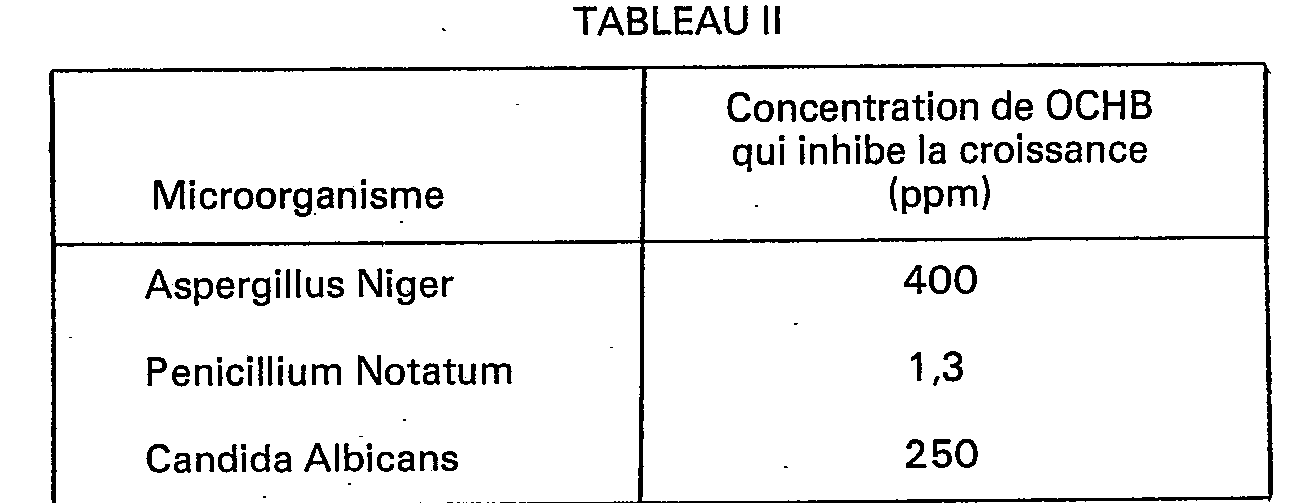
- Mesure de l'activité fongicide du OCHB.
- Ce produit est peu actif contre les moisissures et il est nécessaire d'en utiliser de grandes quantités. On inocule de l'extrait d'agar, on laisse à incubation pendant 4 ou 5 jours et on ajoute la concentration de OCHB qui empêche la croissance des germes. On obtient les résultats suivants. (Tableau II)
-
- Mesure de l'activité bactéricide d'un ammonium quaternaire, à savoir le chlorure de didécyl diméthyl ammonium (CDDA).
- On procède comme pour l'exemple 1 a et on obtient les résultats suivants (tableau III) au bout de 1 minute.

- Par conséquent on voit que la baisse en microorganismes est de 103 seulement, au bout de une minute.
- Mesure de l'activité bactéricide et fongicide d'une composition selon l'invention.
- On prépare la solution suivante:

- On détermine l'activité bactéricide in vivo d'une telle composition.
- On obtient le tableau IV qui rassemble les résultats suivants, après application de la solution pendant 1 min.

- Ainsi on a une diminution de 106 microorganismes en une minute.
- On voit donc d'une part que l'action de chlorure de didécyl diméthyl ammonium et d'autre part que l'action de l'oligomère sont renforcées. L'activité de la solution selon l'invention est beaucoup plus rapide et importante.
- On prépare la solution suivante:

- On utilise cette solution comme désinfectant pour le personnel des hôpitaux, les mains des chirurgiens, les surfaces diverses pouvant être contaminées, les appareil de rayons X, les instruments de chirurgie, etc....
- On prépare le mélange suivant:

- Cette composition, utilisée à 4% est un des plus puisants stérilisants pour les instruments de chirurgie.
- Le mélange suivant est préparé:

- On prépare une solution de lavage de plaies ou de la peau, ayant la composition ci-dessous:

- On mesure l'activité bactéricide de cette composition. On obtient les résultats suivants (tableau V):

- On prépare une laque à rémanence d'action ayant la composition suivante:

- On détermine l'activité bactéricide selon la méthode de Gashen. Un groupe de trois femmes et de trois hommes se lavent les mains avec du savon pendant une minute, puis ils se rincent celles-ci à l'eau et se les sèchent. Enfin, après 60 min. d'attente, on dénombre la flore sur chaque main. On applique la solution selon l'invention pendant une min. sur chaque main droite, la main gauche servant de référence. On obtient les résultats suivants (tableau VI):

- En outre l'activité du désinfectant reste apparemment aussi bonne après port du gant pendant une heure, puisque la population bactérienne reste au même niveau qu'après action du produit pendant une minute. La rémanence d'action est donc très bonne pour cette laque.
- La solution de laque suivante est préparée:

- Ce produit est utilisé pour arroser les surfaces contaminées (tel quel on dilué) et il détruit tous les microorganismes à la surface (bactéries gram+ et -, levures, spores, virus) et forme un léger film ayant une rémanence qui permet de détruire toutes les retombées de germes environnants. Il est utilisé tel quel pour la stérilisation à froid du circuit interne d'appareil d'hemodialyse (rein artificiel), pour la stérilisation à froid des instruments et du matériel de chirurgie, de médecine et d'examen interne (endoscope...). Il détruit à froid tous les microorganismes, bactéries ±, virus, spores, champignons. La présence de polymère polyvinyle pirrolidone permet de garder en suspension les souillures et empêche leur redéposition.
Claims (3)
Priority Applications (1)
| Application Number | Priority Date | Filing Date | Title |
|---|---|---|---|
| AT81400848T ATE10697T1 (de) | 1980-05-29 | 1981-05-27 | Eine quaternaere ammoniumverbindung und ein oligomer von hexamethylenbiguanidhydrochlorid enthaltende desinfizierende zusammensetzung. |
Applications Claiming Priority (2)
| Application Number | Priority Date | Filing Date | Title |
|---|---|---|---|
| FR8011892 | 1980-05-29 | ||
| FR8011892A FR2483177A1 (fr) | 1980-05-29 | 1980-05-29 | Nouvelle composition desinfectante comprenant un ammonium quaternaire et un oligomere de chlorhydrate d'hexamethylene biguanide |
Publications (2)
| Publication Number | Publication Date |
|---|---|
| EP0041448A1 EP0041448A1 (fr) | 1981-12-09 |
| EP0041448B1 true EP0041448B1 (fr) | 1984-12-12 |
Family
ID=9242449
Family Applications (1)
| Application Number | Title | Priority Date | Filing Date |
|---|---|---|---|
| EP81400848A Expired EP0041448B1 (fr) | 1980-05-29 | 1981-05-27 | Nouvelle composition désinfectante comprenant un ammonium quaternaire et un oligomère de chlorhydrate d'hexaméthylène biguanide |
Country Status (8)
| Country | Link |
|---|---|
| EP (1) | EP0041448B1 (fr) |
| JP (1) | JPS5746906A (fr) |
| AT (1) | ATE10697T1 (fr) |
| AU (1) | AU7098381A (fr) |
| CA (1) | CA1164338A (fr) |
| DE (1) | DE3167689D1 (fr) |
| FR (1) | FR2483177A1 (fr) |
| ZA (1) | ZA813565B (fr) |
Cited By (4)
| Publication number | Priority date | Publication date | Assignee | Title |
|---|---|---|---|---|
| US7759327B2 (en) | 2006-01-06 | 2010-07-20 | The Trustees Of Columbia University In The City Of New York | Compositions containing zinc salts for coating medical articles |
| US7871649B2 (en) | 2003-07-17 | 2011-01-18 | The Trustees Of Columbia University In The City Of New York | Antimicrobial compositions containing synergistic combinations of quaternary ammonium compounds and essential oils and/or constituents thereof |
| US7951840B2 (en) | 2002-02-07 | 2011-05-31 | Modak Shanta M | Zinc salt compositions for the prevention of dermal and mucosal irritation |
| US8293802B2 (en) | 2001-10-23 | 2012-10-23 | The Trustees Of Columbia University | Gentle-acting skin-disinfectants and hydroalcoholic gel formulations |
Families Citing this family (25)
| Publication number | Priority date | Publication date | Assignee | Title |
|---|---|---|---|---|
| GB2122900A (en) * | 1982-07-01 | 1984-01-25 | Surgikos Inc | Disinfectant compositions having residual biocidal activity and wipes and sprays containing them |
| FR2552305B1 (fr) * | 1983-09-22 | 1985-12-20 | Salkin Andre | Composition a pouvoir bactericide eleve contenant un biguanide et une pyrimidine |
| CA1259542A (fr) * | 1984-09-28 | 1989-09-19 | Francis X. Smith | Solutions pour la desinfection et la conservation des lentilles de contact et methode d'utilisation |
| DE3445901A1 (de) * | 1984-12-15 | 1986-06-19 | Henkel KGaA, 4000 Düsseldorf | Fluessige desinfektionsmittelzubereitungen mit breitbandwirkung |
| JPS61146882A (ja) * | 1984-12-17 | 1986-07-04 | Dynic Corp | 装飾用シ−ト |
| DE3542516A1 (de) * | 1985-12-02 | 1987-06-04 | Henkel Kgaa | Desinfektionsmittel |
| GB8625103D0 (en) * | 1986-10-20 | 1986-11-26 | Unilever Plc | Disinfectant compositions |
| EP0324211A1 (fr) * | 1988-01-12 | 1989-07-19 | Bosshardt-Chemie AG | L'utilisation des compositions pour désodoriser |
| FR2662174B1 (fr) * | 1990-05-15 | 1993-10-15 | Eparco | Compositions de nettoyage et de desinfection a usage menager a proprietes hypoallergeniques et a capacites aracides. |
| US5508250A (en) * | 1993-12-07 | 1996-04-16 | Bio-Lab, Inc. | Synergistic antimicrobial compositions containing poly(hexamethylammonium) chloride. |
| FR2718352B1 (fr) * | 1994-04-08 | 1996-06-14 | Nicolas Salkind | Composition bactéricide conditionnée dans un emballage hydrosoluble. |
| FR2759380B1 (fr) * | 1997-02-13 | 2002-08-02 | Anios Lab Sarl | Composition detergente et/ou desinfectante |
| GB2324467A (en) * | 1997-04-22 | 1998-10-28 | Rhone Poulenc Chemicals | Rapid and long-lasting biocidal system |
| US6303557B1 (en) | 1999-11-16 | 2001-10-16 | S. C. Johnson Commercial Markets, Inc. | Fast acting disinfectant and cleaner containing a polymeric biguanide |
| JP2001354505A (ja) * | 2000-04-13 | 2001-12-25 | Nissan Chem Ind Ltd | 防腐防カビ防藻剤 |
| JP2001354504A (ja) * | 2000-04-13 | 2001-12-25 | Nissan Chem Ind Ltd | 防腐防カビ防藻剤 |
| US7879365B2 (en) | 2002-02-07 | 2011-02-01 | The Trustees Of Columbia University In The City Of New York | Zinc salt compositions for the prevention of dermal and mucosal irritation |
| JP2006188451A (ja) * | 2005-01-05 | 2006-07-20 | Shoei Kagaku Kk | 防腐・防かび用一液水性製剤 |
| EP2359690A1 (fr) | 2010-02-23 | 2011-08-24 | East Coast Pharmaceutical Research LLC | Multiplication de l'efficacité des agents anti-infectieux par une composition comprenant conjointement un agent dispersant et un agent activateur métallique |
| WO2012080918A2 (fr) | 2010-12-14 | 2012-06-21 | Ecolab Usa Inc. | Compositions antimicrobiennes résistantes à l'usure et procédés d'utilisation |
| JP5837346B2 (ja) * | 2011-07-05 | 2015-12-24 | 攝津製油株式会社 | ウイルス不活化組成物 |
| RU2589835C1 (ru) * | 2015-04-29 | 2016-07-10 | Общество с ограниченной ответственностью "Международный институт эколого-технологических проблем" | Средство для дезинфекции |
| CN105839410A (zh) * | 2016-03-29 | 2016-08-10 | 腾科宝迪(厦门)生物科技有限公司 | 一种安全防护手术衣 |
| BR112018076823A2 (pt) * | 2016-06-24 | 2019-04-02 | Lonza Inc. | combinação sinergética de biocidas |
| CN111450001A (zh) * | 2020-04-14 | 2020-07-28 | 广东润洁日化有限公司 | 一种具有抑菌效果的护手霜及其制备方法 |
Family Cites Families (3)
| Publication number | Priority date | Publication date | Assignee | Title |
|---|---|---|---|---|
| DE2611957C2 (de) * | 1976-03-20 | 1985-06-13 | Henkel KGaA, 4000 Düsseldorf | Antimikrobielle Mittel |
| SE425043B (sv) * | 1977-05-10 | 1982-08-30 | Kenogard Ab | Fungicid komposition, foretredesvis for anvendning som treskyddsmedel, innehallande minst en kvarter ammoniumforening i blandning med en aminkomponent |
| IE47368B1 (en) * | 1977-09-27 | 1984-03-07 | Exterma Germ Prod | Impreganted substrate |
-
1980
- 1980-05-29 FR FR8011892A patent/FR2483177A1/fr not_active Withdrawn
-
1981
- 1981-05-25 AU AU70983/81A patent/AU7098381A/en not_active Abandoned
- 1981-05-27 DE DE8181400848T patent/DE3167689D1/de not_active Expired
- 1981-05-27 EP EP81400848A patent/EP0041448B1/fr not_active Expired
- 1981-05-27 ZA ZA00813565A patent/ZA813565B/xx unknown
- 1981-05-27 AT AT81400848T patent/ATE10697T1/de active
- 1981-05-28 CA CA000378586A patent/CA1164338A/fr not_active Expired
- 1981-05-29 JP JP56081189A patent/JPS5746906A/ja active Pending
Cited By (8)
| Publication number | Priority date | Publication date | Assignee | Title |
|---|---|---|---|---|
| US8293802B2 (en) | 2001-10-23 | 2012-10-23 | The Trustees Of Columbia University | Gentle-acting skin-disinfectants and hydroalcoholic gel formulations |
| US8436050B2 (en) | 2001-10-23 | 2013-05-07 | The Trustees Of Columbia University In The City Of New York | Gentle-acting skin-disinfectants and hydroalcoholic gel formulations |
| US7951840B2 (en) | 2002-02-07 | 2011-05-31 | Modak Shanta M | Zinc salt compositions for the prevention of dermal and mucosal irritation |
| USRE45435E1 (en) | 2002-02-07 | 2015-03-24 | The Trustees Of Columbia University In The City Of New York | Zinc salt compositions for the prevention of dermal and mucosal irritation |
| US7871649B2 (en) | 2003-07-17 | 2011-01-18 | The Trustees Of Columbia University In The City Of New York | Antimicrobial compositions containing synergistic combinations of quaternary ammonium compounds and essential oils and/or constituents thereof |
| US9421263B2 (en) | 2003-07-17 | 2016-08-23 | The Trustees Of Columbia University In The City Of New York | Antimicrobial compositions containing synergistic combinations of quaternary ammonium compounds and essential oils and/or constituents thereof |
| US7759327B2 (en) | 2006-01-06 | 2010-07-20 | The Trustees Of Columbia University In The City Of New York | Compositions containing zinc salts for coating medical articles |
| US8207148B2 (en) | 2006-01-06 | 2012-06-26 | The Trustees Of Columbia University In The City Of New York | Compositions containing zinc salts for coating medical articles |
Also Published As
| Publication number | Publication date |
|---|---|
| ZA813565B (en) | 1982-06-30 |
| CA1164338A (fr) | 1984-03-27 |
| FR2483177A1 (fr) | 1981-12-04 |
| ATE10697T1 (de) | 1984-12-15 |
| AU7098381A (en) | 1981-12-03 |
| EP0041448A1 (fr) | 1981-12-09 |
| JPS5746906A (en) | 1982-03-17 |
| DE3167689D1 (en) | 1985-01-24 |
Similar Documents
| Publication | Publication Date | Title |
|---|---|---|
| EP0041448B1 (fr) | Nouvelle composition désinfectante comprenant un ammonium quaternaire et un oligomère de chlorhydrate d'hexaméthylène biguanide | |
| US6908628B2 (en) | Disinfectant and antiseptic composition | |
| Pitten et al. | Efficacy of cetylpyridinium chloride used as oropharyngeal antiseptic | |
| US6723689B1 (en) | Emollient alcohol skin disinfecting formulation | |
| AU2002322916B2 (en) | A wide spectrum disinfectant | |
| EP0136231B1 (fr) | Composition à pouvoir bactéricide élevé contenant un biguanide et une pyrimidine | |
| Meiller et al. | In vitro studies of the efficacy of antimicrobials against fungi | |
| US5322856A (en) | Fortified glutaraldehyde chemical sterilant/disinfectant | |
| CA2107996A1 (fr) | Alcool perillique biocide qui agit contre les bacteries et les levures | |
| EP4384156A1 (fr) | Compositions à concentration élevée d'iode moléculaire, formulations pharmaceutiques, préparation et utilisations | |
| EP0264658A1 (fr) | Composition stérilisante liquide | |
| EP0555116B1 (fr) | Compositions à base d'antiseptiques et leurs applications | |
| JP2002516259A (ja) | 消毒薬組成物 | |
| WO2013104849A1 (fr) | Utilisation de squalamine ou analogue comme agent desinfectant | |
| US6462088B1 (en) | Disinfecting preparation containing chlorine in alcohol | |
| US20040047829A1 (en) | Fluids for sanitizing the teats of dairy animals | |
| FR2696903A1 (fr) | Composition germicide et savon la contenant. | |
| EP0463202B1 (fr) | Composition et méthode pour la stérilisation des pathogènes en présence de l'eau | |
| CN119678946B (zh) | 采用saew协同百里酚的抗菌消毒方法及其产品 | |
| SK160995A3 (en) | Cleaning and disinfecting agent | |
| CN118574601A (zh) | 组合物 | |
| US7094430B2 (en) | Antimicrobial solution for both tropical and oral use | |
| EP4583854A1 (fr) | Compositions antimicrobiennes | |
| JPH04275202A (ja) | 非毒性酵素的滅菌剤 | |
| FR2978050A1 (fr) | Composition nettoyante et/ou desinfectante |
Legal Events
| Date | Code | Title | Description |
|---|---|---|---|
| PUAI | Public reference made under article 153(3) epc to a published international application that has entered the european phase |
Free format text: ORIGINAL CODE: 0009012 |
|
| AK | Designated contracting states |
Designated state(s): AT BE CH DE FR GB IT LU NL SE |
|
| 17P | Request for examination filed |
Effective date: 19820609 |
|
| ITF | It: translation for a ep patent filed | ||
| GRAA | (expected) grant |
Free format text: ORIGINAL CODE: 0009210 |
|
| AK | Designated contracting states |
Designated state(s): AT BE CH DE FR GB IT LI LU NL SE |
|
| REF | Corresponds to: |
Ref document number: 10697 Country of ref document: AT Date of ref document: 19841215 Kind code of ref document: T |
|
| REF | Corresponds to: |
Ref document number: 3167689 Country of ref document: DE Date of ref document: 19850124 |
|
| PG25 | Lapsed in a contracting state [announced via postgrant information from national office to epo] |
Ref country code: AT Effective date: 19850527 |
|
| PG25 | Lapsed in a contracting state [announced via postgrant information from national office to epo] |
Ref country code: SE Effective date: 19850528 |
|
| PG25 | Lapsed in a contracting state [announced via postgrant information from national office to epo] |
Ref country code: LU Free format text: LAPSE BECAUSE OF NON-PAYMENT OF DUE FEES Effective date: 19850531 Ref country code: LI Effective date: 19850531 Ref country code: CH Effective date: 19850531 Ref country code: BE Effective date: 19850531 |
|
| PLBE | No opposition filed within time limit |
Free format text: ORIGINAL CODE: 0009261 |
|
| STAA | Information on the status of an ep patent application or granted ep patent |
Free format text: STATUS: NO OPPOSITION FILED WITHIN TIME LIMIT |
|
| BERE | Be: lapsed |
Owner name: SALKIN NICOLAS Effective date: 19850527 |
|
| PG25 | Lapsed in a contracting state [announced via postgrant information from national office to epo] |
Ref country code: NL Effective date: 19851201 |
|
| 26N | No opposition filed | ||
| GBPC | Gb: european patent ceased through non-payment of renewal fee | ||
| NLV4 | Nl: lapsed or anulled due to non-payment of the annual fee | ||
| PG25 | Lapsed in a contracting state [announced via postgrant information from national office to epo] |
Ref country code: FR Free format text: LAPSE BECAUSE OF NON-PAYMENT OF DUE FEES Effective date: 19860131 |
|
| REG | Reference to a national code |
Ref country code: CH Ref legal event code: PL |
|
| PG25 | Lapsed in a contracting state [announced via postgrant information from national office to epo] |
Ref country code: DE Effective date: 19860201 |
|
| REG | Reference to a national code |
Ref country code: FR Ref legal event code: ST |
|
| PG25 | Lapsed in a contracting state [announced via postgrant information from national office to epo] |
Ref country code: GB Effective date: 19881118 |
|
| EUG | Se: european patent has lapsed |
Ref document number: 81400848.8 Effective date: 19860702 |