EP0041661A2 - Neues Verfahren zur Herstellung von Carbacyclin-Zwischenprodukten - Google Patents
Neues Verfahren zur Herstellung von Carbacyclin-Zwischenprodukten Download PDFInfo
- Publication number
- EP0041661A2 EP0041661A2 EP81104119A EP81104119A EP0041661A2 EP 0041661 A2 EP0041661 A2 EP 0041661A2 EP 81104119 A EP81104119 A EP 81104119A EP 81104119 A EP81104119 A EP 81104119A EP 0041661 A2 EP0041661 A2 EP 0041661A2
- Authority
- EP
- European Patent Office
- Prior art keywords
- atoms
- radical
- mit
- alkyl
- einen
- Prior art date
- Legal status (The legal status is an assumption and is not a legal conclusion. Google has not performed a legal analysis and makes no representation as to the accuracy of the status listed.)
- Granted
Links
- 238000002360 preparation method Methods 0.000 title claims abstract description 6
- 239000000543 intermediate Substances 0.000 title description 5
- 125000004432 carbon atom Chemical group C* 0.000 claims abstract description 25
- 125000000217 alkyl group Chemical group 0.000 claims abstract description 17
- 238000000034 method Methods 0.000 claims abstract description 12
- 230000003647 oxidation Effects 0.000 claims abstract description 9
- 238000007254 oxidation reaction Methods 0.000 claims abstract description 9
- 125000001997 phenyl group Chemical group [H]C1=C([H])C([H])=C(*)C([H])=C1[H] 0.000 claims abstract description 8
- 125000003118 aryl group Chemical group 0.000 claims abstract description 7
- 239000003638 chemical reducing agent Substances 0.000 claims abstract description 6
- BCYYDADOMABBOV-UHFFFAOYSA-N 2-(5-hydroxy-3,3a,4,5,6,6a-hexahydrocyclopenta[b]furan-2-ylidene)acetic acid Chemical compound C1C(=CC(O)=O)OC2CC(O)CC21 BCYYDADOMABBOV-UHFFFAOYSA-N 0.000 claims abstract description 4
- 125000004435 hydrogen atom Chemical group [H]* 0.000 claims abstract description 4
- XYBUZIDDHXJIIX-UHFFFAOYSA-N 5-hydroxy-2-oxo-3,3a,4,5,6,6a-hexahydro-1H-pentalene-1-carboxylic acid Chemical class C1C(=O)C(C(O)=O)C2CC(O)CC21 XYBUZIDDHXJIIX-UHFFFAOYSA-N 0.000 claims abstract description 3
- 125000003718 tetrahydrofuranyl group Chemical group 0.000 claims abstract description 3
- 125000001412 tetrahydropyranyl group Chemical group 0.000 claims abstract description 3
- 150000001875 compounds Chemical class 0.000 claims description 14
- SGUVLZREKBPKCE-UHFFFAOYSA-N 1,5-diazabicyclo[4.3.0]-non-5-ene Chemical compound C1CCN=C2CCCN21 SGUVLZREKBPKCE-UHFFFAOYSA-N 0.000 claims description 6
- JABYJIQOLGWMQW-UHFFFAOYSA-N undec-4-ene Chemical compound CCCCCCC=CCCC JABYJIQOLGWMQW-UHFFFAOYSA-N 0.000 claims 2
- -1 Tetrahydropyranyl- Chemical group 0.000 abstract description 21
- FZNCGRZWXLXZSZ-CIQUZCHMSA-N Voglibose Chemical compound OCC(CO)N[C@H]1C[C@](O)(CO)[C@@H](O)[C@H](O)[C@H]1O FZNCGRZWXLXZSZ-CIQUZCHMSA-N 0.000 abstract description 2
- RTZKZFJDLAIYFH-UHFFFAOYSA-N ether Substances CCOCC RTZKZFJDLAIYFH-UHFFFAOYSA-N 0.000 description 42
- YXFVVABEGXRONW-UHFFFAOYSA-N Toluene Chemical compound CC1=CC=CC=C1 YXFVVABEGXRONW-UHFFFAOYSA-N 0.000 description 24
- YMWUJEATGCHHMB-UHFFFAOYSA-N Dichloromethane Chemical compound ClCCl YMWUJEATGCHHMB-UHFFFAOYSA-N 0.000 description 21
- VLKZOEOYAKHREP-UHFFFAOYSA-N n-Hexane Chemical compound CCCCCC VLKZOEOYAKHREP-UHFFFAOYSA-N 0.000 description 21
- OKKJLVBELUTLKV-UHFFFAOYSA-N Methanol Chemical compound OC OKKJLVBELUTLKV-UHFFFAOYSA-N 0.000 description 18
- 239000000243 solution Substances 0.000 description 16
- WYURNTSHIVDZCO-UHFFFAOYSA-N Tetrahydrofuran Chemical compound C1CCOC1 WYURNTSHIVDZCO-UHFFFAOYSA-N 0.000 description 14
- 239000000203 mixture Substances 0.000 description 13
- XLYOFNOQVPJJNP-UHFFFAOYSA-N water Substances O XLYOFNOQVPJJNP-UHFFFAOYSA-N 0.000 description 13
- XEKOWRVHYACXOJ-UHFFFAOYSA-N Ethyl acetate Chemical compound CCOC(C)=O XEKOWRVHYACXOJ-UHFFFAOYSA-N 0.000 description 12
- XKRFYHLGVUSROY-UHFFFAOYSA-N Argon Chemical compound [Ar] XKRFYHLGVUSROY-UHFFFAOYSA-N 0.000 description 10
- CSNNHWWHGAXBCP-UHFFFAOYSA-L Magnesium sulfate Chemical compound [Mg+2].[O-][S+2]([O-])([O-])[O-] CSNNHWWHGAXBCP-UHFFFAOYSA-L 0.000 description 10
- QAOWNCQODCNURD-UHFFFAOYSA-N Sulfuric acid Chemical compound OS(O)(=O)=O QAOWNCQODCNURD-UHFFFAOYSA-N 0.000 description 10
- KRKNYBCHXYNGOX-UHFFFAOYSA-N citric acid Chemical compound OC(=O)CC(O)(C(O)=O)CC(O)=O KRKNYBCHXYNGOX-UHFFFAOYSA-N 0.000 description 9
- XZFRIPGNUQRGPI-WLPVIMDJSA-N Carbacyclin Chemical compound C1\C(=C\CCCC(O)=O)C[C@@H]2[C@@H](/C=C/[C@@H](O)CCCCC)[C@H](O)C[C@@H]21 XZFRIPGNUQRGPI-WLPVIMDJSA-N 0.000 description 7
- LFQSCWFLJHTTHZ-UHFFFAOYSA-N Ethanol Chemical compound CCO LFQSCWFLJHTTHZ-UHFFFAOYSA-N 0.000 description 7
- GQHTUMJGOHRCHB-UHFFFAOYSA-N 2,3,4,6,7,8,9,10-octahydropyrimido[1,2-a]azepine Chemical compound C1CCCCN2CCCN=C21 GQHTUMJGOHRCHB-UHFFFAOYSA-N 0.000 description 6
- ZMXDDKWLCZADIW-UHFFFAOYSA-N N,N-Dimethylformamide Chemical compound CN(C)C=O ZMXDDKWLCZADIW-UHFFFAOYSA-N 0.000 description 6
- UAOMVDZJSHZZME-UHFFFAOYSA-N diisopropylamine Chemical compound CC(C)NC(C)C UAOMVDZJSHZZME-UHFFFAOYSA-N 0.000 description 6
- 230000007935 neutral effect Effects 0.000 description 6
- 239000002904 solvent Substances 0.000 description 6
- YLQBMQCUIZJEEH-UHFFFAOYSA-N tetrahydrofuran Natural products C=1C=COC=1 YLQBMQCUIZJEEH-UHFFFAOYSA-N 0.000 description 6
- JOXIMZWYDAKGHI-UHFFFAOYSA-N toluene-4-sulfonic acid Chemical compound CC1=CC=C(S(O)(=O)=O)C=C1 JOXIMZWYDAKGHI-UHFFFAOYSA-N 0.000 description 6
- VYPSYNLAJGMNEJ-UHFFFAOYSA-N Silicium dioxide Chemical compound O=[Si]=O VYPSYNLAJGMNEJ-UHFFFAOYSA-N 0.000 description 5
- 229910052786 argon Inorganic materials 0.000 description 5
- 238000006243 chemical reaction Methods 0.000 description 5
- 238000004587 chromatography analysis Methods 0.000 description 5
- 229910052943 magnesium sulfate Inorganic materials 0.000 description 5
- 235000019341 magnesium sulphate Nutrition 0.000 description 5
- 239000000741 silica gel Substances 0.000 description 5
- 229910002027 silica gel Inorganic materials 0.000 description 5
- CSCPPACGZOOCGX-UHFFFAOYSA-N Acetone Chemical compound CC(C)=O CSCPPACGZOOCGX-UHFFFAOYSA-N 0.000 description 4
- HEDRZPFGACZZDS-UHFFFAOYSA-N Chloroform Chemical compound ClC(Cl)Cl HEDRZPFGACZZDS-UHFFFAOYSA-N 0.000 description 4
- 239000012027 Collins reagent Substances 0.000 description 4
- MZRVEZGGRBJDDB-UHFFFAOYSA-N N-Butyllithium Chemical compound [Li]CCCC MZRVEZGGRBJDDB-UHFFFAOYSA-N 0.000 description 4
- UIIMBOGNXHQVGW-UHFFFAOYSA-M Sodium bicarbonate Chemical compound [Na+].OC([O-])=O UIIMBOGNXHQVGW-UHFFFAOYSA-M 0.000 description 4
- 239000002585 base Substances 0.000 description 4
- 239000013078 crystal Substances 0.000 description 4
- 125000001495 ethyl group Chemical group [H]C([H])([H])C([H])([H])* 0.000 description 4
- BWHMMNNQKKPAPP-UHFFFAOYSA-L potassium carbonate Chemical compound [K+].[K+].[O-]C([O-])=O BWHMMNNQKKPAPP-UHFFFAOYSA-L 0.000 description 4
- NPRDHMWYZHSAHR-UHFFFAOYSA-N pyridine;trioxochromium Chemical compound O=[Cr](=O)=O.C1=CC=NC=C1.C1=CC=NC=C1 NPRDHMWYZHSAHR-UHFFFAOYSA-N 0.000 description 4
- LEHBURLTIWGHEM-UHFFFAOYSA-N pyridinium chlorochromate Chemical compound [O-][Cr](Cl)(=O)=O.C1=CC=[NH+]C=C1 LEHBURLTIWGHEM-UHFFFAOYSA-N 0.000 description 4
- 239000012279 sodium borohydride Substances 0.000 description 4
- 229910000033 sodium borohydride Inorganic materials 0.000 description 4
- WFDIJRYMOXRFFG-UHFFFAOYSA-N Acetic anhydride Chemical compound CC(=O)OC(C)=O WFDIJRYMOXRFFG-UHFFFAOYSA-N 0.000 description 3
- PMZURENOXWZQFD-UHFFFAOYSA-L Sodium Sulfate Chemical compound [Na+].[Na+].[O-]S([O-])(=O)=O PMZURENOXWZQFD-UHFFFAOYSA-L 0.000 description 3
- 239000012230 colorless oil Substances 0.000 description 3
- RAXXELZNTBOGNW-UHFFFAOYSA-N imidazole Natural products C1=CNC=N1 RAXXELZNTBOGNW-UHFFFAOYSA-N 0.000 description 3
- 125000000959 isobutyl group Chemical group [H]C([H])([H])C([H])(C([H])([H])[H])C([H])([H])* 0.000 description 3
- 125000001449 isopropyl group Chemical group [H]C([H])([H])C([H])(*)C([H])([H])[H] 0.000 description 3
- 150000002576 ketones Chemical class 0.000 description 3
- 150000002596 lactones Chemical group 0.000 description 3
- 125000002496 methyl group Chemical group [H]C([H])([H])* 0.000 description 3
- 239000012074 organic phase Substances 0.000 description 3
- 125000002914 sec-butyl group Chemical group [H]C([H])([H])C([H])([H])C([H])(*)C([H])([H])[H] 0.000 description 3
- 229910052938 sodium sulfate Inorganic materials 0.000 description 3
- 235000011152 sodium sulphate Nutrition 0.000 description 3
- 239000007858 starting material Substances 0.000 description 3
- 125000000999 tert-butyl group Chemical group [H]C([H])([H])C(*)(C([H])([H])[H])C([H])([H])[H] 0.000 description 3
- RYHBNJHYFVUHQT-UHFFFAOYSA-N 1,4-Dioxane Chemical compound C1COCCO1 RYHBNJHYFVUHQT-UHFFFAOYSA-N 0.000 description 2
- ZPVFWPFBNIEHGJ-UHFFFAOYSA-N 2-octanone Chemical compound CCCCCCC(C)=O ZPVFWPFBNIEHGJ-UHFFFAOYSA-N 0.000 description 2
- QTBSBXVTEAMEQO-UHFFFAOYSA-N Acetic acid Chemical compound CC(O)=O QTBSBXVTEAMEQO-UHFFFAOYSA-N 0.000 description 2
- NLXLAEXVIDQMFP-UHFFFAOYSA-N Ammonia chloride Chemical class [NH4+].[Cl-] NLXLAEXVIDQMFP-UHFFFAOYSA-N 0.000 description 2
- VTYYLEPIZMXCLO-UHFFFAOYSA-L Calcium carbonate Chemical compound [Ca+2].[O-]C([O-])=O VTYYLEPIZMXCLO-UHFFFAOYSA-L 0.000 description 2
- VEXZGXHMUGYJMC-UHFFFAOYSA-N Hydrochloric acid Chemical compound Cl VEXZGXHMUGYJMC-UHFFFAOYSA-N 0.000 description 2
- KFZMGEQAYNKOFK-UHFFFAOYSA-N Isopropanol Chemical compound CC(C)O KFZMGEQAYNKOFK-UHFFFAOYSA-N 0.000 description 2
- 239000003810 Jones reagent Substances 0.000 description 2
- LRHPLDYGYMQRHN-UHFFFAOYSA-N N-Butanol Chemical compound CCCCO LRHPLDYGYMQRHN-UHFFFAOYSA-N 0.000 description 2
- OFBQJSOFQDEBGM-UHFFFAOYSA-N Pentane Chemical compound CCCCC OFBQJSOFQDEBGM-UHFFFAOYSA-N 0.000 description 2
- JUJWROOIHBZHMG-UHFFFAOYSA-N Pyridine Chemical compound C1=CC=NC=C1 JUJWROOIHBZHMG-UHFFFAOYSA-N 0.000 description 2
- CDBYLPFSWZWCQE-UHFFFAOYSA-L Sodium Carbonate Chemical compound [Na+].[Na+].[O-]C([O-])=O CDBYLPFSWZWCQE-UHFFFAOYSA-L 0.000 description 2
- 239000002253 acid Substances 0.000 description 2
- PASDCCFISLVPSO-UHFFFAOYSA-N benzoyl chloride Chemical compound ClC(=O)C1=CC=CC=C1 PASDCCFISLVPSO-UHFFFAOYSA-N 0.000 description 2
- 230000015572 biosynthetic process Effects 0.000 description 2
- WTEOIRVLGSZEPR-UHFFFAOYSA-N boron trifluoride Chemical compound FB(F)F WTEOIRVLGSZEPR-UHFFFAOYSA-N 0.000 description 2
- 239000012267 brine Substances 0.000 description 2
- 229940043279 diisopropylamine Drugs 0.000 description 2
- ASTFGLACBQPHBB-TVFCKZIOSA-N ethyl 2-[(3ar,4s,5r,6as)-5-hydroxy-4-(phenylmethoxymethyl)-3,3a,4,5,6,6a-hexahydrocyclopenta[b]furan-2-ylidene]acetate Chemical compound C([C@H]1[C@H](O)C[C@H]2[C@@H]1CC(O2)=CC(=O)OCC)OCC1=CC=CC=C1 ASTFGLACBQPHBB-TVFCKZIOSA-N 0.000 description 2
- RCBVKBFIWMOMHF-UHFFFAOYSA-L hydroxy-(hydroxy(dioxo)chromio)oxy-dioxochromium;pyridine Chemical compound C1=CC=NC=C1.C1=CC=NC=C1.O[Cr](=O)(=O)O[Cr](O)(=O)=O RCBVKBFIWMOMHF-UHFFFAOYSA-L 0.000 description 2
- 125000004108 n-butyl group Chemical group [H]C([H])([H])C([H])([H])C([H])([H])C([H])([H])* 0.000 description 2
- 125000004123 n-propyl group Chemical group [H]C([H])([H])C([H])([H])C([H])([H])* 0.000 description 2
- 238000010653 organometallic reaction Methods 0.000 description 2
- 239000007800 oxidant agent Substances 0.000 description 2
- 229910000027 potassium carbonate Inorganic materials 0.000 description 2
- 239000011541 reaction mixture Substances 0.000 description 2
- 238000007363 ring formation reaction Methods 0.000 description 2
- 229910000030 sodium bicarbonate Inorganic materials 0.000 description 2
- 235000017557 sodium bicarbonate Nutrition 0.000 description 2
- MFRIHAYPQRLWNB-UHFFFAOYSA-N sodium tert-butoxide Chemical compound [Na+].CC(C)(C)[O-] MFRIHAYPQRLWNB-UHFFFAOYSA-N 0.000 description 2
- HPALAKNZSZLMCH-UHFFFAOYSA-M sodium;chloride;hydrate Chemical compound O.[Na+].[Cl-] HPALAKNZSZLMCH-UHFFFAOYSA-M 0.000 description 2
- 238000003756 stirring Methods 0.000 description 2
- 238000003786 synthesis reaction Methods 0.000 description 2
- VZGDMQKNWNREIO-UHFFFAOYSA-N tetrachloromethane Chemical compound ClC(Cl)(Cl)Cl VZGDMQKNWNREIO-UHFFFAOYSA-N 0.000 description 2
- 0 *[C@](C1)[C@](*)[C@](C2)C1*C2=* Chemical compound *[C@](C1)[C@](*)[C@](C2)C1*C2=* 0.000 description 1
- FTTATHOUSOIFOQ-UHFFFAOYSA-N 1,2,3,4,6,7,8,8a-octahydropyrrolo[1,2-a]pyrazine Chemical compound C1NCCN2CCCC21 FTTATHOUSOIFOQ-UHFFFAOYSA-N 0.000 description 1
- 125000003890 2-phenylbutyl group Chemical group [H]C1=C([H])C([H])=C(C([H])=C1[H])C([H])(C([H])([H])*)C([H])([H])C([H])([H])[H] 0.000 description 1
- 125000000094 2-phenylethyl group Chemical group [H]C1=C([H])C([H])=C(C([H])=C1[H])C([H])([H])C([H])([H])* 0.000 description 1
- 125000006201 3-phenylpropyl group Chemical group [H]C1=C([H])C([H])=C(C([H])=C1[H])C([H])([H])C([H])([H])C([H])([H])* 0.000 description 1
- 229910015900 BF3 Inorganic materials 0.000 description 1
- WKBOTKDWSSQWDR-UHFFFAOYSA-N Bromine atom Chemical group [Br] WKBOTKDWSSQWDR-UHFFFAOYSA-N 0.000 description 1
- XTHFKEDIFFGKHM-UHFFFAOYSA-N Dimethoxyethane Chemical compound COCCOC XTHFKEDIFFGKHM-UHFFFAOYSA-N 0.000 description 1
- VGGSQFUCUMXWEO-UHFFFAOYSA-N Ethene Chemical compound C=C VGGSQFUCUMXWEO-UHFFFAOYSA-N 0.000 description 1
- 239000005977 Ethylene Substances 0.000 description 1
- FYYHWMGAXLPEAU-UHFFFAOYSA-N Magnesium Chemical compound [Mg] FYYHWMGAXLPEAU-UHFFFAOYSA-N 0.000 description 1
- HCHKCACWOHOZIP-UHFFFAOYSA-N Zinc Chemical compound [Zn] HCHKCACWOHOZIP-UHFFFAOYSA-N 0.000 description 1
- IFCJCYGBDIDFBS-SPWCGHHHSA-N [(1s,2r,3ar,6as)-1-(hydroxymethyl)-5-oxo-2,3,3a,4,6,6a-hexahydro-1h-pentalen-2-yl] benzoate Chemical compound O([C@H]1[C@@H]([C@H]2CC(=O)C[C@H]2C1)CO)C(=O)C1=CC=CC=C1 IFCJCYGBDIDFBS-SPWCGHHHSA-N 0.000 description 1
- OBRRYUZUDKVCOO-FVCCEPFGSA-N [(3ar,4s,5r,6as)-4-(hydroxymethyl)-2-oxo-3,3a,4,5,6,6a-hexahydrocyclopenta[b]furan-5-yl] benzoate Chemical compound O([C@H]1[C@@H]([C@H]2CC(=O)O[C@H]2C1)CO)C(=O)C1=CC=CC=C1 OBRRYUZUDKVCOO-FVCCEPFGSA-N 0.000 description 1
- QQGWBRJQPRTJDA-UHFFFAOYSA-N [Li].CC(O)=O Chemical compound [Li].CC(O)=O QQGWBRJQPRTJDA-UHFFFAOYSA-N 0.000 description 1
- 229960000583 acetic acid Drugs 0.000 description 1
- 150000007513 acids Chemical class 0.000 description 1
- 125000002252 acyl group Chemical group 0.000 description 1
- 150000001298 alcohols Chemical class 0.000 description 1
- 239000003513 alkali Substances 0.000 description 1
- 229910052783 alkali metal Inorganic materials 0.000 description 1
- 150000001340 alkali metals Chemical class 0.000 description 1
- 229910052784 alkaline earth metal Inorganic materials 0.000 description 1
- 125000003545 alkoxy group Chemical group 0.000 description 1
- SMZOGRDCAXLAAR-UHFFFAOYSA-N aluminium isopropoxide Chemical compound [Al+3].CC(C)[O-].CC(C)[O-].CC(C)[O-] SMZOGRDCAXLAAR-UHFFFAOYSA-N 0.000 description 1
- 125000003710 aryl alkyl group Chemical group 0.000 description 1
- AYJRCSIUFZENHW-DEQYMQKBSA-L barium(2+);oxomethanediolate Chemical compound [Ba+2].[O-][14C]([O-])=O AYJRCSIUFZENHW-DEQYMQKBSA-L 0.000 description 1
- GDTBXPJZTBHREO-UHFFFAOYSA-N bromine Chemical group BrBr GDTBXPJZTBHREO-UHFFFAOYSA-N 0.000 description 1
- 229910052794 bromium Inorganic materials 0.000 description 1
- 229910000019 calcium carbonate Inorganic materials 0.000 description 1
- 150000004649 carbonic acid derivatives Chemical class 0.000 description 1
- 230000003197 catalytic effect Effects 0.000 description 1
- 239000003153 chemical reaction reagent Substances 0.000 description 1
- 239000000460 chlorine Substances 0.000 description 1
- 229910052801 chlorine Inorganic materials 0.000 description 1
- 125000001309 chloro group Chemical group Cl* 0.000 description 1
- 238000004140 cleaning Methods 0.000 description 1
- 239000012043 crude product Substances 0.000 description 1
- 238000006114 decarboxylation reaction Methods 0.000 description 1
- KPUWHANPEXNPJT-UHFFFAOYSA-N disiloxane Chemical compound [SiH3]O[SiH3] KPUWHANPEXNPJT-UHFFFAOYSA-N 0.000 description 1
- KAQKFAOMNZTLHT-VVUHWYTRSA-N epoprostenol Chemical compound O1C(=CCCCC(O)=O)C[C@@H]2[C@@H](/C=C/[C@@H](O)CCCCC)[C@H](O)C[C@@H]21 KAQKFAOMNZTLHT-VVUHWYTRSA-N 0.000 description 1
- 229960001123 epoprostenol Drugs 0.000 description 1
- 230000032050 esterification Effects 0.000 description 1
- 238000005886 esterification reaction Methods 0.000 description 1
- 150000002168 ethanoic acid esters Chemical class 0.000 description 1
- CNZQYCPCLJFCFH-ULZXXIEVSA-N ethyl 2-[(3aR,4S,5R,6aS)-4-(1-dimethylsilyloxy-2,2-dimethylpropyl)-5-hydroxy-3,3a,4,5,6,6a-hexahydrocyclopenta[b]furan-2-ylidene]acetate Chemical compound C(C)OC(C=C1O[C@H]2C[C@H]([C@H]([C@H]2C1)C(O[SiH](C)C)C(C)(C)C)O)=O CNZQYCPCLJFCFH-ULZXXIEVSA-N 0.000 description 1
- 238000001704 evaporation Methods 0.000 description 1
- 230000008020 evaporation Effects 0.000 description 1
- 239000012362 glacial acetic acid Substances 0.000 description 1
- 238000005984 hydrogenation reaction Methods 0.000 description 1
- 125000002887 hydroxy group Chemical group [H]O* 0.000 description 1
- 239000012535 impurity Substances 0.000 description 1
- 239000012442 inert solvent Substances 0.000 description 1
- 238000011835 investigation Methods 0.000 description 1
- 125000004491 isohexyl group Chemical group C(CCC(C)C)* 0.000 description 1
- 125000001972 isopentyl group Chemical group [H]C([H])([H])C([H])(C([H])([H])[H])C([H])([H])C([H])([H])* 0.000 description 1
- 125000000468 ketone group Chemical group 0.000 description 1
- HTBVGZAVHBZXMS-UHFFFAOYSA-N lithium;tris[(2-methylpropan-2-yl)oxy]alumane Chemical compound [Li].[Al+3].CC(C)(C)[O-].CC(C)(C)[O-].CC(C)(C)[O-] HTBVGZAVHBZXMS-UHFFFAOYSA-N 0.000 description 1
- 229910052749 magnesium Inorganic materials 0.000 description 1
- 239000011777 magnesium Substances 0.000 description 1
- 230000008018 melting Effects 0.000 description 1
- 238000002844 melting Methods 0.000 description 1
- KXKVLQRXCPHEJC-UHFFFAOYSA-N methyl acetate Chemical group COC(C)=O KXKVLQRXCPHEJC-UHFFFAOYSA-N 0.000 description 1
- 125000001570 methylene group Chemical group [H]C([H])([*:1])[*:2] 0.000 description 1
- 125000001280 n-hexyl group Chemical group C(CCCCC)* 0.000 description 1
- TVMXDCGIABBOFY-UHFFFAOYSA-N octane Chemical compound CCCCCCCC TVMXDCGIABBOFY-UHFFFAOYSA-N 0.000 description 1
- 125000004344 phenylpropyl group Chemical group 0.000 description 1
- LPNYRYFBWFDTMA-UHFFFAOYSA-N potassium tert-butoxide Chemical compound [K+].CC(C)(C)[O-] LPNYRYFBWFDTMA-UHFFFAOYSA-N 0.000 description 1
- 239000002243 precursor Substances 0.000 description 1
- BDERNNFJNOPAEC-UHFFFAOYSA-N propan-1-ol Chemical compound CCCO BDERNNFJNOPAEC-UHFFFAOYSA-N 0.000 description 1
- 150000003815 prostacyclins Chemical class 0.000 description 1
- 125000006239 protecting group Chemical group 0.000 description 1
- 238000000746 purification Methods 0.000 description 1
- UMJSCPRVCHMLSP-UHFFFAOYSA-N pyridine Natural products COC1=CC=CN=C1 UMJSCPRVCHMLSP-UHFFFAOYSA-N 0.000 description 1
- 238000007127 saponification reaction Methods 0.000 description 1
- 229920006395 saturated elastomer Polymers 0.000 description 1
- 239000002002 slurry Substances 0.000 description 1
- 229910000029 sodium carbonate Inorganic materials 0.000 description 1
- 239000000126 substance Substances 0.000 description 1
- BCNZYOJHNLTNEZ-UHFFFAOYSA-N tert-butyldimethylsilyl chloride Chemical compound CC(C)(C)[Si](C)(C)Cl BCNZYOJHNLTNEZ-UHFFFAOYSA-N 0.000 description 1
- 150000003512 tertiary amines Chemical class 0.000 description 1
- 125000004665 trialkylsilyl group Chemical group 0.000 description 1
- IMNIMPAHZVJRPE-UHFFFAOYSA-N triethylenediamine Chemical compound C1CN2CCN1CC2 IMNIMPAHZVJRPE-UHFFFAOYSA-N 0.000 description 1
- 229910052725 zinc Inorganic materials 0.000 description 1
- 239000011701 zinc Substances 0.000 description 1
Classifications
-
- C—CHEMISTRY; METALLURGY
- C07—ORGANIC CHEMISTRY
- C07C—ACYCLIC OR CARBOCYCLIC COMPOUNDS
- C07C405/00—Compounds containing a five-membered ring having two side-chains in ortho position to each other, and having oxygen atoms directly attached to the ring in ortho position to one of the side-chains, one side-chain containing, not directly attached to the ring, a carbon atom having three bonds to hetero atoms with at the most one bond to halogen, and the other side-chain having oxygen atoms attached in gamma-position to the ring, e.g. prostaglandins ; Analogues or derivatives thereof
- C07C405/005—Analogues or derivatives having the five membered ring replaced by other rings
- C07C405/0075—Analogues or derivatives having the five membered ring replaced by other rings having the side-chains or their analogues or derivatives attached to a condensed ring system
- C07C405/0083—Analogues or derivatives having the five membered ring replaced by other rings having the side-chains or their analogues or derivatives attached to a condensed ring system which is only ortho or peri condensed, e.g. carbacyclins
Definitions
- the invention relates to a process for the preparation of carbacyclin intermediates from 7-hydroxy-2-oxa-bicyclo [3.3.0] octan-3-ylideneacetic acid esters. This process can be used to produce stable and pharmacologically active carbacyclin derivatives in an advantageous manner.
- DE-OS 29 12 409 describes a carbacyclin synthesis which, starting from a bicyclic lactone and opening the lactone ring and introducing an acetic acid ester to form a dicarboxylic acid ester after previous hydrogenation, finally leads to the carbacyclin intermediate with cyclization.
- This synthesis is not only associated with considerable synthetic effort, but it also proceeds with significant losses in yield in some stages, e.g. during the introduction of the methyl acetate residue into the opened ring lactone, but especially during the cyclization of the dicarboxylic acid diester and the subsequent decarboxylation.
- the oxidation of the hydroxyl group in the compound of the general formula II is carried out according to the methods known to the person skilled in the art taken.
- oxidizing agents or methods which can be used are: Collins reagent (Tetrahedron Letters, 1968, 3368), Jones reagent (J.Chem.Soc. 1953, 2555), pyridinium chlorochromate (Tetrahedron Letters, 1975, 2647, pyridinium dichromate (Tetrahedron Letters, 1979, 399) or the Moffat-Pfitzner method
- the oxidation is carried out with Collins reagent at -20 ° C. to + 30 ° C., preferably 0-5 ° C. or with Jones reagent at -40 ° C.
- Possible bases for the further reaction are, for example: tertiary amines, such as 1,5-diazabicyclo [4.3.0] non-5-ene (DBN) and 1,8-diazabicyclo [5.4.0] undec -7-ene ( DBU), potassium tert-butoxide, sodium tert-butoxide. DBN and DBU are particularly preferred bases.
- the reaction can be carried out with or without addition of solvent at -40 ° C to + 60 ° C, preferably 0-30 ° C.
- Possible solvents are: tetrahydrofuran, diethyl ether, dioxane, toluene.
- the subsequent reduction of the keto group is carried out in the same reaction vessel by adding conventional reducing agents at temperatures between -80 ° C and + 30 ° C, preferably at -30 ° C to + 10 ° C.
- suitable reducing agents are sodium borohydride, lithium tri-tert-butoxy aluminum hydride, zinc borohydride, aluminum isopropylate, etc., preferably sodium borohydride.
- an alcohol such as, for example, methanol, ethanol, propanol, isopropanol, can advantageously be added.
- Saturated alkyl radicals with 1-6 C atoms are straight-chain or branched alkyl radicals, such as, for example, methyl, ethyl, n- propyl, isopropyl, n-butyl, isobutyl, sec-butyl, tert-butyl, n- pentyl, Isopentyl, tert-pentyl-neopentyl, n-hexyl, isohexyl and sw.
- Particularly preferred are alkyl radicals with 1-4 carbon atoms.
- Phenylal- k y lr este which may be alkyl or branched in such as Phe- n y lm ethyl, phenethyl, a-phenylethyl, phenylpropyl, phenylbutyl, a-phenylpropyl , a-phenylbutyl.
- Phenylalkyl radicals with 7-8 C atoms are preferred.
- the alkyl groups of the trialkylsilyl group in R 2 represent saturated straight chain or branched alkyl radicals which may also be substituted by phenyl (for example, 2-phenylbutyl, 3-phenylpropyl, P h enylmethyl), such as methyl, ethyl, n-propyl , Isopropyl, n-butyl, isobutyl, sec-butyl, tert-butyl.
- phenyl for example, 2-phenylbutyl, 3-phenylpropyl, P h enylmethyl
- aryl groups in the meaning of R 3 are meant: phenyl, ⁇ - and ⁇ -naphthyl, biphenylyl and phenyl substituted with chlorine, bromine, C 1-4 alkyl or C 1-4 alkoxy.
- Possible alkyl radicals with 1-4 C atoms are: methyl, ethyl, n-propyl, isopropyl, n -butyl, isobutyl, sec-butyl, tert-butyl.
- Possible alkoxy radicals with 1 to 4 carbon atoms are: methoxy, ethoxy, n-propoxy, isopropoxy, n-butoxy, isobutoxy, tert-butoxy.
- the starting material of the general formula II required for the process according to the invention can be obtained from the known lactone prepare general formula III, wherein R 2 has the above meaning and R 4 represents a hydrogen atom or the rest with R 3 in the meaning of an alkyl group with 1-6 C atoms or an aryl group, in which one with a lithium acetic acid ester of the general formula IV, wherein R 1 has the above meaning, at temperatures between -80 ° C and 0 ° C. , preferably at -70 ° C to -50 ° C, in a solvent suitable for organometallic reactions.
- suitable solvents are: diethyl ether, tetrahydrofuran, dioxane, dimethoxyethane, etc.
- the crude product of the organometallic reaction is treated with a catalytic amount of an acid in a water-immiscible solvent, such as, for example, toluene, methylene chloride, chloroform, carbon tetrachloride, diethyl ether, etc., preferably toluene, at temperatures between 20 ° C. and 100 ° C. preferably 20 ° C to 30 ° C.
- a water-immiscible solvent such as, for example, toluene, methylene chloride, chloroform, carbon tetrachloride, diethyl ether, etc.
- suitable acids are: p-toluenesulfonic acid, sulfuric acid, hydrochloric acid, boron trifluoride, etc.
- the saponification of the acyl groups which may be present takes place, for example, with alkali or alkaline earth carbonates in an alcohol.
- Aliphatic alcohols such as, for example, methanol, ethanol, butanol, etc., preferably methanol, are suitable as alcohols.
- suitable alkali metal or alkaline earth metal carbonates are: potassium carbonate, sodium carbonate, calcium carbonate, barium carbonate, etc.
- the reaction is preferably carried out at from -10 ° C. to 70 ° C. wise at 2 5 0 C.
- ketone of the general formula V thereby obtained can for example be converted into the desired Uarbacycline according to the procedure described in DE-OS 29 12 409 or DE-OS 28 45 770th
- the ketone (95g) was dissolved in 320ml tetra- hy d rofuran obtained in this manner, at 0 ° C with 134 ml of 1,5-diazabicyclo [4.3.0] non-5-ene, stirred for 105 minutes at 0 ° C and cooled to -20 ° C, adding 10.2 g of sodium borohydride, and then 385 ml of methanol, stirred for 100 minutes at -20 o C, treated with l60 ml of acetone, stirred for 30 minutes and then poured into 2 liters. 10% citric acid solution.
Landscapes
- Chemical & Material Sciences (AREA)
- Organic Chemistry (AREA)
- Organic Low-Molecular-Weight Compounds And Preparation Thereof (AREA)
- Heterocyclic Carbon Compounds Containing A Hetero Ring Having Oxygen Or Sulfur (AREA)
- Furan Compounds (AREA)
Abstract

- R1 einen gesättigten Alkylrest mit 1-6 C-Atomen oder einen Aralkylrest mit 7-10 C-Atomen und
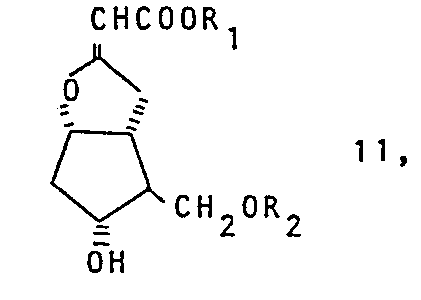
- R2 ein Wasserstoffatom, einen gesättigten Alkylrest mit 1-6 C-Atomen, einen Aralkylrest mit 7-10 C-Atomen, einen Tetrahydropyranyl-, Tetrahydrofuranyl- oder einen a-Äthoxyäthylrest, einen Trialkylsilylrest mit 1-4 C-Atomen im Alkyl, wobei Alkyl auch mit Phenyl substituiert sein kann, oder den Rest 0 -C-R3 mit R3 in der Bedeutung einer Alkylgruppe mit 1-6 C-Atomen oder einer Arylgruppe darstellt, dadurch gekennzeichnet, daß man einen 7-Hydroxy-2-oxa- bicyclo[3.3.0] octan-3-yliden-essigsäureester der allgemeinen Formell II
Description
- Die Erfindung betrifft ein Verfahren zur Herstellung von Carbacyclin-Zwischenprodukten aus 7-Hydroxy-2-oxa-bicyclo[3.3.0]octan-3-ylidenessigsäureestern. Mit diesem Verfahren lassen sich in vorteilhafter Weise stabile und pharmakologisch wirksame Carbacyclin-Derivate herstellen.
- In der DE-OS 29 12 409 wird eine Carbacyclin-Synthese beschrieben, die von einem bicyclischen Lakton ausgehend über Öffnung des Laktonringes und Einführung eines Essigsäureesters unter Bildung eines Dicarbonsäureesters nach vorangegangener Hydrierung schließlich unter Cyclisierung zum Carbacyclin-Zwischenprodukt führt. Diese Synthese ist nicht nur mit erheblichem synthetischen Aufwand verbunden, sondern sie verläuft bei einigen Stufen auch unter deutlichen Ausbeuteverlusten, z.B. bei der Einführung des Essigsäuremethylesterrestes in das geöffnete Ringlakton, besondere jedoch bei der Cyclisierung des Dicarbonsäurediesters und der sich anschließenden Decarboxylierung.
- Es wurde nun gefunden, daß die Prostacyclin-Vorstufe 7-Hydroxy-2- oxabicyclo-[3.3.0]octan-3-yliden-essigsäureester nach vorangegangener Oxidation mit Basen (und nachfolgender Reduktion) zu dem Carbacyclin-Zwischenprodukt 7-Hydroxy-3-oxo-bicyclo[3.3.0]ctan-2-yl-carbonsäureester in hoher Ausbeute umgesetzt werden kann.
- Die Erfindung betrifft somit ein Verfahren zur Herstellung von 3-Oxo-7-hydroxy-bicyclo[3.3.0]-octan-2-yl-carbonsäureastern der allgemeinen Formel I

- R1 einen gesättigten Alkylrest mit 1-6 C-Atomen oder einen Aralkylrest mit 7-10 C-Atomen und
- R2 ein Wasserstoffatom, einen gesättigten Alkylrest mit 1-6 C-Atomen, einen Aralkylrest mit 7-10 C-Atomen, einen Tetrahydropyranyl-, Tetrahydrofuranyl- oder einen α-Äthoxyäthylrest, einen Trialkylsilylrest mit 1-4 C-Atomen im Alkyl, wobei Alkyl auch mit Phenyl substituiert sein kann,oder den Rest R3 mit R3 in der Bedeutung einer Alkylgruppe mit 1-6 C-Atomen oder einer Arylgruppe darstellt, dadurch gekennzeichnet, daß man einen 7-Hydroxy-2-oxa-bicyclo[3-3-0]octhn-3-yliden- essigsäureester der allgemeinen Formel II


- Verbindungen der allgemeinen Formel I sind hervorragend geeignete Zwischenprodukte zur Herstellung von stabilen, pharmakologisch wirlsamen Carbacyclinderivaten, in denen der α-ÄtheraauerBtoff der Prostacycline durch eine Methylengruppe ersetzt ist.
- Die Oxidation der Hydroxygruppe in der Verbindung der allgemeinen Formel II wird nach den dem Fachmann bekannten Methoden vorgenommen. Als Oxydationsmittel oder -methoden können beispielsweise dienen: Collins-Reagenz (Tetrahedron Letters, 1968, 3368), Jones-Reagenz (J.Chem.Soc. 1953, 2555), Pyridinium-chlorochromat (Tetrahedron Letters,1975, 2647, Pyridinium-dichromat (Tetrahedron Letters, 1979, 399)oder die Moffat-Pfitzner-Methode. Die Oxidation wird mit Collins-Reagenz bei -20°C bis+30°C, vorzugsweise 0-5°C oder mit Jones-Reagenz bei -40°C bis +30°C, vorzugsweise -30°C bis 0°C oder mit Pyridiniumchlorochromat oder Pyridinium-dichromat bei -20°C bis + 40°C, vorzugsweise bei 20°C - 30°C in einem gegenüber Oxydationsmittel inerten Lösungsmittel durchgeführt. Als Lösungsmittel können je nach dem verwendeten Reagenz Methylenchlorid, Chloroform, Äthylenchlonid, Dimethylformamid, Pyridin u.a. verwendet werden. Das in praktisch quantitativer Ausbeute erhaltene Keton, in dem R1 und R2 die obenangegebenen Bedeutungen haben, wird ohne weitere Reinigung weiter umgesetzt.
- Als Basen für die weitere Umsetzung kommen beispielsweise in Frage: tertiäre Amine, wie 1,5-Diazabicyclo[4.3.0]non-5-en (DBN) und 1,8-Diazabicyclo[5.4.0]undec -7-en (DBU), Kalium-tert.-Butylat, Natrium-tert.-butylat. Besonders bevorzugte Basen sind DBN und DBU. Die Umsetzung kann mit oder ohne Lösungsmittelzusatz bei -40°C bis +60°C, vorzugsweise 0-30°C, erfolgen. Als Lösungsmittel kommen in Frage: Tetrahydrofuran, Diäthyläther, Dioxan, Toluol. Die anschliessende Reduktion der Ketogruppe wird im gleichen Reaktionsgefäß durch Zusatz von üblichen Reduktionsmitteln bei Temperaturen zwischen -80°C und +30°C, vorzugsweise bei -30°C bis +10°C, durchgeführt. Als Reduktionsmittel eignen sich beispielsweise Natriumborhydrid, Lithium-tri-tert.- butoxy-aluminiumhydrid, Zinkborhydrid, Aluminiumisopropylat usw., vorzugsweise Natriumborhydrid. Zur Verbesserung der Löslichkeit kann zweckmäßigerweise ein Alkohol, wie beispielsweise Methanol, Äthanol, Propanol, Isopropanol, zugesetzt werden.
- Obwohl die dümachichtchromatographische Untersuchung des Rohpro- duktes der Verbindung der allgemeinen Formel I nur geringfügige Begleitstoffe ..zeigt und eine Reinigung nicht notwendig erschei- nen läßt, kann gegebenenfalls gchromatographisch gereinigt werden. Dabei werden die reinen Verbindungen der allgemeinen Formel I in einer Gesamtausbeute von ca. 70% d.Th. aus den Verbindungen der allgemeinen Formel II erhalten.
- Unter gesättigten Alkylresten mit 1-6 C-Atomen versteht man geradkettige öder verzweigte Alkylreste, wie z.B. Methyl, Äthyl, n-Propyl, Isopropyl, n-Butyl, Isobutyl, sek.-Butyl-, tert.-Butyl, n-Pentyl, Isopentyl, tert.-Pentyl-Neopentyl, n-Hexyl, Isohexyl usw. Besonders bevorzugt sind Alkylreste mit 1-4 C-Atomen.
- Als Aralkylrest mit 7-10 C-Atomen kommen in Betracht: Phenylal- kylreste, die im alkyl auch verzweigt sein können, wie z.B. Phe- nylmethyl, Phenäthyl, a-Phenyläthyl, Phenylpropyl, Phenylbutyl, a-Phenylpropyl, a- Phenylbutyl. Phenylalkylreste mit 7-8 C-Atomen kommen bevorzugt in Betracht.
- Die Alkylreste der Trialkylsilyl-Gruppe in R2 stellen gesättigte geradkettige oder verzweigte Alkylreste dar, die auch durch Phenyl substituiert sein können (z.B. 2-Phenyl-butyl, 3-Phenylpropyl, Phenylmethyl), wie z.B. Methyl, Äthyl, n-Propyl, Isopropyl, n-Butyl, Isobutyl, sek.-Butyl, tert.-Butyl.
- Als Arylgruppen in der Bedeutung von R3 sind gemeint: Phenyl, α- und ß-Naphthyl, Biphenylyl sowie mit Chlor, Brom, C1-4-Alkyl oder C1-4-Alkoxy substituiertes Phenyl. Als Alkylreste mit 1-4 C-Atomen kommen in Frage: Methyl, Äthyl, n-Propyl, Isopropyl, n-Butyl, Isobutyl, sek.-Butyl, tert.-Butyl. Als Alkoxyreste mit 1 - 4 C-Atomen kommen in Frage: Methoxy, Äthoxy, n-Propoxy, Isopropoxy, n-Butoxy, Isobutoxy, tert.-Butoxy.
- Das für das erfindungsgemäße Verfahren benötigte Ausgangsmaterial der allgemeinen Formel II läßt sich aus dem bekannten Lakton der allgemeinen Formel III herstellen, worin R2 die obige Bedeutung aufweist


- Zur Wasserabspaltung behandelt man das Rohprodukt der metallorganischen Umsetzung mit einer katalytischen Menge einer Säure in einem mit Wasser nicht mischbaren Lösungsmittel wie beispielsweise Toluol, Methylenchlorid, Chloroform, Tetrachlorkohlenstoff, Diäthyläther usw., vorzugsweise Toluol, bei Temperaturen zwischen 20°C und 100°C, vorzugsweise 20°C bis 30°C. Als Säuren kommen beispielsweise in Frage: p-Toluolsulfonsäure, Schwefelsäure, Salzsäure, Bortrifluorid usw.
- Die Verseifung der gegebenenfalls vorhandenen Acylgruppen erfolgt beispielsweise mit Alkali- oder Erdalkali-carbonaten in einem Alkohol. Als Alkohole kommen aliphatische Alkohole in Betracht, wie zum Beispiel Methanol, Äthanol, Butanol usw., vorzugsweise Methanol. Als Alkali- oder Erdalkalicarbonate sind beispielsweise geeignet: Kaliumcarbonat, Natriumcarbonat, Calciumcarbonat, Bariumcarbonat usw. Die Umsetzung erfolgt bei -10°C bis 70°C, vorzugsweise bei 25 0 C.
- Die weitere Umwandlung der Verbindungen der allgemeinen Formel I in Carbacyclin-Derivate erfolgt nach bekannter Verfahrensweise, beispielsweise durch Decarbalkoxylierung mit beispielswei- se 1,4-Diazabicyclo[2.2.2]octan in Toluol, Veresterung mit beispielsweise Benzoylchlorid oder Essigsäureanhydrid und Abspaltung der Schutzgruppe.

- Das dabei erhaltene Keton der allgemeinen Formel V, worin R4 die obenangegebene Bedeutung besitzt, läßt sich beispielsweise nach der Arbeitsweise in DE-OS 29 12 409 oder DE-OS 28 45 770 in die gewünschten Uarbacycline überführen.
- Zu einer Lösung von 540g Collins-Reagenz in 4,6 ltr. Methylenchlorid (abs.) fügt man bei Eisbadtemperatur eine Lösung aus 94,4g (1S;5R,6S,7R)-7-Hydroxy-6-(dimethyl-tert-butyl-silyloxymethyl)-2- oxabicyclo[3.3.0]octan-3-yliden-essigsäureäthylester in 1,6 ltr. Methylenchlorid und rührt 15 Minuten bei 5°C. Anschliessend verdünnt man mit 10 ltr. Äther, rührt die organische Phase viermal mit 5%iger Natriumbicarbonatlösung, einmal mit Wasser, zweimal mit 10%iger Schwefelsäure und dreimal mit Wasser. Man trocknet über Natriumsulfat und dampft im Vakuum ein.
- Das auf diese Weise erhaltene Keton (95g) löst man in 320ml Tetra- hydrofuran, versetzt bei 0°C mit 134 ml 1,5-Diazabicyclo[4.3.0]non-5-en, rührt 105 Minuten bei 0°C, kühlt auf -20°C, fügt 10,2g Natriumborhydrid und anschließend 385 ml Methanol zu, rührt 100 Minuten bei -20oC, versetzt mit l60 ml Aceton, rührt 30 Minuten und gießt dann auf 2 ltr. 10%ige Zitronensäurelösung. Man extrahiert mit Äther, wäscht die organische Phase mit Wasser neutral, trocknet über Natriumsulfat und dampft im Vakuum ein. Nach Chromatographie des Rückstandes an Kieselgel erhält man mit Hexan/Äther (3+2) 65,5 g der Titelverbindung als farbloses Öl. IR (cHCl3): 3520,.2955, 2930, 2860, 1750, 1720, 1660, 1620, 834cm-1
- Das Ausgangsmaterial für die obige Titelverbindung wurde wie folgt hergestellt:
- Zu einer Lösung von 100 g (1S,5R,6S,7R)-7-Benzoyloxy-6-hydroxymethyl-2-oxabicyclo[3.3.0]octan-3-on und 62g Imidazol in 110ml Dimethylformamid fügt man bei 0°C 65g tert.-Butyl-dimethylsilyl- chlorid und rührt 24 Stunden bei 24°C.unter Argon. Ansnhließend verdünnt man mit 6 ltr. Äther, schüttelt zweimal mit 5%iger Schwefelsäure, viermal mit Wasser, trocknet über Magnesiumsul- fat und dampft im Vakuum ein. Den Rückstand kristallisiert man aus Hexan/Methylenchlorid um. Dabei erhält man 137 g des Silyl- äthers als farblose Kristalle (F. 75oC).
- Man tropft zu 95 ml Diisopropylamin bei -25°C unter Argon 425 ml einer 1,6 molar en Butyllithiumlösung in Hexan und rührt 1 Stunde bei -25°C. In diese Mischung tropft man bei -70°C 66 ml Essigsäureäthylester, rührt 20 Minuten und fügt anschlies- send eine Lösung von 66 g des nach Beispiel la hergestellten Silyläthers in 500 ml Diäthyläther und 500 ml Tetrahydrofuran zu. Man rührt 20 Minuten bei -70°C, gießt die Reaktionsmischung auf eine Mischung aus 1,4 ltr. gesättigte Ammoniumchloridlösung und 1,4 ltr. 10%ige Zitronensäurelösung, extrahiert mit Äther, wäscht den organischen Extrakt mit Wasser neutral, trocknet übwr Magnesiumsulfat und dampft im Vakuum ein. Den Rückstand löst man in 1,5 ltr. Toluol, fügt 1,5 g p-Toluolsulfonsäure zu, rührt 2 Stunden bei 25°C und dampft im Vakuum bei 40°C ein. Man fügt 24 g Kaliumcarbonat (wasserfrei) zu, versetzt mit 500 ml Methanol und rührt 3 Stunden bei 25°C unter Argon. Anschließend verdünnt man mit Äther, wäscht mit Sole neutral, trocknet mit Natriumsulfat und dampft im Vakuum ein. Nach Chromatographie des Rückstandes an Kieselgel erhält man mit Hexan/Essigester (7+3) 48g der Titelverbindung als farblose Kristalle (F. 35°C). IR (CHCl3): 3520, 2955, 2930, 286o, 1742, 1635, 832 cm-1.
- Zu einer Lösung von 30 g Collins-Reagenz in 250 ml Methylenchlorid fügt man bei Eisbadtemperatur eine Lösung von 5g (1S,5R,6S,7R)-6-Benzyloxymethyl-7-hydroxy-2-oxabicyclo[3.3.0]octan-3-yliden-essigsäureäthylester (Beispiel 2a) in 90 ml Methylenchlorid und rührt 15 Minuten bei 5°C. Anschließend verdünnt man mit 600 ml Äther, schüttelt viermal mit 5%iger Natriumbicarbonatlösung, einmal mit Wasser, zweimal mit 10%iger Schwefelsäure und dreimal mit Wasser. Man trocknet über Magnesiumsulfat und dampft im Vakuum ein.
- Den Rückstand (5g) löst man in l8 ml Tetrahydrofuran, versetzt hei 0°C mit 7,5 ml 1,5-Diazabicyclo[4.3.0]non-5-en, rührt 100 Minuten bei 0°C, kühlt auf -20°C, fügt 550 mg Natriumborhydrid und l8 ml Methanol zu, rührt 100 Minuten bei -20oC, versetzt mit 10 ml Aceton, rührt 30 Minuten und gießt dann auf 100 ml 10%ige Zitronensäurelösung. Man extrahiert mit Äther, wäscht die organische Phase mit Wasser neutral, trocknet über Magnesiumsulfat und dampft im Vakuum ein. Nach Chromatographie des Rückstandes an Kieselgel erhält man mit Äther/Hexan (3+2) 3,4 g der Titelverbindung als farbloses Öl. IR (CHCl3): 3540, 2930, 2860, 1755, 1725, 1660, 1620 cm.
- Das Ausgangsmaterial für die obige Titelverbindung wurde wie folgt hergestellt:
- Man tropft zu 69 ml Diisopropylamin bei -250C unter Argon 550 ml einer 0,91 molaren Butyllithiumlösung in Hexan und rührt 1 Stunde bei -25°C. In diese Mischung tropft man bei -70°C 49 ml Essigsäureäthylester, rührt 20 Minuten bei -70°C und fügt anschließend eine Lösung von 26,2 g (lS,5R,6S,7R)-6-Benzyloxy- methyl-7-hydroxy-2-oxabicyclo[3.3.0]octan-3-on in 300 ml Diäthyläther und 300 ml Tetrahydrofuran zu. Nach 20 Minuten gießt man die Reaktionsmischung auf 1 ltr. gesättigte Ammoniumchloridlösung, extrahiert mit Äther, wäscht den organischen Extrakt mit Sole neutral und trocknet über Magnesiumsulfat.
- Den Eindampfrückstand löst man in 700 ml Toluol, fügt 0,25 g p-Toluolsulfonsäure zu, rührt 2 Stunden bei 25°C, destilliert im Vakuum bei 40°C ca. 400 ml Toluol ab, wäscht mit Wasser neutral, trocknet über Magnesiumfulfat und dampft im Vakuum ein. Nach Chromatographie des Rückstandes an Kieselgel erhält man mit Hexan/Essigester 20,3 g der Titelverbindung als farblose Kristalle (F. 59°C aus Pentan/Äther). IR (CHC13): 3540, 2990, 2945, 2870, 1695, 1639, 1120/cm.
- Zu einer Lösung von 47g des nach Beispiel 1 hergestellten ß-Ketoesters in 1,2 ltr. Toluol fügt man 157 g 1,4 Diazabicyclo(2.2.0)-octan und kocht 5 Stunden am Rückfluß unter Argon. Anschließend engt man im Vakuum ein, nimmt den Rückstand in 320 ml Tetrahydrofuran auf, versetzt bei 0°C mit 23 ml Benzoylchlorid und rührt 15 Minuten bei 0°C. Man fügt 9 ml Wasser zu, rührt 2 Stunden bei 25°C, löst den Kristallbrei in 2,5 ltr. Äther, schüttelt mehrfach mit 10%iger Schwefelsäure, zweimal mit Wasser und dampft im Vakuum ein. Den Rückstand rührt man 5 Stunden bei 30°C in einer Mischung aus Eisessig, Wasser, THF (65+35+10) und dampft anschließend im Vakuum ein. Nach Chromatographie des Rückstandes an Kieselgel erhält man mit Äther 24,2 g der Titelverbindung als farbloses Öl. IR (CHCl3): 3510, 2945, 1739, 1712, 1602, 1588, 1278/cm.
Claims (2)


Priority Applications (1)
| Application Number | Priority Date | Filing Date | Title |
|---|---|---|---|
| AT81104119T ATE8496T1 (de) | 1980-06-06 | 1981-05-29 | Neues verfahren zur herstellung von carbacyclin- zwischenprodukten. |
Applications Claiming Priority (2)
| Application Number | Priority Date | Filing Date | Title |
|---|---|---|---|
| DE3021895 | 1980-06-06 | ||
| DE3021895A DE3021895A1 (de) | 1980-06-06 | 1980-06-06 | Neues verfahren zur herstellung von carbacyclin-zwischenprodukten |
Publications (3)
| Publication Number | Publication Date |
|---|---|
| EP0041661A2 true EP0041661A2 (de) | 1981-12-16 |
| EP0041661A3 EP0041661A3 (en) | 1982-01-27 |
| EP0041661B1 EP0041661B1 (de) | 1984-07-18 |
Family
ID=6104355
Family Applications (1)
| Application Number | Title | Priority Date | Filing Date |
|---|---|---|---|
| EP81104119A Expired EP0041661B1 (de) | 1980-06-06 | 1981-05-29 | Neues Verfahren zur Herstellung von Carbacyclin-Zwischenprodukten |
Country Status (6)
| Country | Link |
|---|---|
| US (1) | US4359581A (de) |
| EP (1) | EP0041661B1 (de) |
| JP (1) | JPS5726644A (de) |
| AT (1) | ATE8496T1 (de) |
| DE (2) | DE3021895A1 (de) |
| HU (1) | HU187336B (de) |
Cited By (2)
| Publication number | Priority date | Publication date | Assignee | Title |
|---|---|---|---|---|
| WO1988003570A1 (fr) * | 1986-11-13 | 1988-05-19 | Schering Aktiengesellschaft | CLIVAGE RACEMIQUE DE 7alpha-ACYLOXY-6beta-HYDROXYMETHYL-2-OXABICYCLO[3.3.0]OCTANE-3-ONES PAR HYDROLYSE D'ACYLATE STEREOSPECIFIQUE ENZYMATIQUE |
| DE3816801A1 (de) * | 1988-05-13 | 1989-11-23 | Schering Ag | Verfahren zur herstellung von carbacyclinen |
Families Citing this family (3)
| Publication number | Priority date | Publication date | Assignee | Title |
|---|---|---|---|---|
| US5283349A (en) * | 1985-09-13 | 1994-02-01 | Teijin Limited | 2,6,7-trisubstituted-3-methylenebicyclo(3.3.0)-octanes, and process for production thereof |
| US5169960A (en) * | 1987-08-11 | 1992-12-08 | Schering Aktiengesellschaft | Process for the production of E/Z mixtures of 2-(bicyclo[3.3.0]octan-3-ylidene)-acetic acid derivatives with predominant E or Z portion |
| US4871869A (en) * | 1988-01-06 | 1989-10-03 | Nisshin Flour Milling Co., Ltd. | Optically active bicyclo[3.3.0]octane and processes for the preparation thereof |
Family Cites Families (3)
| Publication number | Priority date | Publication date | Assignee | Title |
|---|---|---|---|---|
| JPS54119441A (en) * | 1978-03-09 | 1979-09-17 | Sumitomo Chem Co Ltd | Novel bicyclooctane derivative |
| DE2912409A1 (de) * | 1978-03-31 | 1979-10-11 | Ono Pharmaceutical Co | 6,9-methano-pgi tief 2 -analoge |
| DE2845770A1 (de) * | 1978-10-19 | 1980-04-30 | Schering Ag | Neue prostacyclin-derivate und verfahren zu ihrer herstellung |
-
1980
- 1980-06-06 DE DE3021895A patent/DE3021895A1/de not_active Withdrawn
-
1981
- 1981-05-29 AT AT81104119T patent/ATE8496T1/de active
- 1981-05-29 EP EP81104119A patent/EP0041661B1/de not_active Expired
- 1981-05-29 DE DE8181104119T patent/DE3164871D1/de not_active Expired
- 1981-06-03 JP JP8452781A patent/JPS5726644A/ja active Granted
- 1981-06-05 HU HU811694A patent/HU187336B/hu not_active IP Right Cessation
- 1981-06-05 US US06/270,716 patent/US4359581A/en not_active Expired - Fee Related
Cited By (3)
| Publication number | Priority date | Publication date | Assignee | Title |
|---|---|---|---|---|
| WO1988003570A1 (fr) * | 1986-11-13 | 1988-05-19 | Schering Aktiengesellschaft | CLIVAGE RACEMIQUE DE 7alpha-ACYLOXY-6beta-HYDROXYMETHYL-2-OXABICYCLO[3.3.0]OCTANE-3-ONES PAR HYDROLYSE D'ACYLATE STEREOSPECIFIQUE ENZYMATIQUE |
| EP0271433A1 (de) * | 1986-11-13 | 1988-06-15 | Schering Aktiengesellschaft | Racematspaltung von 7 alpha-Acyloxy-6 beta-hydroxy-methyl-2-oxabicyclo 3.3.0 octan-3-onen durch stereospezifische enzymatische Acylat-Hydrolyse |
| DE3816801A1 (de) * | 1988-05-13 | 1989-11-23 | Schering Ag | Verfahren zur herstellung von carbacyclinen |
Also Published As
| Publication number | Publication date |
|---|---|
| US4359581A (en) | 1982-11-16 |
| EP0041661B1 (de) | 1984-07-18 |
| JPH0148256B2 (de) | 1989-10-18 |
| DE3021895A1 (de) | 1981-12-24 |
| EP0041661A3 (en) | 1982-01-27 |
| DE3164871D1 (en) | 1984-08-23 |
| HU187336B (en) | 1985-12-28 |
| JPS5726644A (en) | 1982-02-12 |
| ATE8496T1 (de) | 1984-08-15 |
Similar Documents
| Publication | Publication Date | Title |
|---|---|---|
| CH647222A5 (de) | 9-desoxy-9a-methylen-isostere von pgi-2 und verfahren zu deren herstellung. | |
| CH651292A5 (de) | Bicyclo(3,3,0)octan-derivate. | |
| CH623304A5 (de) | ||
| DE3437903A1 (de) | 7-oxabicycloheptan-verbindungen | |
| DE1958600A1 (de) | Neue Isoxazolderivate und deren Herstellung | |
| EP0041661B1 (de) | Neues Verfahren zur Herstellung von Carbacyclin-Zwischenprodukten | |
| DE2423485A1 (de) | Bicyclooctan-derivate | |
| Weiguny et al. | Electroorganic synthesis, 57. Synthesis of advanced prostaglandin precursors by Kolbe electrolysis, II.–Preparation of coacids and anodic initiated tandem radical‐addition/radical‐coupling reaction with (1′ R, 4′ S, 3R/S)‐3‐(cis‐4‐acetoxycyclopent‐2‐enyloxy)‐3‐ethoxypropionic acid | |
| DE68910774T2 (de) | Cyclopentanheptencarbonsäurederivate und Verfahren zu ihrer Herstellung. | |
| DE60024353T2 (de) | Verfahren zur Herstellung Antiosteoporicagenz | |
| DE69114911T2 (de) | Verfahren zur Herstellung von optisch-aktivem Cyclobutanon, ein Zwischenprodukt in der Synthese von optisch-aktiven Cyclobutannukleosiden. | |
| WO1996000207A1 (de) | Cyclohexanon-derivate, verfahren zu deren herstellung und zwischenprodukte des verfahrens | |
| WO1983001449A1 (fr) | Procede de preparation de composes intermediaires de carbacycline | |
| EP0270481B1 (de) | Neues Verfahren zur Herstellung von optisch aktiven Carbacyclin-Zwischenprodukten | |
| EP0051597B1 (de) | Neue prostacyclinderivate und ihre herstellung | |
| DE2602508A1 (de) | Aliphatische carbonylverbindungen | |
| DE4447594A1 (de) | Neue pharmakologisch wirksame, enantiomere Sesquiterpene und pharmazeutische Zubereitungen, enthaltend diese Verbindungen | |
| DE2654668A1 (de) | Verfahren zur herstellung von verbindungen des prostaglandintyps und nach diesem verfahren erhaltene produkte | |
| EP0008077B1 (de) | Neue Prostaglandinderivate in der Delta-2-PGF2 und Delta-2-PGE2-Reihe, Verfahren zu deren Herstellung und ihre Verwendung als Arzneimittel | |
| US4159998A (en) | Process for the preparation of 2-(7-hydroxyalkyl)-4R, 4S or 4RS -hydroxy-cyclopent-2-enone | |
| DE2653604C2 (de) | ||
| WO1988003527A1 (fr) | Reduction cetonique amelioree d'intermediaires de carbacycline | |
| DE69326972T2 (de) | Verfahren zur Herstellung eines optisch aktiven Olefins | |
| KR100543172B1 (ko) | 테레인 화합물의 제조방법 | |
| DE2166797C2 (de) | Optisch aktive tricyclische Lactonaldehyde und Verfahren zu deren Herstellung |
Legal Events
| Date | Code | Title | Description |
|---|---|---|---|
| PUAI | Public reference made under article 153(3) epc to a published international application that has entered the european phase |
Free format text: ORIGINAL CODE: 0009012 |
|
| PUAL | Search report despatched |
Free format text: ORIGINAL CODE: 0009013 |
|
| AK | Designated contracting states |
Designated state(s): AT BE CH DE FR GB IT LU NL SE |
|
| AK | Designated contracting states |
Designated state(s): AT BE CH DE FR GB IT LU NL SE |
|
| 17P | Request for examination filed |
Effective date: 19820723 |
|
| ITF | It: translation for a ep patent filed | ||
| GRAA | (expected) grant |
Free format text: ORIGINAL CODE: 0009210 |
|
| AK | Designated contracting states |
Designated state(s): AT BE CH DE FR GB IT LI LU NL SE |
|
| REF | Corresponds to: |
Ref document number: 8496 Country of ref document: AT Date of ref document: 19840815 Kind code of ref document: T |
|
| REF | Corresponds to: |
Ref document number: 3164871 Country of ref document: DE Date of ref document: 19840823 |
|
| ET | Fr: translation filed | ||
| PLBE | No opposition filed within time limit |
Free format text: ORIGINAL CODE: 0009261 |
|
| STAA | Information on the status of an ep patent application or granted ep patent |
Free format text: STATUS: NO OPPOSITION FILED WITHIN TIME LIMIT |
|
| PG25 | Lapsed in a contracting state [announced via postgrant information from national office to epo] |
Ref country code: LU Free format text: LAPSE BECAUSE OF NON-PAYMENT OF DUE FEES Effective date: 19850531 |
|
| 26N | No opposition filed | ||
| PGFP | Annual fee paid to national office [announced via postgrant information from national office to epo] |
Ref country code: AT Payment date: 19860409 Year of fee payment: 6 |
|
| PG25 | Lapsed in a contracting state [announced via postgrant information from national office to epo] |
Ref country code: AT Effective date: 19890529 |
|
| PG25 | Lapsed in a contracting state [announced via postgrant information from national office to epo] |
Ref country code: SE Effective date: 19890530 |
|
| PGFP | Annual fee paid to national office [announced via postgrant information from national office to epo] |
Ref country code: FR Payment date: 19910410 Year of fee payment: 11 |
|
| PGFP | Annual fee paid to national office [announced via postgrant information from national office to epo] |
Ref country code: GB Payment date: 19910412 Year of fee payment: 11 |
|
| PGFP | Annual fee paid to national office [announced via postgrant information from national office to epo] |
Ref country code: BE Payment date: 19910415 Year of fee payment: 11 |
|
| PGFP | Annual fee paid to national office [announced via postgrant information from national office to epo] |
Ref country code: CH Payment date: 19910423 Year of fee payment: 11 |
|
| ITTA | It: last paid annual fee | ||
| PGFP | Annual fee paid to national office [announced via postgrant information from national office to epo] |
Ref country code: NL Payment date: 19910531 Year of fee payment: 11 |
|
| PGFP | Annual fee paid to national office [announced via postgrant information from national office to epo] |
Ref country code: DE Payment date: 19920415 Year of fee payment: 12 |
|
| PG25 | Lapsed in a contracting state [announced via postgrant information from national office to epo] |
Ref country code: GB Effective date: 19920529 |
|
| PG25 | Lapsed in a contracting state [announced via postgrant information from national office to epo] |
Ref country code: LI Effective date: 19920531 Ref country code: CH Effective date: 19920531 Ref country code: BE Effective date: 19920531 |
|
| BERE | Be: lapsed |
Owner name: SCHERING A.G. BERLIN UND BERGKAMEN Effective date: 19920531 |
|
| PG25 | Lapsed in a contracting state [announced via postgrant information from national office to epo] |
Ref country code: NL Effective date: 19921201 |
|
| NLV4 | Nl: lapsed or anulled due to non-payment of the annual fee | ||
| GBPC | Gb: european patent ceased through non-payment of renewal fee |
Effective date: 19920529 |
|
| PG25 | Lapsed in a contracting state [announced via postgrant information from national office to epo] |
Ref country code: FR Effective date: 19930129 |
|
| REG | Reference to a national code |
Ref country code: CH Ref legal event code: PL |
|
| REG | Reference to a national code |
Ref country code: FR Ref legal event code: ST |
|
| PG25 | Lapsed in a contracting state [announced via postgrant information from national office to epo] |
Ref country code: DE Effective date: 19940201 |
|
| EUG | Se: european patent has lapsed |
Ref document number: 81104119.3 Effective date: 19900412 |