EP0042094A1 - Stabilisierte thermoplastische Formmassen - Google Patents
Stabilisierte thermoplastische Formmassen Download PDFInfo
- Publication number
- EP0042094A1 EP0042094A1 EP81104167A EP81104167A EP0042094A1 EP 0042094 A1 EP0042094 A1 EP 0042094A1 EP 81104167 A EP81104167 A EP 81104167A EP 81104167 A EP81104167 A EP 81104167A EP 0042094 A1 EP0042094 A1 EP 0042094A1
- Authority
- EP
- European Patent Office
- Prior art keywords
- bis
- hydroxiphenyl
- boric acid
- weight
- alkyl
- Prior art date
- Legal status (The legal status is an assumption and is not a legal conclusion. Google has not performed a legal analysis and makes no representation as to the accuracy of the status listed.)
- Withdrawn
Links
- 0 Cc(cc1C2(*)C=C2)cc(C2CCCCC2)c1OBOc1ccccc1 Chemical compound Cc(cc1C2(*)C=C2)cc(C2CCCCC2)c1OBOc1ccccc1 0.000 description 3
Classifications
-
- C—CHEMISTRY; METALLURGY
- C08—ORGANIC MACROMOLECULAR COMPOUNDS; THEIR PREPARATION OR CHEMICAL WORKING-UP; COMPOSITIONS BASED THEREON
- C08K—Use of inorganic or non-macromolecular organic substances as compounding ingredients
- C08K5/00—Use of organic ingredients
- C08K5/55—Boron-containing compounds
-
- C—CHEMISTRY; METALLURGY
- C08—ORGANIC MACROMOLECULAR COMPOUNDS; THEIR PREPARATION OR CHEMICAL WORKING-UP; COMPOSITIONS BASED THEREON
- C08L—COMPOSITIONS OF MACROMOLECULAR COMPOUNDS
- C08L69/00—Compositions of polycarbonates; Compositions of derivatives of polycarbonates
Definitions
- ABS plastics and aromatic polycarbonates are known (DE-PS 1 170 141), as are corresponding mixtures with styrene / acrylonitrile copolymers as a third component (DE-AS 1 810 993).
- Mixtures of aromatic polycarbonates with special, ABS plastics are described in DE-PS 2 259 656, DE-OS 2 329 548 and DE-OS 2 329 546.
- the invention relates to mixtures of aromatic polycarbonates and ABS plastics, the 0.01 to 3 wt .-%, preferably 0.05 to 2 wt .-%, based on the total mixture, of one or more esters of boric acid, especially those with ortho - And / or para-alkyl-substituted phenols or corresponding bisphenols contain.
- the invention relates to mixtures of which are characterized in that, as stabilizers, they contain one or more esters of boric acid with ortho- and / or para-alkyl-substituted phenols or bisphenols in amounts of 0.01-3.0% by weight, preferably 0.05-2, 0 wt .-%, based on the total mixture.
- the invention furthermore relates to the use of esters of boric acid, in particular those with ortho- and / or para-alkyl-substituted phenols or corresponding bisphenols in amounts of 0.01-3.0% by weight, preferably 0.05-2, 0% by weight, based on the total mixture, for the thermal stabilization of mixtures of aromatic polycarbonates and ABS plastics.
- the thermal stabilization according to the invention not only improves the thermal behavior, but also produces better ones Surface, higher melt stability and better mechanical properties of the stabilized products.
- X can also be used for or oxyalkylation products of glycerol, trimethylolpropane or pentaerythritol with 3-8-oxiethyl or oxipropyl radicals.
- thermoplastic polycarbonates can be used for the molding compositions according to the invention.
- Preferred aromatic polycarbonates are those based on one or more of the diphenols mentioned as preferred.
- Copolycarbonates based on 2,2-bis (4-hydroxiphenyl) propane and one of the other diphenols mentioned as particularly preferred are particularly preferred.
- Polycarbonates based solely on 2,2-bis (4-hydroxiphenyl) propane or 2,2-bis (3,5-dimethyl-4-hydroxiphenyl) propane are also particularly preferred.
- the aromatic polycarbonates can be prepared by known methods, e.g. a melt transesterification from bisphenol and diphenyl carbonate and in solution from bisphenols and phosgene.
- the solution can be homogeneous ("pyridine method") or heterogeneous ("two-phase interface method").
- polycarbonates which have been prepared in solution, in particular by the two-phase interface process are particularly suitable.
- the aromatic polycarbonates can, by incorporating small amounts, preferably amounts of between 0.05 and 2.0 mol-96, based on the diphenols used, of three or more than three-functional compounds, for example those having three or more than three phenolic hydroxyl groups, be branched.
- Polycarbonates of this type are e.g. in DE-OS 1 570 533; 1,595,762; 2,116,974; 2 113 347; 2,500,092, GB-PS 1 079 821, US-PS 3 544 514.
- Some of the usable compounds with three or more than three phenolic hydroxyl groups are, for example, phloroglucin, 4,6-dimethyl-2,4,6-tri- (4-hydroxiphenyl) -hepten-2, 4,6-dimethyl-2,4, 6-tri- (4-hydroxiphenyl) -heptane, 1,3,5-tri- (4-hydroxiphenyl) -benzene, 1,1,1-tri- (4-hydroxiphenyl) -ethane, tri- (4th -hydroxiphenyl) -phenylmethane, 2,2-bis-4,4-bis- (4-hydroxiphenyl) -cyclohexyl-propane, 2,4-bis- (4-hydroxiphenyl-isopropyl) -phenol, 2,6-bis- (2'-hydroxy-5'-methyl-benzyl) -4-methylphenol, 2- (4-hydroxy-phenyl) -2- (2,4-dihydroxiphenyl) propane and 1,4
- Some of the other three-functional compounds are 2,4-dihydroxybenzoic acid, trimesic acid, cyanuric chloride and 3,3-bis- (4-hydroxyphenyl) -2-oxo-2,3-dihydroindole.
- the aromatic polycarbonates are generally intended to have average weight-average molecular weights M W from 10,000 to over 200,000, preferably from 20,000 to 80,000 (determined by measuring the relative viscosity in CH 2 C1 2 at 25 ° C. at a concentration of 0.5% by weight).
- the high molecular weight polycarbonates can M W from 10,000 to 200,000 also small proportions of low molecular weight polycarbonates, for example with an average degree of polymerization of 2 to 20, can be added.
- Another component of the molding compositions is a graft polymer (2.1) in which a rubber mixture of 95-50% by weight of styrene and methyl meth is based on a rubber acrylate or mixtures thereof and 5-50% by weight acrylonitrile, methyl methacrylate or mixtures thereof is graft-polymerized.
- Suitable rubbers are, in particular, polybutadiene, butadiene / styrene copolymers with up to 30% by weight of copolymerized styrene, copolymers of butadiene and acrylonitrile with up to 20% by weight of acrylonitrile or copolymers of butadiene with up to 20% by weight of a lower Alkyl esters of acrylic or methacrylic acid (e.g. methyl acrylate, ethyl acrylate, methyl methacrylate and ethyl methacrylate); in principle, all elasticizing components are suitable, provided they show rubber-elastic behavior.
- acrylic or methacrylic acid e.g. methyl acrylate, ethyl acrylate, methyl methacrylate and ethyl methacrylate
- the molding composition may also contain a butadiene polymer (2.2.).
- the butadiene polymers which are contained in the molding compositions are preferably copolymers of 5-95% by weight of butadiene and 70-5% by weight of acrylonitrile, acrylic acid, methacrylic acid, C 1 -C 6 -alkyl esters of acrylic or methacrylic acid (especially preferably methyl methacrylate), divinylbenzene and mixtures of these comonomers.
- Particularly suitable are copolymers of 70-90% by weight of butadiene and 30-10% by weight of styrene, copolymers of 60-95% by weight of butadiene and 40-5% by weight of methyl methacrylate, copolymers of 30-95% by weight.
- butadiene and 70-5% by weight butyl acrylate and copolymers of 60-80% by weight butadiene and 40-20% by weight acrylonitrile. Smaller amounts (up to about 10% in total) of methacrylic acid and / or divinylbenzene can also be polymerized into these latter copolymers. Examples of ter or quarter polymers of the latter type are copolymers of 63% butadiene, 34% acrylonitrile and 3% methacrylic acid or copolymers of 60% by weight butadiene, 36% by weight acrylonitrile, 3% methacrylic acid and 1% divinylbenzene.
- the molding composition may also contain a copolymer (2.3) from the graft monomers or similar monomers.
- a copolymer 2.3
- these copolymers of 95-50% by weight of styrene, C4-methylstyrene, methyl methacrylate or mixtures thereof with 5-50% by weight of acrylonitrile, methacrylonitrile, methyl methacrylate or mixtures thereof.
- Such copolymers often arise as by-products in graft polymerization, especially when large amounts of monomers are grafted onto small amounts of rubber.
- the molding compositions according to the invention can be obtained by mixing the individual components.
- the latices of the graft polymer (2.1) and, if appropriate, those of the butadiene polymer (2.2) and the copolymer (2.3) are first mixed and the solids are precipitated and dried together.
- the powder mixture thus obtained is then mixed with the polycarbonate.
- the individual components of the molding compositions according to the invention can also be produced separately and then mixed on known mixing devices. Suitable for this are e.g. Mixing mills, screw extruders or internal mixers.
- the stabilizers according to the invention can be incorporated in any manner using known techniques.
- the stabilizers can be kneaded or screw machines either beforehand into the individual components of the mixture or directly during the thermoplastic processing of the individual components to form the overall mixture or subsequently incorporated into the overall mixture itself.
- Either the individual components of the molding compositions according to the invention contain additives such as stabilizers, flame retardants, pigments, flow agents, lubricants, mold release agents, antistatic agents, or the above-mentioned additives can be added when the individual components are mixed.
- additives such as stabilizers, flame retardants, pigments, flow agents, lubricants, mold release agents, antistatic agents, or the above-mentioned additives can be added when the individual components are mixed.
- the molding compositions of the present invention can be used for the production of moldings of any kind.
- moldings can be produced by injection molding.
- moldings that can be produced are: housing parts of all kinds (e.g. for household appliances such as juicers, coffee machines, mixers) or cover plates for the construction sector and parts for the motor vehicle sector. They are also used in the field of electrical engineering because they have very good electrical properties.
- Another form of processing is the production of shaped bodies by deep drawing from previously produced plates or foils.
- Boric acid esters from bis (2-hydroxy-3-tert-butyl-5-methylphenyl) methane A mixture of 145 g (0.5 mol.) Of triphenyl borate and 9 g (0.5 mol) of H 2 0 is stirred under nitrogen at 80-100 ° C. for about 2 hours. Then 170 g (0.5 mol) of bis- (2-hydroxy-3-tert-butyl-5-methylphenyl) methane are added and the mixture is heated at 20 mb from 85 ° to 180 ° C. and 140 g is distilled in the process Phenol.
- a yellow, brittle resin of 183 g of melting point 150-2 ° C. (from ligroin) is obtained as a residue.
- the molding compositions of the examples below were added on an internal kneader at 230 ° C. or on a twin-screw extruder. 260 ° C by mixing the ABS polymer with the polycarbonate component and the respective stabilizer.
Landscapes
- Chemical & Material Sciences (AREA)
- Health & Medical Sciences (AREA)
- Chemical Kinetics & Catalysis (AREA)
- Medicinal Chemistry (AREA)
- Polymers & Plastics (AREA)
- Organic Chemistry (AREA)
- Compositions Of Macromolecular Compounds (AREA)
Abstract
Die Erfindung betrifft die thermische Stabilisierung von Gemischen aus aromatischen Polycarbonaten und ABS-Kunststoffen mit 0,01 bis 3 Gew.-%, bezogen auf Gesamtmischung, von Estern der Borsäure, insbesondere solchen mit ortho- und/oder para-alkyl-substituierten Phenolen oder entsprechenden Bisphenoien.
Description
- Mischungen aus ABS-Kunststoffen und aromatischen Poly- 'carbonaten sind bekannt (DE-PS 1 170 141), ebenso entsprechende Mischungen mit Styrol/Acrylnitril-Copolymerisaten als drittem Bestandteil (DE-AS 1 810 993). Mischungen aromatischer Polycarbonate mit speziellen,ABS-Kunststoffen werden in-DE-PS 2 259 656, DE-OS 2 329 548 und DE-OS 2 329 546 beschrieben.
- Bei der Verarbeitung solcher Mischungen können insbesondere bei der Herstellung großflächiger Teile bei Temperaturbelastungen bis zu 300°C Oberflächenstörungen in Form von Bläschen oder Streifen auftreten.
- Gegenstand der Erfindung sind Mischungen aus aromatischen Polycarbonaten und ABS-Kunststoffen, die 0,01 bis 3 Gew.-%, bevorzugt 0,05 bis 2 Gew.-%, bezogen auf Gesamtmischung, eines oder mehrerer Ester der Borsäure, insbesondere solche mit ortho- und/oder para-alkylsubstituierten Phenolen oder entsprechenden Bisphenolen enthalten.
- Insbesondere sind Gegenstand der Erfindung Mischungen aus

- Ein weiterer Gegenstand der Erfindung ist die Verwendung von Estern der Borsäure, insbesondere solchen mit ortho-und/oder para-alkylsubstituierten Phenolen oder entsprechenden Bisphenolen in Mengen von 0,01 - 3,0 Gew.-%, bevorzugt 0,05 - 2,0 Gew.-%, bezogen auf Gesamtmischung, zur thermischen Stabilisierung von Mischungen aus aromatischen Polycarbonaten und ABS-Kunststoffen.
- Die erfindungsgemäße Thermostabilisierung verbessert nicht nur das thermische Verhalten, sondern bewirkt bessere Oberfläche, höhere Stabilität der Schmelze und bessere mechanische Eigenschaften der stabilisierten Produkte.
- Erfindungsgemäß geeignet sind Borsäureester der Formel (I)

- X Wasserstoff, einen gegebenenfalls substituierten aliphatischen, cycloaliphatischen oder aromatischen Rest mit 1 - 18 C-Atomen oder einen Alkaryl- oder Aralkylrest mit 7 - 24 C-Atomen, wobei jeder der Reste auch olefinische Doppelbindungen und Heteroatome (bevorzugt 0, S, P und nichtbasische Stickstoffe) enthalten kann,
- n eine ganze Zahl von 1 - 4, vorzugsweise 1 - 2, entsprechend der Bindigkeit von X,
- R1 und R2 unabhängig voneinander C1-C18-Alkyl, C 5-C 15-Cycloalkyl, C7-C24-Aralkyl bzw. -Alkaryl oder C6-C24-Aryl bedeuten, oder für einen geradkettigen oder verzweigten C1-C9-Alkyl- oder C5-C 7-Cycloalkylrest stehen können, der mit 3 - 6gliedrigen cyclischen Resten, die als Heteroatome 0 und S enthalten, substituiert sein kann.
- X kann mit R 1 oder R2 verbunden sein und die gleiche Bedeutung wie R1 und R2 haben.
- Geeignet sind weiter Borsäureester der Formel (II)

- R1 und R2 die oben genannte Bedeutung haben.
- Erfindungsgemäß geeignet sind auch Borsäureester der Formel (III)

- X und n die oben angegebene Bedeutung haben,
- R3 und R gleich oder verschieden sind und C1-C9 aliphatische, C5-C6 cycloaliphatische und C7-C9-Aralkyl oder C6-C10-Arylreste bedeuten,
- Y für S oder HCR5 steht, wobei R5 = H, C1-C6-Alkyl, Cyclohexenyl oder Cyclohexyl ist.
- Als Substituenten der zu X genannten Reste eignen sich vorzugsweise OH, C1-C4-Alkoxi-, -SH, C1-C4-Alkylmercapto-, C1-C12-Alkyl-, C5-C6-Cycloalkyl-, C7-C12-Aralkyl-, C6-C10-Aroxi- und C6-C10-Arylgruppen.
- X steht vorzugsweise für Wasserstoff, einen Rest der allgemeinen Formel (IV)

- R6 Wasserstoff, -L-, Aryl-, ein kondensierter Ring, ein C1-C9-Alkyl-, C7-C12-Alkylaryl, C1-C4-Alkylmercapto-, C1-C4-Alkoxi-, ß-Hydroxialkoxirest, eine OH-, Amino-SH-Gruppe, oder ein

- z 1 oder 2,
- L eine einfache Bindung oder Alkylenoxi
- oder einen Rest der allgemeinen Formel (V)

- R 7 OH, H
- Z eine einfache Bindung, ein C1-C4-Alkylidenrest, 0, S oder 0-(CH2)2-0, oder einen ein- oder zweiwertigen C1-C18-Alkylrest, der durch Phenyl, OH oder Phenoxi substituiert ist und gegebenenfalls über Etherbrücken oder S-Brücken verbunden sein kann, einen C1-C9-Alkyl-cyclohexyl- oder Tetraallylrest oder einen Rest der allgemeinen Formel (VI)

- R8 H, -M-, einen Hydroxialkyl-, einen Hydroxialkoxi-, Alkylenrest, H, OH oder eine Bindung,
- M einen Alkylen-, Alkylencycloalkylrest bedeuten.
- Außerdem kann X für

- Erfindungsgemäß geeignet sind auch Borsäureester der Formel (VII)
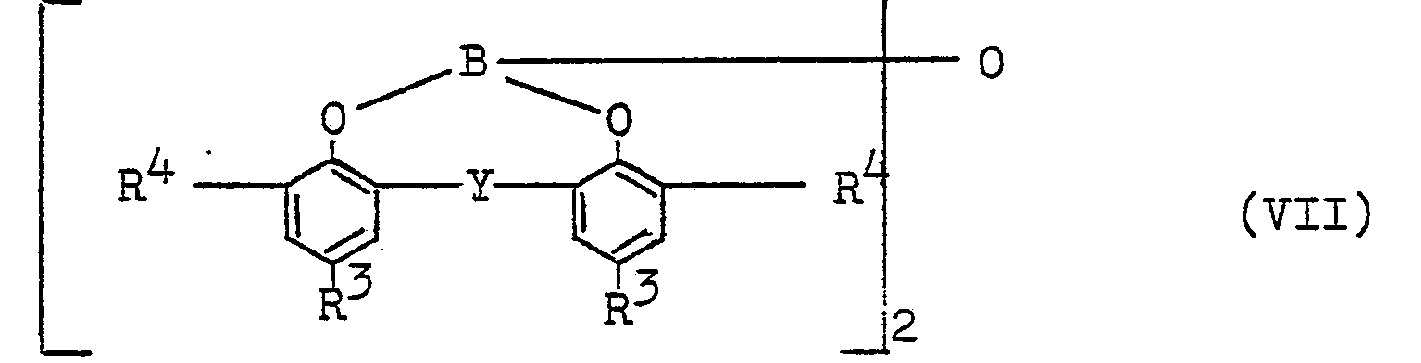
- Y, R3 und R4 die oben angegebene Bedeutung haben.
- Bevorzugt sind Stabilisatoren der Formel (I) und (II) mit X = H und R1 und R2 = Aromat, vorzugsweise substituiert mit C1-C9-Alkylresten in o- und/oder p-Stellung zur Esterbindung.
- Besonders bevorzugt sind Verbindungen der Formeln (III) und (VII), in denen
- X H, R3 einen C1-C9-Alkylrest, einen C5-C6-Cycloalkylrest, einen C7-C9-Aralkylrest, oder einen C6-C10-Arylrest bedeutet,
- R 4 einen Benzyl-, α-Methylbenzyl-, α,α-Dimethylbenzyl-, Methyl-, Ethyl-, Isopropyl-, tert.-Butyl-, tert.-Amyl-, Isononyl-, Cyclopentyl- oder Cyclohexylrest darstellt, und
- Y für S, CH29 CH3-CH,- CH3CH2CH, CH3CH2CH2-CH, (CH3)2CH-CH,

- Für die erfindungsgemäßen Formmassen können grundsätzlich alle thermoplastischen Polycarbonate verwendet werden.
- Unter aromatischen Polycarbonaten im Sinne der Erfindung werden Homopolycarbonate und Copolycarbonate verstanden, denen z.B. ein oder mehrere der folgenden Diphenole zugrundeliegen:
- Hydrochinon
- Resorcin
- Dihydroxidiphenyle
- Bis-(hydroxiphenyl)-alkane
- Bis-(hydroxiphenyl)-cycloalkane
- Bis-(hydroxiphenyl)-sulfide
- Bis-(hydroxiphenyl)-ether
- Bis-(hydroxiphenyl)-ketone
- Bis-(hydroxiphenyl)-sulfoxide
- Bis-(hydroxiphenyl)-sulfone
- α,α'-Bis-(hydroxiphenyl)-diisopropylbenzole,
- Bevorzugte Diphenole sind z.B.:
- 4,4'-Dihydroxidiphenyl
- 2,2-Bis-(4-hydroxiphenyl)-propan
- 2,4-Bis-(4-hydroxiphenyl)-2-methylbutan
- 1,1-Bis-(4-hydroxiphenyl)-cyclohexan
- α,α'-Bis-(4-hydroxiphenyl)-p-diisopropylbenzol
- 2,2-Bis-(3-methyl-4-hydroxiphenyl)-propan
- 2,2-Bis-(3-chlor-4-hydroxiphenyl)-propan
- Bis-(3,5-dimethyl-4-hydroxiphenyl)-methan
- 2,2-Bis-(3,5-dimethyl-4-hydroxiphenyl)-prepan
- Bis-(3,5-dimethyl-4-hydroxiphenyl)-sulfon
- 2,4-Bis-(3,5-dimethyl-4-hydroxiphenyl)-2-methylbutan
- 1,1-Bis-(3,5-dimethyl-4-hydroxiphenyl)-cyclohexan
- α,α'-Bis-(3,5-dimethyl-4-hydroxiphenyl)-p-diisopropylbenzol
- Le A 20 371
- 2,2-Bis-(3,5-dichlor-4-hydroxiphenyl)-propan
- 2,2-Bis-(3,5-dibrom-4-hydroxiphenyl)-propan.
- Besonders bevorzugte Diphenole sind z.B.:
- 2,2-Bis-(4-hydroxiphenyl)-propan
- 2,2-Bis-(3,5-dimethyl-4-hydroxiphenyl)-propan
- 2,2-Bis-(3,5-dichlor-4-hydroxiphenyl)-propan
- 2.,2-Bis-(3,5-dibrom-4-hydroxiphenyl)-propan
- 1,1-Bis-(4-hydroxiphenyl)-cyclohexan.
- Bevorzugte aromatische Polycarbonate sind solche, denen eines oder mehrere der als bevorzugt genannten Diphenole zugrundeliegen. Besonders bevorzugt werden Copolycarbonate, denen 2,2-Bis-(4-hydroxiphenyl)-propan.und eines der anderen als besonders bevorzugt genannten Diphenole zugrundeliegen. Besonders bevorzugt sind weiterhin Polycarbonate allein auf Basis von 2,2-Bis-(4-hydroxiphenyl)-propan oder 2,2-Bis-(3,5-dimethyl-4-hydroxiphenyl)-propan.
- Die aromatischen Polycarbonate können nach bekannten Verfahren hergestellt werden, z.B. einer Schmelzumesterung aus Bisphenol und Diphenylcarbonat und in Lösung aus Bisphenolen und Phosgen. Die Lösung kann homogen sein ("Pyridinverfahren") oder heterogen ("Zweiphasen-Grenzflächenverfahren"). Erfindungsgemäß sind Polycarbonate, die in Lösung, insbesondere nach dem Zweiphasen-Grenzflächenverfahren hergestellt worden sind, besonders geeignet.
- Die aromatischen Polycarbonate können durch den Einbau geringer Mengen, vorzugsweise von Mengen zwischen 0,05 und 2,0 Mol-96, bezogen auf eingesetzte Diphenole, an drei-oder mehr als dreifunktionellen Verbindungen, z.B. solchen mit drei oder mehr als drei phenolischen Hydroxigruppen, verzweigt sein.
- Polycarbonate dieser Art sind z.B. in den DE-OS 1 570 533; 1 595 762; 2 116 974; 2 113 347; 2 500 092, der GB-PS 1 079 821, der US-PS 3 544 514 beschrieben.
- Einige der verwendbaren Verbindungen mit drei oder mehr als drei phenolischen Hydroxigruppen sind beispielsweise Phloroglucin, 4,6-Dimethyl-2,4,6-tri-(4-hydroxiphenyl)-hepten-2, 4,6-Dimethyl-2,4,6-tri-(4-hydroxiphenyl)-heptan, 1,3,5-Tri-(4-hydroxiphenyl)-benzol, 1,1,1-Tri-(4-hydroxi- phenyl)-ethan, Tri-(4-hydroxiphenyl)-phenylmethan, 2,2-Bis-4,4-bis-(4-hydroxiphenyl)-cyclohexyl-propan, 2,4-Bis-(4-hydroxiphenyl-isopropyl)-phenol, 2,6-Bis-(2'-hydroxi-5'-methyl-benzyl)-4-methylphenol, 2-(4-Hydroxi- - phenyl)-2-(2,4-dihydroxiphenyl)-propan und 1,4-Bis-(4,4H- dihydroxitriphenyl-methyl)-benzol. Einige der sonstigen dreifunktionellen Verbindungen sind 2,4-Dihydroxibenzoesäure, Trimesinsäure, Cyanurchlorid und 3,3-Bis-(4-hydroxi- phenyl)-2-oxo-2,3-dihydroindol.
- Die aromatischen Polycarbonate sollen in der Regel mittlere Gewichtsmittel-Molekulargewichte
M W von 10 000 bis über 200 000, vorzugsweise von 20 000 bis 80 000 haben (ermittelt durch Messungen der rel. Viskosität in CH2C12 bei 250C bei einer Konzentration von 0,5 Gew.-%). - Im Falle von Polycarbonatmischungen können den hochmolekularen Polycarbonaten mit
M W von 10 000 bis 200 000 auch kleine Anteile niedermolekularer Polycarbonate, z.B. mit einem mittleren Polymerisationsgrad von 2 - 20, zugemischt sein. - Ein weiterer Bestandteil der Formmassen ist ein Pfropfpolymerisat (2.1), in welchem auf einen Kautschuk eine Monomerenmischung von 95 - 50 Gew.-% Styrol, Methylmethacrylat oder Mischungen daraus und 5 - 50 Gew.-% Acrylnitril, Methylmethacrylat oder Mischungen daraus pfropfpolymerisiert ist. Geeignete Kautschuke sind insbesondere Polybutadien, Butadien/Styrol-Copolymerisate mit bis zu 30 Gew.-% einpolymerisiertem Styrol, Copolymerisate von Butadien und Acrylnitril mit bis zu 20 Gew.-% Acrylnitril oder Copolymerisate von Butadien mit bis zu 20 Gew.-% eines niederen Alkylesters von Acryl- oder Methacrylsäure (z.B. Methylacrylat, Ethylacrylat, Methylmethacrylat und Ethylmethacrylat); prinzipiell sind alle elastifizierenden Komponenten geeignet, sofern sie ein kautschukelastisches Verhalten zeigen.
- Neben dem Pfropfpolymerisat kann die Formmasse noch ein Butadienpolymerisat (2.2.) enthalten.
- Die Butadienpolymerisate, die in den Formmassen enthalten sind, sind bevorzugt Copolymerisate von 5 - 95 Gew.-% Butadien und 70 - 5 Gew.-% Acrylnitril, Acrylsäure, Methacrylsäure, C1-C6-Alkylester der Acryl- oder Methacrylsäure (besonders bevorzugt Methylmethacrylat), Divinylbenzol und Mischungen dieser Comonomeren. Insbesondere sind geeignet Copolymerisate aus 70 - 90 Gew.-% Butadien und 30 - 10 Gew.-% Styrol, Copolymerisate aus 60 - 95 Gew.- % Butadien und 40 - 5 Gew.-% Methylmethacrylat, Copolymerisate von 30 - 95 Gew.-% Butadien und 70 - 5 Gew.-% Acrylsäurebutylester, sowie Copolymerisate aus 60 - 80 Gew.-% Butadien und 40 - 20 Gew.-% Acrylnitril. In diesen letzteren Copolymerisaten können auch noch zusätzlich kleinere Mengen (bis etwa insgesamt 10 %) Methacrylsäure und/oder Divinylbenzol einpolymerisiert sein. Beispiele für Ter- bzw. Quarterpolymerisate der letztgenannten Art sind Copolymerisate aus 63 % Butadien, 34 % Acrylnitril und 3 % Methacrylsäure oder Copolymerisate aus 60 Gew.-% Butadien, 36 Gew.-% Acrylnitril, 3 % Methacrylsäure und 1 % Divinylbenzol.
- Neben dem Pfropfcopolymerisat kann die Formmasse noch ein Copolymerisat (2.3) aus den Pfropfmonomeren oder ähnlichen Monomeren enthalten. Es handelt sich um Copolymerisate aus 95 - 50 Gew.-% Styrol, C4-Methylstyrol, Methylmethacrylat oder Mischungen daraus mit 5 - 50 Gew.-% Acrylnitril, Methacrylnitril, Methylmethacrylat oder Mischungen daraus. Solche Copolymeren entstehen häufig bei der Pfropfpolymerisation als Nebenprodukte, besonders dann, wenn große Mengen Monomerer auf kleine Mengen Kautschuk gepfropft werden. Es ist dabei möglich, neben oder anstelle der so entstandenen Copolymeren noch getrennt hergestellte Copolymere dieser Art zuzumischen.
- Die erfindungsgemäßen Formmassen können durch Vermischen der Einzelkomponenten erhalten werden. In einer bevorzugten Herstellungsmethode werden zunächst die Latices des Pfropfpolymerisats (2.1) und gegebenenfalls die des Butadienpolymerisats (2.2) und des Copolymerisats (2.3) gemischt und die Feststoffe gemeinsam ausgefällt und getrocknet. Die so erhaltene Pulvermischung wird dann mit dem Polycarbonat abgemischt. Die Einzelkomponenten der erfindungsgemäßen Formmassen können aber auch getrennt hergestellt und dann auf bekannten Mischvorrichtungen gemischt werden. Geeignet sind hierfür z.B. Mischwalzwerke, Schneckenextruder oder Innenmischer.
- Die Einarbeitung der erfindungsgemäßen Stabilisatoren kann nach bekannten Techniken in jeglicher Weise erfolgen. So können die Stabilisatoren z.B. über Kneter oder Schneckenmaschinen sowohl vorher in die Einzelkomponenten der Mischung als auch direkt bei der thermoplastischen Verarbeitung der Einzelkomponenten zur Gesamtmischung oder auch nachträglich in die Gesamtmischung selbst eingearbeitet werden.
- Entweder enthalten die Einzelkomponenten der erfindungsgemäßen Formmassen Zusätze wie Stabilisatoren, Flammschutzmittel, Pigmente, Fließmittel, Gleitmittel, Entformungsmittel, Antistatika, oder bei der Vermischung der Einzelkomponenten können die oben genannten Zusätze zugefügt werden.
- Die Formmassen der vorliegenden Erfindung können zur Herstellung von Formkörpern jeder Art verwendet werden. Insbesondere können Formkörper durch Spritzguß hergestellt werden. Beispiele für herstellbare Formkörper sind: Gehäuseteile jeder Art (z.B. für Haushaltsgeräte wie Saftpressen, Kaffeemaschinen, Mixer) oder Abdeckplatten für den Bausektor und Teile für den Kfz-Sektor. Sie werden außerdem auf dem Gebiet der Elektrotechnik eingesetzt, weil sie sehr gute elektrische Eigenschaften haben. Eine weitere Form der Verarbeitung ist die Herstellung von Formkörpern durch Tiefziehen aus vorher hergestellten Platten oder Folien.
- Borsäureester aus Phenol und Bis-(2-hydroxi-3-cyclohexyl-5-methylphenyl)-methan

- Borsäureester aus Bis-(2-hydroxi-3-cyclohexyl-5-methylphenyl)-methan

- Borsäureester aus Stearylalkohol und Bis-(2-hydroxi-3-cyclohexyl-5-methylphenyl)-methan

- Borsäureester aus Bis(2-hydroxi-3-tert.-butyl-5-methylphenyl)-methan

- Man erhält als Rückstand ein gelbes, sprödes Harz 183 g Tp. 150 - 2°C (aus Ligroin).
- Borsäureester aus Phenol und Bis-(2-hydroxi-3,5-dimethyl-phenyl)-isobutan-1,1


- Borsäureester aus Bis-(2-hydroxi-3-styryl-5-methylphenyl)-methan

- Borsäureester aus Bis-(2-hydroxi-3-tert.-butyl-5-methylphenyl)-sulfid

- Borsäureester aus Phenol und Bis-(2-hydroxi-3-styryl-5-methylphenyl)-methan


- Borsäureester aus Bis-(2-hydroxi-3-cyclohexyl-5-methyl-phenyl)-sulfid


- Borsäureester aus Phenol und Bis-(2-hydroxi-3-styryl-5-methylphenyl)-sulfid

- 235,2 g (1,02 Mol) Borsäuretributylester werden mit 712,5 g 3-Ethyl-3-hydroxiethyloxetan vermischt. Dann werden 1,5 g Natriummethylat zugesetzt. Die Lösung wird unter, Rühren und Einleiten von Stickstoff innerhalb von 3 Std. auf 160°C hochgeheizt. Dabei destillieren über eine Kolonne 200 g Destillat bei einer Kopftemperatur von 117 bis 1180C ab. Dann wird die Reaktionsmischung abgekühlt, die Kolonne abgenommen und ein Vakuum von 20 Torr angelegt. Unter diesen Bedingungen destillieren bei nochmaligem Aufheizen bis auf eine Sumpftemperatur von 120°C 24 g Destillat ab. Der Rückstand wird im Hochvakuum fraktioniert. Nach einem Vorlauf von 365 g, der von 75 - 1650C/0,2 Torr übergeht, destilliert das Reaktionsprodukt im Bereich von 165 - 1700C/0,2 Torr über.
- Es werden 256 g = 70,4 % der Theorie erhalten.
-

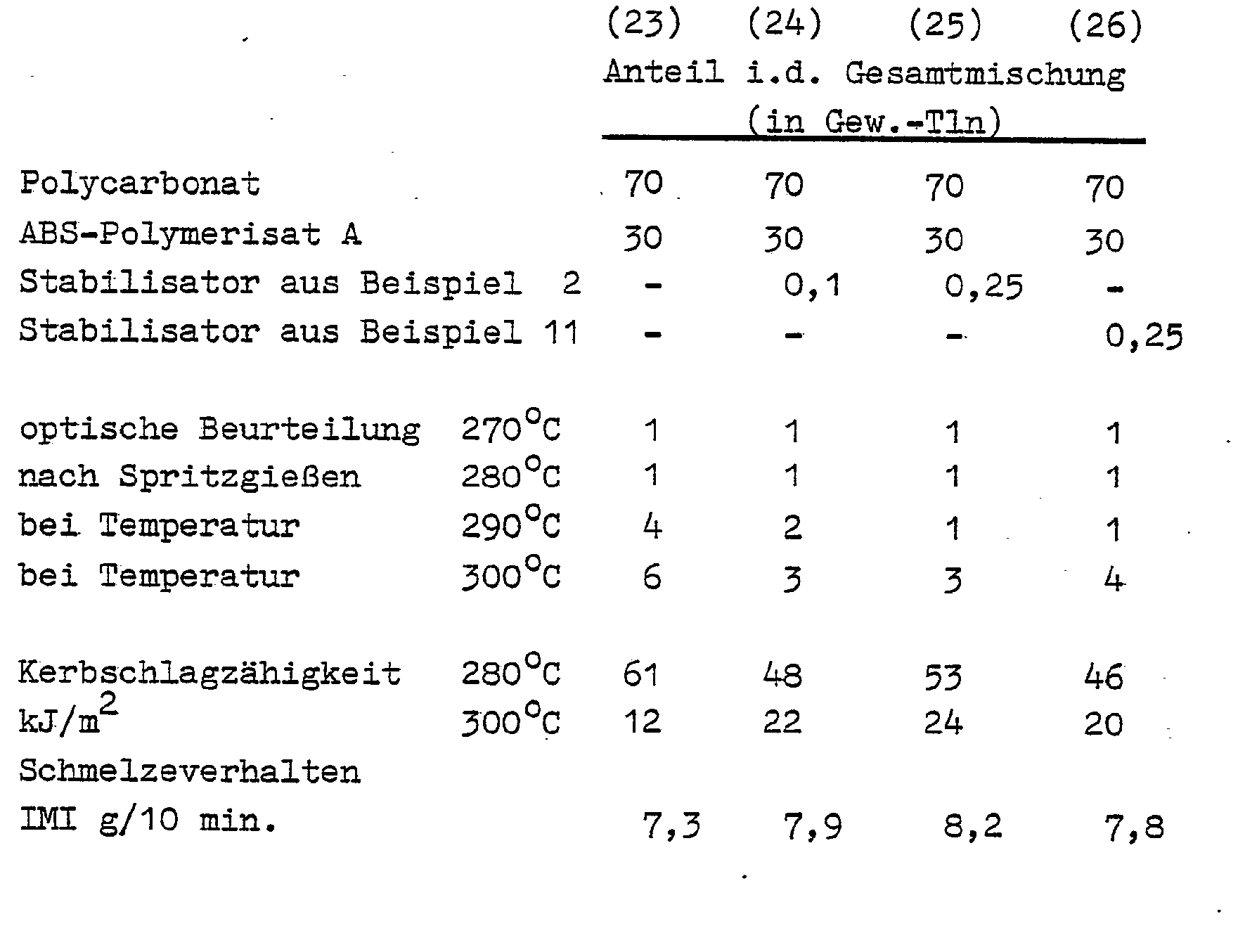
- Die Formmassen der nachfolgenden Beispiele wurden auf einem Innenkneter bei 230°C bzw. einem Doppelwellenextruder bei. 260°C durch Mischen des ABS-Polymerisats mit der Polycarbonatkomponente und dem jeweiligen Stabilisator hergestellt.
- Die Eigenschaften der Formmassen wurden nach folgenden Methoden bestimmt:
- 1. Kerbschlagzähigkeit nach DIN 53 453 bei Raumtemperatur. Die Prüfkörper wurden bei den angegebenen Massetemperaturen auf Schneckenspritzgießmaschinen hergestellt.
- 2. Die optische Beurteilung erfolgt an spritzgegossenen Musterplatten (60 x 40 x 2 mm). Zugrundegelegt wurde eine Bewertungsskala von 1 - 7. Hierin bedeutet
- 1 einwandfreie Oberfläche,
- 3 - 4 geringfügige, vertretbare Oberflächenstörungen,
- 7 starke Schlieren.
- 3. Der Intrinsic-Melt-Index (IMI) und die theoretische Halbwertszeit th wurden bei 5-kg-Belastung nach DIN 53 735 bei 260°C gemessen.
- Bei diesen Beispielen wurden ein Polycarbonat auf Basis Bisphenol A mit einer relativen Lösungsviskosität rel = 1,290 bis 1,300 (0,5 g Polycarbonat in 100 ml Methylenchlorid bei 25°C) und folgende ABS-Polymerisate verwendet:
-
- a. 60 Gew.-Tle eines Pfropfpolymerisats, hergestellt durch Pfropfung von 35 Gew.-Tln Styrol und 15 Gew.-Tln Acrylnitril auf 50 Gew.-Tle eines grobteiligen Polybutadiens (gemäß den Angaben der DE-AS 1 247 665 und 1 269 360 über eine Emulsionspolymerisation), wobei der mittlere Teilchendurchmesser der in Latexform vorliegenden Polybutadienpfropfgrundlage zwischen 0,3 und 0,4/u liegt, und
- b. 40 Gew.-Tle eines Styrol-Acrylnitril-Copolymerisats mit einem Styrol-Acrylnitril-Verhältnis von 70 : 30 und einer Grenzviskosität von [η] = 79,1 (Messung in Dimethylformamid bei 20°C).
-
- a.) 70 Gew.-Tle eines Pfropfpolymerisats, hergestellt durch Pfropfung von 35 Gew.-Tln Styrol und 15 Gew.-Tln Acrylnitril auf 50 Gew.-Tle eines feinteiligen Polybutadiens mit einem mittleren Teilchendurchmesser von 0,05 - 0,15/u, und
- b.) 30 Gew.-Tle eines Copolymerisats aus Styrol-Acrylnitril im Verhältnis 70 : 30 mit einer Grenzviskosität von [η] = 80,9.


-
sowie deren kernalkylierte und kernhalogenierte Verbindungen. Diese und weitere geeignete Diphenole sind z.B. in den US-Patentschriften 3 028 365; 2 999 835; 3 148 172; 3 275 601; 2 991 273; 3 271 367; 3 062 781 und 2 999 846, in den deutschen Offenlegungsschriften 1 570 703; 2 063 050; 2 063 052; 2 211 956; 2 211 957, der französischen Patentschrift 1 561 518 und der Monographie "H. Schnell, Chemistry and Physics of Polycarbonates, Interscience Publishers, New York, 1964" beschrieben.

Claims (6)
1. Mischungen aus aromatischen Polycarbonaten und ABS-Kunststoffen, die 0,01 bis 3,0 Gew.-%, bezogen auf Gesamtmischung, eines Esters der Borsäure als Stabilisator enthalten.
2.. Mischungen gemäß Anspruch 1, dadurch gekennzeichnet, daß der Ester der Borsäure ein Ester eines o- und/oder p-alkylsubstituierten Phenols oder eines Bisphenols ist.
3. Verwendung von Borsäureestern in Mengen von 0,01 bis 3,0 Gew.-%, bezogen auf Gesamtmischung, als Stabilisatoren für Gemische aus aromatischen Polycarbonaten und ABS-Kunststoffen.
4. Verwendung eines Esters der Borsäure mit einem o- und/ oder p-alkylsubstituierten Phenol oder einem Bisphenol gemäß Anspruch 3.
5. Verfahren zum Stabilisieren eines Gemisches aus aromatischem Polycarbonat und ABS-Kunststoff, dadurch gekennzeichnet, daß man 0,01 bis 3,0 Gew.-%, bezogen auf Gesamtmischung, eines Borsäureesters einarbeitet.
6. Verfahren nach Anspruch 5, dadurch gekennzeichnet, daß man einen Ester der Borsäure mit o- und/oder p-alkyl- substituierten Phenolen oder einem Bisphenol einarbeitet.
Applications Claiming Priority (2)
| Application Number | Priority Date | Filing Date | Title |
|---|---|---|---|
| DE19803021726 DE3021726A1 (de) | 1980-06-10 | 1980-06-10 | Stabilisierte thermoplastische formmassen |
| DE3021726 | 1980-06-10 |
Publications (1)
| Publication Number | Publication Date |
|---|---|
| EP0042094A1 true EP0042094A1 (de) | 1981-12-23 |
Family
ID=6104255
Family Applications (1)
| Application Number | Title | Priority Date | Filing Date |
|---|---|---|---|
| EP81104167A Withdrawn EP0042094A1 (de) | 1980-06-10 | 1981-06-01 | Stabilisierte thermoplastische Formmassen |
Country Status (4)
| Country | Link |
|---|---|
| US (1) | US4415692A (de) |
| EP (1) | EP0042094A1 (de) |
| JP (1) | JPS5725350A (de) |
| DE (1) | DE3021726A1 (de) |
Cited By (1)
| Publication number | Priority date | Publication date | Assignee | Title |
|---|---|---|---|---|
| EP0189583A3 (en) * | 1985-01-02 | 1987-12-02 | General Electric Company | Polycarbonate compositions containing boron compounds |
Families Citing this family (5)
| Publication number | Priority date | Publication date | Assignee | Title |
|---|---|---|---|---|
| JPS6016355A (ja) * | 1983-07-05 | 1985-01-28 | Toyoda Mach Works Ltd | 平面研削装置 |
| GB8617004D0 (en) * | 1986-07-11 | 1986-08-20 | Bp Chem Int Ltd | Polymer composition |
| GB8829535D0 (en) * | 1988-12-19 | 1989-02-08 | Monsanto Europe Sa | Resin compositions |
| RU2115675C1 (ru) * | 1997-06-02 | 1998-07-20 | Закрытое акционерное общество "Фирма "Экорпласт" | Термопластичная полимерная композиция |
| US6414060B1 (en) | 1999-07-07 | 2002-07-02 | Albemarle Corporation | Flame retardant polycarbonate-ABS polymer compositions |
Citations (2)
| Publication number | Priority date | Publication date | Assignee | Title |
|---|---|---|---|---|
| DE1170141B (de) * | 1961-03-24 | 1964-05-14 | Borg Warner | Polycarbonat-Spritzgussmassen |
| DE1239471B (de) * | 1963-03-09 | 1967-04-27 | Bayer Ag | Stabilisieren hochmolekularer linearer thermoplastischer Polycarbonate gegen Abbau durch Feuchtigkeit |
Family Cites Families (6)
| Publication number | Priority date | Publication date | Assignee | Title |
|---|---|---|---|---|
| US3361672A (en) * | 1965-10-23 | 1968-01-02 | Mobil Oil Corp | Stabilized organic compositions |
| US3669926A (en) * | 1967-06-21 | 1972-06-13 | Universal Oil Prod Co | Stabilizing plastic with borated dihydroxydiphenyl sulfide |
| JPS559435B2 (de) * | 1972-08-30 | 1980-03-10 | ||
| JPS52103449A (en) * | 1976-02-27 | 1977-08-30 | Adeka Argus Chem Co Ltd | Stabilized synthetic resin compositions |
| DE2750043A1 (de) * | 1977-11-09 | 1979-05-10 | Bayer Ag | Verwendung von borsaeureestern zum stabilisieren von phosphitfreien polycarbonaten |
| US4211679A (en) * | 1978-09-28 | 1980-07-08 | General Electric Company | Organoboron plasticized polycarbonate composition |
-
1980
- 1980-06-10 DE DE19803021726 patent/DE3021726A1/de not_active Withdrawn
-
1981
- 1981-05-29 US US06/268,365 patent/US4415692A/en not_active Expired - Fee Related
- 1981-06-01 EP EP81104167A patent/EP0042094A1/de not_active Withdrawn
- 1981-06-05 JP JP8583781A patent/JPS5725350A/ja active Pending
Patent Citations (2)
| Publication number | Priority date | Publication date | Assignee | Title |
|---|---|---|---|---|
| DE1170141B (de) * | 1961-03-24 | 1964-05-14 | Borg Warner | Polycarbonat-Spritzgussmassen |
| DE1239471B (de) * | 1963-03-09 | 1967-04-27 | Bayer Ag | Stabilisieren hochmolekularer linearer thermoplastischer Polycarbonate gegen Abbau durch Feuchtigkeit |
Cited By (1)
| Publication number | Priority date | Publication date | Assignee | Title |
|---|---|---|---|---|
| EP0189583A3 (en) * | 1985-01-02 | 1987-12-02 | General Electric Company | Polycarbonate compositions containing boron compounds |
Also Published As
| Publication number | Publication date |
|---|---|
| DE3021726A1 (de) | 1981-12-17 |
| US4415692A (en) | 1983-11-15 |
| JPS5725350A (en) | 1982-02-10 |
Similar Documents
| Publication | Publication Date | Title |
|---|---|---|
| EP0023291B2 (de) | Stabilisierte thermoplastische Formmassen auf Basis von Polycarbonaten, ABS-Polymeren und Phosphiten | |
| EP0576950B1 (de) | Thermoplastische Formmassen | |
| DE2712171A1 (de) | Thermoplastische formmassen | |
| DE69920200T2 (de) | Kompatibilisierte abs-polycarbonat-formmasse | |
| EP0182226A2 (de) | Verfahren zur Herstellung von Tetrafluorethylenpolymerisathaltigen, flammwidrigen Polycarbonatformmassen | |
| EP0089540A1 (de) | Polycarbonatabmischungen | |
| EP0436186B1 (de) | Wärmeformbeständige, gut verarbeitbare und thermostabile Polycarbonat-Formmassen | |
| DE19946129A1 (de) | Hydrolysestabile Polycarbonat-Formmasse | |
| EP0401629B1 (de) | Hochwärmeformbeständige Polycarbonat/ABS-Mischungen | |
| DE3619059A1 (de) | Leicht entformbare formmassen | |
| EP0403837A2 (de) | Polycarbonat-Formmassen | |
| DE3641990A1 (de) | Thermoplastische formmassen auf basis spezieller pfropfpolymerisate | |
| EP0183116B1 (de) | Thermoplastische Formmassen mit flammwidrigen Eigenschaften | |
| EP0028753A1 (de) | Thermoplastische Formmassen aus Polycarbonat, Polyolefin und Butadienpolymerisat | |
| EP0064692A2 (de) | Thermoplastische Formmassen aus aromatischem Polycarbonat und Pfropfpolymerisat | |
| DE3002662A1 (de) | Flammwidrige thermoplastische formmassen aus polycarbonaten und abs-polymerisaten | |
| EP0174503A1 (de) | Acrylnitrilfreie Blends aus Polycarbonat, Methylmethacrylat, Pfropfkautschuk und einem Terpolymerisatharz | |
| DE3021726A1 (de) | Stabilisierte thermoplastische formmassen | |
| EP0224111A2 (de) | Thermoplastische Formmassen auf Basis Polyphenylenoxid-Polycarbonat-Blockkondensaten | |
| EP0176811B1 (de) | Neue Stabilisatoren für ABS-Kunststoffe und ABS-Legierungen | |
| EP0576948B1 (de) | Thermoplastische Formmassen | |
| EP0445402B1 (de) | Thermostabile Formmassen | |
| DE3326562A1 (de) | Polycarbonat-gemische mit verbesserter schlagzaehigkeit | |
| EP0410239A1 (de) | Polycarbonat-Formmassen | |
| DE19632701B4 (de) | Stabilisierung von ABS-Pfropfpolymerisaten mit Dithiodipropionsäure und sterisch gehinderten Phenolen |
Legal Events
| Date | Code | Title | Description |
|---|---|---|---|
| PUAI | Public reference made under article 153(3) epc to a published international application that has entered the european phase |
Free format text: ORIGINAL CODE: 0009012 |
|
| 17P | Request for examination filed |
Effective date: 19810601 |
|
| AK | Designated contracting states |
Designated state(s): DE FR GB IT NL |
|
| STAA | Information on the status of an ep patent application or granted ep patent |
Free format text: STATUS: THE APPLICATION HAS BEEN WITHDRAWN |
|
| 18W | Application withdrawn |
Withdrawal date: 19830616 |
|
| RIN1 | Information on inventor provided before grant (corrected) |
Inventor name: IDEL, KARSTEN, DR. Inventor name: PETERS, HORST, DR. Inventor name: BUYSCH, HANS-JOSEF, DR. Inventor name: BUEKERS, JOSEF |