EP0043301A1 - Procédé de fabrication d'oxyde de gallium - Google Patents
Procédé de fabrication d'oxyde de gallium Download PDFInfo
- Publication number
- EP0043301A1 EP0043301A1 EP81400933A EP81400933A EP0043301A1 EP 0043301 A1 EP0043301 A1 EP 0043301A1 EP 81400933 A EP81400933 A EP 81400933A EP 81400933 A EP81400933 A EP 81400933A EP 0043301 A1 EP0043301 A1 EP 0043301A1
- Authority
- EP
- European Patent Office
- Prior art keywords
- gallium
- ripening
- oxyhydroxide
- hydroxide
- carried out
- Prior art date
- Legal status (The legal status is an assumption and is not a legal conclusion. Google has not performed a legal analysis and makes no representation as to the accuracy of the status listed.)
- Granted
Links
- 238000000034 method Methods 0.000 title claims abstract description 30
- 229910001195 gallium oxide Inorganic materials 0.000 title claims abstract description 18
- AJNVQOSZGJRYEI-UHFFFAOYSA-N digallium;oxygen(2-) Chemical compound [O-2].[O-2].[O-2].[Ga+3].[Ga+3] AJNVQOSZGJRYEI-UHFFFAOYSA-N 0.000 title claims abstract description 17
- 238000004519 manufacturing process Methods 0.000 title claims abstract description 13
- 230000005070 ripening Effects 0.000 claims abstract description 14
- 229910021513 gallium hydroxide Inorganic materials 0.000 claims abstract description 12
- DNUARHPNFXVKEI-UHFFFAOYSA-K gallium(iii) hydroxide Chemical compound [OH-].[OH-].[OH-].[Ga+3] DNUARHPNFXVKEI-UHFFFAOYSA-K 0.000 claims abstract description 12
- 238000001914 filtration Methods 0.000 claims abstract description 11
- 150000002258 gallium Chemical class 0.000 claims abstract description 8
- 239000012266 salt solution Substances 0.000 claims abstract description 8
- 238000003756 stirring Methods 0.000 claims abstract description 6
- 238000001556 precipitation Methods 0.000 claims description 11
- QGZKDVFQNNGYKY-UHFFFAOYSA-N Ammonia Chemical compound N QGZKDVFQNNGYKY-UHFFFAOYSA-N 0.000 claims description 10
- 239000000243 solution Substances 0.000 claims description 8
- CHPZKNULDCNCBW-UHFFFAOYSA-N gallium nitrate Chemical compound [Ga+3].[O-][N+]([O-])=O.[O-][N+]([O-])=O.[O-][N+]([O-])=O CHPZKNULDCNCBW-UHFFFAOYSA-N 0.000 claims description 6
- 229910021529 ammonia Inorganic materials 0.000 claims description 5
- 239000000203 mixture Substances 0.000 claims description 5
- UPWPDUACHOATKO-UHFFFAOYSA-K gallium trichloride Chemical compound Cl[Ga](Cl)Cl UPWPDUACHOATKO-UHFFFAOYSA-K 0.000 claims description 4
- XSQUKJJJFZCRTK-UHFFFAOYSA-N Urea Chemical compound NC(N)=O XSQUKJJJFZCRTK-UHFFFAOYSA-N 0.000 claims description 3
- 229940044658 gallium nitrate Drugs 0.000 claims description 3
- CDBYLPFSWZWCQE-UHFFFAOYSA-L Sodium Carbonate Chemical compound [Na+].[Na+].[O-]C([O-])=O CDBYLPFSWZWCQE-UHFFFAOYSA-L 0.000 claims description 2
- BVCZEBOGSOYJJT-UHFFFAOYSA-N ammonium carbamate Chemical compound [NH4+].NC([O-])=O BVCZEBOGSOYJJT-UHFFFAOYSA-N 0.000 claims description 2
- 239000004202 carbamide Substances 0.000 claims description 2
- KXDHJXZQYSOELW-UHFFFAOYSA-N carbonic acid monoamide Natural products NC(O)=O KXDHJXZQYSOELW-UHFFFAOYSA-N 0.000 claims description 2
- 239000012429 reaction media Substances 0.000 claims description 2
- VKYKSIONXSXAKP-UHFFFAOYSA-N hexamethylenetetramine Chemical compound C1N(C2)CN3CN1CN2C3 VKYKSIONXSXAKP-UHFFFAOYSA-N 0.000 claims 2
- 235000010299 hexamethylene tetramine Nutrition 0.000 claims 1
- 239000004312 hexamethylene tetramine Substances 0.000 claims 1
- 229960004011 methenamine Drugs 0.000 claims 1
- GYHNNYVSQQEPJS-UHFFFAOYSA-N Gallium Chemical compound [Ga] GYHNNYVSQQEPJS-UHFFFAOYSA-N 0.000 description 10
- 229910052733 gallium Inorganic materials 0.000 description 10
- 238000005406 washing Methods 0.000 description 7
- 239000002244 precipitate Substances 0.000 description 6
- 239000000047 product Substances 0.000 description 6
- 239000013078 crystal Substances 0.000 description 4
- XLYOFNOQVPJJNP-UHFFFAOYSA-N water Substances O XLYOFNOQVPJJNP-UHFFFAOYSA-N 0.000 description 4
- HEMHJVSKTPXQMS-UHFFFAOYSA-M Sodium hydroxide Chemical compound [OH-].[Na+] HEMHJVSKTPXQMS-UHFFFAOYSA-M 0.000 description 3
- 238000006243 chemical reaction Methods 0.000 description 3
- 239000012065 filter cake Substances 0.000 description 3
- 230000001105 regulatory effect Effects 0.000 description 3
- 239000007787 solid Substances 0.000 description 3
- NLXLAEXVIDQMFP-UHFFFAOYSA-N Ammonium chloride Substances [NH4+].[Cl-] NLXLAEXVIDQMFP-UHFFFAOYSA-N 0.000 description 2
- VHUUQVKOLVNVRT-UHFFFAOYSA-N Ammonium hydroxide Chemical compound [NH4+].[OH-] VHUUQVKOLVNVRT-UHFFFAOYSA-N 0.000 description 2
- 235000011114 ammonium hydroxide Nutrition 0.000 description 2
- 238000001354 calcination Methods 0.000 description 2
- XLYOFNOQVPJJNP-UHFFFAOYSA-M hydroxide Chemical compound [OH-] XLYOFNOQVPJJNP-UHFFFAOYSA-M 0.000 description 2
- 150000003839 salts Chemical class 0.000 description 2
- 238000004626 scanning electron microscopy Methods 0.000 description 2
- VEXZGXHMUGYJMC-UHFFFAOYSA-M Chloride anion Chemical compound [Cl-] VEXZGXHMUGYJMC-UHFFFAOYSA-M 0.000 description 1
- 229910052688 Gadolinium Inorganic materials 0.000 description 1
- 229910002651 NO3 Inorganic materials 0.000 description 1
- NHNBFGGVMKEFGY-UHFFFAOYSA-N Nitrate Chemical compound [O-][N+]([O-])=O NHNBFGGVMKEFGY-UHFFFAOYSA-N 0.000 description 1
- QAOWNCQODCNURD-UHFFFAOYSA-L Sulfate Chemical compound [O-]S([O-])(=O)=O QAOWNCQODCNURD-UHFFFAOYSA-L 0.000 description 1
- 238000013019 agitation Methods 0.000 description 1
- 238000009835 boiling Methods 0.000 description 1
- 150000001805 chlorine compounds Chemical class 0.000 description 1
- 238000010908 decantation Methods 0.000 description 1
- 230000007547 defect Effects 0.000 description 1
- 230000018044 dehydration Effects 0.000 description 1
- 238000006297 dehydration reaction Methods 0.000 description 1
- 238000001035 drying Methods 0.000 description 1
- 239000008394 flocculating agent Substances 0.000 description 1
- UIWYJDYFSGRHKR-UHFFFAOYSA-N gadolinium atom Chemical compound [Gd] UIWYJDYFSGRHKR-UHFFFAOYSA-N 0.000 description 1
- 125000004836 hexamethylene group Chemical group [H]C([H])([*:2])C([H])([H])C([H])([H])C([H])([H])C([H])([H])C([H])([H])[*:1] 0.000 description 1
- 230000007774 longterm Effects 0.000 description 1
- 238000002156 mixing Methods 0.000 description 1
- 230000009257 reactivity Effects 0.000 description 1
- 238000010992 reflux Methods 0.000 description 1
- 239000003643 water by type Substances 0.000 description 1
Images

Classifications
-
- C—CHEMISTRY; METALLURGY
- C01—INORGANIC CHEMISTRY
- C01G—COMPOUNDS CONTAINING METALS NOT COVERED BY SUBCLASSES C01D OR C01F
- C01G15/00—Compounds of gallium, indium or thallium
Definitions
- the present invention relates to a process for the manufacture of gallium oxide.
- gallium oxide The processes for manufacturing gallium oxide are known by precipitation and then dehydration of the hydroxide. More preclsement it is known to precipitate the hydroxide with a base such as NaOH or NH 4 0H from solutions of sulfate, nitrate or gallium chloride.
- a base such as NaOH or NH 4 0H from solutions of sulfate, nitrate or gallium chloride.
- Such a method has many drawbacks. It leads to a precipitate whose filtration and washing can prove to be very difficult. Furthermore, the morphology of the product obtained can prove to be unfavorable, in particular for the manufacture of gallium-based garnets by solid-solid reaction. For example, a gallium oxide prepared by this process may have a significant needle phase alongside an agglomerated phase.
- the Applicant has developed a process for the manufacture of gallium oxide which makes it possible to obtain excellent filtration of the precipitate and which leads to a homogeneous product consisting of well individualized gallium oxide crystals in the form of small needles and whose reactivity, particularly in solid-solid reactions for manufacturing gallium-based garnets, is excellent.
- This process notably includes a precipitation step under well-defined pH conditions and a hot-ripening step which leads to the production of gallium oxyhydroxide which is dried and then calcined to obtain gallium oxide .
- the process for manufacturing gallium oxide according to the invention comprises a step a) according to which a gallium salt solution is mixed with stirring with a base in order to obtain gallium hydroxide.
- the gallium salt solution that can be used is any solution capable of forming gallium hydroxide by contacting with a base.
- the gallium concentration of the gallium salt solution can vary within wide limits, for example from 1 to 150 g / l; it can advantageously be between 40 and 100 g / 1. It is preferred to use a chloride solution or a gallium nitrate solution.
- the base used can in particular be chosen from: ammonia, ammonia, soda, urea, hexamethylene tetamine, ammonium carbamate ... ... It is preferable to use ammonia .
- the pH of the reaction medium is advantageously maintained between approximately 6 and 8.5 and preferably between 6.4 and 6.8. In these intervals it may be advantageous to keep the pH at a constant value of ⁇ 0.1 pH unit.
- the mixing is carried out hot, that is to say at a temperature between about 60 and 100 ° C. and more particularly between 95 and 100 ° C. It is advantageously carried out at boiling under reflux.
- step b) of the process of the invention the gallium hydroxide Ga (OH) matures so as to transform it into gallium oxyhydroxide GaO (OH).
- the ripening is carried out hot, that is to say at a temperature between about 60 and 100 ° C and preferably between 95 ° C and 100 ° C.
- the pH of the medium is maintained between approximately 6 and 7 and preferably between 6.5 and 7. It is more particularly regulated at a constant value in this range at ⁇ 0.2 pH units.
- the ripening time depends in particular on the conditions under which the precipitation of the gallium hydroxide is carried out, it is generally between approximately 1 hour and 10 hours.
- step c) of the process of the invention the oxyhydroxide obtained is filtered under pressure or under vacuum.
- the filter element used should preferably have a very low porosity of the order of 1 to 5 microns.
- the filtration of the oxyhydroxide can be carried out by adding to the precipitate, before or after ripening, a flocculating agent which can be decomposed at low temperature.
- washing of the oxyhydroxide is carried out according to the process of the invention before and / or after the filtration operation. Washing is preferably carried out with water until washing waters having a pH close to neutrality are obtained.
- the main purpose of this washing is to remove the salts formed during precipitation, it can in particular be carried out either by transfer through the oxyhydroxide cake of a certain volume of water, or by resuspension of the cake. filtration.
- the process of the invention thus allows, compared to the processes of the prior art, to operate the filtration-washing operations with very great ease and much more quickly.
- the oxyhydroxide is then dried in air or under vacuum at temperatures between about 100 ° C and 200 ° C for about 5 to 15 hours. This drying is preferably carried out in an oven at a temperature between 110 and 150 ° C for a time between 10 and 12 hours.
- the dried product is calcined at a temperature between 800 and 1400 ° C. depending on the nature of the starting salt.
- calcination at a temperature in the region of 1200 ° C. proves to be advantageous in order to remove all of the chlorides remaining after washing.
- the calcination time to obtain the gallium oxide Ga2 0 3 is preferably between approximately 1 and 10 hours and more particularly between 2 and 4 hours.
- the gallium oxide obtained generally has a specific surface of between approximately 0.5 and 12 m 2 / g and a density close to approximately 6.0.
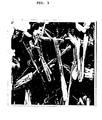
- the scanning electron microscope reveals the existence of elementary crystals in the form of needles, the length of which is generally between approximately 2 and 30 microns and the width between 1 and 3 microns.
- gallium oxide obtained according to the method of the present invention can be used in particular in electronics for the manufacture of garnets, phosphors, etc.
- the temperature is maintained at 95 ° C.
- the ripening of the precipitate is then carried out at 95 ° C. for 2 hours. During the ripening the pH is maintained at the value of 6.7.
- the oxyhydroxide obtained is washed by three decantation operations with a volume of water equal to the volume of the mother liquors.
- the oxyhydroxide is then filtered through a Nutche filter.
- the filtration speed is around 3m 3 / h / m 2 .
- the filter cake is dried in an oven at 130 ° C for 15 hours, then calcined at 1200 ° C for 3 hours.
- the gallium oxide obtained has a specific surface of 4m 2 / g and a density of 6.0.
- the temperature is maintained at 100 ° C.
- the precipitation lasted 4 hours.
- the precipitate is then ripened at 98 ° C for 4 hours. During ripening, the pH is maintained at the value of 6.60.
- the oxyhydroxide obtained is filtered on a Nutche filter.
- the filtration speed is of the order of 2.5 m 3 / h / m 2 .
- the oxyhydroxide is then washed by passing 200 liters of water through the filter cake.
- the filter cake is dried at study at 120 ° C for 15 hours, then calcined at 125 ° C for 10 hours.
- the gallium oxide obtained has a specific surface of 2 m 2 / g and a density of 6.0.
Landscapes
- Chemical & Material Sciences (AREA)
- Organic Chemistry (AREA)
- Inorganic Chemistry (AREA)
- Catalysts (AREA)
- Inorganic Compounds Of Heavy Metals (AREA)
- Crystals, And After-Treatments Of Crystals (AREA)
- Glass Compositions (AREA)
Abstract
Description
- La présente invention a pour objet un procédé de fabrication d'oxyde de gallium.
- On connait les procédés de fabrication d'oxyde de gallium par précipitation puis déshydratation de l'hydroxyde. Plus préclsement il est connu de précipiter l'hydroxyde avec une base telle que NaOH ou NH40H à partir de solutions de sulfate, nitrate ou chlorure de gallium.
- Un tel procédé présente de nombreux inconvénients. Il conduit à un précipité dont la filtration et le lavage peuvent s'avérer très difficile . Par ailleurs, la morphologie du produit obtenu peut s'avérer défavorable, notamment pour la fabrication de grenats à base de gallium par réaction solide-solide. Par exemple, un oxyde de gallium préparé par ce procédé peut présenter une phase aciculaire importante au côté d'une phase agglomérée.
- La demanderesse a mis au point un procédé de fabrication d'oxyde de gallium qui permet d'obtenir une excellente filtration du précipité et qui conduit à un produit homogène constitué de cristaux d'oxyde de gallium bien individualisés se présentant sous formes de petites aiguilles et dont la réactivité notamment dans les réactions solide-solide pour fabriquer les grenats à base de gallium est excellente. Ce procédé comporte notamment une étape de précipitation dans des conditions de pH bien définies et une étape de mûrissement à chaud qui conduit à la fabrication d'oxyhydroxyde de gallium que l'on sèche puis que l'on calcine pour obtenir l'oxyde de gallium.
- La présente invention concerne en effet un procédé de fabrication d'oxyde de gallium caractérisé en ce que :
- a) on mélange sous agitation une solution de sel de gallium avec une base pour obtenir l'hydroxyde de gallium.
- b) on opère à chaud le mûrissement de l'hydroxyde de gallium obtenu.
- c) on filtre l'oxyhydroxyde obtenu.
- d) on le sèche.
- e) puis on le calcine, et en ce que, avant et/ou après la filtration, on lave l'oxyhydroxyde.
- Le procédé de fabrication d'oxyde de gallium selon l'invention comporte une étape a) selon laquelle on mélange sous agitation une solution de sel de gallium avec une base pour obtenir l'hydroxyde de gallium.
- La solution de sel de gallium que l'on peut mettre en oeuvre est toute solution susceptible de former l'hydroxyde de gallium par mise en contact avec une base. La concentration en gallium de la solution de sel de gallium peut varier dans de larges limites, par exemple de 1 à 150g/1 ; elle peut être avantageusement comprise entre 40 et 100g/1. On préfère utiliser une solution de chlorure ou une solution de nitrate de gallium.
- La base mise en oeuvre peut notamment être choisie parmi : l'ammoniaque, l'ammoniac, la soude, l'urée, l'hexaméthylène têtramine, le carbamate d'ammonium...... On préfère mettre en oeuvre l'ammoniaque.
- Pendant toute la durée du mélange opèrant la précipitation de l'hydroxyde de gallium, le pH du milieu réactionnel est avantageusement maintenu entre environ 6 et 8,5 et de préférence entre 6,4 et 6,8. Dans ces intervalles, il peut être avantageux de maintenir le pH à une valeur constante à ± 0,1 unité de pH.
- Selon une mise en oeuvre préférée du procédé de l'invention le mélange est effectué à chaud c'est-à-dire à une température comprise entre environ 60 et 100°C et plus particulièrement entre 95 et 100°C. On opère avantageusement à l'ébullition sous reflux.
- Selon l'étape b) du procédé de l'invention on opère le mûrissement de l'hydroxyde de gallium Ga(OH) de façon à le transformer en oxyhydroxyde de gallium GaO(OH).
- Le mûrissement est opéré à chaud c'est-à-dire à une température comprise entre environ 60 et 100°C et de préférence entre 95°C et 100°C.
- Au cours du mûrissement le pH du milieu est maintenu entre environ 6 et 7 et de préférence entre 6,5 et 7. Il est plus particulièrement régulé à une valeur constante dans cet intervalle à ± 0,2 unité de pH.
- Le temps de mûrissement dépend notamment des conditions dans lesquelles on a effectué la précipitation de l'hydroxyde de gallium, il est généralement compris entre environ 1 heure et 10 heures.
- D'une façon générale, dans une mise en oeuvre discontinue, il s'avère qu'à quantités précipitées égales, une précipitation de longue durée conduit à un temps de mûrissement important afin d'homogénéiser la morphologie du précipité, alors qu'une précipitation de courte durée conduit à un temps de mûrissement court pour les mêmes raisons.
- Selon l'étape c) du procédé de l'invention, on opère la filtration de l'oxyhydroxyde obtenu sous pression ou sous vide.
- L'élément filtrant mis en oeuvre doit présenter, de préférence, une porosité très faible de l'ordre de 1 à 5 microns. Ainsi qu'il est bien connu de l'homme de l'art, la filtration de l'oxyhydroxyde peut être mise en oeuvre en ajoutant au précipité, avant ou après le mûrissement, un agent floculant décomposable à basse température.
- Le lavage de l'oxyhydroxyde est effectué selon le procédé de l'invention avant et/ou après l'opération de filtration. Le lavage est, de préférence, opéré avec de l'eau jusqu'à l'obtention d'eaux de lavage présentant un pH voisin de la neutralité. Ce lavage a essentiellement pour but d'éliminer les sels formés lors de la précipitation, 11 peut notamment s'effectuer soit par transfert à travers le gâteau d'oxyhydroxyde d'un certain volume d'eau, soit par remise en suspension du gâteau de filtration.
- Le procédé de l'invention permet ainsi, par rapport aux procédés de l'art antérieur, d'opérer les opérations de filtration-lavage avec une très grande facilité et beaucoup plus rapidement.
- Selon l'étape d) du procédé de l'invention, on sèche ensuite l'oxyhydroxyde à l'air ou sous vide à des températures comprises entre environ 100°C et 200°C pendant environ 5 à 15 heures. Ce séchage est, de préférence, opéré à l'étuve à une température comprise entre 110 et 150°C pendant un temps compris entre 10 et 12 heures.
- Selon l'étape e) du procédé de l'invention, on calcine le produit séché à une température comprise entre 800 et 1400°C selon la nature du sel de départ. Ainsi lorsque l'on part de chlorure de gallium, une calcination à une température voisine de 1200°C s'avère avantageuse pour éliminer la totalité des chlorures restant après lavage. Le temps de calcination pour obtenir l'oxyde de gallium Ga203 est de préférence compris entre environ 1 et 10 heures et plus particulièrement entre 2 et 4 heures.
- L'oxyde de gallium obtenu présente généralement une surface spécifique comprise entre environ 0,5 et 12m2/g et une densité voisine de 6,0 environ.
- Le microscope électronique à balayage révèle l'existence de cristaux élémentaires sous forme d'aiguilles dont la longueur est généralement comprise entre environ 2 et 30 microns et la largeur entre 1 et 3 microns.
- Ces cristaux sont bien individualisés et caractéristiques d'un produit homogène, réagissant très bien dans les réactions solide-solide. Ainsi, le tirage de Czochralski sur le mélange des oxydes de gallium et de gadolinium non préréagl a donné des cristaux sans défaut.
- Par ailleurs, l'oxyde de gallium obtenu selon le procédé de la présente invention peut être utilisé notamment en électronique pour la fabrication de grenats, luminophores, etc...
- Dans un réacteur agité de 3 000 litres, on mélange sous agitation une solution de 537 litres de chlorure de gallium dont la concentration est de 61,4g/l en gallium avec une solution d'ammoniaque dont la concentration est de 6,6 moles/1 à pH régulé à la valeur 6,7± 0.1.
- Pendant toute la durée de la précipitation, la température est maintenue à 95°C.
- On opère ensuite le mûrissement du précipité à 95°C pendant 2 heures. Au cours du mûrlssement le pH est maintenu à la valeur de 6,7.
- On opère le lavage de l'oxyhydroxyde obtenu par trois opérations de décantation avec un volume d'eau égal au volume des eaux-mères.
- On filtre ensuite sur filtre Nutche l'oxyhydroxyde. La vitesse de filtration est de l'ordre de 3m3/h/m 2.
- On sèche à l'étuve à 130°C pendant 15 heures le gâteau de filtration, puis on le calcine à 1 200°C pendant 3 heures.
- L'oxyde de gallium obtenu prcésente une surface spécifique de 4m2/g et une densité de 6,0.
- La photographie du produit obtenu par la microscopie électronique à balayage est donnée à la figure 1.
- Dans un réacteur agité de 500 litres, on mélange sous agitation une solution de 68 litres de nitrate de gallium dont la concentration est de 112g/1 en gallium avec une solution d'ammoniaque dont la concentration est de 6 N à un pH régulé à la valeur de 6,55 ± 0,1.
- Pendant toute la durée de la précipitation la température est maintenue à 100°C. La précipitation a duré 4 heures.
- On opère ensuite le mûrissement du précipité à 98°C pendant 4 heures. Au cours du mûrissement le pH est maintenu à la valeur de 6,60.
- On opère la filtration sur filtre Nutche de l'oxyhydroxyde obtenu. La vitesse de filtration est de l'ordre de 2,5m3/h/m2.
- On effectue ensuite le lavage de l'oxyhydroxyde par passage de 200 litres d'eau à travers le gâteau de filtration.
- On sèche à l'étude à 120°C pendant 15 heures le gâteau de filtration, puis on le calcine à 125°C pendant 10 heures.
- L'oxyde de gallium obtenq présente une surface spécifique de 2m2/g une densite de 6,0.
- La photographie du produit obtenu par la microscopie électronique à balayage est donnée à la figure 2.
Claims (10)
et en ce que, avant et/ou après la filtration, on lave l'oxyhydroxyde.
Priority Applications (1)
| Application Number | Priority Date | Filing Date | Title |
|---|---|---|---|
| AT81400933T ATE9217T1 (de) | 1980-06-27 | 1981-06-12 | Verfahren zur herstellung von galliumoxyd. |
Applications Claiming Priority (2)
| Application Number | Priority Date | Filing Date | Title |
|---|---|---|---|
| FR8014308 | 1980-06-27 | ||
| FR8014308A FR2485508A1 (fr) | 1980-06-27 | 1980-06-27 | Procede de fabrication d'oxyde de gallium |
Publications (2)
| Publication Number | Publication Date |
|---|---|
| EP0043301A1 true EP0043301A1 (fr) | 1982-01-06 |
| EP0043301B1 EP0043301B1 (fr) | 1984-09-05 |
Family
ID=9243585
Family Applications (1)
| Application Number | Title | Priority Date | Filing Date |
|---|---|---|---|
| EP81400933A Expired EP0043301B1 (fr) | 1980-06-27 | 1981-06-12 | Procédé de fabrication d'oxyde de gallium |
Country Status (8)
| Country | Link |
|---|---|
| US (1) | US4351821A (fr) |
| EP (1) | EP0043301B1 (fr) |
| JP (1) | JPS6038339B2 (fr) |
| AT (1) | ATE9217T1 (fr) |
| AU (1) | AU547171B2 (fr) |
| CA (1) | CA1143540A (fr) |
| DE (1) | DE3165843D1 (fr) |
| FR (1) | FR2485508A1 (fr) |
Families Citing this family (14)
| Publication number | Priority date | Publication date | Assignee | Title |
|---|---|---|---|---|
| JP5206152B2 (ja) * | 2007-06-29 | 2013-06-12 | 住友化学株式会社 | 酸化ガリウム及びその製造方法 |
| RU2349548C1 (ru) * | 2007-08-03 | 2009-03-20 | Георгий Георгиевич Кознов | Способ получения ультрадисперсного оксида галлия |
| JP5640749B2 (ja) * | 2010-01-07 | 2014-12-17 | 住友化学株式会社 | 酸化ガリウム及びその製造方法 |
| JP5640775B2 (ja) * | 2011-01-31 | 2014-12-17 | 住友化学株式会社 | 顆粒状酸化ガリウムの製造方法 |
| JP2012162440A (ja) * | 2011-02-09 | 2012-08-30 | Mitsui Mining & Smelting Co Ltd | 酸化ガリウム粉末 |
| TW201416323A (zh) * | 2012-10-18 | 2014-05-01 | Solar Applied Mat Tech Corp | 氧化鎵粉末及其製作方法 |
| JP2015044740A (ja) * | 2014-11-07 | 2015-03-12 | Jx日鉱日石金属株式会社 | 酸化ガリウム粉末及びその製造方法並びに酸化物焼結体スパッタリングターゲット及びその製造方法 |
| JP6436073B2 (ja) * | 2015-12-09 | 2018-12-12 | 住友金属鉱山株式会社 | CaMgZr置換型ガドリニウム・ガリウム・ガーネット単結晶の育成方法 |
| PL3539138T3 (pl) | 2016-11-11 | 2021-12-13 | Curium Us Llc | Sposoby generowania germanu-68 ze zmniejszoną ilością części lotnych |
| JP7126922B2 (ja) * | 2018-10-26 | 2022-08-29 | 株式会社アルバック | 酸化ガリウム粉末の製造方法 |
| CN111592033A (zh) * | 2020-05-21 | 2020-08-28 | 广东先导稀材股份有限公司 | 一种靶材级氧化镓的制备方法 |
| CN113666410B (zh) * | 2021-08-24 | 2022-07-19 | 安徽工业大学 | 一种利用氮化镓废料直接制备氧化镓的方法 |
| CN113830820B (zh) * | 2021-10-20 | 2022-12-02 | 安徽工程大学 | 一种管状氧化镓纳米材料及其制备方法和应用 |
| CN116903028A (zh) * | 2023-07-21 | 2023-10-20 | 武汉拓材科技有限公司 | 一种低成本形态可控的氧化镓纳米粉体制备方法 |
Family Cites Families (1)
| Publication number | Priority date | Publication date | Assignee | Title |
|---|---|---|---|---|
| DE2517292B2 (de) * | 1975-04-18 | 1977-11-24 | Vereinigte Aluminium-Werke Ag, 5300 Bonn | Verfahren zur herstellung von reinem galliumoxid |
-
1980
- 1980-06-27 FR FR8014308A patent/FR2485508A1/fr active Granted
-
1981
- 1981-06-12 AT AT81400933T patent/ATE9217T1/de not_active IP Right Cessation
- 1981-06-12 EP EP81400933A patent/EP0043301B1/fr not_active Expired
- 1981-06-12 DE DE8181400933T patent/DE3165843D1/de not_active Expired
- 1981-06-16 US US06/274,231 patent/US4351821A/en not_active Expired - Fee Related
- 1981-06-22 AU AU72042/81A patent/AU547171B2/en not_active Ceased
- 1981-06-25 JP JP56097635A patent/JPS6038339B2/ja not_active Expired
- 1981-06-26 CA CA000380715A patent/CA1143540A/fr not_active Expired
Non-Patent Citations (2)
| Title |
|---|
| CHEMICAL ABSTRACTS, Vol. 76, No. 16, 17 Avril 1972, page 139 Abrege 87914s Columbus, Ohio, US B. TOTH et al.: "Preparation of high Purity Trivalent Gallium Oxide" & Banyasz. Kohasz. Lapok, Kohasz 1972, 105(1), 39-41 * |
| PAUL PASCAL: "Nouveau Traite de Chimie Minerale", Vol. VI, 1961, blz. 746-747 Masson et Cie Paris, FR * page 746, lignes 1-5 et 28-36 * * |
Also Published As
| Publication number | Publication date |
|---|---|
| AU547171B2 (en) | 1985-10-10 |
| CA1143540A (fr) | 1983-03-29 |
| JPS6038339B2 (ja) | 1985-08-31 |
| DE3165843D1 (en) | 1984-10-11 |
| ATE9217T1 (de) | 1984-09-15 |
| AU7204281A (en) | 1982-01-07 |
| EP0043301B1 (fr) | 1984-09-05 |
| FR2485508B1 (fr) | 1984-12-07 |
| US4351821A (en) | 1982-09-28 |
| JPS5734024A (en) | 1982-02-24 |
| FR2485508A1 (fr) | 1981-12-31 |
Similar Documents
| Publication | Publication Date | Title |
|---|---|---|
| EP0043301B1 (fr) | Procédé de fabrication d'oxyde de gallium | |
| EP0085592B1 (fr) | Boehmites et pseudo-boehmites ultra-pures et leur procédé de fabrication | |
| EP0486351B1 (fr) | Procédé de fabrication d'oxalates doubles de terres rares et d'ammonium et leurs utilisations pour la fabrication d'oxydes de terres rares | |
| FR2472601A1 (fr) | Procede de fabrication de compositions de polissage a base de cerium | |
| US5198025A (en) | Preparation of metal oxide-doped zinc oxide pigments | |
| CN101065325B (zh) | 纳米尺寸二氧化钛颗粒的合成方法 | |
| US5338473A (en) | Aqueous beta cobaltous hydroxide and method for making | |
| EP0455529B1 (fr) | Procédé de fabrication d'oxalates doubles de terres rares et d'ammonium et leurs utilisations pour la fabrication d'oxydes de terres rares, oxalates doubles et oxydes obtenus | |
| AU678097B2 (en) | Process for producing nickel hydroxide from elemental nickel | |
| JPH02296732A (ja) | 酸化マンガンの製造方法 | |
| US1540445A (en) | Gellike absorbent and process of making same | |
| FR2669027A1 (fr) | Procede de fabrication d'oxalates doubles de terres rares et d'ammonium et leurs utilisations pour la fabrication d'oxydes de terres rares et oxydes de terres rares obtenus. | |
| CN116199270B (zh) | 一种减少钴氧化物生产过程废水的处理工艺 | |
| JP4737577B2 (ja) | 針状酸化亜鉛の製法 | |
| EP0369897B1 (fr) | Procédé de préparation de particules magnétiques d'hexaferrites, particules obtenues et produit les contenant | |
| JP3240643B2 (ja) | セラミック原料微粉の製造方法 | |
| Goldman et al. | A new process for coprecipitation of ferrites | |
| JPH0310578B2 (fr) | ||
| JPH0319166B2 (fr) | ||
| JPH0524861B2 (fr) | ||
| FR2584703A1 (fr) | Nouveau compose du neodyme et son procede de preparation | |
| JPS5820733A (ja) | 極微小な非針状鉄酸化物の製造方法 | |
| EP4674818A1 (fr) | Procédé de traitement de sulfate dans des processus industriels | |
| JPS61111919A (ja) | 酸化ジルコニウム微粉末の製造方法 | |
| SU1115112A1 (ru) | Способ получени терморезистивного материала |
Legal Events
| Date | Code | Title | Description |
|---|---|---|---|
| PUAI | Public reference made under article 153(3) epc to a published international application that has entered the european phase |
Free format text: ORIGINAL CODE: 0009012 |
|
| AK | Designated contracting states |
Designated state(s): AT BE CH DE FR GB IT LU NL SE |
|
| 17P | Request for examination filed |
Effective date: 19811127 |
|
| RAP1 | Party data changed (applicant data changed or rights of an application transferred) |
Owner name: RHONE-POULENC RECHERCHES |
|
| RAP1 | Party data changed (applicant data changed or rights of an application transferred) |
Owner name: RHONE-POULENC SPECIALITES CHIMIQUES |
|
| RAP1 | Party data changed (applicant data changed or rights of an application transferred) |
Owner name: RHONE-POULENC SPECIALITES CHIMIQUES |
|
| ITF | It: translation for a ep patent filed | ||
| GRAA | (expected) grant |
Free format text: ORIGINAL CODE: 0009210 |
|
| AK | Designated contracting states |
Designated state(s): AT BE CH DE FR GB IT LI LU NL SE |
|
| REF | Corresponds to: |
Ref document number: 9217 Country of ref document: AT Date of ref document: 19840915 Kind code of ref document: T |
|
| REF | Corresponds to: |
Ref document number: 3165843 Country of ref document: DE Date of ref document: 19841011 |
|
| PG25 | Lapsed in a contracting state [announced via postgrant information from national office to epo] |
Ref country code: LU Free format text: LAPSE BECAUSE OF NON-PAYMENT OF DUE FEES Effective date: 19850630 |
|
| PLBE | No opposition filed within time limit |
Free format text: ORIGINAL CODE: 0009261 |
|
| STAA | Information on the status of an ep patent application or granted ep patent |
Free format text: STATUS: NO OPPOSITION FILED WITHIN TIME LIMIT |
|
| 26N | No opposition filed | ||
| PGFP | Annual fee paid to national office [announced via postgrant information from national office to epo] |
Ref country code: FR Payment date: 19890503 Year of fee payment: 9 |
|
| PGFP | Annual fee paid to national office [announced via postgrant information from national office to epo] |
Ref country code: SE Payment date: 19890526 Year of fee payment: 9 |
|
| PGFP | Annual fee paid to national office [announced via postgrant information from national office to epo] |
Ref country code: CH Payment date: 19890623 Year of fee payment: 9 |
|
| PGFP | Annual fee paid to national office [announced via postgrant information from national office to epo] |
Ref country code: AT Payment date: 19890627 Year of fee payment: 9 |
|
| ITTA | It: last paid annual fee | ||
| PGFP | Annual fee paid to national office [announced via postgrant information from national office to epo] |
Ref country code: NL Payment date: 19890630 Year of fee payment: 9 Ref country code: GB Payment date: 19890630 Year of fee payment: 9 |
|
| PGFP | Annual fee paid to national office [announced via postgrant information from national office to epo] |
Ref country code: LU Payment date: 19890712 Year of fee payment: 9 |
|
| PGFP | Annual fee paid to national office [announced via postgrant information from national office to epo] |
Ref country code: BE Payment date: 19890809 Year of fee payment: 9 |
|
| PGFP | Annual fee paid to national office [announced via postgrant information from national office to epo] |
Ref country code: DE Payment date: 19890831 Year of fee payment: 9 |
|
| PG25 | Lapsed in a contracting state [announced via postgrant information from national office to epo] |
Ref country code: GB Effective date: 19900612 Ref country code: AT Effective date: 19900612 |
|
| PG25 | Lapsed in a contracting state [announced via postgrant information from national office to epo] |
Ref country code: SE Effective date: 19900613 |
|
| PG25 | Lapsed in a contracting state [announced via postgrant information from national office to epo] |
Ref country code: LI Effective date: 19900630 Ref country code: CH Effective date: 19900630 Ref country code: BE Effective date: 19900630 |
|
| BERE | Be: lapsed |
Owner name: RHONE-POULENC SPECIALITES CHIMIQUES Effective date: 19900630 |
|
| PG25 | Lapsed in a contracting state [announced via postgrant information from national office to epo] |
Ref country code: NL Effective date: 19910101 |
|
| GBPC | Gb: european patent ceased through non-payment of renewal fee | ||
| NLV4 | Nl: lapsed or anulled due to non-payment of the annual fee | ||
| PG25 | Lapsed in a contracting state [announced via postgrant information from national office to epo] |
Ref country code: FR Effective date: 19910228 |
|
| REG | Reference to a national code |
Ref country code: CH Ref legal event code: PL |
|
| PG25 | Lapsed in a contracting state [announced via postgrant information from national office to epo] |
Ref country code: DE Effective date: 19910301 |
|
| REG | Reference to a national code |
Ref country code: FR Ref legal event code: ST |
|
| EUG | Se: european patent has lapsed |
Ref document number: 81400933.8 Effective date: 19910206 |