EP0043331A1 - Procédé de teinture à froid sur tissu et produits pour sa mise en oeuvre - Google Patents
Procédé de teinture à froid sur tissu et produits pour sa mise en oeuvre Download PDFInfo
- Publication number
- EP0043331A1 EP0043331A1 EP81401056A EP81401056A EP0043331A1 EP 0043331 A1 EP0043331 A1 EP 0043331A1 EP 81401056 A EP81401056 A EP 81401056A EP 81401056 A EP81401056 A EP 81401056A EP 0043331 A1 EP0043331 A1 EP 0043331A1
- Authority
- EP
- European Patent Office
- Prior art keywords
- dye
- fabric
- solution
- mixture
- solutions
- Prior art date
- Legal status (The legal status is an assumption and is not a legal conclusion. Google has not performed a legal analysis and makes no representation as to the accuracy of the status listed.)
- Granted
Links
- 238000000034 method Methods 0.000 title claims abstract description 21
- 238000004043 dyeing Methods 0.000 title claims abstract description 13
- 230000008569 process Effects 0.000 title claims description 12
- 239000002759 woven fabric Substances 0.000 title 1
- 239000000975 dye Substances 0.000 claims abstract description 55
- 239000004744 fabric Substances 0.000 claims abstract description 53
- 239000000243 solution Substances 0.000 claims abstract description 40
- 239000000203 mixture Substances 0.000 claims abstract description 21
- 239000003230 hygroscopic agent Substances 0.000 claims abstract description 17
- 238000010422 painting Methods 0.000 claims abstract description 11
- 239000000985 reactive dye Substances 0.000 claims abstract description 11
- 238000006243 chemical reaction Methods 0.000 claims abstract description 8
- 238000005406 washing Methods 0.000 claims abstract description 8
- 230000007935 neutral effect Effects 0.000 claims abstract description 7
- 230000009471 action Effects 0.000 claims abstract description 3
- 239000007788 liquid Substances 0.000 claims abstract description 3
- 239000000470 constituent Substances 0.000 claims abstract 2
- 229920000742 Cotton Polymers 0.000 claims description 11
- 238000010790 dilution Methods 0.000 claims description 11
- 239000012895 dilution Substances 0.000 claims description 11
- 238000001035 drying Methods 0.000 claims description 5
- 150000001875 compounds Chemical class 0.000 claims description 4
- 238000009792 diffusion process Methods 0.000 claims description 4
- 239000000654 additive Substances 0.000 claims description 3
- 239000007853 buffer solution Substances 0.000 claims description 3
- 239000003795 chemical substances by application Substances 0.000 claims description 3
- XSQUKJJJFZCRTK-UHFFFAOYSA-N Urea Chemical compound NC(N)=O XSQUKJJJFZCRTK-UHFFFAOYSA-N 0.000 claims description 2
- 239000004202 carbamide Substances 0.000 claims description 2
- 238000004090 dissolution Methods 0.000 claims description 2
- 150000003839 salts Chemical class 0.000 claims description 2
- 230000002349 favourable effect Effects 0.000 claims 2
- 239000012736 aqueous medium Substances 0.000 claims 1
- 239000000872 buffer Substances 0.000 claims 1
- 239000002609 medium Substances 0.000 claims 1
- 229920005862 polyol Polymers 0.000 claims 1
- 150000003077 polyols Chemical group 0.000 claims 1
- 230000001737 promoting effect Effects 0.000 claims 1
- PEDCQBHIVMGVHV-UHFFFAOYSA-N Glycerine Chemical compound OCC(O)CO PEDCQBHIVMGVHV-UHFFFAOYSA-N 0.000 abstract description 9
- DNIAPMSPPWPWGF-UHFFFAOYSA-N Propylene glycol Chemical compound CC(O)CO DNIAPMSPPWPWGF-UHFFFAOYSA-N 0.000 abstract description 9
- LYCAIKOWRPUZTN-UHFFFAOYSA-N Ethylene glycol Chemical compound OCCO LYCAIKOWRPUZTN-UHFFFAOYSA-N 0.000 abstract description 8
- 239000004753 textile Substances 0.000 abstract description 3
- CYDQOEWLBCCFJZ-UHFFFAOYSA-N 4-(4-fluorophenyl)oxane-4-carboxylic acid Chemical compound C=1C=C(F)C=CC=1C1(C(=O)O)CCOCC1 CYDQOEWLBCCFJZ-UHFFFAOYSA-N 0.000 abstract description 2
- ODHCTXKNWHHXJC-VKHMYHEASA-N 5-oxo-L-proline Chemical compound OC(=O)[C@@H]1CCC(=O)N1 ODHCTXKNWHHXJC-VKHMYHEASA-N 0.000 abstract description 2
- XSTXAVWGXDQKEL-UHFFFAOYSA-N Trichloroethylene Chemical compound ClC=C(Cl)Cl XSTXAVWGXDQKEL-UHFFFAOYSA-N 0.000 abstract description 2
- 229960005150 glycerol Drugs 0.000 abstract description 2
- 229940079889 pyrrolidonecarboxylic acid Drugs 0.000 abstract description 2
- 239000001540 sodium lactate Substances 0.000 abstract description 2
- 229940005581 sodium lactate Drugs 0.000 abstract description 2
- 235000011088 sodium lactate Nutrition 0.000 abstract description 2
- 239000007864 aqueous solution Substances 0.000 abstract 1
- 229940093476 ethylene glycol Drugs 0.000 abstract 1
- 229960004063 propylene glycol Drugs 0.000 abstract 1
- 235000013772 propylene glycol Nutrition 0.000 abstract 1
- 239000000835 fiber Substances 0.000 description 7
- CDBYLPFSWZWCQE-UHFFFAOYSA-L Sodium Carbonate Chemical compound [Na+].[Na+].[O-]C([O-])=O CDBYLPFSWZWCQE-UHFFFAOYSA-L 0.000 description 4
- 230000008901 benefit Effects 0.000 description 4
- 239000003086 colorant Substances 0.000 description 4
- 239000003085 diluting agent Substances 0.000 description 4
- UIIMBOGNXHQVGW-UHFFFAOYSA-M Sodium bicarbonate Chemical compound [Na+].OC([O-])=O UIIMBOGNXHQVGW-UHFFFAOYSA-M 0.000 description 3
- HEMHJVSKTPXQMS-UHFFFAOYSA-M Sodium hydroxide Chemical compound [OH-].[Na+] HEMHJVSKTPXQMS-UHFFFAOYSA-M 0.000 description 3
- XLYOFNOQVPJJNP-UHFFFAOYSA-N water Substances O XLYOFNOQVPJJNP-UHFFFAOYSA-N 0.000 description 3
- RTZKZFJDLAIYFH-UHFFFAOYSA-N Diethyl ether Chemical compound CCOCC RTZKZFJDLAIYFH-UHFFFAOYSA-N 0.000 description 2
- ZLMJMSJWJFRBEC-UHFFFAOYSA-N Potassium Chemical compound [K] ZLMJMSJWJFRBEC-UHFFFAOYSA-N 0.000 description 2
- 230000004888 barrier function Effects 0.000 description 2
- 238000005034 decoration Methods 0.000 description 2
- 239000002270 dispersing agent Substances 0.000 description 2
- 239000000834 fixative Substances 0.000 description 2
- 238000010409 ironing Methods 0.000 description 2
- 239000004816 latex Substances 0.000 description 2
- 229920000126 latex Polymers 0.000 description 2
- 229910052700 potassium Inorganic materials 0.000 description 2
- 239000011591 potassium Substances 0.000 description 2
- 239000003223 protective agent Substances 0.000 description 2
- 229910000030 sodium bicarbonate Inorganic materials 0.000 description 2
- 235000017557 sodium bicarbonate Nutrition 0.000 description 2
- 229910000029 sodium carbonate Inorganic materials 0.000 description 2
- 239000007787 solid Substances 0.000 description 2
- 239000000126 substance Substances 0.000 description 2
- 229920002994 synthetic fiber Polymers 0.000 description 2
- 239000000080 wetting agent Substances 0.000 description 2
- RTLULCVBFCRQKI-UHFFFAOYSA-N 1-amino-4-[3-[(4,6-dichloro-1,3,5-triazin-2-yl)amino]-4-sulfoanilino]-9,10-dioxoanthracene-2-sulfonic acid Chemical compound C1=2C(=O)C3=CC=CC=C3C(=O)C=2C(N)=C(S(O)(=O)=O)C=C1NC(C=1)=CC=C(S(O)(=O)=O)C=1NC1=NC(Cl)=NC(Cl)=N1 RTLULCVBFCRQKI-UHFFFAOYSA-N 0.000 description 1
- RTNUTCOTGVKVBR-UHFFFAOYSA-N 4-chlorotriazine Chemical class ClC1=CC=NN=N1 RTNUTCOTGVKVBR-UHFFFAOYSA-N 0.000 description 1
- ODHCTXKNWHHXJC-UHFFFAOYSA-N 5-oxoproline Chemical compound OC(=O)C1CCC(=O)N1 ODHCTXKNWHHXJC-UHFFFAOYSA-N 0.000 description 1
- BVKZGUZCCUSVTD-UHFFFAOYSA-M Bicarbonate Chemical compound OC([O-])=O BVKZGUZCCUSVTD-UHFFFAOYSA-M 0.000 description 1
- 108010022355 Fibroins Proteins 0.000 description 1
- 239000000899 Gutta-Percha Substances 0.000 description 1
- 240000000342 Palaquium gutta Species 0.000 description 1
- 239000012190 activator Substances 0.000 description 1
- -1 aliphatic ethers Chemical class 0.000 description 1
- 125000001931 aliphatic group Chemical group 0.000 description 1
- 239000003513 alkali Substances 0.000 description 1
- 239000012670 alkaline solution Substances 0.000 description 1
- 239000012298 atmosphere Substances 0.000 description 1
- 239000002585 base Substances 0.000 description 1
- 230000009286 beneficial effect Effects 0.000 description 1
- 229920002678 cellulose Polymers 0.000 description 1
- 239000001913 cellulose Substances 0.000 description 1
- 239000003638 chemical reducing agent Substances 0.000 description 1
- 150000001805 chlorine compounds Chemical class 0.000 description 1
- 238000004040 coloring Methods 0.000 description 1
- 238000007865 diluting Methods 0.000 description 1
- 239000000982 direct dye Substances 0.000 description 1
- 230000000694 effects Effects 0.000 description 1
- 238000001704 evaporation Methods 0.000 description 1
- 230000008020 evaporation Effects 0.000 description 1
- 239000012530 fluid Substances 0.000 description 1
- 229920000588 gutta-percha Polymers 0.000 description 1
- 238000010438 heat treatment Methods 0.000 description 1
- 230000036571 hydration Effects 0.000 description 1
- 238000006703 hydration reaction Methods 0.000 description 1
- WGCNASOHLSPBMP-UHFFFAOYSA-N hydroxyacetaldehyde Natural products OCC=O WGCNASOHLSPBMP-UHFFFAOYSA-N 0.000 description 1
- 239000003973 paint Substances 0.000 description 1
- 238000002360 preparation method Methods 0.000 description 1
- 238000003825 pressing Methods 0.000 description 1
- 230000000135 prohibitive effect Effects 0.000 description 1
- 230000009257 reactivity Effects 0.000 description 1
- 238000006722 reduction reaction Methods 0.000 description 1
- GHMLBKRAJCXXBS-UHFFFAOYSA-N resorcinol Chemical compound OC1=CC=CC(O)=C1 GHMLBKRAJCXXBS-UHFFFAOYSA-N 0.000 description 1
- 238000002791 soaking Methods 0.000 description 1
- LIBWRRJGKWQFSD-UHFFFAOYSA-M sodium;2-nitrobenzenesulfonate Chemical compound [Na+].[O-][N+](=O)C1=CC=CC=C1S([O-])(=O)=O LIBWRRJGKWQFSD-UHFFFAOYSA-M 0.000 description 1
- 239000002904 solvent Substances 0.000 description 1
- 238000005507 spraying Methods 0.000 description 1
- 238000010025 steaming Methods 0.000 description 1
- 150000003467 sulfuric acid derivatives Chemical class 0.000 description 1
Classifications
-
- D—TEXTILES; PAPER
- D06—TREATMENT OF TEXTILES OR THE LIKE; LAUNDERING; FLEXIBLE MATERIALS NOT OTHERWISE PROVIDED FOR
- D06P—DYEING OR PRINTING TEXTILES; DYEING LEATHER, FURS OR SOLID MACROMOLECULAR SUBSTANCES IN ANY FORM
- D06P1/00—General processes of dyeing or printing textiles, or general processes of dyeing leather, furs, or solid macromolecular substances in any form, classified according to the dyes, pigments, or auxiliary substances employed
- D06P1/38—General processes of dyeing or printing textiles, or general processes of dyeing leather, furs, or solid macromolecular substances in any form, classified according to the dyes, pigments, or auxiliary substances employed using reactive dyes
-
- C—CHEMISTRY; METALLURGY
- C09—DYES; PAINTS; POLISHES; NATURAL RESINS; ADHESIVES; COMPOSITIONS NOT OTHERWISE PROVIDED FOR; APPLICATIONS OF MATERIALS NOT OTHERWISE PROVIDED FOR
- C09B—ORGANIC DYES OR CLOSELY-RELATED COMPOUNDS FOR PRODUCING DYES, e.g. PIGMENTS; MORDANTS; LAKES
- C09B67/00—Influencing the physical, e.g. the dyeing or printing properties of dyestuffs without chemical reactions, e.g. by treating with solvents grinding or grinding assistants, coating of pigments or dyes; Process features in the making of dyestuff preparations; Dyestuff preparations of a special physical nature, e.g. tablets, films
- C09B67/0071—Process features in the making of dyestuff preparations; Dehydrating agents; Dispersing agents; Dustfree compositions
- C09B67/0072—Preparations with anionic dyes or reactive dyes
-
- C—CHEMISTRY; METALLURGY
- C09—DYES; PAINTS; POLISHES; NATURAL RESINS; ADHESIVES; COMPOSITIONS NOT OTHERWISE PROVIDED FOR; APPLICATIONS OF MATERIALS NOT OTHERWISE PROVIDED FOR
- C09B—ORGANIC DYES OR CLOSELY-RELATED COMPOUNDS FOR PRODUCING DYES, e.g. PIGMENTS; MORDANTS; LAKES
- C09B67/00—Influencing the physical, e.g. the dyeing or printing properties of dyestuffs without chemical reactions, e.g. by treating with solvents grinding or grinding assistants, coating of pigments or dyes; Process features in the making of dyestuff preparations; Dyestuff preparations of a special physical nature, e.g. tablets, films
- C09B67/0097—Dye preparations of special physical nature; Tablets, films, extrusion, microcapsules, sheets, pads, bags with dyes
-
- D—TEXTILES; PAPER
- D06—TREATMENT OF TEXTILES OR THE LIKE; LAUNDERING; FLEXIBLE MATERIALS NOT OTHERWISE PROVIDED FOR
- D06P—DYEING OR PRINTING TEXTILES; DYEING LEATHER, FURS OR SOLID MACROMOLECULAR SUBSTANCES IN ANY FORM
- D06P1/00—General processes of dyeing or printing textiles, or general processes of dyeing leather, furs, or solid macromolecular substances in any form, classified according to the dyes, pigments, or auxiliary substances employed
- D06P1/0096—Multicolour dyeing
Definitions
- the invention relates to cold dyeing of fabrics. It relates to a cold dyeing process and products useful for the implementation of this process. It extends to fabrics dyed by this process, most often by hand. It aims, in fact, mainly to allow the decoration of fabrics, of all natural or artificial fibers, in particular those of cotton, by means of dyeing products applicable with the ' brush and not requiring any special fixing treatment.
- the present invention remedies this shortcoming by the fact that it makes it possible to paint on cotton as easily as on silk and simultaneously, it also provides the advantage, on all fabrics, of eliminating the additional heat treatment for fixing the dye.
- the main object of the invention is a cold dyeing process on fabric, essentially characterized in that a dye mixture comprising a neutral solution containing a reactive dye in a stable medium, a diluting to a pH corresponding to the reaction pH of the dye on the fibers of the fabric to be dyed, and a hygroscopic agent, said mixture is applied to the fabric, by painting and diffusion and, after a contact time allowing the reaction of the dye, washing away excess dye and hygroscopic agent.
- the hygroscopic agent prevents too rapid drying of the fabric and controls the humidity necessary for the reaction of the dye in the solution in contact with the fibers of the fabric, as long as it is not not intentionally eliminated.
- hygroscopic agent it is possible in particular to use a glycol such as ethylene glycol or propylene glycol, a triol such as glycerol, sodium lactate, pyrrolidone-carboxylic acid, or any other compound capable of giving the dye mixture the ability to absorb ambient humidity in a normal atmospheric medium, without substantially modifying other physical or chemical properties of the mixture, such as its initial fluid nature and its reactivity with the fibers of the fabric.
- the preferred hygroscopic agents are, on the other hand, advantageous in that they are easy to remove by simple washing of the fabric with soapy water.
- the hygroscopic agent can advantageously be present in one or other of the solutions which are mixed at the time of use, and preferably in the solution at substantially neutral pH which contains the dye.
- the dye is kept in a stable state.
- the dilution solution is added to it, it creates pH conditions in the mixture which bring the dye to the reactive state and promote its fixing on the fabric.
- the invention thus puts painting on fabric within the reach of any particular since it does not need to have any special means for a fixing treatment which is eliminated.
- the application of dye mixture can be carried out, on the fabric stretched over a frame, using a brush of any type.
- the liquid mixture spreads in the fabric and its diffusion is generally limited to the interior of zones previously circumvented by latex Ju, such as gutta-percha, which forms a hygroscopic barrier.
- latex Ju such as gutta-percha
- the diluent is an aqueous alkaline solution, with a pH advantageously between 9 and 12, and preferably between 10 and 11.5 .
- a solution of dilution it is possible to use, for example, a sodium hydroxide or potassium solution of appropriate concentration, or any strong base salt at alkaline pH, but generally preferred are buffer solutions such as sodium carbonate / sodium bicarbonate solutions and / or potassium, which have the advantage of offering more safety for the user handling them.
- concentrations which do not hinder the rise of the dyes are, for example, of the order of 5 to 100 g / l, and preferably of 10 to 50 g / l, for glycerol or propylene glycol, or of the order of 2 to 15 g / l for a more hygroscopic agent such as DL 2-pyrrolidone 5-carboxylic acid.
- the neutral dye solution at a pH generally between 6.5 and 7.5, may also contain various conventional additives in themselves, and in particular a dye solubilizing agent, most often urea in low concentration. almost equivalent to that of the dye, that is to say of the order of 20 to 200 g / 1. It will be noted, however, that most of the additives can be incorporated both in the dilution solution and in the dye solution, provided that they do not exhibit the same instability in an alkaline medium as the dye. Thus, both of the solutions may contain agents which increase the affinity of the dye for the textile fibers and which improve the unison of the dye, such as chlorides or alkali sulfates in a proportion of 10 to 50 g.
- agents which increase the affinity of the dye for the textile fibers and which improve the unison of the dye such as chlorides or alkali sulfates in a proportion of 10 to 50 g.
- the dispersant used in these examples is an aliphatic ether sold under the trade name Lyocol BC and the protective agent for redeposition is a product bearing the trade mark Révatol S.
- alkaline dilution solutions playing the role of activator and fixative for the preceding dyes, present the following compositions:
- the wetting agent used carries the Albigene A brand and is produced by Ciba-Geigy.
- a dye suitable for silk is produced, using a fixative based on sodium carbonate and bicarbonate.
- the solutions to be mixed at the time of use have the following compositions:
- compositions are only examples and the invention encompasses all their variants.
- the most varied shades can be achieved with dye solutions containing mixtures of colo rants chosen to present a great affinity for different textile fibers and thus facilitate the dyeing of mixed and diverse fabrics.
Landscapes
- Chemical & Material Sciences (AREA)
- Chemical Kinetics & Catalysis (AREA)
- Organic Chemistry (AREA)
- Engineering & Computer Science (AREA)
- Textile Engineering (AREA)
- Coloring (AREA)
Abstract
Description
- L'invention concerne la teinture à froid des tissus. Elle a pour objet un procédé de teinture à froid et des produits utiles pour la mise en oeuvre de ce procédé. Elle s'étend aux tissus teints par ce procédé, le plus souvent de manière artisanale. Elle vise , en effet, principalement à permettre la décoration des tissus, de toutes fibres naturelles ou artificielles, en particulier ceux de coton, au moyen de produits de teinture applicables au 'pinceau et ne nécessitant pas de traitement de fixage spécial.
- Jusqu'à présent, la méthode de teinture au pinceau sur un tissu tendu sur un cadre, à des fins artistiques, n'était applicable qu'aux tissus de soie. Encore demandait-elle le traitement de fixage que l'invention permet d'éviter. Dans la peinture sur soie, on utilise des colorants de diverses catégories chimiques, du type des colorants dits réactifs, que l'on applique au pinceau sur le tissu, à l'intérieur de motifs décoratifs dont le contour est au préalable déterminé à l'aide d'une dissolution de latex qui a pour rôle de former sur le tissu une barrière hygroscope. Celle-ci limite la diffusion de la solution de colorants qui s'étend par capillarité sur toute la surface du motif. Cette solution de colorants est dite fusante. Après son application et son séchage la pièce de tissu peinte est traitée thermiquement au cours d'une opération de fixage par vaporisation et étuvage.
- Telle qu'elle est pratiquée actuellement, la peinture sur soie exige donc que l'artisan dispose d'une étuve ou qu'il fasse traiter l'article peint par un spécialiste. L'opération thermique de fixation constitue donc une entrave sérieuse dans l'application du procédé.
- Malgré ces difficultés, on a cherché à étendre les possibilités d'application du procédé à la décoration des tissus de coton, mais en vain. Les colorants directs susceptibles d'être utilisés sur le coton réclament l'application de techniques tinctoriales, par trempage et foulage, qui nécessitent un bain de teinture porté à une température élevée. Il existe aussi des colorants réactifs qui conviennent au coton et permettent la teinture à froid, tout en conduisant à des couleurs "solides", mais à la condition que le tissu soit maintenu dans le bain pendant environ six heures. C'est dire que ces colorants sont actuellement toujours utilisés en bains et qu'il est apparu sans espoir de chercher à adapter aux tissus de coton les techniques de la peinture sur soie impliquant l'application du colorant sur un tissu tendu sur un cadre.
- La présente invention remédie à cette lacune parle fait qu'elle permet de peindre sur coton aussi facilement que sur soie et simultanément, elle apporte en plus l'avantage, sur tous tisssus, de supprimer le traitement thermique complémentaire de fixation du colorant.
- L'invention a principalement pour objet un procédé de teinture à froid sur tissu, essentiellement caractérisé en ce que l'on prépare, au moment de l'emploi, un mélange de teinture comprenant une solution neutre contenant un colorant réactif en milieu stable, un diluant à un pH correspondant aux pH de réaction du colorant sur les fibres du tissu à teindre, et un agent hygroscopique, on applique ledit mélange sur le tissu, par peinture et diffusion et, après un temps de contact permettant la réaction du colorant, on élimine par lavage l'excès de colorant et l'agent hygroscopique.
- Dans la mise en oeuvre de ce procédé, l'agent hygroscopique évite un séchage trop rapide du tissu et maitient l'humidité nécessaire à la réaction du colorant dans la solution en contact avec les fibres du tissu, aussi longtemps qu'il n'est pas volontairement éliminé. Comme agent hygroscopique, on peut utiliser notamment un glycol comme l'éthylène-glycol ou le propylène-glycol, un triol comme le glycérol, le lactate de sodium, l'acide pyrrolidone-carboxylique, ou tout autre composé capable de conférer au mélange de teinture la capacité d'absorber l'humidité ambiante dans un milieu atmosphérique normal, sans pour autant modifier sensiblement d'autres propriétés physiques ou chimiques du mélange, telles que son caractère fluide initial et sa réactivité avec les' fibres du tissu. Les agents hygroscopiques préférés sont, d'autre part, avantageux en ce sens qu'ils sont faciles à éliminer par simple lavage du tissu à l'eau savonneuse.
- Au départ, l'agent hygroscopique peut être avantageusement présent dans l'une ou l'autre des solutions qui sont mélangées au moment de l'emploi, et de préférence dans la solution à pH sensiblement neutre qui contient le colorant. Dans cette première solution, le colorant est conservé à l'état stable. Mais quand on y ajoute la solution de dilution, celle-ci crée dans le mélange des conditions de pH qui amènent le colorant à l'état réactif et favorisent sa fixation sur le tissu.
- Après lavage et rinçage, la réaction se trouve arrêtée par le fait que ces conditions sont supprimées ainsi que l'agent hygroscopique. Un repassage normal, à la température usuelle de repassage du tissu, permet alors d'assurer un séchage rapide du tissu, de telle sorte que l'on obtient finalement un tissu teint aux couleurs solides, résistant aux lavages répétés à la température normale correspondant à la nature du tissu. Il n'y a pas lieu de prévoir un traitement spécial de fixation en étuve.
- L'invention met ainsi la peinture sur tissu à la portée de tout particulier puisqu'il n'est besoin de disposer d'aucun moyen spécial pour un traitement de fixation qui est supprimé. L'application de mélange de teinture peut s'effectuer, sur le tissu tendu sur un cadre, à l'aide d'un pinceau de type quelconque. Le mélange liquide s'étend dans le tissu et on limite, en général, sa diffusion à l'intérieur de zones contournées au préalable par du latex Ju genre de la gutta-percha qui forme une barrière hygros- zopë. On peut aussi laisser des teintes différentes diffuser les unes dans les autres et réaliser aisément des dégradés de couleurs. Pour éclaircir une teinte, il n'est pas nécessaire de mélanger des colorants différents et d'ajou-' ter du blanc. Il suffit de diluer la quantité de solution tampon que l'on mélange à la solution neutre. Suivant la proportion de diluant, on peut obtenir, à volonté, des effets du genre de l'aquarelle, où un lavis transparent préserve l'aspect du tissu.
- Les avantages qui viennent d'être signalés sont communs à tous les tissus. Mais ils ne s'arrêtent pas là. Par le fait que le procédé est applicable à tous genres de tissus, par emploi de colorants réactifs correspondants, l'invention permet de retrouver la liberté de création artistique de la peinture sur soie dans le cas d'autres tissus qui présentent sur la soie des avantages propres, de nature de fibres, texture, lavabilité par exemple, et pour lesquels on ne dispose pas de colorants réactifs utilisables suivant la technique usuelle de la peinture sur soie. Ainsi, notamment, dans le cas des tissus de coton, alors que les temps de contact nécessaires entre les colorants et les fibres du tissu étaient rédhibitoires en regard de la rapidité de séchage par évaporation dans le cas d'un tissu teint par des solutions classiques, ils ne posent plus aucun problème lorsque l'agent hygroscopique utilisé dans le procédé de l'invention maintient suffisamment longtemps l'état d'hydratation apte à permettre la montée des colorants réactifs.
- Conformément à un mode de mise en oeuvre particulier de l'invention, convenant notamment à des tissus à base de coton, le diluant est une solution aqueuse alcaline, de pH avantageusement compris entre 9 et 12, et de préférence entre 10 et 11,5. Pour constituer une telle solution de dilution, on peut utiliser par exemple une solution d'hydroxyde de sodium ou de potassium de concentration appropriée, ou tous sels de base forte à pH alcalin, mais on préfère en général les solutions tampons telles que les solutions carbonate/bicarbonate de sodium et/ou potassium, qui ont l'avantage d'offrir plus de sécurité pour l'utili* sateur les manipulant.
- Sur le coton, on a en général intérêt à prévoir des temps de contact qui soient relativement longs, de l'ordre de 2 à 6 jours, avant lavage du tissu pour éliminer les excès et l'agent hygroscopique. Pendant cès temps, le tissu peut être laissé à l'atmosphère ambiante. Il n'est pas utile d'élever la température. Sur d'autres tissus, on peut utiliser les mêmes diluants, toujours à froid, mais on peut alors réduire les temps de contact, parfois d'une manière importante, par exemple jusqu'à des temps de 2 à 10 heures pour la soie.
- Dans les conditions usuelles de température et d'humidité, on trouve facilement des agents hygroscopiques efficaces à des concentrations qui ne gênent pas la montée des colorants. Ces concentrations sont par exemple de l'ordre de 5 à 100 g/1, et de préférence de 10 à 50 g/1, pour le glycérol ou le propylène-glycol, ou de l'ordre de 2 à 15 g/1 pour un agent plus hygroscopique tel que l'acide DL 2-pyrrolidone 5-carboxylique. Il s'agit là de concentrations exprimées par rapport au volume d'une solution de colorant contenant elle-même l'agent hygroscopique, ou par rapport à une solution de dilution alcaline contenant cet agent et destinée à être mélangée en volume au moins égal avec la solution de colorant.
- Il existe de nombreux colorants réactifs de la cellulose ou de la fibroine qui peuvent être utilisés dans ces conditions selon l'invention. En général, on préfère ceux qui ont une solubilité dans l'eau au moins égale à 100 g/1, ce qui permet de préparer des solutions neutres concentrées à partir desquelles on peut obtenir des colorations intenses même après dilution avec de 1 à 3 volumes de diluant lors de la préparation du mélange de teinture prêt à l'emploi. Pour obtenir des teintes plus claires, on augmente la proportion de diluant, qui peut donc varier dans des gammes très larges, par exemple entre 1 et 1000 volumes pour 1 volume de solution à 20 à 200 g/1 de colorant. '
- La solution neutre de colorant, à pH généralement compris entre 6,5 et 7,5, peut contenir en outre divers additifs classiques en eux-mêmes, et notamment un agent solubilisant du colorant, le plus souvent de l'urée en concentration à peu près équivalent à celle du colorant, c'est-à-dire de l'ordre de 20 à 200 g/1. On remarquera cependant que la plupart des additifs peuvent être incorporés aussi bien à la solution de dilution qu'à la solution de colorant, du moment qu'ils ne présentent pas en milieu alcalin la même instabilité que le colorant. Ainsi, l'une comme l'autre des solutions peuvent contenir des agents qui augmentent l'affinité du colorant pour les fibres textiles et qui améliorent l'unisson de la teinture, tels que les chlorures ou sulfates alcalins en proportion de 10 à 50 g/1, des dispersants du genre des éthers aliphatiques en proportion de 20 à 50 g/1, des agents protecteurs de la redéposition, qui évitent la réduction chimique des colorants au moment du lavage, tels que le nitrobenzène-sulfonate de sodium en proportion de 1 à 5 g/1, des agents mouillants en proportion de 0,1 à 3 g/1, etc.
- On indiquera maintenant d'une manière plus précise quelques compositions de produits selon l'invention, à titre d'exemples non limitatifs.
- On a préparé tout une gamme de couleurs pour coton, utilisables aussi sur tous tissus de fibres naturelles ou artificielles, en utilisant comme colorants réactifs des colorants de la famille des dérivés chlorotriaziniques de la marque Procion (I.C.I), des colorants à reste béta- sulfatoéthyl sulfonique de la marque Remazol, et des colorants dérivés de la tétrachloro-2, 4, 5, 6pyrimidine de la série de la marque Drimaren (Sandoz). Les solutions de colorants présentaient les compositions suivantes, dans l'eau déminéralisée :

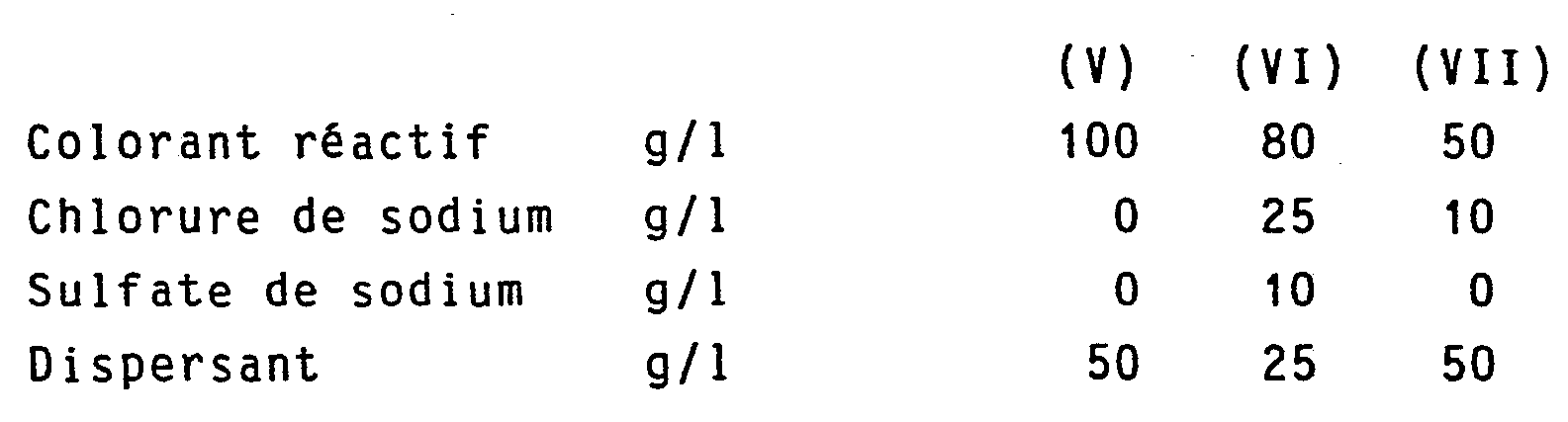
- Le dispersant utilisé dans ces exemples est un éther aliphatique vendu sous la marque Lyocol BC et l'agent protecteur de la redéposition est un produit portant la marque Révatol S.
- Des exemples de solutions de dilution alcalines, jouant le rôle d'activateur et fixateur pour les colorants précédents, présentent les compositions suivantes :

- L'agent mouillant utilisé porte la marque Albigène A et il est produit par Ciba-Geigy.
- Dans un autre exemple, on réalise une teinture convenant pour la soie, en utilisant un fixateur à base de carbonate et bicarbonate de sodium. Les solutions à mélanger au moment de l'emploi présentent les compositions suivantes :

- Comme on l'a déjà indiqué, ces compositions ne sont que des exemple et l'invention englobe toutes leurs variantes. Les teintes les plus variées peuvent être réalisées par des solutions de colorants contenant des mélanges de colorants choisis pour présenter une grande affinité pour des fibres textiles différentes et faciliter ainsi la teinture de tissus mixtes et divers.
Claims (10)
Priority Applications (1)
| Application Number | Priority Date | Filing Date | Title |
|---|---|---|---|
| AT81401056T ATE12530T1 (de) | 1980-07-02 | 1981-07-01 | Verfahren zum kaltfaerben auf geweben und produkte zur durchfuehrung desselben. |
Applications Claiming Priority (2)
| Application Number | Priority Date | Filing Date | Title |
|---|---|---|---|
| FR8014727 | 1980-07-02 | ||
| FR8014727A FR2486115A1 (fr) | 1980-07-02 | 1980-07-02 | Procede de teinture a froid sur tissu et produits pour sa mise en oeuvre |
Publications (2)
| Publication Number | Publication Date |
|---|---|
| EP0043331A1 true EP0043331A1 (fr) | 1982-01-06 |
| EP0043331B1 EP0043331B1 (fr) | 1985-04-03 |
Family
ID=9243766
Family Applications (1)
| Application Number | Title | Priority Date | Filing Date |
|---|---|---|---|
| EP81401056A Expired EP0043331B1 (fr) | 1980-07-02 | 1981-07-01 | Procédé de teinture à froid sur tissu et produits pour sa mise en oeuvre |
Country Status (4)
| Country | Link |
|---|---|
| EP (1) | EP0043331B1 (fr) |
| AT (1) | ATE12530T1 (fr) |
| DE (1) | DE3169667D1 (fr) |
| FR (1) | FR2486115A1 (fr) |
Cited By (3)
| Publication number | Priority date | Publication date | Assignee | Title |
|---|---|---|---|---|
| EP0126025A1 (fr) * | 1983-04-20 | 1984-11-21 | Ciba-Geigy Ag | Procédé de teinture de soie ou de matières textiles mixtes contenant de la soie |
| EP0189851A3 (en) * | 1985-01-30 | 1987-02-04 | Hoechst Aktiengesellschaft | Pad-dyeing process for wool |
| EP0189850A3 (en) * | 1985-01-30 | 1987-02-04 | Hoechst Aktiengesellschaft | Pad-dyeing process for wool |
Citations (5)
| Publication number | Priority date | Publication date | Assignee | Title |
|---|---|---|---|---|
| FR1232348A (fr) * | 1958-03-28 | 1960-10-07 | Ciba Geigy | Procédé de teinture de matières polyhydroxylées de structure fibreuse |
| FR1421945A (fr) * | 1964-01-22 | 1965-12-17 | Bayer Ag | Procédé de teinture de superpolyamides naturelles par des colorants réactifs |
| FR1523400A (fr) * | 1967-03-22 | 1968-05-03 | Gillet Thaon Sa | Procédé de teinture de matières textiles |
| FR2146545A6 (fr) * | 1968-08-30 | 1973-03-02 | Inst Textile De France | Jeu educatif permettant de s'initier a la teinture et a l'impression de polymeres polyhydroxyles |
| FR2245816A1 (fr) * | 1972-02-04 | 1975-04-25 | Bsg Designs |
Family Cites Families (2)
| Publication number | Priority date | Publication date | Assignee | Title |
|---|---|---|---|---|
| DE2940849A1 (de) * | 1979-10-09 | 1981-04-23 | Bayer Ag, 5090 Leverkusen | Konzentrierte farbstoffpraeparationen anionischer und kationischer farbstoffe, verfahren zu deren herstellung und deren verwendung zum faerben |
| JPS6054438B2 (ja) * | 1980-03-31 | 1985-11-29 | 住友化学工業株式会社 | セルロ−ス系繊維材料の染色用反応染料液状組成物 |
-
1980
- 1980-07-02 FR FR8014727A patent/FR2486115A1/fr active Granted
-
1981
- 1981-07-01 DE DE8181401056T patent/DE3169667D1/de not_active Expired
- 1981-07-01 AT AT81401056T patent/ATE12530T1/de not_active IP Right Cessation
- 1981-07-01 EP EP81401056A patent/EP0043331B1/fr not_active Expired
Patent Citations (5)
| Publication number | Priority date | Publication date | Assignee | Title |
|---|---|---|---|---|
| FR1232348A (fr) * | 1958-03-28 | 1960-10-07 | Ciba Geigy | Procédé de teinture de matières polyhydroxylées de structure fibreuse |
| FR1421945A (fr) * | 1964-01-22 | 1965-12-17 | Bayer Ag | Procédé de teinture de superpolyamides naturelles par des colorants réactifs |
| FR1523400A (fr) * | 1967-03-22 | 1968-05-03 | Gillet Thaon Sa | Procédé de teinture de matières textiles |
| FR2146545A6 (fr) * | 1968-08-30 | 1973-03-02 | Inst Textile De France | Jeu educatif permettant de s'initier a la teinture et a l'impression de polymeres polyhydroxyles |
| FR2245816A1 (fr) * | 1972-02-04 | 1975-04-25 | Bsg Designs |
Non-Patent Citations (1)
| Title |
|---|
| TEXTILVEREDLUNG, vol. 14, no. 7, juillet 1979 BASEL (CH) B. MIHALIK: "Kunstgewerblich handbemalte Textilien", pages 285 à 292. * |
Cited By (4)
| Publication number | Priority date | Publication date | Assignee | Title |
|---|---|---|---|---|
| EP0126025A1 (fr) * | 1983-04-20 | 1984-11-21 | Ciba-Geigy Ag | Procédé de teinture de soie ou de matières textiles mixtes contenant de la soie |
| US4560388A (en) * | 1983-04-20 | 1985-12-24 | Ciba-Geigy Corporation | Process for dyeing silk or fibre blends containing silk |
| EP0189851A3 (en) * | 1985-01-30 | 1987-02-04 | Hoechst Aktiengesellschaft | Pad-dyeing process for wool |
| EP0189850A3 (en) * | 1985-01-30 | 1987-02-04 | Hoechst Aktiengesellschaft | Pad-dyeing process for wool |
Also Published As
| Publication number | Publication date |
|---|---|
| FR2486115A1 (fr) | 1982-01-08 |
| EP0043331B1 (fr) | 1985-04-03 |
| DE3169667D1 (en) | 1985-05-09 |
| FR2486115B1 (fr) | 1983-09-30 |
| ATE12530T1 (de) | 1985-04-15 |
Similar Documents
| Publication | Publication Date | Title |
|---|---|---|
| BE1008269A3 (fr) | Traitement de textiles. | |
| FR2640988A1 (fr) | ||
| FR2627517A1 (fr) | Procede de blanchiment des matieres textiles avec destruction enzymatique de l'exces de peroxyde | |
| EP0043331B1 (fr) | Procédé de teinture à froid sur tissu et produits pour sa mise en oeuvre | |
| FR2849068A1 (fr) | Procede de delavage et de teinture d'une piece de vetement en tissu polyester/coton | |
| JPH0733487B2 (ja) | 水溶性染料混合物 | |
| FR2702226A1 (fr) | Procédé de teinture des fibres cellulosiques avec des colorants réactifs de la série des phtalocyanines. | |
| JPS6312783A (ja) | カチオン化改質セルロ−ス系繊維材料の染色および捺染方法 | |
| Abubakar et al. | Optimization of Dyeing Conditions of Natural Dye Obtained from Vaccinium corrymbosum (Blueberry) On Cotton Fabric | |
| FR2493363A1 (fr) | Nouveau procede de teinture de substrats cellulosiques | |
| JPH01170665A (ja) | 水溶性染料混合物 | |
| EP0182693B1 (fr) | Perfectionnement aux procédés de blanchiment oxydant réalisés en milieu acide | |
| Lin et al. | Improvement of colour fastness for deep blue shade of cotton fabric | |
| EP0181257B1 (fr) | Perfectionnement au procédé d'oxydation des colorants au soufre | |
| MX2007005607A (es) | Productos textiles teñidos por medio de colorantes cationicos y proceso para su fabricacion. | |
| JPH05179579A (ja) | 反応性染料浸染物のソーピングもしくは洗浄方法 | |
| FR2661927A1 (fr) | Procede pour le mercerisage et la teinture au mouille de materiau cellulosique humide. | |
| FR2685017A1 (fr) | Nouveau procede de teinture des matieres textiles constituees d'un melange de fibres. | |
| JPS6136118B2 (fr) | ||
| RU2103432C1 (ru) | Способ промывки целлюлозосодержащих текстильных материалов после крашения или печатания | |
| RU2268955C1 (ru) | Способ крашения шерстяных материалов хромовыми красителями | |
| JPS6233891A (ja) | 繊維構造物の染色加工方法 | |
| EP0076986A1 (fr) | Procédé pour la teinture ou/et l'impression de cellulose mercerisée ou caustifiée naturelle ou régénérée | |
| FR2684395A1 (fr) | Nouveau procede de teinture par foulardage-vaporisage. | |
| BE696843A (fr) |
Legal Events
| Date | Code | Title | Description |
|---|---|---|---|
| PUAI | Public reference made under article 153(3) epc to a published international application that has entered the european phase |
Free format text: ORIGINAL CODE: 0009012 |
|
| AK | Designated contracting states |
Designated state(s): AT BE CH DE GB IT LU NL SE |
|
| 17P | Request for examination filed |
Effective date: 19820615 |
|
| GRAA | (expected) grant |
Free format text: ORIGINAL CODE: 0009210 |
|
| AK | Designated contracting states |
Designated state(s): AT BE CH DE GB IT LI LU NL SE |
|
| PG25 | Lapsed in a contracting state [announced via postgrant information from national office to epo] |
Ref country code: NL Effective date: 19850403 Ref country code: IT Free format text: LAPSE BECAUSE OF FAILURE TO SUBMIT A TRANSLATION OF THE DESCRIPTION OR TO PAY THE FEE WITHIN THE PRESCRIBED TIME-LIMIT;WARNING: LAPSES OF ITALIAN PATENTS WITH EFFECTIVE DATE BEFORE 2007 MAY HAVE OCCURRED AT ANY TIME BEFORE 2007. THE CORRECT EFFECTIVE DATE MAY BE DIFFERENT FROM THE ONE RECORDED. Effective date: 19850403 Ref country code: AT Effective date: 19850403 |
|
| REF | Corresponds to: |
Ref document number: 12530 Country of ref document: AT Date of ref document: 19850415 Kind code of ref document: T |
|
| PG25 | Lapsed in a contracting state [announced via postgrant information from national office to epo] |
Ref country code: SE Effective date: 19850430 |
|
| REF | Corresponds to: |
Ref document number: 3169667 Country of ref document: DE Date of ref document: 19850509 |
|
| PG25 | Lapsed in a contracting state [announced via postgrant information from national office to epo] |
Ref country code: LU Free format text: LAPSE BECAUSE OF NON-PAYMENT OF DUE FEES Effective date: 19850731 |
|
| NLV1 | Nl: lapsed or annulled due to failure to fulfill the requirements of art. 29p and 29m of the patents act | ||
| PLBE | No opposition filed within time limit |
Free format text: ORIGINAL CODE: 0009261 |
|
| STAA | Information on the status of an ep patent application or granted ep patent |
Free format text: STATUS: NO OPPOSITION FILED WITHIN TIME LIMIT |
|
| 26N | No opposition filed | ||
| PG25 | Lapsed in a contracting state [announced via postgrant information from national office to epo] |
Ref country code: LI Effective date: 19870731 Ref country code: CH Effective date: 19870731 |
|
| BERE | Be: lapsed |
Owner name: ARTSCHIMIE Effective date: 19870731 |
|
| REG | Reference to a national code |
Ref country code: CH Ref legal event code: PL |
|
| GBPC | Gb: european patent ceased through non-payment of renewal fee | ||
| PG25 | Lapsed in a contracting state [announced via postgrant information from national office to epo] |
Ref country code: GB Free format text: LAPSE BECAUSE OF NON-PAYMENT OF DUE FEES Effective date: 19881118 |
|
| PG25 | Lapsed in a contracting state [announced via postgrant information from national office to epo] |
Ref country code: BE Effective date: 19890731 |
|
| PGFP | Annual fee paid to national office [announced via postgrant information from national office to epo] |
Ref country code: DE Payment date: 19910206 Year of fee payment: 10 |
|
| PG25 | Lapsed in a contracting state [announced via postgrant information from national office to epo] |
Ref country code: DE Effective date: 19920401 |