EP0043576B1 - Alliage à base de molybdène - Google Patents
Alliage à base de molybdène Download PDFInfo
- Publication number
- EP0043576B1 EP0043576B1 EP81105240A EP81105240A EP0043576B1 EP 0043576 B1 EP0043576 B1 EP 0043576B1 EP 81105240 A EP81105240 A EP 81105240A EP 81105240 A EP81105240 A EP 81105240A EP 0043576 B1 EP0043576 B1 EP 0043576B1
- Authority
- EP
- European Patent Office
- Prior art keywords
- molybdenum
- weight
- scandium
- alloy
- less
- Prior art date
- Legal status (The legal status is an assumption and is not a legal conclusion. Google has not performed a legal analysis and makes no representation as to the accuracy of the status listed.)
- Expired
Links
- ZOKXTWBITQBERF-UHFFFAOYSA-N Molybdenum Chemical compound [Mo] ZOKXTWBITQBERF-UHFFFAOYSA-N 0.000 title claims abstract description 67
- 229910052750 molybdenum Inorganic materials 0.000 title claims abstract description 62
- 239000011733 molybdenum Substances 0.000 title claims abstract description 62
- 239000000956 alloy Substances 0.000 title claims abstract description 54
- 229910045601 alloy Inorganic materials 0.000 title claims abstract description 53
- SIXSYDAISGFNSX-UHFFFAOYSA-N scandium atom Chemical compound [Sc] SIXSYDAISGFNSX-UHFFFAOYSA-N 0.000 claims abstract description 36
- 229910052706 scandium Inorganic materials 0.000 claims abstract description 35
- 239000012535 impurity Substances 0.000 claims description 9
- QVGXLLKOCUKJST-UHFFFAOYSA-N atomic oxygen Chemical compound [O] QVGXLLKOCUKJST-UHFFFAOYSA-N 0.000 claims description 8
- 229910052760 oxygen Inorganic materials 0.000 claims description 8
- 239000001301 oxygen Substances 0.000 claims description 8
- IJGRMHOSHXDMSA-UHFFFAOYSA-N Atomic nitrogen Chemical compound N#N IJGRMHOSHXDMSA-UHFFFAOYSA-N 0.000 claims description 6
- 229910052799 carbon Inorganic materials 0.000 claims description 6
- 229910052702 rhenium Inorganic materials 0.000 claims description 6
- 229910052796 boron Inorganic materials 0.000 claims description 5
- 229910052757 nitrogen Inorganic materials 0.000 claims description 5
- XEEYBQQBJWHFJM-UHFFFAOYSA-N Iron Chemical compound [Fe] XEEYBQQBJWHFJM-UHFFFAOYSA-N 0.000 claims description 4
- WFKWXMTUELFFGS-UHFFFAOYSA-N tungsten Chemical compound [W] WFKWXMTUELFFGS-UHFFFAOYSA-N 0.000 claims description 4
- 229910052721 tungsten Inorganic materials 0.000 claims description 4
- 239000010937 tungsten Substances 0.000 claims description 4
- 229910052720 vanadium Inorganic materials 0.000 claims description 4
- 229910052726 zirconium Inorganic materials 0.000 claims description 4
- ZOXJGFHDIHLPTG-UHFFFAOYSA-N Boron Chemical compound [B] ZOXJGFHDIHLPTG-UHFFFAOYSA-N 0.000 claims description 3
- OKTJSMMVPCPJKN-UHFFFAOYSA-N Carbon Chemical compound [C] OKTJSMMVPCPJKN-UHFFFAOYSA-N 0.000 claims description 3
- WUAPFZMCVAUBPE-UHFFFAOYSA-N rhenium atom Chemical compound [Re] WUAPFZMCVAUBPE-UHFFFAOYSA-N 0.000 claims description 3
- 229910052719 titanium Inorganic materials 0.000 claims description 3
- 239000010936 titanium Substances 0.000 claims description 3
- VYZAMTAEIAYCRO-UHFFFAOYSA-N Chromium Chemical compound [Cr] VYZAMTAEIAYCRO-UHFFFAOYSA-N 0.000 claims description 2
- KJTLSVCANCCWHF-UHFFFAOYSA-N Ruthenium Chemical compound [Ru] KJTLSVCANCCWHF-UHFFFAOYSA-N 0.000 claims description 2
- RTAQQCXQSZGOHL-UHFFFAOYSA-N Titanium Chemical compound [Ti] RTAQQCXQSZGOHL-UHFFFAOYSA-N 0.000 claims description 2
- QCWXUUIWCKQGHC-UHFFFAOYSA-N Zirconium Chemical compound [Zr] QCWXUUIWCKQGHC-UHFFFAOYSA-N 0.000 claims description 2
- 229910052804 chromium Inorganic materials 0.000 claims description 2
- 239000011651 chromium Substances 0.000 claims description 2
- 229910017052 cobalt Inorganic materials 0.000 claims description 2
- 239000010941 cobalt Substances 0.000 claims description 2
- GUTLYIVDDKVIGB-UHFFFAOYSA-N cobalt atom Chemical compound [Co] GUTLYIVDDKVIGB-UHFFFAOYSA-N 0.000 claims description 2
- 229910052742 iron Inorganic materials 0.000 claims description 2
- 229910052758 niobium Inorganic materials 0.000 claims description 2
- 239000010955 niobium Substances 0.000 claims description 2
- GUCVJGMIXFAOAE-UHFFFAOYSA-N niobium atom Chemical compound [Nb] GUCVJGMIXFAOAE-UHFFFAOYSA-N 0.000 claims description 2
- 229910052707 ruthenium Inorganic materials 0.000 claims description 2
- LEONUFNNVUYDNQ-UHFFFAOYSA-N vanadium atom Chemical compound [V] LEONUFNNVUYDNQ-UHFFFAOYSA-N 0.000 claims 1
- 238000000137 annealing Methods 0.000 description 18
- 238000007792 addition Methods 0.000 description 16
- 239000000843 powder Substances 0.000 description 9
- 239000002994 raw material Substances 0.000 description 8
- 230000007704 transition Effects 0.000 description 8
- 238000000034 method Methods 0.000 description 6
- 230000000694 effects Effects 0.000 description 5
- 238000002474 experimental method Methods 0.000 description 5
- 239000000463 material Substances 0.000 description 5
- 238000002844 melting Methods 0.000 description 5
- 239000000203 mixture Substances 0.000 description 5
- 238000005096 rolling process Methods 0.000 description 5
- UFHFLCQGNIYNRP-UHFFFAOYSA-N Hydrogen Chemical compound [H][H] UFHFLCQGNIYNRP-UHFFFAOYSA-N 0.000 description 4
- 238000010894 electron beam technology Methods 0.000 description 4
- 238000005242 forging Methods 0.000 description 4
- 239000001257 hydrogen Substances 0.000 description 4
- 229910052739 hydrogen Inorganic materials 0.000 description 4
- 230000008018 melting Effects 0.000 description 4
- 229910052776 Thorium Inorganic materials 0.000 description 3
- 239000012300 argon atmosphere Substances 0.000 description 3
- 238000012360 testing method Methods 0.000 description 3
- 229910052684 Cerium Inorganic materials 0.000 description 2
- 239000002131 composite material Substances 0.000 description 2
- 230000003247 decreasing effect Effects 0.000 description 2
- 229910052751 metal Inorganic materials 0.000 description 2
- 239000002184 metal Substances 0.000 description 2
- 239000002244 precipitate Substances 0.000 description 2
- 238000001556 precipitation Methods 0.000 description 2
- -1 scandium hydride Chemical compound 0.000 description 2
- 229910000046 scandium hydride Inorganic materials 0.000 description 2
- 238000005245 sintering Methods 0.000 description 2
- 238000005482 strain hardening Methods 0.000 description 2
- 239000008207 working material Substances 0.000 description 2
- 229910052782 aluminium Inorganic materials 0.000 description 1
- 239000012298 atmosphere Substances 0.000 description 1
- 230000015572 biosynthetic process Effects 0.000 description 1
- 229910052791 calcium Inorganic materials 0.000 description 1
- 238000005266 casting Methods 0.000 description 1
- 150000001875 compounds Chemical class 0.000 description 1
- 229910052802 copper Inorganic materials 0.000 description 1
- 239000013078 crystal Substances 0.000 description 1
- 238000011156 evaluation Methods 0.000 description 1
- 238000010438 heat treatment Methods 0.000 description 1
- 229910000765 intermetallic Inorganic materials 0.000 description 1
- 229910052749 magnesium Inorganic materials 0.000 description 1
- 150000001247 metal acetylides Chemical class 0.000 description 1
- 150000002739 metals Chemical class 0.000 description 1
- 238000002156 mixing Methods 0.000 description 1
- 229910052759 nickel Inorganic materials 0.000 description 1
- 230000001590 oxidative effect Effects 0.000 description 1
- 230000000704 physical effect Effects 0.000 description 1
- 238000012545 processing Methods 0.000 description 1
- 238000001953 recrystallisation Methods 0.000 description 1
- 150000003326 scandium compounds Chemical class 0.000 description 1
- LQPWUWOODZHKKW-UHFFFAOYSA-K scandium(3+);trihydroxide Chemical compound [OH-].[OH-].[OH-].[Sc+3] LQPWUWOODZHKKW-UHFFFAOYSA-K 0.000 description 1
- 238000005204 segregation Methods 0.000 description 1
- 239000002893 slag Substances 0.000 description 1
- GPPXJZIENCGNKB-UHFFFAOYSA-N vanadium Chemical compound [V]#[V] GPPXJZIENCGNKB-UHFFFAOYSA-N 0.000 description 1
- 229910052727 yttrium Inorganic materials 0.000 description 1
Images
Classifications
-
- C—CHEMISTRY; METALLURGY
- C22—METALLURGY; FERROUS OR NON-FERROUS ALLOYS; TREATMENT OF ALLOYS OR NON-FERROUS METALS
- C22C—ALLOYS
- C22C27/00—Alloys based on rhenium or a refractory metal not mentioned in groups C22C14/00 or C22C16/00
- C22C27/04—Alloys based on tungsten or molybdenum
Definitions
- the present invention relates to a molybdenum-based alloy and, more particularly, to a molybdenum-based alloy with excellent workability.
- Molybdenum is known to have excellent resistance against high temperatures and is used for heat- resistant structural parts or as lamp bulb materials.
- molybdenum as cast has a relatively high ductile-brittle transition temperature and poor ductility, and requires working at high temperatures such as 1,400°C.
- the transition temperature of molybdenum can be lowered by working such as forgoing, it is only lowered slightly, resulting in the requirement of high temperatures for working.
- the amount of Re to be added is as large as 20 to 50%. Addition of Re in such a large amount indicates that the addition of Re to Mo is intended to change the essential properties of the alloy. It is further known that the addition of Th in an amount of about 10% lowers by a maximum of 100°C the ductile-brittle transition temperature of molybdenum after casting without further processing (i.e., as cast). It is also known that the addition of elements, other than Re and Th, in amounts of 0.005 to 1.0% provide similar effects as the addition of Th.
- the other principle aims at lowering the temperature for hot working of molybdenum or a molybdenum-based alloy.
- the primary object of the present invention to provide a molybdenum-based alloy which exibits workability at relatively low temperatures.
- the present invention provides a molybdenum-based alloy with excellent hot workability consisting of 0.001 to 0.5% by weight of scandium, an impurity selected from the group consisting of carbon in an amount up to 0.025 by weight, oxygen in an amount up to 0.0015% by weight and nitrogen in an amount up to 0.0010% by weight, and the remainder of molybdenum, with or without at least one optional element selected from the group consisting of 1% by weight or less of cobalt, 1% by weight or less of iron, 30% by weight or less of rhenium, 0.5% by weight or less of ruthenium, 10% by weight or less of vanadium, 10% by weight or less of niobium, 10% by weight or less of chromium, 10% by weight or less of titanium, 50% by weight or less of tungsten, 0.5% by weight or less or zirconium and 0.001 to 0.1% by weight of boron.
- molybdenum generally exhibits poor workability, and cracks form mainly at the grain boundaries during hot working.
- the formation of these cracks is considered to be mainly attributable to precipitation or segregation of impurities present in small amounts, especially oxides or carbides.
- the crystal grains are extremely coarse, so that the above-mentioned impurities may significantly exert an influence on intergranular embrittlement.
- Scandium which is added to molybdenum according to the present invention shows a strong deoxidation tendency and thus especially reduces oxides among the impurities which precipitate or segregate into the grain boundaries.
- the molybdenum-based alloy of the present invention does not exhibit intergranular embrittlement even at relatively low temperatures and thus allows various types of working such as forging, rolling, swaging, and drawing in an excellent manner (i.e., working is easy and cracks do not form) at relatively low temperatures (e.g., 800°C or less).
- relatively low temperatures e.g. 800°C or less.
- the molybdenum-based alloy of the present invention exhibits low reduction in strength and hardness and even better elongation at high temperatures. As a result, the alloy of the present invention has excellent resistance to stress.
- the present inventors have made extensive studies for the purpose of improving the workability at relatively low temperatures of molybdenum as cast. In order to reduce especially the oxides among the impurities which precipitate or segregate into the grain boundaries of Mo, various elements were added to molybdenum and the workability of the resultant molybdenum-based alloys at relatively low temperatures was examined. As a result of these studies, it has been found that scandium has strong affinity for oxygen and that the addition of scandium largely improves the workability of the molybdenum-based alloy, thus establishing the present invention.
- the molybdenum-based alloy of the present invention contains 0.001 to 0.5% by weight of scandium.
- scandium content deviates from this range, cracks tend to form during working at relatively low temperatures (e.g., 800°C).
- the remaining portion of the alloy of the present invention consists essentially of molybdenum.
- molybdenum as a raw material generally unavoidably contains impurities such as carbon, oxygen and nitrogen.
- impurities such as carbon, oxygen and nitrogen.
- the contents of the mentioned impurities in the alloy of the present invention must be within the given limits. Impurities other than those specified above, such as Ca, Mg, Ni and Cu, are preferably contained in the alloy in as small amounts as possible.
- Molybdenum as a principle raw material of the alloy of the present invention may be a commercially available powder of pure molybdenum, and preferably contains the smallest possible amounts of C, 0 and N, as described above.
- the scandium raw material to be added to the alloy of the present invention may be a metal scandium powder or a scandium compound such as a scandium hybride, a scandium halogenide, a scandium hydroxide, a scandium boride, a scandium carbide, or a scandium intermetallic compound such as Sc-V.
- a scandium hydride which may be available at relatively inexpensive cost in powder form and which contains hydrogen having a strong tendency for reduction.
- the above-mentioned molybdenum powder and the scandium-containing raw material powder are well mixed together with the other alloy components or elements mentioned above, if desired, and pressed to provide a green compact which is then melted in an non-oxidizing atmosphere.
- the melting may be performed in an arc furnace having non-consumable or consumable type electrodes, or it may be performed by heating with an electron beam or a plasma arc. It is preferable to maintain the mixture in the molten state for a sufficient time to allow scandium and oxygen to react fully.
- the resultant slag is removed from the molten mass which is then cast to provide an ingot of the molybdenum-based alloy of the present invention.
- the amount of the scandium-containing raw material to be used must be sufficient (e.g., the amount that added scandium accounts for 0.1 to 1.0% by weight) so that the scandium content in the resultant alloy is 0.001 to 0.5%.
- the amount of the scandium-based raw material to be added differs depending upon the amount of oxygen contained in the molybdenum, it may be easily determined by performing a preliminary test.
- the content of the remaining scandium is preferably 0.2% or less.
- the alloy of the present invention may be generally prepared by the melting method as described above, it may alternatively be prepared by sintering the green compact described above to provide a sintered ingot. ⁇
- the workability is better and cracks do not form during forging or rolling at relatively low temperatures such as 800°C, unlike the ingot or sintered into of the prior art molybdenum-based alloys.
- the rate of decrease in the ductile-brittle transition temperature in forging is also great with the alloy of the present invention and shows, for example, a transition temperature around room temperature at a 50% draft.
- top and bottom surfaces of these 8 different kinds of ingots were ground to provide plates of about 8 mm thickness. They were then forged to a thickness of 3 mm at temperatures between 400 and 1,000°C in increments of 100°C. They were then rolled at the respective temperatures to provide plates of 1 mm thickness.
- samples No. 1 and 2 As a result, cracks formed at the respective temperatures in samples No. 1 and 2, that is, the sample with no scandium added and the sample with 0.05% added scandium and less than 0.001% remaining.
- samples No. 2 to 8 provided excellent working samples in which cracks did not form at all at the temperatures tested. It follows from this that addition of scandium contributes to improving the workability of molybdenum. It has also been found that when the remaining scandium content exceeded 0.5% cracks tended to form unless the lowest working temperature was elevated. Marks O and x in Table 1 respectively indicate excellent and poor workability of the samples obtained.
- a 99.90% pure Mo powder was treated in wet hydrogen at 900°C. After adding a scandium hybride powder to the Mo powder, the mixture was mixed well in a V-type mixer for 2 hours. The mixture was arc-melted with non-consumable type tungsten electrodes in an argon atmosphere to provide an ingot of 30 mm thickness, 30 mm width, and 70 mm length. This ingot was forged within a temperature range of 700 to 1,300°C to reduce the thickness from 30 mm to 11 mm at the first step and then from 11 mm to 5 mm at the second step. Next, the ingot was hot-worked at a draft of 74% within a temperature range of 700 to 1,300°C to reduce the thickness from 5 mm to 1.3 mm. Thereafter, the ingot was held at 900°C for 20 minutes and was annealed. The annealed ingot was then cold-worked at a draft of 75% to reduce the thickness from 1.3 mm to 0.33 mm.
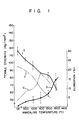
- Fig. 1 shows the relationship between the annealing temperature and the tensile strength or elongation of the samples.
- curves (a) and (b) correspond to the alloy of the present invention and show the relationship between the annealing temperature and the tensile strength and between the annealing temperature and the elongation of a sample having a 0.034% remaining scandium content.
- Curves (c) and (d) show the relationship between the annealing temperature and the tensile strength and between the annealing temperature and the elongation for a sample obtained by similarly hot working, annealing, and cold working a molybdenum sintered body for electric appliances (99.90% or higher in purity), as defined by JIS H 4483.
- the annealing temperature when the annealing temperature is higher, the elongation of the alloy of the present invention becomes greater while the elongation of the commercially available pure molybdenum is decreased at temperatures above 1,100°C. It is seen from this that the alloy of the present invention is stable in strength at high temperatures. Therefore, the alloy of the present invention exhibits better resistance than the commercially available pure molybdenum upon being repeatedly subjected to stress at high temperatures.
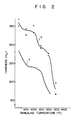
- Fig. 2 The relations between the annealing temperature and hardness (Hv) of the samples of the alloy of the present invention and the commercially available pure molybdenum (JIS H 4483) are shown in Fig. 2.
- curve (e) corresponds to an alloy of the present invention.
- Marks O represent the relationship between the hardness (Hv) and the annealing temperature for the side face along the direction of rolling of the sample in the final cold working, and marks 0 represent the relationship between the hardness (Hv) and the annealing temperature for the end face of the sample along the direction of rolling.
- Curve (f) corresponds to a commercially available molybdenum.
- the hardness of the alloy of the present invention is far greater than that of the prior art molybdenum at the same annealing temperature.
- the alloy of the present invention although work-hardened, exhibits excellent workability as compared with the prior art pure molybdenum.
- Molybdenum-based alloys of the compositions as shown in Table 2 were prepared according to the same procedures of Example 1, and the forgeability and rollability of these alloys were examined. The obtained results are shown in Table 2 wherein mark 0 indicates an evaluation of excellent, mark A indicates good, and mark x indicates poor.
- the workability at relatively low temperatures is improved with the alloys of the present invention since the addition of scandium results in sufficient deoxidation and therefore a reduction in precipitation of oxides or the like in the grain boundaries. It is further considered that the addition of scandium not only contributes to deoxidation but also to improving other properties such as workability, tensile strength, elongation and hardness (Hv) of the alloy of the present invention, although the reasons for this remain unknown.
- lamp bulb parts may be conveniently manufactured from plates of the alloy of the present invention and wires may also be manufactured. Further, considering the tendency of the tensile strength, elongation and hardness to change upon annealing, the mechanical strength of the heat-resistant members using molybdenum plates may be improved by the use of the alloy of the present invention. Finally embrittlement of prior art molybdenum material upon irradiation by neutrons for nuclear power may be significantly reduced by using the alloy material of the present invention.
Landscapes
- Chemical & Material Sciences (AREA)
- Engineering & Computer Science (AREA)
- Materials Engineering (AREA)
- Mechanical Engineering (AREA)
- Metallurgy (AREA)
- Organic Chemistry (AREA)
- Manufacture And Refinement Of Metals (AREA)
- Pistons, Piston Rings, And Cylinders (AREA)
- Solid Thermionic Cathode (AREA)
- Powder Metallurgy (AREA)
Claims (2)
Priority Applications (1)
| Application Number | Priority Date | Filing Date | Title |
|---|---|---|---|
| AT81105240T ATE7155T1 (de) | 1980-07-08 | 1981-07-06 | Molybdaenlegierung. |
Applications Claiming Priority (2)
| Application Number | Priority Date | Filing Date | Title |
|---|---|---|---|
| JP92198/80 | 1980-07-08 | ||
| JP55092198A JPS5853703B2 (ja) | 1980-07-08 | 1980-07-08 | 熱間加工性に優れたモリブデン材料 |
Publications (2)
| Publication Number | Publication Date |
|---|---|
| EP0043576A1 EP0043576A1 (fr) | 1982-01-13 |
| EP0043576B1 true EP0043576B1 (fr) | 1984-04-18 |
Family
ID=14047742
Family Applications (1)
| Application Number | Title | Priority Date | Filing Date |
|---|---|---|---|
| EP81105240A Expired EP0043576B1 (fr) | 1980-07-08 | 1981-07-06 | Alliage à base de molybdène |
Country Status (5)
| Country | Link |
|---|---|
| US (1) | US4370299A (fr) |
| EP (1) | EP0043576B1 (fr) |
| JP (1) | JPS5853703B2 (fr) |
| AT (1) | ATE7155T1 (fr) |
| DE (1) | DE3163202D1 (fr) |
Families Citing this family (9)
| Publication number | Priority date | Publication date | Assignee | Title |
|---|---|---|---|---|
| AT377584B (de) | 1981-06-25 | 1985-04-10 | Klima & Kaelte Gmbh | Eck-verbindung an metallrahmen |
| US4755712A (en) * | 1986-12-09 | 1988-07-05 | North American Philips Corp. | Molybdenum base alloy and lead-in wire made therefrom |
| US5028756A (en) * | 1988-10-18 | 1991-07-02 | Sumitomo Electric Industries, Ltd. | Electrode wire for electric spark cutting |
| DE4442161C1 (de) * | 1994-11-27 | 1996-03-07 | Bayerische Metallwerke Gmbh | Verfahren zur Herstellung eines Formteils |
| JPH08165528A (ja) * | 1994-12-09 | 1996-06-25 | Japan Energy Corp | 高純度高融点金属または合金の製造方法 |
| DE102005003445B4 (de) * | 2005-01-21 | 2009-06-04 | H.C. Starck Hermsdorf Gmbh | Metallsubstrat-Werkstoff für die Anodenteller von Drehanodenröntgenröhren, Verfahren zur Herstellung eines solchen Werkstoffes sowie Verfahren zur Herstellung eines Anodentellers unter Verwendung eines solchen Werkstoffes |
| CN101460279B (zh) * | 2006-06-08 | 2011-12-28 | 日本钨株式会社 | 点焊用电极 |
| AT15903U1 (de) * | 2017-09-29 | 2018-08-15 | Plansee Se | Molybdän-Sinterteil |
| CN119016728A (zh) * | 2024-10-24 | 2024-11-26 | 中国科学院金属研究所 | 一种大尺寸均质致密钼棒坯制备方法 |
Family Cites Families (10)
| Publication number | Priority date | Publication date | Assignee | Title |
|---|---|---|---|---|
| US2188405A (en) * | 1939-02-11 | 1940-01-30 | Mallory & Co Inc P R | Molybdenum alloys |
| US2678268A (en) * | 1951-10-06 | 1954-05-11 | Climax Molybdenum Co | Molybdenum-vanadium alloys |
| US2678272A (en) * | 1951-10-06 | 1954-05-11 | Climax Molybdenum Co | Molybdenum-columbium alloys |
| US2678269A (en) * | 1951-10-06 | 1954-05-11 | Climax Molybdenum Co | Molybdenum-titanium alloys |
| US2883284A (en) * | 1956-07-30 | 1959-04-21 | Westinghouse Electric Corp | Molybdenum base alloys |
| US2883283A (en) * | 1957-07-02 | 1959-04-21 | Horizons Inc | Oxidation resistant molybdenum base alloy |
| GB898811A (en) * | 1960-04-11 | 1962-06-14 | Stauffer Chemical Co | Process of grain-refining molybdenum or tungsten |
| DE1248952B (fr) * | 1960-05-23 | 1967-08-31 | ||
| US3312539A (en) * | 1964-09-11 | 1967-04-04 | James C Marshall | Brazing alloys for tungsten and molybdenum |
| US3841846A (en) * | 1970-01-25 | 1974-10-15 | Mallory & Co Inc P R | Liquid phase sintered molybdenum base alloys having additives and shaping members made therefrom |
-
1980
- 1980-07-08 JP JP55092198A patent/JPS5853703B2/ja not_active Expired
-
1981
- 1981-07-06 DE DE8181105240T patent/DE3163202D1/de not_active Expired
- 1981-07-06 EP EP81105240A patent/EP0043576B1/fr not_active Expired
- 1981-07-06 US US06/280,352 patent/US4370299A/en not_active Expired - Lifetime
- 1981-07-06 AT AT81105240T patent/ATE7155T1/de not_active IP Right Cessation
Also Published As
| Publication number | Publication date |
|---|---|
| EP0043576A1 (fr) | 1982-01-13 |
| DE3163202D1 (en) | 1984-05-24 |
| JPS5853703B2 (ja) | 1983-11-30 |
| US4370299A (en) | 1983-01-25 |
| ATE7155T1 (de) | 1984-05-15 |
| JPS5719352A (en) | 1982-02-01 |
Similar Documents
| Publication | Publication Date | Title |
|---|---|---|
| US5332545A (en) | Method of making low cost Ti-6A1-4V ballistic alloy | |
| US3767385A (en) | Cobalt-base alloys | |
| CA1066922A (fr) | Alliage thermoresistant pour charpentes soudees | |
| US4386976A (en) | Dispersion-strengthened nickel-base alloy | |
| EP3572541B1 (fr) | Superalliage à base de nickel | |
| US2678269A (en) | Molybdenum-titanium alloys | |
| JPH03500188A (ja) | 酸化物分散硬化焼結合金の製造方法 | |
| US4370299A (en) | Molybdenum-based alloy | |
| EP0593824A1 (fr) | Alliages monocristallins à base d'aluminure de nickel et méthode | |
| GB928407A (en) | Improvements in the production of titanium base alloys | |
| EP1652945B1 (fr) | Feuille en niobium ou en tantale recristallisée à grains fins à teneur en silicium, procédée par fondre suivi d'un procédé thermoméchanique | |
| EP0270230B1 (fr) | Article à base de nickel, fabriqué par la voie de la métallurgie des poudres | |
| US3317314A (en) | Columbium-base alloy | |
| Morito | Effect of impurities on the weldability of powder metallurgy, electron-beam melted and arc-melted molybdenum and its alloys | |
| US2883284A (en) | Molybdenum base alloys | |
| JP7665324B2 (ja) | 耐摩耗性部材およびそれを用いた機械装置 | |
| Wang et al. | Effect of silicon on grain boundary carbide precipitation and properties of a cobalt-free wrought nickel-base superalloy | |
| JPH06279894A (ja) | 強度および導電性に優れた銅合金 | |
| US3447921A (en) | Molybdenum-base alloy | |
| US3285736A (en) | Powder metallurgical alloy | |
| JPH06271901A (ja) | 焼結性に優れたTi−Al系金属間化合物粉末およびその焼結体 | |
| JPH0215618B2 (fr) | ||
| USRE26122E (en) | Ductile niobium and tantalum alloys | |
| Lassner et al. | Tungsten alloys | |
| JP4276853B2 (ja) | ニオブ基複合材料 |
Legal Events
| Date | Code | Title | Description |
|---|---|---|---|
| PUAI | Public reference made under article 153(3) epc to a published international application that has entered the european phase |
Free format text: ORIGINAL CODE: 0009012 |
|
| 17P | Request for examination filed |
Effective date: 19810708 |
|
| AK | Designated contracting states |
Designated state(s): AT DE FR GB IT NL |
|
| ITF | It: translation for a ep patent filed | ||
| GRAA | (expected) grant |
Free format text: ORIGINAL CODE: 0009210 |
|
| AK | Designated contracting states |
Designated state(s): AT DE FR GB IT NL |
|
| REF | Corresponds to: |
Ref document number: 7155 Country of ref document: AT Date of ref document: 19840515 Kind code of ref document: T |
|
| REF | Corresponds to: |
Ref document number: 3163202 Country of ref document: DE Date of ref document: 19840524 |
|
| ET | Fr: translation filed | ||
| RAP2 | Party data changed (patent owner data changed or rights of a patent transferred) |
Owner name: MOROZUMI, SHOTARO Owner name: KABUSHIKI KAISHA TOSHIBA |
|
| REG | Reference to a national code |
Ref country code: FR Ref legal event code: CD |
|
| PLBE | No opposition filed within time limit |
Free format text: ORIGINAL CODE: 0009261 |
|
| STAA | Information on the status of an ep patent application or granted ep patent |
Free format text: STATUS: NO OPPOSITION FILED WITHIN TIME LIMIT |
|
| 26N | No opposition filed | ||
| REG | Reference to a national code |
Ref country code: GB Ref legal event code: 746 |
|
| ITTA | It: last paid annual fee | ||
| PGFP | Annual fee paid to national office [announced via postgrant information from national office to epo] |
Ref country code: GB Payment date: 19950626 Year of fee payment: 15 |
|
| PGFP | Annual fee paid to national office [announced via postgrant information from national office to epo] |
Ref country code: DE Payment date: 19950710 Year of fee payment: 15 |
|
| PGFP | Annual fee paid to national office [announced via postgrant information from national office to epo] |
Ref country code: FR Payment date: 19950711 Year of fee payment: 15 |
|
| PGFP | Annual fee paid to national office [announced via postgrant information from national office to epo] |
Ref country code: AT Payment date: 19950713 Year of fee payment: 15 |
|
| PGFP | Annual fee paid to national office [announced via postgrant information from national office to epo] |
Ref country code: NL Payment date: 19950727 Year of fee payment: 15 |
|
| PG25 | Lapsed in a contracting state [announced via postgrant information from national office to epo] |
Ref country code: GB Effective date: 19960706 Ref country code: AT Effective date: 19960706 |
|
| PG25 | Lapsed in a contracting state [announced via postgrant information from national office to epo] |
Ref country code: NL Effective date: 19970201 |
|
| GBPC | Gb: european patent ceased through non-payment of renewal fee |
Effective date: 19960706 |
|
| PG25 | Lapsed in a contracting state [announced via postgrant information from national office to epo] |
Ref country code: FR Effective date: 19970328 |
|
| NLV4 | Nl: lapsed or anulled due to non-payment of the annual fee |
Effective date: 19970201 |
|
| PG25 | Lapsed in a contracting state [announced via postgrant information from national office to epo] |
Ref country code: DE Effective date: 19970402 |
|
| REG | Reference to a national code |
Ref country code: FR Ref legal event code: ST |