EP0044425A2 - Halogenierte Triazolylvinyl-keto- und -carbinol-Derivate, Verfahren zu ihrer Herstellung sowie ihre Verwendung als Pflanzenwachstumsregulatoren und Fungizide - Google Patents
Halogenierte Triazolylvinyl-keto- und -carbinol-Derivate, Verfahren zu ihrer Herstellung sowie ihre Verwendung als Pflanzenwachstumsregulatoren und Fungizide Download PDFInfo
- Publication number
- EP0044425A2 EP0044425A2 EP81104778A EP81104778A EP0044425A2 EP 0044425 A2 EP0044425 A2 EP 0044425A2 EP 81104778 A EP81104778 A EP 81104778A EP 81104778 A EP81104778 A EP 81104778A EP 0044425 A2 EP0044425 A2 EP 0044425A2
- Authority
- EP
- European Patent Office
- Prior art keywords
- formula
- keto
- halogenated
- carbon atoms
- halogen
- Prior art date
- Legal status (The legal status is an assumption and is not a legal conclusion. Google has not performed a legal analysis and makes no representation as to the accuracy of the status listed.)
- Granted
Links
Classifications
-
- C—CHEMISTRY; METALLURGY
- C07—ORGANIC CHEMISTRY
- C07D—HETEROCYCLIC COMPOUNDS
- C07D231/00—Heterocyclic compounds containing 1,2-diazole or hydrogenated 1,2-diazole rings
- C07D231/02—Heterocyclic compounds containing 1,2-diazole or hydrogenated 1,2-diazole rings not condensed with other rings
- C07D231/10—Heterocyclic compounds containing 1,2-diazole or hydrogenated 1,2-diazole rings not condensed with other rings having two or three double bonds between ring members or between ring members and non-ring members
- C07D231/12—Heterocyclic compounds containing 1,2-diazole or hydrogenated 1,2-diazole rings not condensed with other rings having two or three double bonds between ring members or between ring members and non-ring members with only hydrogen atoms, hydrocarbon or substituted hydrocarbon radicals, directly attached to ring carbon atoms
-
- A—HUMAN NECESSITIES
- A01—AGRICULTURE; FORESTRY; ANIMAL HUSBANDRY; HUNTING; TRAPPING; FISHING
- A01N—PRESERVATION OF BODIES OF HUMANS OR ANIMALS OR PLANTS OR PARTS THEREOF; BIOCIDES, e.g. AS DISINFECTANTS, AS PESTICIDES OR AS HERBICIDES; PEST REPELLANTS OR ATTRACTANTS; PLANT GROWTH REGULATORS
- A01N43/00—Biocides, pest repellants or attractants, or plant growth regulators containing heterocyclic compounds
- A01N43/64—Biocides, pest repellants or attractants, or plant growth regulators containing heterocyclic compounds having rings with three nitrogen atoms as the only ring hetero atoms
- A01N43/647—Triazoles; Hydrogenated triazoles
- A01N43/653—1,2,4-Triazoles; Hydrogenated 1,2,4-triazoles
-
- C—CHEMISTRY; METALLURGY
- C07—ORGANIC CHEMISTRY
- C07C—ACYCLIC OR CARBOCYCLIC COMPOUNDS
- C07C45/00—Preparation of compounds having >C = O groups bound only to carbon or hydrogen atoms; Preparation of chelates of such compounds
- C07C45/61—Preparation of compounds having >C = O groups bound only to carbon or hydrogen atoms; Preparation of chelates of such compounds by reactions not involving the formation of >C = O groups
- C07C45/63—Preparation of compounds having >C = O groups bound only to carbon or hydrogen atoms; Preparation of chelates of such compounds by reactions not involving the formation of >C = O groups by introduction of halogen; by substitution of halogen atoms by other halogen atoms
-
- C—CHEMISTRY; METALLURGY
- C07—ORGANIC CHEMISTRY
- C07C—ACYCLIC OR CARBOCYCLIC COMPOUNDS
- C07C49/00—Ketones; Ketenes; Dimeric ketenes; Ketonic chelates
- C07C49/04—Saturated compounds containing keto groups bound to acyclic carbon atoms
- C07C49/16—Saturated compounds containing keto groups bound to acyclic carbon atoms containing halogen
-
- C—CHEMISTRY; METALLURGY
- C07—ORGANIC CHEMISTRY
- C07D—HETEROCYCLIC COMPOUNDS
- C07D233/00—Heterocyclic compounds containing 1,3-diazole or hydrogenated 1,3-diazole rings, not condensed with other rings
- C07D233/54—Heterocyclic compounds containing 1,3-diazole or hydrogenated 1,3-diazole rings, not condensed with other rings having two double bonds between ring members or between ring members and non-ring members
- C07D233/56—Heterocyclic compounds containing 1,3-diazole or hydrogenated 1,3-diazole rings, not condensed with other rings having two double bonds between ring members or between ring members and non-ring members with only hydrogen atoms or radicals containing only hydrogen and carbon atoms, attached to ring carbon atoms
-
- C—CHEMISTRY; METALLURGY
- C07—ORGANIC CHEMISTRY
- C07D—HETEROCYCLIC COMPOUNDS
- C07D249/00—Heterocyclic compounds containing five-membered rings having three nitrogen atoms as the only ring hetero atoms
- C07D249/02—Heterocyclic compounds containing five-membered rings having three nitrogen atoms as the only ring hetero atoms not condensed with other rings
- C07D249/08—1,2,4-Triazoles; Hydrogenated 1,2,4-triazoles
Definitions
- the present invention relates to new halogenated triazolylvinyl keto and carbinol derivatives, a process for their production and their use as plant growth regulators and fungicides.
- the compounds of formula (I) according to the invention occur in the geometric isomers E (trans) and Z (cis).
- E geometric isomers
- Z cis
- the substituents on the double bond are classified according to the decreasing priority according to the Cahn-Ingold-Prelog rule. If the preferred substituents are on the same side of the double bond, the configuration Z (derived from “together”) is present; if they are on the opposite side, the con is figuration E (derived from "counter”).
- the present invention relates to both the individual isomers and isomer mixtures.
- the compounds of the formula (I) according to the invention show a better fungicidal and growth-regulating action than the 4,4-dimethyl-1-phenyl-2-triazolyl-1-penten-3-ones and ols which are known from the prior art and which chemically and functionally obvious compounds.
- the active compounds according to the invention thus represent an enrichment of the technology.
- halogenated triazolyl vinyl keto and carbinol derivatives according to the invention are generally defined by the formula (I).
- X preferably represents hydrogen, fluorine, chlorine and bromine.
- Y preferably represents fluorine, chlorine and bromine.
- the radical R is preferably for fluorine, chlorine, bromine; straight-chain or branched alkyl, alkoxy and alkylthio each having 1 to 4 carbon atoms; Haloalkyl, haloalkoxy and Halcgenalkylthio each with 1 to 2 carbon atoms and up to 5 identical or different halogen atoms, such as in particular fluorine and chlorine atoms; Alkylamino and dialkylamino each having 1 to 2 carbon atoms in each alkyl part; Nitro, cyano, hydroxy and alkylcarbonyloxy with 1 to 4 carbon atoms in the alkyl part; R also preferably represents optionally substituted phenyl, phenoxy and benzyloxy, the following may be mentioned as substituents: fluorine, chlorine, bromine and alkyl having 1 to 2 carbon atoms.
- a and the index n preferably have the meaning given in the definition of the invention.
- Formula (II) provides a general definition of the triazolyl ketones required as starting materials when carrying out the process according to the invention.
- X and Y preferably represent those radicals which have already been mentioned for these substituents in connection with the description of the substances of the formula (I) according to the invention.
- halogen ketones of the formula (IV) are known (compare, for example, DE-OS 2 632 603 and DE-OS 2 843 767) or are obtained in a generally known manner by using compounds of the formula in which X and Y have the meaning given above, chlorine or bromine are added in the presence of an inert organic solvent at room temperature; or, for example, with customary chlorinating agents, such as sulfuryl chloride, at 20 to 60 ° C.
- aldehydes also to be used as starting materials for the process according to the invention. are generally defined by the formula (III).
- R and the index n preferably have those meanings which have already been mentioned preferably in connection with the description of the substances of the formula (I) according to the invention for this substituent or for this index.
- the aldehydes of the formula (III) are generally known compounds of organic chemistry.
- Inert organic solvents are preferably suitable as solvents for the process according to the invention. These preferably include alcohols, such as methanol and ethanol; Ethers such as tetrahydrofuran and dioxane; aliphatic and cycloaliphatic hydrocarbons such as hexane and cyclohexane; aromatic hydrocarbons such as benzene, toluene and cumene; halogenated aliphatic and aromatic hydrocarbons such as methylene chloride, carbon tetrachloride, chloroform, chlorobenzene and dichlorobenzene.
- alcohols such as methanol and ethanol
- Ethers such as tetrahydrofuran and dioxane
- aliphatic and cycloaliphatic hydrocarbons such as hexane and cyclohexane
- aromatic hydrocarbons such as benzene, toluene and cumene
- the process according to the invention is carried out in the presence of a catalyst.
- a catalyst It is possible to use all acidic and in particular basic catalysts which can be used as well as their buffer mixtures. These preferably include Lewis acids, e.g. Boron trifluoride, boron trichloride, tin tetrachloride or titanium tetrachloride; organic bases such as pyridine and piperidine; and in particular piperidine acetate.
- reaction temperatures can be varied within a substantial range when carrying out the process according to the invention. In general, one works between 20 and 160 ° C, preferably at the boiling point of the solvent.
- a separation into the pure isomers is possible in the usual way, e.g. by crystallization or by chromatographic separation processes.
- the reduction according to the invention is carried out in the usual way, e.g. by reaction with complex hydrides, optionally in the presence of a diluent, or by reaction with aluminum isopropylate in the presence of a diluent.
- polar organic solvents are suitable as diluents for the reaction according to the invention.
- polar organic solvents preferably include alcohols, such as methanol, ethanol, butanol, isopropanol, and ethers, such as diethyl ether or tetrahydrofuran.
- the reaction is generally carried out at -10 to + 30 ° C, preferably at -10 to 20 ° C.
- a complex hydride such as sodium borohydride, calcium borohydride or lithium alanate, is used per mol of the ketone of the formula (Ta).
- the residue is taken up in dilute hydrochloric acid, then made alkaline and extracted with an organic solvent. Further processing is carried out in the usual way, as is any separation of the E / Z isomer mixtures.
- reaction temperatures can in turn be varied over a wide range; generally one works between 20 and 120 ° C, preferably at 50 to 100 ° C.
- To carry out the re action is used on 1 mol of the corresponding ketone of the formula (Ia) about 1 to 2 mol of aluminum isopropylate.
- the H 1 nuclear magnetic resonance of the two triazole protons is a clear characterization feature for the two geometric isomers.
- the difference in the shift values for these two protons is approximately twice as large in the E forms as in the corresponding Z forms.
- the following acids are preferably suitable for the preparation of physiologically tolerated acid addition salts of the compounds of the formula (I):
- the hydrohalic acids such as e.g. Hydrochloric acid and hydrobromic acid, especially hydrochloric acid, also phosphoric acid, nitric acid, sulfuric acid, monofunctional and bifunctional carboxylic acids and hydroxycarboxylic acids, such as e.g. Acetic acid, maleic acid, succinic acid, fumaric acid, tartaric acid, citric acid, salicylic acid, sorbic acid, lactic acid, as well as sulfonic acids, e.g. p-toluenesulfonic acid and 1,5-naphthalenedisulfonic acid.
- sulfonic acids e.g. p-toluenesulfonic acid and 1,5-naphthalenedisulfonic acid.
- the acid addition salts of the compounds of formula (I) can be easily obtained by conventional salt formation methods, e.g. by dissolving a compound of formula (I) in a suitable inert solvent and adding the acid, e.g. Hydrochloric acid can be obtained and in a known manner, e.g. by filtration, isolated and, if necessary, cleaned by washing with an inert organic solvent.
- salts of metals preference is given to salts of metals from the II. To IV. Main group and from I. and II. As well as IV. To VIII. Subgroup of the periodic table, copper, zinc, manganese , Magnesium, tin, iron and nickel may be mentioned as examples.
- Anions of the salts are those which are preferably derived from the following acids: hydrohalic acids, e.g. Hydrochloric acid and hydrobromic acid, also phosphoric acid and sulfuric acid.
- the metal salt complexes of compounds of formula (I) can be obtained in a simple manner by conventional methods, e.g. by dissolving the metal salt in alcohol, e.g. Ethanol and adding to the compound of formula (I).
- Metal salt complexes can be prepared in a known manner, e.g. by filtering, isolating and, if necessary, cleaning by recrystallization.
- the active compounds according to the invention intervene in the metabolism of the plants and can therefore be used as growth regulators.
- plant growth regulators According to previous experience, the principle of action of plant growth regulators is that an active ingredient can also have several different effects on plants.
- the effects of the substances essentially depend on the time of use in relation to the development stage of the plant and on the amounts of active ingredient applied to the plants or their surroundings and on the nature of the applications. In any case, growth regulators should influence the crop plants in a certain desired manner.
- Plant growth regulating substances can be used, for example, to inhibit the vegetative growth of the plants.
- Such inhibition of growth is of economic interest, among other things, for grasses, because it can reduce the frequency of grass cuts in ornamental gardens, parks and sports facilities, on the side of roads, at airports or in orchards. It is also important to inhibit the growth of herbaceous and woody plants on the side of the road and in the vicinity of pipelines or overland lines or in general in areas where a strong growth of the plants is undesirable.
- growth regulators it is also important to use growth regulators to inhibit the longitudinal growth of cereals. This reduces or completely eliminates the risk of the plants twisting ("storing") before harvesting. In addition, growth regulators in cereals can cause stalk reinforcement, which also counteracts storage. The use of growth regulators for stalk shortening and stalk reinforcement makes it possible to apply higher amounts of fertilizer in order to increase the yield without the risk of the grain being stored.
- An inhibition of vegetative growth enables denser planting in many crops, so that additional yields can be achieved based on the bocene area.
- An advantage of the klei thus obtained Another plant is that the crop can be processed and harvested more easily.
- Inhibiting the vegetative growth of the plants can also lead to increased yields in that the nutrients and assimilates benefit the bloom and fruit formation to a greater extent than the vegetative parts of the plants.
- Growth regulators can often also be used to promote vegetative growth. This is of great benefit when the vegetative parts of the plant are harvested. A promotion of vegetative growth can also lead to a promotion of generative growth at the same time, in that more assimilates are formed, so that more or larger fruits are formed.
- increases in yield can be achieved by intervening in plant metabolism without any changes in vegetative growth being noticeable.
- growth regulators can be used to change the composition of the plants, which in turn can lead to an improvement in the quality of the harvested products. For example, it is possible to increase the sugar content in sugar beets, sugar cane, pineapple and citrus fruits, or to increase the protein content in soybeans or cereals. It is also possible, for example, to break down desired ingredients, such as To inhibit sugar in sugar beets or cane, using growth regulators before or after harvest.
- the production or outflow of secondary plant substances can be positively influenced.
- One example is the stimulation of latex flow in rubber trees.
- Parthenocarpic fruits can develop under the influence of growth regulators.
- the gender of the flowers can also be influenced.
- Sterility of the pollen can also be generated, which is of great importance in the breeding and production of hybrid seeds.
- the branching of the plants can be controlled by using growth regulators.
- the development of side shoots can be promoted by breaking the apical dominance, which can be very desirable, especially in ornamental plant cultivation, in connection with an inhibition of growth.
- the number of leaves in the plants can be controlled in such a way that defoliation of the plants is achieved at a desired point in time.
- Defoliation of this kind plays a major role in the mechanical harvesting of cotton, but is also used in other crops such as of interest in viticulture to facilitate harvesting. Defoliation of the plants can also be carried out in order to reduce the transpiration of the plants before transplanting.
- the crop fall can also be controlled with growth regulators. On the one hand, premature fruit fall can be prevented. On the other hand, the fall of fruit or even the falling off of the flowers can be promoted to a desired extent ("thinning") in order to break the alternation. Alternance is the peculiarity of some types of fruit, which endogenously produce very different yields from year to year. Finally, it is possible to use growth regulators at the time of harvest to reduce the forces required to detach the fruit in order to enable mechanical harvesting or to facilitate manual harvesting.
- growth regulators it is also possible to accelerate or delay the ripening of the crop before or after the harvest. This is particularly advantageous because it can be optimally adapted to the needs of the market. Furthermore, growth regulators can improve fruit coloration in some cases. In addition, growth regulators can also be used to concentrate maturity over time. This creates the conditions for, for example, tobacco, Tomatoes or coffee a full mechanical or manual harvest can be done in one operation.
- growth regulators can also influence the resting of the seeds or the plants, so that the plants, e.g. Pineapples or ornamental plants in nurseries, germinate, sprout or bloom at a time when they are usually not ready to do so. Delaying the bud budding or the germination of seeds with the help of growth regulators may be desirable in frost-prone areas in order to avoid damage from late frosts.
- growth regulators can induce plant resistance to frost, drought or high salinity in the soil. This makes it possible to cultivate plants in areas that are normally unsuitable for this.
- the active compounds according to the invention also have a strong microbicidal action and can be used practically to control unwanted microorganisms.
- the active compounds are suitable for use as crop protection agents.
- Fungicidal agents in crop protection are used to control Plasmodiophoromycetes, .Oomycetes, c h yt r i-diomycetes, Zygomycetes, Ascomycetes, Basidiomycetes, Deuteromycetes.
- the active compounds according to the invention can be used with particularly good success as crop protection agents to combat those fungi which cause real mildew diseases; so to combat Erysiphe species, such as against the pathogen of barley or cereal powdery mildew (Erysiphe graminis) and cucumber powdery mildew (Erysiphe .cichoracearum); as well as for combating Pyricularia oryzae and Pellicularia sasakii.
- the active compounds according to the invention not only have a protective effect, but are also systemically active. It is thus possible to protect plants against fungal attack if the active ingredient is supplied to the aerial parts of the plant via the soil and the roots or via the seeds.
- the compounds according to the invention When applied in appropriate amounts, the compounds according to the invention also have a herbicidal action.
- the active ingredients can be converted into the customary formulations, such as solutions, emulsions, suspensions, powders, foams, pastes, granules, aerosols, active ingredient-impregnated natural and synthetic substances, very fine encapsulations in polymeric substances and in coating compositions for seeds, and also in formulations with Fuel sets, such as smoking cartridges, cans, spirals, etc., as well as ULV cold and warm mist formulations.
- customary formulations such as solutions, emulsions, suspensions, powders, foams, pastes, granules, aerosols, active ingredient-impregnated natural and synthetic substances, very fine encapsulations in polymeric substances and in coating compositions for seeds, and also in formulations with Fuel sets, such as smoking cartridges, cans, spirals, etc., as well as ULV cold and warm mist formulations.
- formulations are prepared in a known manner, for example by mixing the active ingredients with extenders, that is to say liquid solvents, pressurized liquefied gases and / or solid carriers, optionally using surface-active agents, that is to say emulsifiers and / or dispersants and / or foam-generating agents. If water is used as an extender, organic solvents can, for example, also be used as auxiliary solvents.
- extenders that is to say liquid solvents, pressurized liquefied gases and / or solid carriers, optionally using surface-active agents, that is to say emulsifiers and / or dispersants and / or foam-generating agents.
- surface-active agents that is to say emulsifiers and / or dispersants and / or foam-generating agents.
- organic solvents can, for example, also be used as auxiliary solvents.
- liquid solvents aromatics, such as xylene, toluene, or alkylnaphthalenes, chlorinated aromatics or chlorinated aliphatic hydrocarbons, such as chlorobenzenes, chloroethylene or methylene chloride, aliphatic hydrocarbons, such as cyclohexane or paraffins, for example petroleum fractions, alcohols, such as butanol or glycol as well as their ethers and esters, ketones, such as acetone, methyl ethyl ketone, methyl isobutyl ketone or cyclohexanone, strongly polar solvents such as dimethylformamide and dimethyl sulfoxide, and water;
- Liquefied gaseous extenders or carriers mean liquids which are gaseous at normal temperature and under normal pressure, for example aerosol propellants, such as halogenated hydrocarbons and butane, propane, nitrogen and carbon dioxide;
- Solid carrier materials are suitable: for example natural rock powders
- Adhesives such as carboxymethyl cellulose, natural and synthetic powdery, granular and latex-shaped polymers, such as gum arabic, polyvinyl alcohol and polyvinyl acetate, can be used in the formulations.
- Dyes such as inorganic pigments, e.g. Iron oxide, titanium oxide, ferrocyan blue and organic dyes such as alizarin, azo-metal phthalocyanine dyes and trace nutrients such as salts of iron, manganese, boron, copper, cobalt, molybdenum and zinc can be used.
- the formulations generally contain between 0.1 and 95 percent by weight of active compound, preferably between 0.5 and 90%. :
- the active compounds according to the invention can be present in the formulations or in the various use forms in a mixture with other known active compounds, such as fungicides, bactericides, insecticides, acaricides, nematicides, herbicides, bird repellants, growth inhibitors. substances, plant nutrients, soil structure improvement agents and plant growth regulators.
- the active compounds can be used as such, in the form of their formulations or in the use forms prepared therefrom by further dilution, such as ready-to-use solutions, emulsions, suspensions, powders, pastes and granules. They are used in the usual way, e.g. by pouring, dipping, spraying, spraying, atomizing, evaporating, injecting, slurrying, spreading, dusting, scattering, dry pickling, wet pickling, wet pickling, slurry pickling or incrusting. It is also possible to apply the active ingredients using the ultra-low-volume process or to inject the active ingredient preparation or the active ingredient itself into the soil. The seeds of the plants can also be treated.
- the application rates can be varied within a substantial range.
- 0.01 to 50 kg, preferably 0.05 to 10 kg, of active ingredient are used per hectare of soil.
- the application is carried out in a preferred period of time, the precise delimitation of which depends on the climatic and vegetative conditions.
- the application rate can be varied within a substantial range depending on the type of application.
- the active substance concentrations in the treatment of parts of plants in the use forms are generally between 1 and 0.0001% by weight, preferably between 0.5 and 0.001% by weight.
- amounts of active ingredient of 0.001 to 50 g per kilogram of seed, preferably 0.01 to 10 g are generally required.
- active ingredient concentrations of 0.00001 to 0.1% by weight, preferably 0.0001 to 0.02% are required at the site of action.
- active compound 1 part by weight of active compound is mixed with the stated amounts of solvent and emulsifier and the mixture is made up to the desired concentration with water.
- Soybean plants are grown in the greenhouse until the first subsequent leaf is fully developed. At this stage, the plants are sprayed dripping wet with the active ingredient preparations. After 3 weeks, the growth of all plants is measured and the growth inhibition is calculated as a percentage of the growth of the control plants. 100% growth inhibition means that growth has stopped and 0% means growth corresponding to that of the control plants.
- the compounds according to the following preparation examples show a very clear superiority in activity over the compounds (A), (B), (D), (E), (F) and (G) known from the prior art: 3, 4, 7, 12, 13 14, 35, 36, 37, 38 and 40.
- active compound 1 part by weight of active compound is mixed with the stated amounts of solvent and emulsifier and the mixture is made up to the desired concentration with water.
- Cotton plants are grown in the greenhouse until the 5th following leaf is fully developed. At this stage, the plants are sprayed dripping wet with the active ingredient preparations. After 3 weeks, the growth of the plants is measured and the growth inhibition is calculated as a percentage of the growth of the control plants. 100% growth inhibition means that growth has stopped and 0% means growth corresponding to that of the control plants.
- active compound 1 part by weight of active compound is mixed with the stated amounts of solvent and emulsifier and the mixture is made up to the desired concentration with water.
- Sugar beets are grown in the greenhouse until the cotyledons have fully developed. At this stage, the plants are sprayed dripping wet with the active ingredient preparations. After 14 days, the growth of the plants is measured and the growth inhibition is calculated as a percentage of the growth of the control plants. 0% growth inhibition means growth corresponding to that of the control plants. 100% growth inhibition means growth stops.
- the active substances 3, 4, 12, 13, 35, 36, 37, 38, 39 and 40 show better growth inhibition than the compounds (E) and (F) known from the prior art.
- Example 3 When young sugar beet plants were treated with the active compound preparation, resistance to soil dryness was found, particularly in Example 3 according to the invention in the concentrations 250 and 125 ppm.
- active compound 1 part by weight of active compound is mixed with the stated amounts of solvent and emulsifier and the concentrate is diluted with water to the desired concentration.
- the plants are placed in a greenhouse at a temperature of approx. 20 ° C and a relative air humidity of approx. 80% in order to promote the development of mildew pustules.
- Evaluation is carried out 7 days after the inoculation.
- the active ingredients are used as powdered seed treatment agents. They are produced by stretching the active ingredient with a mixture of equal parts by weight of talc and kieselguhr to a fine powdery mixture with the desired active ingredient concentration.
- the degree of infestation is expressed as a percentage of the infestation of the untreated control plants. 0% means no infection and 100% means the same degree of infection as in the untreated control. The lower the mildew infestation, the more effective the active ingredient.
- the amount of active ingredient required for the desired active ingredient concentration in the spray liquid is mixed with the stated amount of solvent and the concentrate is diluted with the stated amount of water which contains the additives mentioned.
- the spray liquid is used to spray young cucumber plants with about three leaves to the point of dripping wet.
- the cucumber plants remain in the greenhouse for drying for 24 hours. Then they become inoculated with conidia of the Erysiphe cichoracearum fungus. pollinated.
- the plants are then placed in a greenhouse at 23 to 24 ° C. and at a relative atmospheric humidity of about 75%.
- the infestation of the cucumber plants is determined after 12 days. The rating values received are converted into percent infestation. C% means no infection, 100% means that the plants are completely infected.
Landscapes
- Chemical & Material Sciences (AREA)
- Organic Chemistry (AREA)
- Life Sciences & Earth Sciences (AREA)
- Plant Pathology (AREA)
- Agronomy & Crop Science (AREA)
- Pest Control & Pesticides (AREA)
- Chemical Kinetics & Catalysis (AREA)
- Health & Medical Sciences (AREA)
- Engineering & Computer Science (AREA)
- Dentistry (AREA)
- General Health & Medical Sciences (AREA)
- Wood Science & Technology (AREA)
- Zoology (AREA)
- Environmental Sciences (AREA)
- Agricultural Chemicals And Associated Chemicals (AREA)
Abstract
- A für die Ketogruppe oder die CH(OH)-Gruppierung steht,
- X für Wasserstoff oder Halogen steht,
- Y für Halogen steht,
- R für Halogen, Alkyl, Halogenalkyl, Halogenalkoxy, Alkoxy, Alkylthio, Halogenalkylthio, Alkylamino, Dialkylamino, Nitro, Cyano, Hydroxy, Alkylcarbonyloxy, gegebenenfalls substituiertes Phenyl, gegebenenfalls substituiertes Phenoxy oder gegebenenfalls substituiertes Benzyloxy steht und
- n für die Zahlen 0, 1, 2 oder 3 steht,
sowie deren physiologisch verträgliche Säureadditionssalze und Metallsalzkomplexe. Die genannten Stoffe lassen sich durch Umsetzung von Triazolylketonen mit Aldehyden herstellen. Sie besitzen pflanzenwuchsregulierende und fungizide Eigenschaften.
Description
- Die vorliegende Erfindung betrifft neue halogenierte Triazolylvinyl-keto- und -carbinol-Derivate, ein Verfahren zu ihrer.Herstellung sowie ihre Verwendung als Pflanzenwachstumsregulatoren und Fungizide.
- Es ist bereits bekannt geworden, daß bestimmte 4,4-Dimethyl-1-phenyl-2-triazolyl-penten-3-one und -ole eine gute fungizide Wirksamkeit besitzen (vgl. die japanische Patentanmeldung J5 3130 661 und DE-OS 28 38 847). Die Wirkung dieser Verbindungen ist jedoch, insbesondere bei niedrigen Aufwandmengen und -konzentrationen, nicht immer voll befriedigend. Die pflanzenwachstumsregulierende Wirkung dieser Azol-Derivate ist ebenfalls nicht immer ganz befriedigend.
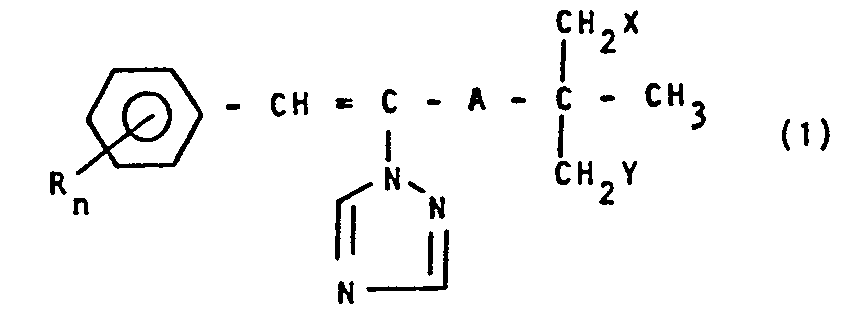
- Es wurden neue halogenierte Triazolylvinyl-keto- und -carbinol-Derivate der Formel

- A für die Ketogruppe oder die CH(OH)-Gruppierung steht,
- X für Wasserstoff oder Halogen steht,
- Y für Halogen steht,
- R für Halogen, Alkyl, Halogenalkyl, Halogenalkoxy, Alkoxy, Alkylthio, Halogenalkylthio, Alkylamino, Dialkylamino, Nitro, Cyano, Hydroxy, Alkylcarbonyloxy, gegebenenfalls substituiertes Phenyl, gegebenenfalls substituiertes Phenoxy oder gegebenenfalls substituiertes Benzyloxy steht und
- n für die Zahlen 0, 1, 2 oder 3 steht,
- Die erfindungsgemäßen Verbindungen der Formel (I) kommen in den geometrischen Isomeren E (trans) und Z (cis) vor. Bei der E,Z-Nomenklatur werden die an der Doppelbindung stehenden Substituenten nach der Cahn-Ingold-Prelog-Regel nach abnehmender Priorität eingeordnet. Stehen die bevorzugten Substituenten auf derselben Seite der Doppelbindung, liegt die Konfiguration Z (abgeleitet von "zusammen") vor, stehen sie auf entgegengesetzter Seite, liegt die Konfiguration E (abgeleitet von "entgegen") vor.
- Wenn A für die CH(OH)-Gruppierung steht, liegt ein asymmetrisches Kohlenstoffatom vor, so daß die Verbindungen der Formel (I) in diesem Fall außerdem in zwei optischen Isomerenformen anfallen.
- Die vorliegende Erfindung betrifft sowohl die einzelnen Isomeren als auch Isomerengemische.
- Weiterhin wurde gefunden, daß man die halogenierten Triazolylvinyl-keto- und -carbinol-Derivate der Formel (I) sowie deren Säureadditionssalze und Metallsalzkomplexe erhält, wenn man Triazolyl-ketone der Formel
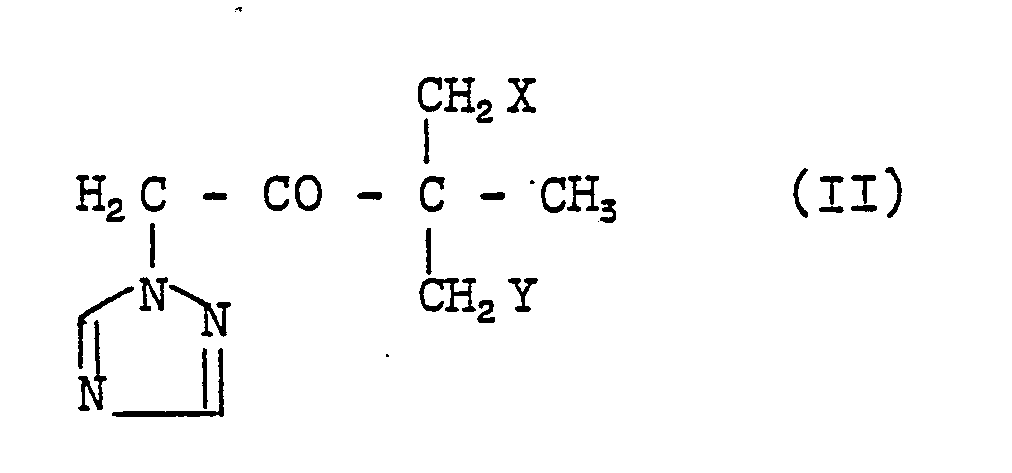
- X und Y die oben angegebene Bedeutung haben, mit Aldehyden der Formel

- R und n die oben angegebene Bedeutung haben,
- in Gegenwart eines Lösungsmittels und in Gegenwart eines Katalysators umsetzt, gegebenenfalls anschließend die halogenierten Triazolylvinyl-keto-Derivate der Formel

X,Y,R und n die oben angegebene Bedeutung haben, in allgemein üblicher Weise reduziert, und gegebenenfalls anschließend an die erhaltenen Verbindungen der Formel (I) eine Säure oder ein Metallsalz addiert. - Schließlich wurde gefunden, daß die neuen halogenierten Triazolylvinyl-keto- und -carbinol-Derivate der.Formel (I) sowie deren Säureadditionssalze und Metallsalzkomplexe starke pflanzenwachstumsregulierende und starke fungizide Eigenschaften aufweisen.
- Ueberraschenderweise zeigen die erfindungsgemäßen Verbindungen der Formel (I) eine bessere fungizide und wachstumsregulierende Wirkung als die aus dem Stand der Technik bekannten 4,4-Dimethyl-l-phenyl-2-triazolyl-l-penten-3-one und -ole, welche chemisch und wirkungsmäßig naheliegende Verbindungen sind. Die erfindungsgemäßen Wirkstoffe stellen somit eine Bereicherung der Technik dar.
- Die erfindungsgemäßen halogenierten Triazolylvinyl-keto-und -carbinol-Derivate sind durch die Formel (I) allgemein definiert. In dieser Formel steht X vorzugsweise für Wasserstoff, Fluor, Chlor und Brom. Y steht vorzugsweise für Fluor, Chlor und Brom. Der Rest R steht vorzugsweise für Fluor, Chlor, Brom; geradkettiges oder verzweigtes Alkyl, Alkoxy und Alkylthio mit jeweils 1 bis 4 Kohlenstoffatomen; Halogenalkyl, Halogenalkoxy und Halcgenalkylthio mit jeweils 1 bis 2 Kohlenstoff- und bis zu 5 gleichen oder verschiedenen Halogenatomen, wie insbesondere Fluor- und Chloratomen; Alkylamino und Dialkylamino mit jeweils 1 bis 2 Kohlenstoffatomen in jedem Alkylteil; Nitro, Cyano, Hydroxy und Alkylcarbonyloxy mit 1 bis 4 Kohlenstoffatomen im Alkylteil; R steht außerdem vorzugsweise für gegebenenfalls substituiertes Phenyl, Phenoxy und Benzyloxy, wobei als Substituenten vorzugsweise genannt seien: Fluor, Chlor, Brom und Alkyl mit 1 bis 2 Kohlenstoffatomen. A und der Index n haben vorzugsweise die in der Erfindungsdefinition angegebene Bedeutung.
- Besonders bevorzugt sind diejenigen Verbindungen der Formel (I) in denen X für Wasserstoff und Y für Fluor oder Chlor steht, oder X und Y gleich sind und für Fluor oder Chlor stehen; R für Fluor, Chlor, Methyl, Isopropyl, tert.-Butyl, Methoxy, Methylthio, Isopropoxy, Trifluormethyl,Difluorchlormethyl, Fluordichlormethyl, Trichlormethyl, 1,1,2-Trifluor-2-chlor-ethyl, Trifluormethoxy, Trifluormethylthio, 1,1,2-Triflucr-2-chlor-ethoxy und -ethylthio, Dimethylamino, Nitro, Cyano, Hydroxy, Acetoxy, tert.-Butyl- carbonyloxy, sowie für gegebenenfalls einfach oder zweifach, gleich oder verschieden durch Fluor, Chlor und/oder Methyl substituiertes Phenyl, Phenoxy und Benzyloxy steht; A und der Index n die in der Erfindungsdefinition angegebene Bedeutung haben.
- Im einzelenen seien außer den bei den Herstellungsbeispielen genannten Verbindungen folgende Verbindungen der allgemeinen Formel (I) genannt:


- Verwendet man beispielsweise Chlorpinakolyl-1,2,4-triazol und 4-Chlorbenzaldehyd als Ausgangsstoffe, so kann der Ablauf des erfindungsgemäßen Verfahrens durch das folgende Formelschema wiedergegeben werden:

- Verwendet man beispielsweise 1-Chlor-S-(4-chlorphenyl)-2,2-dimethyl-4-(1,2,4-triazol-1-yl)-4-penten-3-on und Natriumborhydrid als Ausgangsstoffe, so kann der Ablauf des erfindungsgemäßen Verfahrens durch das folgende Formelschema wiedergegeben werden:

- Die bei der Durchführung des erfindungsgemäßen Verfahrens als Ausgangsstoffe benötigten Triazolyl-ketone sind durch die Formel (II) allgemein definiert. In dieser Formel stehen X und Y vorzugsweise für diejenigen Reste, die bereits im Zusammenhang mit der Beschreibung der erfindungsgemäßen Stoffe der Formel (I) vorzugsweise für diese Substituenten genannt wurden.
- Die Triazolyl-ketone der Formel (II) sind bekannt (vergleiche DE-OS 2 820 361) oder können nach bekannten Verfahren synthetisiert werden. So erhält man Triazolyl- ketone der Formel (II) zum Beispiel dadurch, daß man Halogenketone der Formel

- X und Y die oben angegebene Bedeutung haben und
- Hal für Chlor oder Brom steht,
- Die Halogenketone der Formel (IV) sind bekannt (vergleiche z.B. DE-OS 2 632 603 und DE-OS 2 843 767) bzw. werden in allgemein bekannter Art und Weise erhalten, indem man Verbindungen der Formel

X und Y die oben angegebene Bedeutung haben,
in Gegenwart eines inerten organischen Lösungsmittels bei Raumtemperatur mit Chlor oder Brom versetzt; oder z.B. mit üblichen Chlorierungsmitteln, wie Sulfurylchlorid, bei 20 bis 60°C umsetzt. - Die außerdem für das erfindungsgemäße Verfahren als Ausgangsstoffe zu verwendenden Aldehyde. sind durch die Formel (III) allgemein definiert. In dieser Formel haben R und der Index n vorzugsweise diejenigen Bedeutungen, die bereits im Zusammenhang mit der Beschreibung der erfindungsgemäßen Stoffe der Formel (I) vorzugsweise für diesen Substituenten bzw. für diesen Index genannt wurden.
- Die Aldehyde der Formel (III) sind allgemein bekannte Verbindungen der organischen Chemie.
- Als Lösungsmittel kommen für das erfindungsgemäße Verfahren vorzugsweise inerte organische Lösungsmittel infrage. Hierzu gehören vorzugsweise Alkohole, wie Methanol und Ethanol; Ether, wie Tetrahydrofuran und Dioxan; aliphatische und cycloaliphatische Kohlenwasserstoffe, wie Hexan und Cyclohexan; aromatische Kohlenwasserstoffe, wie Benzol, Toluol und Cumol; halogenierte aliphatische und aromatische Kohlenwasserstoffe, wie Methylenchlorid, Tetrachlorkohlenstoff, Chloroform, Chlorbenzol und Dichlorbenzol.
- Das erfindungsgemäßeVerfahren wird in Gegenwart eines Katalysators durchgeführt. Man kann alle üblicherweise verwendbaren sauren und insbesondere basischen Katalysatoren sowie deren Puffergemische einsetzen. Hierzu gehören vorzugsweise Lewis-Säuren, wie z.B. Bortrifluorid, Bortrichlorid, Zinntetrachlorid oder Titantetrachlorid; organische Basen wie Pyridin und Piperidin; sowie insbesondere Piperidinacetat.
- Die Reaktionstemperaturen können bei der Durchführung des erfindungsgemäßen Verfahrens in einem größeren Bereich variiert werden. Im allgemeinen arbeitet man zwischen 20 und 160°C, vorzugsweise bei der Siedetemperatur des jeweiligen Lösungsmittels.
- Bei der Durchführung des erfindungsgemäßen Verfahrens setzt man auf 1 Mol Triazolyl-keton der Formel (II) 1 bis 1,5 Mol Aldehyd der Formel (III) und katalytische bis 0,2 molare Mengen an Katalysator ein. Die Endprodukte der Formel (I) fallen vorzugsweise als E/Z-Isomerengemische an.
- Eine Trennung in die reinen Isomeren ist auf übliche Art und Weise möglich, wie z.B. durch Kristallisation oder durch chromatographische Trennverfahren.
- Die erfindungsgemäße Reduktion erfolgt in üblicher Weise, z.B. durch Umsetzung mit komplexen Hydriden, gegebenenfalls in Gegenwart eines Verdünnungsmittels, oder durch Umsetzung mit Aluminiumisopropylat in Gegenwart eines Verdünnungsmittels.
- Arbeitet man mit komplexen Hydriden, so kommen als Verdünnungsmittel für die erfindungsgemäße Umsetzung polare organische Lösungsmittel infrage.Hierzu gehören vorzugsweise Alkohole, wie Methanol, Ethanol, Butanol, Isopropanol, und Ether, wie Diethylether oder -Tetrahydrofuran. Die Reaktion wird im allgemeinen bei -10 bis +30°C, vorzugsweise bei -10 bis 20°C durchgeführt. Hierzu setzt man auf 1 Mol des Ketons der Formel (Ta) etwa 1 Mol eines komplexen Hydrids, wie Natriumborhydrid, Calciumborhydrid oder Lithiumalanat, ein.
- Zur Isolierung der reduzierten Verbindungen der Formel (I) wird der Rückstand in verdünnter Salzsäure aufgenommen, anschließend alkalisch gestellt und mit einem organischen Lösungsmittel extrahiert. Die weitere Aufarbeitung erfolgt in üblicher Weise, ebenso eine eventuelle Trennung der E/Z-Isomerengemische.
- Arbeitet man mit Aluminiumisopropylat, so kommen als Verdünnungsmittel für die erfindungsgemäße Umsetzung bevorzugt Alkohole, wie Isopropanol, oder inerte Kohlenwasserstoffe, wie Benzol, infrage. Die Reaktionstemperaturen können wiederum in einem größeren Bereich variiert werden; im allgemeinen arbeitet man zwischen 20 und 120°C, vorzugsweise bei 50 bis 100°C. Zur Durchführung der Reaktion setzt man auf 1 Mol des entsprechenden Ketons der Formel (Ia) etwa 1 bis 2 Mol Aluminiumisopropylat ein. Zur Isolierung der reduzierten Verbindungen der Formel (I) wird das überschüssige Lösungsmittel durch Destillation im Vakuum entfernt und die entstandene-AluminiumVerbindung mit verdünnter Schwefelsäure oder Natronlauge zersetzt. Die weitere Aufarbeitung erfolgt in üblicher Weise.
- Bei der Reduktion mit Aluminiumisopropylat erhält man ausschließlich die Z-Isomeren.
- Ein eindeutiges Charakterisierungsmerkmal für die beiden geometrischen Isomeren ist die Hl-Kernresonanz der zwei Triazol-Protonen. Die Differenz der Shiftwerte für diese beiden Protonen ist in den E-Formen ungefähr doppelt so groß wie in den entsprechenden Z-Formen.
- Zur Herstellung von physiologisch verträglichen Säureadditionssalzen der Verbindungen der Formel (I) kommen vorzugsweise folgende Säuren infrage: Die Halogenwasserstoffsäuren, wie z.B. Chlorwasserstoffsäure und die Bromwasserstoffsäure, insbesondere die Chlorwasserstoffsäure, ferner Phosphorsäure, Salpetersäure, Schwefelsäure, mono-und bifunktionelle Carbonsäuren und Hydroxycarbonsäuren, wie z.B. Essigsäure, Maleinsäure, Bernsteinsäure, Fumarsäure, Weinsäure, Zitronensäure, Salicylsäure, Sorbinsäure, Milchsäure, sowie Sulfonsäuren,wie z.B. p-Toluolsulfonsäure und 1,5-Naphthalindisulfonsäure.
- Die Säureadditionssalze der Verbindungen der Formel (I) können in einfacher Weise nach üblichen Salzbildungsmethoden, z.B. durch Lösen einer Verbindung der Formel (I) in einem geeigneten inerten Lösungsmittel und Hinzufügen der Säure, z.B. Chlorwasserstoffsäure, erhalten werden und in bekannter Weise, z.B. durch Abfiltrieren, isoliert und gegebenenfalls durch Waschen mit einem inerten organischen Lösungsmittel gereinigt werden.
- Zur Herstellung von Metallsalz-Komplexen der Verbindungen der Formel (I) kommen vorzugsweise Salze von Metallen der II. bis IV. Hauptgruppe und der I. und II. sowie IV. bis VIII. Nebengruppe des Periodensystems in Frage, wobei Kupfer, Zink, Mangan, Magnesium, Zinn, Eisen und Nickel beispielhaft genannt seien.
- Als Anionen der Salze kommen solche in Betracht, die sich vorzugsweise von folgenden Säuren ableiten: Halogenwasserstoffsäuren, wie z.B. Chlorwasserstoffsäure und Bromwasserstoffsäure, ferner Phosphorsäure und Schwefelsäure.
- Die Metallsalz-Komplexe von Verbindungen der Formel (I) können in einfacher Weise nach üblichen Verfahren erhalten werden, so z.B. durch Lösen des Metallsalzes in Alkohol, z.B. Ethanol und Hinzufügen zur Verbindung der Formel (I). Man kann Metallsalz-Komplexe in bekannter Weise, z.B. durch Abfiltrieren, isolieren und gegebenenfalls durch Umkristallisation reinigen.
- Die erfindungsgemäßen Wirkstoffe greifen in den Metabolismus der Pflanzen ein und können deshalb als Wachstumsregulatoren eingesetzt werden.
- Für die Wirkungsweise von Pflanzenwachstumsregulatoren gilt nach der bisherigen Erfahrung, daß ein Wirkstoff auch mehrere verschiedenartige Wirkungen auf Pflanzen ausüben kann. Die Wirkungen der Stoffe hängen im wesentlichen ab von dem Zeitpunkt der Anwendung bezogen auf das Entvicklungsstadium der Pflanze sowie von den auf die Pflanzen oder ihre Umgebung ausgebrachten Wirkstoffmengen und von der Art der Applikaticn. In jedem Fall sollen Wachstumsregulatoren die Kulturpflanzen in bestimmter gewünschter Weise beeinflussen.
- Pflanzenwuchsregulierende Stoffe können zum Beispiel zur Hemmung des vegetativen Wachstums der Pflanzen eingesetzt werden. Eine derartige Wuchshemmung ist unter anderem bei Gräsern von wirtschaftlichem Interesse, denn dadurch kann die Häufigkeit der Grasschnitte in Ziergärten, Park- und Sportanlagen, an Straßenrändern, auf Flughäfen oder in Cbstanlagen reduziert werden. Von Bedeutung ist auch die Hemmung des Wuchses von krautigen und holzigen Pflanzen an Straßenrändern und in der Nähe von Pipelines oder überlandleitungen oder ganz allgemein in Bereichen, in denen ein starker Zuwachs der Pflanzen unerwünscht ist.
- Wichtig ist auch die Anwendung von Wachstumsregulatoren zur Hemmung des Längenwachstums von Getreide. Hierdurch wird die Gefahr des Umknickens ("Lagerns") der Pflanzen vor der Ernte verringert oder vollkommen beseitigt. Außerdem können Wachstumsregulatoren bei Getreide eine Halmverstärkung hervorrufen, die ebenfalls dem Lagern entgegenwirkt. Die Anwendung von Wachstumsregulatoren zur Halmverkürzung und Halmverstärkung erlaubt es, höhere Düngermengen auszubringen, um den Ertrag zu steigern, ohne daß die Gefahr besteht, daß das Getreide lagert.
- Eine Hemmung des vegetativen Wachstums ermöglicht bei vielen Kulturpflanzen eine dichtere Anpflanzung, sodaß Mehrerträge bezogen auf die Bocenfläche erzielt werden können. Ein Vorteil der so erzielten kleineren Pflanzen ist auch, daß die Kultur leichter bearbeitet und beerntet werden kann.
- Eine Hemmung des vegetativen Wachstums der Pflanzen kann auch dadurch zu Ertragsteigerungen führen, daß die Nährstoffe und Assimilate in stärkerem Maße der Blüten- und Fruchtbildung zugute kommen als den vegetativen Pflanzenteilen.
- Mit Wachstumsregulatoren läßt sich häufig auch eine Förderung des vegetativen Wachstums erzielen. Dies ist von großem Nutzen, wenn die vegetativen Pflanzenteile geerntet werden. Eine Förderung des vegetativen Wachstums kann aber auch gleichzeitig zu einer Förderung des generativen Wachstums führen, dadurch daß mehr Assimilate gebildet werden, sodaß mehr oder größere Früchte entstehen.
- Ertragssteigerungen können in manchen Fällen durch einen Eingriff in den pflanzlichen Stoffwechsel erreicht werden, ohne daß sich Änderungen des vegetativen Wachstums bemerkbar machen. Ferner kann mit Wachstumsregulatoren eine Veränderung der Zusammensetzung der Pflanzen erreicht werden, was wiederum zu einer Qualitätsverbesserung der Ernteprodukte führen kann. So ist es beispielsweise möglich, den Gehalt an Zucker in Zuckerrüben, Zuckerrohr, Ananas sowie in Zitrusfrüchten zu erhöhen oder den Proteingehalt in Soja oder Getreide zu steigern. Auch ist es beispielsweise möglich, den Abbau erwünschter Inhaltsstoffe, wie z.B. Zucker in Zuckerrüben oder Zuckerrohr, mit Wachstumsregulatoren vor-oder nach der Ernte zu hemmen. Außerdem läßt sich die Produktion oder der Abfluß von sekundären Pflanzeninhaltsstoffen positiv beeinflussen. Als Beispiel sei die Stimulierung des Latexflusses bei Gummibäumen genannt.
- Unter dem Einfluß von Wachstumsregulatoren kann es zur Ausbildung parthenokarper Früchte kommen. Ferner kann das Geschlecht der Blüten beeinflußt werden. Auch kann eine Sterilität des Pollens erzeugt werden, was bei der Züchtung und Herstellung von Hybridsaatgut eine große Bedeutung hat.
- Durch den Einsatz von Wachstumsregulatoren läßt sich die Verzweigung der Pflanzen steuern. Einerseits kann durch Brechen der Apikaldominanz die Entwicklung von Seitentrieben gefördert werden, was besonders im Zierpflanzenbau auch in Verbindung-mit einer Wuchshemmung sehr erwünscht sein kann. Andererseits ist es aber auch möglich, das Wachstum der Seitentriebe zu hemmen. Für diese Wirkung besteht z.B. großes Interesse im Tabakanbau oder bei der Anpflanzung von Tomaten.
- Unter dem Einfluß von Wachstumsregulatoren kann der Blattbestand der Pflanzen so gesteuert werden, daß ein Entblättern der Pflanzen zu einem gewünschten Zeitpunkt erreicht wird. Eine derartige Entlaubung spielt bei der mechanischen Beerntung der Baumwolle eine große Rolle ist aber auch in anderen Kulturen wie z.B. im Weinbau zur Erleichterung der Ernte von Interesse. Eine Entlaubung der Pflanzen kann auch vorgenommen werden, um die Transpiration der Pflanzen vor dem Verpflanzen herabzusetzen.
- Ebenso läßt sich mit Wachstumsregulatoren der Fruchtfall steuern. Einerseits kann ein vorzeitiger Fruchtfall verhindert werden. Andererseits kann aber auch der Fruchtfall oder sogar das Abfallen der Blüten bis zu einem gewünschten-Maße gefördert werden ("Ausdünnung"), um die Alternanz zu brechen. Unter Alternanz versteht man die Eigenart einiger Obstarten, endogen bedingt von Jahr zu Jahr sehr unterschiedliche Erträge zu bringen. Schließlich ist es möglich, mit Wachstumsregulatoren zum Zeitpunkt der Ernte die zum Ablösen der Früchte erforderlichen Kräfte zu reduzieren, um eine mechanische Beerntung zu ermöglichen oder eine manuelle Beerntung zu erleichtern.
- Mit Wachstumsregulatoren läßt sich ferner eine Beschleunigung oder auch Verzögerung der Reife des Erntegutes vor oder nach der Ernte erreichen. Dieses ist von besonderem Vorteil, weil sich dadurch eine optimale Anpassung an die Bedürfnisse des Marktes herbeiführen läßt. Weiterhin können Wachstumsregulatoren in manchen Fällen die Fruchtausfärbung verbessern. Darüberhinaus, kann mit Wachstumsregulatoren auch eine zeitliche Konzentrierung der Reife erzielt werden. Damit werden die Voraussetzungen dafür geschaffen, daß z.B. bei Tabak, Tomaten oder Kaffee eine vollständige mechanische oder manuelle Beerntung in einem Arbeitsgang vorgenommen werden kann.
- Durch Anwendung von Wachstumsregulatoren kann ferner die Samen- oder Kncspenruhe der Pflanzen beeinflußt werden, sodaß die Pflanzen, wie z.B. Ananas oder Zierpflanzen in Gärtnereien, zu einem Zeitpunkt keimen, austreiben oder blühen, an dem sie normalerweise hierzu keine Bereitschaft zeigen. Eine Verzögerung des Austriebes von Knospen oder der Keimung von Samen mit Hilfe von Wachstumsregulatoren kann in frostgefährdeten Gebieten erwünscht sein, um Schädigungen durch Spätfröste zu vermeiden.
- Schließlich kann mit Wachstumsregulatoren eine Resistenz der Pflanzen gegen Frost, Trockenheit oder hohen Salzgehalt des Bodens induziert werden. Hierdurch wird die Kultivierung von Pflanzen in Gebieten möglich, die hierzu normalerweise ungeeignet sind.
- Die erfindungsgemäßen Wirkstoffe weisen auch eine starke mikrobizide Wirkung auf und können zur Bekämpfung-von unerwünschten Mikroorganismen praktisch eingesetzt werden Die Wirkstoffe sind für den Gebrauch als Pflanzenschutzmittel geeignet.
- Fungizide Mittel im Pflanzenschutz werden eingesetzt zur Bekämpfung von Plasmodiophoromycetes,.Oomycetes, chytri-diomycetes, Zygomycetes, Ascomycetes, Basidiomycetes, Deuteromycetes.
- Die gute Pflanzenverträglichkeit der Wirkstoffe in den zur Bekämpfung von Pflanzenkrankheiten notwendigen Konzentrationen erlaubt eine Behandlung von oberirdischen Pflanzenteilen, von Pflanz- und Saatgut, und des Bodens. Als Pflanzenschutzmittel können die erfindungsgemäßen Wirkstoffe mit besonders gutem Erfolg zur Bekämpfung solcher Pilze eingesetzt werden, die echte Mehltauerkrankungen hervorrufen; so zur Bekämpfung von Erysiphe-Arten, wie z.B. gegen den Erreger des Gersten- bzw. des Getreidemehltaus (Erysiphe graminis) und des Gurkenmehltaus (Erysiphe .cichoracearum) ; sowie zur Bekämpfung von Pyricularia oryzae und Pellicularia sasakii. Besonders hervorzuheben ist, daß die erfindungsgemäßen Wirkstoffe nicht nur eine protektive Wirkung entfalten, sondern auch systemisch wirksam sind. So gelingt es, Pflanzen gegen Pilzbefall zu schützen, wenn man den Wirkstoff über den Boden und die Wurzel oder über das Saatgut den oberirdischen Teilen der Pflanze zuführt.
- In entsprechenden Aufwandmengen zeigen die erfindungsgemäßen Verbindungen auch eine herbizide Wirkung.
- Die Wirkstoffe können in die üblichen Formulierungen übergeführt werden, wie Lösungen, Emulsionen, Suspensionen, Pulver, Schäume, Pasten, Granulate, Aerosole, Wirkstoff-imprägnierte Natur- und synthetische Stoffe, Feinstverkapselungen in polymeren Stoffen und in Hüllmassen für Saatgut, ferner in Formulierungen mit Brennsätzen, wie Räucherpatronen, -dosen, -spiralen u.ä., sowie ULV-Kalt- und Warmnebel-Formulierungen.
- Diese Formulierungen werden in bekannter Weise hergestellt, z.B. durch Vermischen der Wirkstoffe mit Streckmitteln, also flüssigen Lösungsmitteln, unter Druck stehenden verflüssigten Gasen und/oder festen Trägerstoffen, gegebenenfalls unter Verwendung von oberflächenaktiven Mitteln, also Emulgiermitteln und/oder Dispergiermitteln und/oder schaumerzeugenden Mitteln. Im Falle der Benutzung von Wasser als Streckmittel können z.B. auch organische Lösungsmittel als Hilfslösungsmittel verwendet werden. Als flüssige Lösungsmittel kommen im wesentlichen in Frage: Aromaten, wie Xylol, Toluol, oder Alkylnaphthaline, chlorierte Aromaten oder chlorierte aliphatische Kohlenwasserstoffe, wie Chlorbenzole, Chloräthylene oder Methylenchlorid, aliphatische Kohlenwasserstoffe, wie Cyclohexan oder Paraffine, z.B. Erdölfraktionen, Alkohole, wie Butanol oder Glycol sowie deren Äther und Ester, Ketone, wie Aceton, Methyläthylketon, Methylisobutylketon oder Cyclohexanon, stark polare Lösungsmittel, wie Dimethylformamid und Dimethylsulfoxid, sowie Wasser; mit verflüssigten gasförmigen Streckmitteln oder Trägerstoffen sind solche Flüssigkeiten gemeint, welche bei normaler Temperatur und unter Normaldruck gasförmig sind, z.B. Aerosol- Treibgase, wie Halogenkohlenwasserstoffe sowie Butan, Propan, Stickstoff und Kohlendioxid; als feste Trägerstoffe kommen in Frage: z.B. natürliche Gesteinsmehle, wie Kaoline, Tonerden, Talkum, Kreide, Quarz, Attapulgit, Montmorillonit oder Diatomeenerde und synthetische Gesteinsmehle, wie hochdisperse Kieselsäure, Aluminiumoxid und Silikate; als feste Trägerstoffe für Granulate kommen in Frage: z.B. gebrochene und fraktionierte natürliche Gesteine wie Calcit, Marmor, Bims, Sepiolith, Dolomit sowie synthetische Granulate aus anorganischen und organischen Mehlen sowie Granulate aus organischem Material wie Sägemehl, Kokosnußschalen, Maiskolben und Tabakstengel; als Emulgier-und/oder schaumerzeugende Mittel kommen in Frage: z.B. nichtionogene und anionische Emulgatoren, wie Polyoxyäthylen-Fettsäure-Ester, Polyoxyäthylen-Fettalkohol-λther, z.B. Alkylarylpolyglykol-äther, Alkylsulfonate, Alkylsulfate, Arylsulfonate sowie Eiweißhydrolysate; als Dispergiermittel kommen in Frage: z.B. Lignin-Sulfitablaugen und Methylcellulose.
- Es können in den Formulierungen Haftmittel wie Carboxymethylcellulose, natürliche und synthetische pulverige, körnige und latexförmige Polymere verwendet werden, wie Gummiarabicum, Polyvinylalkohol, Polyvinylacetat.
- Es können Farbstoffe wie anorganische Pigmente, z.B. Eisenoxid, Titanoxid, Ferrocyanblau und organische Farbstoffe, wie Alizarin-, Azo -Metallphthalocyaninfarbstoffe und Spurennährstoffe wie Salze von Eisen, Mangan, Bor, Kupfer, Kobalt, Molybdän und Zink verwendet werden.
- Die Formulierungen enthalten im allgemeinen zwischen 0,1 und 95 Gewichtsprozent Wirkstoff, vorzugsweise zwischen 0,5 und 90 %. :
- Die erfindungsgemäßen Wirkstoffe können in den Formulierungen oder in den verschiedenen Anwendungsformen in Mischung mit anderen bekannten Wirkstoffen vorliegen, wie Fungiziden,Bakteriziden,Insektiziden,Akariziden,Nematiziden,Herbiziden, Schutzstoffen gegen Vogelfraß, Wuchs- . stoffen, Pflanzennährstoffen, Bodenstrukturverbesserungsnitteln und Pflanzenwachstumsregulatoren.
- Die Wirkstoffe können als solche, in Form ihrer Formulierungen oder der daraus durch weiteres Verdünnen bereiteten Anwendungsformen, wie gebrauchsfertige Lösungen, Emulsionen, Suspensionen, Pulver, Pasten und Granulate angewendet werden. Die Anwendung geschieht in üblicher Weise, z.B. durch Gießen, Tauchen, Spritzen, Sprühen, Vernebeln, Verdampfen, Injizieren, Verschlämmen, Verstreichen, Stäuben, Streuen, Trockenbeizen, Feuchtbeizen, Naßbeizen, Schlämmbeizen oder Inkrustieren. Es ist ferner möglich, die Wirkstoffe nach dem Ultra-Low-Volume-Verfahren auszubringen oder die Wirkstoffzubereitung oder den Wirkstoff selber in den Boden zu injizieren. Es kann auch das Saatgut der Pflanzen behandelt werden.
- Beim Einsatz der erfindungsgemäßen Verbindungen als Pflanzenwachstumsregulatoren können die Aufwandmengen in einem größeren Bereich variiert werden. Im allgemeinen verwendet man pro Hektar Bodenfläche 0,01 bis 50kg, bevorzugt 0,05 bis 10 kg an Wirkstoff.
- Beim Einsatz der erfindungsgemäßen Stoffe als Pflanzenwachstumsregulatoren gilt, daß die Anwendung in einem bevorzugten Zeitraum vorgenommen wird, dessen genaue Abgrenzung sich nach den klimatischen und vegetativen Gegebenheiten richtet.
- Auch beim Einsatz der erfindungsgemäßen Stoffe als Fungizide kann die Aufwandmenge je nach Art der Applikation in einem größeren Bereich variiert werden. So liegen die Wirkstoffkonzentrationen bei der Behandlung von Pflanzenteilen in den Anwendungsformen im allgemeinen zwischen 1 und 0,0001 Gew-%, vorzugsweise zwischen 0,5 und 0,001 Gew.-%. Bei der Saatgutbehandlung werden im allgemeinen Wirkstoffmengen von 0,001 bis 50g je Kilogramm Saatgut, vorzugsweise 0,01 bis 10g, benötigt. Bei Behandlung des Bodens sind Wirkstoffkonzentrationen von 0,00001 bis 0,1 Gew.-%, vorzugsweise von 0,0001 bis 0,02 %, am Wirkungsort erforderlich.
-

-

-

-

- (Das l-Chlor-2,2-dimethyl-butan-3-on wird in einer Ausbeute von 90 % erhalten, wenn man äquimolare Mengen 2,2-Dimethyl-1-hydroxy-butan-3-on und Triphenylphosphin in der zehnfachen Menge Tetrachlorkohlenstoff 12 Stunden unter Rückfluß erhitzt, das Lösungsmittel abdestilliert, den Rückstand in Ether aufnimmt, filtriert und destilliert.)

- Zu 172g (2 Mol) Methylisopropylketon in 1000 ml Methanol werden 66g (2,2 Mol) Paraformaldehyd und lg Kaliumhydroxid in 10 ml Methanol getropft. Man erhitzt 15 Stunden unter Rückfluß und destilliert anschließend das Methanol über eine Kolonne bei 82°C Innentemperatur ab. Der Rückstand wird im Wasserstrahlvakuum destilliert. Man erhält 152,7g (68 % der Theorie) 2,2-Dimethyl-l-hydroxy-butan-3-on vom Siedepunkt 80-82°C/l2mm Hg.
-


-

-

- In entsprechender Weise werden die folgenden Verbin- dungen der allgemeinen Formel (I) erhalten:


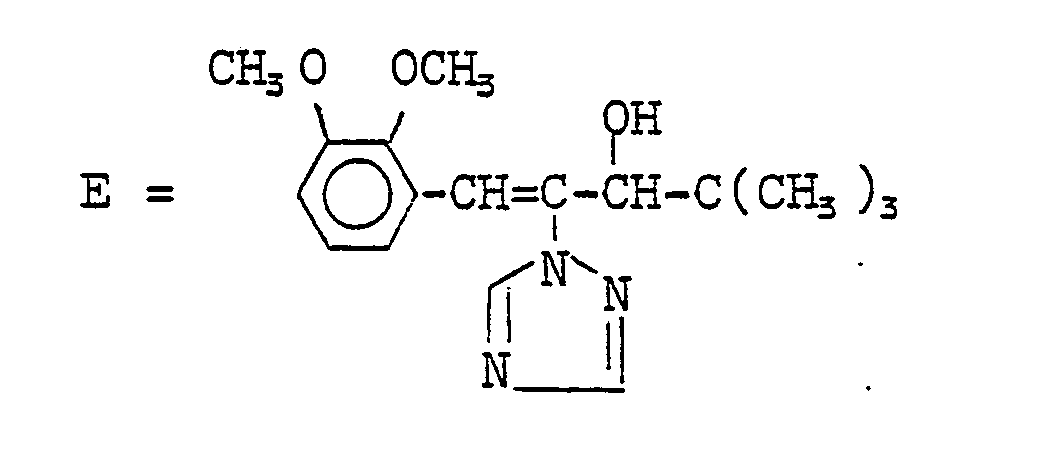
- In den nachfolgenden Anwendungsbeispielen werden die nachstehend angegebenen Verbindungen als Vergleichssubstanzen eingesetzt:




-

- Sojabohnenpflanzen werden im Gewächshaus bis zur vollen Entfaltung des ersten Folgeblattes angezogen. In diesem Stadium werden die Pflanzen tropfnaß mit den Wirkstoffzubereitungen besprüht. Nach 3 Wochen wird bei allen Pflanzen der Zuwachs gemessen und die Wuchshemmung in Prozent des Zuwachses der Kontrollpflanzen berechnet. Es bedeuten loo % Wuchshemmung den Stillstand des Wachstums und 0 % ein Wachstum entsprechend dem der Kontrollpflanzen.
- Eine sehr deutliche Überlegenheit in der Wirksamkeit gegenüber den aus dem Stand der Technik bekannten Verbindungen (A), (B), (D), (E), (F) und (G) zeigen bei diesem Test z.B. die Verbindungen gemäß folgenden Herstellungsbeispielen: 3, 4, 7, 12, 13 14, 35, 36, 37, 38 und 40.
-

- Baumwollpflanzen werden im Gewächshaus bis zur vollen Entfaltung des 5. Folgeblattes angezogen. In diesem Stadium werden die Pflanzen tropfnaß mit den Wirkstoffzubereitungen besprüht. Nach 3 Wochen wird der Zuwachs der Pflanzen gemessen und die Wuchshemmung in Prozent des Zuwachses der Kontrollpflanzen berechnet. Es bedeuten loo % Wuchshemmung den Stillstand des Wachstums und 0 % ein Wachstum entsprechend dem der Kontrollpflanzen.
- Eine sehr deutliche Überlegenheit in der Wirksamkeit gegenüber den aus dem Stand der Technik bekannten Verbindungen (A), (B), (E), (F) und (H) zeigen bei diesem Test z.B. die Verbindungen gemäß folgenden Herstellungsbeispielen: 3, 4, 7, 13, 14, 36, 37, 38 und 40.
-

- Zuckerrüben werden im Gewächshaus bis zur vollen Ausbildung der Keimblätter angezogen. In diesem Stadium werden die Pflanzen tropfnaß mit den Wirkstoffzubereitungen besprüht. Nach 14 Tagen wird der Zuwachs der Pflanzen gemessen und die Wuchshemmung in Prozent des Zuwachses der Kontrollpflanzen berechnet. Es bedeuten 0 % Wuchshemmung ein Wachstum entsprechend dem der Kontrollpflanzen. 100 % Wuchshemmung bedeutet Stillstand des Wachstums.
- Die erfindungsgemäßen Wirkstoffe 3,4,12,13,35,36,37,38,39 und 40 zeigen in diesem Test eine bessere Wuchshemmung als die aus dem Stand der Technik bekannten Verbindungen (E) und (F) .
- Bei Behandlung junger Zuckerrübenpflanzen mit der Wirkstoffzubereitung wurde besonders bei dem erfindungsgemäßen Beispiel 3 in den Konzentrationen 250 und 125 ppm eine Resistenz gegenüber Boden-Trockenheit festgestellt.
- Erysiphe-Test (Gerste) /protektiv
-

- Zur Prüfung auf protektive Wirksamkeit besprüht man junge Pflanzen mit der Wirkstoffzubereitung taufeucht. Nach Antrocknen des Spritzbelages werden die Pflanzen mit Sporen von Erysiphe graminis f.sp.hordei bestäubt.
- Die Pflanzen werden in einem Gewächshaus bei einer Temperatur von ca. 20°C und einer relativen Luftfeuchtigkeit von ca. 80% aufgestellt, um die Entwicklung von Mehltaupusteln zu begünstigen.
- 7 Tage nach der Inokulation erfolgt die Auswertung.
- Eine deutliche Ueberlegenheit in der Wirksamkeit gegenüber den aus dem Stand der Technik bekannten Verbindungen (B) und (E) zeigen bei diesem Test z.B. die Verbindungen gemäß folgender Herstellungsbeispiel.e: 6,7,3,4,12,13 und 14.
- Gerstenmehltau-Test (Erysiphe graminis var.hordei)/ systemisch (pilzliche GetreidesproBkrankheit)
- Die Anwendung der Wirkstoffe erfolgt als pulverförmige Saatgutbehandlungsmittel. Sie werden hergestellt durch Abstrecken des Wirkstoffes mit einem Gemisch aus gleichen Gewichtsteilen Talkum und Kieselgur zu einer feinpulverigen Mischung mit der gewünschten Wirkstoffkonzentration.
- Zur Saatgutbehandlung schüttelt man Gerstensaatgut mit dem abgestreckten Wirkstoff in einer verschlossenen Glasflasche. Das Saatgut sät man mit 3 x 12 Korn in Blumentöpfe 2 cm tief in ein Gemisch aus einem Volumenteil Fruhstorfer Einheitserde und einem Volumenteil Quarzsand ein. Die Keimung und der Auflauf erfolgen unter günstigen Bedingungen im Gewächshaus. 7 Tage nach der Aussaat, wenn die Gerstenpflanzen ihr erstes Blatt entfaltet haben, werden sie mit frischen Sporen von Erysiphe graminis var.hordei bestäubt und bei 21-22°C und 80-90% rel.Luftfeuchte und 16-stündiger Belichtung weiter kultiviert. Innerhalb von 6 Tagen bilden sich an den Blättern die typischen Mehltau- pusteln aus.
- Der Befallsgrad wird in Prozent des Befalls der unbehandelten Kontrollpflanzen ausgedrückt. So bedeutet 0% keinen Befall und 100% den gleichen Befallsgrad wie bei der unbehandelten Kontrolle. Der Wirkstoff ist um so wirksamer je geringer der Mehltaubefall ist.
- Eine deutliche Ueberlegenheit in der Wirksamkeit gegenüber der aus dem Stand der Technik bekannten Verbindung (H) zeigt bei diesem Test z.B. die Verbindung gemäß Herstellungsbeispiel 3.
- Erysiphe-Test (Gurken)/ Protektiv
-

- Mit der Spritzflüssigkeit bespritzt man junge Gurkenpflanzen mit etwa drei Laubblättern bis zur Tropfnässe. Die Gurkenpflanzen verbleiben zur Trocknung 24 Stunden im Gewächshaus. Dann werden sie zur Inokulation mit Konidien des Pilzes Erysiphe cichoracearum. bestäubt. Die Pflanzen werden anschließend bei 23 bis 24°C und bei einer relativen Luftfeuchtigkeit von ca 75 % im Gewächshaus-aufgestellt.
- Nach 12 Tagen wird der Befall der Gurkenpflanzen bestimmt. Die erhaltenen Boniturwerte werden in Prozent Befall umgerechnet. C % bedeutet keinen Befall, 100 % bedeutet, daß die Pflanzen vollständig befallen sind.
- Bei diesem Test zeigen z.B. die folgenden Verbindungen eine sehr gute Wirkung, die derjenigen der aus dem Stand der Technik bekannten Verbindungen (D)und(E) überlegen ist:
- Verbindungen gemäß Herstellungsbeispielen:6,7,14, 2 und 13.
sowie deren physiologisch verträglichen Säureadditions- salze und Metallsalzkomplexe gefunden.
mit 1,2,4-Triazol in Gegenwart eines Verdünnungsmittels, wie beispielsweise Aceton, und in Gegenwart eines Säurebindemittels, wie beispielsweise Kaliumcarbonat, bei Temperaturen zwischen 20 und 150°C umsetzt.
Claims (10)

sowie deren physiologisch verträglichen Säureadditionssalze und Metallsalzkomplexe.


in Gegenwart eines Lösungsmittels und in Gegenwart eines Katalysators umsetzt, gegebenenfalls anschließend die halogenierten Triazolylvinyl-keto-Derivate der Formel

in allgemein üblicher Weise reduziert, und gegebenenfalls anschließend an die erhaltenen Verbindungen der Formel (I) eine Säure oder ein Metallsalz addiert.
Priority Applications (1)
| Application Number | Priority Date | Filing Date | Title |
|---|---|---|---|
| AT81104778T ATE15664T1 (de) | 1980-07-03 | 1981-06-22 | Halogenierte triazolylvinyl-keto- und -carbinol- derivate, verfahren zu ihrer herstellung sowie ihre verwendung als pflanzenwachstumsregulatoren und fungizide. |
Applications Claiming Priority (4)
| Application Number | Priority Date | Filing Date | Title |
|---|---|---|---|
| DE3025242 | 1980-07-03 | ||
| DE19803025242 DE3025242A1 (de) | 1980-07-03 | 1980-07-03 | Halogenierte triazolylvinyl-keto- und -carbinol-derivate, verfahren zu ihrer herstellung sowie ihre verwendung als pflanzenwachstumsregulatoren und fungizide |
| DE3111012 | 1981-03-20 | ||
| DE19813111012 DE3111012A1 (de) | 1981-03-20 | 1981-03-20 | Halogenierte triazolylvinyl-keto- und -carbinol-derivate, verfahren zu ihrer herstellung sowie ihre verwendung als pflanzenwachstumsregulatoren und fungizide |
Publications (3)
| Publication Number | Publication Date |
|---|---|
| EP0044425A2 true EP0044425A2 (de) | 1982-01-27 |
| EP0044425A3 EP0044425A3 (en) | 1982-02-03 |
| EP0044425B1 EP0044425B1 (de) | 1985-09-18 |
Family
ID=25786409
Family Applications (1)
| Application Number | Title | Priority Date | Filing Date |
|---|---|---|---|
| EP81104778A Expired EP0044425B1 (de) | 1980-07-03 | 1981-06-22 | Halogenierte Triazolylvinyl-keto- und -carbinol-Derivate, Verfahren zu ihrer Herstellung sowie ihre Verwendung als Pflanzenwachstumsregulatoren und Fungizide |
Country Status (17)
| Country | Link |
|---|---|
| US (1) | US4729783A (de) |
| EP (1) | EP0044425B1 (de) |
| AR (1) | AR228277A1 (de) |
| BR (1) | BR8104231A (de) |
| CA (1) | CA1167452A (de) |
| DD (1) | DD205812A5 (de) |
| DE (1) | DE3172327D1 (de) |
| DK (1) | DK294481A (de) |
| EG (1) | EG14837A (de) |
| ES (1) | ES8204987A1 (de) |
| GR (1) | GR82266B (de) |
| IE (1) | IE51366B1 (de) |
| IL (1) | IL63210A (de) |
| NZ (1) | NZ197571A (de) |
| PL (1) | PL131138B1 (de) |
| PT (1) | PT73246B (de) |
| TR (1) | TR21023A (de) |
Cited By (5)
| Publication number | Priority date | Publication date | Assignee | Title |
|---|---|---|---|---|
| DE3309870A1 (de) * | 1982-03-19 | 1983-09-29 | Montedison S.p.A., 20121 Milano | Heterocyclische verbindungen, verfahren zu ihrer herstellung und ihre verwendung als pflanzenwachstumsregulatoren |
| EP0101925B1 (de) * | 1982-08-05 | 1986-11-26 | Bayer Ag | Substituierte Azolylvinylketone und -carbinole |
| FR2588724A1 (fr) * | 1985-10-18 | 1987-04-24 | Rhone Poulenc Agrochimie | Compositions fongicides a base de derive du triazole et leur utilisation |
| EP0223142A1 (de) * | 1985-11-15 | 1987-05-27 | Bayer Ag | (-)-Antipode des (E)-1-(4-Chlorphenyl)-5-fluor-4,4-dimethyl-3-hydroxy-2-(1,2,4-triazol-l-yl)-pent-l-ens |
| US5273722A (en) * | 1991-10-25 | 1993-12-28 | Bayern-Chemie Airbags Gmbh | Gas generator |
Families Citing this family (9)
| Publication number | Priority date | Publication date | Assignee | Title |
|---|---|---|---|---|
| US5006154A (en) * | 1986-07-24 | 1991-04-09 | Shell Oil Company | Method of synchronizing flowering in plants |
| DE3913725A1 (de) * | 1989-04-26 | 1990-10-31 | Basf Ag | 1-halogenvinyl-azole und diese enthaltende fungizide und wachstumsregulatoren |
| JP2000510438A (ja) * | 1995-12-21 | 2000-08-15 | ビー・エイ・エス・エフ、コーポレーション | 塩化メピクァートと組み合わせたアミノエトキシビニルグリシン |
| AU1373797A (en) * | 1995-12-21 | 1997-07-17 | Basf Corporation | Low rate application of inhibitors of ethylene biosynthesis or action |
| CA2193714A1 (en) * | 1995-12-21 | 1997-06-22 | Wilhelm Rademacher | Encapsulated plant growth regulator formulations and applications |
| US5837653A (en) * | 1995-12-21 | 1998-11-17 | Basf Corporation | Encapsulated plant growth regulator formulations |
| ID19230A (id) | 1996-12-20 | 1998-06-28 | Basf Corp | Pengatur pertumbuhan tanaman dalam zat pelarut pirrolidon |
| EP2654433B1 (de) | 2010-12-21 | 2017-08-30 | Bayer Cropscience LP | "sandpapier"-mutanten von bacillus und methoden ihrer verwendung zur förderung von pflanzenwachstum, pflanzengesundheit und zur kontrolle von krankheiten und schädlingen |
| MX2014002890A (es) | 2011-09-12 | 2015-01-19 | Bayer Cropscience Lp | Metodo para mejorar la salud y/o promover el crecimiento de una planta y/o mejorar la maduracion de frutos. |
Family Cites Families (11)
| Publication number | Priority date | Publication date | Assignee | Title |
|---|---|---|---|---|
| DE2423987C2 (de) * | 1974-05-17 | 1986-01-16 | Bayer Ag, 5090 Leverkusen | Metallkomplexe von Azolyläthern, Verfahren zu ihrer Herstellung sowie ihre Verwendung als Fungizide |
| PT66803B (en) * | 1976-07-20 | 1978-12-20 | Bayer Ag | Process for preparing a fungicidal composition containing halogenated 1-azolyl-butane derivatives and their phisiologically suitable salts |
| JPS6019751B2 (ja) * | 1977-04-15 | 1985-05-17 | 住友化学工業株式会社 | ベンジリデンケトン系化合物、その製造法および該化合物からなる殺菌剤 |
| JPS6053018B2 (ja) * | 1977-09-07 | 1985-11-22 | 住友化学工業株式会社 | アゾ−ル系化合物、その製造法および該化合物からなる殺菌剤 |
| US4182862A (en) * | 1978-10-18 | 1980-01-08 | Rohm And Haas Company | Process for the preparation of 1,3-disubstituted-2-azoyl-2-propen-1-ones |
| US4486218A (en) * | 1979-02-16 | 1984-12-04 | Bayer Aktiengesellschaft | 1-Vinyltriazole compounds and plant growth and fungicidal compositions |
| US4554007A (en) * | 1979-03-20 | 1985-11-19 | Sumitomo Chemical Company, Limited | Geometrical isomer of 1-substituted-1-triazolylstyrenes, and their production and use as fungicide, herbicide and/or plant growth regulant |
| DE2920437A1 (de) * | 1979-05-19 | 1980-11-27 | Bayer Ag | Geometrische isomere von 4,4- dimethyl-1-phenyl-2-(1,2,4-triazol-1-yl)- 1-penten-3-olen, verfahren zu ihrer herstellung sowie ihre verwendung als arzneimittel |
| DE2929602A1 (de) * | 1979-07-21 | 1981-02-12 | Bayer Ag | Triazolyl-alken-derivate, verfahren zu ihrer herstellung und ihre verwendung als fungizide |
| DE3000643A1 (de) * | 1980-01-10 | 1981-07-16 | Bayer Ag, 5090 Leverkusen | Verfahren zur herstellung von azolyl-vinyl-ketonen |
| DE3019046A1 (de) * | 1980-05-19 | 1981-11-26 | Bayer Ag, 5090 Leverkusen | Triazolyl-vinyl-ketone und -carbinole, verfahren zu ihrer herstellung sowie ihre verwendung als fungizide |
-
1981
- 1981-06-22 DE DE8181104778T patent/DE3172327D1/de not_active Expired
- 1981-06-22 EP EP81104778A patent/EP0044425B1/de not_active Expired
- 1981-06-23 PT PT73246A patent/PT73246B/pt unknown
- 1981-06-29 TR TR21023A patent/TR21023A/xx unknown
- 1981-06-30 NZ NZ197571A patent/NZ197571A/en unknown
- 1981-06-30 CA CA000380908A patent/CA1167452A/en not_active Expired
- 1981-07-01 AR AR285948A patent/AR228277A1/es active
- 1981-07-01 EG EG81366A patent/EG14837A/xx active
- 1981-07-01 GR GR65404A patent/GR82266B/el unknown
- 1981-07-01 IL IL63210A patent/IL63210A/xx unknown
- 1981-07-02 PL PL1981231997A patent/PL131138B1/pl unknown
- 1981-07-02 BR BR8104231A patent/BR8104231A/pt unknown
- 1981-07-02 IE IE1485/81A patent/IE51366B1/en unknown
- 1981-07-02 ES ES503610A patent/ES8204987A1/es not_active Expired
- 1981-07-02 DK DK294481A patent/DK294481A/da not_active Application Discontinuation
- 1981-07-02 DD DD81231399A patent/DD205812A5/de unknown
-
1985
- 1985-03-22 US US06/715,574 patent/US4729783A/en not_active Expired - Fee Related
Cited By (5)
| Publication number | Priority date | Publication date | Assignee | Title |
|---|---|---|---|---|
| DE3309870A1 (de) * | 1982-03-19 | 1983-09-29 | Montedison S.p.A., 20121 Milano | Heterocyclische verbindungen, verfahren zu ihrer herstellung und ihre verwendung als pflanzenwachstumsregulatoren |
| EP0101925B1 (de) * | 1982-08-05 | 1986-11-26 | Bayer Ag | Substituierte Azolylvinylketone und -carbinole |
| FR2588724A1 (fr) * | 1985-10-18 | 1987-04-24 | Rhone Poulenc Agrochimie | Compositions fongicides a base de derive du triazole et leur utilisation |
| EP0223142A1 (de) * | 1985-11-15 | 1987-05-27 | Bayer Ag | (-)-Antipode des (E)-1-(4-Chlorphenyl)-5-fluor-4,4-dimethyl-3-hydroxy-2-(1,2,4-triazol-l-yl)-pent-l-ens |
| US5273722A (en) * | 1991-10-25 | 1993-12-28 | Bayern-Chemie Airbags Gmbh | Gas generator |
Also Published As
| Publication number | Publication date |
|---|---|
| IL63210A0 (en) | 1981-10-30 |
| DE3172327D1 (en) | 1985-10-24 |
| BR8104231A (pt) | 1982-03-23 |
| IL63210A (en) | 1985-03-31 |
| CA1167452A (en) | 1984-05-15 |
| IE811485L (en) | 1982-01-03 |
| EG14837A (en) | 1985-03-31 |
| PL231997A1 (de) | 1982-03-01 |
| GR82266B (de) | 1984-12-13 |
| PT73246A (en) | 1981-07-01 |
| PL131138B1 (en) | 1984-10-31 |
| NZ197571A (en) | 1984-07-06 |
| AR228277A1 (es) | 1983-02-15 |
| ES503610A0 (es) | 1982-05-16 |
| DD205812A5 (de) | 1984-01-11 |
| DK294481A (da) | 1982-01-04 |
| IE51366B1 (en) | 1986-12-10 |
| TR21023A (tr) | 1983-05-16 |
| EP0044425A3 (en) | 1982-02-03 |
| ES8204987A1 (es) | 1982-05-16 |
| EP0044425B1 (de) | 1985-09-18 |
| PT73246B (en) | 1982-07-22 |
| US4729783A (en) | 1988-03-08 |
Similar Documents
| Publication | Publication Date | Title |
|---|---|---|
| EP0072580B1 (de) | 1-Hydroxyethyl-azol-Derivate, Verfahren zu ihrer Herstellung sowie ihre Verwendung als Pflanzenwachstumsregulatoren und Fungizide | |
| EP0015387B1 (de) | 1-Vinyltriazol-Derivate, Verfahren zu ihrer Herstellung sowie ihre Verwendung als Wachstumsregulatoren und Fungizide | |
| EP0055833B1 (de) | Substituierte 1-Azolyl-butan-2-ole, Verfahren zu ihrer Herstellung und ihre Verwendung als Pflanzenschutzmittel sowie als Zwischenprodukte | |
| EP0032200B1 (de) | Substituierte Triazolylmethyl-tert.-butyl-carbinole, Verfahren zu ihrer Herstellung und ihre Verwendung als Pflanzenschutzmittel sowie als Zwischenprodukte | |
| DE3018866A1 (de) | 1-hydroxyethyl-azol-derivate, verfahren zu ihrer herstellung sowie ihre verwendung als pflanzenwachstumsregulatoren und fungizide | |
| EP0044425B1 (de) | Halogenierte Triazolylvinyl-keto- und -carbinol-Derivate, Verfahren zu ihrer Herstellung sowie ihre Verwendung als Pflanzenwachstumsregulatoren und Fungizide | |
| EP0044993B1 (de) | Triazolylpropenol-Derivate, Verfahren zu ihrer Herstellung sowie ihre Verwendung als Pflanzenwachstumsregulatoren und Fungizide | |
| EP0298332B1 (de) | Hydroxyalkyl-azolyl-Derivate | |
| EP0079006B1 (de) | Azolyl-alkenone und -ole, Verfahren zu ihrer Herstellung sowie ihre Verwendung als Pflanzenwachstumsregulatoren und Fungizide | |
| EP0016323A1 (de) | 1-Allyltriazol-Derivate, Verfahren zu ihrer Herstellung und ihre Verwendung als Pflanzenschutzmittel | |
| EP0031911B1 (de) | Substituierte Triazolylmethyl-tert.-butyl-ketone, Verfahren zu ihrer Herstellung und ihre Verwendung als Pflanzenschutzmittel sowie als Zwischenprodukte | |
| EP0059894B1 (de) | Triazolylalkyl-thioether, Verfahren zu ihrer Herstellung sowie ihre Verwendung als Pflanzenwachstumsregulatoren und Fungizide | |
| EP0086901B1 (de) | Azolyl-thioether-Derivate, Verfahren zu ihrer Herstellung sowie ihre Verwendung als Fungizide und Pflanzenwachstumsregulatoren | |
| EP0080102B1 (de) | Cycloalkyl-(alpha-triazolyl-beta-hydroxy)-ketone, Verfahren zu ihrer Herstellung sowie ihre Verwendung als Fungizide und Pflanzenwachstumsregulatoren | |
| EP0058347A2 (de) | Benzyl-pyrimidinylalkyl-ether, Verfahren zu ihrer Herstellung, ihre Verwendung als Pflanzenwachstumsregulatoren und Fungizide sowie Zwischenprodukte und deren Herstellung | |
| EP0101925B1 (de) | Substituierte Azolylvinylketone und -carbinole | |
| EP0053311B1 (de) | Substituierte 1-Phenyl-2-triazolyl-1-penten-3-ole, Verfahren zu ihrer Herstellung sowie ihre Verwendung als Pflanzenwachstumsregulatoren und Fungizide | |
| EP0094572A2 (de) | 1-Azolyl-2-oximino-butan-Derivate, Verfahren zu ihrer Herstellung sowie ihre Verwendung als Fungizide und Pflanzenwachstumsregulatoren | |
| EP0297393A2 (de) | 1-Phenoxy-3-triazolyl-1-hexen-Derivate | |
| DE3045182A1 (de) | Pflanzenwachstumsregulierende und fungizide mittel | |
| DE3025242A1 (de) | Halogenierte triazolylvinyl-keto- und -carbinol-derivate, verfahren zu ihrer herstellung sowie ihre verwendung als pflanzenwachstumsregulatoren und fungizide | |
| EP0100952A1 (de) | Substituierte Azolylallylketone und -carbinole | |
| DE3028330A1 (de) | Triazolylpropenol-derivate, verfahren zu ihrer herstellung sowie ihre verwendung als pflanzenwachstumsregulatoren und fungizide | |
| DE3111012A1 (de) | Halogenierte triazolylvinyl-keto- und -carbinol-derivate, verfahren zu ihrer herstellung sowie ihre verwendung als pflanzenwachstumsregulatoren und fungizide |
Legal Events
| Date | Code | Title | Description |
|---|---|---|---|
| PUAI | Public reference made under article 153(3) epc to a published international application that has entered the european phase |
Free format text: ORIGINAL CODE: 0009012 |
|
| PUAL | Search report despatched |
Free format text: ORIGINAL CODE: 0009013 |
|
| 17P | Request for examination filed |
Effective date: 19810622 |
|
| AK | Designated contracting states |
Designated state(s): AT BE CH DE FR GB IT NL SE |
|
| AK | Designated contracting states |
Designated state(s): AT BE CH DE FR GB IT NL SE |
|
| ITF | It: translation for a ep patent filed | ||
| GRAA | (expected) grant |
Free format text: ORIGINAL CODE: 0009210 |
|
| AK | Designated contracting states |
Designated state(s): AT BE CH DE FR GB IT LI NL SE |
|
| REF | Corresponds to: |
Ref document number: 15664 Country of ref document: AT Date of ref document: 19851015 Kind code of ref document: T |
|
| REF | Corresponds to: |
Ref document number: 3172327 Country of ref document: DE Date of ref document: 19851024 |
|
| ET | Fr: translation filed | ||
| PGFP | Annual fee paid to national office [announced via postgrant information from national office to epo] |
Ref country code: AT Payment date: 19860613 Year of fee payment: 6 |
|
| PLBE | No opposition filed within time limit |
Free format text: ORIGINAL CODE: 0009261 |
|
| STAA | Information on the status of an ep patent application or granted ep patent |
Free format text: STATUS: NO OPPOSITION FILED WITHIN TIME LIMIT |
|
| 26N | No opposition filed | ||
| PGFP | Annual fee paid to national office [announced via postgrant information from national office to epo] |
Ref country code: DE Payment date: 19890520 Year of fee payment: 9 |
|
| PGFP | Annual fee paid to national office [announced via postgrant information from national office to epo] |
Ref country code: GB Payment date: 19890531 Year of fee payment: 9 |
|
| PGFP | Annual fee paid to national office [announced via postgrant information from national office to epo] |
Ref country code: BE Payment date: 19890621 Year of fee payment: 9 |
|
| PG25 | Lapsed in a contracting state [announced via postgrant information from national office to epo] |
Ref country code: AT Effective date: 19890622 |
|
| PGFP | Annual fee paid to national office [announced via postgrant information from national office to epo] |
Ref country code: CH Payment date: 19890622 Year of fee payment: 9 |
|
| PG25 | Lapsed in a contracting state [announced via postgrant information from national office to epo] |
Ref country code: SE Effective date: 19890623 |
|
| ITTA | It: last paid annual fee | ||
| PGFP | Annual fee paid to national office [announced via postgrant information from national office to epo] |
Ref country code: NL Payment date: 19890630 Year of fee payment: 9 Ref country code: FR Payment date: 19890630 Year of fee payment: 9 |
|
| PG25 | Lapsed in a contracting state [announced via postgrant information from national office to epo] |
Ref country code: GB Effective date: 19900622 |
|
| PG25 | Lapsed in a contracting state [announced via postgrant information from national office to epo] |
Ref country code: LI Effective date: 19900630 Ref country code: CH Effective date: 19900630 Ref country code: BE Effective date: 19900630 |
|
| BERE | Be: lapsed |
Owner name: BAYER A.G. Effective date: 19900630 |
|
| PG25 | Lapsed in a contracting state [announced via postgrant information from national office to epo] |
Ref country code: NL Effective date: 19910101 |
|
| NLV4 | Nl: lapsed or anulled due to non-payment of the annual fee | ||
| GBPC | Gb: european patent ceased through non-payment of renewal fee | ||
| PG25 | Lapsed in a contracting state [announced via postgrant information from national office to epo] |
Ref country code: FR Effective date: 19910228 |
|
| REG | Reference to a national code |
Ref country code: CH Ref legal event code: PL |
|
| PG25 | Lapsed in a contracting state [announced via postgrant information from national office to epo] |
Ref country code: DE Effective date: 19910301 |
|
| REG | Reference to a national code |
Ref country code: FR Ref legal event code: ST |
|
| EUG | Se: european patent has lapsed |
Ref document number: 81104778.6 Effective date: 19900412 |