EP0044728A2 - Verres polychromatiques et potentiellement polychromatiques ainsi que leur fabrication - Google Patents
Verres polychromatiques et potentiellement polychromatiques ainsi que leur fabrication Download PDFInfo
- Publication number
- EP0044728A2 EP0044728A2 EP81303295A EP81303295A EP0044728A2 EP 0044728 A2 EP0044728 A2 EP 0044728A2 EP 81303295 A EP81303295 A EP 81303295A EP 81303295 A EP81303295 A EP 81303295A EP 0044728 A2 EP0044728 A2 EP 0044728A2
- Authority
- EP
- European Patent Office
- Prior art keywords
- glass
- silver
- microcrystals
- polychromatic
- copper
- Prior art date
- Legal status (The legal status is an assumption and is not a legal conclusion. Google has not performed a legal analysis and makes no representation as to the accuracy of the status listed.)
- Withdrawn
Links
- 239000011521 glass Substances 0.000 title claims abstract description 144
- 238000004519 manufacturing process Methods 0.000 title claims abstract description 7
- 229910052709 silver Inorganic materials 0.000 claims abstract description 55
- 239000004332 silver Substances 0.000 claims abstract description 55
- BQCADISMDOOEFD-UHFFFAOYSA-N Silver Chemical compound [Ag] BQCADISMDOOEFD-UHFFFAOYSA-N 0.000 claims abstract description 43
- 230000005855 radiation Effects 0.000 claims abstract description 42
- 239000003795 chemical substances by application Substances 0.000 claims abstract description 34
- 238000010438 heat treatment Methods 0.000 claims abstract description 29
- 239000013081 microcrystal Substances 0.000 claims abstract description 28
- 239000010949 copper Substances 0.000 claims abstract description 26
- 230000001235 sensitizing effect Effects 0.000 claims abstract description 26
- RYGMFSIKBFXOCR-UHFFFAOYSA-N Copper Chemical compound [Cu] RYGMFSIKBFXOCR-UHFFFAOYSA-N 0.000 claims abstract description 25
- 229910052802 copper Inorganic materials 0.000 claims abstract description 25
- 239000002245 particle Substances 0.000 claims abstract description 22
- KRHYYFGTRYWZRS-UHFFFAOYSA-M Fluoride anion Chemical compound [F-] KRHYYFGTRYWZRS-UHFFFAOYSA-M 0.000 claims abstract description 21
- 239000003513 alkali Substances 0.000 claims abstract description 20
- 238000000034 method Methods 0.000 claims abstract description 16
- 229910052693 Europium Inorganic materials 0.000 claims abstract description 13
- 229910052772 Samarium Inorganic materials 0.000 claims abstract description 13
- 229910052771 Terbium Inorganic materials 0.000 claims abstract description 13
- OGPBJKLSAFTDLK-UHFFFAOYSA-N europium atom Chemical compound [Eu] OGPBJKLSAFTDLK-UHFFFAOYSA-N 0.000 claims abstract description 13
- KZUNJOHGWZRPMI-UHFFFAOYSA-N samarium atom Chemical compound [Sm] KZUNJOHGWZRPMI-UHFFFAOYSA-N 0.000 claims abstract description 13
- -1 silver halide Chemical class 0.000 claims abstract description 13
- GZCRRIHWUXGPOV-UHFFFAOYSA-N terbium atom Chemical compound [Tb] GZCRRIHWUXGPOV-UHFFFAOYSA-N 0.000 claims abstract description 13
- 229910021607 Silver chloride Inorganic materials 0.000 claims abstract description 12
- 229910021612 Silver iodide Inorganic materials 0.000 claims abstract description 12
- HKZLPVFGJNLROG-UHFFFAOYSA-M silver monochloride Chemical compound [Cl-].[Ag+] HKZLPVFGJNLROG-UHFFFAOYSA-M 0.000 claims abstract description 12
- JKFYKCYQEWQPTM-UHFFFAOYSA-N 2-azaniumyl-2-(4-fluorophenyl)acetate Chemical compound OC(=O)C(N)C1=CC=C(F)C=C1 JKFYKCYQEWQPTM-UHFFFAOYSA-N 0.000 claims abstract description 11
- ADZWSOLPGZMUMY-UHFFFAOYSA-M silver bromide Chemical compound [Ag]Br ADZWSOLPGZMUMY-UHFFFAOYSA-M 0.000 claims abstract description 11
- 229940045105 silver iodide Drugs 0.000 claims abstract description 11
- 230000009466 transformation Effects 0.000 claims abstract description 9
- 239000006121 base glass Substances 0.000 claims abstract description 8
- 230000008569 process Effects 0.000 claims abstract description 8
- 229910001887 tin oxide Inorganic materials 0.000 claims abstract description 8
- 239000000470 constituent Substances 0.000 claims abstract description 7
- 239000000155 melt Substances 0.000 claims abstract description 7
- 229910000410 antimony oxide Inorganic materials 0.000 claims abstract description 6
- XOLBLPGZBRYERU-UHFFFAOYSA-N tin dioxide Chemical compound O=[Sn]=O XOLBLPGZBRYERU-UHFFFAOYSA-N 0.000 claims abstract description 6
- 238000001816 cooling Methods 0.000 claims abstract description 5
- 239000006066 glass batch Substances 0.000 claims abstract description 5
- 238000002844 melting Methods 0.000 claims abstract description 5
- 230000008018 melting Effects 0.000 claims abstract description 5
- VTRUBDSFZJNXHI-UHFFFAOYSA-N oxoantimony Chemical compound [Sb]=O VTRUBDSFZJNXHI-UHFFFAOYSA-N 0.000 claims abstract description 5
- 229910052910 alkali metal silicate Inorganic materials 0.000 claims abstract description 4
- 229910000420 cerium oxide Inorganic materials 0.000 claims description 10
- 206010073306 Exposure to radiation Diseases 0.000 claims description 9
- BMMGVYCKOGBVEV-UHFFFAOYSA-N oxo(oxoceriooxy)cerium Chemical compound [Ce]=O.O=[Ce]=O BMMGVYCKOGBVEV-UHFFFAOYSA-N 0.000 claims description 8
- 230000000153 supplemental effect Effects 0.000 claims description 2
- 231100000489 sensitizer Toxicity 0.000 abstract description 14
- GWXLDORMOJMVQZ-UHFFFAOYSA-N cerium Chemical compound [Ce] GWXLDORMOJMVQZ-UHFFFAOYSA-N 0.000 abstract description 9
- 229910052684 Cerium Inorganic materials 0.000 abstract description 8
- 239000003086 colorant Substances 0.000 description 17
- 150000002500 ions Chemical class 0.000 description 14
- 238000011161 development Methods 0.000 description 12
- 230000000694 effects Effects 0.000 description 9
- 239000000203 mixture Substances 0.000 description 9
- 235000021384 green leafy vegetables Nutrition 0.000 description 8
- 150000004820 halides Chemical class 0.000 description 8
- 238000010521 absorption reaction Methods 0.000 description 7
- 230000001965 increasing effect Effects 0.000 description 7
- 230000000750 progressive effect Effects 0.000 description 6
- 238000011282 treatment Methods 0.000 description 6
- 230000003213 activating effect Effects 0.000 description 5
- 239000000654 additive Substances 0.000 description 5
- 229910000422 cerium(IV) oxide Inorganic materials 0.000 description 5
- 239000013078 crystal Substances 0.000 description 5
- 230000004907 flux Effects 0.000 description 5
- 230000035945 sensitivity Effects 0.000 description 5
- 238000002834 transmittance Methods 0.000 description 5
- FOIXSVOLVBLSDH-UHFFFAOYSA-N Silver ion Chemical compound [Ag+] FOIXSVOLVBLSDH-UHFFFAOYSA-N 0.000 description 4
- 229910052783 alkali metal Inorganic materials 0.000 description 4
- 150000001340 alkali metals Chemical class 0.000 description 4
- 239000000463 material Substances 0.000 description 4
- PUZPDOWCWNUUKD-UHFFFAOYSA-M sodium fluoride Chemical compound [F-].[Na+] PUZPDOWCWNUUKD-UHFFFAOYSA-M 0.000 description 4
- QPLDLSVMHZLSFG-UHFFFAOYSA-N Copper oxide Chemical compound [Cu]=O QPLDLSVMHZLSFG-UHFFFAOYSA-N 0.000 description 3
- JPVYNHNXODAKFH-UHFFFAOYSA-N Cu2+ Chemical compound [Cu+2] JPVYNHNXODAKFH-UHFFFAOYSA-N 0.000 description 3
- FKNQFGJONOIPTF-UHFFFAOYSA-N Sodium cation Chemical compound [Na+] FKNQFGJONOIPTF-UHFFFAOYSA-N 0.000 description 3
- 239000012190 activator Substances 0.000 description 3
- WATWJIUSRGPENY-UHFFFAOYSA-N antimony atom Chemical compound [Sb] WATWJIUSRGPENY-UHFFFAOYSA-N 0.000 description 3
- 230000008901 benefit Effects 0.000 description 3
- 238000009472 formulation Methods 0.000 description 3
- 230000003647 oxidation Effects 0.000 description 3
- 238000007254 oxidation reaction Methods 0.000 description 3
- 230000002165 photosensitisation Effects 0.000 description 3
- 238000001556 precipitation Methods 0.000 description 3
- 239000000047 product Substances 0.000 description 3
- FKTOIHSPIPYAPE-UHFFFAOYSA-N samarium(iii) oxide Chemical class [O-2].[O-2].[O-2].[Sm+3].[Sm+3] FKTOIHSPIPYAPE-UHFFFAOYSA-N 0.000 description 3
- 229910001415 sodium ion Inorganic materials 0.000 description 3
- 230000003595 spectral effect Effects 0.000 description 3
- 238000001228 spectrum Methods 0.000 description 3
- CPELXLSAUQHCOX-UHFFFAOYSA-M Bromide Chemical compound [Br-] CPELXLSAUQHCOX-UHFFFAOYSA-M 0.000 description 2
- VEXZGXHMUGYJMC-UHFFFAOYSA-M Chloride anion Chemical compound [Cl-] VEXZGXHMUGYJMC-UHFFFAOYSA-M 0.000 description 2
- 239000005751 Copper oxide Substances 0.000 description 2
- VMQMZMRVKUZKQL-UHFFFAOYSA-N Cu+ Chemical compound [Cu+] VMQMZMRVKUZKQL-UHFFFAOYSA-N 0.000 description 2
- XEEYBQQBJWHFJM-UHFFFAOYSA-N Iron Chemical compound [Fe] XEEYBQQBJWHFJM-UHFFFAOYSA-N 0.000 description 2
- OAICVXFJPJFONN-UHFFFAOYSA-N Phosphorus Chemical compound [P] OAICVXFJPJFONN-UHFFFAOYSA-N 0.000 description 2
- 239000004115 Sodium Silicate Substances 0.000 description 2
- ATJFFYVFTNAWJD-UHFFFAOYSA-N Tin Chemical compound [Sn] ATJFFYVFTNAWJD-UHFFFAOYSA-N 0.000 description 2
- 239000013543 active substance Substances 0.000 description 2
- 238000007792 addition Methods 0.000 description 2
- 230000000996 additive effect Effects 0.000 description 2
- 229910052787 antimony Inorganic materials 0.000 description 2
- 230000008859 change Effects 0.000 description 2
- 239000003638 chemical reducing agent Substances 0.000 description 2
- 239000000460 chlorine Substances 0.000 description 2
- 238000012505 colouration Methods 0.000 description 2
- 230000000052 comparative effect Effects 0.000 description 2
- 229910001431 copper ion Inorganic materials 0.000 description 2
- 229910000431 copper oxide Inorganic materials 0.000 description 2
- 230000006870 function Effects 0.000 description 2
- 239000004615 ingredient Substances 0.000 description 2
- 238000005259 measurement Methods 0.000 description 2
- QSHDDOUJBYECFT-UHFFFAOYSA-N mercury Chemical compound [Hg] QSHDDOUJBYECFT-UHFFFAOYSA-N 0.000 description 2
- 229910052753 mercury Inorganic materials 0.000 description 2
- VSQYNPJPULBZKU-UHFFFAOYSA-N mercury xenon Chemical compound [Xe].[Hg] VSQYNPJPULBZKU-UHFFFAOYSA-N 0.000 description 2
- 229910052751 metal Inorganic materials 0.000 description 2
- 239000002184 metal Substances 0.000 description 2
- 230000006911 nucleation Effects 0.000 description 2
- 238000010899 nucleation Methods 0.000 description 2
- 239000011022 opal Substances 0.000 description 2
- 230000003287 optical effect Effects 0.000 description 2
- 239000006089 photosensitive glass Substances 0.000 description 2
- 238000012545 processing Methods 0.000 description 2
- 230000009467 reduction Effects 0.000 description 2
- 239000005368 silicate glass Substances 0.000 description 2
- 235000013024 sodium fluoride Nutrition 0.000 description 2
- 239000011775 sodium fluoride Substances 0.000 description 2
- 229910052911 sodium silicate Inorganic materials 0.000 description 2
- NTHWMYGWWRZVTN-UHFFFAOYSA-N sodium silicate Chemical compound [Na+].[Na+].[O-][Si]([O-])=O NTHWMYGWWRZVTN-UHFFFAOYSA-N 0.000 description 2
- WKBOTKDWSSQWDR-UHFFFAOYSA-N Bromine atom Chemical compound [Br] WKBOTKDWSSQWDR-UHFFFAOYSA-N 0.000 description 1
- ZAMOUSCENKQFHK-UHFFFAOYSA-N Chlorine atom Chemical compound [Cl] ZAMOUSCENKQFHK-UHFFFAOYSA-N 0.000 description 1
- PXGOKWXKJXAPGV-UHFFFAOYSA-N Fluorine Chemical compound FF PXGOKWXKJXAPGV-UHFFFAOYSA-N 0.000 description 1
- 241001465805 Nymphalidae Species 0.000 description 1
- 229910019142 PO4 Inorganic materials 0.000 description 1
- 206010034972 Photosensitivity reaction Diseases 0.000 description 1
- 235000003447 Pistacia vera Nutrition 0.000 description 1
- 240000006711 Pistacia vera Species 0.000 description 1
- 229910000831 Steel Inorganic materials 0.000 description 1
- 229910021626 Tin(II) chloride Inorganic materials 0.000 description 1
- RHHVRNCIVQRQFK-UHFFFAOYSA-N [Tb].[Sm] Chemical compound [Tb].[Sm] RHHVRNCIVQRQFK-UHFFFAOYSA-N 0.000 description 1
- 230000004913 activation Effects 0.000 description 1
- 229910001508 alkali metal halide Inorganic materials 0.000 description 1
- 150000008045 alkali metal halides Chemical class 0.000 description 1
- 229910000272 alkali metal oxide Inorganic materials 0.000 description 1
- PNEYBMLMFCGWSK-UHFFFAOYSA-N aluminium oxide Inorganic materials [O-2].[O-2].[O-2].[Al+3].[Al+3] PNEYBMLMFCGWSK-UHFFFAOYSA-N 0.000 description 1
- 229920002892 amber Polymers 0.000 description 1
- 229910052785 arsenic Inorganic materials 0.000 description 1
- RQNWIZPPADIBDY-UHFFFAOYSA-N arsenic atom Chemical compound [As] RQNWIZPPADIBDY-UHFFFAOYSA-N 0.000 description 1
- 239000002585 base Substances 0.000 description 1
- 239000006105 batch ingredient Substances 0.000 description 1
- 230000005540 biological transmission Effects 0.000 description 1
- 230000015572 biosynthetic process Effects 0.000 description 1
- GDTBXPJZTBHREO-UHFFFAOYSA-N bromine Substances BrBr GDTBXPJZTBHREO-UHFFFAOYSA-N 0.000 description 1
- 229910052794 bromium Inorganic materials 0.000 description 1
- 150000001768 cations Chemical class 0.000 description 1
- CETPSERCERDGAM-UHFFFAOYSA-N ceric oxide Chemical compound O=[Ce]=O CETPSERCERDGAM-UHFFFAOYSA-N 0.000 description 1
- DRVWBEJJZZTIGJ-UHFFFAOYSA-N cerium(3+);oxygen(2-) Chemical class [O-2].[O-2].[O-2].[Ce+3].[Ce+3] DRVWBEJJZZTIGJ-UHFFFAOYSA-N 0.000 description 1
- 238000006243 chemical reaction Methods 0.000 description 1
- 229910052801 chlorine Inorganic materials 0.000 description 1
- 239000000084 colloidal system Substances 0.000 description 1
- 150000001875 compounds Chemical class 0.000 description 1
- 238000007796 conventional method Methods 0.000 description 1
- 235000019628 coolness Nutrition 0.000 description 1
- 229910052593 corundum Inorganic materials 0.000 description 1
- 230000002708 enhancing effect Effects 0.000 description 1
- 229910001940 europium oxide Inorganic materials 0.000 description 1
- AEBZCFFCDTZXHP-UHFFFAOYSA-N europium(3+);oxygen(2-) Chemical class [O-2].[O-2].[O-2].[Eu+3].[Eu+3] AEBZCFFCDTZXHP-UHFFFAOYSA-N 0.000 description 1
- 230000001747 exhibiting effect Effects 0.000 description 1
- 238000002474 experimental method Methods 0.000 description 1
- 239000012467 final product Substances 0.000 description 1
- 229910052731 fluorine Inorganic materials 0.000 description 1
- 239000011737 fluorine Substances 0.000 description 1
- 238000007429 general method Methods 0.000 description 1
- XMBWDFGMSWQBCA-UHFFFAOYSA-N hydrogen iodide Chemical compound I XMBWDFGMSWQBCA-UHFFFAOYSA-N 0.000 description 1
- 238000011065 in-situ storage Methods 0.000 description 1
- OCVXZQOKBHXGRU-UHFFFAOYSA-N iodine(1+) Chemical compound [I+] OCVXZQOKBHXGRU-UHFFFAOYSA-N 0.000 description 1
- 229910052742 iron Inorganic materials 0.000 description 1
- 239000010410 layer Substances 0.000 description 1
- 230000007246 mechanism Effects 0.000 description 1
- 239000013528 metallic particle Substances 0.000 description 1
- 150000002739 metals Chemical class 0.000 description 1
- 230000004048 modification Effects 0.000 description 1
- 238000012986 modification Methods 0.000 description 1
- 230000035515 penetration Effects 0.000 description 1
- NBIIXXVUZAFLBC-UHFFFAOYSA-K phosphate Chemical compound [O-]P([O-])([O-])=O NBIIXXVUZAFLBC-UHFFFAOYSA-K 0.000 description 1
- 239000010452 phosphate Substances 0.000 description 1
- 230000036211 photosensitivity Effects 0.000 description 1
- 235000020233 pistachio Nutrition 0.000 description 1
- 229910052761 rare earth metal Inorganic materials 0.000 description 1
- 150000002910 rare earth metals Chemical class 0.000 description 1
- 229910001954 samarium oxide Inorganic materials 0.000 description 1
- 239000011734 sodium Substances 0.000 description 1
- 238000001179 sorption measurement Methods 0.000 description 1
- 241000894007 species Species 0.000 description 1
- 239000010959 steel Substances 0.000 description 1
- 238000003756 stirring Methods 0.000 description 1
- 239000000126 substance Substances 0.000 description 1
- 238000006467 substitution reaction Methods 0.000 description 1
- 239000013589 supplement Substances 0.000 description 1
- 239000002344 surface layer Substances 0.000 description 1
- 229910052716 thallium Inorganic materials 0.000 description 1
- BKVIYDNLLOSFOA-UHFFFAOYSA-N thallium Chemical compound [Tl] BKVIYDNLLOSFOA-UHFFFAOYSA-N 0.000 description 1
- 238000007669 thermal treatment Methods 0.000 description 1
- 229910052718 tin Inorganic materials 0.000 description 1
- AXZWODMDQAVCJE-UHFFFAOYSA-L tin(II) chloride (anhydrous) Chemical compound [Cl-].[Cl-].[Sn+2] AXZWODMDQAVCJE-UHFFFAOYSA-L 0.000 description 1
- QHGNHLZPVBIIPX-UHFFFAOYSA-N tin(ii) oxide Chemical class [Sn]=O QHGNHLZPVBIIPX-UHFFFAOYSA-N 0.000 description 1
- 229910001845 yogo sapphire Inorganic materials 0.000 description 1
Images

Classifications
-
- C—CHEMISTRY; METALLURGY
- C03—GLASS; MINERAL OR SLAG WOOL
- C03C—CHEMICAL COMPOSITION OF GLASSES, GLAZES OR VITREOUS ENAMELS; SURFACE TREATMENT OF GLASS; SURFACE TREATMENT OF FIBRES OR FILAMENTS MADE FROM GLASS, MINERALS OR SLAGS; JOINING GLASS TO GLASS OR OTHER MATERIALS
- C03C23/00—Other surface treatment of glass not in the form of fibres or filaments
-
- C—CHEMISTRY; METALLURGY
- C03—GLASS; MINERAL OR SLAG WOOL
- C03C—CHEMICAL COMPOSITION OF GLASSES, GLAZES OR VITREOUS ENAMELS; SURFACE TREATMENT OF GLASS; SURFACE TREATMENT OF FIBRES OR FILAMENTS MADE FROM GLASS, MINERALS OR SLAGS; JOINING GLASS TO GLASS OR OTHER MATERIALS
- C03C4/00—Compositions for glass with special properties
- C03C4/04—Compositions for glass with special properties for photosensitive glass
Definitions
- This invention relates to polychromatic and potentially polychromatic glasses and to the production thereof.
- Polychromatic glass is a form of photosensitively colourable glass. It is a transparent glass capable of having developed therein a range of colours that essentially span the colour spectrum. Colour is developed in a polychromatic glass by certain combinations of radiation exposure and thermal treatment. Variation of colour within a given glass results primarily from variation in the initial exposure flux which is defined as the product of radiation intensity and exposure time.
- United States Patent No. 4,017,318 describes the physical and chemical characteristics of polychromatic glasses; also, general methods for developing a range of colours in such glasses.
- polychromatic glasses may be composed of a wide range of base compositions. However, each must contain silver, an alkali metal oxide (preferably Na Z O), fluoride and at least one halide selected from chloride, bromide and iodide.
- the glasses may be irradiated using either high energy or actinic radiations. When the actinic radiation is supplied as ultra-violet radiation, cerium oxide (Ce0 2 ) is a required component of the glass composition.
- the glass is initially exposed to high energy or actinic radiations selected from high velocity electrons, X-radiations and actinic radiations in the ultra-violet portion of the spectrum, preferably in the range of from 2800 to 3500A (from 2.8 x 1 0 -7 to 3. 5 x 10 -7 m ). This exposure develops a latent image in the glass.
- the intensity and duration of the exposure primarily determine the final colour which will be produced in the glass.
- the glass is subjected to a heat treatment at a temperature between the transformation range thereof and the softening point thereof.
- a heat treatment is of such duration as to effect the precipitation of colloidal silver nuclei and to cause the growth thereon of extremely small microcrystals of alkali metal fluoride-silver halide, e.g. NaF + AgCl and/or AgBr and/or AgI.
- the heat treatment will be continued for a sufficient period of time not only to promote the precipitation of colloidal silver nuclei, but also to effect the growth of the microcrystals on the silver nuclei to a size large enough to scatter light.
- the nucleated glass is then cooled, conveniently to room temperature, but, in any event, to a temperature at least 25C° below the strain point of the glass.
- it is again exposed to high energy or actinic radiations. This second exposure intensifies the colour, the hue of which was previously determined by the first exposure.
- the glass is re-heated to a temperature between about the transformation range and the softening point of the glass to produce the desired colour in the glass. It has been theorised that sub- microscopic particles of metallic silver are precipitated as discrete colloidal particles and/or deposited on the surface and/or within the alkali metal fluoride-silver halide microcrystals.
- the mechanism of the colour phenomenon is not undisputably known. However, the quantity of silver precipitated and the geometry thereof, as well as, perhaps, the refractive index of the crystals, are deemed to determine the colour produced. In any event, the colours are achieved with very low silver contents and exhibit characteristics similar to interference colours.
- the reference discloses that the heat treatment after each exposure to high energy or actinic radiation may consist of a series of heatings and coolings rather than a single heat treating cycle. This does not change the colour developed, but may improve colour intensity.
- the reference further teaches a sequence of colours that may be developed by progressively increasing the magnitude of the exposure flux in the initial exposure step.
- progressively increasing the radiation flux (by increasing intensity, time or both)-succesively produces pale yellow, green, blue, violet, red, orange and dark yellow colours.
- United States Patent No. 4,092,139 discloses an alternative colour developing procedure whereby the second exposure (the re-exposure) of the above method is carried out at a temperature of from 200 to 410°C. to cause the metallic silver to precipitate. This obviates the separate re-heating step.
- Cerium oxide in the form of Ce 2 0 3 or cerous ions (Ce 3+ ), is a very effective activator having a high quantum efficiency. However, it also has a high aborptivity in the ultra-violet region of the spectrum. Consequently, penetration of ultra-violet radiation into a cerium-containing glass occurs only in a shallow surface layer. This, in turn, results in a correspondingly shallow colour layer in a cerium-sensitised polychromatic glass.
- cerous ion level may be increased in a glass to shorten processing time or otherwise enhance glass behaviour.
- the tail of the absorption curve may extend into the visible and produce a yellow colour. It would then be desirable to have a sensitiser exibit- ing adsorption at shorter wavelengths. This would permit very high levels of sensitiser to be used without uncontrolled development of colour.
- cerium oxide (Ce0 2 ) is not required as a photosensitising agent in a polychromatic glass. Rather, it has been found that a complete range of polychromatic colours may be developed utilizing one or more oxides selected from copper, samarium, terbium, praeseodymium and europium oxides to activate the glass.
- the characteristics of the present glasses and the effective methods of treatment otherwise closely parallel those of known polychromatic glasses.
- the present method is limited to activation of the glass by ultra-violet radiation. This takes advantage of the absorption and sensitising characteristics of the present glasses and more particularly the unique sensitising agents thereof.
- the present invention relates to a polychromatic glass article wherein at least a portion thereof is integrally coloured by silver, the portion containing microcrystals of alkali fluoride in a concentration of at least 0.005%, by volume, the silver being in the form of metallic particles less than 200R (2 x 10⁻⁸ m) in the smallest dimension, and optionally being dispersed within or deposited on the crystals, the glass containing one or more oxides of copper, samarium, terbium, praeseodymium and europium as an activating agent.
- the present invention also relates to a process for the production of a polychromatic glass article, wherein at least a portion of the article is integrally coloured by silver, consisting of melting a glass batch containing the constituents of an alkali fluoride and at least one silver halide selected from silver chloride, silver bromide and silver iodide, and at least one sensitising agent selected from the oxides of copper, samarium, terbium, praeseodymium and uropium, forming such melt into a glass article, exposing at least a portion of the article to ultra-violet radiation at ambient temperature, heating the exposed glass to a temperature between the transformation range thereof and the softening point thereof for a sufficient period of time to cause growth of microcrystals of alkali fluoride with at least one silver halide selected from silver chloride, silver bromide and silver iodide, thereafter subjecting the article to a second ultra-violet radiation exposure and a second heat treatment to cause metallic silver
- the present invention provides a polychromatic glass, at least a portion of which contains microcrystals of alkali fluoride in a concentration of at least 0.005%, by volume, and is integrally coloured by metallic silver particles less than 200R (2 x 10 -8 m) in the smallest dimension, the silver particles being deposited (a) as discrete colloidal particles, (b) within the microcrystals and/or (c) on the surface of the microcrystals, characterised in that the glass contains an oxide of copper, samarium, terbium, praeseodymium and/or europium as a sensitising agent.
- the present invention provides a process for the production of such a glass characterised in that it comprises melting a glass batch containing the constituents of an alkali fluoride and at least one silver halide selected from silver chloride, solver bromide and silver iodide, and at least one sensitising agent selected from the oxides of copper, samarium, terbium, praeseodymium and europium; forming the melt; exposing at least a portion of the glass to ultra-violet radiation at ambient temperature; heating the exposed glass to a temperature between the transformation range thereof and the softening point thereof to cause growth of microcrystals of alkali fluoride with at least one silver halide selected from silver chloride, silver bromide and silver iodide; subjecting the glass to a second ultra-violet radiation exposure and a second heat treatment to cause metallic silver particles less than 20oR (2 x 10 -8 m) in the smallest dimension to be deposited as discrete colloidal particles, or
- the present invention provides a potentially polychromatic glass characterised in that it comprises an alkali metal silicate base glass containing dissolved therein an alkali fluoride, at least one silver halide selected from silver chloride, silver bromide and silver iodide, and at least one sensitising agent selected from the oxides of copper, samarium, terbium, praeseodymium and europium and optionally tin oxide and/or antimony oxide as a thermoreducing agent.
- a photosensitive glass is altered, by exposure to actinic type radiation, in such a manner that irradiated areas are capable of heat-developed colouration while non-irradiated areas remain unchanged.
- United States Patent Nos. 2,326,012 and 2,422,472 disclose that copper-containing glasses may be rendered photosensitive when melted reducingly, e.g. using tin oxide as a reducing agent in the melt.
- United States Patent No. 2,515,938 discloses enhancing photosensitivity in such glasses by adding cerium oxide (Ce0 2 ).
- United States Patent No. 2,515,936 discloses corresponding silver-containing photosensitive glasses.
- Photochromic glasses also referred to as “phototropic glasses” are characterised by the optical transmittance thereof varying reversibly with the intensity of incident actinic radiation.
- the basic disclosure in this area United States Patent No. 3,208,860, describes the presence of silver halide microcrystals as an active agent in such glasses. It further discloses that a reducing agent, such as an oxide of arsenic, antimony, iron or copper, may enhance metallic silver formation.
- United States Patent Nos. 3,269,847 and 3,278,319 describe phototropic (photochromic glasses wherein europhous ions (Eu 2+ ) or cerous ions ( C e 3+ ) are the active agent. Such ions are said to be excited by short wavelength radiation to form trapped electron colour centres.
- Luminescent phosphor materials are widely used and well known. Numerous proposals have been made for glasses exhibiting similar properties, but commercial success has been elusive.
- United States Patent No. 2,049,765 discloses bringing together in a glass the ground mass and the sensitising metal of a phosphor material. The wide range of sensitising metals mentioned includes the rare earth metals and copper.
- United States Patent No. 3,323,926 discloses silver-containing, silicate glasses that are rendered fluorescent by irradiation and heat treatment. The presence of tin and/or cerium oxides enhances sensitivity.
- United States Patent No. 3,654,172 discloses terbium- activated radioluminescent glasses
- United States Patent No. 4,038,203 discloses thallium or silver with europium or terbium in phosphate photoluminescent glasses.
- the sensitising or activating agents employed in the present glasses are the essential distinguishing characteristic.
- the present invention is based on introducing one or more of the oxides of copper, samarium terbium, praeseodymium and europium into a polychromatic glass and maintaining such oxide(s) in a lower oxidation or valence state to at least partially replace cerium oxide as a sensitising agent.
- cerous ions (Ce 3+ ) were considered a necessary and unique sensitising agent in a polychromatic glass when ultra-violet light was employed as the activating radiation. Now, they may be replaced entirely if desired. However, the presence of cerous ions is not necessarily precluded and they may be present as a secondary or supplemental sensitiser.
- the present sensitisers tend to be responsive to lower wavelength radiation, as well as being less aborptive of such radiation.
- a glass containing, for example, cerium and samarium oxides might be exposed, successively, to 300 nm radiation and 270 nm radiation.
- the cerium oxide would be effective as a sensitiser at the 300 nm wavelength, while the samaria would be effective at the lower wavelength.
- sensitising agents Even trace amounts of the sensitising agents appear to have some effect.
- the content of sensitising agent will be at least 0.01%, by weight, of the glass.
- the effective amount to produce a given colour effect will vary with exposure flux (time and/or intensity), base glass composition, halide and silver concentrations and processing factors. Amounts of up to 0.25% have been used effectively and larger amounts may be employed, although not necessarily to advantage.
- a sodium silicate base glass that contains at least 0.0005% silver (Ag), at least one percent fluorine (F) and sufficient chlorine (Cl), bromine (Br) and/or iodine (I) to react stoichiometrically with the silver.
- silver At least one percent fluorine (F) and sufficient chlorine (Cl), bromine (Br) and/or iodine (I) to react stoichiometrically with the silver.
- the present invention does not contemplate any substantial change in previously disclosed methods of treatment. Reference may be made to the above-mentioned references for further details of the conventional techniques.
- the present sensitisers like cerous ions, are effective only with ultra-violet radiation. Hence, use of a high energy source of radiation is not contemplated.
- the present glasses will be exposed to a source of ultra-violet radiation which may be selected from well known sources, such as mercury and mercury-xenon vapour arc lamps.
- a source of ultra-violet radiation which may be selected from well known sources, such as mercury and mercury-xenon vapour arc lamps.
- the initial exposure determines the ultimate colour which only appears after subsequent treatment. Colour will depend on exposure flux which is a product of time and intensity.
- the exposed glass having a latent image or colour development therein, is heat treated at a temperature between the glass transformation temperature and softening point thereof. This causes growth of alkali metal fluoride-silver halide microcrystals on colloidal silver nuclei.
- the glass is then exposed to ultra-violet radiation a second time.
- This may be in conjunction with a second heat treatment, as taught in United States Patent No. 4,092,139, or may be a step separate from the final heat treatment. If the second heat treatment is separate, it too should be at a temperature, between the glass transformation temperature and softening point thereof. However, if a combined radiation and heat treatment is employed, a substantially lower temperature will be employed. As explained below, a secondary feature of the present invention is a rather lower temperature for such combined treatment which will be below 300°C.
- the shorter wavelength absorption characteristics of copper, as well as of the other sensitisers, provides distinct advantages over cerium. For example, larger percentage additionsmay be made without concern for producing an absorption tail in the visible spectral region. This avoids the condition of a yellow colour throughout the glass. As a consequence, copper levels over 0.25% may be employed without background colour problems.
- redox conditions are sensitive to redox conditions. This may be observed visually. Excess reduction tends to give the glass a yellow cast due to precipitated silver and excess oxidation imparts a blue colour due to cupric ions (Cu 2+ ). Proper redox conditions leave a colourless glass.
- redox conditions may be controlled using thermoreducing agents, preferably, antimony oxide additions (oxidation) and tin oxide additions (reduction).
- the present invention is further illustrated in the following.
- a simple alkali silicate glass was chosen as a base glass. While the basic formulation of this glass was held constant, a variety of different additive combinations was used to make a comparative study.
- the base glass formulation in parts, by weight, on the oxide basis, consisted of 72 parts Si0 2 , 16 parts Na 2 0, 6.7 parts Al 2 O 3 and 4.8 parts ZnO.
- Table 1 sets forth several of the additive combinations used to supplement this base glass in developing glass batch formulations for the present studies. It is not known with which cation(s) the halides are combined. Hence, they are merely reported as, say, fluoride and chloride in accordance with conventional glass analytical practice. Likewise, inasmuch as the silver is present in such.small amounts, it is simply tabulated as Ag.
- the actual batch ingredients may comprise various materials, for example oxides or other compounds, which, when melted together, will be converted into the desired constituents in the proper proportions.
- the halides were commonly added as alkali metal halides. Occasionally, when Sn 2+ was employed as a thermoreducing agent, SnCl 2 was utilized as a batch material for that purpose. Inasmuch as the sum of the individual glass constituents approximates 100, each may, for practical purposes, be deemed to be present in weight percent.
- the following samples represent laboratory melts. However, it will be recognised that large-scale commercial melts, utilising pots or continuous tanks, may be undertaken with the present glasses.
- each glass slab or plate thus produced was subdivided to provide a series of samples. These were subjected to a sequence of actinic radiation exposures and heat treatments in accordance with prior practice as described, for example, in above-mentioned U.S. Patent Nos. 4,017,318 and 4,134,747. In general, each group of samples was given an initial actinic radiation exposure with individual samples being progressively removed. This provided a series of samples with progressively longer exposure times.
- Example 1 glass samples were exposed to radiation from an 800 watt (800 J/sec), high pressure, mercury vapour arc lamp having a substantial output in the vicinity of 300 nm.
- Example 2 glass samples were exposed to radiation from a high pressure, mercury-xenon vapour lamp, rated at 2500 watts (2500 J/sec).
- the radiation was reflected from a pair of 45° mirrors and collimated in a Model 390 Ultraviolet Exposure System, manufactured by Optical Radiation Corporation. It will, of course, be appreciated that other ultraviolet radiation sources may be used. Actually, a source peaking at a lower wavelength should be more effective for the present purposes.
- each group of samples was given a predetermined heat treatment at a temperature above the glass transformation range.
- Each group was then cooled and subjected to a second actinic radiation exposure using the ultra-violet source previously employed.
- the individual samples within each group were given progressively longer exposures corresponding to the initial exposure practice.
- the several sample groups were given a second heat treatment.
- the first group was heat treated separately, while the remaining groups were given a combined second exposure and heat treatment in accordance with the practice disclosed in United States Patent No. 4,092,139.
- the samples were exposed at ambient temperature to an 800 watt (800 J/sec) ultra-violet lamp positioned a distance of 18" (46 cm) from the samples. Progressive exposure times of 0, 4, 8, 15, 30 and 60 minutes were employed with individual samples.
- the samples were then heat treated at 460°C, for 30 minutes, cooled, and reheated at 540°C for 1 hour. Following this, the samples were cooled and given a second exposure to the ultra-violet lamp. This exposure was at a distance of 9" (23 cm) and progressive times were 0, 15, 20, 60 and 120 minutes.
- the samples in this group were exposed at ambient temperature to a stronger source of radiation for a series of shorter times. Specifically, a 2500 watt (2500 J/sec) lamp was employed with light reflected twice by 45° mirrors, the total light path being 40 inches (100 cm). Progressive individual exposure times were 0, k, 1, 3, 4, 5, 6k and 8i minutes.
- the samples were heat treated for 30 minutes at 520°C.
- the samples were then cooled and placed in a hot plate while being re-exposed to radiation from the lamp described above.
- the glasses combined a 460°C heat treatment with progressive exposures as in Example 1, that is, 0, 15, 30, 60 and 120 minutes,
- Example 3 The following sequence of colour development, corresponding to increasing initial exposure time, was observed in the samples of Example 3: pistachio greens, bluish greens and browns. The colours were less intense than those in Example 2.
- Example 4 An essentially corresponding sequence of colours was observed in the samples of Example 4. However, the colours were somewhat more intense than in Example 3.
- Example 5 The samples of Example 5 were observed to provide this sequence of colour development: light greens, bluish greens and brownish ambers. Again, colour intensity was somewhat greater than in Example 3.
- Example 8 demonstrated this colour sequence: light blue, dark blue, copper and red. Again, intensity was very good.
- the samples in this group were exposed to light from the 2500 watt (2500 J/sec) lamp of Example 2 in accordance with the conditions described therein, except for exposure times. Progressive times for these samples were 0, 1, 2, 3, 4, 5, 6, 7, 8, 9, 10, 12, 14, 16, 18 and 20 minutes. Following this initial exposure, the samples were heat treated at 460°C, for hour, cooled, re-heated to 530°C and held for 1 ⁇ 2 hour.
- Example 2 Thereafter, the samples were cooled and given a combined second exposure and heat treatment as described in Example 2. When cooled and observed, the samples showed this sequence of colour development: yellowish greens, greens, bluish greens, purples and magentas. Colour intensity was very good.
- the measurements employed to plot the several curves were made on polished glass samples 1 mm in thickness.
- the measuring instrument was a Varian Cary-17 DX spectrophotometer.
- Curve A was measured on a glass essentially corresponding in composition to the glass of Example 2 in United States Patent No., 4,092,139, that is, a glass containing 0.04% cerium oxide as sensitiser.
- Curve B was measured on a glass having the compositon of sample 1 in Table 1 above.
- Curve C was measured on a glass having the composition of sample 5 in the Table. Similar curves were plotted for similar sodium silicate glasses containing, respectively, 0.06% Sm 2 0 3' 0.05% Pr 2 O 3 and 0.05% Eu203. These are not plotted in FIGURE 1 since they are essentially indistinguishable from Curve C.
- glasses containing the present sensitisers have rather different transmittance curves. In particular, they transmit substantially further into the ultra-violet range than do cerium-containing glasses.
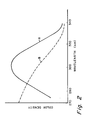
- FIGURE 2 shows the spectral sensitivity curve for the cerium-sensitised glass of United States Patent No. 4,092,139 (Curve A) and that for the glass of sample 1 in the above Table (Curve B). Radiation wavelengths between 270 and 340 nm are plotted on the horizontal axis. There are no absolute values for sensitivity on the vertical axis. Rather, relative densities of colour development at different wavelengths of constant exposure were visually observed. Hence, no absolute comparison is contemplated, but only the obvious difference in general nature of the curves.
- the optimum wavelength for exposing the cerium-sensitised glass is from 300 to 310 nm.
- the copper-sensitised glass appears to peak below 270 nm.
- measurements could not readily be made at lower wavelengths, so that a peak value was not ascertained. It is apparent, however, that such peak value is at or below 270 nm.
- This fact coupled with the transmittance curves of FIGURE 1, shows that the copper-sensitised glass may, for example, be exposed at from 250 to 270 nm.
- the cerium-sensitised glass is exposed in the from 290 to 320 nm range.
- a glass containing both sensitisers might have unique effects obtained by colour development at different waveLengths.
Landscapes
- Chemical & Material Sciences (AREA)
- Life Sciences & Earth Sciences (AREA)
- Engineering & Computer Science (AREA)
- Chemical Kinetics & Catalysis (AREA)
- General Chemical & Material Sciences (AREA)
- Geochemistry & Mineralogy (AREA)
- Materials Engineering (AREA)
- Organic Chemistry (AREA)
- Glass Compositions (AREA)
Applications Claiming Priority (2)
| Application Number | Priority Date | Filing Date | Title |
|---|---|---|---|
| US171655 | 1980-07-23 | ||
| US06/171,655 US4328299A (en) | 1980-07-23 | 1980-07-23 | Polychromatic glasses and method |
Publications (2)
| Publication Number | Publication Date |
|---|---|
| EP0044728A2 true EP0044728A2 (fr) | 1982-01-27 |
| EP0044728A3 EP0044728A3 (fr) | 1982-09-08 |
Family
ID=22624625
Family Applications (1)
| Application Number | Title | Priority Date | Filing Date |
|---|---|---|---|
| EP81303295A Withdrawn EP0044728A3 (fr) | 1980-07-23 | 1981-07-17 | Verres polychromatiques et potentiellement polychromatiques ainsi que leur fabrication |
Country Status (3)
| Country | Link |
|---|---|
| US (1) | US4328299A (fr) |
| EP (1) | EP0044728A3 (fr) |
| JP (1) | JPS5751147A (fr) |
Families Citing this family (13)
| Publication number | Priority date | Publication date | Assignee | Title |
|---|---|---|---|---|
| US4563276A (en) * | 1983-12-16 | 1986-01-07 | At&T Bell Laboratories | Chromatographic apparatus and process |
| US4743099A (en) * | 1987-01-28 | 1988-05-10 | International Business Machines Corporation | Method of making a TFT LC display having polychromatic glass color filters |
| US5731075A (en) * | 1990-11-21 | 1998-03-24 | Mitsuboshi Belting Ltd. | Colorant for a transparent substrate and method of making the colorant |
| US5102833A (en) * | 1991-07-10 | 1992-04-07 | Alfred University | Strengthening glass articles with electromagnetic radiation and resulting product |
| DE69311680T2 (de) * | 1992-08-20 | 1997-10-02 | Mitsuboshi Belting Ltd | Glasartiger Werkstoff mit ultrafeinen dispergierten Teilchen und Verfahren zu seiner Herstellung |
| US6566626B2 (en) | 2001-07-03 | 2003-05-20 | Laserglass Ltd. | Method and apparatus for generating color images in a transparent medium |
| US20050044895A1 (en) * | 2002-04-16 | 2005-03-03 | Central Glass Company, Limited | Method for putting color to glass or erasing color from colored glass |
| US6865328B2 (en) * | 2002-10-11 | 2005-03-08 | Corning Incorporated | Positive dispersion optical fiber |
| US7288495B2 (en) * | 2003-12-31 | 2007-10-30 | Corning Incorporated | Photorefractive glass and optical elements made therefrom |
| US20060091124A1 (en) * | 2004-11-02 | 2006-05-04 | Igor Troitski | Method for transformation of color images into point arrangement for production of laser-induced color images inside transparent materials |
| US20060138103A1 (en) * | 2004-12-28 | 2006-06-29 | Igor Troitski | Method and system for production of laser-induced color images which change characteristics during observation |
| US9240568B2 (en) | 2011-11-10 | 2016-01-19 | Corning Incorporated | Opal glasses for light extraction |
| KR20160088353A (ko) * | 2013-11-19 | 2016-07-25 | 코닝 인코포레이티드 | 다중색성 유리 |
Family Cites Families (9)
| Publication number | Priority date | Publication date | Assignee | Title |
|---|---|---|---|---|
| US2515939A (en) * | 1943-12-08 | 1950-07-18 | Corning Glass Works | Opacifiable photosensitive glasses |
| US3208860A (en) * | 1962-07-31 | 1965-09-28 | Corning Glass Works | Phototropic material and article made therefrom |
| GB1107219A (en) * | 1964-06-08 | 1968-03-27 | Corning Glass Works | Fluorescent glass and method of making it |
| US3522191A (en) * | 1966-12-21 | 1970-07-28 | Owens Illinois Inc | Luminophors and method |
| US3663193A (en) * | 1969-06-30 | 1972-05-16 | Corning Glass Works | Strengthened photosensitive opal glass |
| US4017318A (en) * | 1976-01-02 | 1977-04-12 | Corning Glass Works | Photosensitive colored glasses |
| US4092139A (en) * | 1977-03-16 | 1978-05-30 | Corning Glass Works | Process for making colored photosensitive glass |
| US4134747A (en) * | 1977-03-16 | 1979-01-16 | Corning Glass Works | Method of forming transparent and opaque portions in a reducing atmosphere glass |
| US4191547A (en) * | 1978-07-14 | 1980-03-04 | Corning Glass Works | Method of making photosensitive colored glasses exhibiting alterable photo-anisotropic effects |
-
1980
- 1980-07-23 US US06/171,655 patent/US4328299A/en not_active Expired - Lifetime
-
1981
- 1981-07-17 EP EP81303295A patent/EP0044728A3/fr not_active Withdrawn
- 1981-07-22 JP JP56115007A patent/JPS5751147A/ja active Pending
Also Published As
| Publication number | Publication date |
|---|---|
| US4328299A (en) | 1982-05-04 |
| JPS5751147A (en) | 1982-03-25 |
| EP0044728A3 (fr) | 1982-09-08 |
Similar Documents
| Publication | Publication Date | Title |
|---|---|---|
| Stookey et al. | Full‐color photosensitive glass | |
| US4017318A (en) | Photosensitive colored glasses | |
| US4134747A (en) | Method of forming transparent and opaque portions in a reducing atmosphere glass | |
| US4092139A (en) | Process for making colored photosensitive glass | |
| US4118214A (en) | Treating polychromatic glass in reducing atmospheres | |
| US2515937A (en) | Photosensitive gold glass and method of making it | |
| US4251278A (en) | Photochromic glasses which darken to a brown hue | |
| EP0044728A2 (fr) | Verres polychromatiques et potentiellement polychromatiques ainsi que leur fabrication | |
| EP0595002B1 (fr) | Verres colorés et procédé | |
| JPS6028770B2 (ja) | 銀‐ハロゲン化銀含有着色ガラスの光学処理方法 | |
| US4979975A (en) | Fast response photosensitive opal glasses | |
| US4832724A (en) | Method of making colored photochromic glasses | |
| US5019538A (en) | Colored photosensitive opal glasses | |
| Kumar et al. | Optical absorption and fluorescent behaviour of titanium ions in silicate glasses | |
| EP0592864B1 (fr) | Verres polarisants | |
| JP2001510431A (ja) | 改良されたフォトクロミックガラス | |
| Marzouk et al. | Gamma irradiation effects on photoluminescence and semiconducting properties of non-conventional heavy metal binary PbO–Bi2O3 glasses | |
| US2515942A (en) | Photosensitive glass containing palladium | |
| US2440048A (en) | Fluorescent silicate glasses and methods for making same | |
| Morse | Copper halide-containing photochromic glasses | |
| US2515939A (en) | Opacifiable photosensitive glasses | |
| JPH0859289A (ja) | 高輝度光源用紫外線シャープカットガラスの製造法 | |
| Gliemeroth et al. | Phototropic glass | |
| US4076544A (en) | Copper-cadmium-silver photochromic glass | |
| US3615761A (en) | Phototropic articles containing thallous halide |
Legal Events
| Date | Code | Title | Description |
|---|---|---|---|
| PUAI | Public reference made under article 153(3) epc to a published international application that has entered the european phase |
Free format text: ORIGINAL CODE: 0009012 |
|
| AK | Designated contracting states |
Designated state(s): AT BE DE FR GB NL |
|
| PUAL | Search report despatched |
Free format text: ORIGINAL CODE: 0009013 |
|
| AK | Designated contracting states |
Designated state(s): AT BE DE FR GB NL |
|
| 17P | Request for examination filed |
Effective date: 19830219 |
|
| STAA | Information on the status of an ep patent application or granted ep patent |
Free format text: STATUS: THE APPLICATION IS DEEMED TO BE WITHDRAWN |
|
| RAP1 | Party data changed (applicant data changed or rights of an application transferred) |
Owner name: CORNING GLASS WORKS |
|
| 18D | Application deemed to be withdrawn |
Effective date: 19831216 |
|
| RIN1 | Information on inventor provided before grant (corrected) |
Inventor name: HODA, SYED NURUL Inventor name: BEALL, GEORGE HALSEY Inventor name: WALDRON, RICHARD WILLIAM |