EP0045155B1 - Dérivés de guanidine - Google Patents
Dérivés de guanidine Download PDFInfo
- Publication number
- EP0045155B1 EP0045155B1 EP81303222A EP81303222A EP0045155B1 EP 0045155 B1 EP0045155 B1 EP 0045155B1 EP 81303222 A EP81303222 A EP 81303222A EP 81303222 A EP81303222 A EP 81303222A EP 0045155 B1 EP0045155 B1 EP 0045155B1
- Authority
- EP
- European Patent Office
- Prior art keywords
- radical
- formula
- compound
- alkyl
- atom
- Prior art date
- Legal status (The legal status is an assumption and is not a legal conclusion. Google has not performed a legal analysis and makes no representation as to the accuracy of the status listed.)
- Expired
Links
- 0 Cc1nc(C(CC**)=C)n[n]1* Chemical compound Cc1nc(C(CC**)=C)n[n]1* 0.000 description 3
- XOGKHDLFEPEFCV-AKGZTFGVSA-N CC[C@@H](C(C)N)[N+]([O-])=O Chemical compound CC[C@@H](C(C)N)[N+]([O-])=O XOGKHDLFEPEFCV-AKGZTFGVSA-N 0.000 description 1
Classifications
-
- C—CHEMISTRY; METALLURGY
- C07—ORGANIC CHEMISTRY
- C07D—HETEROCYCLIC COMPOUNDS
- C07D239/00—Heterocyclic compounds containing 1,3-diazine or hydrogenated 1,3-diazine rings
- C07D239/02—Heterocyclic compounds containing 1,3-diazine or hydrogenated 1,3-diazine rings not condensed with other rings
- C07D239/24—Heterocyclic compounds containing 1,3-diazine or hydrogenated 1,3-diazine rings not condensed with other rings having three or more double bonds between ring members or between ring members and non-ring members
- C07D239/28—Heterocyclic compounds containing 1,3-diazine or hydrogenated 1,3-diazine rings not condensed with other rings having three or more double bonds between ring members or between ring members and non-ring members with hetero atoms or with carbon atoms having three bonds to hetero atoms with at the most one bond to halogen, directly attached to ring carbon atoms
- C07D239/32—One oxygen, sulfur or nitrogen atom
- C07D239/42—One nitrogen atom
-
- A—HUMAN NECESSITIES
- A61—MEDICAL OR VETERINARY SCIENCE; HYGIENE
- A61P—SPECIFIC THERAPEUTIC ACTIVITY OF CHEMICAL COMPOUNDS OR MEDICINAL PREPARATIONS
- A61P43/00—Drugs for specific purposes, not provided for in groups A61P1/00-A61P41/00
-
- C—CHEMISTRY; METALLURGY
- C07—ORGANIC CHEMISTRY
- C07D—HETEROCYCLIC COMPOUNDS
- C07D277/00—Heterocyclic compounds containing 1,3-thiazole or hydrogenated 1,3-thiazole rings
- C07D277/02—Heterocyclic compounds containing 1,3-thiazole or hydrogenated 1,3-thiazole rings not condensed with other rings
- C07D277/20—Heterocyclic compounds containing 1,3-thiazole or hydrogenated 1,3-thiazole rings not condensed with other rings having two or three double bonds between ring members or between ring members and non-ring members
- C07D277/32—Heterocyclic compounds containing 1,3-thiazole or hydrogenated 1,3-thiazole rings not condensed with other rings having two or three double bonds between ring members or between ring members and non-ring members with hetero atoms or with carbon atoms having three bonds to hetero atoms with at the most one bond to halogen, e.g. ester or nitrile radicals, directly attached to ring carbon atoms
- C07D277/38—Nitrogen atoms
- C07D277/44—Acylated amino or imino radicals
- C07D277/48—Acylated amino or imino radicals by radicals derived from carbonic acid, or sulfur or nitrogen analogues thereof, e.g. carbonylguanidines
Definitions
- This invention relates to guanidine derivatives which are histamine H-2 antagonists and which inhibit gastric acid secretion.
- the physiologically-active compound histamine which occurs naturally within the human body, is able to combine, in the course of exerting its activity, with certain specific receptors of which there are at least two distinct and separate types.
- the first has been named the H-1 receptor (Ash and Schild, Brit. J. Pharmac., 1966, 27, 427) and the action of histamine at this receptor is blocked (antagonised) by classical "antihistamine” drugs such as mepyramine.
- the second histamine receptor has been named the H-2 receptor (Black et al., Nature, 1972, 238, 385) and the action of histamine at this receptor is blocked by drugs such as cimetidine.
- histamine H-2 receptor antagonists which are guanidine heterocycles carrying a side chain to the end of which is attached a variously-modified guanidine residue. It has now been discovered that if the guanidine radical attached to the heterocyclic ring carries a substituted alkyl radical there are produced compounds which are potent histamine H-2 receptor antagonists.
- Y is an oxygen or sulphur atom, a direct bond, a methylene, cis or trans vinylene or sulphinyl radical or a radical of the formula NR 4 in which R 4 is a hydrogen atom or a 1-6C alkyl radical;
- P is a direct bond or a 1-4 C unbranched alkylene radical optionally substituted by one or two 1-4C alkyl radicals;
- Q is a 1 ⁇ 4C unbranched alkylene radical optionally substituted by one or two 1 ⁇ 4C alkyl radicals, provided that when Y is an oxygen atom, a sulphinyl radical or a radical of the formula NR 4 , Q is a 2-4C optionally substituted alkylene radical;
- a particular value for the optional substituent on W is a methyl radical.
- R 1 or R 3 is a hydrogen atom or a methyl radical.
- a particular value for the optional substituent on R 1 is a methyl radical.
- a particular value for ring X is a phenyl thiophene, pyridine, pyrimidine, imidazole, thiazole, oxazole, pyrazole, triazole, thiadiazole, oxadiazole, pyrazine, pyridazine, isothiazole, isoxazole or triazine ring.
- a particular value for the optional substituent on ring X when it is an alkyl, alkoxy or alkylthio radical is a methyl, methoxy or methylthio radical.
- a particular value for R 4 when it is an alkyl radical is a methyl radical.
- a particular value for the optional substituent on P or Q is a methyl radical.
- R 5 is a methyl, ethyl, n-propyl, i-propyl, n-butyl, trifluoromethyl, 2,2,2-trifluoroethyl, phenyl, p-tolyl or pyridyl radical.
- R 6 is a hydrogen atom or a methyl, 2,2,2-trifluoroethyl, phenyl or p-tolyl radical.
- a particular value for B when it is an alkyl, alkoxy or alkylthio radical is a methyl, ethyl, methoxy, ethoxy or methylthio radical.
- R 7 or R 8 is a hydrogen atom or a methyl, ethyl, i-propyl, 2,2,2-trifluoroethyl, methoxycarbonyl, ethoxycarbonyl, allyl, propargyl, 2-hydroxyethyl, 2-aminoethyl, 2-methylaminoethyl, 2-dimethylaminoethyl, 2-diethylaminoethyl, cyclohexyl or phenyl radical.
- R 7 and R 8 when they are joined to form a ring is a pyrrolidine, piperidine, morpholine or piperazine ring.
- R 9 is a hydrogen atom or a methyl radical.
- G is an ethylene, trimethylene, tetramethylene, but-2-enylene, but-2- ynylene or 2-hydroxytrimethylene radical.
- R 10 or R 11 when it is a substituted alkyl radical is a 2,2,2-trifluoroethyl, 2,2,2-trichloroethyl, 2-chloro-2,2-difluoroethyl, 2,2-dichloro-2-fluoroethyl, 2-bromo-2,2-difluoroethyl, 2,2-di- bromo-2-fluoroethyl, 2-fluoroethyl, 2-chloroethyl, 2,2-difluoroethyl, 2,2-dichloroethyl, 2-chloro-2-fluoroethyl, 2-bromo-2-fluoroethyl, 2,2,3,3,3-pentafluoropropyl, 1,1,1,3,3,3-hexafluoroisopropyl, 1,3-dichloro-1,1,3,3-tetrafluoroisopropyl, 1-chloro-1,1,3,3,3-pent
- R 10 or R" when it is a substituted cycloalkyl radical is a 2,2,3,3-tetrafluorocyclopropyl, 2-chloro-2,3,3-trifluorocyclopropyl, 2,2-difluorocyclopropyl, 2-chloro-3,3-difluorocyclopropyl, 2,2,3,3,4,4-hexafluorocyclobutyl or 2-chloro-2,3,3,4,4-pentafluorocyclobutyl radical.
- R 10 or R" when it is a substituted cycloalkylalkyl radical is a (1,2,2,3,3-pentafluorocyclopropyl)methyl, (2-chloro-1,2,3,3-tetrafluorocyclopropyl)methyl, (1,2,2,3,3,4,4-hepta- fluorocyclobutyl)methyl or (2-chloro-1,2,3,3,4,4-hexafluorocyclobutyl)methyl radical.
- R 10 or R 11 when it is an alkyl radical is a methyl, ethyl, propyl, isopropyl or butyl radical.
- R 10 or R 11 when it is a cycloalkyl radical is a cyclopropyl or cyclobutyl radical.
- R 10 or R" when it is a cycloalkylalkyl radical is a cyclopropylmethyl or cyclobutylmethyl radical.
- R 13 or R 14 is a hydrogen atom or a methyl, allyl, propargyl, cyclohexyl, trifluoromethyl, 2-hydroxyethyl, 2-methoxyethyl, 2-aminoethyl, 2-methylaminoethyl, 2-dimethylaminoethyl, cyclopropylmethyl or benzyl radical.
- R 12 is a hydrogen atom or a methyl, n-butyl, acetyl, propionyl or benzoyl radical.
- a particular value for the optional substituent on Het when it is an alkoxy or alkylthio radical is a methoxy or methylthio radical.
- R 13 and R 14 when they are joined to form a ring is a pyrrolidine, piperidine, piperazine or morpholine ring.
- a particular value for M is a methylene, ethylene or trimethylene radical.
- R 15 is a hydrogen atom or a methyl, allyl, 2-hydroxyethyl, 2-methoxyethyl, phenyl or benzyl radical.
- R 16 or R 17 is a hydrogen atom or a methyl, allyl, 2-hydroxyethyl, 2-methoxyethyl, benzyl or pyridylmethyl radical.
- R 16 and R 17 when they are joined to form a ring is a pyrrolidine, piperidine, piperazine or morpholine ring.
- a particular value for R 19 when it is an alkyl radical is a methyl radical.
- a particular value for the optional substituent on U when U is an alkylene radical is a methyl, benzyl, 2-furylmethyl, 2-thienylmethyl or 2-pyridylmethyl radical.
- a particular value for R 20 is one of the particular values given above for the optional substituent on U when it is an alkylene radical.
- R 21 is a hydrogen atom or one of the particular values given above for the optional substituent on U when U is an alkylene radical.
- R 22 is a hydrogen atom or a methyl radical.
- R 23 or R 24 when it is an alkyl radical is a methyl radical.
- R 25 when it is a cycloalkyl radical or a cyclohexyl radical.
- a particular value for the optional substituent on R2 5 when R 25 is a phenyl radical is a fluorine, chlorine or bromine atom or a methylenedioxy, ethylenedioxy, methyl, methoxy, trifluoromethyl, benzyloxy, 2-methoxyethoxy, dimethylamino, 4-methoxyphenyl, 4-methoxyphenoxy, hydroxy, phenyl, 4-chlorophenyl, 4-bromophenyl or phenoxy radical.
- a particular value for the optional substituent on R 25 when R 25 is a heterocyclic ring is a fluorine, chlorine or bromine atom or a methyl, methoxy, hydroxy or amino radical.
- a particular value for the optional substituent on R 2 when R 2 is a pyrimid-2-yl or imidazol-2-yl radical to which is optionally fused ⁇ a benzene ring is one of the particular values for the optional substituent on ring X given above.
- a suitable pharmaceutically-acceptable acid-addition salt of the guanidine derivative of the invention is, for example, a salt formed with hydrochloric, hydrobromic, phosphoric, sulphuric, acetic, citric or maleic acid.
- the guanidine derivative of the invention may be manufactured by methods known in themselves for the manufacture of chemically-analogous compounds.
- the following processes, (X, Y, m, n, A, B, A 1 , A 2 , A 3 , E 1 , E 2 , G, W, q, p, r, s, Het, Het 1 , U, D and R 1 to R 23 inclusive having the meanings stated above), are therefore provided as further features of the invention.
- the process may be carried out using an excess of R 27 ⁇ H.
- R 26 is preferably a methoxy, ethoxy or methylthio radical.
- the process may be carried out in a diluent or solvent such as water, methanol, ethanol or pyridine.
- the process may be accelerated by the application of heat, for example by heating to the boiling point of the diluent or solvent.
- the process may be carried out in a diluent or solvent such as ethanol or dimethylformamide.
- the process of the invention manufactures the compound of the formula I in the form of the free base and an acid-addition salt is required, the compound of the formula I in the free base form is reacted with an acid which affords a pharmaceutically-acceptable anion.
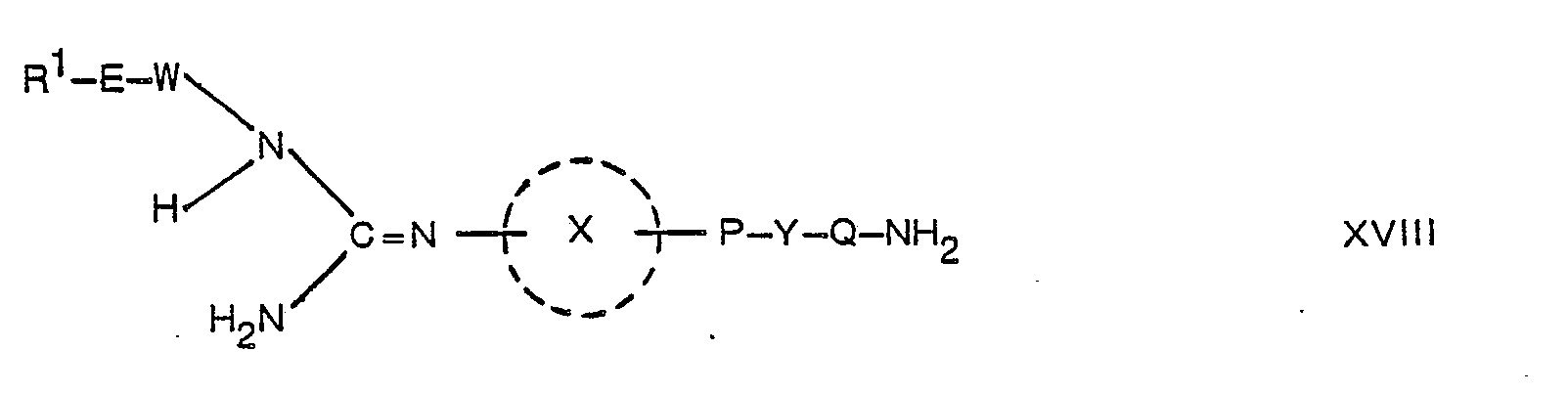
- a critical starting material for use in a number of the above processes is the compound of the formula XVIII.
- This compound may also be used as an intermediate in the preparation of starting materials for a number of other processes.
- the compound of the formula XVIII is therefore considered to be a further feature of the invention.
- the compound of the formula XVIII may be prepared in a number of ways depending on the nature of the ring X and on the nature of Y.
- the two side chains attached to ring X may be constructed one before the other, in either order, starting either from a suitably substituted ring X or by constructing ring X itself from subfragments.
- Y is a direct bond, a methylene or vinylene radical
- Y is an oxygen or sulphur atom, a sulphinyl radical or a radical of the formula NR 4 , it is generally convenient to introduce Y at a later stage of the synthesis.
- the compound of the formula XVIII may be obtained as follows. Reaction of a compound of the formula:- with an optionally substituted 3-chloroacrylonitrile gives the 2-substituted-4-aminopyrimidine. This compound is then reacted with a compound of the formula:- to form the corresponding thiourea which is treated with ammonia in the presence of mercuric oxide to give the guanidine (via the carbodiimide as intermediate). Finally the amine is liberated from its protecting group.
- the compound of the formula XVIII may be obtained as follows.
- a compound of the formula:- in which R 26 is a displaceable radical and R 33 is the optional substituent on ring X is reacted with a compound of the formula:- to give the compound of the formula:-
- the compound of the formula XVIII may be obtained as follows.
- An amine of the formula R 1 ⁇ E ⁇ W ⁇ NH 2 is reacted with sodium dicyanimide to give the compound of the formula:- which is in turn reacted with thioacetamide and an acid (a source of H 2 S) to give the amidinothiourea of the formula:-
- the compound of the formula XVIII may be obtained as follows.
- the compound of the formula XXXV is reacted with a compound of the formula:- in which R 34 is a hydrogen atom or the optional ring substituent to give the compound of the formula:
- the compound of the formula XVIII may be prepared by mild oxidation of the corresponding compound in which Y is a sulphur atom.
- the compound of the formula XIX for use in process (b) may be prepared by reaction of the compound of the formula XVIII with a compound of the formula R 26 ⁇ A 4 ⁇ R 26 , for example as described in Examples 1, 2, 4, 5, 7 and 10.
- the compound of the formula XXI for use in process (c) may be prepared by reaction of the compound of the formula XVIII with thiocarbonyldimidazole or carbonyldiimidazole.
- the compound of the formula XXIII for use in process (d) may be prepared by reaction of a compound of the formula:- (many of which are known compounds, other of which may be prepared by modifications of the processes described above) with a compound of the formula R'-E-W-NCS to give the corresponding thiourea.
- This thiourea is treated with yellow mercuric oxide to give the carbodiimide of the formula XXIII which is preferably then reacted as described in process (d) in situ without isolation.
- the compound of the formula XXV for use in process (g) may be prepared by reaction of a compound of the formula:- with yellow mercuric oxide or silver nitrite to give the carbodiimide which is preferably reacted as described in process (g) in situ without isolation.
- the compound of the formula XXVII for use in process (k) may be prepared by reaction of a compound of the formula XXI in which D is a sulphur atom with a compound of the formula:-
- the resulting thiourea is treated with silver nitrate and the carbodiimide of the formula XXVII thus formed is preferably reacted as described in process (k) in situ without isolation.
- the guanidine derivative of the invention is a histamine H-2 antagonist, inhibits the secretion of gastric acid in warm-blooded animals and is therefore useful in the treatment of peptic ulcers and other conditions caused or exacerbated by gastric acidity, including stress ulcers and gastrointestinal bleeding due to trauma.
- the histamine H-2 antagonist activity may be demonstrated on standard tests, for example by the ability of the compound of the formula I to inhibit the histamine-induced positive chronotropic response in the spontaneously beating right atrium of the guinea pig or by its ability to inhibit the histamine-induced increase in the level of cyclic AMP (in the presence of a phosphodiesterase inhibitor) in a free cell suspension obtained from canine gastric mucosa.
- the guinea pig atrium test is carried out as follows:-
- histamine-stimulated cyclic AMP test is carried out as described by Scholes et aI, Agents and Actions, 1976, 6, 677-682.
- the inhibition of the secretion of gastric acid may be demonstrated in standard tests, for example by the ability of the compound of the formula I, when dosed intravenously, intragastrically or orally, to inhibit the secretion of acidic gastric juice in, for example, rats, cats or dogs provided with gastric fistulae and whose gastric secretion is stimulated by the administration of a secretagogue, for example pentagastrin or histamine.
- a secretagogue for example pentagastrin or histamine.
- test compound When studying the test compound by the intragastric route, the absence of basal secretion over a period of 30 minutes is ascertained and the test compound, contained in 25 MI. of 0.5% w/v hydroxypropyl methylcellulose and 0.1% w/v 'Tween' 80 in water ('Tween' is a Trade Mark) is instilled into the stomach through a fistula dosing plug. One hour later, the fistula is reopened and intravenous infusion of a secretagogue, as described above, is immediately begun. Gastric acid samples are measured as described above and the approach of acid secretion to a plateau is compared to that of a control animal which is dosed intragastrically only with the dosing vehicle.
- test compound When studying the test compound by the oral route, it is administered in a gelatin capsule washed down with 15 mi. of water. One hour later, the fistula is opened and intravenous infusion of the secretagogue is immediately begun. Gastric acid samples are measured as above and the approach of acid secretion to a plateau is compared to that of an undosed control animal.
- the results obtained in the atrium test are predictive of activity in the dog test.
- a pharmaceutical composition which comprises a guanidine derivative of the invention in association with a non-toxic pharmaceutically-acceptable diluent or carrier.
- the pharmaceutical composition may, for example, be in a form suitable for oral, rectal, parenteral or topical administration, for which purposes it may be formulated by means known to the art into the form of, for example, tablets, capsules, aqueous or oily solutions or suspensions, emulsions, dispersible powders, suppositories, sterile injectable aqueous or oily solutions or suspensions, gels, creams, ointments or lotions.
- the pharmaceutical composition of the invention for oral, rectal or parenteral administration may also contain, or be co-administered with, one or more known drugs selected from antacids, for example aluminium hydroxide - magnesium hydroxide mixtures; antipepsin compounds, for example pepstatin; other histamine H-2 antagonists, for example cimetidine; ulcer healing agents, for example carbenoxolone or bismuth salts; antiinflammatory agents, for example ibuprofen, indomethacin, naproxen or asprin; prostaglandsin, for example 16,16-dimethylprostaglandin E 2 ; classical antihistamines (histamine H-1 antagonists), for example mepyramine or diphenylhydramine; anticholinergic agents, for example atropine or propantheline bromide; anxiolytic agents, for example diazepam, chlordiazepoxide or phenobarbital.
- antacids for example aluminium hydroxide -
- the pharmaceutical composition of the invention for topical administration may also contain, in addition to the guanidine derivative, one or more classical anti-histamines (histamine H-1 antagonists), for example mepyramine or diphenhydramine and/or one or more steroidal antiinflammatory agents, for example fluocinolone or triamcinolone.
- one or more classical anti-histamines for example mepyramine or diphenhydramine
- steroidal antiinflammatory agents for example fluocinolone or triamcinolone.
- a topical formulation may contain 1-10% w/w of the guanidine derivative of the invention.
- a preferred pharmaceutical composition of the invention is one suitable for oral administration in unit dosage form, for example a tablet or capsule which contains between 10 mg. and 500 mg. of the guanidine derivative, or one suitable for intravenous, subcutaneous or intramuscular injection, for example a sterile injectable containing between 0.1% and 10% w/w of the guanidine derivative.
- the pharmaceutical composition of the invention will normally be administered to man for the treatment of peptic ulcers and other conditions caused or exacerbated by gastric acidity in the same general manner as that employed for cimetidine, due allowance being made in terms of dose levels for the potency of the guanidine derivative of the present invention relative to cimetidine.
- each patient will receive an oral dose of between 15 mg. and 1500 mg. and preferably between 20 mg. and 200 mg. of guanidine derivative or an intravenous, subcutaneous or intramuscular dose of between 1.5 mg. and 150 mg., and preferably between 5 mg. and 20 mg. of the guanidine derivative, the composition being administered 1 to 4 times per day.
- the rectal dose will be approximately the same as the oral dose.
- the composition may be administered less frequently when it contains an amount of guanidine derivative which is a multiple of the amount which is effective when given 1-4 times per day.
- the invention is illustrated by the following Examples in which the temperatures are in degrees Centigrade.
- the 2-[2-(2-methoxyethyl)guanidino]-4-(4-aminobutyl)thiazole used as starting material may be prepared as follows:-
- the 2-[2-(2-hydroxyethyl)guanidino]-4-(4-aminobutyl)thiazole used as starting material may be prepared as follows:-
- the 2-[2-(2-methylthioethyl)guanidino]-4-(4-aminobutyl)thiazole used as starting material may be prepared as follows:-
- the 2-[2-(2-methoxyethyl)guanidino]-4-[(2-aminoethyl)thiomethyl]thiazole used as a starting material may be prepared as follows:-
- the 2-[2-(2-dimethylaminoethyl)guanidino]-4-[4-aminobutyl]thiazole used as starting material may be prepared as follows:-
- the 2-[2-(2-methoxyethyl)guanidino]-4-[5-aminopentyl]thiazole used as starting material may be prepared as follows:-
- the 2-[4-(2-cyano-3-methylguanidino)butyl]-4-[2-(2-methoxyethyl)guanidino]pyrimidine used as starting material may be prepared as follows:-
Landscapes
- Chemical & Material Sciences (AREA)
- Organic Chemistry (AREA)
- Health & Medical Sciences (AREA)
- Chemical Kinetics & Catalysis (AREA)
- Life Sciences & Earth Sciences (AREA)
- General Chemical & Material Sciences (AREA)
- Medicinal Chemistry (AREA)
- Nuclear Medicine, Radiotherapy & Molecular Imaging (AREA)
- Bioinformatics & Cheminformatics (AREA)
- Pharmacology & Pharmacy (AREA)
- Engineering & Computer Science (AREA)
- Animal Behavior & Ethology (AREA)
- General Health & Medical Sciences (AREA)
- Public Health (AREA)
- Veterinary Medicine (AREA)
- Pharmaceuticals Containing Other Organic And Inorganic Compounds (AREA)
- Acyclic And Carbocyclic Compounds In Medicinal Compositions (AREA)
- Organic Low-Molecular-Weight Compounds And Preparation Thereof (AREA)
Claims (24)


Applications Claiming Priority (2)
| Application Number | Priority Date | Filing Date | Title |
|---|---|---|---|
| GB8024963 | 1980-07-30 | ||
| GB8024963 | 1980-07-30 |
Publications (2)
| Publication Number | Publication Date |
|---|---|
| EP0045155A1 EP0045155A1 (fr) | 1982-02-03 |
| EP0045155B1 true EP0045155B1 (fr) | 1985-01-02 |
Family
ID=10515153
Family Applications (1)
| Application Number | Title | Priority Date | Filing Date |
|---|---|---|---|
| EP81303222A Expired EP0045155B1 (fr) | 1980-07-30 | 1981-07-14 | Dérivés de guanidine |
Country Status (5)
| Country | Link |
|---|---|
| US (1) | US4464374A (fr) |
| EP (1) | EP0045155B1 (fr) |
| JP (1) | JPS5770857A (fr) |
| CA (1) | CA1220478A (fr) |
| DE (1) | DE3168031D1 (fr) |
Families Citing this family (12)
| Publication number | Priority date | Publication date | Assignee | Title |
|---|---|---|---|---|
| DK160611C (da) * | 1979-09-04 | 1991-09-16 | Bristol Myers Squibb Co | Analogifremgangsmaade til fremstilling af 3,4-disubstituerede 1,2,5-thiadiazol-1-oxider og -1,1-dioxider |
| EP0059597B1 (fr) * | 1981-02-27 | 1986-04-23 | Imperial Chemical Industries Plc | Dérivés heterocycliques guanidino substitués possédant une activité antihistaminique H-2 |
| US4460584A (en) * | 1981-03-13 | 1984-07-17 | Imperial Chemical Industries Plc | Nitrogen heterocycles |
| IN158869B (fr) * | 1981-03-18 | 1987-02-07 | Ici Plc | |
| US4501747A (en) * | 1982-05-10 | 1985-02-26 | Sanofi | Certain amide derivatives of 2-guanidino-thiazoles and compositions containing same |
| FR2526431A1 (fr) * | 1982-05-10 | 1983-11-10 | Sanofi Sa | Thioalkylnicotinamide 1-oxyde, ses sels, procede pour leur preparation et compositions pharmaceutiques en contenant |
| JPS59104370A (ja) * | 1982-12-03 | 1984-06-16 | Kotobuki Seiyaku Kk | チアゾ−ル誘導体及びその製造方法 |
| US4692531A (en) * | 1984-06-22 | 1987-09-08 | Bristol-Myers Company | Substituted 3,4-diamino-1,2,5-thiadiazoles having histamine H2 -receptor antagonist activity |
| US4644006A (en) * | 1984-06-22 | 1987-02-17 | Bristol-Myers Company | Substituted 3,4-diamino-1,2,5-thiadiazoles having histamine H2 -receptor antagonist activity |
| DE3532880A1 (de) * | 1985-09-14 | 1987-03-26 | Basf Ag | 1,4-disubstituierte pyrazolderivate |
| KR890014504A (ko) * | 1988-03-11 | 1989-10-24 | 우대규 | 4-(2'-시아노 에틸티오)메틸-2-구아니디노티아졸의 제조방법 |
| EP4196793A1 (fr) | 2020-08-11 | 2023-06-21 | Université de Strasbourg | Bloqueurs de h2 ciblant des macrophages du foie pour la prévention et le traitement d'une maladie du foie et du cancer |
Family Cites Families (13)
| Publication number | Priority date | Publication date | Assignee | Title |
|---|---|---|---|---|
| GB1338169A (en) * | 1971-03-09 | 1973-11-21 | Smith Kline French Lab | Ureas thioureas and guanidines |
| JPS53118592A (en) * | 1977-03-23 | 1978-10-17 | Dai Ichi Seiyaku Co Ltd | Preparation of high purity adenosine triphosphoric acid aqueous solution |
| US4165378A (en) * | 1977-04-20 | 1979-08-21 | Ici Americas Inc. | Guanidine derivatives of imidazoles and thiazoles |
| GB2001624B (en) * | 1977-04-20 | 1982-03-03 | Ici Ltd | Guanidine derivatives processes for their manufacture and pharmaceutical compositions containing them |
| NZ186965A (en) * | 1977-04-20 | 1980-02-21 | Ici Ltd | Guanidino derivatives and pharmaceutical compositions |
| JPS54132566A (en) * | 1978-01-18 | 1979-10-15 | Ici Ltd | Guanidine derivative*its manufacture and secretion controlling pharmaceutical composition containing it |
| US4309435A (en) * | 1978-10-16 | 1982-01-05 | Imperial Chemical Industries Ltd. | Antisecretory guanidine derivatives and pharmaceutical compositions containing them |
| CA1140925A (fr) * | 1978-10-16 | 1983-02-08 | Derrick F. Jones | Derives heterocycliques anti-secretion, a chaine ramifiee, procedes pour les fabriquer et compositions pharmaceutiques qui en contiennent |
| JPS5553247A (en) * | 1978-10-17 | 1980-04-18 | Shionogi & Co Ltd | Novel benzylamine derivative |
| FR2446829A1 (fr) * | 1978-11-16 | 1980-08-14 | Glaxo Group Ltd | Derives de polymethylene disubstitues en alpha, omega, procede pour leur preparation et compositions pharmaceutiques les contenant |
| EP0014057B1 (fr) * | 1979-01-18 | 1985-01-02 | Imperial Chemical Industries Plc | Dérivés de la guanidine, procédés pour leur préparation et compositions pharmaceutiques les contenant |
| JPS6056143B2 (ja) * | 1979-08-02 | 1985-12-09 | 山之内製薬株式会社 | アミジン誘導体ならびにその製造法 |
| GR71929B (fr) * | 1979-11-13 | 1983-08-19 | Ici Ltd |
-
1981
- 1981-07-14 DE DE8181303222T patent/DE3168031D1/de not_active Expired
- 1981-07-14 EP EP81303222A patent/EP0045155B1/fr not_active Expired
- 1981-07-22 CA CA000382289A patent/CA1220478A/fr not_active Expired
- 1981-07-23 US US06/286,064 patent/US4464374A/en not_active Expired - Fee Related
- 1981-07-30 JP JP56118592A patent/JPS5770857A/ja active Pending
Also Published As
| Publication number | Publication date |
|---|---|
| EP0045155A1 (fr) | 1982-02-03 |
| DE3168031D1 (en) | 1985-02-14 |
| JPS5770857A (en) | 1982-05-01 |
| CA1220478A (fr) | 1987-04-14 |
| US4464374A (en) | 1984-08-07 |
Similar Documents
| Publication | Publication Date | Title |
|---|---|---|
| US4362728A (en) | Haloguanidine compounds, pharmaceutical compositions and methods of use | |
| EP0003640B1 (fr) | Dérivés de guanidine à activité antisécrétive de l'acide gastrique, procédés pour leur préparation et compositions pharmaceutiques les contenant | |
| EP0010418B1 (fr) | Dérivés antisécrétoires de la guanidine, procédés pour leur préparation et compositions pharmaceutiques les contenant | |
| US4374248A (en) | 3,4-Disubstituted-1,2,5-thiadiazole-1-oxide compounds | |
| EP0006679B1 (fr) | Dérivés antisécréteurs de thiadiazole, procédé pour leur préparation et compositions pharmaceutiques les contenant | |
| US4262126A (en) | Guanidine derivatives of imidazoles and thiazoles | |
| US4394508A (en) | Chemical compounds | |
| EP0014057B1 (fr) | Dérivés de la guanidine, procédés pour leur préparation et compositions pharmaceutiques les contenant | |
| US4464374A (en) | Substituted guanidine derivatives, processes, pharmaceutical compositions and methods and intermediates | |
| EP0010894B1 (fr) | Dérivés antisécrétoires hétérocycliques de la guanidine, procédé pour leur préparation et compositions pharmaceutiques les contenant | |
| US4657908A (en) | Carbonyl derivatives | |
| US4242351A (en) | Antisecretory oxadiazoles and pharmaceutical compositions containing them | |
| US4795755A (en) | Heterocyclic derivatives | |
| EP0010893B1 (fr) | Dérivés antisécrétoires hétérocycliques de la guanidine comprenant des chaînes ramifiées, procédés pour leur préparation, produits intermédiaires et compositions pharmaceutiques contenant lesdits dérivés | |
| US4510309A (en) | Histamine H2 -antagonists | |
| US4451463A (en) | Alcohol derivatives | |
| EP0006286B1 (fr) | Dérivés antisécréteurs de l'oxadiazole, procédé pour leur préparation ainsi que les compositions pharmaceutiques les contenant | |
| US4696933A (en) | Guanidine compounds useful as histamine H2-antagonists | |
| US4471122A (en) | Thiadiazole histamine H2 -antagonists | |
| US4380639A (en) | Substituted 1,2,5-thiadiazole derivatives | |
| US4746672A (en) | Oxides of 1,2,5-thiadiazoles, their use in pharmaceutical compositions | |
| US4570000A (en) | Nitrogen heterocycles | |
| US4380638A (en) | Chemical compounds |
Legal Events
| Date | Code | Title | Description |
|---|---|---|---|
| PUAI | Public reference made under article 153(3) epc to a published international application that has entered the european phase |
Free format text: ORIGINAL CODE: 0009012 |
|
| AK | Designated contracting states |
Designated state(s): AT BE CH DE FR GB IT LI LU NL SE |
|
| 17P | Request for examination filed |
Effective date: 19820223 |
|
| ITF | It: translation for a ep patent filed | ||
| GRAA | (expected) grant |
Free format text: ORIGINAL CODE: 0009210 |
|
| AK | Designated contracting states |
Designated state(s): BE CH DE FR GB IT LI LU NL SE |
|
| REF | Corresponds to: |
Ref document number: 3168031 Country of ref document: DE Date of ref document: 19850214 |
|
| ET | Fr: translation filed | ||
| PG25 | Lapsed in a contracting state [announced via postgrant information from national office to epo] |
Ref country code: LU Free format text: LAPSE BECAUSE OF NON-PAYMENT OF DUE FEES Effective date: 19850731 |
|
| PLBE | No opposition filed within time limit |
Free format text: ORIGINAL CODE: 0009261 |
|
| STAA | Information on the status of an ep patent application or granted ep patent |
Free format text: STATUS: NO OPPOSITION FILED WITHIN TIME LIMIT |
|
| 26N | No opposition filed | ||
| PGFP | Annual fee paid to national office [announced via postgrant information from national office to epo] |
Ref country code: NL Payment date: 19870731 Year of fee payment: 7 |
|
| PG25 | Lapsed in a contracting state [announced via postgrant information from national office to epo] |
Ref country code: SE Effective date: 19880715 |
|
| PG25 | Lapsed in a contracting state [announced via postgrant information from national office to epo] |
Ref country code: LI Effective date: 19880731 Ref country code: CH Effective date: 19880731 Ref country code: BE Effective date: 19880731 |
|
| BERE | Be: lapsed |
Owner name: ICI AMERICAS INC Effective date: 19880731 Owner name: IMPERIAL CHEMICAL INDUSTRIES P.L.C. Effective date: 19880731 |
|
| PG25 | Lapsed in a contracting state [announced via postgrant information from national office to epo] |
Ref country code: NL Effective date: 19890201 |
|
| NLV4 | Nl: lapsed or anulled due to non-payment of the annual fee | ||
| REG | Reference to a national code |
Ref country code: CH Ref legal event code: PL |
|
| PGFP | Annual fee paid to national office [announced via postgrant information from national office to epo] |
Ref country code: FR Payment date: 19910610 Year of fee payment: 11 |
|
| PGFP | Annual fee paid to national office [announced via postgrant information from national office to epo] |
Ref country code: GB Payment date: 19910628 Year of fee payment: 11 Ref country code: DE Payment date: 19910628 Year of fee payment: 11 |
|
| ITTA | It: last paid annual fee | ||
| PG25 | Lapsed in a contracting state [announced via postgrant information from national office to epo] |
Ref country code: GB Effective date: 19920714 |
|
| GBPC | Gb: european patent ceased through non-payment of renewal fee |
Effective date: 19920714 |
|
| PG25 | Lapsed in a contracting state [announced via postgrant information from national office to epo] |
Ref country code: FR Effective date: 19930331 |
|
| PG25 | Lapsed in a contracting state [announced via postgrant information from national office to epo] |
Ref country code: DE Effective date: 19930401 |
|
| REG | Reference to a national code |
Ref country code: FR Ref legal event code: ST |
|
| EUG | Se: european patent has lapsed |
Ref document number: 81303222.4 Effective date: 19890510 |