EP0045385A2 - Selbstschliessendes Ventil und Verschlussvorrichtung - Google Patents
Selbstschliessendes Ventil und Verschlussvorrichtung Download PDFInfo
- Publication number
- EP0045385A2 EP0045385A2 EP81105298A EP81105298A EP0045385A2 EP 0045385 A2 EP0045385 A2 EP 0045385A2 EP 81105298 A EP81105298 A EP 81105298A EP 81105298 A EP81105298 A EP 81105298A EP 0045385 A2 EP0045385 A2 EP 0045385A2
- Authority
- EP
- European Patent Office
- Prior art keywords
- valve
- lid
- disc
- container
- sidewall
- Prior art date
- Legal status (The legal status is an assumption and is not a legal conclusion. Google has not performed a legal analysis and makes no representation as to the accuracy of the status listed.)
- Granted
Links
- 239000000047 product Substances 0.000 claims description 49
- 238000007789 sealing Methods 0.000 claims description 46
- 230000002093 peripheral effect Effects 0.000 claims description 26
- 239000000463 material Substances 0.000 claims description 14
- 238000007599 discharging Methods 0.000 claims description 10
- 239000011324 bead Substances 0.000 claims description 8
- 238000005260 corrosion Methods 0.000 claims description 6
- 230000007797 corrosion Effects 0.000 claims description 6
- 239000012263 liquid product Substances 0.000 claims description 6
- 239000004411 aluminium Substances 0.000 claims description 4
- 229910052782 aluminium Inorganic materials 0.000 claims description 4
- XAGFODPZIPBFFR-UHFFFAOYSA-N aluminium Chemical compound [Al] XAGFODPZIPBFFR-UHFFFAOYSA-N 0.000 claims description 4
- 239000011796 hollow space material Substances 0.000 claims description 4
- 229920000728 polyester Polymers 0.000 claims description 4
- 229920005989 resin Polymers 0.000 claims description 4
- 239000011347 resin Substances 0.000 claims description 4
- 229920003345 Elvax® Polymers 0.000 claims description 3
- 230000000881 depressing effect Effects 0.000 claims description 3
- 239000005038 ethylene vinyl acetate Substances 0.000 claims description 3
- 239000002184 metal Substances 0.000 claims description 3
- 229910052751 metal Inorganic materials 0.000 claims description 3
- 229920001200 poly(ethylene-vinyl acetate) Polymers 0.000 claims description 3
- 230000001681 protective effect Effects 0.000 claims description 3
- 230000000284 resting effect Effects 0.000 claims description 3
- 230000000630 rising effect Effects 0.000 claims description 3
- 229920003002 synthetic resin Polymers 0.000 claims description 2
- 239000000057 synthetic resin Substances 0.000 claims description 2
- 230000001154 acute effect Effects 0.000 claims 2
- 230000002035 prolonged effect Effects 0.000 claims 2
- 125000006850 spacer group Chemical group 0.000 claims 2
- 239000007921 spray Substances 0.000 abstract description 11
- 238000004891 communication Methods 0.000 abstract description 8
- 239000012858 resilient material Substances 0.000 abstract description 3
- 230000000694 effects Effects 0.000 description 11
- 239000003380 propellant Substances 0.000 description 8
- 238000002788 crimping Methods 0.000 description 6
- 229920001971 elastomer Polymers 0.000 description 5
- 238000004519 manufacturing process Methods 0.000 description 5
- 239000000443 aerosol Substances 0.000 description 4
- 230000000712 assembly Effects 0.000 description 4
- 238000000429 assembly Methods 0.000 description 4
- 239000000806 elastomer Substances 0.000 description 4
- 239000000945 filler Substances 0.000 description 3
- 238000003780 insertion Methods 0.000 description 3
- 230000037431 insertion Effects 0.000 description 3
- 238000000034 method Methods 0.000 description 2
- 229920003023 plastic Polymers 0.000 description 2
- 239000004033 plastic Substances 0.000 description 2
- 229920000877 Melamine resin Polymers 0.000 description 1
- 229910000831 Steel Inorganic materials 0.000 description 1
- 229920001807 Urea-formaldehyde Polymers 0.000 description 1
- XTXRWKRVRITETP-UHFFFAOYSA-N Vinyl acetate Chemical group CC(=O)OC=C XTXRWKRVRITETP-UHFFFAOYSA-N 0.000 description 1
- 239000005030 aluminium foil Substances 0.000 description 1
- 239000003795 chemical substances by application Substances 0.000 description 1
- 238000010276 construction Methods 0.000 description 1
- 238000001816 cooling Methods 0.000 description 1
- 230000001419 dependent effect Effects 0.000 description 1
- 230000000994 depressogenic effect Effects 0.000 description 1
- 229910003460 diamond Inorganic materials 0.000 description 1
- 239000010432 diamond Substances 0.000 description 1
- 238000010438 heat treatment Methods 0.000 description 1
- 238000007373 indentation Methods 0.000 description 1
- 238000002347 injection Methods 0.000 description 1
- 239000007924 injection Substances 0.000 description 1
- 238000001746 injection moulding Methods 0.000 description 1
- 239000010410 layer Substances 0.000 description 1
- 239000007788 liquid Substances 0.000 description 1
- 239000000155 melt Substances 0.000 description 1
- 230000035515 penetration Effects 0.000 description 1
- 229920005594 polymer fiber Polymers 0.000 description 1
- ODGAOXROABLFNM-UHFFFAOYSA-N polynoxylin Chemical compound O=C.NC(N)=O ODGAOXROABLFNM-UHFFFAOYSA-N 0.000 description 1
- 239000011241 protective layer Substances 0.000 description 1
- 239000010959 steel Substances 0.000 description 1
- 239000000126 substance Substances 0.000 description 1
- 229920002994 synthetic fiber Polymers 0.000 description 1
- 239000005028 tinplate Substances 0.000 description 1
Images





Classifications
-
- B—PERFORMING OPERATIONS; TRANSPORTING
- B65—CONVEYING; PACKING; STORING; HANDLING THIN OR FILAMENTARY MATERIAL
- B65D—CONTAINERS FOR STORAGE OR TRANSPORT OF ARTICLES OR MATERIALS, e.g. BAGS, BARRELS, BOTTLES, BOXES, CANS, CARTONS, CRATES, DRUMS, JARS, TANKS, HOPPERS, FORWARDING CONTAINERS; ACCESSORIES, CLOSURES, OR FITTINGS THEREFOR; PACKAGING ELEMENTS; PACKAGES
- B65D83/00—Containers or packages with special means for dispensing contents
- B65D83/14—Containers for dispensing liquid or semi-liquid contents by internal gaseous pressure, i.e. aerosol containers comprising propellant
- B65D83/44—Valves specially adapted for the discharge of contents; Regulating devices
- B65D83/46—Tilt valves
-
- B—PERFORMING OPERATIONS; TRANSPORTING
- B65—CONVEYING; PACKING; STORING; HANDLING THIN OR FILAMENTARY MATERIAL
- B65D—CONTAINERS FOR STORAGE OR TRANSPORT OF ARTICLES OR MATERIALS, e.g. BAGS, BARRELS, BOTTLES, BOXES, CANS, CARTONS, CRATES, DRUMS, JARS, TANKS, HOPPERS, FORWARDING CONTAINERS; ACCESSORIES, CLOSURES, OR FITTINGS THEREFOR; PACKAGING ELEMENTS; PACKAGES
- B65D83/00—Containers or packages with special means for dispensing contents
- B65D83/14—Containers for dispensing liquid or semi-liquid contents by internal gaseous pressure, i.e. aerosol containers comprising propellant
- B65D83/16—Actuating means
- B65D83/164—Actuators comprising a manually operated valve and being attachable to the aerosol container, e.g. downstream a valve fitted to the container; Actuators associated to container valves with valve seats located outside the aerosol container
-
- B—PERFORMING OPERATIONS; TRANSPORTING
- B65—CONVEYING; PACKING; STORING; HANDLING THIN OR FILAMENTARY MATERIAL
- B65D—CONTAINERS FOR STORAGE OR TRANSPORT OF ARTICLES OR MATERIALS, e.g. BAGS, BARRELS, BOTTLES, BOXES, CANS, CARTONS, CRATES, DRUMS, JARS, TANKS, HOPPERS, FORWARDING CONTAINERS; ACCESSORIES, CLOSURES, OR FITTINGS THEREFOR; PACKAGING ELEMENTS; PACKAGES
- B65D83/00—Containers or packages with special means for dispensing contents
- B65D83/14—Containers for dispensing liquid or semi-liquid contents by internal gaseous pressure, i.e. aerosol containers comprising propellant
- B65D83/44—Valves specially adapted for the discharge of contents; Regulating devices
- B65D83/48—Lift valves, e.g. operated by push action
Definitions
- This invention relates to a self-closing valve-and-lid assembly adapted for closing the open top end of a container fillable with pressurized product. It also refers to a novel lid and valve disc, both of which are suitable for being used in the novel valve-and-lid assembly.
- Valve-and-lid assemblies which are used to close the open top end of a can or the like container, especially such container destined to be filled with a preferably liquid product and a pressurizing agent, are well known in the art of aerosol cans and are described in numerous patents and other publications.
- German Offenlegungsschrift 27 22 265 of George Bernard Diamond describes a pressurized can which is closed off at the top by a lid, preferably of metal such as aluminium, and which is equipped with a discharge valve mounted in the center of the lid, on a common central axis of the valve-and-lid assembly.
- the valve is provided with a product passage, a valve disc or plate having a central opening, and with a valve body which cooperates with the valve disc to obturate the product passage when the valve is in closed position; at least one of the two aforesaid valve elements is usually made of an elastically resilient material.
- the lid comprises a centrally located dome part which protrudes, in the shape of an inverted cup or bell, from a main lid plane in which a flat part of the lid surrounding the dome part extends, and which plane extends radially to the above-mentioned central axis.
- the dome part is provided with a central opening coaxially with that of the valve disc and is crimped or stamped in another suitable manner to hold the peripheral zone of the valve disc in a fast, liquid and gas-tight manner.
- the periphery of the lid is sealingly connected with a top rim of the container sidewall surrounding the said container top opening, and extends generally to the said central assembly axis.
- the lid including the dome part thereof must usually be rigid under conditions of filling product (and, of course, propellant of such is used) into, and of discharging product (and propellant) from the container.
- valve disc and valve body When opening the valve, the valve disc and valve body are so changed in their position relative to one another that there opens a gap between them which permits the flow of product through the product passage of the valve to the outside.
- the manufacture of the movable part i.e. the valve body which carries a valve stem and on the latter often an atomizer head
- the manufacture of the movable part is relatively complicated, especially when it is to be manufactured by means of modern injection molding techniques.
- the known valves often require costly spring means for biassing the valve body into its closing position.
- valve-and-lid assembly the manufacture of which is simpler than that of the known assemblies and which requires a minimum number of parts, each of which is in itself easy to manufacture.
- a further object of the invention is to provide a valve-and-lid assembly in which an atomizer head stem or sleeve or a filler head can be introduced easily without damaging any sensitive parts thereof such as an elastically resilient gasket.
- the collar portion protrudes from the dome part top wall on the side thereof adapted for facing toward the interior of the container
- the valve disc comprises a valve head depending from said inner surface valve disc and extending through said central opening of said dome part to outside said collar portion and having a sidewall and a contact face thereon which, in closed state, is in sealing contact with at least preferably said collar portion, preferably below said main lid plane, and the second orifice of said duct is in said sidewall of said valve head above at least a first portion of said contact face.
- valve head comprises
- the dome part of the lid protrudes downwardly from the main lid plane, depending from the flat lid part on the side of the latter which is turned toward'the interior of the container the open end of which is closed off by the lid.
- the circumferential sidewall of the dome part of the lid comprises an annular crimped region firmly clamping a peripheral zone of the valve disc.
- the dome top wall is vaulted away from the main lid plane below the crimped sidewall region to provide a hollow space between the vaulted top wall and the underside face of the valve disc which is lodged inside the clamped-in peripheral zone of the disc. (Claim 4)
- the distance of the annular shoulder on the valve head button from the underside face of the valve disc, prior to being mounted in the valve-and-lid assembly is shorter than the distance between the same two disc elements when the disc is mounted in the dome part, thereby imparting a bias to the annular shoulder against the annular rim of the collar portion, and obtaining a stronger sealing effect.
- the whole valve disc can be so firmly held in place, that the above-mentioned crimped fold of the dome part clamping-in the periphery of the valve disc can be dispensed with.
- the dome part protrudes downwardly from the flat lid part toward the interior of the container
- the dome part can also protrude upwardly, from the main lid plane, thus rising above the flat lid part on the outside, above the outer face of the latter;
- the collar portion consists of an annular bead means about said central opening of said dome part and protrudes downwardly out of the main lid plane on the underside of the flat lid part which is turned toward the interior of the container.
- the invention provides a container lid which is usable in the above described self-closing valve-and-lid assemblies, the periphery of the lid being adapted for sealing connection with a top rim of a container sidewall surrounding the container top opening,
- lid has a central dome part and a central opening in the middle of the dome part, and is rigid under conditions of filling product into, and discharging product from said container, and is preferably made of metal;
- the whole dome part protrudes from the flat lid part on the side of the latter destined to face toward the interior of the container. If it does not, at least the collar portion should always do so.
- the invention provides a novel valve disc adapted for being mounted in a self-closing valve-and-lid assembly according to the invention
- the valve disc consists of a synthetic resin material selected from the group consisting of a polyester elastomer of the Hytrel 4055 type and an ethylene-vinyl acetate copolymer resin of the Elvax 3120 type.
- Elvax 3120 is an ethylene-vinyl acetate copolymer resin made by E. I. Dupont de Nemours, Vilmingtor, Delaware, it contains 7.5 weight-% of vinyl acetate units and has a density of 0.93 g/cm 3 and a melt index of 1.2 g/10 min (ASTM D-1238), while the even more preferred polyester elastomer Hytrel 4055, which is also made by Dupont, has a melcing point of 168 °C, a softening point of 112 oC, a density of 1.17 and a tensile strength of 415 kg/cm 2 . Futher details about these substances can be found in pamphlets of the above-mentioned American company.
- the dome part protrudes from the flat lid part on the side thereof adapted to be turned toward the interior of the container.
- a riser tube can be inserted in the collar portion and extend into the container interior, opening in a bottom zone of the container.
- the interior of the riser tube is in communication with the duct or ducts of the valve disc when the latter is deformed by transverse pressure on the actuating means to open a gap between the lid surface and the valve disc surface in contact therewith, while such communication is interrupted when the valve disc is at rest or closure position in the dome part.
- valve disc comprises a sleeve part depending from the contact zone and extending downward into the interior of the collar portion between an inner wall of the latter and the riser tube, and the riser tube has an open top end at a level in the collar portion spaced from the contact zone of the valve disc above the collar portion; the sleeve part has at least one window therein opening into the space between the open top end of said riser tube and the contact zone of the disc thereabove.
- the dome part protrudes from the flat lid part on the side of the latter adapted for facing away from the interior of a container, when the assembly is mounted on the container.
- the actuating means are advantageously connected with the inner valve disc face inside the central opening of the dome part and protrude upwardly out of the- opening.
- the actuating means can be of tubular shape and can have an axial passage, which registers with the central opening of the dome part, and an inner end wall resting in positive contact with the contact zone of the valve disc inside the central dome part opening; this end wall of the actuating means has at least one port therein, adapted for registering with a gap formed between the annular rim of the collar portion and the contact zone of the valve disc, when finger pressure is exerted on the actuating means.
- the tubular actuating means can advantageously be integral with the valve disc.
- the actuating means can also comprise a valve actuating rod which is mounted centrally on the outside surface of the valve disc, and an enveloping, preferably conical mantle having a discharge opening at its top end or apex and a circumferential foot rim which is connected with the same outside surface of the valve disc but outside the outlets of the ducts of the valve disc.
- the opening at the apex is closed, in rest position, by the preferably conically tapered tip of the rod, thus providing a second sealing in addtion to the primary sealing effect between the valve disc and lid.
- This double seal does not require any special precision manufacturing and will nevertheless be satisfactory when pressures prevailing in the container on the product are 3 to 5 bars in excess of ambient pressure.
- valve-and-lid assembly of the invention it is particularly easy to fill product and/or propellant into the container after the valve-and-lid assembly has been firmly mounted on the container top rim, for instance by peripheral crimping in a manner known per se. No tilting or depression of an actuating member is required during filling.
- the valve disc face opposite the inner disc face, which opposite face is turned toward the interior of the container comprises a peripheral skin portion covering the underside of the entire lid which underside faces toward the interior of the container.
- This skin portion covering the underside of the flat lid part and the periphery of the lid protects this lid underside against corrosion.
- the lid can be made of a material such as tin plate, which is less resistant to corrosion than the preferred aluminium.
- valve-and-lid assembly of the invention It is one advantage of the valve-and-lid assembly of the invention that a riser tube use of which is preferred in certain types of aerosol spray cans, can be mounted directly on the lid rather than on the valve housing conventionally used in such cases.
- the lid 10 closes a can or the like container having an open end 2 at the top thereof which open end is surrounded by a top rim 3 of a can sidewall 4.
- the periphery 11 of the lid 10 is sealingly connected to can rim 3, thus closing off the interior 5 of can 1, which can be filled with a liquid product under pressure by a propellant.
- the lid 10 has a central dome part 12 which is surrounded by a flat lid part 13, extending in a main lid plane LP which is radial to a central assembly axis CA.
- the dome part 12- protrudes from' the lid plane LP downward toward the interior 5 of can 1.
- the dome part 12 has a top wall 14 and a circumferential sidewall 15, as well as a central opening 16 in the top wall 14 which is surrounded by an axially downwardly extending collar portion 17 that depends from the dome top wall 14. At its lower, free end the rim 18 of collar portion 17 serves as a contact and sealing element to be engaged by a corresponding portion of a valve disc.
- the sidewall 15 of the dome part 12 comprises an annular region 15a which is crimped to firmly clamp in a peripheral zone 21 of a valve disc 20.
- the latter has a disc part 22 proper which extends across the base of dome part 12 and bears on its underside face 13, turned toward the interior 5 of can 1, a valve head 23 which depends from underside face 20a to extend axially through the central dome opening 16 and to end beneath the rim 18 of collar portion 17.
- the valve head 23 shown in Figures 1 and 2 comprises a stem part 24, of reduced radial diameter, which depends from the central portion of valve disc 20 and bears at its lower end, at the level of collar portion rim 18, a valve head button 25 of larger radial diameter than the stem part 24.
- a shoulder 26 which, in the embodiment of Figures 1 and 2, extends in a plane parallel to the main lid plane LP.
- top wall region 14a is vaulted further away from the main lid plane LP so as to provide a hollow space 27 between the inner surface of vaulted top wall region 14a and the underside face 20a of valve disc 20. (Claim 4)
- valve head 23 is further provided with an annular sealing rib 28 which protrudes radially from the outer surface of stem part 24 and engages the opposite inner wall surface 17a of collar portion 17 slidingly and sealingly at all times.
- valve head 23 has a cavity 30 therein which has a bottom 32 and is enclosed by a sidewall 33 of stem part 24 and has a top opening 34 in outer valve disc face 20b.
- a duct 35 extends through the stem part 24' from a first, entry orifice 35a in the outside wall surface 24a of stem part 24 to a second, exit orifice 35b in the sidewall 33 of cavity 30c
- the actuating means of this embodiment is indicated by phantom lines in Fig. 1. It can be a tubular sleeve 40, for instance, of an atomizer head of the type used conventionally with spray cans.
- the lower end 41 of sleeve 40 can be tapered and fit in the correspondingly bevelled rim 34a about cavity opening 34 in top face 20b of valve disc 20.
- valve head button 25 When finger pressure is exercised on the actuating means comprising sleeve 40, in axial direction as indicated by arrow P1, then the central region of valve disc 20 together with valve head 23 is moved downward to a position as shown in Fig. 2. In this "open" position, obturating shoulder 26 of valve head button 25 has moved out of engagement with rim 18 of collar portion 17 and frees a path for product (and optionally propellant) from the can interior 5 into entry orifice 35a of duct 35, and through duct 35 via exit orifice 35b into cavity 30 and further through central passage 42 of actuating sleeve 40, which registers with the cavity 30, on to the spray nozzle (not shown) of an atomizing head mounted on sleeve 40.
- sealing rib 28 remains constantly in sealing contact with the inner wall surface 17a of collar portion 17, thus preventing penetration of product into the space 27, in which product could age and dry'up and thus impede proper actuation of the valve disc 20. It is therefore particularly important that the entry orifice 35a of duct 35 is located between shoulder 26 and sealing rib 28 of the valve head 23.
- Pressure can also be applied in transverse, tilting direction as indicated by arrow P 2 .
- ducts 35 can be provided, in particular,regardless of whether the valve is to be opened by axial finger pressure (Arrow P l ) or by tilting (Arrow P 2 ).
- valve disc 20 The space 27 between valve disc 20 and the inner face of the vaulted dome top wall region 14a facilitates downward deformation of valve disc 20 as shown in Fig. 2.
- the radius R 1 of the curvature at the junction 17b of dome top wall region 14a and collar portion 17 must be large enough to avoid too early an abutment of the underside disc face 20a against the junction 17b.
- This junction can also be provided with an annular bevel (not shown).
- valve disc 20 Another important advantage resides in the fact that the important deformable portions of the valve disc do not come into contact with the liquid product in, or being discharged from the can 1, but remain in contact with air only. Deformation of the valve disc 20 and also axial lengthening of the stem part 24 in the "open” position are facilitated by the polymer fiber structure of the deformable element. This axial lengthening occurs particularly when deforming "opening" pressure is exercised directly on the bottom 32 of cavity 30 (see the description of Figures 12 and 13 below).
- valve-and-lid assembly especially as shown in Figures 1 and 2 resides in the facility of filling the can 1 through the assembly which is already mounted in place across the can opening 2, avoiding damage to the valve parts.
- the actuating member comprises a separate sleeve 40 which rests on the outer valve disc face 20 and a riser tube 45 is attached to the outside wall 17b of collar portion 17.
- the riser tube 45 must be wide enough to stay clear of valve head button 25 at all times, and can be mounted by widening its internal diameter by heating the tube end, placing it about collar portion 17 and then shrink-seating it on the latter by cooling.
- the actuating member is a tubular sleeve 50 integral with the valve disc 20.
- Duct or ducts 35 are provided only on the right hand side of the stem part 24 in this figure, and correspondingly, a small button or the like projection 43 on the opposite side of sleeve 50 indicates the side on which radial pressure (arrow P 2 ) must be exerted when opening the valve by tilting sleeve 50 and valve head 23 together therewith, to the right in Fig. 4, thereby moving shoulder 26 out of engagement with the right hand zone of rim 18 of collar portion 17 and freeing orifice 35a.
- radial pressure arrow P 2
- Fig. 5 shows an improved way of mounting the riser tube 45 on the collar portion 47.
- the latter has its lower free end crimped outwardly to provide an outer collar flange 49.
- the curved crimping bend of the collar portion 47 provides an advantageous configuration for the rim 48 against which shoulder 26 of valve head button 25 abuts with improved sealing effect.
- the outer edge 49a of collar flange 49 cuts into the material of the heat-widened top portion of riser tube 45 when the latter is cooled, providing a particular safe hold of the tube on collar flange 49.
- the riser tube is spaced further away from the shoulder 26 of valve head button 25 than in the embodiment of Fig. 3.
- Fig. 6 there is shown another embodiment in which the underside face 20a rests on the flat upper surface 53a of flat top wall 53 of dome part 52.
- the elastomer material of which the valve disc 20 is made must be particularly longitudinally stretchable, as only then axial pressure exerted'on the bottom 32 of cavity 30 will stretch especially the stem part 24 sufficiently to move shoulder 26 of valve head button 25 out of engagement with collar portion rim 58 and free duct 35.
- Outflow of product through duct 35 is particularly facilitated by having the duct inclined inwardly and upwardly in the direction of product flow therethrough, (Fig 8) by having the entry orifice 35a located at a lower level, nearer shoulder 26 of valve head button 25 than the exit orifice 35b which is located in the inner wall surface 33 of cavity 30 preferably at the same level above the cavity bottom 32 as sealing member 28. (Claim 11)
- a preferred manner of mounting the valve disc in the lid dome part affording a particular firm seat and improved sealing action between the shoulder 66 of valve head button 65 and the rim 58 of collar portion 57 is achieved by providing,at manufacture of the valve disc 60, a distance D 1 between the underside face 60a of valve disc 60 and shoulder 66 thereof which is smaller prior to mounting the valve disc in the dome part 52, than is the distance D 2 between the upper surface 53a of flat dome part top wall 53 and the rim 58 of collar portion 57 of the dome part 52 (Fig 9).
- the outer wall zone in which the underside face 60a of the valve disc 60 merges with the stem part 64 can be devised as a conically bevelled annular zone 67 which is urged against the bended junction zone of flat top wall 53 with collar portion 5 . (, thus adding an additional contact zone and enhanced biasing and sealing effect to the annular zone 6 which helps to keep valve disc 60 and the upper portion of stem part 64 rigid while only the lower stem part is stretched when opening a gap between elements 58 and 66 by pressure on bottom 32 of cavity 30. (Claim 5)
- valve disc 60 is held so fast in position in dome part 52 that a crimping of the dome sidewall to clamp in the periphery of valve disc 60 can be dispensed with.
- a similar manner of mounting the valve disc in the dome part will not offer quite the same advantages, as the disc will be bent inwardly in closed positbn, and its path of travel during opening may become too short.
- Figs. 1 and 6 the same advantages can be obtained when mounting the valve disc in the dome part in the same manner as in the case of Fig. 9, because the disc periphery 21 is clamped in.
- the lid 70 has a dome part 72 which contains an annular crimped zone about the peripheral rim 81 of a valve disc 80.
- the shoulder 86 of valve head button 85 rests firmly against the rounded rim 78 which is formed by crimping the end zone of collar portion 77 upward to form an outer cuff part 79.
- Actuation must, in this case, be-by means of a hollow sleeve 91 of an actuating head 90 (indicated in phantom lines) which acts upon the bottom 82 of cavity 83 in the valve head stem part 840
- Sleeve 91 is provided with a cutout or port 91a at the bottom end thereof to permit product flow from duct 85a into the hollow interior of sleeve 91.
- a riser tube 75 can be mounted on the cuff part 79 in the same manner as described hereinbefore.
- valve disc 100 has a valve bead the stem part 104 of which gradually increases in diameter until it merges with the button part 105.
- collar portion 97 of the dome part 92 gradually widens toward the rim 98. Sealing between valve head stem part 104 and the inner surface 97a of collar portion 97 is effected by the snug fit of the surface 104a of stem part 104 on the said inner surface 97a, whereby duct 106 is satisfactorily obturated.
- a similar actuating member as shown in Fig. 10 can be used to stretch the elastically resilient stem part 104 until the entry orifice 106a of duct 106 emerges below the collar portion rim 98, thus opening the valve.
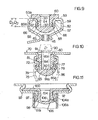
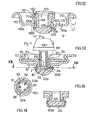
- the embodiment shown in Fig. 12 has a dome part 112 of lid 110 that protrudes upwardly, i.e. away from the can interior 2, and is crimped to clamp in the periphery of a valve disc 120 which bears a valve head 123 with stem part 124 and valve head button 125 similar to these elements shown in Figures 1 and 2.
- the collar portion in this embodiment is constituted by a circular indentation 128a in flat lid part 113 about the foot end 112a of dome part 112, whereby an annular sealing bead 128 is formed which protrudes downwardly toward the can interior 2 from the underside 113a of lid 110.
- the shoulder 126 of valve head button 125 is urged firmly and sealingly with bias against this sealing bead 128, obturating the duct 135 which extends through stem part 124.
- the same mounting mode for generating this bias is used as in the case of the embodiment of Fig o 9. (Claim 16)
- actuating means of the embodiment of Fig. 10 should be employed also in this case.
- the stretchability of the stem part 124 can be improved in the same manner as in the embodiment of Fig. 7.
- FIGs 13 and 14 there is illustrated a preferred way of mounting a sleeve 191 of spray head 190 in the cavity 30 of valve disc 20.
- a port 91a (Fig. 10) to register with the exit orifice 35b of duct 35
- the spray head sleeve 191 fits snugly into cavity 30 and is held firmly and with good seal against the elastically resilient internal wall surface 33 thereof.
- valve head button 125 is covered on its downwardly facing surface 125a by a protection cap 29 of corrosion-resistant material.
- the downwardly directed lid surface 10a which faces toward the can interior 2 can be coated with a similar protective layer 129.
- a similar protective layer 129 In the crimped region 15a of the dome part 12, there can be provided rubber elastic sealing strips 115 which can afford an additional sealing effect against the valve disc peripheral portion 21 which is to be clamped in to the crimped region 15a.
- the collar portion 117 has an end rim 118 being crimped to have a cuff part 119 thereabout which is similar to that provided in the embodiment of Fig. 10.
- the material from which the lid is made. is, for instance, an aluminium sheet of only 0.6 to 0.8 mm thickness
- the cuff 119, or the outer collar flange 49 shown in Fig. 5 contribute significantly to spacing the inner wall of a riser tube affixed to the lower end of the collar portion sufficiently from the valve head button which the riser tube surrounds.
- Another advantage of the novel lid according to the invention resides in the fact that the crimped zone in the dome part sidewall can be prefabricated (Fig. 16) and the valve disc bearing the valve head can then be snapped into place inside the dome part with the valve head button protruding through the central dome part opening. Sealing of the valve disc is guaranteed by sealing strips 115, even when the snapped-in valve disc should not fit with complete seal in the prefabricated crimped zone of the, dome part.
- the protection cap 29 or layer 129 ( Figures 15 and 16) can be made either of aluminium foil or a hard resin injection molded part, e.g. of a melamin resin or formaldehyde urea resin.
- the provision of a space 27 ( Figures 1 and 2) underneath the valve disc 20 inside the dome part 12 has the further advantage that the thickness of the valve disc 20 can be considerably greater than in the conventional gaskets used in the known aerosol spray can valves (see description of gasket 202 in Fig. 18, infra).
- the wide cavity 30 permits introduction of a filling head or of the stem of an atomizer head without the danger of damaging a functional portion of the valve disc or of having a lacking seal along the cavity sidewall 33, thus avoiding the fountain effect during filling that is feared when filling a conventional aerosol can through its valve.
- the sleeve or stem of a filler head or of an atomizer head can be slipped over the tubular sleeve part 50 of valve disc 20 and come to rest with its lower end rim sealingly on the upper valve disc face 20b, thus avoiding damage or the above-mentioned undesirable fountain effect.
- the actuating member constituted by tubular sleeve 50 can also bear an annular finger rest 51 on which two fingers can come to rest in order to exercise downward pressure and open the valve (Fig. 19).
- cover disc 51a can extend about the finger rest 51 and the peripheral zone of cover disc 5la can rest on the periphery 11 of lid 10.
- valve disc 60 is of the same stopper-like configuration as in the embodiment of Fig. 9, while the lid 152, which bears the same collar portion 57 as in Fig. 9 is integral with the sidewall of a container depending from the lid itself.
- the container sidewall can then be sealingly connected to a con 7 tainer bottom part, e.g. by crimping in a manner known per se.
- the metallic lid is replaced by a stopper-like lid 101 which replaces the central portion of lid 110 in F ig. 12 or the entire lid, and, in the former case, is mounted firmly and sealingly in the upper opening 102 of the annular metallic lid part or in the corresponding top opening of a container sidewall 103.
- the lid 111 is made of a synthetic plastics material which is substantially harder than the synthetic material of which valve disc 101 consists.
- the upper portion 107 of lid 101 has an inner peripheral groove llla of rectangular cross section in which the periphery llla of valve disc 111 is clamped in sealingly and firmly.
- lid sleeve portion 108 constituting the dome part of the lid 101.
- lid sleeve portion 108 projects with an annular bulge 109 beneath the neck part 103a of container sidewall 103, while on its upper annular face 108a, it supports the underside of valve disc 111.
- the latter is clamped into the central opening 108b of lid sleeve portion 108 by having the shoulder 166 of valve head button 165 rest against the underside 108c of sleeve portion 108 with bias in the same manner as described relative to Fig. 9.
- a riser tube 145 can be fastened in a corresponding recess 145a in the underside of sleeve portion 108.
- Fig. 22 shows an embodiment in which the valve disc 180 is of somewhat similar construction as in the embodiment shown in Fig. 10.
- the dome part 172 of the lid is vaulted downwardly from the outer surface 170a of the very short flat lid part 170, and is provided in its top part 173 with an annular indented bead 171 which reinforces the dome part 172 against being distorted when the periphery at 170b of the lid is crimped on to a container sidewall (not shown).
- the collar portion 177 extends in this embodiment, axially outwardly from the top wall 173 of the dome part sidewall 177, at the upper free end 177a of which there is firmly mounted the upper end 180a of valve disc 180.
- the valve head 185 has its contact face 186 at its periphery and engages.sealingly the inner wall 178 of collar portion 177.
- valve disc 280 has a sealing element which is a flexible annular flange 279 surrounding and integral with valve head stem 284, which flange comes to lie with its upper side 279a against the inner zone 178 of the lid underside about the bottom opening of collar portion 177, while the contact face 286 of valve head button 285 sealingly presses with bias against the underside 27.9b of annular flange 279.
- the actuating means for this embodiment are preferably identical with those shown in Fig. 10 and operate ih the same manner when the valve is to be opened.
- Fig. 18 shows a conventional valve-and-lid assembly comprising an atomizer head and dependent sleeve as actuating member.
- Such known valve comprises a lid 200, a valve housing 201 which is held at the lid 200 by means of an indented portion 200a of the latter, an elastically resilient valve disc or gasket 202 the peripheral region 202a of which is wedged in between a dome top wall 212 and the top rim 203 of valve housing 201.
- a steel spring 204 one end of which rests on the housing bottom 205, urges a valve body 206 with its upper obturating rim 207 into sealing engagement with the underside of valve disc 202.
- a sleeve of the atomizer head 210 is inserted into the top opening 213 of dome top wall 212 and rests upon the top face 206a of valve body 206 c Depression of the atomizer head 210 compresses the spring 204 and opens a gap between the obturating rim 207 and the valve disc 202, whereupon product can flow from a riser tube 215 through valve housing 201 and through the aforesaid gap into a port 214 in sleeve 21h and through the interior of the latter to the spray nozzle 216 in atomizer head 210.
- Ducts 312 for the passage of product to be dispensed extend through the valve disc 310 from its underside 310b and end in exit openings 312a inside the hollow interior 3lla of socket 311.
- the valve disc 310 is lodged in a cup-shaped dome part 315 which is vaulted inwardly from the plane of a container lid 316, i.e., toward the interior of a container (not shown) which the lid is destined to close.
- the sidewall 317 of the dome part 315 is crimped so as to hold the peripheral portion 310a of the valve disc 310 firmly in place at all times.
- the dome part 315 which cooperates with the valve disc 310 as one of the elements of a valve, has in its flat top wall 315a a central opening 313 which is surrounded by a collar portion 314. The latter protrudes upwardly from the dome top wall 315a toward the interior of dome part 315.
- a riser tube : 318 is firmly inserted in the collar portion 314.
- the opening 313 is hermetically sealed by the underside 310b of valve disc 310 and there is thus no free communication with the entry orifices 312b of ducts 312. These entry orifices 312b are obturated by the flat dome top wall 315a.
- This deformation affects mainly the underside 310b of valve disc 310 lifting the same off the flat top wall 315.
- free communication is established between the upper open end of riser tube 318 in central opening 313 and the entry orifice 312b of at least one of the ducts 312.
- Product thus passing through duct 312 emerges into the interior 311a of socket 311 and from there into an atomizer head (not shown) equipped with a spray nozzle or similar discharge means.
- the socket 311 is replaced as actuating means by a rod or mandrel 321 which protrudes from the top face 310c of valve disc 310 and is integral with the latter.
- Rod 321 is surrounded by a conical enveloping mantle 322 which is mounted with its foot end 323 having a rim bead 324 firmly in a corresponding peripheral groove 325 in the sidewall of valve disc 310.
- the rod 321 is conically bevelled and a correspondingly tapered inside face 322a about the upper open end of mantle 322 sealingly engages this conical top end 321a when the valve is in closed position.
- exit orifices 312a of ducts 312 open into the conical interior space 326 inside mantle 322.
- valve disc 310 can also be cylindrical; fastening is then effected by means of flexible and readily stretchable fingers of a collar 330 projecting downward from the underside 310b of, and being integral with the valve disc 310.
- Collar 330 projects downwardly into opening 313 and reaches with its radially extending outer annular flange 330a somewhat underneath the collar portion 314 of dome part 315 and the inner face 316a of top wall 315a of dome part 315, which inner face is turned toward the interior of a container which is closed by lid 316.
- collar 330 is provided with at least one window 331 through which product passes from the open top end of riser tube 318, which top end is spaced from the underside 310b of valve disc 310 while being held inside collar 330, into the gap opening above the collar portion at tilting of actuating members 321 and 322, and into, entry orifice 312b of at least one of ducts 312.
- the riser tube 328 is integral with the top wall 315a of dome part 315.
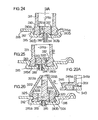
- cup-shaped dome part 345 of lid 336 is not vaulted inwardly toward a container interior, but outwardly away from that interior. These embodiments are particularly suitable in those cases in which the container does not require a riser tube.
- dome part 345 has a central opening 343 in a flat top wall 345 thereof which opening is surrounded by a collar portion 344 which, in these embodiments, depends downwardly, i.e. toward the container interior, from the flat top wall 345a.
- An actuating member in the form of a tubulure 341 which can be the tubular shaft of a conventional atomizer head (not shown) is set in the opening 343 and is held slidingly in collar portion 344 and is provided at its lower end with a lateral port or window 351.
- a valve disc 340 is held firmly in the interior of dome part 345.
- Ducts 342 extend from entry orifices 342b in the underside 340a of valve disc 340 through the latter to exit orifices 342a on the upper face 340b thereof.
- tubulure 341a is made integral with the flat top wall 345a of upwardly vaulted dome part 345, while in the embodiment of Fig. 30 the tubulure 350 is made integral with the valve disc 340.
- Fig. 26 illustrates a further embodiment of the valve and-lid assembly according to the invention, which is similar to that shown in Fig. 30.
- the valve disc 340 has about its periphery a thin wide annular flange 348 extending radially relative to assembly axis VA and covering the entire underside face 336a of lid 336 and being crimped at its periphery together with the peripheral portion 337 of lid 336 about the top margin of the top rim of a container sidewall 338.
- the crimped periphery of flange 348 serves simultaneously as a sealing for the crimped lid and container top periphery.
- Fig. 31 further shows the deformed central portion of valve disc 340, being in its "open” position due to pressure exerted in the direction of arrow P on tubulure 350 or a spray head (not shown) borne by the latter. Due to this deformation, a gap is formed between the rim 344a of collar portion 344 and the upper side 340b of valve disc 340 through which gap free communication is established between the exit orifices 342a of ducts 342 and, via windows 351, the interior of tubulure 350.
- the lateral fastening of the valve disc 340 by means of crimping the sidewall 345c of dome part 345 is replaced, similar to the case of Fig. 27, by fastening collar 360 which protrudes upwardly from the upper side of valve disc 340 and is integral with the latter.
- the collar 360 is easily stretchable so as to permit downward movement of valve disc 360 within the guiding annular sidewall 345d of dome part 345, and reaches a short distance above the upper side of flat top wall 345a of dome part 345.
- collar 360 is provided with transverse ducts or windows 361, by way of which product from exit orifices 342a can pass to window 351 at the lower end of tubulure 341 when the latter is depressed in order to open the valve.
- the tubulure can also carry a filling head in order to fill a suitable product and/or propellant into the container.
Landscapes
- Chemical & Material Sciences (AREA)
- Dispersion Chemistry (AREA)
- Engineering & Computer Science (AREA)
- Mechanical Engineering (AREA)
- Containers And Packaging Bodies Having A Special Means To Remove Contents (AREA)
- Nozzles (AREA)
- Float Valves (AREA)
- Pens And Brushes (AREA)
- External Artificial Organs (AREA)
Applications Claiming Priority (4)
| Application Number | Priority Date | Filing Date | Title |
|---|---|---|---|
| CH591280 | 1980-08-04 | ||
| CH5912/80 | 1980-08-05 | ||
| US06/259,158 US4442959A (en) | 1981-04-30 | 1981-04-30 | Self-closing valve-and-lid assembly |
| US259158 | 1999-02-26 |
Related Child Applications (2)
| Application Number | Title | Priority Date | Filing Date |
|---|---|---|---|
| EP84107567A Division EP0128595A3 (de) | 1980-08-04 | 1981-07-08 | Ventil und Verschlussvorrichtung für Behälter |
| EP84107567.4 Division-Into | 1981-07-08 |
Publications (3)
| Publication Number | Publication Date |
|---|---|
| EP0045385A2 true EP0045385A2 (de) | 1982-02-10 |
| EP0045385A3 EP0045385A3 (en) | 1982-05-12 |
| EP0045385B1 EP0045385B1 (de) | 1986-04-16 |
Family
ID=25698630
Family Applications (1)
| Application Number | Title | Priority Date | Filing Date |
|---|---|---|---|
| EP81105298A Expired EP0045385B1 (de) | 1980-08-04 | 1981-07-08 | Selbstschliessendes Ventil und Verschlussvorrichtung |
Country Status (15)
| Country | Link |
|---|---|
| US (1) | US4493444A (de) |
| EP (1) | EP0045385B1 (de) |
| AR (1) | AR228871A1 (de) |
| AT (1) | ATE19226T1 (de) |
| AU (1) | AU546800B2 (de) |
| BR (1) | BR8105023A (de) |
| DE (1) | DE3174393D1 (de) |
| DK (1) | DK345181A (de) |
| ES (1) | ES504498A0 (de) |
| GR (1) | GR74986B (de) |
| IE (1) | IE52198B1 (de) |
| MX (1) | MX153831A (de) |
| NO (1) | NO158795C (de) |
| PT (1) | PT73460B (de) |
| YU (1) | YU184281A (de) |
Cited By (9)
| Publication number | Priority date | Publication date | Assignee | Title |
|---|---|---|---|---|
| DE3238271A1 (de) * | 1982-10-15 | 1984-04-19 | Heinz 8868 Oberurnen Hartnig | Ventilanordnung an druckbehaeltern |
| DE3238203A1 (de) * | 1982-10-15 | 1984-04-19 | Heinz 8868 Oberurnen Hartnig | Ventilanordnung an druckbehaeltern |
| EP0080750A3 (de) * | 1981-11-26 | 1985-03-20 | Franco Del Bon | Verfahren zur Herstellung einer Ventil- und Kappenkombination |
| EP0111089A3 (en) * | 1982-11-30 | 1985-11-21 | Ladoco Ag | Pressurised container for gases, liquids, pasty products or the like |
| EP0224380A3 (de) * | 1985-11-19 | 1988-08-17 | Baderi, Jopado | Ventilanordnung |
| WO2011139677A1 (en) * | 2010-04-26 | 2011-11-10 | The Gillette Company | Plug and valve system |
| WO2011139508A1 (en) * | 2010-04-26 | 2011-11-10 | The Gillette Company | Plug and valve system |
| WO2021016343A1 (en) * | 2019-07-22 | 2021-01-28 | Good Design, Inc. | Cartridge for dispensing products and methods for their manufacture |
| WO2021055937A1 (en) * | 2019-09-20 | 2021-03-25 | Good Design, Inc. | Cartridge for dispensing products and methods for their manufacture |
Families Citing this family (32)
| Publication number | Priority date | Publication date | Assignee | Title |
|---|---|---|---|---|
| US4877624A (en) * | 1985-04-11 | 1989-10-31 | Cem Corporation | Digestion and sterilization methods and apparatus |
| EP0198675B2 (de) * | 1985-04-11 | 1994-04-13 | CEM Corporation | Selbstregulierendes Ventil in einem Mikrowellen- und Behältersystem |
| US5605258A (en) * | 1986-12-03 | 1997-02-25 | Abplanalp; Robert H. | Two-piece aerosol valve for vertical or tilt action |
| US5027985A (en) * | 1986-12-03 | 1991-07-02 | Abplanalp Robert H | Aerosol valve |
| ATE354437T1 (de) * | 1998-04-20 | 2007-03-15 | Cem Corp | Flexibler behälter und rahmen für mikrowellen assistierte chemie |
| US6135311A (en) * | 1998-09-23 | 2000-10-24 | Acorn Bay, Llc | Drink valve |
| FR2798367B1 (fr) * | 1999-09-15 | 2001-11-23 | Valois Sa | Joint de soupape pour valve doseuse |
| JP4746247B2 (ja) * | 2000-04-18 | 2011-08-10 | エイヴォン プロテクション システムズ,インク. | 自己密封フィルター接続部およびそれを取り入れたガスマスクおよびフィルター組立体 |
| US6325248B1 (en) | 2000-07-05 | 2001-12-04 | Robert E. Corba | Container assembly |
| US6299024B1 (en) | 2000-07-05 | 2001-10-09 | Robert E. Corba | Valve assembly for dispensing container |
| US6415957B1 (en) * | 2000-11-27 | 2002-07-09 | S. C. Johnson & Son, Inc. | Apparatus for dispensing a heated post-foaming gel |
| USD456654S1 (en) | 2000-11-27 | 2002-05-07 | S. C. Johnson & Son, Inc. | Dispenser for shaving product |
| US6631823B2 (en) | 2001-03-05 | 2003-10-14 | Acorn Bay, Llc | Drink spout system |
| US6629624B2 (en) | 2001-03-05 | 2003-10-07 | Acorn Bay, Llc | Drink spout system |
| EP2428172B1 (de) | 2001-09-24 | 2013-07-24 | Applied Medical Resources Corporation | Obturator ohne Klinge |
| EP1503677B1 (de) | 2002-05-16 | 2011-05-04 | Applied Medical Resources Corporation | Obturator mit kegelspitze |
| EP2545865B1 (de) | 2003-10-03 | 2015-07-08 | Applied Medical Resources Corporation | Optischer Obturator ohne Klinge |
| EP3175804B1 (de) * | 2004-06-29 | 2018-09-26 | Applied Medical Resources Corporation | Insufflierendes optisches operationsinstrument |
| AU2007303069B2 (en) * | 2006-10-06 | 2013-03-21 | Applied Medical Resources Corporation | Visual insufflation port |
| DE102007049614B4 (de) * | 2007-03-15 | 2015-03-05 | Aptar Dortmund Gmbh | Abgabevorrichtung |
| EP2837345B1 (de) * | 2008-01-25 | 2016-10-05 | Applied Medical Resources Corporation | Insufflierendes Zugangssystem |
| FR2930765B1 (fr) * | 2008-04-30 | 2012-11-16 | Lindal France | Valve pour diffuseur |
| ES2436002T3 (es) * | 2008-06-20 | 2013-12-26 | Aptar Dortmund Gmbh | Dispositivo de distribución |
| DE102008038654B4 (de) | 2008-08-12 | 2019-09-19 | Aptar Dortmund Gmbh | Abgabekopf mit schwenkbarem Ventilelement |
| ES2917876T3 (es) | 2008-09-29 | 2022-07-12 | Applied Med Resources | Sistema de trócar de primera entrada |
| DE102009030627B4 (de) * | 2009-06-25 | 2020-03-12 | Aptar Dortmund Gmbh | Ventil und Abgabevorrichtung |
| EP2558380B1 (de) * | 2010-04-12 | 2016-06-01 | Hoffmann Neopac AG | Rohr mit einwegventil zur entladungsregulierung in rohren und verfahren zur herstellung solch eines einwegventils |
| US9254148B2 (en) | 2011-05-02 | 2016-02-09 | Applied Medical Resources Corporation | Low-profile surgical universal access port |
| FR3016618B1 (fr) * | 2014-01-17 | 2016-02-19 | Aptar France Sas | Reservoir de produit fluide et distributeur integrant un tel reservoir. |
| KR101990236B1 (ko) | 2015-04-06 | 2019-06-17 | 에스.씨. 존슨 앤 선 인코포레이티드 | 분배 시스템 |
| EP3380411A1 (de) * | 2015-11-25 | 2018-10-03 | Sika Technology AG | Behälter zur aufbewahrung eines inhaltsstoffes |
| BE1024213B1 (nl) * | 2016-11-04 | 2017-12-13 | Altachem Nv | Klep |
Family Cites Families (17)
| Publication number | Priority date | Publication date | Assignee | Title |
|---|---|---|---|---|
| US2662668A (en) * | 1950-01-09 | 1953-12-15 | Crown Can Company | Dispensing container and slitted resilient valve therefor |
| US2662669A (en) * | 1950-01-09 | 1953-12-15 | Crown Can Company | Dispensing container and slitted resilient valve therefor |
| US2696934A (en) * | 1950-04-18 | 1954-12-14 | Oscar L Ashton | Container valve means |
| US2761593A (en) * | 1951-02-15 | 1956-09-04 | Nat Dairy Res Lab Inc | Valve for pressurized containers |
| US2845203A (en) * | 1955-04-21 | 1958-07-29 | Potash Norman | Filling and sealing device |
| US2863699A (en) * | 1955-08-23 | 1958-12-09 | Owens Illinois Glass Co | Resilient valve mounting assembly |
| US3144179A (en) * | 1961-05-05 | 1964-08-11 | Gildone Anthony Michael | Aerosol valve |
| GB1106986A (en) * | 1964-10-16 | 1968-03-20 | Assalit Louis | Valves for pressurised dispensing containers |
| US3272403A (en) * | 1964-10-19 | 1966-09-13 | American Can Co | Valve for pressure container |
| US3323695A (en) * | 1965-09-22 | 1967-06-06 | Oel Inc | Concealed spout assembly |
| US3434633A (en) * | 1967-10-23 | 1969-03-25 | Scovill Manufacturing Co | Dispensing actuator for aerosol containers |
| US3540634A (en) * | 1968-02-23 | 1970-11-17 | John G Mayercik | Tilt actuator for pressurized spray dispenser |
| AT303601B (de) * | 1969-05-30 | 1972-12-11 | Bottani Angelo | Abgabe- und Füllventil |
| US3613728A (en) * | 1969-09-29 | 1971-10-19 | Valve Corp Of America | Diaphragm-actuated aerosol valve |
| US3633798A (en) * | 1969-12-22 | 1972-01-11 | Gillette Co | Aerosol valve |
| CA1092069A (en) * | 1976-06-08 | 1980-12-23 | George B. Diamond | Pressurized barrier pack |
| US4171074A (en) * | 1977-05-09 | 1979-10-16 | Diamond George B | Pressure responsive tilt valve for pressurized container |
-
1981
- 1981-07-08 DE DE8181105298T patent/DE3174393D1/de not_active Expired
- 1981-07-08 EP EP81105298A patent/EP0045385B1/de not_active Expired
- 1981-07-08 AT AT81105298T patent/ATE19226T1/de not_active IP Right Cessation
- 1981-07-21 IE IE1643/81A patent/IE52198B1/en unknown
- 1981-07-24 NO NO81812540A patent/NO158795C/no unknown
- 1981-07-27 YU YU01842/81A patent/YU184281A/xx unknown
- 1981-07-31 AR AR286322A patent/AR228871A1/es active
- 1981-07-31 PT PT73460A patent/PT73460B/pt unknown
- 1981-08-03 ES ES504498A patent/ES504498A0/es active Granted
- 1981-08-03 GR GR65706A patent/GR74986B/el unknown
- 1981-08-03 DK DK345181A patent/DK345181A/da not_active Application Discontinuation
- 1981-08-03 MX MX81188583A patent/MX153831A/es unknown
- 1981-08-04 AU AU73669/81A patent/AU546800B2/en not_active Ceased
- 1981-08-04 BR BR8105023A patent/BR8105023A/pt unknown
-
1982
- 1982-02-09 US US06/347,321 patent/US4493444A/en not_active Expired - Fee Related
Cited By (9)
| Publication number | Priority date | Publication date | Assignee | Title |
|---|---|---|---|---|
| EP0080750A3 (de) * | 1981-11-26 | 1985-03-20 | Franco Del Bon | Verfahren zur Herstellung einer Ventil- und Kappenkombination |
| DE3238271A1 (de) * | 1982-10-15 | 1984-04-19 | Heinz 8868 Oberurnen Hartnig | Ventilanordnung an druckbehaeltern |
| DE3238203A1 (de) * | 1982-10-15 | 1984-04-19 | Heinz 8868 Oberurnen Hartnig | Ventilanordnung an druckbehaeltern |
| EP0111089A3 (en) * | 1982-11-30 | 1985-11-21 | Ladoco Ag | Pressurised container for gases, liquids, pasty products or the like |
| EP0224380A3 (de) * | 1985-11-19 | 1988-08-17 | Baderi, Jopado | Ventilanordnung |
| WO2011139677A1 (en) * | 2010-04-26 | 2011-11-10 | The Gillette Company | Plug and valve system |
| WO2011139508A1 (en) * | 2010-04-26 | 2011-11-10 | The Gillette Company | Plug and valve system |
| WO2021016343A1 (en) * | 2019-07-22 | 2021-01-28 | Good Design, Inc. | Cartridge for dispensing products and methods for their manufacture |
| WO2021055937A1 (en) * | 2019-09-20 | 2021-03-25 | Good Design, Inc. | Cartridge for dispensing products and methods for their manufacture |
Also Published As
| Publication number | Publication date |
|---|---|
| ATE19226T1 (de) | 1986-05-15 |
| GR74986B (de) | 1984-07-12 |
| NO158795C (no) | 1988-11-02 |
| DE3174393D1 (en) | 1986-05-22 |
| PT73460B (en) | 1982-10-15 |
| EP0045385A3 (en) | 1982-05-12 |
| EP0045385B1 (de) | 1986-04-16 |
| ES8204685A1 (es) | 1982-05-16 |
| AU7366981A (en) | 1982-02-11 |
| US4493444A (en) | 1985-01-15 |
| IE811643L (en) | 1982-10-30 |
| BR8105023A (pt) | 1982-04-20 |
| AR228871A1 (es) | 1983-04-29 |
| YU184281A (en) | 1984-10-31 |
| AU546800B2 (en) | 1985-09-19 |
| DK345181A (da) | 1982-02-05 |
| NO158795B (no) | 1988-07-25 |
| PT73460A (en) | 1981-08-01 |
| MX153831A (es) | 1987-01-19 |
| NO812540L (no) | 1982-02-05 |
| ES504498A0 (es) | 1982-05-16 |
| IE52198B1 (en) | 1987-08-05 |
Similar Documents
| Publication | Publication Date | Title |
|---|---|---|
| US4493444A (en) | Self-closing valve-and-lid assembly | |
| US4442959A (en) | Self-closing valve-and-lid assembly | |
| US4410110A (en) | Valve-and-lid assembly for a container | |
| US3991916A (en) | Automatic closure device for the discharge of a foam product from a pressurized container | |
| US4785978A (en) | Container closure provided with automatic opening-closing mechanism | |
| US3946911A (en) | Cap for operating dispensing valve which may be actuated from a plurality of directions | |
| US3263867A (en) | Metering button-type aerosol actuator | |
| US3987938A (en) | Dispensing pump | |
| EP1210268B1 (de) | Hochvolumenaerosolventil | |
| US3154224A (en) | Valve actuator for pressurized package | |
| US3146922A (en) | Sealing device for pressurized package | |
| US3981419A (en) | Self-closing closures | |
| US4435135A (en) | Pump assembly with improved seal | |
| US20100096416A1 (en) | Liquid dispensing device equipped with a sealing component moveable under the effect of pressure by a user | |
| US3160182A (en) | Aerosol dispenser siphon construction | |
| US5271533A (en) | Container provided with a spring closure device | |
| US3613964A (en) | Valve and mounting | |
| US3155291A (en) | Closure for pressurized package | |
| US4991751A (en) | Foam actuator for metering an aerosol product | |
| US3211384A (en) | Dispensing head | |
| GB2058229A (en) | An aerosol can | |
| US3123261A (en) | gorman | |
| US4532690A (en) | Process for producing a valve-and-lid assembly | |
| GB2258860A (en) | Valved closure | |
| US3572557A (en) | Aerosol valves |
Legal Events
| Date | Code | Title | Description |
|---|---|---|---|
| PUAI | Public reference made under article 153(3) epc to a published international application that has entered the european phase |
Free format text: ORIGINAL CODE: 0009012 |
|
| AK | Designated contracting states |
Kind code of ref document: A2 Designated state(s): AT BE CH DE FR GB IT LU NL SE |
|
| PUAL | Search report despatched |
Free format text: ORIGINAL CODE: 0009013 |
|
| AK | Designated contracting states |
Kind code of ref document: A3 Designated state(s): AT BE CH DE FR GB IT LU NL SE |
|
| 17P | Request for examination filed |
Effective date: 19820702 |
|
| ITF | It: translation for a ep patent filed | ||
| GRAA | (expected) grant |
Free format text: ORIGINAL CODE: 0009210 |
|
| AK | Designated contracting states |
Kind code of ref document: B1 Designated state(s): AT BE CH DE FR GB IT LI LU NL SE |
|
| REF | Corresponds to: |
Ref document number: 19226 Country of ref document: AT Date of ref document: 19860515 Kind code of ref document: T |
|
| REF | Corresponds to: |
Ref document number: 3174393 Country of ref document: DE Date of ref document: 19860522 |
|
| PGFP | Annual fee paid to national office [announced via postgrant information from national office to epo] |
Ref country code: AT Payment date: 19860715 Year of fee payment: 6 |
|
| ET | Fr: translation filed | ||
| PG25 | Lapsed in a contracting state [announced via postgrant information from national office to epo] |
Ref country code: LU Free format text: LAPSE BECAUSE OF NON-PAYMENT OF DUE FEES Effective date: 19860731 |
|
| PLBE | No opposition filed within time limit |
Free format text: ORIGINAL CODE: 0009261 |
|
| STAA | Information on the status of an ep patent application or granted ep patent |
Free format text: STATUS: NO OPPOSITION FILED WITHIN TIME LIMIT |
|
| 26N | No opposition filed | ||
| PGFP | Annual fee paid to national office [announced via postgrant information from national office to epo] |
Ref country code: NL Payment date: 19870731 Year of fee payment: 7 |
|
| PGFP | Annual fee paid to national office [announced via postgrant information from national office to epo] |
Ref country code: CH Payment date: 19890126 Year of fee payment: 8 |
|
| PG25 | Lapsed in a contracting state [announced via postgrant information from national office to epo] |
Ref country code: GB Effective date: 19890708 Ref country code: AT Effective date: 19890708 |
|
| PG25 | Lapsed in a contracting state [announced via postgrant information from national office to epo] |
Ref country code: SE Effective date: 19890709 |
|
| PG25 | Lapsed in a contracting state [announced via postgrant information from national office to epo] |
Ref country code: LI Effective date: 19890731 Ref country code: CH Effective date: 19890731 Ref country code: BE Effective date: 19890731 |
|
| BERE | Be: lapsed |
Owner name: DEL BON LUIGI Effective date: 19890731 Owner name: DEL BON FRANCO Effective date: 19890731 |
|
| PG25 | Lapsed in a contracting state [announced via postgrant information from national office to epo] |
Ref country code: NL Effective date: 19900201 |
|
| GBPC | Gb: european patent ceased through non-payment of renewal fee | ||
| NLV4 | Nl: lapsed or anulled due to non-payment of the annual fee | ||
| PG25 | Lapsed in a contracting state [announced via postgrant information from national office to epo] |
Ref country code: FR Free format text: LAPSE BECAUSE OF NON-PAYMENT OF DUE FEES Effective date: 19900330 |
|
| REG | Reference to a national code |
Ref country code: CH Ref legal event code: PL |
|
| PG25 | Lapsed in a contracting state [announced via postgrant information from national office to epo] |
Ref country code: DE Effective date: 19900403 |
|
| REG | Reference to a national code |
Ref country code: FR Ref legal event code: ST |
|
| EUG | Se: european patent has lapsed |
Ref document number: 81105298.4 Effective date: 19900418 |