EP0046729A2 - Verfahren zum Färben faserbildender Polyamide in der Masse mit Azofarbstoffen - Google Patents
Verfahren zum Färben faserbildender Polyamide in der Masse mit Azofarbstoffen Download PDFInfo
- Publication number
- EP0046729A2 EP0046729A2 EP81810332A EP81810332A EP0046729A2 EP 0046729 A2 EP0046729 A2 EP 0046729A2 EP 81810332 A EP81810332 A EP 81810332A EP 81810332 A EP81810332 A EP 81810332A EP 0046729 A2 EP0046729 A2 EP 0046729A2
- Authority
- EP
- European Patent Office
- Prior art keywords
- group
- methyl
- dyes
- formula
- groups
- Prior art date
- Legal status (The legal status is an assumption and is not a legal conclusion. Google has not performed a legal analysis and makes no representation as to the accuracy of the status listed.)
- Granted
Links
- 0 C[N+](*1**(C(C2)CC2=N)***1*=*)[O-] Chemical compound C[N+](*1**(C(C2)CC2=N)***1*=*)[O-] 0.000 description 3
Classifications
-
- C—CHEMISTRY; METALLURGY
- C08—ORGANIC MACROMOLECULAR COMPOUNDS; THEIR PREPARATION OR CHEMICAL WORKING-UP; COMPOSITIONS BASED THEREON
- C08K—Use of inorganic or non-macromolecular organic substances as compounding ingredients
- C08K5/00—Use of organic ingredients
- C08K5/16—Nitrogen-containing compounds
- C08K5/34—Heterocyclic compounds having nitrogen in the ring
- C08K5/3442—Heterocyclic compounds having nitrogen in the ring having two nitrogen atoms in the ring
- C08K5/3462—Six-membered rings
Definitions
- the invention relates to a process for dyeing fiber-forming polyamides in bulk with azo dyes of the formula where A is the residue of a diazo or tetrazo component, R 1 , R 2 and R 3 are H atoms, alkyl, cycloalkyl, phenylalkyl or aryl radicals and n is 1 or 2.
- the radical A can be derived from any diazo components, for example the benzene or naphthalene series. These can contain the substituents customary in azo dyes, in particular sulfonic acid or carboxyl groups, furthermore halogen atoms, such as fluorine, chlorine or bromine, carbamoyl, sulfamoyl or cyano groups, alkyl, alkoxy or alkyl mercapto groups with 1-6 C, optionally by halogen atoms, Methyl or methoxy groups, substituted phenoxy or phenyl mercapto groups, naphthoxy groups, phenalkyl groups or acyl groups, such as alkanoyl groups with 2-6 C, furthermore acylamino groups, such as alkanoylamino groups with 2-6 C, such as acetylamino, chloroacetylamino, propionylamino groups or benzoylamino groups -6 C, alkyl carbamo
- heterocyclic diazo components are 5- or 6-membered, N-containing heterocycles of aromatic character, for example belonging to the pyrrole, pyrazole, thiazole, oxdiazole, thiodiazole, triazole, tetrazole or pyridine series .
- Polynuclear fused heterocycles are also suitable, which then preferably have a fused benzene ring, such as the optionally substituted benzothiazole, benzotriazole, indole, indazole, quinoline, phthalimide and phthalic anhydride rings.
- These mono- or polynuclear heterocyclic diazo radicals may also contain substituents of the type enumerated above which are customary in azo dyes.
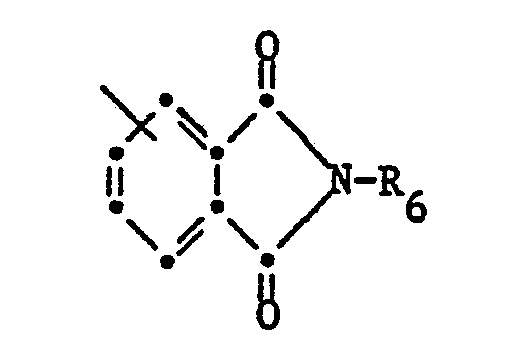
- A is a phthalimide residue, then preferably one of the formula wherein R 6 represents an H atom, a C 1 -C 4 alkyl group or a phenyl radical which is optionally substituted by chlorine atoms, methyl and methoxy groups.
- the radical A can also be the radical of a tetrazo component, that is to say derived from a diamine, from a diaminodiphenyl or a diaminodiphenyl derivative whose benzene nuclei are connected via a bridge member.
- R 1 , R2 and R 3 are alkyl radicals, then preferably those with 1-6 C, where these alkyl radicals can be substituted, for example by hydroxyl groups, alkoxy groups with 1-4 C, cyano or phenyl groups. Cyclohexyl radicals may be mentioned as examples of cycloalkyl radicals.
- R 1 , R 2 or R 3 are aryl radicals, then preferably phenyl radicals, which can contain chlorine atoms, methyl, methoxy or sulfo groups.
- the dyes of the formula 1) preferably contain 1 or 2 carboxyl or sulfo groups in the molecule.
- R 4 is an H atom, an alkyl group with 1-6 C, a phenyl group optionally substituted by chlorine atoms or methyl groups
- R 5 is a H atom or an alkyl group with 1-6 C
- Y is an H or halogen atom, a
- Dyes of the formula are preferred where X, Y and Z have the meaning given above.
- Dyes of the formula are also preferred wherein X 1 is a carboxylic acid or sulfonic acid group, Y 1 is an H atom, a methyl or carboxylic acid group, and the new dyes of the formula wherein X, Y, Z have the meaning given above, one of the radicals R 1 , R 2 and R 3 is a sulfophenyl group optionally substituted by chlorine atoms, methyl or methoxy groups, the remaining H atoms, alkyl groups with 1-6 C or optionally by Chlorine atoms, methyl or methoxy groups are substituted phenyl groups.
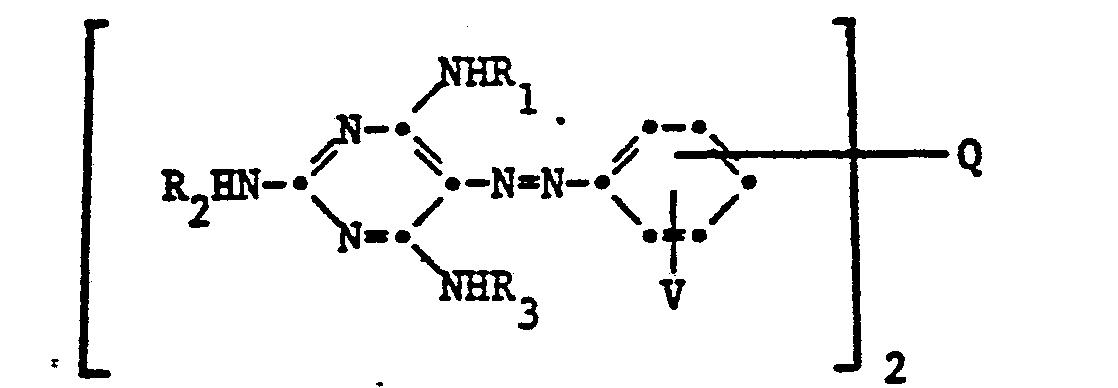
- R 1 , R 2 and R 3 have the meaning given above, Q is a direct bond or a bridge member, V is an H or chlorine atom, a methyl or methoxy group.
- Some of the dyes according to the invention are known (DE-PS 1.719.080 and Chem. Pharma Bull. 7, pages 1-6 (1959)) and can be prepared by the processes described there by coupling a diazotized monoamine or tetrazotinated diamine with one or two Mol of a triaminopyrimidine of the formula can be obtained by customary methods in an acidic, neutral or alkaline agent, if appropriate in the presence of water-soluble solvents, such as ethanol or dioxane.
- benzotriazinones are formed in the diazotization and must be cleaved in alkaline medium by treatment with alkalis before the coupling.
- the coupling components are known compounds. They are obtained by known processes, e.g. by reacting trichloropyrimidine with ammonia or the corresponding amines, for example methylamine, ethylamine, propylamine, isopropylamine, N-butylamine, n-hexylamine, n-octylamine, cyclohexylamine, aniline, 2-, -3- or -4-chloroaniline, 2- , -3- or -4-methylaniline or anilino-2, -3- or -4-sulfonic acid.
- the three chlorine atoms of trichloropyrimidine can optionally be replaced by the same or different of the amines mentioned.
- Suitable fiber-forming polyamides for the present process are the linear polyamides, such as those made from E-caprolactam ("Perlon", Nylon 6), from ⁇ -aminoundecanoic acid (“Rilsan”), from hexamethylene diamine and adipic acid (“Nylon” 6, 6) or can be produced from analogous starting materials.
- E-caprolactam Perlon
- ⁇ -aminoundecanoic acid Rosan
- Nylon 6 6 hexamethylene diamine and adipic acid
- Mixed polyamides for example composed of ⁇ -caprolactam and hexamethylenediamine and adipic acid, are also suitable.
- the dyes are mixed in solid or liquid form or as a solution with the polyamide by known processes and the mixture obtained is optionally dried.
- the polyamides to be colored are preferably breaded in the form of powders, granules or chips with the dry dye powder, i.e. mechanically mixed such that the surface of these particles is coated with a layer of the dye.
- the dye is advantageously in finely divided form.
- preparations which, in addition to the dye, contain a carrier, preferably a Ca or Mg salt of a higher fatty acid, for example stearic or behenic acid.
- the polyamide particles containing the dye or the dye preparation are melted and spun by known processes or otherwise, for example to give films or other molded parts, for example injection molded articles.
- the dye or dye preparation can also be introduced into the molten polyamide in solid or liquid form and then spun or deformed.
- Uniformly colored objects are obtained which are distinguished by a high fastness to light, wet, rubbing and heat setting.
- the dyes are evenly and finely distributed in the colored material. Although their solubilities in organic solvents such as chlorinated hydrocarbons, lower ketones, esters and alcohols are not high, they are often in dissolved form in polyamide.
- the colored objects expediently contain 0.01 to 3 Z of dye.
- Azo compounds containing sulfo groups of the present application are distinguished from the arylazopyrazolone sulfonic acids known from GDR Patent No. 107,065 by better thermal stability. They can therefore be used in a much wider temperature range and over longer spinning times.
- Azo compounds containing carboxy groups of the present application are superior in rubbing fastness (bleeding) to the azopyridine compounds described in DE-OS 24 09 754, which are free of acidic groups.
- Example 1 5 g of azo dye of the formula 1) or an isomeric formula
- Example 2 99 g of polyamide from ⁇ -caprolactam (polyamide 6) are in the form of chips with 1 g of the azo dye of the formula.
- Example 3 60 g of the azo dye of the formula
- Examples 4-56 Very real uniformly yellow to orange colored fibers are obtained by mass dyeing polyamide 6 analogously to Examples 1-3 using one of the monoazo dyes listed in Table 1 or one of the disazo dyes listed in Table 2.
- Example 57 The dye according to Example 12 is obtained as follows:
- Example 58 If the same amount of 4-aminophthalic acid disodium salt is used instead of 3-aminophthalic acid derivative, 63 parts of a yellow dye of the formula
- Example 59 99 g of polyamide granules of ⁇ -caprolactam (polyamide 6) are mixed with 1 g of azo dye of the formula
- Example 60 Very real, uniformly colored fibers are also obtained by mass dyeing polyamide 6 analogously to Examples 1-3 and 59 using an azo dye listed in Table 3.
Landscapes
- Chemical & Material Sciences (AREA)
- Health & Medical Sciences (AREA)
- Chemical Kinetics & Catalysis (AREA)
- Medicinal Chemistry (AREA)
- Polymers & Plastics (AREA)
- Organic Chemistry (AREA)
- Coloring (AREA)
- Compositions Of Macromolecular Compounds (AREA)
Abstract
Description
- Die Erfindung betrifft ein Verfahren zum Färben faserbildender Polyamide in der Masse mit Azofarbstoffen der Formel

- Der Rest A kann sich von beliebigen Diazokomponenten ableiten, beispielsweise der Benzol-, oder Naphthalinreihe. Diese können die in Azofarbstoffen üblichen Substituenten enthalten, insbesondere Sulfonsäure- oder Carboxylgruppen, ferner Halogenatome, wie Fluor, Chlor oder Brom, Carbamoyl-, Sulfamoyl- oder Cyangruppen, Alkyl-, Alkoxy-oder Alkylmercaptogruppen mit 1-6 C, gegebenenfalls durch Halogenatome, Methyl- oder Methoxygruppen, substituierte Phenoxy- oder Phenylmercaptogruppen, Naphthoxygruppen, Phenalkylgruppen oder Acylgruppen, wie Alkanoylgruppen mit 2-6 C, ferner Acylaminogruppen, wie Alkanoylaminogruppen mit 2-6 C, wie Acetylamino-, Chloracetylamino-, Propionylaminogruppen oder Benzoylaminogruppen, Alkylsulfamoylgruppen mit 1-6 C, Alkylcarbamoylgruppen mit 2-6 C, gegebenenfalls durch Chloratome, Methyl- oder Methoxygruppen, substituierte Phenylsulfonyl- Phenylsulfamoyl- oder Phenylcarbamoylgruppen, ferner Phenylazogruppen.
- Als Reste heterocyclischer Diazokomponenten kommen vor allem 5- oder 6-gliedrige, N-haltige Heterocyclen aromatischen Charakters in Betracht, beispielsweise der Pyrrol-, Pyrazol-, Thiazol-, Oxdiazol-, Thiodiazol-, Triazol-, Tetrazol- oder Pyridin-Reihe angehören. Auch mehrkernige kondensierte Heterocyclen kommen in Betracht, die dann vorzugsweise einen anellierten Benzolring aufweisen, wie beispielsweise die gegebenenfalls substituierten Benzthiazol-, Benztriazol-, Indol-, Indazol-, Chinolin-, Phtalimid- und Phtalsäureanhydridringe. Diese ein- odermehrkernigenheterocyclischen Diazoreste können ebenfalls in Azofarbstoffen übliche Substituenten der oben aufgezählten Art enthalten.
- Bedeutet A einen Phtalimidrest, dann vorzugsweise einen solchen der Formel
- Der Rest A kann auch den Rest einer Tetrazokomponente darstellen, sich also von einem Diamin ableiten, von einem Diaminodiphenyl oder einem Diaminodiphenylderivat, dessen Benzolkerne über ein Brückenglied verbunden sind. Brückenglieder können zweiwertige Atome, wie 0 oder S oder zweiwertige Gruppen sein, beispielsweise eine gegebenenfalls durch Alkylgruppen mit 1-6 C substituierte Aminogruppe , gradkettige oder verzweigte Alkylenreste, vorzugsweise mit 1-6 C, beispielsweise die-Methylen-, 1,2-Alkylen-oder 2,2-Propylengruppe, Cycloalkylgruppen, wie die 1,1-Cyclohexylgruppe, ferner die Reste -CO-, -SO- oder -SO2-, -CH=CH-, -N=N-, -SO2O-, -SO2-NR-, -SO2NHSO2-, -RNCO- oder -RN-CO-NR-, worin R ein H-Atom oder eine Alkylgruppe mit 1-6 C bedeutet.
- Sofern in Formel l) R1, R2 und R3 Alkylreste bedeuten, dann vorzugsweise solche mit 1-6 C, wobei diese Alkylreste substituiert sein können, beispielsweise durch Hydroxylgruppen, Alkoxygruppen mit 1-4 C, Cyan- oder Phenylgruppen. Als Beispiele von Cycloalkylresten seien Cyclohexylreste genannt. Bedeuten R1, R2 oder R3 Arylreste, dann vorzugsweise Phenylreste, die Chloratome, Methyl-, Methoxy- oder Sulfogruppen enthalten können.
- Die Farbstoffe der Formel 1) enthalten vorzugsweise 1 oder 2 Carboxyl- oder Sulfogruppen im Molekül.
- Von besonderem Interesse sind Farbstoffe der Formel 1), worin A einen Phenyl- oder Naphthylrest bedeutet, insbesondere einen solchen der Formel


- Bevorzugt sind Farbstoffe der Formel

- Ebenfalls bevorzugt sind Farbstoffe der Formel


- Aus der Reihe der Disazofarbstoffe sind von besonderem Interesse jene der Formel

- Die erfindungsgemässen Farbstoffe sind zum Teil bekannt (DE-PS 1.719.080 und Chem. Pharma Bull. 7, Seite 1-6 (1959)) und können nach den dort beschriebenen Verfahren durch Kuppeln eines diazotierten Monoamins oder tetrazotierten Diamins mit einem bzw. zwei Mol eines Triaminopyrimidins der Formel

- Verwendet man als Diazokomponenten l-Aminobenzol-2-sulfonsäure-oder -carbonsäureamide, so bilden sich bei der Diazotierung Benztriazinone, die vor der Kupplung in alkalischem Mittel durch Behandeln mit Alkalien gespalten werden müssen.
- Als Beispiele von Diazokomponenten seien genannt:
- Aminobenzol .
- l-Amino-2-, -3- oder -4-chlorbenzol
- l-Amino-2,3-, -2,4-, -3,4- oder 2,5-dichlorbenzol
- l-Amino-3-chlor-4-methylbenzol
- l-Amino-2- oder 4-methylbenzol
- l-Amino-2- oder 4-methoxybenzol
- l-Aminobenzol-2,-3,- oder -4-sulfonsäure
- l-Aminobenzol-2,5-disulfonsäure
- l-Amino-2-chlorbenzol-4-sulfonsäure
- l-Amino-4-chlorbenzol-3-sulfonsäure
- 1-Amino-2,5-dichlorbenzol-4-sulfonsäure
- 1-Aminobenzol-2-, -3- oder -4-sulfonsäurephenylester
- l-Aminobenzol-2-, -3- oder -4-sulfonsäureamid
- l-Aminobenzol-2-, -3- oder -4-sulfonsäuremethylamid
- 1-Aminobenzol-2-, -3- oder -4-sulfonsäureäthylamid
- l-Aminobenzol-2-, -3- oder -4-sulfonsäurephenylamid
- l-Aminobenzol-2-, -3- oder -4-carbonsäure
- l-Aminobenzol-2,3-, -2,4- oder -3,4-dicarbonsäure
- 1-Amino-2-chlor-5-benzoesäure
- 1-Aminobenzol-2-, -3- oder -4-carbonsäuremethylester
- 1-Aminobenzol-2-, -3- oder -4-carbonsäureäthylester
- l-Aminobenzol-2-, -3- oder -4-carbonsäurephenylester
- l-Aminobenzol-2-, -3- oder -4-carbonsäureamid
- 1-Aminobenzol-2-, -3- oder -4-carbonsäureäthylamid
- 1-Aminobenzol-2-, -3- oder -4-carbonsäureanilid
- l-Aminobenzol-2-, -3- oder -4-carbonsäure-N-äthylanilid
- l-Aminobenzol-2-, -3- oder -4-methylsulfonylbenzol
- 4-Aminoazobenzol
- 4-Aminoazobenzol-2'-, -3'- oder -4'-sulfonsäure
- 4-Amino-3'-chlorazobenzol
- 4-Amino-2-methylazobenzol
- 4-Amino-4'-methylazobenzol
- 4-Amino-2-methoxyazobenzol
- 2-Amino-diphenyläther
- 2-Amino-4,4'-dichlor-2'-sulfo-diphenyläther
- 2-Amino-benzophenon
- 4-Amino-4'-methyl-benzophenon
- 2-Amino-4'-methyl-diphenylsulfon
- 3-Amino-4-chlor-diphenylsulfon
- 2-Amino-3'-sulfo-diphenylsulfon
- l-Aminobenzol-naphthalin-4-sulfonsäure
- 2-Aminobenzol-naphthalin-4-sulfonsäure
- 2-Aminobenzol-naphthalin-3,6-disulfonsäure
- 4-Aminophthalsäure-anhydrid
- 3-Aminophthalsäure-anhydrid
- 3- oder 4-Aminophthalsäure-imid
- 3-Amino-phthalsäure-2'-methyl-5'-chlorphenylimid
- 3-Amino-phthalsäure-2'-methoxy-5'-chlorphenylimid
- Als Tetrazokomponenten seien genannt:
- Benzidin
- 3,3'-Dichlorbenzidin
- 3,3'-Dimethylbenzidin
- 3,3'-Dimethoxybenzidin:
- 4,4'-Diaminostilben
- 2,2', 3,3', und 4,4'-Diaminodiphenylsulfon
- 3,3'-Diaminobenzophenon
- 4,4'-Diaminodiphenyloxid
- 4,4'-Diaminodiphenylsulfid
- 4,4'-Diaminodiphenylmethan
- 2,2-Bis-(4'-aminophenyl)-propan
- 4,4'-Diamino-diphenylamin
- 4,4'-Diamino-diphenylharnstoff
- 4,4'-Diamino-benzoesäureanilid
- 4,4'-Diamino-azobenzol.
- Die Kupplungskomponenten stellen bekannte Verbindungen dar. Man erhält sie nach bekannten Verfahren, wie z.B. durch Umsetzen von Trichlorpyrimidin mit Ammoniak oder den entsprechenden Aminen, beispielsweise Methylamin, Aethylamin, Propylamin, Isopropylamin, N-Butylamin, n-Hexylamin, n-Oktylamin, Cyclohexylamin, Anilin, 2-, -3- oder -4-Chloranilin, 2-, -3- oder -4-Methylanilin oder Anilino-2, -3- oder -4-sulfonsäure. Die drei Chloratome des Trichlorpyrimidins können wahlweise durch gleiche oder verschiedene der genannten Amine ausgetauscht werden.
- Als faserbildende Polyamide kommen für das vorliegende Verfahren die linearen Polyamide in Betracht, wie sie beispielsweise aus E-Caprolactam ("Perlon", Nylon 6), aus ω-Aminoundecansäure ("Rilsan"), aus Hexamethylendiamin und Adipinsäure ("Nylon" 6,6) oder aus analogen Ausgangsstoffen herstellbar sind. Ferner kommen auch Mischpolyamide in Betracht, beispielsweise aus ε-Caprolactam und Hexamethylendiamin und Adipinsäure.
- Die Farbstoffe werden nach bekannten Verfahren in fester oder flüssiger Form oder als Lösung mit dem Polyamid vermischt und die erhaltene Mischung gegebenenfalls zwischengetrocknet.
- Bevorzugt werden die zu färbenden Polyamide in Form von Pulvern, Körnern oder Schnitzeln mit dem trockenen Farbstoffpulver paniert, d.h. mechanisch derart vermischt, dass die Oberfläche dieser Teilchen mit einer Schicht des Farbstoffes überzogen ist. Der Farbstoff liegt vorteilhaft in fein verteilter Form vor.
- Anstelle der reinen Farbstoffe kann man in vielen Fällen mit Vorteil Präparate verwenden, die neben dem Farbstoff einen Trägerstoff enthalten, vorzugsweise ein Ca- oder Mg-Salz einer höheren Fettsäure, beispielsweise der Stearin- oder Behensäure.
- Die den Farbstoff bzw. das Farbstoffpräparat enthaltenden Polyamidteilchen werden geschmolzen und nach bekannten Verfahren versponnen oder sonstwie, beispielsweise zu Folien oder anderen Formteilen, beispielsweise Spritzgussartikeln, verformt.
- Man kann den Farbstoff bzw. das Farbstoffpräparat auch in fester oder flüssiger Form in das geschmolzene Polyamid einbringen und dieses anschliessend verspinnen bzw. verformen.
- Man erhält gleichmässig gefärbte Gegenstände, die sich durch eine hohe Licht-, Nass-, Reib- und Thermofixierechtheit auszeichnen.
- Die Farbstoffe sind im gefärbten Material gleichmässig und fein verteilt. Obwohl ihre Löslichkeiten in'organischen Solventien wie chlorierten Kohlenwasserstoffen, niederen Ketonen, Estern und Alkoholen nicht hoch sind, liegen sie im Polyamid oft in gelöster Form vor.
- Die gefärbten Gegenstände enthalten zweckmässig 0,01 bis 3 Z Farbstoff.
- Es ist überraschend, dass die erfindungsgemäss zu verwendenden Azofarbstoffe die hohen Temperaturen und die reduzierenden Bedingungen des Schmelzprozesses ohne wesentliche Zersetzung überstehen und die textilen Eigenschaften der Fasern nicht merklich verschlechtern.
- Sulfogruppenhaltige Azoverbindungen der vorliegenden Anmeldung zeichnen sich gegenüber den aus der DDR-Patentschrift Nr. 107'065 bekannten Arylazopyrazolonsulfonsäuren durch eine bessere Thermostabilität aus. Sie können daher in einem wesentlich breiteren Temperaturbereich und über längere Spinnzeiten eingesetzt werden.
- Carboxygruppen enthaltende Azoverbindungen der vorliegenden Anmeldung sind den in der DE-OS 24 09 754 beschriebenen, von sauren Gruppen freien Azopyridin-Verbindungen in der Reibechtheit (Ausbluten) überlegen.
- In den nachfolgenden Beispielen bedeuten die Teile, sofern nichts anderes angegeben, Gewichtsteile, die Prozente Gewichtsprozente und die Temperaturen sind in Celsiusgraden angegeben.
-

-

-

- 98 g Polyamid 6 werden in Granulat-Form mit 2 g des Farbstoffpräparates trocken paniert. Durch Verspinnen des so behandelten Granulats bei 270-280° in einem Extruder erhält man ein kräftig gelbes Fasermaterial mit sehr guten Gebrauchsechtheiten.
-


- 45 Teile 3-Aminophthalsäure-dinatriumsalz (0,2 mol) werden in 200 Teilen Wasser gelöst dann nach Zugabe von 90 Vol. Teilen 30 %-iger Salzsäure bei einer Temperatur von 0 bis 3°C mittels 50 Volumen Teile einer 4N NaN02-Lösung diazotiert, wobei das so hergestellte DiazoniumSalz nach kurzem Inlösung-gehen ausfällt.
- 25 Teile 2,4,6-Triaminopyrimidin (0,2 mol) werden zuerst in 300 Teilen Wasser bei 55°C gelöst dann bei Raumtemperatur aufgefällt. Danach wird die obige Diazoniumsalz-Suspension innert ca. 90 Minuten bei einer Temperatur von 15-20°C und bei einem pH-Wert von 8-9 unter allmählicher Zugabe von cirka 57Vol.-Teilen 30 %-iger Natronlauge der Kupplungskomponente-Suspension zugesetzt. Nach 2 Stunden ist die Kupplung beendet. Nach Zugabe von 72 Teilen 30 %-iger Salzsäure wird die erhaltene Suspension auf den pH-Wert 1 gestellt und danach während 30 Minuten bei 80°C weitergerührt. Nach üblicher Filtration und neutralem Waschen mittels Wasser wird der so erhaltene Presskuchen bei 80°C unter Vakuum getrocknet. Man erhält 64 Teile (95,5 % der Theorie) eines gelben pulvrigen Farbstoffes der Formel

-

-

-

Claims (9)


Applications Claiming Priority (2)
| Application Number | Priority Date | Filing Date | Title |
|---|---|---|---|
| CH628580 | 1980-08-20 | ||
| CH6285/80 | 1980-08-20 |
Publications (3)
| Publication Number | Publication Date |
|---|---|
| EP0046729A2 true EP0046729A2 (de) | 1982-03-03 |
| EP0046729A3 EP0046729A3 (en) | 1982-05-05 |
| EP0046729B1 EP0046729B1 (de) | 1984-12-19 |
Family
ID=4307145
Family Applications (1)
| Application Number | Title | Priority Date | Filing Date |
|---|---|---|---|
| EP81810332A Expired EP0046729B1 (de) | 1980-08-20 | 1981-08-14 | Verfahren zum Färben faserbildender Polyamide in der Masse mit Azofarbstoffen |
Country Status (8)
| Country | Link |
|---|---|
| US (1) | US4370431A (de) |
| EP (1) | EP0046729B1 (de) |
| JP (1) | JPS5773047A (de) |
| CA (1) | CA1176774A (de) |
| CS (1) | CS221948B2 (de) |
| DD (1) | DD201614A5 (de) |
| DE (1) | DE3167828D1 (de) |
| PL (1) | PL127386B1 (de) |
Cited By (3)
| Publication number | Priority date | Publication date | Assignee | Title |
|---|---|---|---|---|
| WO2008049744A1 (en) | 2006-10-25 | 2008-05-02 | Ciba Holding Inc. | Monoazo colorants for mass-colouring of polymers |
| US8013045B2 (en) | 2006-10-25 | 2011-09-06 | BASF SE Ludwigshafen | Monoazo colorants for mass-colouring of polymers |
| US8461229B2 (en) | 2006-10-25 | 2013-06-11 | Basf Se | Heat-stable encapsulated pigments |
Families Citing this family (5)
| Publication number | Priority date | Publication date | Assignee | Title |
|---|---|---|---|---|
| JPS6146914A (ja) * | 1984-08-13 | 1986-03-07 | Showa Electric Wire & Cable Co Ltd | 光フアイバ心線 |
| DE3901717A1 (de) * | 1989-01-21 | 1990-07-26 | Sandoz Ag | Synthetische polyamide mit verbesserter anfaerbbarkeit |
| JP2572505B2 (ja) * | 1991-11-25 | 1997-01-16 | フクビ化学工業株式会社 | タイル貼り下地材 |
| US5462802A (en) * | 1991-12-02 | 1995-10-31 | Teijin Limited | Polyamide hollow and/or non-circular fiber and process for making same |
| JP2016011464A (ja) * | 2014-06-27 | 2016-01-21 | Dic株式会社 | 捺染物の製造方法、及び画像形成方法 |
Family Cites Families (5)
| Publication number | Priority date | Publication date | Assignee | Title |
|---|---|---|---|---|
| CH480410A (de) * | 1967-01-09 | 1969-10-31 | Geigy Ag J R | Verfahren zur Herstellung von wasserlöslichen Azopyrimidinfarbstoffen |
| CH483478A (de) * | 1967-06-14 | 1969-12-31 | Geigy Ag J R | Verfahren zur Herstellung von Cyclammoniumazofarbstoffen |
| DD107065A1 (de) | 1973-10-25 | 1974-07-12 | ||
| US3974123A (en) * | 1974-03-01 | 1976-08-10 | Basf Aktiengesellschaft | Dyes for thermoplastics |
| US4340430A (en) * | 1979-08-17 | 1982-07-20 | Ciba-Geigy Corporation | Azo pigments, process for their production and their use |
-
1981
- 1981-08-10 US US06/291,546 patent/US4370431A/en not_active Expired - Fee Related
- 1981-08-14 DE DE8181810332T patent/DE3167828D1/de not_active Expired
- 1981-08-14 EP EP81810332A patent/EP0046729B1/de not_active Expired
- 1981-08-14 DD DD81232613A patent/DD201614A5/de unknown
- 1981-08-18 CS CS816171A patent/CS221948B2/cs unknown
- 1981-08-18 PL PL1981232687A patent/PL127386B1/pl unknown
- 1981-08-18 CA CA000384114A patent/CA1176774A/en not_active Expired
- 1981-08-20 JP JP56130827A patent/JPS5773047A/ja active Granted
Cited By (4)
| Publication number | Priority date | Publication date | Assignee | Title |
|---|---|---|---|---|
| WO2008049744A1 (en) | 2006-10-25 | 2008-05-02 | Ciba Holding Inc. | Monoazo colorants for mass-colouring of polymers |
| US8013045B2 (en) | 2006-10-25 | 2011-09-06 | BASF SE Ludwigshafen | Monoazo colorants for mass-colouring of polymers |
| US8461229B2 (en) | 2006-10-25 | 2013-06-11 | Basf Se | Heat-stable encapsulated pigments |
| KR101434322B1 (ko) * | 2006-10-25 | 2014-08-27 | 시바 홀딩 인크 | 중합체의 매스-착색을 위한 모노아조 착색제 |
Also Published As
| Publication number | Publication date |
|---|---|
| EP0046729A3 (en) | 1982-05-05 |
| US4370431A (en) | 1983-01-25 |
| PL127386B1 (en) | 1983-10-31 |
| DE3167828D1 (en) | 1985-01-31 |
| CS221948B2 (en) | 1983-04-29 |
| CA1176774A (en) | 1984-10-23 |
| JPS5773047A (en) | 1982-05-07 |
| PL232687A1 (de) | 1982-04-13 |
| JPH0144740B2 (de) | 1989-09-29 |
| EP0046729B1 (de) | 1984-12-19 |
| DD201614A5 (de) | 1983-07-27 |
Similar Documents
| Publication | Publication Date | Title |
|---|---|---|
| DE2251719A1 (de) | Dispersionsfarbstoffe der 2,6diaminopyridinreihe | |
| EP0046729B1 (de) | Verfahren zum Färben faserbildender Polyamide in der Masse mit Azofarbstoffen | |
| DE2004488A1 (en) | Water-soluble azo dyes for wool and poly-amide fibres | |
| EP0241413A2 (de) | Neue Aminsalze von Azoverbindungen | |
| US4263197A (en) | Process for dyeing linear polyamides in the melt | |
| DE1544453A1 (de) | Verfahren zur Herstellung von Disazopigmenten | |
| DE2244035C3 (de) | Disazopigmente, Verfahren zu deren Herstellung und ihre Verwendung zum Pigmentieren von hochmolekularem organischen Material | |
| EP0169167B1 (de) | Verfahren zum Färben von hochmolekularem organischem Material und neue Metallkomplexe | |
| EP0079859A1 (de) | Verfahren zum Färben von organischen Polymeren in der Masse | |
| EP0168343A2 (de) | Neue Metallkomplexe, Verfahren zu ihrer Herstellung ihre Verwendung zum Färben von hochmolekularem organischem Material | |
| DE2211663B2 (de) | Azofarbstoffe mit 2,6-Diaminopyridinen als Kupplungskomponenten, Verfahren zu deren Herstellung und Farbstoffzubereitungen | |
| DE2033253A1 (de) | Farbstoffe. Verfahren zu deren Herstellung und ihre Anwendung | |
| DE1769219A1 (de) | Monoazofarbstoffe | |
| DE2255525C3 (de) | Diaminopyrimidin-DispersionsazoterbsUttte, Verfahren zu deren Herstellung und Ihre Verwendung | |
| DE1644093A1 (de) | Verfahren zur Herstellung von wasserloeslichen basischen Azofarbstoffen | |
| DE2025429A1 (en) | Bis-azomethine pigment dyes - giving yellow to red shades of good - fastness esp to light and solvents | |
| DE2657110A1 (de) | Wasserunloesliche azofarbstoffe, verfahren zu ihrer herstellung und ihre verwendung | |
| DE2140511A1 (de) | Neue kationische Azofarbstoffe und die Zwischenprodukte für ihre Herstellung | |
| DE2232449A1 (de) | Azofarbstoffe | |
| DE1928678A1 (de) | Azofarbstoffe,Verfahren zu deren Herstellung und deren Anwendung | |
| SU1520081A1 (ru) | Способ получени моноазопигментов диоксихинолинового р да | |
| DE2500845A1 (de) | Neue diazoverbindungen, verfahren zu deren herstellung sowie deren verwendung | |
| DE2811189A1 (de) | Wasserloesliche saure azofarbstoffe | |
| DE2259684A1 (de) | Azofarbstoffe mit 2,6-diaminopyridinen als kupplungskomponenten | |
| DE2432838A1 (de) | Azofarbstoffe mit einem oxdiazolylrest |
Legal Events
| Date | Code | Title | Description |
|---|---|---|---|
| PUAI | Public reference made under article 153(3) epc to a published international application that has entered the european phase |
Free format text: ORIGINAL CODE: 0009012 |
|
| 17P | Request for examination filed |
Effective date: 19810817 |
|
| AK | Designated contracting states |
Designated state(s): CH DE FR GB IT |
|
| PUAL | Search report despatched |
Free format text: ORIGINAL CODE: 0009013 |
|
| AK | Designated contracting states |
Designated state(s): CH DE FR GB IT |
|
| ITF | It: translation for a ep patent filed | ||
| GRAA | (expected) grant |
Free format text: ORIGINAL CODE: 0009210 |
|
| AK | Designated contracting states |
Designated state(s): CH DE FR GB IT LI |
|
| REF | Corresponds to: |
Ref document number: 3167828 Country of ref document: DE Date of ref document: 19850131 |
|
| ET | Fr: translation filed | ||
| PLBE | No opposition filed within time limit |
Free format text: ORIGINAL CODE: 0009261 |
|
| STAA | Information on the status of an ep patent application or granted ep patent |
Free format text: STATUS: NO OPPOSITION FILED WITHIN TIME LIMIT |
|
| 26N | No opposition filed | ||
| PG25 | Lapsed in a contracting state [announced via postgrant information from national office to epo] |
Ref country code: LI Effective date: 19860831 Ref country code: CH Effective date: 19860831 |
|
| GBPC | Gb: european patent ceased through non-payment of renewal fee | ||
| PG25 | Lapsed in a contracting state [announced via postgrant information from national office to epo] |
Ref country code: FR Free format text: LAPSE BECAUSE OF NON-PAYMENT OF DUE FEES Effective date: 19870430 |
|
| REG | Reference to a national code |
Ref country code: CH Ref legal event code: PL |
|
| PG25 | Lapsed in a contracting state [announced via postgrant information from national office to epo] |
Ref country code: DE Effective date: 19870501 |
|
| REG | Reference to a national code |
Ref country code: FR Ref legal event code: ST |
|
| PG25 | Lapsed in a contracting state [announced via postgrant information from national office to epo] |
Ref country code: GB Effective date: 19881118 |