EP0048006B1 - Teilbarer Flaschenkasten - Google Patents
Teilbarer Flaschenkasten Download PDFInfo
- Publication number
- EP0048006B1 EP0048006B1 EP81107210A EP81107210A EP0048006B1 EP 0048006 B1 EP0048006 B1 EP 0048006B1 EP 81107210 A EP81107210 A EP 81107210A EP 81107210 A EP81107210 A EP 81107210A EP 0048006 B1 EP0048006 B1 EP 0048006B1
- Authority
- EP
- European Patent Office
- Prior art keywords
- crate
- locking
- brackets
- shaft
- slide
- Prior art date
- Legal status (The legal status is an assumption and is not a legal conclusion. Google has not performed a legal analysis and makes no representation as to the accuracy of the status listed.)
- Expired
Links
- 229920003023 plastic Polymers 0.000 claims description 2
- 239000004033 plastic Substances 0.000 claims description 2
- 239000000463 material Substances 0.000 claims 1
- 210000000078 claw Anatomy 0.000 description 2
- 230000007704 transition Effects 0.000 description 2
- 235000013405 beer Nutrition 0.000 description 1
- 238000010586 diagram Methods 0.000 description 1
- 239000000945 filler Substances 0.000 description 1
- 238000000034 method Methods 0.000 description 1
- 238000005192 partition Methods 0.000 description 1
- 230000000149 penetrating effect Effects 0.000 description 1
- 238000000926 separation method Methods 0.000 description 1
Images


Classifications
-
- B—PERFORMING OPERATIONS; TRANSPORTING
- B65—CONVEYING; PACKING; STORING; HANDLING THIN OR FILAMENTARY MATERIAL
- B65D—CONTAINERS FOR STORAGE OR TRANSPORT OF ARTICLES OR MATERIALS, e.g. BAGS, BARRELS, BOTTLES, BOXES, CANS, CARTONS, CRATES, DRUMS, JARS, TANKS, HOPPERS, FORWARDING CONTAINERS; ACCESSORIES, CLOSURES, OR FITTINGS THEREFOR; PACKAGING ELEMENTS; PACKAGES
- B65D21/00—Nestable, stackable or joinable containers; Containers of variable capacity
- B65D21/02—Containers specially shaped, or provided with fittings or attachments, to facilitate nesting, stacking, or joining together
- B65D21/0201—Containers specially shaped, or provided with fittings or attachments, to facilitate nesting, stacking, or joining together stackable or joined together side-by-side
- B65D21/0204—Containers specially shaped, or provided with fittings or attachments, to facilitate nesting, stacking, or joining together stackable or joined together side-by-side and joined together by interconnecting formations forming part of the container, e.g. dove-tail, snap connections, hook elements
-
- B—PERFORMING OPERATIONS; TRANSPORTING
- B65—CONVEYING; PACKING; STORING; HANDLING THIN OR FILAMENTARY MATERIAL
- B65D—CONTAINERS FOR STORAGE OR TRANSPORT OF ARTICLES OR MATERIALS, e.g. BAGS, BARRELS, BOTTLES, BOXES, CANS, CARTONS, CRATES, DRUMS, JARS, TANKS, HOPPERS, FORWARDING CONTAINERS; ACCESSORIES, CLOSURES, OR FITTINGS THEREFOR; PACKAGING ELEMENTS; PACKAGES
- B65D25/00—Details of other kinds or types of rigid or semi-rigid containers
- B65D25/28—Handles
- B65D25/32—Bail handles, i.e. pivoted rigid handles of generally semi-circular shape with pivot points on two opposed sides or wall parts of the conainter
Definitions
- the invention relates to a multi-part, in particular two-part plastic bottle crate with a partition running parallel to an outer wall, the part-bounding, adjoining auxiliary walls and interlocking interlocking elements in the form of a plurality of hooks projecting over the partial parts in the area of a vertical edge of each auxiliary wall in the area of the other vertical edge, which opens into a locking shaft and corresponds to the hook cross-section, wherein a locking slide is arranged in the shaft with the hooks projecting into the shaft of the corresponding part engaging behind the surface parts, and wherein each part is adjacent to its auxiliary wall Walls has an articulated support bracket which can be pivoted against the sections and which projects with the free ends of its legs over the articulations.
- the divisibility of commercially available bottle crates is desirable in order to facilitate handling, in particular removal from the point of sale, for the end user.
- the division should not affect the handling of such boxes by the filler, for example the brewery, and by the dealer.
- the invention has for its object to design such a bottle crate and in particular the locking of such a bottle crate so that the separation and Joining the box sections can be effected more easily.
- a divisible bottle crate of the type outlined at the outset which is characterized in that the bracket provided with an attachment at the free end of a leg has a recess in the wall of the corresponding locking shaft when the brackets are pivoted against the crate with this attachment engaging in a recess in the locking slide hold it in the locking position.
- the unlocking is effected by lifting the brackets assigned to each of the box sections, which are then also available for convenient transportation of the box sections. It is also easily possible to join two box sections to form a box when the brackets are raised, which are then locked together by folding the brackets.
- brackets fit into a recess of the box sections in the folded state.
- This configuration is connected with the fact that the box sections in the bottom area along the joint are provided with a continuous slot on the assembled box, which includes the locking shaft, ensuring the perfect stackability of such boxes.
- the slide is inserted into the overhead shaft from the open bottom side, a spring-loaded lock starting from the shaft behind the slide ensuring that the slide does not slip out of the shaft.
- the slide is profiled and has longitudinal grooves in which guide strips engage, starting from the correspondingly designed shaft.
- the shaft receiving the slide projects to a limited extent over the auxiliary wall and the area equipped with the locking hooks is set back accordingly in order not to reduce the usable space of the box section too much in the shaft area. This is helped if the profiled slide and thus also the shaft receiving the slide receives an approximately trapezoidal cross-section, the short leg of the trapezoid corresponding approximately to the thickness of the box wall to which it adjoins.
- the bracket is preferably provided with studs molded onto it, which can be blasted into elongated holes provided in the corresponding wall parts of the box section.
- a limitation of the swivel bracket area by a stop on the box section can be provided.
- the bracket in the locking position i.e. in the pivoted state against the box section
- the box consists of the sections 11 and 11 'with the outer walls 111, 112, 113 and 111', 112 ', 113', the bottom 114 and 114 'and the auxiliary walls 116 and 116', respectively, which are joined together to form the box Box sections 11, 11 'rest against each other ( Figure 1).
- the wall and, if appropriate, also the floor elements 111, 111 'to 116, 116' are provided with recesses or openings in a manner known per se.
- the box sections 11, 11 ' are divided in a manner known per se into a plurality of compartments each receiving a bottle or the like.
- Each box section 11, 11 ' is provided at the transition of the auxiliary walls 116 and 116' into an outer wall 113 and 113 'with an above-closed (1171) shaft 117 and 117' which extends over the height of the box and at the transition of the auxiliary walls 116, 116 'd in the otherêtwa "111 or 111' with a plurality of spaced apart on the auxiliary walls 116, 116 'projecting hooks with downward claw 1181, of which in the drawing (figures 2 to 4) the hooks 118 'extending from the box section 113' can be seen.
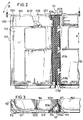
- the locking mechanism is further explained on the basis of the locking mechanism V1 shown in detail in FIGS. 2 to 4.
- the lock V2 on the opposite side is designed accordingly.
- recesses 1172 are provided in the wall of the shaft 117 forming a component of the corresponding box section 11, which, in the case of assembled box sections 11 and 11 ', start from those emanating from the box section 11' Hook 118 'can be reached.
- a slide 119 which can be displaced in the shaft 117 in the direction of the double arrow A in FIG. 2, has recesses 1191 (in particular FIG. 4) at corresponding intervals, into which the hooks 118 'penetrating the shaft wall when the box sections 11, 11' are joined together.
- the recesses 1191 in the slide 119 merge into a sack-like recess 1192 (in particular FIG. 4) into which the claw 1181 of the hook 118 ′ is inserted when the slide is raised (FIG. 2), as a result of which the box sections 11, 11 ′ are locked together becomes.
- the slider 119 is lifted and held in the locking position (FIG. 2) by the bracket 121 assigned to the section 11.
- the bracket 121 pivoted on the box section 11 at 1111 and 1131 in the sense of the double arrow B in FIG the articulation 1131 of the projecting leg 1211 has a recess 1173 (in particular FIG. 4) in the wall of the shaft 117 facing it, engages under a recess 1193 (in particular FIG. 4) in the slide 119 and transfers the slide 119 into the locking position when pivoting against the box section 11 ( Figure 2) in which he then holds it.
- bracket 121 For unlocking, the bracket 121 is raised (FIG. 4) and the slide 119 which runs smoothly in the shaft 117 slides down, thereby releasing the hooks 118 'forming part of the other box section 11', so that the box sections 11 and 11 'can be separated.
- the bracket 121 forming part of the box section 11 is then also available for transporting the box section 11, as is the component of the box section 11 'forming bracket 121' which unlocks the locking V2.
- the slide 119 which has an essentially pentagonal cross section, is provided with two longitudinal grooves 1194, 1194 ', into which guide strips 1174, 1174' projecting into the shaft 117 engage (FIG. 3).
- a lock 1176, 1196 prevents the slide 119 inserted into the shaft 117 from the bottom from slipping out of the shaft 117 (in particular FIG. 2).
- brackets 121, 121 'pivoted against the box sections 11, 11' fit flush in the corresponding recesses on the circumference of the box sections 11, 11 ', for example 122.
- Recesses 123, 123' on the bottom 114, 114 'of the box sections 11, 11' in conjunction with recesses 124, known per se, on the circumference of the box ensure the stable stackability of the box.
- the brackets 121, 121 ' with stud bolts molded onto them, for example 1212 in FIGS. 2 and 3, are pushed into elongated holes provided for this purpose, for example 1131 in FIG. 2. Stops, for example 1132 in FIG. 4, on the box sections 11, 11 'limit the pivoting range of the brackets 121, 121' in such a way that they can be pivoted at most into the vertical position shown in FIG. 4.
- brackets 121, 121' are fixed by cams 1213 which snap into corresponding recesses 1121 in the box wall 112 and are molded onto the brackets 121, 121 '.
Landscapes
- Engineering & Computer Science (AREA)
- Mechanical Engineering (AREA)
- Rigid Containers With Two Or More Constituent Elements (AREA)
- Stackable Containers (AREA)
- Details Of Rigid Or Semi-Rigid Containers (AREA)
Description
- Die Erfindung betrifft einen mehrteiligen, insbesondere zweiteiligen Kunststoff-Flaschenkasten mit einer parallel zu einer Außenwand verlaufenden Teilung, die Teilstücke begrenzenden, aneinander liegenden Hilfswänden und formschlüssig ineinandergreifenden Verriegelungselementen in Gestalt einer Mehrzahl von im Bereich je einer senkrechten Kante jeder Hilfswand über die Teilstücke vorspringenden Haken und im Bereich der anderen Senkrechten Kante befindlichen, in einen Verriegelungsschacht mündenden, dem Hakenquerschnitt entsprechenden Aussparungen, wobei im Schacht ein Verriegelungsschieber mit in Verriegelungsstellung die in den Schacht hineinragenden Haken des korrespondierenden Teilstückes hintergreifenden Flächenteilen angeordnet ist, und wobei jedes Teilstück an den an seine Hilfswand angrenzenden Wänden einen angelenkten, gegen die Teilstücke verschwenkbare Tragbügel aufweist, der mit den freien Enden seiner Schenkel über die Anlenkungen vorspringt.
- Die Teilbarkeit von handelsüblichen, zum Beispiel 20 1/2-Liter Bierflaschen aufnehmenden Flaschenkästen ist erwünscht, um dem Endabnehmer die Handhabung, insbesondere den Abtransport von der Verkaufsstelle zu erleichtern. Dabei soll die Teilung die Handhabbarkeit solcher Kästen durch den Befüller, zum Beispiel die Brauerei, und durch den Händler nicht beeinträchtigen.
- In zurückliegender Zeit gemachte Vorschläge zur Teilung von Flaschenkästen (z. B. US-A-2 311 723, US-A-2 610 760) sind insbesondere deshalb nicht aufgegriffen worden, weil dabei das Zusammenfassen und Trennen der Kastenteilstücke durch einen speziellen Ver- bzw. Entriegelungsvorgang bewirkt wird. Aus dem selben Grund sind auch aus jüngerer Zeit stammende Vorschläge (DE-U-7 518 030, DE-U-7 923 328) nicht realisiert worden.
- Ausgehend von dem Flaschenkasten nach dem DE-U-7 923, 328, der die im Oberbegriff des Anspruchs 1 umrissenen Merkmale aufweist, liegt der Erfindung die Aufgabe zugrunde, einen solchen Flaschenkasten und insbesondere die Verriegelung eines solchen Flaschenkastens so auszugestalten, daß das Trennen und Zusammenfügen der Kastenteilstücke sich leichter bewirken läßt.
- Die Aufgabe wird erfindungsgemäß mit einem teilbaren Flaschenkasten der eingangs umrissenen Art gelöst, der dadurch gekennzeichnet ist, daß die am freien Ende eines Schenkels mit einem Ansatz versehenen Tragbügel bei gegen den Kasten verschwenkten Bügeln mit diesem Ansatz eine Aussparung in der Wandung des korrespondierenden Verriegelungsschachtes durchgreifend und in einer Ausnehmung im Verriegelungsschieber eingreifend diesen in Verriegelungsstellung halten.
- Hierbei wird die Entriegelung durch Anheben der jedem der Kastenteilstücke zugeordneten Bügel bewirkt, die dann auch zum handlichen Transport der Kastenteilstücke zur Verfügung stehen. Auch das Zusammenfügen von zwei Kastenteilstücken zu einem Kasten ist bei angehobenen Bügeln ohne weiteres möglich, die dann durch Umlegen der Bügel miteinander verriegelt werden.
- Zweckmäßigerweise ist vorgesehen, daß die Bügel sich im umgelegten Zustand in einen Rücksprung der Kastenteilstücke einfügen. Diese Ausgestaltung stellt in Verbindung damit, daß die Kastenteilstücke im Bodenbereich entlang des Stoßes mit einem am zusammengefügten Kasten einen durchgehenden Schlitz ergebenden, den Verriegelungsschacht einbeziehenden Rücksprung versehen wird, die einwandfreie Stapelbarkeit solcher Kästen sichern.
- Eingefügt wird der Schieber in den über Kopf geschlossenen Schacht von der Offenen Bodenseite her, wobei eine vom Schacht ausgehend, den Schieber hinterfangende auffedernde Sperre sicherstellt, daß der Schieber nicht aus dem Schacht herausrutscht.
- In Ausgestaltung ist der Schieber profiliert und weist Längsnuten auf, in die von dem dementsprechend ausgebildeten Schacht ausgehend Führungsleisten eingreifen.
- Vorgesehen sein kann, daß der den Schieber aufnehmende Schacht begrenzt über die Hilfswand vorspringt und der mit den Verriegelungshaken bestückte Bereich dementsprechend zurückgesetzt ist, um im Schachtbereich den Nutzraum des Kastenteilstückes nicht zu stark zu reduzieren. Dazu trägt bei, wenn der profilierte Schieber und damit dann auch der den Schieber aufnehmende Schacht etwa einen trapezförmigen Querschnitt erhält, wobei der kurze Schenkel des Trapezes etwa der Stärke der Kastenwand entspricht, an die er angrenzt.
- Der Bügel ist vorzugsweise mit an ihn angeformten Stehbolzen versehen, die in in den entsprechenden Wandteilen des Kastenteilstückes vorgesehene Langlöcher einsprengbar sind. Eine Begrenzung des Bügelschwenkbereiches durch einen Anschlag am Kastenteilstück kann vorgesehen sein.
- Vorgesehen sein kann des weiteren, daß der Bügel in Verriegelungsstellung, also im gegen das Kastenteilstück verschwenkten Zustand, an dem Kastenteilstück in einer eine selbsttätige Entriegelung ausschließenden Weise fixiert ist, etwa durch Einrasten eines an der Innenseite des Bügels befindlichen Nockens in eine dementsprechende Ausnehmung in der Wandung des Kastenteilstückes.
- In der Zeichnung ist die Erfindung an Hand eines Ausführungsbeispieles weitergehend erläutert. Es zeigen :
- Figur 1 den neuen Flaschenkasten in schaubildlicher Darstellung,
- Figur 2 die abgebrochene Ansicht des Kastens in Richtung des Pfeiles II in Figur 1, den Verriegelungsbereich aufgebrochen,
- Figur3 einen Schnitt nach Linie 111-111 in Figur 2,
- Figur4 eine der Figur 2 entsprechende Darstellung im entriegelten Zustand des Kastens.
- Der Kasten besteht aus den Teilstücken 11 und 11' mit den Außenwänden 111, 112, 113 bzw. 111', 112', 113', dem Boden 114 bzw. 114' sowie den Hilfswänden 116 bzw. 116', die bei zum Kasten zusammengefügten Kastenteilstücken 11, 11' gegeneinander anliegen (Figur 1).
- Die Wand- und gegebenenfalls auch die Bodenelemente 111, 111' bis 116, 116' sind in an sich bekannter Weise mit Aussparungen bzw. Durchbrüchen versehen. Außerdem sind die Kastenteilstücke 11, 11' in an sich bekannter Weise in eine Mehrzahl von jeweils eine Flasche oder dergleichen aufnehmenden Fächern unterteilt.
- Jedes Kastenteilstück 11, 11' ist am Übergang der Hilfswände 116 bzw. 116' in eine Außenwand 113 bzw. 113' mit einem sich über die Höhe des Kastens erstreckenden, oben geschlossenen (1171) Schacht 117 bzw. 117' versehen und am Übergang der Hilfswände 116, 116' in die andere Außenwa"d 111 bzw. 111' mit einer Mehrzahl von im Abstand voneinander über die Hilfswände 116, 116' vorspringenden Haken mit nach unten gerichteten Klauen 1181, von denen in der Zeichnung (Figuren 2 bis 4) die vom Kastenteilstück 113' ausgehenden Haken 118' erkennbar sind.
- Weitergehend erläutert ist der Verriegelungsmechanismus anhand der in den Figuren 2 bis 4 detailliert dargestellten Verriegelung V1. Die auf der gegenüberliegenden Seite liegende Verriegelung V2 ist entsprechend ausgebildet.
- In Höhe der Bestandteile des Kastenteilstückes 11' bildenden Haken 118' sind in der Wandung des einen Bestandteil des korrespondierenden Kastenteilstückes 11 bildenden Schachtes 117 Aussparungen 1172 (insbesondere Figur 4) vorgesehen, die bei zusammengefügten Kastenteilstücken 11 und 11' von den vom Kastenteilstück 11' ausgehenden Haken 118' durchgriffen werden. Ein im Schacht 117 in Richtung des Doppelpfeiles A in Figur 2 verlagerbarer Schieber 119 weist in den Hakenabständen entsprechenden Abständen Aussparungen 1191 (insbesondere Figur 4) auf, in die sich die bei zusammengefügten Kastenteilstücken 11, 11' die Schachtwandung durchdringenden Haken 118' einfügen. Die Aussparungen 1191 im Schieber 119 gehen bodenseitig in eine sackartige Vertiefung 1192 (insbesondere Figur 4) über, in die sich bei angehobenem Schieber (Figur 2) die Klaue 1181 der Haken 118' einfügt, wodurch die Verriegelung der Kastenteilstücke 11, 11' miteinander bewirkt wird.
- Das Anheben und Halten des Schiebers 119 in Verriegelungsposition (Figur 2) erfolgt durch den dem Teilstück 11 zugeordneten Bügel 121. Der bei 1111 und 1131 im Sinne des Doppelpfeiles B in Figur 2 schwenkbar am Kastenteilstück 11 gelagerte Bügel 121 durchgreift mit dem Ansatz 1214 des über die Anlenkung 1131 vorspringenden Schenkels 1211 eine Aussparung 1173 (insbesondere Figur 4) in der ihm zugekehrten Wandung des Schachtes 117, untergreift eine Aussparung 1193 (insbesondere Figur 4) im Schieber 119 und überführt den Schieber 119 beim Verschwenken gegen das Kastenteilstück 11 in die Verriegelungsstellung (Figur 2) in der er ihn dann auch hält.
- Zur Entriegelung wird der Bügel 121 angehoben (Figur 4) und der in dem Schacht 117 leichtgängige Schieber 119 rutscht nach unten wodurch die Bestandteil des anderen Kastenteilstückes 11' bildenden Haken 118' freigegeben werden, sodaß die Kastenteilstücke 11 und 11' getrennt werden können. Der Bestandteil des Kastenteilstückes 11 bildende Bügel 121 steht dann darüber hinaus zum Transport des Kastenteilstückes 11 zur Verfügung, ebenso der Bestandteil des Kastenteilstückes 11' bildende, die Entriegelung der Verriegelung V2 bewirkende Bügel 121'.
- Der einen im wesentlichen fünfeckigen Querschnitt aufweisende Schieber 119 ist mit zwei Längsnuten 1194, 1194' versehen, in die in den Schacht 117 vorspringende Führungsleisten 1174, 1174' eingreifen (Figur 3). Bodenseitig verhindert eine Sperre 1176, 1196 das Herausrutschen des vom Boden her in den Schacht 117 eingefügten Schiebers 119 aus dem Schacht 117 (insbesondere Figur 2).
- Die gegen die Kastenteilstücke 11, 11' verschwenkten Bügel 121, 121' fügen sich bündig in dementsprechende Rücksprünge am Umfang der Kastenteilstücke 11, 11', zum Beispiel 122. Rücksprünge 123, 123' am Boden 114, 114' der Kastenteilstücke 11, 11' in Verbindung mit an sich bekannten Rücksprüngen 124 am Kastenumfang stellen die standfeste Stapelbarkeit des Kastens sicher.
- Die Bügel 121, 121' sind mit an sie angeformten Stehbolzen, zum Beispiel 1212 in Figur 2 und 3, in dafür vorgesehene Langlöcher, zum Beispiel 1131 in Figur 2, eingesprengt. Anschläge, zum Beispiel 1132 in Figur 4, an den Kastenteilstücken 11, 11' begrenzen den Schwenkbereich der Bügel 121, 121' in der Weise, daß sie maximal in die in Figur 4 dargestellte senkrechte Position verschwenkt werden können.
- In gegen die Kastenteilstücke 11, 11' verschwenkter horizontaler Lage (Figuren 1 bis 3) sind die Bügel 121, 121' durch in entsprechende Ausnehmungen 1121 in der Kastenwandung 112 einrastende, an die Bügel 121, 121' angeformte Nocken 1213 fixiert.
Claims (8)
Priority Applications (1)
| Application Number | Priority Date | Filing Date | Title |
|---|---|---|---|
| AT81107210T ATE8233T1 (de) | 1980-09-13 | 1981-09-12 | Teilbarer flaschenkasten. |
Applications Claiming Priority (2)
| Application Number | Priority Date | Filing Date | Title |
|---|---|---|---|
| DE3034650 | 1980-09-13 | ||
| DE3034650A DE3034650C2 (de) | 1980-09-13 | 1980-09-13 | Teilbarer Flaschenkasten |
Publications (2)
| Publication Number | Publication Date |
|---|---|
| EP0048006A1 EP0048006A1 (de) | 1982-03-24 |
| EP0048006B1 true EP0048006B1 (de) | 1984-07-04 |
Family
ID=6111905
Family Applications (1)
| Application Number | Title | Priority Date | Filing Date |
|---|---|---|---|
| EP81107210A Expired EP0048006B1 (de) | 1980-09-13 | 1981-09-12 | Teilbarer Flaschenkasten |
Country Status (4)
| Country | Link |
|---|---|
| US (1) | US4387824A (de) |
| EP (1) | EP0048006B1 (de) |
| AT (1) | ATE8233T1 (de) |
| DE (1) | DE3034650C2 (de) |
Families Citing this family (34)
| Publication number | Priority date | Publication date | Assignee | Title |
|---|---|---|---|---|
| JPS60184816U (ja) * | 1984-05-17 | 1985-12-07 | 麒麟麦酒株式会社 | 連結可能な合成樹脂製壜箱 |
| JPS6114621U (ja) * | 1984-06-28 | 1986-01-28 | 麒麟麦酒株式会社 | 連結可能な合成樹脂製壜箱 |
| JPS6114620U (ja) * | 1984-06-28 | 1986-01-28 | 麒麟麦酒株式会社 | 連結可能な合成樹脂製壜箱 |
| JPS6114616U (ja) * | 1984-06-28 | 1986-01-28 | 麒麟麦酒株式会社 | 連結可能な合成樹脂製壜箱 |
| JPS6114645U (ja) * | 1984-06-28 | 1986-01-28 | 麒麟麦酒株式会社 | 連結可能な合成樹脂製壜箱 |
| JPS6114619U (ja) * | 1984-06-28 | 1986-01-28 | 麒麟麦酒株式会社 | 連結可能な合成樹脂製壜箱 |
| JPS6114623U (ja) * | 1984-06-28 | 1986-01-28 | 麒麟麦酒株式会社 | 連結可能な合成樹脂製壜箱 |
| JPS6114622U (ja) * | 1984-06-28 | 1986-01-28 | 麒麟麦酒株式会社 | 連結可能な合成樹脂製壜箱 |
| JPS6111350A (ja) * | 1984-06-28 | 1986-01-18 | 麒麟麦酒株式会社 | 連結可能な合成樹脂製壜箱 |
| JPH0228180Y2 (de) * | 1985-02-19 | 1990-07-30 | ||
| JPH0228179Y2 (de) * | 1985-02-19 | 1990-07-30 | ||
| JPH0231381Y2 (de) * | 1985-04-05 | 1990-08-24 | ||
| DE3533114A1 (de) * | 1985-09-17 | 1987-03-26 | Berolina Kunststoff | Teilbarer flaschenkasten |
| US4793492A (en) * | 1986-11-14 | 1988-12-27 | Frank Halbich | Homecare pillbox |
| US4785604A (en) * | 1987-03-17 | 1988-11-22 | Johnson Jr Robert H | Collapsible gridworks for forming structures by confining fluent materials |
| US4945689A (en) * | 1987-03-17 | 1990-08-07 | Johnson Jr Robert H | Collapsible gridwork for forming structures by confining fluent materials |
| DE3912321A1 (de) * | 1989-04-14 | 1990-10-25 | Split Box Patentverwertung | Teilbarer kunststoff-flaschenkasten |
| DE3909352A1 (de) * | 1989-03-22 | 1990-09-27 | Wilhelm Goetz | Zweiteiliger kasten aus kunststoff od. dgl. |
| DE59002245D1 (de) * | 1989-03-30 | 1993-09-16 | Schoeller Plast Ag | Teilbarer behaelter, insbesondere flaschenkasten. |
| DE3910735A1 (de) * | 1989-04-03 | 1990-10-04 | Berolina Kunststoff | Teilbarer flaschenkasten |
| FR2674505A1 (fr) * | 1991-03-29 | 1992-10-02 | Allibert Sa | Casier en matiere plastique moulee a anses repliables. |
| US5267873A (en) * | 1991-11-12 | 1993-12-07 | Unisys Corporation | Inter-box coupling |
| US5273175A (en) * | 1993-01-28 | 1993-12-28 | Rehrig Pacific Company, Inc. | Split box case construction |
| US5344021A (en) * | 1993-09-21 | 1994-09-06 | Formall, Inc. | Molded crate with interlocking rim appliances |
| USD384230S (en) * | 1996-03-18 | 1997-09-30 | Hollanding Inc. | Top for a mobile storage unit |
| AU2002240570B2 (en) | 2001-02-28 | 2008-07-31 | Al M. Arellanes | Fluent material confinement system |
| US7591611B2 (en) | 2001-02-28 | 2009-09-22 | Geocell Systems, Inc. | Fluent material confinement system |
| ITMI20030163U1 (it) * | 2003-04-07 | 2004-10-08 | Whirlpool Co | Cassetto mobile ed asportabile per frigorifero con maniglia di presa |
| US9475602B2 (en) * | 2008-10-06 | 2016-10-25 | Rehrig Pacific Company | Stackable low depth tray |
| HUE032226T2 (en) | 2013-04-18 | 2017-09-28 | Ds Smith Plastics Karlovac D O O | Can be divided into a bottle holder |
| MX2015016756A (es) | 2014-12-04 | 2016-06-03 | Rehrig Pacific Co | Caja para bebidas. |
| CA2917506A1 (en) | 2015-01-14 | 2016-07-14 | Rehrig Pacific Company | Beverage crate with handle |
| CN107380732B (zh) * | 2017-08-28 | 2018-12-11 | 重庆洁邦电器有限公司 | 便于多种类储存的真空储粮装置 |
| USD831962S1 (en) | 2017-12-22 | 2018-10-30 | Rehrig Pacific Company | Beverage crate |
Family Cites Families (10)
| Publication number | Priority date | Publication date | Assignee | Title |
|---|---|---|---|---|
| US2732969A (en) * | 1956-01-31 | browne | ||
| US2311723A (en) * | 1941-08-23 | 1943-02-23 | Tillman R Anderson | Sectional case |
| US2610760A (en) * | 1948-08-30 | 1952-09-16 | Dexter D Ball | Sectional container |
| DE1171328B (de) * | 1962-01-10 | 1964-05-27 | Gunnar Lundstedt | Kiste |
| US3297196A (en) * | 1965-05-06 | 1967-01-10 | Cornelius Co | Bottle carrier |
| US3317081A (en) * | 1965-06-14 | 1967-05-02 | Cornelius Co | Bottle carrier |
| US3603475A (en) * | 1969-06-16 | 1971-09-07 | Gerald Erickson | Interlocking means for divisible container carrier |
| DE7518030U1 (de) * | 1975-06-06 | 1976-03-18 | Schoeller & Co Kg | Kunststoff-Flaschenkasten mit Verriegelungsvorrichtung |
| DE2525169C3 (de) * | 1975-06-06 | 1978-09-07 | Schoeller Gmbh & Co Kg, 3400 Goettingen | Kunststoff-Flaschenkasten mit Verriegelungsvorrichtung |
| DE7923328U1 (de) * | 1979-08-16 | 1979-11-29 | Wefers Werner | Flaschenkasten |
-
1980
- 1980-09-13 DE DE3034650A patent/DE3034650C2/de not_active Expired
-
1981
- 1981-09-12 EP EP81107210A patent/EP0048006B1/de not_active Expired
- 1981-09-12 AT AT81107210T patent/ATE8233T1/de not_active IP Right Cessation
- 1981-10-07 US US06/309,176 patent/US4387824A/en not_active Expired - Lifetime
Also Published As
| Publication number | Publication date |
|---|---|
| ATE8233T1 (de) | 1984-07-15 |
| DE3034650A1 (de) | 1982-04-22 |
| DE3034650C2 (de) | 1983-04-07 |
| US4387824A (en) | 1983-06-14 |
| EP0048006A1 (de) | 1982-03-24 |
Similar Documents
| Publication | Publication Date | Title |
|---|---|---|
| EP0048006B1 (de) | Teilbarer Flaschenkasten | |
| DE69321973T2 (de) | Transportbehälter mit selbstschliessendem oberrand | |
| DE60014368T2 (de) | Stapelbares Behältersystem | |
| DE9218977U9 (de) | Behälter aus Kunststoff, insbesondere Gemüsebehälter, mit klappbaren Seitenwänden | |
| DE9321234U1 (de) | Behälter aus Kunststoff, insbesondere Gemüsebehälter mit klappbaren Seitenwänden | |
| EP0253363B1 (de) | Stapelbarer Flaschenkasten | |
| CH422633A (de) | Satz von Lager- und Transportbehältern | |
| DE102010037517B3 (de) | Lager- und Transportbehälter | |
| WO1998034838A2 (de) | Behälter insbesondere für den transport von obst und gemüse | |
| DE3044471A1 (de) | Bauteile aus kunststoff zur herstellung einer schublade | |
| EP0429015B1 (de) | Unterteilbarer Lagerbehälter für Kleinteile o.dgl. | |
| DE2729737A1 (de) | Dicht verschliessbarer, unterteilbarer behaelter | |
| EP0860366A1 (de) | Faltbarer Grosscontainer | |
| DE19948124B4 (de) | Zerlegbare Stapelkiste | |
| EP0091718B1 (de) | Zusammenklappbare Transportkiste | |
| DE102004006416A1 (de) | Mehrwegbehälter zum Transportieren von Stückgut | |
| DE3633348A1 (de) | Zusammenlegbarer transportbehaelter fuer stueckgueter | |
| DE102004006415B4 (de) | Behälter | |
| DE9415663U1 (de) | Sockel für Warenträger | |
| DE2902689C2 (de) | Behälter für den Transport gefährlicher Flüssigkeiten | |
| DE2200945A1 (de) | Stapel- und verschachtelbarer Behaelter | |
| DE4126749A1 (de) | Behaelter aus kunststoff zur aufnahme von gegenstaenden | |
| DE4333626C2 (de) | Transportkasten aus Kunststoff | |
| DE1536038C (de) | Stapelbare Gemusesteige aus Kunst stoff | |
| DE2954497C2 (de) | Stapelbarer Transport- und Lagersichtkasten aus Kunststoff |
Legal Events
| Date | Code | Title | Description |
|---|---|---|---|
| PUAI | Public reference made under article 153(3) epc to a published international application that has entered the european phase |
Free format text: ORIGINAL CODE: 0009012 |
|
| AK | Designated contracting states |
Designated state(s): AT BE CH FR GB IT LU NL SE |
|
| 17P | Request for examination filed |
Effective date: 19820212 |
|
| ITF | It: translation for a ep patent filed | ||
| GRAA | (expected) grant |
Free format text: ORIGINAL CODE: 0009210 |
|
| AK | Designated contracting states |
Designated state(s): AT BE CH FR GB IT LI LU NL SE |
|
| REF | Corresponds to: |
Ref document number: 8233 Country of ref document: AT Date of ref document: 19840715 Kind code of ref document: T |
|
| ET | Fr: translation filed | ||
| BECH | Be: change of holder |
Free format text: 840704 *SPLIT-BOX PATENTVERWERTUNG K.G. |
|
| PLBE | No opposition filed within time limit |
Free format text: ORIGINAL CODE: 0009261 |
|
| STAA | Information on the status of an ep patent application or granted ep patent |
Free format text: STATUS: NO OPPOSITION FILED WITHIN TIME LIMIT |
|
| 26N | No opposition filed | ||
| ITPR | It: changes in ownership of a european patent |
Owner name: CESSIONE;SPLIT - BOX PATENTVERWERTUNG KG |
|
| REG | Reference to a national code |
Ref country code: CH Ref legal event code: PUE Owner name: SPLIT-BOX PATENTVERWERTUNG KG |
|
| REG | Reference to a national code |
Ref country code: FR Ref legal event code: TP |
|
| NLS | Nl: assignments of ep-patents |
Owner name: SPLIT-BOX PATENTVERWERTUNG KG TE DORTMUND, BONDSRE |
|
| REG | Reference to a national code |
Ref country code: GB Ref legal event code: 732 |
|
| ITTA | It: last paid annual fee | ||
| EPTA | Lu: last paid annual fee | ||
| EAL | Se: european patent in force in sweden |
Ref document number: 81107210.7 |
|
| PGFP | Annual fee paid to national office [announced via postgrant information from national office to epo] |
Ref country code: SE Payment date: 19990914 Year of fee payment: 19 |
|
| PGFP | Annual fee paid to national office [announced via postgrant information from national office to epo] |
Ref country code: AT Payment date: 19990928 Year of fee payment: 19 |
|
| PGFP | Annual fee paid to national office [announced via postgrant information from national office to epo] |
Ref country code: NL Payment date: 19990930 Year of fee payment: 19 Ref country code: FR Payment date: 19990930 Year of fee payment: 19 |
|
| PGFP | Annual fee paid to national office [announced via postgrant information from national office to epo] |
Ref country code: GB Payment date: 19991007 Year of fee payment: 19 |
|
| PGFP | Annual fee paid to national office [announced via postgrant information from national office to epo] |
Ref country code: BE Payment date: 19991119 Year of fee payment: 19 |
|
| PGFP | Annual fee paid to national office [announced via postgrant information from national office to epo] |
Ref country code: CH Payment date: 19991129 Year of fee payment: 19 |
|
| PGFP | Annual fee paid to national office [announced via postgrant information from national office to epo] |
Ref country code: LU Payment date: 19991208 Year of fee payment: 19 |
|
| PG25 | Lapsed in a contracting state [announced via postgrant information from national office to epo] |
Ref country code: LU Free format text: LAPSE BECAUSE OF EXPIRATION OF PROTECTION Effective date: 20000912 Ref country code: GB Free format text: LAPSE BECAUSE OF NON-PAYMENT OF DUE FEES Effective date: 20000912 Ref country code: AT Free format text: LAPSE BECAUSE OF NON-PAYMENT OF DUE FEES Effective date: 20000912 |
|
| PG25 | Lapsed in a contracting state [announced via postgrant information from national office to epo] |
Ref country code: SE Free format text: THE PATENT HAS BEEN ANNULLED BY A DECISION OF A NATIONAL AUTHORITY Effective date: 20000929 |
|
| PG25 | Lapsed in a contracting state [announced via postgrant information from national office to epo] |
Ref country code: LI Free format text: LAPSE BECAUSE OF NON-PAYMENT OF DUE FEES Effective date: 20000930 Ref country code: CH Free format text: LAPSE BECAUSE OF NON-PAYMENT OF DUE FEES Effective date: 20000930 Ref country code: BE Free format text: LAPSE BECAUSE OF NON-PAYMENT OF DUE FEES Effective date: 20000930 |
|
| BERE | Be: lapsed |
Owner name: SPLIT-BOX PATENTVERWERTUNG K.G. Effective date: 20000930 |
|
| PG25 | Lapsed in a contracting state [announced via postgrant information from national office to epo] |
Ref country code: NL Free format text: LAPSE BECAUSE OF NON-PAYMENT OF DUE FEES Effective date: 20010401 |
|
| GBPC | Gb: european patent ceased through non-payment of renewal fee |
Effective date: 20000912 |
|
| REG | Reference to a national code |
Ref country code: CH Ref legal event code: PL |
|
| EUG | Se: european patent has lapsed |
Ref document number: 81107210.7 |
|
| PG25 | Lapsed in a contracting state [announced via postgrant information from national office to epo] |
Ref country code: FR Free format text: LAPSE BECAUSE OF NON-PAYMENT OF DUE FEES Effective date: 20010531 |
|
| NLV4 | Nl: lapsed or anulled due to non-payment of the annual fee |
Effective date: 20010401 |
|
| REG | Reference to a national code |
Ref country code: FR Ref legal event code: ST |