EP0048286A1 - Verfahren zur Herstellung homogener Harz-Polyjodid-Desinfektionsmittel - Google Patents
Verfahren zur Herstellung homogener Harz-Polyjodid-Desinfektionsmittel Download PDFInfo
- Publication number
- EP0048286A1 EP0048286A1 EP80105605A EP80105605A EP0048286A1 EP 0048286 A1 EP0048286 A1 EP 0048286A1 EP 80105605 A EP80105605 A EP 80105605A EP 80105605 A EP80105605 A EP 80105605A EP 0048286 A1 EP0048286 A1 EP 0048286A1
- Authority
- EP
- European Patent Office
- Prior art keywords
- resin
- iodine
- water
- reactor
- iodide
- Prior art date
- Legal status (The legal status is an assumption and is not a legal conclusion. Google has not performed a legal analysis and makes no representation as to the accuracy of the status listed.)
- Granted
Links
Images

Classifications
-
- A—HUMAN NECESSITIES
- A61—MEDICAL OR VETERINARY SCIENCE; HYGIENE
- A61L—METHODS OR APPARATUS FOR STERILISING MATERIALS OR OBJECTS IN GENERAL; DISINFECTION, STERILISATION OR DEODORISATION OF AIR; CHEMICAL ASPECTS OF BANDAGES, DRESSINGS, ABSORBENT PADS OR SURGICAL ARTICLES; MATERIALS FOR BANDAGES, DRESSINGS, ABSORBENT PADS OR SURGICAL ARTICLES
- A61L2/00—Disinfection or sterilisation of materials or objects, in general; Accessories therefor
- A61L2/16—Disinfection or sterilisation of materials or objects, in general; Accessories therefor using chemical substances
-
- A—HUMAN NECESSITIES
- A01—AGRICULTURE; FORESTRY; ANIMAL HUSBANDRY; HUNTING; TRAPPING; FISHING
- A01N—PRESERVATION OF BODIES OF HUMANS OR ANIMALS OR PLANTS OR PARTS THEREOF; BIOCIDES, e.g. AS DISINFECTANTS, AS PESTICIDES OR AS HERBICIDES; PEST REPELLANTS OR ATTRACTANTS; PLANT GROWTH REGULATORS
- A01N59/00—Biocides, pest repellants or attractants, or plant growth regulators containing elements or inorganic compounds
- A01N59/12—Iodine, e.g. iodophors; Compounds thereof
-
- B—PERFORMING OPERATIONS; TRANSPORTING
- B01—PHYSICAL OR CHEMICAL PROCESSES OR APPARATUS IN GENERAL
- B01J—CHEMICAL OR PHYSICAL PROCESSES, e.g. CATALYSIS OR COLLOID CHEMISTRY; THEIR RELEVANT APPARATUS
- B01J47/00—Ion-exchange processes in general; Apparatus therefor
- B01J47/016—Modification or after-treatment of ion-exchangers
-
- C—CHEMISTRY; METALLURGY
- C02—TREATMENT OF WATER, WASTE WATER, SEWAGE, OR SLUDGE
- C02F—TREATMENT OF WATER, WASTE WATER, SEWAGE, OR SLUDGE
- C02F1/00—Treatment of water, waste water, or sewage
- C02F1/72—Treatment of water, waste water, or sewage by oxidation
- C02F1/76—Treatment of water, waste water, or sewage by oxidation with halogens or compounds of halogens
- C02F1/766—Treatment of water, waste water, or sewage by oxidation with halogens or compounds of halogens by means of halogens other than chlorine or of halogenated compounds containing halogen other than chlorine
Definitions
- This invention relates to the preparation of demand-type broad-spectrum resin-polyiodide water disinfectants.
- Triiodide-quaternary ammonium resin disinfectants have heretofore received primary consideration, since when properly prepared, the iodine is tenaciously bound to the active sites of the resin and is released almost entirely on a demand-action basis. See Lambert and Fina U.S. patents 3,817,860 and 3,923,665. Also, see Fina, L.R. and Lambert, J.L. (1975), "A Broad-Spectrum Water Disinfectant that Releases Germicide on Demand", Second World Congress, International Water Resources Association, New Delhi, India, December 1975, Volume II, pp. 53-59.
- the process of the present invention can be used for preparing not only a triiodide resin disinfectant, but also disinfectants in which part or all of the active sites are in the form of higher polyiodides, such as penta-iodide I 5 ) .
- the amount of iodine applied will be the exact stoichiometric amount to produce the I 3 - , I 5 , I 7 , or predetermined mixtures, such as a 50-50 mixture of triiodide and penta-iodide.
- the resin is first converted to the iodide form, and is thereafter contacted with a recycling stream of water which acts as a carrier for the iodine to be applied to the resin.
- the recycling stream also contacts a pre-measured amount of elemental iodine, which is gradually dissolved in the water. The contacting of the water solution of the iodine is preferably continued until all of the iodine has been absorbed from the water by the resin beads.
- the resin beads may be contacted with the water carrier in a thin bed.
- a fluidized bed will be desirable.
- the bed of resin beads being treated will be arranged and the flow rate of the water passing through the bed will be controlled to produce a fluidization of the bed in which the beads circulate freely within the bed, thereby further enhancing the uniformity of the contacting.
- the process of this invention in its broad form can also be carried out with a static resin bed.
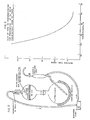
- FIG. 1 illustrates commercial scale apparatus for practicing the method of this invention, including the using of a fluidized bed
- FIG. 2 illustrates laboratory scale apparatus
- FIG. 3 is a graph representing the change in reaction time with temperature.
- the present invention can be practiced with any strong base anion exchange resin, but quaternary ammonium anion exchangers are preferred, the term “strong base anion exchange resin” designates a class of resins either containing strongly basic (cationic) groups, such as quaternary ammonium groups, or which have strongly basic properties substantially equivalent to quaternary ammonium anion exchange resins.
- strongly basic (cationic) groups such as quaternary ammonium groups
- strong base resins contrasts with the "weak base” resins where the basic groups are amine nitrogen rather than quaternary ammonium groups.
- commercial quaternary ammonium resins may be remetbylated to assure that the active sites are in quaternary form.
- Some commercially available quaternary ammonium resins contain a small portion of tertiary amine sites. These can be eliminated by treatment of the commercial resin with methyliodide or dimethyl sulfate in ethyl alcohol solution. The resin can be allowed to react with the solution overnight, and the remaining solution drained off, and the resin washed with a sequence of ethanol and ion-free water. (see Example VIII of U.S.
- the strong base anion exchange resin is first converted to the iodide (I - ) form.
- the resin was already in the iodide form, such conversion would not need to be performed by the manufacturer of the disinfectant.
- most quaternary ammonium resins are supplied either as the chloride or sulfate.
- the resin is treated with a solution of potassium or other soluble iodide salt.
- the solution should be free of other anions which would compete with the iodide ion for replacement of the chloride or sulfate in the resin.
- the amount of iodide required is calculated on a weight or volume basis from data supplied by the resin manufacturer; an excess of the iodide salt between 1.2 and 2.0 times the equivalent exchange capacity of the resin can be used to insure complete conversion to the iodide form.
- the converted resin is thoroughly washed in a column with ion-free water to a negative test with silver nitrate (essentially little trubidity of silver iodide).
- the equivalent exchange capacity of the resin should be known.
- the exchange capacity of the resin is supplied by the manufacturer. However, if necessary, it can be readily determined, for example, by the procedure described in U.S. patent 3,817,860 (col. 9, lines 15-28).
- the amount of iodine to be applied to the resin is then determined. For example, if the iodide is to be converted to triodide, one equivalent of I 2 will be required for each equivalent of the resin, or two equivalents of I 2 for each equivalent of the resin for the penta-iodide. For example, with 50 millieouivalents (meq) of Dowex-X8 resin (Dow Chemical Company, Midland, Michigan), 50 meq of I 2 would be required to prepare the stoichiometric triiodide.
- Water is used as the carrier to apply the iodine gradually and uniformly to the resin. More specifically, the water is circulated in a recycling stream which is arranged to contact the iodine and the resin beads in sequence. The circulating water gradually dissolves the iodine and carries it as I 2 in solution to the resin beads.
- the water should be free of halide ions, and is preferably free of all other ions.
- distilled or deionized water can be used. While the transfer can be carried out with the water at room temperature (20-25 C), it is preferably to heat the water so that it carries more iodine. Even at elevated temperatures, the solubility of iodine in water is very limited.
- iodine dissolve in 100 cc of water at 25°C.
- the saturation solubility is increased to 0.078 grams per 100 cc.
- the iodine is transferred by the water with the water being maintained at a non-boiling temperature of not lower than 40°C.
- a suitable temperature range for commercial use is from 60 to 95°C.
- transfer may be completed in from 4 to 6 hours, while at 40°C., the completion of the transfer may require from 24 to 48 hours.
- the transfer can be carried out to substantial exhaustion of the iodine. This is accomplished by continuing the circulation until all of the crystalline iodine has been dissolved and until the dissolved I 2 has all been absorbed by the resin beads.
- the completion can be determined by analyzing the circulating water for iodine, and finding that the iodine has dropped below detectable limits, such as by using the cadmium iodide-linear starch reagent described in Lambert, Anal. Chem., 23, 1247 (1951), and Lambert and Rhodes, Anal. Chem., 28, 1629 (1956).
- total exhaustion of the iodine in the water is not required, since any residual iodine in the water is a relatively small amount of that being applied. Therefore, substantial completion is sufficient for the purpose of the present invention.
- the heater is controlled to provide the desired water temperature, such as 70-80°C.
- the water becomes saturated with iodine.
- an agitator may be employed within the dissolver, as shown.
- the saturated water solution of the iodine then flows through the reactor.
- Branch pipe lines may be provided beneath the microporous support plate, as indicated to assure uniformity of flow through the support plates and the resin bed.
- the circulating water exits through an outlet at the top of the reactor, and is returned through the pump and heater to the dissolver to pick up additional iodine.
- the circulation is continued until the iodine has been completely dissolved, and until substantially all of the iodine has been transferred to the resin beads.
- the water may be drained from the system, for example through the drain connection, as indicated. Reacted resin is then removed from the reactor, for example, through the indicated access port. The process is then repeated with a new batch of resin.
- the starting material may be resin in triiodide form.
- an additional equivalent of iodine may be applied to form the penta-iodide.
- resin in iodide form it will be more efficient to utilize resin in iodide form, and to carry the iodine transfer as far as required to prepare the desired final product.
- polyiodide disinfectants such as those containing substantially entirely I 5 - or I 7 - , etc., can be readily prepared.
- resin products may be prepared containing a mixture of polyiodides, such as a mixture of triiodide and penta-iodide.
- triiodide and/or penta-iodide disinfectant resins can be prepared by a procedure demonstrating the principle of the present invention.
- a 350-ml. capacity, 90-mm i.d. fritted pyrex glass funnel is modified by removing the stem, cutting the side of the funnel so that it was approximately 60 mm overall height, and cutting 2 mm x 20 mm segments approximately 4 mm apart around the circumference of the funnel.
- the modified funnel is then inverted, a mat of pyrex glass wool laid on top (previously bottom) of the fritted glass disc, and the whole inverted funnel placed in the crystallization dish which contains a small magnetic stirring bar.
- a measured amount of iodine, I 2 is placed on the pyrex wool mat, and ion-free water is added to cover the inverted funnel.
- the amount of iodine is calculated from the equivalent exchange capacity of the resin to be used.
- a quaternary ammonium anion exchange resin is converted to the iodide (I - ) form by washing with a water solution of KI free of other ions.
- the iodide resin is added to the crystallizing dish outside the funnel, making a thin layer on the bottom.
- the crystallizing dish with funnel is placed on a magnetic stirrer and the magnetic stirrer ad- j usted to moderate speed.
- a flat glass plate is placed over the crystallization dish to prevent evaporation and loss of iodine.
- the stirring action thrusts the room temperature (25° - 30°C) water to the side and out through the slots cut in the side of the funnel.
- the water passes over the strong base resin, continues upward along the inside of the crystallizing dish, and down the center of the inverted funnel dissolving the solid iodine thereon.
- the iodine solution continues downward through the fritted glass disc of the funnel to the stirring bar, and the cycle repeats.
- the gentle pumping action maintains a flow of iodine solution over the strong base resin.
- the triiodide-resin disinfectant prepared as described above can be used as a starting material for preparing a penta-iodide resin disinfectant.
- the procedure as described is repeated, using the triiodide-resin as the starting material, and applying a second equivalent of iodine, thereby preparing the penta-iodide disinfectant.
- Penta-iodide (I 5 - ) resin was prepared from a commercial grade quaternary ammonium ion exchange resin (un-remethyl- ated Dowex 1X8 resin, 50-100 mesh) in the chloride (Cl - ) form by first treating 100 milliequivalents (meq) of resin with excess potassium iodide solution, draining off the solution, repeating the treatment a second time, and again draining the resin. The resin was then washed thoroughly with distilled water.
- Fig. 2 In commercial practice the process would be conducted in different equipment than the laboratory set-up of Fig. 2. For example, an apparatus like that illustrated in Fig. 1 could be used. The controls for measuring and maintaining the temperature and the flow rate are not shown in Fig. 1, since this could be done either manually or automatically. All materials in contact with iodine or iodide solutions should be protected from corrosion. Glass and teflon are two materials that resist attack by such solutions.
- the remaining water containing the excess KI and the ions removed from the resin by the exchange is drained to the sewer.
- the resin is then washed with water several times until the effluent is essentially free of iodide ions.
- the system is filled with water and the pump started.
- the flow rate through the reactor is controlled between incipient fluidization as the lowest rate and complete wash out of the resin beads as the highest rate, the best operation being a rate about halfway between these two extremes.
- the temperature of the circulating water is adjusted to a temperature between 50 and 70°C where it is maintained. The higher the temperature, the more rapidly the iodine is dissolved and absorbed by the resin.
Landscapes
- Life Sciences & Earth Sciences (AREA)
- Chemical & Material Sciences (AREA)
- Health & Medical Sciences (AREA)
- Organic Chemistry (AREA)
- Chemical Kinetics & Catalysis (AREA)
- General Health & Medical Sciences (AREA)
- Engineering & Computer Science (AREA)
- Wood Science & Technology (AREA)
- Environmental & Geological Engineering (AREA)
- Pest Control & Pesticides (AREA)
- Dentistry (AREA)
- Inorganic Chemistry (AREA)
- Agronomy & Crop Science (AREA)
- Zoology (AREA)
- Environmental Sciences (AREA)
- Hydrology & Water Resources (AREA)
- Plant Pathology (AREA)
- Water Supply & Treatment (AREA)
- General Chemical & Material Sciences (AREA)
- Epidemiology (AREA)
- Animal Behavior & Ethology (AREA)
- Public Health (AREA)
- Veterinary Medicine (AREA)
- Agricultural Chemicals And Associated Chemicals (AREA)
- Treatment Of Water By Ion Exchange (AREA)
- Manufacture Of Macromolecular Shaped Articles (AREA)
- Addition Polymer Or Copolymer, Post-Treatments, Or Chemical Modifications (AREA)
Priority Applications (2)
| Application Number | Priority Date | Filing Date | Title |
|---|---|---|---|
| DE8080105605T DE3065947D1 (en) | 1980-09-18 | 1980-09-18 | Process of preparing homogeneous resin-polyiodide disinfectants |
| AT80105605T ATE5630T1 (de) | 1980-09-18 | 1980-09-18 | Verfahren zur herstellung homogener harzpolyjodid-desinfektionsmittel. |
Applications Claiming Priority (1)
| Application Number | Priority Date | Filing Date | Title |
|---|---|---|---|
| US06/031,920 US4238477A (en) | 1979-04-20 | 1979-04-20 | Process of preparing homogeneous resin-polyiodide disinfectants |
Publications (2)
| Publication Number | Publication Date |
|---|---|
| EP0048286A1 true EP0048286A1 (de) | 1982-03-31 |
| EP0048286B1 EP0048286B1 (de) | 1983-12-21 |
Family
ID=21862111
Family Applications (1)
| Application Number | Title | Priority Date | Filing Date |
|---|---|---|---|
| EP80105605A Expired EP0048286B1 (de) | 1979-04-20 | 1980-09-18 | Verfahren zur Herstellung homogener Harz-Polyjodid-Desinfektionsmittel |
Country Status (4)
| Country | Link |
|---|---|
| US (1) | US4238477A (de) |
| EP (1) | EP0048286B1 (de) |
| JP (1) | JPS5919924B2 (de) |
| CA (1) | CA1125651A (de) |
Cited By (7)
| Publication number | Priority date | Publication date | Assignee | Title |
|---|---|---|---|---|
| EP0248930A1 (de) * | 1984-02-13 | 1987-12-16 | Ametek, Inc. Plymouth Products Division | Halogenierte Harze für die Wasserentkeimung |
| WO1994006296A1 (en) * | 1992-09-16 | 1994-03-31 | Pierre Jean Messier | Iodine/resin disinfectant and a procedure for the preparation thereof |
| WO1996020019A1 (en) * | 1994-12-28 | 1996-07-04 | Baxter International Inc. | Antimicrobial materials |
| US5948385A (en) * | 1996-09-30 | 1999-09-07 | Baxter International Inc. | Antimicrobial materials |
| WO1999046990A1 (en) * | 1998-03-19 | 1999-09-23 | Battelle Memorial Institute | Composition for deactivating chemically and biologically active agents |
| AU719312B2 (en) * | 1992-09-16 | 2000-05-04 | Triosyn Holding Inc. | Combinations for sterilisation barriers |
| US6680050B1 (en) | 1992-09-16 | 2004-01-20 | Triosyn Holdings, Inc. | Iodine/resin disinfectant and a procedure for the preparation thereof |
Families Citing this family (40)
| Publication number | Priority date | Publication date | Assignee | Title |
|---|---|---|---|---|
| US4661344A (en) * | 1982-06-01 | 1987-04-28 | The Dow Chemical Company | Antimicrobial cation exchange composition |
| US4594361A (en) * | 1984-11-26 | 1986-06-10 | Everpure, Inc. | Stabilized polybromide resins and method of preparation |
| NL8500774A (nl) * | 1985-03-18 | 1986-10-16 | Dagra Nv | Werkwijze ter bereiding van een vrij vloeiend, homogeen povidonjood wondpoeder. |
| US4999190A (en) * | 1989-06-13 | 1991-03-12 | Kansas State University Research Foundation | Preparation of I5 - polyiodide disinfectant resins |
| US5268093A (en) * | 1990-04-05 | 1993-12-07 | Recovery Engineering, Inc. | Portable water purification system |
| US5106500A (en) * | 1990-06-20 | 1992-04-21 | Recovery Engineering, Inc. | Portable water purification system including a filter cleaning mechanism |
| US5176836A (en) * | 1991-03-18 | 1993-01-05 | The United States Of America As Represented By The Administrator Of The National Aeronautics And Space Administration | Regenerable biocide delivery unit |
| US5269919A (en) * | 1992-01-17 | 1993-12-14 | Von Medlin Wallace | Self-contained water treatment system |
| IL101109A (en) * | 1992-02-28 | 1996-12-05 | Purotech Ltd | Disinfecting resin |
| US7261879B2 (en) * | 1992-09-16 | 2007-08-28 | Triosyn Holding Inc. | Iodinated anion exchange resin and process for preparing same |
| US5370534A (en) * | 1992-11-09 | 1994-12-06 | Time Motion Systems Company | Water purification system for dental instrument |
| US5230624A (en) * | 1992-11-09 | 1993-07-27 | Wolf Leo H | Water purification system for dental instrument |
| US5431908A (en) * | 1993-03-17 | 1995-07-11 | Recovery Engineering, Inc. | Method for preparing polyhalide resin disinfectants |
| US5401399A (en) * | 1993-08-27 | 1995-03-28 | Magnusson; Jan H. | Water purification system |
| US5367031A (en) * | 1994-01-25 | 1994-11-22 | Kansas State University Research Foundation | Oxidizing resin for iodide conversion and retention |
| US5366636A (en) * | 1994-03-18 | 1994-11-22 | Kansas State University Research Foundation | Method of treating water with resin bound ionic silver |
| US6096216A (en) * | 1994-06-09 | 2000-08-01 | American National Red Cross | Iodinated matrices for disinfecting biological fluids |
| WO1997020776A1 (en) * | 1995-12-06 | 1997-06-12 | Teledyne Industries, Inc. | Point-of-use water treatment system |
| US5624567A (en) * | 1996-02-12 | 1997-04-29 | Umpqua Research Company | Process for removing iodine/iodide from aqueous solutions |
| US5935426A (en) | 1997-08-08 | 1999-08-10 | Teledyne Industries, Inc., A California Corporation | Water treatment device with volumetric and time monitoring features |
| US6106773A (en) * | 1998-09-24 | 2000-08-22 | American National Red Cross | Pathogen inactivating compositions for disinfecting biological fluids |
| US6727400B2 (en) | 1999-06-08 | 2004-04-27 | Triosyn Holdings, Inc. | Deactivation of toxic chemical agents |
| US6190437B1 (en) * | 1999-06-24 | 2001-02-20 | Aria Pureair Ltd. | Iodinated air filter |
| US6827874B2 (en) | 2000-06-27 | 2004-12-07 | The Procter & Gamble Co. | Water treatment compositions |
| DE10063299A1 (de) * | 2000-12-19 | 2002-06-20 | Bayer Ag | Iodharze |
| KR20040107470A (ko) * | 2002-02-25 | 2004-12-20 | 젠텍스 코오포레이숀 | 다기능 보호 섬유 및 그 이용 방법 |
| US20040195181A1 (en) * | 2003-04-04 | 2004-10-07 | Loftis Joseph Michael | Water purification system for heating, ventilating and cooling systems and open loop systems |
| CA2535729A1 (en) * | 2003-07-30 | 2005-02-10 | Triosyn Holding, Inc. | Method and system for control of microorganisms in metalworking fluid |
| US7326334B2 (en) | 2003-10-01 | 2008-02-05 | Instapure Brands, Inc. | End-of-faucet filter |
| USD533622S1 (en) | 2003-10-01 | 2006-12-12 | Water Pik, Inc. | End-of-faucet filter |
| US9750834B1 (en) * | 2011-12-29 | 2017-09-05 | Crosstex International, Inc. | Water treatment dispensing apparatus |
| US8993643B2 (en) | 2012-05-08 | 2015-03-31 | Water Security Corporation | Methods of producing iodinated anion exchange resins |
| US9096444B2 (en) * | 2012-05-17 | 2015-08-04 | Hamilton Sundstrand Space Systems International, Inc. | Low pressure drop remediation bed for water based coolant loops |
| US8980962B2 (en) | 2013-02-06 | 2015-03-17 | Water Security Corporation | Methods of producing iodinated resins |
| US9732315B2 (en) * | 2013-06-19 | 2017-08-15 | Advanced Biomass R&D Center | Axenic inoculation system for microalgae using TR tube of triiodide resin and method for culturing axenic culture |
| KR101527384B1 (ko) * | 2013-06-19 | 2015-06-09 | 재단법인 탄소순환형 차세대 바이오매스 생산전환 기술연구단 | 트리이오다이드 수지를 이용한 미세조류의 무균배양물 제조방법 및 tr관 |
| USD858690S1 (en) | 2017-10-24 | 2019-09-03 | Crosstex International, Inc. | Water treatment cartridge |
| WO2019083926A1 (en) | 2017-10-24 | 2019-05-02 | Crosstex International, Inc. | WATER TREATMENT DISTRIBUTION APPARATUS |
| KR102041516B1 (ko) * | 2018-06-22 | 2019-11-06 | 경상대학교 산학협력단 | 녹말을 이용한 트리이오다이드 수지(Triiodide resin)의 제조방법 |
| WO2020047034A1 (en) | 2018-08-30 | 2020-03-05 | Crosstex International, Inc. | Dental instrument water supply filter |
Citations (1)
| Publication number | Priority date | Publication date | Assignee | Title |
|---|---|---|---|---|
| US3817860A (en) * | 1969-12-03 | 1974-06-18 | Univ Kansas State | Method of disinfecting water and demand bactericide for use therein |
Family Cites Families (5)
| Publication number | Priority date | Publication date | Assignee | Title |
|---|---|---|---|---|
| US3316173A (en) * | 1963-05-27 | 1967-04-25 | Dow Chemical Co | Process for treating water with bromine |
| US3462363A (en) * | 1967-07-14 | 1969-08-19 | Dow Chemical Co | Control of microorganisms with polyhalide resins |
| US3923665A (en) * | 1969-12-03 | 1975-12-02 | Univ Kansas State | Demand bactericide for disinfecting water and process of preparation |
| US4187183A (en) * | 1975-03-28 | 1980-02-05 | Aqua-Chem, Inc. | Mixed-form polyhalide resins for disinfecting water |
| US4076622A (en) * | 1976-06-22 | 1978-02-28 | Rohm And Haas Company | Microbiocidal macroreticular ion exchange resins, their method of preparation and use |
-
1979
- 1979-04-20 US US06/031,920 patent/US4238477A/en not_active Expired - Lifetime
-
1980
- 1980-09-09 CA CA359,943A patent/CA1125651A/en not_active Expired
- 1980-09-12 JP JP55126150A patent/JPS5919924B2/ja not_active Expired
- 1980-09-18 EP EP80105605A patent/EP0048286B1/de not_active Expired
Patent Citations (1)
| Publication number | Priority date | Publication date | Assignee | Title |
|---|---|---|---|---|
| US3817860A (en) * | 1969-12-03 | 1974-06-18 | Univ Kansas State | Method of disinfecting water and demand bactericide for use therein |
Non-Patent Citations (2)
| Title |
|---|
| Angew. Chemie, Vol. 71, 1959 No. 8, Weinheim, DE ZIEGLER: "Sorption von Brom und Jod durch Anionen-Austauscher" * pages 283-284 * * |
| Chemistry and Industry, September 14, 1957 Letchworth, GB J. AVESTON: "The Adsorption of Bromine and Iodine by Anion-Exchange Resins", * pages 1238-1239 * * |
Cited By (11)
| Publication number | Priority date | Publication date | Assignee | Title |
|---|---|---|---|---|
| EP0248930A1 (de) * | 1984-02-13 | 1987-12-16 | Ametek, Inc. Plymouth Products Division | Halogenierte Harze für die Wasserentkeimung |
| WO1994006296A1 (en) * | 1992-09-16 | 1994-03-31 | Pierre Jean Messier | Iodine/resin disinfectant and a procedure for the preparation thereof |
| US5639452A (en) * | 1992-09-16 | 1997-06-17 | Messier; Pierre Jean | Iodine/resin disinfectant and a procedure for the preparation thereof |
| US5980827A (en) * | 1992-09-16 | 1999-11-09 | Triosyn Corp | Disinfection of air using an iodine/resin disinfectant |
| US6045820A (en) * | 1992-09-16 | 2000-04-04 | Triosyn Corporation | Iodine/resin disinfectant a procedure for the preparation thereof |
| AU719312B2 (en) * | 1992-09-16 | 2000-05-04 | Triosyn Holding Inc. | Combinations for sterilisation barriers |
| US6680050B1 (en) | 1992-09-16 | 2004-01-20 | Triosyn Holdings, Inc. | Iodine/resin disinfectant and a procedure for the preparation thereof |
| US6899868B2 (en) | 1992-09-16 | 2005-05-31 | Triosyn Holding Inc. | Iodine/resin disinfectant and a procedure for the preparation thereof |
| WO1996020019A1 (en) * | 1994-12-28 | 1996-07-04 | Baxter International Inc. | Antimicrobial materials |
| US5948385A (en) * | 1996-09-30 | 1999-09-07 | Baxter International Inc. | Antimicrobial materials |
| WO1999046990A1 (en) * | 1998-03-19 | 1999-09-23 | Battelle Memorial Institute | Composition for deactivating chemically and biologically active agents |
Also Published As
| Publication number | Publication date |
|---|---|
| US4238477A (en) | 1980-12-09 |
| JPS5919924B2 (ja) | 1984-05-09 |
| EP0048286B1 (de) | 1983-12-21 |
| JPS5750905A (en) | 1982-03-25 |
| CA1125651A (en) | 1982-06-15 |
Similar Documents
| Publication | Publication Date | Title |
|---|---|---|
| EP0048286B1 (de) | Verfahren zur Herstellung homogener Harz-Polyjodid-Desinfektionsmittel | |
| US4999190A (en) | Preparation of I5 - polyiodide disinfectant resins | |
| US4190529A (en) | Mixed-form polyhalide resins for disinfecting water | |
| US4187183A (en) | Mixed-form polyhalide resins for disinfecting water | |
| US5366636A (en) | Method of treating water with resin bound ionic silver | |
| Mackie et al. | The sorption of electrolytes by a cation-exchange resin membrane | |
| JPH01316303A (ja) | 水系殺菌材 | |
| US4650339A (en) | Solution mixing method and apparatus | |
| US2669713A (en) | Method of regenerating anion exchange resins | |
| US4876036A (en) | Process for the extraction of cations and application thereof to the treatment of aqueous effluents | |
| US3425790A (en) | Process for obtaining equilibrium controlled amounts of halogen and/or interhalogen in a fluid medium | |
| Bowman et al. | Control of nickel and strontium sorption by free metal ion activity | |
| Murthy et al. | Method for removing iodine131 from milk | |
| US5169883A (en) | Product for the absorption of dissolved ions | |
| IE50232B1 (en) | PROCESS OF PREPARING HOMOGENEOUS RESINPOLYIODIDE DISINFECTANTS IE | |
| US2768990A (en) | Sulphonium anion-exchanger | |
| Juda et al. | Equilibrium and Velocity of the Sodium—Hydrogen Exchange on Carbonaceous Exchangers in Contact with Chloride Solutions | |
| DE1301538B (de) | Verfahren zur Herstellung von Anionenaustauschern | |
| US2862893A (en) | Preparation of strongly basic anionexchange resins from chlorohydrin esters of acrylic type acids | |
| JPS62197154A (ja) | イオン交換樹脂混合物およびそれらのカチオン交換工程での使用 | |
| JP2519973B2 (ja) | 抗菌性アルミノケイ酸塩 | |
| EP0194766B1 (de) | Kationische Fasern für Ionenaustauschermaterial und deren Herstellung | |
| JPH02251292A (ja) | 冷却塔用殺菌材 | |
| RU2213063C1 (ru) | Способ приготовления бактерицида | |
| EP0355007A2 (de) | Verfahren zur Herstellung von Aminoalkylenphosphonsäuregruppen aufweisenden Ionenaustauscherharzen |
Legal Events
| Date | Code | Title | Description |
|---|---|---|---|
| PUAI | Public reference made under article 153(3) epc to a published international application that has entered the european phase |
Free format text: ORIGINAL CODE: 0009012 |
|
| 17P | Request for examination filed |
Effective date: 19810731 |
|
| AK | Designated contracting states |
Designated state(s): AT BE CH DE FR GB IT LU NL SE |
|
| ITF | It: translation for a ep patent filed | ||
| GRAA | (expected) grant |
Free format text: ORIGINAL CODE: 0009210 |
|
| AK | Designated contracting states |
Designated state(s): AT BE CH DE FR GB IT LI LU NL SE |
|
| PG25 | Lapsed in a contracting state [announced via postgrant information from national office to epo] |
Ref country code: SE Effective date: 19831221 Ref country code: AT Effective date: 19831221 |
|
| REF | Corresponds to: |
Ref document number: 5630 Country of ref document: AT Date of ref document: 19840115 Kind code of ref document: T |
|
| REF | Corresponds to: |
Ref document number: 3065947 Country of ref document: DE Date of ref document: 19840126 |
|
| ET | Fr: translation filed | ||
| PG25 | Lapsed in a contracting state [announced via postgrant information from national office to epo] |
Ref country code: LU Free format text: LAPSE BECAUSE OF NON-PAYMENT OF DUE FEES Effective date: 19840930 |
|
| PLBE | No opposition filed within time limit |
Free format text: ORIGINAL CODE: 0009261 |
|
| STAA | Information on the status of an ep patent application or granted ep patent |
Free format text: STATUS: NO OPPOSITION FILED WITHIN TIME LIMIT |
|
| 26N | No opposition filed | ||
| ITTA | It: last paid annual fee | ||
| PGFP | Annual fee paid to national office [announced via postgrant information from national office to epo] |
Ref country code: CH Payment date: 19940802 Year of fee payment: 15 |
|
| PGFP | Annual fee paid to national office [announced via postgrant information from national office to epo] |
Ref country code: GB Payment date: 19940808 Year of fee payment: 15 |
|
| PGFP | Annual fee paid to national office [announced via postgrant information from national office to epo] |
Ref country code: FR Payment date: 19940817 Year of fee payment: 15 |
|
| PGFP | Annual fee paid to national office [announced via postgrant information from national office to epo] |
Ref country code: DE Payment date: 19940818 Year of fee payment: 15 |
|
| PGFP | Annual fee paid to national office [announced via postgrant information from national office to epo] |
Ref country code: BE Payment date: 19940927 Year of fee payment: 15 |
|
| PGFP | Annual fee paid to national office [announced via postgrant information from national office to epo] |
Ref country code: NL Payment date: 19940930 Year of fee payment: 15 |
|
| PG25 | Lapsed in a contracting state [announced via postgrant information from national office to epo] |
Ref country code: GB Effective date: 19950918 |
|
| PG25 | Lapsed in a contracting state [announced via postgrant information from national office to epo] |
Ref country code: LI Effective date: 19950930 Ref country code: CH Effective date: 19950930 Ref country code: BE Effective date: 19950930 |
|
| BERE | Be: lapsed |
Owner name: KANSAS STATE UNIVERSITY RESEARCH FOUNDATION Effective date: 19950930 |
|
| PG25 | Lapsed in a contracting state [announced via postgrant information from national office to epo] |
Ref country code: NL Effective date: 19960401 |
|
| GBPC | Gb: european patent ceased through non-payment of renewal fee |
Effective date: 19950918 |
|
| REG | Reference to a national code |
Ref country code: CH Ref legal event code: PL |
|
| PG25 | Lapsed in a contracting state [announced via postgrant information from national office to epo] |
Ref country code: FR Effective date: 19960531 |
|
| PG25 | Lapsed in a contracting state [announced via postgrant information from national office to epo] |
Ref country code: DE Effective date: 19960601 |
|
| NLV4 | Nl: lapsed or anulled due to non-payment of the annual fee |
Effective date: 19960401 |
|
| REG | Reference to a national code |
Ref country code: FR Ref legal event code: ST |