EP0048369A2 - Neue Di- und Polyamine und ihre Verwendung - Google Patents
Neue Di- und Polyamine und ihre Verwendung Download PDFInfo
- Publication number
- EP0048369A2 EP0048369A2 EP81107010A EP81107010A EP0048369A2 EP 0048369 A2 EP0048369 A2 EP 0048369A2 EP 81107010 A EP81107010 A EP 81107010A EP 81107010 A EP81107010 A EP 81107010A EP 0048369 A2 EP0048369 A2 EP 0048369A2
- Authority
- EP
- European Patent Office
- Prior art keywords
- groups
- polyamines
- diisocyanate
- polyester
- group
- Prior art date
- Legal status (The legal status is an assumption and is not a legal conclusion. Google has not performed a legal analysis and makes no representation as to the accuracy of the status listed.)
- Withdrawn
Links
Classifications
-
- C—CHEMISTRY; METALLURGY
- C08—ORGANIC MACROMOLECULAR COMPOUNDS; THEIR PREPARATION OR CHEMICAL WORKING-UP; COMPOSITIONS BASED THEREON
- C08G—MACROMOLECULAR COMPOUNDS OBTAINED OTHERWISE THAN BY REACTIONS ONLY INVOLVING UNSATURATED CARBON-TO-CARBON BONDS
- C08G18/00—Polymeric products of isocyanates or isothiocyanates
- C08G18/06—Polymeric products of isocyanates or isothiocyanates with compounds having active hydrogen
- C08G18/28—Polymeric products of isocyanates or isothiocyanates with compounds having active hydrogen characterised by the compounds used containing active hydrogen
- C08G18/40—High-molecular-weight compounds
- C08G18/42—Polycondensates having carboxylic or carbonic ester groups in the main chain
- C08G18/46—Polycondensates having carboxylic or carbonic ester groups in the main chain having heteroatoms other than oxygen
- C08G18/4615—Polycondensates having carboxylic or carbonic ester groups in the main chain having heteroatoms other than oxygen containing nitrogen
- C08G18/4623—Polycondensates having carboxylic or carbonic ester groups in the main chain having heteroatoms other than oxygen containing nitrogen containing primary or secondary terminal aminogroups
-
- C—CHEMISTRY; METALLURGY
- C08—ORGANIC MACROMOLECULAR COMPOUNDS; THEIR PREPARATION OR CHEMICAL WORKING-UP; COMPOSITIONS BASED THEREON
- C08G—MACROMOLECULAR COMPOUNDS OBTAINED OTHERWISE THAN BY REACTIONS ONLY INVOLVING UNSATURATED CARBON-TO-CARBON BONDS
- C08G18/00—Polymeric products of isocyanates or isothiocyanates
- C08G18/06—Polymeric products of isocyanates or isothiocyanates with compounds having active hydrogen
- C08G18/28—Polymeric products of isocyanates or isothiocyanates with compounds having active hydrogen characterised by the compounds used containing active hydrogen
- C08G18/40—High-molecular-weight compounds
- C08G18/48—Polyethers
- C08G18/50—Polyethers having heteroatoms other than oxygen
- C08G18/5021—Polyethers having heteroatoms other than oxygen having nitrogen
- C08G18/5036—Polyethers having heteroatoms other than oxygen having nitrogen containing -N-C=O groups
-
- C—CHEMISTRY; METALLURGY
- C08—ORGANIC MACROMOLECULAR COMPOUNDS; THEIR PREPARATION OR CHEMICAL WORKING-UP; COMPOSITIONS BASED THEREON
- C08G—MACROMOLECULAR COMPOUNDS OBTAINED OTHERWISE THAN BY REACTIONS ONLY INVOLVING UNSATURATED CARBON-TO-CARBON BONDS
- C08G18/00—Polymeric products of isocyanates or isothiocyanates
- C08G18/06—Polymeric products of isocyanates or isothiocyanates with compounds having active hydrogen
- C08G18/28—Polymeric products of isocyanates or isothiocyanates with compounds having active hydrogen characterised by the compounds used containing active hydrogen
- C08G18/40—High-molecular-weight compounds
- C08G18/64—Macromolecular compounds not provided for by groups C08G18/42 - C08G18/63
- C08G18/6415—Macromolecular compounds not provided for by groups C08G18/42 - C08G18/63 having nitrogen
-
- C—CHEMISTRY; METALLURGY
- C08—ORGANIC MACROMOLECULAR COMPOUNDS; THEIR PREPARATION OR CHEMICAL WORKING-UP; COMPOSITIONS BASED THEREON
- C08G—MACROMOLECULAR COMPOUNDS OBTAINED OTHERWISE THAN BY REACTIONS ONLY INVOLVING UNSATURATED CARBON-TO-CARBON BONDS
- C08G18/00—Polymeric products of isocyanates or isothiocyanates
- C08G18/06—Polymeric products of isocyanates or isothiocyanates with compounds having active hydrogen
- C08G18/83—Chemically modified polymers
Definitions
- the invention relates to new, linear or branched, primary di- and polyamines with terminal primary amino groups which contain at least two urethane groups and polyethers and / or polyester segments or at least one urea, biuret, allophanate or isocyanurate group in the molecule. They are used as curing or modifying agents for epoxy resins or for resins with groups that provide isocyanate groups or groups and are in many cases characterized by a relatively low viscosity and easy processing, and give the end products good performance properties.
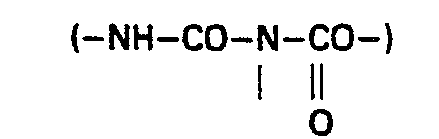
- the invention thus relates to linear or branched, primary di- or polyamines with terminal primary amino groups, obtainable by hydrogenolysis of di- and poly (-O-benzylurethanes) from di- and polyisocyanates, the molecular chains of which are aliphatic, cycloaliphatic, aromatic or araliphatic Hydrocarbon residues and polyether, polyester or polyether polyester segments and always at least two urethane groups or the abovementioned hydrocarbon radicals and at least one urea group (-NH-CO-NH-), a number of biuret groups (-NH-CO-N-CO-NH-), an allophanate group (-NH-CO-N- or an isocyanurate group built in, and benzyl alcohol with hydrogen in the presence of hydrogenation catalysts with elimination of toluene and carbon dioxide.
- di- and poly (-O-benzylurethanes) from di- and polyisocyanates
- the di- and polyisocyanates necessary for the hydrogenolysis of the di- and poly (-O-benzyl-urethanes) are known and represent modified di- and polyisocyanates.
- the above-mentioned isocyanates can be modified by partially converting the isocyanate groups into urea, biuret, allophanate or isocyanurate groups.
- Polyisocyanates containing urea groups are, for example, in DE patent 1 230 778, polyisocyanates containing biuret groups in US Pat. Nos. 3 124 605, 3 201 372 and 3 124 605 and in GB patent 889 050, polyisocyanates containing allophanate groups in the GB patent 994-890, BE patent 761 626 and NL patent application 7 102 525, polyisocyanates containing isocyanurate groups in US Pat. No. 3,001,973 and in DE Patents 1,022,789 and 1,222,067.
- the di- and polyisocyanates are preferably modified by reaction with linear or branched alcohols, polyether alcohols, polyester or polyether alcohols, polyesters or polyether polyesters containing more than one OH group per molecule, with a 1 hydroxyl group being 1,1 -5, preferably 1.1-2.5 isocyanate groups are used.
- the excess isocyanate can then be removed by thin-layer distillation.
- the molecular weights Mn of the OH groups Components can be 90-10000, preferably 900-5000.
- the OH group-containing components preferably contain 2-4 , in particular 2-3 OH groups per molecule.
- polyesters are also suitable as polyesters, which e.g. by reacting diols such as propanediol (1,3), butanediol (1,4) and / or hexanediol (1,6), diethylene glycol, triethylene glycol, tetraethylene glycol or thiodiglycol with diaryl carbonates, e.g. Diphenyl carbonate, or phosgene can be produced (DE-Auslegeschrift 1 694 080, 1 915 908 and 2 221 751; DE-Offenlegungsschrift 2 605 024).
- diols such as propanediol (1,3), butanediol (1,4) and / or hexanediol (1,6)
- diethylene glycol triethylene glycol
- tetraethylene glycol or thiodiglycol e.g. Diphenyl carbonate, or phosgene
- the above-mentioned components containing OH groups are in bulk or inert to the reactants Solvents modified in known manner with 'di- and / or polyisocyanates and converted into so-called isocyanate group-containing isocyanate prepolymers. If a certain additional chain extension reaction via urethane groups is accepted or even desirable, the hydroxyl-containing polymerization or polycondensation products may be set first at 0 ° -25 ° C. and with cooling and later optionally over several hours with heating to preferably 50-120 ° C in an NCO / OH ratio of 1.5-2.5 to 1, preferably 1.8-2.2 to 1, with the di- or polyisocyanates.
- a chain extension reaction is not desired, a much larger excess of di- or polyisocyanate is used, preferably calculated for an NCO / OH ratio of 3-5 to 1, otherwise the same procedure is used as for the low NCO / OH ratios and finally removes the excess di- or polyisocyanate, for example in the case of distillable di- or polyisocyanates by thin-layer distillation or, in the case of non-distillable isocyanates, by solvent extraction.
- Suitable solvents for the production of the modified di- and polyurethanes are e.g. Esters, such as ethyl acetate, butyl acetate, methyl glycol acetate and ethyl glycol acetate, ketones such as methyl ethyl ketone, methyl isobutyl ketone, aromatics, such as toluene, xylene and higher aromatic mixtures, and mixtures of the solvents mentioned.
- Esters such as ethyl acetate, butyl acetate, methyl glycol acetate and ethyl glycol acetate
- ketones such as methyl ethyl ketone, methyl isobutyl ketone
- aromatics such as toluene, xylene and higher aromatic mixtures, and mixtures of the solvents mentioned.
- Preferred modified di- and polyisocyanates which are followed by urethanization with a benzyl alcohol and the hydrogenolysis lead to the preferred di- and polyamines of the formula I correspond to the formula III in which R 1 , R 2 and n have the meaning given for formula I.
- Particularly preferred (modified) di- and polyisocyanates are reaction products of isophorone diisocyanate, hexamethylene diisocyanate, tolylene diisocyanate or their mixtures and a polypropylene glycol ether, polyethylene glycol ether, polybutylene glycol ether, a propoxylated trimethylolpropane, propoxylated bisphenol A or mixtures thereof, preferably a hydroxyl group 1,1-5 1.1-2.5, isocyanate groups have been used.
- diisocyanates and polyisocyanates are particularly preferred which are reaction products of tolylene diisocyanate, diphenylmethane diisocyanate or mixtures thereof and at least one polyester containing 2-4 hydroxyl groups per molecule, consisting of adipic acid and ethylene glycol, propylene glycol, butylene glycol, 1,6-hexanediol, di-, tri - or tetraethylene glycol or mixtures thereof, isocyanate groups being used on 1 hydroxyl group of the polyester 1.1-5, preferably 1.1-2.5.
- the di- and poly (-O-benzylurethanes) are expediently prepared by adding a benzyl alcohol to the (modified) di- and polyurethanes at 40-150 ° C., preferably 50-120 ° C., in practically equivalent amounts conditions.
- the reaction is preferably carried out in the presence of a catalyst and optionally in the presence of a solvent until isocyanate can no longer be detected.
- D is a benzyl during subsequent hydrogenolysis split anymore, it is most useful, benzyl alcohol for the urethanization.
- benzyl alcohol for the urethanization.
- core- and side-chain-substituted benzyl alcohols or benzhydrol or fluorenol can be used.
- tertiary amines such as Dinethylbenzylamin, compounds of tin, lead and titanium, for example, Z innoctoat, dibutyl tin dilaurate, lead octoate in question, in amounts of from 0.01 to 1.0 wt .-%, based on the reaction mixture.
- Alcohols, ethers and hydrocarbons such as dioxane, ethylene glycol dimethyl ether, dibutyl ether, diisopropyl ether, benzene, toluene and xylenes may be mentioned as optional solvents.
- Tem p ERA between 30 and 120 ° C, especially 40-110 ° C. In exceptional cases, you can also work at temperatures up to 150 ° C.
- the hydrogen pressure can be between 1-300 bar, preferably 3-200 bar and particularly preferably 5-150 bar.
- the amount of catalyst can be between 0.005-10% by weight, preferably 0.01-2.0, particularly preferably 0.02-1.0% by weight of metal, based on the polybenzyl urethane to be hydrogenated.
- Typical hydrogenation catalysts are used for the hydrogenation, which have a low activity for the hydrogenation of aromatic nuclei under the process conditions.
- catalysts which contain elements of groups 8 and 1b of the periodic table as active constituents, such as Nickel, cobalt, copper or palladium.
- These can be used as finely divided metals, e.g. Palladium black, in the form of skeletal catalysts, e.g. Raney nickel, Raney cobalt, Raney copper, as supported catalysts, e.g. Nickel diatomaceous earth, palladium-carbon, palladium-aluminum oxide, palladium-silicon dioxide, palladium-barium sulfate, or as mixed catalysts, e.g. Nickel chromite catalysts, copper chromite catalysts are used.
- the hydrogenation can also be carried out using fixed bed catalysts.
- Palladium and nickel catalysts are particularly suitable, preferably supported palladium catalysts and nickel skeleton catalysts.
- the hydrogenolysis can be carried out in bulk or in solution.
- the same solvents are expediently used which can be used in the preparation of the di- and poly- (- O-benzylurethanes).
- alcohols such as methanol, ethanol, isopropanol, n-butanol, isobutanol and tert are preferably used.
- Butanol used
- first filtering or centrifuging when working with fixed bed catalysts eliminates this step of contact and then, if necessary, volatile reaction products such as toluene and optionally solvents by distillation, optionally under reduced pressure, for example using a thin film evaporator, at temperatures of o -180 ° C, preferably 20-150 ° C, particularly preferably at 20-120 ° C removed.
- the polyamines according to the invention are excellent agents for modifying epoxy resins and resins with isocyanate groups or groups providing isocyanate groups. They are used to manufacture paints, moldings, casting compounds, fillers, coatings, coatings, sealing, putty and connecting compounds. Epoxy resins, especially those made from diphenolpropane and epichlorohydrin, result in hard and chemical-resistant compositions and adhesive coatings after curing with polyamines; however, they often lack elasticity. This applies particularly to epoxy resins based on diphenylol propane.
- the flexibility and elasticity desired here which manifests itself in the hardened moldings, coatings, joint seals, coatings and connecting compounds in improved impact and shock resistance, stretchability and compressibility, can be achieved in an outstanding manner by using the polyamines according to the invention. Due to the extraordinarily wide range of variations of the polyamines which can be prepared according to the invention, from linear, aliphatic polyether-based diamines with molecular weights of several 1000, via branched, several amino groups in a small molecule in addition to aliphatic polyamines containing urethane, isocyanate, biuret or allophanate groups linear or branched aromatic di- or polyamines based on polyether or polyester with very different molecular weights are sufficient, it is possible to adjust the properties of the hardened products in a wider range as desired.
- Aromatic amines can only because of their toxicity with certain precautions writings and precautions are used in a limited framework as hardeners for epoxy resins and polyurethanes.
- Epoxides and polyurethanes cured with aromatic amines of the type according to the invention can therefore find applications which have hitherto been closed to them because of potential health risks, for example for container and floor coatings in the food processing industry.
- the known, customary polyepoxides with more than one 1,2-epoxy group are suitable as epoxides.
- These include polyglycidyl ethers of polyhydric phenols, for example from pyrocatechol, resorcinol, hydroquinone, from 4,4'-dihydroxydiphenylmethane, from 4,4'-di-hydroxy-3,3'-dimethyldiphenylmethane, from 4,4'-dihydroxy-diphenyldimethylmethane (Bisphenol A), from 4,4'-dihydroxy diphenylmethyl methane, from 4,4'-dihydroxydiphenylcyclohexane, from 4,4'-dihydroxy-3,3'-dimethyldiphenylpropane, from 4,4'-dihydroxydiphenyl, from 4,4'-dihydroxydiphenylsulfone, from tris- (4-hydroxyphenyl) - methane, from the chlorination and bromination
- Glycidyl ethers of polyhydric alcohols for example from 1,4-butanediol, 1,4-butenediol, glycerol, trimethylolpropane, pentaerythritol and polyethylene glycols, may also be mentioned.
- triglycidyl isocyanurate N, N'-diepoxypropyloxamide
- polyglycidyl thioethers from polyvalent thiols, such as from bismer captomethylbenzene, diglycidyl trimethylene trisulfone, epoxidized polybutadiene, epoxidized linseed oil, vinylcyclohexene diepoxide.
- Glycidyl esters of polyvalent aromatic, aliphatic and cycloaliphatic carboxylic acids for example, diglycidyl phthalate, diglycidyl terephthalate, diglycidyl tetrahydrophthalate, diglycidyl adidate and methacrylate derivatives of hexahydrophthalate, glycidylalidate from methylacetate, / 2 mol of a diol or 1 / n mol of a polyol with n hydroxyl groups, such as glycidyl carboxylic acid esters of the general formula in which A is an at least divalent radical of an aliphatic hydrocarbon which may be interrupted by oxygen and / or cycloaliphatic rings or the divalent radical of a cycloaliphatic hydrocarbon, R is hydrogen or alkyl radicals having 1-3 C atoms and n is a number between 2 and 6 mean, or mixtures of glycidyl carboxylic acid
- epoxy resins which have been reacted with monocarboxylic acids, in particular with fatty acids, such as those from linseed oil, soybean oil, saffron oil, perilla oil, tung oil, poppy seed oil, sunflower oil, tall oil, walnut oil, dehydrated castor oil, herring oil and the like.
- the epoxy resins can be esterified in a simple manner by refluxing them in the presence of one or more carboxylic acids and at the same time removing the water azeotropically.
- the resin compositions composed of hardener and epoxy components can additionally contain extenders such as coumarone oil, diluents such as dibutyl phthalate, if they are preferably used without them, and also reactive diluents such as monoglycide esters or monoglycidyl ethers, such as reaction products of phenols with epichlorohydrin, catalysts which accelerate curing, such as alcohols. Phenols, tert.
- extenders such as coumarone oil, diluents such as dibutyl phthalate, if they are preferably used without them, and also reactive diluents such as monoglycide esters or monoglycidyl ethers, such as reaction products of phenols with epichlorohydrin, catalysts which accelerate curing, such as alcohols. Phenols, tert.
- Amines or organic acids such as salicylic acid and amines, acids such as BF 3 or its adducts with alcohols, phosphorus compounds such as triphenylphosphite, retarders which delay hardening, such as ketones or esters, and finally solid additives, fillers and reinforcing materials such as talc, quartz powder, titanium dioxide, Diatomaceous earth, heavy spar, asbestos, Glass fibers, zinc dust, mica, siccatives, tixotropic agents and color pigments such as iron oxide, chromium oxide and cadmium sulfide. UV stabilizers can also be added for outdoor use.
- the systems described are particularly advantageously used where cold-curing epoxy resins are generally used, e.g. for the production of castings and resin mats, but especially in the coating and varnishing sector for potting and sealing compounds.
- Metals, wood, paper, cardboard, textiles, leather, glass, plastics, ceramic materials, concrete and rock masses are suitable as substrates to be coated, coated or bonded.
- Suitable starting products for the production of polyurethanes using the polyamines according to the invention are polymerization or polycondensation products (isocyanate prepolymers) containing isocyanate or capped isocyanate groups, which by reaction of the corresponding hydroxyl, amino or sulfhydryl groups-carrying polymerization or polycondensation products, such as preferably the customary hydroxyl-containing ones
- Polyethers, polythioethers, polyesters, polyacetals or polyesteramides with di- or polyisocyanates for example in an NCO / OH ratio of 1.5-2.5 to 1 or with a large excess of isocyanate and subsequent removal of the excess of isocyanate, e.g. can be obtained by thin film distillation.
- Suitable capping agents are e.g. Phenols, lactams or acetoacetic esters.
- polyamines or amine-releasing compounds can also be used in addition to the polyamines according to the invention together with the polyepoxides, the polyisocyanate resins or the blocked polyisocyanate resins.
- polyepoxides e.g. aliphatic, cycloaliphatic or heterocyclic polyamines or polyamide amines.
- Alkylene polyamines such as ethylene diamine, diethylene triamine, triethylene tetramine, tetraethylene pentamine, 1,4-diaminobutane, 1,3-diaminobutane, hexamethylene diamine, 3- (n-isopropylamino) propylamine, N, N'-diethyl-1,3-propane diamine are particularly suitable.
- Usable heterocyclic polyamines are, for example, N- (aminoalkyl) piperazines- such as N-aminobutylpiperazine, N- (aminoisopropyl-3-butoxypiperazine, N-aminoethylpiperazine, 2,5-di butyl-N-aminoethylpiperazine, 2,5-dibutyl-N-aminoethylpiperazine, the alkyl groups of which preferably contain no more than 6 carbon atoms and the entire molecule contains no more than 18 carbon atoms.
- N- (aminoalkyl) piperazines- such as N-aminobutylpiperazine, N- (aminoisopropyl-3-butoxypiperazine, N-aminoethylpiperazine, 2,5-di butyl-N-aminoethylpiperazine, 2,5-dibutyl-N-aminoethylpiperazine,
- hardeners with multiple amino hydrogen atoms are polyamides of an aliphatic or cycloaliphatic polycarboxylic acid with an aliphatic amine.
- the product obtained has groups which are reactive with epoxy groups, such as amino or carboxyl groups.
- polybasic acids for the production of these polyaminoamides are dimerized and trimerized unsaturated fatty acids from the polymerization of fatty acid drying oils in the heat. In some cases it is advantageous to use a mixture of two or more of the polyamines mentioned.
- the amine-releasing compounds are the condensation products of the polyamines described with aliphatic, cycloaliphatic, araliphatic and aromatic ketones. They are useful e.g. manufactured in such a way that the water formed during the condensation is continuously removed from the reaction mixture by azeotropic distillation.
- the compounds which give off amine are particularly valuable for the production of one-component systems, the hardening of which is brought about by the hydrolyzing action of atmospheric moisture.
- aromatic diamines such as diaminodiphenylmethane, 4,4-diaminodiphenylsulfone, 4,4'-diamino-3,3'-dichlorodiphenylmethane, m-phenylenediamine, 3,5-diamino-4-chloro-benzoic acid ethyl ester, bisesters of diols such as hexanediol 1,6 or polyethylene glycol ether with athranilic acid, 4,4'-diaminodiphenyl sulfide and other other aromatic di- and polyamines, which are usually used as hardeners for epoxies and chain extenders for polyurethanes.
- aromatic diamines such as diaminodiphenylmethane, 4,4-diaminodiphenylsulfone, 4,4'-diamino-3,3'-dichlorodiphenylmethane, m-phen
- fillers, pigments, solvents, plasticizers, thickeners and also dispersions from water can also be added. It is also possible to introduce substances that stretch the mixture or that should act as adhesives, such as tar and tar pitch, asphalts and other plastics such as phenol, aldehyde, phenol-urea plastics, vinyl plastics, polyolefins, synthetic rubbers, etc.
- fillers sand, rock flour, calcium sulfate, calcium carbonate, aluminum powder, and also silica, asbestos flour, koalin and talc.
- Suitable solvents which are used in particular to adjust the desired viscosity in amounts of 5%, but preferably in amounts below 24% by weight, based on the total mixture, are, for example, Aromatics such as toluene, xylene, alcohol such as methanol and isopropanol, esters and methyl isobutyl ketone and ether.
- the drying agents mentioned can be: molecular sieve zeolites such as sodium aluminosilicate, orthoformic acid esters, low molecular weight isocyanate compounds such as phenyl isocyanate, and furthermore metal alcoholates such as aluminum isobutylate and titanium tetrabutylate.
- molecular sieve zeolites such as sodium aluminosilicate, orthoformic acid esters, low molecular weight isocyanate compounds such as phenyl isocyanate, and furthermore metal alcoholates such as aluminum isobutylate and titanium tetrabutylate.
- Catalysts to accelerate curing can also be used.
- the accelerators known in epoxy resin chemistry such as the reaction products of phenol or substituted phenols with formaldehyde and ammonia, salicylic acid, tertiary amines, amino alcohols, benzyl alcohol, phosphines and phosphites, p-toluenesulfonic acid esters, N-hydroxyethylpiperazine and titanium acid esters, and also the accelerators customary in isocyanate chemistry, such as tertiary amines, diazabicyclo- 2,2,2) octane, amidines, diazabicyclo-0,3,4) -nones, compounds of lead, di- and tetravalent tin and tetravalent titanium.
- the mixtures prepared with amines according to the invention are also suitable for the production of coatings and moldings in which special elasticity is important.
- One- and two-component systems can be manufactured, e.g. are suitable for roof coatings and floor coatings.
- coatings with the mixtures according to the invention can be used for wear protection on metals. Hardening is accelerated by using higher temperatures. It is possible to insert textile fabrics or glass mats.
- the process products can be used as sealing compounds in the construction sector as putty-like compounds be used. It is noteworthy that the problem of insufficient interlayer adhesion does not occur with the mixtures according to the invention. This effect is particularly acute in the case of pure epoxy resins if longer waiting times occur between the individual coating processes in the case of multilayer film build-up. Pure epoxy resin films show poor adhesive strength under these conditions, while the mixtures according to the invention have good interlayer adhesion even after prolonged aging.
- a diisocyanate prepared from a polypropylene glycol ether (Mn approx. 1900, 1.7% OH) and isophorone diisocyanate with an NCO content of 4.0%, is freed of monomers by thin-layer distillation, with 10.3 g of benzyl alcohol per 100 g of the diisocyanate in the presence of 0.1 g of tin octoate as a catalyst, quantitatively converted into the corresponding dibenzyl urethane by heating to 50-60 ° C.
- 700 g of the bisurethane thus obtained are taken up in 500 ml of methanol and, after the addition of 26 g of a palladium catalyst on activated carbon (5% by weight of Pd), are hydrogenated in a shaking autoclave for 3.5 hours at 100 ° C. and 50-60 bar hydrogen pressure.
- the catalyst is separated off by filtration and the clear solution up to a bottom temperature of 100 ° C. lastly at reduced pressure, evaporated.
- a colorless, pale yellow oil ( 600 g) with a viscosity of 8800 mPa.s, a content of basic nitrogen of 1.31% by weight (calc. 1.36) and a total nitrogen of 2.66% by weight is obtained. % (calc. 2.72). Since the basic nitrogen content within the error limits represents half of the total nitrogen, the hydrogenation of the benzyl urethane was practically quantitative, i.e. a polymeric, diprimeric, aliphatic diamine was obtained.
- a polyisocyanate with isocyanurate groups prepared by catalytic trimerization of isophorone diisocyanate, which is present as a 70% solution in xylene, is corresponding to the isocyanate content of 11.5% by weight with 29.6 g benzyl alcohol per 100 g solution in the presence of 0.1 G Dibutyltin dilaurate as a catalyst at 70-80 ° C until the disappearance of the isocyanate groups. After dilution with the same amount of isopropanol, 300 g of the polybenzyl urethane are hydrogenated in a shaking autoclave for 4 h at 60 ° C.
- a polyisocyanate produced by biuretization of 1,6-hexamethylene diisocyanate with an NCO content of 22% by weight, is mixed with 60.5 g of benzyl alcohol per 100 g of polyisocyanate at 60 ° C. until the isocyanate groups disappear in the presence of 0.1 g dibutyltin dilaurate implemented.
- 300 g of the polybenzyl urethane thus obtained are dissolved in about 300 ml of isopropanol, 15 g of palladium on activated carbon are added, and the mixture is hydrogenated in a stirred autoclave for 5 hours at 60 ° C. and 100 bar hydrogen pressure.
- a diisocyanate produced by addition of 1,6-hexamethylene diisocyanate to a propoxylated bisphenol A with 5% by weight OH (Mn 680 ), which is freed of monomers by thin-layer distillation and has an NCO content of 7.9% by weight , is stirred in the presence of 1 wt .-% lead octoate as a catalyst with 20.6 g of benzyl alcohol per 100 g of diisocyanate until the NCO groups have completely converted at 70.degree.
- a diisocyanate made from a polypropylene glycol ether ( M n 4000, 0.85% OH) and 14 g 2,4-diphenylmethane diisocyanate per 100 g polypropylene glycol ether (NCO content of 2.3% by weight) is mixed with 6.2 g benzyl alcohol in the presence of 0.1 g tin Octoat converted to dibenzyl urethane.
- Example 2 800 g of the product obtained in this way are diluted with 500 g of isopropanol, mixed with 9 g of palladium contact and hydrogenated at 60 ° C. and 80 bar.
- Working up as in Example 2 gives a yellowish, highly viscous resin with a total nitrogen content of 1.35% by weight and basic nitrogen of 0.64% by weight.
- the ratio of the two nitrogen values shows that the yield of basic nitrogen is almost complete.
- a polyisocyanate, as described in Example 1, is reacted with benzyl alcohol and hydrogenated in a shaker at 80 ° C. under 1.5 bar hydrogen pressure in the presence of 10 g palladium on carbon (10% palladium) for 20 hours.
- An aliphatic polyamine with a basic nitrogen content of 1.10% and in total is obtained nitrogen of 2.48%.
- the yield of basic nitrogen is thus 89% of theory
- a liquid epoxy resin made from bisphenol A, with an epoxy equivalent weight of 180-200 are mixed with 320 g of the aliphatic polyamine described in Example 1 and cured at 50 ° C.
- a soft, elastic end product with Shore hardness .A 60 is obtained.
- Example 8 100 g of epoxy resin from Example 8 are mixed with 300 g of the aromatic polyamine described in Example 2. The liquid mixture is ready for use at room temperature for more than 10 days and can be cured to elastic coatings at 180 ° C.
- the mixtures harden well and lead to elastic products with a dry surface finish.
Landscapes
- Chemical & Material Sciences (AREA)
- Health & Medical Sciences (AREA)
- Chemical Kinetics & Catalysis (AREA)
- Medicinal Chemistry (AREA)
- Polymers & Plastics (AREA)
- Organic Chemistry (AREA)
- General Chemical & Material Sciences (AREA)
- Polyurethanes Or Polyureas (AREA)
- Organic Low-Molecular-Weight Compounds And Preparation Thereof (AREA)
Abstract


Description
- Die Erfindung betrifft neue, lineare oder verzweigte, primäre Di- und Polyamine mit endständigen primären Aminogruppen, die mindestens zwei Urethangruppen und Polyether und/oder Polyestersegmente oder mindestens eine Harnstoff-, Biuret-, Allophanat- oder Isocyanuratgruppe im Molekül enthalten. Sie werden als Härtungs- oder Modifizierungsmittel für Epoxidharze oder für Harze mit Isocyanatgruppen oder Isocyanatgruppen liefernden Gruppen eingesetzt und zeichnen sich in vielen Fällen durch eine relativ niedrige Viskosität und eine leichte Verarbeitbarkeit aus und verleihen den Endprodukten gute anwendungstechnische Eigenschaften.
- Aus der Peptidchemie ist es bekannt, primäre Aminogruppen von Aminosäuren durch Umsetzung mit Benzyloxycarbonylchlorid (=Chlorameisensäurebenzylester) in 0-Benzylcarbamatgruppen zu schützen, die freie Carboxylgruppe zu aktivieren und für die Peptidsynthese durch Reaktion mit anderen, freie Aminogruppen aufweisenden Aminosäurenmolekülen auszunutzen. Anschließend wird das Umsetzungsprodukt mit den 0-Benzylcarbamatgruppen einer Hydrogenolyse mit Wasserstoff in Gegenwart von Hydrierkatalysatoren unterworfen, wobei die 0-Benzylcarbamatgruppe unter Abspaltung von Toluol und Kohlendioxid in die ursprüngliche primäre Aminogruppe rückgespalten wird (vgl. Organic Reactions, New York, John Wiley & Sons, Inc. 1953, Volume VII, Seite 273, Absatz 2).
- Aufgabe der vorliegenden Erfindung war es, möglichst niedrigviskose, prinäre Di- und Polyamine mit Polyether-und/oder Polyestersegmenten und Urethangruppen bzw. mit Harnstoff-, Biuret-, Allophanat- oder Isocyanuratgruppen im Molekül bereitzustellen, die eine leichte Verarbeitung mit Polyepoxidharzen bzw. Isocyanatharzen ohne Verwendung von Lösungsmitteln und auch ohne Zusatz anderer dünnflüssiger Di- oder Polyamine und eine große Variationsbreite bezüglich der Eigenschaften der Härtungsprodukte ermöglichen.
- Die Aufgabe wurde dadurch gelöst, daß Di- und Polyisocya" nate, die Polyether- und/oder Polyestersegmente und Urethangruppen oder aber Harnstoff-, Biuret-, Allophanat-oder Isocyanuratgruppen im Molekül enthalten, mit Benzylalkohol in die entsprechenden Di- und Poly(-O-benzylurethane) überführt und letztere durch Hydrogenolyse in primäre Amine rückgespalten werden.
- Obwohl die Hydrogenolyse der 0-Benzylcarbamatgruppen (=0-Benzylurethangruppen) in der Peptidchemie oft mit zufriedenstellenden Ergebnissen verläuft, mußte insbesondere bei höheren Molekulargewichten der als Ausgangsmaterial dienenden Di- und Polyisocyanate mit einer schlechteren Durchführbarkeit der Hydrogenolyse gerechnet werden. Überraschenderweise verläuft sie jedoch auch bei den höhermolekularen Produkten in nahezu quantitativen Ausbeuten.
- Gegenstand der Erfindung sind somit lineare oder verzweigte, primäre Di- oder Polyamine mit endständigen primären Aminogruppen, erhältlich durch Hydrogenolyse von Di- und Poly(-O-benzylurethanen) aus Di- und Polyisocyanaten, die in ihren Molekülketten aliphatische, cycloaliphatische, aromatische oder araliphatische Kohlenwasserstoffreste und Polyether-, Polyester- oder Polyetherpolyestersegmente und stets mindestens zwei Urethangruppen


- Bevorzugte Di- und Polyamine entsprechen der allgemeinen Formel I

- R 1 einen aliphatischen Kohlenwasserstoffrest mit 2-18, vorzugsweise 6-10 C-Atomen, einen cycloaliphatischen Kohlenwasserstoffrest mit 4-15, vorzugsweise 5-10 C-Atomen, einen aromatischen Kohlenwasserstoffrest mit 6-15, vorzugsweise 6-13 C-Atomen, einen aromatischen, durch mindestens-eine C1-C4-Alkylengruppe unterbrochenen Kohlenwasserstoffrest mit insgesamt 13-16 C-Atomen oder einen araliphatischen Kohlenwasserstoffrest mit 8-15, vorzugsweise 8-13 C-Atomen,
- R 2 einen um die Hydroxylgruppen verminderten 2-4-wertigen, vorzugsweise 2-3-wertigen Rest eines 2-4- wertigen, vorzugsweise 2-3-wertigen Alkohols, oder eines 2-4, vorzugsweise 2-3 Hydroxylgruppen aufweisenden Polyethers, Polyesters oder Polyetherpolyesters oder vorstehende Reste, die durch mindestens 2 Urethangruppen (-O-CO-NH-) unterbrochen sind und
- n eine ganze Zahl von 2-4, vorzugsweise 2-3 darstellen.
- Die für die Hydrogenolyse der Di- und Poly(-O-benzyl- urethane) notwendigen Di- und Polyisocyanate sind bekannt und stellen modifizierte Di- und Polyisocyanate dar.
- Für die Modifizierung werden als Ausgangskomponenten aliphatische, cycloaliphatische, araliphatische und aromatische Polyisocyanate eingesetzt, wie sie z.B. von W. Siefken in Justus Liebigs Annalen der Chemie, 562, Seiten 75 bis 136, beschrieben werden, beispielsweise solche der Formel II

- Die Modifizierung der vorgenannten Isocyanate kann einmal durch teilweise Umwandlung der Isocyanatgruppen in Harnstoff-,Biuret-, Allophanat- oder Isocyanuratgruppen er- .folgen.
- Harnstoffgruppen aufweisende Polyisocyanate sind beispielsweise in der DE-Patentschrift 1 230 778, Biuretgruppen aufweisende Polyisocyanate in den US-Patentschriften 3 124 605, 3 201 372 und 3 124 605 sowie in der GB-Patentschrift 889 050,Allophanatgruppen aufweisende Polyisocyanate in der GB-Patentschrift 994-890, der BE-Patentschrift 761 626 und der NL-Patentanmeldung 7 102 525, Isocyanuratgruppen aufweisende Polyisocyanate in der US-Patentschrift 3 001 973 und in den DE-Patentschriften 1 022 789 und 1 222 067 beschrieben.
- Bevorzugt erfolgt die Modifizierung der Di- und Polyisocyanate etwa der Formel II durch Umsetzung mit durchschnittlich mehr als eine OH-Gruppe pro Molekül enthaltenden linearen oder verzweigten Alkoholen, Polyetheralkoholen, Polyester-oder Polyetheralkoholen, Polyestern oder Polyetherpolyestern, wobei auf eine 1 Hydroxylgruppe 1,1-5, vorzugsweise 1,1-2,5 Isocyanatgruppen eingesetzt werden. Die anschließende Entfernung des überschüssigen Isocyanats kann durch Dünnschichtdestillation erfolgen. Die Molgewichte Mn der OH-Gruppen enthaltenden Komponenten Können 90-10000, vorzugsweise 900-5000 betragen. Vorzugsweise enthalten die OH-Gruppentragenden Komponenten 2-4, insbesondere 2-3 OH-Gruppen pro Molekül.
- Als Alkohole und Polyetheralkohole seien beispielhaft genannt:
- Butylenglykol-(1,4) und -(2,4), Pentandiol-(1,5) , Hexandiol-(1,6), Octandiol-(1,8), Neopentylglykol, 1,4-Bis-hydroxymethyl-cyclohexan, 2-Methyl-1,3-propandiol, Dibrombutendiol (US-Patentschrift 3 723 392), Glyzerin, Trimethylolpropan, Hexantriol-(1,2,6), Trimethylolethan, Pentaerythrit, Chinit, Mannit und Sorbit, Ricinusöl, Diethylenglykol, Triethylenglykol, Tetraethylenglykol, höhere Polyethylenglykole mit einem Molekulargewicht Mn bis 400, Dipropylenglykol, höhere Polypropylengykole mit einem Molekulargewicht Mn bis 400, Dibutylenglykol, höhere Polybutylenglykole mit einem 'Molekulargewicht Mn bis 400, 4,4'-Dihydroxy-diphenylpropan, Di-hydroxymethyl-hydrochinon, Diethanolamin, N-Methyldiethanolamin, Triethanolamin, Polymerisationsprodukte von Epoxiden wie Ethylenoxid, Propylenoxid, Butylenoxid, Tetrahydrofuran, Styroloxid oder Epichlorhydrin mit sich selbst, z.B. in Gegenwart von Lewis-Katalysatoren wie BF3, oder durch Anlagerung dieser Epoxide, vorzugsweise von Ethylenoxid und Propylenoxid, gegebenenfalls im Gemisch oder nacheinander, an Startkomponenten mit reaktionsfähigen Wasserstoffatomen wie' Wasser, Alkohole, Ammoniak oder Amine, z.B. Ethylenglykol, Propylenglykol-(1,3) oder -(1,2), Trimethylolpropan, Glycerin, Sorbit, 4,4'-Dihydroxy-diphenylpropan, Anilin, Ethanolamin oder Ethylendiamin hergestellt mit Molekulargewichten Mn größer als 400. Auch Sucrosepolyether, wie sie z.B. in den DE-Auslegeschriften 1 176 358 und 1 064 938 beschrieben werden, sowie auf Formit oder Formose gestartete Polyether (DE-Offenlegungsschriften 2 639 083 bzw. 2 737 951), kommen für die Modifizierung in Frage. Vielfach sind solche Polyether bevorzugt, die überwiegend (bis zu 90 Gew.-%, bezogen auf alle vorhandenen OH-Gruppen im Polyether) primäre OH-Gruppen aufweisen. Auch OH-Gruppen aufweisende Polybutadiene sind für die Modifizierung geeignet.
- Die für die Modifizierung in Frage kommenden Hydroxylgruppen aufweisenden Polyester bzw. Polyesterpolyetheralkohole sind z.B. ümsetzungsprodukte von mehrwertigen, vorzugsweise zweiwertigen und gegebenenfalls zusätzlich dreiwertigen Alkoholen mit mehrwertigen, vorzugsweise zweiwertigen, Carbonsäuren. Anstelle der freien Polycarbonsäuren können auch die entsprechenden Polycarbonsäureanhydride oder entsprechende Polycarbonsäureester von niedrigen Alkoholen oder deren Gemische zur Herstellung der Polyester verwendet werden. Die Polycarbonsäuren können aliphatischer, cycloaliphatischer, aromatischer und/oder heterocyclischer Natur sein und gegebenenfalls, z.B. durch Halogenatome,.substituiert und/oder ungesättigt sein. Als Beispiele für solche Carbonsäure und Alkohole und deren Derivate seien genannt:
- Bernsteinsäure, Adipinsäure, Korksäure, Azelainsäure, Sebacinsäure, Phthalsäure, Isophthalsäure, Trimellitsäure, Phthalsäureanhydrid, Tetrahydrophthalsäureanhydrid, Hexahydrophthalsäureanhydrid, Tetrachlorphthalsäureanhydrid, Endomethylentetrahydrophthalsäureanhydrid, Fumarsäure, dimerisierte und trimerisierte ungesättigte Fettsäuren, gegebenenfalls in Mischung mit monomeren ungesättigten Fettsäuren, wie ölsäure; Terephthalsäuredimethylester und Terephthalsäure-bis-glykolester. Als mehrwertige Alkohole kommen z.B. Ethylenglykol, Propylenglykol-(1,2) und -(1,3), Butylenglykol-(1,4) und -(2,3), Hexandiol-(1,6), Octandiol-(1,8), Neopentylglykol, 1,4-Bis-hydroxymethylcyclohexan, 2-Methyl-1,3-propandiol, Glycerin, Trimethylolpropan, Hexantriol-(1,2,6), Butantriol-(1,2,4,), Trimethylolethan, Pentaerythrit, Chinit, Mannit und Sorbit, Formit, Methylglykosid, ferner Diethylenglykol, Triethylenglykol, Tetraethylenglykol und höhere Polyethylenglykole, Dipropylenglykol_ und hähere Polypropylenglykole sowie Dibutylenglykol und höhere Polybutylenglykole in Frage.
- Als Polyester kommen auch Hydroxylgruppen aufweisende Polycarbonate der an sich bekannten Art in Betracht, die z.B. durch Umsetzung von Diolen wie Propandiol-(1,3), Butandiol-(1,4) und/oder Hexandiol-(1,6), Diethylenglykol, Triethylenglykol, Tetraethylenglykol oder Thiodiglykol mit Diarylcarbonaten, z.B. Diphenylcarbonat, oder Phosgen hergestellt werden können (DE-Auslegeschriften 1 694 080, 1 915 908 und 2 221 751; DE-Offenlegungsschrift 2 605 024).
- Die vorgenannten OH-Gruppen enthaltenden Komponenten werden in Substanz oder in gegenüber den Reaktanten inerten Lösungsmitteln in bekannter Weise mit'Di- und/oder Polyisocyanaten modifiziert und in Isocyanatgruppen enthaltende sogenannte Isocyanatprepolymere übergeführt. Nimmt man eine bestimmte zusätzliche Kettenverlängerungsreaktion über Urethangruppen in Kauf oder ist diese sogar erwünscht, so setzt man die hydroxylgruppenhaltige Polymerisations- oder Polykondensationsprodukte gegebenenfalls zunächst bei 0 - 25°C und unter Kühlung und später gegebenenfalls über mehrere Stunden unter Erwärmung auf vorzugsweise 50 - 120°C in einem NCO/OH-Verhältnis von 1,5 - 2,5 zu 1, vorzugsweise von 1,8 - 2,2 zu 1, mit den Di- oder Polyisocyanaten um. Ist eine Kettenverlängerungsreaktion nicht erwünscht, so verwendet man einen wesentlich größeren Überschuß an Di- bzw. Polyisocyanat, vorzugsweise für ein NCO/OH-Verhältnis_von 3-5 zu 1 berechnet, verfährt im übrigen in derselben Weise wie bei den niedrigen NCO/OH-Verhältnissen und entfernt schließlich das überschüssige Di- bzw. Polyisocyanat, z.B. im Falle destillierbarer Di- bzw. Polyisocyanate durch Dünnschichtdestillation oder, bei nicht destillierbaren Isocyanaten, durch Lösungsmittelextraktion.
- Geeignete Lösungsmittel bei der Herstellung der modifizierten Di- und Polyurethane sind z.B. Ester, wie Ethylacetat, Butylacetat, Methylglykolacetat und Ethylglykolacetat, Ketone wie Methylethylketon, Methylisobutylketon, Aromaten, wie Toluol, Xylol und höhere Aromatengemische,sowie Gemische der genannten Lösungsmittel.
- Bevorzugte modifizierte Di- und Polyisocyanate, die nach Urethanisierung mit einem Benzylalkohol und anschließender Hydrogenolyse zu den bevorzugten Di- und Polyaminen der Formel I führen, entsprechen der Formel III

- Besonders bevorzugte (modifizierte) Di- und Polyisocyanate sind Umsetzungsprodukte aus Isophorondiisocyanat, Hexamethylendiisocyanat, Toluylendiisocyanat oder deren Mischungen und einem Polypropylenglykolether, Polyethylenglykolether, Polybutylenglykolether, einem propoxylierten Trimethylolpropan, propoxylierten Bisphenol A oder deren Mischungen, wobei auf eine Hydroxylgruppe 1,1-5, vorzugsweise 1,1-2,5, Isocyanatgruppen eingesetzt worden sind. Weiter sind solche Di- und Polyisocyanate besonders bevorzugt, welche Umsetzungsprodukte aus Toluylendiisocyanat, Diphenylmethandiisocyanat oder deren Mischungen und mindestens einem, 2-4 Hydroxylgruppen pro Molekül aufweisenden Polyester aus Adipinsäure und Ethylenglykol, Propylenglykol, Butylenglykol, 1,6-Hexandiol, Di-, Tri- oder Tetraethylenglykol oder deren Mischungen darstellen, wobei auf 1 Hydroxylgruppe des Polyesters 1,1-5, vorzugsweise 1,1-2,5, Isocyanatgruppen eingesetzt worden sind.
- Die Herstellung der Di- und Poly(-O-benzylurethane) erfolgt zweckmäßig durch Addition eines Benzylalkohols an die (modifizierten) Di- und Polyurethane bei 40-150°C, vorzugsweise 50-120°C, in praktisch äquivalenten Mengenverhältnissen. Die Reaktion wird vorzugsweise in Gegenwart eines Katalysators und gegebenenfalls in Gegenwart eines Lösungsmittels durchgeführt, bis kein Isocyanat mehr nachzuweisen ist.
- Da die Benzylgruppe während der späteren Hydrogenolyse abgespalten wird,ist es am sinnvollsten, Benzylalkohol für die Urethanisierung einzusetzen. Es können jedoch kern- und seitenkettensubstituierte Benzylalkohole oder Benzhydrol oder Fluorenol eingesetzt werden.
- Als Katalysatoren kommen tertiäre Amine wie Dinethylbenzylamin, Verbindungen des Zinns, Bleis und Titans, beispielsweise Zinnoctoat, Dibutylzinndilaurat, Bleioctoat in Frage, und zwar in Mengen von 0,01 bis 1,0 Gew.-%, bezogen auf Reaktionsmischung.
- Als gegebenenfalls zu verwendende Lösungsmittel seien Alkohole, Ether und Kohlenwasserstoffe wie Dioxan, Ethylenglykoldimethylether, Dibutylether, Diisopropylether, Benzol, Toluol und Xylole genannt.
- Die Hydrogenolyse der Di- und Poly(-O-benzylurethane) durch Hydrierung mit Wasserstoff verläuft schon bei Raunrtemperatur (20°C) unter Normaldruck mit annehmbarer Geschwindigkeit bei genügend hohen Katalysatordosen (z.B. 10 Gew.-%).
- Rascher und mit weniger Kontakt erfolgt sie bei Tempera- turen zwischen 30 und 120°C, besonders 40-110°C. Man kann in Ausnahmefällen auch bei Temperaturen bis 150°C arbeiten.
- Der Wasserstoffdruck kann zwischen 1-300 bar, vorzugsweise 3-200 bar und besonders bevorzugt 5-150 bar, betragen. Die Katalysatormenge kann zwischen 0,005-10 Gew.-%, bevorzugt 0,01-2,0, besonders.bevorzugt 0,02-1,0 Gew.-% Metall,bezogen auf das zu hydrierende Polybenzylurethan, liegen.
- Für die Hydrierung werden typische Hydrierkatalysatoren verwendet, die unter den Verfahrensbedingungen eine geringe Aktivität für die Hydrierung aromatischer Kerne aufweisen.
- Geeignet sind insbesondere solche Katalysatoren, die als wirksame Bestandteile Elemente der Gruppen 8 und 1b des Periodensystems enthalten, wie z.B. Nickel, Kobalt, Kupfer oder Palladium.
- Diese können für sich als feinverteilte Metalle, z.B. Palladiumschwarz, in Form von Skelettkatalysatoren, z.B. Raney-Nickel, Raney-Kobalt, Raney-Kupfer, als Trägerkatalysatoren, z.B. Nickel-Kieselgur, Palladium-Kohle, Palladium-Aluminiumoxid, Palladium-Siliciumdioxid, Palladium-Bariumsulfat, oder als Mischkatalysatoren, z.B. Nickelchromit-Katalysatoren, Kupferchromit-Katalysatoren, eingesetzt werden. Die Hydrierung kann auch mit im Festbett angeordneten Katalysatoren erfolgen.
- Besonders geeignet sind Palladium- und Nickelkatalysatoren, vorzugsweise Palladium-Trägerkatalysatoren und Nickel-Skelettkatalysatoren.
- Die Hydrogenolyse kann in Substanz oder in Lösung durchgeführt werden. Bei der Hydrierung hochviskoser oder fester Produkte verwendet man zweckmäßig die gleichen Lösungsmittel, die bei der Herstellung der Di- und Poly-(-O-benzylurethane) eingesetzt werden können. Darüberhinaus werden vorzugsweise Alkohole wie Methanol, Ethanol, Isopropanol, n-Butanol, Isobutanol und tert. Butanol verwendet
- Zur Aufarbeituno der Hydrierungsprodukte wird zunächst durch Filtrieren oder zentrifugieren beim Arbeiten mit Festbettkatalysatoren entfällt dieser Schritt der-Kontakt abqetrennt und dann, falls notwendig, flüchtige Peaktionsproouktewie Toluol und gegebenenfalls Lösungsmittel destillativ, gegebenenfalls unter vermindertem Druck, beispielsweise mit Hilfe eines Dünnschichtverdampfers, bei Temperaturen von o-180°C, bevorzugt 20-150°C,besonders bevorzugt bei 20-120°C entfernt.
- Die erfindungsgemäßen Polyamine sind ausgezeichnete Mittel zur Modifizierung von Epoxidharzen und von Harzen mit Isocyanatgruppen oder Isocyanatgruppen liefernden Gruppen. Sie dienen zur Herstellung von Lacken, Formkörpern, Vergußmassen, Spachtelmassen, Überzügen, Beschichtungen, Dichtungs-, Kitt- und Verbindungsmassen. Epoxidharze, insbesondere die aus Diphenolpropan und Epichlorhydrin hergestellten, ergeben nach Aushärtung mit Polyaminen harte und chemikalienbeständige Massen und haftfeste überzüge; es mangelt ihnen jedoch häufig an Elastizität. Dies gilt besonders für die Epoxidharze auf Basis Diphenylolpropan. Die hier erwünschte Flexibilität und Elastizität, die sich bei den gehärteten Formkörpern, überzügen, Fugendichtungen, Beschichtungen und Verbindungsmassen in einer verbesserten Schlag- und Stoßfestigkeit, Dehnbarkeit und Komprimierbarkeit äußert, lassen sich durch Einsatz der erfindungsgemäßen Polyamine in hervorragender Weise realisieren. Durch die außerordentlich große Variationsbreite der erfindungsgemäß herstellbaren Polyamine, die von linearen, aliphatischen Diaminen auf Polyetherbasis mit Molgewichten von mehreren 1000, über verzweigte, mehrere Aminogruppen in einem kleinen Molekül neben Urethan-, Isocyanat-, Biuret-, oder Allophanatgruppen enthaltende aliphatische Polyamine bis zu linearen oder verzweigten aromatischen Di- oder Polyaminen auf Polyether- oder Polyesterbasis mit sehr unterschiedlichen Molgewichten reicht, ist es möglich, die Eigenschaften der gehärteten Produkte in einem weiteren Rahmen nach Wunsch einzustellen.
- Besondere Bedeutung kommt dabei den höhermolekularen aromatischen Polyaminen zu. Aromatische Amine können ja wegen ihrer Toxizität nur unter Beachtung gewisser Vorschriften und Vorsichtsmaßnahmen in einem beschränkten Rahmen als Härter für Epoxidharze und Polyurethane eingesetzt werden.
- Durch die Anbindung an große Moleküle werden die aromatischen Amine sehr wirksam entgiftet. Stäube und Dämpfe können nicht mehr auftreten, die Resorptions- und Migrationsgeschwindigkeit im Organismus ist stark reduziert, und damit sind Intoxikationen jeglicher Art sehr unwahrscheinlich geworden.
- Mit aromatischen Aminen der erfindungsgemäßen Art gehärtete Epoxide und Polyurethane können daher Anwendungen finden, die ihnen bisher wegen potentieller Gefahren für die Gesundheit verschlossen waren, z.B.'für Behälter-und Bodenbeschichtungen in der Lebensmittel-verarbeitenden Industrie.
- Gegenstand der vorliegenden Erfindung ist-daher auch die Verwendung der erfindungsgemäßen Polyamine zur Härtung oder Modifizierung von Epoxidharzen und Harzen mit Isocyanatgruppen oder Isocyanatgruppen liefernden Gruppen (= Polyurethanmassen).
- Als Epoxide kommen die bekannten, üblichen Polyepoxide mit mehr als einer 1,2-Epoxidgruppe in Frage. Das sind unter anderem Polyglycidylether mehrwertiger Phenole, beispielsweise aus Brenzkatechin, Resorcin, Hydrochinon, aus 4,4'-Dihydroxydiphenylmethan, aus 4,4'-Di-hydroxy-3,3'-dimethyldiphenylmethan, aus 4,4'-Dihydroxy-diphenyldimethylmethan (Bisphenol A), aus 4,4'-Dihydroxydiphenylmethylmethan, aus 4,4'-Dihydroxydiphenylcyclohexan, aus 4,4'-Dihydroxy-3,3'-dimethyldiphenylpropan, aus 4,4'-Dihydroxydiphenyl, aus 4,4'-Dihydroxydiphenylsulfon, aus Tris-(4-hydroxyphenyl)-methan, aus den Chlorierungs- und Bromierungsprodukten der vorstehend genannten Diphenple, insbesondere aus Bisphenol A; aus Novolaken (d.h. aus Umsetzungsprodukten von ein- oder mehrwertigen Phenolen mit Aldehyden, insbesondere Formaldehyd, in Gegenwart saurer Katalysatoren), aus Diphenolen, die durch Veresterung von 2 Mol des Natriumsalzes einer aromatischen Oxicarbonsäure mit einem Mol eines Dihalogenalkans oder Dihalogendialkylethers erhalten wurden (vgl. britische Patentschrift 1 017 612), aus Polyphenolen, die durch Kondensation von Phenolen und langkettigen, mindestens 2 Halogenatome enthaltenden Halogenparaffinen erhalten wurden (vgl. britische Patentschrift 1 024 288).
- Außer den Epoxyharzen auf Basis eines mehrwertigen Phenols und einer Chlorepoxyverbindung können auch die epoxydierten Ringverbindungen gemäß US-Patentschrift 2 715 123 verwendet werden.
- Weiter seien genannt Glycidylether mehrwertiger Alkohole, beispielsweise aus 1,4-Butandiol, 1,4-Butendiol, Glycerin, Trimethylolpropan, Pentaerythrit und Polyethylenglykolen.
- Von weiterem Interesse sind Triglycidylisocyanurat, N,N'-Diepoxypropyloxamid, Polyglycidylthioether aus mehrwertigen Thiolen, wie beispielsweise aus Bismercaptomethylbenzol, Diglycidyl-trimethylentrisulfon, epoxidiertes Polybutadien, epoxidiertes Leinöl, Vinylcyclohexendiepoxid.
- Außerdem kommen in Frage: Glycidylester mehrwertiger aromatischer, aliphatischer und cycloaliphatischer Carbonsäuren, beispielsweise Phthalsäurediglycidylester, Terephthalsäurediglycidylester, Tetrahydrophthalsäurediglycidylester, Adipinsäure-diglycidylester, Hexahydrophthalsäurediglycidylester, die gegebenenfalls durch Methylgruppen substituiert sein können,.und Glycidylester von Umsetzungsprodukten aus 1 Mol eines aromatischen oder cycloaliphatischen Dicarbonsäureanhydrids und 1/2 Mol eines Diols bzw. 1/n Mol eines Polyols mit n Hydroxylgruppen, etwa Glycidylcarbonsäureester der allgemeinen Formel

- Von Interesse sind auch Epoxidharze, die mit Monocarbonsäuren umgesetzt wurden, insbesondere mit Fettsäuren, wie denjenigen aus Leinsamenöl, Sojaöl, Safranöl, Perillaöl, Tungöl, Mohnsamenöl, Sonnenblumenöl, Tallöl, Walnußöl, dehydratisiertes Ricinusöl, Heringöl u. dgl. Die Epoxidharze können in einfacher weise verestert werden, indem man sie in Gegenwart von einer oder mehreren Carbonsäuren unter Rückflußkühlung erwärmt und das Wasser gleichzeitig azeotrop entfernt.
- Bevorzugt sind Polyglycidylether mehrwertiger Phenole und mehrwertiger Alkohole sowie Glycidylester, insbesondere Polyepoxide auf Basis des Bisphenol A.
- Die Harzkompositionen aus Härter und Epoxidkomponenten können zusätzlich Extender wie Cumaronöl, Verdünnungsmittel wie Dibutylphthalat enthalten, wenn sie auch vorzugsweise ohne solche eingesetzt werden, ferner Reaktivverdünner wie Monoglycidester oder Monoglycidether, wie Umsetzungsprodukte von Phenolen mit Epichlorhydrin, Katalysatoren, die die Härtung beschleunigen, wie Alkohole, Phenole, tert. Amine oder organische Säuren wie Salicylsäure und Amine, Säuren wie BF3 oder dessen Addukte mit Alkoholen, Phosphorverbindungen wie Triphenylphösphit, Retarder, die die Aushärtung verzögern, wie Ketone oder Ester, und schließlich feste Zuschläge, Füllmaterialien und Verstärkungsstoffe wie Talkum, Quarzmehl, Titandioxid, Kieselgur, Schwerspat, Asbest, Glasfasern, Zinkstaub, Glimmer, Sikkative, Tixotropierungsmittel und Farbstoffpigmente wie Eisenoxid, Chromoxid und Cadmiumsulfid. Bei Außenanwendung können auch UV-Stabilisatoren zugesetzt werden.
- Mit besonderem Vorteil finden die beschriebenen Systeme dort Anwendung, wo kalthärtende Epoxidharze in der Regel eingesetzt werden, z.B. für die Fertigung von Gießkörpern und Harzmatten, besonders aber auf dem Beschichtungs- und Lackierungssektor für Verguß und Dichtungsmassen.
- Als zu überziehende bzw. zu beschichtende oder zu verbindende Substrate kommen Metalle, Holz, Papier, Kartonagen, Textilien, Leder, Glas, Kunststoffe, keramische Materialien, Beton- und Gesteinsmassen in Frage.
- Geeignete Ausgangsprodukte für die Herstellung von Polyurethanen unter Verwendung der erfindungsgemäßen Polyamine sind Isocyanat- oder verkappte Isocyanatgruppen enthaltende Polymerisations- oder Polykondensationsprodukte (Isocyanatprepolymere), die durch Umsetzung der entsprechenden Hydroxyl-, Amino- oder Sulfhydrylgruppen tragenden Polymerisations- oder Polykondensationsprodukte, wie vorzugsweise der üblichen hydroxylgruppenhaltigen Polyether, Polythioether, Polyester, Polyacetale oder Polyesteramide mit Di- oder Polyisocyanaten z.B. in einem NCO/OH-Verhältnis von 1,5-2,5 zu 1 oder mit einem großen Isocyanatüberschuß und anschließende Entfernung des Isocyanatüberschusses, z.B. durch Dünnschichtdestillation gewonnen werden.
- Geeignete Verkappungsmittel sind z.B. Phenole, Lactame oder Acetessigester.
- Zusammen mit den Polyepoxiden,den Polyisocyanatharzen bzw. den verkappten Polyisocyanatharzen können,falls gewünscht, auch zusätzlich zu den erfindungsgemäßen Polyaminen andere Polyamine bzw. Amin abspaltende Verbindungen eingesetzt werden. Hierunter sind die zur Härtung von Polyepoxiden gebräuchlichen Aminogruppen enthaltenden Verbindungen zu verstehen,z.B. aliphatische, cycloaliphatische oder heterocyclische Polyamine bzw. Polyamidamine. Bevorzugt geeignet sind Alkylenpolyamine wie Ethylendiamin, Diethylentriamin, Triethylentetramin, Tetraethylenpentamin, 1,4-Diaminobutan, 1,3-Diaminobutan, Hexamethylendiamin, 3-(n-Isopropylamino)-propylamin, N,N'-Diethyl-1,3-propandiamin, Hexapropylenheptamin, Penta-(1-methylethylen)-hexamin, Tetrabutylenpentamin, Hexa-(1,1-dimethylethylen)-heptamin, Di-(1-methylbutylen)-triamin, Tetra-(1,2-dimethylpropylen)-pentamin und N,N'-Dibutyl-1,6-hexandiamin, cycloaliphatische Polyamine wie 1-Cyclohexylamino-3-aminopropan, 1,4-Diaminocyclohexan, 1,3-Diaminocyclopentan, Di-(amino-cyclohexyl)-methan, Di-(aminocyclohexyl)-sulfon, 1,3-Di-(amino-cyclohexyl)-propan, 4-Isopropyl-1,2-diamino-cyclohexan, 2,4-Diaminocyclohexan, N,N'-Diethyl-1,4-diamino-cyclohexan, Isophoröndiamin und 3,3'-Dimethyl-4,4'-diamino-dicyclohexylmethan.
- Verwendbare heterocyclische Polyamine sind z.B. N-(Aminoalkyl)-piperazine- wie N-Aminobutylpiperazin, N-(Aminoiso- propyl-3-butoxypiperazin, N-Aminoethylpiperazin, 2,5-Dibutyl-N-aminoethylpiperazin, 2,5-Dibutyl-N-aminoethylpiperazin, deren Alkylgruppen vorzugsweise nicht mehr als 6 Kohlenstoffatome und das gesamte Molekül nicht mehr als 18 Kohlenstoffatome enthält.
- Andere Härter'mit mehreren Aminowasserstoffatomen sind Polyamide einer aliphatischen oder cycloaliphatischen Polycarbonsäure mit einem aliphatischen Amin. Das erhaltene Produkt besitzt mit Epoxygruppen reaktionsfähige Gruppen wie Amino- oder Carboxylgruppen.
- Beispiele für mehrbasische Säuren zur Herstellung dieser Polyaminoamide sind dimerisierte sowie trimerisierte ungesättigte Fettsäuren aus der Polymerisation von-Fettsäuren trocknender öle in der Wärme. In manchen Fällen ist es vorteilhaft, zwei oder mehr der genannten Polyamine in Mischung einzusetzen.
- Als aminabspaltende Verbindungen kommen die Kondensationsprodukte der beschriebenen Polyamine mit aliphatischen, cycloaliphatischen, araliphatischen und aromatischen Ketonen in Betracht. Sie werden zweckmäßig z.B. in der Weise hergestellt, daß das bei der Kondensation entstehende Wasser fortlaufend durch azeotrope Destillation aus dem Reaktionsgemisch entfernt wird.-Die aminabspaltenden Verbindungen sind besonders wertvoll für die Herstellung von Einkomponentensystemen, deren Härtung durch die hydrolysierende Wirkung von Luftfeuchtigkeit zustandekommt.
- Ferner aromatische Diamine wie Diaminodiphenylmethane, 4,4-Diaminodiphenylsulfon, 4,4'-Diamino-3,3'-dichlor-diphenylmethan, m-Phenylendiamin, 3,5-Diamino-4-chlor-benzoesäureethylester, Bisester von Diolen wie Hexandiol-1,6 oder Polyethylenglykolether mit Athranilsäure, 4,4'-Diamino-diphenylsulfid und weitere andere aromatische Di- und Polyamine, die üblicherweise als Härter für Epoxide und Kettenverlängerer für Polyurethane eingesetzt werden.
- Zur Herstellung von gebrauchsfertigen Mischungen können weiterhin Füllstoffe, Pigmente, Lösungsmittel, Weichmacher, Verdickungsmittel und auch Dispersionen aus Wasser zugesetzt werden. Man kann auch noch Stoffe einbringen, die das Gemisch strecken oder die als Haftmittler wirken sollen, wie Teer und Teerpech, Asphalte sowie andere Kunststoffe wie Phenol-, Aldehyd-, Phenol-Harnstoff-Kunststoffe, Vinylkunststoffe, Polyolefine, synthetische Kautschukarten u.a.
- Als Füllstoffe seien genannt: Sand, Gesteinsmehl, Kalziumsulfat, Kalziumcarbonat, Aluminiumpulver, ferner Kieselsäure, Asbestmehl, Koalin und Talkum.
- Als Lösungsmittel, die insbesondere zur Einstellung der gewünschten Viskosität in Mengen von 5 - %, vorzugsweise jedoch in Mengen unter 24 % Gewichtsprozent, bezogen auf die Gesamtmischung, eingesetzt werden, eignen sich z.B. Aromaten, wie Toluol, Xylol, Alkohol wie Methanol und Isopropanol, Ester und Methylisobutylketon sowie Ether.
- Die erwähnten Trocknungsmittel können sein: Molekularsieb-Zeolithe wie Natriumalumosilikat, Orthoameisensäureester, niedrigmolekulare Isocyanatverbindungen wie Phenylisocyanat, ferner Metallalkoholate wie Aluminiumisobutylat und Titantetrabutylat.
- Katalysatoren zur Beschleunigung der Härtung können ebenfalls eingesetzt werden. Es kommen die in der Epoxidharz-Chemie bekannten Beschleuniger in Betracht, wie z.B. die Umsetzungsprodukte aus Phenol bzw. substituierten Phenolen mit Formaldehyd und Ammoniak, Salicylsäure, tertiäre Amine, Aminoalkohole, Benzylalkohol, Phosphine und Phosphite, p-Toluolsulfonsäureester, N-Hydroxyethylpiperazin und Titansäureester, ferner die in der Isocyanatchemie üblichen Beschleuniger wie tertiäre Amine, Diazabicyclo-(2,2,2)-octan, Amidine, Diazabicyclo-0,3,4)-nonen, Verbindungen des Bleis, des zwei- und vierwertigen Zinns und des vierwertigen Titans.
- Die mit erfindungsgemäßen Aminen hergestellten Mischungen eignen sich auch zur Herstellung von Überzügen und Formkörpern, bei denen es auf besondere Elastizität ankommt. Es lassen sich Ein- und Zweikomponentensysteme herstellen, die z.B. für Dachbeschichtungen und Fußbodenbeschichtungen geeignet sind.
- Ferner'können Überzüge mit den erfindungsgemäßen Mischungen für den Verschleißschutz auf Metallen eingesetzt werden. Die Härtung wird durch Anwendung höherer Temperaturen beschleunigt. Das Einlegen von Textilgeweben oder Glasmatten ist möglich. Als kittartige Massen können die Verfahrensprodukte als Dichtungsmassen auf dem Bausektor eingesetzt werden. Es ist bemerkenswert, daß bei den erfindunqsqemäßen Mischungen das Problem mangelnder Zwischenschichthaftung nicht auftritt. Dieser Effekt ist bei reinen Epoxidharzen besonders dann akut, wenn bei mehrschichtigem Filmauflaau längere Wartezeiten zwischen den einzelnen Beschichtungsvorgängen auftreten. Reine Epoxidharzfilme zeigen unter diesen Bedingungen mangelhafte Haftfestigkeit, während die erfindungsgemäßen Mischungen selbst nach längerer Alterung gute Zwischenschichthaftung aufweisen.
- Die in den Beispielen angegebenen Teile und Prozente, so-fern nicht anders angegeben, beziehen sich auf das Gewicht. Die angegebenen Viskositäten werden bei t = 20°C gemessen.
- Ein Diisocyanat, hergestellt aus einem Polypropylenglykolether (Mn ca. 1900, 1,7 % OH) und Isophorondiisocyanat mit einem NCO-Gehalt von 4,0 %, durch Dünnschichtdestillation von Monomeren befreit, wird mit 10,3 g Benzylalkohol auf 100 g des Diisocyanates in Gegenwart von 0,1 g Zinnoctoat als Katalysator durch Erwärmen auf 50-60°C quantitativ in das entsprechende Dibenzylurethan übergeführt.
- 700 g des so erhaltenen Bisurethans werden in 500 ml Methanol aufgenommen und nach Zugabe von 26 g eines Palladiumkatalysators auf Aktivkohle (5 Gew.-% Pd) in einem Schüttelautoklaven 3,5 h bei 100°C und 50-60 bar Wasserstoffdruck hydriert. Der Katalysator wird durch Filtration abgetrennt und die klare Lösung bis zu einer Sumpftemperatur von 100°C. zuletzt bei reduziertem Druck, eingedampft.
- Man erhält ein farbloses bisblaßgelbes öl (= 600 g) mit einer Viskosität von 8800 mPa.s, einem Gehalt an basischem Stickstoff von 1,31 Gew.-% (ber. 1,36) und an Gesamtstickstoff von 2,66 Gew.-% (ber. 2,72). Da der basische Stickstoffgehalt innerhalb der Fehlergrenzen die Hälfte des Gesamtstickstoffs darstellt, ist die Hydrierung des Benzylurethans praktisch quantitativ verlaufen, d.h.,es wurde ein polymeres, diprimäres, aliphatisches Diamin erhalten.
- Ein Triisocyanat, hergestellt aus einem auf Trimethylolpropan qestarteten Polypropylenglykolether (Mn 2900, 1,7 %OH)und2,4-Toluylendiisocyanat mit einem NCO-Gehalt von 3,5 Gew.-%, das durch Dünnschichtdestillation monomerenfrei gemacht wurde, wird mit 9,0 g-Benzylalkohol pro 100 g Triisocyanat in Gegenwart von 0,1 g Dibutylzinndilaurat bis zum Verschwinden der Isocyanatgruppen bei 60°C umgesetzt.
- 450 g des so erhaltenen Trisbenzylurethans werden in 300 ml Isopropanol gelöst und 5 h bei 60°C und 100 bar Wasserstoffdruck in einem Rührautoklaven hydriert.
- Nach Abfiltrieren des Kontaktes wird das klare Filtrat bis zu einer Sumpftemperatur von 110°C, zuletzt bei vermindertem Druck,eingedampft. Man erhält 385 g eines blaßgelben öles mit einer Viskosität von 16600 mPa.s,einem Gehalt an Gesamtstickstoff von 2,32 Gew.-% und an basischem Stickstoff von 1,15 Gew.-%. Das Verhältnis der beiden Stickstoffwerte zeigt eine praktisch quantitative Umwandlung des Benzylurethans in ein polymeres, triprimäres, aromatisches Triamin an.
- Ein Polyisocyanat mit Isocyanuratgruppen, hergestellt durch katalytische Trimerisierung von Isophorondiisocyanat, das als 70 %ige Lösung in Xylol vorliegt, wird entsprechend dem Isocyanatgehalt von 11,5 Gew.-% mit 29,6 g Benzylalkohol pro 100 g Lösung in Gegenwart von 0,1 g Dibutylzinndilaurat als Katalysator bei 70-80°C bis zum Verschwinden der Isocyanatgruppen umgesetzt. Nach Verdünnen mit der gleichen Menge Isopropanol werden 300 g des Polybenzylurethans nach Zugabe von 12 g Palladium auf Kohle (5 Gew.-% Pd) 4 h bei 60°C und 100 bar Wasserstoffdruck in einem Schüttelautoklaven hydriert. Nach Abziehen des Lösungsmittels und flüchtiger Reaktionsprodukte erhält man 180 g eines fast farblosen, festen Harzes mit einem Gehalt an Gesamtstickstoff von 9,57 Gew.-% und an basischem Stickstoff von 4,3 % (ber. 6,07 %). Die Ausbeute, bezogen auf den ursprünglichen NCO-Stockstoff,beträgt demnach 71 % d. Th.
- Ein Polyisocyanat, hergestellt durch Biuretisierung von Hexamethylendiisocyanat-1,6'mit einem NCO-Gehalt von 22 Gew.-% wird mit 60,5 g Benzylalkohol pro 100 g Polyisocyanat bei 60°C bis zum Verschwinden der Isocyanatgruppen in Gegenwart von 0,1 g Dibutylzinndilaurat umgesetzt. 300 g des so erhaltenen Polybenzylurethans werden in ca. 300 ml Isopropanol gelöst, mit 15 g Palladium auf Aktivkohle versetzt,und im Rührautoklaven 5 h bei 60°C und 100 bar Wasserstoffdruck hydriert. Nach Abziehen des Lösungsmittels und flüchtiger Reaktionsprodukte, zuletzt unter reduziertem Druck bis zu einer Sumpftemperatur von 110°C,erhält man 240 g eines dickflüssigen hellen Harzes mit einem Gehalt an basischem Stickstoff von 4,78 Gew.-% (ber. 8,45 %) und an Gesamtstickstoff von 14,7 Gew.-%. Die Ausbeute an basischem Stickstoff, bezogen auf den ursprünglichen NCO-Stickstoff, beträgt demnach ca. 58 % d.Th.
- Durch Verdünnen mit 20 Gew.-% Benzylalkohol gewinnt man einen gut fließenden Kalthärter für Epoxyharze (Viskosität 36000 mPa.s).
- Ein Diisocyanat, hergestellt durch Addition von Hexamethylendiisocyanat-1,6 an ein propoxyliertes Bisphenol A mit 5 Gew.-% OH (Mn 680 ), das durch Dünnschichtdestillation von Monomeren befreit ist und einen NCO-Gehalt von 7,9 Gew.-% aufweist, wird in Gegenwart von 1 Gew.-% Bleioctoat als Katalysator mit 20,6 g Benzylalkohol pro 100 g Diisocyanat bis zum vollständigen Umsatz der NCO-Gruppen bei 70°C gerührt.
- 1774 g des so erhaltenen Bisbenzylurethans wird nach Verdünnen mit 1 1 Isopropanol und Zugabe von 36 g Palladium auf Aktivkohle bei 60°C und 80 bar Wasserstoffdruck in einem Schüttelautoklaven 10 h lang hydriert. Nach Aufarbeitung erhält man ein hochviskoses, blaßgelbes Harz mit einem Gehalt an Gesamtstickstoff von 5,85 Gew.-% und an basischem Stickstoff von 2,30 Gew.-% (ber. 2,78). Die Ausbeute an basischem Stickstoff, bezogen auf ursprünglichen NCO-Stickstoff, beträgt somit 83 % d.Th.
- Ein Diisocyanat, hergestellt aus einem Polypropylenglykolether (
M n 4000, 0,85 % OH) und 14 g 2,4-Diphenylmethandiisocyanat pro 100 g Polypropylenglykolether (NCO-Gehalt von 2,3 Gew.-%) wird mit 6,2 g Benzylalkohol in Gegenwart von 0,1 g Zinn-Octoat zum Dibenzylurethan umgesetzt. - 800 g des so gewonnenen Produktes werden mit 500 g Isopropanol verdünnt, mit 9 g Palladiumkontakt versetzt und bei 60°C und 80 bar hydriert. Nach Aufarbeitung wie in Beispiel 2 erhält man ein gelblicheshochviskoses Harz mit einem Gehalt an Gesamtstickstoff von 1,35 Gew.-% und an basischem Stickstoff von 0,64 Gew.-%.
- Aus dem Verhältnis der beiden Stickstoffwerte ergibt sich, daß die Ausbeute an basischem Stickstoff nahezu vollständig ist.
- Ein Polyisocyanat, wie in Beispiel 1 beschrieben, wird mit Benzylalkohol umgesetzt und in einer Schüttelapparatur bei 8o°C unter 1,5 bar Wasserstoffdruck in Gegenwart von 10 g Palladium auf Kohle (10 % Palladium) 20 h hydriert. Man erhält ein aliphatisches Polyamin mit einem Gehalt an basischem Stickstoff von 1,10 % und an Gesamtstickstoff von 2,48 %. Die Ausbeute an.basischem Stickstoff beträgt damit 89 % d.Th.
- Die nachfolgenden Beispiele erläutern die Verwendung der erfindungsgemäßen Polyamine zur Härtung von Epoxidharzen.
- 100 g eines flüssigen Epoxidharzes, hergestellt aus Bisphenol A, mit einem Epoxidäquivalentgewicht von 180-200 werden mit 320 g des in Beispiel 1 beschriebenen aliphatischen Polyaminsvermischt und bei 50°C ausgehärtet. Es wird ein weichelastisches Endprodukt mit Shore Härte .A = 60 erhalten.
- 100 g Epoxidharz aus Beispiel 8 werden mit 300 g des in Beispiel 2 beschriebenen aromatischen Polyamins vermischt. Die flüssige Mischung ist bei Raumtemperatur länger als 10 Tage gebrauchsfertig und kann bei 180°C zu elastischen Beschichtungen gehärtet werden.
- 100 g Epoxidharz aus Beispiel 8 werden mit 100 g einer Härtermischung, hergestellt aus 82,5 g Polyamin gemäß Beispiel 1, und 17,5 g Isophorondiamin versetzt. Nach Zusatz von 10 g Nonylphenol als Beschleuniger härtet die Mischung zu einem Endprodukt mit Shore Härte D = 60 aus.
- Herstellung einer elastifizierten Epoxidharz-Beschichtung
-

-

- Die weiteren Beispiele beschreiben Umsetzungen der erfindungsgemäßen Polyamine mit Polyisocyanaten.
- Verglichen wird die Reaktivität des Polyamins aus Beispiel 2 mit verschiedenen Polyisocyanaten.

- Die Mischungen härten gut durch und führen zu elastischen Produkten mit trockener Oberflächenbeschaffenheit.
- 100 g eines mit Nonylphenol blockierten Triisocyanats, hergestellt aus einem auf Trimethylolpropan gestarteten Polypropylenglykolether und 2,4-Toluolendiisocyanat, mit einem Äquivalentgewicht von ca. 1600,werden mit 60 g des aliphatischen Polyamins aus Beispiel 1 und 5 g Benzyliminocaprolactam als Katalysator vermischt. Bei einer Topfzeit von 7 Minuten wird ein weichelastisches Endprodukt erhalten.
- 100 g des blockierten Triisocyanats aus Beispiel 13 und 70 g des aromatischen Polyamins aus Beispiel 2 ergeben bei Raumtemperatur eine gut haltbare Mischung, die bei 150°C nach 15 Minuten einen elastischen Belag mit Shore Härte A = 40 liefert.
Claims (7)


darstellen.
Applications Claiming Priority (2)
| Application Number | Priority Date | Filing Date | Title |
|---|---|---|---|
| DE19803035639 DE3035639A1 (de) | 1980-09-20 | 1980-09-20 | Neue di- und polyamine, verfahren zu ihrer herstellung, und ihre verwendung |
| DE3035639 | 1980-09-20 |
Publications (2)
| Publication Number | Publication Date |
|---|---|
| EP0048369A2 true EP0048369A2 (de) | 1982-03-31 |
| EP0048369A3 EP0048369A3 (de) | 1982-10-27 |
Family
ID=6112512
Family Applications (1)
| Application Number | Title | Priority Date | Filing Date |
|---|---|---|---|
| EP81107010A Withdrawn EP0048369A3 (de) | 1980-09-20 | 1981-09-07 | Neue Di- und Polyamine und ihre Verwendung |
Country Status (2)
| Country | Link |
|---|---|
| EP (1) | EP0048369A3 (de) |
| DE (1) | DE3035639A1 (de) |
Cited By (3)
| Publication number | Priority date | Publication date | Assignee | Title |
|---|---|---|---|---|
| US4501873A (en) * | 1982-12-04 | 1985-02-26 | Bayer Aktiengesellschaft | Preparation of polyamines by hydrolyzing a polyisocyanate in the presence of an isocyanate-reactive compound with water |
| US5705594A (en) * | 1995-12-21 | 1998-01-06 | Bayer Aktiengesellschaft | Polyamine crosslinking agent formulation and its preparation |
| CN111454414A (zh) * | 2020-05-15 | 2020-07-28 | 万华化学集团股份有限公司 | 一种哑光型多异氰酸酯固化剂及其制备方法与用途 |
Families Citing this family (1)
| Publication number | Priority date | Publication date | Assignee | Title |
|---|---|---|---|---|
| DE102004032417A1 (de) * | 2004-07-05 | 2006-02-16 | Bayer Materialscience Ag | Verfahren zur Herstellung aminofunktioneller Polyurethan-Prepolymere |
Family Cites Families (3)
| Publication number | Priority date | Publication date | Assignee | Title |
|---|---|---|---|---|
| US2888439A (en) * | 1957-08-16 | 1959-05-26 | Du Pont | Polyurethane diamines |
| DE1270046B (de) * | 1965-01-22 | 1968-06-12 | Bayer Ag | Verfahren zur Herstellung von Polyalkylenglykolaether enthaltenden primaeren aromatischen Aminen |
| DE1908675A1 (de) * | 1969-02-21 | 1970-09-03 | Bayer Ag | Verfahren zur Herstellung von hoehermolekularen,Urethangruppen aufweisenden aromatischen Polyaminen |
-
1980
- 1980-09-20 DE DE19803035639 patent/DE3035639A1/de not_active Withdrawn
-
1981
- 1981-09-07 EP EP81107010A patent/EP0048369A3/de not_active Withdrawn
Cited By (3)
| Publication number | Priority date | Publication date | Assignee | Title |
|---|---|---|---|---|
| US4501873A (en) * | 1982-12-04 | 1985-02-26 | Bayer Aktiengesellschaft | Preparation of polyamines by hydrolyzing a polyisocyanate in the presence of an isocyanate-reactive compound with water |
| US5705594A (en) * | 1995-12-21 | 1998-01-06 | Bayer Aktiengesellschaft | Polyamine crosslinking agent formulation and its preparation |
| CN111454414A (zh) * | 2020-05-15 | 2020-07-28 | 万华化学集团股份有限公司 | 一种哑光型多异氰酸酯固化剂及其制备方法与用途 |
Also Published As
| Publication number | Publication date |
|---|---|
| DE3035639A1 (de) | 1982-04-29 |
| EP0048369A3 (de) | 1982-10-27 |
Similar Documents
| Publication | Publication Date | Title |
|---|---|---|
| DE2152606C3 (de) | Härtbare Kunststoffmischungen | |
| EP0338985B1 (de) | Modifizierte Epoxidharze | |
| EP4132984B1 (de) | Mit aus cashewnuss-schalenöl erhältlichen phenolen blockierte, niedrigviskose isocyanat-prepolymere, verfahren zur deren herstellung und deren verwendung | |
| EP0286933B1 (de) | Härtungskomponente für Kunstharze und deren Verwendung | |
| EP0307666A1 (de) | Phenol-terminierte Polyurethane oder Polyharnstoffe und Epoxidharze enthaltend diese Verbindungen | |
| EP3749730B1 (de) | Zweikomponenten-strukturklebstoffe | |
| EP0051787B1 (de) | Neue Amidine und Amidin/Isocyanat-Addukte, Verfahren zu ihrer Herstellung und ihre Verwendung als Katalysatoren für die Härtung von Epoxidharzen | |
| EP0407829B1 (de) | Hitzehärtbare Gemische und ihre Verwendung zur Herstellung von Beschichtungen von hitzeresistenten Substraten | |
| EP0819733A2 (de) | Amin-modifizierte Epoxidharz-Zusammensetzung | |
| EP0317741B1 (de) | PUR-Pulverlacke für matte Überzüge | |
| DE2003411A1 (de) | Einbrennlacke | |
| EP0045892B1 (de) | Verfahren zur Herstellung von Oxazolin-2-on-Ringe aufweisenden Kunststoffvorläufern und ihre Verwendung zur Herstellung von hochmolekularen Kunststoffen | |
| DE3035639A1 (de) | Neue di- und polyamine, verfahren zu ihrer herstellung, und ihre verwendung | |
| EP0082983A1 (de) | Härtbare Kunstharzmischungen und Mittel für härtbare Kunstharzmischungen auf Basis von präpolymeren Polyätherurethanharnstoffaminen und Epoxidharzen und/oder aromatischen Carbamidsäurearylestern | |
| EP4010393A1 (de) | Wasserfeste zweikomponenten-strukturklebstoffe | |
| EP0402579B1 (de) | Härtungsmittel für Epoxidverbindungen | |
| EP0538597A1 (de) | Blockierte höherfuntionelle Polyisocyanataddukte, ein Verfahren zu ihrer Herstellung sowie deren Verwendung | |
| EP0253115B1 (de) | Pulverlacke, deren Herstellung und Verwendung | |
| EP0007052B1 (de) | Ammoniumsalze von alpha-Ketocarbonsäuren, ihre Verwendung zur Herstellung von Aminen und sie enthaltende Beschichtungsmassen | |
| DE4138384A1 (de) | Kunstharz | |
| DE102020127468A1 (de) | Multifunktionale Epoxyd-Systeme | |
| EP0253101A2 (de) | Pulverlacke, deren Herstellung und Verwendung | |
| DE3328455A1 (de) | Verwendung von aminosaeure-salzaddukten, die urethanisierte aminogruppen enthalten, und deren umsetzungsprodukten mit epoxydgruppenhaltigen verbindungen als vernetzer von hydroxyl-und/oder epoxydgruppenhaltigen verbindungen, diese addukte und umsetzungsprodukte sowie verahren zu deren herstellung | |
| EP0050780B1 (de) | Isocyanato-oxazolinone, ein Verfahren zur Herstellung von Oxazolin-2-on-Ringe aufweisenden Kunststoffvorläufern und deren Verwendung zur Herstellung von hochmolekularen Kunststoffen | |
| EP0179273B1 (de) | Verfahren zur Herstellung von Harnstoffkondensationsprodukten und deren Verwendung |
Legal Events
| Date | Code | Title | Description |
|---|---|---|---|
| PUAI | Public reference made under article 153(3) epc to a published international application that has entered the european phase |
Free format text: ORIGINAL CODE: 0009012 |
|
| 17P | Request for examination filed |
Effective date: 19810907 |
|
| AK | Designated contracting states |
Designated state(s): BE CH DE FR GB IT LI NL |
|
| PUAL | Search report despatched |
Free format text: ORIGINAL CODE: 0009013 |
|
| AK | Designated contracting states |
Designated state(s): BE CH DE FR GB IT LI NL |
|
| RBV | Designated contracting states (corrected) |
Designated state(s): BE CH DE FR GB IT LI NL |
|
| STAA | Information on the status of an ep patent application or granted ep patent |
Free format text: STATUS: THE APPLICATION HAS BEEN WITHDRAWN |
|
| 18W | Application withdrawn |
Withdrawal date: 19850315 |
|
| RIN1 | Information on inventor provided before grant (corrected) |
Inventor name: GRUBER, HERMANN, DR. Inventor name: WEISSEL, OSKAR, DR. Inventor name: WELLNER, WOLFGANG, DR. Inventor name: BUYSCH, HANS-JOSEF, DR. |