EP0050132B1 - Appareil d'alimentation - Google Patents
Appareil d'alimentation Download PDFInfo
- Publication number
- EP0050132B1 EP0050132B1 EP81900980A EP81900980A EP0050132B1 EP 0050132 B1 EP0050132 B1 EP 0050132B1 EP 81900980 A EP81900980 A EP 81900980A EP 81900980 A EP81900980 A EP 81900980A EP 0050132 B1 EP0050132 B1 EP 0050132B1
- Authority
- EP
- European Patent Office
- Prior art keywords
- capacitor
- main transistor
- charge
- protective
- supply apparatus
- Prior art date
- Legal status (The legal status is an assumption and is not a legal conclusion. Google has not performed a legal analysis and makes no representation as to the accuracy of the status listed.)
- Expired
Links
- 239000003990 capacitor Substances 0.000 claims abstract description 72
- 230000001681 protective effect Effects 0.000 claims description 30
- 230000000903 blocking effect Effects 0.000 claims description 3
- 230000003111 delayed effect Effects 0.000 abstract 1
- 230000002441 reversible effect Effects 0.000 description 2
- 230000001934 delay Effects 0.000 description 1
- 238000000034 method Methods 0.000 description 1
- 238000012544 monitoring process Methods 0.000 description 1
- 230000000737 periodic effect Effects 0.000 description 1
- 230000009466 transformation Effects 0.000 description 1
Images
Classifications
-
- H—ELECTRICITY
- H05—ELECTRIC TECHNIQUES NOT OTHERWISE PROVIDED FOR
- H05B—ELECTRIC HEATING; ELECTRIC LIGHT SOURCES NOT OTHERWISE PROVIDED FOR; CIRCUIT ARRANGEMENTS FOR ELECTRIC LIGHT SOURCES, IN GENERAL
- H05B41/00—Circuit arrangements or apparatus for igniting or operating discharge lamps
- H05B41/14—Circuit arrangements
- H05B41/26—Circuit arrangements in which the lamp is fed by power derived from DC by means of a converter, e.g. by high-voltage DC
- H05B41/28—Circuit arrangements in which the lamp is fed by power derived from DC by means of a converter, e.g. by high-voltage DC using static converters
Definitions
- the invention relates to a power supply device according to the preamble of claim 1.
- a source of further losses is associated with the generation of the low operating voltages for the control electronics in power supply devices of the type mentioned at the outset, unless complex transformation circuits are used.
- the invention has for its object to reduce the power losses in a power supply device of the type mentioned with little circuitry.
- the protective capacitor thus forms, together with the charging capacitor, a capacitive voltage divider which, on the one hand, reduces the switch-off losses by delaying the voltage rise at the main transistor and with the aid of which it is possible to generate a low operating voltage on the charging capacitor with virtually no loss.
- the voltage supply for the electronics requires a higher positive and a smaller negative voltage.
- the charging capacitor of the auxiliary voltage source consists of two partial capacitors. It is not practical to adjust the relation of the voltages by appropriate selection of the capacitances, because then a very large capacitor would be needed to generate the lower voltage, but on the other hand the energy requirement is lower at the lower voltage level than at the higher one.
- the relation of the voltages at the two partial capacitors is therefore preferably set by appropriate dimensioning of the protective choke.
- the protective choke must be dimensioned approximately three times as large as would be necessary with a view to reducing the steepness of the discharge current of the protective capacitor; With capacitors of approximately the same capacitance, a voltage ratio of approximately 1: 3 can then be set.
- the charging capacitor receives energy from the DC voltage source. If the charging capacitor consists of two partial capacitors, one of them receives additional energy if the protective capacitor is charged when the main transistor is blocked.
- the protective capacitor is preferably dimensioned in such a way that this additional energy is at least sufficient to control the main transistor.
- the other partial capacitor is then charged with part of the energy of the protective capacitor through the protective inductor, which in turn charges the two partial capacitors in series connection, with the main transistor turned on.
- the energy supplied to the partial capacitors via the protective capacitor does not need to be supplied by the auxiliary voltage source, which can be dimensioned correspondingly smaller.
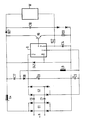
- the storage capacitor C18 feeds an inverter W and is connected on the one hand via a blocking inductor L1, the charging diode D27 and the charging inductor L4, and on the other hand via a measuring resistor R33 to a main rectifier G1 in a two-way circuit, which is fed by an AC voltage network N and essentially has one at its terminals provides unsmoothed voltage.
- the main transistor V6 via which the charging inductor L4 can be switched to the main rectifier and thus can be charged, is used to regulate the voltage at the storage capacitor C18.
- the signal at the measuring resistor R33 lying between the main transistor V6 and the storage capacitor C18 on the one hand and the main rectifier G1 on the other hand is fed via a delay element (resistor R27 and capacitor C14) to the input 7 of a control part with a controller X, which controls the main transistor V6 as a secondary switch.
- a swinging diode D42 is also connected in anti-parallel to the main transistor and the measuring resistor R33;
- the "invisible" capacitances (the choke, the diodes, etc.) can discharge past the main transistor V6 via these.
- the inductor L4 charges and the capacitor C14 decelerates until its voltage reaches the setpoint value which is fed to the controller X of the control part and takes the form of an unsmoothed rectified alternating voltage: the current drawn from the mains therefore has an average a sinusoidal course.
- the controller switches off the main transistor V6:
- the inductor L4 then outputs its energy via the charging diode D27 to the storage capacitor C18, the voltage of which in the meantime had dropped somewhat as a result of the load from the inverter W.
- the signal at the measuring resistor R33 and - with a delay - the signal at the capacitor C14 decrease.
- the delay element R27 / C14 is dimensioned such that the voltage at C14 reaches the lower switchover point of the regulator when the current through the charging inductor L4 has become zero, i.e. it has been completely magnetized back:
- V6 is then switched on, this transistor has to take over neither a residual current of the charging choke L4 nor a reverse current of the diode D27, so that practically no switch-on losses occur.
- the protective capacitor C17 serves to limit the voltage rise at the blocked main transistor V6 and is connected in parallel to the switching path of this transistor and the measuring resistor R33 via the decoupling diode D9 and a capacitor C8:
- the protective capacitor C17 charges via L4, D9 and a charging capacitor C8 and thereby delays the rise in the blocking voltage on the switching path of the main transistor V6, so that only a small power loss occurs.
- the DC operating voltages for the control section are supplied in the start-up phase by an additional rectifier G2 which is connected to the AC network N via capacitors C6, C7 and which feeds the partial capacitors C8 and C9 in series connection; the connection point of these two capacitors lies at the negative terminal of the main rectifier G1, so that they supply a positive or a negative operating voltage.
- the partial capacitor C8 is also connected to the main rectifier G1 via the decoupling diode D9, the protective capacitor C17 and the charging inductor L4 and thus receives an additional charge from the main rectifier when the main transistor V6 is blocked and C17 is charging; C17 is dimensioned with 300 pF so large that this additional charge of C8 is sufficient for the subsequent control of the main transistor. Additional rectifiers and capacitors C6, C7 are therefore only dimensioned for the remaining power requirements of the controller and monitoring section.
- the other partial capacitor C9 is connected via the protective inductor L9 and the protective capacitor C17 in parallel to the switching path of the main transistor V6 and the measuring resistor R33;
- the discharge current of the protective capacitor C17 flows through this discharge circuit and thus via C9 when the main transistor V6 is turned on, which in this case charges the partial capacitor C9.
- both capacitors have approximately the same capacitance (approx. 50 ⁇ f).
- the different voltages are set during operation by appropriate dimensioning of the protective choke L9: The latter is dimensioned about three times as large as would be necessary to sufficiently delay the rise in the discharge current from C17 to V6.
- the recharging of the partial capacitor C9 when the protective capacitor C17 is discharged via the main transistor V6 is namely considerably less than the charge of the partial capacitor C8 when the protective capacitor C17 is charged.
- Such a coordination of the time constants is assumed that a complete charge or discharge of C17 is guaranteed in the associated switching cycles of V6.
- the energy stored in the protective choke L9 is finally discharged via the diode D9 and the two partial capacitors C8 and C9 in series connection. This discharge process is irrelevant for the voltage relation across the partial capacitors, since it affects both capacitors to the same extent.
- the energy of the protective choke L9 is thus used to supply the electronics and does not burden the main transistor V6.
Landscapes
- Rectifiers (AREA)
- Circuit Arrangements For Discharge Lamps (AREA)
- Dc-Dc Converters (AREA)
Abstract
Claims (7)
Priority Applications (1)
| Application Number | Priority Date | Filing Date | Title |
|---|---|---|---|
| AT81900980T ATE8954T1 (de) | 1980-04-15 | 1981-04-14 | Stromversorgungsgeraet. |
Applications Claiming Priority (4)
| Application Number | Priority Date | Filing Date | Title |
|---|---|---|---|
| DE3014472A DE3014472C2 (de) | 1980-04-15 | 1980-04-15 | Stromversorgungsgerät |
| DE3014472 | 1980-04-15 | ||
| DE3029656 | 1980-08-05 | ||
| DE19803029656 DE3029656C2 (de) | 1980-08-05 | 1980-08-05 | Stromversorgungsgerät |
Publications (2)
| Publication Number | Publication Date |
|---|---|
| EP0050132A1 EP0050132A1 (fr) | 1982-04-28 |
| EP0050132B1 true EP0050132B1 (fr) | 1984-08-08 |
Family
ID=25784971
Family Applications (1)
| Application Number | Title | Priority Date | Filing Date |
|---|---|---|---|
| EP81900980A Expired EP0050132B1 (fr) | 1980-04-15 | 1981-04-14 | Appareil d'alimentation |
Country Status (4)
| Country | Link |
|---|---|
| EP (1) | EP0050132B1 (fr) |
| FI (1) | FI72015C (fr) |
| IT (1) | IT1137329B (fr) |
| WO (1) | WO1981003103A1 (fr) |
Families Citing this family (1)
| Publication number | Priority date | Publication date | Assignee | Title |
|---|---|---|---|---|
| CH670340A5 (fr) * | 1985-08-19 | 1989-05-31 | Hasler Ag Ascom |
Family Cites Families (1)
| Publication number | Priority date | Publication date | Assignee | Title |
|---|---|---|---|---|
| US3969652A (en) * | 1974-01-04 | 1976-07-13 | General Electric Company | Electronic ballast for gaseous discharge lamps |
-
1981
- 1981-04-10 IT IT21037/81A patent/IT1137329B/it active
- 1981-04-14 WO PCT/DE1981/000059 patent/WO1981003103A1/fr not_active Ceased
- 1981-04-14 EP EP81900980A patent/EP0050132B1/fr not_active Expired
- 1981-04-15 FI FI811180A patent/FI72015C/fi not_active IP Right Cessation
Non-Patent Citations (1)
| Title |
|---|
| ETZ, Bd. 100, 1979, H. 13, S. 664-670 * |
Also Published As
| Publication number | Publication date |
|---|---|
| FI72015C (fi) | 1987-03-09 |
| IT8121037A0 (it) | 1981-04-10 |
| EP0050132A1 (fr) | 1982-04-28 |
| FI72015B (fi) | 1986-11-28 |
| IT1137329B (it) | 1986-09-10 |
| FI811180L (fi) | 1981-10-16 |
| WO1981003103A1 (fr) | 1981-10-29 |
Similar Documents
| Publication | Publication Date | Title |
|---|---|---|
| DE3319739C2 (de) | Vorschaltgerät für Gasentladungslampen | |
| DE69623394T2 (de) | Schaltkreis und Verfahren zum Steuerung eines Einschaltstrombegrenzers in ein Leistungswandler mit Leistungsfaktorkorrektur | |
| DE3785534T2 (de) | Parallel resonanter auf-abwaertskonverter. | |
| DE2827693A1 (de) | Wechselrichter und dessen verwendung in einem batterieladegeraet | |
| EP0299339A1 (fr) | Dispositif de commutation à faible perte de commutateurs à semi-conducteur d'un onduleur à trois points | |
| DE4010435C2 (fr) | ||
| DE10153738B4 (de) | Gleichrichterschaltung und Verfahren zu deren Steuerung | |
| DE2312127A1 (de) | Elektrische drehzahlregelungseinrichtung fuer einen wechselstrommotor | |
| DE1463662C3 (de) | Elektrisches Kleingerat | |
| DE69007442T2 (de) | Netzteil vom Typ AC-DC-Wandler. | |
| DE4025322A1 (de) | Netzbetriebene phasenanschnitt-steuerschaltung | |
| DE69410775T2 (de) | Elektronisches Vorschaltgerät für Entladungslampen mit einem Resonanzkreis zur Begrenzung des Formfaktors und zur Verbesserung des Leistungsfaktors | |
| EP0203571B1 (fr) | Onduleur statique avec surélévation de courant en cas de court-circuit | |
| EP0057910B1 (fr) | Circuit pour l'alimentation régulée d'un utilisateur | |
| EP0050753A1 (fr) | Disposition de circuit pour alimenter un utilisateur en courant alternatif avec une tension alternative et plus particulièrement avec une tension sinusoidale | |
| DE1513209A1 (de) | Einrichtung zur Erzeugung einer sinusfoermigen Wechselspannung konstanter Amplitude mittels eines statischen Resonanzkreis-Wechselrichters | |
| DE3720600A1 (de) | Stabilisierschaltung fuer schalt-spannungsversorgungsschaltung | |
| EP0324904A1 (fr) | Alimentation pour générer une tension continue régulée | |
| EP0165898A2 (fr) | Dispositif pour remédier à disparition de la tension alternative de réseau | |
| DE3149447A1 (de) | Regelungsschaltung zum konstanthalten der betriebsspannung eines elektrischen verbrauchers | |
| EP0120258B1 (fr) | Circuit économiseur d'énergie | |
| DE69313256T2 (de) | Ballastschaltung | |
| DE2816361A1 (de) | Verfahren zum betrieb eines leistungskondensators zur blindstromkompensation | |
| EP0324902B1 (fr) | Alimentation stabilisée pour fournir une tension régulée | |
| DE3029656C2 (de) | Stromversorgungsgerät |
Legal Events
| Date | Code | Title | Description |
|---|---|---|---|
| PUAI | Public reference made under article 153(3) epc to a published international application that has entered the european phase |
Free format text: ORIGINAL CODE: 0009012 |
|
| 17P | Request for examination filed |
Effective date: 19811106 |
|
| AK | Designated contracting states |
Designated state(s): AT CH FR GB NL SE |
|
| GRAA | (expected) grant |
Free format text: ORIGINAL CODE: 0009210 |
|
| AK | Designated contracting states |
Designated state(s): AT CH FR GB LI NL SE |
|
| REF | Corresponds to: |
Ref document number: 8954 Country of ref document: AT Date of ref document: 19840815 Kind code of ref document: T |
|
| ET | Fr: translation filed | ||
| PLBE | No opposition filed within time limit |
Free format text: ORIGINAL CODE: 0009261 |
|
| STAA | Information on the status of an ep patent application or granted ep patent |
Free format text: STATUS: NO OPPOSITION FILED WITHIN TIME LIMIT |
|
| 26N | No opposition filed | ||
| PGFP | Annual fee paid to national office [announced via postgrant information from national office to epo] |
Ref country code: GB Payment date: 19890331 Year of fee payment: 9 |
|
| PGFP | Annual fee paid to national office [announced via postgrant information from national office to epo] |
Ref country code: AT Payment date: 19890403 Year of fee payment: 9 |
|
| PGFP | Annual fee paid to national office [announced via postgrant information from national office to epo] |
Ref country code: FR Payment date: 19890421 Year of fee payment: 9 |
|
| PGFP | Annual fee paid to national office [announced via postgrant information from national office to epo] |
Ref country code: SE Payment date: 19890428 Year of fee payment: 9 |
|
| PGFP | Annual fee paid to national office [announced via postgrant information from national office to epo] |
Ref country code: NL Payment date: 19890430 Year of fee payment: 9 |
|
| PGFP | Annual fee paid to national office [announced via postgrant information from national office to epo] |
Ref country code: CH Payment date: 19890724 Year of fee payment: 9 |
|
| PG25 | Lapsed in a contracting state [announced via postgrant information from national office to epo] |
Ref country code: GB Effective date: 19900414 Ref country code: AT Effective date: 19900414 |
|
| PG25 | Lapsed in a contracting state [announced via postgrant information from national office to epo] |
Ref country code: SE Effective date: 19900415 |
|
| PG25 | Lapsed in a contracting state [announced via postgrant information from national office to epo] |
Ref country code: LI Effective date: 19900430 Ref country code: CH Effective date: 19900430 |
|
| PG25 | Lapsed in a contracting state [announced via postgrant information from national office to epo] |
Ref country code: NL Effective date: 19901101 |
|
| GBPC | Gb: european patent ceased through non-payment of renewal fee | ||
| NLV4 | Nl: lapsed or anulled due to non-payment of the annual fee | ||
| PG25 | Lapsed in a contracting state [announced via postgrant information from national office to epo] |
Ref country code: FR Effective date: 19901228 |
|
| REG | Reference to a national code |
Ref country code: CH Ref legal event code: PL |
|
| REG | Reference to a national code |
Ref country code: FR Ref legal event code: ST |
|
| EUG | Se: european patent has lapsed |
Ref document number: 81900980.4 Effective date: 19910115 |