EP0050156A1 - Rotierendes schneidwerkzeug - Google Patents
Rotierendes schneidwerkzeug Download PDFInfo
- Publication number
- EP0050156A1 EP0050156A1 EP81900017A EP81900017A EP0050156A1 EP 0050156 A1 EP0050156 A1 EP 0050156A1 EP 81900017 A EP81900017 A EP 81900017A EP 81900017 A EP81900017 A EP 81900017A EP 0050156 A1 EP0050156 A1 EP 0050156A1
- Authority
- EP
- European Patent Office
- Prior art keywords
- groove
- rotary
- pair
- rotary blade
- disks
- Prior art date
- Legal status (The legal status is an assumption and is not a legal conclusion. Google has not performed a legal analysis and makes no representation as to the accuracy of the status listed.)
- Ceased
Links
Images

Classifications
-
- B—PERFORMING OPERATIONS; TRANSPORTING
- B27—WORKING OR PRESERVING WOOD OR SIMILAR MATERIAL; NAILING OR STAPLING MACHINES IN GENERAL
- B27B—SAWS FOR WOOD OR SIMILAR MATERIAL; COMPONENTS OR ACCESSORIES THEREFOR
- B27B5/00—Sawing machines working with circular or cylindrical saw blades; Components or equipment therefor
- B27B5/29—Details; Component parts; Accessories
- B27B5/30—Details; Component parts; Accessories for mounting or securing saw blades or saw spindles
- B27B5/36—Mounting for swivelling or tilting the circular saw blade, e.g. using an adjustable mounting
Definitions
- the present invention relates to a rotary cutter of the type in which the rotary blade of a sawing machine such as a table or radial saw or of a milling machine or the like is mounted at an angle with respect to a rotary arbor or shaft and in which grooves of any desired widths may be cut through changing the mounting angle of the rotary blade with respect to the rotary arbor or shaft.
- the bottom surface of the groove may not be cut. into a flat surface regardless of the groove width, but into an arcuate surface with its centre coincident with the centre of rotation of the rotary cutter. This.phenomenon becomes more and more pronounced with increase of the groove width.
- the pair of clamping disks 8 are rotatably and tiltably supported between the pair of pressing disks 4 and the rotary blade 13 is rotatably supported between said clamping disks 8.
- the desired mounting angle of the rotary blade 13 can be obtained as desired to enable the grooves 15 of various widths to be cut upon rotation of the rotary blade 13, and the bottom surface of the groove 15 to be formed to a substantially flat surface at all times regardless of the width of the groove.
- the pressing disks 4 are connected with each other by means of the fastening screws 7, and the pair of clamping disks 8 are unrotatably engaged with each other through engagement of the engagement recesses 11 and engagement projections 12.
- the pair of pressing disks 4 and . the pair of clamping disks 8 may be rotated in unison at the time of rotational adjustment between the pressing disks 4 and the clamping disks 8'or between the clamping disks 8 and the rotary blade 13, so that the disks 4 and 8 of each pair need not be rotated separately and hence the rotary blade 13 may be readily adjusted for tilting.
- a pair of pressing disks 4 are mounted on the arbor 1 between the pair of holding disks 2 and are pressedly engaged between the holding disks 2 so as to be capable of rotating in unison with the arbor.
- the inner confronting surfaces 5 of the pressing disks 4 are inclined with respect to the outer surfaces thereof and extend parallel to each other.
- the central portion of each inclined surface 5 of the pressing disks 4 is projectively provided with a pair of bearing sleeves 6, the radially outer peripheral surfaces of this pair of bearing sleeves 6 forming a portion of a spherical surface 26 whose centre is situated on a point on the central axis of the arbor 1, when the axial end faces of the respective bearing sleeves are abutted with each other as shown in Fig. 1.
- One of the bearing sleeves 6 projects by a greater length than the other.
- a pair of fastening screws 7 are passed through the shorter bearing sleeve 6 from outside and are screwed into the longer bearing sleeve 6 on the other pressing disk 4 for rotationally connecting the pressing disks 4 to each
- a pair of clamping disks 8 are mounted between the two pressing disks 4'so as to be supported on the bearing sleeves 6 and are pressedly engaged and secured between the disks 4.
- the inner peripheral surface of a bore 28 of the clamping disks 8 is not curved but extends linearly axially as shown in Fig. 1.
- Each clamping disks 8 and each pressing disk 4 may be rotated relative to the other disk of each pair by relieving the pressure contact in a manner to be described below.
- the inner confronting surfaces 9 of the disks 8 are inclined with respect to the outer surfaces thereof and are extended parallel to each other.
- the central portion of the inclined surface 9 on one of the clamping disks 8 is provided with an annular projection 10 which is interrupted by upper and lower recesses 11, as illustrated in Fig. 2(a).
- the inclined surface of the other clamping disk 8 is provided with upper and lower engagement projections 12 at locations corresponding to the engagement recesses ' 11, the projections 12 engaging with said recesses 11 for rotationally connecting the disks 8 to each other.
- a rotary cutting blade-13 is clampedly held between the disks 8 and has a central opening 23 in which are engaged the ring-shaped projection 10 and engagement projections 12.
- the rotary cutting blade 13 is capable of being mounted perpendicularly to the axis of the arbor 1 or at an inclination with respect thereto. Upon removal of clamping action of the pressing disks 4, the rotary blade 13 and the pair.of clamping disks may be rotated relative to one another.
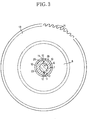
- the outer periphery of rotary blade 13 has a multiplicity of cutting elements or teeth 14 having end faces or cutting edges with continuously changing end skew angles as shown in
- the rotary cutter blade 13 has an overall elliptical shape, with the lengths of the cutting elements A1, A2; Bl, B2; and Cl, C2 becoming shorter in this sequence.
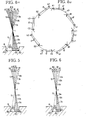
- a plurality of lines 13a-13c symbolically represent the vertical and inclined attitudes of the rotary blade 13.
- cutting elements al-c2, represented by lines 17 drawn tangentially to each of the cutting elements A1-C2, are projections of each of the cutting elements A1-C2 as viewed substantially from the tangential direction.
- a nut 16 Screwed onto the end portion of the arbor 1 is a nut 16 which cooperates with the step portion 3 of the arbor 1 to tightly clamp such elements as the pairs of holding disks 2, pressing disks 4 and clamping disks 8.
- Cutting the groove 15 as shown in Fig. 4(a) by utilizing the rotary blade 13 of the foregoing construction is accomplished by rotating the blade together with the arbor 1.
- the angle portions on either side of the groove 15 are cut by the cutting elementsAl, A2 which have the maximum length and whose end faces or cutting edges have the maximum end skew or bevel angles.
- the groove 15 is cut successively inwardly from both of the angle portions by a multiplicity of cutting elements Bl, B2 which become gradually shorter than the cutting elements A1, A2 and whose cutting edges have end skew which also becomes gradually smaller than those of the cutting elements Al, A2.
- the central portion of the groove 15 is cut by the cutting elements Cl, C2 which are the shortest of the cutting elements and whose cutting edges have zero end skew angles.
- the bottom surface of the groove 15 may be cut to a flat surface.
- the mounting angle of inclination of the rotary blade 13 is changed in case of changing the width of groove 15 to be cut. For thus changing the mounting angle, the rotary blade 13 is rotated along with both clamping disks 8 with respect to the pair of pressing disks 4.
- the disks 8 are rotated with disks 4 remaining stationary, the radially inner surface of the disks 4 travelling on the radially outer spherical surface of the bearing sleeves 6.
- both clamping disks 8 will be tilted smoothly along the spherical surface portion 26 while being held in linear conta0t:with this surface at any position thereon, the line of contact between the spherical surface portion 26 and clamping disks 8 defining a circle.
- the rotary blade 13 is clamped stably on the bearing sleeves 6 and will not vibrate radially of the arbor.
- the relative position between the pressing disks 4 and clamping disks 8 is changed, because the rotary blade 13 is brought to the more erect position by the rotational adjustment of the clamping.disks 8 with respect to the pressing disks 4, as described above. Consequently, once the rotary blade 13 has been erected and as long as the attitudes of the rotary blade 13 and clamping disks 8 are not corrected relative to one another, the cutting elements A1, A2 of maximum length and whose end faces or cutting edges have the maximum end skew angles, will not cut the side walls of the groove 15, contrary to what is intended. Instead, other cutting elements such as cutting elements Bl, B2 will cut the side walls, the cutting elements Cl, C2 will cut the groove 15 at portions offset towards one or the other sides.
- the bottom surface of the groove 15 will be.cut by the cutting elements Al, A2, Cl, C2. As a result, the bottom surface of the groove 15 will become uneven or irregular instead of being cut to a flat surface.
- the rotary blade when altering the mounting angle of the rotary blade 13 as described above, the rotary blade is rotated further and adjusted relative to the pair of clamping disks 8, so that the positions of the cutting elements Al, A2, which are of maximum length and have the maximum end skew or bevel angles at the cutting edges will cut the angle portions inside the groove 15 as shown in Fig. 6.
- the cutting elements Al, A2 always cut the angle portions inside the groove 15, the cutting elements Bl, B2 will cut the positions inwards of the groove sides, and the cutting elements Cl, C2 will cut the central portion at the bottom of the groove.
- the bottom surface of the groove 15 becomes substantially flat or level without any extreme unevenness regardless of the prevailing groove widths.
- each of the cutting elements A1-C2 of the rotary blade 13 is formed so as to cut the bottom surface of the groove 15 to flatness when the rotary blade 13 is in the inclined state shown in Fig. 4(a).
- the bottom surface of the groove 15 therefore will always have some unevenness but this can be ignored since the amount of change in the level of the unevenness is extremely small.
- the operation for adjusting the mounting angle of the rotary cutter 13 is as follows.
- the rotary blade 13 is rotated relative to the clamping disks 8, until the cutting elements Al and A2, whose cutting edges have the maximum end skew angles, have been brought to a position to cut both the angle portions of the groove 15.
Landscapes
- Life Sciences & Earth Sciences (AREA)
- Engineering & Computer Science (AREA)
- Mechanical Engineering (AREA)
- Wood Science & Technology (AREA)
- Forests & Forestry (AREA)
- Milling Processes (AREA)
- Processing Of Stones Or Stones Resemblance Materials (AREA)
Applications Claiming Priority (2)
| Application Number | Priority Date | Filing Date | Title |
|---|---|---|---|
| JP202880U JPS56104825U (de) | 1980-01-12 | 1980-01-12 | |
| JP2028/80 | 1980-01-12 |
Publications (2)
| Publication Number | Publication Date |
|---|---|
| EP0050156A1 true EP0050156A1 (de) | 1982-04-28 |
| EP0050156A4 EP0050156A4 (de) | 1984-03-26 |
Family
ID=11517870
Family Applications (1)
| Application Number | Title | Priority Date | Filing Date |
|---|---|---|---|
| EP19810900017 Ceased EP0050156A4 (de) | 1980-01-12 | 1980-12-13 | Rotierendes schneidwerkzeug. |
Country Status (4)
| Country | Link |
|---|---|
| EP (1) | EP0050156A4 (de) |
| JP (1) | JPS56104825U (de) |
| DK (1) | DK149131C (de) |
| WO (1) | WO1981001977A1 (de) |
Family Cites Families (1)
| Publication number | Priority date | Publication date | Assignee | Title |
|---|---|---|---|---|
| GB1538424A (en) * | 1976-02-23 | 1979-01-17 | Ellis G | Rotary cutting device |
-
1980
- 1980-01-12 JP JP202880U patent/JPS56104825U/ja active Pending
- 1980-12-13 EP EP19810900017 patent/EP0050156A4/de not_active Ceased
- 1980-12-13 WO PCT/JP1980/000306 patent/WO1981001977A1/ja not_active Ceased
-
1981
- 1981-09-11 DK DK404381A patent/DK149131C/da not_active IP Right Cessation
Non-Patent Citations (2)
| Title |
|---|
| No relevant documents have been disclosed * |
| See also references of WO8101977A1 * |
Also Published As
| Publication number | Publication date |
|---|---|
| EP0050156A4 (de) | 1984-03-26 |
| JPS56104825U (de) | 1981-08-15 |
| DK404381A (da) | 1981-09-11 |
| WO1981001977A1 (fr) | 1981-07-23 |
| DK149131B (da) | 1986-02-10 |
| DK149131C (da) | 1986-07-21 |
Similar Documents
| Publication | Publication Date | Title |
|---|---|---|
| US4589458A (en) | Multiple saw blade adjustable dado cutter | |
| US5901629A (en) | Saw arbor and guided circular saw | |
| JP2000509336A (ja) | 歯付き部品用切削工具 | |
| US12605781B2 (en) | Circular saw blades | |
| US4573831A (en) | Cutter blade | |
| JPH01295709A (ja) | フライス | |
| US3976112A (en) | Refuse cutter and trim saw unit | |
| US4305441A (en) | Rotary cutter | |
| EP0050156A1 (de) | Rotierendes schneidwerkzeug | |
| EP0598389B1 (de) | Schwingungsgedämpfte Tragscheibe für Diamantwerkzeuge | |
| JP2005501748A (ja) | 切刃板と該切刃板を備えた切削工具 | |
| US4033018A (en) | Indexable milling cutter | |
| WO2005110655A1 (ja) | チップソー | |
| JP7029625B2 (ja) | ブレード固定装置及びダイシング装置 | |
| US5259428A (en) | Rotary cutters | |
| JPH0671684B2 (ja) | リ−マ | |
| JPH09234619A (ja) | スローアウェイチップ及びこれを含む切削工具 | |
| KR970706951A (ko) | 브로칭 공구(Broaching tool) | |
| JP6886105B2 (ja) | ブレード固定装置及びダイシング装置 | |
| JPS6113281Y2 (de) | ||
| AU644374B2 (en) | Rotary cutters | |
| JPH0723203Y2 (ja) | 板材加工用円板カッタ | |
| JP2540113Y2 (ja) | 仕口加工用回転カッター | |
| JP4652187B2 (ja) | 回転切削工具 | |
| JPS6113282Y2 (de) |
Legal Events
| Date | Code | Title | Description |
|---|---|---|---|
| PUAI | Public reference made under article 153(3) epc to a published international application that has entered the european phase |
Free format text: ORIGINAL CODE: 0009012 |
|
| 17P | Request for examination filed |
Effective date: 19820202 |
|
| AK | Designated contracting states |
Designated state(s): AT CH DE GB NL SE |
|
| STAA | Information on the status of an ep patent application or granted ep patent |
Free format text: STATUS: THE APPLICATION HAS BEEN REFUSED |
|
| 18R | Application refused |
Effective date: 19861102 |
|
| RIN1 | Information on inventor provided before grant (corrected) |
Inventor name: FUJISHIRO, NOBUMASA |