EP0050180B1 - Clôture absorbeuse utilisée comme échangeur de chaleur à grande surface - Google Patents
Clôture absorbeuse utilisée comme échangeur de chaleur à grande surface Download PDFInfo
- Publication number
- EP0050180B1 EP0050180B1 EP81101527A EP81101527A EP0050180B1 EP 0050180 B1 EP0050180 B1 EP 0050180B1 EP 81101527 A EP81101527 A EP 81101527A EP 81101527 A EP81101527 A EP 81101527A EP 0050180 B1 EP0050180 B1 EP 0050180B1
- Authority
- EP
- European Patent Office
- Prior art keywords
- heat exchange
- fence
- sections
- heat exchanger
- heat
- Prior art date
- Legal status (The legal status is an assumption and is not a legal conclusion. Google has not performed a legal analysis and makes no representation as to the accuracy of the status listed.)
- Expired
Links
- 239000006096 absorbing agent Substances 0.000 title claims abstract description 16
- 238000001816 cooling Methods 0.000 claims abstract description 3
- 238000010438 heat treatment Methods 0.000 claims abstract description 3
- 239000002131 composite material Substances 0.000 claims description 2
- 238000004080 punching Methods 0.000 claims description 2
- 238000009423 ventilation Methods 0.000 claims description 2
- 238000001125 extrusion Methods 0.000 claims 1
- 238000005253 cladding Methods 0.000 description 14
- 239000003570 air Substances 0.000 description 9
- 239000012267 brine Substances 0.000 description 3
- 238000009826 distribution Methods 0.000 description 3
- HPALAKNZSZLMCH-UHFFFAOYSA-M sodium;chloride;hydrate Chemical compound O.[Na+].[Cl-] HPALAKNZSZLMCH-UHFFFAOYSA-M 0.000 description 3
- 210000002105 tongue Anatomy 0.000 description 3
- 241001136792 Alle Species 0.000 description 2
- VOPWNXZWBYDODV-UHFFFAOYSA-N Chlorodifluoromethane Chemical compound FC(F)Cl VOPWNXZWBYDODV-UHFFFAOYSA-N 0.000 description 2
- 241001295925 Gegenes Species 0.000 description 2
- 238000005452 bending Methods 0.000 description 2
- 238000009434 installation Methods 0.000 description 2
- 239000000463 material Substances 0.000 description 2
- 229910052751 metal Inorganic materials 0.000 description 2
- 210000002445 nipple Anatomy 0.000 description 2
- 239000004033 plastic Substances 0.000 description 2
- 238000010079 rubber tapping Methods 0.000 description 2
- 239000012080 ambient air Substances 0.000 description 1
- 230000000712 assembly Effects 0.000 description 1
- 238000000429 assembly Methods 0.000 description 1
- 238000004140 cleaning Methods 0.000 description 1
- 238000009833 condensation Methods 0.000 description 1
- 230000005494 condensation Effects 0.000 description 1
- 238000010276 construction Methods 0.000 description 1
- 238000011109 contamination Methods 0.000 description 1
- 230000000694 effects Effects 0.000 description 1
- 238000005516 engineering process Methods 0.000 description 1
- 230000007613 environmental effect Effects 0.000 description 1
- 238000001704 evaporation Methods 0.000 description 1
- 230000008020 evaporation Effects 0.000 description 1
- 238000000605 extraction Methods 0.000 description 1
- 239000004744 fabric Substances 0.000 description 1
- 230000002349 favourable effect Effects 0.000 description 1
- 239000013529 heat transfer fluid Substances 0.000 description 1
- 238000004519 manufacturing process Methods 0.000 description 1
- 239000002184 metal Substances 0.000 description 1
- 238000003801 milling Methods 0.000 description 1
- 238000004806 packaging method and process Methods 0.000 description 1
- 239000003973 paint Substances 0.000 description 1
- 238000010422 painting Methods 0.000 description 1
- 230000002035 prolonged effect Effects 0.000 description 1
- 230000001681 protective effect Effects 0.000 description 1
- 239000000243 solution Substances 0.000 description 1
- 229910001220 stainless steel Inorganic materials 0.000 description 1
- 239000010935 stainless steel Substances 0.000 description 1
- 230000003068 static effect Effects 0.000 description 1
- 239000002966 varnish Substances 0.000 description 1
- 238000013022 venting Methods 0.000 description 1
Images





Classifications
-
- F—MECHANICAL ENGINEERING; LIGHTING; HEATING; WEAPONS; BLASTING
- F24—HEATING; RANGES; VENTILATING
- F24S—SOLAR HEAT COLLECTORS; SOLAR HEAT SYSTEMS
- F24S10/00—Solar heat collectors using working fluids
- F24S10/70—Solar heat collectors using working fluids the working fluids being conveyed through tubular absorbing conduits
- F24S10/75—Solar heat collectors using working fluids the working fluids being conveyed through tubular absorbing conduits with enlarged surfaces, e.g. with protrusions or corrugations
- F24S10/753—Solar heat collectors using working fluids the working fluids being conveyed through tubular absorbing conduits with enlarged surfaces, e.g. with protrusions or corrugations the conduits being parallel to each other
-
- F—MECHANICAL ENGINEERING; LIGHTING; HEATING; WEAPONS; BLASTING
- F24—HEATING; RANGES; VENTILATING
- F24S—SOLAR HEAT COLLECTORS; SOLAR HEAT SYSTEMS
- F24S20/00—Solar heat collectors specially adapted for particular uses or environments
- F24S20/40—Solar heat collectors combined with other heat sources, e.g. using electrical heating or heat from ambient air
-
- F—MECHANICAL ENGINEERING; LIGHTING; HEATING; WEAPONS; BLASTING
- F24—HEATING; RANGES; VENTILATING
- F24S—SOLAR HEAT COLLECTORS; SOLAR HEAT SYSTEMS
- F24S20/00—Solar heat collectors specially adapted for particular uses or environments
- F24S20/60—Solar heat collectors integrated in fixed constructions, e.g. in buildings
- F24S20/62—Solar heat collectors integrated in fixed constructions, e.g. in buildings in the form of fences, balustrades or handrails
-
- F—MECHANICAL ENGINEERING; LIGHTING; HEATING; WEAPONS; BLASTING
- F24—HEATING; RANGES; VENTILATING
- F24S—SOLAR HEAT COLLECTORS; SOLAR HEAT SYSTEMS
- F24S80/00—Details, accessories or component parts of solar heat collectors not provided for in groups F24S10/00-F24S70/00
- F24S80/30—Arrangements for connecting the fluid circuits of solar collectors with each other or with other components, e.g. pipe connections; Fluid distributing means, e.g. headers
-
- Y—GENERAL TAGGING OF NEW TECHNOLOGICAL DEVELOPMENTS; GENERAL TAGGING OF CROSS-SECTIONAL TECHNOLOGIES SPANNING OVER SEVERAL SECTIONS OF THE IPC; TECHNICAL SUBJECTS COVERED BY FORMER USPC CROSS-REFERENCE ART COLLECTIONS [XRACs] AND DIGESTS
- Y02—TECHNOLOGIES OR APPLICATIONS FOR MITIGATION OR ADAPTATION AGAINST CLIMATE CHANGE
- Y02B—CLIMATE CHANGE MITIGATION TECHNOLOGIES RELATED TO BUILDINGS, e.g. HOUSING, HOUSE APPLIANCES OR RELATED END-USER APPLICATIONS
- Y02B10/00—Integration of renewable energy sources in buildings
- Y02B10/20—Solar thermal
-
- Y—GENERAL TAGGING OF NEW TECHNOLOGICAL DEVELOPMENTS; GENERAL TAGGING OF CROSS-SECTIONAL TECHNOLOGIES SPANNING OVER SEVERAL SECTIONS OF THE IPC; TECHNICAL SUBJECTS COVERED BY FORMER USPC CROSS-REFERENCE ART COLLECTIONS [XRACs] AND DIGESTS
- Y02—TECHNOLOGIES OR APPLICATIONS FOR MITIGATION OR ADAPTATION AGAINST CLIMATE CHANGE
- Y02E—REDUCTION OF GREENHOUSE GAS [GHG] EMISSIONS, RELATED TO ENERGY GENERATION, TRANSMISSION OR DISTRIBUTION
- Y02E10/00—Energy generation through renewable energy sources
- Y02E10/40—Solar thermal energy, e.g. solar towers
- Y02E10/44—Heat exchange systems
Definitions
- the invention relates to an absorber fence system as a large-area heat exchanger for building heating or cooling by means of heat pumps, consisting of several heat exchanger profiles which are attached to fence posts.
- an absorber fence system is known as a large-area heat exchanger, which consists of several heat exchanger profiles.
- This fence system consists of plastic pipes. With this construction, heat transfer from the bypass air to the plastic pipes takes place only incompletely. Furthermore, privacy protection of the fence system is not guaranteed.
- DE-A-2 530152 discloses a collector element for utilizing the sun's heat, which can be placed and fastened horizontally or inclined on a stable surface (page 4, 1st paragraph). These collector elements have a closed cover, which reduces the efficiency of a large-area heat exchanger. An attachment as a fence system is not shown. The natural breeze would be greatly reduced even with such an attachment or a flow through the fence area would be impossible.
- the object of the present invention is therefore to produce a large-area heat exchanger for an absorber fence system, which has a high degree of efficiency, ensures privacy and whose individual profiles are easy to assemble, easy to transport and are installed in such a way that they are only slightly contaminated even after prolonged use Have service life.
- this object is achieved with a heat exchanger of the type mentioned at the outset in that the individual heat exchanger profiles have a trapezoidal or U-shaped cross section with base surfaces 11, web surfaces 12a, b and bends 13a, b, one web surface 12a being essentially parallel to Cladding profiles 26 of the fence posts 2a, b, c run and are arranged parallel to the opposite bend 13b and the base surfaces 11 of the heat exchanger profiles are inclined at an angle between 5 and 30 degrees to the horizontal, the heat exchanger profiles each having a heat transfer line in the central axis.
- the predominantly extruded heat transfer profiles can be punched out at both ends so that the actual pipe part remains. By subsequent round milling, these short projecting pipe ends can form the connecting parts for the pipe connecting members to be attached during assembly. Arranged one above the other, the individual heat exchanger profiles 1 form a z. B. brine-flow heat exchanger element.
- the heat exchanger profiles can also be produced in the same form as composite profiles made of metal sheets and extruded profiles with the interposition of a thermal paste, as described in DE-A-3 010 523.
- the fence system is advantageously divided into assemblies, so-called modules.
- modules By adding further absorber fields, whereby a standardized number of heat exchanger profiles per absorber field also brings considerable sales advantages, the absorber fence system can be gradually adapted to the required heat extraction performance.
- the feed with the heat transfer medium (brine or frigen) is carried out from a point just above the ground, at the starting post. This saves pipe installation costs from the absorber to the heat pump during installation.
- the fence posts are designed according to the static requirements due to wind pressure and suction in a double-T shape.
- special holders are provided which can be freely moved in the vertical direction in order to enable precise alignment of the individual heat exchanger profiles. This precise alignment is necessary in order to be able to vent the system properly during operation.
- the I-shaped fence posts are provided with pressed-in grooves, in which both conventional hexagon screws and round-head screws with square attachment (DIN 603) are inserted with the screw head so that they cannot rotate and can be freely displaced in the vertical direction.
- DIN 603 conventional hexagon screws and round-head screws with square attachment
- a tongue is formed by sawing or punching two slots in the front vertical part, which forms a counter bearing by simply bending over with a hammer or the like.
- the two parts that stand vertically on the right and left form the mounting bearings for the front post cladding panel.
- cladding panels are attached from the front and rear of the fence using self-tapping screws or rivets.
- These cladding plates not only have the task of protecting the pipe connectors against external influences and meeting aesthetic requirements, but at the same time these shaped plates form the abutment for the heat exchanger profiles, so that twisting is made impossible. A further connection of the cladding sheets with the heat exchanger profiles is therefore not necessary.
- FIG. 1 shows heat exchanger profiles 1a, 1b, which are arranged between fence posts 2a, 2b, 2c.
- the heat exchanger medium is passed through pipe connection connections 3.
- these lead on the one hand to the feed manifold 4 with welded-on connection nipples and on the other hand via the respectively adjacent heat exchanger profiles into the return manifold 5 with welded-on connection nipples.
- a pressure compensation tube 6 is arranged, which enables a uniform flow through the heat transfer medium (brine or Frigene) through the entire absorber fence system.
- the pressure compensation tube 6 is largely from the distributor pipe 4 lying in front of it.
- a pipe reversing bend 7 is installed between the return line 5 and the pressure compensation pipe 6. At its highest point, there is a venting do sventil g. 8
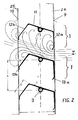
- FIG. 2 shows a plurality of heat exchanger profiles 1 (trapezoidal cross section) shown in cross section, each having a base surface 11 and two web surfaces 12a, 12b and two bevels 13a, 13b. It can be seen that the web surface 12a is in contact with the stop surface 9 of the cladding profile 26 and the bevel 13b is in contact with the stop surface 10 of the cladding profile 25.
- the turbulence generation within the space is shown in Fig. 2 by wind between two trapezoidal heat exchanger profiles.
- Fig. 3 shows an alternative embodiment of the heat exchanger profile 1 with a riveted pipe flange extruded profile 14 and brine pipe connection 3. With 15 the rivets for the pipe press profile are indicated.
- 11 is the base of the heat exchanger profile, 12a is a web surface and 13b is a bevel. The contact points between web surface and stop surface 9 on the one hand and bevel 13b and stop surface 10 on the other hand are shown in a dash-dotted line.
- the width of the wind pipes t is preferably one third of the web height s, the length 1 preferably corresponds to half to a third of the distance a between the wind pipes. Under these conditions, a particularly favorable generation of turbulence between the heat exchanger profiles is achieved.
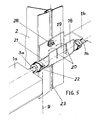
- FIG. 5 shows in perspective a fence post 2, only the front of the I-beam, which contains a sliding groove 23, being shown.
- a pipe connection holder 18 can be locked in the sliding groove by means of fastening screw 28.
- the pipe connection holder has a central tongue 19 which, by bending in the direction of the arrow, serves to secure the elastic pipe connector 21 from being lifted out.
- the elastic pipe connector is connected via clamps 22 to the pipe connections 3a, 3b of the heat exchanger profiles 1a, 1b.
- FIG. 6 Another view of a middle fence post is shown in FIG. 6 according to section II-II / Fig. 1.
- the fence post 2c in the form of a double-T profile each has a sliding groove 23a, 23b for fastening screws 28.
- the semicircular bulge 24 serves to guide the head when using a round-head screw (DIN 603) as an alternative.
- Cladding plates 25a and 25b are fastened to the rear T-flanges of the fence post via self-tapping screws 27.
- the front cladding plate 26 is screwed onto the two vertical tongues of the holder 18. It can be clearly seen that the stop surfaces 9a, 9b of the front cladding plate on the front web surfaces of the heat exchanger profiles 1a. 1 b abut while the abutment surfaces 10a, 10b of the rear cladding plates 25a, 25b abut the folds of the heat exchanger profiles 1 a, 1 b.
- FIG. 7 shows the initial part of an absorber fence according to section Ht-iii / Fig. 1.
- the fence post 2a carries two elastic pipe connectors 21 a, 21 b, which are each connected via a clamp 22a, 22b to the return manifold 5 and the feed manifold 4.
- a one-piece trapezoidal covering hood 30 is provided here, which is of identical design for the start and end posts.
- Fig. 8 shows in stacked form the trapezoidal heat exchanger profiles.
- the highest efficiency in heat transfer is achieved in the solution according to the invention in that the lowest possible air resistance of the large-area heat exchanger is provided.
- the areas blown by the wind are set at a special angle. This enables maximum air flow through the natural air movement between the individual elements of the heat exchanger.
Landscapes
- Engineering & Computer Science (AREA)
- Chemical & Material Sciences (AREA)
- Sustainable Development (AREA)
- Physics & Mathematics (AREA)
- Sustainable Energy (AREA)
- Thermal Sciences (AREA)
- Life Sciences & Earth Sciences (AREA)
- Combustion & Propulsion (AREA)
- Mechanical Engineering (AREA)
- General Engineering & Computer Science (AREA)
- Dispersion Chemistry (AREA)
- Heat-Exchange Devices With Radiators And Conduit Assemblies (AREA)
- Fencing (AREA)
Claims (10)
Priority Applications (1)
| Application Number | Priority Date | Filing Date | Title |
|---|---|---|---|
| AT81101527T ATE14158T1 (de) | 1980-10-16 | 1981-03-04 | Absorberzaunanlage als grossflaechiger waermetauscher. |
Applications Claiming Priority (2)
| Application Number | Priority Date | Filing Date | Title |
|---|---|---|---|
| DE3039062 | 1980-10-16 | ||
| DE3039062A DE3039062C2 (de) | 1980-10-16 | 1980-10-16 | Absorberzaunanlage als großflächiger Wärmetauscher |
Publications (2)
| Publication Number | Publication Date |
|---|---|
| EP0050180A1 EP0050180A1 (fr) | 1982-04-28 |
| EP0050180B1 true EP0050180B1 (fr) | 1985-07-03 |
Family
ID=6114497
Family Applications (1)
| Application Number | Title | Priority Date | Filing Date |
|---|---|---|---|
| EP81101527A Expired EP0050180B1 (fr) | 1980-10-16 | 1981-03-04 | Clôture absorbeuse utilisée comme échangeur de chaleur à grande surface |
Country Status (3)
| Country | Link |
|---|---|
| EP (1) | EP0050180B1 (fr) |
| AT (1) | ATE14158T1 (fr) |
| DE (1) | DE3039062C2 (fr) |
Families Citing this family (21)
| Publication number | Priority date | Publication date | Assignee | Title |
|---|---|---|---|---|
| DE3050717C2 (de) * | 1980-10-16 | 1985-10-24 | Vereinigte Aluminium-Werke AG, 1000 Berlin und 5300 Bonn | Vorrichtung zum Befestigen von Wärmetauscherprofilen in einer Absorberzaunanlage |
| DE3039062C2 (de) | 1980-10-16 | 1983-05-11 | Vaw-Leichtmetall Gmbh, 5300 Bonn | Absorberzaunanlage als großflächiger Wärmetauscher |
| DE3146659A1 (de) * | 1981-11-25 | 1983-06-23 | Gebrüder Uhl GmbH & Co KG, 7981 Vogt | "einrichtung zur uebertragung von waermeenergie" |
| DE3309430A1 (de) * | 1983-03-16 | 1984-09-20 | Helfrecht, Manfred, 8598 Waldershof | Waermesammler |
| DE3326129A1 (de) * | 1983-07-20 | 1985-01-31 | Felten & Guilleaume Energietechnik GmbH, 5000 Köln | Freiflaechen-waermetauscher in zaunform (energiezaun) |
| FR2586092B1 (fr) * | 1985-07-18 | 1988-01-22 | Cornu Jean | Procede d'amelioration du rendement d'un systeme de chauffage par pompe thermodynamique et systeme pour la mise en oeuvre d'un tel procede |
| DE3919143A1 (de) * | 1989-06-12 | 1990-12-13 | Turbon Tunzini Klimatechnik | Flaechenfoermiges waermeaustauschelement zum heizen und kuehlen von raeumen |
| DE102005008680B3 (de) * | 2005-02-25 | 2006-10-26 | Nkt Cables Gmbh | Steckvorrichtung für Geräte oder Kabel an eine elektrische Anlage |
| FR2954792B1 (fr) * | 2009-12-24 | 2012-04-20 | Christophe Foudraz | Garde-corps destine a recevoir des panneaux capteurs de l'energie solaire de differents types |
| DE102011016871B4 (de) | 2011-04-13 | 2014-12-31 | Rainer Elsner | Sicht- oder Lärmschutzwand |
| US8868492B2 (en) | 2011-06-15 | 2014-10-21 | Oracle International Corporation | Method for maximizing throughput and minimizing transactions response times on the primary system in the presence of a zero data loss standby replica |
| ITGE20120038A1 (it) * | 2012-04-13 | 2013-10-14 | 3Tc Engineering S R L | Metodo di impiego di tubi metallici non coibentati come collettori di energia solare e ambientale abbinati a sistemi a pompa di calore. |
| DE102013217964A1 (de) * | 2013-09-09 | 2015-03-26 | Robert Bosch Gmbh | Befestigungssystem für Solarelemente und Kupplungselement für ein derartiges Befestigungssystem |
| US9767178B2 (en) | 2013-10-30 | 2017-09-19 | Oracle International Corporation | Multi-instance redo apply |
| US11657037B2 (en) | 2015-10-23 | 2023-05-23 | Oracle International Corporation | Query execution against an in-memory standby database |
| US10747752B2 (en) | 2015-10-23 | 2020-08-18 | Oracle International Corporation | Space management for transactional consistency of in-memory objects on a standby database |
| CN105674596A (zh) * | 2016-03-23 | 2016-06-15 | 唐玉敏 | 一种翅式聚热窗 |
| US10698771B2 (en) | 2016-09-15 | 2020-06-30 | Oracle International Corporation | Zero-data-loss with asynchronous redo shipping to a standby database |
| US10891291B2 (en) | 2016-10-31 | 2021-01-12 | Oracle International Corporation | Facilitating operations on pluggable databases using separate logical timestamp services |
| US11475006B2 (en) | 2016-12-02 | 2022-10-18 | Oracle International Corporation | Query and change propagation scheduling for heterogeneous database systems |
| US10691722B2 (en) | 2017-05-31 | 2020-06-23 | Oracle International Corporation | Consistent query execution for big data analytics in a hybrid database |
Family Cites Families (7)
| Publication number | Priority date | Publication date | Assignee | Title |
|---|---|---|---|---|
| US3472272A (en) * | 1966-11-21 | 1969-10-14 | Erie Technological Prod Inc | Railing |
| DE1979804U (de) | 1967-12-04 | 1968-02-29 | Bremshey & Co | Heizungsradiator. |
| DE2415656A1 (de) * | 1974-04-01 | 1975-10-16 | Buderus Eisenwerk | Waermeaustauscher mit im abstand zueinander angeordneten rippen |
| DE2530152C2 (de) * | 1975-07-05 | 1983-07-28 | Julius & August Erbslöh GmbH + Co, 5600 Wuppertal | Kollektorelemente zur Ausnutzung der Sonnenwärme |
| DE2941609A1 (de) * | 1979-10-13 | 1981-04-23 | Kabel- und Metallwerke Gutehoffnungshütte AG, 3000 Hannover | Metallplatte oder -bahn zur aufnahme von waermeenergie aus der umluft |
| DE3010523C2 (de) * | 1980-03-19 | 1985-09-12 | Vereinigte Aluminium-Werke AG, 1000 Berlin und 5300 Bonn | Wärmetauscher für Hausdächer, Fassaden, Zäune o.dgl. |
| DE3039062C2 (de) | 1980-10-16 | 1983-05-11 | Vaw-Leichtmetall Gmbh, 5300 Bonn | Absorberzaunanlage als großflächiger Wärmetauscher |
-
1980
- 1980-10-16 DE DE3039062A patent/DE3039062C2/de not_active Expired
-
1981
- 1981-03-04 AT AT81101527T patent/ATE14158T1/de not_active IP Right Cessation
- 1981-03-04 EP EP81101527A patent/EP0050180B1/fr not_active Expired
Also Published As
| Publication number | Publication date |
|---|---|
| DE3039062A1 (de) | 1981-11-05 |
| EP0050180A1 (fr) | 1982-04-28 |
| ATE14158T1 (de) | 1985-07-15 |
| DE3039062C2 (de) | 1983-05-11 |
Similar Documents
| Publication | Publication Date | Title |
|---|---|---|
| EP0050180A1 (fr) | Clôture absorbeuse utilisée comme échangeur de chaleur à grande surface | |
| DE2720885A1 (de) | Sonnenkollektor | |
| DE102013008717A1 (de) | Flächenwärmetauscherelement, Verfahren zur Herstellung eines Flächenwärmetauscherelementes und Werkzeug | |
| EP2190030A2 (fr) | Unité photovoltaïque, système photovoltaïque ainsi que procédé de fabrication d'une unité photovoltaïque | |
| DE3027996A1 (de) | Sonnenkollektor | |
| DE2816970A1 (de) | Dach- oder wandteil mit waermeaustauscher | |
| EP0023043A2 (fr) | Chauffage de surface | |
| DE2750602A1 (de) | Tafel zur ausnutzung der sonnenenergie | |
| DE3046380C2 (de) | Wärmesammlerelement für ein Energiedach oder eine Energiefassade | |
| EP3786532B1 (fr) | Échangeur de chaleur de surface, système et procédé | |
| DE102008013686B4 (de) | Solar-Kollektoren | |
| EP0018543B1 (fr) | Collecteur d'énergie solaire | |
| DE3133790C2 (de) | Plattenheizkörper, insbesondere Plattensammler für Solarheizungen | |
| DE102006006718B4 (de) | Solarkollektor | |
| DE3108535C2 (de) | Energieabsorber für die Ausnutzung von Umweltwärme aus der Atmosphäre | |
| DE4427947A1 (de) | Vorrichtung zur Entwärmung elektrischer und/oder elektronischer Geräte | |
| DE2729829A1 (de) | Kollektor fuer sonnenenergie | |
| DE2922678A1 (de) | Bautafel zur verwendung fuer die waermerueckgewinnung bei gebaeuden mit hilfe einer waermepumpe | |
| WO2009036821A1 (fr) | Dispositif collecteur d'énergie solaire à air | |
| EP1818625B1 (fr) | Agencement de collecteurs solaires | |
| DE3108730C2 (de) | Flächiges Schallschutzelement | |
| DE2633862A1 (de) | Sonnenkollektor | |
| DE3050717C2 (de) | Vorrichtung zum Befestigen von Wärmetauscherprofilen in einer Absorberzaunanlage | |
| DE2832304A1 (de) | Sonnenkollektor aus kunststoff | |
| EP0026808B1 (fr) | Couverture de toit ou revêtement de façade et procédé pour la fabrication d'un panneau pour cette couverture de toit ou ce revêtement de façade |
Legal Events
| Date | Code | Title | Description |
|---|---|---|---|
| PUAI | Public reference made under article 153(3) epc to a published international application that has entered the european phase |
Free format text: ORIGINAL CODE: 0009012 |
|
| AK | Designated contracting states |
Designated state(s): AT BE CH FR GB IT LI LU NL SE |
|
| 17P | Request for examination filed |
Effective date: 19820618 |
|
| RAP1 | Party data changed (applicant data changed or rights of an application transferred) |
Owner name: VEREINIGTE ALUMINIUMWERKE AKTIENGESELLSCHAFT |
|
| ITF | It: translation for a ep patent filed | ||
| GRAA | (expected) grant |
Free format text: ORIGINAL CODE: 0009210 |
|
| AK | Designated contracting states |
Designated state(s): AT BE CH FR GB IT LI LU NL SE |
|
| REF | Corresponds to: |
Ref document number: 14158 Country of ref document: AT Date of ref document: 19850715 Kind code of ref document: T |
|
| ET | Fr: translation filed | ||
| PLBE | No opposition filed within time limit |
Free format text: ORIGINAL CODE: 0009261 |
|
| STAA | Information on the status of an ep patent application or granted ep patent |
Free format text: STATUS: NO OPPOSITION FILED WITHIN TIME LIMIT |
|
| 26N | No opposition filed | ||
| PGFP | Annual fee paid to national office [announced via postgrant information from national office to epo] |
Ref country code: GB Payment date: 19910225 Year of fee payment: 11 |
|
| PGFP | Annual fee paid to national office [announced via postgrant information from national office to epo] |
Ref country code: AT Payment date: 19910228 Year of fee payment: 11 |
|
| PGFP | Annual fee paid to national office [announced via postgrant information from national office to epo] |
Ref country code: FR Payment date: 19910307 Year of fee payment: 11 |
|
| PGFP | Annual fee paid to national office [announced via postgrant information from national office to epo] |
Ref country code: BE Payment date: 19910311 Year of fee payment: 11 |
|
| PGFP | Annual fee paid to national office [announced via postgrant information from national office to epo] |
Ref country code: SE Payment date: 19910318 Year of fee payment: 11 Ref country code: LU Payment date: 19910318 Year of fee payment: 11 |
|
| ITTA | It: last paid annual fee | ||
| PGFP | Annual fee paid to national office [announced via postgrant information from national office to epo] |
Ref country code: NL Payment date: 19910331 Year of fee payment: 11 |
|
| PGFP | Annual fee paid to national office [announced via postgrant information from national office to epo] |
Ref country code: CH Payment date: 19910415 Year of fee payment: 11 |
|
| EPTA | Lu: last paid annual fee | ||
| PG25 | Lapsed in a contracting state [announced via postgrant information from national office to epo] |
Ref country code: LU Free format text: LAPSE BECAUSE OF NON-PAYMENT OF DUE FEES Effective date: 19920304 Ref country code: GB Effective date: 19920304 Ref country code: AT Effective date: 19920304 |
|
| PG25 | Lapsed in a contracting state [announced via postgrant information from national office to epo] |
Ref country code: SE Effective date: 19920305 |
|
| PG25 | Lapsed in a contracting state [announced via postgrant information from national office to epo] |
Ref country code: LI Effective date: 19920331 Ref country code: CH Effective date: 19920331 Ref country code: BE Effective date: 19920331 |
|
| BERE | Be: lapsed |
Owner name: VEREINIGTE ALUMINIUM-WERKE AKTIENGESELLSCHAFT Effective date: 19920331 |
|
| PG25 | Lapsed in a contracting state [announced via postgrant information from national office to epo] |
Ref country code: NL Effective date: 19921001 |
|
| GBPC | Gb: european patent ceased through non-payment of renewal fee | ||
| NLV4 | Nl: lapsed or anulled due to non-payment of the annual fee | ||
| PG25 | Lapsed in a contracting state [announced via postgrant information from national office to epo] |
Ref country code: FR Effective date: 19921130 |
|
| REG | Reference to a national code |
Ref country code: CH Ref legal event code: PL |
|
| REG | Reference to a national code |
Ref country code: FR Ref legal event code: ST |
|
| EUG | Se: european patent has lapsed |
Ref document number: 81101527.0 Effective date: 19921005 |