EP0050351B1 - Alpha-Hydroxyaldehyde in optisch aktiver oder racemischer Form und ihre Benzyl-Derivate - Google Patents
Alpha-Hydroxyaldehyde in optisch aktiver oder racemischer Form und ihre Benzyl-Derivate Download PDFInfo
- Publication number
- EP0050351B1 EP0050351B1 EP81108506A EP81108506A EP0050351B1 EP 0050351 B1 EP0050351 B1 EP 0050351B1 EP 81108506 A EP81108506 A EP 81108506A EP 81108506 A EP81108506 A EP 81108506A EP 0050351 B1 EP0050351 B1 EP 0050351B1
- Authority
- EP
- European Patent Office
- Prior art keywords
- formula
- ether
- optically active
- phenyl
- group
- Prior art date
- Legal status (The legal status is an assumption and is not a legal conclusion. Google has not performed a legal analysis and makes no representation as to the accuracy of the status listed.)
- Expired
Links
Classifications
-
- C—CHEMISTRY; METALLURGY
- C07—ORGANIC CHEMISTRY
- C07D—HETEROCYCLIC COMPOUNDS
- C07D487/00—Heterocyclic compounds containing nitrogen atoms as the only ring hetero atoms in the condensed system, not provided for by groups C07D451/00 - C07D477/00
- C07D487/02—Heterocyclic compounds containing nitrogen atoms as the only ring hetero atoms in the condensed system, not provided for by groups C07D451/00 - C07D477/00 in which the condensed system contains two hetero rings
- C07D487/04—Ortho-condensed systems
-
- C—CHEMISTRY; METALLURGY
- C07—ORGANIC CHEMISTRY
- C07C—ACYCLIC OR CARBOCYCLIC COMPOUNDS
- C07C45/00—Preparation of compounds having >C = O groups bound only to carbon or hydrogen atoms; Preparation of chelates of such compounds
- C07C45/27—Preparation of compounds having >C = O groups bound only to carbon or hydrogen atoms; Preparation of chelates of such compounds by oxidation
-
- C—CHEMISTRY; METALLURGY
- C07—ORGANIC CHEMISTRY
- C07C—ACYCLIC OR CARBOCYCLIC COMPOUNDS
- C07C45/00—Preparation of compounds having >C = O groups bound only to carbon or hydrogen atoms; Preparation of chelates of such compounds
- C07C45/56—Preparation of compounds having >C = O groups bound only to carbon or hydrogen atoms; Preparation of chelates of such compounds from heterocyclic compounds
- C07C45/562—Preparation of compounds having >C = O groups bound only to carbon or hydrogen atoms; Preparation of chelates of such compounds from heterocyclic compounds with nitrogen as the only hetero atom
-
- C—CHEMISTRY; METALLURGY
- C07—ORGANIC CHEMISTRY
- C07C—ACYCLIC OR CARBOCYCLIC COMPOUNDS
- C07C47/00—Compounds having —CHO groups
- C07C47/20—Unsaturated compounds having —CHO groups bound to acyclic carbon atoms
- C07C47/26—Unsaturated compounds having —CHO groups bound to acyclic carbon atoms containing hydroxy groups
- C07C47/263—Unsaturated compounds having —CHO groups bound to acyclic carbon atoms containing hydroxy groups acyclic
-
- C—CHEMISTRY; METALLURGY
- C07—ORGANIC CHEMISTRY
- C07C—ACYCLIC OR CARBOCYCLIC COMPOUNDS
- C07C47/00—Compounds having —CHO groups
- C07C47/20—Unsaturated compounds having —CHO groups bound to acyclic carbon atoms
- C07C47/26—Unsaturated compounds having —CHO groups bound to acyclic carbon atoms containing hydroxy groups
- C07C47/27—Unsaturated compounds having —CHO groups bound to acyclic carbon atoms containing hydroxy groups containing six-membered aromatic rings
-
- C—CHEMISTRY; METALLURGY
- C07—ORGANIC CHEMISTRY
- C07C—ACYCLIC OR CARBOCYCLIC COMPOUNDS
- C07C47/00—Compounds having —CHO groups
- C07C47/20—Unsaturated compounds having —CHO groups bound to acyclic carbon atoms
- C07C47/277—Unsaturated compounds having —CHO groups bound to acyclic carbon atoms containing ether groups, groups, groups, or groups
Definitions
- This invention relates to optically active or racemic a-hydroxyaldehydes.
- a-hydroxyaldehydes of this invention can be used as intermediates for the preparation of pharmaceuticals and agricultural chemicals.
- the optically-active a-hydroxyaldehydes are of great significance.
- atrolactamide derivable from 2-hydroxy-2-phenylpropionaldehyde is used as a pharmaceutical.
- These intermediates are used also in synthesizing frontalin and derivatives thereof which are aggregation pheromones.
- the a-hydroxyaldehydes of this invention can be prepared with high optical purity by allowing an optically active or racemic aminal of formula wherein R 1 is as defined above and A represents a C 6 -C 14 aryl group or a C 1 -C 4 alkyl or alkoxy group- or halogen-substituted C 6 -C 14 aryl group, to react with a Grignard reagent represented by the formula, R 2 MgX wherein R 2 is as defined above and X is a halogen atom such as CI, Br or I, and then hydrolyzing the reaction product.
- a Grignard reagent represented by the formula, R 2 MgX wherein R 2 is as defined above and X is a halogen atom such as CI, Br or I
- the intermediate aminal derivatives of formula (1) may themselves be formed by allowing a C 6 -C 14 arylglyoxal to react with an optically active or racemic 2-(N-substituted aminomethyl)-pyrrolidine of formula wherein A is as defined above; or by allowing a Grignard reagent represented by the formula R 1 MgX wherein R 1 and X are as defined above, to react with an optically active or racemic diazabicyclooctane derivative of formula wherein A is as defined above and R 3 represents a C 1 -C 4 alkyl group.
- the diazabicyclooctane derivatives represented by the formula (4) are novel compounds and can be obtained by allowing a glyoxylate ester or a glyoxylate ester hemiacetal to react with the above-said optically active or racemic 2-(N-substituted aminomethyl)pyrrolidine of formula (3).
- This process and the compounds of formula (4) form the subject of EP-A- 0 048 501 which is divided from EP-A- 0 011 417.
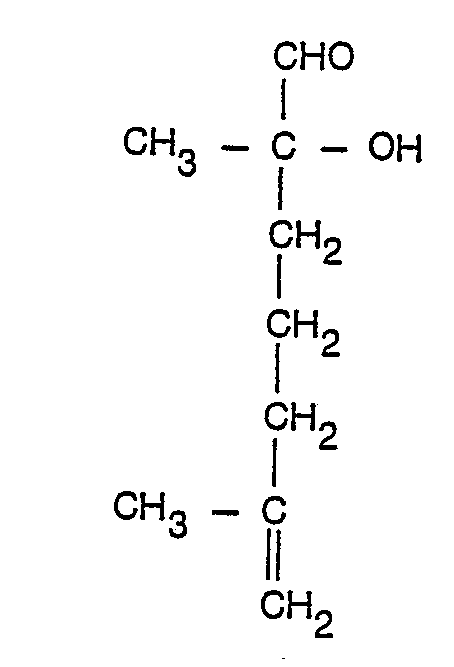
- R 1 is an alkyl group such as methyl, ethyl, n-propyl, isopropyl, n-butyl, isobutyl, n-amyl or cyclohexyl; an alkenyl group such as 2-propenyl, 2-butenyl, 3-butenyl, 2-pentenyl, 3 - pentenyl, 4-pentenyl, 4-methyl-4-pentenyl or cyclohexenyl; an alkynyl group such as ethynyl, propargyl, 2-butynyl, 2-pentynyl, or 3-pentynyl; an aralkyl group such as benzyl, phenethyl or phenylpropyl; or an aryl group such as phenyl, p-tolyl, 2,4-xylyl or naphthyl; or any of these groups substituted with a C
- R 1 and R 2 must, however, represent different groups. Further illustrative such compounds, besides those specifically referred to above and in the Examples which follow, include the optically active a-hydroxyaldehydes of formula 2 in which R 1 is phenyl and R 2 is p-tolyl, isopropyl or ethyl.
- Glyoxylate esters or glyoxylate ester hemiacetals used in preparing diazabicyclooctane derivatives of formula (4) are generally C 1 -C 4 alkyl esters such as methyl glyoxylate, ethyl glyoxylate, n-propyl glyoxylate, isopropyl glyoxylate, n-butyl glyoxylate, methyl hydroxymethoxyacetate ethyl hydroxyethoxyacetate, n-propyl hydroxy-n-propoxyacetate, isopropyl hydroxyisopropoxyacetate, n-butyl hydroxy-n-butoxyacetate and the like.
- the alkyl group of these esters correspond to R 3 in formula (4).
- 2-(N-substituted aminomethyl)pyrrolidines can be prepared easily, for example, from proline [Bull. Chem. Soc., Japan, 51 1869 (1978)].
- the most preferably used are those of formula (3) in which A is a C 6 -C 14 aryl group or a C 1 -C 4 alkoxy- or halogen-substituted C a -C 14 aryl group, such as 2-(anilinomethyl)-pyrrolidine, 2-(2,6-xylidinomethyl)pyrrolidine, 2-(N-p-tolylaminomethyl)pyrrolidine and 2-(N-naphthyl- aminomethyl)pyrrolidine.
- Diazabicyclooctane derivatives of formula (4) are prepared by the reaction between optically active or racemic 2-(N-substituted aminomethyl)pyrrolidines and glyoxylate esters or glyoxylate ester hemiacetals. This reaction is carried out generally in the presence of a common organic solvent such as benzene, toluene, ether, chloroform, hexane, heptane or the like. Although the reaction temperature is subject to no particular limitation, it is generally in the range of -30° to 200°C and preferably below the boiling point of the solvent employed.
- the reaction system must be kept under a superatmospheric pressure in a closed vessel.
- the water formed with the progress of reaction should be removed by the use of a dehydrating agent such as molecular sieve or by azeotropic distillation.
- a dehydrating agent such as molecular sieve or by azeotropic distillation.
- the removal of water by azetropic distillation with benzene or toluene is convenient and economical.
- the diazabicyclooctane derivative of the formula (4) thus obtained can be purified by column chromatograph or distillation, but a crude product obtained after removal of the solvent by distillation can be used without further purification.
- diazabicyclooctane derivatives obtainable in the above manner include 2-alkoxycarbonyl-3-phenyl-1, 3-diazabicyclo[3,3,0]octanes such as 2 - methoxycarbonyl - 3 - phenyl - 1,3 - diazabicyclo[3,3,0]octane, 2 - ethoxycarbonyl - 3 - phenyl - 1,3 - diazabicyclo[3,3,0]octane and 2-butoxycarbonyl-3-phenyl-1, 3-diazabicyclo[3,3,0]octane. It will be easily understood that other diazabicyclooctane derivatives can also be obtained in a similar manner.
- aminal of formula (1) used in preparing an a-hydroxyaldehyde or a benzyl ether thereof of the present invention can be obtained by the reaction of a Grignard reagent with the above-mentioned diazabicyclooctane derivative.
- the Grignard reagents include common Grignard reagents such as C1-C,o-alkyl- magnesium halides, C 3 - 1o -alkenylmagnesium halides, C 2 - 10 -alkynylmagnesium halides, C 7 - 14 -aralkyl- magnesium halides and C6-14-arylmagnesium halides and those compounds substituted by a C 1 - 4 -alkoxy group.
- the organic group bonded to the magnesium atom of a Grignard reagent after reaction corresponds to R 1 of an aminal.
- examples are those containing R 1 as hereinbefore exemplified.
- the yield of an aminal derivative can be improved by conducting the reaction of a Grignard reagent with an optically active or racemic diazabicyclooctane derivative of the formula (4) in the presence of a magnesium halide.
- the magnesium halides include magnesium iodide, magnesium bromide and magnesium chloride. Of these halides, magnesium chloride is preferred.
- the solvents used in the above-said reaction with a Grignard reagent are ethereal solvents used in common Grignard reactions, such as diethyl ether, tetrahydrofuran or a mixture thereof. When the Grignard reagent is reacted in the presence of a magnesium halide, it is preferable to use tetrahydrofuran as solvent.
- reaction temperature is under no particular limitation, it is generally in the range of -100° to 70°C and below the boiling pointof the solvent employed. Lower temperatures are preferable to reduce the by-products.
- the molar ratio of a diazabicyclooctane derivative to a Grignard reagent is generally 1:1 to 1:3, preferably 1:1 to 1:1.5.
- aminals of formula (1) from alkylglyoxals, alkenylglyoxals, alkynylglyoxals and aralkylglyoxals are novel compounds.
- Examples for A of the formula (1) are aryl groups such as phenyl, 2,6-xylyl, p-tolyl and naphthyl. These groups may also be substituted with a halogen or C 1 -C 4 alkoxy group. Examples for R 1 groups are indicated above.
- the arylglyoxal aminal can be further purified by the common technique such as recrystallization of chromatography.
- a crude product obtained after removal of the solvent by distillation is pure enough to be used directly as the starting material in preparing an a-hydroxyaldehyde or a derivative thereof described below.
- the Grignard reagents for use in preparing the compounds of this invention from an aminal of formula (1) can be the same as those used in preparing aminals from diazabicyclooctane derivatives of formula (4).
- R 2 in the formula (2) corresponds to the organic group bonded to the magnesium atom of the Grignard reagent. Therefore, by selecting a suitable Grignard reagent, it is possible to obtain an aldehyde having an intended R 2 .
- the solvent for use in the reaction involving a Grignard reagent can be an ether-type solvent commonly used in general Grignard reactions, such as diethyl ether, tetrahydrofuran or a mixture thereof.
- the reaction temperature is subject to no particular limitation, but is generally in the range of -100° to 70°C and below the boiling point of the solvent employed. Lower reaction temperatures are preferred to obtain a product of high optical purity.
- the molar ratio of an aminal to the Grignard reagent is not particularly limited, but is preferably in the range of 1:1-1:5.
- the optically active a-hydroxyaldehyde of the present invention can be obtained by hydrolyzing the reaction product of the above Grignard reaction. It is also possible to prepare a benzyl ether of an a-hydroxyaldehyde of the invention by allowing the reaction product of the Grignard reaction to react with a benzyl halide and then hydrolyzing. The hydrolysis is effected with an acid such as hydrochloric acid or sulfuric acid at a temperature in the range of generally from 0° to 100°C. In view of the stability of the a-hydroxyaldehyde to be prepared, a lower temperature is preferred.
- the benzyl ether derivatives of optically active compounds of formula (2) and the racemates of certain of these compounds represent a further embodiment of the present invention.
- the optically active a-hydroxyaldehyde thus obtained from (S)-2-(N-substituted aminomethyl)-pyrrolidine used as asymmetric source has R-configuration when the substituent group R 2 has higher priority than the substituent group R 1 in the formula (2) and, conversely, S-configuration when the substituent group R 2 has lower priority than the substituent group R 1 . Therefore, it is possible to prepare an a-hydroxyaldehyde having either configuration by suitably combining the substituent group R 1 of an aminal with the substituent group R 2 of a Grignard reagent used in this invention.
- R-configuration is formed when an aminal having a methyl group as R 1 of formula (1) is allowed to react with an ethyl magnesium halide, while S-configuration is formed by the reaction of an aminal having an ethyl group as R 1 with a methyl magnesium halide.
- an a-hydroxyaldehyde having any configuration can be prepared by the suitable combination of an aminal with a Grignard reagent and, moreover, 2-(N-substituted aminomethyl)pyrrolidine can be recovered by extracting with an organic solvent the neutralized aqueous layer resulting from the hydrolysis.
- the recovered material shows NMR spectrum and IR spectrum identical with those of the starting material. This is one of the advantages of this invention, because an aminal can be repeatedly prepared by using the recovered 2-(N-substituted aminomethyl) pyrrolidine.
- optical yield was determined by reducing (S)-(+)-2-hydroxy-2-phenyl-3-methylbutyraldehyde to (S)-(-)-2-phenyl-3-methylbutane-1,2-diol, condensing the hydroxyl group at position 1 of the latter with (+)-a-methoxy-a-trifluoromethylphenylacetyl chloride to form an ester, and measuring NMR spectra of the diastereomer.
- the reaction was subjected to extraction with ether and the ether layer was washed with saturated aqueous sodium chloride solution and dried over anhydrous sodium sulfate. After removal of the solvent by distillation under reduced pressure, the residue was dissolved in 7 ml of dimethylformamide. To the resulting solution, was added 0.38 g of sodium hydride (55%). The mixture was stirred at 60°C for 2 hours, then admixed with 1.49 g of benzyl bromide, and allowed to react for one hour. The reaction mixture was subjected to extraction by adding water and ether and the ether layer was washed with saturated aqueous sodium chloride solution, and dried over anhydrous sodium sulfate.
- the dried ether layer was freed from the ether by distillation under reduced pressure and then obtained residue was purified by the alumina column, admixed with 40 ml of 2% hydrochloric acid and 40 ml of ether to react at 0°C for 12 hours.
- the ether layer was separated, washed with saturated aqueous sodium chloride solution and dried over anhydrous sodium sulfate.
Landscapes
- Chemical & Material Sciences (AREA)
- Organic Chemistry (AREA)
- Organic Low-Molecular-Weight Compounds And Preparation Thereof (AREA)
- Nitrogen Condensed Heterocyclic Rings (AREA)
Claims (9)



Priority Applications (1)
| Application Number | Priority Date | Filing Date | Title |
|---|---|---|---|
| DE7979302419T DE2965322D1 (en) | 1978-11-02 | 1979-11-02 | Optically active or racemic aminal derivatives, process for preparing same and for converting same to alpha-hydroxyaldehydes |
Applications Claiming Priority (10)
| Application Number | Priority Date | Filing Date | Title |
|---|---|---|---|
| JP135511/78 | 1978-11-02 | ||
| JP13551178A JPS5562089A (en) | 1978-11-02 | 1978-11-02 | Aminal derivative and its preparation |
| JP137147/78 | 1978-11-06 | ||
| JP13714778A JPS5918375B2 (ja) | 1978-11-06 | 1978-11-06 | 光学活性α−ヒドロキシアルデヒドの製造法 |
| JP7036579A JPS55162786A (en) | 1979-06-04 | 1979-06-04 | Glyoxylic acid derivative and its preparation |
| JP70365/79 | 1979-06-04 | ||
| JP70366/79 | 1979-06-04 | ||
| JP70367/79 | 1979-06-04 | ||
| JP7036779A JPS55162729A (en) | 1979-06-04 | 1979-06-04 | Alpha-hydroxyaldehyde and its preparation |
| JP7036679A JPS55162787A (en) | 1979-06-04 | 1979-06-04 | Aminal derivative and its preparation |
Related Parent Applications (1)
| Application Number | Title | Priority Date | Filing Date |
|---|---|---|---|
| EP79302419.1 Division | 1979-11-02 |
Publications (2)
| Publication Number | Publication Date |
|---|---|
| EP0050351A1 EP0050351A1 (de) | 1982-04-28 |
| EP0050351B1 true EP0050351B1 (de) | 1985-03-27 |
Family
ID=27524253
Family Applications (3)
| Application Number | Title | Priority Date | Filing Date |
|---|---|---|---|
| EP81108506A Expired EP0050351B1 (de) | 1978-11-02 | 1979-11-02 | Alpha-Hydroxyaldehyde in optisch aktiver oder racemischer Form und ihre Benzyl-Derivate |
| EP79302419A Expired EP0011417B1 (de) | 1978-11-02 | 1979-11-02 | Optisch aktive oder racemische Aminale, Verfahren zu ihrer Herstellung, ihre Umwandlung in alpha-Hydroxyaldehyde |
| EP81108507A Expired EP0048501B1 (de) | 1978-11-02 | 1979-11-02 | Optisch aktive oder racemische Diazabicyclooctan-Derivate |
Family Applications After (2)
| Application Number | Title | Priority Date | Filing Date |
|---|---|---|---|
| EP79302419A Expired EP0011417B1 (de) | 1978-11-02 | 1979-11-02 | Optisch aktive oder racemische Aminale, Verfahren zu ihrer Herstellung, ihre Umwandlung in alpha-Hydroxyaldehyde |
| EP81108507A Expired EP0048501B1 (de) | 1978-11-02 | 1979-11-02 | Optisch aktive oder racemische Diazabicyclooctan-Derivate |
Country Status (2)
| Country | Link |
|---|---|
| US (3) | US4337346A (de) |
| EP (3) | EP0050351B1 (de) |
Families Citing this family (10)
| Publication number | Priority date | Publication date | Assignee | Title |
|---|---|---|---|---|
| US6204261B1 (en) * | 1995-12-20 | 2001-03-20 | Vertex Pharmaceuticals Incorporated | Inhibitors of interleukin-1β Converting enzyme inhibitors |
| JPS57183782A (en) * | 1981-04-30 | 1982-11-12 | Sumitomo Chem Co Ltd | Preparation of coumarone compound |
| US4800224A (en) * | 1986-05-16 | 1989-01-24 | Ciba-Geigy Corporation | Optically active styrene derivatives, polymers obtained from these, complexes with iridium(I) and their use |
| US4896832A (en) * | 1987-09-07 | 1990-01-30 | Bespak Plc | Dispensing apparatus for metered quantities of pressurised fluid |
| JPH0739418B2 (ja) * | 1987-09-10 | 1995-05-01 | 久光製薬株式会社 | 新規な3−アロイル−6,7−ジヒドロ−5H−ピロロ〔1,2−c〕イミダゾール−7−カルボン酸誘導体 |
| US5043480A (en) * | 1989-06-29 | 1991-08-27 | Eastman Kodak Company | Difunctional products from ethylene oxide and synthesis gas |
| US5182097A (en) * | 1991-02-14 | 1993-01-26 | Virginia Commonwealth University | Formulations for delivery of drugs by metered dose inhalers with reduced or no chlorofluorocarbon content |
| US5124468A (en) * | 1991-08-02 | 1992-06-23 | General Electric Company | Method for silylformylating alkynes and products obtained therefrom |
| US6420522B1 (en) * | 1995-06-05 | 2002-07-16 | Vertex Pharmaceuticals Incorporated | Inhibitors of interleukin-1β converting enzyme |
| WO2005095317A1 (ja) * | 2004-03-31 | 2005-10-13 | Kuraray Co., Ltd. | ハロゲン化不飽和カルボニル化合物の製造方法 |
Family Cites Families (1)
| Publication number | Priority date | Publication date | Assignee | Title |
|---|---|---|---|---|
| US4131623A (en) * | 1969-07-08 | 1978-12-26 | Board Of Supervisors Of Louisiana State University And Agricultural & Mechanical College | Synthesis of aldehydes and products of such synthesis |
-
1979
- 1979-10-30 US US06/089,356 patent/US4337346A/en not_active Expired - Lifetime
- 1979-11-02 EP EP81108506A patent/EP0050351B1/de not_active Expired
- 1979-11-02 EP EP79302419A patent/EP0011417B1/de not_active Expired
- 1979-11-02 EP EP81108507A patent/EP0048501B1/de not_active Expired
-
1981
- 1981-04-27 US US06/257,587 patent/US4383122A/en not_active Expired - Lifetime
-
1983
- 1983-01-13 US US06/457,666 patent/US4584387A/en not_active Expired - Lifetime
Non-Patent Citations (5)
| Title |
|---|
| Chemistry Letters (1979) pp. 1027-1028 * |
| Chemistry Letters (1980), pp. 1223-1226 * |
| Tetrahedron Letters Vol. 23 (47) pp. 4953-54 (1982) * |
| Tetrahedron letters, Vol. 31, (1975) pp. 1381-84 * |
| Topics in stereochemistry, Vol. 6 (1971), p. 108 * |
Also Published As
| Publication number | Publication date |
|---|---|
| EP0050351A1 (de) | 1982-04-28 |
| US4584387A (en) | 1986-04-22 |
| EP0048501A1 (de) | 1982-03-31 |
| US4337346A (en) | 1982-06-29 |
| EP0048501B1 (de) | 1983-07-27 |
| EP0011417B1 (de) | 1983-05-04 |
| EP0011417A1 (de) | 1980-05-28 |
| US4383122A (en) | 1983-05-10 |
Similar Documents
| Publication | Publication Date | Title |
|---|---|---|
| Welch et al. | Synthesis, regioselective deprotonation, and stereoselective alkylation of fluoro ketimines | |
| US4383122A (en) | Process for preparing α-hydroxyaldehyde | |
| Tanikaga et al. | Stereochemical behavior of intermediary compounds in the amine-catalyzed Knoevenagel reaction. | |
| Mukaiyama et al. | Asymmetric synthesis of α-hydroxy aldehydes | |
| JPS6154795B2 (de) | ||
| US4958033A (en) | Process for preparing alcohols | |
| Ito et al. | Trimethylchlorosilane induced ring opening of 2-alkyloxazolidines to enamine derivatives | |
| JPS61129145A (ja) | ヒドロキノン誘導体及びその製造方法 | |
| US4325877A (en) | Production of intermediates for enzyme inhibitors | |
| Kenyon et al. | Alkylations of Phenylacetic, α-Alkylphenylacetic, and Diphenylacetic Esters by Means of Sodamide and Sodium Hydride1 | |
| US5929287A (en) | Chlorination of substituted alkenes using trichloroisocyanuric acid | |
| JP2835785B2 (ja) | 光学活性2−(1−ヒドロキシアルキル)ベンズアルデヒド類の製法 | |
| US3910958A (en) | Process for preparing arylacetic acids and esters thereof | |
| JP4110490B2 (ja) | β−シネンサールの製造法 | |
| JP4437012B2 (ja) | ムスコンのアセタール付加体、その調製方法、並びに(±)−ムスコンの光学分割方法 | |
| JP2571081B2 (ja) | 光学活性1,2−アルカンジオールの製造方法 | |
| Meyers et al. | A Convenient Synthesis and Resolution of R-and S-Atrolactic Acid in High Enantiomeric Purity | |
| US6201158B1 (en) | Process for making intermediate aldehydes | |
| JPH09110773A (ja) | メチラールの精製方法 | |
| JPS6363546B2 (de) | ||
| Loh et al. | Tin‐and Indium‐Mediated Allylation Reactions in Water: Highly Stereoselective Synthesis of β‐Trifluoromethylated Homoallylic Alcohols | |
| JPH0148267B2 (de) | ||
| JPS6148488B2 (de) | ||
| JPS5919535B2 (ja) | r−イオノン及びその誘導体の製法 | |
| EP0385368B1 (de) | Optisch aktive Verbindung |
Legal Events
| Date | Code | Title | Description |
|---|---|---|---|
| PUAI | Public reference made under article 153(3) epc to a published international application that has entered the european phase |
Free format text: ORIGINAL CODE: 0009012 |
|
| 17P | Request for examination filed |
Effective date: 19811019 |
|
| AC | Divisional application: reference to earlier application |
Ref document number: 11417 Country of ref document: EP |
|
| AK | Designated contracting states |
Designated state(s): DE FR GB IT NL |
|
| ITF | It: translation for a ep patent filed | ||
| GRAA | (expected) grant |
Free format text: ORIGINAL CODE: 0009210 |
|
| AC | Divisional application: reference to earlier application |
Ref document number: 11417 Country of ref document: EP |
|
| AK | Designated contracting states |
Designated state(s): DE FR GB IT NL |
|
| REF | Corresponds to: |
Ref document number: 2967419 Country of ref document: DE Date of ref document: 19850502 |
|
| ET | Fr: translation filed | ||
| PLBE | No opposition filed within time limit |
Free format text: ORIGINAL CODE: 0009261 |
|
| STAA | Information on the status of an ep patent application or granted ep patent |
Free format text: STATUS: NO OPPOSITION FILED WITHIN TIME LIMIT |
|
| R20 | Corrections of a patent specification |
Effective date: 19851217 |
|
| 26N | No opposition filed | ||
| ITTA | It: last paid annual fee | ||
| PGFP | Annual fee paid to national office [announced via postgrant information from national office to epo] |
Ref country code: NL Payment date: 19901130 Year of fee payment: 12 |
|
| PG25 | Lapsed in a contracting state [announced via postgrant information from national office to epo] |
Ref country code: NL Effective date: 19920601 |
|
| NLV4 | Nl: lapsed or anulled due to non-payment of the annual fee | ||
| PGFP | Annual fee paid to national office [announced via postgrant information from national office to epo] |
Ref country code: FR Payment date: 19931011 Year of fee payment: 15 |
|
| PGFP | Annual fee paid to national office [announced via postgrant information from national office to epo] |
Ref country code: GB Payment date: 19931013 Year of fee payment: 15 |
|
| PGFP | Annual fee paid to national office [announced via postgrant information from national office to epo] |
Ref country code: DE Payment date: 19931020 Year of fee payment: 15 |
|
| PG25 | Lapsed in a contracting state [announced via postgrant information from national office to epo] |
Ref country code: GB Effective date: 19941102 |
|
| GBPC | Gb: european patent ceased through non-payment of renewal fee |
Effective date: 19941102 |
|
| PG25 | Lapsed in a contracting state [announced via postgrant information from national office to epo] |
Ref country code: FR Effective date: 19950731 |
|
| PG25 | Lapsed in a contracting state [announced via postgrant information from national office to epo] |
Ref country code: DE Effective date: 19950801 |
|
| REG | Reference to a national code |
Ref country code: FR Ref legal event code: ST |