EP0050972A2 - Verfahren zum Herstellen eines Halbleiterbauelementes mit einer verbindenden Elektrodenschicht - Google Patents
Verfahren zum Herstellen eines Halbleiterbauelementes mit einer verbindenden Elektrodenschicht Download PDFInfo
- Publication number
- EP0050972A2 EP0050972A2 EP81305009A EP81305009A EP0050972A2 EP 0050972 A2 EP0050972 A2 EP 0050972A2 EP 81305009 A EP81305009 A EP 81305009A EP 81305009 A EP81305009 A EP 81305009A EP 0050972 A2 EP0050972 A2 EP 0050972A2
- Authority
- EP
- European Patent Office
- Prior art keywords
- material layer
- layer
- gas
- etching
- interconnection
- Prior art date
- Legal status (The legal status is an assumption and is not a legal conclusion. Google has not performed a legal analysis and makes no representation as to the accuracy of the status listed.)
- Granted
Links
Images

Classifications
-
- H—ELECTRICITY
- H10—SEMICONDUCTOR DEVICES; ELECTRIC SOLID-STATE DEVICES NOT OTHERWISE PROVIDED FOR
- H10P—GENERIC PROCESSES OR APPARATUS FOR THE MANUFACTURE OR TREATMENT OF DEVICES COVERED BY CLASS H10
- H10P50/00—Etching of wafers, substrates or parts of devices
- H10P50/73—Etching of wafers, substrates or parts of devices using masks for insulating materials
-
- H—ELECTRICITY
- H10—SEMICONDUCTOR DEVICES; ELECTRIC SOLID-STATE DEVICES NOT OTHERWISE PROVIDED FOR
- H10P—GENERIC PROCESSES OR APPARATUS FOR THE MANUFACTURE OR TREATMENT OF DEVICES COVERED BY CLASS H10
- H10P50/00—Etching of wafers, substrates or parts of devices
- H10P50/20—Dry etching; Plasma etching; Reactive-ion etching
- H10P50/28—Dry etching; Plasma etching; Reactive-ion etching of insulating materials
- H10P50/282—Dry etching; Plasma etching; Reactive-ion etching of insulating materials of inorganic materials
- H10P50/283—Dry etching; Plasma etching; Reactive-ion etching of insulating materials of inorganic materials by chemical means
-
- H—ELECTRICITY
- H10—SEMICONDUCTOR DEVICES; ELECTRIC SOLID-STATE DEVICES NOT OTHERWISE PROVIDED FOR
- H10W—GENERIC PACKAGES, INTERCONNECTIONS, CONNECTORS OR OTHER CONSTRUCTIONAL DETAILS OF DEVICES COVERED BY CLASS H10
- H10W20/00—Interconnections in chips, wafers or substrates
- H10W20/01—Manufacture or treatment
- H10W20/071—Manufacture or treatment of dielectric parts thereof
- H10W20/081—Manufacture or treatment of dielectric parts thereof by forming openings in the dielectric parts
- H10W20/082—Manufacture or treatment of dielectric parts thereof by forming openings in the dielectric parts the openings being tapered via holes
Definitions
- This invention relates to a method for manufacturing a semiconductor device and in particular an improved method for forming thin layers on a semiconductor substrate.
- a multi-interconnection structure has more often been adopted with the advent of a high- density and high-integrated version of semiconductor device.
- One important task in the formation of the multi-interconnection structure is to prevent the disconnection of the interconnection electrode layer due to a possible stepped configuration.
- An etching technique is used in the formation of such multi-interconnection structure. With a recent advance of a microminiaturization technique the etching technique is shifted from a wet process using a liquid etchant to a dry process utilizing plasma.
- a dry etching method has been used in the formation of a contact hole and through hole in an insulating layer as well as the patterning of a metal electrode layer. The dry etching process permits a thin layer such as an insulating layer and metal layer to be formed without undercutting.
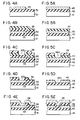
- FIG. lA an active region such as a diffusion layer is formed in a semiconductor substrate and then a contact hole 4 is formed by a dry etching method with a resist film as a mask.
- the side wall of the contact hole 4 extends vertically as shown in Fig. lA. If, as shown in Fig. 1B, a metal layer 5, i.e.
- a first interconnection layer is formed by a vacuum evaporation or sputtering method on the insulating layer, metal will not be deposited on the side wall of the contact hole 4, resulting in a so-called "disconnection" phenomenon.
- a method has been proposed in which metal is deposited on a substrate, while heating the substrate, to cause the mobility of the deposited metal atoms to be enhanced to permit adequate metal to be deposited on the side wall of the contact hole 4. According to this method, however, an irregular surface is likely to be formed on the interconnection electrode layer, making is unsuitable for the microminiaturization of the semiconductor structure.
- the disconnection phenomenon occurs on an interconnection electrode layer on a contact hole, on an interconnection electrode layer on the through hole of the insulating layer between the layers of the multi-interconnection structure, and on an upper interconnection electrode layer on the discontinuity area of a lower interconnection electrode layer.
- An object of this invention is to provide a method for manufacturing a semiconductor device for preventing a possible disconnection of an interconnection electrode layer.
- Another object of this invention is to provide a semiconductor device having a multi-interconnection structure of high reliability.
- a method for manufacturing a semiconductor device comprising the steps of forming a first material layer on a semiconductor substrate, forming a second material layer made of silicon nitride on the first material layer, selectively removing the second material layer, and selectively removing the first material layer with the second material layer as a mask, characterized in that the second material layer is selectively removed by a reactive ion etching method using a gas containing hydrogen and carbon-halogen bonds, to form an opening with a sloped side wall, and said first material layer is selectively removd by an etching method to form an opening with a sloped side wall, the etching method permitting the first and second material layers to be etched away.
- an underlying material layer is selectively removed by an etching method whereby both the silicon nitride layer and the underlying material layer can be etched away, to automatically form a sloped side wall in a resultant opening in the material layer. If a conductive material is deposited directly on the material layer or on an insulating layer overlying the material layer, followed by patterning, an interconnection electrode layer is formed on or above the opening without producing any disconnection.
- the gas containing hydrogen and carbon-halogen bonds as an etchant may be a mixture gas of a hydrogen gas with a gas of CF 4 , C 2 F 6 , C 3 F 8 , CCR 4 , CH 3 Br or the like.
- a CHF 3 gas may also be used.
- an amount of hydrogen gas is preferably 10 to 40 % based on the whole amount of the gas mixture. In this case, it is possible to obtain a silicon nitride layer whose opening has a sloped side wall with an inclination angle of 60° to 70°.
- the reactive ion etching is performed by an apparatus as shown in Fig. 2.
- a workpiece 14 is placed on one (12b) of a pair of parallel, planar electrodes 12a, 12b which are mounted within an etching chamber 11.
- the electrode 12b is connected to a high frequency power generator.
- etching method whereby both the silicon nitride and the underlying material can be etched away
- any etching method such as a plasma etching, reactive ion etching, sputtering etching, wet etching method, in which a proper etchant is used.
- a gas mixture of a H 2 gas with a fluorocarbon gas such as CF 4 may be used as an etchant for an underlying material of silicon oxide; a fluoro-carbon gas such as CF 4 , as an etchant for an underlying material of poly-Si; and a chloro-carbon gas such as CCt 4 as an etchant for an underlying material of aluminium.
- the silicon nitride layer is selectively removed by a first etching on an etching device and then a second etching is performed on the same device under the similar conditions by causing an amount of H 2 to be increased or decreased to, for example, 10 to 30 % i.e. an amount permitting both the silicon nitride layer and the underlying material layer to be etched away.
- the method of this invention can be applied to the formation of an interconnection electrode layer on an insulating layer with a contact hole or a through hole or the formation of a second interconnection electrode layer overlying the first interconnection electrode layer having a discontinuity area with an insulating film therebetween.
- an opening such as a contact hole, through hole and discontinuity in the interconnection electrode layer can be formed to have a sloped side wall, preventing a possible disconnection of an interconnection electrode which is formed on the opening.
- a first insulating layer such as a silicon oxide film 23 is wholly coated on a semiconductor substrate 21 in which an active region 22 such as a diode and transistor is formed and then a silicon nitride film 24 is formed by a plasma CVD method using, for example, SiH 4 and NH 3 .
- a silicon nitride film 24 is etched, by a reactive ion etching method (using a device as shown in Fig. 2), under the conditions of 25 cc/min of CF 4 , 9 cc/min. of H 2 , 0.01 Torr of pressure and 0.25 W/cm 2 of a high frequency power.
- a hole 26a is formed in the silicon nitride film 24 and has a taper of 60° to 70°.
- a reactive ion etching is effected. If at this time both the silicon oxide film 23 and nitride film 24 are etched in a mixed gas under the conditions such as 20 cc/min. of CF 4 and 10 cc/min. of -H 2 , since a sloped side wall has already been formed in the hole 26a, the hole 26a is widened with the continued etching to form a tapered contact hole 26b as shown in Fig. 3C, which would not otherwise be formed by an ordinary etching with a resist as a mask.
- the silicon nitride film 24 is thinly left on the resultant structure, but it may be completely removed dependent upon the etching requirements.
- an interconnection electrode layer 27 made of, for example, aluminium is formed on the resultant structure. Since in this case the taper is formed on the side wall of the contact hole, no disconnection of the interconnection layer 27 occurs due to a possible stepped configuration.
- the resist 25 is removed after the silicon nitride film 24 is selectively etched, the silicon oxide film 23 may be etched with the resist 25 left as it is.
- this invention is applied to the formation of a through hole in a multi-interconnection structure.
- an insulating layer 32 is formed on a semiconductor substrate 31 and a first interconnection layer 33 is formed on the insulating layer 32.
- a silicon oxide film 34 is formed as an insulating layer and then a silicon nitride film 35 is coated on the surface of the resultant structure.
- a through hole 37a is formed, as in Example 1, in a predetermined area of the silicon nitride film 35. If, as shown in Fig.
- etching is effected as in Example 1 after the resist 36 is removed, a tapered through hole 37b is formed in the silicon oxide film (the insulating layer) as in Example 1.
- a second interconnection layer 38 is formed on the surface of the resultant structure. In this case, no discontinuity occurs due to a possible stepped configuration.
- this invention is applied to the formation of an interconnection layer per se.
- a first interconnection layer 43 made of, for example, poly-Si or aluminium is formed on an insulating layer 42 overlying a semiconductor substrate 41.
- a silicon nitride film 44 is wholly formed on the surface of the resultant structure.
- a resist 45 as a maks the silicon nitride film 44 is etched into a predetermined interconnection pattern to provide, for example, a slit 46a.
- the silicon nitride film 44 can be etched such that, as in Examples 1 and 2, the slit 46a has a taper on its side wall. If with the silicon nitride film 44 as a mask the interconnection layr 43 is subjected to a reactive ion etching using, for example, a CF 4 gas for poly-Si or a CCt 4 gas for aluminium, a taper is formed on the side wall of a slit 46b of the interconnection layer 43.
- a reactive ion etching using, for example, a CF 4 gas for poly-Si or a CCt 4 gas for aluminium
- a taper is formed on the side wall of a slit 46b of the interconnection layer 43.
Landscapes
- Drying Of Semiconductors (AREA)
- Internal Circuitry In Semiconductor Integrated Circuit Devices (AREA)
Applications Claiming Priority (2)
| Application Number | Priority Date | Filing Date | Title |
|---|---|---|---|
| JP150991/80 | 1980-10-28 | ||
| JP55150991A JPS5775429A (en) | 1980-10-28 | 1980-10-28 | Manufacture of semiconductor device |
Publications (3)
| Publication Number | Publication Date |
|---|---|
| EP0050972A2 true EP0050972A2 (de) | 1982-05-05 |
| EP0050972A3 EP0050972A3 (en) | 1983-01-26 |
| EP0050972B1 EP0050972B1 (de) | 1985-05-22 |
Family
ID=15508889
Family Applications (1)
| Application Number | Title | Priority Date | Filing Date |
|---|---|---|---|
| EP81305009A Expired EP0050972B1 (de) | 1980-10-28 | 1981-10-23 | Verfahren zum Herstellen eines Halbleiterbauelementes mit einer verbindenden Elektrodenschicht |
Country Status (3)
| Country | Link |
|---|---|
| EP (1) | EP0050972B1 (de) |
| JP (1) | JPS5775429A (de) |
| DE (1) | DE3170633D1 (de) |
Cited By (10)
| Publication number | Priority date | Publication date | Assignee | Title |
|---|---|---|---|---|
| GB2165992A (en) * | 1984-10-23 | 1986-04-23 | Sgs Microelettronica Spa | Reduced-beak planox process for the formation of integrated electronic components |
| EP0274718A3 (de) * | 1987-01-14 | 1990-06-06 | Polaroid Corporation | Zweischichtige Schutzschicht für III-V-Halbleiter |
| EP0436387A3 (en) * | 1990-01-03 | 1991-10-16 | Hewlett-Packard Company | Single chamber via etch through a dual-layer dielectric |
| US5423945A (en) * | 1992-09-08 | 1995-06-13 | Applied Materials, Inc. | Selectivity for etching an oxide over a nitride |
| DE4410747A1 (de) * | 1994-03-28 | 1995-10-05 | Siemens Ag | Verfahren und Einrichtung zum Entsorgen einer Lösung, die eine organische Säure enthält |
| WO2003107410A3 (en) * | 2002-06-14 | 2004-04-15 | Lam Res Corp | Process for etching dielectric films with improved resist and/or etch profile characteristics |
| EP1557875A1 (de) * | 2003-12-29 | 2005-07-27 | STMicroelectronics S.r.l. | Verfahren zur Bildung von Gräben mit abgeschrägtem Profil in einem dielektrischen Material |
| US7049244B2 (en) | 1992-06-15 | 2006-05-23 | Micron Technology, Inc. | Method for enhancing silicon dioxide to silicon nitride selectivity |
| KR101155664B1 (ko) * | 2007-03-15 | 2012-06-13 | 삼성전자주식회사 | 화상형성장치 및 그 동력 단속 장치 |
| US10332850B2 (en) | 2013-06-24 | 2019-06-25 | Imec | Method for producing contact areas on a semiconductor substrate |
Family Cites Families (7)
| Publication number | Priority date | Publication date | Assignee | Title |
|---|---|---|---|---|
| GB1417085A (en) * | 1973-05-17 | 1975-12-10 | Standard Telephones Cables Ltd | Plasma etching |
| US3880684A (en) * | 1973-08-03 | 1975-04-29 | Mitsubishi Electric Corp | Process for preparing semiconductor |
| JPS5158071A (ja) * | 1974-11-18 | 1976-05-21 | Nichiden Varian Kk | Supatsutaetsuchinguho |
| DE2536718C3 (de) * | 1975-08-18 | 1978-04-27 | Siemens Ag, 1000 Berlin Und 8000 Muenchen | Verfahren zur Herstellung geätzter Strukturen in Festkörperoberflächen durch Ionenätzung und Bestrahlungsmaske zur Verwendung in diesem Verfahren |
| NL7607298A (nl) * | 1976-07-02 | 1978-01-04 | Philips Nv | Werkwijze voor het vervaardigen van een inrichting en inrichting vervaardigd volgens de werkwijze. |
| EP0001538B1 (de) * | 1977-10-06 | 1983-01-12 | International Business Machines Corporation | Verfahren zum reaktiven Ionenätzen eines Bauelementes |
| US4269654A (en) * | 1977-11-18 | 1981-05-26 | Rca Corporation | Silicon nitride and silicon oxide etchant |
-
1980
- 1980-10-28 JP JP55150991A patent/JPS5775429A/ja active Granted
-
1981
- 1981-10-23 DE DE8181305009T patent/DE3170633D1/de not_active Expired
- 1981-10-23 EP EP81305009A patent/EP0050972B1/de not_active Expired
Cited By (13)
| Publication number | Priority date | Publication date | Assignee | Title |
|---|---|---|---|---|
| FR2572217A1 (fr) * | 1984-10-23 | 1986-04-25 | Sgs Microelettronica Spa | Procede planox a bec reduit pour la formation de composants electroniques integres |
| GB2165992A (en) * | 1984-10-23 | 1986-04-23 | Sgs Microelettronica Spa | Reduced-beak planox process for the formation of integrated electronic components |
| EP0274718A3 (de) * | 1987-01-14 | 1990-06-06 | Polaroid Corporation | Zweischichtige Schutzschicht für III-V-Halbleiter |
| EP0436387A3 (en) * | 1990-01-03 | 1991-10-16 | Hewlett-Packard Company | Single chamber via etch through a dual-layer dielectric |
| US7049244B2 (en) | 1992-06-15 | 2006-05-23 | Micron Technology, Inc. | Method for enhancing silicon dioxide to silicon nitride selectivity |
| US5423945A (en) * | 1992-09-08 | 1995-06-13 | Applied Materials, Inc. | Selectivity for etching an oxide over a nitride |
| DE4410747A1 (de) * | 1994-03-28 | 1995-10-05 | Siemens Ag | Verfahren und Einrichtung zum Entsorgen einer Lösung, die eine organische Säure enthält |
| WO2003107410A3 (en) * | 2002-06-14 | 2004-04-15 | Lam Res Corp | Process for etching dielectric films with improved resist and/or etch profile characteristics |
| US7547635B2 (en) | 2002-06-14 | 2009-06-16 | Lam Research Corporation | Process for etching dielectric films with improved resist and/or etch profile characteristics |
| EP1557875A1 (de) * | 2003-12-29 | 2005-07-27 | STMicroelectronics S.r.l. | Verfahren zur Bildung von Gräben mit abgeschrägtem Profil in einem dielektrischen Material |
| US7247573B2 (en) | 2003-12-29 | 2007-07-24 | Stmicroelectronics S.R.L. | Process for forming tapered trenches in a dielectric material |
| KR101155664B1 (ko) * | 2007-03-15 | 2012-06-13 | 삼성전자주식회사 | 화상형성장치 및 그 동력 단속 장치 |
| US10332850B2 (en) | 2013-06-24 | 2019-06-25 | Imec | Method for producing contact areas on a semiconductor substrate |
Also Published As
| Publication number | Publication date |
|---|---|
| EP0050972B1 (de) | 1985-05-22 |
| DE3170633D1 (en) | 1985-06-27 |
| EP0050972A3 (en) | 1983-01-26 |
| JPS5775429A (en) | 1982-05-12 |
| JPH0157495B2 (de) | 1989-12-06 |
Similar Documents
| Publication | Publication Date | Title |
|---|---|---|
| US4377438A (en) | Method for producing semiconductor device | |
| CA1169022A (en) | Integrated circuit planarizing process | |
| US4663832A (en) | Method for improving the planarity and passivation in a semiconductor isolation trench arrangement | |
| JP3252780B2 (ja) | シリコン層のエッチング方法 | |
| JPH01290236A (ja) | 幅の広いトレンチを平坦化する方法 | |
| US4758306A (en) | Stud formation method optimizing insulator gap-fill and metal hole-fill | |
| US4818334A (en) | Method of etching a layer including polysilicon | |
| JPS60208838A (ja) | ポリイミドの傾斜エツチング法 | |
| KR20010006099A (ko) | 도핑처리된 이산화규소의 선택적인 에칭을 위한 에칭스톱제로서의 비도핑처리된 이산화규소 | |
| US4708767A (en) | Method for providing a semiconductor device with planarized contacts | |
| EP0050972B1 (de) | Verfahren zum Herstellen eines Halbleiterbauelementes mit einer verbindenden Elektrodenschicht | |
| US4631248A (en) | Method for forming an electrical contact in an integrated circuit | |
| US6127239A (en) | Semiconductor processing methods, and methods of forming capacitors | |
| US6291359B1 (en) | Methods of forming openings and methods of controlling the degree of taper of openings | |
| US5767017A (en) | Selective removal of vertical portions of a film | |
| US6117764A (en) | Use of a plasma source to form a layer during the formation of a semiconductor device | |
| US7709343B2 (en) | Use of a plasma source to form a layer during the formation of a semiconductor device | |
| US20020068377A1 (en) | Method of forming a film of a semiconductor device | |
| US5940730A (en) | Method of forming a contact hole of a semiconductor device | |
| US6326312B1 (en) | Contact hole of semiconductor and its forming method | |
| US6139647A (en) | Selective removal of vertical portions of a film | |
| KR0172042B1 (ko) | 반도체 소자의 텅스텐 플러그 제조 방법 | |
| KR20000061225A (ko) | 반도체소자의 트렌치 형성방법 | |
| JPH04162625A (ja) | コンタクトホールの形成方法 | |
| JPS63296353A (ja) | コンタクトホ−ル形成方法 |
Legal Events
| Date | Code | Title | Description |
|---|---|---|---|
| PUAI | Public reference made under article 153(3) epc to a published international application that has entered the european phase |
Free format text: ORIGINAL CODE: 0009012 |
|
| 17P | Request for examination filed |
Effective date: 19811029 |
|
| AK | Designated contracting states |
Designated state(s): DE FR GB NL |
|
| PUAL | Search report despatched |
Free format text: ORIGINAL CODE: 0009013 |
|
| AK | Designated contracting states |
Designated state(s): DE FR GB NL |
|
| RAP1 | Party data changed (applicant data changed or rights of an application transferred) |
Owner name: KABUSHIKI KAISHA TOSHIBA |
|
| RBV | Designated contracting states (corrected) |
Designated state(s): DE FR GB |
|
| GRAA | (expected) grant |
Free format text: ORIGINAL CODE: 0009210 |
|
| AK | Designated contracting states |
Designated state(s): DE FR GB |
|
| REF | Corresponds to: |
Ref document number: 3170633 Country of ref document: DE Date of ref document: 19850627 |
|
| ET | Fr: translation filed | ||
| PLBI | Opposition filed |
Free format text: ORIGINAL CODE: 0009260 |
|
| 26 | Opposition filed |
Opponent name: DEUTSCHE ITT INDUSTRIES GMBH Effective date: 19860214 |
|
| RDAG | Patent revoked |
Free format text: ORIGINAL CODE: 0009271 |
|
| STAA | Information on the status of an ep patent application or granted ep patent |
Free format text: STATUS: PATENT REVOKED |
|
| GBPR | Gb: patent revoked under art. 102 of the ep convention designating the uk as contracting state | ||
| 27W | Patent revoked |
Effective date: 19890227 |
|
| APAC | Appeal dossier modified |
Free format text: ORIGINAL CODE: EPIDOS NOAPO |
|
| APAC | Appeal dossier modified |
Free format text: ORIGINAL CODE: EPIDOS NOAPO |
|
| APAH | Appeal reference modified |
Free format text: ORIGINAL CODE: EPIDOSCREFNO |