EP0051253A2 - Heissangusskanal-Ventilzusammenbau für eine Spritzgiessmaschine - Google Patents
Heissangusskanal-Ventilzusammenbau für eine Spritzgiessmaschine Download PDFInfo
- Publication number
- EP0051253A2 EP0051253A2 EP81109022A EP81109022A EP0051253A2 EP 0051253 A2 EP0051253 A2 EP 0051253A2 EP 81109022 A EP81109022 A EP 81109022A EP 81109022 A EP81109022 A EP 81109022A EP 0051253 A2 EP0051253 A2 EP 0051253A2
- Authority
- EP
- European Patent Office
- Prior art keywords
- mold cavity
- disc
- sprue bushing
- forming material
- valve
- Prior art date
- Legal status (The legal status is an assumption and is not a legal conclusion. Google has not performed a legal analysis and makes no representation as to the accuracy of the status listed.)
- Granted
Links
Images


Classifications
-
- B—PERFORMING OPERATIONS; TRANSPORTING
- B29—WORKING OF PLASTICS; WORKING OF SUBSTANCES IN A PLASTIC STATE IN GENERAL
- B29C—SHAPING OR JOINING OF PLASTICS; SHAPING OF MATERIAL IN A PLASTIC STATE, NOT OTHERWISE PROVIDED FOR; AFTER-TREATMENT OF THE SHAPED PRODUCTS, e.g. REPAIRING
- B29C45/00—Injection moulding, i.e. forcing the required volume of moulding material through a nozzle into a closed mould; Apparatus therefor
- B29C45/17—Component parts, details or accessories; Auxiliary operations
- B29C45/26—Moulds
-
- B—PERFORMING OPERATIONS; TRANSPORTING
- B29—WORKING OF PLASTICS; WORKING OF SUBSTANCES IN A PLASTIC STATE IN GENERAL
- B29C—SHAPING OR JOINING OF PLASTICS; SHAPING OF MATERIAL IN A PLASTIC STATE, NOT OTHERWISE PROVIDED FOR; AFTER-TREATMENT OF THE SHAPED PRODUCTS, e.g. REPAIRING
- B29C45/00—Injection moulding, i.e. forcing the required volume of moulding material through a nozzle into a closed mould; Apparatus therefor
- B29C45/17—Component parts, details or accessories; Auxiliary operations
- B29C45/26—Moulds
- B29C45/263—Moulds with mould wall parts provided with fine grooves or impressions, e.g. for record discs
-
- B—PERFORMING OPERATIONS; TRANSPORTING
- B29—WORKING OF PLASTICS; WORKING OF SUBSTANCES IN A PLASTIC STATE IN GENERAL
- B29C—SHAPING OR JOINING OF PLASTICS; SHAPING OF MATERIAL IN A PLASTIC STATE, NOT OTHERWISE PROVIDED FOR; AFTER-TREATMENT OF THE SHAPED PRODUCTS, e.g. REPAIRING
- B29C45/00—Injection moulding, i.e. forcing the required volume of moulding material through a nozzle into a closed mould; Apparatus therefor
- B29C45/17—Component parts, details or accessories; Auxiliary operations
- B29C45/26—Moulds
- B29C45/27—Sprue channels ; Runner channels or runner nozzles
- B29C45/28—Closure devices therefor
- B29C45/2896—Closure devices therefor extending in or through the mould cavity, e.g. valves mounted opposite the sprue channel
-
- B—PERFORMING OPERATIONS; TRANSPORTING
- B29—WORKING OF PLASTICS; WORKING OF SUBSTANCES IN A PLASTIC STATE IN GENERAL
- B29C—SHAPING OR JOINING OF PLASTICS; SHAPING OF MATERIAL IN A PLASTIC STATE, NOT OTHERWISE PROVIDED FOR; AFTER-TREATMENT OF THE SHAPED PRODUCTS, e.g. REPAIRING
- B29C45/00—Injection moulding, i.e. forcing the required volume of moulding material through a nozzle into a closed mould; Apparatus therefor
- B29C45/17—Component parts, details or accessories; Auxiliary operations
- B29C45/38—Cutting-off equipment for sprues or ingates
-
- B—PERFORMING OPERATIONS; TRANSPORTING
- B29—WORKING OF PLASTICS; WORKING OF SUBSTANCES IN A PLASTIC STATE IN GENERAL
- B29C—SHAPING OR JOINING OF PLASTICS; SHAPING OF MATERIAL IN A PLASTIC STATE, NOT OTHERWISE PROVIDED FOR; AFTER-TREATMENT OF THE SHAPED PRODUCTS, e.g. REPAIRING
- B29C45/00—Injection moulding, i.e. forcing the required volume of moulding material through a nozzle into a closed mould; Apparatus therefor
- B29C45/17—Component parts, details or accessories; Auxiliary operations
- B29C45/26—Moulds
- B29C45/263—Moulds with mould wall parts provided with fine grooves or impressions, e.g. for record discs
- B29C2045/2653—Moulds with mould wall parts provided with fine grooves or impressions, e.g. for record discs using two stampers
Definitions
- This invention relates generally to injection molding machines and, more particularly, to injection molding machines including means for selectively opening and closing the hot sprue of a machine molding assembly designed for molding centrally apertured record discs, such as video information discs.
- the plastic material within the sprue bushing is relatively thick compared with the plastic material within the mold cavity, whereby the plastic material within the sprue bushing takes the longest time to solidify.
- the cycle time for molding the record discs is therefore dependent upon the cooling time of the sprue material, and not upon the cooling time of the disc per se.
- this solidified sprue material must be removed from the molded record disc, as by means of a punch assembly or the like, to yield the desired thin, substantially planar record disc including the desired central aperture.
- the present invention provides an injection molding machine including an improved mold assembly particularly designed for use in making relatively thin, substantially planar record discs, such as video information discs, wherein the disc production rate is substantially independent of the solidification time of molten plastic material in the sprue bushing region of the injection machine.
- the present invention fulfills this need by providing a valve assembly for isolating the molten plastic material within the sprue bushing from the mold cavity during solidification of the plastic material.
- the present invention is embodied in an improved injection molding machine for use in producing centrally apertured record discs, such as video information discs.
- the machine includes a mold assembly having first and second mold halves reciprocally movable with respect to each other between a closed position wherein molten plastic material is injected into an annular disc-shaped mold cavity to form a molded record disc, and an open position wherein the mold parting line is opened and the molded record disc can be extracted from the machine.
- At least one surface of the annular mold cavity is defined by a planar, disc-shaped stamping die carried by one of the two molds halves for use in imparting appropriate information to the surface of the molded disc.
- the molding assembly for the machine machine includes a hot sprue bushing through which molten plastic material is maintained at an elevated temperature and is injected into the mold cavity.
- This hot sprue bushing defines a flow path positioned generally at a right angle to the plane of the mold cavity and aligned axially with the central axis of the mold cavity. The molten plastic is thus injected into the mold cavity along an axis coincident with the central aperture to be formed in the molded record di.sc.
- a hot sprue valve assembly is mounted on the machine generally in axial alignement with the hot sprue bushing and on the side of the mold cavity opposite the hot sprue bushing.
- the hot sprue valve assembly includes a valve member movable toward the hot sprue bushing when the mold cavity is filled with molten plastic material for cooperation therewith to close off flow of molten plastic material into the mold cavity.
- This valve member remains in this closed position during solidification of the plastic material in the mold cavity to isolate the hot sprue region of the mold assembly from the mold cavity.
- a cooling fluid can be circulated in heat exchange relation with the material within the mold cavity to speed solidification of the plastic material therein without waiting for the plastic material within the sprue region to solidify. Since the material within the mold cavity is relatively thin, solidification occurs at a rapid rate resulting in a substantial decrease in the cycle time for a given record disc, and a corresponding substantial increase in the overall record disc production rate of the machine.
- the hot sprue valve assembly comprises a cylindrical sleeve valve which is advanced into and through the mold cavity, and into bearing engagement with the hot sprue bushing to prevent further flow of plastic material into the mold cavity.
- the sleeve valve molds a central aperture in the record disc prior to solidification of the plastic material. After-the plastic material within the mold cavity has solidified, the mold parting line is opened and the sleeve valve is retracted whereupon an ejector pin positioned for movement along the axis of the sleeve valve is advanced to eject from the machine the relatively small partially -solidified plastic wafer in the aperture region of the disc.
- an ejector valve pin is positioned generally in axial alignment with the sprue bushing on the side of the mold cavity opposite the sprue bushing.
- the ejector valve pin is advanced to a first position to valve off and close the sprue bushing to further flow of plastic material into the mold cavity.
- the sprue bushing is moved axially away from the mold cavity and a punch carried about the ejector valve pin is advanced through the mold cavity to punch the central aperture in the disc.
- the mold parting line is then opened whereupon the ejector valve pin is advanced further to dislodge the relatively small wafer of at least partially solidified plastic material from the punch, whereupon the punch and the ejector pin are retracted to their initial positions for the next cycle and the solidified disc is removed from the machine.
- a molding apparatus 10 for use in combination with an injection molding machine (not shown) to produce a centrally apertured record disc 12, such as a video information disc.
- the molding apparatus 10 comprises a first mold half 14 including a base plate 16 and a carrier plate 18, and a second mold half 20 including a base plate 22 and a carrier plate 24.
- the first and second mold halves 14 and 20 along with their associated base and carrier plates 16, 18 and 22, 24 are reciprocally movable toward and away from each other to open and close a relatively thin, substantially planar mold cavity 25 in which the record disc 12 is molded. More specifically, the mold halves 14 and 20 are movable between a closed position with their carrier plates 18 and 24 in abutting relation with each other as shown in Fig. 1, and an open position separated from each other as illustrated in Fig. 4.
- a plurality of guide pins 26, one of which is shown in Fig. 1, are received slidably within bushings 28 and 30, respectively, mounted on the two carrier plates 18 and 24 for maintaining the two mold halves 14 and 20 in close axial alignment with each other.
- the carrier plates 18 and 24 of the two mold halves 14 and 20 respectively include annular plate- shaped recesses 32 and 34 facing toward each other generally in axial alignment for receiving annular platens 36 and 38, respectively. As illustrated, these platens 36 and 38 can be secured in position within the recesses 32 and 34 as by means of bolts 44, or the like.
- the platens 36 and 38 respectively carry disc-shaped stamping dies 40 and .42 which have a surface configuration representative of the information to be cast into the record disc 12 and cooperate with each other when the mold halves 14 and 20 are in the closed position to define the disc-shaped mold cavity 25 in which the disc 12 is injection molded.
- Annular rings 46 and 48 can be provided about the circumference of the mold cavity 25, and annular clamps 50 and 52 can be provided near the central axis of the mold cavity 25 for securing the stamping dies 40 and 42 in fixed positions upon their respective platens 36 and 38, all in a well-known manner.
- An injector assembly 54 is carried by the base plate 16 of the first mold half 14, and this injector assembly 54 operates to supply a disc-forming melt to the mold cavity 25. More specifically, the injector assembly 54 comprises an injector gun assembly for heating plastic material to a molten state and for injecting an appropriate quantity of the molten plastic material to the mold cavity 25. This molten plastic material is injected into the mold cavity through a flow path 55 defined by a generally cylindrical sprue bushing 56 including a nozzle 58 opening into the mold cavity 25. As illustrated, this flow path 55 is oriented generally at a right angle to the plane of the mold cavity 25, and generally in alignment with the central axis of the mold cavity.
- the injector assembly 54 includes a cylindrical sleeve 57 extending downwardly, as illustrated in Fig. 1, through the carrier plate 18 and the platen 36 of the first mold half 14.
- This sleeve 57 concentrically contains the sprue bushing 56 in the desired positional alignment with the mold cavity 25.
- the sleeve 57 is in turn received within a cylindrical die bushing 59 captured by the central clamp 50 for constraining the sleeve 57 and the sprue bushing 56 in alignment with respect to the platen 36 and the associated stamping die 40.
- the sprue bushing 56 carries a suitable heating device, such as the annular heating coil 60 illustrated in the drawings.
- a suitable heating device such as the annular heating coil 60 illustrated in the drawings.
- the sprue bushing 56 and the coil 60 maintain the temperature level of the molten plastic material within the bushing flow path 55 at a desired elevated temperature as the material is injected into the mold cavity 25.
- the injected molten plastic material fills the mold cavity 25 and conforms to the shape of said cavity, whereby the plastic material also conforms to the specific geometry of the two stamping dies 40 and 42.
- the stamping dies 40 and 42 When one or both of the stamping dies 40 and 42 is formed to include appropriate surface discontinuities representative of appropriate information, such as video and/or audio information, the stamping dies 40 and 42 correspondingly impart this information to the plastic material within the mold cavity 25 as that material solidifies to form the molded record disc 12.
- the invention of this application comprises a hot sprue valve assembly 62 designed to valve off flow of molten plastic material through the sprue bushing 56 when the mold cavity 25 is filled with the molten plastic material.
- a hot sprue valve assembly 62 designed to valve off flow of molten plastic material through the sprue bushing 56 when the mold cavity 25 is filled with the molten plastic material.
- the molten plastic material within the flow path 55 of the hot sprue bushing 56 is isolated from the mold cavity 25 whereby the plastic material within the mold cavity 25 can be solidified rapidly and substantially independently of the plastic material in the region of the sprue bushing 56.
- a cooling fluid such as water can be circulated in heat exchange relation with the mold cavity 25 via an inlet 64 and through a plurality of coolant fluid flow passages 66 defined by the carrier plates 18 and 24 and their respective platens 36 and 38.
- This circulating coolant fluid reduces the temperature level of the plastic material within the mold cavity 25 and thereby solidies that material rapidly to form the molded record disc 12.
- this coolant fluid is circulated from these passage 66 via an outlet (not shown) to an appropriate heat exchanger or the like for reduction of coolant fluid temperature and recirculation to the mold assembly 10 through the inlet 64.
- the hot sprue valve assembly 62 of this invention offers significant advantages over the prior art in that it is not necessary to wait for the molten plastic material within the region of the sprue bushing 56 to solidify before the record disc 12 can be removed from the mold cavity 25. Alternately stated, it is necessary only to solidify the plastic material having a relatively small thickness within the mold cavity 44 before the solidified disc 12 can be removed from the machine and a subsequent molding cycle initiated. This significantly decreases the cycle time for producing a single record disc 12, and thereby substantially increases the overall disc production rate of the injection molding machine.
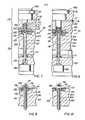
- the hot sprue valve assembly 62 is illustrated in detail in Figs. 2-5.
- the valve assembly 62 comprises an elongated cylindrical sleeve valve 68 positioned on the side of the mold cavity 25 opposite the sprue bushing 56, and aligned generally on an axis common with the axis of the sprue bushing 56.
- the sleeve valve 62 is connected at one end as by screws 69 to a reciprocal plate 70 for movement toward and away from the sprue bushing 56 in response to operation of an air cylinder 72 coupled to the plate 70 via a piston rod 74.
- the sleeve valve 68 is sized for engagement with the sprue bushing 56, and is movable between a "back" position spaced from the sprue bushing 56 as illustrated in Fig. 2, and a "forward” position in sealing engagement with the sprue bushing 56 as illustrated in Fig. 3.
- the sleeve valve 68 projects slidably through matingly sized openings in the carrier plate 24 and the associated platen 38 of the second mold half 20.
- a stationary cylindrical valve guide 76 is secured to the base plate 22 as by a nut 77, and is concentrically received within the sleeve valve 68 for guiding the sliding movement of the sleeve valve 68.
- a cylindrical die bushing 78 retained in position by the adjacent central clamp 52 functions to accurately guide movement of the sleeve valve 68.
- the hot sprue valve assembly 62 also includes an ejector pin 80 carried slidably within the stationary valve guide 76 for movement along the central axis of the valve guide 76 and the sleeve valve 68.
- This ejector pin has its rear end secured in a suitable manner to an air cylinder 82 which operates to reciprocate the ejector pin 80 toward and away from the sprue bushing 56 independently of the sleeve valve 68.
- the air cylinder 82 operates to move the ejector pin 80 between a "back" position retracted away from the sprue bushing.56, and a "forward” position wherein the ejector pin 80 is advanced toward the sprue bushing 56 to a position generally coinciding with the forward end of the valve guide 76.
- Molten plastic material is injected under pressure by the injector assembly 54 through the sprue bushing 56 and its nozzle 58 into the mold cavity 25 whereupon the material spreads annularly to fill the mold cavity 25.
- the sleeve valve 68 is advanced to its "forward" position for annular cooperation and engagement with the lowermost face of the sprue bushing 56, as shown in Fig. 3. This cooperation between the sleeve valve 68 and the sprue bushing 56 effectively isolates the portion of the molten plastic material within the sprue bushing 56 and within the sleeve valve 68 from the mold cavity 25.
- the sleeve valve 68 is sized to correspond with the desired size of the central aperture in the disc 12, and this movement of the sleeve valve 68 functions to mold a central aperture 86 into the disc 12 prior to solidification of the plastic material within the mold cavity 25.
- the axial face of the sleeve valve 68 engaging the sprue bushing 56 desirably includes a radially inwardly presented taper, as at 84, to encourage the displaced plastic material to flow radially inwardly toward the cavity 88.
- the liquid coolant is supplied to the mold halves 14 and 20 for flow through the circulating paths 66 to reduce the temperature of the molten plastic material within the mold cavity 25 and thereby solidify the record disc 12.
- This circulation of the liquid coolant also at least partially solidifies the plastic material circumscribed within the sleeve valve 68 to a semi-rigid state.
- the liquid coolant is not supplied to solidify the molten plastic material within the flow path 55 of the sprue bushing 56 whereby a precise separation line between the relatively small wafer 92 and the still-molten plastic material within the flow path 55 is not well defined.
- the wafer 92 and the molten plastic material within the sprue bushing flow path 55 are isolated from the disc 12 within the mold cavity 25 to allow the disc to be rapidly solidified. Only partial solidification of the wafer 92 is necessary before the mold cavity 25 can be opened and the molded record disc 12 extracted from the machine.
- the mold halves 14 and 20 are separated for extraction of the record disc 12 from the machine.
- a small portion of the wafer 92 received within the valve guide undercut 90 prevents uncontrolled ejection of the wafer from the mold assembly.
- the ejector pin 80 is advanced to its "forward" position as illustrated in Fig. 5, to eject the small wafer 92 from the mold assembly 10.
- the sleeve valve 68 is retracted to its "back" position and the record disc 12 is extracted in a known manner.
- the mold halves 14 and 20 can then be closed once again to define the mold cavity 25 and the injection molding cycle is repeated.
- the hot sprue valve assembly 62 shown and described in Figs. 1-5 is highly advantageous compared with valve assemblies and ejectors commonly found in the prior art.
- the valve assembly 62 isolates the molten plastic material within the sprue bushing 56 from the mold cavity 25 during solidification of the material within the mold cavity. This allows the machine production rate to be governed by the solidification time of the disc 12 within the cavity 25, and not by the longer solidification time of plastic material within the region of the sprue bushing 56. This results in substantial decreases in cycle time for each record disc 12, and corresponding substantial increases in machine production rate.
- the hot sprue valve assembly 62 of Figs. 1-5 is further advantageous in that the cylindrical sleeve valve 68 functions to mold the central aperture 86 into the record 12 prior to material solidification thereby eliminating the need for punching or other post-solifdi- fication formation of the central aperture.
- This molding technique eliminates any need to grind or otherwise machine the size and shape of the central aperture to a final size, and also prevents possible cracking of the disc 12 or the creation of small debris during punching which can become trapped within the mold cavity 25 and deleteriously affect subsequent record disc formation.
- the use of the sleeve valve 68 to mold the central aperture eliminates the requirement for periodic replacement of a conventional punching apparatus which can wear over a period of time.
- FIG. 7-10 An alternate embodiment of the invention is illustrated in Figs. 7-10, and comprises a hot sprue valve assembly 100 for use with a molding assembly 110 of an injection molding machine generally of the type described above with respect to the embodiment of Figs. 1-5. More specifically, as shown in Figs. 7 and 8, the molding apparatus 110 comprises a first mold half 114 with a base plate 116 and a carrier plate 118, and a second mold half 120 with a base plate 122 and a carrier plate 124.
- the two mold halves 114 and 120 are reciprocally movable toward and away from each other to open and close a relatively thin and substantially planar, disc-shaped mold cavity 125 in which a record disc 112 is molded.
- the two carrier plates l18 and 124 of the two mold halves 114 and 120 carry platens and stamping dies similar to those described with reference to Figs. 1-5, whereby these details are not repeated.
- An injector assembly 154 is carried by the base plate 116 of the first mold half 114 for supplying molten plastic material to the mold cavity 125.
- this injection assembly 154 includes a cylindrical sleeve 157 projecting downwardly through the carrier plate 118 in axial alignment with the central axis of the mold cavity 125.
- the sleeve 157 slides within the carrier plate 118 and with respect to a die bushing 159 secured in position by a central clamp 150.
- a hot sprue bushing 156 is concentrically carried within the sleeve 157, and this bushing 156 defines a flow path 155 for molten plastic material from the injector assembly 154 to the mold cavity 125.
- a heating coil 160 or the like is carried by the sprue bushing 156 to maintain the temperature of the plastic material injected therethrough, and thereby maintain that material in a molten state.
- the hot sprue valve assembly 100 of Fig. 7 is provided for closing off the sprue bushing 156 to further flow of plastic material when the mold cavity 125 is filled. This allows the portion of the plastic material within the mold cavity 125 to be solidified, as by application of a cooling liquid or the like, independently of the solidification of the plastic material with the sprue bushing flow path 155. As in the previous embodiment, this results in a substantial decrease in mold cycle time for each record disc 112, and thereby provides a corresponding substantial increase in machine production rate.
- the hot sprue valve assembly 100 comprises an ejector valve pin 180 positioned on the side of the mold cavity 125 opposite the sprue bushing 156.
- This ejector valve pin 180 is secured to an air cylinder 182 for controlled movement between a plurality of positions for controlling flow of molten plastic material through the sprue bushing 56.
- the pin 180 is axially aligned with the flow path 155 of the sprue bushing 156 and is movable in response to the air cylinder 182 toward and away from the sprue bushing 156.
- the ejector valve pin 180 is slidably received within a sleeve punch 168.
- This sleeve punch 168 has one end secured as by a nut 177 to-a reciprocal plate 170, the movement of which is controlled by a suitable air cylinder (not shown) or the like corresponding with the air cylinder 72 of Fig. 1.
- the opposite end of the sleeve punch 168 extends through the associated carrier plate 124 of the second mold half 120 and includes a cylindrical punch head 169 adjacent the sprue bushing 156.
- This punch head 169 is slidably received within a die bushing 178 which is secured in position by a central clamp 152.
- the ejector valve pin 180 is advanced toward the sprue bushing 156 when the mold cavity 125 is filled with molten plastic material.
- the ejector valve pin 180 includes a tapered conical valve head 181 sized for engaging the sprue bushing 156 to valve off the flow path 155, as shown by the dotted line positon of the ejector valve pin 180 in Fig. 7.
- the ejector valve pin 180 remains in this dotted line position until the plastic material within the mold cavity 125 is solidified.
- the mold halves 114 and 120 are separated to open the mold cavity and allow extraction of the molded record disc 112 from the mold assembly 110.
- the base plate l16 and the carrier plate 118 of the first mold half 114 separate from each other, as illustrated by the space 117 in Fig. 8. This movement is effective to begin withdrawal of the sprue bushing 156 from the mold cavity 125 while the carrier plates 118 and 124 of the two mold halves 114 and 120 remain initially in abutting contact with each other.
- This movement is controlled by means of an appropriate latch-lock mechanism.
- the sleeve punch 168 is advanced through the mold cavity 125 to punch a central aperture 186 of the desired size in the solidified record disc 112.
- This movement of the sleeve punch 168 is shown in Fig 8 wherein a relatively small wafer 192 is displaced from the disc 112 to define the aperture 186.
- the disc 112 is tightly supported between the die bushings 159 and 178.
- the wafer 192 is at least partially solidified by virtue of the solidification of the disc 112, the plastic material within the sprue bushing flow path 155 remains substantially in a molten state.
- the conical head 181 of the ejector valve pin 180 cooperates with the advanced sleeve punch 168 to define a relatively small cavity 188 in which a portion of the wafer 192 is trapped. This prevents uncontrolled falling of the wafer 192 from the mold assembly 110 when the mold halves l14 and 120 are opened, as will be described.
- the sleeve punch 168 can include an annular undercut 190 about the conical pin head 181 to assist in controlling the position of the wafer 192.
- the two mold halves 114 and 120 are separated to allow for extraction of the molded record disc 112 from the mold assembly 110. As illustrated in Fig. 9, this also allows for removal of the relatively small wafer 192 in the sprue region of the central aperture 186. More specifically, the ejector valve pin 180 is advanced to a further forward position by means of the air cylinder 182 to push to wafer 192 from the end of the advanced sleeve punch 168. As illustrated in Fig. 10, the ejector valve pin 180 and the sleeve punch 168 are then retracted together to their initial positions to allow the wafer 192 to freely fall from the mold assembly 110. At this stage, the molded record disc 112 can be easily removed from the mold assembly 110 in a convenient manner, and the mold halves 114 and 120 can be returned to abutting engagement with each other for the next cycle of the machine.
- the hot sprue valve assembly 100 of Figs. 7-10 operates to isolate the plastic material within the sprue bushing 156 from the mold cavity 125 during solidification of the record disc 112. In this manner, it is not necessary for substantial quantities of plastic material in the sprue region to solidify prior to removal of the disc 112 from the machine. Thus, the disc cycle time is governed by the solidification of plastic material within the mold cavity 125 and not by the solidification of plastic material in the sprue region. This effectively decreases the cycle time for a given record disc 112, and substantially increases the overall machine production rate.
Landscapes
- Engineering & Computer Science (AREA)
- Manufacturing & Machinery (AREA)
- Mechanical Engineering (AREA)
- Moulds For Moulding Plastics Or The Like (AREA)
- Injection Moulding Of Plastics Or The Like (AREA)
- Lift Valve (AREA)
- Sliding Valves (AREA)
- Temperature-Responsive Valves (AREA)
Priority Applications (1)
| Application Number | Priority Date | Filing Date | Title |
|---|---|---|---|
| AT81109022T ATE18867T1 (de) | 1980-10-31 | 1981-10-27 | Heissangusskanal-ventilzusammenbau fuer eine spritzgiessmaschine. |
Applications Claiming Priority (2)
| Application Number | Priority Date | Filing Date | Title |
|---|---|---|---|
| US202824 | 1980-10-31 | ||
| US06/202,824 US4372741A (en) | 1980-10-31 | 1980-10-31 | Hot sprue valve assembly for an injection molding machine |
Publications (3)
| Publication Number | Publication Date |
|---|---|
| EP0051253A2 true EP0051253A2 (de) | 1982-05-12 |
| EP0051253A3 EP0051253A3 (en) | 1983-04-06 |
| EP0051253B1 EP0051253B1 (de) | 1986-04-02 |
Family
ID=22751408
Family Applications (1)
| Application Number | Title | Priority Date | Filing Date |
|---|---|---|---|
| EP81109022A Expired EP0051253B1 (de) | 1980-10-31 | 1981-10-27 | Heissangusskanal-Ventilzusammenbau für eine Spritzgiessmaschine |
Country Status (11)
| Country | Link |
|---|---|
| US (1) | US4372741A (de) |
| EP (1) | EP0051253B1 (de) |
| JP (2) | JPS6023970B2 (de) |
| KR (1) | KR860001332B1 (de) |
| AT (1) | ATE18867T1 (de) |
| AU (1) | AU544892B2 (de) |
| BR (1) | BR8106959A (de) |
| CA (1) | CA1160009A (de) |
| DE (1) | DE3174258D1 (de) |
| HK (1) | HK48489A (de) |
| SG (1) | SG19089G (de) |
Cited By (7)
| Publication number | Priority date | Publication date | Assignee | Title |
|---|---|---|---|---|
| EP0066649A3 (en) * | 1981-06-10 | 1983-10-05 | Discovision Associates | Hot sprue sleeve valve assembly for an injection molding machine |
| EP0181590A3 (en) * | 1984-11-16 | 1988-03-16 | Krauss-Maffei Aktiengesellschaft | Method and apparatus for punching and removing the sprue in an injection mould |
| EP0255088A3 (en) * | 1986-07-30 | 1989-11-02 | Hitachi, Ltd. | Method and apparatus for producing optical disk base |
| EP0551869A1 (de) * | 1992-01-14 | 1993-07-21 | Sony Corporation | Verfahren und Vorrichtung zur Herstellung eines Substrats für eine Platte |
| US5326240A (en) * | 1991-10-12 | 1994-07-05 | Sony Corporation | Metal mold device for molding a disc substrate |
| NL1010869C2 (nl) * | 1998-12-22 | 2000-06-30 | Axxicon Moulds Eindhoven Bv | Meervoudige spuitgieteenheid. |
| EP1074373A1 (de) * | 1999-08-05 | 2001-02-07 | Axxicon Moulds Eindhoven B.V. | Verstellbare Stanzvorrichtung |
Families Citing this family (28)
| Publication number | Priority date | Publication date | Assignee | Title |
|---|---|---|---|---|
| US4372741A (en) * | 1980-10-31 | 1983-02-08 | Discovision Associates | Hot sprue valve assembly for an injection molding machine |
| DE3336080A1 (de) * | 1983-10-04 | 1985-04-18 | Maschinenfabrik J. Dieffenbacher Gmbh & Co, 7519 Eppingen | Spritzpresse |
| JPS60247532A (ja) * | 1984-05-23 | 1985-12-07 | Tekunopurasu:Kk | 円盤状記録媒体の成形方法 |
| JPS62105616A (ja) * | 1985-11-01 | 1987-05-16 | Daicel Chem Ind Ltd | 光デイスクの射出成形用金型 |
| EP0247244B1 (de) * | 1986-02-26 | 1992-01-15 | Kabushiki Kaisha Meiki Seisakusho | Formvorrichtung und Verfahren zum Herstellen von Platten mit Mittelloch |
| JPS63114609A (ja) * | 1986-03-28 | 1988-05-19 | Meiki Co Ltd | デイスクの射出成形装置とデイスクの射出成形方法 |
| JPS62198422A (ja) * | 1986-02-26 | 1987-09-02 | Meiki Co Ltd | デイスクの射出成形装置 |
| DE3611249A1 (de) * | 1986-04-04 | 1987-10-15 | Braun Pebra Gmbh | Verfahren und vorrichtung zur herstellung von kunststoff-formteilen |
| JPH0665484B2 (ja) * | 1986-09-09 | 1994-08-24 | 住友重機械工業株式会社 | 打抜き孔付成形品用射出成形方法 |
| JPH0513538Y2 (de) * | 1987-06-26 | 1993-04-09 | ||
| US6937998B1 (en) | 1987-12-28 | 2005-08-30 | Symbol Technologies, Inc. | Arrangement for and method of expediting transactions based on a customer's proximity to the transactions |
| US6340115B1 (en) | 1987-12-28 | 2002-01-22 | Symbol Technologies, Inc. | Card reader and method for completing transactions |
| US5448046A (en) | 1987-12-28 | 1995-09-05 | Symbol Technologies, Inc. | Arrangement for and method of expediting commercial product transactions at a point-of-sale site |
| JPH01148319U (de) * | 1988-03-28 | 1989-10-13 | ||
| JP2607961B2 (ja) * | 1989-11-29 | 1997-05-07 | 日精樹脂工業 株式会社 | 射出成形方法 |
| CA2037306C (en) * | 1990-07-16 | 2005-06-28 | Symbol Technologies, Inc. | Arrangement for and method of processing products at a point-of-sale site |
| US5427520A (en) * | 1992-01-31 | 1995-06-27 | Sony Corporation | Mold device for fabricating disc substrate |
| US5346659A (en) * | 1992-11-23 | 1994-09-13 | S. C. Johnson & Son, Inc. | Method for producing a weld-line free injection molded plastic container body portion |
| JP2944359B2 (ja) * | 1993-03-23 | 1999-09-06 | 株式会社精工技研 | 基盤射出成形金型 |
| KR100230244B1 (ko) * | 1995-01-24 | 1999-11-15 | 윤종용 | 다층 광 기록 매체의 제조방법 및 그 장치 |
| JP3937525B2 (ja) * | 1997-09-10 | 2007-06-27 | 双葉電子工業株式会社 | 圧力センサ付エジェクタピン |
| JP3517770B2 (ja) * | 1997-09-11 | 2004-04-12 | 株式会社名機製作所 | ディスク成形方法 |
| US20020167115A1 (en) * | 2000-02-23 | 2002-11-14 | Yoji Tanaka | Injection molding method and injection mold assembly |
| SE521046C2 (sv) * | 2001-07-02 | 2003-09-23 | Hans Mueller | Anordning vid en inbyggbar tvåstegsutstötare |
| JP4345064B2 (ja) * | 2005-03-25 | 2009-10-14 | セイコーエプソン株式会社 | 光電変換素子の製造方法、および電子機器 |
| KR100725789B1 (ko) * | 2005-06-30 | 2007-06-08 | 삼성전자주식회사 | 금형장치 |
| JP4647568B2 (ja) * | 2006-09-12 | 2011-03-09 | 東洋機械金属株式会社 | 射出成形機 |
| IT1410977B1 (it) * | 2010-06-14 | 2014-10-03 | Automobili Lamborghini Spa | Processo e dispositivi per fabbricare prodotti in materiali compositi |
Family Cites Families (15)
| Publication number | Priority date | Publication date | Assignee | Title |
|---|---|---|---|---|
| FR871956A (fr) * | 1940-05-10 | 1942-05-23 | Eckert & Ziegler Gmbh | Moule pour la coulée sous pression ou par injeotion |
| US2613395A (en) * | 1949-02-24 | 1952-10-14 | M & W Company Inc | Apparatus and method for producing disk phonograph records |
| US2698464A (en) * | 1952-07-10 | 1955-01-04 | M And W Company Inc | Method of forming gate-free injection molded products |
| US2992455A (en) * | 1958-11-14 | 1961-07-18 | Allied Record Mfg Company | Automatic stockmold and curing press |
| CH453671A (fr) * | 1965-10-05 | 1968-03-31 | Wasal Anstalt | Procédé de fabrication d'objets moulés présentant un trou |
| US3649728A (en) * | 1968-07-31 | 1972-03-14 | Matsushita Electric Industrial Co Ltd | Method for molding thermoplastic articles having through-holes therein |
| NL7003886A (de) * | 1969-03-26 | 1970-09-29 | ||
| US3937779A (en) * | 1972-05-03 | 1976-02-10 | Emi Limited | Moulding of gramophone records |
| JPS5156865A (en) * | 1974-11-12 | 1976-05-18 | Matsushita Electric Industrial Co Ltd | Shashutsuseikeikanagata |
| US3989436A (en) * | 1975-12-18 | 1976-11-02 | Rca Corporation | Apparatus for producing injection molded and centrally apertured disc records |
| US4185955A (en) * | 1977-10-31 | 1980-01-29 | Mca Disco-Vision, Inc. | Apparatus for replicating centrally apertured video disc records |
| US4260360A (en) * | 1978-06-26 | 1981-04-07 | Mca Disco-Vision, Inc. | Method and means for replicating centrally apertured video disc records |
| CA1143517A (en) * | 1979-04-18 | 1983-03-29 | John R. Holmes | Apparatus for producing centrally apertured record discs |
| US4372741A (en) * | 1980-10-31 | 1983-02-08 | Discovision Associates | Hot sprue valve assembly for an injection molding machine |
| JPS6023970A (ja) * | 1983-07-19 | 1985-02-06 | Toshiba Corp | 非水溶媒電池 |
-
1980
- 1980-10-31 US US06/202,824 patent/US4372741A/en not_active Expired - Lifetime
-
1981
- 1981-08-18 AU AU74280/81A patent/AU544892B2/en not_active Expired
- 1981-10-27 DE DE8181109022T patent/DE3174258D1/de not_active Expired
- 1981-10-27 BR BR8106959A patent/BR8106959A/pt unknown
- 1981-10-27 EP EP81109022A patent/EP0051253B1/de not_active Expired
- 1981-10-27 AT AT81109022T patent/ATE18867T1/de not_active IP Right Cessation
- 1981-10-30 JP JP56173149A patent/JPS6023970B2/ja not_active Expired
- 1981-10-30 KR KR1019810004155A patent/KR860001332B1/ko not_active Expired
- 1981-10-30 CA CA000389136A patent/CA1160009A/en not_active Expired
-
1986
- 1986-02-19 JP JP61033114A patent/JPS61228923A/ja active Granted
-
1989
- 1989-03-31 SG SG190/89A patent/SG19089G/en unknown
- 1989-06-15 HK HK484/89A patent/HK48489A/en not_active IP Right Cessation
Cited By (15)
| Publication number | Priority date | Publication date | Assignee | Title |
|---|---|---|---|---|
| EP0066649A3 (en) * | 1981-06-10 | 1983-10-05 | Discovision Associates | Hot sprue sleeve valve assembly for an injection molding machine |
| EP0181590A3 (en) * | 1984-11-16 | 1988-03-16 | Krauss-Maffei Aktiengesellschaft | Method and apparatus for punching and removing the sprue in an injection mould |
| US4820467A (en) * | 1984-11-16 | 1989-04-11 | Krauss-Maffei A.G. | Process for the punching and removing of the sprue in an injection molding tool |
| AU589581B2 (en) * | 1984-11-16 | 1989-10-19 | Krauss-Maffei Kunststofftechnik Gmbh | In an injection moulding tool, a method of and an apparatus for stamping out and removing the runner |
| EP0255088A3 (en) * | 1986-07-30 | 1989-11-02 | Hitachi, Ltd. | Method and apparatus for producing optical disk base |
| US5326240A (en) * | 1991-10-12 | 1994-07-05 | Sony Corporation | Metal mold device for molding a disc substrate |
| US5552098A (en) * | 1991-10-12 | 1996-09-03 | Sony Corporation | Method for fabrication of disc substrate |
| EP0705676A3 (de) * | 1991-10-12 | 1996-12-27 | Sony Corp | Metallische Formvorrichtung und Verfahren zum Formen eines Plattensubstrats |
| EP0537953B1 (de) * | 1991-10-12 | 1997-05-07 | Sony Corporation | Metallische Formvorrichtung zum Formen eines Plattensubstrats |
| EP0551869A1 (de) * | 1992-01-14 | 1993-07-21 | Sony Corporation | Verfahren und Vorrichtung zur Herstellung eines Substrats für eine Platte |
| NL1010869C2 (nl) * | 1998-12-22 | 2000-06-30 | Axxicon Moulds Eindhoven Bv | Meervoudige spuitgieteenheid. |
| EP1022109A1 (de) * | 1998-12-22 | 2000-07-26 | Axxicon Moulds Eindhoven B.V. | Mehrfachspritzgiesseinheit |
| US6264459B1 (en) | 1998-12-22 | 2001-07-24 | Axxicon Moulds Eindhoven B.V. | Multiple injection moulding unit |
| EP1074373A1 (de) * | 1999-08-05 | 2001-02-07 | Axxicon Moulds Eindhoven B.V. | Verstellbare Stanzvorrichtung |
| NL1012778C2 (nl) * | 1999-08-05 | 2001-02-12 | Axxicon Moulds Eindhoven Bv | Verplaatsbaar ponsorgaan. |
Also Published As
| Publication number | Publication date |
|---|---|
| AU7428081A (en) | 1982-05-06 |
| CA1160009A (en) | 1984-01-10 |
| EP0051253A3 (en) | 1983-04-06 |
| AU544892B2 (en) | 1985-06-20 |
| EP0051253B1 (de) | 1986-04-02 |
| JPS61228923A (ja) | 1986-10-13 |
| HK48489A (en) | 1989-06-23 |
| JPS57105328A (en) | 1982-06-30 |
| ATE18867T1 (de) | 1986-04-15 |
| KR830007263A (ko) | 1983-10-19 |
| SG19089G (en) | 1989-09-01 |
| DE3174258D1 (en) | 1986-05-07 |
| KR860001332B1 (ko) | 1986-09-15 |
| US4372741A (en) | 1983-02-08 |
| JPS6023970B2 (ja) | 1985-06-10 |
| JPH0325334B2 (de) | 1991-04-05 |
| BR8106959A (pt) | 1982-07-13 |
Similar Documents
| Publication | Publication Date | Title |
|---|---|---|
| EP0051253B1 (de) | Heissangusskanal-Ventilzusammenbau für eine Spritzgiessmaschine | |
| US4340353A (en) | Hot sprue valve assembly for an injection molding machine | |
| US4466934A (en) | Hot sprue valve assembly for an injection molding machine | |
| EP0075043B1 (de) | Heissangusskanalventilzusammenbau für eine Spritzgussmaschine | |
| EP0066649B1 (de) | Heissangusskanal-Muffenventilkombination für eine Spritzgiessmaschine | |
| US4840557A (en) | Vertical injection apparatus | |
| KR100278213B1 (ko) | 복수의 광 기록 디스크 기판 제조 방법 및 그의 장치 | |
| US4412805A (en) | Hot sprue assembly for an injection molding machine | |
| EP0066650B1 (de) | Heissangusskanalkombination für eine Spritzgiessmaschine | |
| EP1080862B1 (de) | Vorrichtung zum Trennen des Angusses und Giessverfahren für Platten | |
| US4405540A (en) | Hot sprue valve assembly for an injection molding machine | |
| JPH05261766A (ja) | 光ディスク用成形機 | |
| EP0075042B1 (de) | Heissgusskanalzusammenbau für eine Spritzgussmaschine | |
| JP2532422Y2 (ja) | ディスク射出成形用金型装置 | |
| JPH05261767A (ja) | 光ディスク成形用金型装置 | |
| JPS63114609A (ja) | デイスクの射出成形装置とデイスクの射出成形方法 | |
| JPH0257314A (ja) | ディスク用成形型 | |
| JPH0338098B2 (de) | ||
| JPH0338099B2 (de) | ||
| NL9002131A (nl) | Inrichting voor gebruik in een spuitgietmachine. |
Legal Events
| Date | Code | Title | Description |
|---|---|---|---|
| PUAI | Public reference made under article 153(3) epc to a published international application that has entered the european phase |
Free format text: ORIGINAL CODE: 0009012 |
|
| AK | Designated contracting states |
Designated state(s): AT BE CH DE FR GB IT LU NL SE |
|
| PUAL | Search report despatched |
Free format text: ORIGINAL CODE: 0009013 |
|
| AK | Designated contracting states |
Designated state(s): AT BE CH DE FR GB IT LI LU NL SE |
|
| 17P | Request for examination filed |
Effective date: 19830805 |
|
| ITF | It: translation for a ep patent filed | ||
| GRAA | (expected) grant |
Free format text: ORIGINAL CODE: 0009210 |
|
| AK | Designated contracting states |
Kind code of ref document: B1 Designated state(s): AT BE CH DE FR GB IT LI LU NL SE |
|
| REF | Corresponds to: |
Ref document number: 18867 Country of ref document: AT Date of ref document: 19860415 Kind code of ref document: T |
|
| REF | Corresponds to: |
Ref document number: 3174258 Country of ref document: DE Date of ref document: 19860507 |
|
| ET | Fr: translation filed | ||
| PLBE | No opposition filed within time limit |
Free format text: ORIGINAL CODE: 0009261 |
|
| STAA | Information on the status of an ep patent application or granted ep patent |
Free format text: STATUS: NO OPPOSITION FILED WITHIN TIME LIMIT |
|
| 26N | No opposition filed | ||
| ITTA | It: last paid annual fee | ||
| EPTA | Lu: last paid annual fee | ||
| EAL | Se: european patent in force in sweden |
Ref document number: 81109022.4 |
|
| PGFP | Annual fee paid to national office [announced via postgrant information from national office to epo] |
Ref country code: FR Payment date: 20001002 Year of fee payment: 20 |
|
| PGFP | Annual fee paid to national office [announced via postgrant information from national office to epo] |
Ref country code: SE Payment date: 20001003 Year of fee payment: 20 Ref country code: DE Payment date: 20001003 Year of fee payment: 20 |
|
| PGFP | Annual fee paid to national office [announced via postgrant information from national office to epo] |
Ref country code: GB Payment date: 20001004 Year of fee payment: 20 Ref country code: CH Payment date: 20001004 Year of fee payment: 20 Ref country code: AT Payment date: 20001004 Year of fee payment: 20 |
|
| PGFP | Annual fee paid to national office [announced via postgrant information from national office to epo] |
Ref country code: NL Payment date: 20001006 Year of fee payment: 20 |
|
| PGFP | Annual fee paid to national office [announced via postgrant information from national office to epo] |
Ref country code: LU Payment date: 20001013 Year of fee payment: 20 |
|
| PGFP | Annual fee paid to national office [announced via postgrant information from national office to epo] |
Ref country code: BE Payment date: 20001116 Year of fee payment: 20 |
|
| BE20 | Be: patent expired |
Free format text: 20011027 *DISCOVISION ASSOCIATES |
|
| PG25 | Lapsed in a contracting state [announced via postgrant information from national office to epo] |
Ref country code: LI Free format text: LAPSE BECAUSE OF EXPIRATION OF PROTECTION Effective date: 20011026 Ref country code: GB Free format text: LAPSE BECAUSE OF EXPIRATION OF PROTECTION Effective date: 20011026 Ref country code: CH Free format text: LAPSE BECAUSE OF EXPIRATION OF PROTECTION Effective date: 20011026 |
|
| PG25 | Lapsed in a contracting state [announced via postgrant information from national office to epo] |
Ref country code: NL Free format text: LAPSE BECAUSE OF EXPIRATION OF PROTECTION Effective date: 20011027 Ref country code: LU Free format text: LAPSE BECAUSE OF EXPIRATION OF PROTECTION Effective date: 20011027 Ref country code: AT Free format text: LAPSE BECAUSE OF EXPIRATION OF PROTECTION Effective date: 20011027 |
|
| PG25 | Lapsed in a contracting state [announced via postgrant information from national office to epo] |
Ref country code: SE Free format text: THE PATENT HAS BEEN ANNULLED BY A DECISION OF A NATIONAL AUTHORITY Effective date: 20011030 |
|
| REG | Reference to a national code |
Ref country code: CH Ref legal event code: PL |
|
| REG | Reference to a national code |
Ref country code: GB Ref legal event code: PE20 Effective date: 20011026 |
|
| EUG | Se: european patent has lapsed |
Ref document number: 81109022.4 |
|
| NLV7 | Nl: ceased due to reaching the maximum lifetime of a patent |
Effective date: 20011027 |