EP0051855B1 - Verfahren zur Herstellung von Polycarbosilanen - Google Patents
Verfahren zur Herstellung von Polycarbosilanen Download PDFInfo
- Publication number
- EP0051855B1 EP0051855B1 EP81109510A EP81109510A EP0051855B1 EP 0051855 B1 EP0051855 B1 EP 0051855B1 EP 81109510 A EP81109510 A EP 81109510A EP 81109510 A EP81109510 A EP 81109510A EP 0051855 B1 EP0051855 B1 EP 0051855B1
- Authority
- EP
- European Patent Office
- Prior art keywords
- molecular weight
- polycarbosilane
- polysilane
- fraction
- number mean
- Prior art date
- Legal status (The legal status is an assumption and is not a legal conclusion. Google has not performed a legal analysis and makes no representation as to the accuracy of the status listed.)
- Expired
Links
Images
Classifications
-
- C—CHEMISTRY; METALLURGY
- C04—CEMENTS; CONCRETE; ARTIFICIAL STONE; CERAMICS; REFRACTORIES
- C04B—LIME, MAGNESIA; SLAG; CEMENTS; COMPOSITIONS THEREOF, e.g. MORTARS, CONCRETE OR LIKE BUILDING MATERIALS; ARTIFICIAL STONE; CERAMICS; REFRACTORIES; TREATMENT OF NATURAL STONE
- C04B35/00—Shaped ceramic products characterised by their composition; Ceramics compositions; Processing powders of inorganic compounds preparatory to the manufacturing of ceramic products
- C04B35/515—Shaped ceramic products characterised by their composition; Ceramics compositions; Processing powders of inorganic compounds preparatory to the manufacturing of ceramic products based on non-oxide ceramics
- C04B35/56—Shaped ceramic products characterised by their composition; Ceramics compositions; Processing powders of inorganic compounds preparatory to the manufacturing of ceramic products based on non-oxide ceramics based on carbides or oxycarbides
- C04B35/565—Shaped ceramic products characterised by their composition; Ceramics compositions; Processing powders of inorganic compounds preparatory to the manufacturing of ceramic products based on non-oxide ceramics based on carbides or oxycarbides based on silicon carbide
- C04B35/571—Shaped ceramic products characterised by their composition; Ceramics compositions; Processing powders of inorganic compounds preparatory to the manufacturing of ceramic products based on non-oxide ceramics based on carbides or oxycarbides based on silicon carbide obtained from Si-containing polymer precursors or organosilicon monomers
-
- C—CHEMISTRY; METALLURGY
- C08—ORGANIC MACROMOLECULAR COMPOUNDS; THEIR PREPARATION OR CHEMICAL WORKING-UP; COMPOSITIONS BASED THEREON
- C08G—MACROMOLECULAR COMPOUNDS OBTAINED OTHERWISE THAN BY REACTIONS ONLY INVOLVING UNSATURATED CARBON-TO-CARBON BONDS
- C08G77/00—Macromolecular compounds obtained by reactions forming a linkage containing silicon with or without sulfur, nitrogen, oxygen or carbon in the main chain of the macromolecule
- C08G77/60—Macromolecular compounds obtained by reactions forming a linkage containing silicon with or without sulfur, nitrogen, oxygen or carbon in the main chain of the macromolecule in which all the silicon atoms are connected by linkages other than oxygen atoms
Definitions
- the present invention relates to an improved method of preparing polycarbosilanes having high molecular weight and also having the major structural unit of silicon-carbon linkage, by using a polysilane as the starting material.
- Polycarbosilanes are known to be useful for the precursor of silicon carbide fibres and shaped articles, as they may be converted to silicon carbide by baking them.
- pressure vessels such as autoclave or circulating flow vessels have been employed in the preparation of polycarbosilanes from polysinale.
- the reaction in the case of using former vessels, the reaction must be performed at high temperature and pressure, say, at 400-480°C. and 80-130 atmospheric pressure, for more than 10 hours; hence pressure-resistant facilities and countermeasure for hazzard are required.
- the reaction In the case of using latter vessels, the reaction must be performed at high temperature for a long period of time, say, at 600 ⁇ 800°C. for 20-50 hours. Further, separation from and circulation into vessel of the products having low molecular weight are necessitated; hence complication of facilities and poor production efficiency are unavoidable.
- the present inventors have made intensive studies to improve the above-mentioned defects involved in conventional methods and found a method of preparing polycarbosilanes from a polysilane at relatively low temperature and at around normal pressure for a shorter period of time.
- the invention therefore, relates to a method of preparing polycarbosilanes having high molecular weight and also having the major structural unit of silicon-carbon linkage, which method comprises heating a polysilane at 50-600°C. in an atmosphere of an inert gas, distilling out a low molecular weight polycarbosilane fraction having the number mean molecular weight of 300-600, followed by polymerizing the fraction by heating it at 250-500°C. in atmosphere of an inert gas.
- Polysilanes used for the starting material in the present method may be obtained by dechlorinating and condensing a monosilane (such as dimethyldichlorosilane, diphenyldichlorosilane, methylphenyldichlorosilane, tri- chloromethylsilane, trichlorophenylsilane, methyldichlorosilane or phenyldichlorosilane) with metallic sodium or lithium.
- the polysilane thus prepared include usually impurities such as sodium chloride or lithium chloride. They may be used, however, as such without through purification for the method of the invention.
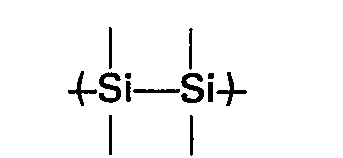
- Polysilanes are represented by the following structural unit: (in which R represents a lower alkyl group, a phenyl group or a hydrogen atom and n is an integer of 3 or more).
- Especially preferred polysilanes include those whose side chains are substantially composed of methyl groups, or more than 50% of the side chains are methyl groups and the remainder being phenyl groups and/or hydrogen atoms.
- the terminal groups are preferably hydroxy orpmethyl groups.
- the method of the invention may be performed once by collecting, outside of the reaction system, a fraction that is distilled out by heating a polysilane at 50-600°C., particularly 150-500 0 C., at around normal pressure, followed by polymerizing the fraction by heating it at more than 250°C., particularly 300-500 0 C., at around normal pressure.
- the heat treatment in the first step and the heat polymerization in the second step are preferably performed in atomsphere of an inert gas, such as nitrogen, argon, helium or hydrogen.
- the reactions are preferably performed at around normal pressure, although they may be performed either applying a bit of pressure or under slightly reduced pressure.
- the heat treatment at excessively lower or higher temperature should be avoided. If it is performed at below 50°C., the conversion rate of polysilane to low molecular weight carbosilane will slow down. On the contrary, if it is performed at above 600°C., the molecular weight of the resulting carbosilane will be extremely small, and the yield will decrease.
- the fraction distilled out at 50-600°C. by heating a polysilane may be obtained in the form of a gas or a liquid. In the case of a gas, it may be collected, outside of the reaction system, by cooling and condensing it.
- the fraction comprises chiefly the following two structural units: and (in which R represents a lower alkyl group, a phenyl group or a hydrogen atom).
- the ratio of the former to the latter is 1-6:1.
- the low molecular weight carbosilane has the number mean molecular weight of 300-600, of which distribution being quite narrow, showing the high purity, and is almost colorless, transparent and slightly viscous liquid at ambient temperature.
- the low molecular weight carbosilane fraction having the number mean molecular weight of 300-600 thus collected outside of the reaction system is then polymerized by heating it to prepare a high molecular weight polycarbosilane having the major structural unit of carbon-silicon linkage.
- the reaction is performed at temperature of 250-500°C. and at around normal pressure in atmosphere of an inert gas.
- the reaction will be usually complete for 2-10 hours.
- the reaction itself is known and may be performed in the presence of a radical reaction initiator such as benzoyl peroxide or di-ti butyl peroxide, a catalyst such as those containing aluminium or boron, or under irradiation.
- a radical reaction initiator such as benzoyl peroxide or di-ti butyl peroxide
- a catalyst such as those containing aluminium or boron, or under irradiation.
- the polycarbosilane having high molecular weight and also having the major structural unit of silicon-carbon linkage is a transparent, pale yellowish substance. It comprises the linkage units and the number mean molecular weight is 1,000-2,500, of which distribution being relatively narrow.
- a liquid, low molecular weight polycarbosilane distilled out from the reaction system by heating a polysilane as the starting material is used for the material of polymerization reaction.
- a polysilane is used as such for the starting material of polymerization reaction.
- the method of the invention has advantages over the prior art methods that no purification of the starting polysilane and the produced polycarbosilane is needed and that polymerization may be performed at relatively low temperature.
- the volume of polymerization apparatus may be minimized by using the method of the invention as opposed to conventional methods in which a polysilane is directly subjected to polymerization reaction.
- the polycarbosilane obtained by the method of the present invention are useful for the precursor of preparing silicon carbide fibres and shaped articles. For instance, in preparing a silicon carbide fibre by spinning and baking it, no purification and condensation thereof are required at all; the spinning properties are quite excellent; and the mechanical strength of obtained silicon carbide fibre is remarkably improved, as opposed to the preparation of silicon carbide fibre by using a polycarbosilane obtained by prior art methods.
- the IR spectroscopy revealed absorptions at 2100 cm- 1 assigned to Si-H, 1400 cm- 1 assigned to Si-CF 3 and 1350 cm -1 assigned to Si-CH 2 -Si, besides absorptions assigned to the polysilane, thus showing that the low molecular weight polysilane was composed of 3:1 structural units of and In 200 ml three-necked flask equipped with a gas introduction tube, a stirrer and a reflux condenser, 38 g of the thus obtained low molecular weight polycarbosilane were placed.
- the polycarbosilane was of a high quality, which was introduced to a spinning machine, without any purification, melted by heating it at 240°C. and melt-spun into the air at the rate of 300 m/min to give a fibre of a diameter of 18 ⁇ m.
- the fibre was gradually heated in the air from room temperature to 120°C. at the rate of 12° C./hr, then maintained at 120°C. for one hour to impart infusibility to it.
- the fibre was then further heated up to 1200°C. under nitrogen stream over 12 hours and baked at 1200°C. for one hour to give a silicon carbide fibre having a diameter of 17 ⁇ m, a tensile strength of 320 Kg/mm 2 (3.14 GPa) and a modulus of elasticity of 12 ton/mm 2 (117.7 GPa).
- the polycarbosilane was of a good spinning property, without any purification, which was melt-spun into the air at the rate of 500 m/min to give a fibre having a diameter of 10 gm.
- the fibre was gradually heated in the air from room temperature to 110°C. at the rate of 30°C./hr, then maintained at 110°C. for 30 minutes to impart infusibility to it.
- the fibre was then heated in vacuo up to 1300°C. over 6.5 hours, baked at 1300°C.
- a silicon carbide fibre having a diameter of 9 ⁇ m, a tensile strength of 570 Kg/mm 2 (5.59 GPa) and a modulus of elasticity of 25 ton/mm 2 (245.2 GPa).
- a mixture of 30 g of low molecuar weight organic silicon compound obtained in Example 1 and 1.2 g of polyborosiloxane was heated at 280°C. for 12 hours to give 23 g of a solid, high molecular weight polycarbosilane having the number mean molecular weight of 1,900.
- the polymer was melt-spun into the air, without any purification, at the rate of 300 m/min. to give a fibre having a diameter of 13 ⁇ m.
- the fibre was then heated in the air from room temperature to 110°C. at the rate of 15°C./hr, then maintained at 110°C. for one hour to impart infusibility to it.
- the fibre was further heated under nitrogen stream up to 1,200°C. over 12 hours, then baked at 1,200°C. for one hour to give a silicon carbide fibre having a diameter of 12 ,am, a tensile strength of 530 Kg/mm 2 (5.20 GPa) and a modulus of elasticity of 20 ton/mm 2 (196.1 GPa).
- reaction vessel having an outer diameter of 12 cm and a length of 30 cm, equipped with a gas introduction tube, a stirrer and a reflux condenser, 100 g of polysilane obtained in Preparation 1 and 4 g of polyborosiloxane were placed. The mixture was heated under nitrogen stream at 340°C. for 10 hours, with stirring, to complete the reaction. There were obtained 60 g of a solid polycarbosilane containing a small amount of insolubles.
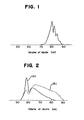
- the molecular weight distribution of the polymer is broader, as shown in Fig. 2, the line (B), than that of the polycarbosilane obtained in Example 1 shown in Fig. 2, the line (A).
- the polycarbosilane was then melt-spun, in the same manner as in Example 1, at the rate of 300 m/min. to give a fibre having a diameter of 20 f-Lm, almost with no cutting of the fibre upon spinning.
- the fibre was subjected to infusion and baked to give a silicon carbide 'fibre having a diameter of 19 ⁇ m mm, a tensile strength of 100 Kg/mm 2 (0.981 GPa) and a modulus of elasticity of 7 ton/mm 2 (68.6 GPa).
- a polymerization reaction was conducted in the same manner as in Comparative Example 1, except that it was performed at 280°C. for 12 hours in place of at 340°C. for 10 hours. After cooling at room temperature, benzene was added to the reaction mixture, insolubles or polysilane was filtered off and the benzene was distilled out. There was thus obtained almost no polycarbosilane, showing that no polymerization reaction took place at all.
Landscapes
- Chemical & Material Sciences (AREA)
- Engineering & Computer Science (AREA)
- Organic Chemistry (AREA)
- Ceramic Engineering (AREA)
- Medicinal Chemistry (AREA)
- Polymers & Plastics (AREA)
- Health & Medical Sciences (AREA)
- Manufacturing & Machinery (AREA)
- Chemical Kinetics & Catalysis (AREA)
- Materials Engineering (AREA)
- Structural Engineering (AREA)
- Silicon Polymers (AREA)
- Inorganic Fibers (AREA)
Claims (6)


Applications Claiming Priority (2)
| Application Number | Priority Date | Filing Date | Title |
|---|---|---|---|
| JP157695/80 | 1980-11-11 | ||
| JP55157695A JPS6046131B2 (ja) | 1980-11-11 | 1980-11-11 | ポリカルボシランの製造法 |
Publications (2)
| Publication Number | Publication Date |
|---|---|
| EP0051855A1 EP0051855A1 (de) | 1982-05-19 |
| EP0051855B1 true EP0051855B1 (de) | 1985-01-30 |
Family
ID=15655357
Family Applications (1)
| Application Number | Title | Priority Date | Filing Date |
|---|---|---|---|
| EP81109510A Expired EP0051855B1 (de) | 1980-11-11 | 1981-11-04 | Verfahren zur Herstellung von Polycarbosilanen |
Country Status (5)
| Country | Link |
|---|---|
| US (1) | US4377677A (de) |
| EP (1) | EP0051855B1 (de) |
| JP (1) | JPS6046131B2 (de) |
| CA (1) | CA1160393A (de) |
| DE (1) | DE3168689D1 (de) |
Cited By (1)
| Publication number | Priority date | Publication date | Assignee | Title |
|---|---|---|---|---|
| CN111019141A (zh) * | 2019-12-10 | 2020-04-17 | 江苏赛菲新材料有限公司 | 一种合成聚碳硅烷的新方法 |
Families Citing this family (33)
| Publication number | Priority date | Publication date | Assignee | Title |
|---|---|---|---|---|
| US4590253A (en) * | 1981-08-26 | 1986-05-20 | Kurosaki Refractoris Co., Ltd. | Organosilicon polymer and process for production thereof |
| JPS59138230A (ja) * | 1983-01-27 | 1984-08-08 | Ryuzo Kasahara | ポリカルボシランの製造方法 |
| EP0129834B1 (de) * | 1983-06-24 | 1988-03-23 | Hitachi, Ltd. | Licht- und strahlungsempfindliches Kunststoffmaterial |
| US4588801A (en) * | 1984-04-05 | 1986-05-13 | The United States Of America As Represented By The United States Department Of Energy | Polysilane positive photoresist materials and methods for their use |
| US4587205A (en) * | 1984-04-05 | 1986-05-06 | The United States Of America As Represented By The United States Department Of Energy | Method of using polysilane positive photoresist materials |
| EP0212485A3 (de) * | 1985-08-16 | 1988-06-15 | Teijin Limited | Verfahren zur Herstellung von geformten Siliziumkarbidgegenständen |
| US4808659A (en) * | 1985-12-13 | 1989-02-28 | Ube Industries, Ltd. | Adhesive composition comprising organometallic polymer |
| US4737552A (en) * | 1986-06-30 | 1988-04-12 | Dow Corning Corporation | Ceramic materials from polycarbosilanes |
| DE3707225A1 (de) * | 1987-03-06 | 1988-09-15 | Wacker Chemie Gmbh | Verfahren zur herstellung von siliciumcarbidfaser |
| US4847027A (en) * | 1987-07-06 | 1989-07-11 | Dow Corning Corporation | Infusible preceramic polymers via nitric oxide treatment |
| US4761458A (en) * | 1987-08-17 | 1988-08-02 | Dow Corning Corporation | Preceramic polycarbosilane derivatives |
| FR2639933B1 (fr) * | 1988-11-25 | 1991-01-18 | Rhone Poulenc Chimie | Procede de preparation de nitrure de silicium a partir de polycarbosilanes |
| FR2640952B1 (de) * | 1988-11-25 | 1991-03-01 | Rhone Poulenc Chimie | |
| US5247028A (en) * | 1989-06-01 | 1993-09-21 | Kali-Chemie Ag | Halogenated polycarbosilanes and processes for preparing them |
| JP2874297B2 (ja) * | 1989-12-18 | 1999-03-24 | 東ソー株式会社 | 逆相クロマトグラフィー用充填剤及びその製造方法 |
| US5153295A (en) * | 1990-07-20 | 1992-10-06 | Rensselaer Polytechnic Institute | Carbosilane polymer precursors to silicon carbide ceramics |
| US5171722A (en) * | 1991-10-09 | 1992-12-15 | University Of Florida | SiC fibers having low oxygen content and methods of preparation |
| US6403750B1 (en) * | 1999-06-03 | 2002-06-11 | Edward J. A. Pope | Apparatus and process for making ceramic composites from photo-curable pre-ceramic polymers |
| JP4334790B2 (ja) * | 2001-09-19 | 2009-09-30 | 独立行政法人科学技術振興機構 | SiC系複合材料用SiC強化繊維の製造 |
| CN1298767C (zh) * | 2004-05-12 | 2007-02-07 | 中国人民解放军国防科学技术大学 | 高温高压合成聚碳硅烷的方法 |
| JP2006152063A (ja) * | 2004-11-26 | 2006-06-15 | Jsr Corp | 新規ポリカルボシランおよびその製造方法、膜形成用組成物、ならびに膜およびその形成方法 |
| US20070093587A1 (en) * | 2005-10-25 | 2007-04-26 | Starfire Systems | Silicon carbide precursors and uses thereof |
| KR100776251B1 (ko) * | 2006-02-23 | 2007-11-13 | 요업기술원 | 다단계 반응공정을 이용한 폴리페닐카보실란의 제조 방법및 그에 의해 제조되는 폴리페닐카보실란 |
| CN101240070B (zh) * | 2007-02-09 | 2012-05-30 | 中国人民解放军国防科学技术大学 | 陶瓷先驱体聚碳硅烷的超临界流体合成方法 |
| KR101277972B1 (ko) | 2008-05-20 | 2013-06-27 | 닛뽕소다 가부시키가이샤 | 폴리실란 화합물의 제조 방법 |
| KR100968803B1 (ko) * | 2008-06-24 | 2010-07-08 | 주식회사 티씨케이 | 폴리카르보실란 및 그 제조방법 |
| CN102558212B (zh) * | 2012-01-17 | 2014-12-17 | 中国人民解放军国防科学技术大学 | 一种聚硅烷裂解方法和装置 |
| CN109821264B (zh) * | 2019-03-22 | 2021-03-26 | 中国人民解放军国防科技大学 | 一种聚碳硅烷熔体的蒸发脱低方法及装置 |
| CN113388121B (zh) * | 2021-05-25 | 2022-09-30 | 长沙达菲新材料科技有限公司 | 一种含异质元素聚碳硅烷及其制备方法 |
| CN113402714B (zh) * | 2021-05-25 | 2022-10-11 | 长沙达菲新材料科技有限公司 | 一种MarkIII型聚碳硅烷及其制备方法 |
| KR102576859B1 (ko) * | 2021-07-21 | 2023-09-12 | 금호타이어 주식회사 | 타이어용 트레드 고무 조성물 |
| CN114891228B (zh) * | 2022-04-07 | 2023-06-16 | 福建立亚化学有限公司 | 一种聚碳硅烷陶瓷先驱体材料及其制备方法和应用 |
| JP7181435B1 (ja) * | 2022-07-01 | 2022-11-30 | 株式会社クレハ | 炭化ケイ素繊維製造用ポリカルボシランの製造方法および炭化ケイ素繊維の製造方法 |
Family Cites Families (3)
| Publication number | Priority date | Publication date | Assignee | Title |
|---|---|---|---|---|
| JPS51126300A (en) * | 1975-04-26 | 1976-11-04 | Res Inst Iron Steel Tohoku Univ | Method for manufacturing an organoo silicon polymer having silicon and carbon atoms as main skeleton component |
| JPS5483099A (en) * | 1977-12-15 | 1979-07-02 | Asahi Chem Ind Co Ltd | Preparation of organosilicon polymer |
| US4310482A (en) * | 1980-07-23 | 1982-01-12 | Dow Corning Corporation | High yield silicon carbide pre-polymers |
-
1980
- 1980-11-11 JP JP55157695A patent/JPS6046131B2/ja not_active Expired
-
1981
- 1981-11-04 DE DE8181109510T patent/DE3168689D1/de not_active Expired
- 1981-11-04 EP EP81109510A patent/EP0051855B1/de not_active Expired
- 1981-11-05 US US06/318,596 patent/US4377677A/en not_active Expired - Lifetime
- 1981-11-10 CA CA000389793A patent/CA1160393A/en not_active Expired
Cited By (2)
| Publication number | Priority date | Publication date | Assignee | Title |
|---|---|---|---|---|
| CN111019141A (zh) * | 2019-12-10 | 2020-04-17 | 江苏赛菲新材料有限公司 | 一种合成聚碳硅烷的新方法 |
| CN111019141B (zh) * | 2019-12-10 | 2021-12-31 | 江苏赛菲新材料有限公司 | 一种合成聚碳硅烷的方法 |
Also Published As
| Publication number | Publication date |
|---|---|
| JPS5783529A (en) | 1982-05-25 |
| DE3168689D1 (en) | 1985-03-14 |
| US4377677A (en) | 1983-03-22 |
| JPS6046131B2 (ja) | 1985-10-14 |
| CA1160393A (en) | 1984-01-10 |
| EP0051855A1 (de) | 1982-05-19 |
Similar Documents
| Publication | Publication Date | Title |
|---|---|---|
| EP0051855B1 (de) | Verfahren zur Herstellung von Polycarbosilanen | |
| US4220600A (en) | Polycarbosilane, process for its production, and its use as material for producing silicon carbide fibers | |
| US4310651A (en) | Method for preparing silicon carbide | |
| US4359559A (en) | Novel polymetallocarbosilane, and process for its production | |
| KR840001596B1 (ko) | 실리콘 카바이드 세라믹물질 제조용 폴리실란의 제조방법 | |
| US4847345A (en) | Process for manufacturing organic silazane polymers and ceramics therefrom | |
| US4228270A (en) | Polyborodiphenylsiloxanes | |
| US4800221A (en) | Silicon carbide preceramic polymers | |
| US4550151A (en) | Organoborosilicon polymer and a method for the preparation thereof | |
| JPH0559177A (ja) | 紫外線処理によるプレセラミツクポリマーの不溶融化方法 | |
| US4806612A (en) | Preceramic acetylenic polysilanes | |
| EP0596680B1 (de) | Borazinderivate von Hydridopolysilazanpolymeren | |
| EP0323062B1 (de) | Verfahren zur Herstellung von Polysilazanen | |
| EP0476903B1 (de) | Herstellung von Poly(silylen)vinylenen ausgehend von Ethinyl- hydridosilanen und ihre Verwendung | |
| CA1121971A (en) | Method for preparing silicon carbide | |
| US4824918A (en) | Method of producing silicon carbide preceramic vinyl-containing polymers | |
| US10201924B2 (en) | High-molecular polysilane and method for the production thereof for producing pre-ceramic molded bodies | |
| JP2609323B2 (ja) | 高性能ケイ素系セラミック繊維の製造方法 | |
| Clade et al. | A new type of precursor for fibers in the system Si–C | |
| EP0429601A1 (de) | Von hexachloro-1,3-butadien abgeleitete silyl- und disilanyl-1,3-butadiengruppen enthaltende polymere | |
| JPS6249299B2 (de) | ||
| JPH02264017A (ja) | 放射線照射による高性質ケイ素系セラミック繊維の製造方法 | |
| JP2760554B2 (ja) | 新規ポリメタロシラザン及びその製造方法 | |
| JPH04227637A (ja) | 特にセラミック繊維の製造のための硼素及び窒素を主体としたポリマーの架橋方法 | |
| JP2672106B2 (ja) | 窒化珪素質無機繊維及びその製造方法 |
Legal Events
| Date | Code | Title | Description |
|---|---|---|---|
| PUAI | Public reference made under article 153(3) epc to a published international application that has entered the european phase |
Free format text: ORIGINAL CODE: 0009012 |
|
| AK | Designated contracting states |
Designated state(s): DE FR GB SE |
|
| 17P | Request for examination filed |
Effective date: 19820902 |
|
| GRAA | (expected) grant |
Free format text: ORIGINAL CODE: 0009210 |
|
| AK | Designated contracting states |
Designated state(s): DE FR GB SE |
|
| REF | Corresponds to: |
Ref document number: 3168689 Country of ref document: DE Date of ref document: 19850314 |
|
| ET | Fr: translation filed | ||
| PLBE | No opposition filed within time limit |
Free format text: ORIGINAL CODE: 0009261 |
|
| STAA | Information on the status of an ep patent application or granted ep patent |
Free format text: STATUS: NO OPPOSITION FILED WITHIN TIME LIMIT |
|
| 26N | No opposition filed | ||
| EAL | Se: european patent in force in sweden |
Ref document number: 81109510.8 |
|
| PGFP | Annual fee paid to national office [announced via postgrant information from national office to epo] |
Ref country code: SE Payment date: 19971117 Year of fee payment: 17 |
|
| PG25 | Lapsed in a contracting state [announced via postgrant information from national office to epo] |
Ref country code: SE Free format text: LAPSE BECAUSE OF NON-PAYMENT OF DUE FEES Effective date: 19981105 |
|
| PGFP | Annual fee paid to national office [announced via postgrant information from national office to epo] |
Ref country code: GB Payment date: 19981106 Year of fee payment: 18 |
|
| PGFP | Annual fee paid to national office [announced via postgrant information from national office to epo] |
Ref country code: FR Payment date: 19981110 Year of fee payment: 18 |
|
| PGFP | Annual fee paid to national office [announced via postgrant information from national office to epo] |
Ref country code: DE Payment date: 19981116 Year of fee payment: 18 |
|
| EUG | Se: european patent has lapsed |
Ref document number: 81109510.8 |
|
| PG25 | Lapsed in a contracting state [announced via postgrant information from national office to epo] |
Ref country code: GB Free format text: LAPSE BECAUSE OF NON-PAYMENT OF DUE FEES Effective date: 19991104 |
|
| GBPC | Gb: european patent ceased through non-payment of renewal fee |
Effective date: 19991104 |
|
| PG25 | Lapsed in a contracting state [announced via postgrant information from national office to epo] |
Ref country code: FR Free format text: LAPSE BECAUSE OF NON-PAYMENT OF DUE FEES Effective date: 20000731 |
|
| PG25 | Lapsed in a contracting state [announced via postgrant information from national office to epo] |
Ref country code: DE Free format text: LAPSE BECAUSE OF NON-PAYMENT OF DUE FEES Effective date: 20000901 |
|
| REG | Reference to a national code |
Ref country code: FR Ref legal event code: ST |