EP0052409B1 - Fromage semi-dur ou fromage dur avec un évidement central, procédé ainsi que dispositif et moule pour la réalisation du procédé - Google Patents
Fromage semi-dur ou fromage dur avec un évidement central, procédé ainsi que dispositif et moule pour la réalisation du procédé Download PDFInfo
- Publication number
- EP0052409B1 EP0052409B1 EP81201269A EP81201269A EP0052409B1 EP 0052409 B1 EP0052409 B1 EP 0052409B1 EP 81201269 A EP81201269 A EP 81201269A EP 81201269 A EP81201269 A EP 81201269A EP 0052409 B1 EP0052409 B1 EP 0052409B1
- Authority
- EP
- European Patent Office
- Prior art keywords
- central
- cheese
- curd
- moulder
- mould
- Prior art date
- Legal status (The legal status is an assumption and is not a legal conclusion. Google has not performed a legal analysis and makes no representation as to the accuracy of the status listed.)
- Expired
Links
Images

Classifications
-
- A—HUMAN NECESSITIES
- A23—FOODS OR FOODSTUFFS; TREATMENT THEREOF, NOT COVERED BY OTHER CLASSES
- A23C—DAIRY PRODUCTS, e.g. MILK, BUTTER OR CHEESE; MILK OR CHEESE SUBSTITUTES; PREPARATION THEREOF
- A23C19/00—Cheese; Cheese preparations; Making thereof
- A23C19/06—Treating cheese curd after whey separation; Products obtained thereby
- A23C19/068—Particular types of cheese
- A23C19/0688—Hard cheese or semi-hard cheese with or without eyes
-
- A—HUMAN NECESSITIES
- A01—AGRICULTURE; FORESTRY; ANIMAL HUSBANDRY; HUNTING; TRAPPING; FISHING
- A01J—MANUFACTURE OF DAIRY PRODUCTS
- A01J25/00—Cheese-making
- A01J25/12—Forming the cheese
-
- A—HUMAN NECESSITIES
- A01—AGRICULTURE; FORESTRY; ANIMAL HUSBANDRY; HUNTING; TRAPPING; FISHING
- A01J—MANUFACTURE OF DAIRY PRODUCTS
- A01J25/00—Cheese-making
- A01J25/12—Forming the cheese
- A01J25/13—Moulds therefor
-
- A—HUMAN NECESSITIES
- A01—AGRICULTURE; FORESTRY; ANIMAL HUSBANDRY; HUNTING; TRAPPING; FISHING
- A01J—MANUFACTURE OF DAIRY PRODUCTS
- A01J25/00—Cheese-making
- A01J25/12—Forming the cheese
- A01J25/15—Presses therefor
Definitions
- the invention relates to a semi-hard or hard cheese with a central opening, a continuous or batch wise process of preparation thereof as well as apparatus and cheese mould for carrying out this process.
- the invention especially relates to semi-hard and hard types of cheese, mainly of the type of Gouda cheese, Kanter cheese and Cheddar cheese. It offers advantages to provide hard or semi-hard cheese products with a central opening because salting and maturing are accelerated and cutting losses with the ready cheese products are reduced. It is known from FR-A-2050342, CH-A-106991, CH-A-274827, FR-A-331710 and FR-A-806504 to prepare cheese products with a central opening, but these are made from soft or semi-soft cheese, i.e. wherein in the preparation process no pressing step and draining of the whey is carried out.
- the invention comprises a cheese model which may be flattened or not with a central opening characterized in that the cheese consists of semi-hard or hard cheese, especially of the Gouda, Kanter or Cheddar type, the surface of the central opening forming with the remainder of the surface of the cheese a continuous smooth rind.
- the meaning thereof is that the rind of the total cheese including that of the opening forms a smooth, continuous totality.
- the invention especially relates to a cylindrical model, such as that of Gouda cheese, Kanter cheese and Cheddar cheese, provided with a central opening which is preferably round.
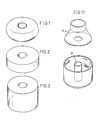
- the Gouda model consists of a cylindrical flat form with round sides, the Kanter model of a flat cylinder with rounded edges at one side, and the Cheddar model of a cylindrical form. These models, which are made in various sizes, wherein the height of the cylinder of the Cheddar type is dependent on the height of the cheese mould chosen, are indicated in figures 1-3 of the drawing.
- the weight classes of the cheese may vary from 0.5 to 25 kg and still heavier.
- the cheese models are distinguished by a continuous transition of the rind of the central open part to the body of the cheese.
- the edges are preferably rounded and the transition is smooth.
- the transition may also be rectangular, dependent on the desired model, wherein however the transition of the rind is not interrupted and comparable with that of for example a rectangular solid cheese or the straight transition of a solid Kanter model.
- the size of the central opening may be varied, the lower limit being determined by the condition that the pieces obtained are as flat as possible, the upper limit being determined by practical considerations.
- the diameter of the opening is preferably not larger than half the diameter of the cheese of a round model or half the axes of an elliptical model.
- the value of the ratio lies in the range of about 1/2 to 1/4 and is in practice of the order of about 1/3, which value for an ellipse as previously mentioned relates to both axes.
- the height of the cheese of a Gouda type is about 1/3 of the diameter.
- a rectangular or square piece of cheese which ends in 2 half spheres is also considered an elliptical model, with diameters equal to the sides where the spheres are lying.
- the same conditions are valid relating to the half spheres which are considered as a whole while the same requirement is valid for the distance of the straight part.
- the central elliptical opening is uniform with the circumference of the cheese.
- the invention thus provides a batch process for preparing a cheese of the aforementioned type wherein in the cheese mould in which the curd is pressed into its definite shape, while the greater part of the residual whey is driven out, provisions are made consisting of one or more central moulders to bring about the final desired shape without disturbing the further preparation process.
- the process is characterized in that during the stage wherein the curd is put in the cheese mould and compressed and during further treatments, one or more porous central moulders are present which screen off the desired central part from the cheese model.
- a central, preferably porous, moulder is applied with a circumference adapted to the desired central opening and during the introduction and compression of the curd a central open space is screen off therefor.
- central moulder a part which is centrically fitted in the cheese mould and which during the introduction of the curd and also during subsequent treatment forms a fixed part thereof and screens off a central space for the curd.
- the central moulder may be a cylindrical part, which may be hollow or not, open at the top or closed, and having a desired cross-section, which is centrically placed and is integral therewith.
- the central moulder is in itself porous or provided with openings to promote drainage of whey.
- the central moulder has a total effective height which is at least equal to that of the cheese mould.
- a removable central moulder which is preferably open at the top and is combined with a second open cylindrical moulder, which fits in and is movable in the central moulder.
- the moulder cooperates with a second separate moulder, preferably of a similar porous material, which preferably is internally movable in the central moulder.
- the height of the second central moulder is chosen in such a way that when compressing the curd the upper part of the second moulder remains above the top level of the central moulder to avoid that the pressure would fall away and only on the top level of the central moulder pressure would be exerted.
- the height of the second central moulder together with that of the other moulder need not be greater than the height of the cheese mould in the extended position.
- the central moulder is porous and of the same type as the central moulder to enable passing of the whey and formation of rind along the face of the first central moulder as well as above the top level thereof and below it.
- the second central moulder By utilizing the second central moulder the rind formation does not appear to be disturbed.
- the height of the second moulder will be chosen relative to that of the first moulder in such a way that the second moulder at the desired compression of the curd will not be pressing on the bottom.
- a centralizing member preferably consisting of a thread or bar which is movable around the edge of the cheese mould and is provided with a central pin with a cross member.
- This pin is introduced into a central opening of the central moulder and by rotating the strip therein one turn the pin will be fixed. In this way the central moulder cannot be moved out of its central position until the mould is filled with curd.
- Other methods are also possible, such as by applying a centre pin through a threaded opening in the bottom of the mould. By tightly screwing the centre pin the central moulder will be kept in position.
- the central moulder is fixedly attached to the cheese mould or is integral therewith, the compression of the curd being carried out by the follower, which is provided with a central opening fitting around the fixed central moulder.
- the invention also relates to a cheese mould applicable to the preparation of cheese, provided with a fixed central moulder as well as a moulder combination which can be removably fitted in a cheese mould as above described.
- the materials used for the cheese mould including the follower and the central moulders need not be identical. When using a plastic cheese mould there should be present a cloth respectively netting between the wall of the mould and the central moulder and below the follower. If the fixed central moulder does not consist of a porous, hollow, partly hollow or solid porous material, the cloth or netting should be placed over the central moulder.
- the follower with central opening which as earlier mentioned is provided with a cloth or netting, moves downwards along the cloth or netting at the wall and the circumference of the central moulder during pressing.
- the central moulder preferably consists of a porous material, i.e. a material provided with small openings, like plastic or metal or metal alloy suitable for use in the dairy industry, in which case the cloth or netting may be omitted.
- the central moulder along the circumference of the mould may be provided with an upright edge extending to the edge of the mould which latter thus functions as an inner mould, preferably a thin porous metal edge of about one mm thickness fitting completely within the mould.
- the cheese cloth or netting in the cheese mould may completely be omitted, the porous edge then functioning as cheese netting.
- the cheese mould itself may consist of any material suitable for cheese mould.
- the fixing of the central moulder cooperating with the second moulder may, if needed, be facilitated by inserting in the bottom of the cheese mould a removable part, for example a truncated part, which can only be removed from the cheese mould in an upwards direction.
- the central moulder may be attached to such a part and taken up in the bottom of the cheese mould, which has the advantage that centralizing measures become superfluous. After use an identical insert may be applied in the opening in the bottom, which makes the cheese mould suitable for the preparation of the usable cheese model.
- the central moulder in the bottom of the cheese mould through a central opening via the bottom part and make provisions to enable the central moulder to move the right distance downwards during the compression step ' of the curd.
- the cheese mould may for instance be provided with a ringlike edge at the bottom side of the vessel with a height sufficient to accommodate for the downward movement of the central moulder.
- This ring or otherwise shaped spacer may or may not be attached to the cheese mould or be integral therewith.
- This variation is especially suitable for a plastic cheese mould, of which the cheese netting is provided with a central opening and the porous central moulder consisting of metal or plastic or fillingly inserted in the cheese mould from the bottom part thereof.
- a plastic porous material which is commercially available as Laude material by which the use of netting becomes superfluous.
- the cheese mould consists of a fixed central moulder cooperating with a follower with a central opening made of a porous plastic as above mentioned.
- the central moulder is preferably rounded at the transition of the bottom of the cheese mould, the bottom itself also being rounded.
- the edge of the follower has a counter rounding for the Gouda model which when a Kanter model is desired is missing.
- the invention also comprises a continuous process for preparing cheese wherein use is made of the following system, as disclosed in FR-A-2305930.
- the curd with whey is fed by means of a pump through a column, which column is provided with enlarged perforated sections for draining off the whey.
- the curd is transported through the column and is resting on a slide-bottom/knife, which after the curd has reached a certain firmness is withdrawn, the column of curd being fed into the dosing cylinder provided with a perforated dosing plate.
- This dosing plate is movable by means of a pneumatically or hydraulically operated piston, the downward movement being precisely adjusted to the dosing. After the dosing plate (and thus also the curd) has reached its adjusted position the slide-bottom with the knife is moved forwards and a block of curd cut to to the right size.
- This block of curd then rests on the dosing plate, the bottom/knife plate again forming the bottom of the cylindrical column.
- the dosing plate now moves upwards to prepress the curd to remove a substantial portion of the whey and give firmness to the curd.
- the prepressing the dosing plate will move back again and the block of curd in the cylinder is moved sidewards in the filling room and introduced, into the cheese mould, which is transported for further treatments. This cycle is thereafter repeated.
- the curd is transported through a column provided with a central moulder pipe with the same diameter as the central space to be provided in the cheese, the so shaped curd is moved in the dosing cylinder constructed as a shaping trough, the dosing plate being provided with a centrically movable piston which screens off the central space of the dosing cylinder corresponding to the central space screened off in the column, the bottom with knife plate is closed after filling the shaping trough while cutting off a dosed piece of curd, next the dosing plate around the central piston is moved upwards in order to prepress the curd, whereafter the dosing plate with central piston is moved downwards to the adjusted lower position, the dosing plate and central piston lying in one face and next the block of curd is moved sidewards out of the shaping trough and transported to the filling trough where it is filled into the cheese mould, provided with a central moulder according to the invention, which cheese mould subsequently is subjected to further treatments
- the moulder pipe in the feeding column of the curd is not made in a fixed form but is movable to the level of the bottom-dosing plate to screen off the central space during the filling of the curd into the dosing-shaping trough. After filling of the shaping trough the block of curd is cut by the knife bottom of the feeding column which has the shape of semi-circular knives.
- the block of curd is first prepressed by the upwards moving bottom-dosing plate and after the dosing plate has been returned to the adjusted position the moulder pipe is withdrawn in the curd feeding pipe. After removing the block of curd in the manner as earlier described the cycle may be started again.
- the cheese according to the invention may however be obtained, independent of how the continuous formation of the predetermined block of curd is carried out, by making provisions to remove the central part of the block of curd just before the step of the block of curd being introduced into the cheese mould.
- an upper part is placed on the central moulder of the cheese mould provided with cutting edges.
- the desired central part of the curd is cut off by means of this upper part, whereafter it will together with the upper part be removed.
- the upper part is preferably provided with an inwardly movable bottom to press out the cut off central piece, whereafter the upper part is again moved to its position above the central moulder of the cheese mould.
- figure 1 is a cheese model of the Gouda-type, figure 2 a Kanter-type and figure 3 a Cheddar-type.
- Figure 4 shows a cheese model according to the invention in elevation in cut form.
- Figure 5 shows an embodiment of a central moulder to be inserted in a cheese mould according to the invention.
- Figure 6 shows in perspective an insert or hollow cylinder which is movable in the central moulder.
- Figure 7 shows in perspective a cheese mould with fixed central moulder attached to the bottom of the cheese mould.
- Figure 8 shows the cover of the cheese mould to be used in the embodiment of figure 7, while figure 9 shows in perspective a normal cheese mould.
- Figure 10 indicates the cover or so- called follower.
- figure 11 a variation of the embodiment of figure 7 is illustrated wherein use is made of a porous plastic material owing to which the lining may be omitted.
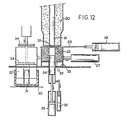
- figure 12 illustrates a continuous preparation process wherein in the feeding pipe of the curd a central pipe is present and in the shaping trough an adjustable central piston, which screens off a central space in the shaping trough.
- FIG 4 a cheese model according to the invention is indicated with a central opening 3, wherein the flat pieces to be cut out are shown schematically.
- the first flat part 2 cut out is indicated separately.
- a normal cheese mould is illustrated, filled with curd from which by pressing the whey is removed.
- This cheese mould thus determines the shape of the final cheese product, which shape will no longer be subjected to substantial change after turning, trimming, salting etc.
- the mould may consist of plastic, metal of a combination thereof, and is composed of a cover or follower 4 provided with an upright edge 5, so that during the pressing stop no tilting movement can occur because of a non-centrically exerted force.
- an inner lining 6 may be present which for some mould is indispensable.
- the edge 7 fits around the edge of 4.
- the follower with inner lining fits in the perforated lining 8, which replaces the cloth used a.o. in wooden cheese moulds.
- This lining 8 is provided with a ring 9.
- Lining 8 fits in mould 10 and the follower therein is movable by pressure.
- the pressure which is exerted on the curd by the follower is usually empirically determined and indicated in terms of the downward movement of the follower.
- the central moulder of the invention is illustrated consisting of a cylindrical hollow part 11, attached to or passing into an edge-shaped bottom 12. It fits totally in the bottom 12. The central moulder thus need not be fixed. Bottom 12 and part 11 consist of an inert material provided with small holes.
- the second cylindrical central moulder 13 according to figure 6, which is hollow as well, is moved into the central moulder (11) to such an extent that the curd after introduction into the cheese mould is screened off in respect of the central opening of the central moulder.
- the follower is subsequently applied and pushed in moving the upper moulder downwards into the central moulder and also pressing the curd to a definite selected height.
- the cheese mould is usually filled to the upper part thereof, while the second moulder is of equal height as the central moulder or somewhat shorter. Cylinder 13 is preferably closed at the upper side. For an elliptical model both central moulders are naturally made in the form of ellipses.
- a cheese mould is indicated containing a central moulder affixed thereto. This is at its lower part welded to the cheese mould or connected therewith in a somewhat extended rounded form and preferably not closed at the upper side.
- the height of the central moulder is at least equal to the height of the cheese mould and after the curd has been introduced into the cheese mould between the wall thereof and the central moulder, the follower as indicated in figure 8 is placed on the cheese mould.
- This follower is provided with a circular opening 14 of the size of the diameter of the central moulder 15 and is fittingly movable over the central moulder. When exerting pressure the follower will thus be moved downwards to the required level and the central space remains screened off.
- the central moulders as mentioned preferably consist of a thin inert metal having a thickness of about 1 millimeter, wherein pores are present. It is also possible to use a porous plastic.
- a cheese mould is indicated consisting of a plastic porous material as mentioned above as a consequence of which the nettings or linings may be omitted.
- the liner 6 as shown in figure 10 is absent.
- the cheese mould is provided with a fixed central moulder, the arrangement being further identical to that of figure 7 and 8.
- FIG 12 a continuous embodiment is shown.
- the curd is fed through feeding pipe 20 wherein a moulding pipe 21 is present, which screens off a central space and may be porous or not.
- a moulding pipe 21 is present, which screens off a central space and may be porous or not.
- the curd is cut off by actuating piston 28, which moves the bottom knife 23.
- the piston 35 which moves the central moulder 24 has moved the moulder at the beginning of the filling step upwards to the upper level 26 of the shaping trough 22.
- the curd is introduced along the central moulder 24 into the trough 22 and prepressed by the dosing plate 32 which is actuated by the piston 35, during which the central moulder 24 remains in its position.
- both the dosing plate 32 which may move independently of the moulder 24 and, simultaneously or thereafter, the central moulder 24 is moved downwards till they both are at the same level of the bottom plate 33 of the shaping trough 22.
- piston 27 By means of piston 27 the trough with the filled curd, which is now open at the top and the bottom, is slid to the left between the pressing plate 34 and the cheese mould 30, and the curd provided with the central opening, which owing to the prepressing step still slightly sticks to the walls of the trough 22, is pushed into the cheese mould 30 by means of said plate 34 which cheese mould contains a fixed central moulder 31 and after being transported is subjected to further treatments not shown.
- In the drawing 22' indicates the block of curd which is pushed into the cheese mould.
- a Gouda cheese was prepared in the usual way, starting from 100 pasteurized milk, to which rennet and acid agent were added. The milk was curdled after about 30 minutes, whereafter the formed cheese curd was cut, the whey drained off, followed by stirring and draining. These preparation steps are known and need not be further illustrated in detail.
- the preparation took two hours and that one finally obtained about 10 kg of curd.
- the curd was filled into the cheese mould, which had a diameter of 30 cm and a height of 15 cm.
- the curd was introduced to a height of 15 cm whereafter it was pressed during 4 hours by means of a hydraulic press so that it still went down a few cms. Subsequently the formed mass of cheese was removed from the mould.
- This shape had the dimensions of the diameter of the cheese mould with a height of 12 cm. After trimming and turning the cheese block was immersed in a brine bath for 3) days and then stored. After application of a plastic layer around the cheese ageing took place on storage racks in the ageing room.
- This moulder like the central moulder had a wall thicknes of about 1 mm.
- the moulders as well as the cheese mould were made of stainless steel especially designed for the dairy industry and provided with small holes.
- the curd was now introduced into the same cheese mould of which the volume was reduced proportionally to the central space saved.
- the follower was applied and in the same way as in the first case pressure was exerted till the curd had dropped about 3 cm.
- the second moulder was also pressed down about 3 cm in the central moulder.
- the further treatments were identical with those of the first case.
- the model obtained had a central uniform opening of which on the lateral parts a normal rind was formed.
Landscapes
- Life Sciences & Earth Sciences (AREA)
- Animal Husbandry (AREA)
- Environmental Sciences (AREA)
- Chemical & Material Sciences (AREA)
- Engineering & Computer Science (AREA)
- Food Science & Technology (AREA)
- Polymers & Plastics (AREA)
- Dairy Products (AREA)
- Beans For Foods Or Fodder (AREA)
Claims (12)
Priority Applications (1)
| Application Number | Priority Date | Filing Date | Title |
|---|---|---|---|
| AT81201269T ATE15745T1 (de) | 1980-11-18 | 1981-11-16 | Halbharter oder hartkaese mit einer zentralen oeffnung, herstellungsverfahren sowie vorrichtung und kaeseform zur durchfuehrung des verfahrens. |
Applications Claiming Priority (2)
| Application Number | Priority Date | Filing Date | Title |
|---|---|---|---|
| NL8006283 | 1980-11-18 | ||
| NL8006283A NL8006283A (nl) | 1980-11-18 | 1980-11-18 | Halfharde of harde kaas met open cilindrische vorm, alsmede werkwijze ter bereiding daarvan. |
Publications (2)
| Publication Number | Publication Date |
|---|---|
| EP0052409A1 EP0052409A1 (fr) | 1982-05-26 |
| EP0052409B1 true EP0052409B1 (fr) | 1985-09-25 |
Family
ID=19836199
Family Applications (1)
| Application Number | Title | Priority Date | Filing Date |
|---|---|---|---|
| EP81201269A Expired EP0052409B1 (fr) | 1980-11-18 | 1981-11-16 | Fromage semi-dur ou fromage dur avec un évidement central, procédé ainsi que dispositif et moule pour la réalisation du procédé |
Country Status (4)
| Country | Link |
|---|---|
| EP (1) | EP0052409B1 (fr) |
| AT (1) | ATE15745T1 (fr) |
| DE (1) | DE3172453D1 (fr) |
| NL (1) | NL8006283A (fr) |
Families Citing this family (6)
| Publication number | Priority date | Publication date | Assignee | Title |
|---|---|---|---|---|
| FR2532525A1 (fr) * | 1982-09-02 | 1984-03-09 | Somecal Sa | Procede, machine et parties constitutives de celle-ci pour la fabrication de fromages, et fromages obtenus en particulier de forme annulaire |
| NL8700126A (nl) * | 1987-01-20 | 1988-08-16 | Dmv Campina Bv | Werkwijze en inrichting voor het snijden van kaas in plakken, alsmede plakken verkregen onder toepassing van deze werkwijze. |
| DE102006020226B4 (de) * | 2006-05-02 | 2008-03-20 | Franz Müller GmbH | Füllanlage zur Käseherstellung |
| ITLI20080014A1 (it) * | 2008-12-15 | 2010-06-16 | Fabrizio Fanelli | Nuovo sistema produttivo nel settore caseario. |
| FR3130116A1 (fr) * | 2021-12-14 | 2023-06-16 | Jean Christophe Polliart | Foncet en inox |
| CN114789137B (zh) * | 2022-06-23 | 2022-09-13 | 大竹县万康生态农业有限公司 | 一种基于黄精根茎的饲料颗粒筛分机 |
Family Cites Families (6)
| Publication number | Priority date | Publication date | Assignee | Title |
|---|---|---|---|---|
| FR331710A (fr) * | 1900-01-01 | |||
| CH106991A (de) * | 1923-10-02 | 1924-09-16 | Osterwalder Jacob | Verfahren zur Herstellung von Käselaiben, Vorrichtung hierzu und nach dem Verfahren hergestellter Käselaib. |
| FR806504A (fr) * | 1936-03-27 | 1936-12-18 | Nouveau dispositif pour la fabrication des fromages à pâte molle | |
| CH274827A (de) * | 1950-12-18 | 1951-04-30 | Osterwalder Sen Jakob | Verfahren zur Herstellung von ringförmigen Käselaiben. |
| FR2050342A1 (en) * | 1969-07-24 | 1971-04-02 | Grenier Marie | Ring shaped cheese |
| GB1542844A (en) * | 1975-04-04 | 1979-03-28 | Wincanton Eng | Method and apparatus for forming blocks of natural cheese from cheese curd |
-
1980
- 1980-11-18 NL NL8006283A patent/NL8006283A/nl not_active Application Discontinuation
-
1981
- 1981-11-16 DE DE8181201269T patent/DE3172453D1/de not_active Expired
- 1981-11-16 EP EP81201269A patent/EP0052409B1/fr not_active Expired
- 1981-11-16 AT AT81201269T patent/ATE15745T1/de not_active IP Right Cessation
Also Published As
| Publication number | Publication date |
|---|---|
| ATE15745T1 (de) | 1985-10-15 |
| DE3172453D1 (en) | 1985-10-31 |
| EP0052409A1 (fr) | 1982-05-26 |
| NL8006283A (nl) | 1982-06-16 |
Similar Documents
| Publication | Publication Date | Title |
|---|---|---|
| US5082681A (en) | Method and apparatus for producing moulded cheese blocks | |
| DE69505582T2 (de) | Herstellung von grössen Pasta-filata Käseblöcken | |
| GB1424174A (en) | Method for the manufacture of cheeses | |
| US4244286A (en) | Apparatus and method for making cheese | |
| US4289793A (en) | Method of making cheese | |
| US3562910A (en) | Method and apparatus for making cheese | |
| US3140185A (en) | Method and apparatus for making cheese | |
| US3841210A (en) | Cheese processing | |
| US3078169A (en) | Method for making cheese | |
| US3078170A (en) | Method for making cheese | |
| EP0052409A1 (fr) | Fromage semi-dur ou fromage dur avec un évidement central, procédé ainsi que dispositif et moule pour la réalisation du procédé | |
| US4332831A (en) | Method of preparing salted cheese curd loaves | |
| US5125329A (en) | Apparatus for continuously producing and maturing curds | |
| US2494637A (en) | Cheese manufacture | |
| USRE21834E (en) | Method fob making cheese | |
| EP1592308B1 (fr) | Processus de caillage continu | |
| DE19704673A1 (de) | Verfahren zur Käsebereitung sowie Vorrichtung für dessen Durchführung | |
| NZ248758A (en) | Cheese mould filling; opposed plate knives sever curd blocks from curd mass at bottom of drain tube, the curd blocks being delivered to an intermediate mould before the cheese mould | |
| SU1734640A1 (ru) | Способ прессовани сыра | |
| EP0782385A1 (fr) | Appareil de fa onnage et de pressage simultanes de plusieurs fromages de type grana | |
| DE529175C (de) | Verfahren und Vorrichtung zur Haltbarmachung von Quark durch Gefrieren | |
| DE1053908B (de) | Verfahren und Vorrichtung zur Herstellung von Weichkaese | |
| DE1150238C2 (de) | Verfahren und Vorrichtung zur Herstellung von Weichkaese | |
| HU195071B (en) | Continuous cheese press | |
| HU221860B1 (hu) | Eljárás sajtok előállítására és berendezés az eljárás kivitelezésére |
Legal Events
| Date | Code | Title | Description |
|---|---|---|---|
| PUAI | Public reference made under article 153(3) epc to a published international application that has entered the european phase |
Free format text: ORIGINAL CODE: 0009012 |
|
| AK | Designated contracting states |
Designated state(s): AT BE CH DE FR GB IT LU NL SE |
|
| 17P | Request for examination filed |
Effective date: 19821122 |
|
| GRAA | (expected) grant |
Free format text: ORIGINAL CODE: 0009210 |
|
| AK | Designated contracting states |
Designated state(s): AT BE CH DE FR GB IT LI LU NL SE |
|
| PG25 | Lapsed in a contracting state [announced via postgrant information from national office to epo] |
Ref country code: IT Free format text: LAPSE BECAUSE OF FAILURE TO SUBMIT A TRANSLATION OF THE DESCRIPTION OR TO PAY THE FEE WITHIN THE PRESCRIBED TIME-LIMIT;WARNING: LAPSES OF ITALIAN PATENTS WITH EFFECTIVE DATE BEFORE 2007 MAY HAVE OCCURRED AT ANY TIME BEFORE 2007. THE CORRECT EFFECTIVE DATE MAY BE DIFFERENT FROM THE ONE RECORDED. Effective date: 19850925 |
|
| REF | Corresponds to: |
Ref document number: 15745 Country of ref document: AT Date of ref document: 19851015 Kind code of ref document: T |
|
| PG25 | Lapsed in a contracting state [announced via postgrant information from national office to epo] |
Ref country code: SE Effective date: 19850930 |
|
| REF | Corresponds to: |
Ref document number: 3172453 Country of ref document: DE Date of ref document: 19851031 |
|
| PG25 | Lapsed in a contracting state [announced via postgrant information from national office to epo] |
Ref country code: LU Free format text: LAPSE BECAUSE OF NON-PAYMENT OF DUE FEES Effective date: 19851130 |
|
| ET | Fr: translation filed | ||
| PLBE | No opposition filed within time limit |
Free format text: ORIGINAL CODE: 0009261 |
|
| STAA | Information on the status of an ep patent application or granted ep patent |
Free format text: STATUS: NO OPPOSITION FILED WITHIN TIME LIMIT |
|
| 26N | No opposition filed | ||
| PGFP | Annual fee paid to national office [announced via postgrant information from national office to epo] |
Ref country code: GB Payment date: 19921116 Year of fee payment: 12 |
|
| PGFP | Annual fee paid to national office [announced via postgrant information from national office to epo] |
Ref country code: AT Payment date: 19921130 Year of fee payment: 12 |
|
| PGFP | Annual fee paid to national office [announced via postgrant information from national office to epo] |
Ref country code: CH Payment date: 19930517 Year of fee payment: 12 |
|
| PG25 | Lapsed in a contracting state [announced via postgrant information from national office to epo] |
Ref country code: GB Effective date: 19931116 Ref country code: AT Effective date: 19931116 |
|
| PG25 | Lapsed in a contracting state [announced via postgrant information from national office to epo] |
Ref country code: LI Effective date: 19931130 Ref country code: CH Effective date: 19931130 |
|
| GBPC | Gb: european patent ceased through non-payment of renewal fee |
Effective date: 19931116 |
|
| REG | Reference to a national code |
Ref country code: CH Ref legal event code: PL |
|
| PGFP | Annual fee paid to national office [announced via postgrant information from national office to epo] |
Ref country code: FR Payment date: 19951025 Year of fee payment: 15 |
|
| PGFP | Annual fee paid to national office [announced via postgrant information from national office to epo] |
Ref country code: BE Payment date: 19951031 Year of fee payment: 15 |
|
| PGFP | Annual fee paid to national office [announced via postgrant information from national office to epo] |
Ref country code: DE Payment date: 19960105 Year of fee payment: 15 |
|
| PGFP | Annual fee paid to national office [announced via postgrant information from national office to epo] |
Ref country code: NL Payment date: 19961128 Year of fee payment: 16 |
|
| PG25 | Lapsed in a contracting state [announced via postgrant information from national office to epo] |
Ref country code: BE Effective date: 19961130 |
|
| BERE | Be: lapsed |
Owner name: HUISMAN JACOB PIETER Effective date: 19961130 |
|
| PG25 | Lapsed in a contracting state [announced via postgrant information from national office to epo] |
Ref country code: FR Effective date: 19970731 |
|
| NLS | Nl: assignments of ep-patents |
Owner name: BROERE KAASSPECIALISTEN |
|
| REG | Reference to a national code |
Ref country code: FR Ref legal event code: ST |
|
| PG25 | Lapsed in a contracting state [announced via postgrant information from national office to epo] |
Ref country code: DE Effective date: 19971001 |
|
| PG25 | Lapsed in a contracting state [announced via postgrant information from national office to epo] |
Ref country code: NL Free format text: LAPSE BECAUSE OF NON-PAYMENT OF DUE FEES Effective date: 19980601 |
|
| NLV4 | Nl: lapsed or anulled due to non-payment of the annual fee |
Effective date: 19980601 |