EP0052415A2 - Gerät zum Regeln der Frequenzcharakteristik - Google Patents
Gerät zum Regeln der Frequenzcharakteristik Download PDFInfo
- Publication number
- EP0052415A2 EP0052415A2 EP81304447A EP81304447A EP0052415A2 EP 0052415 A2 EP0052415 A2 EP 0052415A2 EP 81304447 A EP81304447 A EP 81304447A EP 81304447 A EP81304447 A EP 81304447A EP 0052415 A2 EP0052415 A2 EP 0052415A2
- Authority
- EP
- European Patent Office
- Prior art keywords
- signal
- amplitude control
- control means
- gain
- circuit
- Prior art date
- Legal status (The legal status is an assumption and is not a legal conclusion. Google has not performed a legal analysis and makes no representation as to the accuracy of the status listed.)
- Withdrawn
Links
Images






Classifications
-
- H—ELECTRICITY
- H03—ELECTRONIC CIRCUITRY
- H03G—CONTROL OF AMPLIFICATION
- H03G5/00—Tone control or bandwidth control in amplifiers
- H03G5/02—Manually-operated control
- H03G5/04—Manually-operated control in untuned amplifiers
Definitions
- This invention relates to apparatus for adjusting a frequency characteristic of an electric signal such as an audio signal.
- a frequency characteristic adjusting apparatus which divides an electric signal into a plurality of frequency band signals, and then selectively increases or decreases the amplitude of the band divided signals, is used, for example, as a tone controlling circuit in an audio apparatus.
- a prior art frequency characteristic adjusting apparatus includes a band dividing filter, for example, a low-pass filter for filtering the low frequency signal component in an input signal.
- This prior art apparatus includes a subtraction circuit for subtracting the output signal of the low-pass filter from the input signal thereof so as to obtain the high frequency signal component in the input signal.
- the thus obtained low and high frequency signal components are amplified separately, and an adder circuit adds the output signals from the amplifiers.
- the frequency characteristic of the input signal may be adjusted by increasing or decreasing the gain of the amplifiers.
- frequency characteristic adjusting apparatus entails the following problem.
- the frequency characteristic of the total gain TG1 is adjusted with amplitude of the low frequency signal component GL1 larger than that of the high frequency signal component G4.
- the frequency characteristic of the total gain TG2 has the amplitude of the low frequency signal component GS1 and is smaller than that of the high frequency signal component G4.
- the characteristic curve TG1 has a pattern asymmetric to the pattern of the characteristic curve TG2 with respect to the flat frequency characteristic of the total gain obtained while the amplitude of the low frequency signal component is equal to that of the high frequency signal component. Under such condition, the frequency characteristic adjusting apparatus is not a satisfactory tone-controlling circuit.
- the present invention seeks to provide a frequency characteristic adjusting apparatus which can provide a symmetric frequency characteristic without varying the cut-off frequency of the filter, and which has a simple circuit configuration.
- an input signal is amplified sufficiently by an amplifier.
- the amplified signal is separated into at least a first and a second frequency band.
- the signal of the first frequency band is applied to first and second amplitude control circuits respectively.
- the signal of the second frequency band is applied to third and fourth amplitude control circuits respectively.
- the output signals from the first and third amplitude control circuits are added and then negatively fed back to the amplifier.
- the output signals from the second and fourth amplitude control circuits are added and then supplied to an output terminal.
- the frequency characteristic is adjusted by varying the gains of at least either the first and second amplitude control circuits or the third and fourth amplitude control circuits in response to gain control signal from a gain control signal generating circuit.
- an input signal Vi(s) is applied to an input terminal 11 and delivered to a subtraction circuit 12.
- Subtraction circuit 12 subtracts a feedback signal B(s), which will be described later, from the input signal Vi(s).
- An output signal of subtraction circuit 12 is delivered to an amplifier 13 having a gain A 1 and amplified by it.
- An amplified signal is delivered to a filter circuit having a signal trans- mission characteristic F(s) such as a low-pass filter 14.
- the input and output signals of low-pass filter 14 are delivered to a substraction circuit 15.
- Subtraction circuit 15 subtracts the output signal of low-pass filter 14 from the input signal thereof.
- the output of subtraction circuit 15 is delivered to first and second amplitude control circuits such as voltage controlled amplifiers (hereinafter VCAs) 16 and 17, respectively.
- VCAs voltage controlled amplifiers
- a gain control signal generating circuit 18 is connected to control terminals of VCAs 16 and 17 so as to supply a gain control signal to VCAs 16 and 17.
- the output of low-pass filter 14 is delivered to third and fourth amplitude control circuits such as VCAs 19 and 20, respectively.
- a gain control signal generating circuit 21 is connected to the control terminal of VCAs 19 and 20 so as to supply a gain control signal to VCAs 19 and 20.
- the outputs of VCAs 16 and 19 are supplied to an adder circuit 22.
- Adder circuits 22 adds the outputs from VCAs 16 and 19 to each other and delivers its output signal B(s) to subtraction circuit 12.
- the outputs of VCAs 17 and 20 are supplied to an adder circuit 23.
- Adder circuit 23 adds the outputs from VCAs 17 and 20 to each other and delivers its output signal VO(s) to an output terminal 24.
- the output signal of amplifier 13 is expressed by A 1 Va(s).
- the output signal A 1 Va(s) of amplifier 13 is delivered to filter circuit 14 having the transmission characteristic F(s). Accordingly, the output signal of filter circuit 14 is expressed by F(s)A l Va(s).
- Subtraction circuit 15 subtracts the output signal F(s)A 1 Va(s) of filter circuit 14 from the input signal A 1 Va(s) thereof. Accordingly, the output signal V b (s) of subtraction circuit 15 is expressed by the following equation:
- the output signal of subtraction circuit 15 is amplified by VCA 16 having the gain G 11 and VCA 17 having the gain G 12 respectively.
- the output signals V 11 (s) and V 12 (s) of VCAs 16 and 17 are expressed by the following equations:
- the output signal F(s)A 1 Va(s) of filter circuit 14 is delivered to VCA 19 having the gain G 21 and VCA20 having the gain G 22 respectively, and amplified by them.
- the output signals V 21 (s) and V 22 (s) of VCAs 19 and 20 are expressed by the following equations:
- the output signals V 11 (s) and V 21 (s) of VCAs 16 and 19 are delivered to adder circuit 22 and added to each other. Accordingly, the output signal B(s) of adder circuit 22 is expressed by the following equation:
- This output signal B(s) of adder circuit 22 is delivered to subtraction circuit 12.
- the output signal Vo(s) of adder circuit 23 is delivered to output terminal 24.
- Va(s) is expressed by the following equation:
- the transmission characteristic H(s) is expressed by the following equation:
- the frequency characteristic of the apparatus having the transmission characteristic H(s) is symmetric to the frequency characteristic of the apparatus having the transmission characteristic 1/H(s) with respect to the flat frequency characteristic.
- the frequency characteristic adjusting apparatus having the transmission characteristic H(s) mentioned above is selectively changed into a frequency characteristic adjusting apparatus having the transmission characteristic H'(s) expressed by the following equation:
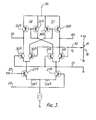
- FIGURE 3 shows a circuit embodying VCAs 16 and 17 and the control signal generating circuit 18 shown in FIGURE 2.
- VCAs 19 and 20 and control signal generating circuit 21 may have the same configuration as the circuit shown in FIGURE 3.
- the gains of VCAs 16 and 17 may be easily exchanged with each other.
- an input signal Vin is applied to input terminals 25 and 26, respectively.
- Input terminals 25 and 26 are connected to the base electrodes of NPN transistors 27a and 27b, respectively.
- the emitter electrodes of transistors 27a and 27b are connected to a constant current source 29 through resistors 28a and 28b, respectively.
- the collector electrode of transistor 27a is connected to the emitter electrodes of a pair of transistors 30a and 30b, the emitter electrodes of which are connected in common..
- the collector electrodes of transistor 27b is connected to the emitter electrodes of a pair of transistors 31a and 31b, the emitter electrodes of which are connected in common.
- the base electrodes of transistors 30b and 31b are connected in common and connected to a control terminal 32.
- the base electrodes of transistors 30a and 31a are connected in common and connected to a control terminal 33.
- the collector electrodes of transistors 30a and 31a, respectively, are connected to collector electrodes of a pair of PNP transistors 35a and 35b which forms a current mirror circuit 34.
- the base electrode of transistor 35b is connected to the collector electrode thereof and further connected to the base electrode of transistor 35a.
- the emitter electrodes of transistors 35a and 35b are connected in common and connected to an electric power source 36.
- the collector electrodes of transistors 30b and 31b, respectively, are connected to collector electrodes of a pair of PNP transistors 38a and 38b which forms a current mirror circuit 37.
- the base electrode of transistor 38a is connected to the collector electrode thereof and further connected to the base electrode of transistor 38b.
- the emitter electrodes of transistors 38a and 38b are connected in common and connected to electric power source 36.
- the collector electrodes of transistor 35a and 38b are connected to output terminals 39 and 40, respectively.
- Gain control signal generating circuit 18 includes a potentiometer 41 connected between voltage sources +VA and -VA. The movable terminal of potentiometer 41 is connected to control terminal 32. Control terminal 33 is connected to ground.
- the collector current Ic of the transistor is approximately expressed by the following equation: where Is is the saturation current, VBE is the voltage between the base and emitter electrodes, a is the charge of electron, k is the Boltzmann's constant and T is the absolute temperature.
- the output currents I 1 and 1 2 may be varied by varying the gain control signal Vc.
- the gains G 11 and G 12 have the relationship expressed by the following equations with the gain control signal Vc:
- the gain Gll of VCA 16 is changed into the gain G 12 when the polarity of the gain control signal Vc is inverted, that is, -Vc is supplied to VCA 16.
- the gain G 12 of VCA 17 is changed into the gain G 11 when the polarity of the gain control signal V C is inverted.
- the polarity of the gain control signal may be inverted easily by moving the movable terminal of potentiometer 41.
- the VCA circuit shown in FIGURE 3 may exchange the gains G 11 and G 12 easily by only inverting the polarity of the gain control signal Vc. Therefore, the frequency characteristic adjusting apparatus according to the present invention may easily obtain the correctly symmetric frequency characteristic with respect to the flat frequency characteristic.
- Filter circuit 14 employed in this invention is designed freely and easily because it is not necessary to vary its time constant so as to obtain the symmetric frequency characteristic with respect to the flat frequency characteristic.
- FIGURE 4 shows a low-pass filter as an embodiment of filter circuit 14, which includes a resistor 45 and capacitor 46.
- the transfer function F(s) of this low-pass filter 14 is expressed by the following equation: where t is the time constant of filter 14. Accordingly, from the equation (11) the transmission characteristic H(s) of the frequency characteristic adjusting apparatus is expressed by the following equation:
- the frequency characteristic of the frequency characteristic adjusting apparatus is shown in FIGURES 5A and 5B.
- the characteristic curves shown in FIGURES 5A were obtained when the gains G 11 and G 12 of VCAs 16 and 17 were varied while the gains G 21 and G 22 of VCAs 19 and 20 were fixed at 0.5.
- curve al was obtained when G 11 was 0.1 and G 12 was 1
- curve a2 was obtained when G 11 and G 12 were 0.5
- curve a3 was obtained when G 11 was 1 and G 12 was 0.1.
- the high frequency characteristic may be adjusted by increasing one of the gains G 11 and G 12 and at the same time decreasing the other'of the gains G 11 and G 12 according to the equations (16) and (17).
- the symmetric frequency characteristic with respect to the flat frequency characteristic was obtained by reversing the relationship between the gains G 11 and G 12 as curves al and a3.
- Curves shown in FIGURE 5B were obtained when the gain G 21 and G 22 of VCAs 19 and 20 were varied while the gains G 11 and G 12 of VCAs 16 and 17 were fixed at 0.5.
- curve bl was obtained when G 21 was 0.1 and G 22 was 1
- curve b2 was obtained when G 21 and G 22 were 0.5
- curve b3 was obtained when G 21 was 1 and G 22 was 0.1.
- the low frequency characteristic may be adjusted by increasing one of the gains G 21 and G 22 and at the same time decreasing the other of the gains G 21 and G 22 .
- the symmetric frequency characteristic with respect to the flat frequency characteristic was obtained by reversing the relationship between the gains G 21 and G 22 as curves bl and b3.
- FIGURES 6A and 6B show modifications of the frequency characteristic adjusting apparatus shown in FIGURE 2.
- at least either the pair of VCAs 16 and 17 or the pair of VCAs 19 and 20 may be replaced with other amplifiers having constant gains or resistors.
- amplfiiers 51 and 52 are not VCAs but amplifiers having constant gains.
- VCAs 19 and 20 shown in FIGURE 2 are replaced with resistors 53 and 54.
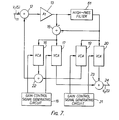
- FIGURE 7 shows the second embodiment of the frequency characteristic adjusting apparatus according to the present inqention.
- a high-pass filter 61 is used as the filter circuit. Accordingly, the high frequency signal component in the input signal Vi(s) is obtained from the output of high-pass filter 61 and the low frequency signal component in the input signal Vi(s) is obtained from output of subtraction circuit 15.
- FIGURE 8 shows the third embodiment of the frequency characteristic adjusting apparatus.
- This embodiment employs a pair of filter circuits 71 and 72 to separate the input signal into three frequency bands.
- Filter circuits 71 and 72 are low-pass filters, the cut-off frequency of which are fcl and fc2 (fcl being greater than fc2) respectively.
- Filter circuits 71 and 72 may be high-pass filters, the cut off frequency of which are fc3 and fc4 (fc3 being less than fc4) respectively.
- a subtraction circuit 73 subtracts the output signal from low-pass filter 71 from the input signal thereinto.
- the output signal of subtraction circuit 73 is delivered to VCAs 74a and 74b.
- a subtraction circuit 74 subtracts the output signal from low-pass filter 72 from the input signal thereinto.
- the output signal of subtraction circuit 74 is delivered to amplifiers 75a and 75b with constant gains, respectively.
- the output signal of filter circuit 72 is delivered to VCAs 76a and 76b.
- the output signals of VCA 74a, VCA 76a and amplfier 75a are delivered to an adder circuit 77 to add together.
- the output signal of adder circuit 77 is delivered to subtraction circuit 12.
- VCA 74b, VCA - 76b and amplifier 75b are delivered to an adder circuit 78 to add together.
- the output signal of adder circuit 78 is delivered to output terminal 24.
- the gains of VCAs 76a and 74b are controlled by gain control signal generator 18.
- the gains of VCAs 76a and 76b are controlled by gain control signal generator 21.
- the frequency characteristic of the high frequency signal band is adjusted by controlling the gains G 11 and G 12 of VCAs 74a and 74b, and the frequency characteristic of the low frequency signal band,is adjusted by controlling the gains G 11 and G 22 of VCAs 76a and 76b as shown in FIGURE 9.
- the curve Cl is obtained when the gain G 22 of VCA 76b increases and the gain G 21 of VCA 76a decreases
- the curve C2 is obtained when the gain G 21 of VCA 76a increases and the gain G 22 of VCA 76b decreases.
- curve C3 is obtained when the gain G 12 of VCA 74b increases and the gain G 11 of VCA 74a decreases
- curve C4 is obtained when the gain G 11 of VCA 74a increases and the gain G 12 of FCA 74b decreases.
- FIGURE 10 shows the fourth embodiment of the frequency characteristic adjusting apparatus.
- This embodiment employs more than two filter circuits 911, 912, ..., 91n connected in series.
- Subtraction circuits 921, 922, ..., 92n obtain the difference signals between the input and output signals of subtraction circuits 911, 912, ..., 91n.
- a plurality of VCAs 931, 932, ..., 932(n+l) amplify the output signals from subtraction circuits 921, 922, ..., 92n in response to the gain control signals from gain control signal generating circuits 181, 182, ..., 18n.
- Adder circuits 941, 942, ..., 94n and 951, 952, ..., 95n add the output signals from VCAs 931, 932, ..., 932(n+l).
- the frequency chraacteristics of a plurality of frequency bands may be adjusted independently.
Landscapes
- Tone Control, Compression And Expansion, Limiting Amplitude (AREA)
Applications Claiming Priority (2)
| Application Number | Priority Date | Filing Date | Title |
|---|---|---|---|
| JP135513/80 | 1980-09-29 | ||
| JP55135513A JPS5760714A (en) | 1980-09-29 | 1980-09-29 | Adjusting device for frequency characteristic |
Publications (2)
| Publication Number | Publication Date |
|---|---|
| EP0052415A2 true EP0052415A2 (de) | 1982-05-26 |
| EP0052415A3 EP0052415A3 (de) | 1982-08-04 |
Family
ID=15153514
Family Applications (1)
| Application Number | Title | Priority Date | Filing Date |
|---|---|---|---|
| EP81304447A Withdrawn EP0052415A3 (de) | 1980-09-29 | 1981-09-25 | Gerät zum Regeln der Frequenzcharakteristik |
Country Status (4)
| Country | Link |
|---|---|
| US (1) | US4455535A (de) |
| EP (1) | EP0052415A3 (de) |
| JP (1) | JPS5760714A (de) |
| CA (1) | CA1174738A (de) |
Cited By (1)
| Publication number | Priority date | Publication date | Assignee | Title |
|---|---|---|---|---|
| DE3422804A1 (de) * | 1984-06-16 | 1985-12-19 | Kort Elektronik GmbH, 3251 Ottenstein | Schaltungsanordnung fuer die wiedergabe von tonfrequenzen von schallquellen |
Families Citing this family (6)
| Publication number | Priority date | Publication date | Assignee | Title |
|---|---|---|---|---|
| US4539526A (en) * | 1983-01-31 | 1985-09-03 | Dbx, Inc. | Adaptive signal weighting system |
| US4731590A (en) * | 1986-07-03 | 1988-03-15 | American Telephone And Telegraph Company, At&T Bell Laboratories | Circuits with multiple controlled gain elements |
| US5129006A (en) * | 1989-01-06 | 1992-07-07 | Hill Amel L | Electronic audio signal amplifier and loudspeaker system |
| FR2670061B1 (fr) * | 1990-11-30 | 1996-09-20 | Bull Sa | Procede et dispositif de transfert de signaux binaires differentiels et application aux additionneurs a selection de retenue. |
| US5442321A (en) * | 1993-07-08 | 1995-08-15 | Anadigics, Inc. | Automatic transimpedance control amplifier |
| US7305190B2 (en) * | 2003-05-06 | 2007-12-04 | Vitesse Semiconductor Corporation | Optical dispersion correction in transimpedance amplifiers |
Family Cites Families (5)
| Publication number | Priority date | Publication date | Assignee | Title |
|---|---|---|---|---|
| US3667043A (en) * | 1969-09-19 | 1972-05-30 | Telcom Inc | Constant gain bandwidth product communication satellite repeater |
| US3875334A (en) * | 1973-06-19 | 1975-04-01 | Motorola Inc | Multi-channel control circuit with D-C operated control devices |
| JPS5337558Y2 (de) * | 1973-08-27 | 1978-09-12 | ||
| JPS5621294B2 (de) * | 1974-09-20 | 1981-05-19 | ||
| JPS55123215A (en) * | 1979-03-15 | 1980-09-22 | Pioneer Electronic Corp | Tone controller |
-
1980
- 1980-09-29 JP JP55135513A patent/JPS5760714A/ja active Pending
-
1981
- 1981-09-11 US US06/301,436 patent/US4455535A/en not_active Expired - Fee Related
- 1981-09-24 CA CA000386551A patent/CA1174738A/en not_active Expired
- 1981-09-25 EP EP81304447A patent/EP0052415A3/de not_active Withdrawn
Cited By (1)
| Publication number | Priority date | Publication date | Assignee | Title |
|---|---|---|---|---|
| DE3422804A1 (de) * | 1984-06-16 | 1985-12-19 | Kort Elektronik GmbH, 3251 Ottenstein | Schaltungsanordnung fuer die wiedergabe von tonfrequenzen von schallquellen |
Also Published As
| Publication number | Publication date |
|---|---|
| US4455535A (en) | 1984-06-19 |
| EP0052415A3 (de) | 1982-08-04 |
| CA1174738A (en) | 1984-09-18 |
| JPS5760714A (en) | 1982-04-12 |
Similar Documents
| Publication | Publication Date | Title |
|---|---|---|
| US4498053A (en) | Current amplifier | |
| US6188280B1 (en) | Differential amplifier with gain linearization through transconductance compensation | |
| JPS5827561B2 (ja) | 電磁変換器バイアス回路 | |
| EP0052415A2 (de) | Gerät zum Regeln der Frequenzcharakteristik | |
| JP2542634B2 (ja) | アクティブフィルタ型信号調整回路 | |
| US5028893A (en) | Switched capacitor filters with continuous time control | |
| EP0265763B1 (de) | Frequenzgangkompensationsschaltung | |
| EP0090543B1 (de) | Linear arbeitender Differenzverstärker | |
| JPH0648775B2 (ja) | リープフロッグ・フィルタ | |
| EP0051362B1 (de) | Elektronische Verstärkungsregelungsschaltung | |
| US3039062A (en) | Balance control system for stereo amplifier | |
| EP0208433A2 (de) | Verstärker mit verstärkungsunabhängiger Bandbreite | |
| GB2156175A (en) | Signal processing circuits | |
| GB966528A (en) | Improvements in electronic control apparatus | |
| US3596198A (en) | Volume controller | |
| SU1164863A1 (ru) | Усилитель низкой частоты | |
| SU379045A1 (de) | ||
| JPS5696518A (en) | Tone control circuit | |
| JPS568912A (en) | Gain control circuit | |
| JPS6238338Y2 (de) | ||
| JPH0746763B2 (ja) | 多段信号伝送装置 | |
| JPS5481760A (en) | Audio amplifier | |
| SU531250A1 (ru) | Усилитель с регулируемым коэффициентом усилени | |
| KR0135461B1 (ko) | 높은 입력 임피던스를 갖는 증폭회로 | |
| SU720690A1 (ru) | Многоканальное усилительное устройство с автоматической стабилизацией коэффициента усилени |
Legal Events
| Date | Code | Title | Description |
|---|---|---|---|
| PUAI | Public reference made under article 153(3) epc to a published international application that has entered the european phase |
Free format text: ORIGINAL CODE: 0009012 |
|
| AK | Designated contracting states |
Designated state(s): DE FR GB NL |
|
| PUAL | Search report despatched |
Free format text: ORIGINAL CODE: 0009013 |
|
| AK | Designated contracting states |
Designated state(s): DE FR GB NL |
|
| 17P | Request for examination filed |
Effective date: 19821224 |
|
| RAP1 | Party data changed (applicant data changed or rights of an application transferred) |
Owner name: KABUSHIKI KAISHA TOSHIBA |
|
| STAA | Information on the status of an ep patent application or granted ep patent |
Free format text: STATUS: THE APPLICATION IS DEEMED TO BE WITHDRAWN |
|
| 18D | Application deemed to be withdrawn |
Effective date: 19840712 |
|
| RIN1 | Information on inventor provided before grant (corrected) |
Inventor name: SUGAWARA, TSUTOMUC/O TOKYO |