EP0052453B1 - Verfahren zum Beseitigen von Ablagerungen auf Ionenaustauscherharzen - Google Patents
Verfahren zum Beseitigen von Ablagerungen auf Ionenaustauscherharzen Download PDFInfo
- Publication number
- EP0052453B1 EP0052453B1 EP81305135A EP81305135A EP0052453B1 EP 0052453 B1 EP0052453 B1 EP 0052453B1 EP 81305135 A EP81305135 A EP 81305135A EP 81305135 A EP81305135 A EP 81305135A EP 0052453 B1 EP0052453 B1 EP 0052453B1
- Authority
- EP
- European Patent Office
- Prior art keywords
- crud
- exchange resin
- ion exchange
- acid
- resin
- Prior art date
- Legal status (The legal status is an assumption and is not a legal conclusion. Google has not performed a legal analysis and makes no representation as to the accuracy of the status listed.)
- Expired
Links
- NWUYHJFMYQTDRP-UHFFFAOYSA-N 1,2-bis(ethenyl)benzene;1-ethenyl-2-ethylbenzene;styrene Chemical compound C=CC1=CC=CC=C1.CCC1=CC=CC=C1C=C.C=CC1=CC=CC=C1C=C NWUYHJFMYQTDRP-UHFFFAOYSA-N 0.000 title claims description 90
- 239000003456 ion exchange resin Substances 0.000 title claims description 81
- 229920003303 ion-exchange polymer Polymers 0.000 title claims description 81
- 238000000034 method Methods 0.000 title claims description 13
- 239000002253 acid Substances 0.000 claims description 22
- 238000002156 mixing Methods 0.000 claims description 20
- QAOWNCQODCNURD-UHFFFAOYSA-N Sulfuric acid Chemical compound OS(O)(=O)=O QAOWNCQODCNURD-UHFFFAOYSA-N 0.000 claims description 18
- 239000002002 slurry Substances 0.000 claims description 15
- 239000011347 resin Substances 0.000 claims description 14
- 229920005989 resin Polymers 0.000 claims description 14
- 239000003513 alkali Substances 0.000 claims description 12
- 239000000701 coagulant Substances 0.000 claims description 8
- 230000000694 effects Effects 0.000 claims description 5
- 238000001556 precipitation Methods 0.000 claims description 2
- 239000000084 colloidal system Substances 0.000 claims 1
- 230000003472 neutralizing effect Effects 0.000 claims 1
- 230000001846 repelling effect Effects 0.000 claims 1
- 239000002270 dispersing agent Substances 0.000 description 25
- XLYOFNOQVPJJNP-UHFFFAOYSA-N water Substances O XLYOFNOQVPJJNP-UHFFFAOYSA-N 0.000 description 14
- 239000003729 cation exchange resin Substances 0.000 description 13
- 238000000926 separation method Methods 0.000 description 12
- 238000005342 ion exchange Methods 0.000 description 10
- 239000002245 particle Substances 0.000 description 9
- 238000005406 washing Methods 0.000 description 9
- 239000003957 anion exchange resin Substances 0.000 description 7
- 239000002901 radioactive waste Substances 0.000 description 6
- 238000009835 boiling Methods 0.000 description 5
- 230000008929 regeneration Effects 0.000 description 5
- 238000011069 regeneration method Methods 0.000 description 5
- 230000003068 static effect Effects 0.000 description 4
- HEMHJVSKTPXQMS-UHFFFAOYSA-M Sodium hydroxide Chemical compound [OH-].[Na+] HEMHJVSKTPXQMS-UHFFFAOYSA-M 0.000 description 3
- 239000000498 cooling water Substances 0.000 description 3
- 150000002500 ions Chemical class 0.000 description 3
- 239000007788 liquid Substances 0.000 description 3
- 239000000463 material Substances 0.000 description 3
- 239000000126 substance Substances 0.000 description 3
- 208000035874 Excoriation Diseases 0.000 description 2
- XEEYBQQBJWHFJM-UHFFFAOYSA-N Iron Chemical compound [Fe] XEEYBQQBJWHFJM-UHFFFAOYSA-N 0.000 description 2
- UQSXHKLRYXJYBZ-UHFFFAOYSA-N Iron oxide Chemical compound [Fe]=O UQSXHKLRYXJYBZ-UHFFFAOYSA-N 0.000 description 2
- 239000000203 mixture Substances 0.000 description 2
- 230000002285 radioactive effect Effects 0.000 description 2
- 230000002940 repellent Effects 0.000 description 2
- 239000005871 repellent Substances 0.000 description 2
- 238000010008 shearing Methods 0.000 description 2
- GUTLYIVDDKVIGB-OUBTZVSYSA-N Cobalt-60 Chemical compound [60Co] GUTLYIVDDKVIGB-OUBTZVSYSA-N 0.000 description 1
- 230000009286 beneficial effect Effects 0.000 description 1
- 150000001768 cations Chemical class 0.000 description 1
- 238000005352 clarification Methods 0.000 description 1
- 238000005260 corrosion Methods 0.000 description 1
- 230000007797 corrosion Effects 0.000 description 1
- 230000003028 elevating effect Effects 0.000 description 1
- 230000003628 erosive effect Effects 0.000 description 1
- 238000002474 experimental method Methods 0.000 description 1
- 229910052595 hematite Inorganic materials 0.000 description 1
- 239000011019 hematite Substances 0.000 description 1
- 230000005661 hydrophobic surface Effects 0.000 description 1
- 229910052742 iron Inorganic materials 0.000 description 1
- 239000000047 product Substances 0.000 description 1
- 238000007711 solidification Methods 0.000 description 1
- 238000003756 stirring Methods 0.000 description 1
- 239000006228 supernatant Substances 0.000 description 1
- 238000011144 upstream manufacturing Methods 0.000 description 1
Images

Classifications
-
- B—PERFORMING OPERATIONS; TRANSPORTING
- B01—PHYSICAL OR CHEMICAL PROCESSES OR APPARATUS IN GENERAL
- B01J—CHEMICAL OR PHYSICAL PROCESSES, e.g. CATALYSIS OR COLLOID CHEMISTRY; THEIR RELEVANT APPARATUS
- B01J47/00—Ion-exchange processes in general; Apparatus therefor
- B01J47/02—Column or bed processes
- B01J47/06—Column or bed processes during which the ion-exchange material is subjected to a physical treatment, e.g. heat, electric current, irradiation or vibration
-
- B—PERFORMING OPERATIONS; TRANSPORTING
- B01—PHYSICAL OR CHEMICAL PROCESSES OR APPARATUS IN GENERAL
- B01J—CHEMICAL OR PHYSICAL PROCESSES, e.g. CATALYSIS OR COLLOID CHEMISTRY; THEIR RELEVANT APPARATUS
- B01J49/00—Regeneration or reactivation of ion-exchangers; Apparatus therefor
- B01J49/60—Cleaning or rinsing ion-exchange beds
Definitions
- the present invention relates to a process for removing crud from contaminated ion exchange resin.
- Crud is a product produced for example by corrosion and erosion.
- ion exchange resin has extensively been used in the clarification of water which is used in a power plant.
- This publication describes a process for removing crud from the used ion exchange resin by applying supersonic energy.
- the removal rate of crud by use of the process was at most as low as about 20%.
- An object of the present invention is to improve the removal rate of crud from ion exchange.resin.
- the characteristic feature of the present invention resides in introducing an acid or alkali solution into a slurry of the ion exchange resin to which crud adheres and separating the crud from the ion exchange resin by applying supersonic energy thereto while dispersing the crud, separated from the ion exchange resin by the action of the acid or alkali, in the slurry in a stable condition.
- the acid or alkali solution used should be one which creates the effect that the crud once separated by application of supersonic energy does not readhere to the ion exchange resin.
- a condensate demineralizer and a condensate demineralizer filter in the water feed pipe feeding cooling water to a pressure vessel of an atomic reactor from a condenser.
- the condensate demineralizer has accumulated layers consisting of a packed granular cation exchange resin and a packed granular anion exchange resin. When described here simply as granular ion exchange resin, these two ion exchange resins are involved.
- the condensate filter has a filter element obtained by precoating a mixture of the powdered cation exchange resin and the powdered anion exchange resin on a holder. Powdered ion exchange resin is a general term for these two powdered ion exchange resins.
- the mean particle diameter of granular ion exchange resin is about 500 pm and that of the powdered ion exchange resin is about 50 pm.
- the crud formed in the main stream feeding pipe and in the water feeding pipe upstream of the condensate demineralizer filter, of an atomic power plant with a boiling water type reactor, is removed by means of a condensate demineralizer filter.
- the particle diameter of crud is about 1 to 10 pm.
- a film of crud is formed on the powdered ion exchange resin in the condensate demineralizer filter, thereby causing an elevation of pressure-loss. Consequently, when the differential pressure of the condensate demineralizer filter reaches 1.5 to 20 kg/cm 2 , regeneration of the condensate demineralizer filter should be carried out by reversal washing of the condensate demineralizer and by the use of chemicals.
- Reversal washing is an operation of removing crud and regeneration by chemicals in an operation of removing ions.
- the ion exchanging properties of the granular ion exchange resin cannot thoroughly be recovered even by these operations.
- the ion exchanging ability of the granular ion exchange resin deteriorates and the resin is . finally disposed as radioactive wastes.
- the frequency of reversal washing is generally once per 10 to 15 days and the amount of ion exchange resin per each reversal washing is in the range from 5 to 10 m 3 in a boiling water reactor of electric output of 1100 Mwe.
- the crud formed in the atomic power plant of the boiling water type reactor comprises mainly a-hematite (a-Fe 2 0 3 ).
- An oxide of iron has a strong ion exchanging ability.
- the crud also tends to adsorb radioactive ions such as C 0 60 in the cooling water.
- the crud in the cooling water of the atomic power plant is usually positively charged and has a hydrophobic surface characteristic. Hence, the crud adheres rather strongly to the surface of the cation exchange resin whose surface is negatively charged by static attraction and van der Waals affinity force.
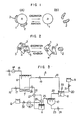
- the adhesion of crud to the granular ion exchange resin and the powdered ion exchange resin is shown in Fig. 1 (A) and Fig. 2(A), respectively.
- Fig. 1 (A) shows the adhesion state of crud by the first phenomenon.
- the numeral 1 shows granular cation exchange resin and the numeral 2 the crud.
- crud 2 is positively charged, and hence it is likely to be adsorbed to the surface of the granular cation exchange resin 1.
- Crud 2 thus adhered electrically to the surface of the granular ion exchange resin is not separated from the surface of the granular ion exchange resin even by reversal washing of the granular ion exchange resin.
- the crud captured by the second phenomenon so as to occupy the space between the adjacent mutual granular ion exchange resins in the granular ion exchange resin layer can be removed easily by reversal washing.
- the crud is adhered to the granular ion exchange resin by the first phenomenon, the part of the granular ion exchange resin on which the crud is adsorbed is not sufficiently regenerated by chemicals and it is difficult to restore the ion exchanging property of said part of the ion exchange resin.
- the numeral 3 shows the powdered cation exchange resin
- the numeral 4 the powdered anion exchange resin. Since the powdered ion exchange resin (particle diameter: 2 to 90 p) has a very small particle diameter as compared with the granular ion exchange resin (particle diameter: 0.25 to 1.2 mm), the powdered cation exchange resin 3 and the powdered anion exchange resin 4 attract mutually and strongly due to static force, thereby forming a block. In such a powdered ion exchange resin, the crud adheres to the powdered cation exchange resin 3 more strongly than the granular cation exchange resin.
- the condensate filter When the pressure-loss of the condensate demineralizer filter reaches a predetermined level, the condensate filter is washed reversibly as mentioned above.
- the powdered ion exchange resin wasted by this reversal washing still has an ion-exchanging function and, therefore, said function is not utilized efficiently.
- the crud can be dissociated from the ion exchange resin. But, when application of the supersonic energy is stopped, the crud dissociated by the adsorbing force such as electric attraction or the like is again adsorbed on the surface of the ion exchange resin. Therefore, the separation rate of crud adhered to the ion exchange resin is extremely small.
- the separation rate of crud from either of the granular and the powdered ion exchange resins is about 20%. In the case of the powdered ion exchange resin having a very strong static attraction, the separation rate of crud is even smaller as compared with the granular ion exchange resin.
- an acid or alkali solution is added according to the present invention.
- the acid or alkali charges the surface of crud either positively or negatively and disperses the crud by taking advantage of the mutual static repulsion force among the crud particles, making it possible to obtain a colloidally stabilized condition.
- Fig. 3 shows an apparatus for realizing the process for separating the crud from the ion exchange resin.
- the apparatus 5 consists of crud-separating tank 6, supersonic transmitter 7, crud-precipitating vessel 10 and dispersing agent blending tank 11.
- the supersonic transmitter 7 is provided at the bottom of the crud-separating tank 6.
- Resin feed pipe 13 and resin discharge pipe 16 communicate with the crud-separating tank 6.
- Pump 14 and valve 15 are arranged in the resin feed pipe 13.
- the resin feed pipe 13 is connected to at least one of the condensate demineralizer and condensate demineralizer filter.
- the demineralizer filter obtained by precoating the powdered ion exchange resin on a holder is arranged in the reactor clean-up system of a boiling water type reactor.
- the resin feed pipe 13 is also connected with this demineralizer filter.
- Valve 17 is installed in the resin discharge pipe 16.
- Pipe 18 having valve 19 communicates the crud-separating tank 6 with blending tank 8.
- Pipe 20 connects a coagulating agent tank 9 with the blending tank 8.
- Valve 21 is arranged in the pipe 20.
- Stirrer 33 is inserted into the blending tank 8.
- Pipe 22 communicates the blending tank 8 with the crud-precipitating vessel 10.
- Crud-discharge pipe 23 having valve 24 is connected with the crud-precipitating vessel 10.
- Pipe 25 connects the crud-precipitating vessel 10 with the dispersing agent blending tank 11.
- Level gauge 29 is arranged in the dispersing agent blending tank 11.
- Pipe 30 connects the dispersing agent blending tank 11 with dispersing agent feed tank 12. Pump 31 and valve 32 are set in the pipe 30.
- the powdered ion exchange resin discharged by reserval washing with water supplied from the condensate filter is fed to the crud-separating tank 6 through the resin feed pipe 13 in the form of slurry.
- the powdered ion exchange resin is precipitated in the bottom of the crud-separating tank 6.
- the dispersing agent i.e. the acid or alkali solution mentioned above
- the supersonic transmitter 7 is operated so as to apply supersonic energy to the powdered ion exchange resin.
- the crud adhering to the powdered ion exchange resin is separated from the powdered ion exchange resin by the action of supersonic energy.
- the separated crud moves upwards to the top of the crud-separating tank 6 while being irradiated with supersonic energy.
- the powdered ion exchange resin remains in the bottom of the crud-separating tank 6. This phenomenon occurs even when the feed of all liquids, particularly water from the pipe 26 to the crud-separating tank 6, is stopped. This is because the particle diameter of crud is smaller than that of the powdered ion exchange resin and because of the action of the supersonic energy.
- the valve 19 When the valve 19 is opened, water containing the crud flows into the blending tank 8 via the pipe 18.
- the coagulating agent in the coagulating agent tank 9 is fed to the blending tank 8 by opening the valve 21.
- the coagulating agent serves to neutralize the surface charge of crud and weaken the repulsion force thereof, and usually polyanionic or nonionic coagulating agent is employed.
- Water containing the coagulating agent and the crud is blended homogeneously by the operation of the stirrer 33. Subsequently, the water is fed to the crud-precipitating tank 10.
- the crud is precipitated in the crud-precipitating tank 10 and accumulated in the bottom of the tank 10. Precipitation of the crud is accelerated by the action of the coagulating agent.
- the supernatant water not containing the crud is fed to the dispersing agent blending tank 11.
- the concentration of dispersing agent in the dispersing agent blending tank 11 is measured.
- the pump 31 is rotated to feed the dispersing agent in the dispersing agent tank 12 to the dispersing agent blending tank 11.
- the concentration of the dispersing agent in the dispersing agent blending tank 11 reaches the predetermined level, rotation of the pump 31 is stopped and feed of the dispersing agent to the dispersing agent blending tank 11 is stopped.
- the pump 27 does not work.
- the crud (contains adsorbed radioactive ions such as cobalt 60 and the like) which was precipitated in the bottom of the crud-precipitating tank 10 is taken out through the pipe 23 by opening the valve 24 and treated as a radioactive waste.
- Fig. 4 shows the characteristics obtained when sulfuric acid was blended as a dispersing agent with a slurry of the ion exchange resin and supersonic energy of 45 kHz in frequency was irradiated thereonto.
- the separation rate was about 20% and, when the pH value was 2, the separation rate was about 40%.
- the pH value was 1, there was obtained the separation rate of about 80%.
- the repellent force overcoming the readhesion force is obtained only when the pH value is 2 or less, desirably 1 or less. From the view-point of increasing the repellent force due to the surface charge, negatively charging by the addition of alkali is possible.
- addition of sodium hydroxide up to the pH value of 13 or 14 provides the separation rate of only about 40% and it has been confirmed that the efficiency of this method not so high as when acid is used.
- Sulfuric acid was used as a dispersing agent in this Example.
- Spent powdered ion exchange resin reverse washed from a condensate filter and having a radioactivity of 0.1 pCi/ml and having 8.5% by weight of iron oxide was formed into a slurry, and dilute sulfuric acid was added and admixed therewith, and supersonic energy of 45 kHz in frequency was applied thereto.
- the relation between the concentration of sulfuric acid in the mixture and separation rate of crud is shown by Fig. 5. When the concentration of sulfuric acid was 0.1 N or less, the separation rate of crud was markedly reduced.
- One of the uses of the ion exchange resin from which the crud was removed is reuse as an ion exchange resiri.
- the regeneration operation is easy, because the cation exchange resin has already been regenerated by the acid added in the step of removing the crud. Consequently, the ion exchange resin from which the crud has been removed is, as the first step, separated into the cation and anion exchange resins and then only the anion exchange resin is regenerated by the addition of alkali.
- the ion exchange resin from which the crud has been removed is as a precoating material on the precoat type filters including the condensate demineralizer filter. If an acid is used as a dispersing agent, the ion exchange resin, particularly the cation exchange resin, from which the crud has been removed, is used as a precoating material on the holder of a condensate demineralizer filter because of the remaining ion exchanging ability thereof and its ion exchanging ability is utilized. With a powdered ion exchange resin, it is difficult to separate the cation exchange resin from the anion exchange resin, as compared with the granular ion exchange resin, and hence regeneration is extremely difficult.
- the ion exchange resin When the ion exchange resin is to be discarded, removal of crud is beneficial. When the radioactive wastes are stored in a container, it is required that the dosage of the container surface be 200 mRe/H or less. In contrast, when it is intended to discard the used ion exchange resin without the removal of crud, the radioactivity concentration of the ion exchange resin reaches 0.1 pCi/mi and hence only about 20 kg is allowed to be contained in a drum of 200 I capacity when canned by the known cement-solidification method.
- the radioactivity concentration of the ion exchange resin may be reduced to 0.05 uCi/m) and hence it is possible to hold the dosage of the drum surface under the standard level or less even when about 40 kg of the ion exchange resin is packed in a drum of 200 I capacity. This effect results in the reduction of the number of drums for radioactive wastes.
Landscapes
- Chemical & Material Sciences (AREA)
- Organic Chemistry (AREA)
- Chemical Kinetics & Catalysis (AREA)
- Treatment Of Water By Ion Exchange (AREA)
Claims (4)
Applications Claiming Priority (4)
| Application Number | Priority Date | Filing Date | Title |
|---|---|---|---|
| JP55153358A JPS5775151A (en) | 1980-10-30 | 1980-10-30 | Separation of component stuck on ion exchange resin |
| JP153358/80 | 1980-10-30 | ||
| JP172036/80 | 1980-12-08 | ||
| JP55172036A JPS6013752B2 (ja) | 1980-12-08 | 1980-12-08 | 粉状イオン交換樹脂の再使用方法 |
Publications (2)
| Publication Number | Publication Date |
|---|---|
| EP0052453A1 EP0052453A1 (de) | 1982-05-26 |
| EP0052453B1 true EP0052453B1 (de) | 1985-04-17 |
Family
ID=26482005
Family Applications (1)
| Application Number | Title | Priority Date | Filing Date |
|---|---|---|---|
| EP81305135A Expired EP0052453B1 (de) | 1980-10-30 | 1981-10-29 | Verfahren zum Beseitigen von Ablagerungen auf Ionenaustauscherharzen |
Country Status (3)
| Country | Link |
|---|---|
| US (1) | US4389253A (de) |
| EP (1) | EP0052453B1 (de) |
| DE (1) | DE3170026D1 (de) |
Cited By (1)
| Publication number | Priority date | Publication date | Assignee | Title |
|---|---|---|---|---|
| KR100855013B1 (ko) * | 2001-06-01 | 2008-08-28 | 쌩-고벵 글래스 프랑스 | 열선 윈도우 |
Families Citing this family (17)
| Publication number | Priority date | Publication date | Assignee | Title |
|---|---|---|---|---|
| US4437999A (en) * | 1981-08-31 | 1984-03-20 | Gram Research & Development Co. | Method of treating contaminated insoluble organic solid material |
| IE55521B1 (en) * | 1982-07-29 | 1990-10-10 | Nalco Chemical Co | Treatment of water treatment solids |
| US4770790A (en) * | 1983-06-17 | 1988-09-13 | Nalco Chemical Company | Treatment and prevention of fouled water treatment solids |
| US4615984A (en) * | 1984-02-23 | 1986-10-07 | Becton Dickinson & Company | Dissociation of ligand-binder complex using ultrasound |
| FI103501B (fi) * | 1990-11-09 | 1999-07-15 | Ebara Corp | Sekakerrossuodatus- ja -demineralisointimenetelmä epäpuhtauksien poist amiseksi voimalan jäähdytysvedestä |
| US5387348A (en) * | 1990-11-09 | 1995-02-07 | Ebara Corporation | Method of mixed-bed filtration and demineralization with ion-exchange resins |
| US5665239A (en) * | 1996-01-16 | 1997-09-09 | Culligan International Company | Processes for deionization and demineralization of fluids |
| WO1997040938A1 (de) * | 1996-04-25 | 1997-11-06 | Aquasonic Trust, Reg. | Verfahren und vorrichtung zur behandlung und modifizierung von ionenaustauschmaterial, sowie zur verbesserung der umweltverträglichkeit von ionenaustauschprozessen |
| AU2005248963A1 (en) * | 2005-05-24 | 2006-12-14 | Ashland Licensing And Intellectual Property Llc | Process for reducing contaminants in condensate resulting from the conversion of bauxite to alumina |
| US20060278358A1 (en) * | 2005-06-02 | 2006-12-14 | Hildebrand Lynn N | Process for reducing contaminants in condensate resulting from the conversion of bauxite to alumina |
| US7517448B2 (en) * | 2005-07-28 | 2009-04-14 | Chen Tony C T | Recycling cool water filter |
| US20070080114A1 (en) * | 2005-09-09 | 2007-04-12 | Dewitt-Dick Douglas B | Process for reducing contaminants in condensate resulting from the conversion of bauxite to alumina |
| WO2011152909A2 (en) | 2010-03-09 | 2011-12-08 | Kurion, Inc. | Isotope-specific separation and vitrification using ion-specific media |
| WO2012048116A2 (en) * | 2010-10-06 | 2012-04-12 | Electric Power Research Institute Inc. | Ion exchange regeneration and nuclide specific selective processes |
| WO2013191781A2 (en) * | 2012-03-26 | 2013-12-27 | Kurion, Inc. | Selective regeneration of isotope-specific media resins in systems for separation of radioactive isotopes from liquid waste materials |
| RU2631942C1 (ru) * | 2016-09-22 | 2017-09-29 | Общество с ограниченной ответственностью Научно-производственное предприятие "Эксорб" | Способ дезактивации радиоактивных ионообменных смол |
| CN107240432B (zh) * | 2017-05-18 | 2019-02-22 | 一重集团大连工程技术有限公司 | 一种核电厂放射性废液处理工艺方法 |
Family Cites Families (17)
| Publication number | Priority date | Publication date | Assignee | Title |
|---|---|---|---|---|
| FR906825A (fr) * | 1942-10-02 | 1946-02-21 | Ig Farbenindustrie Ag | Procédé pour débarrasser les substances à action d'échange des impuretés qui les encrassent |
| NL78480C (de) * | 1950-11-16 | |||
| US2683695A (en) * | 1952-06-27 | 1954-07-13 | Barnstead Still And Sterilizer | Regeneration of cation exchangers containing alkaline earth metals |
| US2977313A (en) * | 1956-05-22 | 1961-03-28 | Hagan Chemicals & Controls Inc | Method of cleansing, sterilizing, and preventing corrosion in base exchange and cation exchange systems and products used therein |
| FR1184272A (fr) * | 1957-10-12 | 1959-07-20 | Procédé pour éliminer les matières organiques retenues sur des échangeurs d'ions | |
| GB977112A (en) * | 1960-03-03 | 1964-12-02 | Rohm & Haas | Removal of iron oxide |
| US3663163A (en) * | 1970-05-18 | 1972-05-16 | Us Interior | Regeneration of cation exchange resins and recovery of salts |
| US3849196A (en) * | 1970-05-20 | 1974-11-19 | Gen Electric | Ultrasonic cleaning of resin |
| US3822055A (en) * | 1970-05-20 | 1974-07-02 | Gen Electric | Ultrasonic cleaning of resin |
| US3882018A (en) * | 1970-12-04 | 1975-05-06 | Aerojet General Co | Process for recovery of minerals from acidic streams |
| US3700592A (en) * | 1970-12-04 | 1972-10-24 | Aerojet General Co | Process for the removal and recovery of mineral pollutants from water |
| CA1031084A (en) * | 1973-03-12 | 1978-05-09 | Robert Kunin | Water conditioning process |
| US3977968A (en) * | 1973-04-13 | 1976-08-31 | Nalco Chemical Company | Ion exchange regeneration |
| US3941693A (en) * | 1974-08-12 | 1976-03-02 | Aerojet-General Corporation | Solid mineral and regenerant recovery for ion-exchange resins |
| DE2524172A1 (de) * | 1975-05-31 | 1976-12-16 | Giulini Gmbh Geb | Verbessertes verfahren zur wasser-, abwasser- und schlammbehandlung mit flockungsmitteln |
| US4080418A (en) * | 1977-02-22 | 1978-03-21 | Amax Inc. | Extraction of cobalt, copper and nickel values from ammoniacal solutions with chelating exchange resins of restored capacity |
| US4205966A (en) * | 1978-11-02 | 1980-06-03 | Fuji Photo Film Co., Ltd. | System for ultrasonic wave type bubble removal |
-
1981
- 1981-10-28 US US06/315,736 patent/US4389253A/en not_active Expired - Fee Related
- 1981-10-29 DE DE8181305135T patent/DE3170026D1/de not_active Expired
- 1981-10-29 EP EP81305135A patent/EP0052453B1/de not_active Expired
Cited By (1)
| Publication number | Priority date | Publication date | Assignee | Title |
|---|---|---|---|---|
| KR100855013B1 (ko) * | 2001-06-01 | 2008-08-28 | 쌩-고벵 글래스 프랑스 | 열선 윈도우 |
Also Published As
| Publication number | Publication date |
|---|---|
| US4389253A (en) | 1983-06-21 |
| DE3170026D1 (en) | 1985-05-23 |
| EP0052453A1 (de) | 1982-05-26 |
Similar Documents
| Publication | Publication Date | Title |
|---|---|---|
| EP0052453B1 (de) | Verfahren zum Beseitigen von Ablagerungen auf Ionenaustauscherharzen | |
| RU2551495C2 (ru) | Новый сорбент, способ его получения и его применение | |
| JP6173396B2 (ja) | 原発の重大事故時に発生する放射性廃液の処理方法及び処理装置 | |
| EP0051456B1 (de) | Verfahren zum Regenerieren von pulverförmigen Ionenaustauscherharzen | |
| JPS62266499A (ja) | 放射性廃液の処理方法 | |
| JP3119538B2 (ja) | 放射性廃樹脂の除染方法 | |
| US3375202A (en) | Separating substances in solution as salts by using a colloidal dispersion of mixed ferrocyanides | |
| US3238126A (en) | Method of regenerating particulate ion exchange resin particles | |
| JPH0283020A (ja) | 中空糸膜を用いる復水の濾過方法 | |
| Brooksbank et al. | LOW-RADIOACTIVITY-LEVEL WASTE TREATMENT. PART II. PILOT PLANT DEMONSTRATION OF THE REMOVAL OF ACTIVITY FROM LOW-LEVEL PROCESS WASTES BY A SCAVENGING-PRECIPITATION ION-EXCHANGE PROCESS | |
| US3692670A (en) | Treatment of cation and anion exchange resins with sodium sulfite | |
| CA1080376A (en) | Process for regeneration of mixed anion and cation exchanged resins | |
| JP3143839B2 (ja) | 放射性廃液の処理方法 | |
| Holcomb | Low-radioactivity-level Waste Treatment. Part I.: Laboratory Development of a Scavenging-precipitation Ion-exchange Process for Decontamination of Process Water Wastes | |
| JPH0214114B2 (de) | ||
| US5564103A (en) | Reducing the volume of depleted ion exchange bead resin | |
| JPS6125686A (ja) | 復水浄化法 | |
| JPH0138554B2 (de) | ||
| JPS58201096A (ja) | 復水脱塩装置 | |
| JPS6013752B2 (ja) | 粉状イオン交換樹脂の再使用方法 | |
| JPS59139944A (ja) | 懸濁固形物付着イオン交換樹脂の洗浄方法 | |
| RU2648283C1 (ru) | Способ регенерации отработанной экстракционной системы на основе органического раствора трибутилфосфата в гексахлорбутадиене (варианты) | |
| Smyth et al. | Improvements in or relating to separation processes | |
| RU2553976C1 (ru) | Способ очистки от 60co технологических растворов радиохимического производства, относящихся к средне- и низкоактивным отходам | |
| JP2025070750A (ja) | 放射性廃液処理装置 |
Legal Events
| Date | Code | Title | Description |
|---|---|---|---|
| PUAI | Public reference made under article 153(3) epc to a published international application that has entered the european phase |
Free format text: ORIGINAL CODE: 0009012 |
|
| AK | Designated contracting states |
Designated state(s): DE FR SE |
|
| RBV | Designated contracting states (corrected) |
Designated state(s): DE FR SE |
|
| 17P | Request for examination filed |
Effective date: 19820930 |
|
| GRAA | (expected) grant |
Free format text: ORIGINAL CODE: 0009210 |
|
| AK | Designated contracting states |
Designated state(s): DE FR SE |
|
| REF | Corresponds to: |
Ref document number: 3170026 Country of ref document: DE Date of ref document: 19850523 |
|
| ET | Fr: translation filed | ||
| PLBE | No opposition filed within time limit |
Free format text: ORIGINAL CODE: 0009261 |
|
| STAA | Information on the status of an ep patent application or granted ep patent |
Free format text: STATUS: NO OPPOSITION FILED WITHIN TIME LIMIT |
|
| 26N | No opposition filed | ||
| PGFP | Annual fee paid to national office [announced via postgrant information from national office to epo] |
Ref country code: SE Payment date: 19930907 Year of fee payment: 13 |
|
| PGFP | Annual fee paid to national office [announced via postgrant information from national office to epo] |
Ref country code: FR Payment date: 19930914 Year of fee payment: 13 |
|
| PGFP | Annual fee paid to national office [announced via postgrant information from national office to epo] |
Ref country code: DE Payment date: 19931231 Year of fee payment: 13 |
|
| PG25 | Lapsed in a contracting state [announced via postgrant information from national office to epo] |
Ref country code: SE Effective date: 19941030 |
|
| EAL | Se: european patent in force in sweden |
Ref document number: 81305135.6 |
|
| PG25 | Lapsed in a contracting state [announced via postgrant information from national office to epo] |
Ref country code: FR Effective date: 19950630 |
|
| PG25 | Lapsed in a contracting state [announced via postgrant information from national office to epo] |
Ref country code: DE Effective date: 19950701 |
|
| EUG | Se: european patent has lapsed |
Ref document number: 81305135.6 |
|
| REG | Reference to a national code |
Ref country code: FR Ref legal event code: ST |