EP0052509B1 - Verfahren zum Entfernen von Oxiden von einer Metalloberfläche - Google Patents
Verfahren zum Entfernen von Oxiden von einer Metalloberfläche Download PDFInfo
- Publication number
- EP0052509B1 EP0052509B1 EP81305425A EP81305425A EP0052509B1 EP 0052509 B1 EP0052509 B1 EP 0052509B1 EP 81305425 A EP81305425 A EP 81305425A EP 81305425 A EP81305425 A EP 81305425A EP 0052509 B1 EP0052509 B1 EP 0052509B1
- Authority
- EP
- European Patent Office
- Prior art keywords
- wash liquid
- oxide
- potential
- electrons
- oxide layer
- Prior art date
- Legal status (The legal status is an assumption and is not a legal conclusion. Google has not performed a legal analysis and makes no representation as to the accuracy of the status listed.)
- Expired
Links
Images






Classifications
-
- C—CHEMISTRY; METALLURGY
- C23—COATING METALLIC MATERIAL; COATING MATERIAL WITH METALLIC MATERIAL; CHEMICAL SURFACE TREATMENT; DIFFUSION TREATMENT OF METALLIC MATERIAL; COATING BY VACUUM EVAPORATION, BY SPUTTERING, BY ION IMPLANTATION OR BY CHEMICAL VAPOUR DEPOSITION, IN GENERAL; INHIBITING CORROSION OF METALLIC MATERIAL OR INCRUSTATION IN GENERAL
- C23G—CLEANING OR DE-GREASING OF METALLIC MATERIAL BY CHEMICAL METHODS OTHER THAN ELECTROLYSIS
- C23G1/00—Cleaning or pickling metallic material with solutions or molten salts
- C23G1/36—Regeneration of waste pickling liquors
-
- C—CHEMISTRY; METALLURGY
- C23—COATING METALLIC MATERIAL; COATING MATERIAL WITH METALLIC MATERIAL; CHEMICAL SURFACE TREATMENT; DIFFUSION TREATMENT OF METALLIC MATERIAL; COATING BY VACUUM EVAPORATION, BY SPUTTERING, BY ION IMPLANTATION OR BY CHEMICAL VAPOUR DEPOSITION, IN GENERAL; INHIBITING CORROSION OF METALLIC MATERIAL OR INCRUSTATION IN GENERAL
- C23G—CLEANING OR DE-GREASING OF METALLIC MATERIAL BY CHEMICAL METHODS OTHER THAN ELECTROLYSIS
- C23G1/00—Cleaning or pickling metallic material with solutions or molten salts
-
- C—CHEMISTRY; METALLURGY
- C25—ELECTROLYTIC OR ELECTROPHORETIC PROCESSES; APPARATUS THEREFOR
- C25F—PROCESSES FOR THE ELECTROLYTIC REMOVAL OF MATERIALS FROM OBJECTS; APPARATUS THEREFOR
- C25F1/00—Electrolytic cleaning, degreasing, pickling or descaling
- C25F1/02—Pickling; Descaling
- C25F1/04—Pickling; Descaling in solution
Definitions
- This invention relates to a method of removing an oxide on a metal surface, and more particularly to a method of removing a metal surface oxide which is suitable for preventing the corrosive damage of a metal (herein called a parent metal or a parent material).
- radioactive ions in cooling water which flows within the nuclear power plant stick to the oxide adherent on the inner surfaces of the equipment and piping of the plant or are accepted into the oxide during the growth of the layers of the oxide which are formed on the inner surfaces of the equipment and piping.
- the radiation doses of the surfaces of the equipment and piping increases. This hinders the maintenance and inspection of the equipment, the piping etc., and conspicuously prolongs the period of time required for the maintenance and inspection. So for the purpose of readily permitting maintenance and inspection in a short time, the oxide formed on the inner surfaces of the equipment and piping need to be removed on occasion.
- US-A-2,915,444 (corresponding to DE-C-1116013) describes a process for removal of rust and scale from ferrous metal in which the article being treated forms the cathode in an electrolytic bath of pH of at least 10 which contains a complexing or chelating agent.
- US-A-3,440,170 describes a method of cleaning steel which involves the use of a solution of an organic or inorganic acid and a reducing agent (stannous ions) and optionally a complexing agent specific for ferric ions.
- the cleaning agent is the acid, which is present in relatively high concentration.
- the stannous salt is present to inhibit corrosion of the steel.
- US-A-3,297,580 discloses a neutral solution (e.g. pH 7-9) for oxide removal, containing hydrazine and a polycarboxylamine acid chelating agent (e.g. EDTA).
- a neutral solution e.g. pH 7-9
- a polycarboxylamine acid chelating agent e.g. EDTA
- the hydrazine and chelating agent are said to work synergistically to dissolve metal oxides.
- An object of this invention is to provide a method of removing a metal surface oxide which can suppress the corrosion of the parent metal.
- This invention has been made on the basis of new knowledge obtained by fully studying the conventional methods of removing oxides.
- a region 1 is a region in which metal iron is thermodynamically stable.
- a region 2 is a region in which FE 3 0 4 being an iron oxide is thermodynamically stable, while a region 3 is a region in which ⁇ Fe 2 O 3 being an iron oxide becomes a thermodynamically stable state.
- a region 4 is a region where the ion of Fe 2+ is thermodynamically stable.
- a region 5 is a region where the ion of Fe 3+ is thermodynamically stable.
- the regions 4 and 5 are regions where corrosion develops in the metal iron.
- FIG. 2(A) shows the situation of adhesion of iron oxides in a part of piping before wash.
- a layer of ferroferric oxide (Fe 3 0 4 ) 9 is formed on the surface of metal iron 8 being the parent material of the pipe, and a layer of ferric oxide (Fe 2 0 3 ) 10 is further formed on the surface of the Fe 3 0 4 layer 9.
- the ferric oxide layer 10. lies in contact with neutral cooling water which flows through the pipe.
- a wash liquid which contains an acid, a complexing agent and a reducing agent is kept flowing through the pipe instead of the cooling water.
- Fe 3+ liquated in the wash liquid by the reaction of Formula (1) accepts an electron e-from the reducing agent and changes to Fe 2+ which is more difficult to flocculate than Fe 3+ , as indicated by the following formula:
- the Fe 2 0 3 layer 10 at the thinnest part A in Figure 2(A) disappears, and the Fe 3 0 4 layer 9 comes into contact with the wash liquid as shown in Figure 2(B).
- the reaction of Formula (4) mentioned below takes place.
- the reaction of Formula (5) sometimes takes place in the surface of a fraction of the part A. That is, when the metal iron 8 has come into contact with the wash liquid, it is dissolved and generates electrons on the basis of the reaction of Formula (4). A very small proportion of the electrons reacts with the acid in the wash liquid and generates hydrogen as indicated by Formula (5). This signifies that the anodic reaction (Formula (4)) is chiefly occurring in the surface of the metal iron 8.
- a cathodic reaction which corresponds to the anodic reaction occurs in a certain place of the Fe 3 0 4 layer 9 or Fe 2 O 3 layer 10 lying in contact with the wash liquid.
- the dissolution of the iron oxide layers by the reactions of Formulae (1) and (3) is conducted.
- the rates of the dissolution processes of the iron oxide layers 9 and 10 involving such reducing reactions are markedly higher than the rates of the dissolution processes of Formulae (1) and (3) based on the acid.
- the ions Fe 3+ generated by Formulae (1) and (3) turn into the ions Fe 2+ on which the reducing agent has acted as indicated by Formula (2).
- a pore 18 due to the anodic reaction arises also in the surface of the metal iron 8 at the part B.
- the reactions of Formulae (2)(6) take place in the state of Figure 2(E), and eventually the Fe 3 0 4 layer 9 is completely dissolved and removed.
- the formation of the pores in the surface of the metal iron 8 as stated above means that the wall thickness of the pipe or the like decreases locally. Accordingly, there are such risks that the strength of the pipe or the like will fall and that the internal fluid will leak due to the appearance of a penetrating hole in the wall of the pipe. In order to avoid this the corrosion of the parent material of the pipe or the like during the wash needs to be prevented.
- the inventors have obtained the knowledge that when electrons are supplied from outside the parent material metal into the oxide layers unlike the electrons created by the reaction of the parent material metal, the reactions of Formulae (6) and (7) can be induced to remove the oxides without corroding the parent material metal.
- the inventors have obtained the knowledge that the corrosion of the parent material metal does not occur when the oxides adhering to the parent material metal are removed under the condition of the region 1 in which the oxides are in the thermodynamically unstable states and in which the parent material metal is in the thermodynamically stable state.
- Fe 3 0 4 can also be represented as ' (FeO)Fe 2 O 3 , it is an n-type semiconductor in which Fe 2+ is contained in Fe 2 O 3 as an impurity (refer to the second literature reference mentioned above).
- the semiconductor model of Fe 3 0 4 expressed in terms of the K-space (reciprocal space) is shown in Figure 3.
- CB stands for a conduction band and VB a valence band, which are composed of the ions Fe 3+ .
- the valence band VC contributes to the bond between iron and oxygen, while the conduction band CB permits electrons to move freely and concerns the electric conductivity.
- Fe 2+ being the impurity serves as a donor which supplies electrons 20 to the conduction band CB.
- a level Ed where the donor exists is an impurity level (donor level) at which Fe" being the impurity exists.
- the donor level Ed is about 0.4 V nobler than the conduction band CB.
- the impurity Fe 2+ having supplied the electrons becomes Fe 3+ , and has positive holes 34 which accept electrons.
- the Fermi level Ef exists between the conduction band CB and the donor level Ed at or near the room temperature, it shifts in the noble direction with rise in the temperature and finally comes to lie at the intermediate position between the conduction band CB and the valence band VB.
- a forbidden band in which the electrons cannot assume any energy level exists between the conduction band CB and the valence band VB.
- the semiconductor model of Fe 2 O 3 has a structure as shown in Figure 3, but almost no Fe 2+ exists at the donor level Ed.
- the difference between the n-type semiconductors of Fe 2 0 3 and Fe 3 0 4 is the difference of the densities of the donor ions, and can be elucidated with models.
- the donor density of the latter Fe 3 0 4 is higher than that of the former Fe 2 0 3 .
- Fe 2+ has a weaker bonding power with O 2- as compared with Fe 3+ .
- Fe 3+ which undergoes a phenomenon to be stated below is firmly bound with six ions O 2- by substantially equal force, and through six bonds.
- Fe 2+ four of its six bonds have high bonding force with O 2+ , but the remaining two bonds have low bonding force.
- the strengths of the bonding forces are always changing among the six bonds of Fe 2+ .
- the complexing agent for example, chelating agent
- Fe 3 0 4 is constructed in such a manner that Fe 2+ and Fe 3+ bond through O 2- . That is, the crystal lattice of Fe 3 O 4 corresponds to the state as depicted in (B) of Figure 4. Since Fe 3 0 4 contains Fe 2+ in its crystal lattice in advance, it is easier to dissolve than Fe 2 0 3 .
- FIG. 5 designates a wash liquid, in which a complexing agent is contained.
- An electrode 22 is immersed in the wash liquid 21.
- the plus side of a D.C. power source 23 is connected to the electrode 22 made of, for example, platinum, while the minus side of the power source 23 is connected to the metal iron 8 through a controller 24.
- the electron injection method based on the cathodic polarization consists in that the potential of the surface of the iron oxide layer 9A is shifted in the base direction from the natural potential to a potential within the range of the region 1 in Figure 1, whereby electrons generated by the anodic reaction of the platinum electrode 22 are supplied from the side of the metal iron 8 into the iron oxide layer 9A.
- Fe 3+ of the iron oxide layer 9A is reduced for dissolution into Fe 2+ under the action of the electrons as illustrated in (B) of Figure 4, and the dissolution is promoted with the complexing agent.
- the metal iron 8 being the parent material is polarized so as to become lower than the cathode corrosion-protection potential.
- the generation of hydrogen should be suppressed by making the wash liquid weakly acid to alkaline (a range of 4-9 in terms of pH).
- a special band structure appears in the vicinity of the surface thereof. More specifically, when the aqueous solution is neutral in pH and the natural potential is not higher than O V in the K-space, the conduction band CB, valence band VB and donor level Ed curve onto the base side in the surface of the semiconductor, for example, the surface of the iron oxide layer 9A shown in Figure 5. Accordingly, an electric double layer is formed in the surface of the iron oxide layer 9A and hinders the liquation of metal ions, i.e., Fe 2+ . However, the bands are flattened to facilitate the dissolution of the iron oxide layer 9A by injecting the electrons generated by the anodic reaction of the platinum electrode 22, into the iron oxide layer 9A as described above.
- the cathodic polarization potential is the potential which renders the crystal structures of the oxides unstable and it is in an insensitive band in which the metal state is stabilized
- the parent material metal that is, where it lies in the range of the region 1 in Figure 1
- a practicable apparatus for performing this injection method based on the cathodic polarization is shown in Figure 6.
- a platinum electrode 22 and an object to-be-washed 26 are immersed in a wash liquid 21 in a container 25.
- the platinum electrode 22 and the object to-be-washed 26 are connected to a potentiostat 30 by leads 31 and 32, respectively.
- Numeral 27 indicates a calomel electrode which is a reference electrode, and which is inserted in a container 28 filled with the wash liquid 21 and is connected to the potentiostat 30 by a lead 33.
- One end of a communicating tube 29 the other end of which is inserted in the container 28 is open in proximity to the surface of the object to-be-washed 26.
- the D.C. power source 23 and the controller 24 shown in Figure 5 are assembled in the potentiostat 30.
- the electrolyte, a pH regulating agent and a complexing agent in the wash liquid used in the present method are not particularly specified, organic compounds which can be dissolved and disappear at about 200°C or above and nitrogen compounds such as ammonia and hydrazine are desirable so that the agents do not remain after the oxide removing operation. Such a consideration is important especially when applying the present method to a nuclear power plant.
- polyaminocarboxylic acid salts such as triammonium citrate, diammonium oxalate ((NH 4 ) 2 C 2 0 4 ) and diammonium ethylenediaminetetraacetate are mentioned as compounds each of which serves both as the pH regulating agent and as the complexing agent.
- concentrations of the agents there is no restriction to specific values.
- concentration of at least 0.1 M/I is recommended in order to make the potential distribution uniform.
- the concentration of diammonium oxalate was 0.1 M/I and the pH of the aqueous solution was approximately 6.5.
- the container 25 was filled with the aqueous solution as the wash liquid 21, and the specimen of SUS 304 with the Fe 3 0 4 pellet mounted thereon and the platinum electrode 22 being the counter electrode were immersed in the wash liquid 21.
- the lead of the specimen was attached to the material SUS 304.
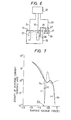
- the cathodic polarization curve of Fe 3 0 4 and the amount of dissolution of Fe 3 0 4 were measured by fixing the surface potential of the Fe 3 0 4 pellet at various values by the use of the potentiostat 30 and keeping the temperature of the wash liquid at 85°C for 30 minutes.
- a curve G 1 indicated by a solid line is the cathodic polarization curve of Fe 3 0 4 .
- the current density of the curve G 1 is indicated by absolute values, and actually assumed minus values.
- the potential on the axis of abscissas is the surface potential of the Fe 3 0 4 pellet, and its values were measured by means of the calomel electrode 27.
- the surface potential of the Fe 3 0 4 pellet could be varied by adjusting the controller 24 of the potentiostat 30.
- a curve G 2 indicated by a broken line is the cathodic polarization curve of carbon steel.
- Eb designates the equilibrium potential of the carbon steel which is substantially equal to the cathode corrosion-protection potential and at which the cathodic polarization curve of the carbon steel changes from plus to minus.
- the side on which the potential is higher than the cathode corrosion-protection potential Eb corresponds to the anodic polarization, while the side on which the potential is lower than the same corresponds to the cathodic polarization.
- the values of the cathodic polarization curve of the carbon steel became minus.
- FIG. 8 As seen from the cathodic polarization curve of Fe 3 0 4 , one maximum value exists in the vicinity of -0.4 V, and the current density increases below -0.6 V.
- Figure 8 arranges and illustrates the amount of dissolution of Fe 3 0 4 .
- a curve E 1 in Figure 8 indicates the solubility of Fe 3 0 4 , a curve E 2 the current efficiency, and a curve E 3 the quantity of electricity.
- the solubility of Fe 3 0 4 exhibits maximum values at surface potentials of approximately -0.4 V and approximately -1.0 V.
- the maximum value of the solubility at approximately -0.4 V corresponds to the maximum value of the cathodic polarization curve of Fe 3 0 4 at approximately -0.4 V as shown in Figure 7.
- the dissolution of the iron oxide layer 9A by the electron injection method based on the cathodic polarization is caused by a phenomenon as stated below.
- the reaction of the following formula (8) takes place in the surface of the platinum electrode 22, to generate electrons e - :
- the electron e- is introduced into the metal iron 8 through the leads, and is finally supplied into the iron oxide layer 9A.
- Some of the electrons e- supplied to the iron oxide layer 9A give rise to the reaction of Formula (5) in the surface of the iron oxide layer 9A.
- the increase of the amount of generation of hydrogen is also apparent from the fact that, in the region where the potential is lower than -1.0 V, the current efficiency decreases in spite of a remarkable increase in the quantity of electricity.
- the current efficiency is a value obtained in such a way that the quantity of electricity consumed for the dissolution of Fe 3 0 4 is divided by the total quantity of electricity conducted.
- the solubility of Fe 3 O 4 is strongly dependent upon the potential, and has the maximum values in the two places as illustrated in Figure 8. This is based on the fact that, as stated previously, Fe 3+ of Fe 3 0 4 is reduced at the predetermined potentials, so the crystal structure of Fe 3 0 4 becomes unstable due to the formation of Fe 2+ as shown in (B) of Figure 4. That is, as described before, the reason will be that the ions Fe 2+ liable to solvation with the wash liquid appear during the reduction of the partly oxidized surface of Fe 3 0 4 and during the reducing reaction (Fe 3 O 4 ⁇ FeO) or (FeO ⁇ Fe).
- the liquation of Fe 2+ during the period during which the crystal structure of Fe 3 0 4 is unstable is dependent strongly upon the complexing agent in the wash liquid.
- the solubilities of Fe 3 0 4 obtained using aqueous solutions which contained 0.1 M/I of triammonium citrate and ethylenediaminetetraacetic acid (EDTA) as the complexing agents are listed in Table 1 as to surface potentials of -0.6 and -1.0 V. Further, the cathodic polarization curve of Fe 3 0 4 obtained when an Na 2 S0 4 aqueous solution of low complexing capability was used as the wash liquid exhibited no maximum value at -0.4 V.
- an aqueous solution containing 0.1 M/I of diammonium oxalate (6.5 in terms of pH) is used as the wash liquid 21, the controller 24 of the potentiostat 30 is adjusted so that the surface potential of the iron oxide layer 9A of the object to-be-washed (for example, the fuel assembly of a boiling water reactor or the impeller of a pump in a recirculating system) 26 may become -1.0 V, and this surface potential is held for a predetermined period of time.
- the iron oxide layer 9A adherent on the object to-be-washed 26 can be completely dissolved and removed. This is based on the fact that the electrons generated by the anodic reaction of the platinum electrode 22 are supplied to the iron oxide layer 9A as described before.
- the metal iron (for example, carbon steel) 8 being the parent material of the object to-be-washed 26 does not corrode. Even when the iron oxide layer 9A is dissolved until the wash liquid comes into contact with the metal iron 8, the surface potential of the metal iron 8 is lower than -1.0 V. The surface potential of the iron oxide layer 9A may well become equal to or higher than the cathode corrosion-protection potential of the metal iron 8 being the parent material (in case of the carbon steel, -0.7 V when the pH of the wash liquid is 6.5).
- the surface potential of the iron oxide layer 9A needs to be adjusted so that when the wash liquid 21 comes into contact with the metal iron 8, the potential of the metal iron 8 may lie within the range of the region 1 in Figure 1.
- the phenomenon in which the potential of the surface of the iron oxide layer 9A becomes higher than the potential of the metal iron 8 being the parent material in the structure of Figure 5 can naturally occur on account of the electric resistance of the iron oxide layer 9A.
- Figure 10(A) corresponds to a state J 1 in Figure 8.
- Figures 10(A)-10(E) there will be described how the band structure of the iron oxide layer 9A changes and how the changes concern the dissolution phenomenon of Fe 3 0 4 when the iron oxide layer 9A is subjected to the cathodic polarization in the state in which the bands (indicative of the conduction band CB, the valence band VB, etc.) curve in the base direction as described above.
- the minus side of the D.C. power source 23 is connected to the metal iron 8 and the plus side thereof to the platinum electrode 22 as shown in Figure 5, whereupon the controller 24 of the potentiostat 30 is operated to raise the potential of the platinum electrode 22.
- the anodic polarization occurs and the reaction of Formula (8) takes place.
- the electrons generated in the platinum electrode 22 by the reaction of Formula (8) are introduced into the metal iron 8 through the leads 31 and 32 which hold the metal iron 8 and the platinum electrode 22 in communication and with which the D.C. power source 23 and the controller 24 are connected.
- the energy level of the electrons supplied externally and accumulated in the metal iron 8 is raised above the energy level of the conduction band CB of the iron oxide layer 9A by the supply of energy from the D.C power source 23. At this time, free electrons 20 in the metal iron 8 enter the iron oxide layer 9A.
- the electron injection into Fe 3+ takes place, and the bands flatten as shown in Figure 10(B). This corresponds to a potential J 2 in Figure 8.
- the controller 24 is operated to apply energy to large quantities of free electrons 20 within the metal iron 8, whereby the amount of the free electrons 20 to be supplied into the iron oxide layer 9A increases to promote the cathodic polarization.
- the surface of the iron oxide layer 9A becomes easy of reduction, resulting in the possibility that the liquation of Fe 2+ will increase. Since, however, a barrier is formed against the liquation of Fe 2+ due to the execution of the cathodic polarization, the rate of increase of Fe 2+ decreases conversely.
- the cathodic polarization occurs in the surface of the iron oxide layer 9A. Due to the occurrence of the cathodic polarization, the potential of the metal iron 8 being the parent material becomes equal to or lower than the cathode corrosion-protection potential and lies in the base direction with respect to the Fermi level Ef. Accordingly, the corrosion of the metal iron 8 can be prevented during the dissolution of the iron oxide layer 9A by utilizing the cathodic polarization of the iron oxide layer 9A.
- Such state indicates that the energy level of the free electrons 20 which are supplied from the metal iron 8 to the iron oxide layer 9A is made the Fermi level Ef or higher by the supply of the energy from the D.C power source 23.
- the Fermi level Ef represents the energy level of that point between the valence band VB and the conduction band CB at which the probability of the presence of an electron is 2.
- the corrosion of the stainless steel can be prevented by holding the potential of the stainless steel at or below the cathode corrosion-protection potential thereof.
- the cathode corrosion-protection potential of the stainless steel is higher than that of the carbon steel.
- the solubility of Ni 2+ is indicated by a curve E 4 , and that of Fe 2+ by a curve E 3 .
- a curve E 6 represents the current efficiency, and a curve E 7 the quantity of electricity.
- the solubilities of Ni 2+ and Fe 2+ become maximal at -1.0 V at which the maximum value exists in the cathodic polarization curve.
- the electron injection method based on the cathodic polarization injects into the oxide the electrons which have energy levels higher than the Fermi level and which are generated by the anodic reaction of the electrode immersed in the wash liquid as caused on the basis of the energy applied from the D.C. power source being the external power source. Therefore, the parent material metal can be reliably prevented from corroding, and moreover, the oxide can be efficiently dissolved.
- the potential of the parent material metal is a potential within the range of the region 1 of Figure 1, that is, a potential in the region where the parent material metal is stable.
- the oxidation-reduction potential Ek is defined as in the following expression:
- Eo denotes a reference oxidation-reduction potential
- K a constant
- [O] the concentration of an oxidizer in the wash liquid
- [R] the concentration of the reducer in the wash liquid.
- the oxidizer [0] is usually present in the solution because part of the reducing substance is oxidized. Accordingly, the oxidation-reduction potential Ek shifts in the noble direction with respect to the Fermi level Ef of the iron oxide layer 9A. In order to move the oxidation-reduction potential Ek in the base direction with respect to the Fermi level Ef, the oxidizer [0] in the wash liquid is converted into the reducer [R] by the electrolysis of the wash liquid 21.
- the electrolysis of the wash liquid 21 is effected between a reduction electrode (platinum electrode) 40 which is immersed in the wash liquid 21 and a counter electrode (platinum electrode) 41 which opposes to the reduction electrode 40 through a cation- exchange film 39.
- the reduction electrode 40 and the counter electrode 41 are connected by leads 31 and 32 through a D.C power source 23 and a controller 24.
- the reduction electrode 40 is connected on the minus side of the D.C. power source 23, and the counter electrode 41 on the plus side thereof.
- the reduction of the oxidizer [0] of the wash liquid 21, that is, the conversion of the oxidizer [0] into the reducer [R] is executed in such a way that upon causing current to flow between the reduction electrode and the counter electrode, the oxidizer [01 combines with an electron supplied. from the reduction electrode.
- the oxidation-reduction potential Ek of the wash liquid 21 shifts in the base direction beyond the Fermi level Ef of the iron oxide layer 9A, and an electron 20 can be directly injected from the reducer in the wash liquid 21 into the conduction band CB of the iron oxide layer 9A.
- the electron 20 injected into the iron oxide layer 9A enters the hole 34 of the donor level Ed eventually and becomes stable in energy. This indicates that Fe3* is reduced into Fe2* as in (B) of Figure 4. Then the complexing agent contained in the wash liquid 21 acts as illustrated in Figure 4, so that Fe 2+ is liquated.
- the reducing agent to be used in the present method is not especially specified, one whose reference oxidation-reduction potential lies furthest on the cathode side is desirable.
- organic substances there are mentioned L-ascorbinic acid, riboflavin, rose Bengal and rhodamine B.
- inorganic substances there are Cr2*, Sn2* etc.
- an organic substance which can be decomposed to disappear at a high temperature of or above approximately 208°C is suitable as the reducing agent.
- Suitable as the complexing agents are the substances which have been used in the electron injection method based on the cathodic polarization.
- the reducer [R] changes into the oxidizer [0].
- the quantity of the oxidizer [0] in the wash liquid 21 increases, and the oxidation-reduction potential Ek of the wash liquid 21 shifts in the noble direction. Since, however, the oxidizer [0] is supplied with the electrons from the reduction electrode 40 and changes into the reducer [R] as stated before, the iron oxide layer 9A can be dissolved without making the concentration of the reducing agent in the wash liquid 21 higher than is required.
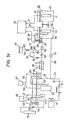
- the iron oxide removing apparatus used for the present method is constructed of a dissolution tank 35 which is filled with a wash liquid 21, an electrolysis tank 36 which has an anode chamber 37 and a cathode chamber 38 separated by a cation exchange film 39, a reduction electrode (platinum electrode) 40 which is immersed in the wash liquid 21 in the cathode chamber 38, a counter electrode (platinum electrode) 41 which is immersed in a liquid 42 in the anode chamber 37, and a potentiostat 30.
- the reduction electrode 40 and the counter electrode 41 are respectively connected to the potentiostat 30 by leads 32 and 31.
- a D.C. power source and a controller are connected to the leads 31 and 32.
- One end of a communicating tube 29 which is inserted in the cathode chamber 38 is open in proximity to the surface of the reduction electrode 40.
- the dissolution tank 35 and the cathode chamber 38 are held in communication by pipes 50 and 54 having pumps 51 and 53 respectively.
- a cooler 55 is disposed in the pipe 54.
- An object to-be-washed 26 is immersed in the wash liquid 21 of the dissolution tank 35.
- a calomel electrode 64 is inserted in a container 65 held in communication with the dissolution tank 35 by a communicating tube 66 which has at its one end an opening proximate to the surface of the object to-be-washed 26.
- the object to-be-washed 26 and the calomel electrode 64 are respectively connected to a potentiometer 67 by leads 68 and 69.
- a platinum electrode 43 is inserted in the dissolution tank 35, while a calomel electrode 44 is inserted in a container 46 held in communication with the dissolution tank 35 by a communicating tube 45 which has one end open in proximity to the platinum electrode 43.
- the platinum electrode 43 and the calomel electrode 44 are respectively connected to a potentiometer 49 by leads 47 and 48.
- the anode chamber 37 is filled with an oxalic acid solution of 0.5 M/I.
- Used as the wash liquid 21 is an aqueous solution which contains 0.002 M/I of L-ascorbinic acid and 0.002 M/I of EDTA (Na).
- the object to-be-washed 26 is of SUS 304 and has an Fe 2 0 3 pellet bonded thereto.
- the lead 68 is connected to the material SUS 304.
- the wash liquid 21 is heated to 85°C and held at that temperature by a heater 71.
- N 3 -gas is spouted from a pressure cylinder 75 into the wash liquid 21 so as to deaerate the wash liquid.
- a pH-electrode 73 connected to a pH-meter is immersed in the wash liquid 21 so as to detect the pH of the wash liquid.
- the wash liquid 21 in the dissolution tank 35 is introduced into the cathode chamber 38 through the pipe 54 by driving the pump 53. At that time, the wash liquid 21 is cooled by the cooler 55.
- Current flows between the reduction electrode 40 and the counter electrode 41 under the action of the D.C. power source (within the potentiostat 30). Owing to the current conduction, the reaction of Formula (8) occurs in the surface of the counter electrode 41 of the anode chamber 37.
- Electrons generated in the counter electrode 41 flow from the lead 31 to the lead 32, and reach the reduction electrode 40.
- the oxidizer [0] in the wash liquid 21 is reduced into the reducer [R] by the electrons.
- the proportion of the converion from the oxidizer [O] into the reducer [R] can be adjusted in such a way that the potential difference between the reduction electrode 40 and the counter electrode 41 is adjusted by adjusting the controller (within the potentiostat 30). Unless the potential difference is great, the proportion increases. Further, the reaction of Formula (5) occurs partly in the surface of the reduction electrode 40, to generate H 2 .
- the wash liquid 21 with the oxidizer [0] decreased returns into the dissolution tank 35 through the pipe 50.
- the surface potential of the reduction electrode 40 is measured by a calomel electrode 27 which is connected to the potentiostat 30 by a lead 33. Further, the surface potential of the iron oxide layer 9A of the object to-be-washed 26 is measured by the calomel electrode 64 and the potentiometer 67. Further, the oxidation-reduction potential Ek of the wash liquid 21 in the dissolution tank 35 is measured by the platinum electrode 43, the calomel electrode 44 and the potentiometer 49.
- the potential to be applied to the reduction electrode 40 is adjusted so that the oxidation-reduction potential Ek may lie in the base direction beyond the Fermi level Ef of the iron oxide layer 9A of the object to-be-washed 26, for example, that it may shift in the base direction beyond the surface potential of the iron oxide layer 9A.
- electrons are injected from the reducer [R] in the wash liquid 21 into the iron oxide layer 9A of the object to-be-washed 26.
- the energy levels of the electrons are higher than the Fermi level Ef.
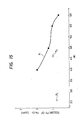
- Shown in Figure 15 is an experimental result obtained when, using the apparatus shown in Figure 14, the Fe 2 0 3 pellet was immersed as previously stated in a mixed aqueous solution which was the wash liquid and which consisted of 0.002 M/I of L-ascorbinic acid and 0.002 M/I of sodium ethylenediaminetetraacetate [EDTA(Na)], the mixed aqueous solution mentioned above was reduced and the Fe 2 0 3 pellet was dissolved for 1 hour.
- a curve P indicates the result.
- L-ascorbinic acid was the reducing agent
- EDTA(Na) was the complexing agent.
- the experiment was conducted by variously changing the pH of the mixed aqueous solution mentioned above.
- the oxidation-reduction potential Ek of the mixed aqueous solution in the dissolution tank 35 was measured by the platinum electrode 43, calomel electrode 44 and potentiometer 49. This oxidation-reduction potential Ek was held at -0.75 V by adjusting the potential difference between the reduction electrode 40 and the counter electrode 41 by operating the controller. The natural potential of carbon steel under the same condition was -0.8 V. These potentials were baser than the Fermi level, approximately -0.7 V of Fe 2 0 3 .
- the solubility of Fe 2 0 3 increases sharply as apparent from the curve P 1 .
- P 2 indicates the solubility of Fe 2 0 3 at the time when Citrox (a mixed solution consisting of 0.3 M/I of oxalic acid and 0.2 M/I of diammonium citrate) was used as the reducing agent.
- P 3 indicates the solubility of Fe 2 0 3 at the time when 0.48 M/I of diammonium citrate was used as the reducing agent.
- the experimental results P 2 and P 3 correspond to a case where the oxidizer produced in the wash liquid by adding the reducing agent is not reduced.
- the solubility of Fe 2 0 3 in the present example increases.
- the potential of the metal iron 8 of the parent material is -0.8 V, which is lower than the cathode corrosion-protection potential of carbon steel so that the corrosion of the parent material can be prevented.
- the wash liquid containing 0.48 M/I of diammonium citrate at P 3 is electrolytically reduced as in the present example, the solubility of Fe 2 0 3 increases.
- the surface potential of the parent material metal is a potential in the region 1 of Figure 1 where the metal is stable.
- Figure 16 shows an experimental result obtained when the Fe 2 0 3 pellet was replaced with an Fe 3 0 4 pellet, which was dissolved under the same experimental conditions as in Figure 15. That is, a curve P 4 indicates the experimental result in the case where the wash liquid containing 0.002 M/I of L-ascorbinic acid and 0.002 M/I of EDTA(Na) was electrolytically reduced. Although the concentration of the reducing agent is low, a high solubility is attained as in the case of Fe 2 0 3 . However, when the pH of the wash liquid becomes great, the solubility of Fe 3 0 4 lowers conspicuously.
- the pH of the wash liquid is set within the range of 4-9 in order to suppress the generation of hydrogen.
- the reducing agent in the wash liquid is reduced on the basis of the energy applied from the D.C. power source 23 being the external power source, while the electrons having the energy levels not lower than the Fermi level are afforded to the reducing agent of the wash liquid from the reduction electrode immersed in the wash liquid and the electrons having the energy levels higher than the Fermi level are injected from this reducing agent into the oxide. Therefore, the parent material metal can be reliably prevented from corroding, and moreover, the oxide can be efficiently dissolved. More specifically, the potential of the parent material metal during the oxide dissolution is lower than the cathode corrosion-protection potential, and exists in the potential range in which the metal is stable as indicated by the region 1 in Figure 1.
- the reducing agent is reduced by the reduction electrode, the reducing agent turned into the oxidizer by affording the electrons to the oxide can be put into the usable state again. For this reason, the frequent addition of a new reducing agent attendant upon the degradation of the reducing agent is not necessary, and the oxide can be dissolved without making the concentration of the reducing agent in the wash liquid higher than is required. This is advantageous when safety is of importance as in a nuclear power plant.
- the electrode connected to the object to-be-washed need not be immersed in the wash liquid as in the foregoing electron injection method based on the cathodic polarization, but merely the wash liquid having the oxidation-reduction potential lying in the base direction with respect to the Fermi level of the oxide may be supplied. Therefore, the oxide formed on the inner surface of piping installed in a plant can be simply dissolved.
- the electrons of the valence band VB directly enter the positive holes 34 existing at the donor level Ed. Due to such entry of the electrons into the holes 34 of the donor level Ed, the electric double layer existing in the surface of the iron oxide layer 9A disappears, and the bands flatten as in Figure 10(B). Thus, the dissolution of the iron oxide layer 9A is promoted. More specifically, when the electron has entered the donor level Ed, Fe2+ is formed among Fe 3+ as shown in (B) of Figure 4. Fe 2+ is liable to bond with the complexing agent, and is liquated into the wash liquid.
- Electrons which the reducer [R] in the wash liquid 21 retains are injected into those holes 34 of the valence band VB which have been formed in the manner that the electrons are excited by the light energy and jumped to the conduction band CB. For this reason, the electron of Fe 2+ created by the reduction does not enter the original holes 34 of the valence band VB. Further, there is a phenomenon in which as illustrated in Figure 18, the electrons of the reducer [R] are excited by the energy of the projected light to become electrons of energy levels higher than the Fermi level, these electrons being supplied to the conduction band CB of the iron oxide layer 9A.
- the electron injection method utilizing the light injects into the iron oxide layer 9A the electrons which have the energy levels not lower than the Fermi level and which are generated outside the parent metal by external energy without taking the electrons of the parent material metal of the object to-be-washed. Therefore, the oxides can be dissolved without corroding the parent material metal.
- Desirable as the chemicals for use in the present method are those which dissolve and disappear at or above about 200°C so as not to remain after the treatment.
- carboxylic acids such as oxalic acid and citric acid
- polyaminocarboxylic acids such as ethylenediaminetetraacetic acid (EDTA) are mentioned by way of example.
- EDTA ethylenediaminetetraacetic acid
- the reducing agents ones the oxidation-reduction potentials Ek of which lie in the base direction to the utmost are desirable, and L-ascorbinic acid, riboflavin, methylene viologen and rhodamine B are mentioned by way of example.
- the light sources there can be mentioned a xenon arc lamp, a tungsten lamp, a halogen lamp and a mercury arc lamp.
- a xenon arc lamp especially the light source having a high light intensity in the near-ultraviolet to ultraviolet region in which the light absorption intensities of the oxides increase and in which the absorption of the light by the reducing agent itself takes place is desirable for use.
- the xenon arc lamp is mentioned by way of example.
- the washing apparatus is constructed of a dissolution tank 35 which is filled with a wash liquid 21, a circulating pipe 77 whose both ends are connected to the dissolution tank, 35, a pump 78 which is installed in the circulating pipe 77, and a xenon arc lamp 79.
- An object to-be-washed 26 (for example, a fuel rod or pump impeller in a nuclear power plant) is immersed in the wash liquid 21 which contains a reducing agent and a complexing agent. Whilst circulating the wash liquid 21 in the dissolution tank 35 through the circulating pipe 77 by means of the pump 78, radiation of wavelengths within the ultraviolet to near-infrared region is projected from the xenon arc lamp 79 toward the object to-be-washed 26.
- the electrons of the valence band VB of the iron oxide layer 9A and the electrons of the reducing agent in the wash liquid 21 absorb the energy of the light to have energy levels not lower than the Fermi level, whereupon they enter the positive holes 34 of the donor level Ed near the surface of the object to-be-washed 26.
- Fe 2+ whose bond state with Fe 3+ is unstable as shown in (B) of Figure 4 is created in the surface of the iron oxide layer 9A.
- Used as the wash liquid 21 was an aqueous solution in which 0.02 M/I of oxalic acid serving as the complexing agent and amounting to 100 cc. and 0.0002 M/I of L-ascorbinic acid serving as the reducing agent and amounting to 1 cc. were mixed.
- This wash liquid 21 was contained in the dissolution tank 35, and the powder of Fe 2 0 3 (0.15 gr.) was put into the dissolution tank 35. Thereafter, the wash liquid 21 in the dissolution tank 35 was held in the room temperature (15-19°C) state and was stirred by a stirrer.
- the Fe 2 0 3 powder was put into the wash liquid, radiation was projected from the xenon arc lamp of 50 W (wavelengths of 350-550 nm) onto the Fe 2 0 3 powder in the wash liquid 21.
- the projection period of time was respectively 5 minutes, 30 minutes and 60 minutes.
- the wash liquid 21 of 30 cc. was sampled into a beaker. The sampled wash liquid 21 had undissolved Fe 2 0 3 removed by a millipore filter of 0.45 ⁇ .
- test pieces of SUS 304 (cubes with one side being 25 mm) covered with aluminum foils to intercept light were immersed in the dissolution tank 35 which contained the wash liquid with the complexing agent and the reducing agent mixed under the same conditions as mentioned above.
- the wash liquid was heated to 80°C and held thereat for 10 hours while being stirred by a stirrer.
- other four test pieces of SUS 304 were immersed in the dissolution tank 35 which was filled with the wash liquid in the room temperature state. Thereafter, whilst stirring the wash liquid, light was projected from the xenon arc lamp of 50 W onto the test pieces.
- test pieces were respectively taken out upon lapse of 1 hour, 3 hours, 6 hours and 10 hours after the immersion thereof, and the corrosion amounts of the test pieces were measured by a chemical balance.
- the results are shown in Figure 21.
- a characteristic Q 3 indicates the amounts of corrosion of the test pieces in the case where the light was projected, while a characteristic Q 4 indicates those in the case where the light was not projected.
- the corrosion amount in the case of projecting the light is remarkably lowered to about 1/90 of that in the case of projecting no light.
- the oxide absorbs the energy of the light and becomes the readily soluble excitation state by applying the electron injection method utilizing the light, so that even when the pH of the wash liquid is set in the neutral and weakly alkaline regions, i.e., in the range of 4-7, the dissolution rate of the oxide higher than in the conventional method can be attained.
- the pH of the wash liquid should desirably be set in a range of 4-9.
- the electron injection method utilizing the light creates the electrons having energy levels higher than the Fermi level of the oxide outside the parent material metal with the energy of the light and injects them into the oxide, it can remarkably suppress the corrosion of the parent material metal and can efficiently remove the oxide.
- the light projection can also be executed locally, the oxide in a part where it adheres in large amounts can be selectively dissolved and removed. It is difficult, however, to apply the present method to the removal of an oxide in piping assembled in a plant.
- the corrosion of an object to-be-washed can be conspicuously reduced, and an oxide adherent to the object to-be-washed can be efficiently eliminated.
Landscapes
- Chemical & Material Sciences (AREA)
- Chemical Kinetics & Catalysis (AREA)
- Engineering & Computer Science (AREA)
- Materials Engineering (AREA)
- Metallurgy (AREA)
- Organic Chemistry (AREA)
- General Chemical & Material Sciences (AREA)
- Mechanical Engineering (AREA)
- Electrochemistry (AREA)
- Preventing Corrosion Or Incrustation Of Metals (AREA)
- Prevention Of Electric Corrosion (AREA)
- Cleaning And De-Greasing Of Metallic Materials By Chemical Methods (AREA)
Claims (5)
Applications Claiming Priority (2)
| Application Number | Priority Date | Filing Date | Title |
|---|---|---|---|
| JP162458/80 | 1980-11-17 | ||
| JP55162458A JPS5785980A (en) | 1980-11-17 | 1980-11-17 | Method for removal of oxide on metallic surface |
Publications (3)
| Publication Number | Publication Date |
|---|---|
| EP0052509A2 EP0052509A2 (de) | 1982-05-26 |
| EP0052509A3 EP0052509A3 (en) | 1982-06-02 |
| EP0052509B1 true EP0052509B1 (de) | 1986-05-21 |
Family
ID=15754990
Family Applications (1)
| Application Number | Title | Priority Date | Filing Date |
|---|---|---|---|
| EP81305425A Expired EP0052509B1 (de) | 1980-11-17 | 1981-11-17 | Verfahren zum Entfernen von Oxiden von einer Metalloberfläche |
Country Status (4)
| Country | Link |
|---|---|
| US (1) | US4588488A (de) |
| EP (1) | EP0052509B1 (de) |
| JP (1) | JPS5785980A (de) |
| DE (1) | DE3174676D1 (de) |
Families Citing this family (16)
| Publication number | Priority date | Publication date | Assignee | Title |
|---|---|---|---|---|
| JPS58210200A (ja) * | 1982-06-02 | 1983-12-07 | Hitachi Ltd | 鉄酸化物皮膜の溶解法 |
| JPS5983800A (ja) * | 1982-11-05 | 1984-05-15 | Hitachi Ltd | 表面付着鉄酸化物の溶解法 |
| JPS5985899A (ja) * | 1982-11-09 | 1984-05-17 | Hitachi Ltd | 表面金属酸化物の電解除去方法 |
| JPS59154400A (ja) * | 1983-02-23 | 1984-09-03 | 株式会社日立製作所 | 放射性汚染金属の除染方法 |
| JPS59232279A (ja) * | 1983-06-13 | 1984-12-27 | Hitachi Ltd | 金属表面酸化物の除去方法 |
| JPS60123800A (ja) * | 1983-12-09 | 1985-07-02 | 株式会社日立製作所 | 原子力プラントの除染法 |
| US5304297A (en) * | 1993-02-26 | 1994-04-19 | Rockwell International Corporation | Reducing agent regeneration system |
| GB9612924D0 (en) * | 1996-06-20 | 1996-08-21 | Clariant Int Ltd | Cobalt-and nickel-free sealant compositions |
| US6837985B2 (en) * | 1999-09-20 | 2005-01-04 | Aeromet Technologies, Inc. | External counter electrode |
| US6294072B1 (en) | 1999-09-20 | 2001-09-25 | Aeromet Technologies, Inc. | Removal of metal oxide scale from metal products |
| JP3849925B2 (ja) * | 2000-12-21 | 2006-11-22 | 株式会社東芝 | 化学除染方法 |
| CN103290464B (zh) * | 2012-02-24 | 2015-12-02 | 比亚迪股份有限公司 | 一种不锈钢发黑膜的电化学退镀方法 |
| CN103572301B (zh) * | 2012-07-19 | 2016-04-06 | 中国石油天然气股份有限公司 | 一种管道及站场断电电位有效性评价方法和装置 |
| JP5721888B1 (ja) * | 2014-07-04 | 2015-05-20 | 三菱日立パワーシステムズ株式会社 | 化学洗浄方法及び化学洗浄装置 |
| WO2016002516A1 (ja) * | 2014-07-04 | 2016-01-07 | 三菱日立パワーシステムズ株式会社 | 化学洗浄方法及び化学洗浄装置 |
| DE102017115122B4 (de) * | 2017-07-06 | 2019-03-07 | Framatome Gmbh | Verfahren zum Dekontaminieren einer Metalloberfläche in einem Kernkraftwerk |
Family Cites Families (16)
| Publication number | Priority date | Publication date | Assignee | Title |
|---|---|---|---|---|
| US2889837A (en) * | 1955-10-17 | 1959-06-09 | Steri Washer Corp | Washer and sterilizer |
| US2915444A (en) * | 1955-12-09 | 1959-12-01 | Enthone | Process for cleaning and plating ferrous metals |
| DE1421953A1 (de) * | 1960-12-07 | 1968-12-19 | Abend Dr Ing Rudolf | Verfahren und Vorrichtung zum Regenerieren von Beiz-oder AEtzloesungen |
| NL282584A (de) * | 1961-08-30 | |||
| NL155315B (nl) * | 1964-06-09 | 1977-12-15 | Ver Kunstmestfabriekn Mekog Al | Werkwijze voor het reinigen van ijzeren of stalen, inwendige oppervlakken van industriele apparatuur |
| US3297580A (en) * | 1964-06-17 | 1967-01-10 | Edgar C Pitzer | Neutral metal cleaning compositions containing hydrazine and a polycarboxylamino acid |
| US3694334A (en) * | 1969-04-10 | 1972-09-26 | Centro Speriment Metallurg | Acid pickling of stainless steels |
| US3666667A (en) * | 1969-04-14 | 1972-05-30 | Enthone | Alkaline cyanide-free aqueous descaling composition containing elemental sulfur |
| JPS4924848A (de) * | 1972-07-01 | 1974-03-05 | ||
| GB1434199A (en) * | 1972-10-19 | 1976-05-05 | Wilkinson Sword Ltd | Selective electrolytic dissolution of predetermined metals |
| JPS50133125A (de) * | 1974-04-10 | 1975-10-22 | ||
| NL7504244A (nl) * | 1975-04-09 | 1976-10-12 | Fokker Vfw | Beitsen van aluminium. |
| JPS5221456A (en) * | 1975-08-11 | 1977-02-18 | Hiroko Miyoshi | Knitting machine |
| US4028135A (en) * | 1976-04-22 | 1977-06-07 | The United States Of America As Represented By The Secretary Of The Army | Method of cleaning surfaces by irradiation with ultraviolet light |
| US4264418A (en) * | 1978-09-19 | 1981-04-28 | Kilene Corp. | Method for detersifying and oxide coating removal |
| DE2943107C2 (de) * | 1979-10-25 | 1984-07-26 | Robert 6600 Saarbrücken Langen | Verfahren zum Entrosten |
-
1980
- 1980-11-17 JP JP55162458A patent/JPS5785980A/ja active Pending
-
1981
- 1981-11-17 EP EP81305425A patent/EP0052509B1/de not_active Expired
- 1981-11-17 DE DE8181305425T patent/DE3174676D1/de not_active Expired
-
1984
- 1984-06-06 US US06/617,917 patent/US4588488A/en not_active Expired - Lifetime
Also Published As
| Publication number | Publication date |
|---|---|
| EP0052509A3 (en) | 1982-06-02 |
| JPS5785980A (en) | 1982-05-28 |
| US4588488A (en) | 1986-05-13 |
| EP0052509A2 (de) | 1982-05-26 |
| DE3174676D1 (en) | 1986-06-26 |
Similar Documents
| Publication | Publication Date | Title |
|---|---|---|
| US4588488A (en) | Method of removing oxide on metal surface | |
| KR100469774B1 (ko) | 화학 오염 제거 용액의 처리 방법 및 장치 | |
| TWI267874B (en) | System and method for chemical decontamination of radioactive material | |
| EP1054413B1 (de) | Verfahren und Vorrichtung zur chemischen Dekontamination von Komponenten einer Anlage zur Behandlung radioaktiver Materialien | |
| US4514270A (en) | Process for regenerating cleaning fluid | |
| US3756957A (en) | Solutions for chemical dissolution treatment of metallic materials | |
| CA2413888A1 (en) | Corrosion control utilizing a hydrogen peroxide donor | |
| Popić et al. | Electrochemistry of active chromium: Part II. Three hydrogen evolution reactions on chromium in sulfuric acid | |
| DE3705956C2 (de) | ||
| JPS59232279A (ja) | 金属表面酸化物の除去方法 | |
| US20020021778A1 (en) | Method of operating nuclear power plant, nuclear power plant, and method of controlling water chemistry of nuclear power plant | |
| Goldik et al. | Surface electrochemistry of UO2 in dilute alkaline hydrogen peroxide solutions: Part II. Effects of carbonate ions | |
| JP4083607B2 (ja) | 放射能の化学除染方法および装置 | |
| JP2015143636A (ja) | 原子力プラントの構造部材への貴金属付着方法 | |
| US4211630A (en) | Electrolytic recovery of silver from photographic bleach-fix baths | |
| EP0859671B1 (de) | Verfahren zur dekontaminierung von komponenten eines kernkraftwerkes | |
| JP3840073B2 (ja) | 化学除染液の処理方法及びその装置 | |
| US9932686B2 (en) | Method and device for decontaminating a metallic surface | |
| US6884332B2 (en) | Method and apparatus for treating an aqueous electroplating bath solution | |
| JP2015158486A (ja) | 原子力プラントの構造部材への貴金属付着方法 | |
| Sherif et al. | Electrochemical behaviour of aluminium in 1M NaCl solution: Part 1: Open circuit potential measurements | |
| US3694334A (en) | Acid pickling of stainless steels | |
| US5068017A (en) | Method to dissolve solid iron oxides | |
| CHOI et al. | Dissolution behaviors of copper metal in alkaline H2O2-EDTA solutions | |
| RU2139593C1 (ru) | Способ непрерывного жидкостного химического снятия слоев полимеров с поверхности изделий, преимущественно полупроводниковых пластин |
Legal Events
| Date | Code | Title | Description |
|---|---|---|---|
| PUAI | Public reference made under article 153(3) epc to a published international application that has entered the european phase |
Free format text: ORIGINAL CODE: 0009012 |
|
| PUAL | Search report despatched |
Free format text: ORIGINAL CODE: 0009013 |
|
| 17P | Request for examination filed |
Effective date: 19811222 |
|
| AK | Designated contracting states |
Designated state(s): DE SE |
|
| AK | Designated contracting states |
Designated state(s): DE SE |
|
| GRAA | (expected) grant |
Free format text: ORIGINAL CODE: 0009210 |
|
| AK | Designated contracting states |
Kind code of ref document: B1 Designated state(s): DE SE |
|
| REF | Corresponds to: |
Ref document number: 3174676 Country of ref document: DE Date of ref document: 19860626 |
|
| PLBE | No opposition filed within time limit |
Free format text: ORIGINAL CODE: 0009261 |
|
| STAA | Information on the status of an ep patent application or granted ep patent |
Free format text: STATUS: NO OPPOSITION FILED WITHIN TIME LIMIT |
|
| 26N | No opposition filed | ||
| PGFP | Annual fee paid to national office [announced via postgrant information from national office to epo] |
Ref country code: SE Payment date: 19930927 Year of fee payment: 13 |
|
| PGFP | Annual fee paid to national office [announced via postgrant information from national office to epo] |
Ref country code: DE Payment date: 19940127 Year of fee payment: 13 |
|
| PG25 | Lapsed in a contracting state [announced via postgrant information from national office to epo] |
Ref country code: SE Effective date: 19941118 |
|
| EAL | Se: european patent in force in sweden |
Ref document number: 81305425.1 |
|
| PG25 | Lapsed in a contracting state [announced via postgrant information from national office to epo] |
Ref country code: DE Effective date: 19950801 |
|
| EUG | Se: european patent has lapsed |
Ref document number: 81305425.1 |